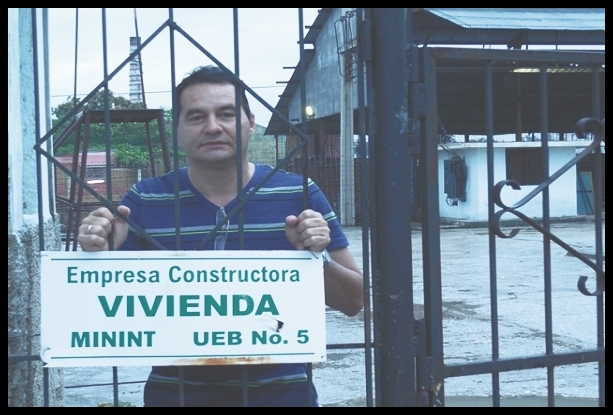
Behind the Scenes of the First of May / Angel Santiesteban

The May Day parade in Cuba

“I have little to lose by going,” I heard him say to a civil worker in the military enterprise where they keep me stowed away. “And I say little because if I lose that, I’ll be up in the air.”

Those who were listening shook their heads in agreement; it was a general fact. “My son studies at the university,” said another. “He has to fake it until he graduates. He even has to be a militant in the Young Communists in order to open doors and be trusted, and when they give him the first opportunity to travel, he will stay.”

There was a poignant silence. “We have to do what we can,” said the first guy. “The little we have is a pittance; we have to care for it more than if we had a lot. I can’t give myself the luxury of losing even a hair.”

“The parade, I’m going to the parade,” said the single man. “I will repudiate…I’m going to scream and kill if it’s necessary. I have to survive.”

Ángel Santiesteban-Prats

Lawton Prison Settlement. April 2014.

Have Amnesty International declare the dissident Cuban Angel Santiesteban a prisoner of conscience.

To sign the petition, follow the link.

Translated by Regina Anavy

7 May 2014

Angel Santiesteban Among the 100 Information Heroes of Reporters without Borders

Angel Santiesteban’s struggle is not in vain.

The more the dictatorship tried to silence him by shutting him away in its miserable concentration camps, his strengths only continued to grow, so that now he is not alone in being recognized for his excellent literary work. The dictatorship established him in world history as one of the umpteen heroes who, like he, set themselves as a model, each minute, each second, in order to fulfill their sacred duty to defend liberty and the rights of all.

continue reading

When an organization of the caliber of Reporters Without Borders, which doesn’t back down one second in its work of protecting those people–famous or unknown, be they journalists by profession or not–who day by day contribute to illuminating the world and giving an account of reality in all its forms, includes Angel on the list of the “100 Heroes” who put their ideals “at the service of the common good” and set the example of courage, then the ruinous intents of all those who tried to convert him into a delinquent “home invader and woman beater” dissolve into nothing, from the dictator Raul Castro through his political police and his “justice,” up to those tiresome colleagues and former “friends,” members of UNEAC (Cuban Writers and Artists Union), and the rest of the fauna out there who swarm to put Angel’s reputation on trial.

What an immense honor to be part of that list of “100 Information Heroes”! How different it is from that list of “the five assassins“!

The writer already had reached international dimension with his award-winning work; now, thanks to the dictatorship, he has attained also the status of defender of liberty, democracy and human rights.

From my humble place as the editor of the blog, happy to return to Angel the voice that they try to stop by imprisoning him, enabling all his posts and denunciations to be published and spread around the entire world, I can do no less than thank immensely Reporters Without Borders for their invaluable support and solidarity that shows every day they support Angel; and Dictator Raul Castro, since without his intervention, none of this would have been possible.

Proudly,

The Editor

Reporters without Borders publishes the list of the “100 Information Heroes.”

Published Tuesday, April 29, 2014.

On the occasion of the World Day of Freedom of the Press 2014, Reporters Without Borders publishes for the first time a list of “100 information heroes.”

Gifted with exemplary courage, these “100 heroes” contribute by their struggle or their work to promoting the freedom, as stated in Article 19 of the Universal Declaration of Human Rights, of “investigating and receiving information and opinions, and disseminating them without limitation of borders, by any medium of expression.” The “100 heroes” put their ideal “at the service of the common good,” and thereby have set an example of courage.

“World Press Freedom Day–whose creation was promoted by Reporters Without Borders–should be the occasion to recognize the courage of these journalists and bloggers who, by their vocation, every day risk their security and on occasion their lives,” said Christophe Deloire, Secretary General of Reporters without Borders. “The ’Heroes of Information’ are a source of inspiration for all the women and men who aspire to freedom. Without their determination and that of all similar people, it simply would not be possible to expand the area of freedom,” he added.

The list of Reporters Without Borders–which naturally is not exhaustive–is a recognition and homage not only to the 100 persons cited, famous or unknown, but also to all the journalists–be they journalists by profession or not–who day by day contribute to illuminating the world and giving an account of reality in all its forms. This initiative has the object of demonstrating that the struggle to defend and promote freedom of information gives intense support to the victims of aggression, but also serves to erect figures who can serve as models.

The list of the “100 Information Heroes” includes women and men of all ages (from 25 to 75 years old) and all nationalities (65 countries). The youngest, Oudom Tat, is Cambodian; the oldest, Muhammed Ziauddin, Pakistani. Iran, Russia, China, Eritrea, Azerbaijan, Mexico and Vietnam are represented by at least three heroes for each one. On the list of the 100 appear such different personalities as Anabel Hernandez, author of a best-seller about the collusion of Mexican politicians with organized crime; Ismail Saymaz, a Turkish journalist who has faced some 20 lawsuits for his reporting; Hassan Ruvakuki, imprisoned for 15 months in Burundi for having reported on rebel movements, and Gerard Ryle, director of the International Consortium of Investigative Journalists, who contributed to the development of global journalistic investigations.

Some journalists perform their work in democratic countries. This is the case with Glenn Greenwald and Laura Poitras, Americans who reveal the massive surveillance of the American and British intelligence services. Others exercise their profession in more authoritarian regimes, like the Iranian journalist Jila Bani Yaghoob. Not all are journalists by profession. The Vietnamese citizen journalist Le Ngoc Thanh also is a Catholic priest. Many of them, like the Italian journalist who specializes in organized crime, Lirio Abbate, has made corruption and criminality in his country his battle horse. That’s the case of Peter John Jaban, a radio operator in Malaysia, who during a long period lived exiled in London; of Serhiy Lechtchenko, a Ukranian investigative journalist, and of the Bulgarian, Assen Yordanov, who often receive death threats. Among those portraits, Reporters without Borders also included activists like Maria Pia Matta, who from the World Association of Community Radio defended for close to ten years the freedom of expression for community radio in Latin America and the Caribbean.

Courage is the common denominator of all these personalities. In Uzbekistan, the authorities didn’t have any doubts about torturing Muhammad Bekjanov to obtain his confessions; the journalist is detained for 15 years. He isn’t receiving medical attention despite suffering from tuberculosis. Eritrea found itself in last place on the World Classification of Press Freedom 2014 of Reporters without Borders; it’s the seventh time it occupies this position. In this country, Dawit Isaac has been in the dungeons of the dictator Isaias Afeworki for 13 years. Mazen Darwish, founder of the Syrian Centre for Media and Freedom of Expression, who received the Prize for Press Freedom 2012 (“Journalist of the Year”) from Reporters without Borders, finds himself imprisoned for more than two years by the regime of Bachar el-Assad.

Translated by Regina Anavy
29 April 2014

The Fake UNEAC Congress / Angel Santiesteban

(Image taken from the Internet)

Once again, the official intellectuals are summoned to “participate” in another Congress of the Union of Writers and Artists of Cuba (UNEAC), to be used as political reaffirmation for the Regime, since they won’t do anything else, the same as on previous occasions.

Some will bleed for their suffering, the officials will pretend to listen, and it will even appear that something will be done in this regard, when the reality is that they will forget the problems, and they will remain only in the memory of those who are present.

The dictatorship, as it always does, will allow the media to publish or televise some sentimental intervention, to make us believe that it has been a space for free debate, and thus hide the hand of censorship that they constantly apply to us.

Those elected know that they would never be able to say what they hide, their true thinking with respect to the dictatorship, and as in a double game, they will also pretend that the first task is to save the culture, when in practice they only save their lifetime stay in power.

Those intellectuals — the majority — entered into the process when they were very young; today they are a litter of oldsters brought to heel who ooze from the wounds made by Fidel Castro and who have overcome profound humiliations: they carried out cynical condemnations and then couldn’t appear physically in society.

I remember when in the “war of the emails” — as a result of some negative characters returning to public view, repressors in the cultural sector in the ’70s — the majority of intellectuals attacked that possibility, and when the government understood that the protest was growing, they ordered the ringmaster, Abel Prieto, to block the bulls, and that they be the ones who watch the affair.

There were hundreds of letters, first nationally and then from every corner of the planet where there was a Cuban who had been harmed by those people. No one ever said that the guiltiest of all was Fidel Castro. They only permitted themselves to judge the people, pure fallen trees that already weren’t of interest to the State, like the comandante Papito Serguera and Luis Pavón, among others.

I dared to say, in my only email that I dedicated to the matter, that we do nothing by condemning the officials who were removed suddenly, when the intellectual author, Fidel Castro, was still in power, that those who they attacked now were no more than repressors, executioners who executed under the orders of the Castro brothers.

Now they had to endure the pretense that they, omnipotent leaders, didn’t know about the purges in the cultural sector, the persecution of homosexuals or artists who shaped some critical revelations in their work. The intellectuals – even in their letters – were not capable of questioning the centers of Military Units to Aid Production (UMAP).

They played their false roles of bulls seated on the steps while they watched the master of the toreros in the ring and the firefighter in the cultural sector, Abel Prieto, manipulate the affair behind closed doors with some conferences, to drain once and for all the spiteful feelings provoked by the constant reactions.

It will be another congress without solid contributions to the cultural process that strengthens the cultural sector.

Ángel Santiesteban-Prats

Lawton Prison Settlement. April 2014.

Please follow the link and sign the petition so that Amnesty International declare the dissident Cuban Angel Santiesteban a prisoner of conscience.

Translated by Regina Anavy
14 April 2014

The Solitude of the Barracks Multiplies My Strengths / Angel Santiesteban

When the 20 convicts who accompany me go out on pass for family reunions, I send them off with the joy that spreads to me from their happy faces. They are barely gone when I plunge myself into literature. Nothing will hurt my exorbitant creation, not even the knowledge that they will deny me the passes I should get according to the Penal Code. They return to violating my rights, now as a prisoner serving a wrongful conviction.

How could I be bored with the quantity of work that awaits me? I remember that night of November 8, 2012, when we were arrested and taken away by the Santiago de Vegas police, after being beaten in front of the police station of Acosta, where we were demonstrating our disagreement with the unjust detention of Antonio Rodiles.

Sharing a cell with the dissident Eugenio Leal, they released me at midnight, but scarcely had I advanced 100 meters when in the darkness of that road–and like a childish game–some seven guards who were waiting for me surged from behind the bushes to announce that I had to return to the cell. I did it happily, since my brothers in struggle remained there, and I felt humiliated at having been the only one to be set free.

Now neither do they notice in me any anxiety, except that which provokes me to want freedom for the prisoners of conscience that today they keep in different prisons throughout the island, the dream of democracy with the disappearance of the totalitarian regime, and free literary creation. Outside of that, nothing drives away my peace.

I am happy in this life because I have learned that I want to struggle even with my fingernails; it’s the way to grapple with the need to comply with our conscience, feelings, family education and patriotic readings.

All that impels me to leave the path of masks with which an artist can live in a dictatorship. I simply ripped up the immorality with which you survive in the Regime, and I decided to renounce everything I had obtained. I presumed a pure honest talent.

Beginning then, of course, I received the answer that totalitarian regimes have for these cases: first the threats, later the direct rebuff, beatings, fractures, censorship, the diabolic mechanism of the “injustice” of the organs of State Security, hidden behind courts that answer to their designs, and, finally, prison.

All that has only served more to multiply all my strengths, hopes, dreams, and my creativity. Now I am more conscious of the need for my country to attain the rights proclaimed by the United Nations in the Universal Declaration of Human Rights, whose Pacts the Regime still hasn’t ratified in spite of having obtained a seat on the Human Rights Council of the United Nations.

The solitude of the barracks is a great stimulus for dedicating myself to writing, and the constant vigilance of the uniforms around me adds to my verve. I know they are beaten because they search for a way to get rid of my power without receiving punishment for their offenses.

Angel Santiesteban-Prats

Lawton Prison Settlement. April 2014.

Have Amnesty International declare the dissident Cuban Angel Santiesteban a prisoner of conscience.  To sign the petition, follow the link.

Translated by Regina Anavy

6 April 2014

Honor for Reporters without Borders / Angel Santiesteban

Dear Christophe Deloire,

Secretary General of Reporters without Borders,

“Honor to those who deserve it,” said our José Martí, anticipating my mother, who inculcated in my education the culture of gratitude.

Many at the start of my imprisonment have stayed at my side in this passage that has lasted more than a year; but Reporters without Borders has been the most outstanding, when, from the beginning, after reading all my proofs presented in the alleged “trial” that they carried out, and later augmented in the Review, they decided to support me without flinching one iota in my defense.

In a personal letter, where I also thanked them for their honest and brave stance, I described to them the feeling that embraces us when, from the darkest cell, behind bars, abused by the henchmen of the dictatorship, we get a sign of encouragement from the organization that you lead, calling on the totalitarian President of State to restore the rights that were taken away.

In my personal case, it provided me this extra strength, after two weeks in the hole on a hunger strike, that made me feel happy for what I do although they advised me and begged that I consider my life first and never choose starvation as a way of struggle.

In spite of the suffering of being deprived of the most valuable thing for a human being, freedom, and of missing our families and the free consumption of art, we feel worthy of such luck, if the state without rights persists in our faces.

I want a country without censorship, and when that happens, we will be living a new political, social and cultural stage, for the Cuba we need to build with the force of everyone. Until then, a grateful hug to you and your work team, especially to the warm and selfless work of Camille Soulier and Lucie Morillon, always attentive to what is happening on our continent with the lamentable regression in the matter of freedom of expression and the persecution of professionals of information, particularly their compromise with Cuban journalists.

All your work is laudable and fundamental for the quest for personal and civic liberties of those of us who humbly wish to contribute a light of truth from the center of total darkness.

Angel Santiesteban Prats

Lawton prison settlement. April 2014.

So that Amnesty International declare the dissident Cuban Angel Santiesteban a prisoner of conscience,  please follow the link to sign the petition.

Translated by Regina Anavy
23 April 2014

The Summer when God Slept: “Novels From the Drawer” Prize Winner reprinted for International Distribution

(Photo courtesy of Neo Club Press)

I have the pleasure to announce that my work, which won the 2013 International Franz Kafka Novels From the Drawer Prize 2013, “The Summer when God Slept,” will be reprinted in coming weeks by Neo Club Editions, an independent publisher located in Miami and directed by the Cuban writer Armando Añel.

Owing to the fact that the original edition, printed in the Czech Republic, according to the rules established for the award, is destined for the Cuban reader on the island, I agreed with Neo Club Editions to make this second edition, which will consist of a greater number of copies, with the idea of reaching what I consider, in addition to Cuba, natural markets for my work: Miami and Spain. The book, furthermore, will be available in ebook format and paperback through Amazon’s channels of international distribution.

Idabell Rosales – president of Neo Club Editions – together with Armando Añel, heads this project so that those of us who are censored and excluded for political reasons from cultural promotion in Cuba can publish our works in freedom and let them be known outside our country.

Thanks to this important and necessary idea, for example, a door has been opened wider to international promotion of the poetry of the writer Rafael Vilches Proenza, a friend enraged by the repression, which already on two occasions threw out works that he had in cultural institutions in Holguín and Santa Clara. The publication of the beautiful poem, “Café Amargo” (“Bitter Coffee”), besides rescuing the work of a writer censured for not bowing to official impositions, is an act of literary justice for one of the most outstanding poets of my generation.

When there’s another reunion on the island to celebrate another Congress of UNEAC in which, same as in the previous ones, no substantial change will happen that hasn’t already been predetermined, because now it’s known that the guild of creators responds only to the interests of the State and thus is converted into a useless and deceptive organization,

I will celebrate – thanks to the project and the generosity of Armando and Idabell – that my novel will be able to be read in the rest of the world, the same as the valuable Cuban literary production of Cuban writers in exile that Neo Club Editions includes in its catalogue.

Angel Santiesteban-Prats

Lawton Prison Settlement, April 2014

Have Amnesty International declare the dissident Cuban Angel Santiesteban a prisoner of conscience.

Translated by Regina Anavy
11 April 2014

Angel Santiesteban’s Work Again Recognized in France

The dictator Raul Castro continues stubbornly to make the world believe that he’s bringing to Cuba an opening that in reality doesn’t exist. He continues being the same dictator as always, violating the rights of all Cubans, submitting them to misery, censoring the press, harassing, beating and imprisoning peaceful opponents.

Angel Santiesteban, unjustly imprisoned, has completed one year after a rigged trial for some crimes that his ex-wife and mother of his son invented together with the political police. They sought to silence his critical voice against the dictatorship, but they have not succeeded. No punishment, beatings or prison itself has made a dent in him.

And by keeping him locked up, the dictator hasn’t prevented his literature from continuing to be recognized in the world, which condemns the injustice against him.

Again in France, this time in Marseille, his book of stories, “Laura in Havana”, published in 2012 by L’Atinoir, will be presented before the public.

Raul Castro continues violating his own law, taking away Angel’s passes that he is supposed to get every sixty days. It doesn’t matter to Angel, because when his companions go to visit their families, he takes even more advantage of the time and the calm to continue writing.

The Editor

A meeting

We invite you to a convivial meeting with Jacques Aubergy and Rasky Beldjoudi, Saturday, April 12, at 5:00 p.m. at the Maison Pour Tous de la Belle de Mai (House For All of the Belle of May).


Jacques Aubergy is a translator, bookseller and publisher. His publishing house, L’Atinoir, publishes authors of noir fiction and Latin American writers.

He will speak to us of his trade, how he chooses his books, and will make us know intimately and with passion some marvels of Latin American literature chosen by him.

He will also present the book, “Laura in Havana,” a collection of ten short stories by Angel Santiesteban-Prats, published by Atinoir.

Angel Santiesteban Prats is one of the greatest Cuban authors, presently in prison after having openly criticized his country’s system. His imprisonment has generated strong support from Reporters Without Borders and the world-wide community of bloggers.

An enthralling book

“The Eleventh Commandment” is a book by Rasky Beldjoudi, a resident of the Belle de Mai.

The name Rasky Beldjoudi will surely mean nothing in particlar to you. You have never noticed him, although it’s very probable that you have already seen him on Caffo Square or perhaps, one day, sitting next to you on bus 32.

However, Rasky is impressive, muscular, and his Belgian accent with a Kabyle (Berber) accent leaves no one indifferent. Since his infancy, Rasky has accumulated difficulties. From scholastic failures to precarious employment, he knew years of struggle and the hell of drugs.

In spite of an uneven road and a life story that is sometimes not very glorious, he succeeded in rising above the circumstances of his life and has just published “The Eleventh Commandment”: an enthralling autobiography, written in a remarkable style, full of humanity, and unbelievably touching.

Nicolás ROMAN BORRE

Saturday, April 12 at 5:00 p.m.

Maison Pour Tous de la Belle de Mai

6 Blvd. Boyer, 13003 Marseille

Free admission

Event organized by Brouettes & Compagnie, the association CIN-CO and the Maison Pour Tous de la Belle de Mai.

Translated by Regina Anavy
4 April 2014

Guille, The Macho Guajiro / Angel Santiesteban

Angel Santiesteban Prats dedicates this article to Guillermo Vidal, to remember the tenth anniversary of his death. He wrote it from the Lawton Prison Settlement for the column “Some Write” from the digital magazine “OtroLunes” (“Another Monday”).

By Angel Santiesteban Prats
It’s always a pleasure to remember Guillermo Vidal.

Sharing with him the adventure of writing has been one of the great rewards that life has offered me. His sympathy, modesty and talent seasoned his conversations. He was a man called to make friends, easy to like, and always persecuted by injustice, since they never could make him bow down. He maintained his literature at a high price, because he didn’t yield even one iota of his level of social criticism.

When they expelled him as a professor from the university, they didn’t even ask how he was going to live or maintain his family. Being despised and marginalized by the government of his territory in Las Tunas, by the demand of the political police, he became himself.

He was part of an intellectual existence that he accepted with stoicism, without complaint, which he endured in solitude and repaid with brilliant writing. That was his revenge.

After treating him like the plague for many years, the government offered a tribute to an official writer, and we agreed to attend if Guille would be among those invited. Once there, in the seat of the Provincial Party, in the same lair as the dictatorship, one of us said publicly that our presence had no other end but to lionize Guillermo Vidal, the most important living writer of Las Tunas, and one of the most important in the country; that it was a way of supporting him and demonstrating our friendship.

The government functionaries and those in charge of culture opened their eyes, surprised by the audacity. Those were the times when we still had not gained some rights that we have now, and where for much less than what is done today, there were immediate reprisals.

What is certain is that on that night and in the following days, we felt like better people and better intellectuals for showing our solidarity with him. Later he let us know that, from that moment, things got better for him. He stopped being banned and persecuted, because the authorities feared his contacts in the country, especially in Havana.

Now that we are on the eve of another congress of UNEAC (National Union of Writers and Artists of Cuba), I remember what happened during the decade of the ’90s. After the vote to name the officers, Professor Ana Cairo, the officer of the Roger Avila Association of Writers, and I counted the votes, and there were a surprising number of artists who voted for Guillermo Vidal.

No one else had as many votes; no one even came close. However, later, when I saw who they elected, I understood that the votes were only a game, because Abel Prieto determined the election. They didn’t give any commission to Guillermo Vidal, not even in his own province. He was cursed, on the list of the marginalized.

When he died, it caused an infinite sadness, impossible to describe. I called the Institute of the Book (ICL), since I knew that they would have transport to take writers who wanted to participate in his burial.

The Taliban Iroel Sanchez, at that time the President of this institution, assured me that the microbus already had seats assigned. Of course, he was lying to me, and I intuited that in his words. Later, those who made the trip in that transport told me that not all the seats were taken.

I regretted very much not being able to say goodbye to him in that last moment. They feared that the truth would come out: that they had condemned him in life by closing all the doors to him that he knew his literature, a stroke of talent, would win. Surely I would have said that.

You can’t talk about Cuban literature at the end of the 20th century without mentioning the genres of the short story and the novel. However, in spite of the human misery that surrounded him, and the material poverty they obliged him to suffer, his genius at being a good Cuban jokester is the first thing that comes to mind when we think about him. That’s how I want to remember him now.

The book fairs in Havana take place in February and almost always coincide with his birthday, the 10th, that all his friends celebrated in harmony. We also celebrated February 14. I have one of his books, presented to me during those days, and I remember the dedication to me that “in spite of it being the day of love (Valentine’s Day), don’t get me wrong, I was a macho, macho guajiro.”

He had a spectacular snore. It almost loosened the nails from the beams and raised the roof. When you approached his room, the first sensation was that there was a roaring lion inside. The result? No one wanted to share a room with him.

Once, late in the night in Ciego de Avila, I met another writer from Las Tunas, Carlos Esquivel, literally crying in the lobby of the hotel because he couldn’t manage to sleep with those snorts.

When I described this scene the next day to Guillermo, he laughed like a naughty child. He asked me to repeat the story so he could continue to amuse himself, and he called for the others to listen to what suffering he was capable of inflicting, unconsciously.

In one of the prizes he won, and there were several, he had the luck to receive dollars. Then we got a telephone call saying that he was a relative of Rockefeller, and that he was ready to share his fortune; thus, he was generous. Certainly, in those few months I didn’t have a cent, and he continued in his material poverty. No one except his friends and spouse could believe him.

At one book fair in Guadalajara he told me that sometimes he had the impression that the government permitted him to leave to see if he stayed and they would get rid of him, and he laughed imagining the faces of the functionaries when they saw him return.

In one of his visits to Havana, he confessed to me how surprised he was because another writer told him that he envied him, and he couldn’t conceive of being anyone to envy, and he laughed. “When I go home from the university, at high noon, the cars pass me and no one gives me a ride, and they leave me wrapped in dust to the point that I stop breathing so I don’t swallow the dust,” he said, and he began to laugh.

Then I told him that I would exchange all that poverty for his books, that I also envied him, and he got serious, and in a respectful tone asked me if I was serious.

Thus he always comes into my memory, ironic as the priest’s pardon after confessing sins, and as sweet as the tamarind that they give the leaders to taste.

This year is the tenth anniversary of his physical disappearance. And every year, in spite of some mediocre political and cultural figures who agree to forget him, the imprint of Guillermo Vidal on Cuban culture overrides frontiers and political regimes. And this is elaborated with the passage of time, which was the only thing he didn’t laugh about. To struggle against time through writing was an exercise on which he bet his life.

Published in OtroLunes.

Please follow the link and sign the petition to have Amnesty International declare the Cuban dissident Angel Santiesteban a prisoner of conscience.
Translated by Regina Anavy

9 April 2014

Angel Santiesteban’s Work Again Recognized in France

The dictator Raul Castro continues stubbornly to make the world believe that he’s bringing to Cuba an opening that in reality doesn’t exist. He continues being the same dictator as always, violating the rights of all Cubans, submitting them to misery, censoring the press, harassing, beating and imprisoning peaceful opponents.

Angel Santiesteban, unjustly imprisoned, has completed one year after a rigged trial for some crimes that his ex-wife and mother of his son invented together with the political police. They sought to silence his critical voice against the dictatorship, but they have not succeeded. No punishment, beatings or prison itself has made a dent in him.

And by keeping him locked up, the dictator hasn’t prevented his literature from continuing to be recognized in the world, which condemns the injustice against him.

Again in France, this time in Marseille, his book of stories, “Laura in Havana”, published in 2012 by L’Atinoir, will be presented before the public.

Raul Castro continues violating his own law, taking away Angel’s passes that he is supposed to get every sixty days. It doesn’t matter to Angel, because when his companions go to visit their families, he takes even more advantage of the time and the calm to continue writing.

The Editor

A meeting

We invite you to a convivial meeting with Jacques Aubergy and Rasky Beldjoudi, Saturday, April 12, at 5:00 p.m. at the Maison Pour Tous de la Belle de Mai (House For All of the Belle of May).

Jacques Aubergy is a translator, bookseller and publisher. His publishing house, L’Atinoir, publishes authors of noir fiction and Latin American writers.

He will speak to us of his trade, how he chooses his books, and will make us know intimately and with passion some marvels of Latin American literature chosen by him.

He will also present the book, “Laura in Havana,” a collection of ten short stories by Angel Santiesteban-Prats, published by Atinoir.

Angel Santiesteban Prats is one of the greatest Cuban authors, presently in prison after having openly criticized his country’s system. His imprisonment has generated strong support from Reporters Without Borders and the world-wide community of bloggers.

An enthralling book

“The Eleventh Commandment” is a book by Rasky Beldjoudi, a resident of the Belle de Mai.

The name Rasky Beldjoudi will surely mean nothing in particlar to you. You have never noticed him, although it’s very probable that you have already seen him on Caffo Square or perhaps, one day, sitting next to you on bus 32.

However, Rasky is impressive, muscular, and his Belgian accent with a Kabyle (Berber) accent leaves no one indifferent. Since his infancy, Rasky has accumulated difficulties. From scholastic failures to precarious employment, he knew years of struggle and the hell of drugs.

In spite of an uneven road and a life story that is sometimes not very glorious, he succeeded in rising above the circumstances of his life and has just published “The Eleventh Commandment”: an enthralling autobiography, written in a remarkable style, full of humanity, and unbelievably touching.

Nicolás ROMAN BORRE

Saturday, April 12 at 5:00 p.m., Maison Pour Tous de la Belle de Mai, 6 Blvd. Boyer, 13003 Marseille

Free admission

Event organized by Brouettes & Compagnie, the association CIN-CO and the Maison Pour Tous de la Belle de Mai.

To sign the petition for Amnesty International to declare Cuban dissident Angel Santiesteban a prisoner of conscience follow the link.


Translated by Regina Anavy

Photophobia / Regina Coyula

According to the still very useful UTEHA dictionary, photophobia is a medical term which means discomfort or pain to the eyes due to light. But the photophobia of my story has nothing to do with medical apprehension, but rather with social apprehension.

More and more I am hearing about people who want to take photos in public places and are told that it’s prohibited. It’s not a matter of taking photos of military units or the movement of troops, no. On a public street, in a pharmacy, in the agro-market, in a maternity hospital, in a night club, a stern employ arrives who threatens the photographer, who, generally, abides by the absurd order.

This paranoia can’t be spontaneous, it has to obey “training passed down”, where behind every camera lens could be hiding, horror!, an independent journalist, which is to say, a CIA agent.

The citizens, of course, say that in order to have legal force, the said prohibition has to be clear and very visible, and be endorsed by a resolution and not by the caprice of an administrator, director or the police.

If there is nothing to hide, why the fear?

 Translated by Regina Anavy

2 April 2014

S.O.S. The Soldiers Are Suffocating Us / Angel Santiesteban

A daring prisoner has revealed to me the intention of high-ranking soldiers to become my enemies. To accomplish this they took away a pass, the most sacred thing for them; then they reduced even more the precarious nutrition. The ration of chicken, which is provided two times a month, has been reduced to one sole occurrence, and what before could be divided by two persons now is shared among three. The acid picadillo has been substituted for the main dish.

The chiefs of the Direction of Prisons, seeing that their pressure has not been effective, have advanced by four hours the schedule for returning from the pass. Before it was at six in the evening; now they stipulated that it be at two. Another gesture of manipulation has been that of the four hours granted for time on the telephone so prisoners can communicate with their families, they have left only one.

The day of access to the pass, they assign work that could be done the following day, with the sole purpose of annoying the prisoners, to increase the ill will against me, since, according to Lieutenant Colonel Eduardo, the head of the penal prosecution, I don’t comply with the schedule and discipline established because the inmates allow me to do it. He asked that they confront me, that they demand I be “re-educated,” so that, once they succeed, they will have privileges returned to them.

Today, payday, their salaries, gained according to contract, have been reduced; that is to say, they can calculate the amount they earned in the month and thus the salary they are owed. However, without explanation, they have been fleeced in the worst style of highway robbery.

I can’t predict how long the prisoners will support this subjugation of their “rights,” in a country where rights don’t exist, especially if people are detained in penitentiaries, where they are persecuted and receive the most inhuman treatment, where the blackmail of the officials is constant, since they control the prisoners’ lives and destinies. Tomorrow, for example, with a single movement of their lips, they can order that those prisoners wake up in Santa Clara, Camaguey or Santiago de Cuba, and thus be removed from their families.

I continue writing my literature in this sabbatical year that the dictatorship has granted me, and I remain standing in the struggle for human rights for all Cubans.

Ángel Santiesteban-Prats

Lawton Prison Settlement. March 2014.

Editor’s Note: The dictatorship continues to systematically violate the rights of Angel Santiesteban, in breach of their own laws. By law he should get a pass for 72 hours every 70 days, in agreement with the prison regimen to which he is submitted. From the second of August 2013 until now, they have “granted” him one single pass at the end of September. That week the rest of the prisoners “enjoyed” a pass of six days, and he was returned to remain alone with the jailers. These punishments that they impose on him don’t scare him. They should realize by now that the more they try to harm him, the more they strengthen him, and they are even collaborating with Cuban literature, which has – for a year – one of the great talents working without pause.

To sign the petition to have Angel Santiesteban declared a prisoner of conscience, please follow the link.

Translated by Regina Anavy

19 March 2014

Signatories Forever, Unredeemed Brownnosers / Angel Santiesteban

The signatures of those artists from the unforgettable book open at UNEAC headquarters match the political calls of the dictatorship to support the execution of minors who tried to emigrate to the United States by hijacking the boat across the bay to the ultramarine village of Regla. Although the passengers declared that they didn’t hurt anyone, they were deceived. They promised them that if they surrendered, nothing would happen. But the next day they were executed after a summary trial.

After that event and the logical international condemnation that it aroused, they looked for accomplices, people who would “give rope,” and just as in the film, “The Man Maisinicu,” they involved more people, besmirching their hands with manure and blood, a recurring combination of a totalitarian regime.

Now these intellectuals are called to sign for a government that assassinates its students. Neither does the fact of protesting violently, if it’s true, justify annihilation. The sad thing is that most of these signatories recognize that it’s an error of the Venezuelan government, in the figure of Nicolas Maduro, ordering repression. Those lives have a cost, of course, and those who continue signing from fear or for personal benefit will be recognized by history as being brownnosers, sycophants of the omnipotent power of the Castro brothers.

Génesis Carmona, estudiante y modelo del estado Carabobo, fue asesinada por un disparo  en la cabeza durante una manifestación opositora

Genesis Carmona, a student and model from Carabobo state, was killed by a shot in the head during an opposition demonstration.

For everyone a little piece of history touches us, and consequently we gain merit or demerit.

Ángel Santiesteban-Prats

Lawton Prison Settlement, March 2014

Please follow the link and sign the petition to have Angel Santiesteban declared a prisoner of conscience by Amnesty International.

 Translated by Regina Anavy

RWB: The Castro Regime Has Developed an Original Model of Control / Angel Santiesteban

Reporters without Borders: Cuba prohibits a free Internet

All content considered “antirevolutionary” is automatically blocked. All information that is published in the media is filtered, according to the criteria of the Party.

Cuba continues preventing the majority of its population from having access to a free (i.e. uncensored) Internet, even though the submarine fiber-optic cable, ALBA-1, coming from Venezuela and the unblocking of some web sites constitute a ray of hope. The Castro regime has developed an original model of control, based on the existence of a local Intranet. Access to the Internet is excessively expensive. The prices are prohibitive. Add to that the omnipresence of the government institutions.

The country’s organ of censorship, the Department of Revolutionary Orientation (DOR), filters all the information that is published in the official communication media, according to the Party’s criteria. They automatically block all content considered “antirevolutionary.” This censorship, that applies not only to the web, it is based on the Penal Code in force that criminalizes “disrespect,” “defamation,” “slander,” “insults,” and “offenses against the authorities, the institutions of the Republic, and the heroes and martyrs of the nation,” among other things.

 The Ministry of Computing and Communications

It was created in the year 2000 with the goal of ensuring respect for the Revolutionary ideology defended by the DOR on the Internet. There is very little information available on the technology that the Cuban authorities employ in terms of censorship. The University of Computer Sciences (UCI), as well as the Telecommunications Company of Cuba (ETECSA) — the national provider of access to the Internet — work with the departments of surveillance and censorship that back up the actions of the Ministry. The blockade of Internet content is carried out by ETECSA.

The year 2011 was marked by certain concessions of the government, like the unblocking of some web sites. This is the case with the sites Desde Cuba and Voces Cubana (From Cuba and Cuban Voices), where numerous opposition blogs are posted, among them Generación Y (Generation Y), whose author is Yoani Sánchez. continue reading

However, the detention of a dozen bloggers and netcitizens at the end of 2012, among them Calixto Ramón Martínez, who was freed seven months after being in prison, counteracted this small advance. Although these interruptions were more sporadic in 2013, it’s accurate to note that the changes in Cuba are millimetric and that the situation remains stagnant.

In 2008, the percentage of connectivity to the Internet was about 1.2 percent of the population. Since then, the number of public points of access to the Internet has increased: According to the authorities, in June 2013, 118 new cyber-salons were inaugurated.

However, the price of connecting continued to be prohibitive: the equivalent to one-third of the average monthly salary of a Cuban (some US $21). The authorities claim that in 2013, four out of ten Cubans accessed the Intranet regularly, which allowed them to read their email, as well as some pages of official sites. According to the independent bureau of information, Hablemos Press, this figure is reduced to two out of 10. It’s possible to get on the Internet in the international hotels, but the usage is reserved for tourists, who can allow themselves to spend US $10 (two weeks of salary for a Cuban, on average).

Furthermore, the connections are surveilled almost systematically. To get on the national network, Cubans must present their identity cards; they surf below the vigilant eye of cameras and the surveillance agents in the cyber-cafes.

Also, the computers are equipped with programs like Avila Link (a link in English), developed in Cuba, that can cut off the connection at the least suspicion of “some violation of the norms of ethical behavior that the Cuban state promotes.” Independent informative Cuban web sites hosted outside Cuba, like Cubanet, Martí Noticias, Cuba Encuentro, Payo Libre and Hablemos Press, are on the black list, and it’s not possible to have access to them, even from the Internet in international hotels.

For a long time the Cuban authorities have attributed the difficulties of connecting to the Internet to the U.S. embargo. However, now that Cuba has the ALBA-1 fiber-optic cable, this argument becomes obsolete and makes it obvious that the authorities want to control the Web, showing their fear of Cubans being able to have free access to the Internet. The use of the high-speed Internet, which is now possible with ALBA-1, is mainly restricted to government officials.

If we believe the official declarations, 2014 should be a good year for accessing the Internet in Cuba. ETECSA forecast that it would begin to install DSL lines at the end of 2014 in zones that have the adequate technology. It’s cruel, but the country lacks infrastructure and the necessary funds to install it. The telephone network is not developed for this type of connection and is under total control of the national service provider, ETECSA. Under these conditions it’s difficult to imagine that the arrival of DSL on the island would have a big impact.

Last January they also announced that Cubans could access the Internet from their mobile phones, thanks to the vigorous entry of a measure that permits telephone bills for users on the island to be paid by people in the Exterior. But the cost of the foreign recharge, more than an opening for Cubans, is an economic strategy to get hard currency into the country.

In spite of this, some analysts observe that there is a tendency toward opening. The informative website Cubanet, based in the U.S., made seven technological predictions for Cuba in 2014. Among them were access to the Internet through mobile phones, the development of WiFi on the island, and even the possibility that the activists could travel outside the island, and acquire knowledge and education in computer science useful for their security online: all this thanks to the immigration and travel reforms that entered into force on January 14, 2013.

 The bloggers, those “mercenaries”

In the report on the “Enemies of the Internet” in 2012, Reporters Without Borders denounced the Cuban propaganda, which “didn’t stop attacking the bloggers who were critical of the regime, whom they accuse of being mercenaries in the service of the ’U.S. Empire’.” The bloggers “have been victims of campaigns to discredit and defame them in the State media, on propaganda sites outside the island, and in blogs like Blogueros y Corresponsales de la Revolución (Bloggers and Correspondents of the Revolution) and Las Razones de Cuba (The Reasons of Cuba).

The cable from the U.S. government — spread by WikiLeaks in 2009 — that suggested that the Regime feared the bloggers more than other types of dissidents, is more real than ever. During her world tour, Yoani Sánchez announced that she would launch a digital daily newspaper in Cuba. “The first day that we do it could be the worst; they could shut it down and attack all of us by blocking us from the web,” she said. “But it could also happen that we are sowing some seeds of a free press,” she added.

By contrast with the obstacles to access the Internet, information passes from hand to hand through USB flash drives. Some also try to create illegal points of access to the Internet. But government agents are in the streets to detect and destroy satellite antennas, so that there are real risks for people who try to have them.

Furthermore, they have positioned antennas to block the signals every five square kilometers. The netcitizens sometimes can use Twitter to send an SMS, without being sure that their messages will appear on Twitter. This microblogging frequently is not detected by the blockades orchestrated by ETECSA, which sometimes last for months.

The bloggers and collaborators of opposition websites like Hablemos Press or Payo Libre, are obliged to turn to certain diplomatic locations in order to publish their writings on websites outside the island.

Others, like the group Martí Noticias, located in Miami, count on correspondents on the island. The purveyors of information found there often are victims of raids in the communication media where they work, or of arbitrary detentions.

Such was the case with Mario Echevarría Driggs, David Ágila Montero, William Cacer Díaz, Denis Noa Martínez and Pablo Morales Marchán, detained for several days in October 2013.

The writer and author of the informative blog, Los hijos que nadie quiso (The Children Nobody Wanted), Ángel Santiesteban, was imprisoned, and his lawyer was suspended, so that she couldn’t practice law in the courts for a period of six months. The blog continues informing us about the situation of Ángel Santiesteban Prats, thanks to the work of activists who collaborate outside Cuba.

, 12 March 2014

Translated by Regina Anavy

13 March 2014

When Freedom Becomes Agony / Angel Santiesteban

“Thank you Fidel, for all you give us…”

Prisoners curse their freedom

Convicts say that when they get a pass for almost 72 hours every 10 days, their worries increase. They experience a major agony in the sense of feeling useless before the economic situation of their families. The little money they earn as slaves of the Regime that keeps them captive barely lets them satisfy the shortages that exist at home. They find their families without food, the children without shoes to go to school, and the electrical appliances broken, among other calamities.

In the first hours at home, already they have exhausted their savings, seeing themselves obligated to loan or offend, with the goal that at the end of their days on pass, their families remain with the minimum of needs guaranteed.

Once back in their beds in prison, they recognize that it’s preferable to be a prisoner, since they suffer less when they don’t have to confront the everyday reality and the constant pain of not knowing how to find a solution, how to stay on top of the poverty, without the familiar temptation of breaking the law.

“At least while we’re in prison we’re not suffering. We don’t see how poor our kids are,” they assert. “And we avoid crime, because we also know that it’s the only possible way to solve things,” says a convict, with whom the rest agree, and he affirms that “it’s preferable to be a prisoner, eat the acid, dirty rice with picadillo, to be beaten and put in a cell each time you feel like venting, than to see your loved ones looking at you like sparrows with open beaks, waiting for us to do a magic act and get some food to fall into them,” he says, and he keeps silent for a bit.

“Outside things have gotten worse. We feel fear when we leave because surely we’ll commit some misdeed,” someone affirms from the door, “and the hard part is to start another more severe sentence,” adds another. “We will never have the chance to be those ’citizens’ they want us to be, because society and the laws forget that we don’t have the least possible chance of surviving without stealing, and if we don’t, we would die of hunger.”

Ángel Santiesteban-Prats

Lawton Prison Settlement, March 2014.

Please follow the link and sign the petition to have the Cuban dissident Angel Santiesteban declared a prisoner of conscience by Amnesty International.

Translated by Regina Anavy

12 March 2014