Cuban Poets: Exile, Prison and Oblivion / Luis Felipe Rojas

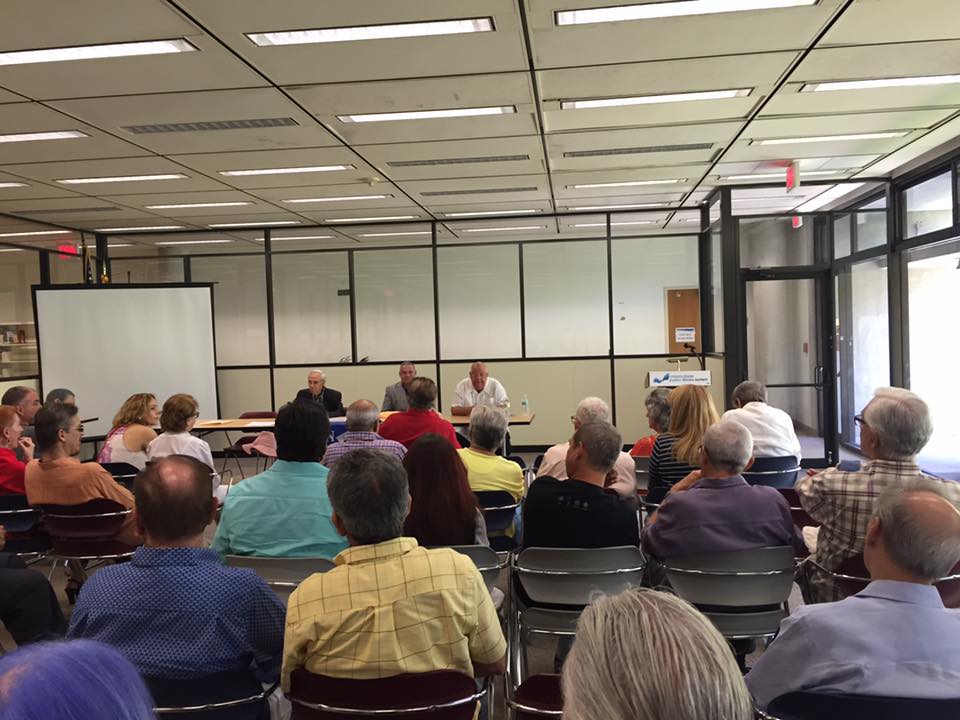
At the front, a panel composed of Ángel Cuadra, Luis De La Paz y José Abreu Felippe (left to right).

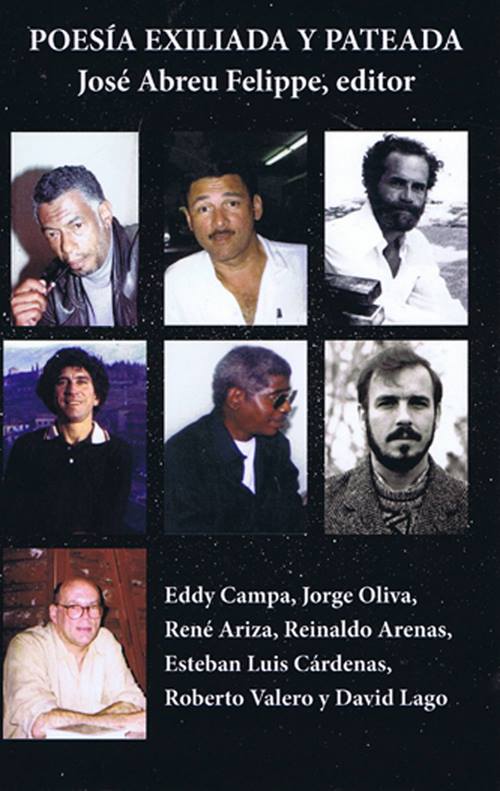
Luis Felipe Rojas, 9 July 2016 — José Abreu Felippe has become a goldsmith. He’s a guy who’s creating a city that will be lost, and he wants to change it into a jewel that we all will carry with us. Poesía exiliada y pateada (Alexandria Library, 2016) collects poems of seven Cuban writers who already have left for other worlds. They are beings with lives twisted by existence itself, and even so, they wrote in verse and kept their fingers on the trigger for generations of readers and writers to come.

They are Eddy CampaEsteban L. CárdenasRoberto ValeroReinaldo ArenasDavid LagoJorge Oliva and René Ariza. Felippe read a poem from each one in the West Dade Regional Library of Miami. There are two routes these bards took: insanity and oblivion, but in both meanings, their transfiguration of reality preserved them for us. The power that they imprinted on their verses has left them a little more beyond the popular imagery. continue reading

“What a well-made trap they have set for us / we who are the mice and the bait / the wall and the point of the sword / the funnel and its narrowest cone,” René Ariza tells us while he practices his actor’s skills, crossing toward eventual liberty or death in a sprint from the port of Mariel in 1980.

Reinaldo Arenas pierced all his narrative with lashes of poetry. Abreu affirmed it today in his presentation at the bookstore: “Rei [sic] was, above everything, a poet. A total poet. Poetry is in all his work.”

Nor is it by far the first or most complete selection of deceased poets in exile. Felippe mentioned the investigation that Felipe Lázaro has done from his headquarters of Betania in Madrid, but each brick put on this wall where we all stop to read helps… a lot.

Here many more are missing, clarifies the journalist and writer, Luis De La Paz: “….too many perhaps — among them the young suicide, Juan Francisco Pulido, and José Mario, founder of the El Puente [The Bridge] group, to mention only two — because in the background all, or almost all, poetry that has been created in exile has been birthed with pain.”

Many more are missing.

The presentation was preceded by the words of the poet and ex-Cuban political prisoner, Ángel Cuadra, President of the PEN Club of Cuban Writers in Exile, as well as by the commentary of the journalist, Luis De La Paz.

Translated by Regina Anavy

Domain Names and an Internet Debate / Regina Coyula

Regina Coyula, 30 June 2016 — For Cubans who update their home entertainment weekly with the now famous, private and anonymous Paquete (Weekly Packet), they are familiar with a subtitle in bright, greenish-yellow letters at the beginning of the movies. This inevitable “http://www.gnula.nu” which comes up so much, piqued my curiosity. It was impossible for me to recognize the country that corresponded to that extension, so I resorted to the always-useful Wikipedia.

Surprise. The country of the pirated movie site that we see at home is Niue, an atoll with airs of a small island, assigned to New Zealand. In 1996, a North American (who doesn’t live in Niue, of course) claimed rights to “.nu” and, in 2003, founded the Internet Society of Niue, which allowed the local authorities to convert the quasi-island into the first wi-fi nation of the world. They supplemented the offer with a free computer for every child. Nothing spectacular; we’re talking about a population of barely 1,300 inhabitants. continue reading

The irony is that the .nu domain generated enormous income, while the inhabitants of Niue not only didn’t enjoy those gains, but also wanted to be connected from their homes and not from the only cyber-café on the island, and they had to pay for the installation and the service.

I also discovered another curiosity. The second extension that is most used on the Internet after .com corresponds to another little place in a corner of the Pacific that few know about, a group of little islands barely 11 square kilometers in size. Tokelau is the name of the place whose domain .tk hatched in 2009, upon offering itself for free. Today it’s the virtual home of hundreds of thousands of websites of doubtful integrity, although, contrary to Niue, the administrative earnings of the island’s government have benefited the infrastructure and services.

The form in which the geographic domains are managed on a higher level (ccTLD) is very different. The Internet Corporation for the Assignment of Names and Numbers (ICANN) has left it to the discretion of each country to do what it likes. Many countries keep them privatized, although in the hands of institutions or businesses created for that purpose, while in others it’s an entity attached to a state agency.

The ccTLDs (country code top-level domains, geographic domains of a higher level, which, for better understanding, is the name that the extensions receive that identify each country or geographic region: .cu for Cuba, .ru for Russia, .mx for Mexico, etc.) are even more curious.

Both forms of operating the ccTLDs described above have advantages and disadvantages. Deregulating the extensions shifts the balance toward the higher-profit businesses to the detriment of agencies, NGOs and institutions with social and cultural goals. This diminishes the influence of the governments, which can have a negative effect on the sovereignty of countries that are economically fragile, or on young or small countries.

State-regulated administration tends to protect social and cultural interests, and successful management can increase earnings, which has a positive impact on national life. It also happens that governmental norms for buying a ccTLD can be restrictive or discriminatory, protected by a deliberatively vague regulation to be applied at the discretion of the government.

In the Latin American environment, Argentina, the only country to offer its site for free and with millions of websites with the extension .ar, decided in 2014 to charge for them. In Chile and Nicaragua, administration is through the public universities. In Guatemala, it is also through a university, but a private one.

In Uruguay, regulation is by the State through the National Association of Telecommunications (ANTEL); in Venezuela by the National Commission on Telecommunications (Conatel); and in Cuba through the Enterprise of Information Technology and Advanced Telematic Services (CITMATEL).

Colombia reflects a debate similar to what is happening in other countries. A private enterprise manages its ccTLD, and 89 percent of the owners of the .co site are foreigners located outside the country which, far from violating the national identity, internationalizes Colombia and carries its trade name to the entire world. What underlies these debates is the idea that the market is imposing itself on cultural values, and national governments can do little in defense of their intangible patrimony.

But in short, who governs the Internet?

Any recently-arrived observer would say that the United States governs it. The institutions and most of the servers destined to organize what would otherwise be chaos are located in its territory. And the well-known ICANN, located in California, which assigns domain names (DNS) to the IP addresses, has a contract with the Government.

Businesses that have a lot of influence on the Internet, like Microsoft, Google or Amazon, are also in the United States. But this concept is changing: It is expected that in September, the process of transition for the custody of IANA, the authority for the assignment of domain names, will no longer be under the U.S. Secretary of Commerce, in order to give ICANN authority and independence.

Other parties that also participate in the Internet have interests opposed to this current asymmetrical influence. International organizations like the Commerce of Intellectual Property (OIC) or the International Union of Communications have been incorporating together with ICANN. Virtual space is modifying the notion of sovereignty, with the added danger for equality and diversity, so that the term “governance” is important in the designing of policies, where governments, civil society, businesses, academics and technical innovators merge.

In the same way in which the technical innovators have guaranteed open access to the Internet from any type of device, it is up to the governance to establish policies, even when they aren’t binding, to guarantee freedom of expression and information, full access to the Internet and limited control.

Translated by Regina Anavy

Havanans Comment on "The Wonder" of Their City / Iván García

“The Wonder” Source: Deviant Art

City of Havana – One of the New7Wonder Cities of the World.

Ivan Garcia, 6 June 2016 — From Miraflores, south of Havana, Sergio comes twice a week with his wheelbarrow to the dump on Calle 100 in Marianao to pick up old junk that he later sells for a few pesos in a traveling fair in the slums of La Víbora.

Among the things he has for sale are a book with a red cover about the external debt signed by Fidel Castro, a crumpled police novel by Daniel Chavarría, three faded blouses, two cut-up pairs of jeans and some carpentry tools. continue reading

The first sale of the day is celebrated with a half-liter of the worst possible alcohol, bought for 10 Cuban pesos at an old bus stop. The dozen ragged men and women who meet every day on the corner of the Plaza Roja have burned all their bridges.

Their skin is an ashy color, their feet have ulcers, and their lost look is caused by the effects of alcohol and poor nutrition. Some carry the HIV virus and, when they get drunk, they mutilate themselves.

Sergio lives in a wooden hovel with a tile roof, surrounded by bags of crushed tin cans and useless refuse. It has no potable water and is lit by a single electric light bulb. He sleeps on a dirty mat and uses a plastic bucket for his “business,” which he later spills into a stinking rivulet in Miraflores, near Los Pinos.

If you ask him for three wishes, he would answer: “To eat hot food, to have enough money to buy a drink and to die soon.” Cubans like Sergio don’t make plans for more than one month. They don’t save money for their daughter’s fifteenth birthday party or something unforeseen. Their future is now.

When he’s asked about Havana, chosen as one of the New7Wonder Cities of the World in December 2014, he thinks you’re pulling his leg. “Havana is a Wonder City? And they say we’re the crazy ones. A place where water is distributed on alternate days, the gunk and dirt are everywhere you look, the people pee and shit anywhere, and transportation is terrible can never be a Wonder City,” comments Sergio.

Against all odds, Magda has been able to remodel her house, buy new furniture and live like God requires, “thanks to the beauty shop I have.” In her house she has modern electric appliances, air conditioning in the three rooms, and every summer she spends a week with her husband and children in a five-star hotel in Varadero.

Although she has café con leche for breakfast and two meals a day, she smiles before offering an appraisal on Havana. “I worked in Foreign Commerce and traveled through half of Europe. Then I visited the United States, and I can assure you that the Cuban capital doesn’t fulfill any parameter that would put it in that category.  The miracle of Havana is that, in spite of the authorities’ apathy and abandonment, it’s still standing,” says Magda.

Diana is an architect and recognizes that the architecture in Havana is distinctive. “But 70 percent of the buildings are very deteriorated. The infrastructure is terrible. And they haven’t found a way to modernize the aqueduct, not even the drains in the low areas. Only in Old Havana do they remodel. It’s a city with an architectural variety that not many cities in the world have. Each neighborhood is different. The vegetation is abundant and looks impressive from the other side of the bay, but it would be very pretentious to categorize it as a Wonder City.”

Joan, a dark, hyperkinetic man from San Leopoldo in the heart of the capital, who lives from what falls off the back of a truck, considers it offensive to have a cultural program June 7 to 11 to celebrate the unusual honor.

“Dude, the role supports everything they put in. It’s hard to swallow this story. I invite those who chose Havana to come spend a few days in my house. There are leaks on all sides. We have to buy water or fill pails from a barrel because it’s been 20 years since water came out of the pipes. What’s fucked up isn’t living so badly: it’s that we can’t see things getting better. The problem is that Cuba is in fashion now, and these awards are part of the package,” Joan points out.

Behind the shabby, unpainted facades, the dirt, the streets full of potholes and leaking water, the beauty of a cosmopolitan, different city can still be perceived. But many people in Havana think that these hidden charms aren’t sufficient to give a prize to the former Villa of San Cristóbal, 97 years after its founding, now that it doesn’t stand up to torrential downpours or hurricane-force winds.

To really evaluate Havana you have to live there. From an air-conditioned car or drinking a beer in the Factoría of the Old Plaza, the city is pure mirage.

Note: In a competition organized for New7Wonders, a Swiss foundation, in December 2014, Havana joined La Paz (Bolivia), Doha (Qatar), Durban (South Africa), Beirut (Lebanon), Vigan (Philippines) and Kuala Lumpur (Malaysia). The official declaration of Havana as a Wonder City of the World was made on June 7, 2016. In 1982, UNESCO declared Old Havana a World Heritage Site.

Translated by Regina Anavy

Why Military Service Should Be Abolished in Cuba / Iván García

Servicio-Militar-_ab-620x330Ivan Garcia, 23 April 2016 — They work as a pair. Raciel, a black man almost six feet tall, with long arms and legs and a pock-marked complexion, is in charge of the fumigation equipment, while Yilsander, a light-skinned, pudgy man, carries a black bag and a clipboard, where he writes down the houses that have already been disinfected in the search ordered by Raúl Castro to minimize the presence of the mosquito that transmits dengue, chikungunya and zika.

Below a torrid sun, the two go house by house in the Havana neighborhood of Víbora. They wear olive-green pants, caps and shirts, the uniform designed by some sadistic tailor who ignored the tropical temperature of the island. And they have on horrifyingly heavy boots with steel tips on the toes. continue reading

Raciel, 19, is sweating buckets, and he smokes a cigarette below the doorway of a shop on Carmen Street, contiguous to the Plaza Roja, in the heart of Víbora. He’s a native of Cienfuegos, 300 kilometers to the southeast of Havana. Yilsander, 20 years old, was born in Mayabeque, a province that was improvised in 2010 by the Regime to prove how effective certain administrative and political transformations were.

“When I got to my unit (a tank unit in Managua, south of the Capital), my feet were full of open blisters,” comments Raciel. “The life of a recruit is very hard. The worst food, abuse from the officials, and they pay us 21 pesos a month.” “It’s shit, brother,” says Yilsander, and he wipes his face with a handkerchief soaked with sweat.

A month ago, 9,000 recruits, low-level officials, officials and police began participating in the fumigation and sanitation of the country. In spite of the heat and the 10-hour days, Raciel and Yilsander prefer this work to the tense sessions on military preparation.

“From six in the morning we have to be marching or training in the heat, with guns that weigh a ton. Or cleaning the tanks, arming and disarming the guns. It’s fucked up, because if Cuba is now friends with the Yankees, they’re not going to invade,” says Yilsander, the more loquacious of the two.

Both agree that Active Military Service, known before as General Military Service or Obligatory Military Service, makes no sense. “Do you know how much money is wasted on taking care of equipment that should be in a museum?” asks Raciel.

Too much money for an economy that is leaking on all sides. According to statistics, there are more than 85,000 armed men and around 6,000,000 men and women between the ages of 17 and 49 available for the armed forces in case of war.

The Revolutionary Armed Forces (FAR) encompasses three armies: western, central and eastern, plus a navy and an air force. Also, a battalion of elite troops and a youth army that performs agricultural and construction work in captive conditions and with ridiculous salaries.

The FAR and MININT (Ministry of the Interior) are the principal tools of social control in Cuba. They manage 75 percent of the national economy. The Council of State and the Politburo, as well as different ministries and first-rate business enterprises are commanded by active or retired soldiers, who have exchanged their olive-green uniforms for white guayaberas.

According to Daniel, an economist, the FAR devours “between 3.8 and 4.0 percent of the GDP. Perhaps more. And it generates expenses of billions of pesos and convertible money into maintaining armaments, military preparation and privileges. A FAR official earns around 1,200 pesos a month and has access to housing, recreation, clothing and food, all subsidized by the State.”

In a survey of 24 young people between 14 to 29 years old, they unanimously prefer abolishing Active Military Service. “Military service in Cuba should be professional and voluntary. Let a solider commit himself for five to ten years and earn a decent salary,” says Diosbel, a baccalaureate student.

For Onel, who is in his second year of studying telecommunications engineering, the disproportionate expense, the emigration from Cuba and the accelerated aging of the population are important elements in favor of designing a new strategy of defense.

“I don’t think it’s worth it to join the army for one or two years, for young people with the sufficient potential to become scientists, engineers, computer programmers. Before the new panorama, the FAR should restructure itself. It should essentially assist the population in the case of disasters or hurricanes. A small, professional armed forces, with no more than 30,000 men, would be the ideal for a country that is getting older, and which is in a permanent economic crisis,” adds Onel.

In the golden years of Fidel Castro’s revolution, the FAR had 1,000,000 men in arms. Cuba, a poor country, in the ’80s, for the first time in its history participated in two civil wars simultaneously in Ethiopia and Angola, sending 50,000 soldiers at its own expense.

“One day of war costs the United States millions of dollars. And Cuba spent 16 years in Angola. I’m convinced that this waste of resources, men and money was the beginning of the Special Period that the country experienced later,” said Daniel, the economist.

When the secret archives of the State pavilion are opened some day, we will be able to know the amount of money squandered on wars outside Cuban borders, on the preparation of foreign guerrilla fighters and on subsidies to Latin America and Africa.

In this twenty-first century, no one wants to attack Cuba. Military service should be abolished.

Translated by Regina Anavy

Prague Happily Infects its Visitors / Dora Leonor Mesa

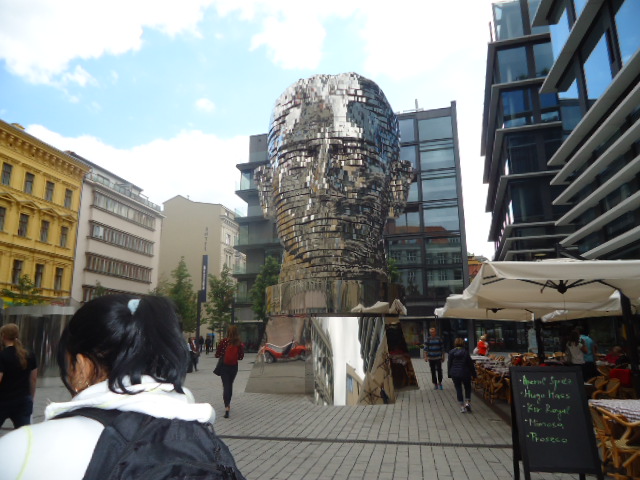
Dora Leonor Mesa, 2 May 2016 — Some years ago I referred to how well Vaclav Havel knew the Cubans. I never imagined that one day I would travel to the capital of the Czech Republic: Prague, the city of 100 towers. My husband always spoke to me with nostalgia for that city which he visited several times during his years as an athlete on the Cuban gymnastics team.

In 2015 I discovered Prague when I went as a delegate to the Forum 2000, an exceptional event dedicated to education and democracy. As scheduled, keeping my promise to the Infant of Prague was among my priorities, and I attended a Mass in his church. Some time ago I wrote a book of poems dedicated to the Infant of Prague that may someday be published. continue reading

The Moldava River is known through the famous Czech composer, Smetana. Kafka’s house formed part of my obligations as a visitor. I live and was born in Cuba, converted in mid-century into an authentic reality show of the famous writer’s work.

I spent 10 very busy days, in which I savored Czech, Hindu and Japanese cuisine (sushi, at last!). I’m not used to drinking beer. Also, it’s expensive in Cuba (at least $1.00 for 330 ml). Sometimes we can’t even pay for our daily food.

Imagine a common Cuban family buying alcoholic beverages! Confidentially, I can say that I always thought the popularity of Czech beer was an exaggeration of alcoholics.

Nonsense! said my insides.

Previously, I had drunk beer in Germany, where the excellence of the beer is part of the national culture. In Prague, almost by chance, I tried a glass of beer. Later I surprised myself by drinking it fearlessly with meals. A gigantic pitcher, one liter or more.

So when I attend some activity or event, no matter where, and I’m offered beer, I try to verify, discreetly, its provenance.

God forgive me if in Cuba I give myself the luxury of wanting to drink only the Cacique and Obama brands. To clarify, Obama beer is really called “President.” There is still no explanation for why the Cuban people changed the name, long before there was talk about Barack Obama’s visit to the island.

To conclude, and seriously analyzing my actual disdain for beer that isn’t Czech, I believe that the Czechs use magic formulas to convert those who drink it into loyal experts. Something like a vaccination against beers that have no class.

At least for me, Prague isn’t only a symbol of marvelous glassware, good clothing and democracy. I now also imagine, with pleasure:

Being in Cuba with a pitcher full of Czech beer!

Translated by Anonymous and Regina Anavy 

Cuban Alternative Journalism: Challenges and Commitments / Iván García

In the homage that the Club of Independent Cuban Writers paid the poet, Rafael Alcides, January 26, 2016, among other independent journalists were Luis Cino (shirt with blue and white stripes), Iván García (dark red shirt) and Jorge Olivera (black jacket), who was a political prisoner during the Black Spring of 2003.

Ivan Garcia, 3 May 2016 — One morning in 1996, the poet and journalist, Raúl Rivero, Director of the press agency Independent Cuba Press, called me at home in Víbora, to ask me to cover the trial of a dissident in a municipal court in Cerro.

The reporter, Ariel de Castro Tapia, (presently living in Turkey) and I were to write up a statement after the judicial ruling and read it on the Radio Martí news broadcast at noon. continue reading

“Improvise, but the news has to go out,” Rivero told me, haltingly. There were many problems. At that time, there were no cell phones or Internet rooms in Cuba, and Twitter and Facebook were the stuff of science fiction.

The trial was attended by agents of State Security. We verified the number of a public telephone from which, although we couldn’t communicate directly with Radio Martí, we were able to establish a point of connection.

We called Rivero so he could inform the broadcasting station, and with the number we gave him Radio Martí communicated with us every half hour. A source inside the trial came out at each break and told us how things were going. A few minutes after the ruling was read, we went on the air with Radio Martí News.

We did all this with only a notebook and a pen. Necessity generates creativity. Like many independent journalists in the ’90s, I took notes by hand and then cleaned them up on an old, Soviet-era typewriter.

Once, a European journalist gave his laptop to Cuba Press as a gift. Raúl Rivero decided that my mother, Tania Quintero, Ariel and I – we all lived near each other in La Víbora – would share it. But the novelty brought us a problem.

At that time, State Security had unleashed a spectacular hunt for computers. Around 10:00 in the morning of June 2, 1997, agents of counterintelligence, commanded by an official who identified himself as Pepín, tore apart the house in search of the laptop.

They didn’t find it. By foresight, we had hidden it somewhere else. We decided to return the laptop to Raúl Rivero and to continue using the typewriter. Once we edited our notes, we read them from a fixed line.

Until Fidel Castro’s raid in March of 2003, when he imprisoned 75 peaceful dissidents, among them 27 reporters, the texts of independent journalists were read by telephone, and collaborators in Miami posted them on websites.

In spite of harassment from the political police, the arrests, acts of repudiation and threats, we wrote from our own perspective about that other Cuba that the regime wanted to hide, without any fuss or pretensions to heroism.

I give this personal anecdote as an example of the fact that you don’t always need sophisticated computer or audiovisual equipment to do journalism in Cuba, one of the worst countries in the world for the profession.

Of course, with good tools and monetary backing, you can do a better journalism, above all, outside Havana. The reality of the capital isn’t the same as that of Villa Clara, Las Tunas or Guantánamo.

But you can do high-quality work with just a few resources. If there is any doubt, just read Periodismo de Barrio (Community Journalism), a project begun by Elaine Díaz, ex-professor of the Faculty of Communication at the University of Havana, who, with a part of the money she received from a scholarship at Harvard, is creating wonderful Cuban journalism.

Today there’s a boom in free journalism. Whatever its bias or format, the independent press is enjoying good health. Havana Times, On Cuba Magazine and El Estornudo (The Sneeze) and El Toque(The Touch) are some examples of alternative media. And several publications specializing in sports, fashion, art and cooking circulate on the Internet, all Made in Cuba.

There is also a more committed journalism, openly anti-Castro, which supports a real democracy, like Primavera Digital (Digital Spring), managed by Juan González Febles and edited by Luis Cino, one the best ungagged journalists. They don’t mince words. They call the Castro Regime a dictatorship, and they don’t turn away from criticizing the dissidence either.

High-style journalism costs money. But the reporters for Primavera Digital stopped receiving money from Switzerland two years ago, and they continue publishing a weekly without one cent coming from the exterior.

Yoani Sánchez administers 14ymedio, a daily whose articles present a balanced point of view. Dagoberto Valdés directs Convivencia (Coexistence) in Pinar del Río. And in almost every province there is some dissident media.

In a parallel manner, audiovisual journalism is taking steps. Ignacio González, Claudio Fuentes and Augusto César San Martín figure among its best exponents.

Ignacio is a man of many talents. Hyperkinetic and creative, he has an online review named En Caliente Prensa Libre (In Caliente Free Press). He has just created a debate program named La Ventana (The Window). And he is thinking about the release of a news website.

There are now more alternative journalists, women and men, who write freely. At the present time, around 300 reporters work for independent media or foreign newspapers.

The quality has improved. Specialists have surged in subjects like economics, history or politics such as Arnaldo Ramos, Orlando Freyre Santana, Osmar Laffita, Miriam Celaya or Dimas Castellanos. Young people like María Matienzo, Yusimí Rodríguez, Marcia Cairo, Ana León, Adriana Zamora, Luz Escobar and Lourdes Gómez perform “street” journalism.

In the sphere of investigation, Elaine Díaz and her group of reporters in Periodismo de Barrio (Community Journalism), and Waldo Fernández Cuenca, author of a book that details how Fidel Castro’s censorship against the press began, do more exhaustive reporting about Cuban society. Others, like Regina Coyula, collaborate with the international media.

There are many challenges and difficulties, mainly from the State, which continues to control the flow of information with an iron hand. The political police still harass and blackmail alternative journalists to keep them from working. Because of these pressures and threats, many have left Cuba, opting for exile.

When you look for the nations with the least freedom of expression on the world map, Cuba is colored red, belonging to the countries with the least press freedom.

Of course the State hasn’t actually killed any journalist. They kill them in another way. They convert them into state reporters, scribes and ventriloquists. Or they try to recruit them as snitches.

Alternative journalism still has some room to maneuver for its growth. We’re always going to be at a technological disadvantage, and we can’t compete with the foreign agencies for “scoops.” Our strength lies in telling stories from another context and showing the variety of opinions that exist on the Island.

One piece of advice for Cuban journalists: Don’t throw away your old typewriter (I still have mine). In an autocracy like Cuba, you never know when you might need it.

Translated by Regina Anavy
MININT Confronts What Could Be Its Worst Challenge: Information Theft / Juan Juan Almeida

Raúl Castro pins the title of Hero of the Cuban Republic on division general Carlos Fernández Gondín.

Juan Juan Almeida, 31 March 2016 — Not so long ago there was a rumor that high officials of MINIT had been arrested by the Ministry. In agreement with those implicated in the event and making a clear allusion comparable to Case No. 1 of 1989 [a highly respected Cuban general was executed for drug trafficking], there was speculation about a new report. But the rumor faded away under a suspicious silence and a potent, air-tight cloak of secrecy.

Theories have flaws, and even the Roman Empire lasted four centuries longer than predicted.

What’s certain is that the Division General, Carlos Fernández Gondín, left his office in the MININT building accompanied by a doctor, after an attack of rage that gave him a stroke and left him hospitalized. continue reading

What could have made him so irritated, or what could be so serious that it could reduce the blood flow of someone who had been capable, without remorse, of ordering the “ready, aim, fire” and, furthermore, justifying it.

A little more than four months after the Army General, Abelardo Colomé Ibarra (alias “Furry”), resigned from the Council of State and as Minister of the Interior, the Ministry faced what could be its biggest challenge: information theft.

What’s certain is that the recent initiate as Minister, Division General Carlos Fernández Gondín, who also holds the “honorable” award as Hero of the Republic of Cuba, left his office accompanied by a doctor, after an attack of fury, which provoked a stroke and left him hospitalized.

The possessor of a sinister countenance, General Gondín is known for keeping himself in the vanguard of the struggle. His principles, as well as his doctrine, begin and end with the word “terror.”

But when he had the new appointment, when he felt part of those who call the shots, a group or an individual, still not identified, entered the warehouse where the ultra-secret rumors are guarded and ransacked a very important data base with privileged information.

What information was stolen? I have no idea! And those who know aren’t talking. However, the Cuban Government has let loose the largest operation ever seen in many years, and, by the aggression of the search, is showing desperation.

Officials of Internal Control, Intelligence, Counter-Intelligence, Military Counter-Intelligence and the Commission of Defense and National Security have been given the task of finding and questioning, completely, without exceptions, those who entered and left the Ministry in question.

And, as all computer networks are fashionable these days, despite assurances that the theft was not the result of any cyber attack, there’s a good group of investigators, working full-time, who are snooping around, with incisive scrupulousness, in the corners of cyperspace.

The fear and reprimand suffered by the sadistic, cowardly, possessed and insecure Gondín, weren’t because he didn’t have copies of the stolen archives, but for the fear and worry of not knowing into whose hands what some consider “delicate information” could fall.

Translated by Regina Anavy

State Security fears a Cuban Snowden / Somos+, Javier Cabrera

Somos+, Javier Cabrera, 1 April 2016 — Yesterday the news came out in various media: Ultra-secret information has been stolen from the Cuban Ministry of the Interior. The poor proclamation “Raúl’s Sovereign Technology” showed itself more focused on censorship of content and limiting communication than on constructing a true plan of security in the service of the nation.

It’s not the first theft of confidential information, although the previous ones were by citizens and not directly by people in the military, like the surveillance videos in Havana or the telephone directory of the state phone company ETECSA. The absurd pledge of reinventing technology has ended up being, as expected, manipulation. continue reading

State Security, formerly considered one of the most efficient bodies, has succumbed to ridicule. The absence of generational relief to conserve jobs and benefits, the government secrecy and the absurd plan of creating technologies that are dedicated only to counteracting the bad reputation of the “Revolution” in the digital world, such as in this blog, have produced fruits, although they aren’t the ones hoped for.

The Internet and technology are not re-inventable. It’s not necessary to adapt technology to Cuba, but for Cuba to enter with full force into technology. It’s not a matter of creating professionals to work in offline businesses, repair computers or traffic in movies, but of forming true leaders in digital businesses that generate quality employment at all levels.

While this change in mentality doesn’t happen, it’s more than probable that this isn’t the only case that scares the analog government of Havana. I’m very curious to know if Raúl will defend the rights of a “Cuban Snowden” when he’s presented to public opinion with the same arguments as the North American analyst.

Mr. President, permit me to welcome you, on behalf of all computer engineers, to the Twenty-First Century.

Translated by Regina Anavy
Cuban Education through the Keyhole / Somos+

Somos+, Amelia Albernas, 26 February 2016 — In my time, professors were proud of being what they were: a living gospel. We students were instructed by them and, furthermore, educated. The values and principles I have are thanks to my parents — one a psychologist and the other a history teacher — and to those teachers who had a true love for their profession.

Sadly, the new generations of Cubans don’t count and won’t be able to count on this. Material deficiencies and — why not? — spiritual ones, also, have wrecked the education that many of us received in past decades. The social and economic deterioration of the country has destroyed educational teaching. The exodus of teachers to other professions with better salaries is a reality that is striking but perfectly understandable. Our teachers lack great commitment, but it’s hard to ask for that commitment if salaries are low. continue reading

So it’s urgent and necessary that a profound change be produced in Cuban society and in the system of government, because a generation of sad, ignorant and lazy people will inherit this island, which José Martí defended with so much impetuous reason*.

It’s because of this that, today, I will share some ideas about what path our social project of Somos + should take in order to stop this disastrous process of demoralization in such an important sector as education. The nation owes an enormous debt to its teachers, and the general opinion is that there should be a more effective way to pay them.

The profession of teaching deserves respect and consideration.

Education, by necessity, should continue to be subsidized; this is an unavoidable principle for every nation and a human right. Apparently it’s not a way to earn money, but only apparently. In reality, school is the beginning of everything. Without an integral and convincing education it’s impossible to count on good professionals and technicians. But it’s to be noted that there should be no indoctrination and, much less, a personality cult of any man.

Education, for most of the dictatorial governments, means trying to direct children in order to reproduce the typical behaviors of the society they represent. For Somos+, education means making creators, inventors and innovators, not conformists. And because we have been and are witness to the enormous loss of values in the young generations that live today in our Cuban society, we champion an education where the maxim is to “drink from all sources, taking as a base the spring of our nationality**.”

Educating for creativity is educating for change and shaping people who are rich in originality, flexibility, future vision, initiative, confidence, risk-taking and readiness to confront the obstacles and problems that are presented to them in their lives as students and in everyday life, in addition to offering them tools for innovation.

Creativity can be developed through the educative process, favoring potentialities and making major use of individual and group resources inside the teaching and learning process.

Continuing with these ideas, we can’t speak of creative education without mentioning the importance of a creative atmosphere that fosters reflective and creative thought in the classroom.

The concept of creative education begins with the approach that creativity is linked to all spheres of human activity and is the product of a determined historical social evolution.

On the other hand, creative education implies a love for change. Creativity must be fostered in an atmosphere of psychological freedom and profound humanism, so that students feel capable of confronting what is new and giving it respect, teaching them to not fear change, but rather to feel at ease with it and enjoy it.

Based on our reasoning for a freer country, we state our principles:

“The best way to defend our rights is to know them; thus we keep faith and strength. Every nation will be unhappy as long as they don’t educate their children. A town of educated men will always be a town of free men. Education is the only way to free oneself from slavery.”

*Martí, José. Complete Works. Volume XVII.

**Taken from Ideas and Principles of the Movement Somos+.

Translated by Regina Anavy

Crisis in Agriculture: Land for Those Who Work It / Dimas Castellanos

By Dimas Castellano, 9 February 2016

Property and crisis

Once the Cuban Government arrived in power, imbued by an exacerbated voluntarism, it ignored the laws that govern the economy and subordinated them to ideology. From this moment on, the loss of the autonomy that is required by economic processes was converted into a factor of poverty.

In 1959, with the first agrarian reform law, the Government handed over property titles to 100,000 farmers but concentrated in its own hands some 40.2 percent of cultivable land. In 1963, with the second agrarian reform law, the 1,000 farms that had more than five horses swelled the fund of State lands, which grew to almost 70 percent.

In 1976, with the objective of decreasing the numbers of small owners, the Government initiated a project of “cooperativization,” through which it created the Cooperatives of Agricultural Production (CPA), thereby raising the share of land that was State property to 75 percent. The result was inefficiency, scarcity of products and high prices, which obliged the Government in 1993 to convert continue reading

a part of unused State land into the Basic Units of Production Cooperative (UBPC), while retaining the property ownership for itself.

Fourteen years later, on July 26, 2007, in his speech in Camagüey, General Raúl Castro recognized the deficiencies, errors and bureaucratic or indolent attitudes reflected in the fields infected with the marabú weed, and he announced the decision to “change everything that should be changed.’

And in 2007, he promulgated Decree Law 259, through which he began the handing over of idle land to private individuals. However, the measure sidestepped the declaration of changing everything that should be changed and was limited to transferring — through a form of leasing known as ’usufruct’, which is the right to use the land without actually owning title to it — a part of the land that the State wasn’t able to make productive. The poor result obtained from this measure did not achieve what was proposed.

Of the 420,000 acres held by the 1,989 existing UBPCs, almost 40 percent remained idle; their expanse, although comprising 27 percent of the agricultural area of the country, produced only 12 percent of the grain, food and vegetables, and 17 percent of the milk, and only 27 percent had satisfactory results. In 2010, 15 percent of the UBPCs closed with losses, and another 6 percent didn’t even submit a balance sheet.

In order to stop the deterioration, in August 2012, the Council of Ministers issued a package of 17 measures and a new General Regulation for the UBPCs that recognized what before had been denied: the capacity to acquire rights and to contract obligations; that is, juridicial personality [a legal term meaning an entity that has a distinct identity, with rights and obligations].

In December 2012, without altering the structure of the property, Decree-Law 300 was substituted for Decree-Law 259. It alleviated some restrictions, but it kept others and implemented new ones. Article 11 said that lands in usufruct could integrate with a State farm with a juridicial personality, to a UBPC or a CPA, for which “the usufruct cedes the right of usufruct over the lands and the improvements to the entity with which it integrates.”

In May, 2013, at the meeting of the Council of Ministers, Marino Murillo Jorge, Vice President of the Council of State, recognized that the measures, which for decades had been put into practice for managing the land, hadn’t led to the necessary growth in production. Finally, in 2014, Decree-Law 300 was modified with Decree-Law 311.

The loss of autonomy — which is to the economy what oxygen is to living bodies — together with voluntarism, the methods of command and control, the centralized planning, the inability of the bosses and administrators, and the diminished interest of the producers, shaped the agricultural inefficiency that has characterized Cuban agriculture for several decades.

The process described shows the impossibility of resolving the crisis in agriculture with the monopoly of State property and leads to the analysis of usufruct and the cooperatives in Cuba.

The cooperatives and usufruct 

As far as cooperatives are concerned, the Declaration of the International Cooperative Alliance (ACI), adopted in 1995, defines cooperatives as autonomous associations of persons who unite voluntarily to cope with their needs and their common economic, social and cultural aspirations, through an enterprise of conjoined and democratically controlled property.

In agreement with this definition, the ones created in Cuba — with the exception of the Cooperatives of Credits and Services, where, although without juridicial personality, the farmers conserved ownership of the land and the means of production — are not classified as such.

The Sugar Cane Cooperatives, created in March 1960 in areas that formerly belonged to private sugar mill owners, almost immediately were converted into State enterprises. The emergence of the CPAs in 1976 with the purpose of reducing, even more, the quantity of land in private hands, was also a State decision. And the UBPCs, organized in 1993, didn’t result from a true socialism but from the crisis in State agriculture.

If the cooperatives in Cuba are created by the will of the State; if the Council of Ministers  regulates them; if the entity that authorizes their constitution is the entity that controls, evaluates their functioning and defines when the “members” can contract with salaried workers; if the activities and tasks that the “partners” can assume are created in places decided by the State and “deal with segments of the market that are not competitive with the State”; and, on top of this, if the State retains ownership over the fundamental means of production, then they are not true cooperatives, but State cooperatives in usufruct.

A convincing proof of this false cooperativism was the report published in the newspaper, Granma, on Friday, January 25, 2013, which announced the decision of the National Association of Small Farmers to replace or remove from their positions 632 presidents of agricultural cooperatives.

For its part, usufruct consists of the use and enjoyment of a good belonging to others. If there had been consistency with the principle of changing everything that should be changed, the idle lands, infected with marabú, would have been handed over to those who work the land.

Nothing justifies making private producers — who have demonstrated they can be efficient — owners in usufruct, and giving ownership to the State, which is responsible for the inefficiency. The question sends us to one of the reasons declared by the 1959 Revolution: to return the land to the farmers. Why now does the land not belong to those who work it?

Neither the State lands, nor the cooperatives created by the State, nor the 17 measures of 2012, nor the successive decrees that handed over land in usufruct have managed to pull Cuban agriculture out of the crisis created by the State monopoly of property.

On the contrary, the crisis has worsened.

Such a result, like it or not, places on the agenda the need for a new reform directed at eliminating the large State land holdings, converting the present owners in usufruct to owners in title and transforming the rest of State property into private property and large cooperative enterprises.

Therefore, what is needed is to determine what are the most effective forms of property in each moment and place for personal and social development, which will make the institution of property a foundation of personal and social order.

Not recognizing this need explains how the administrators of cooperatives can be separated, not by the members, but by a para-State institution like the National Association of Small Farmers, or that the Second Secretary of the Communist Party of Cuba threatens the owners in usufruct with the emphatic declaration: “The land belongs to the State. Without discussion.” The obvious question is: And what is the State going to do with land that it never managed to make productive?

The answer is requires the democratization of economic relations, so that parallel to the State, Cubans participate like subjects with institutionalized rights.

From Diario de Cuba

Translated by Regina Anavy
Discrimination Against the Poor, an Injustice in Present-day Cuba / Juan Juan Almeida

Juan Juan Almeida, 11 January 2016 — Racial and gender designations were fundamental in the dynamics of international politics, basically dominated by white men; but, fortunately, and like the rough action of a Russian-made Aurika washing machine, there are cycles with an expiration date.

Several penal codes in the world sanction racism, homophobia and whatever other ways to exclude human beings; and, disgracefully, there are people and groups that, clinging to outworn concepts, tarnish themselves by raising flags, at least in Cuba, that are shameful and unrestrained. continue reading

It’s clear that bad news is always the most fascinating, and segregation of whatever type is an image that, by being unpleasant, seduces the media and certain politicized groups. But I don’t think that Cubans who live on the island are racist or homophobic; it’s more a matter of being “classist.”

Discrimination, whether racial, sexual, religious, ideological or by social condition, is a phenomenon that came to our hemisphere long before Columbus. Fidel Castro didn’t invent it, nor did the so-called Revolution create it, although, without doubt, in a purposeful moment they used it. This “divide and conquer” stimulated resentment and generated a cruel individuality that, paradoxically, ended up dynamiting the essence of an “egalitarian nation.”

Demonizing wealth had the opposite effect to the one desired by the Revolutionary leaders. It ridiculed the “way of acting that had been established as the way of the proletariat” and created a negative image of the working class. They started to disrespect the sacrifices of the journalist, the soldier, the housewife, the engineer, the builder, the street sweeper and everyone who was working. Thus, the work of those who were able criminals was glorified.

The pyramid inverted itself, and the persistent spectacle of indoctrination saturated everyone. By force of repetition, the echo of the word “discrimination” contaminated all of us and converted us into a transmitter of a thought that, I’m not saying is a lie, but yes, truth was exaggerated so much that today I consider it worthy of study.

It’s true, Cuba is a dictatorship where the consumption of any hallucinogen is better than Raúl Castro for social health. We don’t have a multiparty system, much less a free press, and it’s shameful to see how every day the percentage of the population that finds a solution by fleeing the island is growing. But to say that apartheid and homophobia are growing is a mistake or a very studied manipulation of those who analyze the phenomenon from a single side of society, and identify it as a generality.

It’s a serious fault, I think, the fact of seeing things in a provincial way, clearly biased, and not taking personally our social responsibility; but this appears to be a subject that is as interesting as the problem of mating between a drone and a queen bee.

No one can deny that there exist racists, homophobes and a pack of people who feel superior or with the right to exclude others in Cuba, but this isn’t the majority. It’s a shame that the Communist Party of Cuba (PCC), the National Center of Sexual Education (CENESEX), and even some opposition organizations seem to be pushing strategies that, instead of helping, are stimulating the fracture of Cuban society.

The reality is that today in Cuba, with rare exceptions, Cubans don’t discriminate by black, woman, old, gay nor religious; they discriminate against the poor, and more so when the underdog shares the aforementioned conditions. Without a doubt, the rejection, marginalization and differentiation by social status is frightening.

Translated by Regina Anavy
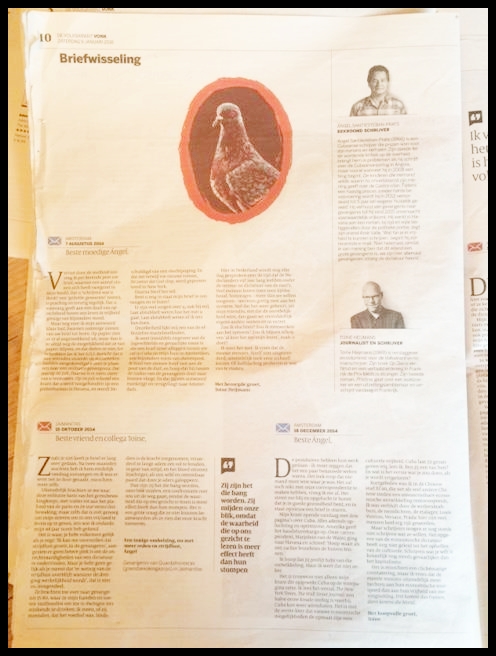
It is Better to Run a Risk than to Shut Up / Angel Santiesteban

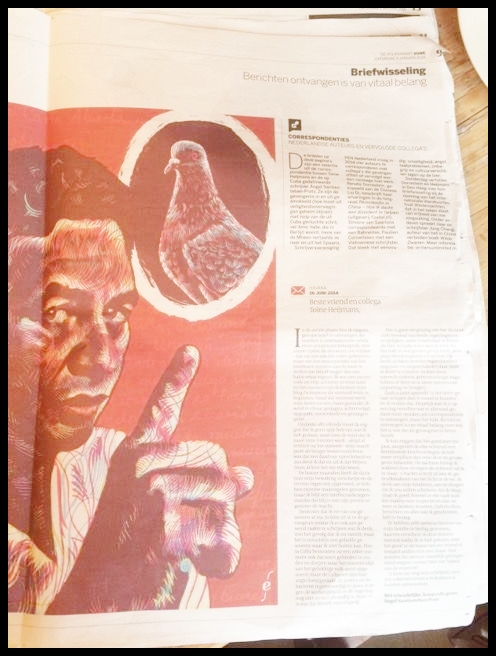
Correspondence between Toine Heijmans and Ángel Santiesteban-Prats

The renown Dutch writer and journalist, Toine Heijmans, a regular columnist for the national Dutch newspaper De Volkskrant, and who sponsored Ángel Santiesteban during his political imprisonment, published the correspondence they maintained during those two and a half years. He has dedicated four pages to it in the prestigious medium. continue reading

We reproduce here the photos of the printed version.

Angel’s Editor, 10 January 2015

Translated by Regina Anavy
Higher Education in Cuba: A Vision (Part 2) / Somos+

Somos+, Rolby Milian, 6 January 2016 — So I begin this second part of my comments remembering the announcement, this past September 6, 7 and 8, through the media of propaganda and creation of the Roundtable excitement, of new “innovative measures” in higher education.

The measures were announced and explained by the Minister himself, Rodolfo Alarcón Ortiz and a government team. It’s worth pointing out, that among other ideas presented by these gentlemen, is the legal reestablishment for the continuing training of professionals, the creation of a new educational level (“non-university higher education”), the requirement of English in order to graduate and the gradual reduction of the length of degree courses to four years.
continue reading

Now, to questions raised with respect to this, they had treasures of linguistic escapism, like: “…these measures are very novel, and right now we can’t exactly explain all the changes they imply….” or “…we still haven’t had meetings to decide how we are going to organize access to the courses.”

What I particularly think is that these measures are a propaganda spectacle about a project that is still in a beginning phase. A typical strategy of the Government to alleviate pressure, deflect attention and pretend that it’s doing something before a crisis of great proportions, like higher education in Cuba (for example, the touted Law of State Businesses, that supposedly will come out in 2017).

From the foregoing I can deduce that right now the Government has no truly solid, concise and intelligent plan to begin solving the multiple problems of higher education in our country.

On the other hand, none of these “measures” match up with the supposed present politics of the Government with respect to the creation of businesses and the increase in private initiatives, in the sense of not mentioning adjustments in the matters of marketing and business management in the related courses of study nor the creation of new disciplines for the training of professionals specializing in this sector (business administration, for example).

With all this it’s difficult not to ask: Are our youth really prepared for a future of economic opening and the creation and development of businesses, with all the logistic and structural support that implies?

My present opinion is no. Youth in Cuba are not ready to efficiently confront an economic opening to the world. Nor does the Government intend to facilitate improvement in the educational system in this sense; in fact, it seems to not even be contemplating this scenario (nor one in which citizens freely participate in any constructive project for the country).

Having arrived at this point, one can look with horror at the future of Cuba, given that the present Government doesn’t offer objective solutions, nor do they listen to proposals that don’t come from their own fiefdom. Which makes me sure that they have no real interest in the education of Cubans. They don’t take it into account or they pretend to ignore reality with respect to the preparation of our professionals, and they ignore the opinions of the student body for creation of their “plans and measures.”

We believe that a packet of emergency measures for the recovery and restructuring of our higher education should be passed, first for the realistic identification of absolutely all the problems, including opinions and proposals from our students.

In addition, there should be no restrictions on absolute freedom of teaching and learning in every one of the institutions and for students, presenting real opportunities for all citizens to have access to higher studies, through an efficient system of vocational training, admission and retention.

Translated by Regina Anavy

Higher education in Cuba: A Vision (Part 1) / Somos+

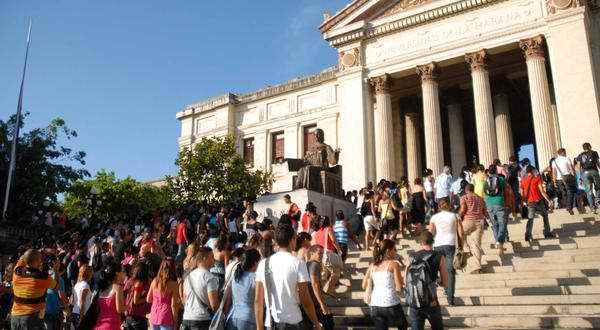
Students at the University of Havana

Somos+, Rolby Milian, 5 January 2016 — Education has always been one of the propaganda bulwarks that the Havana regime has used to sell the image of Cuba as a perfect, paradise society. Like so many others, this has resulted in a lie of gigantic dimensions. But it’s no secret that lately the profound crisis in which the Cuban educational system is plunged has become more and more evident. Fraud, the selling of exams, poor academic results and the critical shortage of professors are some of the reasons that the system of Cuban education, so acclaimed, free and promoted, is in trouble.

Each one of the levels of teaching, by its intrinsic characteristics, suffers decadence in its own way. This time I propose to explain my vision of the problems that presently afflict higher education in our country. Articulating problems and blowing off steam is something that’s been done for more than 50 years; many of us Cubans know very well how to do it — some freely and where they like, and others in the context they consider convenient and comfortable. continue reading

So I’m going to comment similarly about the general proposals that our movement, Somos+, has put forth, for the education reforms, which, we are convinced, will take place when we finally have the freedom to implement a system of informed assessments, with our vision fixed on prosperity for the country and freedom for each citizen.

One of the main problems of higher education in Cuba is that our students can’t gain access to all the information generated in the world about the different subjects of study. They have to learn generally from already out-dated books with retrograde visions and/or prejudiced material, where each paragraph is totally politicized. This fully puts the brakes on the possibility of continually modernizing the study programs, and, of course, it circumvents the professors.

The consequence is that in more than 50 years of isolation, our teaching plans are invalid, and many of our professionals, at the same instant they graduate, aren’t able to compete in the world labor market, which has become more demanding and specialized.

Another visibly problematic situation is the increasing absence of professors able to give classes with the level of excellence that a university requires. The potential recent graduate prefers to look for a way to emigrate (scholarship to study abroad, marriage to a foreigner, jumping on a raft or a flying carpet), and the indices of retention are almost null in the principal faculties. Also, the best professors we once had are now retired, and others have taken the path of emigration or have gone to more profitable jobs: working in hotels or tourism.

These points make it obvious that our educational system needs a radical change; our movement proposes, above all, that education continue to be an inalienable human right of greatest priority, and that the educational process be thought-out in a universal way and that all the information that humanity has generated be put within reach of all students. We reject all the indoctrination, loyalties, myths and personality cults.

For us, education will be a vehicle for the liberation and growth of man, materially as well as spiritually, consumed from all sources, taking as the base the spring of our nationality.

Another question is of the greatest importance: it’s that young people have less motivation to take university courses, which is understandable: for them it means investing five years of their lives in study without earning anything in order to later present their skills in exchange for salaries that don’t even cover basic necessities.

Now, faced with the dichotomy between Engineer or Culinary Worker, our adolescents clearly know that serving in a restaurant brings them closer to their daily bread than does a day designing bridges. Consequently, there has been a considerable reduction in university graduations these last years. This, added to the massive exodus of professionals, is, short of alarming, an urgent call to action for the future of our country.

Our movement proposes, in the interest of minimizing the flight of qualified personnel, that the remuneration for professors be in accord with the importance of education in any society. This is a moral duty of the Nation.

The Cuban Government hasn’t been able to remain blind to the crisis of higher education, and in one of its propaganda strategies, on September 6, 7 and 8 of 2015, it announced a series of “innovative measures.”

In the next post about the subject, I’ll expose the essence of these measures and give my opinion about their effectiveness. I’ll continue to comment on some of the problems and will try to shed a little light on the debate about the preparation of our youth to assume the challenge of bringing clarity and growth to the new Cuba, which we seek, and the need to include them in decisions about the future of education in our country.

Translated by Regina Anavy
Clandestine Fight Clubs are Booming in Cuba / Juan Juan Almeida

Two officers of the People’s Revolutionary Police (PNR) in Cuba in a patrol car.

Juan Juan Almeida, 7 January 2016 — Tired of family conflicts, without a future, restless by today and without a better model for living, clandestine fights become a place where hundreds of Cuban adolescents believe they can fulfill the dream of becoming famous and earning “a lot” of money. It’s a shame that they receive little interest from the State and no sensitivity.

The phenomenon is already part of the underworld, a jungle that seems to combine sports, barbarity and human decadence; something that for the time being can’t be confronted, because it’s impossible to put the brakes on those who have nothing to lose.

A trainer and former member of the Cuban team that participated in the Sydney Olympics explained to me that “with only 5 CUCs (or its equivalent in national money) and the appropriate contacts, anyone can come to those closed and shady places to witness an interesting spectacle. continue reading

“The boxers are young people from the slums who dream of having the money and fame that a professional boxer gets. They’re bored with looking in the mirror of family frustration or of the retired glories of the amateur sport, the national flag having been raised for a gold medal at the Olympics. They don’t have enough money to consume anything, not even in the cheapest makeshift shop.”

“To attend these clandestine coliseums you only have to pay, put yourself on a list and wait; the response arrives by SMS message, which almost always originates from a cell phone with a blocked identity, where they tell you the day, the time, the place and the program.”

The rookies begin charging, depending on whether they win or lose, from 25 to 100 CUC for fights of 4, 6 or 8 rounds, performed in boxing rings built in such an artisanal way that, instead of a ring, they look like cages. And, as in the movies, before starting the fight, the employees register all the bets.

The fighters wear gloves, boxing shorts, mouthpieces and almost never a shirt; and, in spite of looking like outlaws, the support team consists of trainers, ex-martial arts sportsmen, chiropractors, nurses, doctors, sports and health professionals with connections in clinics and hospitals in case of emergency, for any injured boy who needs it.

The PNR (National Revolutionary Police) pursues them.

It’s known that these “illegal circuses,” almost all located in the Havana municipality of Cerro, take place in private gyms and with a business license as “instructor of sports practices,” which, by being designed for a Cuban clientele, would have had to close if they hadn’t struck this vein.

They’re easy to detect, and because of that, there are periods of frequent raids. Although many guess that the earnings from this type of business are impressive, those arrested can’t be indicted because — according to an expert in reliable gossip — it’s not an illegal game but a sports exercise with certain legal guarantees, and there doesn’t exist, as far as I know, a legal description in the penal code that conceptualizes the crime.

Surely the Cuban authorities, moralist and complicated, are thinking about legislation; but the solution is simple and can be found behind that door that still resists opening: authorizing and supporting professional boxing.

Translated by Regina Anavy