Discontent is Growing on the Island / Somos+, Sandy Perez

Somos+, Sandy Pérez, 7 January 2015 — Every day that passes, the Castro dictatorship loses more followers, which was demonstrated in the past elections for delegates to the Municipal Peoples Power Assemblies. The official press supervised by the regime published the results of the polling stations on April 25, in the Juventud Rebelde paper. It’s clear that the figures are made up but, even so, they reflect the growing popular discontent of the now-exhausted Cuban people.

Some 11.22 percent of the electorate didn’t bother to pass through the colleges where they were supposed to vote; that is to say, there are 850,314 people who don’t believe in the political system that has reigned in Cuba since 1959. If you add to that the 343,430 voters who left their ballots blank, and the 372,351 who made them invalid, there are now 1,566,095* non-conformist Cubans, a figure that should worry Castro.

There are several motives for the disinterest showed by the electorate: the very low salaries for workers and pensioners; the lack of housing for young couples and the impossibility of renting, which provokes instability in marriages; the deficiency of the basic basket (ration book) and the low purchasing power.

In the case of young Cubans, most of them are obliged to vote by their parents, who have been indoctrinated since they were little and implant the same fear in their kids. These days you hear things like: “You have to go vote or I’ll be fired from my job!” That’s the sad reality for Cuban youth.

*Translator’s note: The 2013 voting age population in Cuba was reported to be about 8.87 million, with about 8.66 million registered to vote.

Translated by Regina Anavy

Closed Game / Fernando Damaso

Fernando Dámaso, 29 December 2015 — The year 2015 ends, and stagnation seems to have sat squarely on the Cuban authorities. Entrenched in dogma and their absurd demands to the U.S. Government, shielded in the supposed defense of sovereignty and independence, something they forgot when they delivered the country to the Soviets for 32 years, they aren’t moving any political domino tiles, closing the game with the double nine.

The 12th Plenary Session of the Central Committee of the Cuban Communist Party and the work in the commissions, prior to the sessions of the National Assembly, not for the first time repeated the existence of the same problems presented in similar, previous activities, without the appearance of real solutions that would improve the country’s situation or that of its citizens. The talk is of multiple pretenses in all the sectors of production and services, which now form an habitual part of the content of these meetings, where the deputies unanimously approve all agreements without the least disagreement, giving an irrefutable demonstration of totalitarian unity.

The year 2016 is gloomy, with little hope for important changes, at least while the current historical leadership holds power.

Translated by Regina Anavy

A Glance at Cuba in 2015 / Ivan Garcia

Reading_Newspaper_Gerry_Pacher-_ab-620x330Ivan Garcia, 2 January 2016 — Joel Castillo, 19, passed from expectation to frustration in 12 months. After graduating in 2014 in electronics from a technology school south of Havana, he still hasn’t been able to work in his specialty.

“With the reestablishment of diplomatic relations between Cuba and the United States, I thought there would be better options for people. But things remain the same. And I haven’t gotten a job that fits my profile,” says Castillo.

It’s precisely the youngest who are the most disillusioned with the inertia of the olive-green Regime. A government with almost six decades in power and an executive faction whose combined age adds up to more than 300 years should have better policies for its youth. continue reading

Above all, it should take into account that Cuban society is rapidly aging and that in the fiscal year which just finished, in an irregular way, 43,059 compatriots left the Island, an increase of 77 percent in relation to 2014.

Among the irregular emigrants are the terrestrial rafters who, leaving from Ecuador, cross eight countries and different time zones, in order to try to get to the border of the U.S. with Mexico, and those who throw themselves into the sea in precarious embarkations.

If to this quantity we add the more than 20,000 visas for family reunification that the U.S. embassy in Havana grants, in 2015, around 65,000 Cubans abandoned their country in one form or another to go to the U.S.

Other thousands leave for any country. Spain, Germany, Italy, Russia, Alaska, Kazakhstan….Cuba is emptying of young and talented people. In almost all the branches of knowledge, jobs, sports or culture there exists a worrisome deficit.

For many residents on the Island, the future is to “jump the fence.” Ask a Cuban between 15 and 40 years old what his life goal is. Planning an illegal exit or finding a way to emigrate has become a national sport.

Why are Cubans leaving? It’s obvious: The economy continues to be down. It’s not a situation or a period of thin cows. It’s a stationary crisis that has extended for 25 years.

The “Special Period,” that war without the roar of tanks which began in 1990, still hasn’t ended. The inflation is more mundane, but it continues to devour the worker’s salary, and the dual currency is a liability for productivity and economic reasoning.

Economic logic in Cuba is a headache. Whoever works for the State does it eight hours a day, from Monday to Friday, and earns a salary that doesn’t exceed 23 dollars a month. And to have a dignified life, with breakfast and two decent meals, at a minimum you need 250 dollars a month.

Thanks to the taxes, the exaggerated assessments on private entrepreneurs and the poverty wages, the State pays for public health (going downhill) and a highly doctrinaire education.

But no one can repair a house or buy a car. A fundamental repair of a dwelling costs no less than 8,000 dollars. And a Peugeot 508 is worth 300,000 dollars at a State agency. Which is six lifetimes of work for a professional.

With the ration book, every citizen receives monthly, at subsidized prices, seven pounds of rice, 20 ounces of black beans, five pounds of sugar, a pound of chicken and half a pound of soy picadillo. And daily, an insipid bread roll of 80 grams.

These meager rations last for 10 days. The rest of the month you have to take out money and rack your brains. According to the autocrats’ optimistic predictions, in 2015 the Cuban economy grew 4.0 percent, but this growth hasn’t landed on the family table.

On the contrary. Pork, cheese, yogurt, milk, vegetables and fruits went up in price in the State peso markets and in the convertible money shops.

If you have only coffee for breakfast and one hot meal a day, you can understand why more than 65,000 Cubans abandoned their country in 2015. But the economic crisis can’t be summed up by the alimentary arrangement.

Every day life is more uncomfortable. Public transport is a calamity. The streets are torn up, dark and full of water. Garbage accumulates on the corners. Any personal matter occupies several hours or months owing to the lethal bureaucracy.

The hospitals have deteriorated. It’s easier to find a Martian that a medical specialist. In the primary, secondary and high schools, the low quality of teaching is alarming.

The loss of values, family violence, machismo and homophobia are reaching worrisome levels. An important segment of the population barely reads or informs itself. They master around 500 words; when they speak it sounds like they’re barking, and they gesticulate like apes.

They talk by screaming, as if people were deaf, and they listen to loud music. The lack of education has taken root with many Cubans. The most harmful thing isn’t the disorder, the precariousness and the ruins. The worst is living in a nation where you can’t plan for the future.

If you try to change the status quo by political channels, you run risks. Being a dissident in Cuba is illegal. Political parties are prohibited, except the Communist Party, and the institutions of civil society are rigorously controlled by the State.

In 2015, short-term detentions of dissidents multiplied. The beatings of the Ladies in White and peaceful opponents in a park in the neighborhood of Miramar are repeated Sunday after Sunday.

Not even moderate political tendencies are accepted, nor those that flirt with autocracy. Nor alternative press media. The economic and political situations have pushed thousands of Cubans to pack their suitcases and get far away from their country.

Despite the socialized poverty and the lack of freedoms, beginning with December 17, 2014, when Barack Obama and Raúl Castro announced the reestablishment of relations, Cuba became fashionable.

More than 50,000 Americans and famous Anglo-Saxons visited the Island. Among them Conan O’Brien, Rosario Dawson, Paris Hilton, Naomi Campbell, Rihanna, Mick Jagger, Katy Perry, Anne Leibovitz, Frank Gehry, Floyd Mayweather and sports groups from the NBA and the MLB.

Also, representatives from the Democratic and Republican parties, among them Nancy Pelosi, leader of the Democratic minority in the House of Representatives, and delegations of governors from the States of New York, Arkansas, Texas, North Carolina and Missouri, all accompanied by entrepreneurs and businessmen.

The thaw, a much-used work in the international press, has brought to Cuba tourists and people who want to take a selfie in a Havana full of propped-up houses, to ride in an almendron (old American car) and eat in a paladar (private restaurant). Ordinary Cubans see them coming and going. They form part of a thaw that is foreign to them.

Fed up with the hardships and limitations, devoid of hope for a change with the reestablishment of relations between Cuban and the U.S., and noting that in 12 months except for wifi connections in parks and public spaces barely nothing has changed, thousands of Cubans have opted to leave. For any other country.

Iván García

Photo: The photographer, Gerry Pacher, named it “Reading Newspaper,” but of the thousands of images on the Internet that are taken in Havana, we selected it to reflect the decadence of one of the most cosmopolitan cities that existed in the western hemisphere prior to 1959. Taken from the graphic report, “From the Malecón until Ernest Hemingway,” published on Taringa.net.

Translated by Regina Anavy
The Dollar Gains Strength in Cuba / Ivan Garcia

Photo: A branch of Western Union on Obispo Street, Old Havana. According to a manager of this company, 62 percent of Cuban homes receive remittances from the United States. Western Union has offices in 140 of the 158 municipalities in Cuba.

Ivan Garcia, 4 January 2016 — José Manual Cordoví keeps his savings in a rusty cookie tin. He runs a business forging windows, doors and iron in a suburb of low hovels in Arroyo Naranjo, a municipality 40 minutes by car from the heart of Havana.

Cordoví has no relatives or friends who are close to the olive-green mandarins who could give him information. But incessant rumors have encouraged him to change his savings in convertible pesos (CUCs) into U.S. dollars.

“I think that in December or January, those people (the Government) will unify the money and the Cuban convertible will disppear into thin air. They say they’ll respect the money that people have deposited in the bank. But those of us who do business under the table or keep our money under our mattresses could be screwed with a unification of money if it’s accompanied by a depreciation of the CUC,” says José Manuel. continue reading

In Havana, those who have legal or clandestine businesses prefer to bet on the dollar. While the State’s official rate is 87 cents per dollar in face of the convertible peso, people like Obdulio, an illegal jobber, say: “The green bills from 50 to 100 dollars get 95 or 96 cents. I bought others at 93 or 94.”

Every morning, six days a week, Obdulio prowls around the State exchange houses (CADECAs) in hunt of dollars.

“We independent money changers quote a higher price than the Government. Cubans who live in Miami and those who cooperate in Venezuela or Ecuador prefer to sell them to guys like me. Every day I buy 2,000 or 3,000 dollars that I sell later to a buyer at one to one against the chavito (the CUC). Since a month ago, I’ve increased the buying of dollars. Now few want to sell and many want to buy. It seems they smell something in the air,” said Obdulio, seated in a cafe on a central Havana avenue.

Doctors, engineers and sports trainers who render services in Ecuador, Venezuela or Brazil buy important amounts of dollars to get trashy goods, smart phones and home appliances that they later resell on the Island.

Also, occasional “mules” who live in Cuba and travel to the duty-free zone of Colón in Panama or a flea market in Peru or Miami buy dollars by the thousands.

But is there any foundation for the popular intuition of a coming monetary unification and devaluation of the convertible peso (which now is redeemed at one convertible peso for 24 Cuban pesos)? I asked an economist and university professor.

“In 2013, Raúl Castro’s government planned to implement the unification of the two currencies over a term of 18 months. But they haven’t accomplished it. The double monetary system creates distortions in the finances and future business deals with foreign businessmen. There are at least three exchange rates in Cuba. Certain businesses and cooperatives value the CUC at 10 pesos. Others change the CUC at one versus a dollar. And the private businesses and State exchange houses evaluate the CUC at one for 24 or 25 pesos,” says the economist.

And he adds: “Cuban finances are trapped in an unreal bubble. Our two currencies, the Cuban peso (CUP) and the convertible peso (CUC) don’t float on the international exchange market. Their appreciation is artificial, an extremely harmful State policy, since it doesn’t motivate tourists who bring dollars to change a lot of money because of the tax that Fidel Castro placed on the dollar in 2005. The low salaries in Cuba are a brake on the consumer. The unification of the money is not a caprice; it’s a measure that shouldn’t be delayed any more.”

“What could happen when the money is unified?” I asked him.

“There can be three possible scenarios. One: It could cause inflation. Two: And this is already happening, many people would change their savings or find refuge in the dollar due to little confidence in the national currencies. Three: If the unification doesn’t come preceded by a significant devaluation of the convertible peso against the peso, the monetary union would resolve little. They have taken some measures, like issuing bills of high denomination, and sectors like Public Health and ETECSA raising the salaries of their employees. But 1,500 or 1,600 pesos (65 or 70 dollars) continues to be an insignificant salary in proportion to the actual cost of living,” emphasizes the economist.

The expert considers that simultaneously with the monetary unification, they should reduce the inflated mark-ups of up to 300 percent in the State dollar (CUC) stores.

“But the key is in the low productivity which, combined with the laughable salaries, constitute a brake on the consumer, an important base for emerging from the crisis. While there are no transparent norms, a single currency and an exchange rate that is governed by the international standard, growth in the volume of investments and foreign businesses will not be spectacular,” says the university professor.

In such a closed society as Cuba, where a small group of people issue directives, it’s very complicated to know when and how the monetary unification will be carried out.

But there are interesting indications. A recent declaration by the Republican congressman of Illinois, Rodney Davis, accelerated expectations. Davis recently visited the Island on a trade mission, and he declared that Cuban officials informed him that the monetary reform would occur “within a month.”

This past May, Marino Murillo, the obese czar of the Cuban economy, offered some hints at a conference with students at the University of Havana. He told them that at the end of 2015 or the beginning of 2016, the expected monetary unification could happen.

“Don’t ask me what day because I can’t say anything, but keep everything you save in Cuban pesos,” said Murillo.

Although people like the blacksmith, José Manuel Cordoví, prefer to keep their money in dollars.

Iván García

Translated by Regina Anavy

More “Counterrevolutionary” Artists Speak Out For Their Freedom (Part 3) / Angel Santiesteban

Screen capture — A Cuban filmmaker with the black tape of censorship literally covering his mouth.

Ángel Santiesteban-Prats, Havana, 21 December 2015 — In order to complete my personal impression about the G-20* assembly in the Fresa y Chocolate Cultural Film Center this past November 28, I must recognize the solidarity and support of the filmmakers for their colleague, Juan Carlos Cremata, who, through writing, like Enrique Colina among others, showed their disgust and rejection of the assault dealt by the State against the artist, restricting his thinking and his work.

The abuses and injustices committed by the officers and political police have been the last straw for the patience of the unionized filmmakers who — with new verve — have come together with their claims showing that they have matured as people, a society and artists.

The wolf, who for more than half a century has sunk his teeth into the sheep that don’t abide by the rules of the fold, has paused now to wonder why, for the first time, the job of making them submit has been made difficult, and he waits, hoping that they will show some weakness or divide themselves in order to make his job of the bogeyman scaring the children easy.

The dictatorship prefers us to be alone.

I was amazed at the existing cohesion among the constituents of the G-20*, the clarity of their demands, like the Film Law that is indispensable to them in order to continue creating, but, above all, how well disposed they are to continue struggling until they achieve what they demand.

They are not naive, they know that in the eyes of the dictatorship they have been converted into rebels who should be drowned, and if a crack exists, it would be inside one of the columns that integrate the group; and then, beginning with secret conversations with State Security, it would cede before the pressure and would begin to distort, scare, divide and misconstrue the objectives presented from the outset.

Let’s hope that intelligence reigns over fear and serves to save this force that conveys their demands as artists, converts itself into a national necessity and triggers a new pattern in the country’s history.

Their laudable, noble and courageous abilities are the preamble of a new era in which artists recover the dignity that has been lost for more than five decades, letting them be devoured and beaten by the totalitarian Regime for not receiving their punishment.

It is new times, and democracy is the only system possible for any government; now there’s no space for authoritarian regimes (totalitarian) as, for example, Argentina and Venezuela, countries in which the opposition has just won the elections.

Later will come those that are missing, and of course the Castro clan’s dictatorship will have no other option but to cede. With the arrival of freedom, Juan Carlos Cremata and all Cuban artists will recover the cultural spaces that they should not have lost through censorship and prohibitions. Juan Carlos Cremata deserves that space for his talent, strength and commitment.

Let’s hope that without more delay, the Film Law gets approved for the benefit of the seventh art.

Ángel Santiesteban-Prats

Havana, November 2015, under conditional “liberty.”

*Translator’s note: A group of Cuban filmmakers who demand the approval of a Film Law in Cuba. They defend independent production companies. At this meeting they debated censorship and analyzed the case of Juan Carlos Cremata, whose play “The King is Dying” was censored. Cremata was denied the right to stage another play in Cuba.

Translated by Regina Anavy
Nauta vs. Gmail, and the Stupid Strategy / Somos+, Javier Cabrera

Somos+, Javier Cabrera, 30 December 2015 — As a result of the Paris attacks, many governments have put growing pressure on the technology companies to have “backdoors” in order to access users’ information without needing a judicial order. In the U.S., the debate is at its highest point, openly, with the citizens aware of the fight and the technology companies giving their opinions. Such is the case with Apple and others that have announced they won’t deliver users’ data for an increase in security, and the government isn’t taking it easily.

China also is trying to take advantage of the debate, although with a focus a lot more twisted and behind the backs of its citizens, wanting to compel by law all the technology companies to give them whatever information they request, and threatening grave consequences for the economy and the competition. continue reading

Recently the Cuban trolls attacked us in the article, “The Cuban Government is stealing your digital information,” saying that it’s something that happens in the whole world, forgetting the fact that citizens and companies are aware that backdoors have ended. In Cuba, everything is backdoor, since it’s the Government itself that constructs and manages technology security, preventing the development of independent companies and limiting access to the Internet.

There is a gmail.cu with email service. The Government would have to ask Google through a judge for the emails of a specified person, in a range of closed dates, with a formal accusation that wouldn’t be tied to crimes of thought or fabricated. This would limit much of the control they think they now have, and would leave in evidence the methods of State Security.

For that reason, Cuba spends between 3 and 5 million dollars a month, according to conservative estimates, to maintain Nauta.cu as a way of having total access to the correspondence of Cubans. In spite of the large cost, the service suffers “leaks” thanks to poor management. A gmail.cu is perfectly viable today with today’s infrastructure, at zero cost, and with a service that would never drop, break, be interrupted and would cover or exceed the expectations of a public that wants to use more technology. I repeat: It’s completely viable, but as the New York Times says,”It only lacks political will.”

To this we must add that everyone I know in Cuba has an alternative to Nauta for matters where they don’t want the Government sticking its nose in. This strategy limits the real capacity of State Security’s spying but doesn’t lower the cost of Internet services, so desperate people have to use Nauta at moments of urgency. In the real world this is called “competitive barrier and unfair monopoly.”

The Socialist Government Technology is defined in Cuba by the lack of clarity about who has access to your data, the non-existence of defense mechanisms, the lack of transparency in the system, the very high cost and very poor service…with citizens looking for real alternatives to break the control and to show how stupid and unnecessary the whole system is.

We young Cubans must continue to push. We can’t remain indifferent, conforming to what they give and sell us as technology. We are paying for the service; we can make demands. Let’s fight in 2016 for a REAL INTERNET, independent of the Government. We have the right, as does the rest of the world, to discuss our security and to know who has access to our communications. Let’s demand full respect for our privacy and leave it clear that no captain, lieutenant or mercenary of the University of Informatic Sciences (UCI) can give a damn about what we say with our family or friends.

Translated by Regina Anavy

Cuba, One Year After December 17, 2014 / Ivan Garcia

Mujer-en-balcon-y-banderas-620x330

Ivan Garcia, 14 December 2015 — In a basement blackened by humidity and soot, Leonardo Santizo and two workers make cookies, candy and peanut nougat, as a private enterprise.

At the back of the room, piled up in nylon sacks, are hundreds of kilograms of unroasted peanuts, bottles of vegetable oil and all-purpose flour. On a damaged and dirty table, a thermos of recently-made coffee. While they work, they chain-smoke.

“We’ve been on our feet since five in the morning and we work until four in the afternoon. Every day we make 600 cakes, 100 packages of biscuits and 400 tablets of ground peanuts. The average pay is some 400 pesos daily. Sometimes a little more. We sell the cookies and sweets for the most part to private retail businesses,” says Leonardo. continue reading

As in every private business, they apply a double accounting and buy the raw material on the black market. “There’s a balance sheet that is rigged by ONAT (the institution that manages private work in Cuba) and another that they give the business owner, with the real gains and losses. This is the way that all the independent businesses work.”

On December 17, 2014, remembers Leonardo, “The three of us were eating lunch and listening to salsa music on a portable radio when an announcer said that President Raúl Castro would make an important speech.

“We were left without words. After so many years of rattling on about Yankee imperialism, both presidents squared off on their differences. In the afternoon we took up a collection and bought a bottle of aged Havana Club rum, and we began to make plans. We thought that things would get better and we would be able to get raw material from the North. A year has passed and things are still fucked up,” Leonardo confesses.

After drinking a bit of coffee, he continued unloading. “And we can thank God that in one day we earn what a professional earns in a month. I’m not an optimist. Those guys (the Government) don’t intend for people to live better. They want to run all the businesses themselves.”

December 17 was a watershed moment in the national life. It’s hard for Cubans to not remember what they were doing just at noon when the information bomb exploded.

Luis Carlos, a private taxi driver, was driving one of the thousand hybrid autos that circulate in Havana, with a chassis made in the Detroit factories in the 1940s to 1950s, and now rolling with motors and pieces of modern cars.

“Like everyone in Cuba, I believed certain things. I told myself, damn, now the fuckup is over and the idle talk between the Yankees and the Government. That night at home, I thought that soon fast-food restaurants would arrive; they would lower the airfare to Miami and the shops would overflow with food and rubbish from the U.S. One year later, the domino game is still going on,” says Luis Carlos.

If you chat with Cubans who have only coffee for breakfast, this is more or less the register of opinions. In 12 months they have passed from exaggerated expectations to the worst pessimism.

The balance after one year of diplomatic relations and President Obama’s road map to empower the Cuban people and extend the use of new technologies is thin.

There are 40 public plazas where, for two convertible pesos an hour (two days’ salary for a professional), you can have wireless access to the Internet.

There is a contract between the U.S. telecommunications company IDT and ETECSA (Cuba’s telecommunications company). A flurry of famous Americans have visited Cuba and little more.

For the obstruction, because in one year there hasn’t been a larger commercial interchange, the olive-green Regime blames the economic embargo, the military base of Guantánamo, Radio and TV Martí, the Cuban Adjustment Act or any other wildcard.

In those 12 months, the autocracy on the Island has only known how to complain. Or to listen only to proposals about future business with state groups, almost all of them in the orbit of military companies.

The genesis of Plan Obama, to offer a bridge with private entrepreneurs and other Cubans, has been dynamited by Raúl Castro’s government.

It’s no secret that the Island executive has no sympathy for small family businesses. In one of the first sections of the Regime’s economic bible, the so-called Economic Guidelines, it says that the State would not accept the concentration of capital in the hands of individuals.

From here comes the strategy of not permitting Cubans on the Island to invest in their own country or private workers to establish imports or trade with foreign companies.

While private businesses are perceived as nests of criminals, good intentions after December 17 remain only that.

Most Cubans feel prepared for the framework of an economic reform, access to modern capitalism and market economics.

Yohanna, an engineer, was convinced of the benefits of Marxist socialism, and she believed in the utopias of scientific communism. The night before December 17, she was walking on her knees to the entrance of the sanctuary of San Lázaro (Saint Lazarus), south of Havana, to pay a promise to one of the most popular saints in Cuba.

“I asked him that in addition to health he would bless us, since my husband and I had plans to walk to the U.S. by land from Ecuador. The following morning, after hearing the news of the reestablishment of relations, we postponed our plans thinking that things would get better. But seeing the current scenario, the only door that remains open is to emigrate. How and when I don’t know, but I’m convinced that while the same people govern, I have to get out of Cuba,” Yohanna says.

The divide between popular desire and the official narrative is evident. While the optimistic official news tells us that the country is growing, a wide segment of disillusioned Cubans feel trapped in a dead-end street with no way out.

The economy continues leaking, salaries are a joke and having two hot meals a day is an act of prestidigitization. And the Government doesn’t learn.

Iván García

Translated by Regina Anavy

How to Lose Friends / Angel Santiesteban

Angel Santiesteban, Havana, 23 December 2015 — These days I’m immersed in the culmination of my next novel, which I should deliver in February for its possible publication; for this reason, I have dedicated the last two months, in a tireless way, to improving the prose, born from the heat and emotion of the most recent creation. I’ve barely taken time for cultural recreation, repressing — now that it’s possible — going to the theater, movies, ballet, among other spaces of my personal consumption, after having yearned for it for two and a half years, because the dictatorship that considers thinking differently to be dangerous, especially if it involves an artist, decided to send me to prison.

It’s indisputable — and the reason for this post — that I haven’t been able to visit and comply with the demands of some friends, brother masons and political activists, who would like to see me more frequently. continue reading

The rigor with which I apply myself to writing totally absorbs me, to the point that sometimes I lose track of the time that I take up dreaming which I should be using for this final revision; however, some of those important friends are insulted by my absence, thinking I’m distancing myself from their devotion.

Likewise, I’ve received by email complaints from other friends, asking for more warmth from me, which I consider as personal pride; but I’m not lying if I confess to them and explain that when I write short stories, in general, they’re created by a breath, a hit of a chisel that sculpts them with a minimum of blows.

It’s not like that with novels: Then this breath is converted into a persistent state while its realization lasts. I’m possessed for months; an ecstasy keeps me transported to the actual time of the plot in question. It’s the most effective way, particularly for me, to advance and master the characters and their conflicts.

Of course at this rate I’m afraid of being alone and without a social life, and I question whether I work well or badly by remaining isolated, like being expelled from the real world, delivered to the profession of writing.

But what other quality of life could I assume if it’s the only way I know of feeling useful, to breathe in peace, to bring to my dear friends themselves, brother masons and brothers in the struggle, through my texts, that reflection on justice and nobility for the society where we come together? I write for my time, and my spaces of struggle and longings converge: friendship, fraternity and unity in political activism.

Although I appear to be absent, I am, through literature, very close to each one of you and to the national problems that I try to reflect in my books. And very soon — between this writing and the next — I will appear to receive your hugs with the same zeal with which I profess to you that I hold your friendship, in order to then celebrate together a new birth of that literary son that I bring into the world, that I humbly bring to the national culture, our struggle and our shared dreams.

But God makes me lower my head and return every day to ask all of you: If I didn’t have you, then why am I creating literature? For whom would I write?

I wish you a Merry Christmas, although we are aware that it won’t be as we would like while the dictatorship exists.

Big hugs.

Ángel Santiesteban-Prats

Havana, December 2015, under conditional “liberty.”

Translated by Regina Anavy

Padura and the Face of Cultural Context / Angel Santiesteban

Angel Santiesteban, 18 November 2015 — On October 31, in the Museo Napoleónico de La Habana, the book, “The Faces of Padura: Work and Life of a Writer, ” a compilation of texts about Leonardo Padura, was presented. Padura was recently awarded the Princesa de Asturias de las Letras Prize.

At the event, Padura shared the thank-you speech that was read in Oviedo before Spain’s royal family; words that should have been published by the Cuban press. But not only did they not publish them, but also in the official media it was completely ignored that for the first time a Cuban writer was given credit for such a prestigious award. continue reading

This attitude of the Castro press is one more mockery of the Cuban people’s intellect, caused by that “cult of secrecy” so many were talking about in the last Congress of the Union of Journalists of Cuba (UPEC), where it was treated as something from the past, blaming the journalists themselves for unnecessary self-censorship, now that politics is not interfering in the news and its opinions.

Which is to say that suddenly we had overcome the dictatorship and that we found ourselves in a State where there is free thought.

But returning to the question at hand: the book about Padura could have been one more release for the world of the many that the distinguished Cuban writer completed; only this one was special because it happened on his terrain, surrounded by family, friends and his natural readers, and it was delightful because it was presented by colleagues from his generation, among them the writer Francisco López Sacha.

But they couldn’t stop mentioning some irregularities around this event, like the rejection of eight cultural institutions which didn’t celebrate Padura, which is very alarming; of course, behind that was the sinister hairy hand of the Government, which has exhausted without success all its misleading strategies, praising him moderately in order to buy his silence and stop him from telling his truths and offering his critical evaluations about the reality of the Cuban people.

That Leonardo Padura — actually the most distinguished Cuban writer on the international scene — shares his books with readers at home is a deference that makes us grateful; however, that the Regime tries to make him pay the price for not being a writer who kneels before the manipulations of those who direct the cultural politics on the archipelago is an immense immorality, a brutal insensitivity, characteristics that are endemic to Caribbean totalitarianism.

That his books, awards and presentations aren’t promoted as they should be with a National Prize of Literature shows a lack of delicacy and transparency of the cultural politics and the Government, which discredits itself even more (if that’s possible, given the shameful and repeated practice of this and other dirty tricks), ignoring and trying to “invisiblize” a writer who, in spite of not coming out directly against the system, still doesn’t accept gifts or pampering, as do most of the intellectuals and artists on the island.

They at first tried to manipulate him with an open cynicism, through publications, national fairs, a homage in the Casa del las Américas, or with that final power of cultural officials, accepting that a jury award him the National Literature Prize, the greatest award for the work of a Cuban writer residing on the island. But, since Padura didn’t react before such “magnanimous” tokens — because here it’s only important that you have won, not that they decide whether or not you win — now the same cultural officials, who once called themselves his friends, are cold and distant in response.

I also know that the filming of the movies based on his detective novels that have his character Mario Conde as the protagonist, has received negative responses to official requests from foreign filmmakers to use some sets, the same that are used daily to film short police programs for national television.

The dictatorship thus holds a grudge against those who don’t bow their heads, against those who don’t permit the humiliation of being treated like objects, against those who refuse to be manipulated in order to abide by the designs of government power; all because they still try to ignore an irrefutable truth: art expands, endures and always wins against political power.

Ángel Santiesteban-Prats

Havana, November 16, under conditional “liberty” [on parole]

Note from Angel’s editor: The compilation, in the charge of Agustín García, includes his texts, those of Francisco López Sacha, María del Carmen Muzio, Dulce María Sotolongo, Lorenzo Lunar, Rafael Grillo, Michel Encinosa, Enrique Saínz, Rafael Acosta, Rebeca Murga, Elizabeth Mirabal and Gustavo Vega, the filmmaker Lucía López, Leonardo’s wife and one from Padura himself.

Translated by Regina Anavy

No Other Country Has Treated us Like Costa Rica / Ivan Garcia

Sanitarios-de-la-Cruz-Roja-costarricense-atienden-a-una-cubana-_ab-620x330Iván García, Costa Rica, 29 November 2015 — In the last two weeks, the authorities in Costa Rica have been forced to open new shelters to care for the more than 3,000 Cubans trying to reach the U.S. who are stranded on the border with Nicaragua.

Since November 15, thousands of Cubans have been sleeping in temporary shelters because of the decision by Daniel Ortega’s government to deny passage to Cubans, after an outbreak of violence between the Cuban “land rafters” and riot forces from Nicaragua.

In spite of this measure, the number of Cubans arriving in Costa Rica through Panama continues to increase. In general they arrive at night, in groups of 50 or 100 people, in a village named Paso Canoas, more than 600 kilometers south of San José. continue reading

There they stay in hostels that charge between 5 and 50 dollars a night. Those who don’t have money, after being fleeced by coyotes and traffickers in Colombia, sleep on a boarding platform used by interprovincial buses.

The number of Cubans who have entered Costa Rica by Paso Canoas now exceeds 3,000, and it’s said that more than 300 would be waiting in Panama to cross the border. The shelters in the towns of La Cruz, Peñas Blancas and San Ramon are spilling over with emigrants from the Island.

Days earlier, Costa Rican authorities, in cooperation with the Catholic Church in San Ramon, an hour’s drive from San Jose, decided to open another shelter with the capacity of 280 people.

Cubans arriving by bus from Paso Canoas must pay 15 dollars for the ticket. But at least three dozen migrants find themselves sleeping on cardboard on the floor of the bus station. The uncertainty is the biggest worry for the Cubans.

After 2:30 in the afternoon, an Immigration official returned passports to the Cubans who wanted to go to one of the shelters, where the authorities are guaranteeing them three hot meals a day. While some wait in hostels or outdoors for a decision that is out of their hands, others, who now are counting their money in pennies, decided to stay in a shelter set up in the parish of La Pastoral, in the county of San Ramón.

During the six-hour journey, through steep hills and a mountainous landscape crowned by dormant volcanoes, many of the Cubans were snoozing, listening to music on their cell phones or talking with family members in Cuba using the Internet from the telephone lines they access locally.

Halfway there, the bus was stopped at a checkpoint. A Costa Rican policeman reviewed the passports and, in a respectful tone, warned the group not to try to enter Nicaragua illegally.

The other bus stop was at a business on the side of the road. This allowed the immigrants to stretch their legs and look at the merchandise that few could buy because of the high cost.

Around 10:00 at night, local time, the group of Cubans arrived at the hostel. There, some 30 volunteers from the church, the Red Cross and the priest, Gravin Hidalgo, were waiting to take care of them and offer them a dinner (soup, white rice, scrambled eggs, salad, bananas, bread and orange juice). Then they were shown to rooms with four individual beds in each.

According to Father Hidalgo, they “want famlies and groups of friends to stay together.” But the unstoppable influx of Cubans escaping the Castros’ “tropical socialism” worries the Costa Rican pastor.

“We already have more than 280 people here. We’ve had to set up bunk beds in a room to be able to take care of them.” The exquisite treatment and the detail of locating an image of the Virgen de la Caridad, the patron saint of Cuba, brought congratulations on the part of the emigrants.

“Some, moved, have commented to me that they made the crossing with necklaces of the Virgen de la Caridad as amulets. One of the Cubans gave me a stone chosen by him in the Santuario del Cobre, in Santiago de Cuba. A very valuable gift for me. We hope to take care of them the whole time they stay in San Ramón. The civil society of the city, the Church and the authorities are happy to give this help,” the priest pointed out.

But good will can flood humanitarian assistance in a small country, which doesn’t count on an army and has limited financial resources at its disposal.

Meanwhile, in Paso Canoas, Cubans continue arriving.

Iván García, from Costa Rica

Translated by Regina Anavy

My Cable and I. Fiber Optics in My Town? / Somos+


SOMOS+, Frank Rojas Torres, 24 November 2015 — It was October 15, 2015, and a success that should be transcendental for all my compatriots turns out to be nothing more than a false alarm, one more of so many expectations that remains only that. Another promise to be fulfilled in the long-term, only because “the steps taken should be well thought-out in order to not commit errors.”

It’s true that weeks before the news spread by word of mouth, growing or shrinking according to what one brought to it or took from it, showing this writer that we all believed it would be a reality weeks later.

The so-much announced, glorified, dreamed-of and awaited fiber optic cable called ALBA-1 finally made its brilliant entrance onto the terrain of my little country town, opening a passage between the solid rocks that make up its subsoil, pushing us a little more while we try to shorten the tremendous gap, which on this subject as on almost all, separates us from a large part of the outside world. continue reading

And yes, here I was so proud telling people about the immense amount of information that can run through its veins. I became majestic making a show of what it could do and having it rubbed it in my face that in the matters of information and informatization we are, as a good Cuban says, “more backward than the ampalla” (i.e. extremely backward) or light years from even the century in which we live.

I can’t deny that I was inundated with emotion, feeling the privilege of remembering that I’m human.

From Venezuela swam the cable, which would connect us with civilization, with our fellow men, leaving behind the primitive life of ignorant cave-dwellers. Now it seemed I finally would belong to the modern era. I already felt better located in time and space. It made me think about the idea of having nearby the key of traveling “to the infinite and beyond.”

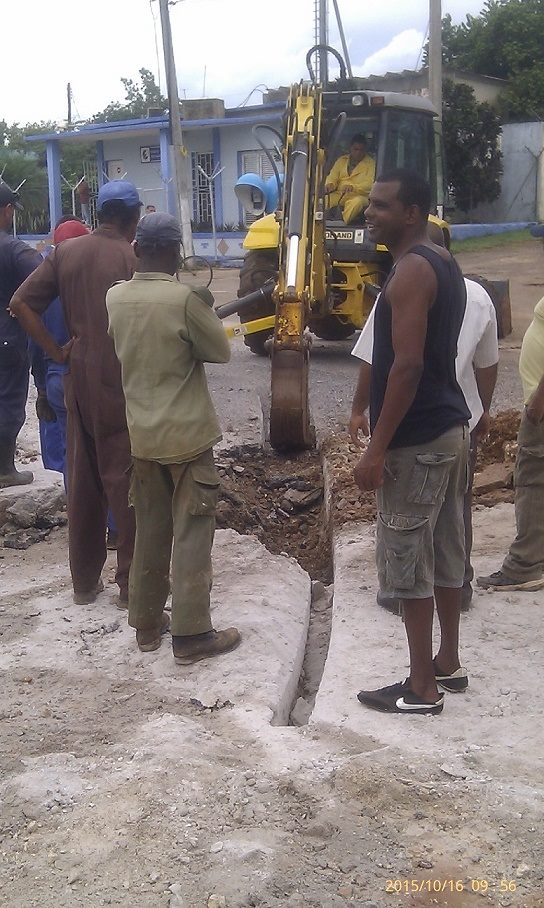
In front of me, the brigade of workers and machinery from the army — something already suspicious, hmmm — charged with creating the conditions pertinent to the good functioning of the new technology, were hard at work opening a trench where the aforementioned cable would extend to the terminals, while the curious — like me — little by little were gathering around the work area, asking questions and exchanging opinions about something that also was novel for them, seeing who could pick out the next stone that they would fling away.

Well, it’s not that I like gossip, but I couldn’t avoid being pushed by curiosity to see up close how they were connecting the cable to the terminals. Who would be the object of the test? Because everything that’s done here is submitted to a meticulous test before using it for more people, to avoid a “false” step. Because of this we function so “well.” Because of this our country is in the “vanguard” of “everything.” We can’t give ourselves the luxury of committing “errors.” We can’t give the “enemy” even the least opportunity to criticize us.

Well, who is our enemy now? Caramba, we have to fabricate another now that the Americans suddenly became our friends. Well, now someone will have to appear who wants to “blockade” us and put us on some black list.

Well, as I was saying, an irresistible force pushed me onto Street 3, to follow “Mr. Cable” as in his time Theseus did, following Ariadne’s thread that was leading him to the exit of the Minotaur’s labyrinth.

While I walk I wonder about who has been chosen for such an experiment. Finally I turn the corner and follow my cable, if indeed it’s mine. At this height and with all the joy that seizes me, I already feel it’s mine, a part of me and my family. Okay, it’s not a guy or a girl, nor will it be in the bakery or the grocery store. It’s logical that it should be in the library. Nor is Frank here.* I miss him, but I follow my cable. Where will it take me?

I almost run into a gentleman on a bicycle while I walk down the street, already connected with my friends, investigating things, looking for information, rediscovering my country and its rich history, especially the one not told, exploring a new world and perhaps finding a new girl to conquer in cyberspace.

I come to another corner and look up to calculate how many more were left before I saw where my cable would be placed, and I finally see its destination. No, it can’t be! This has to be a joke in very poor taste! I almost fall on my ass when, before my thunderstruck eyes, my cable, my friend the cable, like a fish in water, is being hooked up at the PNR (National Revolutionary Police) headquarters.

What was it doing there? It recently had come to my humble little town, and now they were surely warning the cable that it wouldn’t be like we thought, no sir, without first having to pass through this place before entering the life of all of us, because here all is done with “order.” This would be its Customshouse, where surely they would remove from it many things it was bringing to me and my people. I suppose they left the cable very clear about what it could or could not say, and what it could or could not let us see.

I felt newly brutalized and regressed again in time, moving away more and more from my friends and from the enormous universe that minutes before told me it was waiting for me. I was on the point of screaming from so much rage and frustration. I can’t deny that I almost cried.

Soon came to mind the image of a large filter through which would pass the information traffic that would travel in all possible ways through my cable. At once I realized it was an illusion to believe that everything would be so easy beneath this Regime of “total” totalitarianism. My naivety betrayed me at thinking during my detective run that this innovation would come to me just like that. Automatically I began to link together the latest stories about the building where the PNR is located, subjected for a couple of months to changes in its structure and some other remodeling.

Of course, conditions must be created in order to better adapt oneself to the new area of work. I had to change many things so that I felt comfortable with their listening in when I spoke with the “worms**,” my brothers in struggle.

Today is November 7, 2015, and for me it was going to be a big date in my little rural town. It ended up adding to that long list of things that today move me to continue looking for a different Cuba. I continue dreaming, awake, about something that arrived but continued on, like the waiter that passes in front of you with a succulent plate, leaving behind the smell of what you would like to eat but can’t because your money doesn’t stretch far enough to allow yourself that luxury.

Today November 7, 2015, and it’s almost a month since the arrival in the land of Limonar of the fiber optic cable. My buddy, my brother, I remain with the desire to touch you and a strange, bitter taste that reminds me where I am. I still see in the streets the open wounds made by those machines of doubtful origin, now infested with garbage and dirty water as unequivocal marks of a system that only leaves us that: open wounds full of filth.

Today I want to laugh at myself for being so stupid and for having converted this real-life story into one of those scenes from the fairy tale, “Little Red Riding Hood.” In the distribution of roles, the PNR is the wolf that waits for me in bed after swallowing my grandmother – my cable. I am the tender and innocent Little Red Riding Hood, who arrives at her grandmother’s house and sees her in bed with the face of a wolf:

“Yo! Little Red Riding Hood.” “But grandmother, what big ears you have!”

PNR, the wolf: “Ah, the better to hear you with my dear!”

Translator’s notes:
*Reference to a movie about a band leader. 
** “Gusanos” — worms — is one of Fidel Castro’s epithets for people who leave Cuba for the U.S.

Translated by Regina Anavy

A Night in Paso Canoas on the Border with Panama / Ivan Garcia

Cubans at the Panama/Costa Rica border

Ivan Garcia, Costa Rica, 25 November 2015 — When Alex Sigler, 22, landed in the Quito airport in an African heat with thunderclouds that presaged a tropical shower this past November 11, he began his own journey to achieve the American dream.

In five days of passing through the Colombian jungle, Alex encountered hitmen of few words and with twitchy trigger fingers.

“The police, who supposedly are there to preserve citizen order, are the first to rob us. Almost all Cubans have been fleeced at Colombian checkpoints. The coyotes are frightening. They traffic cocaine the same as people. They talk about their criminal exploits like a group of friends in the neighborhood commenting on football and a penalty,” explains Alex, lying on top of some tattered cardboard in an inter-provincial bus terminal in the Costa Rican town of Paso Canoas, a stone’s throw from the border with Panama. continue reading

On the platform about 30 Cubans are sleeping, having been robbed or conned by drug traffickers in Colombia. They have lost everything.

They find themselves without money, waiting for some relative or friend in Miami to urgently spin a few hundred dollars their way so they can pay for the rest of the crossing, if the authorities in Nicaragua will finally let them pass through their territory.

They burned all their bridges. On the Island, they sold everything. Or almost everything. The hazardous journey through eight countries to reach the U.S. is much harder than they thought.

But they’re not sorry. “I was already worn out. In Cuba we’re just a number. People count only for voting in the elections or supporting the Government. Maybe things will be bad for me in la Yuma (the US), but at least I’ll be a free man,” says Alex, who in Caibarién, some 350 kilometers east of Havana, left his wife and a four-month-old daughter.

The village of Paso Canoas is a township of one-story houses and ambulatory stalls where they sell every possible commodity. At night it’s deserted. The more than 300 Cubans who arrive in unstoppable dribbles from Panama have several options at hand for lodging. Those who arrive without a cent sleep in the old Canoas bus terminal.

Others pay five dollars a night, the lowest price for lodging, in a sweltering hostel without windows that is run by Pepe Restoi, a Catalán, who says with two raised hands that he is voting for Catalán independence.

“Man, it’s not that I’m uncaring; obviously I’m aware of the drama of the Cuban emigrants. But I’m a businessman. In Paso Canoas, between hotels and guest houses, there are about twenty. What you have to do is keep your property occupied,” says Restoi in the door of the El Azteca pension.

It would be very pretentious to call “hotels” a chain of houses adapted for guests or enlarged to be rented to the more than 3,125 Cubans who, since November 15, have walked through Paso Canoas.

Prices are expensive for a segment of terrestrial balseros (rafters) who, in tune with the closing of the Nicaraguan border, have to dig out bills and scratch their heads to stretch their money after having spent between three and four thousand dollars on their trip through Ecuador, Colombia and Panama.

“You have to be very farsighted with your money. You have to hide it in unsuspected places so that the Colombian hitmen don’t fleece you. You still have to cross four countries before reaching the U.S., and the dough is going to run out,” says Alfredo Ávila, 28, an electrical engineer who lives in the eastern province of Holguín.

Among the island emigrants there are different hierarchies. Those of extreme poverty are the ones who spend the night on the unpolished cement floor in the bus terminal and, for lack of a bathroom, urinate in a garbage dump site.

“This is hard. The majority eat only once a day. They only have their clothing left from their baggage. On the road, to lighten up, they left their belongings or sold them to be able to eat,” indicates Alex.

Gabriel, a young man who recently left military service in Cuba, says that while crossing Colombia a compatriot had to improvise a fishing rod to be able to eat.

The emigrants who have a more substantial economy spend the night in third- or fourth-class hotels, which in Costa Rica rent at first-class prices. The El Descanso hostel doesn’t calculate how many it’s received. A large grocery store is sometimes a restaurant, a bar and, occasionally, the Cubans who wait to cross the border drink beer without too much moderation.

One night, in a monumentally drunken episode in the swimming pool, some Costa Rican guests were wounded.

“They had to call the police. Many Cubans behaved inappropriately. Particularly those from Havana, who believe they deserve everything. They steal the towels, destroy the electrical outlets and are always complaining, even though the hotel management decided to reduce the tariff for them to nine dollars a night,” says Rey Guzmán, the manager of the El Descanso.

The lack of money has caused several girls to prostitute themselves or ask for money from the ticos (Costa Ricans). “In the Peñas Blancas encampment, two or three girls offered me sex in exchange for 20 dollars. Another asked me for two dollars to buy cigarettes,” says Jorge, a Costa Rican taxi driver.

Past midnight, Yadira, a willowy morena (brown-skinned woman) of 22 years, a native of Las Tunas, some 600 kilometers from the capital, was dancing a Dominican merengue surrounded by a chorus of drunken men who were whistling at her.

“She’s happy. If she’s looking for a man to save her (offer her money) she’ll do well. All the Cubans who are here have had trouble crossing, but for women it’s been worse. I have a friend who was raped seven times in Colombia,” says Magda, a blond who, in Cuba, owned a small manicure business.

Among the wandering emigrants from the Island there are those with sufficient money to stay in the best hotel in Paso Canoas, a two-floor building, painted an ivory color, that rents for 50 dollars a night.

Where are some Cubans getting so much money that they can pay between 10 and 12 thousand dollars in a country with an average salary of 23 dollars/month? I asked the engineer, Alfredo, at the entrance of the El Azteca pension.

“Many sold their car, their house or gold. Others earned money thanks to private business. Or they receive enough money from their relatives in the U.S. But most travel with their own money, which a family member abroad sends them, little by little, after a reunion, so they can come. It’s not recommended to travel with so much cash,” he answers.

Gabriel made an agreement with a sister who lives in Miami. “She offered me a loan and when I get to the U.S. I will pay her back,” he confesses, worried. He has spent the three thousand dollars and is still stranded in Paso Canoas.

Even far from Cuba, not a few emigrants are panicked at the thought of talking before the cameras or answering questions from journalists. “If I talk more, in case they send me back, I wouldn’t even be able to belong to the CDR (Committee for the Defense of the Revolution),” says a shirtless young man in the bus terminal.

On the contrary, a black man with a rugged complexion unloads his frustration, blaming the government of the Castros. “It’s their fault that people have to leave their country. Not even dead will I return.”

That’s the perception of the Cubans stranded in Puerto Canoas. There’s no way back.

Iván García, from Costa Rica

Translated by Regina Anavy

Bucanero-Cristal Exploits Ties to Self-Employed and Palco and Habaguanex Executives / Juan Juan Almeida

Juan Juan Almeida, 24 November 2015 — Just as the proceedings surpassed the scandalous total of 42 people indicted, the General Vice-Prosecutor of the Republic of Cuba, Carlos Raúl Concepción Rangel, imposed a gag order on the case and hid it underneath the trite mantle of “secret character,” because — according to sources in the Prosecutor’s office — he’s expecting the number of those involved to increase.

The investigation filtered down, and some of the people implicated hardened themselves and beat it out of the country. Others are hiding out; there is a border alert for them, and an order of search and capture.

Before such an emergency, and even without finishing the trial, they’re taking the accused out of the investigation center at 100 and Aldabó — the women to the western prison, El Guatao (known as Manto Negro), the men to Valle Grande or the Combinado del Este. The VIP accomplices, owing to their natural status as first-class citizens, were sent home and asked to be “low profile” until their names could be pulled from the file or, at least, their complicity silenced in a case that could paint them as crooks. continue reading

Certainly the population’s complaints will increase due to the absence of the country’s beer in Cuban markets. There hasn’t been any of the national beer available in any restaurant or State establishment, nor in the TRD shops, the so-called Rápidos, or Ditú*.

The Minister of Foreign Trade faces lawsuits from international distributors for frequent non-compliance with contractual commitments.

The litigants claim that there was no delivery of Cristal and Bucanero; but the headquarters, Cervecería Bucanero S.A., says it fulfilled its production plans and satisfied requests without reporting anything stolen or lost.

Everyone’s asking the same question: “Where did that beer mysteriously go, once it left the factory, was paid for and didn’t show up in the State system?”

Indications point in only one direction: the private restaurants, private bars and other establishments of the self-employment initiative.

The investigation started at the end of last August, when a couple of inspectors, as lethal and accurate as good snipers, targeted a truck from Cervecería Bucanero S.A., which each week unloaded merchandise in a private restaurant located on the Pinar del Río-Havana highway.

Inconsistent but true because — although the Government says it’s boosting private initiative and the press repeats the lie and many who are misled believe it — there is a regulation that prohibits the self-employed from buying what they sell privately directly from the companies (whether national or foreign), that is, wholesale; they can only buy goods in ordinary consumer stores or shops.

Ministry of the Interior (MININT forces), as part of the process of compiling data and evidence to document the investigation’s case, and make citizens uncomfortable, are examining the house of one of the managers of the Bucanero warehouse, and — according to the investigative file: “In one room (Fambá’s**), inside a safe, the police confiscated 82,000 CUC and three lists: one with the names of sellers to whom they must pay a commission, another of Palco and Habaguanex officials, and the other with directions for distributing merchandise.”

They’re adding prisoners to the list; the investigation is expanding; and the anger of those organizing the case is growing, even when those implicated find themselves facing an “accomplished fact” with no defense. It’s difficult to imagine, because they managed to use methods of buying and selling that are not even conventional enough to qualify as criminal acts.

The private business owners delivered money to the officers of State companies, Palco and Habaguanex; and the officers issued, to Cervecería Bucanero S.A., a bill of payment (not falsified) with the amount of the merchandise, together with an official order.

Bucanero had to deliver, and it did deliver. So sellers and buyers were violating the regulations, yes, but not the law. And in place of being judged for an act of corruption, they should be awarded for their ingenious solution.

Translator’s notes:
*TRD is the Spanish initials for “Hard Currency Collection Store” — which the regime uses to ’collect’ people’s remittances from abroad by selling them overpriced products not available in Cuban pesos; El Rápido is a fast-food chain; Ditú is a chain of coffee shops.
**In the African-Caribbean religion, Abakua, the Fambá is a room where rituals are performed.

Translated by Regina Anavy

Press Workshop with Raul Rivero / Ivan Garcia

Photo: Raúl Rivero in his house in Havana.

Ivan Garcia, 23 November 2015 — On these hot nights in Havana, when nostalgia, that silent thief that robs you of strength, strikes without warning, Raúl Rivero, the poet, sneaks through my window and offers me a workshop specifically on the latest news from modern journalism.

The art of teaching still doesn’t accept journalistic lectures by telepathy. But I confess that I have grown as a reporter by brushing up on the lessons of the poet from Morón, Ciego de Ávila.

I met him one day before Christmas in 1995. There was an unusual cold spell in Havana. The sun didn’t poke out, and the greyness made the streets simmer with grime. continue reading

Raúl lived with his wife, Blanca Reyes, in an apartment building surrounded by tenements and braced-up houses in the La Victoria district, just in the heart of the capital.

A complicated district. Formerly a zone of pleasure and whorehouses and, after the olive-green Revolution, the cradle of prostitution, drugs and cheating by the deformed “New Man” that Fidel Castro intended to mold.

Spanish is reinvented in La Victoria, sprinkled with jargon that sounds like the Buenos Aires lunfardo. At the foot of the staircase, in the building where Rivero lived, they offer you bath soap and detergent, stolen the night before from the shops in Sabatéss, or a leg of homemade ham.

In that itinerant market, among mothers who gossiped about soap operas and husbands, resided the best living poet in Cuba. I had just turned 30, and journalism wasn’t alien to me.

When I was a kid, my mother — who since 2003 has been living in Switzerland as a political refugee — took me around the whole country while she prepared reports for Bohemia magazine or the Points of View program on national television.

A journalist friend of my mother told us: “That fat guy, Rivero, is organizing an independent press agency. Go there.” On September 23, 1955, the poet founded Cuba Press.

On the day I went to see him, Rivero received me in shorts and without a shirt, smoking one cigarette after another. Absorbed, he heard my proposal and spit out, laconically: “Write something, then we’ll see.”

Cuba Press was pure journalistic abstraction, but it had a marked intent of telling stories in another way. It would be very pretentious to call it a press agency, when the writing took place in a kind of office in the living room of Blanca and Raúl’s house.

There were no computers or teletypes. Only a fixed telephone and an Olivetti Lettera typewriter. There were times when the journalistic texts were read over the phone, and the Internet sounded like a fable.

Cuba Press was a factory for journalists, in particular for those who dreamed of doing it the best — riskier in the case of autocratic countries — in service to the world.

Together with reporters who were disenchanted with State journalism, like Rivero himself, Ana Luisa López Baeza, Iria González Rodiles, Tania Quintero Antúnez, José Rivero García and Ricardo González Alfonso, I learned how to be an independent journalist.

The Black Spring came later, in March 2003. And by Fidel Castro’s express order, 75 peaceful dissidents went to prison. Raúl Rivero was one of them. In 1999, when the Cuban Regime approved a gag law that harshly restricted freedom of expression and condemned whoever violated it to up to 20 years of prison, he wrote an anthology piece, Monologue of the Guilty:

“No one, no law could make me assume the mentality of a gangster or a delinquent because I report the arrest of a dissident or give the prices of basic food products in Cuba, or write an article where I say that it seems a disaster to me that more than 20,000 Cubans go into exile every year to the U.S., and hundreds more are trying to leave to go anywhere. No one can make me feel like a criminal, an enemy agent or unpatriotic by any of those idiocies that the Government uses to degrade and humiliate. I’m only a man who writes. And I write in the country where I was born, and where my great-grandparents were born.”

His imprisonment provoked a resounding international disgust. On April 1, 2005, he went to Madrid with his mother and wife as a political exile from the Castro Regime. One more.

Now Raúl publishes his weekly articles in the daily newspaper El Mundo, and friends say he sleeps with Cuba underneath his pillow.

Over here, on this side of the Malecón, when I get together with Luis Cino, Jorge Olivera and Victor Manuel Domínguez, we remember anecdotes about Rivera (they could fill a book). Or those press workshops that he taught, shooting words at us from an old armchair. And every time, we review his poetry and dissect our newspaper articles.

Some are authentic and masterful for professionals of the word. Read the introduction of this chronicle after the death of Gabo [Gabriel García Márquez]:

“For me the death that hurts is that of Gabriel García, that old reporter from Aracataca who let his mustache grow to resemble the singer, Bienvenido Granda. A man who liked to dream and write novels, clever and generous, who discovered beauty whenever he saw a woman for the first time, treated you to words and to whom life gave all the literary glory of the world — even a Nobel Prize — but let him die without permitting him to write the lyrics of a bolero.”

Or more recently, when in “None appeared to go to Cuba” he says: “None of those famous media people have been to Cuba. That zone in the Caribbean where they were and where others went to stay and photograph isn’t a country. It’s a reality imposed by a group in power who reclaim the money from foreign investment to leave their heirs in the Palace in command of that entelechy.

On November 23, Raúl Rivero will be 70 years old. We, his friends, are going to toast him with a drink of rum. Meanwhile, on an old turntable, we will listen to “Gray Rain,” the Spanish version of “Stormy Weather,” which launched Olga Guillot to fame in 1945.

Iván García

Translated by Regina Anavy

The Stampede Continues / Rebeca Monzo

Rebeca Monzo, 20 November 2015  — One year after initiating conversations to reestablish relations with the U.S., the Cuban Government continues its immobile posture, without taking a step forward.

The raised expectations, with which the immense majority of the Cuban population gave itself illusions, have stagnated, and the stampede of Cubans, most of them young, continues making news in all the foreign newspapers.

A new Mariel Boatlift, but this time by land, is happening. So far this year, the alarming number of national emigrants by different routes and countries, with Miami the final destination, has risen to 43,169, surpassing the massive emigration of 1994. continue reading

The loss of faith in the Cuban Government and the lack of those so-awaited changes have caused a large part of the Cuban people to opt for escape, in search of a better future for them and their families, in other latitudes. Even people who have the privilege of working in successful private establishments, like some private restaurants, realized that the options of expanding and becoming independent, and offering a better education to their children, were each time more unreachable.

Others, still clinging to what they call “change,” for lack of knowledge — for example, being able to travel, buy a car or an apartment, or sell their house —  ignore that these so-called changes are nothing more than the return of some rights usurped by their own government, for which they don’t need to be so grateful.

While a real opening isn’t happening and the Government continues clinging and demanding nothing intelligent, and continues paying wages of poverty to professionals and preventing them from having their own business, everything will continue the same.

This makes me think that really they don’t want change that would make their ancient governmental structure totter, or the irremediable loss of power, which would cause the failure of their politics to be discovered.

As long as the higher-ups don’t have the courage to renounce and admit their own errors, and continue to entrench themselves behind demands and absurd accusations directed at our neighbor to the north, the migratory stampede will be unstoppable.

Translated by Regina Anavy