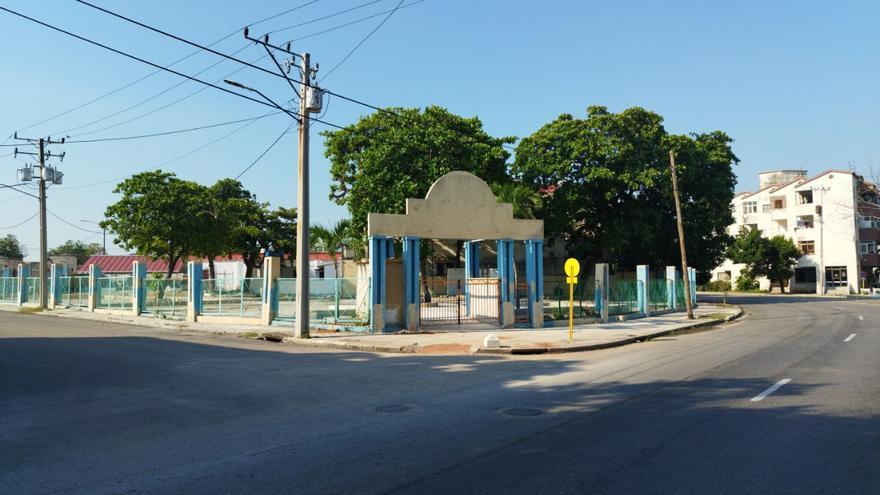

Under Private Management, Havana ‘Future Jalisco Park Is Going To Be Hollywood-Style’

Since Jalisco Park closed its gates several years ago, the entire area has been silent. (14ymedio)

14ymedio bigger14ymedio, Juan Diego Rodríguez, Havana, 18 May 2023 — The laughter of the children and the noise of the playground were heard before reaching the corner of 23rd and 18th in El Vedado, but since  Jalisco Park closed its doors, several years ago, the whole area has become silent. Now, the recreation center has passed into the hands of a private company that seeks to restore its former splendor and attract families again.

Where the carousel used to go around with the horses, the small rollercoaster stood and colorful boats floated, currently there is only the empty land on which the new attractions will be placed. “This is going to be Hollywood style,” jokes an employee who this Thursday guarded the enclosure, located a few feet from the Colón Cemetery.

The worker confirmed to 14ymedio that the management of the emblematic amusement park has passed into private hands, and it is expected that in the coming months the new apparatus will begin to arrive. At the moment, a brigade of masons is repairing the exterior walls that had been deteriorating from abandonment and lack of investment.

“They are going to bring crazy cars, other very modern attractions, and it will keep its original name,” adds the employee, who is optimistic about the transition to private managers. “The children are going to rediscover this place that is very well located and before was always full.” continue reading

Nearby neighbors also welcome the fact that a private company will take care of the recreational park. “Everything in this neighborhood revolved around this place, but since it closed the area has become very depressed. Before, near Jalisco Park you could eat anything from pizza to a snack, and now you have to go further to find anything,” says Josué, 26 years old and born in the neighborhood.

The park also had a small square for shows with clowns and magicians. “That was the way they earned their living and when they closed those people were out of work,” explains the young man. “Recreatur [Recreation and Tourism Company] ran the park and let it die because it didn’t have the resources to repair it. The equipment was very old and broke little by little.”

When the original attractions shut down, Recreatur rented part of the space to self-employed workers “who brought inflatable dolls and were also the ones who sold the food because the state cafeteria also ran out of supplies,” Josué recalls.

It wasn’t the first time that Jalisco Park languished. In the ’80s the recreational center also was closed for a long time, and the history of its decrepitude inspired the singer-songwriter Carlos Varela to compose a song. “They wanted to derail the rollercoaster, for all the slanders of parental authority, and then the father took my little friend to ride the boat and never returned,” says the song, one of the most popular of the troubadour.

In the ’90s the place reopened its doors but without several of its original attractions. However, it was always very busy due to its central location, which contrasted with the more glamorous Coney Island, currently known as Coco Island and located in the municipality of Playa, or the distant Lenin Park on the outskirts of the city.

“The families made the tour, eating at the Cinecitta pizzeria, passing by Jalisco Park and then ending up with the children at the movies,” evokes another neighbor. “On weekends this was full. My children have very good memories of this place, although when you look closely it is a small space for an amusement park.”

Despite the fact that the name of the small private company that will manage the recreation center has not been made public, the neighbors point to the owner of a nearby restaurant as the main investor. “The question that everyone is asking is how much will it cost to bring the children here,” adds one of the people interviewed.

“Every time they repair something, they put it in foreign currency or make it very expensive.”

Translated by Regina Anavy 

____________

COLLABORATE WITH OUR WORKThe 14ymedio team is committed to practicing serious journalism that reflects Cuba’s reality in all its depth. Thank you for joining us on this long journey. We invite you to continue supporting us by becoming a member of 14ymedio now. Together we can continue transforming journalism in Cuba.
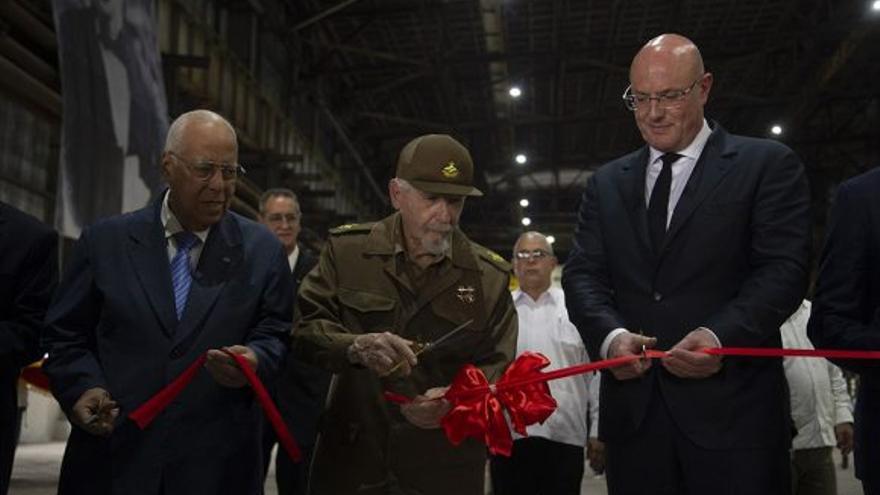
A Report Points Out That the Cuban Electricity System Cannot Tolerate the Power That Antillana De Acero Requires

Ramiro Valdés and Dmitri Chernishenko inaugurated the new José Martí steel plant yesterday, after a total remodeling of Antillana de Acero. (Ismael Francisco/ Cubadebate)

14ymedio bigger14ymedio, Madrid, 19 May 2023 — A huge portrait of José Martí watched this Thursday as the Russian Deputy Prime Minister Dmitri Chernishenko and his Cuban counterpart Ramiro Valdés cut the tape of the new steel company that bears his name and that will replace the old Antillana de Acero. Russian technology replaces the Soviet one, without having solved the problem of the enormous energy consumption of this type of facility in a country that lives to the rhythm of blackouts.

The change seems appropriate, barely anything of the Antillana mill is left. Ninety percent of the equipment is Russian or carries technology from that country, which has invested more than 95 million dollars, according to the Sputnik agency, which does not hesitate to cite the amount in U.S. currency despite the fact that one of the great agreements signed yesterday between Havana and its new preferred partner is, Chernishenko said, “to move towards projects that provide for payment in rubles.”

Among its rain of gifts, Moscow promised yesterday a contract for the supply of 14,500 lights that will illuminate the streets of Havana, but the atmosphere in the steel mill was dim during the event despite the fact that the plant had to be celebrated, because, according to the parties, it will employ more than 500 people and produce between 220,000 and 230,000 tons of liquid steel annually. It has not been explained, however, where the energy necessary for a production like this will come from at a time when the closures of industries and companies have been constant due to the lack of fuel, leaving even the garbage uncollected.

According to a study published in January 2020 by experts from the Higher Polytechnic Institute of Havana, the high power demand of the Antillana de Acero electric arc furnace “cannot be tolerated” by the National Electrical System and “produces dangerous oscillations,” which forces the steel mill to “work in a staggered manner.”

“The modernization and expansion of the steel company José Martí [Antillana de Acero] has been a priority initiative within the framework of bilateral cooperation. It is the first large-scale project to be put into the Cuban steel industry in the last 25 years,” the Russian Deputy Prime Minister said at the ceremony. continue reading

It was Vadin Nicolayevich, general director of LLC Industrial Engineering (the Russian part of the company) who noted that, in reality, the steel industry already has the country in its DNA. “It was a challenge, because the Antillana was deeply modernized by the Soviet Union between the 1960s and 1990s, but many of those companies no longer exist or had lost their abilities. This made us rethink and obtain modern equipment with better technology to revive the lost competitiveness and manufacture equipment with a high level of quality,” he explained to the media.

In his calculations, the volume of material that Russia has supplied reaches 9,000 tons.

The steel mill is one more part, although the fundamental one, of the entire steel company. Reinier Guillén Otero, director of Antillana de Acero, explained that it has been possible to repair the treatment plant, the loading ship, the electric arc furnace, the bucket oven, the continuous emptying machine, and the finished product warehouse, as well as all the electrical part, all the hydraulic part, all the automatic part and the water treatment received by the Electric Steel Mill. All this from a Russian credit that was announced in 2017 and that had an initial amount of 111 million dollars.

More than 20 Russian companies have participated in the process, Nicolayevich added, a number which grows to 60 if you count those involved in the entire production chain.

In any case, the plant will not be fully operational until 2024, according to the Cuban Minister of Industries, Eloy Álvarez Martínez, who signed the agreement that gives continuity to the project.

Carbon steel nozzles will be produced in the steel mill, which “are used to laminate and obtain corrugated bars, popularly known as rods,” explained Omar Ramón Reyes Ricardo, director of the UEB Acería Eléctrica. The manager added that in April the machinery for the testing process and the correction of errors was launched.

“We will begin the production of steel blades, and with this we will be able to achieve important economic impacts for the company and the country, in addition to replacing imports,” said Álvarez Martínez, satisfied.

Chernishenko did not hesitate to resort to the symbolism of the project, which gives continuity to the cooperation of the Soviet era. “Today is a very important day,” he summarized in his speech, where he recalled the 25,000 tons of wheat sent to the Island, announced the street lights for the capital and advanced the participation of a Cuban team in a new Russian invention: the games of the future.

The event will take place between February 23 and March 2, 2024 in Kazan and will feature “16 hybrid disciplines,” which will combine cybersports and classic sports, video game tournaments, virtual and augmented reality, and traditional soccer, basketball, hockey and mixed martial arts games on the same platform.

The exotic tournament was announced by Vladimir Putin in April, who said that “a modern person, a person of the future, is a harmonious person, developed both physically and intellectually,” adding that these games, in which 2,000 athletes from about 100 countries will participate, “will reveal this truth in its entirety.”

The Cuban participation took place during the signing of a sports agreement between the two countries, which also includes the presence of athletes from the Island in the International University Sports Festival and the “Good Will Cup,” in addition to other sports competitions.

Before concluding Chernishenko’s visit this Friday, a meeting is scheduled with Miguel Díaz-Canel, who yesterday was still immersed in his tour of the Island for the supervision of (the poor) agricultural production and gave an interview to the official media to talk about the “ability to face adversity” of the Cuban people, to whom he announced improvements for September without explaining what they were.

Before the Russian delegation leaves the Island, new agreements could still be announced in this incessant daily trickle that proves correct those who predicted a transfer of Cuban sovereignty to the Russian regime, which has almost completely lost the European market due to the sanctions after its invasion of Ukraine and is looking for new partners in Latin America and Africa.

Translated by Regina Anavy 

____________

COLLABORATE WITH OUR WORKThe 14ymedio team is committed to practicing serious journalism that reflects Cuba’s reality in all its depth. Thank you for joining us on this long journey. We invite you to continue supporting us by becoming a member of 14ymedio now. Together we can continue transforming journalism in Cuba.

The Russian National Airline Will Resume Its Flights to Cuba Beginning July 1

Aeroflot is currently leading a homonymous group, which brings together two other Russian state airlines, Rossía and Pobeda. (EFE)

14ymedio bigger14ymedio, Havana, May 19, 2023 — The Russian airline Aeroflot will resume its commercial flights to Cuba on July 1, Russian Deputy Prime Minister Dmitri Chernishenko announced on Thursday during his visit to Havana. Until now, the air service between the two countries had been limited by the international sanctions imposed on Moscow after its invasion of Ukraine, and travel had been restricted to the main tourist centers of the Island of high interest to Russian visitors, such as Varadero and Cayo Coco (Ciego de Ávila).

Chernishenko said that by Vladimir Putin’s “presidential order” regular flights will be restored, although he did not detail how often Aeroflot will operate weekly. The official press reports that the airline stopped flying in Havana — as well as to several markets where it had connections — in March 2022, when Russian aircraft were banned from flying over Europe.

A trip between Moscow and Havana required a more complicated trajectory, with connections to other cities such as Istanbul, in Turkey, whose government does not apply sanctions. On the eve of the high tourist season, in October 2022, Nordwind Airlines resumed its direct flights between Moscow and two Cuban destinations, Varadero and Ciego de Ávila, through a route near the North Pole until it reached the North Atlantic.

Nordwind also has the permission of the Federal Air Transport Agency of Russia to make a stopover at Varadero airport, on its flight from Moscow to the Venezuelan island of Margarita.

These air links were not only used by Russian tourists to spend the summer on the Island, but they were also an escape route for thousands of Cubans before the route was created through Nicaragua to continue by land to the United States. Also, as Cubans were exempt from a visa to enter Russia, Moscow became a destination to make purchases and resell products on the Island. continue reading

With the closure of airports in Europe, Aeroflot seeks to strengthen its presence in the markets of Asia and Africa. Chernishenko assured that Cuba is Russia’s key partner in the region and advocated for a greater development of bilateral economic relations in all areas, Cubadebate said in its article.

The reactivation of the flights was made known within the framework of a business economic forum, held in Havana, where the Cuban government has offered Russian businesspeople the privilege of using land in usufruct for 30 years. The Cuban Minister of Foreign Trade and Foreign Investment, Ricardo Cabrisas, told the press that both countries are working on 10 investment projects and are looking for Cuba to be the “bridge of union” between Russia and Latin America.

Aeroflot turned 100 last March, at the lowest moment of its activity since the dissolution of the Soviet Union due to the slump generated in 2020, when it was forced by the COVID-19 pandemic to leave its planes on the ground and, more recently, by Western sanctions.

The airline, controlled by the Kremlin, has been forced to seek financing to survive its debts, sanctions and the embargo of planes. The same Russian government injected 2.7 billion dollars for the purchase of 5.4 billion shares, at the price of 34.29 rubles per title.

Economically suffocated, Russian aviation is not going through its best moment, and according to the Federal Transport Control Agency (Rostransnadzor), in 2022 it made more than 2,000 flights with expired parts due to supply problems because of Western sanctions. Víctor Basargin, head of the organization, confirmed that they have detected numerous cases of infractions that “relate directly to flight safety.”

The announcement coincides with other events that show the increasingly close ties between Cuba and Russia, such as the inauguration this Thursday of a new steel company, which will replace the old Antillana de Acero plant, in which Moscow has invested more than 95 million dollars and has provided 90% of the equipment.

Translated by Regina Anavy

____________

COLLABORATE WITH OUR WORKThe 14ymedio team is committed to practicing serious journalism that reflects Cuba’s reality in all its depth. Thank you for joining us on this long journey. We invite you to continue supporting us by becoming a member of 14ymedio now. Together we can continue transforming journalism in Cuba.
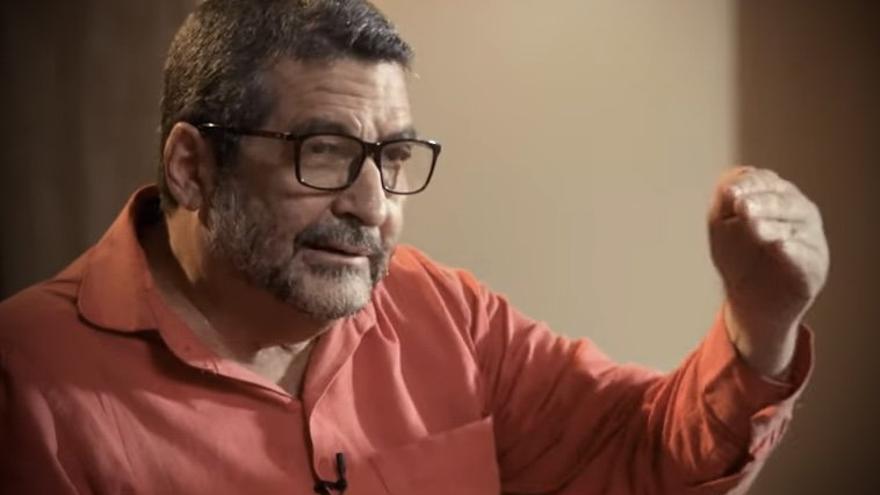
Iroel Sanchez, One of the Most Sectarian Voices of the Cuban Regime, Dies

Iroel Sánchez launched constant attacks on independent journalists and created numerous campaigns to undermine the reputation of activists and dissidents. (ACN)

14ymedio bigger14ymedio, Havana, 18 May 2023 — On Thursday afternoon, computer engineer Iroel Sánchez Espinosa, one of the most extreme voices of Cuban official propaganda, died in Havana at the age of 58. Known for his constant defamation campaigns against dissent and the independent press, so far the cause of his death has not been made public, although the rumor about a cancer that caused his hospitalization began to circulate a few months ago.

Born in Santa Clara in September 1964, Sánchez graduated from the then called Ciudad Universitaria José Antonio Echeverría and for most of his professional life served as a cadre of the Communist Party at the head of different entities of culture and communications.

Sánchez was one of the thousands of Cubans who participated in the armed conflicts in Angola, and on his return from Africa he went on to direct the Abril Publishing House. He was later appointed president of the Cuban Book Institute and the Organizing Committee of the International Book Fair in Havana, positions from which he extended literary censorship, political sectarianism and opportunism.

In 2009, after an alleged verbal confrontation with the then minister of culture, Abel Prieto, he left the Institute and went on to work at the Ministry of Informatics and Communications under the aegis of Ramiro Valdés. His arrival at that entity coincided with the appearance of the first independent blogs within Cuba, and Sánchez became the spearhead against the new information phenomenon.

From there, the computer engineer launched constant attacks on independent journalists, created numerous campaigns to discredit the reputation of activists and dissidents, and presented himself in countless public spaces as an authority on issues of communication, digital media and computerization of society. continue reading

Sánchez promoted the creation of the Ecured encyclopedia, an attempt to emulate the collaborative project of Wikipedia and in which the files dedicated to opponents, exiled artists and defenestrated officials are marked by an evident ideological bias and plagued by omissions and falsehoods.

With his blog La pupila insomne [The Sleepless Pupil] he maintained his crusade against all forms of dissent and emerged as one of the most radical voices of official propaganda. He maintained that style and extended it to the television program La pupila asombrada [The Astonished Pupil], a space that he directed until the moment of his death.

His editorial production also focused on vilifying those who promote democratic change on the Island, with titles in the style of Sospechas y disidencias. Una mirada cubana en la red o Cuba frente al buen vecino. Entre el contrato y la herejía. [Suspicion and Dissent: A Cuban look at the Internet, and Cuba Against the Good Neighbor. Between the Contract and the Heresy.]

Among the projects into which he breathed his sectarianism and his visceral rejection of all political divergence are the Roundtable program on State TV, the digital site Cubadebate and the television spaces Cuadrando la Caja [Squaring the Box] and Con Filo [Cutting Edge], the latter aimed at discrediting artists, activists and participants in the popular protests that shook Cuba in July 2021.

Feared by co-workers, protected by Commander Ramiro Valdés and given to bravado, Iroel Sánchez was a Taliban of official thought and one of the most finished products of radicalism mixed with careerism. With his early death, the questions arise as to whether the projects he helped create will lose steam.

The victims of his defamation have lost the possibility of taking him before a court on a future democratic Cuba.

Translated by Regina Anavy

COLLABORATE WITH OUR WORKThe 14ymedio team is committed to practicing serious journalism that reflects Cuba’s reality in all its depth. Thank you for joining us on this long journey. We invite you to continue supporting us by becoming a member of 14ymedio now. Together we can continue transforming journalism in Cuba.
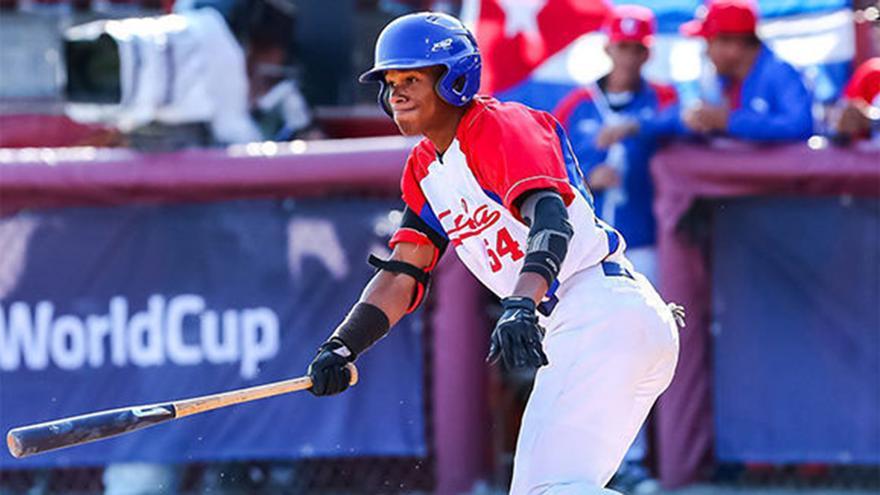
Cuba is looking for U.S. Minor League Players for the Pan American Games

Cuba’s baseball team may be reinforced by Minor League players for the Pan American Games in Chile. (Cubadebate)

14ymedio bigger14ymedio, Havana, 19 May 19, 2023 — The Cuban Baseball Federation will call for baseball players in the Minor Leagues of the United States to join the team that will represent the Island in the Pan American Games of Santiago 2023 in October. According to the specialized media Pelota Cubana, everything will depend on the permits granted to them by the U.S. clubs.

“Perhaps this is due to the evident lack of quality existing in the National Series and the urgency for top-level results by the Cuban Federation,” the same media stressed. The second week of May, the departure from the Island of three young players looking for an opportunity in the Dominican Republic with one of the U.S. Major League teams was confirmed.

“The National Series is feeling very closely the fateful result of this migration,” warned journalist Francys Romero after the departure of these athletes. “The political and economic situation continues to push young talents and their families to look for new paths outside the Island,” stressed the Béisbol FR reporter.

The decision to summon U.S. Minor League athletes, according to the editor of Pelota Cubana, Ariel Santa Cruz, “accentuates the despair of the official baseball organization in Cuba.” More than 150 players have left the Island in the last two years. continue reading

Baseball, declared a part of Cuba’s cultural heritage in 2021, is in crisis. Last year, Cuba did not win any of the nine tournaments in which it participated, extending a losing streak that has exceeded six years. The last championship in which Cuba won dates from August 2016 (World U-15).

The call for Cuban athletes will only be for the Pan American Games in Chile 2023. The team will play the tournament between October 21 and 27 at the Cerrillos Bicentennial Park.

It will be the second event in which Cuba will take players from the U.S., as it did with active Major League players in the last World Baseball Classic, where the so-called Team Asere finished in fourth place.

The news comes after Cuba ran out of balls in the National Series. According to the official publication Jit, the company TeamMate, which looked bad with the delivery of uniforms to players months ago, failed to comply with the distribution of balls for the games and only made one shipment.

The Cuban tournament is using Batos brand balls, which had been acquired as a “reserve.” The same media warned about the cost of balls per game. “Up to May 17, there were 4,207 balls lost in our stadiums.” In Guantánamo, Villa Clara, Isla de la Juventud, Pinar del Río and Havana, between 17 and 20 are lost per game.

Translated by Regina Anavy

____________

COLLABORATE WITH OUR WORKThe 14ymedio team is committed to practicing serious journalism that reflects Cuba’s reality in all its depth. Thank you for joining us on this long journey. We invite you to continue supporting us by becoming a member of 14ymedio now. Together we can continue transforming journalism in Cuba.
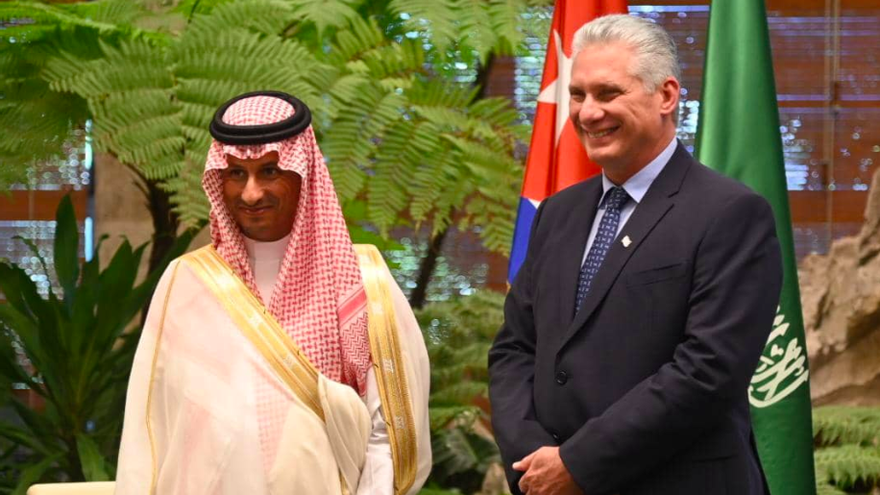
Diaz-Canel Exuberantly Receives a Minister From Saudi Arabia and His Millionaire Proposals for Cuba

Al-Khateeb also said that Saudi Arabia was going to stay “at Cuba’s side” in the international arena. (Twitter/President of Cuba)

14ymedio bigger14ymedio, Havana, 20 May 2023 — Despite his busy schedule of support to Russia in the last 48 hours, Cuban President Miguel Díaz-Canel found time to receive this Friday Ahmed Bin Aqeel Al-Khateeb, Minister of Tourism of Saudi Arabia and president of the Board of Directors of the Saudi Development Fund. As in the case of Vladimir Putin’s emissaries, the president welcomed Arab officials with open arms.

Díaz-Canel described the visitors as “true friends,” whose economic ties with Cuba he described as “indestructible.” He thanked the Arab country for having financed several “hydraulic projects in important Cuban cities” and in other communities. “We maintain full coordination in all fields,” he said.

The Saudi Development Fund will pay for two large hydraulic projects: one to improve the water supply in Jatibonico, in Sancti Spíritus, and another that will benefit several municipalities in Havana. They will also evaluate investing in the aqueduct and sewerage in the provinces of Camagüey and Villa Clara.

Al-Khateeb said that Saudi Arabia was going to stay “at Cuba’s side” in the international arena, and he promised “an important donation for farmers who work tobacco and who were affected by the passage of the recent hurricane,” although he did not give details. continue reading

Although the official press did not allude to it, Al-Khateeb thanked the Government of Havana for helping to make Saudi Arabia the headquarters of the Universal Exhibition to be held in 2030. Cuba was quick to provide its support, the minister observed, and now there are already 138 countries that have joined the request.

The meeting with the Arab envoys was not missed by the Prime Minister, Manuel Marrero, the Minister of Tourism, Juan Carlos García Granda, the Deputy Foreign Minister, Elio Rodríguez Perdomo, the president of the National Institute of Hydraulic Resources and, also, Ricardo Cabrisas, head of Foreign Trade and Foreign Investment.

Cabrisas held a separate meeting with Al-Khateeb, in which the Arab minister declared that the Island was a “strategic place” in the interests of Saudi Arabia and guaranteed that he would support Havana in any international claim against the U.S. blockade. He also celebrated the fact that the Island has continued to send doctors to his country since 2014.

According to official sources, the Island has sent more than 600 healthcare workers to the Arab country since that year, distributed in 34 Saudi cities, especially in Jizan and Bisha.

But Saudi Arabia’s financing has not been restricted to the hydraulic sphere. It was that country that provided the money to build the Fidel Castro Ruz Center, the luxurious museum dedicated to the former Cuban president located in Havana’s Vedado neighborhood. Inaugurated on November 25, 2021 and destined to be a magnet for tourists who are fond of Castro, the great unknown that surrounded the creation of the museum was its cost.

A source from the Office of the Historian of Havana told this newspaper that much of the money came from Saudi Arabia. “The credit was supposed to be for housing but they took a part for the Center and for the Capitolio as well,” the source said.

In 2017, the Fund chaired by Al-Khateeb granted a loan of 26.6 million dollars to Cuba for the Program of Rehabilitation and Construction of Social Works of that Havana organization, from which, the source alleges, the money came for the pharaonic project.

Translated by Regina Anavy

____________

COLLABORATE WITH OUR WORKThe 14ymedio team is committed to practicing serious journalism that reflects Cuba’s reality in all its depth. Thank you for joining us on this long journey. We invite you to continue supporting us by becoming a member of 14ymedio now. Together we can continue transforming journalism in Cuba.

With the Disastrous Economic Situation, Having Children in Cuba Has Become an Ordeal

The litany of dramas faced by a couple who are going to have a child on the Island begins before it arrives, admits the article. (Tribuna de la Habana)

14ymedio bigger14ymedio, Madrid, 16 May 2023 — It’s been only three months since the Cuban press addressed the low fertility rate on the Island. It was in a report in the Sancti Spíritus newspaper, Escambray, that an explanation was sought for the plummeting fall in the figures and, although it was admitted that it was multifactorial, the conclusion, in bold, was that “women of childbearing age continue to prioritize, in most cases, personal projects over motherhood.”

This version is now overturned with an article published in Cuba Joven that Cubadebate reproduced this Tuesday, in which there is no room for doubt: the economy has been a determining factor in the figures given in recent years: the lowest birth rate in 55 years in 2021, with 8.9 per 1,000 inhabitants, and the lowest fertility rate for decades, with 1.52 children per woman in 2020.

In the world ranking, countries with a very low birth rate are among the most developed, from South Korea (0.9) through Spain (1.24) and, among the closest, Puerto Rico (1.48). But comparing the causes — although without ceasing to mention them — is finally over. “After the monetary reorganization and the galloping inflation, the economy becomes the main cause for which Cubans of childbearing age renounce or postpone motherhood,” the article admits.

The litany of dramas faced by a couple who are going to have a child on the Island begins before it arrives, admits the article, which clearly speaks of cesarean section kits, a batch of necessary supplies in case of having to go to a hospital, where it increasingly costs more for something as basic as surgical gloves. Pregnant women turn to social networks and the black market to get hold of these kits, which can cost between 3,000 and 5,000 pesos. continue reading

But when babies are born, the most complicated part arrives. Not only is it difficult to buy a crib, a basket or a car, it is increasingly impossible to find healthy food for proper growth. “If children eat badly (as do mine) it is hard to vary the food,” says one of the interviewees.

Although remuneration during postnatal leave is, on paper, among the most beneficial in the region (100% remuneration in the first three months and 60% in the following months), low wages turn the norm into worthless paper. The Cubans interviewed for this report consider it a utopia to involve men more in upbringing if coverage is not improved during the leave. “If it represented a little more, maybe my husband wouldn’t have to be working the way he’s doing and could get more involved.”

“There is no sterile fabric, nor a crib, nor a mattress. So, I have to look for all those products in a parallel market, a black market, where you often find what they stopped selling in the ’state basket’ itself,” says another of the interviewees. Complaints like this were frequent in the independent press in recent years, but the regime had not put them in black and white with such clarity until now.

The poor coverage for childcare centers, which now are being supported by the casitas — private homes, still very few of them on the Island — is another challenge, since after the year of leave, women must choose to pay for these non-state services, depend on relatives who can provide support or stop working, a situation that continues because schools do not end the situation.

The situation is so sad that most women, despite the perpetual crisis in Cuba, admit that their children have or will have much worse childhoods than they had. Not to mention leisure. “If you decide to buy medicine, you can’t take the child to a place for a walk or to the beach, for example, because now the seats are almost 1,000 pesos, and if my maternity leave is 2,500 pesos, I can’t pay,” says another.

For the article, psychologists were interviewed and talk about the difficulties of facing motherhood, which already in the best conditions means a change of course in women’s lives that requires adaptation and support. In the current circumstances in Cuba, problems are multiplied by a thousand.

“I am not willing in today’s conditions in this country to have another child because that would mean subtracting time from the one that is already there and from my quality of life, which is also very important,” explains one of the women interviewed, who adds that there must be “a change of mentality, a will from the State, from the Education system, to end that inequality gap that has always existed but in recent years has become greater.”

None of the women interviewed aspires to have more than one child, although the only one who has done so says she is more aware of the experience of what is most important and what can be discarded.

“We have to be more proactive; it is urgent to address the issue because the country is aging and with it the hopes of a part of the population die,” adds the text, which considers the demographic an “alarming” problem. And that does not even touch on the mass emigration, which is the third leg, along with aging, of the serious situation.

Translated by Regina Anavy

____________

COLLABORATE WITH OUR WORKThe 14ymedio team is committed to practicing serious journalism that reflects Cuba’s reality in all its depth. Thank you for joining us on this long journey. We invite you to continue supporting us by becoming a member of 14ymedio now. Together we can continue transforming journalism in Cuba.

Despite Diaz-Canel’s Congratulations, Boxing Champion Yoenlis Hernández Does Not Return to Cuba

Cuban boxer Yoenlis Hernández left the Domadores de Cuba in Panama. (Cubadebate/IBA)

14ymedio bigger14ymedio, Havana, 16 May 2023 — Yoenlis Hernández’s escape was a one-two punch for Miguel Díaz-Canel, who the day before congratulated him for having been the only gold medalist and two-time champion in the 165-pound category in the Boxing World Cup that was held in the capital of Uzbekistan. According to journalist Yordano Carmona, the native of Camagüey “abandoned the Cuban delegation returning from Tashkent.”

The reporter shared an image of Hernández with the champion belt and a poster with the $200,000 he earned as part of the Domadores de Cuba team. “No one wants to stay on the Island, not even when you win a prize of 200,000 dollars,” he stressed.

The escape of this pugilist took place in “Panama, during a technical stopover to Havana,” Ernesto La Flecha said on Facebook. “The torches are lit, another one that is looking for a professional future.” Swing Completo published that this Cuban took the opportunity to “board a flight to Spain.”

Hernández’s departure is “a serious casualty for the Cuban squad, in which he had become one of the main figures and the hope for medals in the various international events,” published Play-Off Magazine.

Hernández said goodbye on Saturday from the mixed area of the Humo Arena stadium with a dedication after being proclaimed champion. “What is promised is a debt, here is the gold medal, which is for Cuba.” This athlete, whom the official media Jit praised for having won five fights in the event and staying “averse to the shocks (decisions)” of the judges, said that “he had grown a lot as an athlete.” continue reading

Hernández’s words seemed to announce his escape, as did those of Kevin Brown Bazain, youth world champion in Yerevan, Armenia, in 2012, who fled in March last year prior to his participation in the Continental Boxing Championship in Guayaquil, Ecuador.

Billy Rodríguez took advantage of his stay in Mexico in August 2022 to hit another blow to the Domadores of Cuba. Osvel Caballero, winner of a gold medal at the 2019 Pan American Games in Lima and bronze at the 2021 World Boxing Championship in Belgrade, escaped in November.

He was followed by Albert González and Carlos Castillo who left the team in Germany, where Cuba had won its first three bronze medals in the World Boxing Cup.

Cuban boxing is going through an alarming crisis. In the last Boxing World Cup, Olympic medalists Julio César La Cruz, Arlen López, Lázaro Álvarez and Roniel Iglesias could not even access the medals. The ruling party media Jit blamed the judges for the missteps of the Domadores of Cuba in Tashkent, transforming journalism in Cuba.

Translated by Regina Anavy

____________

COLLABORATE WITH OUR WORKThe 14ymedio team is committed to practicing serious journalism that reflects Cuba’s reality in all its depth. Thank you for joining us on this long journey. We invite you to continue supporting us by becoming a member of 14ymedio now. Together we can continue transforming journalism in Cuba.
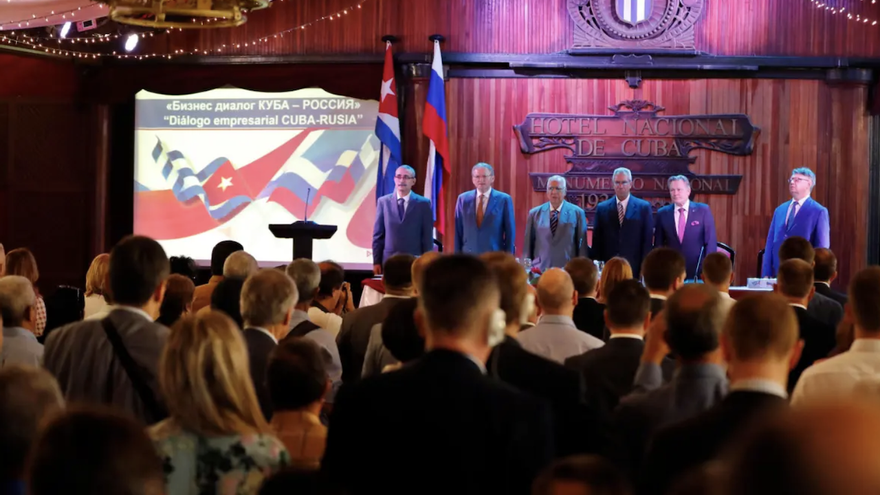
Red Carpet in Cuba for the Russians: Land in Usufruct for 30 Years and Tax Exemptions

Havana, chaired by Ricardo Cabrisas and Boris Titov. (EFE/Ernesto Mastrascusa)

14ymedio bigger14ymedio, Madrid, 18 May 2023 — “They are giving us preferential treatment, the road is paved.” The words of Boris Titov, president of the Cuba-Russia Business Council, at the inauguration of the bilateral business economic forum this Wednesday at the Hotel Nacional in Havana, eloquently illustrate the state of the relationship between the two countries.

According to the Reuters agency, the Kremlin’s adviser said that the Island has offered Russian businessmen the right to land in usufruct for a period of 30 years, an unprecedented concession by the revolutionary regime.

Those conditions affect, he explained, “both the long-term lease of land and the tax-free importation of agricultural machinery, the granting of the right to transfer foreign exchange profits and much more. Of course, we are also waiting for the reduction of bureaucratic barriers,” he added.

Titov, who has been advising the Cuban authorities on economic matters for months, has also stated, according to Sputnik, that the Díaz-Canel Government is willing “to provide more favorable conditions for Russian investors.”

“Cuba is being transformed, mastering new rules for the interaction between the State and the companies,” he said at the opening of the meeting. continue reading

Thus, for example, they will exempt Russian companies from tariffs to import technology and allow them to repatriate their benefits to Russia, a privilege that no other foreign entrepreneurs in Cuba enjoy.

In addition, Putin’s adviser said he was considering speeding up transport between the two countries. “In Soviet times there was a direct port and maritime connection,” he said, and they are “analyzing this possibility with the owners of Cuban ships” (i.e., the State).

On the Island’s side, Ricardo Cabrisas, Minister of Foreign Trade and Foreign Investment, told reporters that the economic ties between his country and Moscow will only grow. “Nothing and no one can stop it,” Reuters quoted him as saying.

Sergei Baldin, Russia’s trade representative in Cuba, told the British agency that bilateral trade between the two nations reached 450 million dollars in 2022, three times as much as in 2021. Ninety percent of this was purchases of petroleum products and soybean oil.

The distrust that Russia had towards Cuba in recent decades for the non-payment of its debts changed completely as a result of Putin’s invasion of Ukraine in February 2022. A few days earlier, Moscow announced an extension for the payments of the Russian credits granted to Havana until 2027.

Since the war began, there have been bilateral meetings that specified symbiotic needs: that of Russia for having allies on the planet, after the majority rejection of its actions in Ukraine, and that of Cuba for trying to breathe life into its devastated economy.

Last January, both agreed to create an Economic Transformation Center with the aim of modifying the Island’s economy based on “the development of private enterprise,” something that many NGOs have denounced as an attempt to transform a “state economy model” into the “Russian market mafia” scheme.

Translated by Regina Anavy

____________

COLLABORATE WITH OUR WORKThe 14ymedio team is committed to practicing serious journalism that reflects Cuba’s reality in all its depth. Thank you for joining us on this long journey. We invite you to continue supporting us by becoming a member of 14ymedio now. Together we can continue transforming journalism in Cuba.
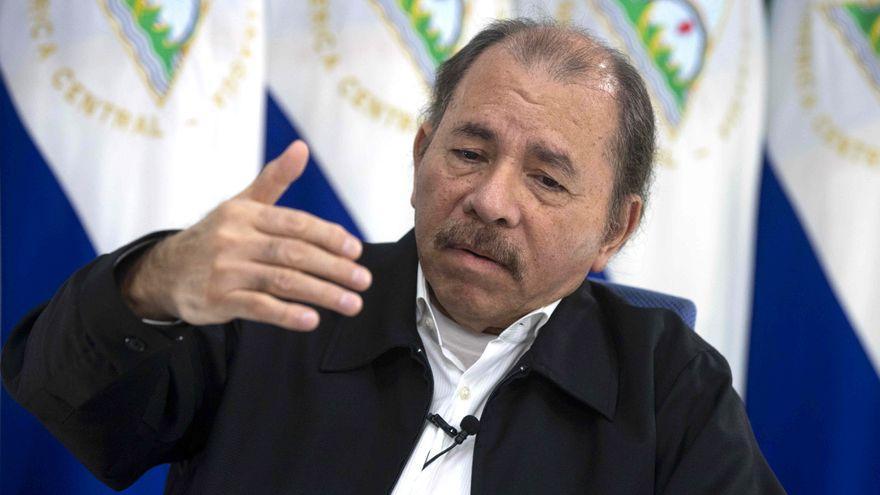
Daniel Ortega’s Government Again Dismisses Nicaragua’s Ambassador to Cuba

The president of Nicaragua, Daniel Ortega. (EFE/Jorge Torres/Archive)

14ymedio biggerEuropa Press/14ymedio, Madrid, 14 May 2023 — The government of Nicaragua, led by President Daniel Ortega and Vice President Rosario Murillo, dismissed Nicaragua’s ambassador to Cuba, Alejandro José Solís, on Wednesday, just one year after he was appointed to the position.

Solís, who was appointed Nicaragua’s ambassador to Cuba in May last year after four consecutive changes in about six months, is the longest serving diplomat in office after the departure of Luis Cabrera, who was dismissed in November 2021.

The latter, a Nicaraguan-nationalized Argentine journalist, was the ambassador in Havana since 2007, when the Sandinista leader Ortega returned to power and re-established diplomatic relations with the Island. He was replaced by the then advisory minister for policies and international affairs of the Presidency, Sidhartha Francisco Marín Aráuz, who only lasted 11 days.

Marín Aráuz was replaced by the retired colonel Reynaldo del Carmen Lacayo Centeno and he, in turn, by Wilfredo Jerónimo Jarquín Lang. continue reading

The 2018 protests against the government of Nicaragua lasted until September and resulted in a repressive escalation that resulted in the following years with more than 200 arrests of people opposed to the government. The UN estimates that, since December 2018, more than 3,100 organizations have been closed.

Nicaragua has withdrawn the legal personality of numerous NGOs and civil society organizations alleging  administrative irregularities. This has been accompanied by other measures, such as the suspension of diplomatic relations with the Vatican, the deprivation of nationality of dissidents and the expulsion of ambassadors from the country.

Translated by Regina Anavy

____________

COLLABORATE WITH OUR WORKThe 14ymedio team is committed to practicing serious journalism that reflects Cuba’s reality in all its depth. Thank you for joining us on this long journey. We invite you to continue supporting us by becoming a member of 14ymedio now. Together we can continue transforming journalism in Cuba.
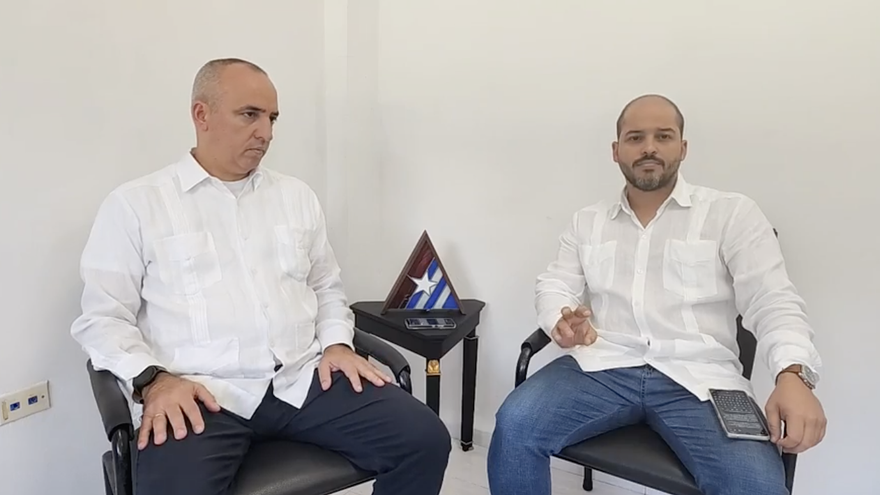
Cuban Official Avoids All Allusion to ‘Regulated’ Cubans and Those Who Are Forbidden To Return to the Island

Ernesto Soberón, on the left, along with another Foreign Affairs official, during his direct transmission this Wednesday. (Facebook/Captura)

14ymedio bigger14ymedio, Madrid, 17 May 2023 — So many doubts seem to have been raised by the new migratory measures announced yesterday by the Ministry of Foreign Affairs, which this Wednesday will not only be devoted entirely to the issue of the official TV Roundtable program. Ernesto Soberón, director general of Consular Affairs and Cubans Residing Abroad, has also offered to respond to them in a direct transmission in the morning.

In an informal interview with another foreign official who was reading the questions to Soberón, he clarified that Cubans who have a passport with a validity of six years will have to keep that document, but that — like those who acquire the new document, from next July 1, with a validity of up to ten years — they will be exempt from the extension every two years.

“It would not be logical to tell Cubans that they have to do an additional procedure to put a sticker on the passport that says that the validity is extended,” said the director of Consular Affairs, who also said that anyone who wants to get a new passport for ten years can do it.

Regarding citizens who do not have an extended passport and have to travel before July 1, when all the measures come into force, Soberón warned that “the cases, which must be punctual, will be analyzed in detail to find a solution.”

Another of the issues raised with the official concerned the “equalization” of the time spent on the Island of Cubans living abroad and their foreign relatives. To this, Soberón recalled that until now, those relatives had a maximum stay of six months, and that from now on it will be one year. continue reading

As for the requirement of the use of the Cuban passport to enter the Island for “emigrants” from before January 1, 1971, the director of Consular Affairs denied that it was a penalty. “I have seen opinions on the networks that a privilege is eliminated; quite the contrary,” he said, arguing that “what we are looking for with this measure is to eliminate the need for a Cuban to ask for an entry permit every time he comes to Cuba.” To get their Cuban passport, he continued, “facility will be granted for a year” to all  citizens, without detailing how that would work.

“We are also seeking to eliminate differences between categories of Cubans,” he insisted, and he repeated another message: “The will of our Government to continue developing a policy of strengthening ties with Cubans abroad remains unchanged.”

To demonstrate that President Miguel Díaz-Canel’s new measures show  “continuity,” he explained that “Fidel initiated the dialogue of 1978,” which granted legal travel for Cuban exiles to the Island, and that Raúl Castro approved the “deeper update of the Cuban migration policy” for January 2013. He did not mention at any time the possibility maintained by the authorities of denying entry to any Cuban who has criticised the regime or the number of those who are “regulated*” and not allowed to leave the country.

*Translator’s note: “Regulated” is the term used by the Cuban government to classify Cubans who are forbidden to travel. Frequently, individuals have not found out they are ’regulated’ until they arrive at the airport with their ticket to leave. 

Translated by Regina Anavy

____________

COLLABORATE WITH OUR WORKThe 14ymedio team is committed to practicing serious journalism that reflects Cuba’s reality in all its depth. Thank you for joining us on this long journey. We invite you to continue supporting us by becoming a member of 14ymedio now. Together we can continue transforming journalism in Cuba.

The Legal Status of 10,000 Cubans Is at Risk Due to Uruguay’s New Immigration Requirements

Uruguay’s stability and economy have made it a preferred southern destination for Cubans. (Captura)

14ymedio bigger14ymedio, Madrid, 16 May 2023 — Nearly 10,000 Cubans living in Uruguay may lose their legal status if nothing happens. The Government of the South American country has become serious about an immigration requirement that has been in force for years. A few months ago Uruguay started requiring the accreditation of legal entry from Brazil, which thousands of people do not have.

According to the Uruguayan media El Observador on Tuesday, two years ago thousands of Cubans who could not be considered refugees arrived in the country and asked for this type of status, although they later renounced the application. Now, they are required to apply for a visa to reside in Uruguay, but for this they must show the entry and exit stamps from Brazil that accredit their regular transit. This puts them in a difficult situation without a resolution.

“Our most conservative calculation is that between 9,000 and 10,000 Cubans living in Uruguay could be left in the limbo of being  irregular, due to the new demands,” Alberto Gianotti of the Migrant Support Network told the media.

Cubans began to arrive in Uruguay significantly six years ago, when US President Barack Obama put an end to the wet-foot/dry-foot policy, and migrants from the Island began to look for other destinations.

Uruguay, one of the richest countries in the region, attracted Cubans, who began to double the number of immigrants after arriving on a route that began in Guyana, visa-free for residents of the Island. From there, they crossed the enormous jungles of Brazil on a very complicated journey and circumvented border controls after paying coyotes, who took them to the South American country, where they asked for refuge. continue reading

During the time their application was processed, those affected received temporary residence, which provided them with access to education, health and employment, but when their requests were rejected — since the Government considered that they could not prove a danger to life — they had to process their stay in the country.

El Observador affirms that Cubans then resorted to a trick that consisted of making an appointment at the consulates bordering Brazil and simulating a new entry. The transit seal requirement in the neighboring country was already in force but was never required. Since 2023, the immigration authorities have been ordered to start demanding it.

Cuba, along with Haiti and the Dominican Republic, is one of the very few Latin American countries from which Uruguay requires a visa and does so in application of the principle of reciprocity, so the Government rejects the revocation of the permit, as requested by some organizations for the defense of the rights of migrants.

El Observador affirms that Uruguay has no intention “to deport undocumented immigrants, much less that irregular inhabitants accumulate,” with the consequent problems that would result from it, so Montevideo is rushing to find a solution, which is not expected to be easy.

“We are fighting to remove the visa requirement, not only to solve the underlying problem, but also to prevent migrants from relying on human trafficking networks and organized crime to get to Uruguay,” Gianotti told the media.

Rinche Roodenburg, another source from El Observador who works in a humanitarian organization, defends national policy in general terms but admits that it is normal for inconveniences to arise. “Uruguay has good intentions, regardless of the government of the day, and respects the right to migrate, but from time to time bureaucratic obstacles appear that end up curtailing rights and leaving thousands in limbo,” he said.

Sources from the Foreign Ministry told El Observador that “the intention of the State is to find a substantive solution and to make  immigration as regular as possible,” but visa exemption is impossible.

Obtaining refugee status in Uruguay has been difficult for Cubans. In the first six months of last year, only three people succeeded, and data from the Refugee Commission indicate that they are the most rejected national group, 85% of the total, while Venezuelans were approved at a rate of 100%.

The Foreign Ministry then pointed out that the majority of Cubans allege economic reasons in the process. “And economic reasons, when they say it in the interview, are not reasons that justify refuge.”

Translated by Regina Anavy

____________

COLLABORATE WITH OUR WORKThe 14ymedio team is committed to practicing serious journalism that reflects Cuba’s reality in all its depth. Thank you for joining us on this long journey. We invite you to continue supporting us by becoming a member of 14ymedio now. Together we can continue transforming journalism in Cuba.

‘Jit’ Blames the Judges for the Setback of the Domadores de Cuba in the Boxing World Cup

Yoenlis Hernández won the gold medal in the Boxing World Cup for the Island. (Cuban News Agency)

14ymedio bigger14ymedio, Havana, 14 May 2023 — Cuba said goodbye to the Tashkent 2023 Boxing World Cup with a result far below expectations: one gold medal, three silver and two bronze. The pro-government media Jit downplayed the failure of the Cuban team in the competition and blamed the judges.

The hope of the Domadores de Cuba was centered on Saidel Horta (125 pounds), but this 21-year-old boxer could not beat the Uzbek Abdumalik Khalokov, who surpassed him 5-0. According to the official newspaper, this was a “gift from the officials who decided he was better” in the first round.

After the setback in Uzbekistan of Julio César La Cruz, Arlen López, Lázaro Álvarez and Roniel Iglesias, the sports site tried to make the defeats less chaotic. “The work of the judges affected Roniel and Julio as part of a phenomenon that was felt again in the Humo Arena,” the same official media published on Sunday, rejecting the idea that the rivals of the Cuban pugilists were superior.

Although Cubadebate acknowledged last Wednesday that with the defeats of its medalists, Cuban boxing “took a nose-dive in the quarterfinals,” for Jit “the negative thing” was that “the response of the leaders (medalists) left doubts.” continue reading

Saidel Horta regretted not being able to reach the gold medal and give the achievement as a gift to the mothers on the Island. “I worked hard to give the title to my mom and to all the mothers in Cuba, but I still dedicate this silver medal to them.”

Horta could not match the performances of Ángel Herrera (Belgrade 1978) and Adolfo Horta (Munich 1982), both with gold medals. Cuba’s performance leaves several questions for the Domadores team in a tournament organized since 1974, where it has won 81 gold, 38 silver and 30 bronze medals.

Yoenlis Hernández (165 pounds) regained the reign exercised in Belgrade 2021, while Erislandy Álvarez (132 pounds) and Fernando Arzola (203 pounds) took silver medals on Saturday. Yosbany Veitía (119 pounds) and Alejandro Claro (106 pounds) won bronze.

Someone else worth mentioning is Arlen López, since the Olympic medalist was surpassed by the Chinese Tanglatihan Tuohetaerbieke. Behind this Asian boxer is Cuban coach Maikro Romero, gold medalist at the Olympic Games in Atlanta (1996) and bronze medalist in Sydney (2000).

Translated by Regina Anavy

____________

COLLABORATE WITH OUR WORKThe 14ymedio team is committed to practicing serious journalism that reflects Cuba’s reality in all its depth. Thank you for joining us on this long journey. We invite you to continue supporting us by becoming a member of 14ymedio now. Together we can continue transforming journalism in Cuba.
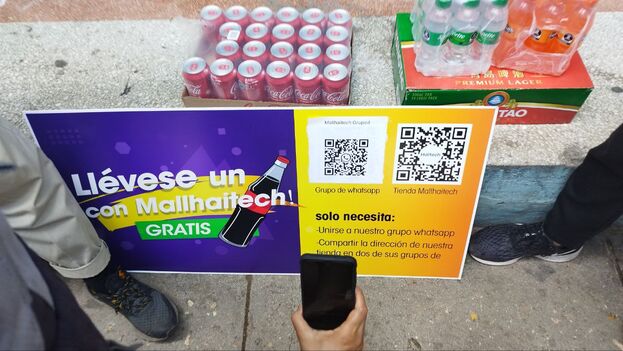
The Cuban-Chinese Company Haitech Gives Away Tsingtao Beer and Coca-Cola to Attract Customers

“You have to scan the code and follow these instructions,” said one of the Haitech workers who distributed the soft drinks. (14ymedio)

14ymedio bigger14ymedio, Juan Diego Rodríguez, Havana, 13 May 2023 — A crowd of people were milling around, suddenly and at full speed, in front of number 665 Carlos III Street. There, two blocks from the market of the same name, where the Pepsi Cola Company of Cuba once was, informal sellers are usually found. This Friday they grumbled about the intruders who were taking their place.

On one step, there were several boxes of soft drinks, one of beer, and a promotional poster of the joint venture Haitech, formed by the Cuban state-owned company Copextel and a Chinese partner. With a brightly colored background, a soft drink was offered in exchange for joining a WhatsApp group and sharing the address of the store in two groups on any social network.

Although the instructions were clear, people kept asking: “What do we have to do?” On the other side, the crowd was attended by two young people, one with Chinese features and the other Cuban. The first, in precarious Spanish, tried to give explanations out loud but could not make himself understood. “I’m going with the Cuban guy because I don’t understand Chinese,” said one lady. “You have to scan the code and follow these instructions,” said the Cuban.

In its virtual store, Haitech offers different appliances and electronic devices (refrigerators, freezers, fans, computer CPUs, meat grinders, blenders, line protectors) at prices in dollars, although there isn’t much to see: just 14 items. The most expensive is a desktop PC, at $795.80, and the cheapest, an LED light bulb at $4.35. As an offer, there was a solar charger reduced from $31.45 to $10.99. continue reading

The WhatsApp group that was accessed by scanning the code was managed by two people who called themselves Gema Wang and Nico Zheng, who answered the questions of those who were entering. Many searched for electrical household appliances or devices that aren’t in their catalog, such as pressure cookers or washing machines, which, they assured them, “will arrive in July.”

“Are they cheaper than in stores in MLC (freely convertible currency)?” asked another potential customer. “Yes!” they answered, despite the fact that items can be bought only with foreign Visa, Mastercard or UnionPay cards (that is, they can only be acquired by emigrants who purchase them for their relatives on the Island).

Although Wang and Zheng welcomed people on WhatsApp saying that they are “a Chinese company,” on their website it can be verified that they are based in Hong Kong and operated jointly with the Cuban state-owned company Copextel, belonging to the Electronic, Automation and Communications Industry Group (Gelect).

Until now, the agreements between China and the Island to create joint ventures in the field of biotechnology were known — one of which, dedicated to producing a drug against nasopharyngeal cancer, was praised in the official press just last month — but barely any are known to be in commerce.

Last November, after the official visit to China of Cuban President Miguel Díaz-Canel, Beijing and Havana signed a total of 12 agreements about which no details were offered beyond saying that “they cover different sectors.”

Among them was a “memorandum of understanding” signed by the ministries of Commerce of both countries for the “strengthening of economic and trade cooperation,” and another with the Agency for International Development Cooperation aimed at “promoting the Chinese proposal for global development.”

In any case, the union of foreign private individuals with Cuban state companies has been raising suspicions for months. The latest denunciation has come from the Communists of Cuba collective, a Trotskyite group, saying that “the Cuban ruling bureaucracy advances decisively to the capitalist restoration, implementing the Chinese-Vietnamese model.”

Those who joined the WhatsApp group were not worried about this at all and immediately turned the exchange of messages into a private bulletin board for the sale of coffee, milk or chicken. Most of them, however, entered the site and left a short time later.

The drinks — 12 Sprite, 12 Orange Fanta, 24 Coca-Cola and 24 beers from the Chinese brand Tsingtao, which Cubans usually make fun of for its similarity with the word singao [“motherfucker”] — vanished in half an hour. Getting a soft drink was the only thing that mattered about Haitech to those who joined the WhatsApp group.

Translated by Regina Anavy

____________

COLLABORATE WITH OUR WORKThe 14ymedio team is committed to practicing serious journalism that reflects Cuba’s reality in all its depth. Thank you for joining us on this long journey. We invite you to continue supporting us by becoming a member of 14ymedio now. Together we can continue transforming journalism in Cuba.
Cuban Activist Yasmany Gonzalez Has Been Detained for Three Weeks by State Security in Villa Marista

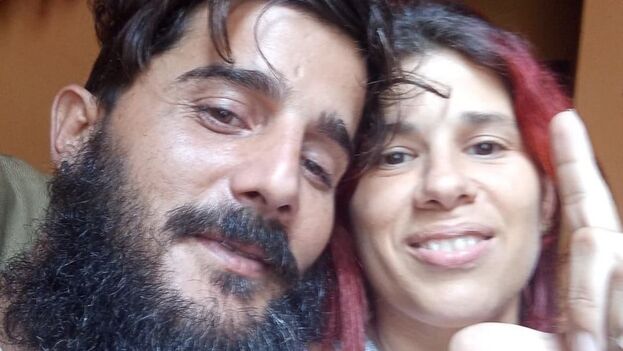
Activist Yasmany González and his wife, Ilsa Ramos. (Facebook/Ilsa Ramos)

14ymedio bigger14ymedio, Havana, 12 May 2023 — “He is very emaciated and they continue to interrogate him,” wife of activist Yasmany González Valdés, tells 14ymedio, after her husband has been detained for three weeks at Villa Marista, the State Security headquarters in Havana. “I ask and ask the officers about his case, but they don’t give me information,” she says.

Ramos was able to visit her husband this Thursday to bring him some toiletries. “We have not been told if he will finally be brought to trial or when it will be. It seems that he will continue in Villa Marista for the time being,” says Ramos, who reiterates that González is being investigated for the alleged crime of “propaganda against government bodies.”

The activist, also known as Libre Libre, was arrested on April 20 after a “violent search” at his home in Centro Habana. About 15 political police officers participated in the search, confiscating a workman’s overalls, a brush and his mobile phone, as part of the investigation into the graffiti that appeared in several central points of the capital against the Cuban regime.

“I pray to God that you will soon be free, as well as all our political prisoners,” Ramos wrote on her Facebook account, where she also recounts the vicissitudes she has had to overcome after the arrest of her husband, especially since the couple has an autistic child who needs care and who is very attached to González. The woman denounces pressure from the political police and having been “also interrogated.” continue reading

Initially, the Observatory of Cultural Rights (ODC) alerted about the detention of Libre Libre and noted that the activist was summoned by the Police at the beginning of April at the Zanja station, in the Cuban capital, where he was linked to the group that calls itself El Nuevo Directorio (END). According to González’s account, on that occasion they did graphological tests and also tried to detain him for a non-payment of fines that had already been paid.

The first painting signed by END with the slogan “No to the PCC” appeared on March 20 on the walls of the Faculty of Physics of the University of Havana. The second appeared in Aguirre Park, on March 23, and a third on April 17 was placed at the entrance of the university stadium, on Ronda Street. But it was the fourth and most recent poster that would have bothered State Security the most, when it appeared on the morning of April 20 at number 7 Humboldt Street, in Centro Habana.

The location of this last sign coincides with the place where four young people belonging to the Revolutionary Directorate were murdered in 1957, during the dictatorship of Fulgencio Batista. The graffiti, made on the same day as the anniversary of that repressive action, generated a strong police operation to cover the letters with paint, in addition to an “act of atonement.”

Yasmany González has repeatedly denounced the harassment he has suffered from State Security. In 2022, after four days of detention in Villa Marista, the activist, who works as a self-employed bricklayer, said he would stop posting on social networks. He had previously been fined for denouncing human rights violations and demanding the release of the detainees in the ’11J’ protests of July 11, 2021.

Translated by Regina Anavy

____________

COLLABORATE WITH OUR WORKThe 14ymedio team is committed to practicing serious journalism that reflects Cuba’s reality in all its depth. Thank you for joining us on this long journey. We invite you to continue supporting us by becoming a member of 14ymedio now. Together we can continue transforming journalism in Cuba.