The Government Paints an Idyllic Country for Foreign Investors / 14ymedio

14ymedio, Havana, 5 November 2014 — The documentation that the Cuban government has distributed among potential foreign investors for the purpose of capturing some 8.7 billion dollars for development projects on the Island highlights the country’s “favorable business environment.”

The Opportunities Portfolio and Guide, to which 14ymedio has had access, highlights the “restructuring of the country’s policies since the updating of the economic model,” even though the reforms promoted by President Raul Castro since 2007 have not solved the many problems that strangle the system.

The so-called Raulist reforms have not prevented the economy from growing at a slower pace than officially forecasted. According to government calculations, the Gross Domestic Product (GDP) will close the year with an increase of 1.4%. Nevertheless, independent analysts think that this figure does not reflect the real state of the economy.

Throughout 168 pages, the Opportunities Portfolio insists on the presence of a “regulatory framework and an updated foreign investment policy and incentives for investors.”

The document mentions the existence of a “secure and transparent body of law” and “promotional institutions at the service of investors” as well as a “climate of security for foreign personnel,” when a little more than a month ago the severe sentence imposed on Canadian entrepreneur Vahe Cy Tokmakjian was made known.

This case, often considered a test for those who plan to invest on the Island, concluded with the 15-year prison sentence for the President of Tomakjian Group for various corruption crimes. Along with him, another 14 Cubans were condemned to sentences of between six and 20 years in jail.

The Portfolio also praises the “high indicators in matters of education, social security and health of the population,” even though the island is going through a delicate situation from the epidemiological point of view. In recent months, the spread of dengue fever, cholera and chikungunya may have caused dozens of deaths throughout the country, although health authorities have not supplied reliable figures.

The document also celebrates the presence of basic infrastructure throughout the whole country, including railways and roadways, in spite of the fact that the bad state of the highways has caused more than 5,600 accidents in the first half of this year, with a balance of 347 deaths and more than 4,300 injuries.


Translated by MLK

Abel Prieto Attacks The “Packet” and “Technological Nomadism” / 14ymedio, Rosa Lopez

Cuba Pavilion, where the Cultural Consumer Forum meets in Cuba: Art, Culture, Education and Technology

14ymedio, Rosa Lopez, Havana / 1 November 2014 — Why do young people prefer video games to the high-flown revolutionary exploits that national television displays? Is the audio-visual “packet” displacing official programming? Those questions hang in the air – although without being directly enunciated – at the Forum on Cultural Consumption in Cuba: Art, Culture, Education and Technology, which is being held this weekend in the Mayo Room of the Cuba Pavilion.

Participating in the official event are Abel Prieo*, Raul Castro’s adviser on cultural topics, Miguel Barnet and other members of the Cuban Union of Writers and Artists (UNEAC) and the Saiz Brothers Brigade. The meeting of intellectuals takes a critical stance in the face of an avalanche of material – uncontrolled by government – that is circulating within the country, especially through the so-called “packet” or “combo” that is distributed by alternative means.

The manifest purpose of this event is to diagnose the ways culture is consumed in Cuba and accordingly “to create an alternative platform for art, education and new technologies and in this way reach a much wider audience.”

Abel Prieto stated in one of the sessions that it seemed to him “that the intellectual position of irrational rejection of new ways of consuming culture is as harmful as that of a post-modern relativism which accepts everything as good. That relativism brings us a blurring of precisely the objectives of a cultural policy, the objectives of the humanism that today is absolutely in bad shape.”

In the forum several references were made to the topic of video games, and Prieto himself judged it as “a complex and dialectical process,” to immediately add that “some are inoffensive, but others are essentially violent and become an addiction.”

Cuba thus seems to be peeping out to the great modern debates about violence and addiction to which video games may give rise, but for the moment it is only permitted to publicly discuss a portion of those involved in the possible problem. The government’s cultural policy tries to determine from above what each Cuban sees on his television screen and what is good or bad for his subsequent social attitude.

Abel Prieto also attacked the “packet” and “technological nomadism” through storage devices like USB memory. The ex-minister of culture opined that “one of the tricks of these new ways of consuming culture is that they give the idea that the person is choosing what he wants to consume, but he does it from the paradigms that are imposed on him. Democracy and diversity are hidden beneath a trap of the hegemonic agenda of the entertainment.”

As evidence that the ruling party surrenders before the existence of those phenomena, Prieto ventured that “we have to promote more diverse and inclusive packets.” The problem is that the greater part of the Cuban people are no longer willing to have officialdom make their audiovisual menu for them.

Tedium, low-quality production, excessive ideology and secrecy have for too long characterized the audiovisual products cooked up in the laboratories of the Communist Party Central Committee Department of Revolutionary Orientation (DOR), the entity that governs television programming and the content of all national press media.

However, the recent speeches in the Forum also hint at alarm. Abel Prieto asserted that “at no time will the State cede to private individuals the decision of cultural policy.” His immediate call “to not demonize new cultural consumption in an authoritarian manner” did not manage to erase the implicit threats in his prior words.

“Hopefully knowledge and cultural information will come into fashion,” concluded Prieto, but he failed to include in that sentence the adjectives “revolutionary” or “politically correct” which always hang over every audiovisual production promoted and encouraged by the ruling party.

Regrettably, culture continues to be governed more by political statements than by demands for education or personal growth.

This morning the Forum’s sessions will continue, missing the voices that defend video games, the “packet,” and the democratization of information.

*Translator’s note: After being ousted as Minister of Culture Prieto was given the title of “Cultural Advisor.”

Translated by MLK

Displaying Those Who Watched Us / 14ymedio, Eliecer Avila

National Memory Institute in Poland (14ymedio)
National Remembrance Institute in Poland (14ymedio)

14ymedio, Eliecer Avila, Warsaw, 23 October 2014 — Recently, a wide cross section of Cuban civil society and opposition has been invited to Poland. The program has included a broad array of activities; including a visit to a jail and the governmental palace, meetings with important political figures, debates and lectures.

What has struck me most was entering the archives of Polish Communist State Security. I had only seen such a degree of paranoia and meticulousness in movies, like the classic “The Lives of Others.”

But this time was different. We found ourselves face to face with 90 kilometers of documents, hundreds of thousands of records, operative cards, photos, video tapes, personal profiles, and information about collaborators and people under surveillance.

These records prove that in all the Russian communist colonies there existed similar repressive agencies that turned into the biggest and most sophisticated institutions of their time. The surveillance and repression of thought was the activity to which those countries devoted the most resources.

The National Remembrance Institute leads investigations to purge the responsibilities in thousands of crimes committed by State Security against Polish citizens, always under the guidelines of the infamous Soviet KGB.

The information that these documents hold even today can be vital for many people who aspire to occupy public office, now that new democratic institutions usually ask those in charge of the archive to investigate if in the past such-and-such a person collaborated with State Security.

Documents destroyed by State Security (14ymedio)

The documents also reveal that practically no one escaped security surveillance. Priests, artists, intellectuals, diplomats, business owners, all foreigners and even the Communist leaders themselves were spied upon. To that end they used the most advanced techniques of the time, like steam machines to unseal and then reseal letters, microphones inside of homes, hidden cameras and personal tracking, among others.

Even Fidel Castro himself had his file in the archives of the Polish State Security

Even Fidel Castro himself had his file in the archives of the Polish State Security, even when cooperation was very tight between all the repressive bodies of the Soviet bloc, including Cuba.

In spite of all that Mafioso and apparently infallible machinery, the people knew how to find their way and free themselves from so much sick perversion and, in the majority of cases, undertake a road towards true development, with a foundation in a government of law and in open and democratic politics.

The gray days dominated by fear and sadness were left behind to give way to a multitude of colors in the plazas of cities like Warsaw and Cracow, converted into reference points for constant growth and improvement.

I am absolutely convinced that one day in the not-too-distant future we will show delegations from all over the world the archives and installations of State Security in Cuba. Officials and collaborators of the repressive apparatus will be like naked kings before the astonished gaze of new generations formed in pluralism and respect for others in order to rebuild the nation.

Translated by MLK

“My Most Fruitful and Difficult Experience Has Been Jail” / 14ymedio, Lilianne Ruiz, Antunez

Jorge Luis García Pérez, Antunez. (14ymedio)

14ymedio, LILIANNE RUIZ, Havana, October 25, 2014 — On leaving prison, it took Jorge Luis Garcia Perez, known as Antunez, some time to digest that he could go where he wanted without being watched. They had held him captive for 17 years and 37 days of his life.

Just as he learned to do in jail, today he devotes his efforts to civic resistance, inspired by the doctrine of Gene Sharp and Martin Luther King. His movement gathers dozens of activists who carry out street protests and civic meetings in several provinces of the country and in his native Placetas.

Lilianne: Let’s talk about before going to prison, adolescent Antunez. What did you want to be?

Antunez: In adolescence, a firefighter. I liked the idea of rescuing people, putting out fires. But before going to prison I wanted to become a lawyer. I believe that was my calling.

Lilianne: Jail is a survival experience. Do you think it hardened you?

Antunez: The most fruitful and difficult experience, as paradoxical as it may seem, has been jail. I never could imagine that jail was going to be a hard as it was, nor that I was going to be a witness to and a victim of the vile abuses that I experienced. I do not know how to answer you if it hardened me or not. When I entered prison I had a much more radical ideology, it was less democratic. But jail, thanks to God and to a group of people whom I met, helped me to become more tolerant, more inclusive, and to respect various opinions.

As a prisoner, I went to the most severe regime in Cuba. The gloomy prison of Kilo 8 in Camaguey, commonly known as “I lost the key,” where the most sinister repressors are found. Torture forms part of the repressive mentality of the jailers in a constant and daily way. It was there where a group of us political prisoners came together and founded the Pedro Luis Boitel Political Prisoner’s Association, in order to confront repression in a civic way. Thus, I tell you that prison did not harden me, because if it had, I would have emerged with resentment, hatred, feelings of vengeance, and it was not so.

Lilianne: What is your favorite music?

Antunez: I like romantic music, Maricela, Marco Antonio Solis, Juan Gabriel. But I also enjoy jazz, although I am no expert. The music to which I always sleep is instrumental.

Lilianne: Will you share with us your personal projects?

Antunez: There is a saying according to which a man, before he dies, should plant a tree, write a book and have a child. Fortunately, there is already a book, titled Boitel Lives; CADAL published it in 2005. I have planted many trees, because I am a country peasant. I only need to have a son with the woman I love, Iris Tamara Perez Aguilera, so here I am now telling you one of my goals I am aiming for.

Lilianne: You know that a growing number of dissidents and activists have identified four consensus points. What do you think?

Antunez: I believe that they are standing demands that concern all members of the opposition and all Cubans wherever they are. I wish that more fellow countrymen would adhere to these four points. I believe that they represent the sentiment of all good Cubans: to free political prisoners, for the Cuban government to ratify the human rights agreements, recognize the legitimacy of the opposition and stop repression. Everything that is done for change, to free us from the communist dictatorship that oppresses us, is positive.

Lilianne: Why does Antunez not leave Placetas?

Antunez: Not everyone wants to go to Havana. I know many people who keep their rootedness. I would say that, more than roots, it is a spiritual necessity. I leave Placetas three or four days and I begin to feel bad. And that sensation that I have when I come up the heights, coming from Santa Clara… that is something inexplicable. The motto that I repeat, “I won’t shut up, and I’m not leaving Cuba,” means also: “I won’t shut up and I’m not leaving Placetas.”

Translated by MLK

Users Bothered By Increase in Internet Prices at Presidente Hotel /14ymedio

14YMEDIO, Havana, 24 October 2014 — Jorge Suarez has been connecting to the Internet for six months at the Presidente Hotel. In recent weeks he has seen an increase in the number of clients who use the wireless connection of the central Havana lodging. Nevertheless, some days ago he got a bitter surprise when the employees informed him of an increase in the price of the service. The measure was not due to a regulation by the Cuban Telecommunications Enterprise (ETECSA) but due to a decision by the management of the place.

The management of the Presidente Hotel has decided to increase the service to 8.50 convertible pesos since it has required a minimum purchase of 4 CUC in the cafeteria of the place, to which is added the price of an hour of Internet connection which is 4.50 CUC. The decision is aimed at decreasing the number of people who show up daily to their facility to navigate the web or check their email. “These people were filling us up, and that is not good for tourists,” says a cleaning lady who prefers to remain anonymous.

While most places that offer the navigation service keep the cost at 4.50 convertible pesos per hour, the Presidente Hotel has invoked the “discretionary” rate. Clients confirm that before the increase in connection costs, the service had been deteriorating, and most of the time at the desk they said that “there were no internet cards to sell.”

Jorge Suarez tells how he was losing confidence in being able to access the network from the well-known hotel establishment. “I knew that they were going to do something to hinder the connection, because every day the workers in this place looked with harsher faces at those of us who came and sat on the terrace or in the lobby with a laptop or a tablet,” he explains. “They told us that we had to make a purchase to be able to be here, but the prices of everything in this place are through the roof.”

The young man, a civil engineering graduate, has no other means of viewing digital sites or answering his email. “I would prefer internet in my home, I only come here because I cannot access a home connection.” The measure implemented in the Presidente Hotel leaves him without any options. “The price before already seemed expensive to me, but the new one is simply beyond reach,” he says with frustration.

According to official statistics in Cuba – with a population of more than 11 million inhabitants – there are 1,014,000 computers and more than 2.9 million internet users. The figure, nevertheless, has been questioned by those who assert that as “internet users” the government includes people who only have access to a national intranet with health or cultural content.

Cuba is the least connected country in Latin America, in spite of the fact that in February 2011 a fiber optic cable was installed between Venezuela and the east side of the island, which at first was announced as the best option for guaranteeing the highest connectivity in the country. Three years later, the government has only opened something more than a hundred public navigation places and offered an email service via mobile phones.

Cubans like Jorge Suarez keep waiting to become web surfers.

Translated by MLK      

Fear Has Seized the Artistic Community of Pinar del Rio / 14ymedio, Juan Carlos Fernandez

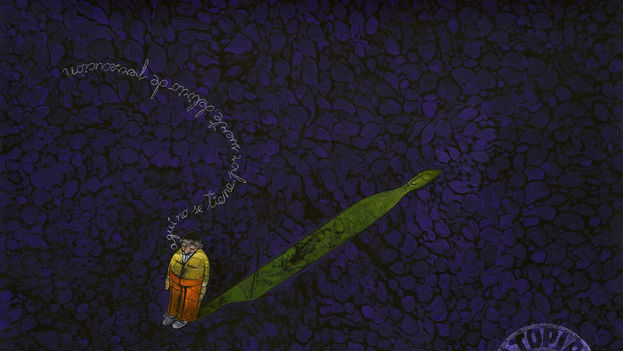
The strange ramblings of Utopito, Pedro Pablo Oliva. (Source: Web Utopias and Dissent)

14ymedio, Juan Carlos Fernandez,Pinar del Río, 25 September 2014 — The artists’ guild in Pinar del Rio is living in distressing times because of the cancellation of the exposition by Pedro Pablo Oliva, “Utopias and Dissidences.” Talking about the most famous of the Pinareno painters has turned into a sad argument by Tyrians and Trojans, some in favor, almost in whispers, and others not so much, also in a quite low tone. But what the whisperers have in common is that they are living a fear that is corroding them and brings up the miseries and limitations that we humans all suffer, but that situations like this multiply.

The way in which the machinery of creating enemies can be efficient and dissuasive then becomes the model, the perception of real danger has been the offering of a local artistic community that shows its solidarity by emulating Nicodemus: they do not want to be seen or heard. They have given to the victim their absence and silence. They have been simple spectators, once again, of the crime of exclusion and disqualification. Listeners at a trial in which they themselves have been condemned although they may only have attended as the public.

The inquisitors of Pedro Pablo Oliva have known how to stimulate in the neurological systems of many Pinareno creators the amygdala situated in the temporal lobe which fires that feeling that we call fear. Although a scant minority has risked and has stood out in spite of also admitting its fears. These last have revived the artistic brotherhood in Pinar; some few carry the decorum of many; someone said one day, those few have meant a breath of hope in the middle of so much impoverishing hate against someone who only has sown love and has been consistent with himself. That is the price of honesty.

The others, the majority, are captivated by reforms that award airplane trips and trips for compensation that rot the soul and ruin the brush.

On the other hand, the common people possess an intuitive intelligence, flavorful and uninhibited and tell you to your face what they think. Overall, they do not plan to fly or exhibit in halls of the elite. Without any ambiguity that take sides with Pedro Pablo, both as a person and an artist, and lament the fear of his fellow painters, according to rumors.

That’s why I think that, although what has happened has been a sovereign injustice, it has served to put on the table who is company for cocktails, galleries and inaugurations and who accompanies you on the road overcoming their fears and discarding the complicity of silence and pretense.

It has been painful for Pedro Pablo, his family, work team and all of us who love him as a friend and national treasure, but instructive. Although it may seem utopian, I think that the night we are living today will not have the last word. It only serves as the anteroom for the light of day.

Translated by MLK

Berta Soler: They Must Put An End To This / 14ymedio, Victor Ariel Gonzalez

Berta Coler, Leader of the Ladies in White
Berta Soler, Leader of the Ladies in White

14ymedio, Havana, Victor Ariel Gonzalez, 21 October 2014 — Berta Soler, leader of the Ladies in White, has called for a vigil this October 21 in front of the Diez de Octubre Municipal Court in Havana. The reason is the new suspension of the trial of Sonia Garro.

Soler explained that there are “dubious things” in the way the authorities have handled this latest extension. “Sonia called to tell me that a captain had told her that the trial was suspended, but she did not believe it.” The activist also said that Sonia Garro’s defense lawyer “was unaware” of the decision. The new date for holding the criminal trial has been set for next November 7.

“We do not trust the Cuban Government, therefore the vigil goes on,” the leader of the Ladies in White told this newspaper. Soler does not rule out that “all this supposed suspension is for the purpose of demobilizing the people.” So, “we are going to be there anyway,” she announced.

There will also be a vigil in the interior of the country because it is expected that in front of the courts of Santiago de Cuba and other cities peaceful demonstrations similar to that in Havana will take place. The Diez de Octubre municipal court is at Juan Delgado and Patrocinio, and Berta Soler says that “the plan is to begin at 8:00 a.m. and last until noon. It depends on whether they let us or not.”

The activist also reported that “since this Saturday, State Security has reinforced vigilance over the Ladies in White.” This is the third time that they have suspended the trial of Sonia Garro. “They must to put an end to this,” she demands.

Translated by MLK

Cuban Government: Two Strategies / Juan Juan Almeida

The man looks like himself.  That’s why, I don’t hit it off with hate.  It’s true, I was born and raised surrounded by men who love to speechify and believe themselves owners of the absolute truth, so much that they imposed it by force with total impunity.

Maybe that’s why some days ago was I surprised myself thinking that separating myself from that government group to which I am genetically tied, more than anything, was due to a strange defect or capacity that I have for accepting criticism and enjoying those insults that for some are attacks and for me, charming primitivism. continue reading

I learned.  As also I learned to look at Cuba without passion and to see that the Cuban government makes itself stronger every day relying on division and that’s why it uses two principal strategies:  one — which is a matter solely for Cuba and Cubans — and another for outdoors, directed to planetary opinion and solidarity transforming our small country in sustained headlines of magazines and news headlines.

Internally it divides society, twists co-existence and feeds the ineffective culture of confrontation between generational groups, between revolutionaries and counter-revolutionaries, desirous of prominence, but fundamentally between rich and poor because — as we already know — socialism loves the poor so much that it multiplies them to make them overrate charity.

Before the world it is something else, evident these days.  The government took advantage of the insufficient response of the international community in the face of the crisis unleashed by the spread of the Ebola virus, and executing a maneuver that besides humanitarian is attractive and magisterial, turned itself into one of the main assistance providers to western Africa sending 165 Cuban health workers and preparing, always publicly because without applause there is no victory, the departure of another group with 296 doctors and nurses.

Ebola went out of control in such a dizzying way that it made the health systems of Liberia, Guinea and Sierra Leone collapse; then Cuba, the greater of the Antilles, the “blockaded” country, delivers with false altruism economic and human resources to the noble work of saving lives.

Impossible not to praise; before such colossal facts what does it matter to Ban Ki-Moon or any other important member of international organizations, that in Palmarito de Cauto they kick another “delinquent.”  Understand the irony, the correct thing is to say dissident.

I am not a red, I am a realist, which although it begins with R is not the same nor is it written the same.  I clarify because I also see that the Cuban opposition continues gaining popularity, above all in virtual spaces, but still it does not capitalize on the discontent of millions of people, of a real population that is disappointed by the system, that does not want to be represented by anyone who victimizes it.  They forget that Cuban society has been saturated with stories of sacrifice and raising pedestals.

Reality seems to walk in the opposite direction desired by many. Cubans want to smile and get to the end of the month without predicaments. That’s why they look with respect and even with a tad of healthy envy at the new entrepreneurs (I don’t like calling them self-employed) and at the artists that prevail at opening doors.  For them, these are the real symbols of individuality, the true vanguard and the most effective creators of popular inspiration because today even sovereignty is a personal concept.

Translated by mlk.

14 October 2014

Of Jails In Cuba / Ivan Garcia

A "combatant" as Cuban prison guards are called, watches over prisoners working in their new uniforms.

For Saul prison is like his second home. He celebrated his 63rd birthday behind bars, fabricating cement and gravel blocks for a Cuban state enterprise called Provari, which makes everything from bricks, tiles and mattresses to insecticides and sells them for hard currency.

Saul knows the island’s penitentiary map like few do. Since 19 years of age he has been held in the main prisons: La Cabana, Chafarinas in Guantanamo, Boniato in Santiago de Cuba and the jails built by Fidel Castro like the Combinado del Este in Havana, Aguica in Matanzas and Canaleta in Ciego de Avila.

“In all, since I was a prisoner for the first time in 1970 because of the Vagrancy Law. I have worked cutting cane, in construction, making tourism furniture or insecticides with hardly any physical protection,” comments Saul, who has been a free man since April. continue reading

According to a former prison official, 90 percent of detainees in Cuba work with scarce security and are paid poverty wages.

“I am convinced that the work of prisoners is one of the main productive engines of the country. Exploiting them allows high profits. Until 2006, when I worked in a Havana jail, they were paid 150 or 200 pesos a month for working up to 14 hours (remember that the minimum salary in Cuba is 484 pesos) or they were paid not a cent. Those who were paid also had deducted expenses like food and lodging. The government gives degrading treatment to the majority of common Cuban prisoners,” says the ex-official.

Throughout the green caiman it is calculated that there exist more than 200 prisons. Cuba is the sixth nation on the planet in per capita prisoners. In 2013, the regime recognized that the penal population is around 57 thousand inmates.

The internal dissidence claims that the figure might approach 100 thousand. Cuban jails are rigorous. Physical mistreatment and abuses by the penitentiary guards are standard.

Suicides, mutilations and insanity within the prisons are a secret statistic that the government handles with clamps. Prestigious companies, like the Swedish Ikea, have been accused of complicity in prisoner slave labor in Cuban factories.

In the 1980’s, Ciro was a prisoner for five years for illegal exit. In his pilgrimage through the detention centers, he worked in a transportation parts warehouse for the Ministry of the Interior (MININT) in the Lawton slum, some 30 minutes from downtown Havana.

“MININT is the main beneficiary of cheap prison labor. In Workshop One I worked with hardly any protection on an assembly line for cars with plastic bodies and VW German motors. I also worked in an upholstery shop where fine furniture was given its varnish. Years later, I learned that they were for Ikea. They never paid me a cent,” says Ciro.

Thousands of inmates participate in construction of hospitals, schools, housing, food production and the most dangerous work. “We do what no one wants to do. Clean streets, sewers and cut the invasive marabou weed,” says Evelio, who is completing a two-year sentence scrubbing urban buses.

Military or state enterprises like Provari are at the head of labor exploitation and captive work. In a brochure published in 2001, the firm Provari was said to have 150 production installations on the island.

In the prison Combinado del Este, on the outskirts of Havana, Provari produces insecticides. A report published in the daily Guerrillero in 2013, said that the Provari branch office in Pinar del Rio in 2010 had sales valued at 200,000 dollars.

According to that report, the Pinarena branch production included chlorine and muriatic acid, beach chairs, baby cribs, concrete and clay blocks, paints, paint brushes, plastic tubes and ornamental plants.

In a workshop in the women’s prison in Havana, jeans are made for export by different brands, as well as uniforms for police, armed forces and the prisoners themselves.

Provari also produces the insecticide Lomate, anti-bacterials for lice and ticks, as well as other products destined for sanitary hygiene. And there are plans to build a solar water heater of 170 liters according to official media.

In that 2001 brochure, among other activities of Provari was mentioned carpentry with precious wood, sale of textiles under the brands Oeste and Hercules and upholstery of office furniture by the Ofimax brand.

“The most worrying thing is that they work without special uniforms, adequate for producing chemical substances.  We prisoners do not have options or a legal representative where we can complain and make demands of the government,” comments the former prisoner Saul.

And he adds that almost all the prisoners work voluntarily. “It’s a way to get air, eat better and escape the abuses of the jailers.”

While the autocratic Castro government prepares “tours” for credentialed western diplomats and correspondents in Cuba to model prisons like La Lima in Guanabacoa, a township to the southeast of the capital, thousands of inmates work in precarious conditions and without the required remuneration.

The odd thing is that state enterprises in the style of Provari, with all signs of participating in slave prison labor, expect a foreign partner to expand their businesses.

Ivan Garcia

Photo:  A “combatant,” as jailers in Cuba are called, poses together with several prisoners who with new uniforms were selected for display during the visits that in April 2013, a group of foreign correspondents and journalists for official media made to Cuban prisons previously chosen by the regime.  Taken from Cuba opens the jails to the press.

Translated by mlk.

7 October 2014

Nicaragua Was Freed From a Regime Modeled On That Of the Castros / 14ymedio, Julio Blanco C.

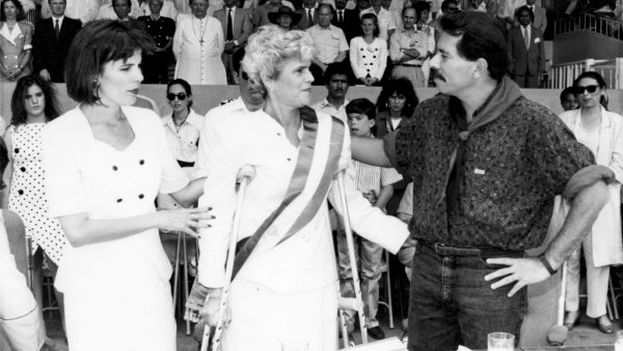
In the election of February 1990, Violeta Chamorro (center) defeated Sandanista commander Daniel Ortega (right)

14ymedio, Julio Blanco C., Managua, 27 September 2014 — I follow with eagerness – almost bordering on addiction – the news out of Cuba. I suppose that my nationality has a lot to do with that because probably no one better understands the reality of the Island (apart from Cubans) than we Nicaraguans.

Here we suffered a regime modeled on that of the Castros, which among other “pearls” imposed on us:

  • A terrible State security system, so that all we citizens were suspected of being traitors and counter-revolutionaries.
  • The rationing card, such an unpleasant memory.
  • Indoctrination of students at all levels of education.
  • The division of society into the good and the bad. Everything within the revolution and nothing outside it was the slogan. Whoever opposed the regime was a pariah, a subhuman, a stinker who deserved not the least consideration or respect. Those “elements” had to be persecuted, silenced, beaten, intimidated and ultimately annihilated.
  • The brutal and ruthless persecution of every communication media disaffected with the regime. This they could not completely achieve, maybe for lack of time, therefore some emblematic media like the daily La Prensa and Radio Corporacion survived the burning.
  • Bank nationalization and the forced socialization or transforming into cooperatives of all means of production, which involved a massive confiscation of private goods.

The list is much longer; I do not need to tell it to Cubans who have suffered first hand for so many years a tragedy so similar but at the same time much more extensive than ours.

My interest now is focused on the transition that Cubans are experiencing, because we went through something very similar, although here everything was quite fast due to the fact that it was not the same government that carried out the changes, but another one.

For the people of my generation who grew up in the midst of so many shortages and limitations, that period of the country’s “normalization,” above all that of the economy, was something almost magical.

The most irrelevant things were all eventful. I remember as if it were yesterday when we began to be happily flooded with junk food. First there was Pizza Hut, then McDonald’s returned after an absence of several years, then Burger King, Friday’s, Subway, Papa John’s and so many other chains that were little by little turning up in the country.

Big hotel companies like Best Western, Intercontinental, Hilton, Hyatt and others arrived, too.

And private national and foreign banks reappeared, and excellent customer attention again became a priority, not like when they were state-owned and little was needed for the employees to bite the unfortunate client.

And the private universities and colleges (these never disappeared) multiplied for every taste and pocketbook.

And many corrupt and inefficient state businesses were privatized and so many others disappeared. Maybe the most significant was Enitel, the embarrassing equivalent of Cuba’s ETECSA telephone company. The change was positively colossal, and soon came competition, and now there were other options for cable, telephone and internet.

Rationing and lines and product scarcity ended, and the giants of the food industry and commerce landed: Walmart, Pricemart, Cargill, Parmalat, Procter and Gamble, and there follows a very long etcetera.

And the first mall opened its doors with dozens of stores and modern movie theaters and its food court and its enormous department stores… but that was nothing, because soon there appeared others even better.

And refueling became a guilty pleasure because the convenience stores are as pleasant as small supermarkets and small restaurants, all in one.

And the public transportation payment system changed. You no longer had to carry a mound of coins, just recharge the electronic card.

And suddenly one day, a growing number of establishments began to offer free wi-fi; even the government installed it in some public parks in all the provincial capitals.

All this, which for us has been fascinating, is completely incomprehensible for someone who has not lived it and been systematically diverted by the State from everything that smells of progress and development however insignificant it might seem.

Maybe one day, sooner than later, Cubans can go through all this, too, and feel that strange satisfaction that is given by knowing “now we are like all the rest,” that we are no longer “different” in the more negative and abject sense of the word. In fact, they are already immersed in a stage of transition – very sui generis – but transition in the end.

Hopefully the weight of reality will finally make the regime understand that it can no longer contain the floodgates of “normality” because Cubans have made too many thousands of holes in the dam, and the waters of creativity and private initiative flow with increasing force.

* Julio Blanco C. is a lawyer in Diplomacy and International Relations. He lives in Managua.

Translated by MLK

The Little Box or the Hospital? / Rebeca Monzo

The little box or the hospital?

A friend, whose name I withhold in order not to harm him, tells me of a neighbor “partner” of his who works in the Ministry of the Interior and who became, what we call here a “super salary,” who confessed to having raised the following complaint at his work center:

“I earn 690 CUP (Cuban pesos), which here is considered a good salary. Recently they passed by my office taking note of colleagues who were interested in buying the decoding boxes for digital television; this equipment, according to what they explained to us, has the purpose of converting the digital signal into analog for those people who, like me (the majority), cannot immediately replace the less modern televisions that we own.

To my understanding, they are of two prices: they cost 30 and 38 CUC (Cuban convertible pesos), depending on their functions. I, of course, would opt for the more economical which, multiplying its price by 25 CUP, as they do in the stores, becomes 750 CUP and I earn 690 monthly, therefore I would have to take 250 CUP from my salary for three months until matching the price of said box, and make do however I can during those 90 days, which means that during this period of time I will not be able to buy milk, pork meat or vegetables and will even have to neglect my grooming a little, besides which with the remaining 440 CUP I will have to pay each month for gas, electricity, water, phone and some other essential grooming article like soap, which would be impossible because that would far surpass my meager budget.

“What to do then?  Get used to not watching television when I arrive home, tired after a long work day, because of not acquiring the little box, or failing that, go after acquiring it, directly to a hospital?”

Translated by mlk.

30 September 2014

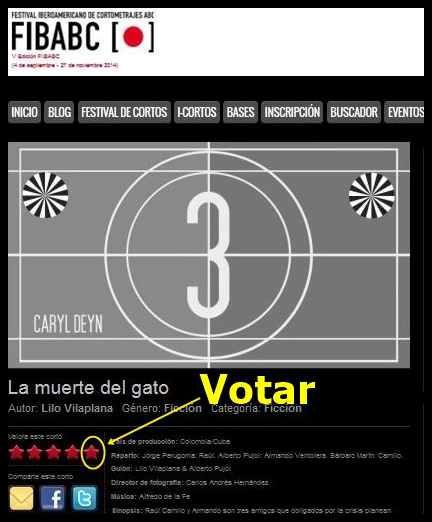
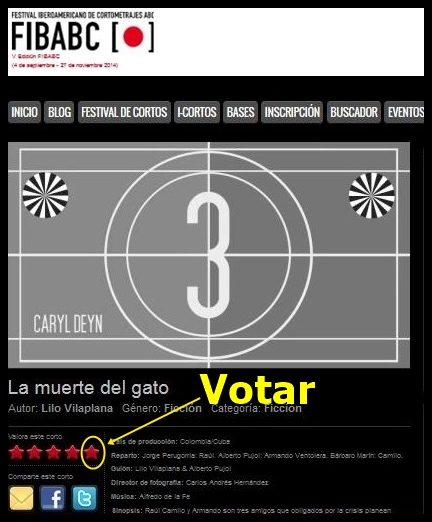
Let’s Join "The Death of The Cat" in Denouncing the Castro Dictatorship at FIBABC

For my soul brother Angel Santiesteban, prisoner of Cuba for thinking differently.

For my second father, Raul Guerra, who died intoxicated with disappointment.

The Death of the Cat

Writer:  Lilo Vilaplana  Genre:  Fiction  Category:  Fiction

The Death of the Cat is much more than an exceptionally accomplished work of art by Lilo Vilaplana.  It is an unambiguous argument against the Castro dictatorship that has plagued Cuba for fifty-six years.

It deeply impacts Cubans who have lived that period, those who even if they have not lived it suffer even today the same painful reality, and the non-Cubans who are moved seeing how the Castro propaganda has fooled them also while all Cubans are prisoners of the big island jail.

Dedicated to Angel Santiesteban and Raul Guerra, it deals with a work of fiction inspired by real events, contextualized in the day after the shooting of General Ochoa but that takes great care with even the smallest details managing to recreate on a Bogota lot the miseries of one Havanan.

Details as “trifling” as to have covered the floor with a paper that mimics the tiles that populate Cuba.  And even the wretched roll that Cubans eat, many preliminary experiments were needed until obtaining what appears in the short film, seeking not to exceed the weight and to be true to what the impoverished people eat.

It is not easy to create intentionally so much destruction, poverty and neglect as the Castros have caused in over five decades.  Painstaking craftsmanship by Lilo’s team has managed to “destroy” the setting, making it so true to life that more than one person will believe that it really was filmed in Havana. continue reading

The director’s merit, and it is great, is not only artistic.  The art, it is true, has brought the short film to first level international festivals.  But it has not only shown the world Cuban talent, which is infinite and in Cuba has no possibility of being developed unless one wants to end up censored, marginalized or in prison.  The short itself, filmed in Colombia, is true testimony that in order to exist, it must have been born on another horizon where liberty reigns.  And just for this reason, the performances by Jorge Perugorria and Coralita Veloz, both residents on the island, are doubly meritorious.  You have to have a lot of guts to participate in such a film and continue living in Cuba.

The fact that The Death of the Cat is shown in the CANNES or GOYA festival, among others (KRALJEVSKI FILMSKI FESTIVAL, Serbia; FESTIVAL IBEROAMERICANO DE CORTOMETRAJES ABC.ES, Spain; FESTIVAL LATINOAMERICANO DE VIDEO ROSARIO, Argentina; PORTOBELLO FILM FESTIVAL, United Kingdom; FESTIVAL PIRIAPOLIS DE PELICULA, Uruguay; TRINIDAD + TOBAGO FILM FESTIVAL, Trinidad and Tobago), means that hundreds of thousands of people from all over the world can learn the reality of Cuba, which tries to hide it at all costs, and I refer not only to the misery, but to the most terrible thing:  a people subjugated to a brutal dictatorship, for the violation of human rights is its denomination of origin.

Seeing The Death of the Cat and voting for it at FIBABC means, besides recognizing Lilo Vilaplana’s talent, an act of patriotism, because his participation in the Goya Festival will help open eyes to the reality of Cuba for a great number of people in the world who have no possibility of seeing it with their own eyes.

Certain that Angel Santiesteban would ask you to support Lilo Vilaplana by voting for The Death of the Cat if they did not have him isolated as they do, I ask it in his name.

The Editor

To see and vote for The Death of the Cat, follow the next link:
Magic Filmmaking

by Angel Santiesteban

Finally, through my son’s cell phone, on the visit he made me in recent days where they have me incarcerated, I was able to see the short film “The Death of the Cat,” by Cuban director Lilo Vilaplana, living in Colombia for more than a decade, a place where he took — besides his talent, craft, some friends and his family — the bitterness that he suffered first hand, totalitarian logic processes, and that now, as a mature creator, he feels the duty to expose, first as literature and now in film.

The traumas lived by Lilo, which he carried in his soul like a mother who travels pregnant, began to flower in that second country — Colombia — which opened its arms to his stroke of talent and effort in the productions.

After a decade of successes, now he can afford to produce these short films; the script of this particular one is based on one of the stories from the collection “A Cuban Story,” which saw light, also, after he emigrated.

Many viewers will confuse its geography and think that it was filmed in its totality in Havana, because at the beginning the character Armando is seen walking through its streets, in the great performance by Albertico Pujol, who was filmed by another colleague, at Lilo’s request, because of the impossibility of his entering Cuba.

Then the brilliant edition would be harmoniously connected with the rest filmed in Colombia, thanks to the plausible set design by excellent professionals who thought of even the most minute detail, and which helped to color the Cuban reality at the end of the eighties decade of the past century — on the eve of the officially named “Special Period” that would uncover the worst penuries ever lived by the Cuban people and that, in a snap, changed the perspectives of a nation deceived and repressed for decades.

To lend context to the story, it is worth remembering that Lilo chose the day after the execution of the Hero of the Republic of Cuba, Brigadier General Arnaldo Ochoa, a circus spectacle by the Castro brothers to entertain the people, to make them forget their hardships and resist taking to the streets in protest.

It was also a lesson for the high military command — on the other hand no less important — to remove the danger of those who had feathered their leadership, and who imitated the habits of the Castro brothers, their mentors, for those “that life was for enjoying at any cost.”

Finally, once the officers “diverted from the principles that the Revolution pursues” were punished, it was said in the official press that the complaints by the government of the United States had to be put to an end at once, complaints which accused Fidel Castro of being part of international narco-trafficking that introduced drugs into its country.

Destroying those men who could testify about the regime’s consent to the participation — and with the most notorious drug lords, like Pablo Escobar himself — they sealed an opprobrious chapter, and — as if it were little — they exterminated those who could create a seditious plan against their government and compete with brother Raul Castro for military power.

Amid this national morass, the artist that grows within Lilo is preoccupied with the little things, apparently inconsequential in the eyes of most, in order to reflect them in the art, like hunger, the need for a political transition, the loss of societal values, the separation of family, and the painful scars, exposed, in this case, in the character of Armando, who has no news of his son who launched himself to sea on a raft, a long time ago; not knowing his whereabouts, he supposes that he did not reach the Miami coast and lost his life.

The story walks the tightrope between social criticism and artistry, between melodrama and sensitivity, managing, happily, to emerge unscathed avoiding the pitfalls of trying to tell the deep suffering of each actress, actor and production team, except the young actor Camilo Vilaplana, who thanks to his parents, managed to grow up far from that social catastrophe.  In the end it manages to ward off, although it always suggests, the conviction of those responsible for the desperate reality; that judgment it leaves in the hands of the public, particularly the Cuban public.

Also without making it obvious, it awakens that unavoidable fine humor in Cubans although the worst occurs.  The cat is the trophy for their real salvation and objectives; adding meat to their food source is vital for them and, in this case, the black pussycat becomes a symbol of the worst, because it is also vengeance for the oppression that they feel because of its owner, the neighborhood snitch.

The masterful performances by Jorge Prugorria as Raul, Alberto Pujol as Armando, Barbaro Marin and Coralita Veloz, as Camilo and Delfina, respectively, ride the scene, in a brilliant team, to a worthy height, artistically speaking, which leaves a taste of pain instead of pleasure.

We are grateful for the effort of the Vilaplana family and the artist friends that joined the project because in the death of the character Armando, we kill part of the shadow that still pursues us from those hardships, and in the suffering and tears of Raul and Camilo, our own tears flowed, in the full exercise of personal exorcisms.

These days, the short film has been invited to participate in the Cannes Festival; in spite of the pain of our lives reflected on the screen, knowing that the guilty dictatorship still maintains power for more than half a century, each time the Cubans wandering the world in search of freedom and opportunity overcome the fear of being pursued in whatever corner of the planet where they try to hide, they triumph, above all with the weapon of art, the most effective of all.

Receive my embrace and thanks for the unmerited dedication, from your brother Angel from the Lawton settlement.
Angel Santiesteban-Prats

Lawton Prison Settlement.  May 2014.
Translated by mlk

21 September 2014

The Unknowns Behind the Cultural Exchange / Juan Juan Almeida

Before the Portuguese awning maker and salt merchant Matias Perez* disappeared in the world, already Cuba and the United States were maintaining solid ties, including cultural exchanges, which continues being today an important part of our history and identity.

Just by glancing we can find Cuban elements in American culture and vice versa, so much so that “Cuban-American” is the highest expression of that cultural ethnic fusion between both nations.

The cultural reciprocity was frequent, artists came and went constantly. The thing got complicated during the first half of the 20th century when both governments–and I’m going to tell the truth, like it or not–began to have a relationship based on political principles so conflicting that paradoxically they made the arts sector, that of the expression of the spirit and creativity, a prisoner of circumstances. continue reading

The Cuban Government historically has used art and culture as a machinery for social control and as influence, as much national as international. Today, in the era of globalization, the internet and social networks, much more so.

It was for this purpose, and in order to undermine with patience and subtlety the controversial law of the embargo, that at the end of the ’90’s the “Battle of Ideas” was created, a real strategy that built new masks.

In 1998, with a depressed economy and more than fifty percent of Cuban artists unemployed. The financial strain was such that it managed to break even the connection with inspiration and many important names decided to emigrate. But this time, the Cuban Government was not prepared to lose so easily its cultural heritage.

For such purpose it invented the figure of the “independent artist,” a category that still permits them to enjoy more of the destination than the trip, to give them the possibility of, paying a paltry sum of Cuban pesos, establishing legal residence indefinitely outside of Cuba, even in the United States, without losing the status quo.

Other less well known artists also managed to find a legal loophole, many times covered in false work contracts that they get weaving a net of bribes, in order to be domiciled outside the island.

That is how various actors, writers, filmmakers,  musicians, artists, dancers and even lecturers leave Cuba, like they left the mango marmalade the coffee, and the guava shells, to produce in liberty.

On living outside the island, these artists hold accounts abroad. Today they come to the United States for cultural exchange, they act, they triumph with poses of lofty urban climbers, and although none of them says it, nothing keeps them from collecting. The embargo law sanctions sending dollars to Cuba; not so the rest of the world.

As a Cuban, I don’t like to stimulate the climate of hostility that separates us as a people and that also serves as a political and economic platform for groups that manipulate us from both shores of the Florida strait.  I believe that contact with exponents of the culture coming from the island is a good thing. I am in favor of exchange; but not this lie that turns it into contraband.

Translator’s note: From Wikipedia: Matias Perez was a Portuguese born, Cuban resident, who started a canopy business in Havana in the 19th century. He was carried away with the ever increasing popularity of aerostatic aircraft, and became a balloon pilot, ascending at least three times before he disappeared while attempting an aerostatic flight from Havana’s Plaza de Marte (today, Parque Central) on June 28, 1856. A few days earlier he had made a successful attempt, flying several miles. His second try, however, became part of Cuba’s folklore: when somebody or something disappears into thin air, Cubans say: “Voló como Matías Pérez” (it flew away like Matias Perez)

Translated by mlk

4 September 2014

All Exiles Are Possible / Luis Felipe Rojas

1405566194_3When I say exile, I only think of the word life. That was what happened to me at the meeting “Fight for Liberation against Castro-communism,” which the writer Julio M. Shiling generously coordinated and which was held at the West Dade Regional Library of Coral Way, Miami, last July 10.

Attending the discussion were no more and no less than the well-known former political prisoners Angel de Fana, Agapito “El Guapo” Rivera, Jorge Gutierrez “El Sherif” and others who presented an overview of the insurrectional struggle from 1959 to the present.

De Fana’s words and his hopes for a future Cuba moved me. Twenty years in jail did not seem to have put a dent in the energy of this man who confronted the torture and prison horror of the Castro regime. “We must fight, not for the Cuba that we lost but for the one that awaits us ahead,” I heard him say. continue reading

Agapito, a peasant known for having fought in the central plains of the island against the militias and formal army, spoke of the bravery of those who accompanied him in that feat (there is no other name for this action). The loss of 11 relatives has not made him a resentful man, although pain emerges with each word for a country that could not be.

“No one knows the pain that is felt on learning of the death of the youngest of the brothers that you have taken to war,” says the man who earned the nickname “Handsome” in the prisons where they tried to break him for the 25 long years that he spent without tasting freedom. His liberation in 1988 must have been a relief for his jailers, according to the anecdotes that are told by those who shared galley, hallway and punishment cells with Agapito.

We live likewise through the story by Jorge Gutierrez, who landed in one of the infilitration teams days before the Cuban expedition in the Bay of Pigs. The loss of friends that had sent him off days before, the bitter flavor of the disappointment of promised help that never arrived, were related in detail by Gutierrez with a dynamic that left no room for doubts.

The other fight, the same country

Roberto Luque Escalona like Normando Hernandez related experiences of what is known as the peaceful resistance struggle, which although it has its detractors on both sides of the island, gave rise to one of the samples of respect that Cuba deserves.

Those who preceded Luque and Hernandez recognized the co-existence of both methods without sidestepping one or the other. Luque as well as Hernandez explored anecdotes that illustrated the advocacy of human rights, the confrontation of a more sophisticated military, which although assisted by Moscow, since its beginning was refining methods of repression from physical to psychological torture: to the point that at the beginning of 1980 many countries ignored what was happening on Dr. Castro’s island. So far the majority of nations ignore the lack of liberty in Cuba.

It has been a good opportunity, a landscape portrait of thousands of Cubans who do not fit in a single photo. Thanks to the labor of Shiling and his insistence on learning more of the untold history of the resistance against communism in Cuba.

1405566195_21405566196_1Translated by mlk.

17 July 2014

Liberty Costs Dearly, and Angel Santiesteban Decided to Buy It for Its Price

In the world there has to be a certain quantity of decency, just as there has to be a certainly quantity of light. Where there are many men without decency, there are always others who have in themselves the decency of many men. Those are the ones who rebel with terrible force against those who steal from the people their freedoms, which is to steal decency from men. In those men are thousands of men, an entire people, human dignity. Those men are sacred.”  Jose Marti.

Today, August 28, 2014, it has been a year and a half, 18 months, 72 weeks, 548 days or 13,152 hours since Angel was unjustly incarcerated.

In this time, not a single response from the dicatorship in answer to the requests for a Review of his rigged trial after the false complaints by a resentful woman manipulated by State Security.

In this time, his son grew enough to distance himself from his mother, the complainant, and to tell that he was manipulated to lie and testify against his father for the purpose of hurting him. continue reading

Cuban writer Amir Valle presenting Angel’s book

In this time, Angel has continued writing, publishing, and reaping awards.

In this time, Angel has continued denouncing the brutalities of the most pampered dynastic dictatorship in the world where hypocrisy reigns.

But, in this same time, thanks to the same dictatorship that keeps him incarcerated, he has been able to denounce the horrors from the very heart of hell, the Castro penitentiary system.

After the simple words of his son — which dismantled the State Security’s crudely concocted plot against him — they have only increased his isolation in punishment because of them, and that’s why we continue not knowing his own version of the events that had him in an unknown location for a week.Right now, his own reality came to occupy the place of the complaints that he cannot send us.

The silence to which they condemn him, the blind, deaf and mute justice, the illegal transfers and his solo confinement, are the most tangible proof that his complaints are true, that Cuba lives in submission to a ruthless dictatorship, where there exists no separation of powers and that to assume the universal right of free expression one pays very dearly.

Incarcerating him and silencing him, the regime says through Angel much more than he himself; it only corroborates with events what it denies in speeches, that yes, always decorated with supposed reforms and feigned openings that are nothing more than the other such farces to which we have become accustomed.

Angel continues a prisoner but freer than ever. The truth is that they will never be able to silence him. The Jaimanitas cell where there is an officer posted at the door 24 hours a day is the most patent and pathetic proof that Cuba is steeped in terror.

“A just principle, from the depths of a cave, can do more than an army.”  Jose Marti.

The Editor

Click the link for Amnesty International to declare Cuban dissident Angel Santiesteban a prisoner of conscience.

 Translated by mlk.

27 August 2014