It Is Never Too Late / Rebeca Monzo

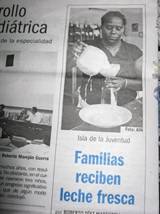
Just a few days ago we celebrated Farmers’ Day. Its highest leader, among other things, expressed that he couldn’t continue extracting and transporting fresh milk, nor offering it to the people with such precarious hygiene.

In May 2010 I put up a post called “Hygiene Is Health”, where I inserted this photo taken from the daily Rebel Youth, because it called my attention tremendously by showing so primitive a form of distribution of fresh milk — even after a high standard of hygiene in the distribution and sales of this product had reached our country in the 1950s.

It is true that it is never too late and that to rectify is of wise men but if a simple citizen can perceive it, the ruling class has the obligation to be the first to note it, isolate it, and correct it. We cannot continue being so late in perceiving things that jump out at the sight of whomever, above all if puts the health of the populace in play.

And to think — how they fill their mouths criticizing Lady Republic, who died while she was still so young. The same which, with her defects — but also with her countless virtues — placed our country among the first of Latin America.

My respects to that lady who today would arrive at her 109th birthday. It is never too late.

Translated by: JT

May 20 2011

A Happy Landing / Rebeca Monzo

When they talked to me about an invitation to Chile to take part in a cultural exchange I was, of course, very happy. In my world, even the cat wants to travel; perhaps because it is so complicated and labyrinthine to do so? We always suppose that the fruit we aren’t allowed to eat will have the best flavour.

Of course, flavour is one thing. The troubles involved for those who need to take a flight is another. Because, in my world, you are never sure that you will be able to travel, until you are on board the plane that will take you to your destination, and it’s safely in the air.

This little trip to Chile started to develop on the 17th of January. On this date I presented the papers that were required (a mountain of them). The days passed and nobody had contacted me, so I called the department that was dealing with me and in that moment I learned that there was a detail that I had to clarify in order for them to proceed to create an essential document I would need. This was corrected and then everything was ready relatively quickly. But, as the saying goes, happiness in the house of the poor doesn’t last long.

Soon after this the application for my visa began smoothly, but the organisation that was going through this process for me, was not up to date with changes that had been made in the Chilean Consulate, despite the fact that they had been informed. As they would explain to me in due course. In the end, this misunderstanding meant I would have to do a lot more running around and make three trips to the Consulate.

Finally today, the 12th of April, we arrived. I say “we” as my sister who is also an artist has come to the same event. We were very well received and looked after and even the weather has been kind to us. There is nothing else but to enjoy our twenty days, that only took me three months to pull together and organise like a complicated jigsaw puzzle. But despite this difficulty, still in my world the cat would give his whiskers to take a little trip. I wonder why that is?

Translated by: Liz

April 13 2011

Largarto Verde / Rebeca Monzo

Another story for distant granddaughters

In the small island Largarto Verde, everyone lived happily. They had almost everything, but people wanted more. They longed for it so much and with such strength that one day a handsome man showed up, speaking soft words to the wind that caressed the ears of the islanders. His name was Delfi. Soon he gained the trust and respect of the naïve lagartoverdianos, who had little and poor experience in political matters.

Young Delfi felt secure, admired and feared. Little by little he started gaining control of everything: first the houses, then the businesses, the animals and the money of each and every one of the inhabitants of the island until he gained control of their thoughts. Some noticed this pretty soon and were able to escape; others decided to trust and were trapped in the middle of the greatest inertia while Mrs. Apathy slowly swallowed Largarto Verde.

Time went by and there was nothing left to do. The spell was beginning to crack, but all exits were already closed and Delfi was the only one who could order the gates that communicated with the great oceanic wall that led you to freedom to open.

When everything started, Bighearted Grandma was still very young. She thought that if she stayed she could prevent the evil from expanding or at least she would try to stop it from reaching her family, but it was not like that.

More leaves from the tree of time inexorably fell. The new family and the new friends withered as well. New members were born and some others died without her being able to be at their side and as time went by she was lonely once again.

One day she found an angel and asked to borrow his silken wings so she could fly, and fly, and fly and meet her granddaughters and see her children who lived far, far away next to the stars. When she returned to Lagarto Verde she had to return the wings and now she has been waiting so many years that Delfi, who is now very old and with a lot of ailments, mistakenly leaves the doors from the big wall opened so grandma can get the crystal boat with platinum oars that she hides in her house, go to the blue water and row, row, row until she meets her loved ones again.

Translated by: Alegna Zavatti

March 24 2011

For How Long? / Rebeca Monzo

A friend who lives outside my world called to ask the question we’ve all been asking almost daily: How long do you think this is going to last? I answered: Unfortunately, this is like church marriages: ’till death do us part.

What could I wish for more than for the end to arrive right now. I don’t have a lot of time left and I have lost lots, perhaps the most important time in the life of any human being. But I try not get my hopes high up. As a nation we have allowed many things to be taken from us, among them, the most important ones: our dignity and our civility. There is induced fear that has driven most to accept without public argument the unfair and extreme measures imposed on us. This, together with the daily hardships to which we are subjected due to the lack of money, food, etc., has prevented people from thinking that by the simple fact of doing nothing against, but also nothing in favor, it would likely be enough

The censorship imposed and to which we are all subjected isn’t enough; most people self-censor themselves creating a sort of civic paralysis that corrodes us inside. We are sucked into our daily hardships. If we add to this the lack of communications with the outside world, the lack of short wave radios, the extremely expensive international phone service, the almost impossible access to the Internet, we are basically isolated. On the other hand, the information we get about the earthquake in Japan and its consequences, the brutal repression of the Libyan dictator against protesters, etcetera, etcetera, we feel selfish for thinking about our day-to-day. Even so, we keep asking the same question: for how long.

Translated by Jay Stgo

March 18 2011

Of Trios and Duos / Rebeca Monzo

Archive photo

They were a deeply rooted tradition in our country, the groups made up of three members, called Trios or Tercetos, which proliferated in the 40s and 50s.

The country’s development took with it the creation and expansion of multiple recreational venues: cabarets, restaurants, open airs, the movies, and later, television. A country of musical greats and different opportunities to develop and express oneself. This made ever more musical groups appear, above all those of this little format, which served to lighten and make long Cuban nights more cozy. Thus emerged: The Matamoros Trio, Trio La Rosa, Trio Taicuba, The Lake Brothers, The Chancellors, The Ambassadors, Voices of America, The Indomitables, to only mention a few of the endless list.

After ’59, they went around closing those venues mentioned earlier, and around the middle of the seventies a sort of dry law popped up which finally shut them down for good; until television was left as the only option for these musicians. Thus they left little by little, most of them abandoning the country; and those who remained dedicated themselves to surviving at unrelated jobs, losing many good examples of our popular music.

Nonetheless, the picturesque creole has brought a new definition that doesn’t appear in Spanish language dictionaries: a trio is a symphonic Cuban orchestra which goes on tour abroad and returns.

However, on our planet there exists another small format: a duo, which, as its sole option for more than 50 years, is making us dance to the same tired rhythm.

Translated by: JT

February 28 2011

Baire, the Closest / Rebeca Monzo

This February 24th will be commemorated — behind closed doors — one more anniversary of that cry of independence that was given in Baire, a day like today then in the year 1895. This date marked the start of the War of Independence, its most notable authors Martí, Maceo, and Máximo Gómez.

Since 1959, this changed. Now flags only fly on the new homeland dates: Anniversaries on the 26 of July, of the Committees for the Defense of the Revolution, and even the Comandante’s birthday. No more do they fly for the Cry of Baire, nor that of Yara, the 20th of May, dates on which cities regaled themselves with a profusion of flags that proudly flew in government places and the fronts of Cuban families’ homes.

For the young people of today, those cries of liberty are now long past. Now, unfortunately the closest they hear in their homes are of their mothers and grandmothers, when in the day-to-day they have to face the culinary battles.

Translated by: JT

February 24 2011

Cries of Freedom / Rebeca Monzo

Health care is one of the two flags of socialism most flown on my planet over all these years. The other is education. Both are faded and frayed. The first thing lost was the color, then the credibility.

There are many stories told by ordinary citizens on the subject of health. Each one more horrifying than the last. Take care! It’s not about the doctors. They also suffer. I’m referring to the services, the facilities, the medicine.

A few days ago my niece was admitted to the old Sacred Heart clinic, today called Gonzalez Coro hospital. They had to give her a cesarean section after working a full day to induce labor. That same night I went to visit her. The only bus route that lets me off nearby never comes, and when it does pass it doesn’t stop, so I decided to walk. Unfortunately at this hour the cemetery, which is the shortcut to Vedado, had closed its doors. I had to go through La Timba neighborhood, but with the evening still light it wasn’t too dangerous. The return would be by 23rd St.

On arriving at the hospital tired from the walk I saw that only one elevator was working and it had a lot of people waiting so I took a deep breath and climbed the stairs to the 5th floor. It was partially illuminated. There was only one light bulb every two floors.

Looking for my niece’s quarters, I stuck my head in every room until I found hers, number 15, handwritten on paper stuck with glue and almost coming off, marked the door. Hugging my niece, still in pain, I saw Laurita at her side in a cradle, pretty, healthy, pink. I reached out my hand to turn on the light and I realized that the electric switch was balanced in a hole almost without plaster. Then the image of that beautiful clinic of the 50’s came to my mind. Only the green granite floor was left intact. It had born the brunt of abuse although now it no longer shone.

My niece, very content, when saying goodbye told me in a conspiratorial tone: Aunt, see how far we’ve come, now when babies are born they no longer need to be spanked to stimulate a holler, they only say to them, “You were born in Cuba, and just like that they start to cry.”

Translated by Dodi 2.0

February 17 2011

Cries of Freedom / Rebeca Monzo

Last night at a gathering at the home of friends, there was a lot of talking and speculating about the cries of freedom that came from the Middle East.

This made all of us who were there question the different implications of why on my planet apparently nothing happened, and no one decided to take to the streets.

There was speculation about whether or not we had this tradition of struggle. Analyzing the various events that occurred during our history, we realized that the overthrows of dictators were not preceded by these street demonstrations. The strikes came after, in celebration.

For over half a century, we have witnessed several mass exodus: Camarioca, Mariel, the Maleconazo, with a single goal: to leave the country. There has never been a mass protest demanding freedom. The closest we came to that was during the great concentration of people in the Plaza, on the occasion of the Mass offered by the Pope during his brief visit. More than a million throats shouted “Freedom! Freedom!”, but it didn’t happen. Induced fear has been the constant in our lives. That, not to mention that the main task of us all during these decades has been to get food to bring to our homes. Here is where the people have indeed been combative. Many of these demonstrations, to get potatoes, rice, sugar, etc., have ended in fights, assaults and even broken arms.

Everyone gets excited when the distant cries of freedom come to our ears, and we would like to infect ourselves, but we must be honest and recognize that, as a people, we are paralyzed by fear, fatigue and hopelessness.

Translated by Rick Schwag

February 16 2011

Flailing Around in the Dark / Rebeca Monzo

A sale at a doorstep

The year has begun, and we see timbiriches* sprouting all over, selling mostly the same products that are sold neighborhood after neighborhood. Necessity has made everyone set up tables outside to sell—in the hope of deriving some financial benefit from it—all sorts of products. The ones that have proliferated the most are the ones that sell food items. It’s logical: when money is scarce, food tends to be the only thing that sells. Bread and roasted pork, bread and ham, bread and omelet, cheese pizza, etc. The omnipresent ingredient is bread.

Many people are already speculating on the scarcity of bread and flour at grocery establishments. The long lines are back—all the time—in front of the stores that sell both items. If you are successful in buying bread, even when it is not expensive (10 pesos per pound) it is seldom of good quality. It usually lacks fat, or it has not been properly baked.

Just the other day, when my friend Armando returned from the bakery with a pound and a half of bread, a very tidy gentleman—even if humbly dressed—approached him with very good manners and explained to him, ashamed, that he had not eaten for the day and did not have the ten pesos to buy liberated bread (that is bread that is not sold through the rationing system). He asked if he could have a piece. My friend, moved by such strange request, immediately gave him the half pound he had just bought. Still amazed by what he had experienced, he told me what had just happened: “The worst of all this—he said—is that, for fifty years now, we have been flailing around in the dark, and we still insist in implementing already tried models that, in the long run, did not produce any results because we didn’t first prepare the proper infrastructure.”

*Translator’s note: Timbiriches is a Cuban word meaning a very small business, such as a stand, kiosk, umbrella, or selling out of one’s home.

Translated by T

January 23 2011

If It’s Wires We’re Talking About… / Rebeca Monzo

Wires have been omnipresent elements of our culture, especially during the past few decades.

There are those fine, multicolored wires, those you find scattered on the streets after telephone lines have been repaired. These, up until a few years ago, were sought for and collected by empirical artisans who, given the scarcity of paste jewelry in stores, improvised necklaces and earrings, much sought after by our women to dress up their poor outfits.

There was also another type of wire, a bit thicker, whose bits were kept as treasures—in improvised storage bins—for those moments when bracing the leg of a piece of furniture or tying up springs in an old sofa was needed.

Now it is the fiber optics cable that has become fashionable. That wire that will supposedly give us better and wider Internet service, here in a country where internet connectivity has become a fantasy for the majority of the population. Official figures insist that a little over a million Cubans have access to a limited Internet service. In good creole Spanish, this really means Intranet service. In other words, those who have the equipment required, plus the privilege of E-Mail access, can navigate through the internal network of the country, but none at all to have access to the World Wide Web, and few to any kind of chat services.

The authorities in our planet have made it quite clear to all that this is not about extending web access, but about allowing present users (mostly from the State) a higher connection speed. Despite this, those of us who insist in believing in progress welcome it, because, in the long-run, one way or another, many more of us will also benefit. So then we arrive at the last wire we wish to talk about, the one that is precisely the best-known among us, due to its sustained and continuous use: The line* that most of us who survive here have been eating for over half-century.

*In this context, “comerse un cable” does not translate literally into “to eat a wire”; it is an idiomatic expression (in Cuba, Puerto Rico, Venezuela, and other Spanish-speaking countries) that refers to boredom / idleness / lack of money—depending on the country—and always related to lack of work or activity. A literal translation, then, is not possible without an explanatory foot-note.

Translated by T

February 9 2011

To the Almendares River / Rebeca Monzo

This last Sunday, as I was coming back home from visiting a friend, I crossed the bridge over the Almendares River. And looking at this river, I remembered that beautiful poem the famous poet, Dulce María Loynáz (1902-1997) wrote, inspired by it.

I met this great lady late in her life, when she was already retired and in her voluntary incile* at home, where she had let time and memories peacefully flow. It was her birthday that day, and a good friend of mine had asked me to accompany her in her visit to greet her. I was excited by the idea, because I would have the opportunity to be face to face with one of the most important figures of Hispanic literature. As I did not have anything to give her as a present—it was a last-minute invitation—I decided to give her a beautiful conch shell with a maidenhair fern planted in it. She was a great lover of nature and simple things.

I was very impressed by her beautiful house at El Vedado, even when it was run-down by her evident lack of resources. You could still see some fine furniture and porcelains around, mute witnesses of her former social status. The ceilings had patches of missing plaster, the rugs were worn-out by time, and the lack of paintings on the wall surrounded the house’s owner in an aura of mystery. She received us with a wide smile and a steaming cup of coffee, served by a niece who took care of her. This wonderful lady, already forgotten, became news once again in our planet when she received, a few years later, the important and well-deserved Cervantes Award.

This is how her poem to the river starts:

This river with a musical name
Reaches my heart through a road
Of warm arteries and a tremor of diastoles

This is its last stanza:

I will not say what hand tears it away from me,
Nor inside of what stone of my breast does it find its source:
I will not say it is the most beautiful
But it is my river, my country, my blood!

*The opposite of exile

Translated by T

February 7 2011

The World is a Mess / Rebeca Monzo

That’s what people in my planet usually say when someone, timidly, dares to voice any sort of criticism in the public media regarding anything that affects us all.

But the truth is that the world is, indeed, a mess. Only a few weeks ago, Tunisian protests began due to the high costs of food and gas. Very soon these protests made clear the long and excessive rule of the Tunisian political leader. And very soon, neighboring countries followed; presently, mass protests have been ongoing in Egypt, where the demonstrations are increasingly heating up.

It was Mubarak’s opponents who first took to the streets: men, women and even children peacefully demanding the resignation of their president. There, the origins of the protests were similar to the Tunisian ones. Yet the stubbornness of a ruler who has been in power for over three decades has come to the forefront, and what initially was taking place peacefully and in an orderly fashion has become unstable: now the supporters of the regime have begun to counterattack and, for the first time, we are witnessing abuses, violence, Molotov cocktails, showers of stones from rooftops, aggression to foreign journalists, deaths and hundreds of injuries. The civilized world asks for a peaceful transition and the creating of a new government. It wasn’t long before Mubarak’s counterpart in Yemen got the message and, sensibly, he has already declared he will not run for reelection and that he will not nominate his son as his successor.

In the meantime, here in our continent, the leader of our neighboring Bolivarian brother, proclaimed that not only he will celebrate his twelve years in power, but that he also plans to celebrate another twelve, and then another twelve, and more and more after that, boasting about his illustrious intelligence.

And meanwhile, I, unwillingly, have caught myself remembering that old saying from my grandma: “When you see your neighbor’s turban burn, soak your beret.”

My friends, the world is, indeed, a mess.

Translated by T

February 4 2011

Martí, the Timeless One / Rebeca Monzo

Oil painting by Cuban painter, E. Abela

So loved by many, misunderstood by some and utilized by others.

Martí is the instinct of love, of generosity, of altruism, of sacrifice.

So predominant was the creative impulse in Martí that the sweep of his life arched further and further away from the center of his “me”.

“Man loves liberty, even if he does not know that he loves it. He is driven by it and flees from where it does not exist.”

“I do not believe that in matters that interest all and are the property of all, nor even in private matters, should the opinion of one man attempt to prevail.”

“All power broadly and extendedly exerted, degenerates when made a caste. With castes come interests, haughty positions, the fears of losing them, the intrigues to sustain them. Castes seek each other out among themselves, and support each other by the shoulder.”

“In the world, there should be a certain amount of decorum, as there should be a certain amount of light. When there are many men without decorum, there are always those who carry within themselves the decorum of many men. Those are the ones that rebel with terrible strength against those who rob peoples of their liberty, which is to rob men of their decorum. Within those men are thousands of men, an entire people, human dignity.”

Remembering the Apostle*, on the 158th anniversary of his birth (28 January, 1853).

*Translator’s note: This refers to El Apóstol de la Independencia Cubana, the Apostle of Cuban Independence, as José Martí is known reverentially by all Cubans.

Translated by: Yoyi el Monaguillo

January 27 2011

From the Sublime to… / Rebeca Monzo

Yesterday in a conversation among friends, fed up with such serious topics as the layoffs of more than one million workers and wanting to lighten up the conversation a little, we ended up telling anecdotes that, although sounding like jokes, are pure reality and make us laugh by being so absurd in themselves.

Look, Marta was telling me, I had to see it to believe it. It turns out that on G Street, after they furiously decimated the busts and statues of the Cuban presidents from the republican era, not taking into account that they are part of our history, there was a statue that became famous, because when it was knocked down, the shoes remained on the pedestal, and for this reason it continues to draw many visitors. However, it’s not that statue that I want to talk about, but the one they made of Salvador Allende, with a colossal out-of-proportion raised arm with the hand pointing to the horizon (in this case the sea).

Well, my friend continued, someone noticed that the hand could be unscrewed and separated from the rest of the bust, and he removed it as a joke. It was lost for several days until one night it was rejoined with the rest of the sculpture. Then, occasionally someone would remove it again, and days later it would reappear as if by magic. For that reason they had to assign a guard to the bust.

Like with John Lennon’s!, said Wilfre. It’s a fact that now there is a person assigned to guard the Chilean president twenty-four hours a day. The same thing happens with the most famous of the Beatles. The caretaker keeps the eyeglasses in his pocket and puts them on the now popular bronze figure when someone wants to take his picture next to it. Once the picture is taken, he puts them away again, until the next occasion.

One thing I am sure of, I told those who were present, is that neither of these two guards is going to be laid off with these new labor readjustments. And wouldn’t it be more economical, interrupted Verónica, if they put contact lenses on the subject statue?

Translated by: Espirituana

January 16 2011

A Well-Deserved Award / Rebeca Monzo

The evening was cool. Since the early hours we were preparing for what would happen that afternoon. We were to pick up the poet and Regina in order to go together to the Dutch ambassador’s residence, where there would be a reception to present the Prince Claus award officially to Yoani Sánchez.

Upon arriving at the appointed place, we were able to observe that there was already a large group of bloggers on the corner of the residence, waiting for the hour stated on the invitation. A mysterious white pickup truck with darkened windows was parked right in front of the place. On the other corner, a cyclist on his motorcycle, with his helmet on and not moving, seemed to have turned into a sculpture. There was also a couple who pretended to be checking an address. None of them were moving.

Among the last to arrive were Coco Fariñas, Father José Conrado and Dagoberto Valdés. After exchanging greetings, the whole group of us headed for the site of the event. Fortunately no one bothered us. But, since we knew what it was all about, before we went in we directed a big smile towards the parked white pickup, as well as the couple that was not moving from its place and the motorcyclist.

The ceremony was truly moving. We were all there to support and accompany Yoani. She, with the wise and simple words that are her hallmark, gave thanks for the well-deserved award. With great applause, the award ceremony was closed. Then a varied and delicious buffet was served. We had a truly charming evening.

Translated by: Espirituana

January 8 2011