Cuban State Security Evicts Journalist Yadiris Fuentes from Her Home

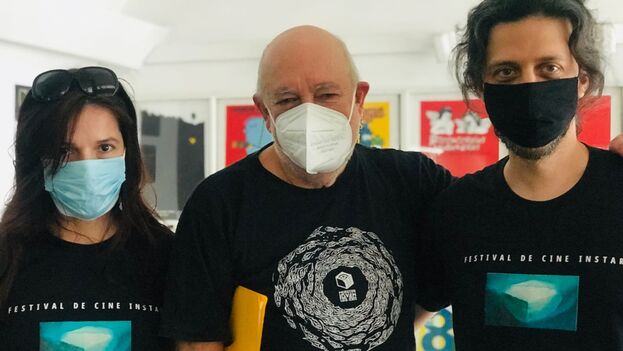
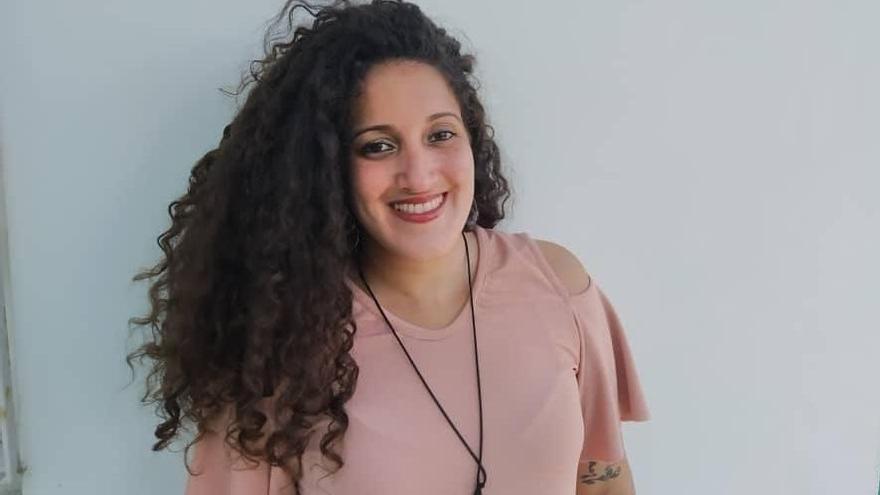
Yadiris Fuentes is a reporter for ADN Cuba. (Julio Llopiz-Casal)

14ymedio bigger14ymedio, Luz Escobar, Havana, 22 January 2021 — Serious threats from Cuban State Security are forcing independent journalist Yadiris Fuentes to, in a few days, move out of the home she’s lived in since June 2021. The owner of the home was warned by political police that if he did not evict her, he could face a fine or even lose his property, which is an illegal rental.

As Fuentes told 14ymedio, she will only be able to remain in the home until February 5th, the last day through which her rent is pre-paid. “Since the state of siege we all had around November (stemming from the announcement made by Archipiélago) they had not bothered me anymore, they had not called me nor seen me,” she explained.

“On Monday, January 17th I was not home, but Manuel called my cell phone, the agent who ’takes care of me’,” says Fuentes, who for years lived in Cienfuegos although she is originally from Pinar del Río. The official told her he wanted to see her in two days, last Wednesday, in the afternoon. “Summon me, if you want to see me, summon me,” she replied.

The ADN Cuba reporter let the Security agent know that she refused to respond to verbal summons and to date, she has not received an official document to appear before the authorities; thus, she believes the objective of the political police “was to intimidate and that, perhaps, to them, the rental thing is enough” harassment. continue reading

“The day after that call, my landlord informed me that State Security went to see him and told him that, ’either he evicts me, or they would fine him 15,000 pesos’ and that they could confiscate his house. Obviously, I will not subject anyone to live under that pressure and I said if that is how it is, I’d leave on February 5th,” she declared.

Fuentes assures us that these pressures to leave her without a place to live will not divert her from her profession, “This won’t influence anything I do as a journalist but while I concentrate on where to live, obviously I cannot work in the same way and they know that and I believe that is part of the method.”

The reporter stated that this type of pressure has been seen before and that her case “is not extraordinary nor unique… It is a technique they’ve already used a lot, especially against women, as if they view us as weaker and more susceptible to pressure.” Among the independent reporters who have suffered this type of pressure so they’d lose their rentals is Camila Acosta, a contributor to the online news portal CubaNet.

Faced with this dilemma, she says, “A friend always appears,” who can take her in for a few days while she finds a place to live, but she insists that she will try “not exploit these avenues” because she does not like “to be bothering anyone nor subjecting them to the pressure from State Security.”

“Right now, finding a rental is super difficult. There was a time when Havana was the easiest place to find one because there were several channels for finding them but right now, for example on Revolico, the online platform for buyers and sellers, there are very few options. Most of the ads are for people looking for rentals,” she says.

According to her experience, looking for options these days, she’s noticed that prices “have increased a lot” and that right now “everything is above 7,000 or 9,000 pesos,” (between 280 and 360 dollars, according to the official exchange rate), and when she communicates with the owners, they inform her that they are already taken.

The independent reporter is aware that what she is experiencing “is a cyclical story,” and that wherever she lives they can, once again, pressure her landlords, even if the rental is legal.

This scene has served as motivation for a group of independent Cuban female journalists to launch the Casa Palanca campaign, with the goal of fundraising to acquire a property. With the initiative, shared on Verkami, the activists and reporters want to create a network “of linkages, protection, and emotional and psychological support.”

Translated by: Silvia Suárez

____________

COLLABORATE WITH OUR WORK: The 14ymedio team is committed to practicing serious journalism that reflects Cuba’s reality in all its depth. Thank you for joining us on this long journey. We invite you to continue supporting us by becoming a member of 14ymedio now. Together we can continue transforming journalism in Cuba.

Ten July 11th Prisoners in Holguin, Cuba Begin Hunger Strike Protesting the Sentences Sought by the Prosecutor

Police deployed outside the tribunal in Santa Clara where, this week,  July 11th (11J) protesters were tried.

14ymedio bigger14ymedio, Luz Escobar, Havana, 15 January 2022 — Ten prisoners in Holguín, for whom the prosecutor maintained its request for very high sentences went on a hunger strike following their trial for the July 11th  (11J) protests. This was reported by Dr. Alejandro Raúl Pupo Casas on his social media, alerted by the mother of one of the defendants, William Manuel Leyva Pupo, a relative of the doctor.

For this 20-year-old, the prosecutor sought 18 years, and the same for Reymundo Fernandez Rodríguez, Jorge Luis Martínez García, Marcos Antonio Pintueles Marrero and Yoel Ricardo Sánchez Borjas.

The same source warned that the prisoners’ families will join their protest, although she did not name the other prisoners who were on hunger strike.

The sentences will be officially handed down on February 11, according to messages shared on Facebook by family members of the accused, and they all take for granted that the judges will bend to the prosecutors’ requests, as is usually the case in political trials. continue reading

Three other trials for 11J also ended on Friday in Santa Clara, Havana, and Mayabeque.

In this city, the news agency Efe reports that according to family members of the prisoners, a trial was held without the families’ prior knowledge.

For now, we know that in Holguín is where they requested the harshest sentences for July 11th protesters accused of “sedition”. Prosecutor Fernando Valentín Sera Planas–included on the Foundation for Human Rights in Cuba’s list of oppressors along with dozens of his colleagues–sought 30 years in prison for Miguel Cabrera Rojas, Yosvany Rosell García Caso, José Ramón Solano Randiche and Iván Colón Suárez for the crime of sedition; 28 years for Maikel Rodríguez del Campo and Mario Josué Prieto Ricardo; 25 for Cruz García Domínguez, Miguel Enrique Girón Velázquez and Yasmany Crespo Hernández, and 22 for Yoirdan Revolta Leyva.

The only woman facing such high penalties in Holguín is Jessica Lisbeth Torres Calvo, for whom they are seeking 27 years, the same as her current age.

We are also aware of four minors tried for the same crime–Yeral Michel Palacios Román, Ernesto Abelardo Martínez Pérez, Ayan Idalberto Jover Cardosa and Keyla Roxana Mulet Calderón–the original request of 15 years was reduced to between five and seven years.

During the last day of the trials, State Security stepped up its harassment of the prisoners’ friends and family who have publicly protested.

In Santa Clara, where 16 protesters were tried, activist Saily González was detained for several hours, as were family members of Andy García Lorenzo, arrested in the morning, they were heading to the tribunal, as they did every day since the start of the trial on Monday.

According to sources close to Saily González, her arrest occurred when she was headed to present a writ of habeas corpus on behalf of García Lorenzo’s familyAll of their phones were confiscated and they were each assessed a fine of 3,000 pesos. “She was very agitated, crying, they took her phone, the hard drive on which she had the habeas corpus document, her earphones. Now neither she nor Andy García’s family has a way to communicate,” reported activist Víctor Arias, whom González visited following her release at 7 pm sharp.

Arias also confirmed that Andy García’s sister, Roxana, and her partner Jonathan López were released, but he alerted that his father, Pedro López, “left the interrogation and there is still no news from him.”

Andy García’s family has been one of the most active in denouncing the irregularities of the trials in which, they assure, the prosecution’s witnesses lie. According to Tayri Lorenzo, the young man’s mother, in the courtroom in Santa Clara one of them said that State Security negotiated a fine for him in exchange for his testimony to implicate the accused.

They are not the only ones suffering harassment by the political police. Yudinela Castro, the mother of Rowland Castillo, a 17-year-old accused of “sedition” and for whom the prosecutor seeks 23 years of deprivation of liberty for participating in the 11J protests in Havana, told 14ymedio that State Security has been pressuring her not to denounce her son’s situation.

“Yesterday I received a summons, I was not at home but they called my phone and left it under my door. It was around midnight,” she said. She was so bothered to see that paper as she arrived home, that she ripped it up.

The civilian agents who identified themselves as Ignacio and Elías, she continued, always tell her they are going to accuse her of “contempt or sedition” for what she posts on social media and the declarations she has made to the press. “They tell me I am associated with terrorists and counterrevolutionaries.”

Castillo, incarcerated in Occidente’s Juvenile Prison in El Guatao, is from Mantilla and the Sunday of the protests, he was arrested on the corner of Toyo in the municipality of Diez de Octubre, one of the epicenters of the protests and a place where a patrol car was overturned.

Translated by: Silvia Suárez

____________

COLLABORATE WITH OUR WORK: The 14ymedio team is committed to practicing serious journalism that reflects Cuba’s reality in all its depth. Thank you for joining us on this long journey. We invite you to continue supporting us by becoming a member of 14ymedio now. Together we can continue transforming journalism in Cuba.

A Ration Store Clerk in Havana Posts Signs So People Will Stop Asking Her if There is Coffee

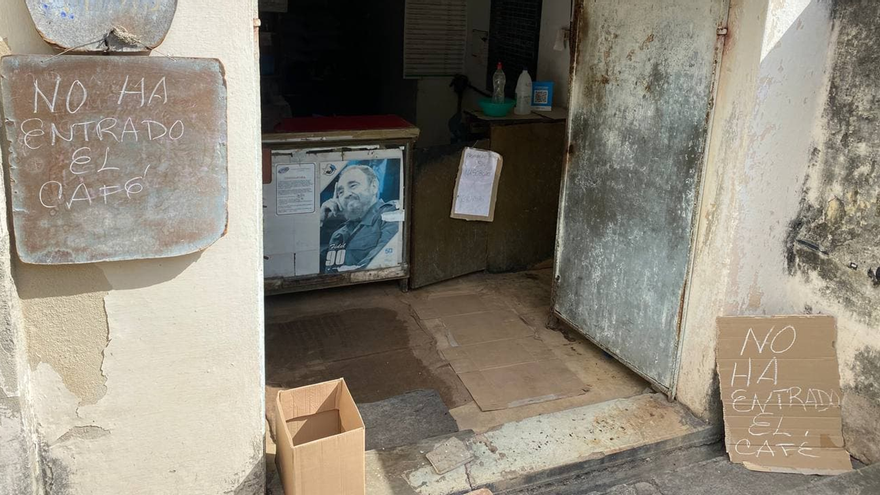
A ration store (bodega) located on e Street between 23rd and 21st in Havana’s El Vedado district with a sign that says “No coffee has come in.” (14ymedio)

14ymedio bigger14ymedio, Luz Escobar, Havana, 11 January 2022 — “No coffee has come in and no coffee has come in.” The clerk at the ration store on E Street between 23rd and 21st, in Havana’s El Vedado district, has chosen to put up two large signs with these words, as she is tired of saying it over and over again to customers who come in asking about the product, while she has no idea when there will be coffee.

“I put up the signs so that people would be warned,” she says with annoyance, while noting that at the beginning of the year the official press published  that the distribution of coffee through the ration book corresponding to January was imminent. “It is not only coffee, there is no compote or milk for children, there are minors who have not had milk since last month,” she adds bluntly.

In another ration store in the same neighborhood, at 27th and A, the picture is the same. “There is no coffee here either,” said the clerk.

Where the product does appear is on the black market, but only now and then. A few blocks from E Street, at the agro-market on 19th and B, this newspaper was able to verify that an informal vendor was offering each package, exactly the same one that is distributed in the family ration basket, at 50 pesos. But residents of the area say that it is not always available in the informal market.

The disappearance of ration-book coffee, and its disappearance in stores that take Cuban pesos or only foreign currency, has coincided with a significant rise in the price of the package that emigrants abroad buy for their families on the island. continue reading

Mayra, a resident of Centro Habana, says in a smiling tone that “her mind cannot function without a sip of coffee.” A few days ago, she was forced to ask her daughter, an emigrant in Spain, to buy her a package from one of the online stores.

Her daughter “flatly” refused, she says, because “a 250-gram package of Cubita or any other brand costs more than $20 on these sites.” For example, one of the stores that offers its merchandise on the Cuballama page, managed from Miami, is selling 250 grams (half a pound) of the El Arriero brand for $25.

“Luckily a friend from the neighborhood, who despite living alone in his house has five more relatives who are  now living in the United States still listed on his ration book, sold me the six packages that he received from the bodega last month,” explains Sergio, a resident of Cerro. “Thanks to that I still have coffee. He sells me each packet for 40 pesos because otherwise I would have to give up to 60 pesos for one on the black market.”

Brewed coffee is also absent in private coffee shops. “I go all over El Vedado and Central Havana looking for a place to have a snack and, incidentally, have a little cup of coffee and they aren’t selling it anywhere,” says Madelaine, a housewife who decided to go out this Tuesday to do some shopping in the agro-markets. “Even in the cafés they put the price on the board, but all the shop assistants tell me the same thing: ’We don’t have coffee’.”

____________

COLLABORATE WITH OUR WORK: The 14ymedio team is committed to practicing serious journalism that reflects Cuba’s reality in all its depth. Thank you for joining us on this long journey. We invite you to continue supporting us by becoming a member of 14ymedio now. Together we can continue transforming journalism in Cuba.

Family Members of Those Arrested on July 11 in Cuba Plea with EFE to Cover Their Trials

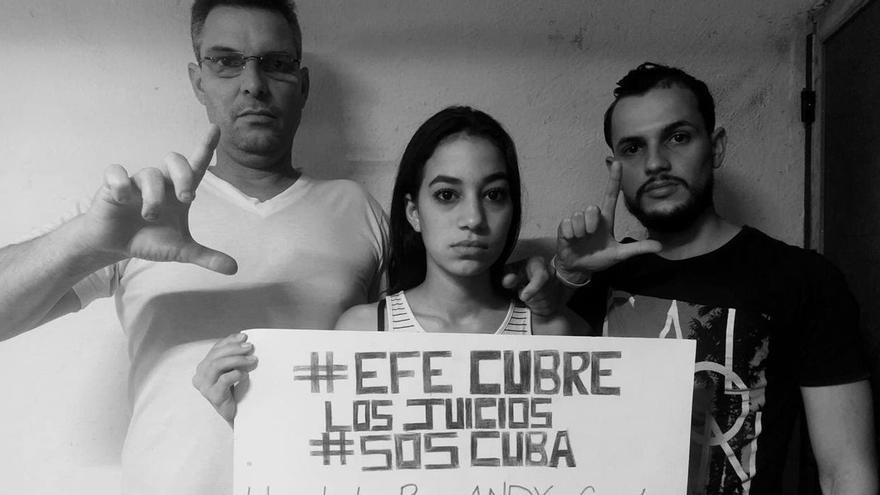
Family members of political prisoner Andy García joined the #EFECubreLosJuicios [EFECovertheTrials] campaign. (Facebook)
14ymedio bigger14ymedio, Luz Escobar, Havana, 7 January 2022 — The Cuban activist and businesswoman Saily González Velázquez, along with others such as Salomé García Bacallao, and family members of those detained on July 11th (11J), have started a social media campaign for the Spanish news agency, EFE, to cover the prisoners’ trials.

“There is still time for foreign press credentialed in Cuba to cover the trials of political prisoners. Several family members and activists have already joined the campaign [with the hashtags] #EFECubreLosJuicios [EFECovertheTrials] and #SOSCuba. Let’s support them,” said González on Twitter from Santa Clara, where she works in the private sector.

For her part, García Bacallao, emphasized that “from January 11th through the 14th four children will be tried in Holguín for the political crime of sedition,” and until now, the Spanish agency “has not covered a single ordinary trial of more than 200 July 11th protesters.”

Activists and citizens on the Island have joined the initiative on social media using the hashtag #EFECubreLosJuicios as a way to demand the agency inform on the legal proceedings, during which some have received sentences that exceed 20 years in jail. continue reading

González explained to us that she shared the idea with a WhatsApp group that brings together family members of those detained on July 11th and civil society actors. “Every once in a while initiatives to support political prisoners are presented there and it occurred to me to launch this campaign to raise the visibility of the situation, since we already know we have no other way to help them because, in Cuba, the legal tools that would allow us to help them do not exist.”

Furthermore, she says the campaign is based “on the responsibility that EFE has, as an international press agency credentialed in Cuba, to cover these trials,” and because it is often “picked up by other European media.”

Over twenty family members have joined the initiative, says González. “We hope more will join because the important thing is to pressure EFE to respond, if not, to make it clear that the agency is being complicit with the dictatorship and to show the lack of mechanisms available to Cuban civil society and family members of political prisoners to achieve justice.”

Jonathan López Alonso, a relative of political prisoner Andy García Lorenzo, said that what they intend to accomplish with this campaign is “for these communications channels which are credentialed in Cuba and do not do their job, to do it.” This young man’s trial will take place on January 10th and he is accused of public disorder, contempt, and assault.

“They hardly cover any of what the opposition and civil society do in Cuba. EFE covered what happened with Yunior García Aguilera in November when his home was under siege, but it is unjust that they covered that and not this. Why don’t they also do this with the trials, which is so important when they seek sentences of up to 25 years?” denounced López.

Bárbara Farrat Guillén, mother of 17-year-old Jonathan Torres, who has been in prison since August 13th awaiting trial for his participation in the 11J protests, also joined the campaigned, as did activists Daniela Rojo, Camila Rodríguez, and Leonardo Fernández Otaño. The latter, on his messages of support, also makes demands of other international press agencies such as AP, Reuters, AFP or television station CNN.

Although support for the initiative is growing, activist Saily González regrets that family members “still have not decided whether to speak publicly,” and they resist “using the few mechanisms we have to exercise our rights or at least try to,” because in her opinion it is something civil society “would love to” support.

“Family members are not accustomed to using the available mechanisms, almost no citizen here in Cuba is; first of all, they don’t know what they are, they do not perceive themselves as citizens with rights. While they decide, we will continue occupying our own social media, because the streets may belong to the revolutionaries, but social media belongs to us,” she confirmed.

Last November, Cuban authorities rescinded the press credentials of EFE journalists in Cuba, in the lead up to the so-called “illegal” Civic March for Change. Later, some of the credentials were reinstated; however, according to the agency, its delegation in Havana is depleted and it needs its entire team to return to work.

Since then, EFE warned its subscribers that the decision of the Cuban authorities in the last several months “have decimated the delegation’s team,” in Havana where currently, “only two journalists can continue working.”

Translated by: Silvia Suárez

____________

COLLABORATE WITH OUR WORK: The 14ymedio team is committed to practicing serious journalism that reflects Cuba’s reality in all its depth. Thank you for joining us on this long journey. We invite you to continue supporting us by becoming a member of 14ymedio now. Together we can continue transforming journalism in Cuba.

Cuban Journalists Esteban Rodriguez and Hecto Luis Valdes are Admitted to El Salvador

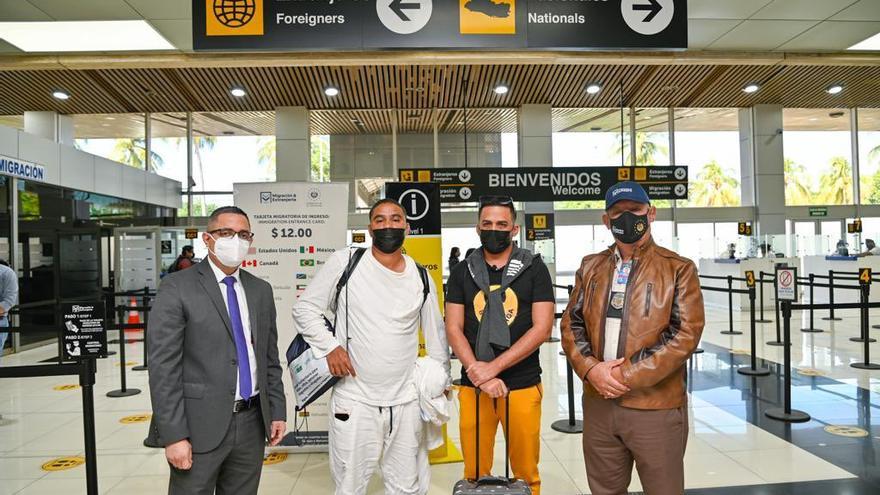
Cuban reporters Esteban Rodríguez, in white, and Héctor Luis Valdés Cocho, flanked by El Salvador’s human rights attorney, Apolonio Tobar, and the general director of Migration and Immigration, Antonio Cucalón. (Twitter / @ migracion_sv)

14ymedio bigger14ymedio, Luz Escobar, Havana, 5 January 2022 — After 24 hours of uncertainty  at the San Salvador airport, where they arrived “fleeing terror” in Cuba, independent journalists Esteban Rodríguez and Héctor Luis Valdés have been admitted to El Salvador, “while they are given humanitarian assistance and their immigration status is resolved,” according to local authorities.

The two Cubans were interviewed by the director of the Department of Migration, Ricardo Cucalón, in the presence of the human rights attorney, Apolonio Tobar. They have left the International Airport to go to the capital, where “they will be supported with accommodation and food.”

At the San Salvador airport, Tobar had declared to the German television station Deutsche Welle that “government institutions” had been called on to bring the activists food and added that he would talk with them to find out “what is the situation and what is their destination.”

“We have been stranded here for more than 36 hours at the San Salvador airport after the Nicaraguan regime denied us entry to their country,” Tobar told the local newspaper El Mundo, after leaving the Valdés Cocho air terminal, and he thanked president Nayib Bukele who intends to help them and the Department of Migration for the “excellent treatment.” continue reading

Esteban Rodríguez, for his part, told reporters that he was in Cuba’s Combinado del Este prison and that he was taken from there “to be expelled from Cuba… They have forced me to leave the country,” he said, “for wanting to think differently, for wanting to practice independent journalism.”

“I had been under torture for eight months, in dark places, I was under threat of death all the time,” denounced Rodríguez, who said that he still had the marks of the handcuffs with which he had been transferred directly from the prison to the airport.

Valdés Cocho explained that “several NGOs” helped him “pay for the passage” and thus “achieve the release (of Esteban) since State Security constantly threatened to leave him suffering harassment in Combinado del Este.”

“We don’t even know what legal status we have, we have requested help and we have received it,” he said.

This morning, Valdés Cocho published a post on Facebook reporting that he and Rodríguez had been forced “to make the decision to leave” the country “bound for Nicaragua,” although he added that his intention was to stay there for a few days, to end up arriving at a place where many Cubans arrive “fleeing the terror perpetuated by a totalitarian system.”

However, according to their testimony, the route had a stopover at the Tocumen airport (Panama), from where they had to fly to El Salvador before continuing to Managua. It was at that point, upon arriving at the San Salvador airport, when they were called by the loudspeaker to inform them that Nicaragua, governed by a partner of the Cuban regime, Daniel Ortega, was rejecting them.

Valdés Cocho also said that Cuban State Security had taken both of them to the airport and told them that they were expelled and that they could never return to Cuba.


____________

COLLABORATE WITH OUR WORK: The 14ymedio team is committed to practicing serious journalism that reflects Cuba’s reality in all its depth. Thank you for joining us on this long journey. We invite you to continue supporting us by becoming a member of 14ymedio now. Together we can continue transforming journalism in Cuba.

Two of Cuba’s Obispo Street Protesters Are Released After Eight Months in Prison

Protesters on Obispo Street in Havana on April 30, 2021. (Capture)

14ymedio bigger14ymedio, Luz Escobar, Havana, 4 January 2022 — The activists Inti Soto and Ángel Cuza, two of the six protesters arrested after the April 30 sit-in on Obispo Street in Havana, were released on Tuesday, after eight months in prison, confirmed Mary Karla Ares, an independent journalist also arrested during the protest, told 14ymedio.

Cuza was in the Combinado del Sur prison in Matanzas. “I just spoke with him, really he hasn’t even come home, he’s on his way. I’ve been in contact with him all this time and now he called me to break the news,” Ares said.

For her part, Soto’s wife, in conversation with this newspaper, said that the activist was released on Tuesday afternoon and has been in the Taco Taco prison, in San Cristóbal, Artemisa. “We are happy, but very nervous. We are on our way to pick him up because he called us to go and get him,” she explained. Last September, activists Thais Mailén Franco Benítez and Yuisan Cancio were also released. Previously, in May, Mary Karla Ares had been released from prison. They are still keeping reporter Esteban Rodríguez in prison; his family has no news about when he will be released.

In their protest, the protesters tried to approach the house of the artist Luis Manuel Otero Alcántara, who was then on a hunger strike, when the Police tried to prevent them. At the time, they sat down to protest against what they saw as a limitation of their right to free movement and were detained.

The video, broadcast live from the house, sparked broad solidarity with the detainees of that day. Amnesty International was one of the first international organizations to call for the immediate release of these protesters.

____________

COLLABORATE WITH OUR WORK: The 14ymedio team is committed to practicing serious journalism that reflects Cuba’s reality in all its depth. Thank you for joining us on this long journey. We invite you to continue supporting us by becoming a member of 14ymedio now. Together we can continue transforming journalism in Cuba.

Cuban Brigadier General Humberto Francis Pardo, in Charge of Fidel Castro’s Security, Dies

General Humberto Francis Pardo, who died this Monday in Havana. (Archive)

14ymedio bigger14ymedio, Luz Escobar / Natalia López Moya, Havana, 28 December 2021 — Reserve Brigadier General Humberto Omar Francis Pardo died this Monday in Havana, as 14ymedio confirmed on Tuesday. His body, which will be cremated, is at the Calzada y K funeral home, located at Calzada number 52, in El Vedado. A source close to the family told this newspaper that the military man had suffered from Alzheimer’s for years.

He was born in Santiago de Cuba in 1945 and studied in the Soviet Union between 1965 and 1969, according to the Internet forum Secretos de Cuba. “When he returned to Cuba, he carried out military missions, at least in Angola, Ethiopia and Nicaragua,” says this website.

As brigadier general, Francis Pardo was in charge of the the Ministry of the Interior’s Personal Security Directorate, the invisible apparatus with the most power on the island, and was in charge of Fidel Castro’s security. He had under his command the “elite” brigade that has more than 3,000 troops, “shock troops” to face protests.

Considered one of the most powerful Cuban military personnel, Francis Pardo was replaced from his duties as Head of the General Directorate of Personal Security (DGSP) in August 2016. Raúl Castro replaced him with his grandson Raúl Guillermo Rodríguez Castro, son of Luis Alberto Rodríguez López-Calleja, the “czar” of the State company Gaesa. continue reading

Until that moment, within the military scheme, General Francis at the head of the DGSP commanded an anti-attacks brigade that was made up of snipers and experts in all types of explosives, in addition to the counterintelligence service, which in coordination with other State agencies controlled all the information of that brotherhood, the family circle and friends. Vice Minister of the Interior under Abelardo Colomé Ibarra, the military man was also in charge of an international relations department that coordinated with other secret services visits to Cuba by persons of interest and personalities.

General Francis was awarded the Order “June 6” of the First Degree in recognition of 55 years of accumulated service in the ranks of the Revolutionary Armed Forces and the Ministry of the Interior. His “consecration, skill and reliability performance, fundamentally in the organization and direction of protection activities for the main leaders,” of the Cuban regime was highlighted.

All the official reactions after the death of Francis Pardo were published long after 14ymedio reported the death of the soldier. The first communiqué was released by the Interior Ministry, which specified that Francis Pardo had “a brilliant record of service in protecting the physical integrity” of the main Cuban leaders and “in defense of the Revolution.”

It also noted that “his remains were on view” at the Calzada and K funeral home, “for a subsequent ceremony with the corresponding military honors.”

For his part, Miguel Díaz-Canel Bermúdez on his Twitter account described Francis Pardo as “a brave combatant of Personal Security,” who was “head of that troop of loyalists during 30 of his 56 years of service in the Ministry of Interior, under the orders of Fidel Castro and his brother Raúl.

____________

COLLABORATE WITH OUR WORK: The 14ymedio team is committed to practicing serious journalism that reflects Cuba’s reality in all its depth. Thank you for joining us on this long journey. We invite you to continue supporting us by becoming a member of 14ymedio now. Together we can continue transforming journalism in Cuba.

Charges Dropped Against Artists Over July 11 Protests in Front of the ICRT

“We are fighting forcefully and intelligently to put fish on the Cuban table,” an official told Cubadebate. (14ymedio)

14ymedio bigger14ymedio, Luz Escobar, Havana, December 30, 2021 — The artists charged with public disorder for protesting in front of the Cuban Institute of Radio and Television (ICRT) on July 11 learned on Thursday that the cases against them were being dropped. In essence, they were being acquitted.

The situation remains unclear, however, for playwright Yunior García Aguilera and curator Solveig Font, both members of the group, are both outside of Cuba.

Actor Reinier Diaz told 14ymedio that when he went to the police station at Zapata and C streets to sign the legal document dismissing his case, he inquired about the status of García Aguilera and Font and they told him, “Their situations are different,” without giving any further information.

García Aguilera tells 14ymedio that he knows nothing about the status of his case and that Font “is looking into it.”

“I just signed the document dismissing the charges over the July 11 protest in front of ICRT. I was not intending to make a public announcement but I feel indebted to many people for this outcome,” wrote historian Leonardo Fernandez Otaño on social media. continue reading

In the post he thanks friends who helped him support himself during this period and those who were subjected to interrogation because of their closeness to him. He also thanked his parents for “all their suffering,” which he says is ongoing, and neighbors who “ferociously” defended him from assault and attempted acts of public repudiation.

The young historian says he is “grateful” that the charges have been dropped “because no one can hide the truth” but also admits to feeling sad that it was “the privileges of being white and intellectual” that saved him. “The young people from La Güinera were not so lucky,” he writes. In late December thirty-two people from this impoverished Cuban town were sentenced to up to twenty-six years in prison for their participation in the July 11 protests. Fernandez Otaño describes their sentences as “unjust and politically motivated.”

Other ICRT protesters who had effectively been placed under house arrest as a precautionary measure included Edel Carrero, Javier Perez Rodriguez, Juan Carlos Saenz Calahorra, Raul Prado, Gretel Medina, Daniel Triana and Aminta Calzado.

____________

COLLABORATE WITH OUR WORK: The 14ymedio team is committed to practicing serious journalism that reflects Cuba’s reality in all its depth. Thank you for joining us on this long journey. We invite you to continue supporting us by becoming a member of 14ymedio now. Together we can continue transforming journalism in Cuba.

“15 Years Ago, They Told Us That They Were Going to Demolish the Building That Fell This Thursday”

Alderete says that he has lived adjacent to the building that collapsed for 16 years, but he clarifies that he used to live on that same corner that collapsed on Thursday night. (14ymedio)

14ymedio biggerLuz Escobar, Havana, 18 December 2021 — At 9 p.m. on Thursday, December 16th, on the eve of Saint Lazarus Day, Miguel Alejandro Alderete Recio and his 81-year-old mother, Rosalba, were listening to a radio program, El Nocturno at their home. A roar broke the tranquility. A wall of the adjoining house, at the corner of Angeles and Monte streets, had collapsed. Neighbors took to the streets to search for possible victims under the rubble. Ambulances, police and firefighters arrived. They found the lifeless body of a passerby, Rolando León.

Alderete is uneasy, he talks about the shock that he experienced at that moment, and both his mind and his body still feel it, his voice too. This Friday, after four in the afternoon, he brewed coffee for a visit and, after saying goodbye, he spoke with 14ymedio about the anguish and disgust that has remained after the collapse.

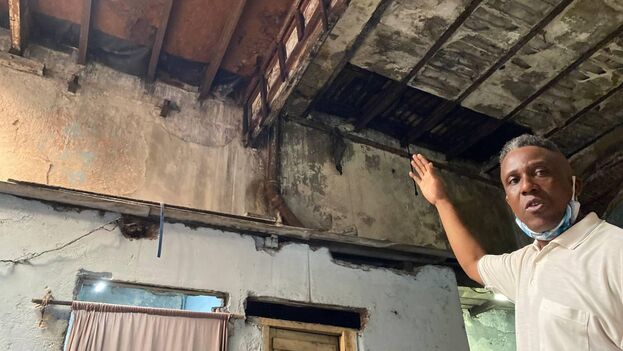
“I saw it all,” he says, and his hands move up and down in an effort to point out every crack in the ceiling, every dampness, every wall about to collapse. The noise from the central avenue, increased by the work of a crane and dozens of onlookers who still come to see what happened, dies down when one walks through the entrance at Monte 429.

Rosalba has just arrived from the hospital where she spent several hours after the collapse on Thursday night. (14ymedio)

Alderete says that he has been in that place for 16 years, adjacent to the building that collapsed, but he clarifies that, before, he lived in that same corner that collapsed on Thursday night and that, being “up there”, they always had “shelter in place order”, to move to one of those places of temporary accommodation. He remembers that continue reading

the place was in “terrible condition” and that one day one of his brothers “had his foot sunk into the ground in such a way that he fell down completely”. He claims that if it hadn’t been for a beam that he tripped over, he would “have gone down completely”.

As a result of this incident, the authorities took the whole family to a nearby but unventilated place and it was then that they offered to go to where they live to this day.

“When they relocated us in that place, it was like in 2005 or 2006, we had to do an enormous amount of cleaning and enable the premises to barely live there. A year after being here they told us that they were going to demolish the upper part but they did not come until today, after what happened, happened. They did not demolish at the time and look at the demolition now, after there has already been one death,” lamented Alderete.

He also remembers that a bus once collided with a column on the façade and knocked it over completely. “The top of the bus hit the door. Luckily, there was no one there at that time, but a man who stood guard there, who lives next door and his name is Claudio, almost got killed” he said.

He says that as a result of the column that fell “they put two sticks there and until the sun came up today” it was the same. “That was 10 years ago and they never took care of it again… ah! but now that this collapse occurs, they immediately come to remove the old props and put in the new ones, do we have to wait for that?” he wonders. “No, we shouldn’t wait till people die” he answers himself.

“I saw it all,” says Alderete, and his hands move up and down in an effort to point out every crack in the ceiling, every damp spot, every wall about to collapse. (14ymedio)

“Then, afterwards they will say that you’re a counterrevolutionary but no, you have to tell the truth. I am stubborn, after the collapse no one has come to hear from us yet, the ones who arrived were the demolition workers but Housing has not come here, I’m very upset”, he says, very angry.

For a moment, his disgust turns into indignation, he would like to express his discontent on the street but he fears for his mother’s health: “Do you know why I didn’t go out to the street? Because of my mother, who is there and yesterday they had to take her to the Calixto García Hospital because her blood pressure was so low, she got very nervous. We felt the noise and I opened the door and went out, so I see the movement and the collapse, after a few minutes they had to take her by ambulance”.

Rosalba, who is listening to the entire conversation from a chair, says: “Before, I lived where the collapse took place, now I feel better, but I got so scared that I had tachycardia.” Her son is very concerned about his mother’s health and the consequences that living in such poor conditions may have for her. “Just like that, my mother will get messed up too, it’s too much, that lady is 81 years old and I’m praying that before she closes her eyes, she is able to see her little house, the only thing I miss is that one day she can live like normal people”.

This man, who has worked at the old Woolworth’s on Monte Street for 28 years, first as a cook and now as a confectioner, does not understand why “we have to wait for Havana to fall down” to make the right decisions. “Those Government people come here to Quisicuaba, and yesterday they were there with Silvio Rodríguez, but nobody has come here”, he criticized, referring to the delivery of the National Community Culture Award to the singer-songwriter, which took place the same day, very close to the collapse.

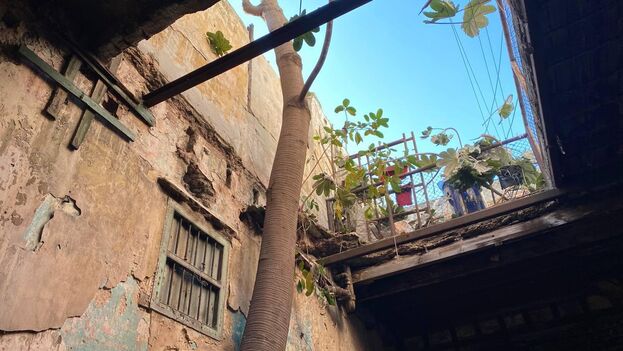
From Calle Ángeles, a brigade of workers pruned the Yagruma tree that comes out of Alderete’s house. (14ymedio)

He remembers when the tornado “completely engaged Havana and they immediately gave shelter to those affected” and he was outraged when he saw on the news that the Diez de Octubre nursing home, which had been closed for nine years, was immediately enabled for 70 families. “Do you have to wait for the tornado to pass to do that? No, that’s totally disrespectful”.

This man does not stare at each crack without doing anything, but he considers that the repairs that the property needs are so extensive that they are beyond his ability. “I have thrown a pile of melts (waterproofing mixture) on that roof to contain the water but it is too much, cracks always appear and the melt lasts a month and then it’s leaks and leaks. I cannot wait for them because it is always the same slobber and they never do anything, it’s too much. ”

“I repeat, because of my mother I did not go out [to demonstrate] on November 15th, for my mother, I did go out on July 11th, and for my mother I did not go out yesterday or today. It is only because of that lady that I refrain, because if I throw myself onto the street, something will happen to her. Until when? One is here, being a good citizen, waiting, and they are doing whatever they want, no, I’m very upset”, he insists.

Translated by Norma Whiting

____________

COLLABORATE WITH OUR WORK: The 14ymedio team is committed to practicing serious journalism that reflects Cuba’s reality in all its depth. Thank you for joining us on this long journey. We invite you to continue supporting us by becoming a member of 14ymedio now. Together we can continue transforming journalism in Cuba.

‘If More Mothers Unite, We Will Achieve Our Children’s Release’

Barbara Farrat went on a hunger strike this Saturday to demand freedom for her son. (14ymedio)

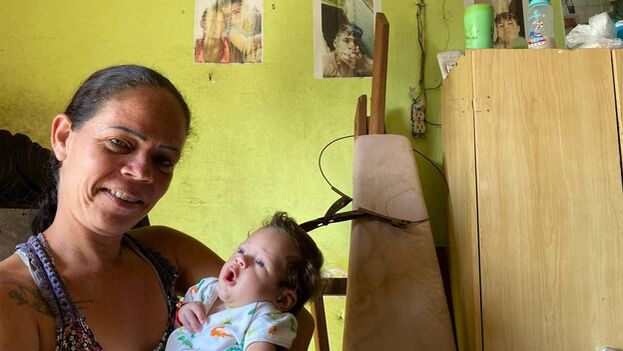
14ymedio bigger14ymedio, Luz Escobar, Havana, 14 December 2021 — The only gleaming corner in the home of Jonathan Torres’s family, one of the young people arrested after the protests on July 11th (11J), is the corner with the crib for the baby, who is almost two months old. The clean sheets, the mosquito net, the wet wipes and the neatly arranged disposable diapers, contrast with the rest of the house, a precarious construction on the Diez de Octubre Boulevard in Havana, with crumbling ceilings, rotten beams, cracks in the walls and damp stains. Here, you can breathe poverty, but also dignity.

Bárbara Farrat, Torres’s mother, abandoned the hunger strike that began three days ago this Monday night to demand her son’s freedom; he has been in prison since August 13th accused of attack, public disorder and spread of epidemic for having thrown a stone at the police without hitting anyone.

The young grandmother, who has become one of the most active faces in defense of the 11J prisoners, has said that she abandoned the strike because of her own mother, who suffered a spike in blood pressure yesterday that was about to cause a stroke, according to Farrat.

“I will not continue to worry about my mother. Her only grandson is in prison. I will not leave my mother fearing that she will have to bury a child,” she said in a video broadcast on social networks. continue reading

The young grandmother, who has become one of the most active faces in defense of the 11J prisoners, stated that she abandoned the strike because of her own mother, suffered a spike in blood pressure yesterday

The hunger strike was abandoned two days after Farrat, just 33 years old and suffering from health problems herself, received 14ymedio at her home, where she resides with her husband, Orlando Ramírez, and her son’s girlfriend – her grandson’s mother – who is 16 years old. The Havana woman, who never imagined that what life has handed her could be possible, told this newspaper what life’s been like in the last four months, with her son imprisoned and the constant pressure from State Security. She also regrets that Torres has only been able to enjoy his baby, born October 27th, “one half an hour at a time during the three visits he has had.”

Farrat declares that her son was caught up in the tumult of that day by chance. That Sunday, when Torres turned 17, the family was celebrating at home, but they ran out of drinks and her husband went out to buy something to continue the party. “We had the music on and hadn’t seen either the newscast or the information from Díaz-Canel saying that the combat order had been given,” she says.

At one point, she relates, the street “began to fill with people coming down the entire Diez de Octubre Boulevard,” a very scary situation, so she decided to go out and look for her partner. Torres, however, dissuaded her and asked her to stay home with his girlfriend, who was pregnant at the time, while he was busy looking for his stepfather (“although he calls him dad because he raised him his whole life”).

On Serafines Street, Torres found Ramírez, hidden behind a wall. “Up the street from Serafines, the police would not let anyone pass,” says Farrat. “Someone among the protesters said that the objective was to reach the Plaza de la Revolución and the officers stood on the Vía Blanca warning that no one else was going to go any further. It was at that moment that the shots and stones began,” he continues. 

“Someone among the protesters said that the objective was to reach the Plaza de la Revolución and the officers stood on the Vía Blanca warning that no one else was going to go any further”

He has already related several times what happened next: on Friday, August 13th, two agents of the Technical Directorate of Investigation appeared at the door of his house and took Jonathan Torres, whom they had identified in one of the videos broadcast in networks on the day of the demonstrations.

At that moment, he began his ordeal. Three hours after they took him away, she learned that he was not in the Acosta police unit, as the officers had told him, but in Aguilera, where she went with his son’s girlfriend. It was not until Monday, as he was finally transferred to the station, when he was first told that he was accused of public disorder, spread of epidemic and attack.

The instructor at that time showed the video in which Torres appears throwing a stone, but it can also be seen, he says, that it is the same stone that the police had thrown at the protesters. “He threw it and it fell 50 meters from where the policemen were standing, and it did not hit a patrol car nor hit anyone, it just fell on the street” says Ramírez.

After 14 days, her son phoned to say that he had been transferred to the Manto Negro prison in Havana, a former women’s prison converted into a prison for minors.

Farrat says that it has been “an odyssey” to face this criminal process, because initially they did not even want to give her her son’s file number. She then sought the advice of a family lawyer, who, since he took over the case, has already unsuccessfully requested six changes to the pre-trial detention measure that keeps the adolescent in jail, “He filed a seventh, which of course they will also deny him. By this Monday, December 13th, my son will have been in detention for four months and does not even have a petition from the prosecutor,” she protests.

Farrat has also denounced that her son, who suffers from coronary hypertrophy, has not had access to his medications for two months. “They not only wanted to play with my son’s freedom, but they were also playing with his life,” she came to denounce on the networks.

She too is not taking the medications she should be taking. She is HIV-positive, and, like her husband, has not taken her retroviral since August

She too is not taking the medications she should be taking. She is HIV-positive, and, like her husband, has not taken her retroviral since August. “I have been very busy and nervous with my son’s case, and although I have the medicines, I have not taken them,” she confesses. “I feel guilty that he is in prison, I can’t get it out of my head that I’m the one who should be in jail, and this is a way that I have found to punish myself,” she says confusedly, by way of explanation, crumbling into tears.

The pressure she has received from State Security is also affecting her health. Last Friday, when she returned from visiting her son, she saw the officer who has questioned her several times hanging around the neighborhood, without knocking on her door, but talking to her neighbors, whom, she believes, they intend to intimidate into “informing” about her and her family.

“I got sick, my husband had to take me to the hospital at midnight because I started with an asthma attack,” she says. The agent “had already been here on Wednesday with his threats, telling me that if I continued making complaints on social networks, he was not going to let me in to see my son.”

Orlando Ramírez intercedes: “The exact words were that he had been called by the head of State Security that runs the Western youth prison to tell him that, if his mother continued to make these publications talking about her son, it was very possible that she would not be allowed any more prison visits to him again.” The stepfather replied to the agent, whom he reminded that they could not question the boy without having his family or his lawyer close by.

Ramírez points out that Torres was offered a sentence reduction – “up to seven years” – if he “cooperated… Our politics, our ideology, are outside of him.”

“They told my son: if you can stop your mother from posting anything on social media, I’m going to give you calling privileges,” Farrat continues. “He only replied that he did not want privileges, that he only wanted what is rightly his: ‘The two calls that I get a week, I do not want anything I’m not entitled to.’ As for my mother to stop publishing, she should decide that, not me.”

Bárbara Farrat says that, even if she abandons her hunger strike, she will continue to denounce the government abuses, but she adds that “a single tree does not a forest make and more mothers should join” in her cause

 Farrat insists that her son only cares about his baby and his studies, he is in his second year of welding. “It was always clear to him that this decision to be a father so young and while studying could not affect me and my husband, that we are sick,” she says. “He always had our support, but he also understood that it was his responsibility, as it was my responsibility when I decided to have him when I was young. He often would leave school to sell bread, to be able to buy clothes for his little one.”

Bárbara Farrat says that, even if she abandons her hunger strike, she will continue to denounce the government abuses, but she adds that “a single tree does not a forest make and more mothers should join” in her cause.

“I know well that as a people we matter little to them” she says, referring to the authorities. “But I have received a lot of support on social media and I know that this pressure can get the government to give me an answer about my son.

Translated by Norma Whiting

____________

COLLABORATE WITH OUR WORK: The 14ymedio team is committed to practicing serious journalism that reflects Cuba’s reality in all its depth. Thank you for joining us on this long journey. We invite you to continue supporting us by becoming a member of 14ymedio now. Together we can continue transforming journalism in Cuba.

Cubans Adrian Lopez Gonzalez, Geandy Pavon, Waldo Perez Cino and David Virelles Win the Cintas Scholarship

The Grupo Matiz de restauradores, whose founder, Adrián López González (on the right), has won one of the Cintas 2021 scholarships. (Screen capture)

14ymedio bigger14ymedio, Luz Escobar, Havana, 15 December 221 — For the first time, the Cintas Foundation has recognized with its annual scholarship, endowed with $20,000, a Cuban resident on the Island, Adrián López González. Founder and leader of the Grupo Matiz de restauradores (Matiz Restoration Group0 in Matanzas, he was the recipient of the award in the architecture and design category.

Matiz was created in 2014 and among the restoration and conservation works that it has undertaken, most notable are those of the Sauto Theater and of the San Carlos de Borromeo Cathedral, in Matanzas. For this group, the award “is the impulse to a work sustained in a city that dreams its best face, our Matanzas.”

“The story behind the Heritage is our foundation and the Cintas scholarship has been the luck to know that we are doing well,” they wrote on their networks after hearing the news.

In addition to López González, the writer Waldo Pérez Cino, the musician David Virelles and the artist Geandy Pavón have received past Cintas scholarships, which is awarded to artists of Cuban origin in different artistic fields.

Pavón, who lives in New Jersey, says that this award has a “very special” meaning for him. “I believe that Cintas is the only award to Cuban artists that is offered in total and absolute freedom,” he told 14ymedio. “In Cuba there are other awards,” he continued, “but all are always subject to ‘good behavior’.” continue reading

The artist is also thankful that the award, “opens up immense opportunities” and exposes both him and his work to “other people, other institutions and specialists in the field of culture and art.”

“It makes me think that what has been done has not been so bad and it is an immense stimulus, apart from being an important economic stimulus to continue doing my work,” said Pavón, who, during the covid pandemic, launched on his social networks an ingenious photographic series entitled Quarantine: 40 days and 40 nights, in which he recreated, together with his partner, Imara López, scenes from classics in art history.

For the writer Waldo Pérez Cino, the scholarship is “a great joy and a great honor.” The latter, he points out to this newspaper, taking into account that “in recent decades the Cintas Foundation has recognized the work of authors such as Cabrera Infante, Reinaldo Arenas, Benítez Rojo and García Vega, along with contemporary authors such as Magali Alabau, Octavio Armand and Carlos A. Aguilera, speaking only about the field of writing.”

“As far as I know, there is no other institution that has been supportive in this way, and with that continuity, of the development of proposals by Cuban artists or authors,” says Pérez Cino, who lives in the Netherlands. In his case, he says, it will serve to support a novel which he has been working on for a long time, “one of those projects that extend more than one would sometimes like and that, precisely because of their breadth, are sometimes overlooked for others more immediate or urgent.”

Among the finalists of Cintas are the artist Luis Manuel Otero Alcántara, who competed in the visual arts category, and who has been in prison since the protests on July 11.

Art curator Claudia Genlui thanked, on behalf of Otero Alcántara, “all the people who made possible his presence in the nomination for the Cintas scholarship… Luis Manuel Otero Alcantara and the political prisoners in Cuba will not be forgotten. We continue working for a Cuba where we can create and work in freedom. Enough censorship for Cuban art and artists that are consistent with our reality,” she stated.

The Cintas Foundation was created with funds from the patrimony of Óscar B. Cintas (1887-1957), Cuban ambassador to the United States and patron of the arts, and has been awarded since 1963. The finalists of the contest are chosen by a jury of experts who enjoy international recognition.

In the last 50 years, this contest has honored the achievements of great Cuban artists in different categories such as Félix González-Torres, Teresita Fernández, Carmen Herrera, María Martínez-Cañas, Oscar Hijuelos, Andrés Duany, María Elena Fornes and Tania León. After receiving the award, the scholarship recipients become part of the Cintas Collection by donating one of their works to the Foundation.

____________

COLLABORATE WITH OUR WORK: The 14ymedio team is committed to practicing serious journalism that reflects Cuba’s reality in all its depth. Thank you for joining us on this long journey. We invite you to continue supporting us by becoming a member of 14ymedio now. Together we can continue transforming journalism in Cuba.

Cuban Filmmaker Rolando Díaz Denounces the “Despicable” Acts of Repudiation to Repress 15N

Filmmaker Rolando Díaz (center) with actress Lynn Cruz and director Miguel Coyula. (Facebook)

14ymedio bigger14ymedio, Luz Escobar, Havana, 7 December 2021 — Repression on the island frustrated “through despicable acts of repudiation” the November 15th march (15N), events that marked “a before and after in the recent history of Cuba,” filmmaker Rolando Diaz denounced in Havana. The creator, who left the country in the mid-90’s, spoke to the public who attended the Acapulco cinema on Monday night to watch his film Dossier de Ausencias, a Dominican film that has just won the Best Production Award at the Festival Ibero-Latinoamericano in Trieste, Italy.

In his words, he not only rejected the acts of repudiation that took place against the activists who participated in the call for the Civic March for Change of 15N, but also sent a message of solidarity to young filmmakers of the Island who are suffering censorship by State institutions.

“Those without a voice have the right to have it. I consider myself part of the national cinema, especially of what has been accomplished by young, highly talented filmmakers, such as Carlos Lechuga, Miguel Coyula, José Luis Aparicio, Fernando Fraguela, Carlos Quintela, Heidi Hassan and Patricia Pérez. The last three are already in exile,” he said during the presentation that was part of the 42nd edition of the New Latin-American Film Festival, which takes place in the Cuban capital between December 3rd and 12th.

Díaz also considered that ignoring “the courage of those who only ask for the right to speak, think differently and demonstrate peacefully” would be “a cowardly act” for not recognizing those truths. continue reading

Speaking to 14ymedio on Tuesday, Rolando Díaz said that, for him, “it is very important” to make this type of “sincere and honest statement” because “the way the official press behaves” is already known

A director of well-known films, such as Birds Firing the Shotgun and En Tres y Dos, Díaz received a public ovation at the end of his speech, and he stated: “I cannot conceive of a country without diverse voices, fear, that fear that I feel for expressing these ideas now, it devours the soul. Those who like movies know what I’m talking about. Fear devours the soul, but dignity is the only antidote to eating ourselves alive.”

Speaking to 14ymedio on Tuesday, Rolando Díaz said that “it is very important” for him to make this type of “sincere and honest statement” because “the way the official press behaves” is already well-known.

“I am afraid that my press conference this Tuesday will only be used in terms of ‘just another one who was in attendance at the event, who participates in a film and no more’. I wholly reaffirm my statement from yesterday, and want to reaffirm that this is my true belief and my true feelings about my presence in Cuba at this Havana Festival.”

In his presentation at the Acapulco cinema, Díaz insisted that, although he is a Spanish national and has been living outside the country for 30 years, he is also Cuban and that, since he had not visited Cuba for a long time, he wanted to make that “kind of statement” before his public.

The director stated that his relationship with the Festival of New Latin-American Cinema “has been controversial” since he left Cuba, because some of his films made outside the country such as Melodrama, (1995), “were badly mistreated” and their “exposure was very limited.” Something similar happened with Si me Comprendieras, another Cuban-themed film, which was even banned from being shown at the University of Havana in 1999. 

“I wholly reaffirm my statement from yesterday, and want to state that this is my true belief and my true feelings about my presence in Cuba at this Havana Festival”

“Then I shot Cercanía in Miami, a film with Reinaldo Miravalles, Carlos Cruz and many other Cuban actors and it was not selected. I sent it to the Festival and it was not selected. Aissa’s Roads, a documentary that I also made in Spain about migration, was placed in an international documentary film show but it went under the table,”,added Díaz in his statement.

The filmmaker Carlos Lechuga thanked Díaz for his words with a post published on his Facebook profile, and he highlighted Díaz’s decency and courage to stand up and say things as they are.”

“I admired this director and now I do so much more,” he added.

In the same way, actress Lynn Cruz considered Díaz’s words very important and transcribed her statement on her social networks. “Because it is in this space where both institutionalized and independent people have been censored, where it is possible to question and criticize those who, protected by a cultural policy, exclude films, filmmakers, actors, and film professionals in Cuba.”

Translated by Norma Whiting

____________

COLLABORATE WITH OUR WORK: The 14ymedio team is committed to practicing serious journalism that reflects Cuba’s reality in all its depth. Thank you for joining us on this long journey. We invite you to continue supporting us by becoming a member of 14ymedio now. Together we can continue transforming journalism in Cuba.

Andy Garcia’s Lawyer Confirms His Transfer to Guamajal Prison in Villa Clara

Andy García Lorenzo’s family members went to the prison to ask about the activist. (Facebook)

14ymedio bigger14ymedio, Luz Escobar, Havana, December 8, 2021 — On Tuesday, Cuban political prisoner Andy García Lorenzo, detained following the protests on July 11th (11J), received a visit from his lawyer at the Guamajal prison in Villa Clara, where he had been transferred last week from La Pendiente prison in that same province. The young man’s family had presented a habeas corpus petition before the People’s Provincial Tribunal last Monday to request information about “his physical and psychological condition” after losing touch with the activist.

“The lawyer was able to see him. He was there for a bit over an hour with Andy,” the young man’s sister, Roxana García, told 14ymedio. “We still do not have details about why he was transferred but he [the lawyer] told us he was well. He sent us word that he was neither mistreated nor beaten. All we know is that he was transferred to Guamajal and that we will be able to see him this Friday, which is visitation day.”

Family members still have no news about a trial date and stated that García Lorenzo did not participate in the protests some of the prisoners in La Pendiente prison staged a few days ago. From that prison, several sources had denounced to his family that an unknown number of prisoners were transferred and their whereabouts were unknown, a situation which was denounced by several human rights activists and Archipiélago.

García Lorenzo is accused of “public disorder” and “contempt” following his participation in the protests of 11J and for which the prosecutor’s office is seeking seven years in prison.

His family members have demanded the activist’s release on several occasions. On November 15 they stood outside of their front door, dressed in white, as a way of responding to the call for the Civic March launched by Archipiélago. Furthermore, they have created a support network for political prisoners and a Help Group which has begun to receive and distribute donations among prisoners. continue reading

“This group was created with the objective of providing economic assistance, through the so-called sacks of food and other initiatives, to political prisoners in communist regime jails for the 11J protests,” states the information describing the initiative on Facebook. “Today these guys are subjected to abandonment by the dictatorial Government. Let’s try to make their days less difficult under these conditions until our country is free.”

In a conversation with this daily, Roxana García explained that “we’ve already collected quite a bit of money,” and that, although at the beginning, they did not have much contact with family members of prisoners, they’ve been able to advance their objectives.

On the other hand, on Tuesday, we learned that the trial for Luis Robles Elizastigui, “the young man with the placard” asking for freedom along San Rafael Boulevard in Havana a year ago, will take place on December 16th.

His brother, Landy Fernández Elizastigui, told 14ymedio his mother received the news in a call from an official from the Provincial Tribunal fo Havana. Fernández stated that Robles has been in jail for a year and that, according to his investigative file, the prosecutor accuses him of “enemy propaganda” and “resistance” and seeks six years in prison.

Luis Robles is the father of a young boy who recently turned two. His trial was scheduled for July 16th, but was postponed due to the 11J protests. The activist has denounced from jail that he has been tortured and mistreated; he was declared a prisoner of conscience this year by the NGO Prisoners Defenders.

Translated by: Silvia Suárez

____________

COLLABORATE WITH OUR WORK: The 14ymedio team is committed to practicing serious journalism that reflects Cuba’s reality in all its depth. Thank you for joining us on this long journey. We invite you to continue supporting us by becoming a member of 14ymedio now. Together we can continue transforming journalism in Cuba.

Jonathan Torres’ Mother Will Start a Hunger Strike in a Church to Demand His Release

Bárbara Farrat Guillén with her son Jonathan Torres Farrat who was arrested on August 13. (Facebook)

14ymedio bigger14ymedio, Luz Escobar, Havana, 7 December 2021 — Bárbara Farrat Guillén, mother of Jonathan Torres Farrat, one of the young people imprisoned by the protests on July 11 (11J) in Havana, has carried out two 24-hour fasts and confirmed to 14ymedio that she will start a hunger and thirst strike together to the father of her son in demand for his release.

“The strike will start on the 11th [December] because the 10th is my son’s visit and I need to tell him the decision I made and to say goodbye to him since I don’t know what will happen,” Farrat Guillén wrote this Monday in his Facebook profile, announcing that he will make his protest publicly in a church, yet without specifying which, “so that everyone can see that it is real and they can come and support us.”

The young man, who turned 17 that same Sunday, July 11 and is asthmatic in addition to suffering from heart disease, was not arrested immediately, but a month later, on August 13, when he was identified in two videos seized by the police.

“I need to get my son out of jail. This whole process is not only affecting him, but also the whole family, even his son, just one month and ten days old,” Farrat Guillén told this newspaper in anguish.

In the videos that the police presented to accuse Jonathan Torres, Farrat Guillén told Radio and Television Mar, her son is observed with a stick and also that picking up a stone and throwing it. For this reason, they accuse him of “attack,” “public disorder” and “propagation of an epidemic.” However, so far neither the young man nor his family have been shown the prosecutor’s request. continue reading

“It is true that my son appears in a video throwing a stone but it was because there were hundreds of policemen attacking them [the protesters],” said Farrat Guillén in an interview with CiberCuba, in which she also assures that before arriving at the “evidence” that he accused her son, the investigator showed her numerous images “in which the officers are seen throwing stones” at those who were protesting that Sunday.

“Here [in the municipality of Diez de Octubre] there were shots. I know my neighbors who had gunshot wounds,” said the mother before asking: “What justice can there be in this country than for [throwing] a stone – because you are defending yourself, because you are an equal human being — they put you in prison and they are accusing you of a lot of crimes?”

The Provincial Prosecutor’s Office of Havana has denied so far, as Farrat Guillén confirmed to this newspaper, six changes of precautionary measures for her son, who has been in the jail for Young Men of the West for almost four months.

In Cuba, criminal responsibility is enforceable from 16 years of age. For people over 16 years of age and under 18, the minimum and maximum limits of penalties can be reduced by up to half, and with respect to those aged 18 to 20, up to a third.

Some 40 minors were detained after July 11 , despite the fact that the Minister of Foreign Affairs, Bruno Rodríguez, assured that there were no prisoners of those ages in Cuban prisons. At present, according to a registry kept by the Cubalex Legal Information Center , 14 adolescents remain imprisoned.

Farrat Guillén told 14ymedio that she has felt supported by other mothers of the minors who are still in prison after 11J. Although there is currently no coordinated action, she announced that in the coming days several family members will demonstrate publicly to demand the release of their children.

____________

COLLABORATE WITH OUR WORK: The 14ymedio team is committed to practicing serious journalism that reflects Cuba’s reality in all its depth. Thank you for joining us on this long journey. We invite you to continue supporting us by becoming a member of 14ymedio now. Together we can continue transforming journalism in Cuba.

Damas Street in San Isidro Street, a Year After the Violent Eviction of Otero Alcantara

Calle Damas 955, in San Isidro, home of the artist Luis Manuel Otero Alcántara, as of today. (14ymedio)

14ymedio bigger14ymedio, Luz Escobar, Havana, 26 November 2021 — A padlock permanently closes the two wooden panels of the 955 Damas Street door in Old Havana, which in the past was almost always open. According to many in the neighborhood, at the home of Luis Manuel Otero Alcántara and headquarters of the San Isidro Movement (MSI), “they always welcomed anyone.” Now, his figure is no longer visible in the doorway or leaning out the window as before. Since the protests of July 11, the artist has been held in a high security prison.

A year has passed since the violent eviction carried out by State Security to remove the group of hunger strikers and their companions from the property, who were demanding the freedom of rapper Denis Solís, and the outlook is now quite different.

This Thursday, November 25, Damas Street was passable, not like a year ago when police surveillance prevented it. From a staircase, music is heard at full volume, a Karol G song coming from the speakers. On the corner, a couple of boys fix a car, another cleans the roof of his pedicab while a young man charges his electric motorcycle.

“The block has been returning to normal,” says a neighbor. “I remember that in those days this was hell, even for us who lived here, they had us under control. The police and the officers had everyone scared, with threats, so that no one would get near Luis Manuel. But they could never screw up the relationship that that boy had with everyone. Here we adore him. He always said that what was his, belonged to everyone.”

The neighbor, who asked to remain anonymous, insistently compliments Otero Alcántara’s generosity. “It was tremendous, the neighbors felt that this was also their home. They passed by, talked, even took food
from the refrigerator if they needed it and ’Luisma’ said not to ask for permission.” continue reading

Solidarity, he argues, went both ways. “His neighbor also gave him food made almost daily. If he made beans, he would bring him some, as if they were family. He made himself known as he is and I tell you something: it is impossible not to love him.”

The neighbor relates that State Security managed to terrorize the area. Long before — and after – -the eviction on November 26, the artist lived harassed and persecuted by the authorities. Upon leaving the Manuel Fajardo Hospital where he was taken that night after several days on a hunger and thirst strike, he found his home besieged by police patrols and State Security officers, who from then on exercised 24-hour a day surveillance.

The government’s violent action against the MSI headquarters unleashed, the following day, an unprecedented protest by citizens, artists and intellectuals at the doors of the Ministry of Culture demanding that freedom of expression and the right to have rights be respected. Where will we meet? What do we do? Where are we going?  Were the questions that ran through the WhatsApp groups that was immediately created to coordinate a meeting on November 27.

Faced with the outrage and violence that many had seen on their cell phone screens, the reaction was to take to the streets, that place that in Cuba is reserved only for “revolutionaries”, according to President Miguel Díaz-Canel himself said during the day of protests on July 11, when Otero Alcántara ended up in prison again, where he has not yet left.

“When Luis Manuel was there, we felt safe, his brave attitude was contagious.” That is why, he says, on April 4 “the whole block” came out to sing Patria y Vida and shout “Díaz-Canel singao [motherficker]” in “the face of the Police” and helped prevent the arrest of Maykel Castillo Osorbo.

Now, “with him in prison, everything is different, there is no one who defends us from the abuses of the Police and it’s quiet here,” he laments.

Another neighbor on the block says that Otero Alcántara went to live with an aunt in El Cerro and almost did not return to Damas Street when he left Calixto García Hospital, where he was in custody for a month after another hunger strike he carried out.

“He just came to get some things and left quickly, because here there was the fixed guard of the State Security and the police patrol cars on the corner,” says the woman. “It is very hard what that boy has lived through, the only thing he does is art.”

A relative of the artist who spoke with 14ymedio remembers that the last time he visited him in prison, Otero Alcántara told him: “Living here has taught me that nothing belongs to anyone, if you want to watch a movie on television and the one who’s bigger and stronger wants to watch the ballgame, that’s what you have to watch.”

Although the artist was laughing as he said it, the relative did not have the courage to answer what he was thinking: “It is 955 Damas Street that is your house, Luis Manuel, not this dungeon where they have put you.”

____________

COLLABORATE WITH OUR WORK: The 14ymedio team is committed to practicing serious journalism that reflects Cuba’s reality in all its depth. Thank you for joining us on this long journey. We invite you to continue supporting us by becoming a member of 14ymedio now. Together we can continue transforming journalism in Cuba.