K-Mart, the First South Korean Shop in Cuba Since Renewed Diplomatic Relations

 The new ’minimarket’ sells imported oriental products, as well as everyday items


A K-Mart shop assistant tells ’14ymedio’ that the store has been bustling with customers since it opened. /14ymedio

14ymedio bigger14ymedio, José Lassa, Havana, 29 January 2025 — Since the beginning of this year, this new shop in Havana has become a meeting point for lovers of Korean culture. K-Mart is the first shop with South Korean products in Cuba, opening amid warming ties between the two nations.

The opening of the private shop, at the intersection of 27th and J streets in El Vedado, coincided with the opening of the South Korean Embassy in Cuba in the middle of this month, almost a year after the two countries re-established diplomatic relations, broken since 1959.

K-Mart offers a varied selection of South Korean products, including ramen, soju, tea, instant coffee, juices and energy drinks. A rarity in Cuba, despite the shop’s tiny space, it has a wide range of foods for sale, crammed on shelves, filling the display cases and piled up on the counter.

The corner where K-Mart stands is in an area that has had several popular private businesses since the 1990s.

The small entrance attracts the locals. The “Open” sign is lit from Monday to Saturday from eight in the morning until six in the evening. K-Mart’s excellent location , close to 23rd Street, the heart of Havana’s Vedado district, is part of an area that since the 1990s has had several very popular private businesses and is just a few metres away from La Colina University. continue reading

Prices reflect the country’s inflation, with payments accepted in Cuban pesos, either in cash or by bank transfer. A pack of biscuits sells for around 1,260 pesos, while Miami-imported Bustelo coffee goes for 2,000. Korean staples aren’t far behind—Ramen Shin is priced at 1,400 pesos, and the spicy Buldak variety at 1,500.

On Wednesday, some people just came in to look, at a box of chicken broth for 1,920 pesos or bottles of wine, from 1,200 to 3,500 pesos. I can eat something different that I could never have tried without leaving Cuba,” said one customer as he poured himself a glass of iced tea, in the shop’s small refreshment corner.

The small K-Mart entrance attracts the locals. / 14ymedio

Alongside Korean brands, are many imported products from the United States, Mexico and Panama, including one-kilo packets of rice for 450 pesos, sugar for 900 and a knob of mayonnaise for 1,200, which some customers exclaimed at when they worked out that a small purchase in the shop could be well over the average Cuban salary of just over 4,000 pesos a month.

One of the K-Mart shop assistants told 14ymedio that it has been bustling with customers since it opened. Most customers are young people, students from the nearby universities, locals, and people who have heard that a shop like this has opened in Havana. The Torre K hotel, about to open nearby in February, could potentially provide more customers for the shop.

On Wednesday, a young fan of the South Korean music group BTS said “I never thought to find a place like this in Cuba, there are posters of my idols, decorative items from K-dramas and, of course, Korean food that I only dreamed of tasting. You often see K-pop star and Korean series posters on the wall at K-Marts, which have lately been very popular on the island.

K-Mart offers a varied selection of South Korean products, including ramen, soju, tea, instant coffee, juices and energy drinks. / 14ymedio

Pavel Kim, Professor Kim, who teaches Korean language classes at the Asian Museum, is in charge of serving customers at K-Mart, and preparing the coffee or ramen to consume on the premises. “It’s a good opportunity for Cubans to get to know more about South Korea, not only through food, but also to learn about their lifestyle and traditions,” he said enthusiastically.

The establishment is also supported by the private shop MYOM:I, which specialises in the sale of Korean cosmetics and skin care products, and by the Cuba-Korea Cultural Exchange Association, which helps several local businesses import products from the Asian nation.

With their support, well-stocked shelves, and a carefully designed layout, K-Mart feels like a world apart. Stepping inside, shoppers find no faded portraits of military men—only faces of music idols. It’s a dimension without decay or shortages, where the register rings up hundreds or thousands of pesos in seconds—almost as fast as a good ramen goes down.

Translated by GH

____________

COLLABORATE WITH OUR WORK: The 14ymedio team is committed to practicing serious journalism that reflects Cuba’s reality in all its depth. Thank you for joining us on this long journey. We invite you to continue supporting us by becoming a member of 14ymedio now. Together we can continue transforming journalism in Cuba.
The Disaster of Cuban Sport Is on Display at the International Sports Fair

The sports fair exhibits the balls, rackets, nets and bats that the athletes of the Island lack

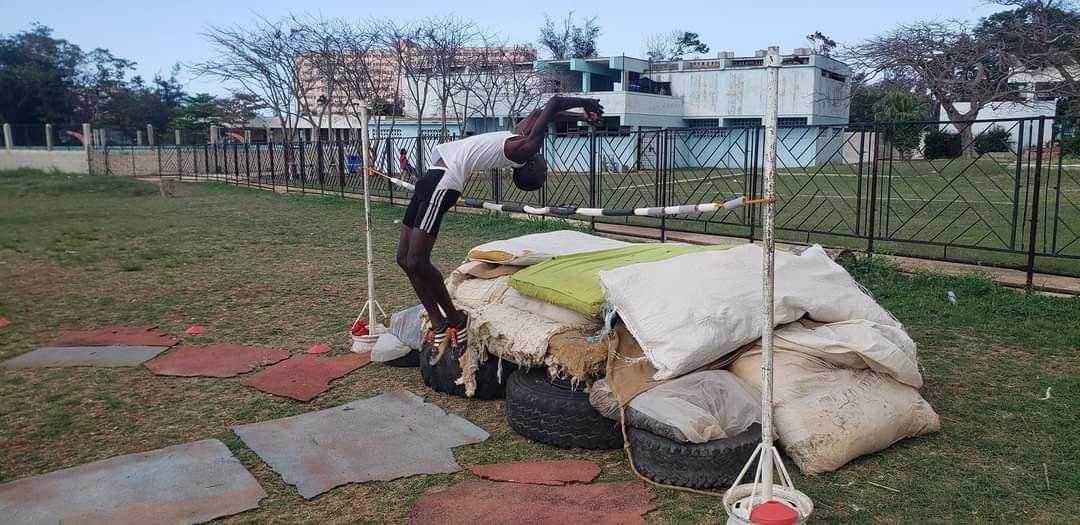
On Thursday, the last day of the event, the Fair opened to all types of public, not just athletes. / 14ymedio

14ymedio bigger14ymedio, José Lassa, Havana, 1 March 2025 — A young man with patched-up sneakers, doing a pirouette to land between old mats and jute sacks: this and many other images sum up the divorce between the International Sports Fair in Cuba and reality. The event concluded this week at the Coliseo de Ciudad Deportiva, in Havana, leaving a bad taste in the mouths of coaches and athletes who have been demanding supplies for months for decent training.

For many of those present – most of them linked to the world of sport – the Fair was “a circus” designed to promote the sector’s links with MSMEs or with foreign companies dedicated to the sale of sporting goods. Rogelio, a former coach interviewed on site by 14ymedio , illustrates this with an example.

“In my province, when a small business was interested in making the clothing for the athletes of the Eide (Sports Initiation School), the answer was negative. So, what Fair are they talking about?” he asks.

Housed in several pavilions inside the Coliseum, some 92 entities participated in the Fair. / 14ymedio

On Thursday, the last day of the event, the Fair opened to all types of people, not just athletes. Recreational activities were held, with music, food sales, an agricultural fair, domino tables and even a promotional entertainer. Success was limited and people, listless, tried to keep up with the pace demanded by the entertainer under the midday sun.

Several barefoot children also ran around the Ciudad Deportiva tracks.

At the bottom of the coverage by Jit, the official specialized media that reported on the event, a user asked the question: “What is on display at this Fair? The disaster of Cuban sport?” The reader underlined the incoherence of celebrating with great fanfare a sector where every level, from the student to the professional, suffers a “clear deterioration.”

Several barefoot children also ran around the Ciudad Deportiva tracks. / 14ymedio

Packed into several pavilions inside the Coliseum, some 92 entities – 15 foreign and the rest national – participated in the Fair. Of the Cubans, 26 continue reading

were private companies with a stand dedicated to exhibiting their products. The greatest interest was not in the sale of sports equipment, but rather in a small/medium-sized company that sold honey.

Another attraction was the presence of glories of sport on the island, such as Javier Sotomayor – recently involved in a financial scandal with the Cuban treasury from which he has tried to disassociate himself – who posed for the cameras of his admirers.

The Inder (National Institute of Sports, Physical Education and Recreation) Marketing and Importing Company displayed balls, rackets, nets and bats that its athletes do not have. From the state-owned Acopio are fruits and vegetables that have not reached the provincial Eide canteens for years. In other booths, sports shirts and suits were sold for between 3,000 and 5,000 Cuban pesos.

Next to the Ciudad Deportiva fairgrounds, another ironic image: that of the Cuban National Circus, another symbol of what propaganda once presented as an “achievement” of the Revolution.

____________

COLLABORATE WITH OUR WORK: The 14ymedio team is committed to practicing serious journalism that reflects Cuba’s reality in all its depth. Thank you for joining us on this long journey. We invite you to continue supporting us by becoming a member of 14ymedio now. Together we can continue transforming journalism in Cuba.

Cuba: Waste of Light in the Dollar Store, Black as Pitch in the MLC Store

When the 3rd and 70th Free Currency Store went dark, customers had to rely on flashlights on their phones to get out.

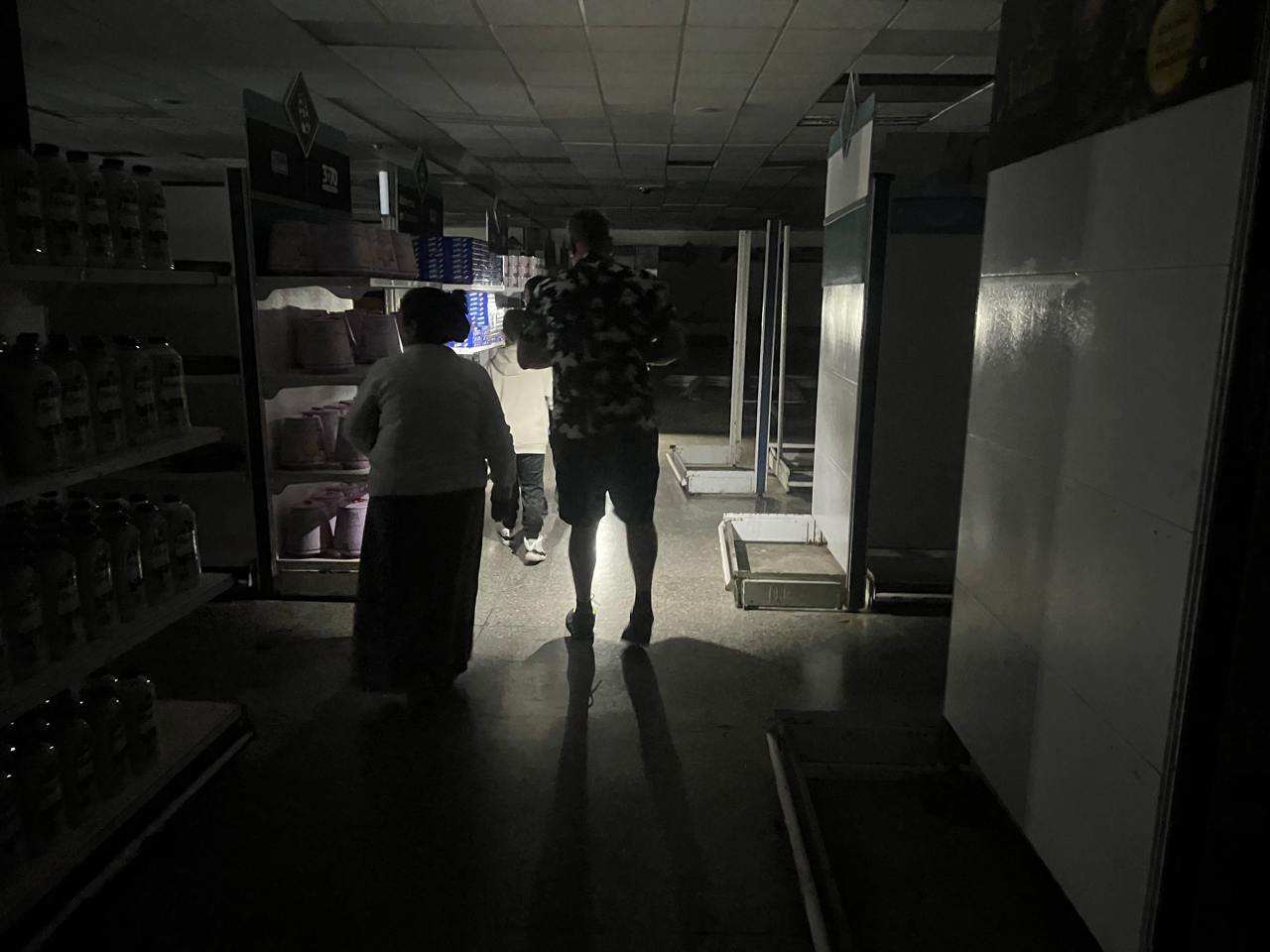
An MLC store this Friday, in the midst of a blackout / 14ymedio

14ymedio bigger14ymedio, José Lassa, Havana, 23 February 2025 — The dollar store at 3rd and 70th in Miramar, Havana, has been crowned the king of all the shops of its kind on the Island. Compared to its sister stores, opened in other provinces, and, above all, to the outdated stores in MLC (freely convertible currency), the luxury and privileges of this commerce are difficult to emulate in Cuba. The waste of light that was exhibited this Friday, while neighboring buildings suffered a blackout, says it all.

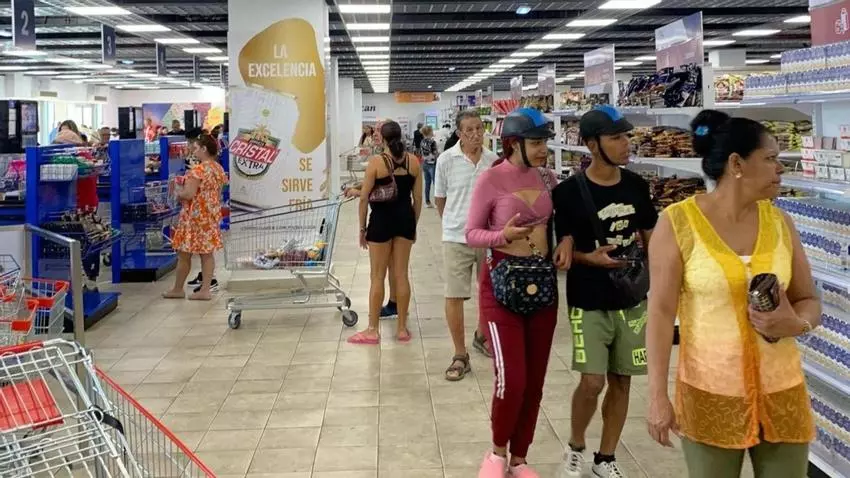
Located at the foot of the luxury hotel Gran Muthu Havana, customers in the dollar store calmly chose the products from well-stocked shelves. The refrigerators full of minced meat or ham, the red shopping carts and the long, well-lit corridors contrasted with the total darkness of the MLC store, on the same corner but on the sidewalk in front, after the power was cut off.

In the dollar store, with no blackout, the customers continued shopping / 14ymedio

Soon the place near 3rd and 70th emptied, and only the privileged customers remained who, greenbacks in hand, carried rice cookers and the indispensable rice packages, in addition to cooking oil, cookies, beer and pasta. There were lines at the refrigerators and the checkout counters, and Cuba – at least during that privileged moment in a stocked and clean supermarket – did not seem like a country in absolute crisis.

Without dollars to buy the products most in demand or even enjoy electrical service, customers in the MLC store reached for their phones to turn on the flashlight. continue reading

At the checkout counters, the saleswomen organized the payments received before the power cut and waited for the last customers, uttering insults, to leave the maze of shelves. Only they, when they reached the street, understood – in the words of a sweaty woman who left the store – what it is to buy in “Socialist Cubita.”

Translated by Regina Anavy

____________

COLLABORATE WITH OUR WORK: The 14ymedio team is committed to practicing serious journalism that reflects Cuba’s reality in all its depth. Thank you for joining us on this long journey. We invite you to continue supporting us by becoming a member of 14ymedio now. Together we can continue transforming journalism in Cuba.
‘That Was My Home!’ Cry the Ten Families Who Were Victims of a Building Collapse in Havana

It was a three-story building located in Santos Suárez and declared uninhabitable years ago.

The building collapsed at the weekend leaving ten families without a roof over their heads. / 14ymedio

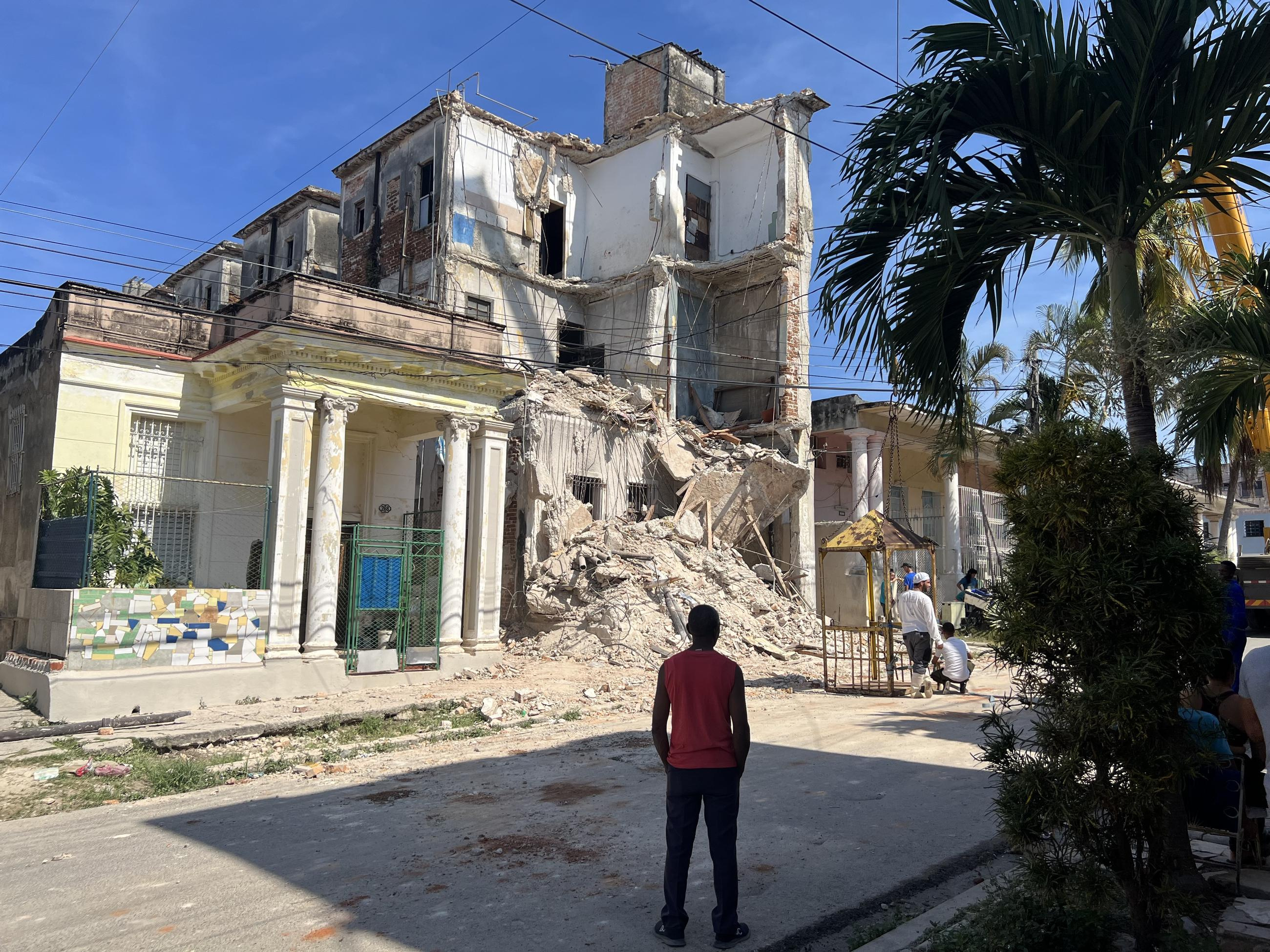
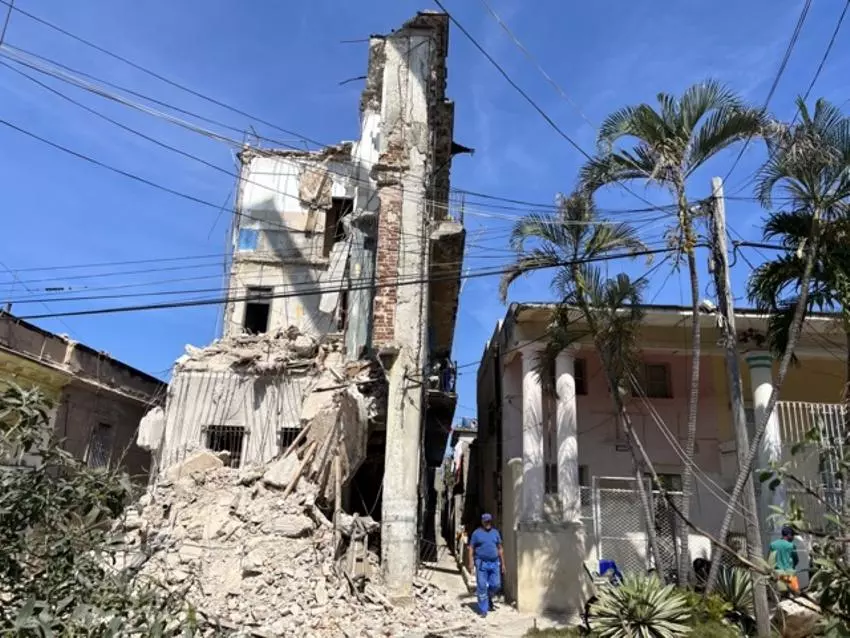
14ymedio bigger14ymedio, José Lassa, Havana, 17 February 2025 – Steel girders exposed to the sun, the front of the building turned into rubble, and dozens of distressed residents standing around it, this was the scene on Monday morning at the building in Calle San Bernardino between Durege and General Serrano, in the Havana suburb of Santos Suárez in the Diez de Octubre district. The building collapsed at the weekend leaving ten families without a roof over their heads.

Sitting in a wheelchair on the pavement out in front, one resident of the collapsed building pointed to the ground floor and said “That was my home!” Around twenty people had brought onto the street the few belongings that they had managed to find among the chunks of wall and twisted metal: a cushion, a washer, and a few pictures which had once adorned the living room walls of those homes which no longer existed.

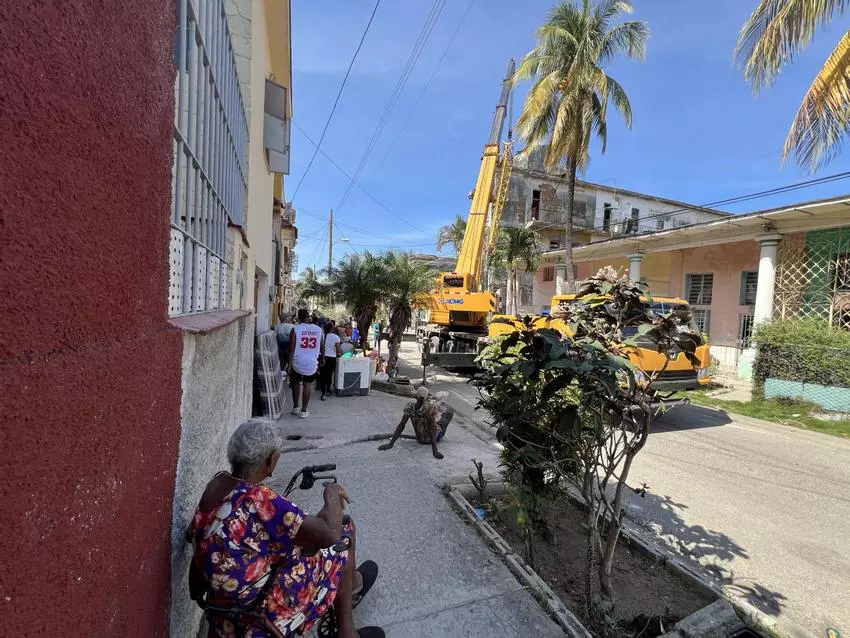
A group of public workers equipped with a crane spent some hours pulling down the remaining bits of the three-storey building – which had been declared uninhabitable for years but in which a number of families still lived. Down onto the stopped traffic, and onto the neighbourhood itself – braced against every sledgehammer blow to the walls – the yellow dust drifted down and covered everything. “At first they said that they were only going to demolish the top floors but now they’re saying they’ll have to demolish it all”, the woman in the wheelchair explained to 14ymedio.

“My home was on the ground floor”, she said, and pointed towards an area of the building in which the tops of the windows themselves were barely still visible, being surrounded as they were by a mountain of rubble. While she spoke, the crane was lifting a worker upwards so that he could help to bring various belongings down from the upper apartments. Every rescued item was greeted by the residents with cries of jubilation, but also with some concern: “I don’t know whether I’ll be able to rescue my bed”, expressed one young woman with a child in her arms. continue reading

“At first they said that they were only going to demolish the top floors but now they’re saying they’ll have to demolish it all”. / 14ymedio

Disregarding warnings not to enter, some residents attempted to get access via the doors in a side passage, in order to try and bring out kitchen appliances, a purse, or family photos kept in a drawer. They came out a short while later with something in their hands but with shocked expressions on their faces. “It’s terrible in there, it feels like it’s going to carry on collapsing”, said one man who had managed to bring out various pairs of shoes and an electric stew pot.

The uncertainty about what will happen after the demolition was also a topic of conversation. “They’ll probably send us to a hotel or who knows where now”, speculated one of the victims who hadn’t managed to recover even one object of value from within the collapsed walls. Until now, neighbourly solidarity had provided them with water and something to eat, but those affected knew that they couldn’t remain indefinitely out on the street in front of the ruin overnight.

“It’s terrible in there, it feels like it’s going to carry on collapsing”.

Building collapses are a frequent reality in the Cuban capital, especially when the rains and the bad weather soften the mortar in structures which are already in danger of collapse. At the end of June last year, when Havana experienced several days of storms, at least 19 buildings suffered from either partial or complete collapse, according to a 14ymedio source who preferred to remain anonymous.

Video footage of the collapse of a villa in Calle 26, between 27 and 29 in Playa district, filmed by various passers-by and neighbours, was one of the most widely shared videos at that time – an incident which was estimated to have claimed at least one life and caused a number of people to be injured.

Translated by Ricardo Recluso

____________

COLLABORATE WITH OUR WORK: The 14ymedio team is committed to practicing serious journalism that reflects Cuba’s reality in all its depth. Thank you for joining us on this long journey. We invite you to continue supporting us by becoming a member of 14ymedio now. Together we can continue transforming journalism in Cuba.
Fatally Injured, Cuba’s Hard Currency (MLC) Stores Refute the Official Speech About Their Continuation

The dollar stores that Tiendas Caribe and Cimex have begun to open in the provincial capitals have given their final blow.

The Puentes Grandes Shopping Center, located on the corner of 26th and 51st streets / 14ymedio

14ymedio bigger14ymedio, José Lassa/Natalia López Moya, Havana, February 13, 2025 — “They have fans for sale in Roseland, hurry up,” writes a user in a WhatsApp group where hundreds of customers meet to monitor stores in freely convertible currency (MLC) in Havana. Following the trail of products in those State shops has become a full-time task due to the shortages that keep their refrigerators and shelves practically empty.

After touring several markets of this type in the Cuban capital, Yusimí, 43, arrived at one quite far from his home: the Puentes Grandes Shopping Center, located on the corner of 26th and 51st streets. “I haven’t been to this place for years, and it left me cold,” he said when he came across the holes in the floor at the entrance. That damage was only a part of the deterioration he found inside.

Practically empty of customers and products, the huge warehouse that once belonged to the Telva towel factory barely had a few cans of tomato sauce, some beach flip-flops and a few appliances with expensive prices and dubious quality. “This was a high-end store and now it’s scary to go inside; not even the lights work well,” lamented Yusimí, who, finally, “in order not to waste the trip” ended up buying a couple of cans of beets.

Damage to the floor was only a part of the deterioration inside / 14ymedio

The place was inaugurated as a shopping center in 2014, under the management of the military corporation Cimex. “The lines were constant because it was very well stocked,” recalls a former employee, who evokes those first years with nostalgia. “People came from all over Havana, because we had a very good supply of perfume and food. The hardware store also attracted a lot of customers, but the best thing we offered was the great variety of appliances.”

At that time, the authorities even announced that the market would have a web-browsing room and a Wi-Fi area that were never installed. “We even offered a gourmet assortment with good cheeses and very fine chocolates,” recalls the employee. It is difficult to reconcile that image of full shelves, well-dressed workers and customers who carried baskets full of goods with the empty refrigerators and listlessness of the employees today. continue reading

“When they removed the convertible peso in 2021, the decline began,” the woman says. The suppliers began to fail: “Cimex supplied sometimes yes and sometimes no, until only a few customers came every day.” The conversion of the store to sales in MLC (hard currency) initially seemed to revive it. “We thought that, since in the end they were dollars that people had deposited in the bank to make the purchase, the supply was not going to be lacking, since we were talking about hard currency.” Less than five years later, the only thing left of that splendor is the bright white paint on the facade.

The final push was given to the stores in MLC by the dollar shops that, through the network of Caribe and Cimex Stores, began to open in the capitals of each of the 15 Cuban provinces. The flagship of that process is the 3rd and 70th Supermarket, on the ground floor of the luxury Gran Muthu Habana hotel, which only accepts payment in that currency, both by card and in cash. While on the platforms of the brand new store there are plenty of goods, at 26th and 51st every day more products are missing.

The scene is repeated in another of the large MLC stores in Havana. The market of Boyeros and Camagüey has followed the same route as its cousin from Puentes Grandes. Recently several officials assured on national television that the freely convertible currency will be maintained, but there has been much speculation about the disappearance of the stores in MLC, and the owners of accounts in that virtual money have fewer and fewer options to spend it.

The old vitality of the business contrasts with the empty refrigerators and the listlessness of the employees / 14ymedio

What three years ago was a parking lot, where a space was barely empty for a few brief minutes before it was occupied by another vehicle, there is now an almost empty esplanade. On the outskirts of the store, this Wednesday, a custodian replied to a customer that they had no chicken or picadillo in the butcher shop. “They haven’t put it out this week, and we don’t know if they’re going to stock up in the next few days,” the worker explained vaguely.

Inside, the floors have holes in several areas, and the shelves are almost empty or filled with the same product. “I came to get olives and Castilian flour, but there isn’t any,” concluded a customer who finally bought a package of custard, family size, so as not to leave empty-handed. Away from the most central neighborhoods, buyers who have a vehicle arrive at Boyeros and Camagüey, a very small number in a city where getting fuel can take several days in line.

With many lights off, the interior of the store not only leaves an image of deterioration but also an unpleasant smell. “The light comes on, the light goes out; the refrigerator holds out for a while but not much, and the products are spoiled,” is how a worker in the storage area summarizes the situation. “There are many employees who have asked for leave, because working like this is not worth it.”

A couple walking down one of the aisles finally decides on a package of peas and a bag of imported sugar. The woman looks at her cell phone and tells the man that in the WhatsApp group where she is registered they have just published a new ad. “They have sausages and Gouda cheese in La Puntilla,” she says, and they leave at full speed to get to the Miramar neighborhood. There, another MLC store, out of stock, with broken floors and no lights, awaits them.

Translated by Regina Anavy

____________

COLLABORATE WITH OUR WORK: The 14ymedio team is committed to practicing serious journalism that reflects Cuba’s reality in all its depth. Thank you for joining us on this long journey. We invite you to continue supporting us by becoming a member of 14ymedio now. Together we can continue transforming journalism in Cuba.
In Havana, the Return of La Rampa Fair, with Fewer Tourists and More Chinese Junk

In its early years, it was only possible to market national productions on its premises.

The reopening of the space, just metres away from the Hotel Habana Libre, comes with a change of image. / 14ymedio

14ymedio bigger14ymedio, José Lassa, Havana, 8 February 2025 – La Rampa Fair has returned to its traditional site in the heart of El Vedado. Dozens of sellers gathered there this week on Avenida 23 between Calles M and N, with products running from artisan items to counterfeit Chinese goods of low quality. And if, until only a few years ago, the ideal customer was a tourist looking for souvenirs, today, with the fall in numbers of foreign visitors to Cuba, the focus is on local buyers.

The reopening of the space, just metres away from the Hotel Habana Libre, comes with a change of image, which makes it look more like a foreign import shop than a local produce one. Along with the traditional maracas, the cedar carvings (that depict an elderly couple dressed to dance a good danzón) or the seed necklaces, it’s the imported trinkets, everyday items, and toiletries which are gaining ground.

“How much are those wireless headphones?”, a youth enquired on Friday morning. “5,000 pesos”, replied the seller, continuing to eat his sandwich. An adolescent asked about a Xiaomi Smart Band – a device which, among other things, should monitor the number of steps taken every day, and which costs 50 dollars on the black market. Nevertheless, at the La Rampa Fair, 2,000 pesos will get you this counterfeit version, which, although visually very similar to the genuine article, unfortunately will only tell you the time.

Along with traditional artisan goods, cheaper trashy items from abroad are gaining ground. / 14ymedio

Sitting next to the headphones were counterfeit Casio watches for 3,000 pesos, and sharing space on the same tablecloth were a whole variety of other products: nail trimmers, cotton buds, hairbrushes, skin cream and a face mask which promises to leave the face fresh and clean. With this range of options the stall resembles, more and more each day, the street markets of the less glamorous but very popular neighbourhoods, such as La Cuevita.

La Rampa Fair was founded in 1993. That summer, trapped in an economic crisis, Fidel Castro relaxed the prohibition of the Dollar, opened up the island to tourism and legalised small private businesses. The street market was then a very closely observed and controlled shop window, given its central location. In its early years it was only permitted to sell national products on its stalls, so that there was an abundance of leather sandals, knitwear, and an infinite variety of souvenirs to take away from the island – from palm tree fridge magnets, to berets in the style made popular by Che continue reading

Guevara, to miniature versions of the old ’almendron’ saloon cars which are everywhere in Habana, or the façade of the Bodeguita del Medio bar.

In the past decade those limits have loosened up and now poor quality foreign imports have taken over parts of the fair, which has also experienced some aesthetic changes. In the market white is now the colour of the parasols, of the sellers’ sweatshirts and of the tablecloths that cover their tables. Maybe it’s a way of exorcising that official argument that they “spoilt” the area, an argument which they used to move the whole thing, some six years ago, down towards one side of the Coppelia ice cream parlour, a change of location that brought losses to the vendors’ pockets and a loss of interest from shoppers.

Payment can be made in cash or by electronic transfer. / 14ymedio

Despite the invasion of plastic junk and counterfeit versions of expensive watches, there is still a variety of artisan produce on sale that is made in Cuba. Leather bags, footwear, goldsmith crafts, women’s dresses for around 4,000 to 6,000 pesos, wooden sculpture and papier-mâché ornaments. Payment can be made in cash or by electronic transfer. You have to show the QR code in each case to do this.

Although on Friday the majority of customers at the fair were Cubans, the few tourists that did approach the site were received like unicorns who had just popped out of a dense forrest. The vendors know that foreigners almost always prefer to pay in their own currency, so they offer to settle the bill in dollars or euros at an informal rate of exchange. The same thing occurs at the other nearby fair in the Don Quixote park. Below the ungainly figure of the famous nobleman, dollars are presented for a pair of flip-flops for the beach just as much as for a guerrilla cap with a red star on the front.

Below the ungainly figure of the famous nobleman, dollars are presented for a pair of flip-flops for the beach just as much as for a guerrilla cap with a red star on the front. / 14ymedio

Translated by Ricardo Recluso

____________

COLLABORATE WITH OUR WORK: The 14ymedio team is committed to practicing serious journalism that reflects Cuba’s reality in all its depth. Thank you for joining us on this long journey. We invite you to continue supporting us by becoming a member of 14ymedio now. Together we can continue transforming journalism in Cuba.
Long Gone Are the Times When a Flying Saucer Arrived at the Ciudad Deportiva in Havana

Stagnant water has turned a shade of green within the pools. / 14ymedio

14ymedio bigger14ymedio, José Lassa, Havana, February 9, 2025 –Resembling a flying saucer or a hamburger bun, Havana’s Ciudad Deportiva stands not only as one of the city’s premier architectural treasures but also as the backdrop for thrilling events like championship finals and Cuba’s sole Rolling Stones concert.

Nestled at the crossroads of several capital neighborhoods, this grand complex, inaugurated in 1958, symbolizes the current state of sports on the island. The training grounds, race track, indoor courts, and especially the swimming pools, are all in dire need of extensive renovation to regain their former glory and pivotal role in nurturing young athletes

Stagnant water has turned a shade of green within the pools—one Olympic-sized and the other for diving. The cracked and peeling interior walls vie with the damaged stands where once the crowd buzzed, shouting or applauding as their favorite athletes swam. Now, a leak has flooded part of the seating area, from which a nauseating smell emanates. continue reading

There are five basketball courts, but of the ten hoops they should have, only three remain. / 14ymedio

Adjacent to the pool area, five basketball courts stretch out, though only three of the ten hoops remain. One of the courts is also plagued by wastewater, giving it an appearance somewhere between a swamp and a landfill where all sorts of trash pile up.

One of the remaining basketball nets collapsed a few days ago, and a coach with his students took it upon themselves to set it back up, knowing that the Ciudad Deportiva staff wouldn’t handle the repair. The officials from the National Institute of Sports, Physical Education, and Recreation (Inder), located within the complex, seem indifferent to the decay spreading around them.”

At the entrance of the Inder headquarters in Havana, coaches and their students often wait to ’catch’ the president of the official entity, Osvaldo Vento. Only after persistent insistence and complaints about the area’s deterioration does the official agree to send some workers to assess a fallen hoop, a race track overgrown with weeds, or the sewage water accumulating in parts of the grounds. Most of the time, only a ’temporary patch’ is done, laments a basketball coach.

Residents avoid the area at night due to the multiple gaps in the fence and the lack of surveillance, making it a dangerous place. During the day, some residents from the nearby neighborhoods of Cerro or Nuevo Vedado come to run, do calisthenics, or simply cut through the complex to shorten their route. The crossing must be done with caution, as the holes and tall grass can hold unexpected surprises.

Residents avoid the area at night because its multiple holes in the fence and lack of surveillance make it a dangerous area. / 14ymedio

Its current state surprises no one. Since its opening, the Ciudad Deportiva has undergone only two major renovations. The first was in preparation for the 1991 Pan American Games in the Cuban capital, and the second as part of the celebrations for the 500th anniversary of the Villa de San Cristóbal de la Habana. Five years after that milestone, the cracks of a renovation that was more superficial painting than deep intervention have emerged.

In memory, however, some stories of its past remain. Like that day on December 28, 1954, Cuba’s equivalent of April Fool’s Day, when Cuban humorous wit flourished on the grounds where the Ciudad Deportiva was being built. Probably influenced by the overwhelming impact of H.G. Wells’ War of the Worlds, a rumor—strengthened by news spread by the national press—spread about the landing of a flying saucer in the vicinity.

Thousands of curious onlookers gathered at the site, with talks of even mobilizing the Army. Eventually, several famous Cuban actors and singers, including the popular Rosita Fornés, emerged from the artifact dressed as Martians. The ’close encounter’ with the Habaneros was accompanied by a musical piece asserting, ’The Martians have arrived / And they arrived dancing cha-cha-cha,’ composed by Rosendo Ruiz.

Seventy years have passed since that memorable day, and the promises to transform the area into a modern zone with cutting-edge infrastructure have not been fulfilled. Neither the enthusiastic crowds nor the thousands of voices that once filled the grounds of the Ciudad Deportiva remain.

One of the playing fields is also affected by wastewater. / 14ymedio

Translated by Gustavo Loredo

____________

COLLABORATE WITH OUR WORK: The 14ymedio team is committed to practicing serious journalism that reflects Cuba’s reality in all its depth. Thank you for joining us on this long journey. We invite you to continue supporting us by becoming a member of 14ymedio now. Together we can continue transforming journalism in Cuba.
The Energy Debacle Melts the Little Ice Cream That Coppelia Offers to Cubans

The blackout reveals the absolute harshness with which Cubans perceive their situation

At 2:00 pm the doors of Coppelia open for a public eager to taste a sip of ice cream / 14ymedio

14ymedio bigger14ymedio, José Lassa, Havana, 13 February 2025 — The ups and downs of electricity give no respite to the refrigerators where Coppelia’s ice cream is stored. From blackout to blackout, between shortages and closures, a scoop of chocolate can become a warm milkshake in a few minutes. Without power and in the tropics, where it will no longer cool down until the end of the year, Havana’s ice cream “cathedral” is not even a chapel.

Even so, there is a line in front of the emblematic blue facade. “They are going to open,” says an enthusiast to whom the 1,810 megawatts (MW) of deficit announced today by the Electric Union has not taken away hope. Indeed, at 2:00 pm the doors of Coppelia open to an audience eager to taste a sip – with 31°C (87.8 F) there is no other consistency – of ice cream.

The joy will not last long. The most informed in the line, who handle the cumbersome calendar of cuts with ease, know that Coppelia will lose power at 3:00 in the afternoon. The time when “they killed Lola,” according to the pessimistic saying,* will be when the possibility of cooling down the product that gave fame to one of the most visited places in El Vedado will be lost.

The most informed in the line, who handle the calendar of cuts with ease, know that Coppelia will lose power at 3:00 in the afternoon

Aside from the energy situation, Coppelia suffers its own way of the cross. Last week, a few days after its laborious reopening, it plunged back into the mediocrity from which, supposedly, the repair was going to save it. Now, along with the price increase and the diminished supply, habaneros will also have to suffer multiple disappointments in the face of a dessert that comes in any form and temperature except in the appropriate one. continue reading

After a fatal January for the national electrical system (SEN), and after a year of alumbrones,** this month the lack of electricity hit rock bottom again. Without too much alarm on the part of the authorities, who have normalized the cycles of increasingly abusive blackouts, a deficit of 1,870 MW was estimated.

The figure, higher than the one the country experienced last October when the SEN collapsed, presaged a new total blackout that is still a threat this Thursday. In practice, cities like Cienfuegos, Cárdenas and Matanzas have their own blackouts of more than 24 hours now, similar to yesterday.

Aside from the energy situation, Coppelia suffers its own way of the cross of closures and reopenings / 14ymedio

“I’m on strike and won’t go to work today,” a pre-university teacher who has been unable to plan her classes and perform various household chores told this newspaper. “I haven’t even dressed. If they don’t turn on the light, I’m not leaving my house.”

No matter the latitude, when the blackout arrives it brings out the total rawness with which Cubans perceive their situation. In a barbershop in Nuevo Vedado, in Havana, the current went out leaving several craniums half-cut. “When are they going to get on the plane!?” was the question that everyone shouted in unison.

They mean the leaders, whose erratic management always affects – and every day – “those below.” Unperturbed, forced to create strategies against electrical uncertainty, the barbers took out rechargeable lamps and electric shavers with the batteries charged. “Prepared and alert,” joked one of the workers, parodying the motto of the Civil Defense in the face of cyclones.

The blackouts totally interrupt or paralyze daily life in Cuba. In addition to economic consequences, energy instability has an important human impact: frustration, depression and proliferating nervous breakdowns leave the brains of Cubans as melted as the ice cream served this Thursday by the Coppelia in Havana.

Translator’s notes

* According to Cuban legend, Lola was a prostitute who was stabbed to death by a lover at 3:00 in the afternoon. It became a popular expression for that time of day.
** As opposed to the apagones (blackouts), Cubans coined the word ‘alumbrones’ for the brief periods when the lights are on.

Translated by Regina Anavy

____________

COLLABORATE WITH OUR WORK: The 14ymedio team is committed to practicing serious journalism that reflects Cuba’s reality in all its depth. Thank you for joining us on this long journey. We invite you to continue supporting us by becoming a member of 14ymedio now. Together we can continue transforming journalism in Cuba.

On the Third Day of Coppelia’s Reopening, Everything Starts To Be Missing at the ‘Ice Cream Cathedral’

In the long lines to enter the ice cream shop, the main topic was the rapid deterioration of the emblematic State business

Private companies are far ahead of state-owned businesses in terms of diversity of flavours and quality. / 14ymedio

14ymedio bigger14ymedio, Natalia Lopez/Jose Lassa, Havana, 8 February 2025 — It has been a few days since the Coppelia ice cream shop reopened and the drop in variety of offerings has already begun to be noticed. This Friday afternoon, only two flavors were still on sale – guava and pineapple – instead of the eight that were shown as available last Wednesday on the product display at the shop. Located on the corner of 23rd and L in Havana’s Vedado neighborhood, one of the Coppelia stands to buy ice cream cones had even closed due to lack of merchandise.

In the long lines to enter the “ice cream cathedral,” the main topic was the rapid deterioration of the iconic shop. “We already know that everything here has little fijador, but the truth is that this place is fading too quickly,” commented a teenager who went in search of a chocolate and strawberry ‘salad’ — multiple scoops — based on the ads she read on social networks. “I thought I was going to find another, more beautiful sight, but it’s the same as always.”

One of the stands to buy barquillos [wafers] was closed due to lack of merchandise. / 14ymedio
With prices ranging from 30 to 40 pesos per scoop, depending on the size and combination ordered, the ice cream shop is still much cheaper than the private businesses that have proliferated in the area. However, private businesses are far ahead of state-owned businesses in terms of the variety of flavors, the quality of the toppings and add-ons, and the wide assortment of sweets. The waiting time is also not in Coppelia’s favor.

“I came at four in the afternoon and it’s already after five and I haven’t been able to get in,” lamented a mother with a small child on Friday. “I wanted to have a nice chocolate curly cake with some torticas, which they told me they had brought out on the first day, but there’s nothing left.” After an hour and a half of waiting, the woman and her daughter finally made it into one of the courts located on the ground floor. The glass of water placed on their table was another hard blow. The temperature of that liquid was as warm as the afternoon that stretched over Havana.

____________

COLLABORATE WITH OUR WORK: The 14ymedio team is committed to practicing serious journalism that reflects Cuba’s reality in all its depth. Thank you for joining us on this long journey. We invite you to continue supporting us by becoming a member of 14ymedio now. Together we can continue transforming journalism in Cuba.

The Cuban State Extends Its Business Network in Dollars With Mercalhabana and Alma Caribe

The authorities expect there to be 50 new Alma Caribe stores, which will supply businesses and the population

The 23rd and C store has suppliers from “the same portfolio” as the one at 3rd and 70th / 14ymedio

14ymedio bigger14ymedio, Rosa Pascual / José Lassa, Madrid / Havana, 6 February 2025 — Three women sat down this Wednesday on the State’s Round Table program to give more details on television about a thorny issue for Cubans: the so-called “partial” dollarization. The regime has inexcusably decided to attach that adjective to the noun to convince the population that one day the peso will have value. However, last night it was again verified that, in the short term, only those who have foreign currency on their cards can expect an improvement.

Aracelys Cardoso Hernández, Deputy Minister of Internal Trade, began with a clear statement: “There is a deficient supply in national currency with the contraction of production and the foreign currency deficit, which does not allow businesses to be restocked,” she said, without identifying – much less assuming – responsibility .

The official explained that the measures approved in 2022 to trade in foreign currency “in order to have future offers in national currency that benefit the population” have led to the launch of several businesses of this type, both in the wholesale and retail markets, in line with what was announced a week ago on the Round Table program.

“Fifteen wholesale and retail marketing plans have been approved, of which eight are linked to the business system”

“Fifteen wholesale and retail marketing businesses have been approved, of which eight are linked to the business system served by the Internal Commerce system. One is made through an international economic partnership contract. The first three are dedicated to wholesale marketing, and five are mixed companies that have approved the wholesale and retail continue reading

marketing of consumer goods and various products for the population,” she said.

In the 60 minutes that Randy Alonso’s program lasts, the origin of foreign investors was not mentioned – “the eight projects come from seven countries,” was all that was known, as she left out the names of the companies. She did want to convey the idea that they will find “a qualified workforce” in Cuba, something that will depend on the salaries that these new businesses can offer, at a time when the workforce is a source of concern in all sectors, particularly in the State sector.

The businesses are aimed at both the population and the wholesale supply of State and private stores – “all the actors of the economy” in bureaucratic language – and their main offers, at least initially, will be food, household utensils and cleaning and personal hygiene products .

The inspiration is in the supermarket at 3rd and 70th, on the ground floor of the luxury hotel Gran Muthu Habana, which has had an excellent economic result according to the authorities. Cardoso Hernández said that an attempt is being made to promote the idea that the prices are “competitive.”

Present at Mesa Redonda, Sonia Rivero Batista will be the Cuban manager of the joint venture Alma Caribe S.A., one of the two large companies presented yesterday that will be dedicated to retail and wholesale trade – both State and private – of many different national and imported products. Its expansion is expected to be vertiginous, according to its representative.

One of the stores announced is at 23rd and C, in El Vedado, Havana, which is ready to receive customers, although it is not yet open. A reporter from 14ymedio went to the store and verified that it remains empty. Some curious people who approached the windows of the establishment made similar observations: the refrigerator was disconnected, and there were no products inside. “It will be both a wholesaler and a retailer,” said a worker who left the store and locked the door.

Rivero indicated that the suppliers of this store are from “the same portfolio” as the one at 3rd and 70th, and that their experience in product rotation and stock needs is the basis for operating in this way. Market studies have also been done, she said, through interviews, to find out how much customers are willing to pay, with sales in freely convertible currency as a basis.

The reporter also visited other places, such as the one at 25th and 12th, where they are remodeling a Panamericana store and training employees in collecting payments by currency cards and cash dollars. “There is still no date set [for the opening]; we don’t know when,” said a worker. Another store that will use the same business model is under repair at Linea and 12th.

From here on, the growth is expected to be brutal. It will start with rented stores – there are now two being repaired – and will move to modular construction, two of them planned for the short term. They will each have 1,000 square meters, and there will be 15 of them in Havana. Ultimately there will be 50 throughout the Island, 48 of them new. In parallel, there will also be online sales.

Rivero Batista stressed that the ultimate goal is to “contribute to the development of national industry. For us, it represents a strength to have the availability of these products in the country, because it allows us to have them at our fingertips in a shorter period of time with cheaper costs. That makes it possible for us to link with these national suppliers.”

Construction work on a Panamericana store in Havana where dollars will be accepted / 14ymedio

The other great protagonist of the night was Mercalhabana S.A., a State-owned commercial company that represents 22 wholesale companies and “has as its main objective participation as a national shareholder in foreign investments, as well as managing imports and exports authorized to supply the wholesale channel of the country.”

Yaimara Pérez Barrera, its vice president, indicated that this will be the “gateway” to the business system, acting as a manager and promoter of projects for the wholesale food sector. She did not reveal the amount that has had to be disbursed for a modernization that, she said, was radical, since the existing structure had “a notable deterioration and technological obsolescence.” Infrastructure has been recovered, and new technology has been incorporated, in particular for refrigeration, where the national company has supplied refrigerators and freezers, essential “for the business scheme in foreign investments.”

The director pointed out, without specifying anything, that there is already an existing business “in the form of a joint venture for wholesale and retail trade,” and two other similar ones are being studied. As a novelty, Pérez Barrera said, Mercalhabana has included “alternative forms of marketing, such as the sale of products on consignment and in customs warehouses.” The latter, she added, has been underway since 2024, and has allowed a “partial replenishment of the wholesale system, alleviating to some extent the shortage of basic necessities.”

All this will only be within the reach of companies and the population that can pay in foreign currency, what could be called a “partial” sphere

All this will only be within the reach of companies and the population that can pay in foreign currency, what could be called a “partial” sphere, but Deputy Minister Cardoso Hernández did not want the broadcast to end without insisting that all this is for a better future.

“Internal trade in national currency is and will continue being the majority in our country. The population must have confidence, because despite the situation that the Cuban market shows today, it is a priority of the State and our ministry that the offers in national currency continue to be the majority,” she said, before citing the battered social programs that must cover the needs of those who will be forced to look for non-existent products in the ration stores.

Thus, she concluded: “The partial dollarization of the economy is a temporary projection in the short term, but necessary for the capture of foreign exchange. The Cuban State will define the priorities of that currency in correspondence with what the population demands, its economy, industry and progress.”

Translated by Regina Anavy

____________

COLLABORATE WITH OUR WORK: The 14ymedio team is committed to practicing serious journalism that reflects Cuba’s reality in all its depth. Thank you for joining us on this long journey. We invite you to continue supporting us by becoming a member of 14ymedio now. Together we can continue transforming journalism in Cuba.

The Return of European Cruises to Cuba Coincides With the Tourism Debacle

The British ’Ambition’ cruise ship is now in Havana and was preceded by the German ’Hamburg’

Passengers of the ’Ambition’ negotiate with the driver of an almendrón. / 14ymedio

14ymedio bigger14ymedio, José Lassa, Havana, 29 January 2025 — For the third time in a month, a cruise ship docked in Havana on Tuesday. It was the Ambition, from the Caribbean island of Saint Kitts and Nevis and operated by the British shipping company Ambassador Cruise Line. It is the first time that this ship, registered in the Bahamas, has arrived in the Cuban capital.

With a capacity of 1,200 passengers and 600 crew members, several dozen of them were seen on Tuesday heading towards the historic centre. Some even immediately hailed an almendrón [a classic American car in service as a taxi].

Passengers of the ’Ambition’ negotiate with the driver of an almendrón. / 14ymedio

The official press echoed the arrival, citing the General Customs Office of the Republic, which stressed that “this operation confirms Cuba as a safe port for tourism and other naval activities in the region.” During the day, the note published by Tribuna de La Habana continued , “the captain of the vessel exchanged plaques with the administration of the Havana Cruise Terminal, in an act of courtesy that reaffirms the good relations and the recognition of the work of the authorities of the Island in the sector.”

Just five days ago, the MS Hamburg, operated by the German operator Conti, docked in Havana again. As usual, its passengers also strolled through Old Havana during its stop. Before that, the ship had been in continue reading

Santiago de Cuba and, before that, also in the capital of the island, after a trip to Colón (Panama), San Andrés (Colombia), Roatán and Puerto Cortés (Honduras), Santo Tomás de Castilla (Guatemala), Belize and Cozumel (Mexico).

The ’Hamburg’ ship docked in the port of Havana on January 24. / 14ymedio

That arrival, at the end of December, marked the beginning of the high season for cruises, which, however, do not seem to be enough to lift the debacle in the tourism sector. As indicated by official data published this Tuesday – later than usual and after the conclusion of the Madrid International Tourism Fair (Fitur) – Cuba closed last year with the lowest number of international travelers since 2007 – excluding the 2020-2022 period, in which the sector collapsed worldwide due to the Covid-19 pandemic – those same 2.2 million that the Minister of Tourism, Juan Carlos García Granda, in December, had predicted before Parliament.

Passengers from the ’Hamburg’ heading to the historic center of Havana, on January 24 / 14ymedio

Particularly worrying are the figures for December, traditionally the best month of the year in terms of tourism, as it is the peak of the Caribbean high season. Only 197,790 travellers were received on the island.

____________

COLLABORATE WITH OUR WORK: The 14ymedio team is committed to practicing serious journalism that reflects Cuba’s reality in all its depth. Thank you for joining us on this long journey. We invite you to continue supporting us by becoming a member of 14ymedio now. Together we can continue transforming journalism in Cuba.

Boarded Up and Roofless, Bola De Nieve’s House Suffers From Neglect in Guanabacoa, Cuba

The house has become a greyish shell that the municipal museum, which is in charge of the building, watches over with suspicion.

The house is located on the corner of Máximo Gómez and Versalles streets / 14ymedio

14ymedio bigger14ymedio, José Lassa, Havana, 2 February 2025 — The state of the house where Bola de Nieve, author of the most melancholic lyrics in Cuban music, was born provides enough to write a heartbreaking bolero. Located on the corner of Máximo Gómez and Versalles streets, in Guanabacoa, Havana, the house has become a grayish shell that the municipal museum, in charge of the property, watches over with suspicion.

What is left standing are walls that mark the perimeter of the house and several columns that support the structure of the porch, topped with floral ornaments that simulate the frames remaining in the windows. The roof has long since collapsed. From the remains of the building, one can guess the dimensions of a republican manor house that once occupied the entire street corner and now remains “ boarded up” to prevent unwanted tenants from sneaking in.

Like the bolero by the Cuban artist Es tan difícil (It’s so difficult), it has become an impossible mission for the Guanabacoa museum to take care of the house and rescue it “There was a project to restore it, but it never came to fruition. In the end, they boarded it up because people were constantly coming in to sleep or live there, and that was the solution: to seal it,” a museum worker told 14ymedio. continue reading

In 2011, on the 100th anniversary of Bola’s birth, the municipal museum put up a plaque commemorating the musician’s birthday, but soon after removed it.

As explained, the house belonged to Ignacio Jacinto Villa Fernandez’s family – who gave himself the ironic artistic name of Bola de Nieve (Snowball) – but the musician moved his relatives to another house in the same municipality, located on the corner of Nazareno and Maceo streets. “His brother’s descendants did not keep the house, so they exchanged it. It was for a time a”cuartería”(similar to a tenement house) where several families lived,” the employee explains.

The republican-style building retains its walls and has long since lost its roof.

While people were living in the house, the museum could not restore it, but nor it did not allow the tenants to make major changes, since the building is considered a heritage site. When it was finally vacant, another place having been given to those who lived there, the museum could “get its hands on it” without obstacles. Then, there were no more resources or intentions to repair the house.

“There has been talk of restoration projects and some have even been submitted, but nothing is being done. There are many heritage sites in Guanabacoa with restoration projects submitted, but the problem is that there is no money,” the worker says. When the Guanabacoa museum itself “needs repairing,” the future of the manor house is clear: “it is going to be lost.”

Translated by LAR

____________

COLLABORATE WITH OUR WORK: The 14ymedio team is committed to practicing serious journalism that reflects Cuba’s reality in all its depth. Thank you for joining us on this long journey. We invite you to continue supporting us by becoming a member of 14ymedio now. Together we can continue transforming journalism in Cuba.

Official Ceremony at José Martí’s House and Police Operation at Otero Alcántara’s House, in the Same Havana Neighborhood

At number 41 on Paula Street, the little house that has been drawn by every Cuban child celebrates a century as a museum this January

On the 172nd anniversary of the birth of José Martí, a hurried official ceremony shook up the routine of the San Isidro neighborhood. / 14ymedio

14ymedio bigger14ymedio, Jose Lassa, Havana, 28 January 2025 — The huge sound systems and a stage, placed in the street, clashed on Tuesday with the narrow and almost childish façade of the house where José Martí was born in Havana. On the 172nd anniversary of the birth of the Cuban national hero, a hurried official ceremony, with some local authorities, shook up the routine of the San Isidro neighborhood, an area where the crisis and lack of investment have left deep wounds.

At number 41 on Paula Street, the little house that has been drawn by every Cuban child, described in songs and photographed to the point of exhaustion, celebrates its 100th anniversary this January as a museum. In the place, where Martí spent only three years of his life, there are photos of his adolescence, images of his time in New York, snapshots with his son, countless documents protected behind glass and some personal objects.

The impeccable yellow facade, the windows with their retouched blue and the red roof form a striking contrast with the surroundings.

The impeccable yellow facade, the windows with their blue touches and the red roof form a striking contrast with the surroundings. While the house, built in 1810, seems to resist the passage of time, other nearby houses are on the verge of collapse or turned into mere rubble. A few meters from the museum, of a neoclassical building from the beginning of the 20th century, only the arches remain. Through the gaps where its doors once stood, mountains of bricks, twisted iron and rubbish now emerge. continue reading

Around the corner, on Avenida de las Misiones, another building abandoned after its roof collapsed “greets” visitors who approach the place where, in 1853, the cry of a baby announced a life as brief as it was prolific. Beyond the short fragment in front of the entrance to the sanctuary, reality becomes harsher and more neglected. The sidewalks full of holes, the balconies on the verge of collapsing on passers-by and the anguished faces of residents looking for food clash with the soft tone of the guide who details the occurrences of that restless child born to a Canarian mother and a Valencian father.

Unlike the immaculate façade of Martí, the one in Otero Alcántara looks like it has been exposed to the elements for centuries. / Juliette Isabel Fernández Estrada/Facebook

If you turn right onto the street that gives the neighborhood its name, the journey then becomes a descent into a poorer, more forgotten Havana. Garbage piles up, abandoned animals search for something to eat among the waste, and a father drags a wheelbarrow with buckets and containers full of water to use in his house. Another turn, also to the right, and you end up on Damas Street. There, around number 955, there was a police operation this morning. A call today to visit the house of Luis Manuel Otero Alcántara and see his work Campesinos felizes 1938-2024 ended with threats against the organizers and several artists with their mobile service cut off.

Unlike the immaculate façade of Martí, the Otero Alcántara façade seems to have been exposed to the elements for many centuries. On its walls, you can hardly make out the blue tone that once covered them. A tangle of cables runs across the top and the door that gives access to the artist’s home, imprisoned since July 2021, has some poorly nailed boards to prevent it from collapsing. A few daring people arrived there on January 28 after reading the call on social media, but they only found poverty and abandonment. There were no platforms with microphones, no officials making speeches and much less tourists taking photos. Nor could you hear the voice of those diligent guides who explain the details of each piece on display, of each photo hanging on the wall. None of that, but rather contempt for the young artist who shouted “Homeland and Life.”

____________

COLLABORATE WITH OUR WORK: The 14ymedio team is committed to practicing serious journalism that reflects Cuba’s reality in all its depth. Thank you for joining us on this long journey. We invite you to continue supporting us by becoming a member of 14ymedio now. Together we can continue transforming journalism in Cuba.

Chic Places for Foreigners and Cubans in Search of Status Are Multiplying in Havana

“Every time we go there, with my husband and my daughter, the bill comes to 18,000 pesos”

A special feature of these restaurants is their cocktails and signature cuisine. / 14ymedio

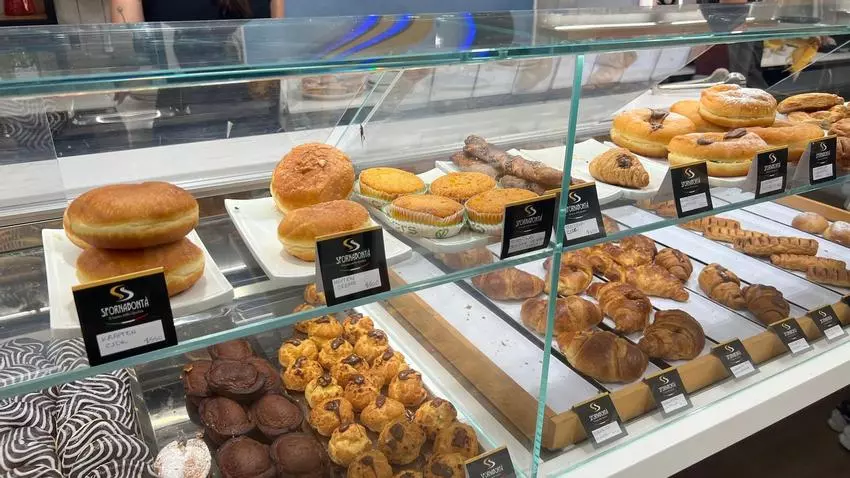
14ymedio bigger14ymedio, José Lassa. Havana, 26 January 2025 —  Garbán, Sfornabontà, Malecón 663, ChaChaChá, Ecléctico, Fangio, Yarini, Antojo, VistaMar are some of the new luxurious and expensive places in Havana where a plate of food costs the equivalent of a Cuban worker’s monthly salary. The proliferation of these establishments, each one more expensive than the last, occurs while the country is going through its worst socioeconomic crisis in history.

Sfornabontà by Amalfi opened its doors just a month ago. The owners, Italians, emphasize that they are the first store selling products from this country in Cuba. Several white-painted wooden tables are occupied almost entirely by older foreigners smoking thin cigarettes or cigars. Located in Miramar on 1st Street, between 44th and 42nd, in front of the Copacabana Hotel, the place offers pizza, pasta and ice cream, as well as sweets and drinks rarely seen before in Cuba.

“The first time I went I just ordered takeout because it was packed. I ordered a cornetto, filled with Iberian ham and cheese, super delicious, and it wasn’t that expensive, 500 pesos. The second time I went, two weeks later, they had raised the price to 750 pesos,” says Amalia Rodríguez, who says she finds out about these places almost always through Instagram, where she and her friends share their visits to chic establishments. “I liked the place, but both times I went they had problems with the electronic payment transfer. Too much coincidence. I don’t think they accept it.” Although the law doesn’t allow it, many of these businesses prefer cash in dollars.

Parked in front of the premises are modern cars and the occasional electric motorbike, as the prices are not for everyone, with pizzas or main dishes ranging from 1,800 to 6,000 pesos.

Sfornabontà by Amalfi opened its doors just a month ago. / 14ymedio

Just one block further along, on the same 1st street, is what YouTubers Javi and Zami have called “the most expensive restaurant in Cuba,” Garbán. The cheapest thing is the soft drinks at 990 pesos, and a bottle of water or a portion of rice can cost up to 2,000 pesos, a portion of continue reading

five croquettes is close to 4,000 pesos, and main dishes are between 4,000 and 9,200 pesos.

Garbán is located just above Gelato, an ice cream shop and confectionery established more than 10 years ago. Both belong to the same owners, Cuban Yanetsi Azahares and her Italian husband.

A special feature of these restaurants is their cocktails and signature cuisine, along with the originality of their decor. Some may be modernist, others minimalist, classic and bohemian or more contemporary, as in the case of Malecón 663, owned by Frenchwoman Sandra Expósito.

“The decor is original. All the chairs are different at the same table, things from the menu are written on the wall. The employees are dressed strangely, with colorful shorts and bare feet,” says Analay Cuello, who, together with her husband, owns a small business selling motorcycles. “Despite it being a strange place, I had a good time.”

Modern and expensive cars are parked in front of these premises. / 14ymedio

“The food is also strange. The pork tenderloins had chocolate sauce. I told him to put the sauce on the side just in case. We didn’t like it. All the dishes had something distinctive about them. The names of the rooms were Gozando en La Habana [Enjoying in Havana], El cuarto de Tula [Tula’s Room], each with a different decor.”

Analay and her husband rented a room, as the Malecón 663 is not only a bar-restaurant but also a boutique hotel. The price per night is $110, with a bottle of cider and breakfast included.

“I didn’t think it was expensive. I’ve been to places that were much more expensive than that, like Chucha’s Tapas Bar, for example. The bills, with my husband and my daughter, every time we go there for her to play, since it has an amusement park, are 18,000 pesos, and what we eat is a dish and a starter for each of us, with a drink, no dessert or anything, and thank goodness we don’t drink alcohol. A lemonade at Chucha’s costs you 1,200 pesos.”

“When I arrived, all I saw were foreigners,” Analay continues. “The manager told us that, indeed, only foreigners or young bohemian Cubans came to listen to jazz and have a few drinks. People like us rarely went.”

Most of these sites have a good presence on social media like Instagram, due to strategies that include collaborations with fashion influencers and artists.

Going to these places is a sign of status. / 14ymedio

Las Noches de Fangio is a well-known weekly event held at the Fangio Havana restaurant, where artists such as Alaín Pérez, Ernán and Ruy López Nussa, Raúl Paz, Frank Delgado, the Abreu Brothers, among others, have performed. Most of these artists could fill a theater, but playing in these places brings them more economic benefits, since 1,000 pesos is the minimum cover charge . Other places that have this duality of restaurant/concert are Yarini, owned by Cuban actor Jorge Perugorría, and Ecléctico, to mention a few.

Going to these places is a sign of status. Posting on social media that you are going to places where the Havana showbiz and foreigners go, who are not the ones who go to all-inclusives, but who stay in luxury hotels and eat lunch and dinner in places where they spend 100 dollars per meal.

One thing is obvious: almost all of the owners of these sites are foreigners or Cubans directly linked to a foreigner.

“It’s something I’ve seen in almost all the places we go to,” Analay continues. “The owners are foreigners. They have their trusted people, the managers, as they call them, and they take care of their business when they are not there, which is most of the time.” “They are all the same. Cubans can’t go anywhere anymore, because they are all expensive. New ones open and they are more expensive,” she concludes.

There are more examples. Color Café, owned by Loypa Izaguirre, a Cuban married to a Frenchman; Plan H, a Cuban owner married to a German; Hotel Boutique Tribe Caribe, owned by two foreigners, one of them the Venezuelan producer Andrés Levin and the other, a mysterious Anglo-Saxon investor, although the shadow of Raúl Castro’s daughter, Mariela, is persistently pointed out.

Most of these sites were recently reviewed by Montreal’s ‘La Presse’ newspaper. / 14ymedio

Most of these sites were recently profiled by Montreal’s La Presse in a series of three surprisingly dithyrambic articles entitled La Havane chic. The author, Canadian photographer Martin Chamberland, describes a new facet of Havana, “more upmarket, even more nutritious for the taste buds and more dazzling for the eyes.”

One of the “experts” he interviewed is Canadian photographer Heidi Hollinger, who says that “this city has the assets to become one of the most outstanding places on the planet and a first-rate gastronomic capital.”

Beyond the stupor provoked by the description of this parallel reality, many questions arise: Did they only see that Havana where foreigners and that very small sector of Cubans with resources congregate? When they moved from one chic place to another, did they not see the other one, invaded by garbage, with buildings in ruins and widespread poverty?

“Cuba is increasingly out of reach for the Cuban people,” says one user in the comments to one of the videos by YouTubers Javi and Zami. Cubans are the last to learn that Havana has become “a gastronomic capital.”

In addition to being a bar-restaurant, the Malecón 663 is also a boutique hotel. / 14ymedio

The Art of Organizing Gas Station Lines in Cuba

There are cars that come with three tanks in the trunk, because they know the pump attendant , and they fill up to 300 liters to resell later.

A long line was waiting for a great spectacle: buying fuel in Cuba. / 14ymedio

14ymedio bigger14ymedio, José Lassa, Havana, 11 December 2024 — The nearby Riviera movie theater, in the middle of the Havana Film Festival, was deserted on Tuesday. The real buzz in that area of El Vedado was not to see a movie premiere or to meet a famous actor. It was at the gas station on the corner of G Street and 25th Street, where a long line was waiting for a great spectacle: buying fuel in Cuba. It is enough to get close to feel the tension.

The vehicles occupy the paths closest to the sidewalk in the vicinity of the gas station. There are people crowded at the entrance of the state-owned company Cuba Petróleo (Cupet) and the drivers gesticulate, shout and get annoyed at the slow progress of the line and the possibility that some profiteers might slip in. The biggest fear: that gasoline will run out before it is their turn.

“There’s been nothing here for three days and there are people who have been sleeping in line all that time. Today, at noon, a tanker came, a small one,” a young man tells 14ymedio, sitting in the driver’s seat of a silver-gray Geely, fanning himself while keeping an eye on what was happening at the fuel pumps. “My brother brought me something for lunch but I think he’s going to have to bring tomorrow’s food and breakfast as well because this isn’t going anywhere.” continue reading

The delay is not only down to the days without supply but also to the fact that four queues have converged on the premises

The delay is not only down to the days without supply but also to the fact that four queues have converged on the premises. “Nothing has arrived yet at El Tángana, nor the Cupet at L and 17 -which, only between the two, totaled one thousand tickets-, nor to the one at 23 and Malecón”, adds the young man, pointing out that “drivers have come here from those places”.

Most of them are waiting for their virtual turn, from the lists kept by a handful of reliable officials through the Telegram app., who warned, before dawn, of the arrival of 26,000 liters of gasoline. Customers at 25 and G, El Tángana and L and 17, who had signed up on the virtual list the day before, were summoned from 7 a.m. at the last two. For the less early risers, from 2 o’clock the service moved to 25 and G.

The mechanism put into practice this Tuesday is nothing short of bizarre. “Since 12:00 pm they began to pump gas. They alternate one from each queue. Now it’s 4:00 pm and it has hardly moved,” a customer waiting his turn told 14ymedio. To take in all the lines, an equally complex mechanism has been implemented.

“The two pumps that are working are now divided and so are the queues, so that in one of them they are supplying people who were in the queue of El Tángana and in this other one those who were in L and 17, alternating with those of 23 and with those of us who are registered in this Cupet”. The merging is slow: “This is going to take a long time, this is going to take a long time”, admits a man whose forearms are already reddened by the December sun, although not as strong as in other months of the year.

They all have similar tired faces, dry mouths due to lack of water, although you can see some whose family gives them something to drink or takes turns with them in the queue.

“The drivers who are in line have already been summoned by the organised virtual list” says another driver.

All gasoline is limited to 40 liters maximum for cars and motorcycles according to their capacity. / 14ymedio

“With this system they want to put an end to the fuel resellers, they even ask for ID cards to prevent the resellers from getting in, but in a troubled river the fishermen profit. Look how many are there managing, this sucks,” complains the man referring to the system in place at the gas station where there are only two pumps working.

In addition to organizing the queue by Telegram for those who were in line yesterday, they were given their tickets to buy today. “I have number 34,” said a customer who arrived at the gas station in an old dark blue Lada and who four and a half hours after the start of the sale was playing with his son quietly in park G. “With each customer the employees take forever, you have to check the data, check them against what appears on the Telegram list, swipe the magnetic card that sometimes produces an error and you have to do it several times,” he explains.

“Look at how many people there are managing over there, not many working and lots of bosses, so completely inefficient,” he adds. The man doesn’t hold out much hope. “I don’t think this gas will last beyond 7 o’clock tonight, or maybe a little longer” he thinks. But he intends to stay put nevertheless.

“The lines are endless. I’ve been here since Monday night at 11,” said a man standing in line at the Cupet in Acapulco. Special gasoline costs 156 pesos a liter, regular, 132; and motor gasoline, 114, all limited to 40 liters maximum for cars and motorcycles according to their capacity. “Some have 15 liters, mine for example has 5,” the customer points out. “Obviously, people carry their hidden containers to refill them. There are cars that sneak in and come with three tanks in the trunk because they know the assistant, and they fill up to 300 liters to resell later. Gasoline runs out quickly,” he complains.

“They collect the cards, but the pump attendants themselves let people in by “the back door” plus the people who try to sneak in. The people in charge don’t say anything, and the queue doesn’t move until the fuel runs out. I myself filmed a Moskvitch getting between 300 and 400 litres”.

The Acapulco queue started at 26th Avenue, went all the way up Kohly, reached the divider and turned around, and ended back at 26th. “Outside, the litre is 550 or 600. “In the queue they told us that people were coming from Mayabeque, because there they get it for between 900 and 1,500 a litre”.

“In the queue they told us that people were coming from Mayabeque, because there they get it for between 900 and 1,500 a litre”.
On both sidewalks on 25th Street, from F to H, there is no room for another car either. The queues criss-cross at various points, go down G, and at a certain point you simply lose track of them.

Every three or four cars there are groups of tense drivers, watching with their eyes for each new car that approaches: “Here they have caught a few coleros [people others pay to wait in line for them] and they are taking them to Zapata [police station]. Not just anyone can turn up either. The other day they asked for the car’s licence and registration”, says a customer at the 25 and G queue.

On Telegram, the groups are still buzzing. They announce the arrival of a pump for 17 and L in the early hours of Wednesday morning and officials explain that “due to Cimex guidelines” it is not possible to arrange things for the morning and the petrol will be dispatched as soon as it arrives. Numbers 1 to 457 of 25 and G started to be dispatched from 9pm, the last 50 were scheduled to be dispatched at 5am on Wednesday. Meanwhile, the messages keep coming in: “Those who asked for special petrol are kept pending until it arrives at one of the service centres”, “tomorrow 11.12.24 at 9 a.m., we will open the group to sign up” or “if you try to use the same car plate more than once, the system will invalidate it”.

A pointy-hatted Father Christmas seems to watch the scene from the sidewalk in front of the gas station, safely behind the perimeter wall of a luxurious private restaurant. Some passing tourists notice the people waiting and ask what is going on, but the drivers don’t even feel like answering.

Translated by GH

____________

COLLABORATE WITH OUR WORK: The 14ymedio team is committed to practicing serious journalism that reflects Cuba’s reality in all its depth. Thank you for joining us on this long journey. We invite you to continue supporting us by becoming a member of 14ymedio now. Together we can continue transforming journalism in Cuba.