His bronze medal in Moscow 1980 marked a turning point for sport shooting in Cuba.
Roberto Castrillo García at the national sport shooting school. / Ecured
14ymedio, Havana, March 2, 2026 – Roberto Castrillo García, a historic figure in Cuban sport shooting and the Island’s first Olympic medalist in the skeet event, died on February 28, 2026, in Guanajay, his hometown, at the age of 85. His bronze medal at the 1980 Moscow Olympic Games remained for 24 years as the country’s only Olympic medal in sport shooting.
Born on June 30, 1941, in the same city where he passed away, then part of the former province of Havana, Castrillo began practicing shooting in the 1960s in Boyeros. Within a few years, he went from amateur to a continental benchmark.
His international career spanned more than fifteen years and five consecutive Pan American Games, from Winnipeg 1967 to Caracas 1983. In those competitions, he reached the podium every time, accumulating seven medals: one gold, four silver, and two bronze, in addition to nine medals at the Central American and Caribbean Games.
His crowning moment came at the 1980 Moscow Olympic Games. At age 39, Castrillo secured the bronze medal in a competition decided by the narrowest of margins. The medal remained the greatest international achievement for Cuban skeet until continue reading
Juan Miguel Rodríguez also won the bronze medal in Athens 2004.
His Olympic medal remained the greatest international achievement of Cuban skeet for 24 years.
His precision reached memorable marks: he broke 200 out of 200 targets in a preparatory competition in Mexico City, although the mark was not certified as a world record.
After retiring from competition, he worked as a coach and later as an international referee, participating in national and international events. He was recognized as a Glory of Cuban Sport.
The National Institute of Sports, Physical Education and Recreation (Inder) announced his passing and highlighted his career. Funeral services were held in Guanajay, where he lived, and he was buried that same afternoon.
Translated by Regina Anavy
______________________
COLLABORATE WITH OUR WORK: The 14ymedio team is committed to practicing serious journalism that reflects Cuba’s reality in all its depth. Thank you for joining us on this long journey. We invite you to continue supporting us by becoming a member of 14ymedio now. Together we can continue transforming journalism in Cuba.
The ‘Eugenia Gas’, docked in Puerto Jose, will carry the fuel used for cooking on the Island.
The tanker Eugenia Gas, flying the Liberian flag, is in the port of Jose. / Marine Traffic
14ymedio, Madrid, March 2, 2026 – After two months wandering around the Caribbean in its search for liquefied petroleum gas (LPG), used for cooking in Cuba, the tanker Eugenia Gas is finally loading at the Venezuelan port of Jose. The vessel, sailing under the flag of Belize, is part of Cuba’s coastal fleet and saw its attempt to obtain fuel in Kingston (Jamaica) thwarted three weeks ago.
“Until the bill of lading is made public, we will not know who the shipper, the consignee, and the carrier are that are requesting authorization for the resale of Venezuelan-origin oil for use in Cuba in compliance with the recent United States sanctions,” Jorge Piñón, an expert from the University of Texas, told 14ymedio.
After confirming that the ship is finally being loaded, the specialist laid out the three fundamental questions surrounding what will be the first shipment from the state-owned PDVSA since Nicolás Maduro’s capture by the United States.
The sale may have been carried out by the Venezuelan oil company, but it could also have been Vitol or Trafigura, the two major commodity trading firms that, according to the international press, obtained licenses to resell PDVSA crude and have already made exports to the United States and several European countries. continue reading
The sale may have been carried out by the Venezuelan oil company, but it could also have been Vitol or Trafigura, the two major commodity trading firms that, according to the international press, obtained licenses for resale.
They could also be the buyers and transporters, but Piñón does not rule out CubaMetales itself, although Washington’s sanctions do not contemplate the possibility of the fuel passing through the hands of the State.
Lastly, one fundamental question remains: how much did the LPG cost and who is paying for it? Barely a week after Maduro’s capture, U.S. President Donald Trump stated on his social network: “Cuba lived, for many years, off large quantities of oil and money from Venezuela. In exchange, Cuba provided ‘security services’ to the last two Venezuelan dictators. But no more! There will be no more oil or money for Cuba! Zero!”
At the end of January, he took another step: imposing tariffs on countries that delivered fuel to the Island. Although those levies were nullified by the Supreme Court’s decision, based on a rule the justices deemed inappropriate for that purpose, Washington still had mechanisms to sanction countries that insisted on helping Havana. The situation has not only forced the Cuban regime to adopt radical savings measures affecting the daily lives of Cubans, but it is also suffocating the private small and medium-sized enterprises that were beginning to gain ground on the Island.
“I have suppliers who tell me: ‘I’m going to lose 100 containers of chicken because it’s at the port, there’s no fuel to go pick it up, and it’s going to spoil,’” lamented Cuban-American businessman Hugo Cancio a few days ago. Just last week, the consulting firm Auge released two reports highlighting the scale of the crisis. In one, it concluded that 78% of 63 companies surveyed reported declines in sales since Trump threatened tariffs on oil supplies. In the other, even more stark, more than 96% of private businesses “face an impact ranging from severe to catastrophic due to the fuel shortage.”
The Trump Administration decided on a shift in recent days, according to some sources, because the idea is to make clear to the regime its dependence on White House decisions and that a cooperative understanding would be beneficial for everyone.
The Trump Administration decided on a shift in recent days, according to some sources, because the idea is to make clear to the regime its dependence on White House decisions and that a cooperative understanding would be beneficial for everyone. Thus, Washington authorized last week the sale of crude to the private sector, although for the moment it is in small quantities. This LPG shipment will be the first Venezuelan cargo to reach the Island since December 8, when the Neptune 6, part of the “ghost fleet,” arrived in Matanzas from Jose with about 598,000 barrels of Merey 16 crude.
Later, the Jasper, flying the flag of Cameroon and carrying 330,000 barrels of Russian crude, arrived on December 23. The United States did not place any obstacles to the arrival in Matanzas and Santiago de Cuba of this vessel, despite it being sanctioned by the European Union. Now, the route of the Sea Horse, flying the Hong Kong flag and supposedly loaded with about 200,000 barrels of Russian fuel for Cuba, remains in question. Moscow denied the information last week, although the tanker continues a slow westward course in the Atlantic and was located this Sunday about 1,463 nautical miles from Cuba’s northern coast, moving at a minimal speed of 0.8 knots.
The United States currently has several vessels available to try to stop a tanker of this type, including the Vincent Danz, John Patterson, Spencer, Richard Dixon, Stone, SAR 26227, and SAR 20313. All of these are less than 36 hours away from Cuba.
Translated by Regina Anavy
______________________
COLLABORATE WITH OUR WORK: The 14ymedio team is committed to practicing serious journalism that reflects Cuba’s reality in all its depth. Thank you for joining us on this long journey. We invite you to continue supporting us by becoming a member of 14ymedio now. Together we can continue transforming journalism in Cuba.
The opposition leader, who presented the Liberation Agreement project in Miami, spoke about a future transition in Cuba in an interview with the Spanish newspaper ‘El Mundo’.
The release agreement was signed this Monday in Miami. / @EmmaRincon
14ymedio, Madrid, 2 March 2026 — Part of the Cuban exile community in Miami gathered this Monday in the Varela Room of the Hermitage of Charity to learn about a new opposition alliance called the Liberation Agreement. The presentation was given by Orlando Gutiérrez Boronat, coordinator of the Cuban Resistance Assembly, and Rosa María Payá, who holds the same position within Pasos de Cambio [Steps for Change] (a platform of which Cuba Decides is a part).
Both have now joined forces in this proposal for “the release and consolidation of a comprehensive plan for the restoration of Democracy and the Rule of Law in Cuba, constituting a democratic alternative for Cubans and offering a viable framework for national reconstruction,” the organizers maintain.
Payá, a member of the Inter-American Commission on Human Rights and daughter of the late Orlando Payá, was interviewed earlier in the day by the Spanish newspaper El Mundo, to which she said, with hope, that this time she truly believes in imminent change in Cuba. “The Berlin Wall of our times can now be torn down,” she said.
Throughout the conversation, the opposition leader defends the role of organizations abroad as unifying forces that can help manage systemic change. She asserts that, over the past two years, her NGO has been working with six documents prepared by different platforms to develop a phased guide outlining the liberation, stabilization, transition, and ultimately, democratization of the country.
In addition, she said, there is another team dedicated exclusively to boosting economic recovery, which she considers urgent, though not as urgent as political change. And she is also working on the strategy of a team that can lead Cuba’s economic recovery. “If there’s one thing we Cubans understand very clearly, it is who is responsible for the misery continue reading
in Cuba, and that responsibility lies with the Castro family and the group of generals in power, who manage that power through an intelligence apparatus that is also a repressive apparatus. The worst of all the crises is the political crisis, which keeps hundreds of people in prison for political reasons, simply for speaking their minds or trying to survive,” she declared.
Payá believes the United States is the most relevant international actor in “helping the Cuban people” at this time, and she is also grateful to it for making the prospect of change more real today than it has been in the last 67 years. “Those in power have the weapons and are willing to use them against the unarmed people. Given this reality, international pressure is also necessary, and this pressure has changed qualitatively thanks to the actions of the U.S. government, both in weakening the network of support that came from authoritarianism to the Cuban regime, such as subsidies from Venezuela, and in imposing direct sanctions on Cuban repressors,” she emphasizes.
However, she also believes that “it is not the place of the US to define, nor do I think it is seeking to define or direct the Cuban people.” In that sense, Payá also responds to the possibility that the aforementioned talks between Washington and Havana will include a Cuban “Delcy,” something she considers practically a given, as is the certainty that these individuals—from within the regime—will have to be dealt with.
“Of course, it will have to work with the people who operate those existing structures to definitively transform them. That’s why the process has phases, and that’s why it’s called a transition. It’s not that there will be free elections in Cuba tomorrow, but we will have a timeline for them to take place once we can transform the state and guarantee the rights and freedoms necessary for the elections to happen,” she admits. However, she defers to speaking with the White House when asked if it is Raúl Guillermo Rodríguez Castro, Raúl Castro’s grandson, with whom U.S. Secretary of State Marco Rubio is dealing.
Payá stated in the interview that “system change in Cuba requires forcing a military group to submit to the sovereign will of the citizens.”
Payá stated in the interview that “system change in Cuba requires forcing the military to submit to the sovereign will of the people,” and that this process requires, precisely, that the people mobilize. She understands, however, that the regime continues to repress, as demonstrated by the detention of the El4tico influencers, and therefore urges the international community to strongly support a democratization process in Cuba.
“The fact that Cubans are physically disappearing from the island (since ’11J’ — the Island-wide protests of 11 July 2021 — almost two million have fled, mostly young people) is like the ultimate metaphor for communism and what that regime means, a regime that destroys the souls and bodies of human beings. This is very concrete, very literal, and devastating. That is why there is a sense of urgency: Cubans are so clear that the only way out of the crisis is to end the dictatorship,” she asserts.
The initiative presented this Monday was attended by members of various organizations who signed the agreement after the opening speeches. Just two weeks ago, Cubans from both inside and outside the island also signed the “Agreement for a Free Cuba,” an initiative promoted by civil organizations with one objective: to demand an end to the dictatorship and a transition to democracy.
That document urged, among other things, the creation of a group “tasked with laying the foundations for a process of truth, justice, memory, and reconciliation, which would coordinate the main aspects of the transitional period.” More than a hundred people, including economists, writers, and artists, signed the proposal.
______________________
COLLABORATE WITH OUR WORK: The 14ymedio team is committed to practicing serious journalism that reflects Cuba’s reality in all its depth. Thank you for joining us on this long journey. We invite you to continue supporting us by becoming a member of 14ymedio now. Together we can continue transforming journalism in Cuba.
In the case of Cuba’s provincial newspapers, they will stop circulating in print due to the energy crisis.
The Cuban Government’s pro-official newspapers, including Granma, will now be printed only once a week. / Granma/Ariel Cecilio Lemus
14ymedio/EFE, Havana, February 28, 2026 / The Cuban Government’s ‘officialist’ newspapers, including Granma, will now be printed only once a week, and the publication on paper of provincial state newspapers is being completely suspended due to the unprecedented energy crisis affecting the Island, a hard blow to the propaganda machinery of the Havana regime.
The state-run Cuban media themselves reported this Saturday on the decision, adopted by the Political Bureau of the Central Committee of the Communist Party of Cuba, which cited as justification “the tightening of the blockade by the United States Government.”
The announcement explains that the newspapers Granma, the official organ of the Communist Party, and Juventud Rebelde will be printed and distributed, in an eight-page format, only on Tuesdays, starting next week.
In addition, the regional newspapers, already limited in frequency, will “stop being printed” for the time being. Each of Cuba’s 14 provinces has its own state-run regional print publication.
The regional newspapers, already limited in frequency, will “stop being printed” for the time being.
The impact of the current crisis “on fuel availability” is the main argument authorities have put forward for this cutback. The shortage of oil not only affects the printing of newspapers but also their transportation to distribution centers and newsstands throughout the country.
Something similar has happened with several provincial radio stations that have had to go off the air or modify their programming due to the prolonged daily blackouts, which hinder and damage station equipment continue reading
and have made their operations unsustainable. Such is the case of Radio Sancti Spíritus and Radio Ángulo.
The situation in Cuba has deteriorated significantly in recent weeks following the capture of Nicolás Maduro by the United States Government and the threat of tariffs on countries that supply oil to the Havana regime. However, the energy crisis had been worsening even before that. President Miguel Díaz-Canel himself acknowledged on February 5 that the country had not received oil since December.
The starting point was already worrying, as the Island had been enduring six years of a severe economic crisis, with a cumulative loss of more than 15% of its gross domestic product and more than 20% of its population.
Currently, gas stations are practically out of fuel; hospitals are suspending basic treatments and operating at minimal capacity; public transportation has essentially disappeared; garbage is piling up in the streets due to a lack of fuel for trucks, and food prices are skyrocketing.
Translated by Regina Anavy
______________________
COLLABORATE WITH OUR WORK: The 14ymedio team is committed to practicing serious journalism that reflects Cuba’s reality in all its depth. Thank you for joining us on this long journey. We invite you to continue supporting us by becoming a member of 14ymedio now. Together we can continue transforming journalism in Cuba.
Special Troops vehicles carrying soldiers in bulletproof vests were traveling last night along the Vía Blanca.
Military exercises in Cuba have become more frequent since the capture of Nicolás Maduro in Caracas. / X / Gladys Martínez Verdecia
14ymedio, Havana, March 1, 2026 —The scene seemed straight out of a war movie, the kind shown on weekends, but it took place on the streets of Havana, on one of its busiest arteries. “Special Troops vehicles, with soldiers standing up, wearing their bulletproof vests,” a Havana resident who witnessed the convoy while driving along the Vía Blanca told this newspaper, shortly before 10 p.m. on Saturday.
“Pickup trucks and vans full of military personnel, patrol cars, and state vehicles were escorting a convoy of tractor-trailers with their contents covered,” he added. The column later turned onto the Carretera Central. “What caught my attention was the hour and that, despite being large, they were moving quietly, as if trying to go unnoticed.” In his view, they could have been transporting heavy weaponry to other provinces, although he cannot confirm it. Opacity is part of the landscape.
It was not the only sign. Shortly after dawn on Sunday, detonations were heard from the Playa area. “We’ve already felt some today,” said a resident of El Vedado. In a city that has gradually lost the noise of the classic American cars and where blackouts silence even the hum of fans, the sharp blast of a military exercise bursts in as a reminder that the country lives in a permanent state of alert.
Each statement is amplified by the Cuban propaganda apparatus as proof of an imminent threat.
Recent months have been a calendar of upheavals. The capture in Caracas of Nicolás Maduro during a U.S. operation that left at least 32 Cubans dead, as acknowledged by the Government itself, shook the official narrative. Havana portrayed the deceased as heroes and forcefully reactivated the doctrine of the “war of all the people.” Since then, military exercises have occurred with greater frequency and continue reading
visibility.
On February 18, another event heightened internal tension: a riot at Canaletas prison in Ciego de Ávila left several dead and numerous injured, according to relatives of the inmates. The regime confirmed “the incident” but avoided specifying the number of victims. Official silence once again opened the door to rumors.
On February 25, a new episode strained relations with the United States. A speedboat coming from Florida was intercepted near Cayo Falcones, in Villa Clara. The official version maintains that the occupants fired first and that the border guards’ response left four dead and six wounded among the expedition members. The authorities spoke of weapons, explosives, and infiltration plans. From Washington came partial confirmations and nuances, but the fact remains that four compatriots died in national waters at the hands of other Cubans, an event that reopens historical wounds.
In this context, Donald Trump’s rhetoric has added pressure to the scenario. The U.S. president has hardened his tone toward Havana and has even spoken of a possible “friendly takeover” of the Island. Each statement is amplified by the Cuban propaganda apparatus as proof of an imminent threat.
Will we be killed by enemy bombs or will we continue to be battered by shortages, disease, building collapses, and the lack of medicines?
On Friday, February 27, the country marked National Defense Day. In several municipalities, combat-readiness exercises were carried out, along with militia mobilizations and drills by the Production and Defense Brigades. President Miguel Díaz-Canel supervised maneuvers in the western part of the country, surrounded by olive-green uniforms and civilians training in shooting practice. The rhetoric insisted on the need to be ready to “confront and defeat” any aggression.
Images showed men and women learning to assemble and disassemble weapons, reviewing plans for a hypothetical external enemy. But outside the cameras, in bread lines and at bus stops, the conversation was different: are we really on the brink of an invasion, or are we witnessing a new chapter in the pedagogy of fear? Will enemy bombs kill us, or will we continue to be struck by shortages, disease, collapsing buildings, and the lack of medicines?
Thousands of miles away, the bombings in Iran, the death of Ayatollah Ali Khamenei, and the escalation in the Middle East complete the landscape of global uncertainty. Each external conflict is presented in Cuba as yet another piece on the chessboard threatening the Island. The tractor-trailers moving at night with their covered cargo become a metaphor for a country where what is essential remains hidden. The detonations echoing from the west are a reminder that the State is always ready for war, even though the most urgent battle continues to be against scarcity and disillusionment.
Translated by Regina Anavy
______________________
COLLABORATE WITH OUR WORK: The 14ymedio team is committed to practicing serious journalism that reflects Cuba’s reality in all its depth. Thank you for joining us on this long journey. We invite you to continue supporting us by becoming a member of 14ymedio now. Together we can continue transforming journalism in Cuba.
An Insmet employee calls José Rubiera a “parasite” and denounces the closure of at least 10 of the agency’s stations.
The historic Santiago de Las Vegas train station has been abandoned and is currently in ruins / Courtesy
14ymedio, 1 March 2026 — This week’s announcement of a United Nations-funded plan to “improve the quality and accuracy of weather forecasts” in Cuba coincided with the delivery to 14ymedio of a devastating testimony about “corruption and nepotism” affecting the Institute of Meteorology (Insmet). “Only those of us who work here know,” explains a young employee at the Casablanca station who asks not to be named.
Currently, half of the personnel remaining at Insmet are over 65 years old: “Rehired retirees who earn double for doing nothing,” the worker asserts. Among these rehired retirees, the renowned Dr. José Rubiera, 80, stands out. He “already forgets the names and years of hurricanes” and manages to earn a considerable amount of money through his YouTube channel and other private contracts.
It was not a committee of experts or a proficiency exam that put him there: it was by political order
“Even though he doesn’t need it, he has a contract with Insmet, like a parasite,” says the young man with heartfelt annoyance, adding that the people still believe that Rubiera is the best meteorologist in Cuba, simply because “he was the one who went out with every cyclone,” without taking into account that whoever put him there was not a commission of experts or a proficiency exam: “It was by political order, for being a deputy and a member of the PCC, like everything else that is done in Cuba.”
José Rubiera and Fidel Castro on an episode of the Round Table TV program. / Cubadebate
The same procedure was followed with Ailyn Justiz, the current head of the Center for Atmospheric Physics, who was assigned the position after the previous head was dismissed for expressing an “incorrect” political opinion on social media. “Ailyn, on the other hand, has the perfect profile: she is a member of the PCC and a deputy to the National Assembly of People’s Power, but she has very little knowledge of meteorology.”
The worker points to the unreliability of the data transmitted by Insmet staff, where there is widespread discontent due to appalling working conditions. “The observers stationed at the stations fabricate numbers to justify their salaries,” he explains. For example, some independent meteorologists have questioned the supposed zero-celsius degree record at Indio Hatuey, as the station’s measurements are inconsistent and there are numerous physical reasons to disprove the record.
The professionals have resigned due to discontent over their low salaries and the insecurity of the facilities, which have already suffered frequent break-ins. / Courtesy
However, this record will not be reviewed or refuted under any circumstances, since the Insmet officially recognized it and the news went viral worldwide. Should any questions arise that surface on social media, they would immediately be dismissed with the assurance that “everything is working perfectly.”
Of the 68 weather stations in the system, at least ten have closed due to a lack of professionals who have resigned in protest over their low salaries and the insecurity of the facilities, which have already suffered frequent assaults. continue reading
At least ten stations have closed due to lack of staff and resources. / Courtesy
Among the stations that have ceased operations is the one in Santiago de las Vegas. Although this facility has decades of history, it has been abandoned for over a year and is now in ruins. It is currently occupied by unknown individuals as an illegal dwelling, and its records have been lost. Other Insmet facilities that have suffered similar fates include the historic stations at Cabo de San Antonio, Güira de Melena, Colón, and Unión de Reyes. At the Tapaste station, only the station manager remains, and she only takes sporadic measurements.
Despite the organization’s precarious situation, none of its top officials have been singled out or sanctioned. While the sector continues to suffer from shortcomings and resource shortages, the directors are using the money for scientific tourism, denounces the Casablanca specialist.
“The three main people responsible for this (although not the only ones) are the general director, Celso Pazos Alberdi; the deputy director Yinelis Bermúdez – a specialist in censoring information – and Ailyn Justiz, who allows the whole disaster at the forecasting center and spends her life in PCC meetings,” the worker asserts.
While the sector continues to suffer from failures and resource shortages, executives are using the money to promote scientific tourism.
The poor state of the meteorological infrastructure is evident in the absence of station reports on the Insmet website itself. Among the persistent problems are various technical deficiencies: “They no longer conduct forecast assessments and have hired technicians with inflated templates to create ‘maps’ using Windows Paint, which is an embarrassment for a professional.”
To stop the loss of specialists, the Ministry of Science, Technology and Environment (CITMA) has decided to increase the salaries of workers at three of its centers, and especially at Insmet itself. Employees have been asked not to divulge the news of the raise, apparently to avoid complaints from professionals in other scientific fields who deserve the same treatment commensurate with their work, but who receive meager salaries.
“The increase, which will arrive in March, is around double the current amount –although that doesn’t mean it will be enough– and the goal is for the Insmet staff to stay, especially in Casablanca, since most of the professionals at that station have resigned to go and work at the airport, where they are paid between 12,000 and 20,000 pesos, plus incentives.”
______________________
COLLABORATE WITH OUR WORK: The 14ymedio team is committed to practicing serious journalism that reflects Cuba’s reality in all its depth. Thank you for joining us on this long journey. We invite you to continue supporting us by becoming a member of 14ymedio now. Together we can continue transforming journalism in Cuba.
The incident reignites criticisms of the deteriorating water system, as residents report weeks without water.
Children play in the floodwaters that have taken over the streets. / Image taken from social media.
14ymedio, Havana, March 1, 2026 / A failure in Havana’s hydraulic system has caused interruptions in the water supply in Guanabacoa and several areas of East Havana. The break has also caused a major flood at the intersection of Calzada de San Miguel and 1st Street, in the municipality of San Miguel del Padrón
The powerful water leak gushing from the road flooded the streets uncontrollably, even reaching nearby homes. Videos circulating on social media show children playing in the strong current, as if it were a river. The irony of seeing so much water flowing in a city suffering from chronic water shortages generated reactions of both astonishment and outrage.
According to the state-owned water company Aguas de La Habana, the break occurred around 4:00 pm this Saturday, affecting a 48-inch pipeline in the Nudo A Tanque María Cristina main. As a safety measure and to facilitate repair work, seven pumps at the El Gato Water Supply Plant have been shut down.
In the comments on the official post, several users reported that the water supply problem extends beyond this incident. Residents pointed to supply failures that have lasted for weeks in areas as diverse as continue reading
Old Havana, Alturas de La Lisa, Luyanó, Altahabana, Arroyo Arenas, Playa, and Cotorro.
Some users commented that the pipe was already damaged, but the authorities had not addressed the issue.
The incident highlights the fragility of the capital’s water infrastructure, which has suffered decades of deterioration without adequate repairs and faces a demand that exceeds the system’s actual capacity. In the news report published by the Havana government on its official profile, some users commented that the pipe was already damaged, but the authorities had not addressed the issue.
The indignation and skepticism of these reactions are framed within a situation where these supply system failures, as well as the persistent incidents in the electrical system, convert the basic into a constant challenge.
Havana Water Company announced that it will provide an update when repairs are completed and service is restored. In the meantime, residents of the affected areas will continue to experience interruptions. This lack of water supply adds to the current crisis and the scarcity that is suffocating an increasingly discontented population.
______________________
COLLABORATE WITH OUR WORK: The 14ymedio team is committed to practicing serious journalism that reflects Cuba’s reality in all its depth. Thank you for joining us on this long journey. We invite you to continue supporting us by becoming a member of 14ymedio now. Together we can continue transforming journalism in Cuba.
Nothing that depends on internet access is guaranteed on the Island
The phenomenon known as FOMO (fear of missing out) is causing people to climb water tanks to see if they can get a 4G signal. / 14ymedio
14ymedio, Yoani Sánchez, Havana, February 28, 2026 – I walk to the corner of the rooftop, raise my arm, and lean forward. A signal bar appears on my phone screen. All the accumulated messages begin to appear, and just as many struggle to come in. The only sound is the hum of a nearby generator in a ministry. The neighborhood falls silent in the blackout, heavier and denser than the peace of the graves.
Nothing that depends on internet access is guaranteed in Cuba. Local mobile apps, which until a few years ago organized food deliveries, passenger transport, or contact with construction workers, are useless most of the time. Only in the early morning hours does web browsing seem to loosen up somewhat and flow, but who would think of ordering a pizza at four in the morning? What’s the point of hiring a plumber shortly after midnight?
There are neighborhoods and then there are neighborhoods. A relative who lives in Vedado tells me I can go to her house anytime to check my email. Hers is a privileged zone. There are hardly any blackouts because it’s connected to a “hospital circuit” that ran out of fuel a while ago to power its generators and must maintain the lights in the surrounding houses, even when all of Havana is in darkness. I do the math: about a forty-minute walk there, another forty minutes to get back. Almost an hour and a half just to download my emails.
Sometimes I miss the days of telegrams. When the postman’s booming voice called out a name in the tenement where I lived, we all knew it was something brief, quick, and probably urgent. People wrote short sentences, without prepositions or compound verbs. Every word cost money, and you couldn’t waste it on embellishments. “Aunt dead, funeral tomorrow”; “Born, eight pounds”; “No wedding, groom left”; or “Send money for the wake.” That’s how we found out about the most important things.
But now, no. Now there are memes to watch, emails loaded with multi-megabyte images sent from all over the world, Valentine’s Day cards that take minutes to download, audio recordings a friend made on the Madrid metro, taking his time, forgetting that we envy the speed at which smoke signals travel. There are reels, heated debates to follow on Facebook, discussions where everyone wants to have the last word, and videos, with faces practically glued to the lens, filmed inside cars parked outside enormous shopping malls in Miami or Tampa.
Anxiety is growing. We’re not aware, nor could we be. The so-called FOMO (fear of missing out ) has people in this city climbing water tanks to see if they can get a 4G signal and those blessed Facebook posts will finally load on their phones. It was one thing when we didn’t know what we were missing, and quite another now, when the abysmal telecommunications service robs us of the internet users we’ve become, that we have constructed through years of social media presence. More than a deficiency, this is an amputation. continue reading
Infanta and San Lázaro Park in Central Havana is one of the few remaining Wi-Fi hotspots in Havana. / 14ymedio
An architect friend has arrived in Cuba after more than a decade living in Europe to bury her mother. Now she has to arrange for someone to care for her father, who has serious mobility issues and is almost 80 years old. But most of her contacts with possible candidates for the position, which she will pay in euros, are through mobile phones and WhatsApp. Having lost all experience dealing with Cuba’s slow internet speeds, my friend curses at her phone screen every time she dials and gets the recording that says “the number you are calling is switched off or out of coverage,” one of the many ways the state monopoly Etecsa masks its inefficiency.
The architect, who emigrated, has to finish and deliver a project she was asked to complete on the other side of the Atlantic. Her employers can’t seem to understand that, by boarding that plane to this island, she’s entered a kind of Faraday cage where communication is either unreliable or impossible. Her finished sketches are stuck in Havana, waiting for the longed-for bars of connectivity to appear on her phone. But my friend has lost the capacity to wait. She says that time is worthless here and that every minute that passes is money lost.
I can’t help her much. The Wi-Fi hotspot closest to our house no longer works. After the initial excitement surrounding these wireless parks, the arrival of mobile internet and the lack of maintenance have little by little shut them down. Mobile internet service began in December 2018, and we thought it was time to abandon the hard benches in public squares where the darkness and the threat of muggers forced us to keep one eye on the screen and the other constantly scanning our surroundings.
This Wednesday I visited several of those Wi-Fi hotspots. Some lost their antennas a while ago, and in others, the limited bandwidth has been absorbed by nearby residents who installed antennas that extend the wireless signal into their living rooms, collapsing the service for everyone else. However, the biggest problem now is getting the recharge cards that allow access to the Nauta portal with a username and password.
“Do you have Wi-Fi access cards?” I ask a telecommunications agent who, until recently, made a living selling mobile phone top-ups and other Etecsa services. “No, those haven’t been available for a while now, except that they’re selling them at some main offices,” he tells me. To offset the drop in sales, the man has set up a makeshift stand where he also sells soft drinks, beer, and cookies. If you can’t get online, at least have a drink and something to eat, seems to be the new motto of his tiny business.
At the Etecsa office on Obispo Street, they tell me they’ve run out of Wi-Fi cards. My relative from Vedado isn’t home so I can sit on her sofa and download my emails, so I decide to go back home. On the stairs, I run into my architect friend who is, quite literally, climbing the walls in despair. She hasn’t been able to check her LinkedIn account for over a week.
I go up to the rooftop. I put my phone in a corner and get to work in my little garden. An hour later, I hear a familiar sound. I’ve just received my first WhatsApp message of the day. Faraday, this time, I’ve beaten you.
______________________
COLLABORATE WITH OUR WORK: The 14ymedio team is committed to practicing serious journalism that reflects Cuba’s reality in all its depth. Thank you for joining us on this long journey. We invite you to continue supporting us by becoming a member of 14ymedio now. Together we can continue transforming journalism in Cuba.
The Island suffers a civil confrontation of nearly seven decades that today reaches its most tense moment
With Washington, the top leadership of the Communist Party has always been willing to dialogue, talk, “reach understandings.” / Screenshot (Raul Castro) / Cubadebate
14ymedio, Yunior García Aguilera, Madrid, 28 February 2026 — It is obvious that Washington and Havana are antagonists, but the real conflict is not between two countries, but between citizens of the same Island irreconcilably opposed to each other. The recent events in Cayo Falcones, where Ministry of the Interior authorities claim to have engaged in combat with other Cubans from Florida, demonstrate this once again.
Those who hold power in Cuba today came to it through arms. And for decades they have insinuated—when not openly stated—that this is also the only way to remove them. Cubans who dissent are not allowed to publicly express their discontent. Organizing protests is illegal, articulating politically outside the single party is forbidden, and the mere aspiration to participate in free and plural elections belongs to the realm of legal fantasy. All civic avenues are closed off, and then violence is invoked as a pretext.
With Washington, on the other hand, the top leadership of the Communist Party has always been willing to dialogue, talk, “reach understandings.” Against the Cuba that opposes Castroism, the repressive apparatus has been implacable, unleashing a virtual civil war from 1959 to the present. And in 67 years, there has never been a serious attempt at a truce.
Since the Revolution began to radicalize, the new power rushed into the arms of Moscow while its opponents sought the support of Washington. But the White House did not even want to involve its marines in the Bay of Pigs. And after the Missile Crisis, it committed to the USSR not to invade the Island. Even after the fall of the Berlin Wall, the United States preferred gradual economic pressure over resorting to military force to finish off the regime. continue reading
No one in the world would lift a finger in favor of the regime if it were too evident that the conflict is really against its own citizens.
The geographical argument, by the way, borders on the picturesque. For decades it has been repeated that the United States does not tolerate “a socialist state 90 miles from its coasts.” But geography is stubborn. The U.S. is closer to Russia than to Cuba. At the narrowest point of the Bering Strait, only 82 kilometers separate Alaska from Chukotka, while between Miami and Havana there are about 150 kilometers. So during the entire Cold War, Washington coexisted with the USSR literally on the other side of the polar fence.
U.S. conduct itself dismantles the thesis of an existential enemy. After the 1996 shoot-down of the Brothers to the Rescue planes—where U.S. citizens died—the response was not to mobilize aircraft carriers, but to tighten the embargo. Even now, everything points to the U.S. strategy continuing to be to pressure for negotiation, not military intervention.
The regime’s official narrative, however, insists that the essence of the problem is the historical dispute with the United States. It sounds epic, cinematic, and—above all—politically profitable, because that discourse attracts international solidarity and allows every internal disaster to be justified. No one in the world would lift a finger for the regime if it were too evident that the conflict is really against its own citizens.
The dictatorship has shown scandalous clumsiness against high-profile external threats—as happened on January 3 in Caracas— in contrast to the notable efficiency it displays when it comes to neutralizing and annihilating other Cubans. The bulk of the apparatus, from the Committees for the Defense of the Revolution to the political police and the army itself, is designed to monitor and discipline its own compatriots. In any serious strategy manual, that is called a structural internal conflict.
The leadership’s response to the largest civilian protests was never to call for national dialogue, but to give the “order to combat.”
In the early years of revolutionary power, the confrontation between Cubans reached levels of open violence. The mass executions of the 1960s set the tone for a policy that turned disagreement into a capital crime. The “Escambray cleanup” was, in essence, an irregular war within its own territory, where thousands of Cubans fought—and died—at the hands of other Cubans.
What is revealing is that, once the armed insurgency was exhausted, the State did not dismantle the logic of war. It simply changed the target. The same rhetoric of “terrorists” and “mercenaries” was recycled to confront peaceful opponents, independent journalists, and human rights activists. And the leadership’s response to the largest civilian protests—the July 11, 2021—was never to call for national dialogue, but to give the “order to combat.”
Currently, the climax of this historical confrontation responds less to Donald Trump’s return to the White House than to the presence of a politician of Cuban origin in a key position in the current Administration: Secretary of State Marco Rubio.
For the regime, Trump is a predictable figure in his tough rhetoric but also in his pragmatic negotiating style. Rubio, on the other hand, embodies the memory of anti-Castroism, the political capital of the diaspora, and above all, the ability to translate the Cuban conflict into the language of U.S. national security without intermediaries.
That is why the real conflict—Cuba versus Cuba—has now reached its most tense moment. And it occurs, moreover, when the Castroist model looks more exhausted than ever, incapable of convincing, of satisfying the basic needs of its population, or of finding an external ally truly committed to its survival. Is it possible to imagine a scenario in which Cubans resolve their differences through civic means? The challenge remains open.
Translated by GH
______________________
COLLABORATE WITH OUR WORK: The 14ymedio team is committed to practicing serious journalism that reflects Cuba’s reality in all its depth. Thank you for joining us on this long journey. We invite you to continue supporting us by becoming a member of 14ymedio now. Together we can continue transforming journalism in Cuba.
Political prisoners, Afro-descendants, and chronically ill inmates are identified as the main affected groups.
Military personnel guard two inmates in a Havana prison. / EFE/Alejandro Ernesto
EFE (via 14ymedio), February 28, 2026 – The NGO Cuban Prison Documentation Center (CDPD) recorded 59 human rights violations in Cuban prisons and one inmate who died due to medical negligence in January 2026, according to its report for that period released this Friday.
In this update on the situation in Cuban prisons, the Mexico-based NGO reported that at least 31 people deprived of liberty (2 women and 29 men) were identified as affected by some of these violations.
The CDPC also lamented the death of political prisoner Lázaro García Ríos, who was serving a 20-year prison sentence imposed in 2022, accused of the crimes of enemy propaganda and sabotage.
It states that García Ríos underwent heart surgery and, although “medical tests indicated that he had not fully recovered,” he was returned to Combinado del Este prison (Havana). He later filed complaints about the deterioration of his health, “without evidence that timely and adequate medical care was granted by prison authorities.”
The NGO indicated that it documented rights violations in 22 prisons across 14 provinces. Among them, the eastern province of Las Tunas recorded the highest number of complaints (10), mainly in the “El Típico” prison.
It again pointed out that the most affected groups are prisoners held for political reasons, Afro-descendants, and those living with chronic illnesses, clarifying that multiple categories of vulnerability may coincide in a single individual. continue reading
The report emphasized that poor living conditions are a widespread constant.
It also states that international human rights organizations expressed concern over the health situation of political prisoners and urged authorities to grant their “immediate and unconditional release.”
The report stressed that poor living conditions are “a generalized constant,” characterized by “insufficient, poorly prepared, and spoiled food, severe malnutrition, scarcity of drinking water, deteriorated infrastructure, lack of mattresses, insect infestations, and epidemiological outbreaks without proper treatment.”
As punishment for inmates who report these situations, the report states that authorities have restricted or monitored their communications, placed them in solitary confinement, transferred them to other prisons, and denied them medical care. This is compounded by beatings carried out with impunity and threats.
Testimonies are also cited of “sexual violence perpetrated by other inmates with the instigation of prison authorities,” as well as the fabrication of new criminal charges to prevent access to prison benefits and restrictions on family and conjugal visits.
The CDPC stressed that the information included in its report represents “an undercount of the real events and victims.”
Finally, it explained that it is impossible to obtain complete documentation due to “the systematic opacity of the Cuban regime, which refuses to make official information about its prison system transparent, prevents independent observers from accessing prisons, and criminalizes the documentation of human rights violations in these spaces.”
Translated by Regina Anavy
______________________
COLLABORATE WITH OUR WORK: The 14ymedio team is committed to practicing serious journalism that reflects Cuba’s reality in all its depth. Thank you for joining us on this long journey. We invite you to continue supporting us by becoming a member of 14ymedio now. Together we can continue transforming journalism in Cuba.
The program ‘Razones de Cuba’ displayed obsolete weapons and failed to demonstrate that the crew had any military training.
The alleged arsenal, laid out in the studio, occupied several meters. / Screenshot
14ymedio, Havana, February 28, 2026 – Without a single image, audio recording, or statement from the survivors, the program Razones de Cuba, hosted by pro-government commentator Humberto López, once again established this Friday the regime’s version of the shooting that occurred on February 25 in the northern keys of Villa Clara. The account, constructed exclusively from institutional voices belonging to the Ministry of the Interior and the Office of the Attorney General, insists that the aggression was initiated by the boat coming from Florida, that the incursion had “terrorist” aims, and that the response of the Border Guard Troops was “rational, defensive, and proportional.”
First Colonel Ebay Carballo Pérez, chief of staff of the Border Guard Troops Directorate, stated that the vessel was intercepted “one mile from the outer strip of the keys” and 11 miles within Cuban territorial waters. According to his timeline, at 7:10 a.m. technical means detected a “naval target” approaching at 24 knots.
However, the official narrative shows cracks. President Miguel Díaz-Canel himself had declared on February 5 that the Government was aware of “plans for terrorist acts” supported and financed from the United States. If prior information existed, was this a simple fortuitous radar detection or a tracking operation? Added to this is the erroneous inclusion in the first reports of an alleged crew member—Roberto Azcorra Consuegra—who was never on the boat, suggesting that authorities had previously handled a preconceived list of names.
While hospitals, transportation, and basic services suffer from an acute fuel crisis, Colonel Carballo stated that the Border Guard Troops maintain a “device in permanent combat readiness,” with naval units “deployed” throughout the country and active radio-technical and visual means. The assertion confirms what many Cubans observe daily: scarcity never reaches the military apparatus. continue reading
If a second boat truly existed, why was it not displayed as evidence?
Colonel Víctor Álvarez Valle, deputy head of the specialized unit for crimes against State security, added another element: originally there were two vessels. One suffered mechanical problems and was left adrift; its crew and cargo were transferred to the boat that was ultimately intercepted.
According to a source close to the group, the boat they initially planned to use never left Florida. In fact, the source claims to have seen it still broken down in its usual location just a day before the television program aired. That circumstance would explain why they ended up taking another vessel to make the crossing.
The detail is relevant because on Razones de Cuba two boats were mentioned: one allegedly left adrift after mechanical failure and another carrying the 10 men who were intercepted. However, only one was shown during the broadcast. According to the consulted source, authorities were expecting a specific boat, based on prior information, and the story of an alleged transfer would be a way to adjust the official version to a vessel that does not match the one they supposedly had identified.
If a second boat really existed, why was it not presented as evidence, just like the weapons and the rest of the confiscated cargo?
The numerical and material imbalance also warrants scrutiny. The interceptor boat, with five combatants armed with three AKM rifles and one RPK machine gun, approached a vessel that, according to the official version, carried 10 men, 1.8 tons of cargo, and a 250-horsepower outboard motor. Nevertheless, Carballo himself admitted that the “offending” vessel was stopped and that some of its occupants were in the water when they were surprised. After noticing the presence of the border guards, they reboarded and headed west.
According to Colonel Álvarez Valle, the official boat received 13 bullet impacts and the vessel from Florida, 21. / Screenshot
The exchange of gunfire at barely 20 meters initially left three dead and seven wounded on the boat with Florida registration. On the official vessel only the skipper, Captain Yosmany, was wounded, who, according to the account, was hit in the abdominal region and forearm but remained at the helm with “courage and conviction.” The exaggeratedly epic tone contrasts with the absence of any independent testimony about what occurred that Wednesday.
According to Álvarez Valle, the official boat received 13 bullet impacts and the vessel from Florida, 21. The figures are striking considering that, according to the television presentation, the 10 occupants carried three AK-type rifles of Soviet and Chinese origin; a dozen rifles based on the AR-15 platform that are very common on the U.S. civilian market; two higher-powered rifles typically used for precision shooting or big-game hunting; 11 semi-automatic pistols from various manufacturers, mostly 9 millimeter; and 12,846 rounds of ammunition. Altogether, it was a varied arsenal combining long and short firearms available on the legal U.S. market.
However, the source consulted by this newspaper states that in their practice sessions they only used semi-automatic rifles; that is, weapons that fire one projectile per trigger pull, and denies that they had automatic military-grade weapons. The arsenal, displayed in the studio, occupied several meters. If the crew was superior in number and weaponry and, as the Government claims, opened fire first, it is difficult to explain the disparity in damage and casualties.
Authorities emphasized the alleged leadership of Amijaíl Sánchez González, presented as a “terrorist” and linked to events in Cuba even when he already resided in the United States. People close to the group contacted by this newspaper deny, however, that Sánchez was the head of the expedition.
The Florida boat, according to the official version, carried 10 men, 1.8 tons of cargo, and a 250-horsepower outboard motor. / Screenshot
Even more striking is the attempt to present Maritza Lugo Fernández—former political prisoner and “plantada*,” residing in the United States—as the “intellectual author” of the events. The accusation not only broadens the case beyond the intercepted vessel but also shifts the focus toward the exile community.
By attributing criminal responsibility to an opposition figure living on U.S. territory, the regime appears to pursue several objectives simultaneously. On one hand, it internationalizes the case file and pressures agencies such as the FBI to open or reactivate investigations into exiled Cubans accused by Havana. On the other, it extends the political and judicial pressure on the diaspora, sending the message that any activism can be reinterpreted as support for violent actions.
Among the confiscated cargo, the program showed emblems of Autodefensa del Pueblo and the 30th of November Democratic Movement, as well as canteens, camouflage nets, Molotov cocktails, and other devices. In a revealing moment, Carballo stated: “If we had not responded as we did, the dead would have been on our side.” The phrase, far from closing the debate, revives the central question: who fired first and under what exact circumstances?
Prosecutor Edward Robert Campbell indicated that sentences could range from 10 years in prison to life imprisonment or even the death penalty. Humberto López intervened to note that, nevertheless, the procedural outcome “is obvious.”
For his part, military doctor Juan Antonio Rodríguez Aguilera reported that the skipper of the official boat is out of danger. He did not clarify, however, the circumstances in which the fourth officially reported fatality died. He did state that the detainees are receiving medical care “with all the resources they need.” When asked why resources are allocated to those who “invaded” the country, he replied that it is part of the Revolution’s ethics.
What the official discourse omits is that providing medical assistance to the wounded and to persons in custody is not an ideological concession but a basic obligation under international humanitarian law. Failing to comply with it would constitute a crime.
*Translator’s note: “Plantado/a’ — literally ’planted’ — is a term with a long history in Cuba and is used to describe a political prisoner who refuses to cooperate in any way with their incarceration. See also…
Translated by Regina Anavy
_________________
COLLABORATE WITH OUR WORK: The 14ymedio team is committed to practicing serious journalism that reflects Cuba’s reality in all its depth. Thank you for joining us on this long journey. We invite you to continue supporting us by becoming a member of 14ymedio now. Together we can continue transforming journalism in Cuba.
Given the severity of the public health emergency, military personnel and civilians have been activated to collect solid waste
Residents have mobilized to collect garbage in the streets. / Image taken from social media
14ymedio / EFE, Havana, February 28, 2026 – Hundreds of brigades took to the streets of Havana this Friday to collect the mountains of accumulated garbage flooding the city, a public health problem that is now impossible to ignore, worsened by Cuba’s energy crisis, which has severely affected the Communal Services Department.
Prime Minister Manuel Marrero told state television that more than 450 brigades, mainly made up of soldiers, have been deployed in several Havana municipalities to collect solid waste.
“We are satisfied with the response to this mobilization. We ask the population to join in because we win when we unite. We will keep fighting despite the difficulties,” he said.
Marrero boasted that ministers, senior officials from the Central Committee of the Communist Party of Cuba (PCC) and the central government, officers and soldiers from the Armed Forces and the Ministry of the Interior are taking part in the effort, contributing equipment along with the general population.
The accumulation of garbage has become a critical public health problem.
The Cuban Government has described the “sanitation” of Havana as a priority issue, since the accumulation of garbage has become a critical public health problem. The buildup of waste in Cuba’s streets has reached levels of sanitary emergency that are worsening each day. The situation is due to continue reading
an extreme fuel shortage and breakdowns in garbage trucks, which have disabled much of Cuba’s Communal Services Department.
According to official data, Havana, with nearly 1.75 million inhabitants, generates about 23,814 cubic meters of waste daily, more than two-thirds of which corresponds to “services and household waste” activity.
The waste overcrowding the streets and the irregularity of collection services have been denounced multiple times in recent months, mainly on social media and in state media. The frequency of collection has been reduced in recent months in the capital and, at times, due to the accumulated volumes, excavators and dump trucks are used.
Cuba is going through a deep economic crisis, manifested in daily blackouts, chronic shortages of food and medicine, high inflation, and a severe shortage of foreign currency and fuel. The Cuban Government blames the U.S. embargo as the main cause of the lack of supplies. Independent experts also point to bureaucratic problems, management failures, neglect, and a lack of human capital due to the strong emigration the country is experiencing.
Translated by Regina Anavy
______________________
COLLABORATE WITH OUR WORK: The 14ymedio team is committed to practicing serious journalism that reflects Cuba’s reality in all its depth. Thank you for joining us on this long journey. We invite you to continue supporting us by becoming a member of 14ymedio now. Together we can continue transforming journalism in Cuba.
One of the alleged detainees in Cuba speaks from the United States to deny his involvement.
Azcorra publicly denied any connection to the events and stated that he is not even in Cuba. / Screenshot / EFE video
14ymedio, Havana, February 26, 2026 – Roberto Azcorra Consuegra, one of the names included by the Ministry of the Interior on the list of alleged individuals involved in the incident with a boat intercepted in waters off Villa Clara that left four dead and seven injured, publicly denied any connection to the events and stated that he is not even in Cuba. In an interview with attorney Eloy Viera for El Toque, the young man from Cienfuegos said he has lived in the United States since 2017 and expressed astonishment at “how poorly they work” in State Security, referring to the inclusion of his name without any verification. Azcorra also suggested that the group had been infiltrated.
In another conversation with influencer Eliecer Ávila, Azcorra confirmed that he stole a vessel from the Border Guard Troops to escape the Island, that he was in the Bahamas, and that he currently has political asylum in the United States. In other words, he is not unknown to the Cuban authorities. The young man suggested that his name may have been sent previously to Cuba, and they assumed he was among the expedition members.
After Azcorra’s testimony was disseminated in multiple media outlets, Deputy Foreign Minister Carlos Fernández de Cossío corrected the record and removed his name from the list of those involved in an extensive statement. In that text, he also identified the four deceased: Michael Ortega Casanova—the only one initially mentioned—Pavel Alling Peña, Ledián Padrón Guevara, and Héctor Duani Cruz Correa.
As for the injured, five of the previously released names remain: Cristian Ernesto Acosta Guevara, Conrado Galindo Serrior, José Manuel Rodríguez Castelló, Leordán Cruz Gómez, and Amijail Sánchez González. Roberto Azcorra’s name is now replaced by Roberto Álvarez Ávila, although the deputy minister insists that Azcorra “is a person known for his background linked to violent actions and intentions against Cuba.” continue reading
Azcorra’s testimony introduced the first visible crack in the official version of the operation that took place near Cayo Falcones.
The official adds that “the Cuban Government is willing to engage with the U.S. Government” and assures that U.S. authorities “have shown willingness to cooperate in clarifying these regrettable events.”
In any case, Azcorra’s testimony introduced the first visible crack in the official account of the operation that occurred near Cayo Falcones, where the Border Guard Troops intercepted a speedboat coming from Florida. According to Havana, the occupants disobeyed the order to stop and opened fire, leading to a shootout that left four dead and six injured among the crew, as well as one wounded Cuban officer.
The doubts do not end there. The brother of the only fatal victim identified at first—Michel Ortega Casanova—told Martí Noticias that his relative, 54 years old, a member of the Republican Party of Cuba (PRC) and originally from Morón, had lived in the United States for more than two decades. “This is badly told,” he said, questioning how the Government has presented the events, portraying his brother as a “terrorist.” Ortega was also married and had his children living outside the country.
Miguel Díaz-Canel himself, in his appearance on February 5, foreshadowed the events.
Although several of the names have been linked to the PRC, its president, Ibrahim Bosch, distanced the organization from the armed incident, stating that the group “has nothing to do with this action.” Bosch reiterated that the organization does not promote armed actions nor control the individual decisions of its members. Although the group confirmed that one of the deceased, Ortega Casanova, belonged to its ranks, it said it was completely unaware of his alleged intentions and expressed condolences to the families, stressing that the case is still under investigation.
Questions also arise regarding the situation of Duniel Hernández Santos, identified by authorities as the alleged contact on land to receive the vessel. Although the Ministry of the Interior presents him as a key piece of the operation, it has so far provided little verifiable information about his specific role, background, or ties to the crew members. People who claim to know him maintain that he was deported to Cuba from the United States in 2024.
The political framing of the case has also fueled suspicions. It is noteworthy that the Cuban Government had been warning about alleged violent plans against the country, which has led to speculation about whether authorities knew in advance the details of the expedition, as well as the names of those involved. Miguel Díaz-Canel himself, in his February 5 appearance, stated: “Today we are aware of plans for terrorist acts that are being supported, financed, and prepared from the United States to attack Cuba.”
Rubio avoided speculating about responsibilities or possible responses until the facts are verified
U.S. Secretary of State Marco Rubio said Washington is independently investigating the boat incident off the Cuban coast after being notified by Havana, and emphasized that most of the available information still comes from Cuban authorities.
Rubio avoided speculating about responsibilities or possible responses until the facts are verified, confirmed that it did not involve U.S. Government personnel, and noted that the Coast Guard, the Department of Homeland Security, and the Embassy in Havana are working to determine the identity of the occupants and obtain access to them if they are U.S. citizens or residents. At the same time, he insisted that the United States will not make decisions based solely on the Cuban Government’s official version and indicated that it will respond once the facts are established with certainty.
From Florida, several members of Congress also demanded an independent investigation and made clear their distrust of the Cuban regime’s official reports. Political pressure suggests the episode could escalate diplomatically if irregularities are confirmed.
The Cuban Government defends its right to protect its territorial waters and maintains that it acted in self-defense. However, past precedents invite skepticism. The lack of transparency, the still incomplete identities, and the denial from U.S. territory keep the case open.
Translated by Regina Anavy
_______________________
COLLABORATE WITH OUR WORK: The 14ymedio team is committed to practicing serious journalism that reflects Cuba’s reality in all its depth. Thank you for joining us on this long journey. We invite you to continue supporting us by becoming a member of 14ymedio now. Together we can continue transforming journalism in Cuba.
Now they’re charging $12 for every $100 sent, up from $10.
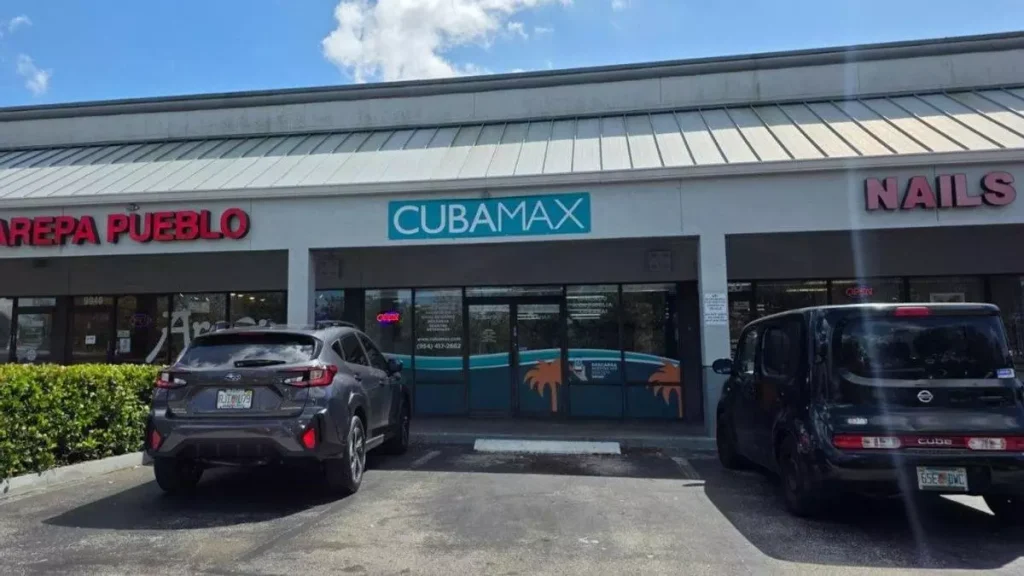
A customer who recently stopped by one of the company’s new spots in Miami described the relaunch vibe to us. / 14ymedio
14ymedio, Havana/Miami, 28 February 2026 — Cubamax has turned the home-delivery service back on in the western part of Cuba, but the comeback comes with a price hike that once again shines a spotlight on the island’s fuel crisis. According to people we talked to, the company bumped the cash-remittance fee from $10 to $12 per $100 sent. They blame it on the skyrocketing price of gasoline — which has basically become the new gold in a country where transportation is pretty much dead.
The service is coming back after several weeks of interruptions that hit both package delivery and cash-to-the-door remittances — a lifeline for thousands of Cuban families who depend on money sent from abroad. The move also underlines how much people are relying on private or semi-private operators to keep money flowing into the island amid sanctions, banking restrictions, and the total inefficiency of state-run systems.
A customer who dropped by a brand-new Cubamax location in Miami told us about the relaunch atmosphere. “This new office just opened like a week ago in an area full of Cubans. It was empty — only two super-nice employees,” he said. According to him, they’re still in client-hunting mode. “They’re basically begging for customers. They even gave us cards to hand out to friends.”
The new tariff fee is locked at $12 per every $100 sent.
The employees confirmed they’ve restarted door-to-door delivery in the west of the island. “They’ve already started dropping off at homes in Pinar del Río, Havana, Artemisa, Mayabeque, and Matanzas,” they told him.
The biggest sting for customers is the extra charge on cash remittances. “Before it was $10 per $100 sent. But the runners in Cuba were complaining that gas was too expensive. It wasn’t worth it anymore, so they decided to add two more bucks,” the workers explained. The new tariff fee is $12 per $100. continue reading
In recent weeks, 14ymedio has been reporting nonstop on the chronic fuel shortage, endless lines at gas stations, and the brutal cutback in both public and private transportation. In that mess, anything that requires moving around — from buses to courier services — has had to raise prices or just shut down.
The informal fuel market keeps running like a well-oiled machine, though.
Still, the fact that they’re restarting home delivery at all raises questions a lot of people are whispering. The same guy we talked to summed it up with classic Cuban sarcasm: “All of a sudden they have gas when every day there’s supposedly less, since no oil tanker has shown up?”
Another person inside Cuba gave a slightly different take on the supposed shutdown. When he asked at one of the Cubamax distributors, he got a telling answer: “They’re bringing the fuel in from over there.” The woman basically implied the company is running on its own private gasoline supply.
He pushed for more details. “I told her, ‘That sounds super risky, moving fuel around like that,’ and she just went, ‘They know what they’re doing, they’re real professionals.’” That line pretty much exposes the suspicion lots of people have: the black-market fuel business is still operating with crazy efficiency.
The packages that were supposedly stuck in collection centers ended up getting delivered right to people’s doors anyway.
The same source downplays how serious the “suspension” really was. In Havana, he says home deliveries barely stopped. Between the announcement of the pause and the official restart, the packages that were supposedly going to sit in warehouses ended up arriving at people’s houses anyway.
His own experience backs it up: almost all the shipments a relative sent have already arrived, and only one heavier one is still pending (it’s already in Cuba, just not distributed yet). Bottom line: the “delay” most people were complaining about hardly affected some households at all.
Recent ship-tracking data and energy reports show zero crude oil shipments to Cuba since January, except for a few isotanks (25,000-liter fuel containers) handled by small private companies (mipymes). In that context, the logistics muscle of remittance-linked companies always makes people raise an eyebrow.
For tons of families, though, the priority is still getting the money — even if it costs more. With inflation through the roof, everything getting dollarized, and the Cuban peso basically worthless, remittances are a must-have lifeline. From abroad, an extra $2 per $100 might seem like peanuts, but inside Cuba it means less cash for food, medicine, or just getting around.
Translated by GH
______________________
COLLABORATE WITH OUR WORK: The 14ymedio team is committed to practicing serious journalism that reflects Cuba’s reality in all its depth. Thank you for joining us on this long journey. We invite you to continue supporting us by becoming a member of 14ymedio now. Together we can continue transforming journalism in Cuba.
The place chosen for landing fuels doubts about a possible ambush.
Ledián Padrón Guevara, only 25 years old, showed artistic interests and aspirations in the urban music genre. / Facebook / Ledián Padrón
14ymedio, Havana, February 27, 2026 – The list of names released by the Cuban regime after the February 25 shooting, near Cayo Falcones in Corralillo, Villa Clara, draws the human map of an episode still surrounded by gray areas. Ten Cubans who set out in a boat registered in Florida suddenly ended up labeled “terrorists” by Havana and “heroes” by part of the exile community, while their families demand something more basic and verifiable: clear information, transparent medical reports, and consular access to the survivors.
A source consulted by 14ymedio on condition of anonymity knew several of the crew members and is surprised by the chosen route. “That’s the hottest spot there is, near a lighthouse,” the source warns. “It’s supposed to be super monitored. Coincidentally, the film Guardafronteras was shot there. Imagine how heavily guarded that is.” The observation reinforces the questions surrounding this case: What exactly happened in those waters? Why choose such an exposed place for a supposedly clandestine operation? Did they fall into a trap?
Some Cubans have lost faith in achieving “democratic changes in a country that is kidnapped by a group that came to power through arms,” the same source adds. The source asserts that “they did not possess assault rifles: that’s illegal. At most they would have had rifles that any U.S. citizen or resident with no criminal record can buy.”
Pável Alling Peña, Michel Ortega Casanova, Ledián Padrón Guevara, and Héctor Duani Cruz Correa were officially identified as the four killed in the confrontation. Beyond the “terrorist” label used by the Ministry of the Interior, the trajectories that emerge from each name show diverse profiles and, in some cases, ones that contradict the official narrative. continue reading
Pável Alling was presented years ago by state media as a creator linked to cultural projects. / Facebook / Pável Alling
Michel Ortega Casanova, 54, was the first confirmed fatality. Various sources place him in central Florida, between Lakeland and Tampa. His relatives say he had lived in the United States for more than two decades and worked as a truck driver. His brother, Misael Ortega, rejects the terrorism accusation and sums up the family’s perception with a phrase repeated in other cases: “They call anyone who goes against their ideology a terrorist.”
Pável Alling Peña, 45, originally from Camagüey, adds a particularly uncomfortable angle for the official narrative. He earned a degree in Art History from the University of Havana in 2004 and was presented years ago by state media as a creator involved in cultural projects. In 2022 he obtained U.S. citizenship and had been working in photography-related activities. On January 30 he posted a message on social media addressed to the regime’s armed forces: “Woe to the soldier who does not lower his weapons and, even worse, fires against the people, because the unleashed terror will be sublime in its crudest expression. Cuba will be free soon.”
The third fatality, Ledián Padrón Guevara, 25, appears in press reports as a young man whose life was divided between Houston and Miami. His social media places him as originally from the Camagüey municipality of Esmeralda and shows primarily artistic interests, with aspirations in the urban music genre. After the July 11, 2021 protests, he wrote: “Come on, Cuba. Stay strong, history is watching.” Those close to him insist he had no violent background.
Amijail Sánchez González, a 47-year-old tree trimmer known as El Guajiro, is described as “the most cheerful and jovial of the group.”
Regarding Héctor Duani Cruz Correa, there is a notable biographical void. What has emerged is the immediate family impact. A former partner told Telemundo 51: “I still don’t know how I will tell my 5-year-old son that daddy won’t be here anymore.” International reports also link him to the theft of the boat, which allegedly was used without the consent of the registered owner in Florida.
Among the six survivors, the name with the most prior accusations is Amijail Sánchez González, a 47-year-old tree trimmer. The Cuban Government includes him among two individuals already listed on its National List linked to investigations for “terrorism or violent acts.” In other words, before the shooting he was already marked as a high-priority target. However, the source consulted by this newspaper describes him very differently: “He is the noblest and most fun-loving of the group.” Among his acquaintances he was known as El Guajiro and “was compared, because of his jovial character, to Camilo Cienfuegos.”
According to his family’s account to The Washington Post, Sánchez informed his elderly parents on the Island just one day before leaving on the boat. During a one-hour call, his relatives begged him to give up the plan. The episode also occurs in a context of prior pressure, as at the end of 2024, authorities detained his parents—both suffering from cancer—for months to force him to return to Cuba and turn himself in.
The second name previously included on that National List is Leordán Enrique Cruz Gómez. Originally from Cienfuegos and born on November 6, 1978, his case has generated strong family reaction. His wife demands “proof of life” and asks why they are not allowed “to know that the person is well, that he is breathing.” His brother fears the worst-case scenario and points out contradictions in the official narrative. “I saw him working in Arizona,” he states, denying that he received any funding to carry out violent actions.
Roberto Álvarez Ávila (standing, wearing a blue T-shirt) was the last to be added to the list, after initially being confused with Roberto Azcorra Consuegra. / Courtesy
Conrado Galindo Sariol is 58 years old and, according to his circle, was a victim of repression. Telemundo 51 reports that he served seven years in prison in Cuba before emigrating and that his family heard direct threats: “Either you leave or we kill you.” His wife acknowledges his political opposition to the Government but rejects the terrorism label. Both she and his daughter recall that Galindo said goodbye saying: “I’m going to work.”
As for Cristian Ernesto Acosta Guevara and José Manuel Rodríguez Castelló, both listed among the injured, verifiable information remains scarce. Their names appear in the official list and in press reproductions, but without a full biographical profile that would allow assessment of their background or migration status.
Roberto Álvarez Ávila, 34, originally from Cienfuegos, was the last to be added to the list after the official correction that initially replaced his name with Roberto Azcorra Consuegra. Azcorra himself appeared in Miami to deny his involvement, a slip that damaged the credibility of the Ministry of the Interior’s statement. According to the source consulted by 14ymedio, Álvarez had no political aspirations and dreamed of “having a little house in Cienfuegos, near the beach, in colonial style.” He has at least one young daughter, and his family has avoided informing his father, who recently underwent heart surgery.
The mistaken inclusion of Azcorra Consuegra in the first official note was not a simple blunder. In a case involving deaths, injuries, and an armed incident in Cuban waters, the error reinforced doubts about the supposed chance encounter described in the government’s version. The subsequent correction, accompanied by new generic accusations about “violent trajectories,” also failed to close the gap of distrust.
Translated by Regina Anavy
______________________
COLLABORATE WITH OUR WORK: The 14ymedio team is committed to practicing serious journalism that reflects Cuba’s reality in all its depth. Thank you for joining us on this long journey. We invite you to continue supporting us by becoming a member of 14ymedio now. Together we can continue transforming journalism in Cuba.

 14ymedio, Havana, March 2, 2026 – Roberto Castrillo García, a historic figure in Cuban sport shooting and the Island’s first Olympic medalist in the skeet event, died on February 28, 2026, in Guanajay, his hometown, at the age of 85. His bronze medal at the 1980 Moscow Olympic Games remained for 24 years as the country’s only Olympic medal in sport shooting.