The place chosen for landing fuels doubts about a possible ambush.

 14ymedio, Havana, February 27, 2026 – The list of names released by the Cuban regime after the February 25 shooting, near Cayo Falcones in Corralillo, Villa Clara, draws the human map of an episode still surrounded by gray areas. Ten Cubans who set out in a boat registered in Florida suddenly ended up labeled “terrorists” by Havana and “heroes” by part of the exile community, while their families demand something more basic and verifiable: clear information, transparent medical reports, and consular access to the survivors.
A source consulted by 14ymedio on condition of anonymity knew several of the crew members and is surprised by the chosen route. “That’s the hottest spot there is, near a lighthouse,” the source warns. “It’s supposed to be super monitored. Coincidentally, the film Guardafronteras was shot there. Imagine how heavily guarded that is.” The observation reinforces the questions surrounding this case: What exactly happened in those waters? Why choose such an exposed place for a supposedly clandestine operation? Did they fall into a trap?
Some Cubans have lost faith in achieving “democratic changes in a country that is kidnapped by a group that came to power through arms,” the same source adds. The source asserts that “they did not possess assault rifles: that’s illegal. At most they would have had rifles that any U.S. citizen or resident with no criminal record can buy.”
Pável Alling Peña, Michel Ortega Casanova, Ledián Padrón Guevara, and Héctor Duani Cruz Correa were officially identified as the four killed in the confrontation. Beyond the “terrorist” label used by the Ministry of the Interior, the trajectories that emerge from each name show diverse profiles and, in some cases, ones that contradict the official narrative.

Michel Ortega Casanova, 54, was the first confirmed fatality. Various sources place him in central Florida, between Lakeland and Tampa. His relatives say he had lived in the United States for more than two decades and worked as a truck driver. His brother, Misael Ortega, rejects the terrorism accusation and sums up the family’s perception with a phrase repeated in other cases: “They call anyone who goes against their ideology a terrorist.”
Pável Alling Peña, 45, originally from Camagüey, adds a particularly uncomfortable angle for the official narrative. He earned a degree in Art History from the University of Havana in 2004 and was presented years ago by state media as a creator involved in cultural projects. In 2022 he obtained U.S. citizenship and had been working in photography-related activities. On January 30 he posted a message on social media addressed to the regime’s armed forces: “Woe to the soldier who does not lower his weapons and, even worse, fires against the people, because the unleashed terror will be sublime in its crudest expression. Cuba will be free soon.”
The third fatality, Ledián Padrón Guevara, 25, appears in press reports as a young man whose life was divided between Houston and Miami. His social media places him as originally from the Camagüey municipality of Esmeralda and shows primarily artistic interests, with aspirations in the urban music genre. After the July 11, 2021 protests, he wrote: “Come on, Cuba. Stay strong, history is watching.” Those close to him insist he had no violent background.
Amijail Sánchez González, a 47-year-old tree trimmer known as El Guajiro, is described as “the most cheerful and jovial of the group.”
Regarding Héctor Duani Cruz Correa, there is a notable biographical void. What has emerged is the immediate family impact. A former partner told Telemundo 51: “I still don’t know how I will tell my 5-year-old son that daddy won’t be here anymore.” International reports also link him to the theft of the boat, which allegedly was used without the consent of the registered owner in Florida.
Among the six survivors, the name with the most prior accusations is Amijail Sánchez González, a 47-year-old tree trimmer. The Cuban Government includes him among two individuals already listed on its National List linked to investigations for “terrorism or violent acts.” In other words, before the shooting he was already marked as a high-priority target. However, the source consulted by this newspaper describes him very differently: “He is the noblest and most fun-loving of the group.” Among his acquaintances he was known as El Guajiro and “was compared, because of his jovial character, to Camilo Cienfuegos.”
According to his family’s account to The Washington Post, Sánchez informed his elderly parents on the Island just one day before leaving on the boat. During a one-hour call, his relatives begged him to give up the plan. The episode also occurs in a context of prior pressure, as at the end of 2024, authorities detained his parents—both suffering from cancer—for months to force him to return to Cuba and turn himself in.
The second name previously included on that National List is Leordán Enrique Cruz Gómez. Originally from Cienfuegos and born on November 6, 1978, his case has generated strong family reaction. His wife demands “proof of life” and asks why they are not allowed “to know that the person is well, that he is breathing.” His brother fears the worst-case scenario and points out contradictions in the official narrative. “I saw him working in Arizona,” he states, denying that he received any funding to carry out violent actions.
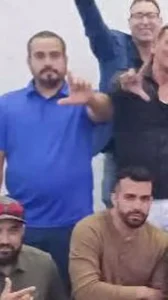
Conrado Galindo Sariol is 58 years old and, according to his circle, was a victim of repression. Telemundo 51 reports that he served seven years in prison in Cuba before emigrating and that his family heard direct threats: “Either you leave or we kill you.” His wife acknowledges his political opposition to the Government but rejects the terrorism label. Both she and his daughter recall that Galindo said goodbye saying: “I’m going to work.”
As for Cristian Ernesto Acosta Guevara and José Manuel Rodríguez Castelló, both listed among the injured, verifiable information remains scarce. Their names appear in the official list and in press reproductions, but without a full biographical profile that would allow assessment of their background or migration status.
Roberto Álvarez Ávila, 34, originally from Cienfuegos, was the last to be added to the list after the official correction that initially replaced his name with Roberto Azcorra Consuegra. Azcorra himself appeared in Miami to deny his involvement, a slip that damaged the credibility of the Ministry of the Interior’s statement. According to the source consulted by 14ymedio, Álvarez had no political aspirations and dreamed of “having a little house in Cienfuegos, near the beach, in colonial style.” He has at least one young daughter, and his family has avoided informing his father, who recently underwent heart surgery.
The mistaken inclusion of Azcorra Consuegra in the first official note was not a simple blunder. In a case involving deaths, injuries, and an armed incident in Cuban waters, the error reinforced doubts about the supposed chance encounter described in the government’s version. The subsequent correction, accompanied by new generic accusations about “violent trajectories,” also failed to close the gap of distrust.
Translated by Regina Anavy
______________________
COLLABORATE WITH OUR WORK: The 14ymedio team is committed to practicing serious journalism that reflects Cuba’s reality in all its depth. Thank you for joining us on this long journey. We invite you to continue supporting us by becoming a member of 14ymedio now. Together we can continue transforming journalism in Cuba.