Tehran calls the arrest warrant against the former president for the shootdown of the Brothers to the Rescue planes “criminal”; Moscow points to “revenge by Miami’s anti-Cuban lobby” and Beijing offers its “firm support”
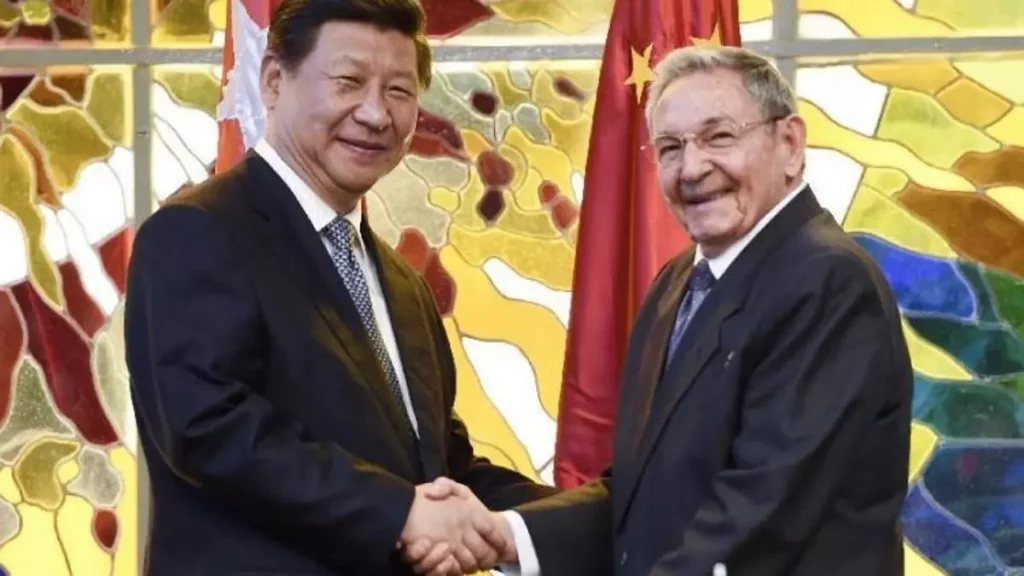
 14ymedio, Madrid, October 21, 2026 / China has been the latest friendly country to join the club of solidarity with the Cuban regime following the indictment of Raúl Castro in the case of the 1996 shootdown of two light aircraft belonging to the Brothers to the Rescue organization, expanded this Monday by a Florida judge. The measure, signed on Friday by Ariana Fajardo Orshan, charges the former ruler with conspiracy to commit first-degree murder, in a case separate from the federal proceedings opened in May over the deaths of four members of the organization.
“Raúl Castro is a highly respected leader of the Cuban Revolution,” Chinese Foreign Ministry spokesperson Mao Ning said this Wednesday, adding that the former leader “enjoys great international prestige.”
Xinhua echoed these statements, made at a regular press conference at which the spokesperson was asked about the matter. “China has consistently opposed the abuse of judicial means to pressure Cuba,” she said, before stressing that Beijing “firmly supports” the island in “protecting its national sovereignty and rejecting foreign interference.”
“China has consistently opposed the abuse of judicial means to pressure Cuba”
Mao once again called on the United States to “put an end to its blockade of Cuba and to any other form of coercion or pressure,” and urged it to “stop violating the Cuban people’s rights to survival and development.”
Beijing had been preceded by two other regular partners of Havana, one of them Iran, whose Ministry of Foreign Affairs released a statement through the state news agency IRNA in which it described the issuing of the arrest warrant against Castro as “criminal and illegal.” Tehran denounced Washington’s “interventionist actions,” including sanctions it called “inhumane” and attempts to threaten and intimidate Cuban authorities and public figures.
The Ministry added that the policy of sanctions, pressure and intimidation “applied against the Cuban people for more than seven decades violates the Charter of the United Nations and contradicts the principles and norms of international law and human rights.” In the view of the Iranian Foreign Ministry, Washington will have to answer for the “catastrophic consequences” of these decisions on the daily life of the population, with which it expressed its solidarity in the face of these “criminal actions.”
Moscow was not missing from the group either: quite the contrary: it was the one that opened fire, criticizing the “unfounded and false accusation” that comes “more than 30 years later.” In the view of the Russian Foreign Ministry, this “is nothing more than revenge by Miami’s anti-Cuban lobby, a desire to settle scores with Castro, who celebrated his 95th birthday in June.”
After “categorically” rejecting and condemning the arrest warrant against Castro, the statement said that it is nothing more than part of “a broader escalation of tensions around the Island of Freedom [as Moscow calls Cuba], which is going through extremely difficult times due to an unprecedented commercial, economic, financial and energy blockade, and could destabilize the entire Latin American and Caribbean region.”
The note concludes with a personal message to the former Cuban leader himself: “We wish Comrade Raúl Castro, a friend of Russia, good health and that he maintain his unwavering bravery, courage and strength.” Although the Russian Foreign Ministry took the opportunity to reaffirm its solidarity with the Cuban regime, with which it will continue “strengthening the close ties of friendship, mutual support, assistance and comprehensive cooperation,” the words once again remain just that. Like those of Iran and China. So far this year, the three countries have not stopped expressing, almost weekly, their support and backing for an island in need of resources that none of them has fully decided to send.
While China is the one that has contributed the most goods, products and donations to the regime, Iran and Russia are the partners that have not dared to defy Washington to send the much-desired fuel that could serve as an immediate lifeline for the regime. Chinese support through solar energy, underway for more than two years, represents a slower and more gradual change in the energy matrix, while the oil tankers that Tehran and Moscow could deliver would give Havana breathing room, as happened in April.
On the last day of March, the Anatoly Kolodkin arrived on the island with 730,000 barrels of Russian crude, an entry authorized by Washington, which did not try to prevent the tanker’s arrival, as it later did with other attempts, without Russia daring to enter into direct confrontation. Iran has not even tried, despite being in open war with the US, which it has repeatedly defied, but only in relation to its own territory and surrounding areas.
“Well, I think it’s political. It’s political and it also has to do with the November election, from my point of view”
Mexico is another of the countries that has tried to find legal loopholes to keep supplying oil to Cuba while avoiding a clash with the US, with which it maintains relations vital to its economy. Its president, Claudia Sheinbaum, was asked by the press this Monday for her opinion on Castro’s new indictment, which she attributes to the pre-election climate in the neighboring country. “Well, I think it’s political. It’s political and it also has to do with the November election, from my point of view,” she said. “And the votes they want to win on one side and the other,” said the president, who went no further in her remarks.
Paradoxically, her opinion is shared by many Cuban-American users on social media, who reacted to the news the other day by calling it a “circus” or “theater,” explicitly linking it to the November elections, as CiberCuba has reported, based on comments on its social media accounts. These messages do not reflect sympathy for the elderly former president, but rather disappointment with Trump’s handling of the Cuban issue and with other political decisions that are causing dismay among his base of loyal Cuban voters and followers.
The reasons go beyond his policy toward the island – or his lack of action – and extend to his attitude toward Venezuela, where he has shown that he puts the oil business ahead of democracy, and to his open animosity toward the president of Ukraine, Volodymyr Zelensky, in contrast to the sympathy he shows for Russia’s Vladimir Putin and for Xi Jinping and Kim Jong-un themselves.
Translated by GH
______________________
COLLABORATE WITH OUR WORK: The 14ymedio team is committed to practicing serious journalism that reflects Cuba’s reality in all its depth. Thank you for joining us on this long journey. We invite you to continue supporting us by becoming a member of 14ymedio now. Together we can continue transforming journalism in Cuba.