The draft bill opens space for the private sector in educational services and financing, but keeps schools in the hands of the State.
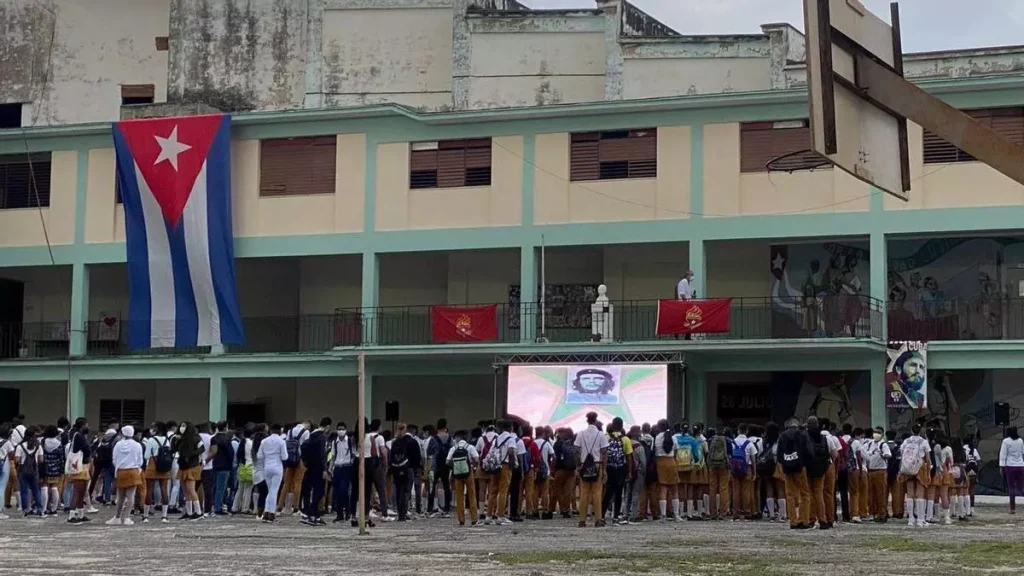
 14ymedio, Havana, October 2026 / Cuban students will have, on paper, the right to express their opinions freely, but they will also be required to “defend the principles of the Revolution.” This is one of the contradictions in the draft bill for the new Education Law, with which the Government intends to replace Law 680 of 1959 and bring together, within a single legal framework, numerous provisions that until now have been scattered across different regulations. The document, comprising 243 articles, incorporates guarantees for students and teachers and opens up new opportunities for private-sector participation, but preserves one of the fundamental characteristics of the Cuban education system: its total subordination to the official ideology.
Economic openness is one of the most interesting new features of the proposal. Although Article 41 keeps the administration and financing of educational institutions in the hands of the State, it allows resources from non-state management models and national and international cooperation to be incorporated. Article 239 also authorizes educational institutions to establish mechanisms for generating supplementary income, including the creation of foundations, interface companies, mipymes (micro, small, and medium-sized enterprises), and other authorized structures.
This is not a possibility entirely foreign to the current reality. At the end of August, several private companies committed to sponsoring more than 50 schools in the municipality of Florida, Camagüey, to help with repairs, painting, cleaning, and maintenance. The initiative, promoted by local authorities, was a response to the State’s difficulties in ensuring adequate material conditions for the school year.
The Cuban draft bill keeps school administration in the hands of the State
This does not amount to authorizing the general opening of private schools. The Cuban draft bill keeps school administration in the hands of the State. The reform allows greater non-state economic participation around the education system, but does not establish general freedom to create independent schools.
In the political sphere, the provisions are equally explicit. Article 11 recognizes students’ right to form and freely express their opinions, to be heard, and to participate in decisions that affect them. However, the following article, which addresses their duties, requires them to “defend the principles of the Revolution, preserving national independence and security.” The document does not clarify how a conflict between these two provisions would be resolved or what would happen to a student who openly advocated political ideas opposed to socialism.
The draft bill also establishes ideological obligations for teachers. Article 14 stipulates that teaching and non-teaching staff must “defend the Socialist Homeland, the principles of the Revolution, and the values of Cuban society.” It also requires them to maintain their political and ideological preparation and systematically keep up to date on national and international events that affect their educational work. Another provision requires them to maintain ethical conduct on social media, without precisely defining the scope of that obligation.
The requirement of political loyalty has explicit precedents. In 2019, the then Deputy Minister of Higher Education, Martha del Carmen Mesa Valenciano, argued that university professors should act as activists for revolutionary policy. In her statement, published on the Ministry’s official website, she invoked Fidel Castro’s definition of the ideological role of educators and maintained that anyone who did not share that commitment should resign from university teaching.
For more than six decades, curricula, student organizations, and school activities have been linked to defending the regime
The new regulation also specifies its doctrinal foundations. Article 6 stipulates that the educational process will promote national values and ideals based on “Martíist, Fidelist, Marxist, and Leninist” thought. Article 50 also includes the Central Committee of the Communist Party of Cuba among the bodies to which certain higher education institutions are subordinate.
This is not a case of political indoctrination only now arriving in Cuban schools. For more than six decades, curricula, student organizations, and school activities have been linked to defending the regime. The new draft bill performs a balancing act to bring these ideological requirements together in new legislation that also proclaims supposed individual rights and the “democratic and participatory” nature of education.
A comparison with other Latin American laws highlights the differences. In Argentina, Article 67 of the National Education Law recognizes teachers’ right to teach on the basis of academic freedom and freedom of instruction. In Uruguay, Article 11 of the General Education Law requires teachers to facilitate access to different sources of information, presenting a broad and balanced range of viewpoints so that students can form their own judgments.
Uruguayan legislation also stipulates that a plurality of opinions and the rational and democratic confrontation of knowledge and beliefs must be guaranteed. The Cuban draft bill, by contrast, does not establish an equivalent general guarantee of academic freedom, although it recognizes a degree of “academic autonomy” in specific activities, such as tutoring and academic supervision.
Another difference from much of Latin America concerns compulsory schooling. While Argentina, Chile, and Uruguay extend it through the completion of secondary education, the Cuban proposal maintains compulsory schooling from preschool through ninth grade. Subsequent levels are presented as a social aspiration that the State should promote, but not as an obligation for everyone.
Universities are not exempt from ideological requirements either. The proposal recognizes students’ right to participate in institutional management, but only within “agreed-upon degrees of relative autonomy.” Another provision makes that autonomy conditional on its consistency with “the principles of socialist society.”
The energy crisis has also endangered the day-to-day operation of educational institutions
In March of this year, the Technological University of Havana (Cujae) decided not to renew Professor Abel Tablada’s contract after he published critical comments about the Government’s economic decisions, according to the professor’s account. His departure sparked protests among students and professors in Cujae’s Faculty of Architecture.
Among the provisions favoring student rights are safeguards against school violence, reporting mechanisms, and protection against retaliation. However, many of these rights were already recognized in the 2025 Code of Children, Adolescents, and Youth. The future law develops the procedures and institutional responsibilities associated with these rights rather than establishing them for the first time.
The document also promises decent working conditions for teachers, school meals, teaching materials, accessibility, and technological resources, although it sets no quantified budgetary commitments to make these guarantees effective. The possibility of turning to business income and supplementary funding sources takes on particular importance in this context. In August, the Education Minister herself acknowledged that only 73% of teaching positions were filled and that in-person attendance throughout the school year could not be guaranteed.
The energy crisis has also endangered the day-to-day operation of educational institutions. In May, UNESCO warned that power outages, fuel shortages, and the deterioration of basic services threatened Cuban education by making it more difficult for students and teachers to attend school and for classes to proceed normally.
Translated by Regina Anavy
______________________
COLLABORATE WITH OUR WORK: The 14ymedio team is committed to practicing serious journalism that reflects Cuba’s reality in all its depth. Thank you for joining us on this long journey. We invite you to continue supporting us by becoming a member of 14ymedio now. Together we can continue transforming journalism in Cuba.