The ‘Cubañoles’ stay on the sidelines of the November 29 elections and of the controversy over the voting rights of hundreds of thousands of Latin Americans naturalized under the ‘Grandchildren’s Law’
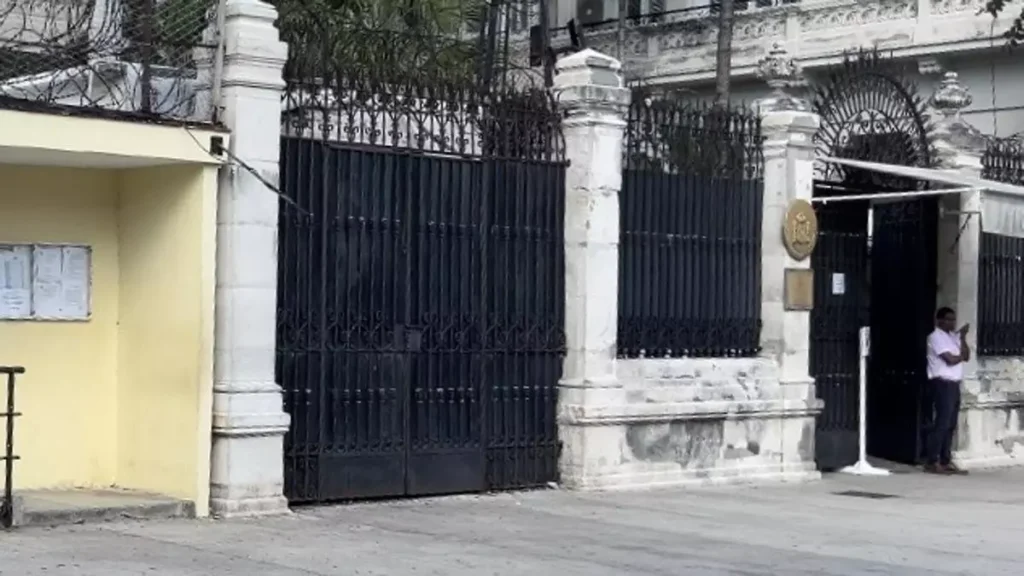
 14ymedio, Darío Hernández, Havana/Madrid, 24 November 2026 / The lines on Monday at the Spanish consulate in Havana bore a certain resemblance to those seen since Sunday at other diplomatic offices of the European country, where hundreds of people have crowded in to cast their votes for the general elections of November 29. But the reality in Cuba is a very different one: the line was made up of Cubans, ready to carry out some consular procedure. [watch video here]
The lack of interest among the Cubañoles [Cubans who also hold Spanish nationality] in the ballot boxes, open from Saturday the 21st to Thursday the 26th for this election, was even more evident the day before. With the consulate closed for other procedures, it was much easier to count the turnout: barely five or so people came to vote during the half hour that a reporter from this newspaper spent near the Palacio de Velasco, located on Zulueta Street in Old Havana.
On a similar visit yesterday, only one person – out of the crowd waiting to process visas and other documents – went in to vote, and took less than five minutes to do so.
Although Cuba has – with 169,290 – the fifth-largest group of Spanish voters registered abroad, the lack of interest has once again been evident, and it is not the first time. One need only look at what happened in the July 2023 elections, when there were 152,796 people registered in Cuba for the CERA vote (Censo de Españoles Residentes Ausentes – Census of Absent Resident Spaniards) and barely 1,184 cast their votes, 0.77%. The only place set up for that purpose was the Havana consulate, which limited – because of the transportation problems on the island – the options of those living in other provinces. In addition, and due to Cuba’s poor postal system, not a single vote was recorded by mail.
The situation contrasts with what has been observed in other countries, especially France, the United Kingdom and Portugal, where traditionally far more people have voted in Spanish elections than in Latin America, despite having fewer registered voters. In France and Germany turnout is around 15%, equaling or exceeding in votes countries on the American continent with three times as many registered. A relative exception is Argentina, where the largest number of CERA ballots in the world was cast, with 26,170, although that was 11% of the total for that country, which had 434,604 registered voters that year.
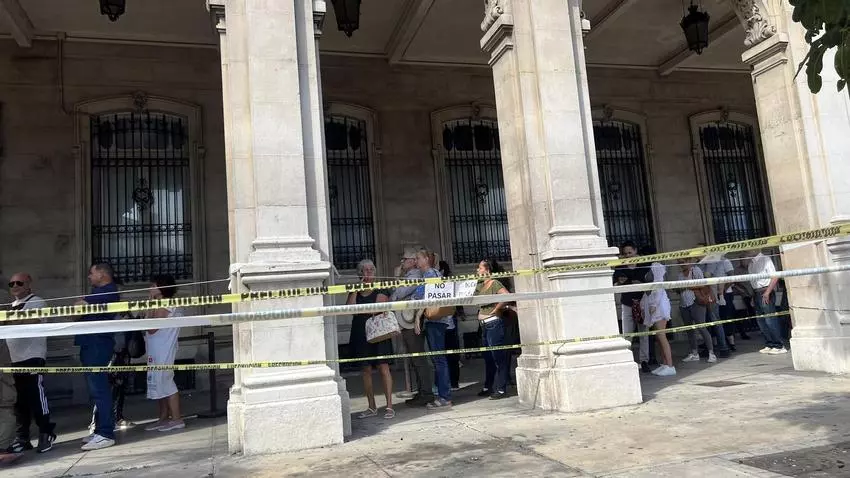
This weekend, in the midst of general elections expected to see high turnout and to be highly polarized, those waiting in line at the Paris consulate could not believe it. Far from the five minutes it took in Cuba at most, in the French capital there were waits of more than three hours.
“It’s the first time I’ve seen so many people. I was blown away when I arrived,” an Andalusian woman who has lived in the country for eight years told the EFE agency. The offices in Bayonne, Bordeaux, Strasbourg, Lyon, Marseille, Montpellier, Pau, Perpignan and Toulouse also set up ballot boxes. The same thing happened in London and in Lisbon, where at closing time at the consulate there were still people waiting in line. Even in Miami and Washington, where some voters spoke of lines more than 600 meters [nearly 2,000 feet] long, turnout overflowed.
In Mexico and Buenos Aires things were calmer, although turnout was not low, while in Caracas at least 5,000 Spaniards have already voted in these elections, in which the confusion surrounding the status of those newly naturalized under the Democratic Memory Law has led to an unprecedented decision: the placement of a ballot box that consular officials already know as “the ballot box that isn’t a ballot box.” In it vote those who are awaiting a possible court ruling that would restore their right to vote, although in Cuba two voters consulted by 14ymedio said they had seen only one.
The ballot box in question is actually called Auto TS – LMD. That is how it must be labeled, according to instructions from the Ministry of Foreign Affairs, which has set out the procedure for those affected by the Supreme Court’s measures. The conflict goes back to the appeals by the parties Iustitia Europa and Vox, filed against an instruction that regulated the practical application of what is known as the Grandchildren’s Law. The measure allowed exile status to be presumed for all Spaniards who left the country between 1936 and 1955, supposedly to resolve the difficulty of gathering such old documents, when they were not altogether nonexistent. Multiple investigations published in the Spanish press have questioned the legality of an administrative measure that has opened the door to the naturalization of numerous descendants of Spaniards with no family link to exiles from the Franco regime.
The plaintiffs considered that these naturalizations could be fraudulent for lack of accreditation, and the Supreme Court decided not to suspend them, but did freeze the vote of the 163,355 people naturalized by that route unless they managed to prove, by means of a consular certificate, the exile of their forebears. On the other hand, the same court rejected the plaintiffs’ request to apply that same criterion to the children of those affected (190,000 people), although it did not rule on the merits of the matter, but rather considered that the claim had reached it when the electoral period was already well advanced.
Since elections had already been called and the electoral roll closed when the High Court issued its ruling, the order directed that those envelopes be collected “separately” and “duly differentiated,” with a record made in the consular minutes, though without specifying that it had to be an approved ballot box, so each consulate is proceeding in its own way.
This situation has added confusion in many places, including Cuba, where some voters have expressed doubts about whether or not they will be able to cast their ballot. Nevertheless, the fact that in previous elections little more than a thousand people voted – roughly the number assigned to each polling station in Spain, where 61,033 will be set up – reflects the apathy of citizens who are more interested in having a better passport than the Cuban one than in who governs in Madrid. As one Cubañola put it, in conversation with this newspaper last October at the consulate door: “What do I care if there are elections in Spain? What I care about is having electricity in my house.”
Translated by GH
______________________
COLLABORATE WITH OUR WORK: The 14ymedio team is committed to practicing serious journalism that reflects Cuba’s reality in all its depth. Thank you for joining us on this long journey. We invite you to continue supporting us by becoming a member of 14ymedio now. Together we can continue transforming journalism in Cuba.