While a tent is set up next to Revolution Square, blackouts and urban decay deepen the isolation of Cubans.
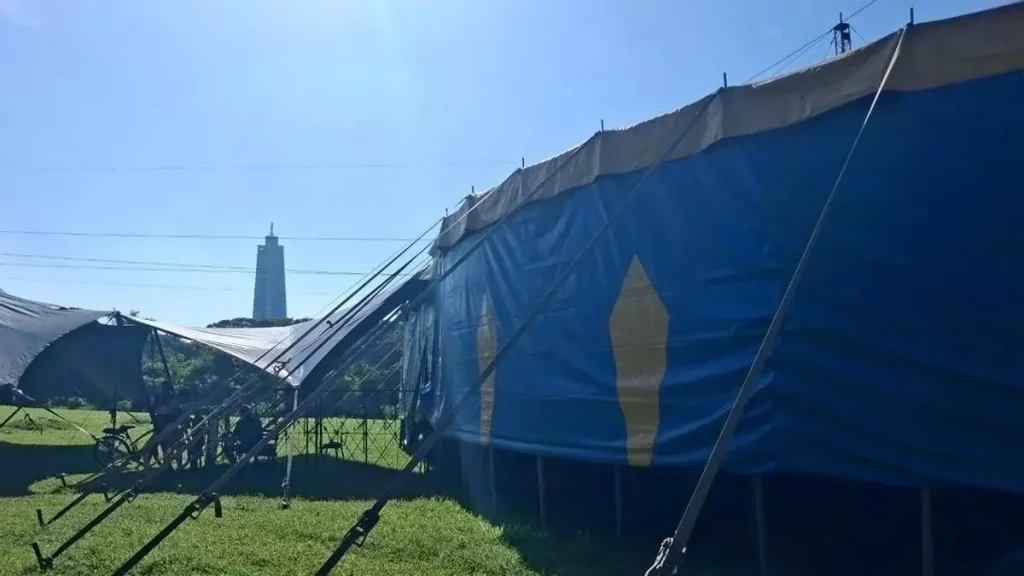
 14ymedio, Yoani Sánchez, Havana, June 14, 2026 / They’ve set up a circus in my neighborhood. A blue tent now stands just a few meters from the Council of State, and the tower of the Plaza de la Revolución blends into the horizon with the yellow stripes that crown its roo. Children wander around curiously, and the neighbors haven’t missed the opportunity to joke about the clowns and illusionists who always proliferate in the area. “If they’re the trainers, then we’re the animals,” an old woman warns me as soon as I approach the plaza where the hammering of preparations still echoed this Saturday.
I came here via Hidalgo Street. Earlier, I passed the bakery at the rationed market, with its endless line of people carrying empty bags. I had to dodge the stream of sewage that gushes from a drain and snakes for over a hundred meters. Garbage also stretches for entire blocks in what was once an area dominated by vegetation and tall buildings. Not anymore. Nuevo Vedado is, at this moment, like much of Havana, a succession of mountains of trash, broken streets, and weary faces.
“They didn’t cut off our power all night,” another neighbor tells me, relieved. He says it in a low voice, almost a whisper, as if afraid of alerting the electric company that our building had finally been able to sleep through the night for the first time in weeks. You almost feel guilty for having so many hours of electricity. When I woke up shortly after four in the morning and looked out onto the roof, I saw several buildings near Colón Street plunged into darkness. “Those are the victims of our left-on lights,” I thought to myself.
In my building, fewer and fewer people are using the elevator. The fear of being trapped in the middle of a power outage discourages anyone from entering that metal box, which transforms into a sauna as soon as the electricity goes out. Some neighbors spend entire days without leaving their homes because knee pain and other ailments prevent them from going up and down the stairs. The energy crisis has a less visible face: immobility and social isolation. Thousands, hundreds of thousands of Cubans across the island have lost contact with friends, acquaintances, and even family members because getting around has become too difficult.
A friend who lives in Central Havana tells me that an elderly man in her building died of “loneliness.” She says it just like that, abruptly, as if desolation had already crept into the Cuban medical lexicon as an official cause of death.
A friend who lives in Central Havana tells me that an elderly man in her building died of “loneliness”
“He stopped going out,” she explains. “Before, he would go to the bank to queue for his pension, but his legs were so sore, and he couldn’t stand for hours.” Then they suspended a social gathering where he met with other retirees to listen to boleros or dance danzón. The lack of electricity has canceled shows, social gatherings, and get-togethers. It has also silenced many conversations.
Finally, “he would just stand at the window watching the people walking down the street. He could go weeks without speaking to anyone.” The day they found him dead, it was the neighbors themselves who had to pay for the cremation.
“I kept the urn containing the ashes to see if my only son ever comes to Cuba, but for now we don’t even know how to find him.”
Abandonment and lack of communication kill, without a doubt.
“I’ve kept the urn containing the ashes to see if his only son ever comes to Cuba, but for now we don’t even know how to find him.”
After exploring the area around the circus, I head towards La Timba. I walk through several of its potholed streets and past its low houses, so different from the twelve-story buildings I’ve left behind. I pass by the National Theater. Everything is silent and empty. There was a time when it was rare for a weekend to go by without one of its halls being filled with children who had come to see a show. Now, only the echo of silence remains.
A woman asks me for the time just as I start to go down the main staircase of the complex.
We chatted for a few minutes about the weather, the power outages, and how bad the transportation system is. She blurts out sentences quickly, one after another, almost without pausing for breath. It seems like she’s been holding them in for too long.
“Oh, mija, it’s just that I have no one to talk to anymore,” she apologizes.
And I think then that this may be one of the most devastating consequences of the Cuban crisis: the epidemic of loneliness that is spreading everywhere.

Note: The above photo is a video in the original, but it failed an attempt to be copied and inserted in this post. It can be viewed (without translation) here.
Previous Havana Chronicles:
Chronicle of a Monday That Feels Like Wednesday
“We Used to Complain About the ‘CUC’, But Now We Miss It”
The Roar of Despair of a Cuban Woman Returning to Her Country After Many Years
The Tulipán Market Closed: “They’ve Given the Order To Go to the March for Raúl”
Along Carlos III Street and towards Ethiopia
Sleeping Is Also a Privilege in Havana
A Desperate Plea in the Middle of the Dark Havana Night: ‘Light!’
Under a Picture-Postcard Blue Sky, the Country is Crumbling
Fatigue Barely Allows One to Enjoy the ‘Lights On’ in Havana
Dollars, the Classic Card, and a Havana Without Tourists
A Journey Through the Lost Names of Havana
The Shipwreck of a Ship Called “Cuba”
Havana Seen From ‘The Control Tower’
In Havana, the Only Ones Who Move Are the Mosquitoes
Reina, the Stately Street Where Garbage is Sold
Searching for Light Through the Deserted Streets of Havana
The Death Throes of ‘Granma’, the Mouthpiece of a Regime Cornered by Crisis
The Anxiety of the Disconnected Cuban
One Mella, Three Mellas, Life in Cuba Is Measured in Thousands of Pesos
It Is Forbidden To Leave Home in Cuba Today Because It Is a “Counter-Revolutionary Day”
Vedado, the Heart of Havana’s Nightlife, Is Now Converted Into a Desert
Havana, in Critical Condition
______________________
COLLABORATE WITH OUR WORK: The 14ymedio team is committed to practicing serious journalism that reflects Cuba’s reality in all its depth. Thank you for joining us on this long journey. We invite you to continue supporting us by becoming a member of 14ymedio now. Together we can continue transforming journalism in Cuba.