With a vote of 47 in favor and 51 against, the initiative was blocked by the Republicans.
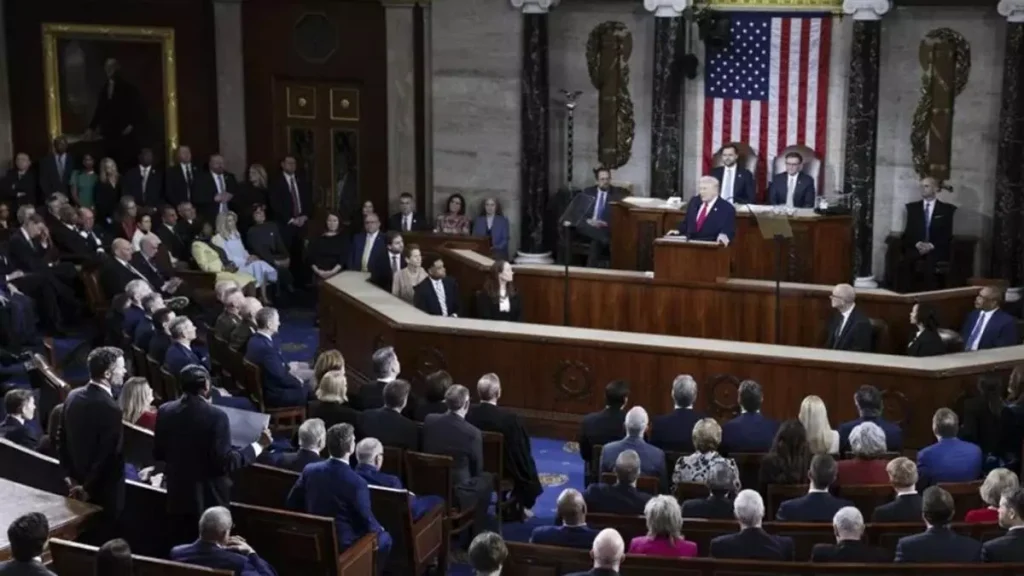
File photo of US President Donald Trump (center) before a joint session of Congress in the US House of Representatives at the US Capitol in Washington DC / EFE/EPA/Will Oliver
EFE (via 14ymedio), Washington DC, April 28, 2026 — US Senate Democrats failed Tuesday in another attempt to limit President Donald Trump’s authority to use military force against Cuba.
With a vote of 47 in favor and 51 against, the initiative to control possible actions of force against Havana ordered from the executive branch was stopped by the Republicans who voted as a bloc.
However, Republicans Susan Collins of Maine and Rand Paul of Kentucky joined the Democratic initiative in the vote held this afternoon.
“Republicans must get ahead of the impending catastrophe in Cuba before it gets even worse, as they should have done with Trump’s war in Iran.”
The failed attempt with regards to Cuba joins a series of Senate failures to control Trump’s military actions, such as the five votes to prevent the president from ordering further attacks on Iran or attempts to restrain the Republican president prior to the capture of Nicolás Maduro in Venezuela.
Before the vote, Democratic Senator Chuck Schumer said that “Republicans must get ahead of the impending catastrophe in Cuba before it gets even worse, as they should have done with Trump’s war in Iran.”
For their part, Republicans rejected accusations that continue reading
the president intended to use force against Cuba and accused Democrats of ignoring allegations of human rights violations that have been made against the government of Miguel Díaz-Canel.
Since January, the Trump Administration has intensified pressure on Havana with an oil embargo, and the president has suggested on several occasions the need for regime change on the island.
______________________
COLLABORATE WITH OUR WORK: The 14ymedio team is committed to practicing serious journalism that reflects Cuba’s reality in all its depth. Thank you for joining us on this long journey. We invite you to continue supporting us by becoming a member of 14ymedio now. Together we can continue transforming journalism in Cuba.
A tricycle driver’s unexpected response to an inspector writing down names on his attendance list for Cuba’s May Day events
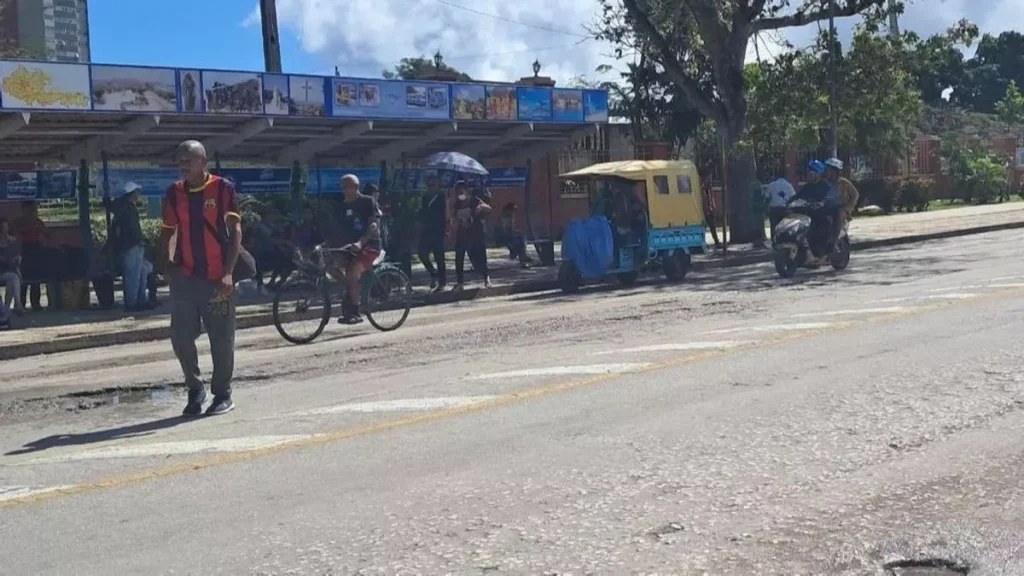
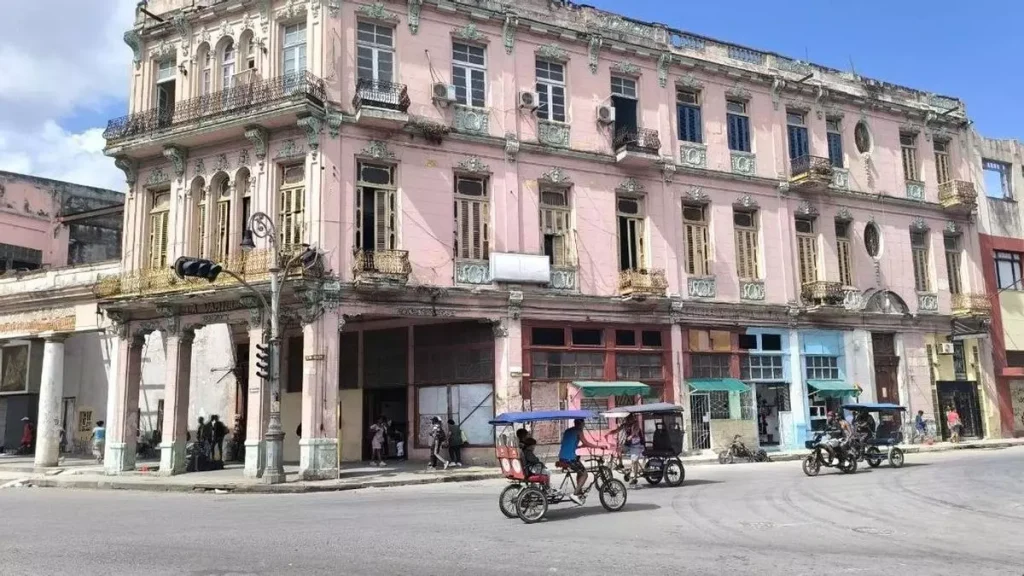
The scene took place at one of the electric tricycle taxi stands that have been authorized in Holguín in recent months to transport passengers. / 14ymedio
14ymedio, Miguel García, Holguín, April 30, 2026 / A private driver in Holguín thought it was just another inspection. He was at the taxi stand near the surgical hospital when a transportation official approached him, asked for his name, and pulled out a piece of paper. The driver prepared to show his documents, license, or vehicle registration. But it wasn’t a traffic ticket or a routine inspection.
“It turns out the man was handing out a political pamphlet or a call to action for the May Day parade,” recounts a passenger who witnessed the events. According to the passenger, the official was asking if the drivers were going to sign their “willingness” to participate in the demonstration.
The scene unfolded at one of the electric tricycle taxi stands that have been authorized in Holguín in recent months to transport passengers, amidst the collapse of public transportation and the energy crisis. In February, provincial authorities began issuing temporary permits allowing cargo tricycles and mopeds to carry passengers as well, a practice previously punishable by fines and even vehicle impoundment.
“Transport inspectors are going around to the bus stops collecting information on the tricycles with the special cargo and passenger permits that are required to participate in the parade.”
The measure was presented as an emergency solution for a city increasingly paralyzed by fuel and bus shortages. But it also placed these drivers under a system of registration, permits, designated taxi stands, and administrative controls. Now, according to testimony, that same structure is being used to incorporate them into the May 1st political machine. continue reading
“The transport inspectors are going around the established taxi stands in the city, collecting the information on the tricycles that were given special cargo and passenger permits to go to the parade,” the passenger explained to this newspaper.
The driver refused to sign. And he did so with a phrase that, just a few years ago, few Cubans would have dared to utter in public, much less before a state official with the power to inspect or penalize their livelihood: “He told them, ‘I’m not going to parade in anything that has to do with communism.’” The inspectors didn’t press the issue and continued on their way.
“He told them, ‘I’m not going to parade in anything that has to do with communism.’”
The complaint coincides with a moment of intense political mobilization in Cuba. The Cuban Workers’ Federation (CTC), the only authorized union on the island, called for the May Day parade under the slogan “The Homeland Defends Itself,” amidst an official campaign seeking to portray the march as a demonstration of unity against the oil blockade imposed by the US and the alleged threats of a military attack. In Holguín, the provincial CTC announced that it expects to gather around 200,000 workers in the main square.
That figure helps to understand the pressure, since mass demonstrations are never left to spontaneity. Workers and students are coerced with meetings, lists, commitments, assembly points, and attendance checks.
“They knock on the door with a piece of paper and you have to write your name, your surname, your ID number and sign it.”
But the pressure isn’t limited to workplaces, universities, or transportation hubs. Another report received from the Diez de Octubre municipality, in Havana, points to the use of vector control fumigators to collect signatures door-to-door in support of the official campaign “My Signature for the Fatherland.”
“Yes, the mosquito control people came, they got them for that purpose,” a neighbor recounts. “They knock on the door with a piece of paper and you have to write your name, your last name, your ID number, and sign it.” According to her, no one in her household agreed to join the campaign: “Of course, no one in my house signed.”
The scene ended with a conversation among the workers sent to collect signatures. “Another colleague arrived, who seemed to have been with her, and he said to her, ‘Are you finished yet?’ And he replied, ‘No, not at all, three people have already slammed the door in my face. Nobody wants to sign this.’” The tension was summed up in a curt phrase, directed at a bricklayer who refused to sign the official document: “If you’re not going to sign it, don’t mess it up.”
______________________
COLLABORATE WITH OUR WORK: The 14ymedio team is committed to practicing serious journalism that reflects Cuba’s reality in all its depth. Thank you for joining us on this long journey. We invite you to continue supporting us by becoming a member of 14ymedio now. Together we can continue transforming journalism in Cuba.
The peace petition campaign took center stage at the event, while official rhetoric alternated between calls for dialogue and threats of bloodshed and violence.
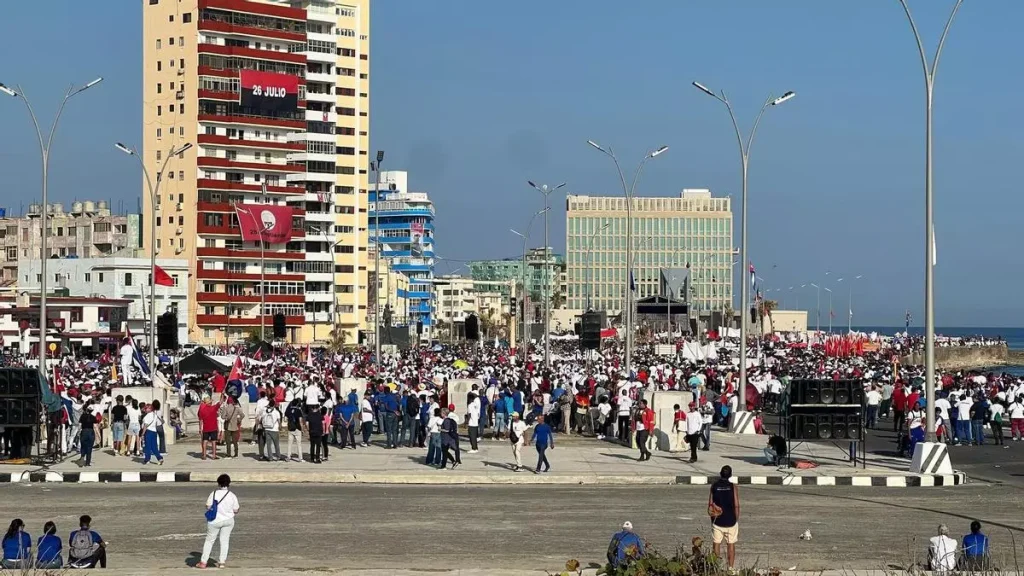
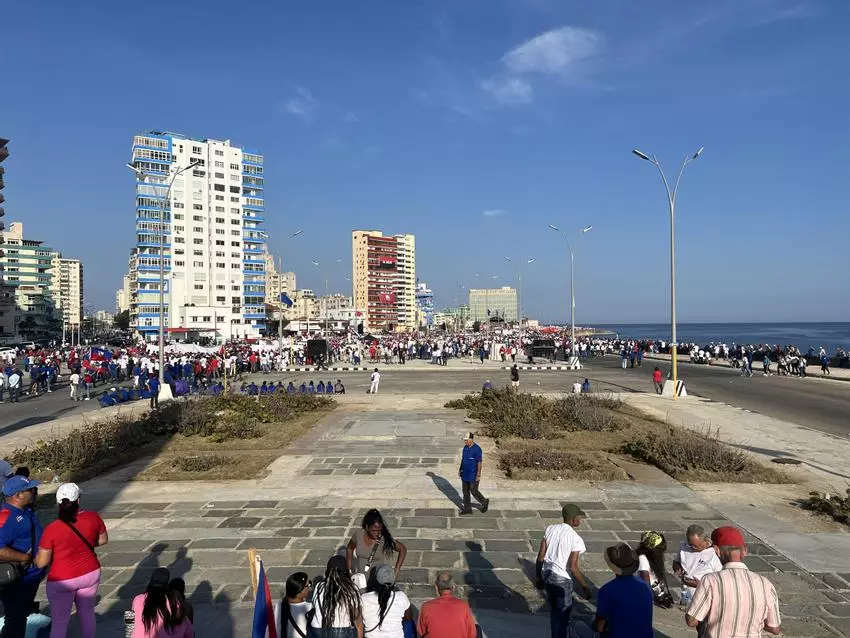
The new location offers the advantage of being easier for cameras to handle and less risky in the event of low attendance. / 14ymedio
14ymedio, Dario Hernandez, Havana, May 1, 2026 / “Practically half the people had already left when it started,” says an attendee at the May Day parade in Havana. The José Martí Anti-Imperialist Tribune, in front of the U.S. Embassy, was once again this year the stage chosen by the government to represent a unanimity that is increasingly difficult to maintain.
The change of venue, traditionally the Plaza of the Revolution, was justified by the authorities as due to the energy crisis. But the new location also offers the advantage of being more manageable for cameras, less risky in the event of low attendance, and easier to transform, through close-ups and enthusiastic narration, into a picture of massive support.
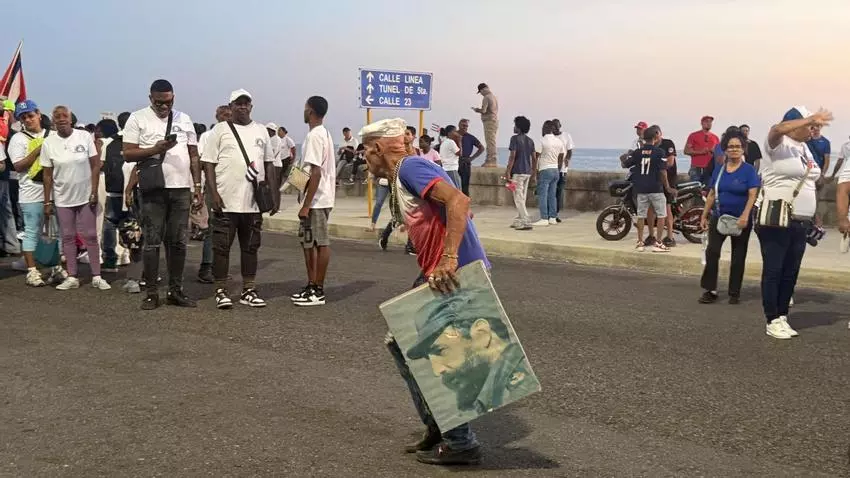
The event revolved around two obsessions: the fear of a US intervention and the desperate need to demonstrate popular support. Under the slogan “The homeland defends itself,” repeated ad nauseam, and with the centennial celebration of Fidel Castro’s birth as a backdrop, thousands of workers were mobilized from dawn toward Havana’s Malecón. The parade was presented by the official press as a combative, patriotic, and voluntary march. On the street, however, the scene resembled more of an obligation and a logistical operation than a display of civic fervor.
With the centennial celebration of Fidel Castro’s birth as a backdrop, thousands of workers were mobilized from the early hours of the morning. / 14ymedio
The demonstration had been organized from four points in Havana, culminating at la Tribuna. One of the attendees, who left from the gathering on Infanta Street around 6:30 a.m., described his experience to this newspaper: “There were mostly conga lines. I counted about five. The usual. Lots of shirts from state-run schools, and a ton of military personnel.” According to what he heard from the participants, many people had been called as early as 2:00 or 3:00 a.m.
When the main event began at 8:15 a.m., many of those invited had already left. “By the time it all started, after listening to Silvio Rodríguez’s entire discography, with the sun already beating down, easily half the people had left,” recounts one attendee. During the speeches, he adds, participants continued to leave. “When the groups came down and gathered on the stage, they stood there for almost an hour. And people were already exhausted.”
Despite this, official media announced the presence of 500,000 workers in the capital. However, the images do not support this figure. The density visible in photos and videos, the gaps in the crowd, the spaciousness continue reading
of the side areas, and the very layout of the location do not correspond to half a million people concentrated in that area, unless they spread out much more massively along adjacent avenues.
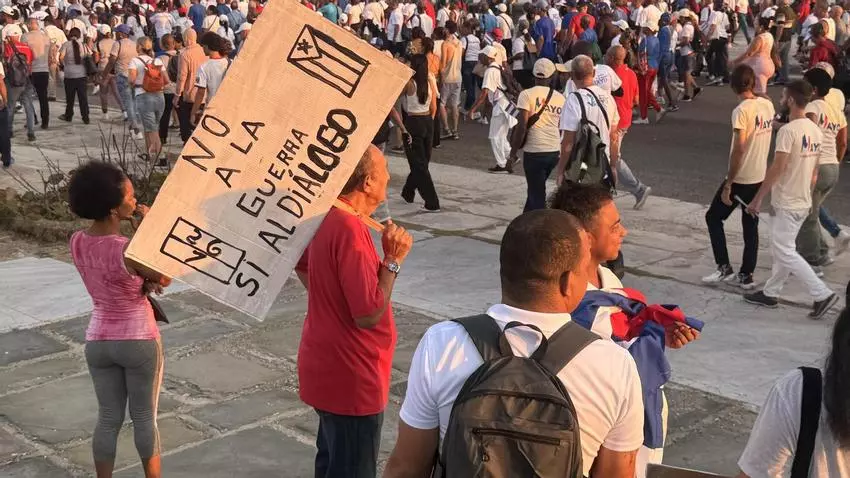
“They were stopped for almost an hour. And people were already exhausted.” / 14ymedio
“The government needed half a million. The images show considerably less,” one observer summarized. And, above all, they show something more damaging to the official narrative, because the crowd no longer seems convinced to even stay until the end.
Buses, work summonses, union orientations, and administrative pressure are all part of a familiar choreography at every political event of this magnitude. The ability to mobilize people remains one of the few organizational skills the state apparatus retains, even amidst the energy crisis and when daily public transportation continues to be a nightmare for millions of Cubans.
“Lots of people were drinking alcohol, ignoring the event,” the source said. In some sections, the honking horns seemed to be trying to compensate for the lack of enthusiasm with noise. “The avenue was empty, with the horns blaring,” the attendee summarized.
“They spoke of peace, of dialogue, and at the same time of whether the people were willing to die, of ‘give me my rifle,’ of whether they would collect blood.” / 14ymedio
The central moment of the event was the symbolic presentation to Raúl Castro and Miguel Díaz-Canel of the signatures collected in the “My Signature for the Fatherland” campaign, which, according to the state registry, totaled 6,230,973 signatures “for peace and sovereignty.” The figure was celebrated as proof of national unity. However, according to testimonies gathered, this support was not as voluntary as the propaganda proclaimed. “My neighbors and I have been practically harassed all week to sign. They came by three times in the last three days,” complained a resident of Diez de Octubre.
State television repeatedly insisted that the rally represented the true Cuba, in stark contrast to the discontent visible on Facebook, in independent media, at civic protests, and in recent polls. “On social media, they’re attacking the Revolution, but that’s not reality; this is reality,” said a commentator on Canal Caribe, while anticipating that criticisms would later emerge claiming that the attendees had been forced to go.
“The government needed half a million. The images show considerably less.” / 14ymedio
The official discourse inadvertently acknowledged the deep divide. “Everyone here is struggling: there’s no transportation, sometimes there’s not enough bread, but people keep persevering,” one commentator remarked. The statement was intended to extol resilience, but it ended up describing failure. In a country with prolonged blackouts, inflation, decimated wages, precarious transportation, impoverished retirees, and mass emigration that empties neighborhoods and families, calling on workers to celebrate their day feels somewhat mocking.
The day was also marked by a police crackdown on critical voices. The offices of this newspaper in Havana were surrounded by a police operation from the early hours of the morning to prevent journalists Yoani Sánchez and Reinaldo Escobar from leaving their homes on May 1st. This action confirms that, while the government attempted to project an image of popular support at the Anti-Imperialist Tribune, it was keeping independent journalists and dissenting citizens under surveillance and control.
The biggest contradiction lay in the language. The white shirts were presented as a symbol of peace, and the signatures as support for dialogue and sovereignty. But this pacifist appeal coexisted with a bellicose rhetoric of “the people’s war,” sacrifice, blood, and rifles. “They spoke of peace, of dialogue, and at the same time of saying the people are willing to die, ‘Give me my rifle,’ that they’ll collect blood. The discourse was quite incoherent,” the attendee concluded.
May Day parade in Havana: fewer people and more tiredness under the sun
______________________
COLLABORATE WITH OUR WORK: The 14ymedio team is committed to practicing serious journalism that reflects Cuba’s reality in all its depth. Thank you for joining us on this long journey. We invite you to continue supporting us by becoming a member of 14ymedio now. Together we can continue transforming journalism in Cuba.
Just as Villa Marista disrupts the cycles of detainees, the Island suffers its own sleep deprivation
The result of this chronic lack of sleep is the constant irritability and confusion seen on the streets. / 14ymedio
14ymedio, Yoani Sánchez, Generation Y, Havana, March 29, 2026 [delayed translation] — They say that detainees at Villa Marista, the feared headquarters of State Security in Havana, have their circadian rhythms disrupted, that biological rhythm that regulates sleep, wakefulness, body temperature, attention, and even one’s emotional state. Deliberately, jailers turn lights on and off in windowless cells and prolong interrogations to induce disorientation, false confessions, extreme fatigue, and cognitive impairment.
In Cuba, we all feel like we’re in Villa Marista. We get up in the middle of the night to wash clothes, cook, or carry water. At some point during the day, we have to try to catch a nap because we don’t know what chores await us after midnight. Even in the middle of that daytime rest, we might not be able to sleep because the stench of burning garbage wakes us up or the mosquitoes prevent us from taking a siesta. The result of this chronic lack of sleep is the constant irritation and confusion that we see on the streets.
In Cuba, we all feel like we’re at Villa Marista.
I ran into a neighbor in the elevator during one of those rare moments when we have electricity. She’d left for work and when she got to Boyeros Avenue, she realized she didn’t have her wallet with the money to pay for an electric tricycle. She went back home, picked up her wallet, and—surprise!—when she went to pay the taxi driver, it was empty. Another neighbor went downstairs as soon as a power outage ended to charge his electric motorcycle in a nearby parking lot, but when he was standing next to the vehicle, he realized he’d forgotten the charger and cable
These aren’t just random lapses in memory. It is the poor quality of sleep that leads to decreased concentration, memory lapses, and a higher risk of mistakes or accidents. We’re a country that barely gets any sleep.
______________________
COLLABORATE WITH OUR WORK: The 14ymedio team is committed to practicing serious journalism that reflects Cuba’s reality in all its depth. Thank you for joining us on this long journey. We invite you to continue supporting us by becoming a member of 14ymedio now. Together we can continue transforming journalism in Cuba.
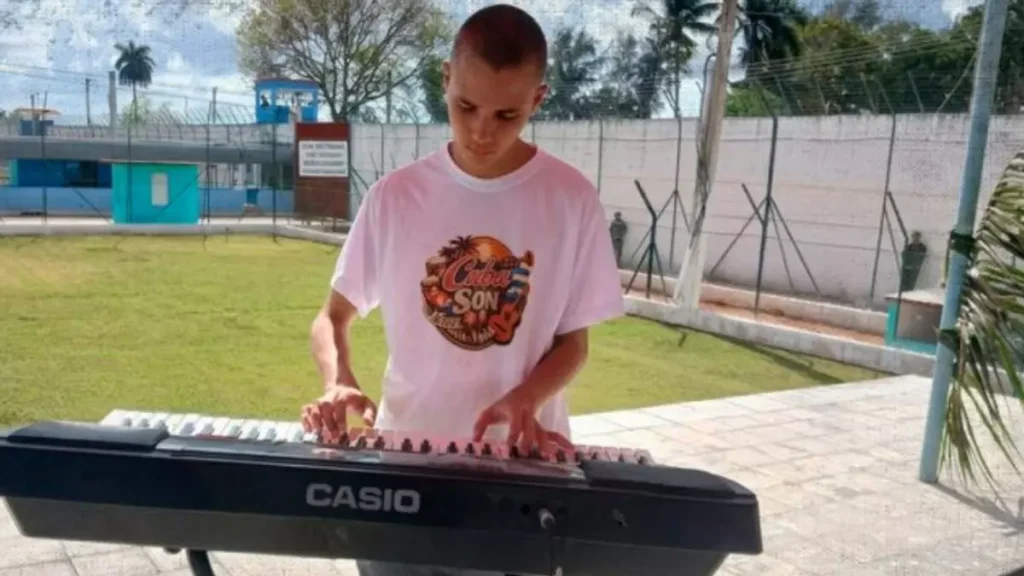
The platform published a photograph of the teenager in prison playing the piano on Wednesday, accompanied by a text accusing the “subversive cluster and political operatives funded by the United States government” of lying when they claim the young man is ill. “Now we ask, using logic: if he were truly so ill, if his immune system were as destroyed as they falsely claim, if he were dying of dyshidrosis, intestinal parasites, and bedbugs… How does he have the strength to be there, standing, playing the piano at a cultural event? How does a boy on the verge of death participate in a benefit concert in prison? How does he spread smiles while moving his hands with such precision?” the text stated.
In a message sent to Cubanet, the young man’s father asserts that the images were taken under false pretenses. He claims they promised him “a day of visitation as a reward.” “They used him, they took his picture, they recorded video, they even recorded his blood type to do these horrendous things. I denounce them, I denounce all of them. And this also involves the prison authorities,” Muir Ávila maintained, after calling the dissemination of the photograph “a big lie, a big fallacy.”
The father, who is a pastor at the Tiempo de Cosecha evangelical church, defended his son, describing him as someone who is held in the highest regard and with the best opinion in his neighborhood. Muir Ávila accused Cuban authorities of trying to create “a very denigrating image of him, portraying him as a delinquent, a vandal, and a criminal, in order to prosecute and incriminate him.” continue reading
“Please, I ask the whole world (…) not to allow such injustice, my child is not a criminal; my child is a teenager, a child going through adolescence who is very sick and needs to be released now to be treated,” he insisted.
Yurisel Montes de Oca, who considers himself the young man’s brother, expressed a similar sentiment, although his testimony differs slightly from Muir Ávila’s. According to his version, Jonathan plays the piano in prison, encouraged by his family “to clear his mind,” which doesn’t mean he doesn’t “desperately ask when they’re going to let him out,” or “the times that, due to the poor digestion of the terrible food they give him, he vomits and has diarrhea,” or the times he says he goes hungry. “He refused to be recorded,” he adds.
“Playing piano does not negate the truth of a chronic illness that, without treatment, can become complicated,” he argues in response to the insistence of Razones de Cuba, which mentions the word piano up to four times in the post .
According to the official platform—which ignores the fact that the young man has been in a maximum-security prison for almost two months for participating in a protest—the fact that the young man engaged in a recreational activity “demonstrates what Cuba has been denouncing for years: the subversive group and its operatives are not trustworthy and lack any credibility. They spread fake news in order to tarnish our country’s image.”
The dissemination of that photograph, in any case, contravenes four rules approved by the Government of Miguel Díaz-Canel, starting with the Constitution itself, which enshrines in article 48 the right to “privacy, honor and one’s own image,” and mentions in article 86 the duty of the State to provide protection to minors.
More specific is the Family Code, approved in 2022, which makes it clear that parents or guardians are the custodians of their children’s image and that a third party cannot disseminate it without their consent. The same principle is established in the 2023 Social Communication Law, which emphasizes the protection of minors when their image is disseminated on social media, and even in the Penal Code. This law punishes anyone who, “with the purpose of knowing, outside of cases authorized by law, or of affecting the privacy or image, voice, data, or identity of another person, without their consent, obtains, facilitates, reproduces, discloses, transmits, or keeps in their possession a recording or reproduction of sound, photo, or video, messages, data, or any other information of a personal or family nature, with the penalty being aggravated if the person is a minor.”
Just a few days ago, the state-run newspaper Cubadebate published a lengthy article accusing the media outlet Cibercuba of using images of minors to “exploit childhood as a high-impact narrative resource.” The article condemned the dissemination of photographs of children enduring hardships to earn money and, at the same time, to impose a narrative contrary to the regime. Furthermore, it made it very clear that “in light of current Cuban regulations, [this] offers strong evidence of a practice that may constitute a violation of the right to one’s image and the dignity of children and adolescents.”
______________________
COLLABORATE WITH OUR WORK: The 14ymedio team is committed to practicing serious journalism that reflects Cuba’s reality in all its depth. Thank you for joining us on this long journey. We invite you to continue supporting us by becoming a member of 14ymedio now. Together we can continue transforming journalism in Cuba.
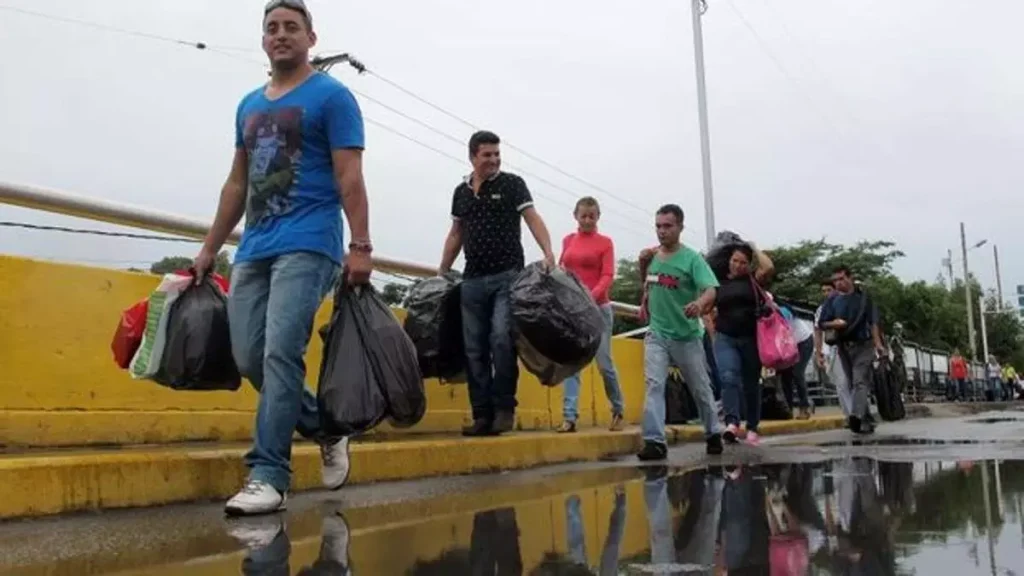
The measure seeks to eradicate potential asylum requests from non-immigrant travelers
Asylum applications at the border were suspended before the court’s decision, although the government plans to appeal. / EFE
14ymedio, Madrid, April 30, 2026 — Cubans applying for a US visa will now find themselves between a rock and a hard place. When consulate officials ask them if they fear what might happen to them in their home country, they will face the dilemma of lying—which would result in a permanent prohibition on entering the country—or telling the truth, in which case the visa will be denied.
Embassies and consulates received a diplomatic cable this week from the State Department indicating that visas should be denied to those who declare fear of their country’s regime.
“Consular officials must prevent abuse of the immigration system by visa applicants who misrepresent their purpose of travel, including those attempting to obtain nonimmigrant visas for the purpose of seeking asylum upon arrival in the United States,” the document states, as reported Tuesday by the Washington Post and confirmed Wednesday by CNN. Both outlets had access to the instruction and, in CNN’s case, to a White House source.
In the interview, applicants for all nonimmigrant visas—including tourist, worker, and student visas—must answer “no” to the questions: “Have you suffered harm or ill-treatment in your country of nationality or last habitual residence?” and “Do you fear harm or ill-treatment upon returning to your country of nationality or permanent residence?” If they do not, the official must not proceed with issuing the visa, the document states. continue reading
In the interview, applicants for all non-immigrant visas – including tourist, worker, or student visas – must answer “no” to the questions
Shortly after taking office, Donald Trump halted asylum applications, claiming there was an “invasion” from the border with Mexico. But last week, a federal court declared the measure illegal and reiterated that immigration laws give people the right to seek asylum at the border and that the president cannot restrict it.
With this decision, the asylum route is open again, hence the Administration is looking for another way to reduce the possibilities, since no one who has claimed fear of the Government of their country of origin, an essential requirement to qualify for international protection, will be able to reach the US.
“Consular officers are the first line of defense for U.S. national security, and the State Department uses every tool and resource available to determine whether each visa applicant qualifies under the law,” a Washington spokesperson told CNN.
The Washington Post also sent its questions to the State Department, which responded similarly, adding: “As Secretary Rubio has made clear on numerous occasions, a U.S. visa is a privilege, not a right. People who do not intend to comply with our laws, including leaving the United States before their authorized period of stay ends, should not apply for a visa.”
“They are trying to systematically destroy any means by which a persecuted person can seek protection and safety in the United States,” Jeremy Konyndyk, president of Refugees International, told the media outlet.
The activist lamented how “any pretense that the United States cares about protection from persecution is completely abandoned. Someone is explicitly asked, ‘Are you being persecuted in your country?’ And if they answer ‘yes,’ the official response from the US government is, ‘Okay, stay there.’”
Konyndyk added that if such a measure had been in place years ago, it would have prevented Iranians from entering the country in the 1970s, Soviet dissidents during the Cold War, and German Jews in the 1930s.
To emphasize the seriousness of the measure, Konyndyk added that if such a measure had been in force years ago, it would have prevented the entry of Iranians in the 1970s, Soviet dissidents during the Cold War, and German Jews in the 1930s.
For her part, Camille Mackler, an immigration policy expert, told CNN that the new directive “is going to put people in really bad and terrible positions of having to make decisions that ultimately affect their safety and that of their families.”
This week, an analysis published by the Cato Institute revealed that the number of monthly asylum seekers at the border fell from nearly 40,000 in December 2024 to just 26 in February 2025, a 99% drop. Similarly, green card issuances —permanent residency—have plummeted by 99.8% in the last year, and family reunification applications have fallen by 20%.
______________________
COLLABORATE WITH OUR WORK: The 14ymedio team is committed to practicing serious journalism that reflects Cuba’s reality in all its depth. Thank you for joining us on this long journey. We invite you to continue supporting us by becoming a member of 14ymedio now. Together we can continue transforming journalism in Cuba.
 EFE (via 14ymedio), Washington DC, April 28, 2026 — US Senate Democrats failed Tuesday in another attempt to limit President Donald Trump’s authority to use military force against Cuba.