An Oil Tanker With 530,000 Barrels From Russia Arrived in Havana

The photographs captured this Tuesday by 14ymedio confirm that the tanker is anchored in front of the capital city’s refinery. (14ymedio)

14ymedio bigger14ymedio, Havana, 5 July 5, 2023 — The oil tanker SCF Prime, with a Liberian flag and an approximate capacity of 530,000 barrels, arrived this Tuesday in the bay of Havana from the Russian port of Tuapse. It is the first tanker to arrive on the Island after the oil supply agreement between Russia and Cuba and, although it was scheduled to unload in Matanzas on July 2, it ended up arriving in the capital.

Through the maritime monitoring websites, this newspaper followed the trajectory of the ship from its departure from Tuapse, on June 3, until it reached the Cuban coast a month later, on July 4. The ship disappeared from radar and does not appear on the lists of ships anchored in any Cuban port.

However, the photographs captured this Tuesday by 14ymedio confirm that the tanker is anchored in front of the capital city’s refinery, although it is unknown if it will travel to other port terminals in the country.

The arrival of the SCF Prime had also been announced by the academic and specialist of the University of Texas, Jorge Piñón. A report on the movement of oil tankers traveling to the Island – with both a Cuban and a foreign flag – offered by Piñón to this newspaper, pointed out that the trafic of fuel to the Island continues to increase.

On Tuesday, the Caribbean Alliance tankers, with the Panamanian flag, anchored in Mariel, were also detected by Vesselfinder: in Cienfuegos are the Gloria C – which operates with a Cuban flag – and the Ocean Integrity, also with the flag of Panama. Meanwhile, in Matanzas, the arrival of the Nicos I.V. and the Vilma, a Cuban tanker that sailed from Havana this Tuesday, the same day that the SCF Prime arrived, is expected. continue reading

Countries allied with Cuba continue to send oil to the Island. On June 17, Mexican journalist Gerardo Aburto accused President Andrés Manuel López Obrador of “giving crude oil to the oppressive government of Cuba.” An invoice, published by Aburto himself, shows how the state monopoly Pemex sold to Gasolineras del Bienestar – a government program to support state institutions and private initiative in Mexico – 350,000 barrels of Isthmus oil (a variant of crude oil used to manufacture gasoline, diesel, jet fuel and kerosene) to be sent to the Island. The document also includes the name of the tanker Delsa and the entity to whom the fuel is delivered: Unión Cuba Petróleo (Cupet).

No other official body, such as Customs or other departments of Pemex, was notified of the transaction through the due documentation. The journalist estimates that the value of the load can be set between 18 and 20 million dollars.

The ship that transported the cargo was the Delsa, one of the six Cuban-flagged oil tankers – along with the Vilma, Alicia, Sandino, Pastorita and Gloria C – which usually transports crude oil from the Venezuelan port of José to the terminals of the Island.

Piñón explained to 14ymedio that the Vilma – which also disappears from radar as soon as it approaches the Cuban coast – arrived in Cienfuegos on June 1 with 390,000 barrels of crude oil from José; the same amount was transported by the Delsa, also from José, to the port of Antilla, on the 30th.

For its part, the Sandino sailed from José with 440,000 barrels to the bay of Nipe, in Holguín, where it arrived on May 5. The Alicia  brought to Havana 290,000 barrels from José on May 16 and another 295,000 from the Venezuelan terminal, Amuay, on the 28th.

Translated by Regina Anavy

____________

COLLABORATE WITH OUR WORKThe 14ymedio team is committed to practicing serious journalism that reflects Cuba’s reality in all its depth. Thank you for joining us on this long journey. We invite you to continue supporting us by becoming a member of 14ymedio now. Together we can continue transforming journalism in Cuba.

The Candonga, a Havana Street Market that Has Everything

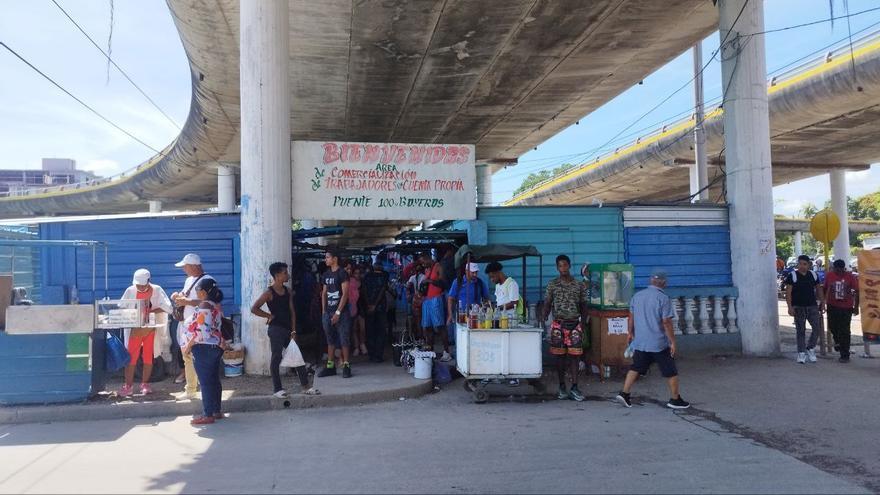
“Welcome to the self-employed workers’ marketplace”, reads a Dante-esque sign that greets shoppers at the candonga. (14ymedio)

14ymedio bigger14ymedio, Juan Diego Rodriguez, Havana, 1 July 2023  —  For Cubans, “to live under a bridge” means to have fallen from grace, to be reduced to poverty. However, the daily swarm of vendors, buyers, dealers, pickpockets, drunkards and fortune seekers under the bridge at 100th and Boyeros in Havana belies that old saying. This is a candonga, a human anthill where everything, even prosperity, is for sale.

It’s mid-morning and traffic is at its peak. Boyeros is one of the city’s main arteries, running from the Carlos III shopping mall to the José Martí airport. It serves as Havana’s western entryway. In the 1990s, the candonga — the name originated in Angola, where it connotes an open-air street market — was a clandestine operation in a makeshift space. It used to be said that if a fugitive managed to reach Boyeros, he could assume he was safe from the police. When government agents show up here, which can happen at any time of day, vendors grab their tents, tables, blankets, umbrellas and wares, and run.

What saved the candonga was its location. From nearby Boyeros Avenue, along which every imaginable vehicle passes, including pricey air-conditioned cars ferrying tourists, the hustle and bustle is hidden from view. Supplied by a constant stream of “mules” arriving from Florida, Panama and elsewhere, it is the largest open-air market in Havana, overshadowed perhaps only by La Cuevita in San Miguel del Padrón.

You could be checking out a pair of sneakers or handing over a thick wad of cash when, all of a sudden, all eyes look upward. A heavy truck travelling along the elevated roadway shakes the concrete structure. True, it’s not a strong jolt but it is enough to cause the imagination to do what it does. Everyone is suddenly aware just how fragile the vendor’s booths, located under this overpass to protect them from the sun and occasionally the rain, really are.

Fear, however, should not lead you to let down your guard. Best beware of the lads standing beneath a hand-painted sign that reads, “Welcome to the self-employed workers’ marketplace.” They are waiting for you to become even slightly distracted so they can slip their hands behind your back and snatch your wallet. continue reading

An almost spotless, very well illuminated tunnel connects the candonga with the other stretch of the avenue. If no one has managed to steal its fluorescent light bulbs, it is because they are out of reach, too high for a thief without resources.

It goes without saying — to paraphrase another Cuban maxim — that they have what you’re looking for. It’s all at the candonga. From an electric fan to a coffin, from a light bulb to a candle, items you might still find useful in the afterlife.

But have no illusions. The merchants here sell what they can get, which is stuff that can be bought for cheap overseas and sold for extravagant prices in Cuba. There is a term for this kind of junk: “Mickey Mouse” merchandise, which connotes plastic objects that break easily, as in a Disney movie.

But that’s not all. At the candonga you can also get raw and cooked food, any kind of spare part (if you are willing to pay the price), handicrafts, imported clothing, bicycles, helmets, cables and canned goods.

The vendors here abide by the law of the jungle. No one is anyone else’s friend and that is reflected in the prices. An electric shower that costs 5,000 pesos at one stall will be 4,500 at another nearby.  Customers get the same treatment, though it might be a little less hostile if you’re lucky.

The price of sneakers can vary from 2,500 to 8,000 pesos. Flip-flops go for 2,000. Handmade footwear, the best kind, for 1,000 to 2,800. Short stockings for 400. Not very supportive bras for 700; bluetooth speakers for 25,000. Nuts and bolts for the exorbitant price of 10 pesos apiece.

Food has the widest price range. Mango is often 20 pesos a pound, yucca costs 60 and a single banana goes for 160. A bottle of water will cost you 300. Prices for meat, whether it be for chicken or ground meat, are in a class by themselves. This is the purview of the shadiest vendors and the price depends on how well you can haggle.

Some merchants do not mince words and react badly when questioned. A young man was looking over at a pair of brand-name sneakers for 2,500 pesos – a price too good to be true – and wanted to know if they were knockoffs. “Of course not,” the saleswoman replied without hesitation. “Let me see?” When she picked up the shoes, she noticed that the label was not correct and put them back down. “Well, at that price what do you expect?” the saleswoman snapped, shrugging her shoulders.

A term you will often see at the candonga is “one size.” It refers to stretchy clothing that will fit a thin body as well as a plump one. The seller’s trick is to ask the potential customer his or her size and return with any random item of clothing. “It there’s no size indicated, it must mean one size fits all,” the vendor tells the interested party with a smile.

For visitors who do not want forget the experience, there are those who will sell you a photo that captures the moment.

One leaves the candonga exhausted, with a bag full of purchases, dodging pickpockets along the way. Just outside are the inspectors, standing in the middle of the road and directing cars with official license plates — the ones always reluctant to stop and pick up strangers – which load up with passengers ready to leave. The advice from the most experienced shoppers, however, is to not spend all your money. You will need some of it to find a taxi home.

____________

COLLABORATE WITH OUR WORKThe 14ymedio team is committed to practicing serious journalism that reflects Cuba’s reality in all its depth. Thank you for joining us on this long journey. We invite you to continue supporting us by becoming a member of 14ymedio now. Together we can continue transforming journalism in Cuba.

‘Fatherland and Lead’ Scrawled on Facade of a Neighborhood Store in Havana

A government sympathizer quickly began painting over the graffiti on the store’s facade as an elderly man waited for the store to open. (14ymedio)

14ymedio bigger14ymedio, Juan Diego Rodriguez, Havana, July 2, 2023 — Cuban slogans evolve and change with the times. The song title “Patria y Vida” (Fatherland and Life) became one of the most popular chants during the protests of July 11, 2021 but now there are new versions. There was a lot of commotion on Saturday in Juanelo, a neighborhood in Havana’s San Miguel del Padrón area, when the neighbors discovered graffiti on the wall of one local store which sells rationed goods.

Sometime shortly after dawn, someone scrawled three words, “Patria y Plomo” (Fatherland and Lead*), in giant letters on the shabby facade. The corner of Serafina and B streets, where the store is located, quickly attracted curious onlookers. Everyone wanted to see with his or her own eyes what the sign said. The more daring among them got out their phones and took photos in spite of the police presence that surrounding the site.

A government sympathizer quickly began painting over the graffiti, which elicited comments from customers who had watched the store’s facade, now covered in grime in some places and flaking off in another, deteriorate over the years. “For this they have paint but they don’t have the materials to fix this neighborhood,” complained a retiree who was born in the area. continue reading

The only person who seemed oblivious to what was going on was an elderly man, sitting near the entrance and waiting for it to open so he could buy two pounds of rice.

The only person who seemed oblivious to what was going on was an elderly man, sitting on the curb near the entrance and waiting for it to open so he could buy two pounds of rice, the June allotment, which went on sale on Saturday. The other customers, though eager to do the same, kept a cautious distance. “No one’s going to blame that guy for the sign,” grumbled a young man.

By mid-morning only the word patria remained. The word plomo had already been painted over to prevent anyone from seeing it. How the word vida in the famous expression morphed into a projectile is anyone’s guess. But everyone could understand the frustration that would move a person’s hand to create a new version of that slogan.

Translator’s note: Presumably a reference to the material from which bullets are made.
____________

COLLABORATE WITH OUR WORKThe 14ymedio team is committed to practicing serious journalism that reflects Cuba’s reality in all its depth. Thank you for joining us on this long journey. We invite you to continue supporting us by becoming a member of 14ymedio now. Together we can continue transforming journalism in Cuba.

Cuba Lacks Food. . . and Will Continue to Lack Food

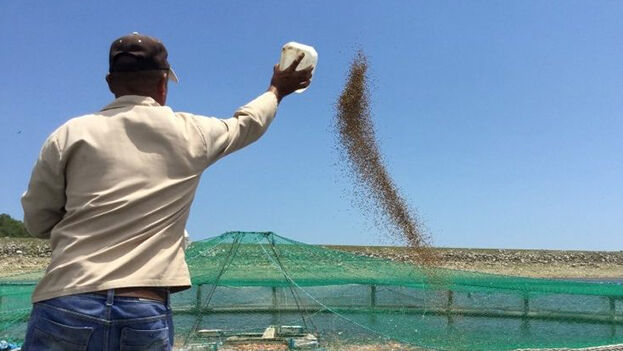
Feeding the fish at the Sancti Spíritus Fishing Company. (Escambray)

14ymedio bigger14ymedio, Elías Amor Bravo, Economist, 22 June  2023 — In Cuba, food is lacking. It’s been six decades of pernicious scarcity that demand a response to one of the most serious day-to-day problems for Cubans. A recent edition of the State TV program Mesa Redonda [Roundtable] was dedicated to this issue, with the title What is happening with food production in Cuba?

Four officials participated in the program. The Minister of Food Industry, Manuel Santiago Sobrino; the Director of Food Industry Research, Jesús Lorenzo Rodríguez; the President of the Food Industry Business Group, Emerio González and the Vice Minister of Food Industry Midalys Naranjo. Each one spoke, without responding to the question all Cubans are asking, Why isn’t there any food?

The Minister of Food Industry stated, in the first place, that in the country’s development plan for 2030, food production is strategic for Cuba, and later recognized that the industry has been affected by the country’s current economic situation, which he attributed to the embargo/blockade. He did not take responsibility for a single thing. He spoke of the increase in international market prices in the last years and of the war in Europe as determinants of the increased food prices in Cuba, without once mentioning the person responsible for it all, the regime’s ally, Putin.

He ended by saying that the availability of electricity has affected the industry’s productifity, in a clear allusion to that branch minister, and even referenced the effects of climate change, specifically drought, as responsible for low production. continue reading

Secondly, the Minister said that the new economic actors have energized the sector and stated that, in the country, there are 844 micro, small, and medium private enterprises, of which 144 are bakeries and cake shops, 194 are meat producers, 188 produce preserves and 92 produce dairy products. He referenced the existence of 350 microindustries primarily in agriculture and in AZCUBA (sugar producers). Enough? Appropriate distribution? Sustainability? All doubtful.

Third, he referred to changes in the agricultural commerce introduced last year, establishing that contracts for these products within the industry should be producer-to-producer, a measure that has not been applied correctly, which affects the size of milk and meat contracts offered to producers. For that, he requested a changes in mentality, business concepts, and leadership structures, and a reliance on communication and information systems. That’s it? And who is responsible for inspiring and promoting change if not him?

Fourth, he referred to the Food Sovereignty and the Food and Nutrition Security Law, which according to him, provides the tools necessary for the Ministry of Food and other actors involved in food production. He recognized that people still cannot see the changes reflected at their tables, for which there are doubts about them. He is not of the same opinion as the UN World Food Programme which gave a stern warning to Cuba for its inflation.

The next one to speak was Jesús Lorenzo Rodrīguez, Director of Food Industry Research, who centered his remarkes on the results of scientific-technical activities within the sectot that, over the last 46 years, has developed 700 products, provided tools to all food processors, from product nutrient composition to the implementation of technical processes and the most efficient equiment. Where are those developments and what have been their results?

He spoke of research projects, such as flour production, training of local producers, to produce food to satisfy the population’s demand in terms of protein, fats, etc. And all that, without citing specific results, such as, for example, the 16 technical consultations. He cited some projects of major impact, all at the direction of the Council of Ministers (a political not technical decision) in the areas of Puerto Padre and Los Palacios. He cited, as if it were notable, the use of food industry sub-products, a practice that is widespread throughout the world and that reduces the environmental impact of waste. Finally, he signaled that currently, since the sugar shortage, the Ministry is working with AZCUBA to use sugar byproducts as sweeteners in other products.

After that, the president of the Food Industry Business Group, Emerio González spoke; he referenced last year’s structural reforms, with the creation of a group dedicated to agrifood activities to attend to the source of primary inputs for agriculture, dairy, meat, preserves, coffee; another fish industry group.

Among the group’s tasks is guaranteeing wheat flour, through the National Milling Company that produces and distributes wheat flour and also yeast and other inputs for bread production destined for the basic food basket and other consumption. The Roundtable participants dedicated their attention to flour and bread, because they know that the issue is worrisome for Cubans.

He explained that, with regard to this product, a very critical situation began in mid-2022 with the wheat supply and it has become more acute in the first six months of this year. To achieve stability in wheat production and traditional consumption within a month requires three shiploads of wheat valued at $35 million. In that regard, he signaled that in 2023 they’ve only managed to purchase four shiploads of wheat, the price of which has increased considerably and pointed to a product that is heavily affected by the blockade.

It’s all the same, the issues are due to the blockade and he cited the case of spare parts. There are four mills, with financing available, they have paid spare parts providers and their banks will not accept payment, but without these spare parts they can’t function. Well, search for them elsewhere. As of now, no one is going to gift them.

Despite the difficulties, the government does not give up bread production and has adopted several actions such as searching for flour and wheat in nearby regions to reduce the shipping time. According to the directors, two ships containing wheat flour have been contracted to arrive in the coming months, though the volume is not large, but two more ships containing wheat are also scheduled to arrive. With that, they can guarantee July and they are working on the contracts for August.

He also recognized that they have not been able to deliver flour to Cadena Cubana de Pan and that several economic actors have imported some flour and have participated in this supply chain. Furthermore, these supply chains are also achieving results in the confectionery industry. What he did not say is that to purchase and contract, they must pay debts, and in that regard, Cuba has bad, very bad data.

With regard to production of alcoholic beverages, he said that the decline in sugar production in Cuba has negatively impacted the sector. Nonetheless, he pointed to measures approved by AZCUBA as an opportunity to correct the situation. In addition, with AZCUBA they are conducting systematic checks on productive processes and to date they have been able to produce more than two million cases of rum, which will allow them to recover production.

Then, to speak of fisheries, the Vice Minister of Food Industry, Midalys Naranjo, surprised everyone by saying that although Cuba is surrounded by sea, its waters do not have the required levels of fish to satisfy the population’s demand. Since when does she have this information?

She explained that between 1976 and 1990 Cuba had a fishing fleet that operated in international waters and provided a portion of the fish consumed in the country (around 100,000 tons per year). However, since 1992 the fleet had to slowly withdraw from international waters, because it could not comply with fishing agreeents, which affected the availability of this food item in Cuba. Between 1986 and 2009, the country imported around 33,000 tons of fish products, which the Vice Minister said was not currently possible to maintain, because of the levels of financing required.

As a result, the regime decided that fish should be based on aquaculture in Cuba, with a program that includes all the provinces in the country. Among products, developed extensively, because intensive aquaculture demands high volume of feed for the fish, which is not currently available. Production of cyprinids (what is commonly known as tench) is one of the most common, although it requires around 18 months to achieve a commercial size fish. Furthermore, there are new economic actors in this activity. There are, for example 485 private producers with around 1,546 hectares under production. It is not a private initiative. They are tenants who do not own the means of production.

The Vice Minister referred to some difficulties in aquaculture, such as the effects of climate change (especially drought and heavy rains), the timeline for producing marketable fish and limited fishery capacity at the moment. With regard to the latter, she informed that the shipments contained inputs for fisheries.

After that, she referred to the Fisheries Law of 2019, which according to her, was debated in fishing communities who offered suggestions; were evaluated and it wasn’t until four years later that they were taken into consideration to supposedly ease the norms. Haven’t they had enough time? In essence, there is a working group charged with revising the legal norms that support the law; it has drafted proposals to develop fishing activities which have been approved by the Executive Committee of the Council of Ministers.

Among the reforms, they discussed gradually creating conditions in all regions for the wholesale and retail of fishing supplies, offering construction and boat repair services, allowing commercial fishing between August and January in areas declared as preferential to tourism for a period of two years, modifying navigation area three C. Currently the following have been approved: navigating up to 12 miles, an increase in the size of motors to seventy horsepower, a revision to the plans for managing protected areas, declaring fishing bases such as fishing ports as areas of local interest and facilitating fish commerce, applying the sales and pricing concepts in accordance with all products and economic actors. Note this last one.

Resolution 52 was approved in October 2022 precisely for this reason, which already applies; it states that commercial fishermen are not required to have a contract with a state entity and can sell products directly. That resulted in an increase in the sale of non-state commercial licenses, which reached 4,042 licenses at the end of May, a much larger number than in 2022.

She clarified that the prior measures were being implemented and that in the next few months they should allow a greater level of easing of fishing activities, which will be well received by fishermen. That remains to be seen. Hopefully all this will result in greater production and consumption of fish, but it does not seem probable. The right to property continues to be untouchable.

At the end of the event, the Minister broached the situation of the basic food basket, the products it comprises and its current situation. A topic of interest for the population.

His remarks addressed what he called challenges in food packaging, safety and quality. Specifically, the bread, in addition to the issues with raw materials, the quality of this product is influenced by the lack of quality control in places where there have not been enough requirements in place.

He later referred to the complex situation of the products that make up the basic food basket, practically all of them.

Of powdered milk he said that to ensure consumption within the country they rely on small imports from Latin America and the Caribbean, which he acknowledged, do not satisfy demand. Regarding oil, he acknowledged they owe consumers one months’ supply [as a part of the rationed goods], but said that it is in the country aboard a ship with enough inventory to satisy demand for two months and assured that oil distribution to the population would begin in the coming days. With regard to baby food, with a difficult situation at the beginning of the year, it seems that the raw materials for its production are now available and it is currently being distributed.

About coffee, he said they are finishing up distribution of the supply for May’s basic food basket, which can be guaranteed with domestic raw materials. He then said something surprising: from now on, coffee production will depend on what can be imported because domestic production can no longer cover these months. With regard to chicken included in the basic food basket he said distribution will begin any day but only for a portion of the population and he assured that in July and August distribution of this product in the rationed basket will improve. About other meats, he said that in the coming days a ship should arrive at a Cuban port carrying raw materials and inventory for two months, designated for production of food items such as ground beef and ham. With regard to soy products, he said the picture is complex due to a shortage of products on the international market and only said that they are working on a timely solution.

After this story, certainly dramatic, he said that a government-driven program is underway to improve the situation this summer, with products such as beer, soft drinks, ice cream and candies. Curiously, these have experienced declines in inflation during the month of May.

He announced that in the coming days more than five foreign capital investment projects and two domestically funded projects will be functioning, which should improve the consumption scenario. Among these are factories for crackers, candies and coffee; as well as a brewery in Mariel; a candy factory in Caibarién, Villa Clara; the launch of the chocolate factory in Baracoa; the expansion of production in the Bucanero brewery; among others.

An extensive event. Anything less would not do. Without a doubt, the topics covered deserved it. The audience that put up with the program up to this point went to bed with the same sensation of misfortune. Even worse, feeling they had been fooled once again.

Translated by: Silvia Suárez 

____________

COLLABORATE WITH OUR WORKThe 14ymedio team is committed to practicing serious journalism that reflects Cuba’s reality in all its depth. Thank you for joining us on this long journey. We invite you to continue supporting us by becoming a member of 14ymedio now. Together we can continue transforming journalism in Cuba.

The Sharp Drop in Cargo Transport Reflects a Cuban Economy in Clear Recession

The import and export of cargo, mainly in ports, has decreased by 44% in recent years. (14ymedio)

14ymedio bigger14ymedio, Madrid, 5 July 2023– Among all the nefarious data of Cuba, those of cargo transport are not spared. According to a report published on Tuesday in the official press, of the 24.7 million total tons of products of all kinds that should have been transferred in the first quarter of the year, only 14.5 million have been transported.

The figures make the Ministry of Transport fear that by the end of the year less than 36 million tons will have been moved in the country.

By rail, for example, the data specifies that 162 fuel tanks were moved weekly, less than the 220 that were transported before 2022, which is reflected in the problem of gasoline shortages.

As for import and export cargo, “mainly in ports,” it was reduced by 44% in recent years, from the 4.5 million tons recorded in 2018 to 2.5 million in 2022. continue reading

The principal responsibility for the situation is the usual one for the Cuban authorities: “the intensification of the economic, commercial and financial blockade imposed by the US Government on our country,” in addition to the “effects” caused by the COVID-19 pandemic.

The report recognizes that “the population is dissatisfied” with the quality of international parcel distribution and delivery service, but the government assures that “work continues on its improvement.”

The objective, they say, is “to reduce the delivery time to seven days, with higher levels in the quality of service, and to have a computer system will allow people to track their packages from the origin.”

Translated by Regina Anavy

____________

COLLABORATE WITH OUR WORKThe 14ymedio team is committed to practicing serious journalism that reflects Cuba’s reality in all its depth. Thank you for joining us on this long journey. We invite you to continue supporting us by becoming a member of 14ymedio now. Together we can continue transforming journalism in Cuba.

Cubans Outraged by the Procedures To Be Spanish Call for a Protest in Havana

Line at the Consulate of Spain in Havana. (14ymedio)

14ymedio bigger14ymedio, Madrid, 4 July 2023 — A group of Cubans who want to take advantage of the new “law of grandchildren” of Spain to obtain that country’s nationality has called for a peaceful protest for this Wednesday, July 5 at 9:30 am in front of the population service office of the Ministry of Foreign Affairs, on H Street between 5th and Calzada, in Havana’s El Vedado neighborhood.

The problem, they explain to this newspaper, is that the process of legalizing the documents, which previously took a month, now takes up to almost four months. “The appointments are through the Ticket application, and there are 2,000 people or more on the waiting list to get an appointment for legalization,” they complain.

According to details, each stage of the process now takes between 20 days and a month: “pending” one month; “accepted at reception” between 20 and 30 days; “legalization” 20 days; “signed” 5 days; and “delivered” between 20 and 30 days. continue reading

In order for the process to be shortened, they propose two measures to the ministry: to create “temporary offices for the legalization of documents in the capitals of the provinces,” so that “there is less volume of documents in Havana,” and hiring more staff. “We just want to have our documentation ready in the fastest possible time and be Spanish; it is our right,” they say in an email sent to the 14ymedio Editorial Office.

The group has also created a Telegram channel to disseminate the call, signed by the Ombudsman’s Office of the Community of Spanish Descendants.

Cuba is the country where the most people have obtained Spanish nationality under the new Law of Democratic Memory, which offers the option of obtaining it to a wide range of descendants of Spaniards.

As of January 31, according to the latest data released by the Ministry of Foreign Affairs of Spain, 24,729 applications had been submitted at the 179 consular offices around the world, most of them in Latin America. Cuba, Argentina and Mexico, in this order, totaled 14,610 applications received and 4,774 registered nationalities.

Of this total, half, 12,862, have already been approved while 6,653 have been registered in the Civil Registry.

Translated by Regina Anavy

____________

COLLABORATE WITH OUR WORKThe 14ymedio team is committed to practicing serious journalism that reflects Cuba’s reality in all its depth. Thank you for joining us on this long journey. We invite you to continue supporting us by becoming a member of 14ymedio now. Together we can continue transforming journalism in Cuba.

A Chinese Wholesale Website Offers To Supply Cuban ‘MSMEs’

Those in charge of the platform describe it as “an essential connection” between Cuban merchants and the international market. (Nihao 53)

14ymedio bigger14ymedio, Havana, 28 June 2023 — A labyrinth of obstacles, verifications and absences makes it difficult to buy on the Nihao 53 digital platform, with which the Chinese conglomerate Leke Holding Group hopes to consolidate its presence in Cuba. With the intention of supplying the wholesale market on the Island, the site offers food, furniture, construction materials and countless items to micro, small and medium-sized enterprises (MSMEs), but the products are not always available for sale or cost crazy amounts of euros or dollars.

The obstacles also assault the buyer from abroad, leaving little room for doubt about who can receive the services of Nihao 53: Cuban “entrepreneurs” within the country, with accounts in foreign banks and the ability to store orders in a warehouse reserved by the Leke group.

Its clients, summarized the directors in a recent report by the Sputnik news agency, seek “access to raw materials that are almost impossible or very difficult to find” in the economic context of the Island.

The platform is described as “an indispensable connection” between Cuban merchants and the international market. Its general manager in Havana, Yeline Ramos, says that Nihao 53 works by sales categories, which range from “machinery and products of the automotive industry” to “construction products, raw materials, toiletries and gastronomy.”

She said they have everything to succeed: the support of the Cuban Government, its unbeatable relations with China and the fact that they began operating at a lucky time and date, 11:00 in the morning of November 11, 2022. As for the name, it responds to the “hello” greeting in Mandarin Chinese – ni hao – and the Cuban telephone code, 53.

Ramos explained that the company wants to improve its distribution “strategy” for the next quarter. In addition to picking up the products in the warehouse, the owners of micro-SMEs will be able to access Nihao 53 products in other provinces of the Island. It will be a way to alleviate the “very undersupplied market” in the interior of the country.

The director of Business Development for Nihao 53, Mario Ríos Vidal, criticized the sphere of possibilities for wholesale sales on the Island as “insufficiently exploited.” The coronavirus pandemic, he said, was an incentive for China to decide to promote that market modality in Cuba.

“We analyzed the competition, what we could offer to the Cuban market, and what its fundamental needs are,” Ríos explained, although he did not describe what “competition” he was talking about in an economic context like the Cuban one.

The most promising area so far, he said, has been what is known as “sublimation”: the personalization of objects and garments with the brand that the client wants. This is “a virgin sphere” on the Island, in which Nihao 53 is a pioneer, celebrated Ríos.

“We not only place the merchandise on the website but we also follow up on the purchase. We intervene in the process and the after-sales because we want feedback. We want to know the users’ feelings, if they are satisfied or pleased, and we cover their expectations or any problem they have in order to reinvent ourselves and improve,” he added.

One of the Cuban MSMEs that systematically accesses the services of Nihao 53 is KeDetalles, a company that sells personalized gifts “through the sublimation technique.” “This alliance has been of vital importance,” its owners told Sputnik, since the Chinese portal “leads them by the hand” in the purchase process.

Another “pleased” company is Manualidades María, which also sells products with its “sublimated” brand. “Until now there was no company that gave us the possibility to buy here, without the need to import, a very cumbersome process for our small business.”

However, Nihao 53 cannot be congratulated for much more. Outside the category of small items and printing – the only things well-stocked – the offer is poor. Although they promise “new lines” of chicken, sausage and flour, the least attractive thing on the platform is, precisely, the gastronomy.

Mostly canned products, sweets and some foods are the only things for sale. In addition, you have to buy them in large quantities and at unreasonable prices: a pallet of small juice boxes costs $1,166.

The company offers the “star product” of the shops that sell to Cuba and the MSMEs: beer. For 52 cents a can, a very competitive price, it offers the Belgian product but, of course, you have to buy it by the pallet for more than $1,200.

The most striking prices are those of construction materials. A crate of transparent acrylic slabs is $3,700; 60 slabs of glass 4 millimeters thick cost more than $4,100, and the same amount, 6 millimeters thick, exceeds $5,500.

Other categories, such as machinery, textiles and furniture, are completely empty, while cleaning products are sold in excessive quantities if you’re not thinking about resale.

Despite the low supply and the poor viability of the platform, Nihao 53 receives the client with an optimistic voluntarism: “Cuba dreams, undertakes and grows.”

Translated by Regina Anavy
____________

COLLABORATE WITH OUR WORKThe 14ymedio team is committed to practicing serious journalism that reflects Cuba’s reality in all its depth. Thank you for joining us on this long journey. We invite you to continue supporting us by becoming a member of 14ymedio now. Together we can continue transforming journalism in Cuba.

Universities of Cuba and Spain Sign Collaboration Agreements in Havana

Staircase of the University of Havana. (14ymedio)

14ymedio biggerEFE (via 14ymedio), Havana, 4 July 2023 — Universities of Cuba and Spain signed more than 15 collaboration agreements during the meeting of rectors and higher education authorities initiated this Monday in Havana to strengthen bilateral academic and scientific cooperation.

The participating rectors presented the portfolio of activities, courses, scholarships and possibilities for collaboration between Cuban and Spanish institutions, with a tradition of academic exchange, as reported by the Ministry of Higher Education of Cuba on social networks.

The meeting is spearheaded by the Cuban Minister of Higher Education, Walter Baluja, and the president of the Ibero-American Postgraduate University Association and rector of the University of Seville, Miguel Ángel Castro Arroyo.

During the Cuba-Spain university meeting, the Ibero-American collaborative program of doctoral training in artificial intelligence will also be presented. “Invigorating the internationalization of higher education is a priority of the sector in Cuba,” the Ministry said.

He also indicated that the meeting of the Cuban and Spanish rectors “values new opportunities for bilateral collaboration” and is “a space conducive to agreements, agreements, mobility, joint projects, double degree programs and doctorates, among other expected results.”

Translated by Regina Anavy

____________

COLLABORATE WITH OUR WORKThe 14ymedio team is committed to practicing serious journalism that reflects Cuba’s reality in all its depth. Thank you for joining us on this long journey. We invite you to continue supporting us by becoming a member of 14ymedio now. Together we can continue transforming journalism in Cuba.

Two Thousand More Tons of Donated Vietnamese Rice Will Arrive in Cuba in September

“Symbolic delivery” in Hanoi of the donation of another 2,000 tons of rice from Vietnam to Cuba, which will arrive in Septiember.

14ymedio bigger14ymedio, Madrid, 4 July 2023 — In the absence of an increase in agricultural production, and in the midst of an unprecedented shortage and inflation, more rice donated by Vietnam will arrive in Cuba. In May the Asian country sent 5,000 tons; this time it will send 2,000. The first shipment left the port of Hai Phong on June 27, and the second will do so this Wednesday.

Although the rice will not arrive until September at the port of Mariel, both parties staged on Tuesday a “symbolic delivery” in the city of Hanoi, as reported by the official Cuban press.

The donation, says Cubadebate, is a “gift from the Party, Government and people of Vietnam to the Party, Government and people of Cuba to support the work of guaranteeing social security.”

Cuban and Vietnamese officials have mobilized, according to the text, to “verify and strictly control the quality of the rice” exported. Complaints from the citizens of the Island are frequent about the Asian variety. They describe it as “muddy” and “bad-smelling,” compared to the rice imported from Uruguay. continue reading

At the event, the deputy director of the Department of Finance of Hanoi, Mai Cong Quyen, said that “they always follow closely the socioeconomic situation of Cuba,” especially “food security.”

Rice, the staple food on Cuban tables, is one of the products whose price has skyrocketed the most, reaching 250 pesos per pound in some markets.

At a Trade and Investment Promotion Forum held last May in Ho Chi Minh City, both countries expressed that “they still have many areas in which to promote trade and investment cooperation, especially in the fields of agriculture and food processing.”

The vice president of the Municipal People’s Committee Duong Anh Duc said at the time that Vietnam and Cuba “although they are geographically distant, have similarities in the process of national construction and defense, aspirations and revolutionary ideals.”

On that occasion, the Cuban Deputy Minister of Agriculture, Maury Hechavarría, said that the Island “wants to strengthen collaboration with Vietnam” in areas where this country has “strengths,” such as rice and coffee production, as well as “coordinate in the diversification of machinery for agricultural production.”

None of the parties mentions, however, the joint project of La Sierpe, in Sancti Spíritus, abandoned in the middle of last year by the Vietnamese due to the lack of compliance of the Cubans.

In any case, both nations continue to sign collaboration agreements, as happened in April, when they signed four cooperation agreements on civil aviation, electricity, oil and construction. “Today Vietnam has become our second trading partner and the main capital investor in the Asian region,” said the Deputy Prime Minister of Cuba, Ricardo Cabrisas.

Just a few days ago, two pro-government economists rightly put Vietnam, along with China, as an example of “socialism that prospers.”

Translated by Regina Anavy
____________

COLLABORATE WITH OUR WORKThe 14ymedio team is committed to practicing serious journalism that reflects Cuba’s reality in all its depth. Thank you for joining us on this long journey. We invite you to continue supporting us by becoming a member of 14ymedio now. Together we can continue transforming journalism in Cuba.

When You Read This Article I Will be Dead

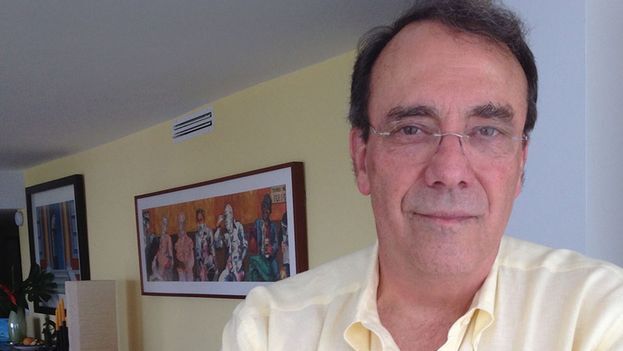
Cuban writer and journalist Carlos Alberto Montaner. (14ymedio)

14ymedio bigger

14ymedio, Carlos Alberto Montaner, Madrid, 3 July 2023 — When you read this article I will be dead. “Living is a right, not an obligation,” said Ramón Sampedro, a Spaniard who had become a quadriplegic after an accident on the beach. His life, his fight to be allowed access to assisted suicide and his death were interpreted in the cinema by Javier Bardem in the film Mar adentro.

“Don Carlos, are you going back to live in Spain?” asked an amazed neighbor from Brickell Avenue, where I was living in Miami. “No. I’m going to die in Spain,” I kindly replied, with a smile, and continued on my way. After all, I lived 40 years in Madrid, my intention was to live again in my apartment across from El Retiro park, I have Spanish nationality and I firmly believe in euthanasia and assisted death, as do, fortunately, more than 70% of Spaniards.

I started writing this article in Miami at the beginning of 2022 and I conclude it by dictating it, since I currently have great difficulties writing. At that moment, before being informed of a more severe diagnosis, I came to the conclusion that I would not allow the Parkinson’s that I had suffered for a few years to take away any more of my faculties. By then, I had already lost the ability to improvise orally, but not the ability to write. It seems that the brain houses the two faculties in different places. In any case, everything would get worse.

I started writing this article in Miami at the beginning of 2022 and I conclude it by dictating it, since I currently have great difficulties writing

In March 2021, the Spanish Congress of Deputies approved the euthanasia law by 202 votes in favor, 141 against, and 2 abstentions. It is one of the countries that has it – in the US there is assisted suicide, but only in 10 states and the District of Columbia, out of the 50 of the American Union. Belgium, the Netherlands, New Zealand, Luxembourg, Switzerland, Portugal and Canada have legislated on euthanasia and assisted dying. It is a small number. There are almost 200 nations recognized by the United Nations Organization.

On April 3, 2022, I turned 79 in Miami. It was the age at which my father died of heart disease on March 7, 1992. My mother died at the age of 83 from a “minor” operation (except for her, of course) in the year 2000. According to the admired Italian neurologist Rita Levi -Montalcini, Nobel Prize in Medicine (1986), children, roughly, should calculate their life expectancy by averaging the age at death of the two parents, but adding ten percent, as a result of medical advances. My number was 88 years. It’s too much. I think starting the eighth inning, as my friend Jorge Sonville says, is more than enough. It’s quite a provocation.

My younger brother, Robert Alex, a brilliant physician with whom I discussed the Levi-Montalcini formula, was skeptical of this hypothesis. He argued, with good reason, that those averages didn’t help much. He, my younger brother, died at the age of 69 in the midst of the Covid 19 epidemic. His death occurred on August 1, 2020. At that time, there was no vaccine. I was almost eight years older than he. But my older brother, born in October 1940, Ernesto, is still alive. Of the three, he is the most resistant to life’s adversities.

The purpose of this article is to stimulate the debate on euthanasia: my position is to support it as long as it is a voluntary choice. In the same way that organs are donated while alive, I think it would be enough to put it in writing or designate a person to make the decisions in the event that it is materially impossible to assume that responsibility. This is how, when I arrived in Madrid in October of last year, I delivered a document to the public health service establishing health care and treatment in extreme situations. Thanks to the advice from the beginning of the Right to Die with Dignity Association (DMD) I have been able, with the unconditional support of my loved ones, to overcome all the bureaucratic steps required by a protectionist law. In that way, I started the legal process that has culminated in the approval of the provision of aid to die in my case, since, in accordance with the provisions of the Law, I meet all the requirements for serious, chronic and disabling illness. Until the end of the road I count on the assistance of Social Security professionals.

The purpose of this article is to stimulate the debate on euthanasia: my position is to support it as long as it is a voluntary choice

As if that were not enough, an MRI carried out at the Gregorio Marañón Hospital concluded that I actually suffer from Progressive Supranuclear Palsy (PSP), an atypical and more aggressive Parkinson’s disease. That explains my accelerated lack of eye movement, which prevents me from reading and writing, in addition to the increasing limitations in expressing myself verbally. My daily life, in which reading, writing and oral expression have been my hallmarks, are erased from one day to the next. My body hasn’t been with me for a long time.

I have lived in a country, Spain, for 40 years, at the western end of Europe, of which it was said, unfairly, that the Spanish only understood at the crack of a whip. It was not true. Democracy and freedom are within the reach of any people who propose it. I have returned in the twilight of my life. Here I have turned 80 years old. The last of my existence thanks to the euthanasia law. Does one want a greater freedom than choosing the moment of departure?

I fulfill my wish to die in Madrid, the city that I love and in which I have shared so much with Linda, my beloved wife through good times and bad. I do so while still enjoying the ability to express my will to exercise my right to end my life in a free and dignified manner in accordance with my beliefs. I will not bother you anymore, dear reader. Adiós.

____________

COLLABORATE WITH OUR WORKThe 14ymedio team is committed to practicing serious journalism that reflects Cuba’s reality in all its depth. Thank you for joining us on this long journey. We invite you to continue supporting us by becoming a member of 14ymedio now. Together we can continue transforming journalism in Cuba.

The Other Cuba: Luxury, Good Taste and Outrageous Prices from the Hand of a Successful Italian

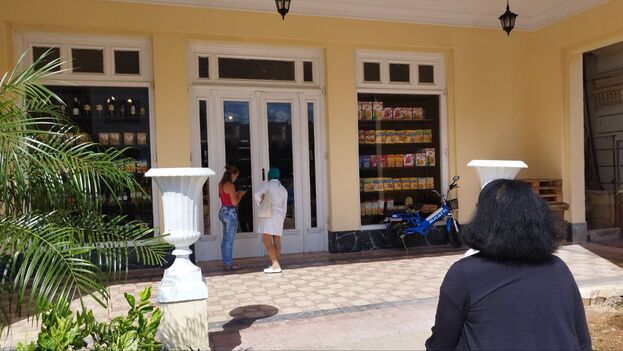
The new Home Deli store in El Vedado, Havana, is a magnet. (14ymedio)

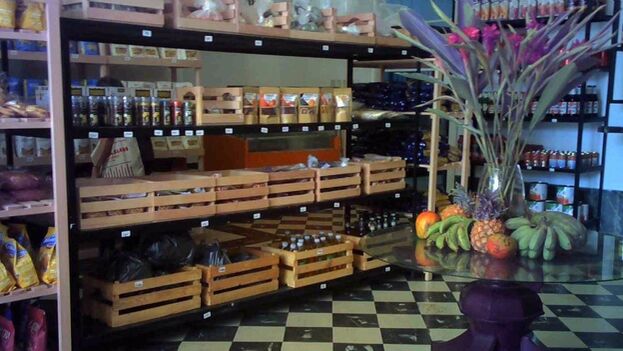
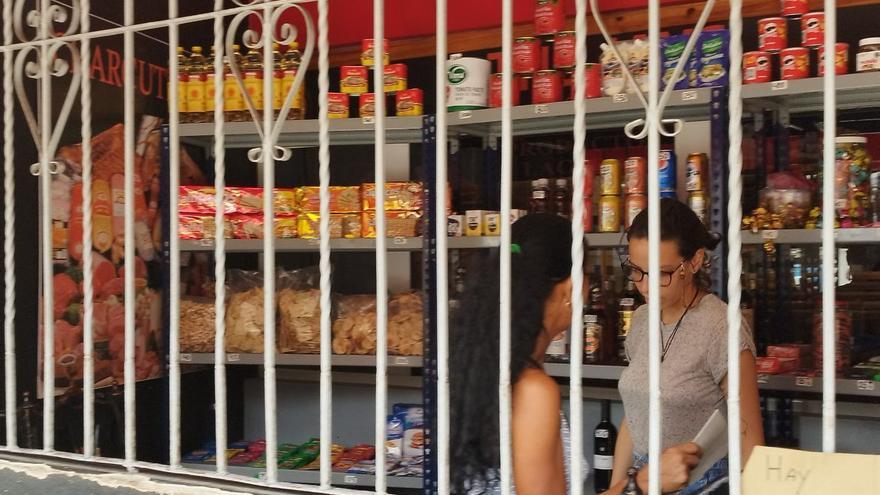
14ymedio bigger14ymedio, Juan Diego Rodríguez and Olea Gallardo, Havana, 26 June 2023 — The new Home Deli food store on Calle 12, between 21 and 23 in the heart of El Vedado, Havana, was inaugurated at the beginning of June and is not like the ones you usually see in Cuba. Clean and stocked, decorated with a certain European “rustic” style, it became a magnet days after it officially opened its doors. The emotion waned when checking the prices of the products, almost all imported.

A bag of bread, with six pieces costs 800 pesos, a small bag with washed and cut lettuce, 70 pesos, and 2,100 pesos for a small cheese. The cost of the meat was stratospheric: 20 pork skewers for 1,400 pesos, 4,500 pesos per kilogram of beef, 2,000 for chicken breast, 2,000 for ground beef, 3,000 for Italian sausage.

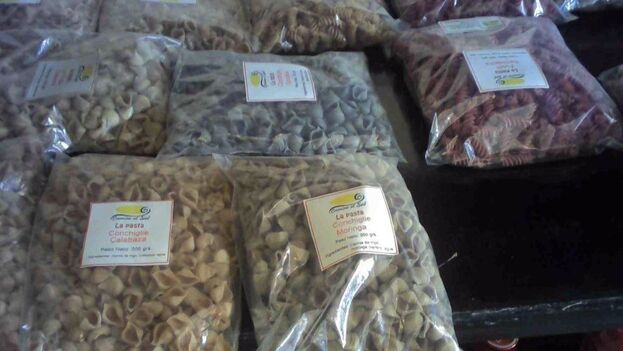
The powdered milk bag, similar to the one sold in other places, looked repackaged, unbranded, and cost 1,900 pesos for a kilogram and 950 pesos for half a kilo. As a curiosity, they had “artisan” pasta for sale, pumpkin and moringa, at 450 pesos a bag.

Home Deli looks clean, stocked, and decorated in a certain European “rustic” style. (14ymedio)

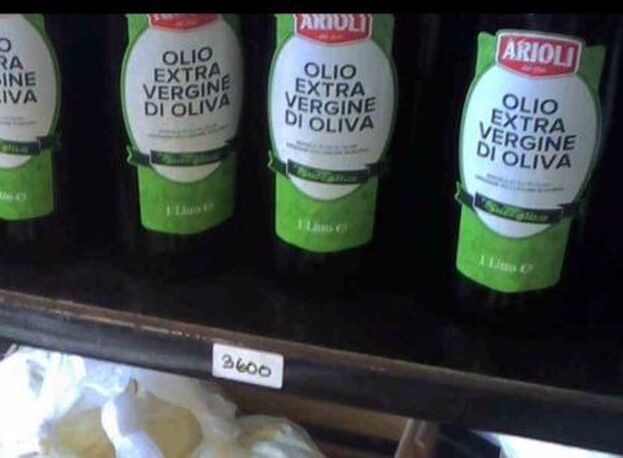
Promoted as a store specializing in Italian products, they offer Arioli oil (3,600 pesos a liter), Balocco and Mulino Bianco biscuits, De Nigris vinegar, De Cecco pasta, Lavazza coffee or Scotti rice. Also, other import labels, such as the Spanish Vima or Carbonell and the Japanese Kikkoman.

The store employees, all young and good-looking, are lavish with attention and kindness towards any possible client, although they do not stop watching the slightest movement and discourage taking photographs with a severe gesture. continue reading

Most of those who entered the store, dazzled by the variety and quality of the products, left discouraged after a tour of the shelves. “It’s very pretty and well put on, but this is the most expensive market I’ve seen so far,” said one woman as she left empty-handed.

Arioli brand olive oil is 3,600 pesos per liter. (14ymedio)

However, the law of supply and demand is implacable even in Cuba: if they set those prices, it is because someone pays them. This newspaper is aware that Home Deli has a large clientele among diplomats stationed in Cuba, in addition to emigrants who, through pages such as Katapulk or TSO, buy food for their relatives in the country in hard currency.

Those who can shop at the store are happy, despite the costs. “It’s the only place where I can get the products that a true Italian recipe requires,” says Lucía, a Cuban who lives in Milan and is on vacation in Cuba visiting her parents.

In addition, she praises her loyal clientele, “they make really tasty and unique spinach tarts in Cuba, not to mention the desserts. It’s not like other private companies, who live by reselling products.”

Homemade pumpkin and moringa pasta sold at Home Deli for 450 pesos a bag. (14ymedio)

The success of Home Deli has been amazing. Not only does it have that new store in El Vedado, but another in the municipality of Playa (19 avenue between 74 and 76) and a third in Cerro (318 Daoiz street, between Colón and Pizarro). In addition, they have a point of sale at the 3rd and 70 market. An efficient home delivery system makes it as modern a business as any in a country where the free market rules.

The company, however, does not only operate with that brand. Directed by the Cuban Diana Sainz and her husband, the Italian Andrea Gallina, as they appear on their social networks, is registered under the name of Mercadiana in the list of micro, small and medium-sized companies (MSMEs) and with the purpose of “gastronomic services”. In Italy, they have the company Gainz SRL, a name that combines the surnames of Gains the owners and that at the time is the provider of Home Deli.

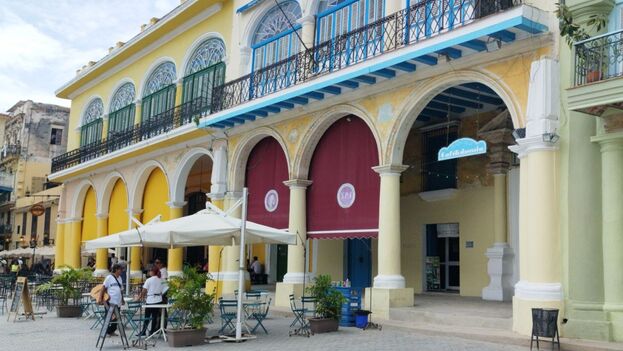
Café Bohemia, adjacent to Estancia Bohemia, is a meeting place for cultural officials. (14ymedio)

Together, they also run the Café Bohemia and the adjacent hotel, Estancia Bohemia, in Old Havana, as well as the Paseo 206 Boutique Hotel and the café on the ground floor, Ecléctico, in El Vedado. It is not uncommon to see them in one of these places, serving the clientele with exquisite treatment, as this newspaper has verified.

“The word standard does not exist for us,” Gallina declared for a report published in “OnCuba” about his establishment on Paseo 206, which they define as “a place with its own stamp, born from the combination of both cultures” and “a warm hug between Cuba and Italy”, and where luxury and good taste are evident.

The same is observed in Estancia Bohemia (San Ignacio 364), where a one-night stay costs 187 dollars, according to the reservation pages. The Café Bohemia is, moreover, a meeting place for culture officials, ostensibly from the Office of the Havana Historian, according to its own publications on networks.

Since they began to proliferate in the streets of Havana, more than a year ago, private businesses generate, in the first instance, mistrust. The fact that some of these (MSMEs) operate in state premises without any type of announcement or public tender, only increases suspicion.

Diana Sáenz, at her Café Bohemia. (14ymedio)

If we add to this the agreements between Cuba and Russia, the last of which were ratified last month at a business forum between the two countries in Havana and which show that Moscow wants to play a leading role in the imminent economic opening of the Island, doubts are difficult to dispel.

On the other hand, especially in all private and successful businesses in the country, since self-employment was allowed, they always raise questions: “They don’t let just anyone do this, what influential figure will be behind it?”

It is not uncommon to see both Diana Sáenz and Andrea Gallina serving their premises with exquisite kindness, (14ymedio)

In the case of Home Deli, its owners have never hidden themselves, on the contrary, they boast of their achievements both in their networks and in business forums and even official media. “Diana is a Cuban entrepreneur who has established important guidelines in the leisure and food sector in Cuba,” they extol in an Instagram post.

The firm has given sensible capitalist advice: “Mercadiana, a food marketing and production MSME, emphasized the need to eliminate bureaucracy when managing business procedures, as well as a review the high tax amounts that go with how prominent they are, since it could jeopardize the survival of companies”, indicated as an example Cuba en Resumen last year.

However, Diana Sainz has not said why she suddenly decided to change the surname that she inherited from her father, Ricardo Sáenz, one of the founders of the Prensa Latina agency and the Bohemia magazine.

Translated by Norma Whiting

____________

COLLABORATE WITH OUR WORKThe 14ymedio team is committed to practicing serious journalism that reflects Cuba’s reality in all its depth. Thank you for joining us on this long journey. We invite you to continue supporting us by becoming a member of 14ymedio now. Together we can continue transforming journalism in Cuba.

With 30 Percent of the Expected Cane Sown, Another Disastrous Sugar Harvest Is Coming in Cuba

View of the Agroindustrial Sugar Company [Azucuba] November 30, in Artemisa. (El Artemiseño)
14ymedio bigger14ymedio, Havana, 28 June 2023 — The sugar cane planting campaign in Cuba makes us fear the worst, again, for the next harvest. In Sancti Spíritus, only 30% of the harvest plan for the spring campaign – which runs from January to June – was fulfilled, said Aselio Sánchez Cadalso, director of Coordination and Supervision of Azcuba, the state sugar company.

In statements to the official press, the official said that work in the field was difficult due to the intense rains of recent months, mainly in March, when it is “decisive” to start planting.

Sánchez Cadalso recognizes that they can take advantage of soil moisture for seed germination, especially since 95% of the sugarcane areas of Sancti Spíritus depend on rain, not having irrigation systems. However, he insisted that due to the rainfall in June, it was impossible to make progress in the work.

He acknowledged that there are delays in “almost all areas of attention to the cane,” which is also obstructed by the lack of agricultural inputs due to the “difficult economic situation that Cuba faces,” which has hindered the import of fertilizers and herbicides. This has forced producers to look for alternatives in agro-ecological techniques, the official said.

The Sancti Spíritus sugarcane fields exceed 123,553 acres, including recovered areas that were previously covered by marabou weed. The director of Azcuba explained that in these areas today, varieties of Cuba 86/12, CP 52/43 and Barbado 80/250 seed are sown, genetically improved to have high sugar yield, adaptation to the climate and early maturity. continue reading

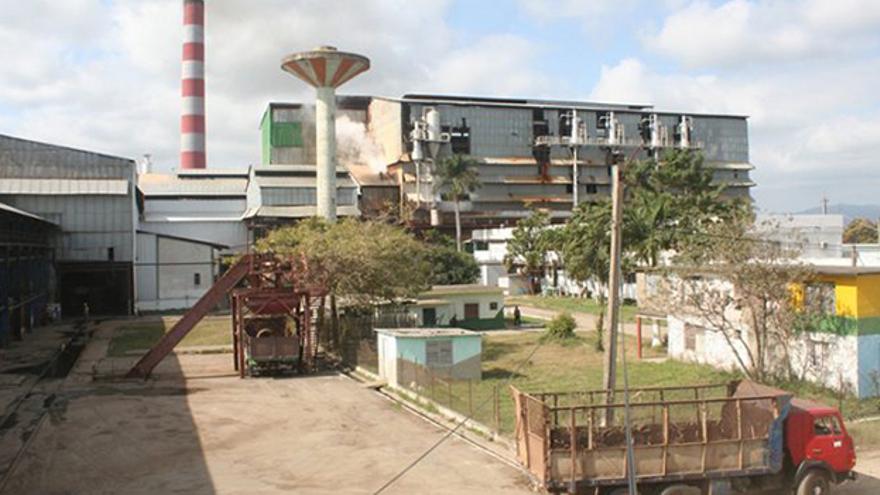
On the other hand, the production process has been disastrous in every way. In March it was reported that the Majibacoa mill, the main one in Cuba located in Las Tunas, had ground 56% of the cane planned for the harvest, and now the results from Artemisa have come to light. Pablo Valdés Amador, director of Informatics, Communications and Analysis of the November 30 Agroindustrial Sugar Company, detailed the poor results of the 121 days of the struggle: 58.4% of the planned raw material was ground, and only 44.9% of the planned sugar was produced, equivalent to 8,306 tons.

According to an article in the provincial newspaper El Artemiseño, the sugar mill started the grinding after 30 days of delay, which results in a lower yield and low use of the factories. Valdés Amador listed the string of problems they faced this year, including difficulties in harvesting and delays in the transportation of raw material to the plant due to the lack of fuel.

Wilfredo Moreno, the Azucuba director of harvest, said that the company must find a way to capture income to meet the payment obligations with the producers, since this also delays the harvests. For him, between July and August “we can’t waste time on equipment maintenance and repair,” prior to the start of the 2023-2024 season.

Although Azcuba has not yet given the final data of production for the 2022-2023 harvest, last May the Government warned that production had barely reached 350,000 tons, well below the 400,000 required for domestic consumption.

Two months earlier, Ángel Luis Ríos Riquenes, an engineer from the state sugar company, said that some sugar mills would finish the harvest in April and others in May, but warned that there was a risk that climatic conditions will affect the schedule again.

The 2022-2023 harvest started at the end of last November with a  target of 455,198 tons after the meager results of the previous agricultural year, when production closed at its lowest level of the last century, and only 68% of the planned 1.2 million tons was met.

Translated by Regina Anavy

____________

COLLABORATE WITH OUR WORKThe 14ymedio team is committed to practicing serious journalism that reflects Cuba’s reality in all its depth. Thank you for joining us on this long journey. We invite you to continue supporting us by becoming a member of 14ymedio now. Together we can continue transforming journalism in Cuba.

Cuban Officials Praise Chinese and Vietnamese-style Capitalism

Professor Díaz Fernandez noted that 19.6% of MSMEs are involved in manufacturing activities and 12% in food and beverage production, and employ 225,000 people. She did not indicate, however,  in what sectors the remaining 68% were involved.

14ymedio bigger14ymedio, Havana, June 30, 2023 — Members of Cuba’s ruling party offered an unprecedented, sudden and impassioned defense of capitalism on Friday. The statements came as part of an extensive two-person interview published in Cubadebate on the role of micro, small and medium-sized companies companies (MSMEs) in the nation’s economy.

Though they acknowledged the misgivings many Cubans have towards these new economic “players”, Ileana Díaz Fernandez and Ricardo González Águila — introduced as professors at the Center for Studies of the Cuban Economy— they were unequivocal in their defense of them.

“The process of creating MSMEs has been positive for the country,” said Díaz Fernandez, who noted that 19.6%  are involved in manufacturing activities and 12% in food and beverage production, and employ 225,000 people. She did not indicate, however,  in what sectors the remaining 68% were involved.

When asked if these companies should be considered a threat to Cuba’s socialist system, she said “expectations are” that all forms of non-governmental management combined would be responsible for no more than 13.9% of gross domestic product and that “basic means of production would not be privately owned.”

“Socialism is not at odds with a mixed economy, which is to say the existence of different forms of property,” she continued. “It is essential that, instead of marginalizing them, they are involved in the construction of socialism, that co-existence with state forms is encouraged.” continue reading

González Águila added, “Conceptually speaking, privatization is associated with the transfer of ownership of a public asset to private companies, or the outsourcing of certain services provided by the state, for example, public health. As I understand it — and I believe this to be correct — that is not what happened in Cuba, what has been happening in Cuba. We have had to gradually get over the conceptual paradigm that tells us social progress is only possible if we rely exclusively on state-owned companies. And this paradigm shift has created an opening, which I would still describe as modest, for the private sector.”

What is most critical, he believes, “is the ability of the state to lead, design and coordinate the national development where the various players, both public and private, will have to be integrated and cooperate with each other.”

In this regard, he cites China and Vietnam as “conceptual references”, two countries “with a vibrant private sector that has managed to raise the quality of life for its population rather than destroy its social system.”

As for high retail prices in the private sector, which have been the subject of widespread popular complaints, González Águila says that it is not MSMEs which are responsible for the ongoing inflationary pressures but rather another underlying cause. “As long as there is a fiscal deficit and other quasi-fiscal factors, inflation will not abate, whether there are SMEs or not,” he claims.

Díaz Fernández pointed out that only 4.6% of private companies are in the retail sector compared to 19% for state-owned companies. “When there are fewer commercial MSMEs and state companies are unproductive, demand goes up. And when there is little competition, prices rise.” she said.

Joining in the defense of private enterprise several days ago was famed Cuban musician Silvio Rodríguez. On his blog Segunda Cita (Second Date), he responded forcefully to a post by Fidel Vascós González entitled “Rethinking Socialism.” Vascós González acknowledged that, since the fall of the Soviet Union, “the process [in Cuba] has not advanced far enough nor been as linear or as fully conceived as it should have been.” He called for a home-grown, Cuban version of democratic market socialism and for abandoning “the current system of highly centralized state socialism inherited from the USSR and CAME” (the Council for Mutual Economic Assistance created in 1949, which Cuba joined in 1972).

In much clearer language, Rodríguez wrote, “After experiencing socialism as a nation and having seen how other ‘socialisms’ have worked, the first thing to be said — because it is extremely important to speak clearly at this [critical] point for the world and for our country — is that the transitional phase known as socialism has, so far, not created a means of production that is superior to capitalism.”

“All forms of socialism that have survived and are prospering have capitalist economies,” Rodriguez pointed out. “I believe one of the biggest, if not the biggest, problems that we have is that we are trying to lead society as though we were leading a communist party meeting.”

“We are in the most difficult phase of the so-called revolutionary period, when there has been a loss of faith and confidence as never before,” Rodríguez added. “And, unfortunately, the level of communication has not been as high the situation requires… Trying to build on the basis of what’s been done before without a very clear and sincere discussion will, I believe, yield a result contrary to what is needed. [It requires] a frankness and clarity as unobjectionable as life itself. This is the only way to begin to change reality: by looking at it, treating it and discussing it as it is, not as we would like it to be.”

____________

COLLABORATE WITH OUR WORKThe 14ymedio team is committed to practicing serious journalism that reflects Cuba’s reality in all its depth. Thank you for joining us on this long journey. We invite you to continue supporting us by becoming a member of 14ymedio now. Together we can continue transforming journalism in Cuba.

Diaz-Canel Resumes His Visits to the ‘Potemkin Villages’ To Learn About Cuba’s Successes

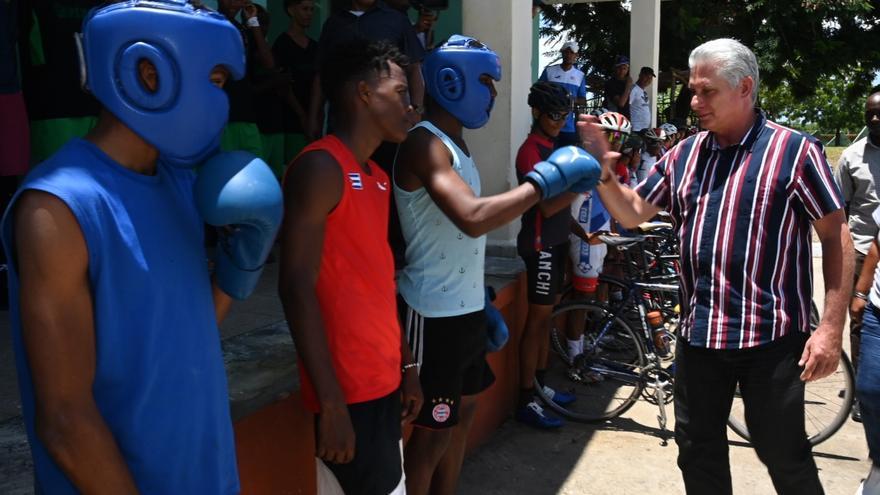
Díaz-Canel visited a successful farmer and the Rafael Freyre School Sports Initiation School. (Cubadebate)

14ymedio bigger14ymedio, Havana, 30 June 2023 — Early this Thursday, Cubadebate announced the visit of Miguel Díaz-Canel to Guantánamo, one of the most forgotten provinces on the Island but one that has recently been on the tips of everyone’s tongues. First for the resounding protests against the Government — followed by the corresponding arrests — last May, in the municipality of Caimanera. In recent days, a UN report has urged the United States to close its prison on the naval base, where prisoners continue to suffer “cruel, inhuman and degrading treatment,” something that the regime has not wasted in order to reclaim that territory.

“They are going to take Díaz-Canel where things are a little better, because we don’t have anything,” said a commentator on the news. It wasn’t hard to predict. The president visited a successful farmer and then the Rafael Freire School of School-Sports Initiation, which the official press describes – accepting its slow construction – as a place “with teaching buildings, dormitories, sports facilities and other essential infrastructures for its operation in perfect condition, beautiful and very well maintained.”

The space had everything, including a little house for the children of workers and athletes, although its capacity is not anything to rave about, since of the 20 places available, only six children have been able to be accommodated. “At the time of the President’s visit, they were taking a nap, so they walked into the cozy space almost on tiptoe and spoke very quietly,” explains Cubadebate.

From there, Díaz-Canel went to the Manuel Simón Tames Guerra Polytechnic Agricultural Institute, built thanks to international collaboration (the Swiss Agency for Development and Cooperation and the United Nations Development Program). There, the president also had time to speak about the importance of these schools, “inspired by Marti’s teaching and Fidel’s idea of combining study and work.”

He also spoke with Jorge Fernández, the farmer at his first stop in Lajas de El Salvador. At 32 years of age, the young man abandoned his dentistry career and “turned to the land,” where he now manages 445 acres under cultivation. Cubadebate praises the attitude of the producer, who had already met with Díaz-Canel on a previous visit to ask for more land, “certain that he could use it to support the demand for food in his municipality and the provincial capital and also contribute to lowering prices.” continue reading

It is left to the reader’s imagination to know why he left a prestigious university career in the second year, but it does explain how he obtained 297 acres of bananas and fulfilled his commitments, being able to incorporate his production into the ’family basket’ [in the rationing system] of the inhabitants of El Salvador for three months. Soon he will plant this fruit again – with seeds from Villa Clara – and plans to grow corn, soy and sweet potato. The leader asked him if the intermediaries paid him on time, if he had supplies and if he adequately remunerated his workers.

“You are still young and it is very important to continue learning,” Díaz-Canel urged the producer, who “promised him that he would think about it, but ’after I manage the farm, which is large and needs a lot of time and effort.’” And with this dialogue the president left, happy to have found a farmer who is doing well and who can serve as an example for him “to encourage others.”

The result of the visit went as planned. Also, hours before, another reader described what was going to happen without missing a beat: “It’s a shame that these visits are ’guided’ because visitors  don’t see the reality of ordinary Cubans. If visitors want to meet a farmer, they are taken to the best one who has all the resources to produce, who does not complain about anything.  Many times these farmers are even reinforced with inputs, like cattle from other properties, so that visitors see what the leaders want them to see. If they go to a community, they take them to the improved, painted one. If they go to a market, they supply it one or two days before and do not sell the products until the day of the visit. So there are plenty of examples to show that this type of visit is not a faithful indicator of the reality at the base, because our problems are the same as always and are increasing.”

The Prime Minister, Manuel Marrero, had a more cumbersome role on the Guantánamo tour. He visited the town of Cayamo, in the rebellious Caimanera, which suffers from drought, shortages and a housing supply with 40% of the homes in regular or bad condition. He also met a group of citizens who expressed their concerns and problems.

Marrero endured the barrage as if it were not his fault and asked that they look for help and “different solutions. The Government’s policies for that are approved,” he said. In addition, he asked the citizens for patience: “It will not be from one day to the next, but surely you have seen that agreements have been made with other countries that will give us new opportunities.”

From there, and after promising new homes thanks to the community’s brick-producing company – which allocates 24,000 units a month to subsidized construction – he went to the Frank País salt plant, where the workers told him about the problems of distributing the product. In the company there are 3,000 tons stopped due to lack of transport, and 700 more waiting to be  delivered.

According to the director, Darlyn Elisástegui Columbié, the poor state of the railroad has complicated the situation, but there are already several containers on their way to the provinces “most affected” by the lack of distribution.

“I am worried about the abandonment of the company. No dry salt is produced, and there is a lack of quality in the manual packaging process,” Marrero said after seeing the workers who deal with this phase. But at the end of his visit, the recipe was the same as always: “The blockade is going to continue, let’s unblock ourselves, let’s open ourselves. Let’s not look for so many explanations for the problems and find more solutions,” he exhorted.

It was another one of the readers’ prophecies fulfilled. “So far I don’t see that the advisory and directed government visits have yielded any results. It’s the same thing over and over again, and things are getting worse every day.”

Translated by Regina Anavy

____________

COLLABORATE WITH OUR WORKThe 14ymedio team is committed to practicing serious journalism that reflects Cuba’s reality in all its depth. Thank you for joining us on this long journey. We invite you to continue supporting us by becoming a member of 14ymedio now. Together we can continue transforming journalism in Cuba.

General Lopez Miera Arrived in Belarus To Negotiate Military Cooperation With Cuba

Jrenin and López Miera exchanged views on the global security situation, as well as the military and political situation in Europe. (Reformation)

14ymedio biggerEFE/14ymedio, Minsk (Belarus), 30 June 2023 — The Minister of Defense of Belarus, Víktor Jrenin, and Álvaro López Miera, head of the Cuban Armed Forces, met today in Minsk and studied ways to develop military cooperation between the two countries, according to a press release from the Belarusian side.

At the meeting, the ministers “addressed in detail the current state of bilateral military cooperation and ways to continue developing it,” the article adds. In addition, Jrenin and López Miera exchanged views on the global security situation, as well as the military and political situation in Europe.

“At the end of the talks, the ministers reiterated their mutual interest in intensifying military contacts,” the article concluded.

López Miera arrived in Minsk from Russia, where he was on Tuesday with the aim of discussing the realization of “a series of joint projects in the technical-military field.” The Cuban was the first senior foreign official to visit Moscow after the uprising of the Wagner mercenary group against Vladimir Putin.

The Russian head of Defense, Sergey Shoigu, was the official who received López Miera at the headquarters of his ministry. According to the Russian news agency Sputnik, Shoigu proposed to his counterpart “to address in detail all existing and promising cooperation projects in the military field.” The minister assured that there was “a wide variety of issues” in which Russia could support Cuba, including “technical” aid to the Island’s Army. continue reading

He praised Cuba as “an important partner” that demonstrated “a complete understanding of the reasons” that led Putin to invade Ukraine, although he did not allude to the cautious silence maintained by the Havana regime during the tension with Wagner’s troops. The bilateral dialogue, Shoiguu summarized, is in the best of states, and they “are taking measures” to “protect their cooperation” against international sanctions.

“Russia is willing to provide assistance to Cuba,” the soldier promised López Miera, although both Sputnik and other media that reported on the visit avoided defining the exact content of that “strategic” aid.

On June 13, Putin decorated López Miera with the Order of Friendship, for his “important contribution” to the “strengthening of military and technical-military cooperation between the two countries,” Prensa Latina reported.

Born in 1943 and Minister of the Armed Forces since 2021, López Miera was part of Cuba’s military interventions in Angola and Ethiopia. He is one of the senior Cuban officials sanctioned by the U.S. Government “for his involvement in human rights violations.”

Translated by Regina Anavy

____________

COLLABORATE WITH OUR WORKThe 14ymedio team is committed to practicing serious journalism that reflects Cuba’s reality in all its depth. Thank you for joining us on this long journey. We invite you to continue supporting us by becoming a member of 14ymedio now. Together we can continue transforming journalism in Cuba.