
High Prices, Breakdowns and Discontent, the Keynote of the New Jalisco Park in Havana

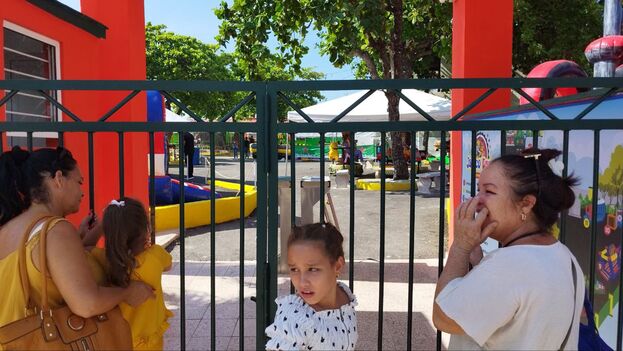
This Monday, Jalisco Park did not open at its scheduled time, nine in the morning, but more than an hour and a half later. (14ymedio)

14ymedio bigger14ymedio, Juan Diego Rodríguez, Havana, 31 July 2023 — “There’s nothing private about this.” Distrust of the new Jalisco Park in Havana, 48 hours after it was reopened under new management, is widespread. Not surprisingly, the reopening has been marked by discontent and setbacks. The most recent one happened this Monday, when the establishment did not open at its scheduled time, nine in the morning, but more than an hour and a half later.

“There was a voltage problem and the electricians are solving it,” a woman identified as the head explained to the various families who had been waiting impatiently at the gate since early morning. “If we can’t solve it, at 10:30 we open with what we have so that the children don’t continue to despair,” she reassured those present.

Shortly after the clock struck that time, and before opening, a worker asked the families if someone could lend him some tools “to adjust some devices that make a lot of noise.” A father who had come by car with his children agreed and passed them through the gate, before the astonished gaze of the people.

A worker asked the families if someone could lend him some tools “to adjust some devices that make a lot of noise.” (14ymedio)

Several electrical devices were damaged, although they did not specify if it was the result of a blackout, a bad installation or an overload. From outside, in fact, an employee was observed adjusting “El Toro Mecánico” [The Mechanical Bull], one of the most expensive attractions in the place, at 50 pesos a ride.

It is precisely the prices that have been one of the constant complaints from the public since the reopening of the establishment, located at the corner of 23rd and 18th in El Vedado, was announced, initially for July 26, although it was finally postponed, without explanations, until Saturday.

At first, many users complained about the requirement to pay for a ticket to enter the park (50 pesos for both children and adults), and then to pay again for each ride on the attractions (between 30 and 50 pesos). Thus, a few hours before the Jalisco Park reopened, it was reported that admission would be free for children. continue reading
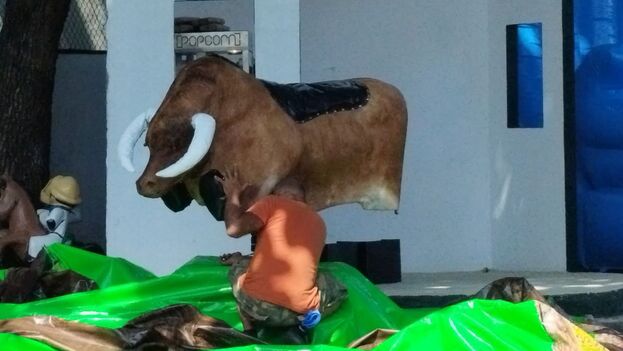
From outside, in fact, an employee was observed adjusting El Toro Mecánico, one of the most expensive attractions in the place, at 50 pesos a trip. (14ymedio)

But what has really ignited the annoyance of the attendees is the cost of the food. The hors d’oeuvres range from 450 to 600 pesos, and the pastas, from 500 (Neapolitan spaghetti) to 750 pesos (carbonara). The cheapest thing on the menu was a bun with ham and cheese (220 pesos), a chicharrón al viento [fried pork skins] (250 pesos) and a scoop of ice cream, in a bowl or in a cone, for 280 pesos. A bag of chips could reach 380 pesos and one of cookies, 120.

All the foods have names related to Cuban television cartoons – “I have a banana truck” (peasant plantains, referring to the children’s song), “You lie, filthy rat” (spaghetti with vegetables, taken from the cartoon series The brave ones), “The plague, the plague, the last plague” (garlic spaghetti, from the cry of the evil mouse from Captain Plin) or “Fumiga, Paquito, Fumiga” (pork hamburger, from one of the sayings of Chuncha), supposedly funny.

This detail was not funny at all, however, judging by the faces of the very few customers in the food service area. “What kind of a joke is it, if these prices are so disrespectful,” lamented a mother who, together with her husband and her son, could only buy one scoop of ice cream.
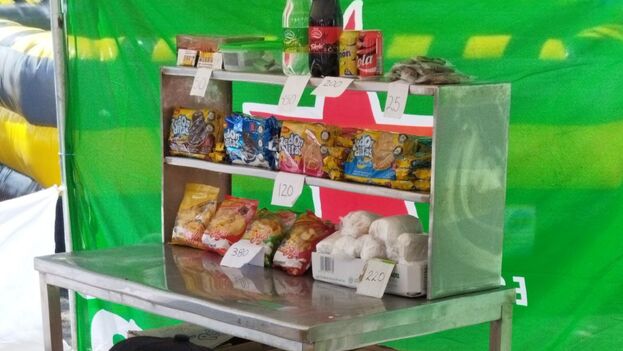
A bag of chips could reach 380 pesos and one of cookies, 120. (14ymedio)

Another repeated complaint was the slowness with which everything works when, in other private companies, what stands out the most is the efficiency of management. This ineffectiveness was evident in the large lines, both to enter and to buy the little tokens necessary to enjoy the park’s offerings (green for a package of corn flakes, blue for inflatables and red for the most expensive attractions, the electrical). “This just like standing in line for chicken or the ATM,” quipped a young woman who was leading her daughter by the hand.

The number of employees was also striking. The security men, grumpy, and wearing black sweaters; the rest, with other types of uniforms, with more colors and with the name of the cartoon character Elpidio Valdés – a predominant presence in the new Jalisco Park – but equally reluctant. This is another difference with respect to private businesses that are usually seen in the capital.
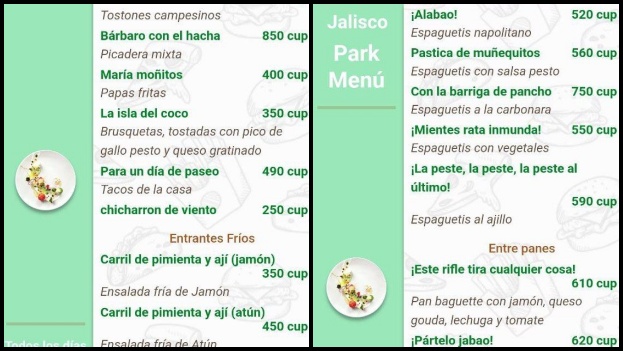
All the foods have names related to Cuban television cartoons, supposedly funny. (14ymedio)

In any case, there will be very few families who can afford to spend the day in the place. Adding transportation, adult tickets, three or four attractions, food and drinks, the bill easily reaches between 3,000 and 4,000 pesos, the average monthly salary of a state worker.

The recreational complex is managed, according to the official press, by the Beijing non-agricultural cooperative “in the form of lease.” Clients are reluctant to believe that it is a private institution. Thus, a young man from Central Havana who came with his nephews and who asserted: “They may say that it is a cooperative, this and that, but what it seems is another state invention to extort the people.”

____________

COLLABORATE WITH OUR WORKThe 14ymedio team is committed to practicing serious journalism that reflects Cuba’s reality in all its depth. Thank you for joining us on this long journey. We invite you to continue supporting us by becoming a member of 14ymedio now. Together we can continue transforming journalism in Cuba.
‘I Am a Peaceful Disobedient Willing to Pay the Consequences’

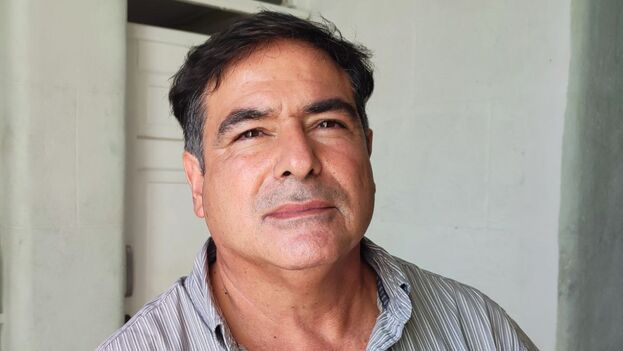
Fernando Vázquez honed his skills as a communicator in the days he hosted shows for tourists at the Hemingway Marina, an occupation he took up after working in Argentina. (14ymedio)

14ymedio bigger14ymedio, Reinaldo Escobar, Miami, 31 July 2023 — Dr. Fernando Vázquez is not recognized in Cuba for his skill as a doctor but for his courage as an activist for the cause in support of political prisoners. In the middle of this hot summer and harassed by the political police, he opens his doors to 14ymedio to talk about his peculiar life path that goes from Public Health to tourism to finally leads to civic action.

Even today it is possible that his neighbors omit the information that Vázquez is a doctor and limit themselves to saying that he works as a gardener in the building where he lives in El Vedado or that he sometimes sells avocados. They will hide his profession because Cubans who have a medical degree are prohibited from working in activities related to tourism and he asked them for discretion on that issue when he aspired to be a tourist entertainer when, in 200 he canceled his employment ties with the Ministry of Public Health.

His experience as a doctor began in 1990 when he was sent on an “internationalist mission” in Livingstone, Zambia.

“When we landed at the Lusaka airport, I was moved to see that officials from the Cuban embassy were waiting for us just at the bottom of the steps of the plane. I thought they were to welcome us, but no. They were only there to take our passports because the regulations prohibited us leaving the city to which we would be assigned.” continue reading

As an activist for the release of political prisoners, Vázquez carried out his first public action on June 14 of this year when, after announcing it on his Facebook wall, he attempted a peaceful march from Lennon Park, on 17th Street, between 6th and 8th, in the Plaza de la Revolución municipality, to the offices of the prisons department of the Ministry of the Interior, in the same neighborhood of El Vedado.

“Although I did not call out to anyone, the State Security agents who detained and interrogated me warned me that I could be prosecuted for the crime of incitement to commit a crime. The document that I wanted to hand over was not only brief but mild, almost sweet, where it implored them, begged them, those who are holding the July 11 protesters in prison to release them as soon as possible.”

In his frequent speeches on Facebook, Vázquez insists that all his activities are motivated by strictly personal motivation. “I don’t belong to any political organization,” he repeats every time. On his broadcasts he conducts himself with ease, he never seems irritated and, unusually, pronounces every letter in every word.

His skills as a communicator were honed in the days when he hosted shows for tourists at the Hemingway Marina, an occupation he took up after working in Argentina.

“I left for Argentina in 1995 as a tourist, after the polyclinic where I worked gave me a permit for a month. There I managed to get hired as a consultant in a clinic, but at that time, according to Cuban immigration laws, I could not be out of the country for more than eleven months. When I returned for the first time, with the intention of not losing my rights as a Cuban, I learned that in order to leave again I needed another permit signed by the minister. That is how I stopped having a working tie with the Ministry of Public Health. Why didn’t I stay to live there? Because I wanted to be with my mother in her last years of life and because my heart is still here, especially in las Minas de Matahambre, where I lived as a child.”

Vázquez doesn’t just talk in front of a camera. Since he defended the freedom of political prisoners, he has visited the relatives of many of them. He has knocked on almost all the doors in the La Güinera neighborhood where a protester was murdered by a police officer, he traveled to Santiago de Cuba to get to know José Daniel Ferrer‘s family up close in the Altamira neighborhood, and he has given a voice to mothers and wives of several political prisoners. On Monday, July 24, he sat on the Malecón in Havana and prayed for freedom. State Security warned him that if he does it again he will be prosecuted for disobedience.

Many of his numerous followers highlight the quixotic nature of his actions, but if Alonso Quijano went mad from an overdose of reading novels of chivalry, Dr. Vázquez sustains his behavior in other readings that have nourished his lucidity. There, all the works of José Martí and the Sermon on Mounts of Jesus of Nazareth have a special place, but also Gandhi, Emerson, John Ruskin, Tolstoy and Henry David Thoreau, who taught him the concept of civil disobedience.

“If I had to define myself in a few words, I would say that I am a peaceful disobedient willing to pay the consequences for fighting against injustice.”

____________

COLLABORATE WITH OUR WORKThe 14ymedio team is committed to practicing serious journalism that reflects Cuba’s reality in all its depth. Thank you for joining us on this long journey. We invite you to continue supporting us by becoming a member of 14ymedio now. Together we can continue transforming journalism in Cuba.

Four Cuban Baseball Players Leave the Island in Just one Weekend

Yulian Quintana, sanctioned in July 2022 to two years without being able to play on the Island for “an unproven exit attempt.” (Capture)

14ymedio bigger14ymedio, Madrid, 31 July 2023 — Four baseball players left Cuba in the last weekend, among them Yulian Quintana, sanctioned in July 2022 to two years without being able to play on the Island for “an unproven attempt to leave the hotel where they were staying in Aguascalientes (Mexico) during the Under-23 World Cup qualification,” according to the journalist Francys Romero reporting at the time.

Quintana, who stood out in that tournament for his speed, is in the Dominican Republic, Romero reported on Saturday, where “he will seek to impact the international market and sign with a Major League organization.”

The journalist, resident in the US and specialized in the flight of athletes, described the athlete as a “pitcher with potential and physique who wore the Huracanes de Mayabeque uniform for three seasons in the National Series. He exceeds 90 miles an hour and has an arsenal with great breaking pitches.”

This Sunday, Romero reported the departure of three more players. The first of them was Marlon Vega, a prospect pitcher who is currently in Mexico but with the goal of signing with the Major Leagues as a free agent.

Until that time arrives, the athlete will pitch as a guest in the Meridian Baseball League, which begins in August in Mexico. His successful career includes milestones such as being the MVP (Most Valuable Player) in the last 2022 National Series, rookie of the year in 2021 and presence in the Cuban team in the main international championships. continue reading

“With almost total security, Vega will sign as soon as he finishes his first appearances in Mexico and as soon as he is a free agent. He is a pitcher of abundant quality, resources, speed and repertoire. He knows how to throw on the mound and his pitches have extreme mobility,” said Francys Romero.

Along with him, 16-year-old pitcher Daivel Álvarez de la Torre also left the island.

A few hours later, the departure of prospect pitcher Roger Bolaños, bound for the Dominican Republic, also became known. The 20-year-old athlete who, according to Romero, was already one of the best players in his position in 2020, is the brother of Ronald Bolaños, who has been in the Major Leagues for four seasons and plays with the Miami Marlins in Triple-A.

Romero recalled, when reporting on Bolaños’ departure this Sunday, the words he wrote about him three years ago, when he included him fourth in the list of the 25 best prospects in Cuba under 18. “He surpassed the 90-mile barrier in the last Youth Championship, although he needs work in command and secondary pitching. Roger was Mayabeque’s closer with a 0.61 ERA, 4 saves and an opponent average of .178. The most surprising thing about everything is that: he still has a year left as a youth.”

Of the 25 on that list drawn up in 2020, there are already 13 who have left Cuba, notes Romero, of whom five have already signed contracts, a figure that certifies the deep crisis of Cuban baseball, not only present, but future.

____________

COLLABORATE WITH OUR WORKThe 14ymedio team is committed to practicing serious journalism that reflects Cuba’s reality in all its depth. Thank you for joining us on this long journey. We invite you to continue supporting us by becoming a member of 14ymedio now. Together we can continue transforming journalism in Cuba.
The Vladimiro Roca I Knew

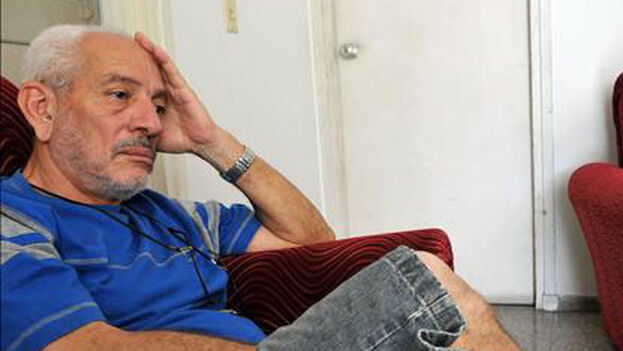
Vladimiro Roca was a MIG pilot who filled us with admiration with his stunts in the skies of Cuba. (EFE)

14ymedio bigger14ymedio, Reinaldo Escobar, Havana, 30 July 2023 — I met Vladimiro Roca in mid-1963. At that time I was a student-soldier at the San Julián Base located in the westernmost part of Pinar del Río. Vladimiro was a MIG pilot who filled us with admiration with his stunts in the skies of Cuba. Then he was just “the son of Blas Roca” who shared his status with Carlos Jesús Menéndez, another pilot who was the son of the Jesús Menéndez, a union leader and politician in the sugar sector.

I heard from Vladimiro again in 1996 when they were trying to hold the Cuban Council to bring the opposition ranks to an agreement. A year later, together with Martha Beatriz Roque, René Gómez Manzano and Félix Bonne, he signed a document known as La Patria es de Todos [The Homeland Belongs to Everyone] that cost him five years in a maximum security prison. Until that moment I had never spoken to him.

In 2003, when I was working as Editor-in-Chief of the digital magazine Consenso, I interviewed him at his home. It was only from that moment on that I was able to discover his human quality, his knowledge of the national reality and his genuine willingness to work for the future of this country.

Later we ended up coinciding in different events in Cuba and abroad, where I was able to realize his strong character and his predisposition to defend his beliefs in a courageous and sometimes defiant way.

Vladimiro has been afflicted by the consequences of what he has experienced in 80 years of life. The penultimate news I had of him was his admission to a hospital with a pessimistic prognosis. Since then I kept hoping that he would manage to improve his state of health but I know that since then he was ready to say goodbye.

Neither he nor I believe very much in the legend that people go to heaven, but I see him there, having fun while doing daring pirouettes in the sky.

____________

COLLABORATE WITH OUR WORKThe 14ymedio team is committed to practicing serious journalism that reflects Cuba’s reality in all its depth. Thank you for joining us on this long journey. We invite you to continue supporting us by becoming a member of 14ymedio now. Together we can continue transforming journalism in Cuba.
Vladimiro Roca, Doyen of the Cuban Opposition, Dies at 80

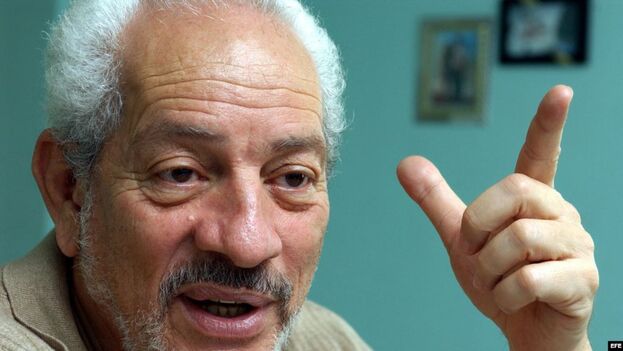
Vladimiro was the son of Blas Roca, an important leader of the Cuban Popular Socialist Party. (EFE)

14ymedio bigger14ymedio, Havana, 30 July 2023 — The Cuban opponent Vladimiro Roca Antúnez has died this Sunday afternoon in Havana at the age of 80. Doyen of dissidence on the Island, the economist and Social Democratic politician had been suffering from diabetes and Alzheimer’s for some time, according to sources close to the family.

Born in Havana on December 21, 1942, Vladimiro was the son of Blas Roca, an important leader of the Popular Socialist Party, and graduated with a degree in International Economic Relations in 1987. Since the approval of the 1976 Constitution, the young man disagreed because the text imposed “socialism by force.”

“He was always a man of the left,” opposition member Martha Beatriz Roque recalled to  14ymedio . “He was an economist and he realized the big mistakes that the dictatorship had made and he reacted as such,” she emphasizes. “This reaction cost him five years in prison when, together with Félix Bonne, Rene Gomez Manzano and yours truly, we signed the document La Patria es de todos. [The Homeland Belongs to Everyone]”

In 1996, Roca was one of the founders of the Social Democratic Party of Cuba and a year later he created the Internal Dissidence Working Group to analyze the situation of the Cuban economy. After the publication La patria es de todos, Vladimiro and his companions were arrested and tried for “actions against the national security of the Cuban State” and “sedition.”

He was released from prison in 2002, months before the repressive turn of the screw known as the Black Spring of 2003. In 2010 he managed to travel to Banes, Holguín, to participate in the burial of opponent Orlando Zapata Tamayo, who died after 86 days on hunger strike. continue reading

In his last years he had maintained his denunciation of the lack of civil rights in Cuba. “Everyone respected him because they knew that this dictatorship was useless. He was sure that the solution for the people of Cuba did not come through this regime,” says Roque.

There will be no wake and his body will be cremated, family sources confirmed to this newspaper.

____________

COLLABORATE WITH OUR WORKThe 14ymedio team is committed to practicing serious journalism that reflects Cuba’s reality in all its depth. Thank you for joining us on this long journey. We invite you to continue supporting us by becoming a member of 14ymedio now. Together we can continue transforming journalism in Cuba.

Cuban Playwright Carlos Celdran’s Play About an ‘Intimate, Hidden and Transgressive’ Jose Marti Arrives in Miami

Scene from the play ’Hierro’ [Iron], by Carlos Celdrán, with actors Caleb Casas and Rachel Pastor. (EFE/Arca Images)
14ymedio biggerEFE (via 14ymedio), Ana Mengotti, Miami, 27 July 2023 – The Cuban playwright Carlos Celdrán, 2016 National Prizewinner for Theatre in his own country and currently resident in Spain, presents his play Hierro in Miami – a work centred on the Cuban war of independence hero José Martí (1853-1895), different from his “edited” biography but not demythologised.

“I’m not attempting to dismantle or criticise Martí, I love Martí. Hierro comes from a love for and identification with him; what I’m trying to do is present his human contradictions in order to understand him better”, Celdrán tells EFE, in the Miami Dade County Auditorium where the play, produced by Arca Images, has its U.S premiere next Thursday.

Hierro, is the title of a poem by Martí, Cuba’s “apostle and martyr”. Martí was a poet and essayist and the play centres on Martí’s private life, which has “not been seen on the stage nor is it discussed in school” – the life of a “great” but “ordinary” man who argues with his wife and even faces up to a possible affair.

Everything that takes place in the play happened in the United States, where Martí lived in exile, apart from interspersed scenes of journeys to other countries – from the beginning of the 1880’s until his return to Cuba in 1895, the year he was killed in combat, fighting against the Spanish military.

Celdrán first premiered this play in Havana in 2020 but performances were interrupted by the Covid pandemic. When Arca Images suggested he take it to Miami he didn’t think twice. continue reading

In the cast, headed by Caleb Casas, Daniel Romero, Claudia Valdés and Rachel Pastor, there are a number of actors from the original Cuban production.

Asked by EFE whether he thought that the Cubans in Miami and those on the island felt the same about Martí he said that the hero continues to be a unifying force. “I think that Marti’s ideology touches all Cubans wherever they are and whatever ideology they have”, he said, and remembers that Martí proposed a republic in which all Cubans would have a place, wherever they were and whatever politics they had.

In Hierro we shall see an “unedited and hidden” Martí, as previously his official biography has been “laundered and edited”, he says.

Though Hierro is performed in Spanish, English speaking audiences will also be able to enjoy the play, through simultaneous translation via wireless headphones.

This is not the first time that Celdrán (who founded Argos Teatro in Cuba in 1996 and has produced his own plays as well as those by Brecht, Beckett, Ibsen, Strindberg and other classical playwrights) has presented work in Miami.

His award winning play Diez millones [Ten Million] was also performed in this city, as well as in other U.S cities, whilst the playwright still lived in Cuba.

Now he is based in Madrid, where he has already presented another of his works, Discurso de agradecimiento [Expression of Gratitude], and is trying to make his mark in a city which, he says, is these days an “international theatre capital”.

The grandson of Spanish grandparents and a Spanish national, Celdrán is trying “not to move away” from his hallmark theatrical style. “What I try to do is work from the human perspective, but there is always a political and social backdrop”, he says.

He is working on a text that may possibly be performed next year in Miami and Spain – a country in which there are, he says, “a lot of stereotypical views” about Cuba, as well as extreme views about the revolution and the daily life of Cubans.

“Spanish people always have either a utopian view of Cuba or a critical one”, says Celdrán, who says that what interests him is that there is “empathy from the audience towards the characters”.

Stereotypes, says the playwright – “the first one would be the island of love, of good sex – they have prejudiced us a lot”.

I show the soul of the Cuban people, I fight against that obvious stereotype and sometimes people are surprised because they expect Cuba to be comical, to be lightweight, to be friendly”, he stresses.

Speaking of recent times in his country, he says that “it’s not easy making theatre in Cuba”, and not only because of the lack of economic resources.

“You’re always in a complicated dialogue with what’s censurable, with the limits of what you can say. And you evade it, you get over it, you go a little further in order to make theatre where you can escape from that confrontation”, he concludes.

Translated by Ricardo Recluso

____________

COLLABORATE WITH OUR WORKThe 14ymedio team is committed to practicing serious journalism that reflects Cuba’s reality in all its depth. Thank you for joining us on this long journey. We invite you to continue supporting us by becoming a member of 14ymedio now. Together we can continue transforming journalism in Cuba.
An Immense Line Outside Jalisco Park Marks its Reopening Day in Havana

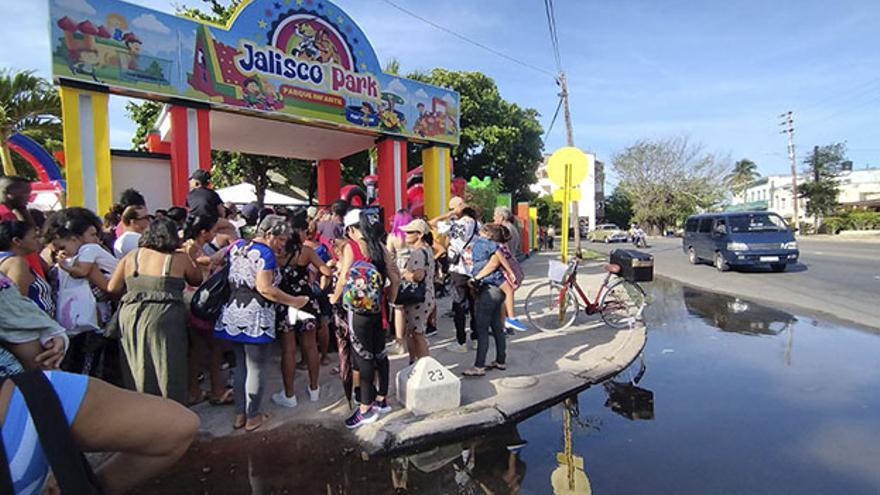
Jalisco Park, at the corner of 23 and 18 in El Vedado, reopened this Saturday with dozens of families trying to enter. (14ymedio)

14ymedio bigger 14ymedio, Juan Diego Rodríguez, Havana, July 29, 2023 — “We are going to spend hours here to get in,” grumbled a grandmother with two grandchildren who, before nine in the morning this Saturday, was in the long line to enter the Jalisco Park, in Havana’s El Vedado district.

Finally, the recreational center – which went from state to private management – ​​opened its doors after months of repairs and after its planned reopening, scheduled for July 26, was frustrated.<

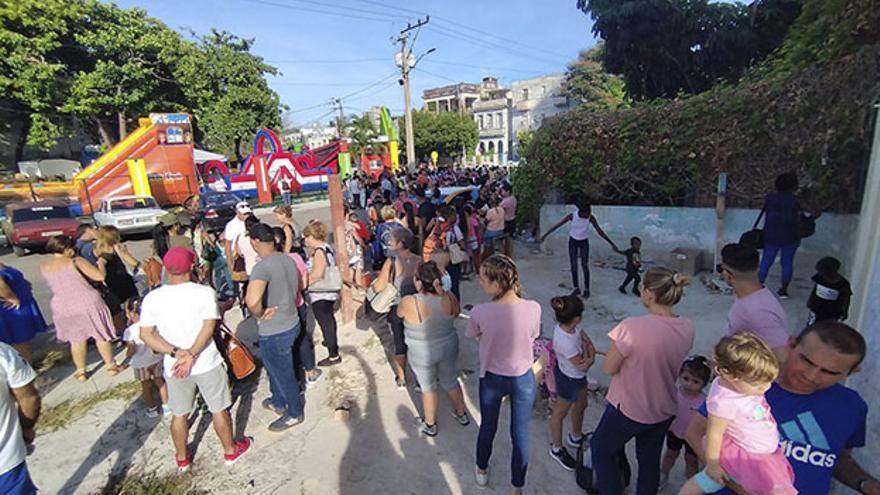
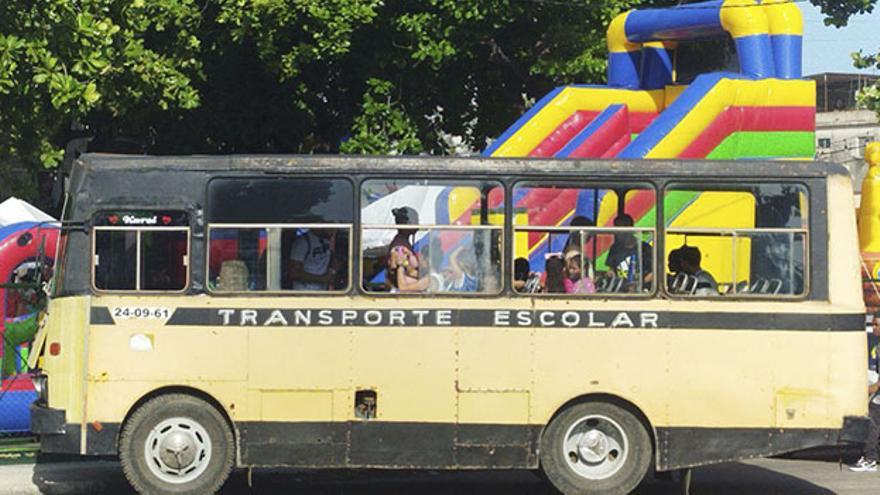
Entire families, parents with children and large groups swelled the line that far exceeded the number of people that could fit in the premises, located at the corner of 23rd and 18th streets. “We got in line at seven and that is why we are among the first but now a school bus arrived with a lot of kids. There are more people here than in line at the Plaza de Carlos III market,” a father with seven-year-old twins told 14ymedio .

A huge puddle of sewage covered part of the street around the corner and was the focus of parental warnings. “Dayron, be careful, don’t step foot in there, that water is filthy!” a mother yelled at a restless child who was jumping from the sidewalk trying to reach the area of ​​asphalt that was dry. A mask ended up floating in the puddle a few minutes later.

The crying of several children, tired by the wait and the heat that was already beginning, was part of the soundtrack around Jalisco. On the other side of the fence that surrounds the park, the new inflatable attractions were ready early and a group of employees, all dressed completely in black, organized the last details before the first group of customers entered. continue reading

“I hope the power doesn’t go out because those devices need to have the air compressor turned on for them to work, if the power goes out everything is messed up,” feared a grandfather who was accompanying his granddaughter. “Shee hasn’t been able to go anywhere so far on vacation because everything is too far or too expensive, this is the first outing we’ve done since school ended,” he explained to this newspaper.

Admission to the park for adults costs 50 pesos per person, while children are free. (14ymedio)

After 9:05 am, the doors of Jalisco Park had not opened and people continued to arrive. Several shared taxis stopped near the park and practically all the passengers got out and went to the line. “If this doesn’t end in a fight today it will be a miracle,” predicted a young woman with a two-year-old child in her arms.

Sitting on the sidewalk curb some children sheltered from the sun that was already beginning to sting and waited to enter Jalisco. Most of these minors did not know the previous format of the recreation center with attractions such as a horse merry-go-round, a small roller coaster, some boats that circled in a tiny pond and a star or Ferris wheel.

Through the gate and the fence, now freshly painted in bright colors, several children kept looking at the new games decorated with motifs of the popular children’s character Elpidio Valdés. Around 9:20 in the morning the first group finally passed and an employee photographed the first girl who entered the gate. By that time the line was already made up of more than 200 people.

“Smoking is prohibited in the park so as not to affect the inflatable devices!” Another employee clarified to everyone who was entering. The first customers managed to get through in an orderly fashion, thanks to security staff organizing the front of the line, though towards the middle and end the line seemed more like a disorganized mound than a line.

A bus with children on board tried to enter the park, but due to overcrowding at the entrance, it ended up leaving. (14ymedio)

Wearing an orange pullover, one of the heads of the private cooperative that manages Jalisco Park went to the line and asked for discipline within the premises. The man detailed the mechanism to access the attractions. Upon entering, you must buy some plastic tokens. A green one allows you to get a package of popcorn, a blue one for the inflatables and the red one for the more complex attractions, such as an electric bull and some tiny carousels.

The school bus ended up leaving with all its passengers, frustrated by the wait and aware that “today there is no getting in,” according to the mother of one of the children who came in the vehicle from another Havana municipality.

By 10:00 in the morning, the line had grown so long outside Jalisco Park that it crossed the street and reached the wall of the Colón Cemetery. Sitting or leaning on the projections of the wall of the necropolis, several parents with their children waited to access the newly opened park, the only children’s recreation center for several kilometers around.

____________

COLLABORATE WITH OUR WORKThe 14ymedio team is committed to practicing serious journalism that reflects Cuba’s reality in all its depth. Thank you for joining us on this long journey. We invite you to continue supporting us by becoming a member of 14ymedio now. Together we can continue transforming journalism in Cuba.
Germany Requires Cubans to Have a Transit Visa to Curb Illegal Immigration

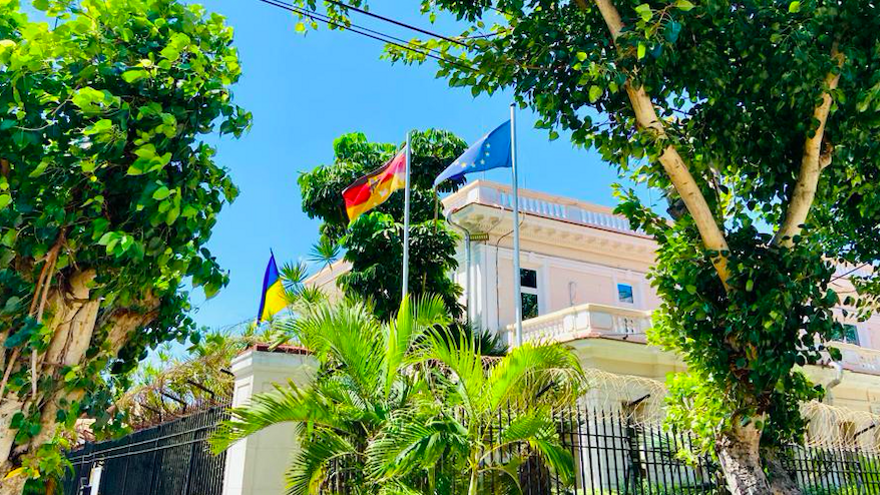
The Embassy isists that the only way to leave the transit zone of German airports is with a Schengen visa. (Facebook/German Embassy in Havana)

14ymedio bigger14ymedio, Havana, July 29, 2023 — The German Embassy in Havana reported that as of this Saturday, Cubans who wish to travel to a third country through an airport in German territory must have a transit visa. Citizens of the Island who meet certain conditions will be exempt from the measure, aimed at reducing the risk of illegal migration to the country and already in full force.

Cubans who have a relative who is a citizen of a State of the European Union may pass without a transit visa through the international transit area of ​​any German airport, says the Embassy.

Similarly, those who have a valid Schengen visa, a national visa – issued by any of the Schengen member states – for a long-term stay or some other “stay document” to travel to those countries, may also pass.

Those who have a visa granted by the United States, Canada and Japan, and those who have a permit to stay in the United States, Canada, Japan, Andorra, Monaco and San Marino may dispense with the document, the embassy adds. Members of aircraft crews from signatory States of the Chicago Convention on civil aviation, and Cuban diplomats, will not be required to have one either.

The Embassy insists that the only way to leave the transit area of ​​German airports – or to go from one terminal to another – is with a Schengen visa. In addition, it “strongly” recommends gathering sufficient information about the trip to avoid scams in agencies and misunderstandings at the German airport to which you are traveling. continue reading

The Cuban citizen who wishes to request the document must do so through the Embassy website, which will assign the user a turn. However, they warn that “the demand for such turns is very high” and that there is little chance that the document will be on time if it is not requested six months in advance.

Among the documents to present, once the date of the appointment is assigned, are the visa application form, a current passport photo and the Cuban passport – valid for at least three more months after the return date – and a copy of it. In addition, 80 euros must be paid in cash for the procedure, or 40 if the document is for a child between six and eight years of age.

In addition, the applicant will have to demonstrate that he will travel to another country after his stopover in Germany and provide data “from which the intention of not entering the jurisdiction of the Member States” of the Schengen area can be judged, and that ensure the “consistency of the planned travel route.”

On July 23, the German newspaper Bild revealed that the number of Cubans who requested asylum in Germany was eight times greater during the first half of this year, compared to the same period in 2022.

“The number of asylum applications from Cuban nationals this year, as of July 2, 2023, has risen compared to the same period last year from 73 to 607,” a spokesperson for the Ministry of the Interior confirmed to the newspaper.

According to the medium, Cubans use a mechanism that consists of buying a plane ticket to a destination for which they do not need a visa, for example Belgrade or Dubai, with a stopover in the German city of Frankfurt. There, where transit passengers do not need a visa, they appear before the Police and request asylum.

In 2022, 302 Cubans who mainly used this transit privilege to request asylum were identified. He added that “not even half” of these Cubans follow the regular route, that is, they do not appear at the corresponding center of the migration office “after expressing their desire for asylum before the federal police” at the airport and the registration of their data.

“It is unacceptable that the Schengen border code can be undermined by a simple trick, that is, with a transit flight. The right of asylum and Schengen rights must be urgently reviewed,” demanded the head of the union of the German policeman, Heiko Teggatz, speaking to Bild .

____________

COLLABORATE WITH OUR WORKThe 14ymedio team is committed to practicing serious journalism that reflects Cuba’s reality in all its depth. Thank you for joining us on this long journey. We invite you to continue supporting us by becoming a member of 14ymedio now. Together we can continue transforming journalism in Cuba.
Cuba Receives 58 Migrants Deported from the US, for a Total of 4,183 From Different Countries in 2023

The returned Cubans were received by the authorities in the port of Orozco, Bahía Honda (Artemisa). (@minint_cuba)

14ymedio biggerEFE (via 14ymedio), Havana, 29 June 2023 — On Friday, Cuba received a total of 58 nationals deported by the United States Coast Guard (USCG), for a total of 4,183 returns from different countries so far in 2023.

The deported Cubans – 49 men and nine women – participated in “three illegal exits from the country and were intercepted at sea,” according to a statement from the Ministry of the Interior. The deported Cubans were received by the island’s authorities in the port of Orozco (Bahía Honda, western province of Artemisa).

Two of the returned citizens were on probation serving criminal sanctions at the time of leaving the country and will be put before the corresponding courts for the revocation of that benefit.

Cuba and the US have a bilateral agreement so that all migrants who arrive by sea are returned to the island.

As of last November those arriving by air are also subject to return. Both countries agreed to resume deportation flights for “inadmissible” people held at the border with Mexico.

Returns by air between Cuba and the US had been suspended since December 2020.

During the current fiscal year, which began on 1 October 2022, more than 6,800 Cubans have been intercepted by the USCG on trips to the Florida coast.

The United States government announced this Friday that it will accept asylum requests from nationals of Cuba, Haiti, Nicaragua and Venezuela who are already in Mexico waiting to cross into US territory, in an attempt to clear the border on the Mexican side.

To apply for asylum in the United States, a person must show that they face persecution because of their race, religion, nationality, political opinion, or membership in a specific social or ethnic group.

Another program created by the administration of Democrat Joe Biden allows nationals of Cuba, Haiti, Nicaragua and Venezuela to apply for an immigration permit to enter the United States, but it only applies to those who arrive in the United States by plane and who have a sponsor who can prove they qualify, and who will help them in their adaptation to the country.

____________

COLLABORATE WITH OUR WORKThe 14ymedio team is committed to practicing serious journalism that reflects Cuba’s reality in all its depth. Thank you for joining us on this long journey. We invite you to continue supporting us by becoming a member of 14ymedio now. Together we can continue transforming journalism in Cuba.
New Economic Actors in Cuba

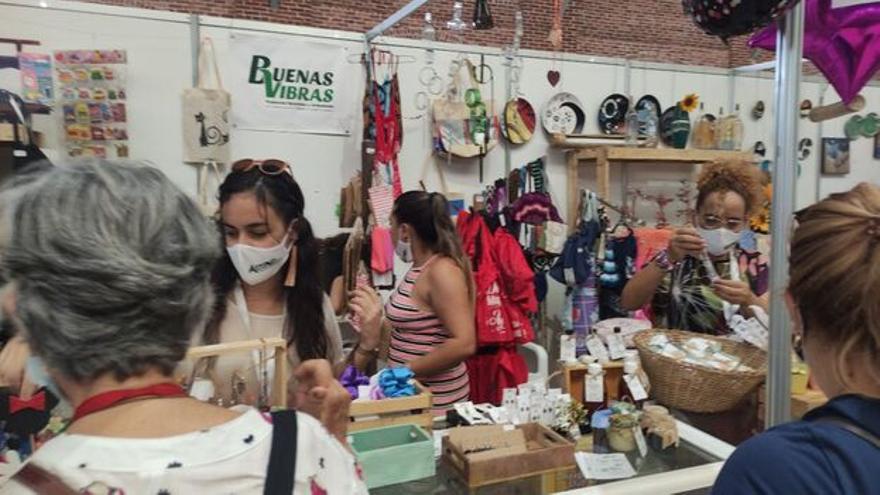
Puesto de Buenas Vibras [Good Vibes Post], a private business, at the Linea Cultural Station Fair, in El Vedado. (14ymedio)
14ymedio bigger14ymedio, Pedro Corzo, Miami, July 29, 2023 — I have rarely addressed Cuban economic issues or those of any other country, but upon receiving my fellow prisoner and friend Juan José Estrada a statement from the Vice Minister of the Food Industry of Cuba, Midalys Naranjo Blanco, I have no choice but to venture into one of the great failures of Castroism.

The official stated that the Cuban seas did not have enough fish to feed the population, a sovereign nonsense that shows the stupidity of those who hold power in Cuba, never because of competition, but because of their unrestricted submission to totalitarianism, distinguishing themselves among all of them, Miguel Díaz -Canel.

I share the vision of many friends that the most capable assets of the regime have always worked in two ministries, the Police and the Armed Forces,  and it cannot be denied also in Foreign Affairs, but this is a unit of the branch that directs the repressive forces.

It must be remembered that, despite the corruption that existed in Cuba and with all the money that Fulgencio Batista and the hierarchs of his regime allegedly stole, in 1958 our country ranked third in Latin American reserves of gold, dollars and convertible securities. Gold: with 373 million dollars was only below Venezuela (1,050 million) and Brazil (465 million); and sixth place in the continent in gross national income, 2,834 billion for a population of 6.6 million inhabitants.

It is worth noting that contrary to what is currently happening, according to the Food and Agriculture Organization of the United Nations (FAO), in calorie consumption, Cuba was only behind Argentina with 2,730 calories per person. In 1957, the FAO itself highlighted that Cuba was the largest exporter of agricultural products in Latin America in proportion to its population. Today it imports a large amount of food, including from the United States, 328 million dollars, and this, with the embargo.

True, we did not live in a paradise, nor in the hell of the present, but we were the third country in the region, in 1958, with the most number of telephones, newspapers and cars per 1,000 inhabitants. continue reading

I recently read that the dictatorship, through the State-run Cubatramite [literally “Cuba paperwork”] agency, is promoting MSMEs ( micro, small, and medium-sized enterprises), as Estrada affirms, “a socialist invention to save the economy that they themselves sank when they abolished private companies,” particularly small businesses, including the most insignificant, creating countless government companies that confused the population while still having fun, such as the famous Ecochinche, the Consolidated Company of bedbugs.

Let’s remember, including the blind, who did not want to see the disaster, in 1968 all self-employment was prohibited. Even the shoe repairer, the traditional scissors sharpener and the home-based barber, was eradicated, on pain of going to prison.

They must remember, especially the Castroites of the time, that on March 13, 1968, the government expropriated 11,878 bodegas, 8,101 restaurants, including street frita stalls — which sold the Cuban hamburger — 4,544 mechanics shops, 3,345 carpentry shops, 6,653 laundries, and an endless list of small businesses passed to the State.

The confiscation and closure of the 3,198 bars was the only time I saw the drunk on the block upset with the dictatorship, the one who most vehemently calling for an execution, and it was because his favorite bar, El Hatuey, had been closed. Overnight it was politically incorrect to have a drink.

Those entrepreneurs,  or as they say today, better still, with pure Castroite language, “new economic actors,” had their assets confiscated regardless of whether the workplace was in their own home.

I clarify that the seizures would have been many more, but the inventory of small businesses had been reduced, among other reasons because people who were sentenced to prison for political reasons, had all their assets confiscated, however modest they were. And I am not mentioning the large companies that had disappeared from the economy several years earlier.

In short, Fidel Castro and his henchmen, in one of those many crazy nights, robbed 55,636 MSMEs that were on the Island, all Cuban properties, most of which were staffed by family and friends, employing more than two million people.

____________

COLLABORATE WITH OUR WORKThe 14ymedio team is committed to practicing serious journalism that reflects Cuba’s reality in all its depth. Thank you for joining us on this long journey. We invite you to continue supporting us by becoming a member of 14ymedio now. Together we can continue transforming journalism in Cuba.

The Cuban Regime Prohibits Boxer Robeisy Ramirez From Using the Cuban Anthem and Flag in Japan

Cuban boxer Robeisy “El Tren” [“The Train”] Ramírez escaped in 2018. (Twitter/@RobeisyRamirez)
14ymedio bigger14ymedio, Havana, 24 July 2023 — Cuban boxer Robeisy “The Train” Ramírez will not be able to appear in his fight in Japan this Tuesday with the anthem of the country that gave birth to him and from which he fled in 2018. According to the athlete himself on his social networks, the Cuban embassy in Japan contacted the television station that will broadcast the event, which will take place at Ariake Arena in Tokyo and in which The Train will defend his World Boxing Organization title of featherweight against the Japanese Satoshi Shimizu; the embassy prohibited his use of the national anthem. It is, says the boxer, “a vile attempt at intimidation.”

“I’m a free man,” cried Ramírez, double Olympic champion (London 2012 and Rio de Janeiro 2016), who says that they offered him the U.S. anthem or none at all. “I’m not going to enter with the U.S. anthem,” replied the boxer, annoyed, who couldn’t believe that the Asian promoter accepted the imposition. “If I don’t enter with the one from Cuba, I enter without an anthem. It’s my homeland; what a lack of respect!”

The fighter is grateful that the U.S. opened its doors for him to continue his career but explains that he will not use the American anthem, because “its not what I represent.” In professional fights, the organizers use the hymns of the country from which the fighters originate, although it is not mandatory. On the Cuban Boxing Facebook page, he stressed that “what bothers me the most is that in Japan there are 12 or 15 lackeys and fat people living life who don’t care what the average Cuban is going through, literally living from what his family outside sends him.”

Total indignation. Share this video everywhere, let the world see everything that the Castro dictatorship and the communist system are doing. The Cuban boxer @RobeisyRamirez this coming July 25 will have a fight to defend his world title in Japan, the Castro regime… pic.twitter.com/tVFRoI2uRC — Marcel (@Marcel_305) July 24, 2023. The athlete, a native of Cienfuegos, attacked the regime, which, he says, has been pursuing him since he decided, five years ago, to make a career outside the Island. “They demanded that I not use the Cuban flag on my uniform or anywhere else.”

The 26-year-old boxer warned that far from “shutting me up” with this type of intimidation, “they have motivated me more to achieve success and continue to raise my voice and cry out for the freedom of my homeland. Now more than ever, Homeland and Life! continue reading

The young man’s coach, Ismael Salas, also joined the protests after the official boycott: “That is a lack of respect from the Cuban Embassy. I say this so everyone can understand what communism is and why I’m against all those communists.”

For his part, the collaborator of Pelota Cuba USA, Yordano Carmona, described as “incredible” that the “tentacles of the Cuban dictatorship” reach all the way to Asia.

Ramírez says that in 2018 he made his best decision. At that time he wanted to leave “so I wouldn’t remain an amateur, but the main reason for my decision was all the problems that happened with the managers of boxing and INDER [National Institute of Sports, Physical Education and Recreation], who created them, but every day they got worse,” he told Play-Off Magazine. “All I had left was to leave or go back to Cienfuegos to survive as I could.”

Translated by Regina Anavy

____________

COLLABORATE WITH OUR WORKThe 14ymedio team is committed to practicing serious journalism that reflects Cuba’s reality in all its depth. Thank you for joining us on this long journey. We invite you to continue supporting us by becoming a member of 14ymedio now. Together we can continue transforming journalism in Cuba.
The Pool Where Cuban Olympic Swimmers Trained Is Now a Garbage Dump

The president of the Municipal Assembly of People’s Power argued that local authorities can do little because the property is in the hands of Emprestur. (Ahora!)

14ymedio bigger14ymedio, Havana, 27 July 2023 — The Olympic pool in Gibara, Holguín, has long since left its golden years behind as a training center for Cuban athletes who competed in international events. The lack of maintenance and the passage of two hurricanes have left the facilities in such a state that even the official press echoes it. Today the place is a “macro garbage dump,” in the words of the provincial newspaper Ahora! in a report published this Tuesday.

The text describes the “stumbling blocks” that, for more than 50 years, have affected the Waldimiro Arcos Riera pool, inaugurated in the late 1970s. Located in the vicinity of the Holguin coast, initially it only had stakes embedded in the sea that formed a quadrilateral. These precarious conditions did not prevent Cuban athletes from training and obtaining good results in international events.

According to the newspaper, it was not until 1979 that the facility gained its “Olympic” status, after the local residents themselves carried out “volunteer work” to build the pool. Gibara was already in the middle of a drinking water supply crisis, so the pool remained empty.

Andrés Ricardo Rivas, president of the Municipal Assembly of People’s Power, argued that the local authorities can do little because the property is in the hands of Emprestur, which is dedicated to the construction of tourism facilities, and they will be in charge of rehabilitating the facilities. He did not say why there is no communication with the state company nor what plans it has to reactivate the swimming center. continue reading

Among the professional swimmers who have trained in the pool are Rafael Leyva, national and Central American champion with the butterfly and free-style technique; Oscar Periche Cardet, goalkeeper of the Cuban national water polo team for more than 20 years and participant in four Olympics; and Juan José Soler González, national swimming runner-up.

In 2008, Hurricane Ike considerably damaged the facilities, but the United Nations Children’s Fund (UNICEF) financed its repair using materials with greater resistance to salt water and a pumping system directly from the sea.

In addition to recovering its initial function of sports training, the investment provided for the creation of conditions for the pool to be used by people with disabilities and by children. A significant part of the investment was allocated to lighting the pool, so that it could also be used at night.

The complex was again destroyed in 2017, when Hurricane Irma, category 5, devastated much of the Holguin coast. Since then, the authorities have done nothing more for the pool, and it ended up becoming a garbage dump that, the newspaper acknowledges, “affects the environment and the neighbors.”

Translated by Regina Anavy

________________

COLLABORATE WITH OUR WORKThe 14ymedio team is committed to practicing serious journalism that reflects Cuba’s reality in all its depth. Thank you for joining us on this long journey. We invite you to continue supporting us by becoming a member of 14ymedio now. Together we can continue transforming journalism in Cuba.
Scarcity and Crime, Today’s ‘Moncada to Attack’ in Cuba, According to President Diaz-Canel

Díaz-Canel resorted to an old political trick and took advantage of the dawn light to begin his speech. (Cuba debate)

14ymedio bigger14ymedio, Juan Izquierdo, Havana, 26 July 2023 — Miguel Díaz-Canel’s speech at the Moncada barracks in Santiago de Cuba, delivered this Wednesday morning, focused on two points: lamenting the “physical disappearance of the historic generation” that stormed the barracks – although he had Raúl Castro and Ramiro Valdés in front of him – and the anguish of the Cuban rulers, who suffer firsthand from “another Moncada”: inflation and crime on the Island.

The event, which commemorates the 70th anniversary of the rebel attack on two important military enclaves in the former province of Oriente during the Fulgencio Batista dictatorship, began at five in the morning on July 26th. The Government spared no resources for the tribute, which began with a play of lights on the façade of the barracks recreating – with notable historical inaccuracy – the frontal shooting of the assailants until the building was symbolically collapsed.

Starting from the “ruins” of Moncada, the voice of Fidel Castro and various signs alluded to the “problems” of the Republic. When the show ended, which included congas and declamations, the first secretary of the Communist Party in Santiago de Cuba, José Ramón Monteagudo, noted that the city had complied with the request of Raúl Castro, who in one of his speeches had called for “beautification days” to make Santiago a “beautiful and hygienic” city.

Díaz-Canel resorted to an old political trick and took advantage of the dawn light to begin his speech. He mentioned the Christian apostle Santiago, patron saint of the city, who came to “dress as a mambí” during the independence wars, and the Virgin of Charity, in whose El Cobre sanctuary Antonio Maceo was baptized. continue reading

The Cuban Television cameras tried to offer a solemn profile of the president, who expressed himself with diction errors and voice breaks, as is usual in his public interventions.

“As long as we do not reach a decent degree of prosperity for Cubans, we will have a Moncada to assault,” he summarized, after alluding to the vicious circle that produced the increase in the price of basic necessities and the wave of crime that is sweeping the island.

As expected, Díaz-Canel blamed the problems in Cuba on the United States, which, in addition to the blockade, is determined to organize campaigns “to prevent foreign investment and foreign trade.” In addition, he accused Washington of leading “a pursuit of fuel supplies” to the island, through whose ports numerous oil tankers move, about which Havana does not offer the slightest information.

He spoke little about Fidel Castro, of whom he limited himself to saying that, while his brother was fighting in the Audiencia building, he “ordered the withdrawal.”

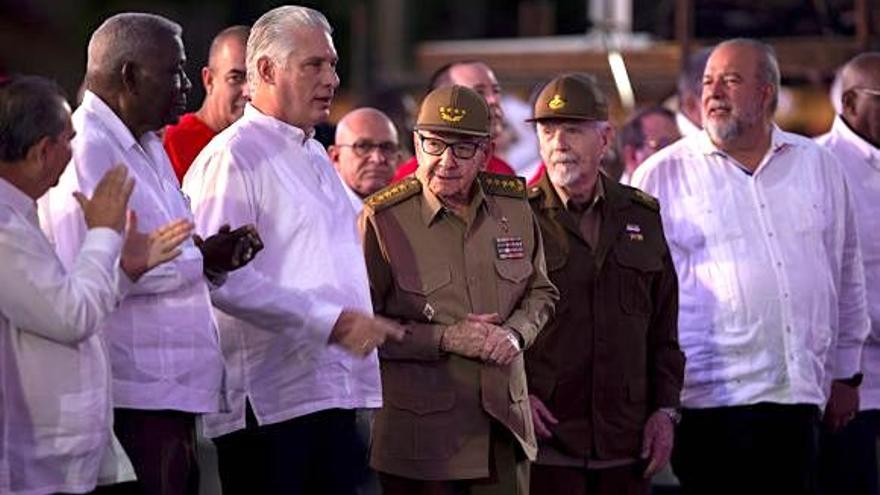
Raúl Castro did not go up to the rostrum or receive ovations. Together with a nonagenarian Ramiro Valdés, the soldier did not leave his seat until the end of the event. (ACN)

The rest of his speech was dedicated to Díaz-Canel allowing himself to be applauded by various groups of foreign visitors such as the Pastors for Peace – whose leader, Gail Walker, was present at the even t- the Puerto Rican independence group Juan Rius Rivera, the Caravan of Brazil and several “brigades” of young Belgians and Germans who traveled to the Island for the commemoration.

This time, Raúl Castro did not go up to the rostrum or receive ovations. Together with a nonagenarian Ramiro Valdés, the soldier did not leave his seat until the end of the act and the cameras captured an expressionless face, which in no way resembles that of the 22-year-old who was captured seven decades ago, after the failure of the assault .

____________

COLLABORATE WITH OUR WORKThe 14ymedio team is committed to practicing serious journalism that reflects Cuba’s reality in all its depth. Thank you for joining us on this long journey. We invite you to continue supporting us by becoming a member of 14ymedio now. Together we can continue transforming journalism in Cuba.

Portugal Will Contract for 200 to 300 Latin American Doctors and Says Their Rights Will be Respected

The medical brigades are one of the main sources of foreign currency for the Cuban government, despite being frequently pointed to as systems of forced labor. (EFE)

14ymedio biggerEFE/14ymedio, Lisbon, July 26, 2023 — The Portuguese government plans to hire between 200 and 300 doctors from different Latin American countries to perform functions in health centers and ensures that all the rights of professionals will be respected.

The Portuguese Minister of Health, Manuel Pizarro, confirmed these contracts today in an appearance in Parliament, where he clarified that the doctors contracted for will not only be from Cuba, as local media had previously published.

They will also come from Colombia and other countries that have the capacity to export healthcare workers, said the head of Health, who explained that their academic training will be recognized by a Portuguese university and they will enroll in the Portuguese College of Physicians.

Pizarro went to Parliament at the request of the Liberal Initiative, which wanted to question the minister about the hiring of Cuban professionals, since this party alleges that they work abroad in “slavery” conditions, through a Cuban state company that only gives them a part of the salary they receive from the Portuguese State. continue reading

“There are hundreds of companies of this type that operate in Portugal,” replied the minister, who pointed out that the Portuguese State will remunerate foreign doctors the same as Portuguese ones, but admitted that the Government does not control what these companies pay professionals.

And he assured that “human rights will be scrupulously respected.”

During Miguel Díaz-Canel’s visit to Portugal in mid-July, the President of Portugal, Marcelo Rebelo de Sousa, had revealed his interest in hiring Cuban doctors after verifying the work that one of these contingents is doing in Italy. Initially, the service would be exercised for a period of three years.

According to the Portuguese outlet Jornal de Noticias , Rebelo de Sousa explained that the Cubans would collect their money without intervention from the Havana regime. The president said he had asked Cuba for a “different agreement than usual” to also pay those hired directly*. Supposedly, he managed to get the Cuban government to accept it, although the exact terms of the agreement are still unknown.

In addition, the Portuguese Government has already started procedures for these professionals to join the public system as soon as possible, taking into account the various steps that foreigners must go through outside the territory of the European Union before being considered fit.

To be authorized, doctors who come from third countries must undergo several tests, not only in medicine, but also in Portuguese, for example.

It is not the first time that Portugal has resorted to Cuban healthcare workers; in 2009 it welcomed 58 to reinforce the public network in the regions of Ribatejo (center), Alentejo and Algarve (south).

Some sources from the Portuguese Ministry of Health, consulted by the EFE news agency, indicated that the hiring of foreign health professionals is “complementary and transitory” and its objective is “to contribute to the adequate provision of human resources and response capacity” of the National Health Service.

In this sense, “joint work is underway between the Ministry of Health and the Ministry of Science, Technology and Higher Education.”

According to the data provided by the portfolio, the Portuguese public system had 1,270 foreign doctors in 2022. Local media, for their part, reported that the total number of foreign health workers registered with the College of Physicians was 4,503.

Health is one of the sectors that has caused the most complaints in the last year, marked by a crisis in emergencies, especially in maternity and obstetrics, due to the lack of resources. Faced with pressure from the sector, the Portuguese Government has found an alternative in health contingents.

For the Cuban government, medical brigades sent abroad are one of the main sources of foreign currency for the, despite being frequently pointed to as systems of forced labor by international organizations such as Human Rights Watch or Prisoners Defenders. The United States also included Cuba in the list of countries that violate human rights.

The Cuban government has also been accused of using the contingents to maintain its influence in allied countries, such as Mexico, Italy, Qatar, Brazil, Venezuela and Nicaragua. The National Office of Statistics and Information (Onei) calculated that, in 2021, the Cuban State collected 4.349 billion dollars for the export of health services to foreign governments.

In contrast, on the island, health services are deteriorating, not only due to a lack of health professionals, but also due to the shortage of basic medicines, which the government in Havana attributes to financing problems and the international supply of raw materials. On the other hand, infrastructure modernization investments are focused on tourist complexes, the bet to activate the compressed economy, while complaints about the precarious conditions in hospitals are increasingly frequent on social networks.

*Translator’s note: The common arrangement to date has been for foreign governments to pay the Cuban government directly for each worker, and from this the Cuban government pays each worker only a portion of the total — in some cases as little as 10% — and retains the rest.

____________

COLLABORATE WITH OUR WORKThe 14ymedio team is committed to practicing serious journalism that reflects Cuba’s reality in all its depth. Thank you for joining us on this long journey. We invite you to continue supporting us by becoming a member of 14ymedio now. Together we can continue transforming journalism in Cuba.
Habana Libre Hotel Recovers its Sign, Battered and With an Incomplete Background

The structure that supports the recognizable letters, lowercase and blue, is not finished and is missing panels. (14ymedio)

14ymedio bigger14ymedio, Juan Diego Rodríguez, Havana, July 26, 2023 — Four years after having barely six letters, the sign on the roof of the Habana Libre hotel, located on the vital corner of L and 23, in El Vedado, is once again complete.

The sign went from “bana Libre” to “na Libre” and from there to “a Libre” in 2019, before the covid-19 pandemic.

The authorities have not announced its restoration, but neither have they given explanations in all this time in which Havanans have seen the emblematic sign crumble, like a metaphor for the Island.

The old Hilton, destined to be one of the most luxurious on the continent, opened its doors in 1958 and was the enclave from where Fidel Castro ruled the country during the first years of the Revolution. Nationalized two years after its inauguration, the building, with 27 floors and an initial investment of 28 million dollars, has gradually languished until it reached a debacle that touched its adjacent premises, both the cafeteria and the candy store.

The recent arrangement, moreover, has not been complete, since the structure that supports the recognizable letters, in lowercase and blue, is not finished and is missing panels. A passerby who this Wednesday noticed the change at the top of the establishment, managed to comment: “Tremendous bungle, as always in this country.”

Nationalized two years after its inauguration, the 27-story building has gradually languished until it reached its current debacle. (14ymedio)

____________

COLLABORATE WITH OUR WORKThe 14ymedio team is committed to practicing serious journalism that reflects Cuba’s reality in all its depth. Thank you for joining us on this long journey. We invite you to continue supporting us by becoming a member of 14ymedio now. Together we can continue transforming journalism in Cuba.