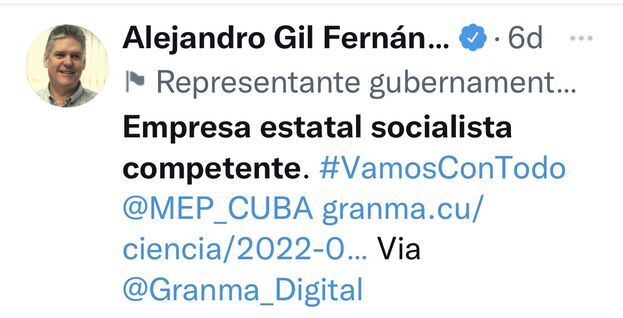
Tweet from the Minister of the Economy that inspired the author. Bold text: “Competent socialist state company”
____________
Author’s note: This text is my recreation and condensation, in English, of my décimas published this week in the Spanish edition of 14ymedio. Remember, this post —part of Ideological Deviation, my weekly column— is considered a crime by the Cuban government.
____________
COLLABORATE WITH OUR WORK: The 14ymedio team is committed to practicing serious journalism that reflects Cuba’s reality in all its depth. Thank you for joining us on this long journey. We invite you to continue supporting us by becoming a member of 14ymedio now. Together we can continue transforming journalism in Cuba.
Stock image of the Twitter logo. (EFE/EPA/JUSTIN LANE)
14ymedio, Yoani Sánchez, Generation Y, Havana, 30 April 2022 — Will it fly higher or crash to the ground? The question about the future of Twitter had been around us for some time, but after the announcement that Elon Musk bought the social network for approximately 44, billion dollars, the question has gained strength. It is not only a virtual space for celebrities and politicians, but it is also the loudspeaker and protective shield of thousands of activists and journalists in the world.
I have had an account on the blue bird for 14 years, I joined in the summer of 2008 when Jack Dorsey’s legendary tweet, in which he wrote “Just setting up my twttr,” was revered as the initial branch of a nest that could shelter us all. Since then, first with 140 characters and later with the current 280, its trill has saved me from some horrors and has helped me tell the story of my country.
The first time that the official Cuban press mentioned Twitter, it defined it as “a technology created by the Central Intelligence Agency (CIA, for its acronym in English).” As with any new phenomenon, the propagandists of Castroism opened fire against something they did not understand but believed to be ephemeral. Their rejection on the one hand and the need for independent activists and journalists to have an immediate publication tool, on the other, marked the flight over the Island of those blue wings.
Twitter had an anti-establishment character from the initial moments when it began to be used by Cubans. When the Plaza de la Revolución understood its true scope, the opposition groups, the alternative media and the most critical citizens had been posting tweets for months or years. Then the Communist Party of the Island also landed in the network it had renounced until recently. continue reading
That arrival of the official hosts to the network was marked by slogans repeated with formality and zero spontaneity, the creation of bots that were dedicated to harassing dissidents, and the provisioning of an entire army of cyber police officers who supervised who crossed the line with criticism of the government. Such practices have been detected by the San Francisco giant, which has frequently responded with suspensions of fake accounts and other reprimands for official threats against defenseless citizens.
The story I just told is repeated in almost any country under an authoritarian regime, with some extreme examples like China, where Twitter can hardly say a peep due to the ironclad censorship prevailing in the Asian nation. Other dictatorships, moreover, have gone from initial rejection to an attempt to use the service for their propaganda and intimidation purposes. With the new change of owner of the company, the big question is whether it will be easier for these tyrannical models to achieve their goal or, on the contrary, they will not be able to continue with their dirty digital tricks.
The richest man in the world now faces a challenge. He has promised that he will make Twitter a “better than ever” space for freedom of expression, but he has acquired the virtual world inhabited by more than 300 million identities, many real and a good part apocryphal or declared fictitious. Beyond celebrities, billionaires and presidents, the question that the most vulnerable users have is whether the blue bird will continue to carry our voice far: to the heights where a short tweet can stop the coup, open the locks of a cell or prevent the coup de grace.
COLLABORATE WITH OUR WORK: The 14ymedio team is committed to practicing serious journalism that reflects Cuba’s reality in all its depth. Thank you for joining us on this long journey. We invite you to continue supporting us by becoming a member of 14ymedio now. Together we can continue transforming journalism in Cuba.
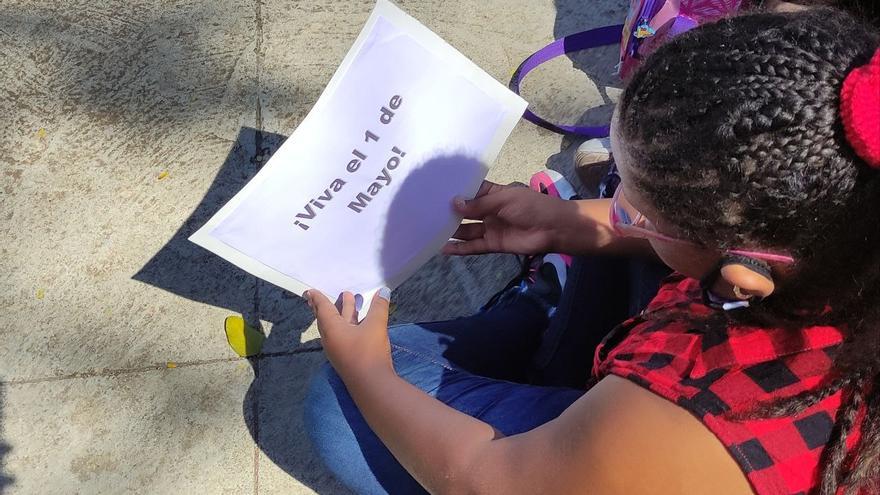
This Friday, in several parks in Havana, groups of schoolchildren could be seen with rudimentary signs that read “Long live May 1!” (14ymedio)
14ymedio, Juan Diego Rodríguez, Havana, 29 April 2022 –President Miguel Díaz-Canel’s invitation to participate in the May Day parade is not extended to all Cubans. The exception is the numerous activists and independent journalists who this week have received a blunt warning from State Security: do not leave your homes this Sunday.
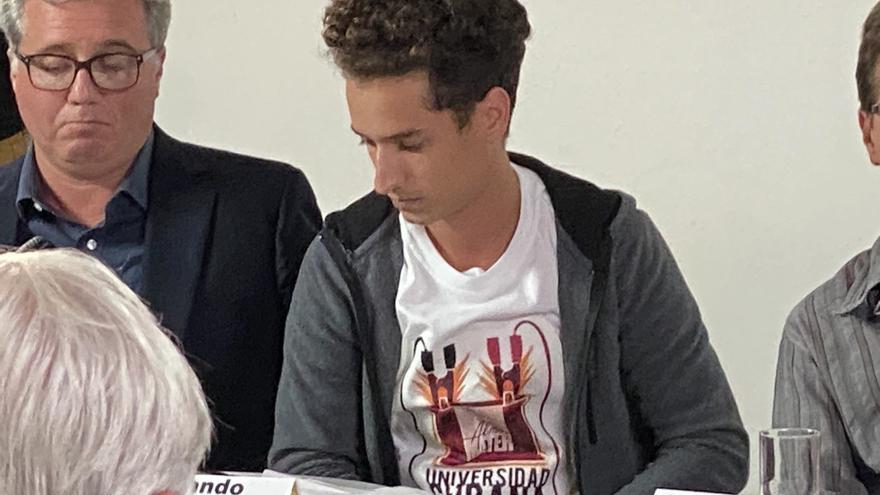
The last of them, the writer and photographer Ariel Maceo , who this Thursday was summoned and threatened by the political police so that he would not attend the march called by the Government. “I told them they can’t control me. He says yes, but no. Because if they could control me then they wouldn’t have to cite me because they fear I’ll do something,” the young man writes in a post on his networks.
Right there, he admits that he was upset when the agent who ’attends’ him began to ask him about his private life. From how he met his girlfriend he went on to say, Maceo details, “that we believe they are like the FBI,” to which the writer replied: “You are not like the FBI, but like the Gestapo and the Stasi, leave the film, that Cuba is a dictatorship.. Explaining to a State Security agent why Cuba is a dictatorship is, Maceo reasoned, “like explaining to a child that he can’t eat the cookie on the floor, he’s going to eat it just the same.”
The political police also summoned and warned independent reporters Yoe Suárez, from Diario de Cuba; Anay Rendon, from Cubanet; Geysi Guía, from Periodismo de Barrio, and Luz Escobar, from 14ymedio.
Journalist Miriam Celaya was not summoned to a police unit, but on Tuesday she received a visit from ’Agent Alberto.’ “Very urbane, even forcedly courteous,” Celaya says in a Facebook post, he told her that “no street activity will be allowed on May Day.” continue reading
“Seen like this, anyone would think that they were going to suspend the march to ’celebrate workers’ day’ called by the PCC [Cuban Communist Party] and that I – as a close friend to whom I told of the brief meeting jokingly told me – I would have to keep the little flag and the tennis shoes that I would have had ready to march with the non-existent CDR of my block,” the journalist ironically wrote. “But no; against all logic, HeCallsHimselfAlberto took the trouble to come and warn me not to go where I, of my own free will, was not going to go.”
Celaya argues that “either there are those who earn salaries and benefits very easily, or they are simply very nervous: “J11” and the prisons full of political dissidents, the massive and constant exodus, the shipwreck of the system, the insurmountable economic crisis and God knows which and how many more demons are affecting the sleep of the Cerberus canines and of the maximum fat cats of Power. And, obviously, they are also affecting their decisions.”
The harassment of Cubans who in one way or another have expressed dissatisfaction with the regime contrasts with the childish enthusiasm with which the government is calling the march from the official media.
To the “ten reasons not to stop going to the parade on May Day” distributed by buildings and social networks of officials, and which include “breaking the daily routine,”,”exercising” and “taking the best live photos live,” something less friendly joins: the usual pressures in the workplace.
Thus, a worker from a state mechanical company denounces to this newspaper that his boss has warned the employees that if they do not attend the parade on Sunday “it will affect the payment of utilities,” since their absence will lower “the points of their evaluation… They are making a list and handing out a T-shirt,” explains the man. “They told us that we have to go on our own to El Vedado and there they will give us a snack. I wonder with what transport, because how is that?”
This Friday, in several parks in Havana, groups of schoolchildren could be seen with rudimentary signs that read “Long live May 1!” In the Mariana Grajales Park, at 23rd between C and D, the teachers handed out Cuban flags among them while making the children repeat: “Long live Fidel! Long live May Day!”
Some of the kids were dressed as doctors and others as peasants – the Cuban labor vanguard — although most wore their school uniforms.
Not far from there, in the Parque de El Quijote, the scene was repeated, under the critical gaze of some passers-by. “These children have not even eaten breakfast,” questioned a woman. The little ones reluctantly repeated the slogans while playing by crumpling up the poster and hitting a classmate’s head with it.
____________
COLLABORATE WITH OUR WORK: The 14ymedio team is committed to practicing serious journalism that reflects Cuba’s reality in all its depth. Thank you for joining us on this long journey. We invite you to continue supporting us by becoming a member of 14ymedio now. Together we can continue transforming journalism in Cuba.
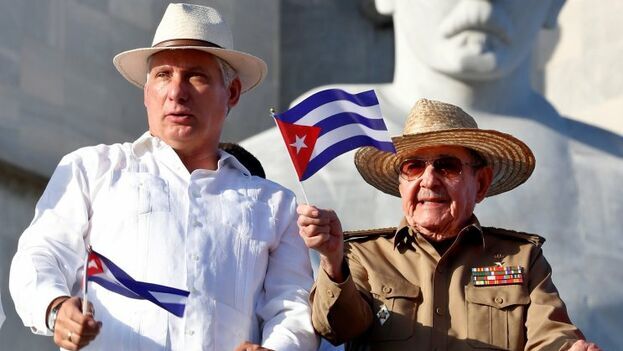
Miguel Díaz-Canel and Raúl Castro, during the May Day 2019 march. (EFE)
A poster placed at the entrance of an apartment building in Havana summarizes the tone of the official call for the upcoming May Day parade. After being suspended for two years due to the covid-19 pandemic, the authorities have wanted to put a less formal stamp on the event and the result is disconcerting.
The list of ten reasons to go to the Plaza de la Revolución that day has been written by hand on several sheets that spell out reasons more similar to those used to participate in a camping trip or a family party than a political rally. As a “fraternal meeting” to “share with distant loved ones,” the list describes the first reason to attend the official celebrations for Labor Day.
The call also ensures that it will be an occasion to break the routine and take “the best photos and artistic designs directly with excellent people.” Only some of the reasons listed contain any ideological nuance, such as “showing that we are not afraid and that unity makes us invincible,” a veiled allusion to the popular protests last July, which brought together thousands of people throughout the country, or the assertion, without much conviction, that “there is socialism for a while.”
The ten reasons to participate in this May Day break down reasons more similar to those used to participate in a camp than in a political rally. (14ymedio)
However, the most striking of the reasons for participating in the parade is the one that advances the possibility that some of the octogenarians who control the threads of power in Cuba will not survive until next year’s call, warning that “perhaps it will be the last time in the presence of important people in the work of the Revolution.”
The enumeration closes with the invitation to “fill the Plaza until the Malecón dries up,” paraphrasing the lyrics of a song by Jacob Forever, a Cuban reggaeton player, currently residing in Miami, who during the day of the demonstrations on July 11 asked the people to take to the streets peacefully: “Between all of us we can achieve the freedom of Cuba,” the singer assured at the time.
____________
COLLABORATE WITH OUR WORK: The 14ymedio team is committed to practicing serious journalism that reflects Cuba’s reality in all its depth. Thank you for joining us on this long journey. We invite you to continue supporting us by becoming a member of 14ymedio now. Together we can continue transforming journalism in Cuba.
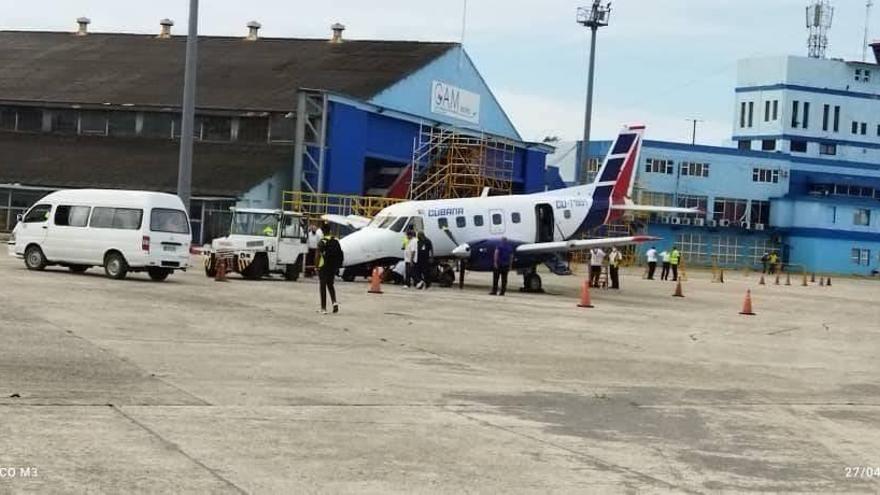
Image of the incident of a Cubana de Aviación plane that lost its landing gear this Tuesday. (Amantes de la aviación cubana/ Facebook)
14ymedio, Havana, 28 April 2022 — Cubana de Aviación last of its remaining three Embraer 110s disabled this Wednesday, after its landing gear collapsed at the José Martí International Airport while it was being towed by ground personnel at Terminal 1.
The news was confirmed by the Facebook group Amantes de la aviación cubana, which also published several photos showing the operators surrounding the aircraft and its license plate: EMB-110 CU-T1551.
It is not the first time that this plane, a Brazilian-made Embraer, has had problems, according to a source from the airport who asks to remain anonymous. “It was broken for a long time, lying in the hangar. They fixed it because there was no plane for domestic flights, and on the same day they announced there was mow domestic flight service, they had to tow it to the hangar again,” explains this source. , referring to last March, when Cubana de Aviación assured that it would resume domestic service with the connection between Havana and Holguín, with two weekly flights.
The same aircraft had its landing gear fall apart in November 2020, when touching down in Havana from Nueva Gerona, in an accident that resulted in no victims among its twenty passengers. continue reading
Last October, and just days after an announcement of new routes by Cubana de Aviación, the Ministry of Transportation announced that the state airline would keep its domestic flights canceled due to the poor condition of the planes.
“The technical availability of the fleet is not a secret; it is known that it is affected and has been very limited in the acquisition of parts to keep our aircraft in flight, so this programming will not start until the conditions created with our aircraft are in place, to start providing domestic flights,” the general director of Transportation and Tickets, Luis Ladrón de Guevara, acknowledged then on national television.
Months later, in January of this year, the state airline was involved in a controversy, when it came to light that Spain had granted direct aid valued at 200,000 euros to the branch of Cubana de Aviación in Madrid.
In any case, the serious crisis of Cubana de Aviación goes back a long way and the coronavirus pandemic only helped to seal its fate.
Last summer, the company was embroiled in a problem, when the International Air Transport Association (IATA) informed travel agencies that the state-owned airline would no longer participate in Spain’s BSP payment compensation mechanism, so the issuance of tickets, electronic multipurpose documents (EMD) and refunds in the name of the company had to be stopped.
In August, the airline maintained some international flights to Madrid with an Ilyushin Il-96, but the rest of the international destinations and several routes to the Spanish capital were operated by other companies.
In 2019, after 17 years without a single purchase, Cubana signed a contract to acquire two ATR 72-600 turboprops from the French-Italian company that had sold it two ATR 42-500 and one ATR 72-200 years before, but the operation It was canceled months later due to the tightening of the embargo during the Donald Trump Administration, which prevents Cuba from acquiring equipment that has 10% or more of its components made in the United States.
That same year, the state company had several problems on its flights, including an emergency on one of its planes due to the loss of the navigation system.
In addition, in May 2018 there was a serious accident in which 112 people lost their lives on a domestic flight between Havana and Holguín and the only survivor was Mailén Díaz.
____________
COLLABORATE WITH OUR WORK: The 14ymedio team is committed to practicing serious journalism that reflects Cuba’s reality in all its depth. Thank you for joining us on this long journey. We invite you to continue supporting us by becoming a member of 14ymedio now. Together we can continue transforming journalism in Cuba.
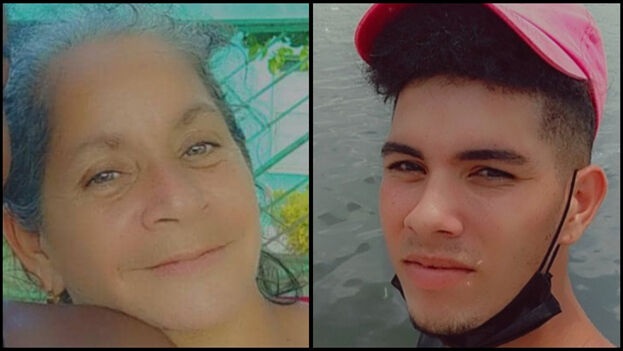
Marylin Cabrera and her son Orlando Carvajal. (Collage)
14ymedio, Yoani Sánchez, Havana, 29 April 2022 — He went out to buy some bread for his family, found a crowd shouting ‘freedom’ and joined the protest on July 12 in La Güinera. Orlando Carvajal was sentenced to 20 years in prison for the crime of sedition, a sentence that exceeds, by a few months, the entire time he has lived to date.
Locked up in the Jovenes de Occidente prison along with others who protested in the same neighborhood of the municipality of Arroyo Naranjo, Carvajal, 19, suffers from a deep depression. His state of mind is the result not only of the disproportion of the sentence but also of the disappointment of being treated as a dangerous criminal.
Marilyn Cabrera, the young man’s mother, tries to lift his spirits every time she visits him in prison, but the possibility of spending two decades behind bars has sunk Carvajal emotionally. The boy who, until a few months ago, sold plastic cups to support his family, now counts each day of confinement.
“I had been in my house for several days, convalescing, because I had just had an operation. I heard that people were commenting on the protest, but I did not know that Orlando had been there. I found out because they told me that it was on the news, in a video filmed that day. My son was seen recording with his phone and then he would crouch down.”
“He didn’t want to tell me that he had been there, I found out from the neighbors. So I asked him and that’s when he began to tell me that he had gone to look for bread and saw people demonstrating. He got up and then they started throwing stones at them from the other side, so he bent down to pick up a stone to defend himself.” continue reading
In the sentence they insist that Carvajal lit the fuse of a Molotov cocktail that was thrown during the protests that summer Monday. The document says he is seen on video just as he sets fire to a piece of cloth protruding from the bottle and then launches another.
Cabrera explains the images that were shown in court: “In the video he appears as if he was already leaving the demonstration and at that moment another young man approaches him and asks for a matchbox, he takes out his and lights it, then the young man puts the bottle to light the fuse. Just that and they have sentenced him to 20 years.”
“We appealed. The trial was very intense and lasted three days. At one point, the mothers who were there were surrounded by guards and we couldn’t even greet our children. They arrived handcuffed hands and feet.” The image of the chained young man is something that the mother cannot get out of her mind.
“My son had never had a problem and seeing him with the chains on was very hard for me. I still have the prosecutor’s words tattooed on my mind, who made it clear that he was not going to take into account their age or whether they had prior criminal charges, that for having ‘betrayed the country’ he asked for all those years of sentence.”
“The Prosecutor’s Office initially asked for 15 years in prison for my son and in the end the sentence was increased to 20. First they accused him of public disorder and attack, but during the process they added the crime of sedition,” adds the mother. “He was in the first trial that was held against the boys from La Güinera and that was the hardest, as they intended the trial to set an example.”
In the sentence handed down by the People’s Court of Havana, to which 14ymedio had access, it reads that the defendants sought to “alter the socialist social order enshrined in the Constitution.” They also blamed them for hurling insults at Miguel Díaz-Canel “in a derogatory tone, all of which responded to the counterrevolutionary action models designed by the enemies of the socialist system.”
But that same system they were shouting against barely paved the way for Carvajal’s life. “He couldn’t finish studying because we had moved from the Isle of Youth to Havana, that is, we had returned to where I was born and we had many difficulties to be able to change the address and have an identity card from here. So my son couldn’t rejoin classes.”
Carvajal is self-employed. “He would go out with two other boys from the neighborhood to sell plastic cups in order to survive because we didn’t have the right to a ration book either to be able to buy the little that comes to the store. With what he earned he supported his sister and me, because I I’m sick.”
As a mother, she says that she had “a lot of work” since he was born: “Everything was a struggle and it was difficult for me to even buy shoes for him. In the end, when I had my second daughter, I moved with her father to Isle of Youth. So Orlando was growing up without being able to achieve a lot of the things that he needed.”
“When I arrived in Havana, it was very difficult for my son to clothe himself because he saw how other boys around him could buy a backpack or certain clothes,” she laments. “All those difficulties were destroying him emotionally but he avoided worrying me with those things, although I realized it.”
La Güinera is a very poor neighborhood. “You live with great difficulty, even the supply to the stores is worse than in other neighborhoods of Havana. Here the products arrive at the butcher shop after they arrived in other municipalities. We are the last. This neighborhood is poor and conflictive, here most young people have not been able to continue their studies.”
The mother explains the reasons for this situation: “It’s not because education isn’t free, which it is, but because they have a lot of trouble getting the things they need to go to school, so most of them I know haven’t finished secondary school, much less pre-university.
The day he learned of his 20-year sentence, Carvajal was put in a punishment cell “because he had allegedly attempted to kill himself,” explains his mother, but when she went to see him, she took his hands and begged him to help: “Mom, Lieutenant Rubén hit me because I was in pain and I couldn’t stand and I asked for medical help,” said the boy.
“I went to talk to the officer in the prison but they wouldn’t let me, so I went to the Provincial Department of Prisons at 15th and K to file a complaint. No one would help me and I got desperate and through a journalist from the Cibercuba portal I uploaded a complaint about the mistreatment of which Orlando had been a victim and the depression that this was causing him.”
The reprimand was not long in coming: “As a result of that, one day, leaving a visit to my son, the head of the prison approached me and told me not to try to upload more complaints to social networks because that only harmed my young guy.”
“Sometimes I come to the visit and see him sad. I try to cheer him up but he tells me that the only thing he thinks about is the 20 years in prison to which he is sentenced.” His mother always answers the same: “Papi, you’re not going to have to serve that time in jail.”
But although she is strong before him, the mother admits that “it is too much pain to see him like that in that situation.” She defines the current state of Carvajal with a scathing phrase: “He is mentally destroyed.” Health problems also accumulate. “He suffers from a six-centimeter cyst in his kidney and was only treated after he made numerous complaints.”
“I have hope that he will get out of there soon, but he doesn’t. Every time we talk about it, he tells me: ‘don’t believe what these people tell you.’ The disappointment he has suffered is very great because he is a boy from his home, with no record and who never had a problem. Suddenly he finds himself sentenced to 20 years in prison, that is very disappointing for him and also for me.”
And she stresses: “I think that young people should not be punished for these things but talk to them and, above all, help them. Not what they have done to them, never what they have done to them.”
____________
COLLABORATE WITH OUR WORK: The 14ymedio team is committed to practicing serious journalism that reflects Cuba’s reality in all its depth. Thank you for joining us on this long journey. We invite you to continue supporting us by becoming a member of 14ymedio now. Together we can continue transforming journalism in Cuba.
Twitter was bought this Tuesday by Elon Musk, who promised to wage war on bots. (Caribbean Channel)
14ymedio, Yunior García Aguilera, Madrid, 27 April 2022 — When I got on Twitter in April 2018, I almost stopped using Facebook. I was fascinated by the rhythm of the platform, the synthesis, the stark debate held there by a group of young Cubans who were beginning target shooting with just 140 ammunition. Those Creole tweeters, in the absence of a country where they could really participate, distributed tasks in an imaginary village. They felt comfortable, because their parents did not read them. There they would not be told to keep quiet or to “speak softly.”
Cuban president Díaz-Canel joined four months later and they began to consider how to spoil the party. The newly enthroned bureaucrat also had the gift of talking to animals, like his Venezuelan compadre*. But unlike the other, this juvenile was not whispered to by the birds, but by certain opportunistic fish capable of breathing out of the water. Wikipedia describes them as paraphyletic fish, with a uniform dark gray coloration: clarias [catfish].
Iroel Sánchez had joined Twitter almost a decade earlier. Perhaps he did it to spy on one of the Cuban pioneers in using networks in a subversive way. Yoani Sánchez, however, had two years of experience and a great nautical advantage. Iroel had become a political corpse since Abel Prieto denounced him for daring to call him “not very ideological.” When his countryman Miguelito [Diaz-Canel] was seated on the throne, he felt that it was time for him to reincarnate. So, like a biblical story from Genesis, the pupil approached the dictatorial couple. Both rested on the grass of a garden in Siboney, completely naked, from a political point of view. It was time for Iroel to get his teeth into the apple.
Getting serious, there is no Cuban who is unaware of the cyberclaria phenomenon. It is an army of false profiles with the mission of defending the indefensible. The order they receive is clear: like the bosses, position hashtags, attack dissenting voices, sow states of opinion and promote bad taste. They began by assigning this task to State Security agents, although some barely knew how to write their own names. Among them, for every one who thinks (more or less), there are four who are only trained in hitting and abusing. continue reading
So they took on the task of recruiting hundreds of students from the University of Informatics Sciences (UCI). In exchange for a good phone and free navigation, some guys were willing to sell their souls even to a poor devil and assume ridiculousness as a watchword. Later they felt that it was not enough and included thousands of bots. However, officials who own “oil” phones are also forced to tweet revolutionaryly, and it is sometimes impossible to tell the difference between the network activity of a cadre and the behavior of a bot.
When the ministerial cabinet was forced to open accounts on the platform, we understood why the Ñico López (the Party’s little school) has such a bad reputation. The Minister of Education herself published a photo of the beginning of the school year where she said “welcome.” Such was the disaster that Iroel himself, chatting with Ernesto Limia and Pedro Jorge (two outstanding catfishers), recognized that they were losing the battle on social networks.
Twitter is the fifteenth social network in the world by number of users, but it works as the nervous system of our societies. Umberto Eco pointed out that some defenders of social networks even maintained that “Auschwitz would not have been possible with the Internet, because the news would have spread virally.” Even the Iron Man of real life himself, the billionaire Elon Musk, was convinced that the platform is the digital public square where vital issues for the future of humanity are debated. That is why, among other things, he has offered 44 billion dollars for it and has bought it.
Twitter, in the hands of Elon Musk, has generated oceans of ink, between apocalyptic forecasts and messianic hopes. But someone does not sleep since the president of Tesla and SpaceX has solemnly sworn that he will defeat the bots or die trying. The only good news for the cyberclarias and for the Minister of Education is that they will be able to edit all the spelling errors that escape them. Now, where is the project that Iroel wanted to bequeath to posterity? Where will he find substitutes for his catfishers if even the UCI boys have ’gone looking for volcanoes’? Who will be left to give Díaz-Canel a sad ’like’? The dictator has no one to write to him.
COLLABORATE WITH OUR WORK: The 14ymedio team is committed to practicing serious journalism that reflects Cuba’s reality in all its depth. Thank you for joining us on this long journey. We invite you to continue supporting us by becoming a member of 14ymedio now. Together we can continue transforming journalism in Cuba.
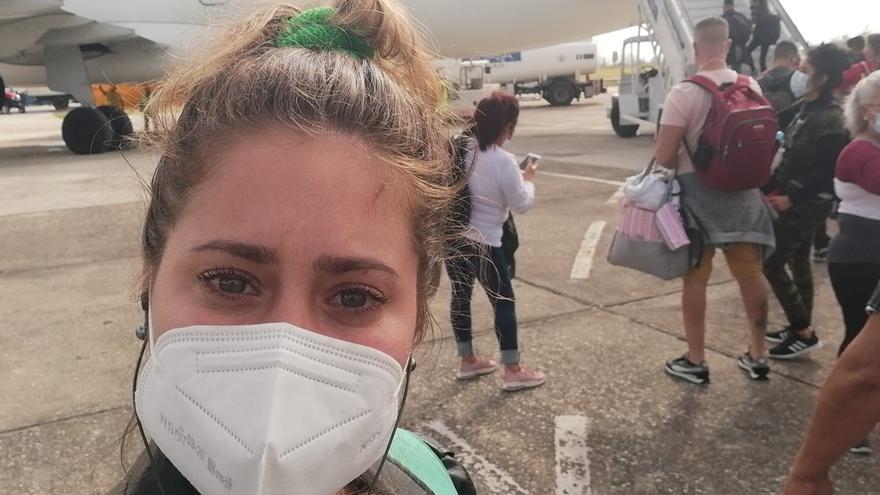
Official announcer Amanda Toirac just before boarding her flight out of Cuba. (Facebook)
14ymedio, Havana, 28 April 2022 — The ’Informative System’ announcer Amanda Toirac joins the ranks of official journalists who are leaving Cuba. The young woman published on social networks that she left the Island after discovering that she felt “complicit and dishonest.”
The young Radio Rebelde announcer pointed out that she was told to “repress” her countrymen and that, on refusing, she saw “the true face of the monster they have turned my country into.”
“I started to leave when I knew that I was a spokesperson for lies on a radio station,” wrote Toirac, who qualifies her words by pointing out that she discovered since the July 11 protests and that she realized that she lived in a country “that only existed in my head.”
In her words, the announcer captures part of the Cuban reality, which she summarizes, speaking softly, when with the Government: purchases in MLC (Freely Convertible Currency), the high prices of food such as oil and milk, and the dismissal of the director of Alma Mater magazine.
“There is no jungle, no river, no desert, no border, where I don’t ask myself if I did the right thing. There isn’t a day that doesn’t hurt,” she adds.
In response to Toirac’s words a river of comments flows wishing her luck on her new route and others questioning her for having waited until July 11 to “realize it.” continue reading
Commenter Jessica Genes wrote, “Since I was 15 years old I realized the reality of my country. I don’t know why it took you so long. Because even a child is capable of seeing reality, what a pity that you were complicit in many, so very many lies.”
Although she does not reveal what her destination is, in the photo she posts on her Facebook account, the young woman is seen about to board an Air Century plane bound for Santo Domingo. Before Toirac, several media professionals have left Cuba, such as Maray Suárez, who has rebuilt her life in Miami as an ’emotional coach’, in the country to which she dedicated so many attacks from Cuban television.
This is also the case of journalist and official Cuban television presenter Yunior Smith, who this March confirmed that he was on the southern border of the United States, requesting political asylum.
That same month, the stampede of spokesmen for the Cuban regime continued with the arrival in Florida of Alejandro Quintana Morales, Radio Rebelde announcer and television presenter, who congratulated himself on his Facebook profile for being in a country where one can “feel free.”
Last January, the arrival in the US of another Cuban official broadcaster, Frank Abel Gómez Bernal, caused much controversy in the exile community in Miami. The communicator, popular on radio and television, requested political asylum and after entering the country he told the press that, although he had his job in Cuba, he “was starving.”
This February, the former director of the Information System of Cuban Television and of the news program Buenos Días, Yailén Insúa Alarcón, ended up stranded at the Bogotá airport when she tried to reach Nicaragua fleeing the island. In her case, she asked the Colombian government for asylum, alleging her life would be in danger if she returned to Cuba.
____________
COLLABORATE WITH OUR WORK: The 14ymedio team is committed to practicing serious journalism that reflects Cuba’s reality in all its depth. Thank you for joining us on this long journey. We invite you to continue supporting us by becoming a member of 14ymedio now. Together we can continue transforming journalism in Cuba.
They leave (a decision that I personally do not question) but I continue to investigate how many lies they helped spread that cost tears, social isolation and physical pain to others. (Facebook)
14ymedio, Yoani Sánchez, Generation Y, Havana, 28 April 2022 — I wonder how many of these official journalists who are taking to their heels helped to prolong the demonization of independent reporters, contributed to silencing the voices of the media not controlled by the Communist Party (either because of their actions or because of their lack of action).
How many of them spread the idea that we were the “traitors,” the “enemies,” who had to be silenced, and then moved their mouths away from the microphone. How many looked at us over their shoulders, chewed our names with annoyance, joined the defamation campaigns against us and, now, put the sea in between us. They leave (a decision that I personally do not question) but I continue to investigate how many lies they helped spread that cost tears, social isolation and physical pain to others.
The responsibility of the journalist is not a suit that is taken off and left behind to put on another, clean of stains. The responsibility of the journalist implies knowing that the words said, the headlines circulated and the lies amplified also left victims, cut off the path for more honest people to reach the cameras, pulled the rug out from under excellent masters of information who, because they had critical ideas, were never able to stand in front of a classroom. The journalist’s responsibility leads us to wonder: These official reporters who are fleeing today, how many years of ‘survival’ did they give the dictatorship?
Questions that I ask myself. From here, from Havana.
____________
COLLABORATE WITH OUR WORK: The 14ymedio team is committed to practicing serious journalism that reflects Cuba’s reality in all its depth. Thank you for joining us on this long journey. We invite you to continue supporting us by becoming a member of 14ymedio now. Together we can continue transforming journalism in Cuba.
Armando Franco Senén became director of ’Alma Mater’ magazine in 2019. (14ymedio)
14ymedio, Havana, April 27, 2022–On Tuesday Alma Mater, the Cuban university magazine, was left without its director, Armando Franco Senén, a decision of the Union of Young Communists (UJC), in a clear interference by the university publication’s partisan organization.
The news was delivered by Alma Mater itself on its Facebook page, where it shared the short statement which left much to be desired by nearly 900 users who joined. “By decision of the National Bureau of the Union of Young Communists, Armando Franco Senén was relieved of his duties as director of the magazine.”
Franco, who graduated with a degree in journalism in 2016 and was a professor in the School of Communication in Havana, took charge of Alma Mater in 2019. The publication had won the favor of many people — close and not so close — to the state for its more modern treatment of information, the openness to topics rarely covered by other media, and, of late, its coverage of July 11th (11J).
The magazine focused heavily on information about the protesters who were arrested, many of them students, which is very unusual for a channel of the regime. Alma Mater clearly advocated, in some cases, for the release of those arrested or the cancellation of the judicial proceedings to which they were subjected.
On Tuesday, the magazine published an interview with Cuban Chancellor Bruno Rodríguez Padilla, which centered on the issue of migration and relations with the U.S. with regard to that topic. Some believe it to be coincidence that Franco’s exit occurred immediately afterward, however there does not appear to be a reason to link them, as the questions did not cause the minister any discomfort, and he was given plenty of space for his discourse. continue reading
Those close to the journalist attribute the dismissal to the timid revolution in form and content that Franco brought to the magazine.
This year Alma Mater celebrates its centennial and it is one of the oldest publications in Cuba. The magazine has always been characterized by its independence and its ability to reflect the sentiment among university students. Following Fidel Castro’s rise to power, it slowly lost its autonomy, but even then tried to maintain its mark. The decision to dismiss its director left many perplexed as it a reflection of the control that the youth organization of Cuba’s Communist Party has over the magazine.
“He revitalized something that for years, no university student had read and others didn’t even know existed. I will proceed to remove my “like” from its page because I already know what’s coming!!!” said one of the hundreds of readers who expressed their rejection of the news.
Another commenter, who knew Franco in high school, praised his character from when he was young and defended causes. “A leader is born, not made, and he was born with that quality, which he further developed during his life. Years later, he became the director of Alma Mater magazine and returned to me a habit I had lost long ago, reading the news; but this time, I was reading something very different to what I was accustomed and that should be appreciated, that is what we need, that is what we have to encourage, it is what we need to defend,” they added.
“I don’t know the reasons, but taking into consideration the journalism that Alma Mater was doing under the direction of Armando Franco, the UJC Bureau should analyze this. Do they know the type of journalism Cuba’s youth need? Without words. It hurts,” laments a third commenter.
The majority have demanded that the reasons be made public with clarity and that the magazine’s autonomy be returned. “And how can the organization which represents reolutionary youth dismiss the director of the magazine and the most revolutionary example of journalism I’ve read in a long time?”
With its refined satiric humor, El Lumpen could not pass up the comparison and has shared the news and images of the former director of the newspaper and the Spanish dictator titled: Alma Mater Rectifies and Franco Returns.
Translated by: Silvia Suárez
____________
COLLABORATE WITH OUR WORK: The 14ymedio team is committed to practicing serious journalism that reflects Cuba’s reality in all its depth. Thank you for joining us on this long journey. We invite you to continue supporting us by becoming a member of 14ymedio now. Together we can continue transforming journalism in Cuba.
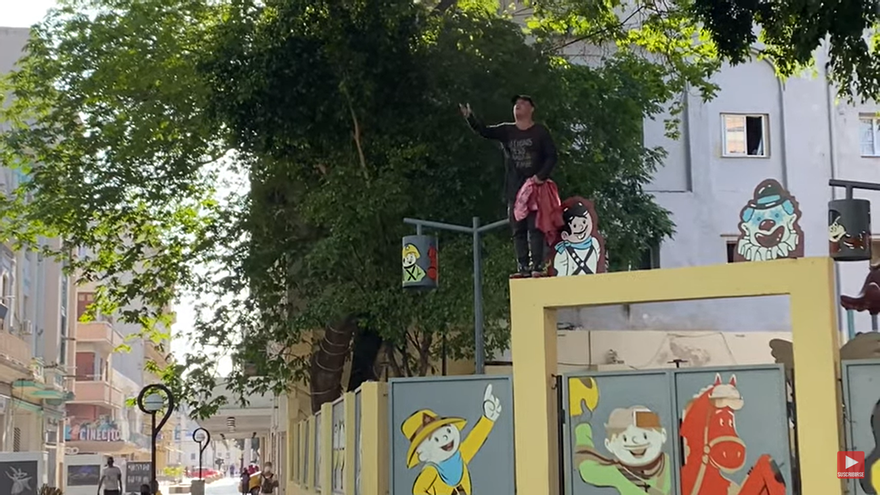
The citizen began to carry out his peaceful protest a approximately 8:47 am. (Camila Carballo/INSIDE/Capture/YouTube)
14ymedio, Havana, 28 April 2022 — “If you want Fidel to live, well let Fidel live, that is your problem. I do not want to be a communist!” The phrase was spoken very loudly early on Thursday morning on San Rafael boulevard in Havana. Some stood and watched, others filmed with their cell phones.
The clamor came from a lone man, Carlos Ernesto Díaz González (known on social media as Ktivo Disidente), standing upon the walled entrance of a playground located on the corner of San Rafael and Industria, a busy pedestrian walkway that includes numerous businesses and connects the municipalities of Centro Habana and La Habana Vieja. A few meters away there is an MLC* store which only takes payments in freely convertible currency.
“There doesn’t need to be violence, there doesn’t need to be bloodshed but they must allow us to participate in the political life of this country,” he demanded. “Whoever is a communist, let them be, but they must respect whomever does not want to be,” continued the activist in a spiel that continued for five minutes.
At several points during his presentation, the man stated, “All Cubans have a right to participate in the political life of the country, be they communists or not.” Díaz González is a member of Archipiélago and was arrested last November, on the eve of the Civic March for Change, for putting up protest posters in Cienfuegos. continue reading
“Soon they will place two or three there so that they can conduct an act of repudiation, to a Cuban who is raising his voice. But it will continue to be that way until we do what we have to do and demand what we need to demand because it is ours, because we have the right to have rights,” he said referencing the daily repression of the Cuban regime against opponents or regular citizens who criticize the government.
On Wednesday, a few hours before climbing on the wall in Havana, Ktivo Disidente had uploaded a video in which he invited Cubans to a march in favor of freedom for political prisoners.
During his speech, the man received shouts of disagreement from some people who demanded he be quiet, but he was not daunted. “The people are scared , the people have been terrorized: citations, the sector chief on your back, a snitch on you. How long will we live like this?” he insists.
“Yes, you can buy there,” he warned another who requested silence from the line to enter the hard currency store — where the line had begun to form early in the morning — and where they sell personal hygiene products and cleaning supplies for the home.
The man demanded freedom for Cuban political prisoners and again insisted, “All Cubans deserve to participate in the political life of the country. They must count on us. Inclusion! An inclusive homeland! We are not obliged to be communists or socialists. Wherever communism has passed is a disaster. They are going to turn us into a North Korea.”
Police began to congregate around him, but their intervention was hampered by the height of the location from where the man shouted. Finally, more than ten uniformed policemen around the corner ordered the passers-by to turn off their mobile phones or move away from the area.
Later the man came down without resisting and, according to witnesses, was handcuffed and placed in a car. “I know nothing more of this sad story,” said one of those present.
Street protests have a recent history. On 4 December 2020, young Luis Robles protested on that same boulevard in Havana, a few meters from where Thursday’s events occurred. At that time, the activist peacefully protested, raising a placard which sought freedom, an end to repression and the release of protest rapper Denis Solís.
In March, Robles was sentenced to five years in prison and in the sentencing document, the judges justified their decision because the young man maintained a “marked interest in creating an environment to destabilize the social system and domestic economic development.”
Translated by: Silvia Suárez
____________
COLLABORATE WITH OUR WORK: The 14ymedio team is committed to practicing serious journalism that reflects Cuba’s reality in all its depth. Thank you for joining us on this long journey. We invite you to continue supporting us by becoming a member of 14ymedio now. Together we can continue transforming journalism in Cuba.
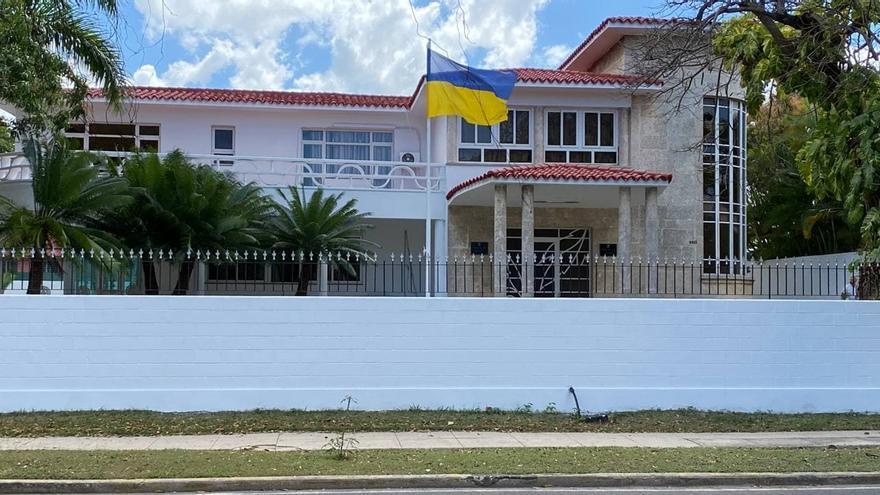
The Embassy of Ukraine is located on Fifth Avenue in the municipality of Playa, Havana. (14ymedio)
14ymedio, Havana, 27 April 2022 — The state press agency of Ukraine, Ukrinform, is blocked in Cuba according to the report of the Cuban political scientist, Alexei Padilla, on Facebook, and published in Diario de Cuba. The site isn’t accessible from the Island without VPN (a Virtual Private Network)*, although the Cuban Government has not made any public decision in this regard, as is usually the case when the decision is taken to prohibit other news media, whether they be international, like CNN, or national, like 14ymedio itself.
“UPEC (The Cuban Union of Journalists) itself, which rent its garments in anguish over the censure of Russian media in Europe and the U.S., perhaps hasn’t heard, I think, of the censure in Cuba of Ukraine’s principal news agency, because Ukraine and its news media don’t have solidarity with UPEC,” said Padilla on Facebook.
Since the beginning of Russia’s invasion of Ukraine on February 24, the official media of the Island have criticized any method of sanction taken by the members of NATO and other western countries against businesses, institutions, and persons linked to Putin’s government. One of these measures has been the European blockade of Russia Today and Sputnik, which have been accused of disinformation and generating destabilizing currents of opinion.
In addition, collaterally, the financial sanctions also prevent the financing of delegations from those media in Europe, and issues can include anything from the rental of housing to workers’ salaries. continue reading
At the beginning of March, UPEC denounced the suspension of those media as a “cultural crime” and considered this a violation of the rights “of millions of people who lack all the elements necessary to evaluate the conflict.” Up to now they haven’t said a word about the application of similar measures in Cuba for Ukrinform, just as they have never said anything about the rights of Cubans to know points of view that are different from the official ones.
In all this time, Cuban State media continues to publish articles rejecting the western censorship of the Russian media and even went so far as to call the West “Nazis” in a text published September 5, entitled “The Russians are the new Jews and the West the Third Reich.”
In it, in addition, half-truths were spread like the one that said the University of Valencia in Spain had “invited” the Russian alumni to leave. In reality, the institution had offered economic and administrative support to whoever wanted to return to Russia, a complex task because of the sanctions.
It also said that the University of Córdoba fired the Russian professors, something legally impossible. That institution indicated that there was a revision of the programs of collaboration maintained with the technical scientific institutions of the Russian State.
The official Cuban press has been the mouthpiece for the Kremlin in the 63 days of the conflict, questioning the reports coming from Ukraine without any proof and defending those coming from Russia, among them denying the massacre in Bucha, verified even through aerial photographs and comprehensive, irrefutable reports from The New York Times.
Ukrinform was founded in 1918 and belongs to the European Alliance of News Agencies. The European governments announced the end of emissions from Russian media in February, while Russia made public the blocking of channels like the BBC, Voice of America, Radio Free Europe/Radio Liberty and Meduza, in addition to Twitter and Facebook. But the Cuban Government maintains silence about its censorship.
*Translator’s note: VPN stands for “Virtual Private Network,” an application that encrypts data, identity, and browser history for a monthly fee.
Translated by Regina Anavy
____________
COLLABORATE WITH OUR WORK: The 14ymedio team is committed to practicing serious journalism that reflects Cuba’s reality in all its depth. Thank you for joining us on this long journey. We invite you to continue supporting us by becoming a member of 14ymedio now. Together we can continue transforming journalism in Cuba.
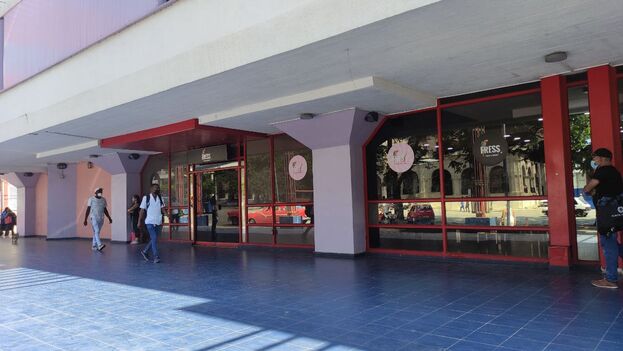
A sign behind the windows said the same thing as the employees of the place: it would be closed due to “technical problems”. (14ymedio)
14ymedio, Juan Diego Rodríguez, Havana, 26 April 2022 — The sale of food in Cuban pesos has lasted three days at the Fress store in Plaza de Carlos III, in Havana. This Monday, the brand new business, which opened its doors on Friday with great anticipation, was closed.
To the question of a client who was surprised, an employee of the place explained that he was without service “temporarily” due to “technical problems.” The same was written on a sign behind its windows. And indeed, inside it could be seen how an operator was messing around in a display refrigerator.
The employee also said that they would open tomorrow, Tuesday, but “only the food area,” that is, the cafeteria to consume already prepared products on the premises. This newspaper was able to verify that almost all the canned foods and also the dairy products that filled the shelves and refrigerators for sale to the public had disappeared.
According to two workers from the Plaza speaking to 14ymedio, “they held an emergency meeting here in Carlos III due to criticism on social networks, and starting tomorrow they can only sell prepared food.”
Another worker asserted that “they had ordered the closure from above, from the Government,” due to criticism of the resale of products such as condensed milk, which was sold for 250 pesos at Fress, a few meters from the Plaza supermarket where it costs 35 pesos but where the lines to enter can take long hours. The same goes for gouda cheese at 4,000 pesos for a wheel of three kilograms, which is only found in stores in hard currency. continue reading
The opening of the store caused outrage among its first customers, who left dismayed by the extremely high prices of products that are much cheaper in state stores in the same shopping center.
The Fress store, in Plaza de Carlos III in Havana, closed this Monday. (14ymedio)
Sources from Carlos III Plaza had confirmed to this newspaper that the state premises were rented to a Spaniard, something unusual in Cuba for a private establishment of this type. The man himself welcomed the customers on opening day. Until now, Fress provided its services through various online shopping sites for home delivery, supported by payments from abroad.
“If the only thing that is going to remain here is the hot table, this will not last even a week, because the food was bad, bad,” commented a young man, this Monday, upon learning of the sudden turn of business.
“But of course, if people here are persecuted for that when they do it at the door of their house, or in their cafeteria, in their paladar (private restaurant),” a woman replied. “I have nothing against the private ones, but the problem is not that it is private, but that it was cheeky. Why some yes and others no?”
____________
COLLABORATE WITH OUR WORK: The 14ymedio team is committed to practicing serious journalism that reflects Cuba’s reality in all its depth. Thank you for joining us on this long journey. We invite you to continue supporting us by becoming a member of 14ymedio now. Together we can continue transforming journalism in Cuba.
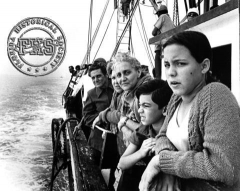
Cubans during the 1980 Mariel boatlift. (FLORIDA HISTORICAL SOCIETY)
14ymedio, Elias Amor Bravo, Economist, 22 April 2022 — There are two phenomena that have affected the life of the Communist Regime in Cuba for six decades. The two are closely related and have also been used for the Cuban government’s own benefit every time it wanted to.
To interpret both processes over such a long period of time can cause forgetfulness, intentional or not, which makes it difficult for the general public to understand what’s being discussed. Is it enough to read an article in the State’s flagship newspaper Granma entitled “Who benefits from creating a ’migratory crisis’ between the U.S. and Cuba”? The article goes to the heart of the matter by recounting facts that seem taken out of a fairytale.
It was enough to read that, already in the Fifties, Cuba wasn’t receiving immigrants and that what was really happening was a massive exodus of Cubans to the United States, where, the article says, 100,000 Cubans were living in 1958. This has nothing to do with the more than 2 million in 2022. But it’s all the same; when It’s a matter of distorting reality and creating a nonexistent alternative, the Communists have no rival.
And there’s no other way to look more ridiculous than to be determined to do the same thing over and over again. The only thing you can do is to go to the ONEI, the National Office of Statistics and Information, and consult the annual statistics for 2020, the latest published in the historical series of population by sex, annual rate of growth, and ratio of male to female.
If you take the figures from 1950, which show 5,876,052 inhabitants, and compare it to 1960, with 7,077,190 inhabitants, there is an increase in population of 1,201,138, or 14%, the highest in the historic data. Later, in the decade of the Sixties, the relative growth was lower, some 13%.
To think that this increase in population in Cuba in the Fifties was due only to birth and death is naive. A half-million Europeans came to Cuba in those years to realize their dreams, because in their countries of origin it was impossible. But be careful with the data, because they’re a boomerang that can come back to hit you. continue reading
Starting from this observation, reality confirms that the Cuban population is affected by the massive exodus of Cubans to the Exterior, a flow that hasn’t slowed since 1959 and that the Communist regime has managed at its will, encouraging every 15 years, more or less, massive population departures: 1965, Camarioca; 1980, Mariel, 1994 Guantánamo (Balseros).
The data exist for anyone interested, and there’s no need to invent them. This continual exodus of six decades has made Cuba the world leader as the country that has a larger percentage of its citizens living in the Exterior, nothing more and nothing less than 20%. Not even the levels of migration in the Third World reach these numbers.
Cubans have turned their backs on the Regime that requires them to live a certain way, a way they don’t want, and with the impossibility of democratic changes, they leave the country, because in Cuba it’s impossible, with the Communist Party in power, to open a space for a democratic process and freedoms, or for economic reforms that improve prosperity and a better quality of life.
So now we have the second result. The U.S, throughout this traumatic history, has received more Cubans and “prevented” them from living in their country because of the “embargo/blockade” (as Fidel Castro branded it), which certainly doesn’t exist. The U.S. has to face, every day, a political regime that presents the ’blockade’ to the international community as the cause of all Cuba’s ills.
But the argument creates many scandalous votes in the United Nations, with claims that Cuba is owed billions of dollars because of the embargo, and other absurd nonsense. The embargo has become wishful thinking that has no common sense. Trade between the United States and Cuba reaches 200 million dollars annually, and Cuba receives from the United States around six billion dollars in remittances each year that now other countries will want.
And in spite of the evidence, the leaders in Havana play the embargo card every time things get complicated in Cuba, as is happening presently, above all since they launched the ’Ordering Task’ in 2021* with disastrous consequences for the country.
So now we face a new cycle in which the Communist leaders can expect another massive exit from the country to reduce the internal social tensions provoked by poor management of the economy. They can blame the U.S. for everything under the heading of “blockade/embargo” and encourage it through some worthless negotiations, which end up with the U.S. welcoming those who want to abandon the Island in search of a better future.
In this way the ’blockade’ and the immigration crisis are two sides of the same coin which the Regime plays with. And it gets advantageous results in the international sphere at the same time it rids itself of many problems that it doesn’t recognize or, worse, that It doesn’t want to fix. And thus for more than 60 years, they fall into the same trap.
*Translator’s note: Tarea ordenamiento, the [so-called] ‘Ordering Task’, is a collection of measures that include eliminating the Cuban Convertible Peso (CUC), leaving the Cuban peso as the only national currency, raising prices, raising salaries (but not as much as prices), opening stores that take payment only in hard currency which must be in the form of specially issued pre-paid debit cards, and other measures.
Translated by Regina Anavy
____________
COLLABORATE WITH OUR WORK: The 14ymedio team is committed to practicing serious journalism that reflects Cuba’s reality in all its depth. Thank you for joining us on this long journey. We invite you to continue supporting us by becoming a member of 14ymedio now. Together we can continue transforming journalism in Cuba.
Brusnelvis Adrián Cabrera Gutiérrez was arrested in La Güinera. (Facebook)
14ymedio, Maite Rico, Madrid, 25 April 2022 — The People’s Provincial Court of Havana has found that “Brusnelvis Adrián Cabrera Gutiérrez, 21, appeared at the scene of the crowd riding a red moped, with which he joined those present, and made gestures with his hands and movements with his body inciting people who were watching to join the disorder.” It was July 11, 2021, when Cuba vibrated with the largest demonstrations against the dictatorship in six decades. For these gestures, Cabrera is sentenced to 15 years in prison.
The repression for the protests has been fierce; 894 protesters, including several minors, were jailed. Of these, 652 have already been sentenced in farce-trials behind closed doors, with 40% of them sentenced to more than ten years. And some of them, to 30 years.
For Lázara González, a girl from Cárdenas, the prosecution asked for eight years for shouting “Díaz-Canel singao [ motherfucker]“, “Patria y Vida” and “Libertad.” After a year in pretrial detention, they have lowered the sentence to three years of “correctional work.” continue reading
Wilmer Moreno, a musician and arranger, has been converted into an “agent of the foreign opposition” because he received 200 euros a month for his work for the Miami Odyssey Studio. He received 26 years in prison.
Add to this the police harassment of families, the raids, the beatings, the atrocious conditions in the overcrowded prisons: the Island has, the largest prison population on the planet* (100,000 inmates out of 11 million inhabitants) and it is the country with the most political prisoners in America.
And while the world is scandalized, there is someone satisfied: a certain Manuel Pineda, who thanks to United Left has managed to sit his enormous buttocks on a seat in the European Parliament. Yes, the same one who confronted the mayor of Melitopol (Ukraine) with the argument of Russian propaganda and was scalded. This same Pineda spat out in December (before an empty European Parliament, it is true) that “Cuba is a participatory democracy” and “an example of respect for human rights.” That there are no arbitrary arrests, that those who are in jail “are criminals” and that “homeland or death, we will win.”
A month earlier, Pineda had gone to Havana to pay homage to Cuban president Díaz-Canel. He looks like a caricature, but he is a Member of the European Parliament (MEP) from Spain. And a co-religionist of several government ministers, by the way. It is convenient not to forget where everyone is and to have located the miserable ones.
Editor’s Note: This article was originally published in the Spanish newspaper El Mundo and is reproduced with the permission of its author.
_____________
COLLABORATE WITH OUR WORK: The 14ymedio team is committed to practicing serious journalism that reflects Cuba’s reality in all its depth. Thank you for joining us on this long journey. We invite you to continue supporting us by becoming a member of 14ymedio now. Together we can continue transforming journalism in Cuba.
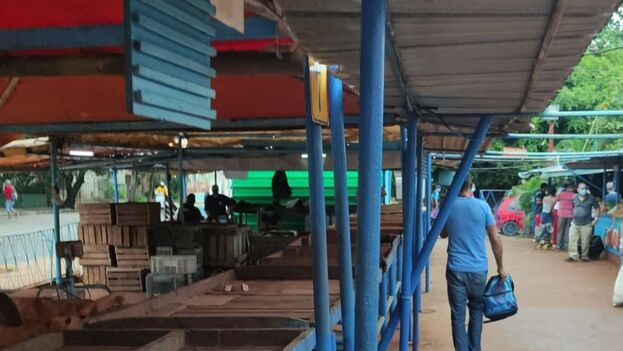
 Alexis Romay, New Jersey, 30 April 2022