Raul Castro Reappears After a Long Public Absence

Raúl Castro reviewed with other officials “the Plan for the prevention and control of the new coronavirus”, details a brief official note. (Granma)

14ymedio bigger14ymedio, Havana, 18 April 2020 — Raúl Castro reappeared this Friday after a long public absence to preside over a meeting to analyze the current situation of Covid-19 in Cuba, according to official press reports. The former president had not been seen in any official image since late February.

As first secretary of the Communist Party, wearing a military uniform and mask, Castro reviewed with other officials “the Plan for the prevention and control of the new coronavirus,” according to a brief note in the state-run newspaper  Granma. The meeting “also evaluated the effects on the performance of the national economy generated by the pandemic.”

Also present at the meeting were President Miguel Díaz-Canel, Prime Minister Manuel Marrero and the second secretary of the Cuban Communist Party (PCC), José Ramón Machado Ventura. continue reading

Castro’s prolonged absence from the public eye, at age 88, had aroused speculation and criticism, in a country where the health of political leaders has always been surrounded by the utmost secrecy. In the streets, many Cubans complained that the leader of the only party allowed on the Island had not sent a message during the current emergency.

The Constitution approved a year ago establishes, in Article 5, the status of the Communist Party as the “superior leading political force of society and the State,” so the organization’s first secretary must lead the policy to be followed in the nation.

After the publication of the news this Friday, several commentators on official digital sites lamented that fragments of what had been discussed at the meeting where Castro was present had not been broadcast on national television. “So that the people would know directly what is being discussed and how it is being discussed in the government, in the party, without having a journalist as an intermediary,” said one Internet user.

Previously, the official media had made reference to the former governor’s participation in a meeting of the PCC Political Bureau, but images of the meeting were never released, fueling popular rumors.

Coincidentally with Castro’s absence in Cuba, Nicaraguan Daniel Ortega went 34 days without showing himself in public. The 74-year-old president reappeared on Thursday and delivered a speech in which he criticized the United Nations Organization and defended his strategy of not taking preventive measures against the pandemic.

The Nicaraguan government has not ordered the closure of borders, compulsory quarantines, the cancellation of massive events or classes in schools.

The World Health Organization (WHO) recently expressed concern about the management of the coronavirus in Nicaragua.

“The Pan American Health Organization (PAHO) has been concerned about the response to Covid-19 seen in Nicaragua. We are concerned about the lack of social distancing, the convening of mass meetings,” said PAHO/WHO director Carissa Etienne.

_____________________

COLLABORATE WITH OUR WORK: The 14ymedio team is committed to practicing serious journalism that reflects Cuba’s reality in all its depth. Thank you for joining us on this long journey. We invite you to continue supporting us by becoming a member of 14ymedio now. Together we can continue transforming journalism in Cuba.
A 3,000 Peso Fine for Monica Baro for Texts on Facebook

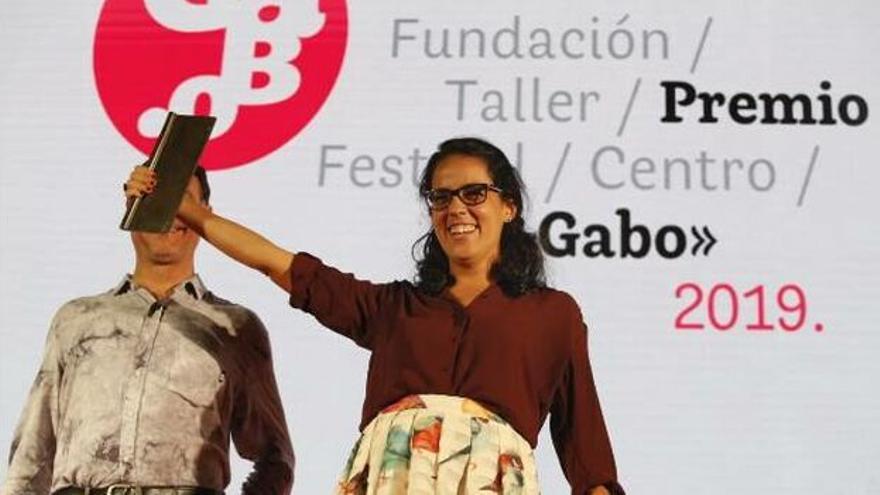
Mónica Baró Sánchez obtained the Gabo Prize 2019 in the Text category for the report ’The blood was never yellow’. (Capture)

14ymedio bigger14ymedio, Havana, 18 April 2020 — After a two-hour interrogation, the independent journalist Mónica Baró was fined 3,000 pesos under the rule of Decree Law 370 that regulates the use of the internet in Cuba. The reporter was summoned despite the Covid-19 pandemic and the authorities’ call for Cubans not to leave their homes.

The fine is called for in Article 68 subsection (i) of the decree, which punishes “disseminating, through public data transmission networks, information contrary to social interest, morality, good customs and the integrity of the people.”

In statements to 14ymedio Mónica Baró said that for her “it is a tremendously vague, imprecise paragraph, and it lends itself, as recent events have shown, to violating the fundamental freedoms of people, whether or not they are journalists, but above all, that of journalists.” continue reading

The reporter for the magazine El Estornudo (The Sneeze), who has collaborated with other media such as Periodismo de Barrio, believes that it is also a violation of privacy. “A profile on Facebook is highly personal, although its content is often public,” she said.

In a post that she published on her networks on leaving the police unit where he was questioned, Baró said that the officers showed her as evidence of her “crime” a folder with dozens of sheets printed with captures of her Facebook posts published over the course of several months.

The reporter didn’t accept the accusation and replied that she was “willing to assume the consequences” of her actions from the moment she decided to become an independent journalist.

“Major Ernesto expected me to say that I was in error, but I did not meet his expectations. Then he sent for two inspectors from the Ministry of Communications, who appeared and immediately spoke to me of Decree Law 370, in particular of subsection ( i) of Article 68,” she added.

The young journalist made clear her disagreement with the fine imposed on her. “I did not want to sign it, nor do I intend to pay it. They explained to me that if I did not pay it, it doubled, tripled, and that the thing could end up in prosecution.”

The officer who identified himself as Major Ernesto told her that “soon” they would see each other again. Baró insisted that she is “prepared for everything” but fears that the next step for the authorities is to go to her home and confiscate her work equipment, a measure that is part of the sanctions established by Decree Law 370.

“And no, I will not stop saying or writing what I think because I receive threats or attempts at intimidation. They will not shut me up. I simply cannot stop being who I am and I am a free woman journalist. Free, first of all.”

Baró Sánchez won the 2019 Gabo Prize in the Text category for the report “The blood was never yellow” and in which she reported on lead poisoning in a community in the municipality of San Miguel del Padrón, in the province of Havana.

Independent journalist Niober García Fournier also received a fine of 3,000 pesos this week, in Guantánamo, also under Decree Law 370 and after being questioned.

In the midst of the crisis that Cuba and the world are experiencing due to Covid-9, several journalists have been summoned to be questioned by State Security, in a clear violation of the measures announced by the Government, which asks everyone not to go into the street to avoid contagion.

Decree Law 370 establishes extensive control by the Government over the internet. It does this by regulating the use of new technologies, greater supervision over wireless networks, and strict limits on the publication of online content. Violations of these regulations are sanctioned with fines and confiscation of the equipment and means used to published the offending materials.

The entry into force of this decree raised a broad condemnation by international organizations related to freedom of expression, in addition to numerous criticisms from activists and independent journalists, which have created their own news spaces thanks to new technologies.

______________

COLLABORATE WITH OUR WORK: The 14ymedio team is committed to practicing serious journalism that reflects Cuba’s reality in all its depth. Thank you for joining us on this long journey. We invite you to continue supporting us by becoming a member of 14ymedio now. Together we can continue transforming journalism in Cuba.
The Uncertain Path of Pork

14ymedio bigger14ymedio, Pedro Acosta, Havana, 16 April 2020 — For lack of other meats, pork has taken center place in the diet of Cubans who can classify as “emerging middle class” or who are on the way to taking their place on that social perch. Fresh fish, sea food and beef are the privilege of that ten percent who don’t ask “how much?” before deciding to buy something. The rest of the population hopes for sausages and canned sardines, and line up early when the rationed chicken arrives.

Pork, however, shows up in one degree or another at all levels of consumption. This is the reason that any situation that decreases its production or hampers its transaction is reflected immediately in its price. The response of the State, which tries to control everything, wavers between rationing and applying a price cap.

A few months before the crisis caused by Covid-19, a rule was announced to regulate at 45 pesos (CUP) the maximum price for a pound of boneless pork in the capital city. In the other municipalities of the countryside, the top price remained at 35 pesos. continue reading

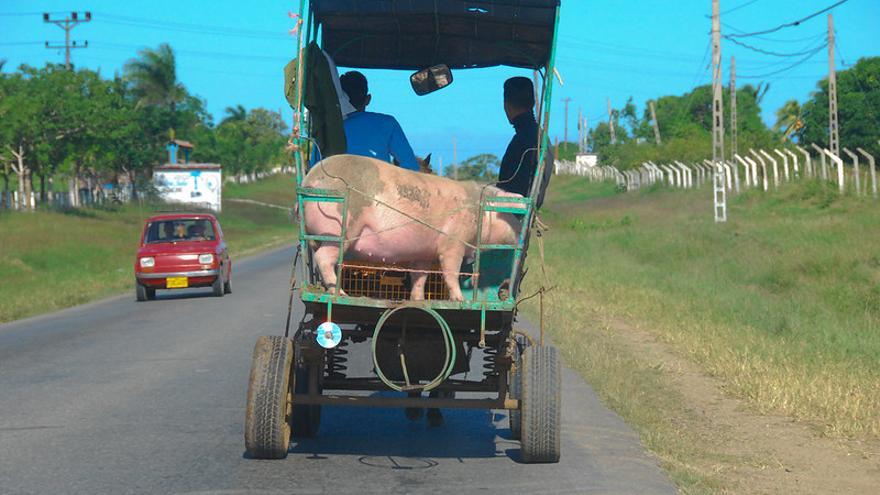
At the present time, in the middle of April, a pound of pork on the hoof varies between 25 and 30 pesos. The hunting-down of each animal is quoted at 50 pesos, because these hogs are not in a stock-yard waiting for someone to come by and pick them up. Detective work is required which consists of verifying who has the hogs and in what place the hogs are kept ready for sacrifice, in addition to going out on horseback to round them up.

On top of this, the drover who exercises this roundup has to pay at least 600 pesos to the wagon driver who will deliver the condemned to the abattoir, and to the executioner goes another 100 pesos for each hog he kills and cleans.

Throughout this process (similar to what the State calls “chain port transport internal economy”) [sic] and at each of these steps the crises is felt. For there is no hauling if fuel prices are too high, and the vigilance for anything which might appear illegal has become insufferable.

As it is dangerous to raise prices at the point of sale, which is the only point under surveillance by the authorities, the merchants have begun to close their butcher shops — at least the visible ones that operate under license. This doesn’t mean that the business has ceased. Each butcher has a fixed number of clients whom he knows personally. Selling to these on the sly suffices to continue earning at least enough to live.

This brings to light a feature of the dark mechanisms of the informal market. When the producer comes to the conclusion that competition doesn’t affect him and that the consumer has no alternative but to accept the prices the producer imposes, the stimulus to increase production in order to earn more disappears.

One needn’t be an economist to realize that this generates a vicious cycle in which the prices enter into a spiral.

Where does it end, and when? First, we need to know when the pandemic ends…

Translated by: Pedro Antonio Gallet Gobin

_____________

COLLABORATE WITH OUR WORK: The 14ymedio team is committed to practicing serious journalism that reflects Cuba’s reality in all its depth. Thank you for joining us on this long journey. We invite you to continue supporting us by becoming a member of 14ymedio now. Together we can continue transforming journalism in Cuba.
Havana Dawns Without Transport

There is calm at the stop in Boyeros and Tulipán on the first day when buses operate only for essential workers. (14ymedio)

14ymedio bigger14ymedio, Luz Escobar, Havana | 14 April 2020 — It is nine o’clock in the morning and the nurse, in her impeccable white uniform, has been waiting since half-past six for transport to take her to work at the hospital.

“This is awful today. I’m at this stop trying to get to the hospital, but nothing,” she says as she waits on Boyeros Avenue. Despite being one of the people whose travel is prioritized, there is no doubt that today she will be late for work.

“The thing is, nothing was coordinated on Sunday and this Monday we did not know how to get around. I hope this improves,” she says. In a few minutes she sees an ambulance and beckons to it in the hope that it will stop and take her to her destination, or at least leave her close, but the vehicle goes in another direction and drives off without being able to carry her. continue reading

Last Thursday, the authorities announced the closure of urban public transport to curb the spread of the coronavirus, which is already spreading through community transmission in Cuba. The Minister of Transportation, Eduardo Rodríguez Dávila, indicated that only workers from prioritized activities could access the vehicles through an identification mechanism, but on the first day it did not work well.

Some, like Luis Cañizares, who was waiting a few yards from the nurse, seemed to have misunderstood the measure. “I live with my mother, but I take care of my aunt who is very ill and lives alone in Playa. From here it is impossible to go direct so I must get to El Vedado first, but nothing has happened. On television they warned us about it but never I thought it was so general,” this resident of Plaza de la Revolución tells 14ymedio. “What happens is that she needs me because she is very old and sick and cannot go out shopping,” he insists.

After waiting almost three hours, the nurse manages to get on a bus from the Transmetro line that serves a hospital and stops to pick her up. Although Cañizares tries to convince the driver he has good reason to travel, the driver explains that he is only allowed to pick up the identified medical personnel.

“Then they talk about solidarity, but it wouldn’t cost him anything to take me. The bus was empty, there were only about five people. I don’t understand why they paralyze everything like this, there are people who need to move and Havana is a big city,” he protests.

Urban transport has been suspended as of Monday (14ymedio)

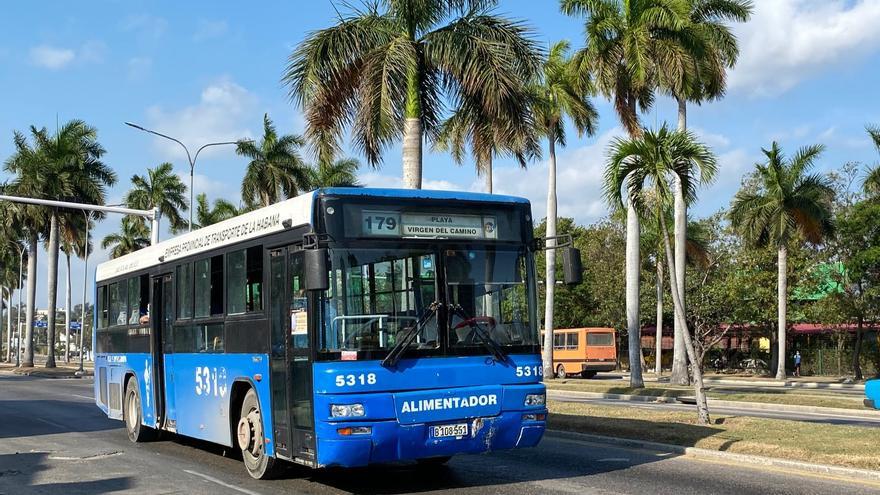
In addition to urban and intercity transport, both public and private, the authorities have also suspended the extra capacity provided by state vehicles at the stops that it regulated since last September, where they were ordered to contribute to carrying bus passengers in the context of crisis that the Government defined as a “temporary situation.”

The Transport Minister noted this Monday in the state-run newspaper Granma that the measures do not affect private vehicles, which can continue to circulate for “the essential and without overcrowding.” In addition, he explained that services related to mobility, such as racing and management of passengers at taxi stops, are also suspended. “The suspension has been carried out ex officio, so that the workers do not need to carry out any formalities,” he clarified.

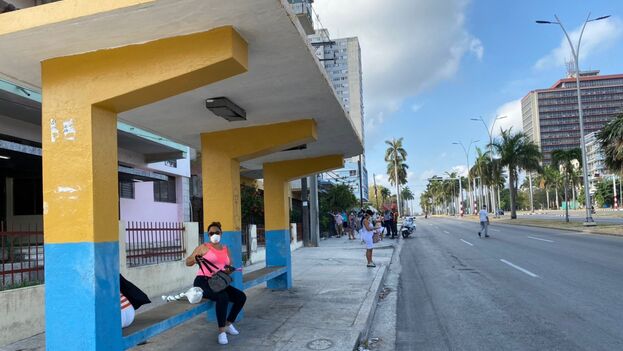
At the Cerro y Boyeros stop, one of the busiest in the capital, there was also calm. Only about five people waited under the concrete roof, avoiding catching the sun rays that were already heating the asphalt. “We have been here for two hours and nothing. I cannot stay at home, I must go see my husband in the Cardiology Institute where he is admitted, and here I am with my son who accompanies me but neither a private car nor a bus has passed, nothing at all, we are desperate now,” says Carmen, a 67-year-old from Havana.

Mayra, 43, a teacher, also waits at the bus stop, hidden under a tree, fanning herself while waiting for a miracle. “I think I’m already walking, I’ve been at this stop for two hours waiting for something to get me out of here and it’s just for fun.”

Although the schools closed, Mayra must stand guard at her teaching center, but the transportation that should be guaranteed does not pass. “I wpon’t head out for guard duty any more if they don’t come and get me at my house,” she says annoyed, as she walks off in the sun.

In the Fajardo hospital the machinery is still greased to move health personnel every day. “They have put on three buses and three fixed-route taxis for us but the itineraries are still being adjusted,” an employee of the health center, who preferred anonymity, tells this newspaper.

The Transport Minister has already warned that “accommodations” will be made daily to avoid that the essential activities that must be carried out every day are harmed. There is no other option if they want to avoid having doctors arrive hours late to hospitals. And in the midst of a pandemic.

________________

COLLABORATE WITH OUR WORK: The 14ymedio team is committed to practicing serious journalism that reflects Cuba’s reality in all its depth. Thank you for joining us on this long journey. We invite you to continue supporting us by becoming a member of 14ymedio now. Together we can continue transforming journalism in Cuba.
Little by Little, Havana Toughens Social Distancing Measures

Havana city officials sounded the alarm over multiple cases of asymptomatic patients who tested positive for Covid-19. Calls to further limit outdoor activity followed. (EFE)

14ymedio bigger14ymedio, Havana, April 9, 2020 – A stay-at-home policy began Wednesday in part of the Havana municipal district of El Cerro,  after an increase in coronavirus cases in that area. This is the second Havana residential neighborhood in which Covid-19 containment measures have been ordered.

Unnecessary movement of individuals will be restricted within the four blocks bordered by Buenos Aires, Agua Dulce, Diana, Carvajal, Serafines, Alejandro Ramírez and Flores streets.

“This is not just a police issue, but one for everybody,” said Luis Antonio Torres Iríbar, president of the Provincial Defense Council. “People cannot be walking around and performing activities that don’t have any justification at all.”

City officials sounded the alarm over multiple cases of asymptomatic patients who tested positive. The limits on movement were the response. But officials added that anyone suffering from possible Covid-19 symptoms should see a doctor. continue reading

El Cerro is one of the most densely populated districts in the Cuban capital. It is also among the neighborhoods with the most shared-housing units, as well as buildings in bad or substandard condition. In addition, the area suffers from a serious lack of access to water, a condition now worsened by drought.

Reinado García Zapata, the defense council vice-president, added that considerable foot traffic has been observed in areas including the Buenos Aires neighborhood and the Diez de Octubre municipal district. He recommended that it be reduced — raising the expectation that these areas will be the next ones in which control measures are ordered.

Plaza de la Revolución and El Cerro continue to be the areas with the greatest numbers of positive cases. New measures will be taken in Consejo Popular de Lotería, in the Cotorro municipal district.

Stepped-up controls ordered last week in El Carmelo, in the centrally located El Vedado neighborhood, were eventually less strict than expected. Citizens were asked to stay at home except for those who were performing “indispensable” work.

García Zapata requested more control in the inter-provincial transport vehicles that operate under an exception to travel restrictions. He noted an increase in the number of people who board these vehicles in restricted areas as a result of illegal deals with drivers. He added that controls should be toughened on production centers for masks, in order to ensure that these are distributed on a rational basis.

Tatiana Viera, coordinator for the defense council, said that there are 27 centers for epidemiological isolation. And additional institutions have been designated to house health workers from other provinces who arrive to augment intensive care personnel. These sites include a hotel run by the Cuban Workers Union and the guest house of the Union of Young Communists.

Among other measures that have been taken are limits on the operating hours of restaurants and stores, which will close at 8 PM. In addition, state-owned establishments such as those operated by independent workers who provide 24-hour-a-day service will be open only during the day.

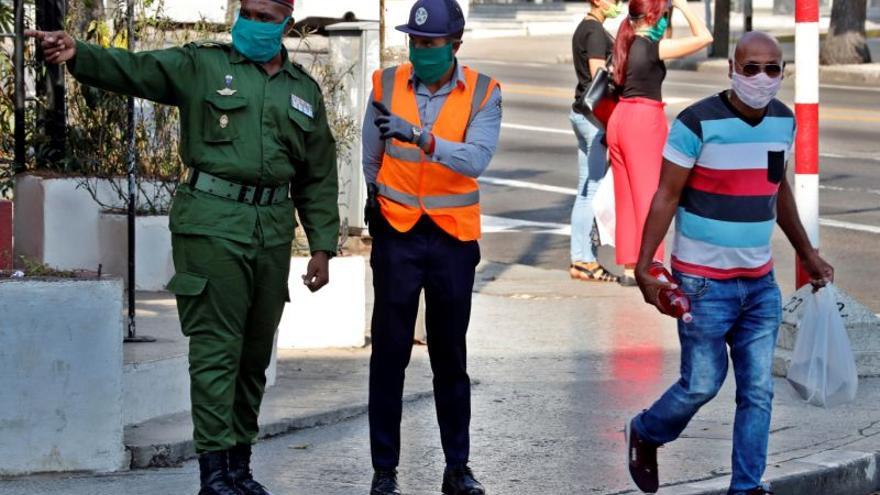
In another move, a staff member of the Havana Prosecutor’s Office will be assigned to each police unit, in order to take action against those who violate measures including required wearing of masks. or drinking alcoholic beverages on the street. Moreover, sales of rum will be limited to one bottle per customer, and beer will be sold only to customers buying take-out food.

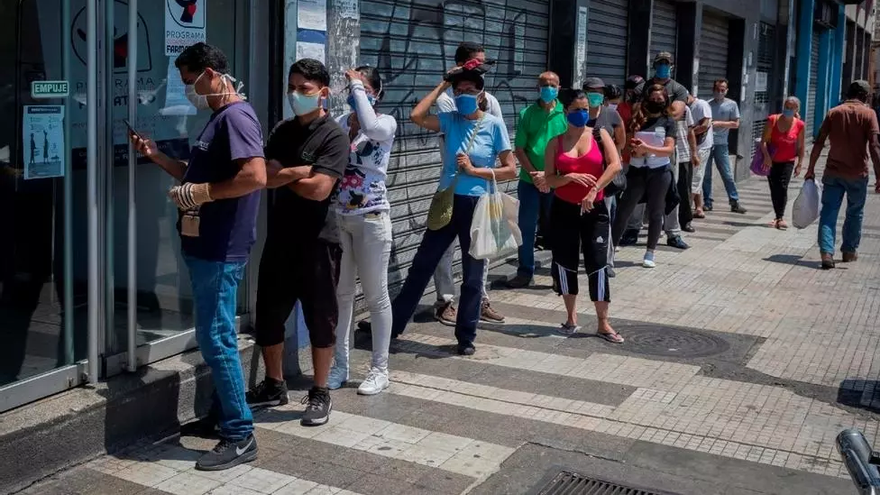
Those who try to set up lines where goods are sold, as well as street merchants, will be fined. “People go out to buy in these markets, and have to make their purchases quickly,” provincial authorities said. They requested increased food production, and better control over sales centers for fruits and vegetables.

Translated by Peter Katel

_____________

COLLABORATE WITH OUR WORK: The 14ymedio team is committed to practicing serious journalism that reflects Cuba’s reality in all its depth. Thank you for joining us on this long journey. We invite you to continue supporting us by becoming a member of 14ymedio now. Together we can continue transforming journalism in Cuba.

Jailed in Camajuani for Swiping 280 Pounds of Spuds

The fall in potato production has been noticeable in recent years. (Yosmani Mayeta/14ymedio)

14ymedio bigger14ymedio, Havana | April 14th, 2020 — The People’s Court of Camajuaní in Villa Clara has sentenced two individuals for filching 280 pounds of potatoes intended for sale under the ration system. In the verdict, described by the official press as “setting an example”, the party in charge of the establishment was sentenced to a year of prison, and a second person unafiliated with the establishment, to eight months’ loss of freedom.

The initial hearing took place this past sixth of April against the supervisor of the State enterprise La Cascada, located at 199 Independencia Street, and another citizen not affiliated with the place of business, according to the notice published in the local media.

Both the accused were convicted of the crime of misappropriation of goods for removing from a grocery store a bit over 280 pounds of potatoes that had been destined for the official “basket of basic family necessities”, as the text explained. This tuber, very scarce in Cuba, has undergone at times greater control and at other times a certain flexibilidad in its distribution. continue reading

The prison sentence for the [state] employee will be satisfied with correctional work and incarceration, added the source. The official was penalized additionally with a temporary suspension of rights disallowing her to hold any position whatsoever for two years.

The convicted have the right of appeal within a period of three working days.

The crime occured in the morning of March the 29th, “when the citizen, under the direction of the supervisor, removed six sacks of the valuable tuber to a hired horse-drawn wagon, with the purpose of parcelling them out among the households of the convicted, the clerks of the store and his own.

Just as the vehicle was leaving the store with the load, it was detected by an official of the Department of Technical Investigation (DTI) of the Ministry of Interior, who arrested the individual.

In 2017, the free distribution of potatoes, a symbol of the government of Raúl Castro, suffered a hard setback upon returning to control throughout the country, with a limit of 14 pounds per person upon presentation of the ration booklet. Since that time, the tuber has become increasingly scarce in the stands at the markets.

The prosecutor Naivi Hernández Cardoso explained that, after analyzing all the proofs gathered by the authorities of the National Revolutionary Police (PNR in Spanish) and directed by the Prosecutor’s Office, “the participation of the accused in the activity became clear on top of the confession of the parties and other elements of proof brought to air in the trial.”

“The matter has a great social repercussion,given that we are speaking of a food destined for the basic food basket of the population, and one of which three pounds per person are distributed [in that province]. With these 283 pounds of misappropriated potatoes, eighty households and ninety-three persons are affected.”

“In the case of Camajuaní, there is a difficult situation because of the outbreak of the corona virus, and now more than ever we have to be well embued with ethical values and the concept of the Revolution, and be more humane and united one with another. This is not the best behaviour of a person entrusted with the caring for State goods and guaranteeing that they arrive directly to the people,” the Prosecutor argued.

The judge as well added that in light of present circumstances, the Prosecution should be energetically opposed to the waylaying of food products, fuel, construction materials, and with regard to the coronavirus, this activity should be considered a crime in spreading the epidemic to those who suffer tne illness or who suspect they have it and decline to check themselves into a health facility.

Trials that “make examples” are approved by the leadership of the Communist Party in the province, and have for an objective “giving a response that’s rapid, exact and necessary in accordance with the responsibility of the court as representative of the State, and to watch over the strict fulfillment of the laws and other legal dispositions,” the notice further stated.

Potatoes on the Island were distributed exclusively in regulated manner up until the year 2009, at a set price of one CUP (Cuban peso, worth four US cents), a price the State describes as subsidized.

The falling-off of potato production has been notable in the past few years. In 1996, in the midst of the Special Period and strictly rationed, they began to be exported once 348,000 tons were reached. With the reforms of Raúl Castro, beginnng in 2010 the unrationed sale was authorized, but within barely five years, the harvest had fallen to 123,938 tons, and the authorities had to import 14,233 more tons in order to cover the internal demand.

Translated by: Pedro Antonio Gallet Gobin

______________

COLLABORATE WITH OUR WORK: The 14ymedio team is committed to practicing serious journalism that reflects Cuba’s reality in all its depth. Thank you for joining us on this long journey. We invite you to continue supporting us by becoming a member of 14ymedio now. Together we can continue transforming journalism in Cuba.
The ’Marielitos’ that Populated Miami Look Back on the 40 Years Since the Mass Exodus from Cuba

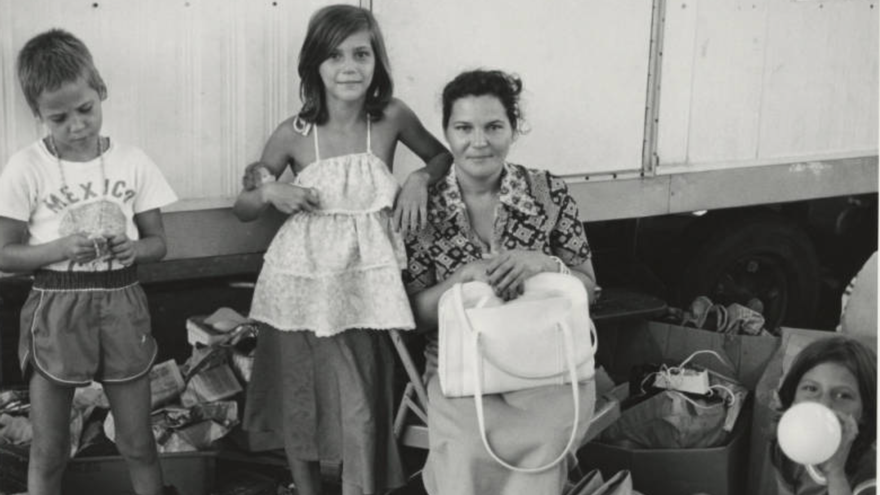
Cuban refugees who arrived in Miami during the Mariel exodus. (UM Cuban Heritage Collection)

14ymedio biggerEFE (via 14ymedio), Jorge Ignacio Pérez, Miami, 16 April 2020 — “The greatest possible change in my life,” is how the journalist Hugo Landa describes to Efe the trip that finally took him out of Cuba, along with 125,000 compatriots, during the ’maritime bridge’ from Cuba’s Port of Mariel to Florida’s Key West. It will be 40 years this Wednesday since the first of  2,000 vessels left Cuba for the United States in what came to called, in the US, the Mariel Boatlift.

Today director of Cubanet, the oldest digital publication of Cuban affairs (1994) published in Miami, Landa tells Efe that most of the asylum seekers sheltering in the Peruvian embassy were “included as ’antisocials’ among the people that the dictatorship forced the exiles who sailed to Cuba to collect their relatives, to also take in their boats.”

The Mariel exodus was a consequence of the violent entry of six Cubans into 1980 into the Peruvian embassy in Cuba to ask for political asylum, which was granted. In retaliation, the Cuban authorities withdrew the surveillance and protection of that diplomatic mission, which then received more than 10,800 people in four days, Landa among them. continue reading

Shortly after, then president Fidel Castro, announced the opening of the port of Mariel, about 40 kilometers from Havana, for anyone who wanted to leave Cuba.

Landa came to a city not as populated as it is now and much more limited in its urban layout compared to today. “For Miami, it must have been very difficult to assimilate that avalanche of refugees who arrived in just 5 months,” he reflects.

“We must also bear in mind that, at that time, the United States was going through a deep economic crisis, with great unemployment and inflation. I remember that everyone told us ’things here are bad’, something that I never understood because there was no ration book and everything seemed wonderful to me,” he recalls.

In some 2,000 small-draft vessels, entire families arrived with him to the United States, but others also arrived who left their loved ones behind and in some cases never saw them again.

The Mariel Boatlift was an escape valve that Castro used to send not only dissidents, but also people who were serving sentences and were removed from jails on the condition that they would permanently leave the country.

The documentary In their own words (1980), by the filmmakers Jorge Ulla and Lawrence Ott, Jr., collected the impressions of those Cubans who set foot on American soil after a dangerous journey, crowded into small boats, including the writer Reinaldo Arenas (1943 -1990).

The condition set for those who came from Florida to pick up their relatives in small boats, was that their yachts had to leave full and officials filled them with people they had never seen before.

“It is true that among the refugees were criminals infiltrated into the exodus by the regime who, as expected, began to do their thing,” says the journalist.

Landa says that “criminals were only a small minority, but they were the ones who appeared on the newscast, because the newscasts do not normally report on people who get up every day to go to a factory to work.”

For the director of Cubanet, “there are many successful Marielitos that one meets in all spheres of life in the United States.”

“Those who arrived as children are already around or over 50 years old and are like any ’American’. I arrived young, at 27 years old, and I am already 67,” he explained.

“All of us from the Mariel exodus knew that there was no return to Cuba, not even as tourists, because the dictatorship did not allow it until almost 20 years passed, I think that is why we are fully focused on living and progressing here,” said the journalist.

The Mariel sea bridge lasted six months, two weeks and two days, from April 15 to October 31, 1980.

Previously, Cuba had carried out a similar operation during the maritime bridge known as “Camarioca,” in 1965, during the government of the then US President Lyndon Johnson.

_______________

COLLABORATE WITH OUR WORK: The 14ymedio team is committed to practicing serious journalism that reflects Cuba’s reality in all its depth. Thank you for joining us on this long journey. We invite you to continue supporting us by becoming a member of 14ymedio now. Together we can continue transforming journalism in Cuba.
The Charge of "Damages" Against Luis Manuel Otero Alcantara is Provisionally Dismissed

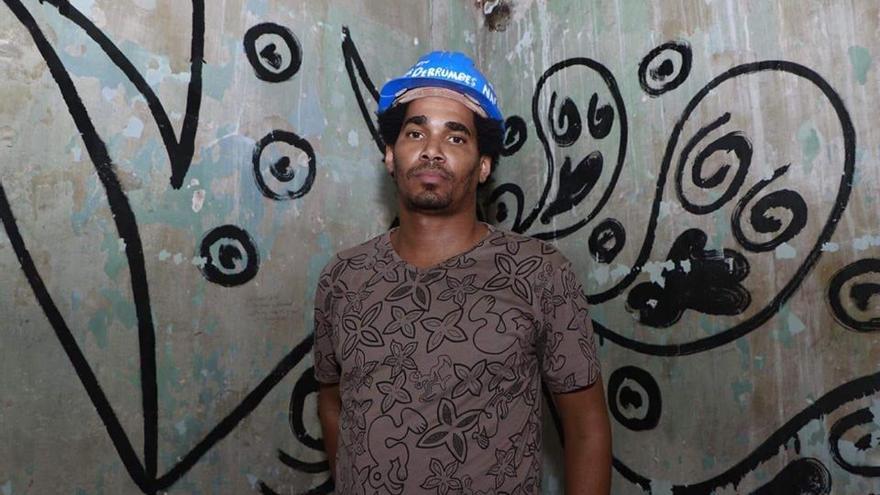
The artist Luis Manuel Otero Alcántara received broad national and international solidarity. (Facebook)

14ymedio bigger14ymedio, Havana, 16 April 2020 — The open case against Luis Manuel Otero Alcántara for a presumed crime of “damages” has been provisionally dismissed due to lack of evidence, meaning that the case is shelved until “new elements allow it to be put in progress.”

The document, to which this newspaper had access, was delivered this Wednesday to the artist through his lawyer.

“Now only the case for ’insult to the flag remains open’,” says Otero Alcántara, although the dismissal of the other charge is provisional. “I do not know what the political trick is now, but it is what it is. I consider this to have been another victory for the pressure that was exerted from all sides. We have been accumulating victories, first 349 [a decree that, in practice, prevented independent artists from developing their work and that was partially modified by the pressure of those affected]. That I am on the street is another triumph,” the artist told 14ymedio. continue reading

Otero Alcántara was notified by his lawyer, first thing in the morning, that he had to “walk” to the Police station so that they could give him “information from the Office of the National Prosecutor of the Republic.” The artist refused to go because he was isolated at home. “If they want, they can come looking for me complying with all the health protocols, or they can bring the information to me where I am spending my quarantine (and they know well where that is), or they can send me the info via WhatsApp, but I am not moving,” he said.

Otero Alcántara was arrested on March 1 when he left his home, and he was released on the night of Friday, March 13, after a campaign carried out by artists and intellectuals for his release. Hours before he was released, Amnesty International had declared him a prisoner of conscience, demanding his immediate release.

His first trial, for “insult to the national symbols,” was scheduled for March 11, but was postponed until further notice “due to the country’s economic conditions.”

______________

COLLABORATE WITH OUR WORK: The 14ymedio team is committed to practicing serious journalism that reflects Cuba’s reality in all its depth. Thank you for joining us on this long journey. We invite you to continue supporting us by becoming a member of 14ymedio now. Together we can continue transforming journalism in Cuba.
The Butter of Discord

In 2000, my friend Filiberto began renting the top floor of his house in Havana’s Lawton neighborhood to tourists. (Archive)

14ymedio bigger14ymedio, Reinaldo Escobar, Havana, 16 April 2020 — Starting in 2000 my friend Filiberto began renting the top floor of his house in Havana’s Lawton neighborhood to tourists. Fortunately, although he does not live in a tourist area, he finds customers who are looking for tranquility, away from the bustle of Old Havana or El Vedado. He has a relative in Turin who takes care of recommending Italians, preferably families, not interested in the sex market.

When his son Yuri was 12, he surprised him one morning spreading thick layers of butter on the rationed bread. The firstborn had been baptized with this name because he was born the same day as Gagarain, the memorable Russian cosmonaut who discovered that the earth was blue.

On that morning in 2003 when Yuri was discovered in flagranti, Filiberto said to him, “Put it down, boy, that butter is for the tourists.” The response of the then 7th-grader was devastating: “Fuck it Pop, you’re just like Fidel Castro.” continue reading

Yuri is now about to turn 30 and lives with his pregnant wife in his father’s house. At last Saturday’s breakfast, which, according to the family rules was Yuri’s to prepare, the cosmonaut’s namesake served not only butter, but also the cheese and ham jealously hoarded in the refrigerator.

Filiberto sat, as is his custom, at the head of the table and with all the authority that still remains to him asked: “What is the meaning of this?”

After a few tense seconds of silence, the one who spoke was Filiberto’s wife: “Beto, if we wait for the Italians to return, all that will spoil.”

As if they had come to a previous agreement, Yuri added: “That’s why we have toilet paper and soap in the bathroom,” while the future mother joked wryly: “But you’re the one who decides what to do, father-in-law.”

Filiberto tells me that, absurd as it may seem, the first thing that came to mind was to ask himself what Fidel Castro would have done in those circumstances, but he decided to respond with a gesture, rather than with words. He took the table knife and spread a thin layer of butter on his scrap of bread.

When he was clearing the table, he managed to say: “Save something, just in case.”

___________________

COLLABORATE WITH OUR WORK: The 14ymedio team is committed to practicing serious journalism that reflects Cuba’s reality in all its depth. Thank you for joining us on this long journey. We invite you to continue supporting us by becoming a member of 14ymedio now. Together we can continue transforming journalism in Cuba.
Dengue and Coronavirus, a Double Battle

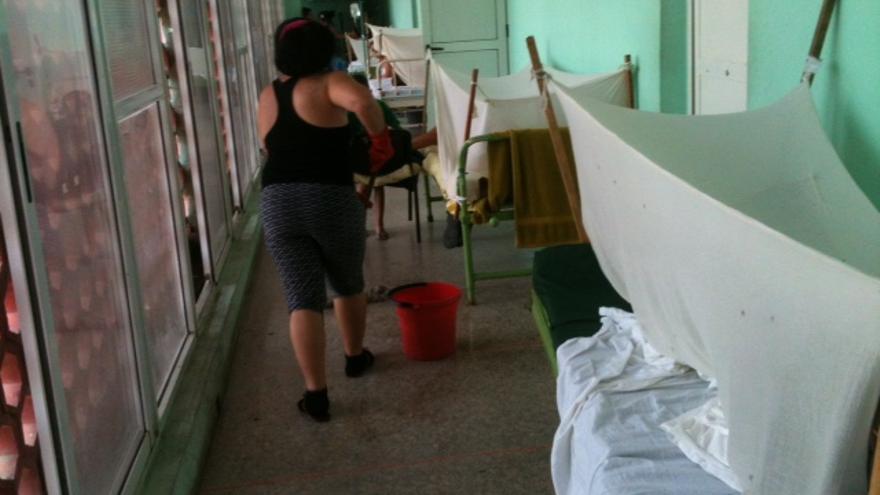
Beds have been set up in the hallways of the Pepe Portilla Pediatric Hospital for patients with fever. (Juan Carlos Fernández/Archive)

14ymedio bigger14ymedio, Havana, April 2, 2020 — “I began feeling very bad, weak, and when I saw that I was getting a rash, I knew it was dengue,” says Manuel, 46, from Camagüey. Dengue continues unabated, but now it competes with the propagation of the coronavirus, which has priority.

Manuel lives in Reparto Garrido, where, in the last weeks, numerous cases of dengue have beem diagnosed, which was confirmed by a source in the Ministry of Public Health in the province. “They’re not being hospitalized unless the patient is very serious because all the hospital beds are being reserved for people with coronavirus,” added Manuel.

“They are requiring that anyone in the house with dengue stay under a mosquito net. But this is complicated by the fear of COVID-19,” he explains. “Now, in addition to preventing a mosquito bite and spreading the virus to my family, I have to maintain strict hygenic measures. But I can barely move from my bed, so I’m using alcohol to wash my hands, but I don’t have much left and there isn’t any in the pharmacy.” continue reading

In the middle of last year, when the incidence of dengue reached worrisome levels on the Island, the Pedro Kourí Institute of Tropical Medicine hosted an international course about dengue, zika and other emerging arboviruses that created a national project to combat the Aedes aegypti mosquito with the application of ionizing radiation.

The method, known as insect sterilization, consists of irradiating the males in their pupal state and freeing them so that when they mate with wild females, they don’t produce young. But they didn’t specify the date of putting the strategy into practice nor its extent on the national territory.

In October 2019, it was announced that the health authorities on the Island were promoting the breeding of guppies as an alternative measure against the Aedes aegypti mosquito. An experiment of this type was launched in the province of Cienfuegos, as an “economical and effective variant” to eradicate the plague, because one single fish can devour between 60 and 150 insect larvae in a day.

However, the new strategies in the fight against the mosquito coincided with a fall in the frequency of fumigation, especially by the lack of fuel that forced them to reduce the zones where it was applied. “We are only authorizing fumigation in the houses and surrounding areas where a case of dengue is detected, but we don’t have enough to do it effectively,” a Camagüeyan medical source told 14ymedio.

“Now, with the rise in temperature, an outbreak of dengue is beginning, and the situation can get worse because it’s been months since we’ve had a fumigation campaign on the national level,” says the source. “It’s really difficult to struggle against two viruses at the same time, and although dengue is an old acquaintance in Cuba, now we are in a very unfavorable situation to confront it.”

The Panamerican Health Organization (PHO) warned in the middle of March of the need to take measures to minimize the consequences of dengue, which already had left 156 dead so far this year. In a recent report, it pointed out that the region was facing the “worst epidemic” in the history of the continent.

“It is estimated that there will be an elevated incidence for the whole region in 2020. The first quarter is very complex for the Southern Cone, and we began the year with situations of high transmission in Paraguay, Bolivia, Brazil, Colombia, Costa Rica, Honduras, Mexico and Peru,” said Marcos Espinal, Director of the PHO Department of Transmissible Disease and Environmental Health Determinants.

“After two years of low incidence in 2017 and 2018, we had a year in 2019 with 3.1 million cases of dengue, the largest figure in history,” he explained. “But so far this year, more than 661,818 cases have been reported, of which 1,820 were diagnosed as serious.”

The experts have asked that the recommendations of the authorities be followed, principally washing your hands. Both dengue and coronavirus can be confronted by taking the same measures; in the case of dengue, it’s essential to focus on eradicating the source.

The symptoms of dengue are high fever, muscle aches, vomiting and diarrhea, while coronavirus causes a dry cough, difficulty breathing and general pain, but ruling out one or the other is always a medical question,” said Espinal.

Translated by Regina Anavy

______________

COLLABORATE WITH OUR WORK: The 14ymedio team is committed to practicing serious journalism that reflects Cuba’s reality in all its depth. Thank you for joining us on this long journey. We invite you to continue supporting us by becoming a member of 14ymedio now. Together we can continue transforming journalism in Cuba.
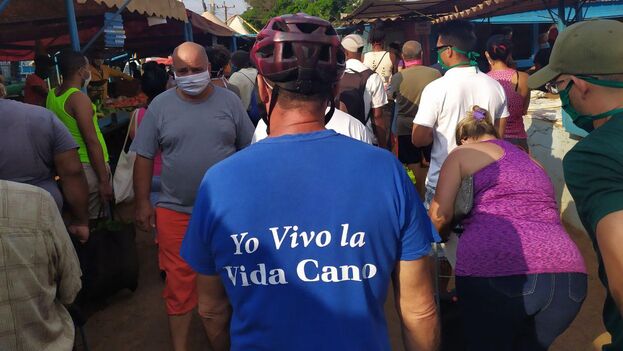
Day 26 of the Covid-19 Crisis in Cuba: There is No Normality to Return To

“I try to stay positive, but anxiety is in the air,” says Yoani Sánchez. (14ymedio)

14ymedio bigger14ymedio, Yoani Sánchez, 15 April 2020 — I’ve been on WhatsApp for days with classmates from my time at the university. The pandemic has revitalized some friendships that, spread across various countries, help me to evoke school times, exchange family photos and project the future. Yesterday, another philologist — who also graduated in 2000 — asked me when I thought we could return to normal.

I did not know what to answer her. Normality is a concept that hardly fits in Cuba. How could we go back to a place we’ve never been? Is it possible to return to a moment that has not been lived? Could January be considered “normal,” a time when the word pandemic had not entered into our conversations and we did not even know the name of the disease that now torments us?

My friend laments that from her house in northern Germany, where she has been locked up for four weeks, she has seen the sun come out and the first signs of spring after a long winter, but the quarantine does not allow her to go outside to enjoy it. She hopes that the coronavirus will depart and she will be able to resume her routine. But in what “daily life” will we disembark in Cuba when the worst weeks pass? continue reading

The forecast does not seem very rosy. With the national economy bottoming out, this Covid-19, which has already claimed 24 lives on this Island, could lead us to experience unprecedented and extreme situations. I try to stay positive, but anxiety is in the air and I’ve already witnessed scenes that remind me of the worst moments of the 90s, with people fighting over a piece of chicken or stealing a bag containing all her purchases from an old woman.

Along with the worst, altruistic gestures also emerge. A little old lady in my building dropped her rationed eggs as soon as she bought them, and several neighbors donated part of theirs. The lady who feeds the abandoned animals that live in the neighborhood has not stopped going down even one day, to bring them something to eat. The octogenarian who lives on the corner calls me every afternoon to find out how I feel, although he is diabetic and has heart disease.

Close to home, next to the railway line that runs south, there are numerous families living in tin and cardboard shacks who, until recently, survived doing informal work, reselling coffee from the nearby roasting machine and collecting cans from the trash. They are “illegal” in Havana, as their identity cards do not contain a Havana address, and they have no ration book registered at a local bodega, much less an official salary from which they are now paid a part of while they stay at home. .

The pandemic has further exposed the fragility of these families. They, unlike my neighbor who dropped the eggs in front of the market, do not even have the right to buy that product because their names are registered only in a distant ration market in Guantánamo, Las Tunas or Santiago de Cuba. To make matters worse, the “box” with food frequently sent to them by their relatives no longer arrives because interprovincial transport has been cancelled.

For them, to return to “normality” is to return to rescuing empty soda or beer cans from the trash, being able knock on nearby doors selling some “good, original” coffee — as they would announce until recently– or being hired in jobs where they are paid less than a Havanan because they are not from here, because they are illegal in their own homeland.

My philologist friend who lives in Germany wants to return to the “normal” country where she lived until a few weeks ago, to go out to buy bread and to spend hours with her friends in a bar. My neighbors of the squatter encampment nearby only know shock and uncertainty as a common state, for them “normal” is not a safe place or a time of guarantees.

See other posts in this series.

_______________

COLLABORATE WITH OUR WORK: In this time of Covid-19 crisis, 14ymedio could really use your help to keep the news coming. Please click on this link to support our work.

Day 25 of the Covid-19 Emergency in Cuba: the Epicenter of Contagion Around the Corner

They are seeking out people who were in the store at 26th and 51st in Havana in recent days. (OnCuba)

14ymedio bigger14ymedio Yoani Sánchez, Havana, 14 April 2020 – For days, Reinaldo had been planning an excursion to the store on the corner of 26th and 51st, near our house. At the first attempt, a neighbor warned us that the line stretched for several blocks; the second time we had to stay home because the water was turned on and we needed to store as much as possible, and the third time we preferred to buy some supplies from an informal vendor. Today, we learned that that state market has become a focus of Covid-19 contagion.

Dr. Yadira Olivera Nodarse, director of the Provincial Center for Hygiene, Epidemiology and Microbiology, told the official press that 18 positive cases of the disease were detected around the premises. Now they are looking for anyone who has been there in recent days, and are planning to use surveys to find them, as well as “even reviewing the images from the security cameras,” she clarifies.

It’s a rare day when we don’t hear about someone in Cuba who is under observation or infected by the pandemic. While official figures insist that so far there have been 21 deaths from Covid-19 and 766 confirmed cases, the disease seems to emerge from every corner. Between doubt about government data, the rumor that always adds several layers of exaggeration to reality, and speculation, we tread doubtful territory. continue reading

But we not only suppose, but also forget. These days, for example, we should be remembering the 40 years years since the exodus, the Mariel Boatlift, an open wound in Cuban memory. But the coronavirus has taken away even our memories. I was five years old and the Mariel crisis is the earliest image from my mind as a child. The commotion in the tenement where I lived, the adults calling and telling us to get inside, and outside the act of repudiation against two neighbors who decided to leave the Island.

Many believe that children don’t understand it, that they are present without being aware at those moments, but the truth is that children’s eyes grasp traumatic events with extreme sharpness and in their own way. So it is for me, where the wounds of 1980 remain and also the questions. I had to live the rest of my childhood between the two camps, those who talked about the “scum” and the “worms,” and those who compulsively tried to communicate with their emigrated family members so that they could send them something.

After that, I spent long nights dialing the phone number of a relative who had gone to Miami for my mother to ask for some vitamins. They were the old dial phones, there was no redial then, so communicating with the operator who established the “collect call” – paid for by the relatives in Miami – was difficult. I bragged about being fast, my finger spun the dial over and over, and my index finger became darker and darker from rubbing against the bakelite of the device. My finger ended up black and the supplements never came.

My cousin who was a medical student was not allowed to leave in that exodus and was punished for trying with long years in island seclusion. He did not managed to graduate as a doctor but, although his entire family emigrated, the penalty was sending him to work long shifts at the General Freyre de Andrade Clinical Surgical Hospital in Centro Habana, better known popularly as “megencias.” There he lost his sanity and his most joyous years without being allowed to cross the border. Now, 2020 would be the year to revisit all that.

So that 1980 marked us all. Those who were aware, those who weren’t even three feet tall, and those who called us to hatred from the rostrum. Even for the latter, it was never the same, because it was shown that there were a large number of Cubans willing to leave everything behind and face repudiation rallies in order not to follow the official script. It was a year of fractures and, four decades later, 2020 does not bode well for repairs.

I am at home, I already feel better after a few days of physical discomfort. Our new little female puppy has destroyed several shoes, the onion planted in our small balcony garden has sprouted, we save every drop of water and we limit our going out. There is time for reflection, love, projects and remembering. Many details again come to mind, like that girl in the middle of a lot in Central Havana who did not understand the screaming and hitting.  I was puzzled and confused then; and now as well.

See other posts in this series.

_______________

COLLABORATE WITH OUR WORK: In this time of Covid-19 crisis, 14ymedio could really use your help to keep the news coming. Please click on this link to support our work.

Days 23 and 24 of the Covid 19 Emergency in Cuba: What We Need Now Are Pushcart Vendors

A pushcart vendor in Havana serves his customers in better days. (14ymedio)

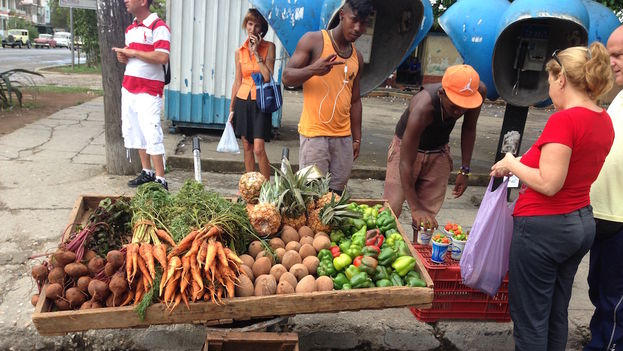
14ymedio bigger14ymedio, Yoani Sánchez, Havana, 13 April 2020 — He used the wheels to make a toy for his son, with the bottom boards he reinforced his sofa, and the iron frame now supports his home’s water tank. My neighbor Yunier, 38, dismantled the makeshift vehicle in which he was selling fruits and vegetables after the last official raid against pushcart vendors. Today, we are missing his wagon with tomatoes and onions.

At a time when crowds and long lines are becoming a death trap in which the coronavirus gloats, the small merchant who was offering his wares through the neighborhoods is a painful memory of the limitations imposed by the authorities on a private sector that could now help supplying food to the population. In order to avoid these vendors “enriching” themselves, they have left entire neighborhoods without supplies.

So this Sunday I had to walk a very long distance — there is no longer public transportation, as the government has shut it down — to find some fruit and vegetables because in the closest state market the stands are almost empty. A small kiosk near Calzada del Cerro was my salvation but the seller warned me that he won’t be open this coming week. “I used to have a pushcart, but they confiscated it,” he tells me. continue reading

Every now and then there is an “enemy” which becomes the focus of official attacks. Once it was the artisans in the Plaza of the Cathedral, another time it was the ‘flowerpots’ as the new rich are called. The private farmers had their turn to the targets of a volley of insults; the “intermediaries” were demonized; and for a few years the target of the expletives have been the pushcart vendors. The official press accuses them of not respecting price caps, of wanting to profit from necessities and of buying cheap to resell high.

Scenes of merchandise seizures, hefty fines, and police assaults on these neighborhood merchants became frequent. The result: for each ten there used to be in Havana now there is only one and that in bad shape, and if five years ago one could go down to this corner or that and come back with garlic, peppers and plantains, now, it is only possible to purchase these products in the state or cooperatively managed markets with poorer supplies, lower prices and questionable quality.

My neighbor Yunier wants to retrieve the pieces to reassemble his rolling cart. He believes that, in the short term, spurred by the collapse of the economy and the need to decentralize the points of sale, the State will once again allow and encourage the small merchant. “I had many customers who were old people who could not move from their homes and bought from me at their doors. Now how do they manage?” he asks himself. But the carts don’t fill up on their own.

In the countryside, there are those who wait for an official decision authorizing the delivery of state lands and facilities to private individuals who will work them, as well as the elimination of high taxes; the eradication of that dysfunctional state apparatus known as Acopio, which only acts as a straitjacket for farmers; and the permitting of direct import of seeds and agricultural supplies. “We are waiting but they do not tell us anything,” a pig producer from Alquízar, who this week has sold his last animals, tells me. “We do not have food for them and so it cannot continue. Either they open things up or the hunger will be great.”

After talking to him, I devoted myself to meticulously washing some cachucha peppers that I got, along with some donkey bananas and some sweet potatoes. I peeled, cut and bagged the products that will allow me to feed the family in the coming days when supplies start to disappear from the streets.

See other posts in this series.

_______________

COLLABORATE WITH OUR WORK: In this time of Covid-19 crisis, 14ymedio could really use your help to keep the news coming. Please click on this link to support our work.

Cuba Promotes Homeopathy, Which Is Considered Junk Science In Spain

Homeopathy, which works only by placebo effect, has been used and promoted in Cuba, while it is fading in Europe, including in countries where it has been very popular.

14ymedio bigger14ymedio, Havana/Madrid, 7 April 2020 — A homeopathy debate is in its infant stage in Cuba. But arguments grew more intense last weekend after Francisco Durán, national director of the Public Health Ministry’s Sanitation and Epidemiology Department, announced the availabaility of PrevengHo-Vir, a homeopathic preventive product to strengthen defenses against the coronavirus. He also warned that the product “does not prevent infection, nor eliminate the need for protective measures” such as hand-washing and social distancing.

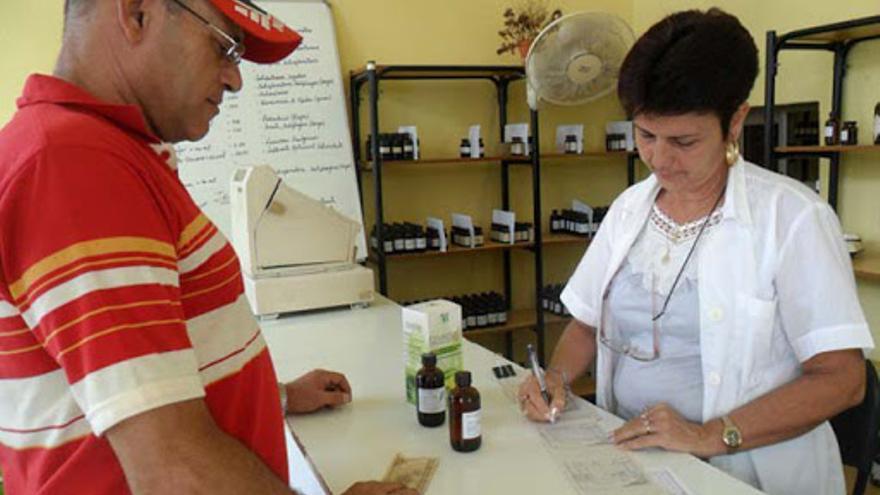
In a press conference, the doctor said that the product — which patients take under the tongue — helps to prevent various illnesses such as influenza, the common cold, dengue and emerging viral contagions.  “Organized distribution throughout the population is planned,” Durán specified.

Initially, the product will be provided via the primary care system to the elderly and to those in the at-risk category, and later to the rest of the population. The medication, manufactured by state-owned BioCubaFarma, is a hydro-alcohol solution  “with homeopathic plant, mineral, animal and biological strains,” said Diadelis Ramírez, a researcher at the Center for State Control of Medication Quality (Cecmed). continue reading

The officials stated that “scientific journals have been published in which this has a demonstrated effect,” but they did not provide details. Cuban medical schools and the public health systrm have promoted homeopathy for decades. They explain it partly as a response to the medication shortage. The official press has not given any space to those who openly criticize this practice. And most Cubans have not had access to sources that reject homeopathy as junk science.

This not the first time that Cuban officials resort to a kind of product that, as Durán said, is “very innocuous.” These fake remedies were deployed against cholera outbreaks on the island in 2012 and 2013.

The debate has surfaced on social media and has drawn attention to events in a country with which Cuba maintains close ties — a country that has staked out a position on the other side, and which has been leading a European fight against homeopathy for the past two years. That country is Spain.

Spain has tried several times to regulate homeopathy, in line with a European directive of 2001. But the country never came as close as it did in May, 2018, when Dolors Montserrat of the Partido Popular, then the Health, Social Services and Equality Minister, approved an order that allowed pharmacies to sell homeopathic remedies as medications, although a report by the ministry admitted that these products did not cure ailments. The entire political opposition, including the Ciudadanos party (liberal, a PP partner in several autonomous and local administrations), raised an outcry.

“The very term, ’homeopathic medication,’ is self-contradicting,” Teresa Giménez, a Ciudadanos member of the European Parliament, told the minister. “A medication has to have some effect on an illness, and homeopathy defines itself correctly as a product that is so diluted as to be innocuous.”

The Cochrane Library, an online collection of medical databases, has just published its seventh study contradicting homeopathy. It was the latest of an endless series of refutations of a pseudo-therapy born in Germany more than 200 years ago.  Created in 1796 by Samuel Hahnemann, the method is based on the dilution of natural substances into infinitesmally small doses. Medical literature has concluded that its only property is the placebo effect.

The Spanish government that took office in 2018 includes two active opponents of homepathy. One of them, Science Minister Pedro Duque, the first Spanish astronaut, explained his position bluntly last year: “It is clear, from current regulations, that you can’t tell a pharmacy not to sell candy. There’s no problem putting homeopathy in the same category as candy.”

In 2016, the University of Barcelona canceled its homeopathy master’s degree program “for lack of scientific basis” And two years ago, all Spanish universities — acting on their own, not by governmental decree — canceled homeopathy studies.  Only private organizations offer any courses in the subject.

The war against homeopathy came to Brussels in September, 2017, when the Spanish government urged the EU to change its legislation, a measure that had never been taken at that level. Spain condemned the fact that “there have been cases of cancer patients dying after giving up scientifically based treatment for homeopathic products.” Current regulations were a “health risk” to citizens, the Spanish government said.

The homeopathic industry has been growing. And, organized into strong lobbying groups, it has been earning millions, billing more than 60 million euros a year in Spain, with tax-exempt status, as if its products were medications. The exemption is based on the sole certainty that homeopathic products are not harmful. However, danger arises when a patient stops taking a medication under the belief that homeopathy can replace it. In 2017, a child in Italy died after being treated homeopathically for an ear infection.

In recent years, various European countries have taken the same path. The United Kingdom stopped financing homeopathy in its public health system in 2018. France will withdraw public subsidies of these products in 2021. Currently, the French public health system reimburses 30 percent of the cost of some 1,200 homeopathic products. That support represents nearly 127 million euros taken from the national budget, and from taxpayers’ pockets. Meanwhile, here in Cuba, the government itself manufactures and promotes these products.

Translated by Peter Katel

_________________

COLLABORATE WITH OUR WORK: The 14ymedio team is committed to practicing serious journalism that reflects Cuba’s reality in all its depth. Thank you for joining us on this long journey. We invite you to continue supporting us by becoming a member of 14ymedio now. Together we can continue transforming journalism in Cuba.
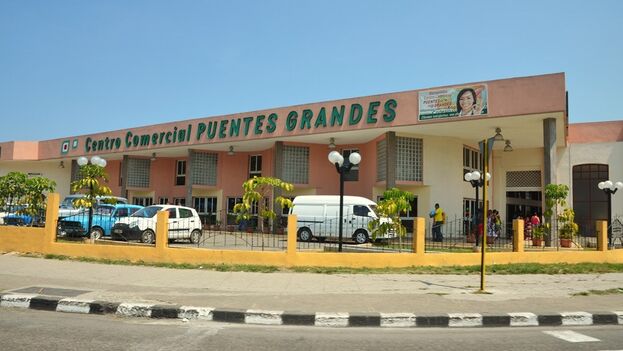
Venezuela, a Fertile Field for the Chinese Virus

The sectors most affected by social distancing and quarantine are those that depend on contact between persons, like commerce, transport, and services. (EFE)

14ymedio bigger14ymedio, Miguel Henrique Otero, Madrid, April 12, 2020 — Just this past week, the Economic Commission for Latin America and the Caribbean (Cepal) has put into circulation number one of a special report dedicated to the economic and social impacts of COVID-19 in the region.

It’s a disturbing document: starting with evaluating the direct effects on health systems and the indirect effects on supply and demand, it suggests the imminence of enormous negative effects, in the short term (unemployment, decreasing income and salaries, growth of poverty and extreme poverty, negative effects in the health systems, among them, the extremely grave inequality of access), as well as the medium and long term (downward economic growth, reduction of investment, bankruptcy of businesses, deterioration of productive capacities and more).

Cepal warns with stark clarity: “distancing generally implies the deceleration of production or even its total paralysis.”

After making a useful and summary tour of the global economic trends, on reviewing the perspective of the region, Cepal warns that the contraction of the regional GDP could reach 3% or 4%, and could even be worse. continue reading

The document notes five “external channels of transmission:” decrease in economic activities of commercial partners, fall in prices of basic products (the example of oil is the most visible of all), disruption of supply chains, drop in the tourism industry (which is also, for countries like France, Italy, Spain, and England, extremely costly), and the growth of “risk aversion and worsening of worldwide financial conditions.”

It adds a fundamental issue: that the sectors most affected by social distancing and quarantine, those that depend on contacts between persons, like commerce, transport, and services of a distinct nature — generate 64% of formal employment.

Issues like the limited levels of Internet access, the precariousness of healthcare systems, the multiple failures of educational systems, the disproportionate percentages of informal employment, the extensive sectors of the population who live in poverty and extreme poverty, the high levels of social vulnerability, and many others, are elements that form a scenario of vulnerability, for the possible damage that COVID-19 could cause (only alleviated by the fact that the majority of the population of Latin America and the Caribbean is made up of children and young people), as well as for the negative economic and social effects.

But if this is the menacing prospective that the study of trends produces for the region, it is valid to ask, for the state of things in Venezuela — now only comparable, according to experts’ criteria, to the historic situation of misery in Haiti — as well as the available resources of the country destroyed by Chávez and Maduro, what to do to confront a pandemic that has been capable of putting in jeopardy the best healthcare systems in the world, like those of Spain, the United Kingdom, and some regions of the United States.

The results of the National Survey of the Impact of COVID-19, done by the National Commission of Health Experts to Confront the Coronavirus Pandemic, created by the interim president, Juan Guaidó, are terrifying. Simply terrifying.

I note several figures which report on the reality suffered by millions of families all throughout Venezuelan territory: 87.7% do not receive reliable electricity service, but rather the opposite with frequent failures, surges and drops and powers. Something else: almost 3% of the population receives no electricity service.

Almost 18% of homes are victims of what, right now, is much more than a failure of service: it can be considered a crime against life. I refer to the lack, for prolonged periods of time, of potable water, the most essential of resources necessary for combating contagions. But there is more: another 75.1% receive water in an irregular manner and, more importantly, water of low quality.

And what to say of public transit, which half of the citizens absolutely lack, and the other half has access to one that is costly, negative, and irregular? What to say, at this time in Venezuelan life, on the threshold of an epidemic that can have disastrous consequences, that ours is a country without fuel, that the Latin American nation that was the paradigm for its oil industry, and that had a capacity in place to produce a million and a half barrels of fuel every day, can today barely supply fuel to less than 1% of the population, and that its refineries are almost totally paralyzed?

And I still must note an inescapable reality: the situation of the hospitals, where doctors, paramedics, and health workers are absolutely exposed, without resources to protect themselves, as defenseless as their patients, who come to the health centers that have no water, nor constant electricity, nor medical technology, nor equipment, nor supplies of any kind, nor medicine, nor gloves, nor masks, nor body protection, nothing.

If to this whole panorama we add that the Maduro regime’s only response is detaining and persecuting political leaders of the democratic opposition and journalists, for the fact of reporting and denouncing what is happening, then the scenario that could ensue in Venezuela could be simply devastating. And that, because essentially, Maduro and those who surround him are drastically accelerating it: the even greater decimation of the Venezuelan citizenry.

Editors’ note: Luis Henrique Otero is director of the Venezuelan newspaper El Nacional.

Translated by: Sheilagh Herrera

______________

COLLABORATE WITH OUR WORK: The 14ymedio team is committed to practicing serious journalism that reflects Cuba’s reality in all its depth. Thank you for joining us on this long journey. We invite you to continue supporting us by becoming a member of 14ymedio now. Together we can continue transforming journalism in Cuba.