
Days 38 to 40 of the Covid-19 Emergency in Cuba: Under the Bed

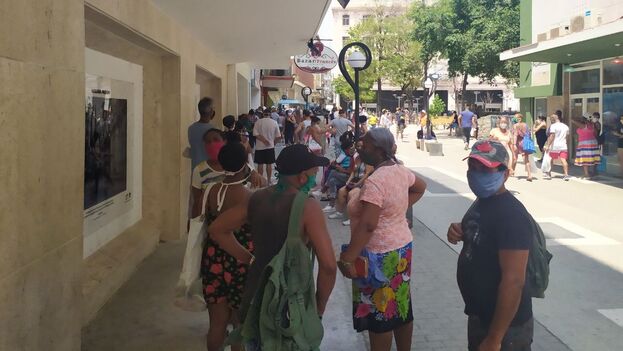
Long lines and shortages at state markets lead many to opt for the black market. (14ymedio)

14ymedio bigger14ymedio, Yoani Sánchez, Havana, 30 April 2020 — These are days of risk to health and freedom. The Cuban government is taking advantage of the Covid-19 emergency situation to further curtail the right to free expression, but also to hold “show” trials that are more circus than justice. At the center of this attack is the black market, the alter ego of Castroism.

Yesterday a neighbor told me that pork would “drop” at 47 CUP (Cuban pesos, less than $2 US) per pound, brought directly from Artemis. I smelled, in the air… not cracklings, but danger. “Thanks, but these days I can’t buy a pin under the table,” I said bluntly, and I’m not exaggerating. It is a rare night that the TV news does not feature cases of the diversion of state resources and unsuspecting buyers sentenced to heavy prison terms.

These types of topics dominate the news as products become scarce and the lines to buy food lengthen, with the apparent aim of removing the responsibility for the shortages from the authorities and putting it on the shoulders of a few thieves and informal merchants. However, in a country immersed in the clandestine economy, a large part of the population is involved in acts of this type, although they do not confess it. continue reading

I remember the first expressions relating to the black market that I learned before I was ten years old. If someone said they had “three meters of red cloth,” I already knew that they were offering three pounds of beef. “They gave me flour,” said a nearby neighbor when the powdered milk arrived, and “an ugly anthill has appeared in the house” was someone else’s code to announce that she was selling coffee.

Metaphors and similes mask a world in which we Cubans have lived for decades and from which we cannot separate. In our existence, the role of the black market is such that it is almost impossible to find someone who can boast of never having resorted to these informal networks. If the person who has never stooped to buying something illegally was urged to throw the first stone, not even a pebble would fly.

Every once in a while, the Plaza of the Revolution takes measures against that deep Cuba where everything is for sale, from medicines to passing grades to get by in school. These are cyclical turns of the screw that give the impression that informal traders and the diversion of state resources have “gone too far,” but they barely manage to move the surface of the waters of an underworld that, on this island, is as deep as the ocean.

In the midst of one of these windstorms, we must redouble our caution.

A friend told me that she called an illegal detergent vendor who had saved her in previous crises. “I am under the bed until the pandemic passes,” replied the merchant, half-joking half-fearful. I liked the phrase because in the midst of all these tensions, we are at risk of losing that popular humor that manages to mock even death. Imagining a whole people hiding under their mattresses wrenched a smile from me, in the midst of the arduous task of searching for food.

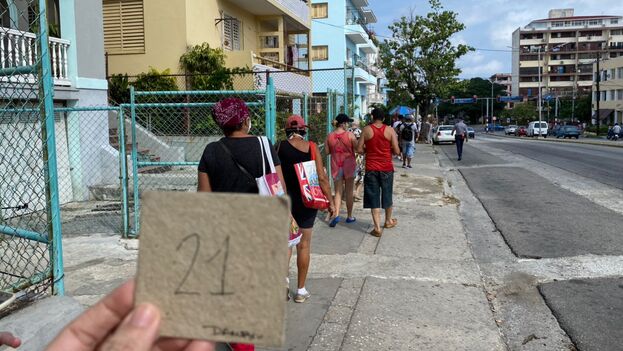
While waiting outside the Youth Labor Army market near my house, I imagined 11 million people crowded together in the narrow space under a bunk. Holding their breath and peering out at a pair of boots and military pants as they walk around the room looking for anyone who has bought at least one illegal aspirin.

It was my turn to enter the market and I kept laughing to myself about the image. I got some carrots, beets and a packet of birdseed. Doves, blackbirds, the occasional mockingbird and little sparrows frequently come to our balcony to eat. At least they will have their guaranteed food for the next few days, without having to dive into the dangerous waters of the black market.

______________________

COLLABORATE WITH OUR WORK: The 14ymedio team is committed to practicing serious journalism that reflects Cuba’s reality in all its depth. Thank you for joining us on this long journey. We invite you to continue supporting us by becoming a member of 14ymedio now. Together we can continue transforming journalism in Cuba.

Cuba’s Demographic "Winter" in the Times of the Pandemic

The number of births in Cuba in the first quarter of the year, 23,666, is clearly fewer than the number of deaths, 27,269.

14ymedio bigger14ymedio, Elías Amor, Valencia, 29 April 2020 — In the midst of the serious crisis of the Covid-19 pandemic, which, unfortunately, is starting to wreak havoc, not only in health but also in economic terms, the State newspaper Granma presents us on the cover with information that, of course, will go down in the history of journalism professional.

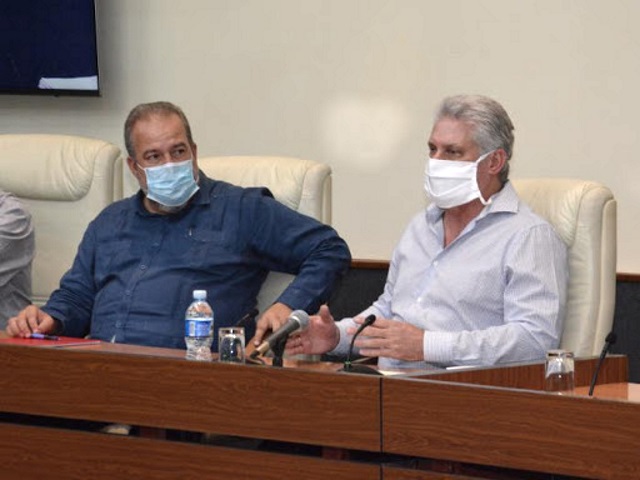
Nothing more nor less than a meeting with President Diaz-Canel is referenced to analyze the demographic dynamics of the country, and to report how population data from the first quarter show an absolute decrease in the population, given that the number of births (23,666) is clearly lower than deaths (27,269) and forecasts say that this trend will continue throughout the year.

Astonishingly, Díaz-Canel left the pressing problem of the pandemic for a few moments and devoted himself to evaluating, according to Granma, “the fulfillment of the program of attention to this important matter, in a context of population decrease, low fertility levels and increased aging.” continue reading

The data and information, drop by drop, were offered by the supposedly “disappeared” Mariano Murillo, who continues as “head of the Permanent Commission for Implementation and Development,” when we thought he had left office. He was in charge of showing the negative and tragic balance of 3,603 fewer Cubans, a part of the natural decrease of the population of Cuba.

They should have already addressed this problem a long ago. As should have Raúl Castro. Because the demographic “winter” of Cuba is not a phenomenon of now, but has been simmering for more than a decade. It is a problem that does not have an easy solution, but rather has very complex structural aspects and, what is worse, it will not be solved with patches and specific measures, no matter how much “intelligent, intensive work, with adequate follow-up, seeking to have more births, to stop the population decrease” is done by the authorities.

How have we gotten to this situation? What is the seriousness of the matter? And what solutions does the problem have?

The official argument is that we have reached this situation because the Cuban population ages due to a high life expectancy, a positive fact if there were a recovery of the demographic cohorts at the base of the pyramid. But since there are not enough births, the segment of the population of Cubans 60 years of age or older has increased to 20.8% of the total population; a figure that during 2020 will continue to grow up to 21.2%.

There is also talk of treatment for infertile couples, which according to Murillo’s data reached a figure of 138,977 couples, who show up at municipal and provincial consultations and high-tech centers, and it the success of this program is outstanding, having achieved, in 2019 and in the first quarter of 2020, 11,678 pregnancies.

Best of all, Granma announces (once again the propaganda reaches the inadmissible) that “to continue finding efficient solutions, around twenty measures are being studied to stimulate the birth rate, which include greater care and protection for pregnant women, for working mothers and fathers and for families responsible for the care of minors. “

The point is that these 20 or 30 measures are not going to solve the problem. In reality, the stagnation of the Cuban population has a lot to do with the terrible state of the economy, the general poverty of the population, the overcrowding of families in houses that are falling apart, the low purchasing power of wages and the absence of freedom of choice.

One would have to wonder who might want to bring their offspring into the world to see them spend their daily existence between ideological slogans and absurd lines to “resolve things” — the terminology used to define shopping for food and other necessities.

This is the main issue, that Cubans have lost faith in the future of their country, and that the youngest, as far as they can, choose the path of emigration to straighten out their lives. If they analyzed the birth rates of Cubans abroad, they would see big surprises.

Díaz-Canel is not right when he says that demographic dynamics is a matter of the greatest complexity, because it is one of those that most impacts the present and future life of Cuba, its economic and social development.

It is just the other way around, as one has to see. It is because of Cuba’s structural poverty, which its government neither acknowledges nor wants to fix, that demographics are sinking without remedy. The causality of economic relations, in this case, is fully justified.

For more than a decade, the Cuban population has grown little or not at all. Those who have tried to solve this problem without reforming the structures of the old and reactionary communist social system have failed. There is no point in “filling” the Constitution with rights for families if there is then no way to exercise them or to put them into practice.

Daycare centers, grandparents’ houses, attention to conciliation, protection of pregnant women and infertile couples, yes, all that is very good as subsidies that fatten the state budget, but the objective must be to improve the living conditions of Cubans, and that depends on economic forces, especially the private ones.

And to achieve this goal of improving the productive structure, unfortunately, nothing new is on the horizon. Next year, Murillo’s data will be much worse. You can be sure of it.

______________

COLLABORATE WITH OUR WORK: The 14ymedio team is committed to practicing serious journalism that reflects Cuba’s reality in all its depth. Thank you for joining us on this long journey. We invite you to continue supporting us by becoming a member of 14ymedio now. Together we can continue transforming journalism in Cuba.
A Group of Independent Cuban Farmers Calls for the Liberalization of Agriculture

Cuban farmers remember when they could negotiate independently with the United States.

14ymedio bigger14ymedio, Havana, 29 April 2020 — The League of Independent Farmers and the Cuban chapter of the Latin American Federation of Rural Women (Flamur) have launched a campaign directed at the Cuban Government demanding the liberalization of agriculture in Cuba in the context of the Covid-19 health crisis. In their opinion, the crisis could lead to famine, due to the poor state of agricultural production and the dependence on imports, which are more complicated during the pandemic.

The demands of the campaign, called Sin campo no hay país (Without the countryside there is no country), are specified in five proposals: freedom of production and distribution, of price setting, and of importing and exporting without intermediaries. In addition, they ask to eliminate all taxes for ten years and the delivery of permanent property titles.

The League members note that they could trade directly with the United States, since the laws only prevent trade with the State and its companies, but not with independent producers. continue reading

In support of this they cite the case of Nestlé, which in 2016 wanted to buy coffee from Cuban farmers and was authorized to do so by the US administration, but Havana blocked the agreement through the official National Association of Small Farmers (ANAP), which denounced that the objective was “to influence the Cuban farmers and separate them from the State.”

“Of course, ANAP did not consult farmers to speak on their behalf. This closed the door to billions of dollars of US investment in the agricultural sector,” the statement said.

The group calls on the government to depoliticize agriculture, especially considering that it imports 80% of what is consumed in the country, and to look at the example of Vietnam, which liberalized the sector during a famine in 1986 and from that point took barely four years to become self-sufficient and to have surpluses.

Although they acknowledge that Raúl Castro, during the reforms that came at the beginning of his term, favored agricultural production, they lament that prices were capped, with control exercised through the state entity Acopio, and that there was “repression of urban vendors and truck drivers.”

“After six decades of state failure, on the verge of a national catastrophe, maintaining the internal blockade of private producers is a crime and colossal stupidity,” they warn.

________________

COLLABORATE WITH OUR WORK: The 14ymedio team is committed to practicing serious journalism that reflects Cuba’s reality in all its depth. Thank you for joining us on this long journey. We invite you to continue supporting us by becoming a member of 14ymedio now. Together we can continue transforming journalism in Cuba.
The Business of Managing Lines Thrives in Pandemic Time in Cuba

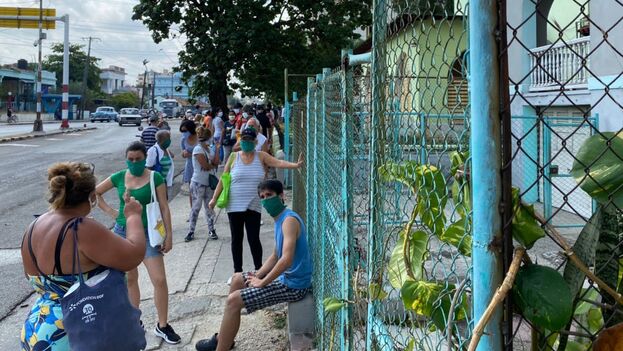
Before nine in the morning, an employee had already distributed the first 60 numbers in line, an hour later she would distribute 60 more and that would be all. (14ymedio)

14ymedio bigger

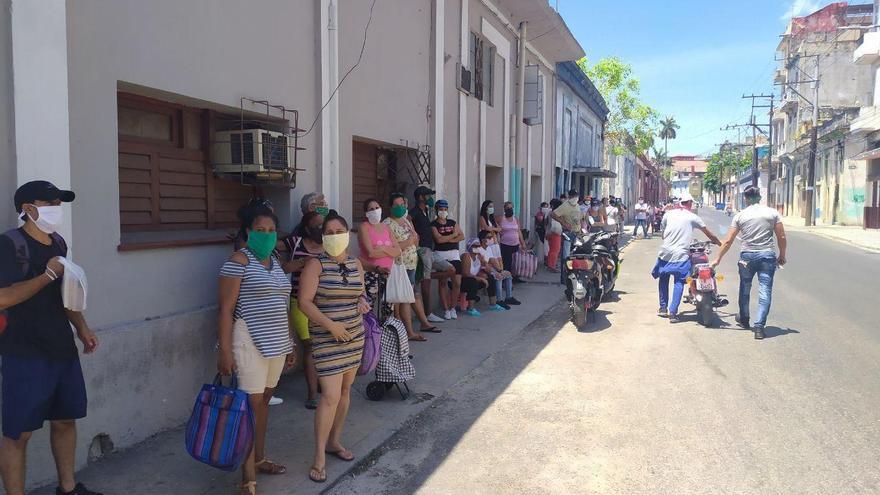
14ymedio, Luz Escobar, Havana, 28 April 2020 — In front of the El Danubio store in El Vedado, the line stretches along 26th Avenue, turns the corner at 25th Street, and stretches for almost two blocks. The routine in the time of coronavirus continues to be marked by lines, for cooking oil, for soap, detergent and, today, for chicken. Two oacks of thighs per person.

Police and plainclothes officers checked that everyone wore their masks correctly and kept a distance of at least one meter between them. In the midst of all this deployment Maura, roughly 60 years old, moves with great discretion, offering her services.

“I have 5, 15, 27, 41 and 59”, the woman whispers, explaining that numbers between one and thirty are at 2 CUC and those between thirty and sixty are at 1 CUC. They are not numbers for the lotto, they are tickets to have a good position in the line to enter the store. continue reading

By half past nine she had already sold all the turns he had taken thanks to her management starting at six in the morning. “I come with a friend to be able to take more places in line and sell them, I mark a place in line 10 or 12 times and she does the same,” she adds before continuing on her way.

Before nine in the morning, an employee had already distributed the first 60 numbers in line, an hour later she would distribute 60 more and that would be all. “Go and tell the official that the chicken I have left is what is in the fridge, and don’t give out any more tickets. If people want to stand in line, they can, but this will be the end of it.”

In the line they say that since Saturday people were coming to the store trying to buy chicken but they had to go home empty-handed even though there was chicken in the fridges.

“It sucks. I came on Saturday and to our faces the employees told us that, on orders from above, the sale of chicken had been prohibited on weekends and that we should wait until Monday,” says one of the unfortunates who did not get a number. “That is why so many people have come today and there is this deployment of police. All they told us was a lie or a very large disinformation because on Sunday they sold chicken here.”

Also in the line — in addition to those making a business of it — are those who do it “for solidarity.” (14ymedio)

Every now and then a patrol passes by with its loudspeakers to repeat the official instructions and to scold the violators. “The gentleman in the green pullover please put your facemask on correctly,” they repeatedly warned a man trying to smoke a cigar while waiting in line to buy chicken.

Also in the line — in addition to those making a business of it — are those who do it “for solidarity,” or at least that is what a group of three women say who haven’t stopped talking during the three hours they have been waiting.

“In my block, mothers have always been helping each other since this started. We let each other know when they put out something we need and we rotated turns to stand in line. Today it was my turn to rest, my neighbor came who marked a place for herself and three others, and I arrived fresh at half past nine but she had been there from seven and we managed to catch numbers in the second round,” one of them answered when asked how she can get supplies in the midst of this situation of isolation and scarcity.

In the line several old women wait their turn, some with priority to buy. A lady with a cane approaches the entrance and everyone lets her through and helps her down the stairs. “Do you live alone?” asks the officer who guards the entrance to the market. She answers yes, shows the ration book she is holding and recites her address. “Come in, ma’am, come in,” says the officer.

Once inside, the old woman takes out all her money, two 20-peso bills, to pay for a package of chicken that costs about 60 pesos. Disoriented, she asks for a smaller package but her 40 CUP is not enough for any. An employee searches the fridge and, after removing all the bags, finds an open one and sets aside four thighs. They add 34 pesos. Happy, the lady thanks the young man and leaves the store leaning on her cane.

_______________

COLLABORATE WITH OUR WORK: The 14ymedio team is committed to practicing serious journalism that reflects Cuba’s reality in all its depth. Thank you for joining us on this long journey. We invite you to continue supporting us by becoming a member of 14ymedio now. Together we can continue transforming journalism in Cuba.
Online ‘Lines’ in Cuba in the Time of Coronavirus

The Cuban authorities have opened a network of virtual stores as a way to avoid the crowds standing in line to acquire basic necessities.

14ymedio bigger14ymedio, Havana, April 20, 2020 — Dianelys filled her virtual shopping cart with some sausage, cooking oil, cookies and bath soap. Once she concluded the purchase, she waited a week for the email notifying her to pick up her order at the shop, but, instead, she got a message saying her money would be refunded to her card because the products were sold out.

Cimex, one of the business arms of the Cuban military, announced recently the expansion to several provinces of services of the digital platform TuEnvío, which combines several markets for online shopping, as a way of avoiding crowds so customers can buy basic necessities without having to leave their homes in these times of COVID-19.

The news was tarnished when, days later, very few internauts could access the shopping site. Most of them couldn’t even register; others had problems viewing the products or paying at the end of the process. The constant failures of the platform generated a chorus of demands, complaints and frustrations that spread across social networks and official media. continue reading

“They didn’t calculate demand well, which was a mistake, because in this desperate situation of buying food, you could predict this would happen,” Samuel, a 28-year-old computer programmer who has developed several applications for Android, told 14ymedio. “There are many good examples of online shops in the world, so they can’t justify themselves by saying that it was something being done for the first time.”

But Samuel warns that the problems with the platform transcend questions of bandwidth or server capacity. “The information about each product is poor, and the photos shown aren’t good quality. Choosing the amounts, which are rationed, is not easy, and the tool will have to be simplified to reach a larger public.”

In order to calm people, the authorities explained on national media that, owing to a “high demand for service, the page has become unstable” and has required “uninterrupted maintenance” in order to manage the traffic of internauts who accessed the main page more from necessity than curiosity.

A short time ago the online shops were functioning so people could buy food for their families and some products from the State stores. But since the end of March, and after the first cases of Covid-19 on the Island, these stores — where you could buy meat, beans, rice and cleaning products — were not offering service or had only a few products to sell.

Nor were the hard currency shops, which opened at the end of last year for the sale of appliances and car parts, offering service, because the commercial network on the Island was meant exclusively for basic products, like food and cleaning supplies.

Last Friday, Cimex opened a forum to answer criticisms. The digital meeting became an ordeal for employees of the conglomerate, who had to endure an avalanche of complaints. In the majority of cases, they were limited to recommending to consumers that they send an email to customer service.

The web site was down for a long time this weekend. “Dear clients, we will momentarily halt the flow of orders in order to readjust the logistical processing. We will return shortly. The orders that are in progress won’t be affected,” the page said.

The authorities also have limited purchases to two units of each product, to avoid hoarding, but the digital shops generate another type of segregation. For now you can only pay with a card associated with an account in Cuban pesos on the EnZona platform, created by the Enterprise of Information Technology for Defense (Xetid).

In January of this year, EnZona had accumulated a volume of sales worth 9,000,000 pesos, with a little more than 23,000 registered users. “Those who can buy now are the happy ones,” laments Lisset Echevarría, who uses the Metropolitan Bank of Havana and has spent weeks trying to get a card.

This newspaper called a dozen bank branches in the capital on Monday, and at least a fourth of them weren’t processing requests for a card. Two recommended avoiding in-person transactions that “aren’t vital” and the rest said to “call again on Tuesday or Wednesday,” to get a precise date when the process would begin.

Zurelys, 38, insisted this Monday on shopping in the Carlos III commercial center, which is among those offered by TuEnvîo. “The connection to this site isn’t secure,” and you shouldn’t “enter confidential information,” the browser warned her as soon as she tried to access the site. She was undeterred and continued, but after three hours, she gave up.

“I could never get to the point of paying because the browser constantly gave me an error message. When I added something to my cart it emptied by itself, or when I tried to select a product, it wouldn’t let me,” Zurelys complains. “They told me it’s better to do it at dawn when there is less traffic, so I should set my alarm for two in the morning.”

But waiting doesn’t end once you’ve filled your cart with purchases and made a digital payment. Shipping can take up to seven days to fall into the hands of the client, and in last Friday’s forum, one of the most repeated complaints was about the delay in deliveries. The most cautious prefer to opt for picking up the goods in the store, but this becomes difficult with the cancellation of public transport.

“This is like the lines we’ve had all our lives, but now, instead of sleeping on the sidewalk outside the shop, you have to stay for hours or days in front of your screen,” says Zurelys. “On top of that, at least in a line you know who you’re behind and how things are going, but here, every time I get an ’error’ message, I have to go back to the beginning. This is a line without end.”

Translated by Regina Anavy 

______________

COLLABORATE WITH OUR WORK: The 14ymedio team is committed to practicing serious journalism that reflects Cuba’s reality in all its depth. Thank you for joining us on this long journey. We invite you to continue supporting us by becoming a member of 14ymedio now. Together we can continue transforming journalism in Cuba.
The Governmment Manages Two Sets of Coronavirus Statistics, the Real and the Touched-up

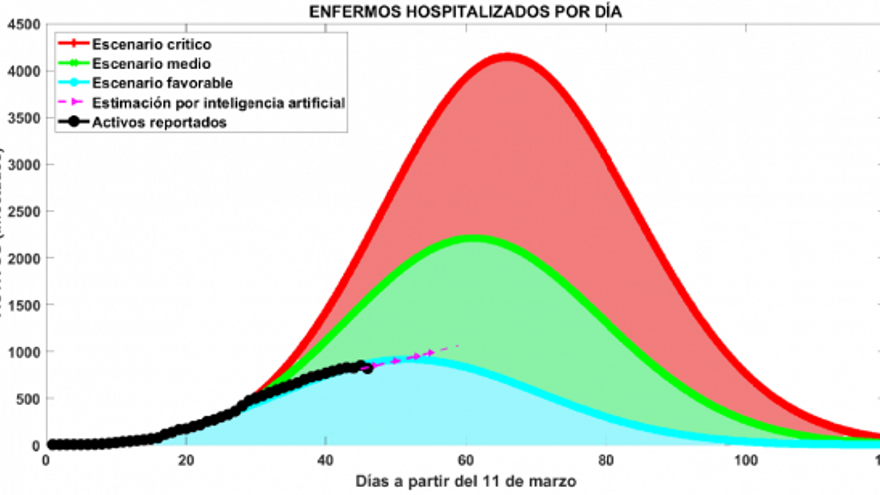
Graph of data managed by the authorities showing the possible scenarios of the evolution of the pandemic.

14ymedio bigger14ymedio, Havana, April 27, 2020 — Cuba will reach the peak of Covid-19 infection next week, in contrast to data offered by other sources, accord to the forecast of experts who evaluate for the government. Although it initially was forecast that this peak would be reached toward the end of May, results from the preventive steps taken allow for moving up the date if the restrictions that are in force are kept, according to specialists interviewed by the official press.

“This is a cautious forecast which depends on the evolution of the sickness in the next few days,” warned Raúl Guinovart Díaz, Dean of the Faculty of Mathematics and Computing at the University of Havana, during an extended report published today in Cubadebate in which he shelled out the official data, illustrated with graphs.

According to these figures, Cuba should have a minimum of 1,500 cases and a maximum of 2,500, this expert says, although he emphasizes that if the present conditions are relaxed, the forecast could change. continue reading

The evolution of the disease, with the official data available, coincides now with the forecasts of a group of Cuban experts in the United States who call themselves “Los Tocos” and who every day since the end of March have shared with 14ymedio their projections from a mathematical model. Nonetheless, these specialists lately have voiced their concern of a possible manipulation of data by the Cuban government.

“We are certain that the number of hospitalizations has been touched up, with a dual purpose — first, to avoid [the fact] that the performance of the Government could be monitored from the outside, and secondly, to allow an additional margin of time for liquidating the epidemic.”

Los Tocos noticed that something wasn’t quite right when, “The number of hospitalizations, which had been increasing vertiginously, decreased and the number of the cured rose inordinately.” According to these experts, it’s not easy to detect the fraud with the numbers of hospitalizations and cured because the authorities do not offer detailed information about these.

“The government manages two sets of statistics — the real one which is used for business purposes, and the gussied-up one for protecting itself and manipulating public opinion,” add Los Tocos. The change for arriving at the peak infection date may be laid to this. Until just a few days ago, the official sources were speaking of the twenty-eighth of May, but the new number of hospitalizations now allow them to advance the date to the third of May. On the other hand, Los Tocos estimate that the peak of the epidemic will arrive “around the fifteenth of May.”

In the interview published in Cubadebate, the dean of the Faculty of Mathematics and Computation explained that, according to the first available models, a more complicated scenario had been foreseen, with up to 4,500 active cases in a single day, which would overwhelm the normal capacity of the health system. Regardless, the positive effects of the steps taken in personal distancing was causing the scenario to change constantly, so that the predictions have improved in recent days.

“The curve was turning toward a more favorable scenario,” emphasized Guinovart.

Lizet Sánchez Valdés, mathematician and epidemiologist, gave nuance to the numbers and indicated that if the numbers of people tested increase, the figures could change due to detection in the asymptomatic. “Anyway, we don’t think it’s going to the critical scenario.”

Specialists have explained that the speed of propagation of the disease has become high, with a base reproduction number (number of additional people each infected person infects) of almost five. In order to control an infectious disease, this number has to fall below one, which is to say that each infected person has to infect fewer than one other.

“Generally, when an epidemic begins, the base reproduction number often is high,” said Guinovart. “Little by little, it’s been going down since the measures taken; it stabilized at one, then rose somewhat due to the event at the senior home in Santa Clara. Being this was such a localized event, it did not affect the figures at national level very much. Meanwhile, Havana was complicated, but after the restrictive measures, this parameter is close to a “one”, maintains the expert.

The predictions that are made around the world help governments make decisions according to the evolution of the pandemic, since such complicated scenarios demand drastic measures. However, if changes show up in the control of the disease, one can consider relaxing the confinement in order to re-activate the economy.

Guinovart vouches for the role of mathematics and statistics in this pandemic. “We think, in our modest opinion, that we have helped in decision making,” he believes.

Sánchez Váldez, moreover, took the opportunity to ask the Government and the population to follow carefully the recommendations that have been made. “The final message to the population is that if they do not adhere to the measures of social isolation, the model can again increase, and we can go to a critical scenario. The model is working as of now, but we all are responsible for it. The epidemic is becoming vulnerable to the actions that are being taken, but this depends on social behavior and governmental steps. The model is showing that we can change the course of the epidemic,” she concludes.

 Translated by: Pedro Antonio Gallet Gobin

______________

COLLABORATE WITH OUR WORK: The 14ymedio team is committed to practicing serious journalism that reflects Cuba’s reality in all its depth. Thank you for joining us on this long journey. We invite you to continue supporting us by becoming a member of 14ymedio now. Together we can continue transforming journalism in Cuba.
Day 33 to 38 of the Covid-19 Emergency in Cuba: There is Always an Eye That Sees You

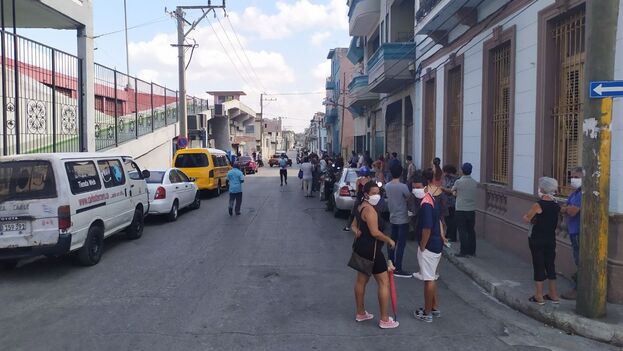
The TuEnvio service only guarantees the products and allowed you to pay in advance, because the line to pick up purchases is practically the same as in the physical stores.

14ymedio bigger14ymedio, Yoani Sanchez, Havana, 27 April 2020 — Life does not stop. We may be in a health emergency or quarantine, but children continue to be born, couples separate and the pipes break. We know about this last thing in our house, where we spent several days trying to repair a leak that made our already complicated daily life even more difficult. In the end we beat it, but that endeavor wore us out.

Among the measures that have been taken in recent weeks to try to stop Covid-19 is the suspension of the sale of all those products that are not considered basic or essential. In other words, if someone is doing a home renovation, they will have to wait for the pandemic to end to buy cement, paint or a simple faucet.

The other option is to dive into the black market, but these days “it’s bad, very bad,” a friend with multiple contacts in informal sales networks warns me. “They are doing surprise operations,” he adds. The wide area around the Plaza de Cuatro Caminos, where until a few weeks ago the main black market for plumbing parts, pipes and fittings was operating, now looks like a desert. continue reading

So Reinaldo and I had to start calling friends to see who had a left-over three-foot piece of three-quarter pipe. Finally, a neighbor on the lower floors told us that he could donate a piece that he had left after a renovation. So now we had the pipe, we needed to make the threads, something also very complicated with the city almost paralyzed and with the police lurking in every corner looking for anyone who’s carrying anything that seems strange.

We took a risk and, with the pipe on our shoulders, we went to a place near the corner of Infanta and San Lázaro, where a plumber made the threads, cut the pipe to the exact length we needed, and even gave us a missing elbow. On the way home we presented an unusual image. While most of the people we ran into carried a bag with food or an empty bag, we looked like pilgrims carrying a nice plastic cross.

Upon arriving at the building, a neighbor stationed on the ground floor looked with inquisitive eyes at what we were bringing, common behavior for him, as he has been snooping for years to see who enters and leaves our home or what is in the bag we are carrying as we return from the market. This is such permanent and open surveillance that we even joke about it and warn our visitors.

Retired and with a very authoritarian mentality, my neighbor is like those thousands and thousands of Cubans whose life revolves around watching others and being aware of what they do, people who consider intimacy a niche of individualism that should not be allowed. They are the ones who are suspicious when we close the door, remain silent and take refuge inside, because there they cannot reach us or delve into our thoughts. “Revolutionary is a revolutionary who has nothing to hide,” they repeat, and in the name of an ideology they feel they have the right to disrespect other people’s space. Poor devils.

The line is back at the ration store on the ground floor of the building. This time it is to buy a food ‘module’ that is being sold to people over 65. Four eggs, cornmeal, and a few noodles make up the survival combo for seniors. The food supply has become so unstable and complicated that I know some who sigh because they are still a few months short of reaching the age that would give them access to this bag.

At home we are inventing all the time. The day we finally managed to fix the pipe, I made a sweet potato puree, which I seasoned with oregano and some garlic cloves from the pots on the terrace. A small can of tuna and several slices of banana completed the dinner. We are lucky, because we did not have to wait eight hours in a line to prepare this “feast.” We have decided to avoid long lines and crowds at all costs, even if that entails much smaller dishes.

But many have no other option. A friend spent six hours outside the Plaza de Carlos III to collect a package that he purchased through the TuEnvío online store. After days trying to complete the operation, due to the constant hiccups on the digital site, he managed to get hold of some soaps, a bottle of oil and some sausages. When he went to pick up for the merchandise, he understood that the online service only guaranteed him the products and allowed him to pay in advance, because the line to pick up his purchases was practically the same as in the physical stores.

Now my friend has decided to go to a black market reseller to get some chicken and powdered milk. He will not have to line up, but he will pay a little more and avoid the stares, the prying eyes that loom everywhere.

See other posts in this series.

_______________

COLLABORATE WITH OUR WORK: In this time of Covid-19 crisis, 14ymedio could really use your help to keep the news coming. Please click on this link to support our work.

Santiago de Cuba Declares Two Municipalities Under Quarantine

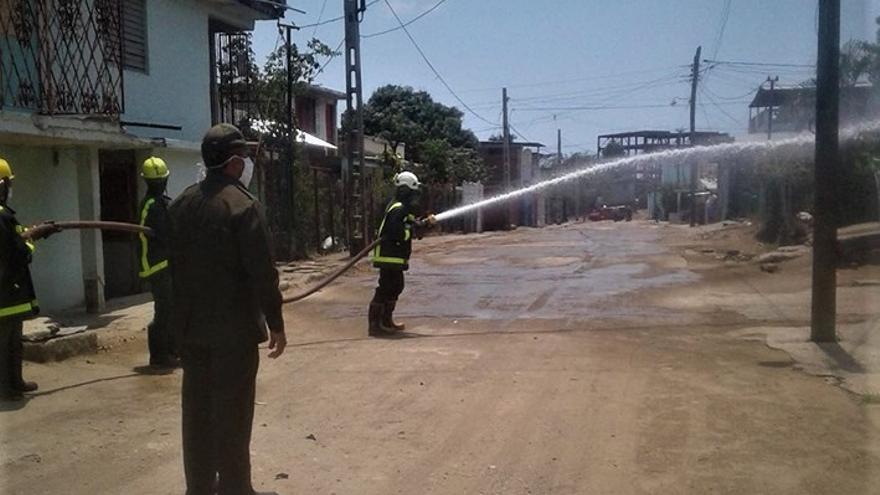
Firemen disinfect an area of Marimón in Santiago de Cuba last week.

14ymedio bigger14ymedio Havana, April 20, 2020 – Two municipalities in Santiago de Cuba, Marimón (Agüero Mar Verde) and Cuabitas (Boniato), are under quarantine starting this Sunday for the next 14 days.

Entering and exiting these towns is limited to residents and essential personnel for the operation of commerce and other essential services, who will work only between 7:00am and 7:00pm. In addition, the movement of residents is restricted between 8:00pm and 7:00am, who can only leave for medical reasons or force majeure.

There will be access control points for these communities, as well as a sanitary containment point for those entering or leaving. continue reading

As reported by the Cuban News Agency, the president of the Municipal Defense Council in Santiago de Cuba, Niurka Bell, assured that the products of the basic food basket in the ration stores were transported to avoid the movement of people.

Yanelis Hechavarría, president of the Municipal Assembly of the People’s Power of Santiago, indicated that Acopio has prepared food modules that must be purchased by a single person per family unit, with the exception of those who are in the most vulnerable groups, who must receive the aid organized by the community for those who live alone or need such assistance.

Hechavarría added that resources have been guaranteed for the Family Care System, which sells inexpensive food to these vulnerable groups.

Santiago de Cuba had, as of this Sunday, 405 patients hospitalized with coronavirus and 473 under isolation. Guillermo Mora García, provincial director of Health, insisted on the danger of contagion implied by the number of asymptomatic positives and called for continuing to do rapid tests to isolate the chains of contagion and contain the spread of the virus.

Translated by Wilfredo Díaz Echevarria

_______________________

COLLABORATE WITH OUR WORK: The 14ymedio team is committed to practicing serious journalism that reflects Cuba’s reality in all its depth. Thank you for joining us on this long journey. We invite you to continue supporting us by becoming a member of 14ymedio now. Together we can continue transforming journalism in Cuba.
A Group of Americans Stranded in Cuba will Depart this Friday on Two Charter Flights

Two charter flights from the US airline Delta will depart this Friday to evacuate some Americans who are still in Cuba. (EFE)

14ymedio bigger14ymedio, Havana, April 23, 2020 – US citizens who are stranded in Cuba will begin to depart this Friday on two charter flights operated by Delta Airlines, as reported by the embassy of that country on Wednesday.

Passengers must pay the airline the price of the tickets, the amount of which is unknown, and will travel from Havana to Miami.

“The embassy will continue to explore options for the repatriation of US citizens who are not traveling on this flight but wish to return home, however, there are no additional charter flights scheduled at this time,” the diplomatic headquarters stated. continue reading

The embassy has advised those who have not been able to obtain a seat on these flights that they should plan their stay in Cuba “until the airport reopens and the airlines can return” and urged them not to contact the mission unnecessarily, indicating that it will be the diplomatic envoy who will communicate with interested parties in case there are more flights available.

The note also reminds that all routine services and visas are on hold for the time being and urges US citizens to access the website for emergency situations.

Cuba closed its borders to international flights the last day of March to stop the spread of the coronavirus, which so far has totaled 1,189 cases on the island and has claimed 40 lives.

On the Island there are 12,744 visitors, of which 5,673 are foreign tourists and 7,071 are Cubans, who the authorities describe as “emigrated” for having permanent residency abroad.

Translated by Wilfredo Díaz Echevarria

_______________________

COLLABORATE WITH OUR WORK: The 14ymedio team is committed to practicing serious journalism that reflects Cuba’s reality in all its depth. Thank you for joining us on this long journey. We invite you to continue supporting us by becoming a member of 14ymedio now. Together we can continue transforming journalism in Cuba.

Old Age Homes, a Time Bomb in Cuba

The appearance of the coronavirus in the old age homes is a dangerous focus due to its great lethality and the level of contagion among this age group. (14ymedio)

14ymedio bigger14ymedio, Havana, 21 April 2020 — The official press has revealed this Tuesday a strong outbreak of coronavirus that afflicts an old age care home in Santa Clara. According to Cubadebate, it is the largest outbreak in the country, with 57 positive cases — 44 residents and 13 workers — one deceased, and 148 contacts of isolated employees.

The danger of massive contagion occurring in these settings is very high and is behind the great lethality in several European countries, such as Italy, Spain and France, where investigations are being opened to clarify the failures in the management of some centers.

The commission that studies the origin of the infection hypothesizes that the responsibility lies with a doctor and a nurse who tested positive for Covid-19 and probably underestimated their symptoms. continue reading

“Perhaps they did not believe that it was something serious or that they should not be absent and affect others, because it was resolved immediately, but the truth is that they failed to comply with the guidelines to stay home in the face of any suspicion of illness,” said Neil Reyes Miranda, director of Hygiene and Epidemiology in Villa Clara.

The alarm went off when a patient admitted to the Arnaldo Milián Castro hospital tested positive on Sunday, April 12, and, following her contacts, several asymptomatic positives were found in the home. Three days later there were already 17 cases, twelve of them over 60 years old and the rest were workers. Later, the cases have increased until reaching the current figures, which are current to April 20.

The infected are distributed among the Military Hospital, where there are 16 patients, two of them serious; and the Oncological Celestino Hernández, in which the others remain, all stable so far.

Manuel Togoso Alcántara, director of this center, indicated that those affected receive “treatment with monoclonal antibodies and other medications to avoid torpid changes” and other conditions typical of hospitalization, such as pneumonia, thromboembolism and bedsores.

Carlos Hidalgo Mesa, chief of these patients at the Military Hospital, explained that there are currently no cases of pneumonia or bedsores and that patients also receive injected vitamins as part of care.

“Many came here with underlying diseases, an element that called for more personalized attention. So we strengthened the teams and increased the number of doctors per shift by one to three, while increasing the number of nurses from two to five. Likewise, we increase surveillance and visit every six hours, although we take vital signs every four if there is no abnormal situation,” he said.

In the isolation center of the province, opened in the Marta Abreu special school, 79 elderly people remain who have not tested positive. Meanwhile, domestic workers who are infected or isolated are in good condition and have not required treatment to date, but they are quarantined in various hospitals, as are the 148 contacts associated with them.

Dr. Rodolfo Ramírez Álvarez, who runs the Marta Abreu isolation center, said that interferon is being supplied by the nasal route to the elderly to “strengthen the immune response to possible infections.”

Some studies carried out in Madrid and Boston warn that interferon could be counterproductive by accelerating the production of two proteins that act in two directions, since although they protect the tissue, they also serve as a gateway to the virus, facilitating invasion. The analyses are not yet conclusive, but they raise fears that the Cuban “miracle” will do more harm than good.

The dangers to old age homes in Cuba are not just that health personnel or other employees carry the virus and spread it to residents. In the Alfredo Gómez Gendra old age home, on Reina street, in Centro Habana, residents coexist with other elderly people who spend some of their time in the premises and some outside. Most come from families with serious financial problems that cannot guarantee their food. “We have old people who spend a few days here, especially to have access to lunch and food, but they go outside and sleep for a few days at home,” a local employee who preferred anonymity told 14ymedio.

“We have tried to reduce to the maximum those entrances and exits but it is difficult because also many of them take advantage when they go out to the streets to make some money selling newspapers and other things, or visit a friend who gives them some food,” adds the worker. “Then they come with bags with food or with clothes that are given to them and that they need here.”

Care home personnel are on notice and have instituted a disinfection method for everything that comes from outside, particularly because they are located on one of the most populous and deteriorated streets in the Cuban capital. “Many people pass through this sidewalk every day, the hygiene around it is not good and there are many tenements where families live on top of each other, so we are in a high-risk area.”

Along with the material problems suffered by all old age homes on the Island, the difficulty of finding cleaning personnel is another aggravating factor in times of coronavirus. “They are not interested in the wages, even if they are given some bonus of hygiene products or food on top every month,” acknowledges the employee. “Getting people to keep the floors, bathrooms and the place clean is the hardest thing right now.”

In Europe there is a strong suspicion that the beginnings of outbreaks of coronavirus in nursing homes are behind the high lethality in Spain and Italy. These countries are, along with Japan, those with the highest life expectancy and very aged population pyramids.

In Spain, mortality from coronavirus in those under 60 years of age is 1%. The figure increases to 5.2% between the ages of 70 and 79 and reaches 17.9% in those over 80. Nearly 12,000 people have died in these centers, almost half in Madrid. The seriousness of the situation has led the authorities to close residences in poor condition and open investigations to clarify responsibilities.

A similar situation has occurred in Italy, where there are about 7,000 elderly people who have died in residences, double the number that were initially counted. More than 600 centers are being investigated and about 17% have irregularities. In both countries, management is decentralized in the regions, which has added complications in determining the magnitude of the tragedy.

France also has a good number of cases of deceased elderly in institutions, with the number exceeding 7,000. Of the confirmed cases throughout France as of April 16, more than half, 56,180, were in these centers. As in the previous cases, the control through testing and intervention of the security forces of the state has tried to redirect a situation out of control.

United Kingdom, Germany, Belgium, Holland… in all European countries, all heavily aged, the same pattern is repeated. Cuba, the country with the oldest average age in the Americas, faces the possibility that outbreaks like that of Santa Clara will escalate the disease on the island.

______________

COLLABORATE WITH OUR WORK: The 14ymedio team is committed to practicing serious journalism that reflects Cuba’s reality in all its depth. Thank you for joining us on this long journey. We invite you to continue supporting us by becoming a member of 14ymedio now. Together we can continue transforming journalism in Cuba.
Don’t Let the Pandemic be a Pretext for Authoritarianism

The writer Mario Vargas Llosa, Nobel Prize for Literature. (EFE)

14ymedio biggerInternational Foundation For Freedom (via 14ymedio), Madrid, 23 April 2020 — We, the undersigned, share the concern about the Covid-19 pandemic that has caused a large number of infections and death throughout the world, and we extend our solidarity to the families in mourning.

While public and private healthcare employees fight the coronavirus valiantly, many governments take measures that indefinitely restrict basic freedoms and rights. Instead of some understandable restrictions on freedom, confinement reigns with several exceptions, the inability to work and produce, and information manipulation in several countries.

Some governments have identified an opportunity to arrogate excessive power to themselves. They have suspended the rule of law and even representative democracy and the justice system. In the dictatorships of Venezuela, Cuba and Nicaragua the pandemic serves as a pretext to increase political persecution and oppression.

In Spain and Argentina, leaders with a marked ideological bias intend to use the harsh circumstances to monopolize political and economic prerogatives that citizens would resolutely reject in another context. In Mexico, the pressure against private companies intensifies and the Puebla Group is used to attack governments of different signs.

On both sides of the Atlantic, statism, interventionism and populism resurface with an impetus that suggests a change of model away from liberal democracy and the market economy.

We want to strongly state that this crisis must not be faced by sacrificing the rights and freedoms that it has cost a lot to achieve. We reject the false dilemma that these circumstances force us to choose between authoritarianism and insecurity, between the Philanthropic Ogre and death.

Madrid, April 2020

_________________

Among many others, the manifesto is signed by: Mario Vargas Llosa, and former presidents Aznar, Zedillo, Macri, Uribe, Sanguinetti, Lacalle, Cristiani and Franco. It is also signed by an outstanding group of intellectuals, businessmen and political leaders from Europe, Latin America and the United States.

COLLABORATE WITH OUR WORK: The 14ymedio team is committed to practicing serious journalism that reflects Cuba’s reality in all its depth. Thank you for joining us on this long journey. We invite you to continue supporting us by becoming a member of 14ymedio now. Together we can continue transforming journalism in Cuba.

Without Tourists and With Businesses Closed, Soroa is Sunk in Crisis

As the days go by, life becomes more difficult for those who rent rooms to foreigners in Soroa. (14ymedio)

14ymedio bigger

14ymedo, Bertha K. Guillén, Soroa, 25 April 2020 — Until recently, the highway to Soroa, in the province of Artemisa, was a continuous coming and going of vehicles loaded with tourists. The travelers supported the economy of most of the families in the area, but after the closure of the borders because of Covid-19, the locals are trying to adapt to a bleak scenario.

As the days go by, life becomes more difficult for those who rent rooms to foreigners, organize excursions through the impressive nature of the area, or offer food or transportation services. Where once there was liveliness, now you only see empty paths and worried faces.

The basic necessities are beginning to be scarce, and the savings have been diminishing little by little. Not even the most prosperous self-employed in the area manage to maintain the standard of living that their businesses allowed them until recently. continue reading

Soroa, in the heart of Sierra del Rosario, has been for years an ideal place for practicing nature tourism. Just one hour from Havana, it earned the name of “the Rainbow of Cuba” for the diversity of its ecosystem, which allows visitors to choose between horseback riding, hiking in the mountains, medicinal baths, and the enjoyment of orchids or bird watching.

Amid so much beauty, residents must now look for alternatives to meet basic food and grooming needs. Santiago, 58, has spent years selling orchids, an illegal but very common practice in the area. With the number of tourists plummeting, he had to start raising turkeys and Creole chickens to ensure at least food to eat. “We have to wait until this crisis passes and tourism returns, in the meantime we will have to invent,” he says.

The houses, which until recently offered quiet accommodation in contact with nature, gradually become gardens. Neighbors who formerly knew precisely when the high season began, what nationalities were coming the most, or where fresh fish and shellfish could be bought for travelers’ table, now have other concerns.

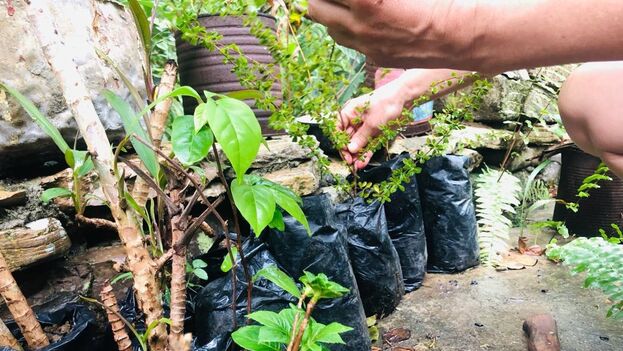
Finishing a flower bed has become the priority of María Caridad, an entrepreneur who is in quarantine with all her children in the house that until recently she rented to tourists. For years, the family has planted their root crops, vegetables and greens around the house because they do not have any agricultural markets nearby.

Finishing a flower bed has become the priority for María Caridad, an entrepreneur who in quarantines the house that until recently she rented to tourists in Soroa. (14ymedio)

Thanks to this production, this month they have a good part of their food needs guaranteed but they have increased the planting rate in order to prepare for an uncertain summer, in which for the first time in a long time they will not have income from tourism.

“In this area there are no markets, no hard currency stores, you have to go to Candelaria,” María Caridad explains to 14ymedio. The town of Candelaria is located about 16 kilometers from her home and only a few vehicles pass by the road every day.

María Caridad’s children have helped her plant pumpkin, sweet potato, tomatoes, radish, cabbage, oregano, lettuce and bell pepper. “We have distributed seeds in the community so that everyone who has a little piece of yard also sows,” she says. However, there are products that they cannot achieve with their own efforts. “The lack of oil and toiletries like toothpaste and soap continues to hit us.”

In nearby Candelaria, for the moment, there is no positive case for Covid-19, but the pandemic has paralyzed the economic life of a mainly agricultural and swine-raising region that had been going through serious difficulties for months.

This April, the center of the small town is deserted and the fruit carts  loaded with mamey, guava or bananas that rolled through the streets are gone.

Alejandro, 35, has started stacking dry firewood to make a charcoal oven. In other times he would be renting his horses to the tourists of the nearby houses or offering to transport them. With these activities, he supported his family, although his legal job is to cut fronds to obtain the palm that feeds the pigs.

“With the problems that there are with cooking gas and soon with electricity, coal will be needed,” predicts Alejandro. The man puts his hopes in the idea that charcoal will rise in market value in the coming weeks due to power cuts and a possible decrease in the supply of liquefied gas.

“In these towns no one is selling cooking gas on the streets and the contracts are few, people bring the canisters from Havana, but now with closed borders, charcoal is the best solution.”

A sack of charcoal can cost up to 60 pesos in Candelaria and reaches 100 pesos in the towns.

For Mariana, 35, the coronavirus has also been a life change. She has started making croquettes to sell door to door in her neighborhood after the rental house where she worked in cleaning closed to tourists. “I am a single mother. I tried to offer my services to wash and clean, but with this situation nobody wants people in their houses,” she regrets.

There is an air of uncertainty. Although in the last decades the region has been hit several times by hurricanes and intense droughts, in addition to suffering the ups and downs of flexibilities and restrictions on agricultural producers, the situation that has caused the coronavirus is completely new. Unlike those moments, few now dare to predict when this crisis will end.

Like a ghost, in the minds of Mariana and many others older than 30, are the memories of the crisis of the 90s. The mere idea of reliving moments similar to those caused by the Special Period frightens. “The situation is desperate. There are days when I would like to stay in bed and sleep, just to avoid stress, but I can’t.”

_______________________

COLLABORATE WITH OUR WORK: The 14ymedio team is committed to practicing serious journalism that reflects Cuba’s reality in all its depth. Thank you for joining us on this long journey. We invite you to continue supporting us by becoming a member of 14ymedio now. Together we can continue transforming journalism in Cuba.

Cuba: Economic Purges and Collateral Damages

Manuel Marrero and Díaz-Canel in a meeting on COVID-19 (Photo: Granma)

Cubanet, Miriam Celaya, Havana, 24 April 2020 — In the course of the last few weeks, Cubans have been witnessing an unusual government offensive against economic crime. With such an onslaught, which is inserted in the midst of the “battle” against COVID-19, the authorities are trying to put into practice the promise of punishment to serve as an example for all those who are trying to profit at the expense of the needs of the people, a need that is increasing, since the resources available in the country are in short supply.

This time the cleansing is so intense and the circulation of the frequent operatives against acts of misuse of state resources, warehouse robberies and food resale on the black market has been so overstated through the Castro press monopoly, that some unofficial media have concluded, perhaps in a very risky way, that we are facing an “increase” in these crimes.

Reality, however, tends to contradict this assertion, since the crimes alluded to in the national economic sphere are long-standing. Furthermore, not only have they been present for decades in the day-to-day life of Cubans, but it can be stated that they have constituted a more constant, efficient and competitive source of food than the State itself throughout that time. The difference is that, in the current circumstances, there is an evident political will to make them visible, either as a warning, as an intimidating message to the whole society over which the State has absolute control, or as an anticipated demonstration of power in the face of worse times that have yet to come. continue reading

Be that as it may, the unquestionable truth is that where there are deficits, rationing and shortages, economic crime and contraband always flourish, which do not diminish the punishable character of any infraction of this nature or the aggravating quality of their execution in times of pandemic.

That said, other aspects of the matter must be added which the official media would prefer to omit. One of them is the contrast between “justice” that applies the full accuracy of the law against transgressors only “at the grassroots level”, and to the privileged, who enjoy the most rampant impunity.

Because it turns out that, while an entire army of police, inspectors and the military equally repress managers of establishments that trade in food, truck drivers, transporters – private or state – and habitual street vendors who prowl around the markets, the State allows itself to keep soaring prices (“unsubsidized”, is the official phrase) on basic necessities, including the already famous and meager “modules” that have been distributed throughout the commercial networks destined to the use of the ration card.

All this, despite the low income of the population and the fact that the majority of Cubans are currently “available” – a euphemism that replaces the terms “unemployed” or “laid off” – or receive only 60% of their already insufficient wages due to the social isolation measures imposed.

Apparently, “speculation” doesn’t apply to the sale of ‘baskets’ for home consumption from several hotels in the Cuban capital which went on for a few days with prices between 25 and 35 CUC, which could only be acquired by some social sectors, not only due to their high cost, but for the inability of the managers to maintain this offer.

And these are just sample buttons of Cuban governmental altruism in times of pandemic.

Thus, in the infinite absurdity of the Cuban socio-economic model and its justice system, parallel worlds survive where, on the one hand, the detentions and arrests of “suspects” of economic crime — treated in principle as culprits without corresponding investigations and trials having been carried out — and on the other, the use of State vehicles for abundant food distribution to homes of the ruling class and its high-ranking acolytes, frequently documented on social networks. Which explains why these privileged few have never been seen in the endless lines for food, detergents and other essential products.

Another edge that envelopes the government’s justice efforts in a halo of mystery is the fate of the products seized in the numerous police operations. So far, no official press report has followed-up on the seized merchandise to sales platforms or to food processing centers for the lowest income families, known in Cuba under the pejorative heading of “social cases”. It could be said that there is a sort of Bermuda Triangle between clandestine refrigerators, unauthorized agricultural products that are transported in trucks, pedicabs or wheelbarrows and the dining tables of Cubans.

And, finally, the official disclosure of the essential issue in this entire saga is pending: is there any government plan to replace the invaluable work of providers to Cuban families that have fallen to smugglers and small-time dealers for so long? Do the country’s constituents have a notion of the magnitude of what we can call “collateral damage”? Is it that they have prepared for us a ready battalion of “pure or emerging administrators” capable of managing warehouses and businesses without getting corrupted?

Because it is fair to recognize that this crusade for economic purity (of others) that the authorities are waging is going to be reflected rigorously on the tables and in the pockets of the millions of people who do not enjoy the privilege of the Power class or those who don’t have their income derived from remittances sent from exiles abroad, which is why they are forced to appeal to the underground market to obtain what is necessary, almost always at prices slightly lower than those of the official market.

All of which places before us other essential questions. Where is the master plan that will finally unlock the productive chain, decentralize the inefficient economic model and make it possible to alleviate – at least – food deficiencies? Or to focus it better, is there a plan?

So far, there are no answers, and once again it has been shown that the only effective thing in the Cuban model is the proliferation of repression. In fact, at present it could be stated that it is the repressive activity that has increased, and not economic crimes. The paradox is that both – repression and the aforementioned crimes – are inherent parts of the same system: they are deep-rooted. Therefore, the supposed fight between opposites is nothing but the proper balance of a failed system that encrypts its survival in the galloping and permanent corruption and in the cyclical repressive forces.

The authorities have us so used to such awkwardness that they re-attack the consequences instead of eliminating the causes that create them. Which is perfectly logical: no system could survive if it removed the pillars on which it was founded. So, on we go…

Translated by Norma Whiting

The Mysterious Medical Alliance Between Cuba and Andorra

Cuban health workers at the entrance to their hotel in Andorra, where they were met with the applause of their colleagues

14ymedio bigger14ymedio, Madrid, April 15, 2020 — Little apparently connects Cuba with Andorra, the first with a yearly income of barely 7,470 Euros per capita, and the latter enjoying an income of 35,975 Euros per inhabitant, per year. Nonetheless, the arrival at the end of March of a medical brigade sent by Havana to the tiny principality has almost become the storyline of a movie.

Three months have gone by since the Cuban health brigade arrived in Andorra to support the country’s health personnel in its battle with Covid-19. Since then, there has been much publicity but few concrete data about the cooperation between the impoverished communist country and the tax haven with which it re-established relations in 1995 during the time of Fidel Castro. All is mystery. This news source has asked the Andorran Ministry of Health to see the agreement, but has not received an answer to date. According to local media, the text has yet to be formalized.

All that’s known for certain is the cost that was incurred for a part of the trip, amounting to 19,811.60 Euros. This past Wednesday, the Official Bulletin of the Principality of Andorra (BOPA) has made public the statement in which the Spanish airline Iberia charged for a round trip of “medical equipment for health emergency”. To this expense it is necessary to add the trip from Madrid to Old Andorra, which was undertaken by bus on the twenty-third of March, given that the principality has no airport of its own. continue reading

The arrival was beset with mishap. With a health worker testing positive for the coronavirus and the entire team being put in quarantine, it came to light this weekend that the expense in the agreement of cooperation would be defrayed by a private family of foreign origin, though residing in Andorra for several decades.

The Andorran Ministry of Finance, Eric Jover, explained in a news conference that the Sirkia family will take in hand all charges that otherwise would be laid to the public treasury by the presence of the Cuban doctors in the Principality. The family, he said, “has offered to make this donation and we thank them very much, since they will take charge of all the expenses of the agreement under which we have brought over the Cuban doctors.”

Who are this family? Little is known. Although an Andorran doctor gives out that they are a family of Cuban origin, this news source has been unable to find any connection between the Island and the Sirkia family, which formerly owned one of the luxury jewelry stores on Meritxell Avenue which crosses the capital of the Principality and its annex Escaldes-Engordany where the health workers are lodged.

The Finance Ministry announced, some weeks ago, a fund of public subscription for collecting money destined for the battle against the coronavirus, the total of which has reached 1.6 millon Euros. Part of this money was collected by SMS, although the most robust donations were those of the International Club which sent in at least 80,000 Euros taken up amongst its members, or [donations] during the skiing season (one of the great sources of revenue for the country specializing in winter tourism), which yielded 50,000 Euros; the Automobile Club, over 9,000 Euros; and from a neighborhood association for the Ransol quarter with more than 5,000 Euros. But to date it is not evident whether anyone has decided on a concrete recipient for the money other than the Cuban brigade.

To the lack of informed cooperation from the Principality is added the habitual opaqueness on the Cuban side which eludes answers to direct questions. The Cuban consul in Barcelona, Alain González who keeps track of the group, offered an interview with Diari D’Andorra this past Friday in which he dodged repeated questions concerning the budgeting of this agreement.

“What expenses did Andorra run for the stay of this brigade?” asked a journalist. “I do not have that information,” the consul replied, directing him to the Andorran authorities.

“How do you measure the monetary value of the brigades sent overseas?” emphasized the interviewer. “I shall ask you a question — do you think that solidarity has a monetary value?” retorted González. There are things that [have no monetary measure] and go beyond economic reach.”

The reporter, however, would not relent. “I shall not go back to Cuba with empty hands …” he replied. “Cuban solidarity never has been motivated by economic interest. What motivates us here is to give support to the Andorran people.” The journalist persisted without giving ground. “Insist on disconnecting philanthropy from business.” To which the consul replied, “We share what we have, and not what we have left over, and this is one way to face the philosophy of life. Solidarity is inherent in our way of thinking … we are not going to look for loot, we are not corsairs, we are not mercenaries, we are not pirates. These are doctors who voluntarily join a mission,” he emphasized.

Although the interviewer repeatedly questioned, reminding González that the sale of medical services is one of the principal sources of income for Cuba, and not for the professionals themselves, the consul settled the matter saying, “That is not the case with the brigade that is here.”

The verbal dispute continued when the journalist asked him to assure that these health workers in Andorra work in decent conditions, and the Cuban continued to elude the question, vouching for the professionalism of the workers, the majority of whom, he explained, have abandonned their country to exercise their calling with dignity, and who feel pride for the Cuban people.

“We haven’t come to create propaganda, nor to look for recognition nor economic benefit. We simply are responding to an appeal from Andorra and humanity,” he affirmed.

This same periodical published an interview this Tuesday with the leader of the brigade, Dr. Luis Enrique Pérez Ulloa. The question was put to him again about the economic interests of these missions, to which the doctor replied that this the question only reveals unfamiliarity with the Cuban public health system, which is “purely altruistic”.

The journalist was interested in the purchasing power of the salaries received by the contingent and whether they adapt to the cost of living in Andorra, to which Pérez Ulloa replied that they are lacking for nothing. “What better example than being here and hearing the notes of the Cuban national anthem sound off from the balconies each evening at eight p.m. And when you walk to the hospital, you see people applauding … this goes to the heart and fills us with pride. This is the best gift we have received, and this cannot be bought with money.”

The interview, like the news about the family that underwrites the agreement, has caused strong disagreements in comments to the online press. Some citizens are grateful to the Sirkia family for having decided to invest part of their money toward medical assisstance, while others are suspicious of the circumstances of the agreement, and claim that taxes and not donations are what supports the public expense.

There are those who applaud this cooperation with the Cuban doctors, regardless of how the agreements were drawn up, while others think that the health workers might be exposed to the habitual conditions of Havana, and reject it.

In Andorra, there have been 659 persons infected with Covid-19 to date, of which 160 have recovered and 31 have died — an extremely high rate of mortality, at 4.7%.

Cuban doctors took up positions at their usual work posts this past Monday after spending several days in quarantine due to one off their members testing positive for Covid-19, and a week off to familiarize themselves with El Cedre, a social health center in which the elderly or handicapped usually reside and which has been outfitted as an auxiliary care center for those ill with coronavirus, initially the less severe cases. The severe ones go to the hospital Nostra Senyora de Meritxell.

Translated by: Pedro Antonio Gallet Gobin

__________________

COLLABORATE WITH OUR WORK: The 14ymedio team is committed to practicing serious journalism that reflects Cuba’s reality in all its depth. Thank you for joining us on this long journey. We invite you to continue supporting us by becoming a member of 14ymedio now. Together we can continue transforming journalism in Cuba.
Government Blames Cuban Families for Increase in Energy Consumption

Energy demand in households has exploded and is not offset by the drop in use by large consumers. (EFE)

14ymedio bigger14ymedio, Havana, 23 April 2020  — Energy consumption has increased atypically in Cuba during this period of confinement. With the increase in the amount of time that citizens stay home, national electricity consumption has risen 10% despite the closure of some companies and large hotel facilities.

“Although sectors such as tourism and other non-essentials are declining, that hardly represents a decrease of 3% in consumption. That figure does not compensate for the increase seen in the consumption by Cuban households,” said Liván Arronte Cruz, Minister of Energy and Mines, reported yesterday on the Roundtable TV show.

According to Elaine Moreno Carnet, general director of the Office for the Rational Use of Energy, consumption is growing in the residential sector at the same time that large consumers are maintaining their usual activities, especially steel mills, light and chemical industries, and cement, agriculture, nickel and oil. continue reading

Cuban economist Elías Amor, resident in Spain, expresses his surprise at the official justifications. “No one explained that, for the same reason, the consumption of electricity in companies that have stopped or reduced operations, in hotels and in establishments in the budgeted sector must have plummeted since the beginning of the confinement. One would think that this drop in consumption should complement and even appear as a surplus, since industry, without going any further, is  a more intensive consumer than are families.”

The argument is consistent with the electrical use pattern in Spain, where the fall in use by large consumers in March was 8.2%. Electricity demand fell between 5% and 10% in the first seven days of the state of alarm and, despite the increase in household consumption, the drop in services and industry led to a sharp decline during the first week of confinement, although in that country the confinement has been strict and the paralysis almost total, except in essential sectors.

The minister said yesterday that the Government has focused on ensuring consumption in hospitals or isolation centers, as well as essential activities, including some that are specifically needed at the moment, such as the production of calcium carbonate and salt, essential for cleaning supplies, and sodium chlorine and hypochlorite (i.e. bleach).

“The production plan for nickel is being met, while national oil production is exceeded, work in the mines is maintained and the refineries remain stable,” the minister explained. He added that there are maintenance works in several generating units to give greater stability to the national electricity system.

“The generation of electricity in Cuba works in a stable way, especially due to the effort made to maintain generation and avoid blackouts, amid difficult conditions imposed by the US blockade and the rise in consumption in homes as a result of the necessary social isolation,” he said, not forgetting the obligatory reference to Washington’s supposed responsibility for Cuba’s shortages.

The minister admitted that the heavy weight of diesel is a drag on the economy, because it is expensive and is used to generate more energy at peak demand. “If we need more diesel than planned, that conspires against other activities in the economy, such as transportation,” he added before invoking savings again, even though transportation is largely paralyzed.

Armando Cepero Hernández, general director of the Electricity Union of Cuba, downplayed the power outages that have occurred in recent weeks and insisted that they are a consequence of the increase in loads caused by more people staying at home, along with the effort to air condition rooms given the high temperatures of recent days.

The official notes that the offices to pay for electricity are closed but it is possible to make the payment electronically if you want to avoid the accumulation of bills. For those who do not, collections will be made when the epidemiological situation improves.

Moreno Carnet urged companies and households to consume responsibly, especially in the middle of the day, when greater peaks in demand are taking place.

For the economist Elías Amor, in addition to the problems of energy production in Cuba, there is the terrible state of the aerial networks and lines that cause continuous breakdowns, as a consequence of the lack of investments. “However, … the fault, in the event of the inevitable blackouts, lies with the Cubans, who leave their refrigerator door open or do not turn off a light bulb. The leaders are never responsible for the decisions they make, or don’t make.”

______________

COLLABORATE WITH OUR WORK: The 14ymedio team is committed to practicing serious journalism that reflects Cuba’s reality in all its depth. Thank you for joining us on this long journey. We invite you to continue supporting us by becoming a member of 14ymedio now. Together we can continue transforming journalism in Cuba.