When Myths Are Not Applauded / Miriam Celaya

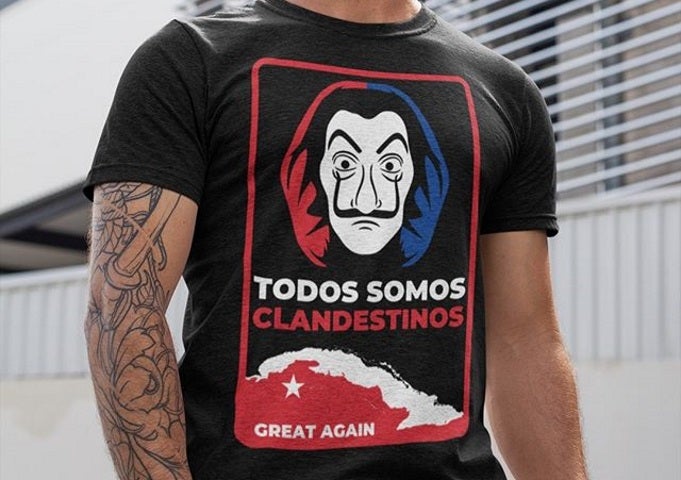
“We are all Clandestinos.” Instagram

Cubanet, Miriam Celaya, West Pam Beach, 29 January 2020 – This is a textbook case: to question a myth is to unleash hysteria. And as it usually happens, the loudest blabbermouths tear off their hair and their clothes against those who dare refuse to follow the little troupe on duty. And in the cast of outraged moralists there is no shortage of cap and gown academics or some famous press figures who, whether with an admonitory finger or with feigned condescension, take the opportunity to “scold” those who dare to speak loudly about what many think of, but do not have the audacity to express. Nothing new.

However, beyond the good name, fame or reputation -deserved or not, for this is about the right to an opinion and not to display emblems or symbols- the beauty of acceptance is not an argument when analyzing the facts. Popularity or fame does not guarantee the supremacy of a principle. What it entails is common sense and, of course, the tangible reality… that which exists in everyday life despite the wistfulness of cyberspace.

Because, while it is true that the opposition and any movement or person who oppose the Cuban dictatorship have  been “suspicious” at some time, or unfoundedly accused of belonging to, or at least collaborating with the (In)Security of the Castro State, it cannot cast aside an essential fact: Oswaldo Payá, as well as the Black Spring prisoners, opposition leaders and civil society groups and we, the independent journalists who reside on the Island, have a real and tangible physical existence, a verifiable job and the common denominator of keeping at the head of the dictatorship’s opposition. You can be for or against our proposals or ideas, but nobody can question our existence. continue reading

That said, it should be clear enough that it is absurd to compare any of the aforementioned with that cyber-hierarchy called “Clandestinos”,  whose real existence no one can confirm beyond cyberspace, whose directives -which, among the most recent, invite to no less than the takeover of a radio station- are absolutely absurd and unrealizable, and whose bravado (always through the networks and hiding their faces) frequently calls for acts of violence, sabotage and anarchy, that in the Cuban circumstances are not only quasi-chimeric actions, but also termed as reckless in a setting that neither they nor anyone else would have control of.  Is this really what we need in Cuba? Is this a solution? Has anyone, among the hard defenders of “Clandestinos” stopped to think about the consequences of these actions and about the day after? Obviously not.

It is understandable that many Cubans, fed-up after 61 years of dictatorship, repression, misery, absence of expectations and hopelessness, tend to stick to any libertarian mirage. Exiles, or at least some of them, are likely to fall into that incantation. It is understandable, I repeat, but not reasonable.

Meanwhile, any opinion that threatens the illusion of a mirage is taken as a declaration of war or, at least, as a “disunifying” proposal of something that has never been united. Thus, the mere fact of questioning the spooky event -until now it is nothing more than that- self-denominated “Clandestinos” is like taking candy from a child, while speculating about its possible origin in the murky labyrinths of the Cuban G2 (State Security Forces) is the worst of sins. “Inverse logic,” says a well-known journalist who doesn’t want to seem too caustic.

And to “prove” that my criterion is about inverse logic and not about anything else  he compares these ghosts with real people and movements within Cuba, in this case, opponents of renown prestige, activists, etc., projects as noteworthy as the Varela Project and movements of proven track record such as the one for Human Rights. Seriously, does the cyber soap opera “Clandestinos” seem comparable? Should it seem like good “logic” to us?

And since citing names and events of the most diverse nature constitutes a good resource when there are scarce arguments, entangling the reader in a lush ajiaco (a Cuban stew) where the name of journalist Yoani Sánchez is invoked along with the names of opposition member Rosa María Payá, of Elian [González], of former US President Jimmy Carter, of the Embargo, of the Five released spies and of another cluster of unrelated issues that vary differently in time and context -the Twin Towers, the attack on Iraq, World War II, the explosion of the USS Maine…- that supposedly conclude by demonstrating that if we do not believe in the much discussed “Clandestinos”,  or if we believe that there is a relationship between their (non)existence and the G2 we are “conspirators”. Which, in any case, results much or more gratuitous than suspecting those who summon violence under the cover of anonymity or from the comfortable protection of cyberspace.

The rest are common places. It is a Perogrullo truth that whenever the opposition has won spaces it has been against the official will. Personally, I am pleased to be part of those who pushed for those little conquests. But it is illusory to suppose that “Clandestinos” has gained space, much less that it is something that has slipped out of the hands of the dictatorship.

In another order, it is true that the Cuban dictatorship opened its arms to Jimmy Carter, but it is no less true that it went back in terror when Barack Obama’s rapprochement  and Cuban support for the flexibility of the Embargo seemed too risky because it endangered the absolute control of the state over life and property of the “governed”, when the dictatorship felt that within Cuba an air of hope was being promoted in terms of economic freedoms and citizen autonomy. That terrifies them. This shows that two similar events at different times and circumstances do not have the same effect on the dictatorship. It is called dialectic.

As for the Embargo, which is not a subject related to “Clandestinos”, but also (because it was useful?) it floated in the ajiaco, it is not only true that it served as a pretext for the dictatorship and that continues to be used, although it has lost effectiveness, but I dare to affirm that the majority of the so-called ordinary Cubans, who suffer the infinite vicissitudes of the system imposed by the political Power, would be happy to have it repealed. I also dare to predict that any credible popular survey (not of the Castro regime, of course) about whether those inside the Island want its repeal will have an overwhelming result in favor of YES. Because, regardless of the wishes of one or the other, everyday reality is what is imposed on people’s lives, especially if survival is of the essence. Most Cubans, with or without foundation, believe that if the Embargo is lifted, they will improve issues related to food, transportation and material goods.

Of course, we know that repression does not depend on either the Embargo or “Clandestinos”. That would be the day! But that does not mean that both factors, although unrelated, do not eventually constitute excuses -no one in their right mind would suppose them to be an “alibi”- that the dictatorship uses for control purposes. The stubborn facts prove it; they are not “conjectures.”

The psychological factor could not be missing in the convoluted “analysis”. A good session on the couch is the supreme resource for attributing failures to the “hot minds” of those who consider that “everything has a why.”

I do believe it. Everything happens for a reason. Everything has causes, consequences, a background. Even if we don’t know them at the moment. But when talking about “Clandestinos” especially when even they have rejected the title of opponents (“We are not the opposition”, they have repeated), it seems at least an exaggeration to label them as a “political novelty”. If those who are, up to now, only an imaginary “group” of network agitators with actions unproven by the general public classify someone as a political novelty, we should start turning off the lights.

If not falling exhausted at the foot of a myth, call it “Clandestinos”  or any other trendy designation that may arise, if not agreeing with what, so far, does not go beyond the bravado of cyberspace, if not supporting incitements to chaos and violence turns me into an “elite” (criteria that I don’t share), then I am so. I confess myself as an “elite”, at least in the diagnosis of this psychoanalyst.

Nevertheless, I have always said and repeated that I would be the first to acknowledge my mistake, if that were the case. In short, the existence of “Clandestinos” if true, does not take away any merit from my work in the field of independent journalism since 2004, or at the time within opposition activism. I have never considered myself a hero for writing and disseminating what I think, nor did I contribute to the manufacture of altars and heroes of any color, let alone of sacred cows. I do not follow leaders of any political hue or nature. I am an irreversible irreverent.

Anyway, whether “Clandestinos” is a conspiracy or not, it does not directly affect me either. With or without “Clandestinos” I am aware that when the dictatorship has wanted to repress me or harass me, it has done so and can do it again in the way and at the moment it decides, since I live on the Island and I am -like any freethinker- at the mercy of its whim. And I also know that, with or without “Clandestinos”, the end of the dictatorship is inevitable.

I fully understand that decades of absence can create a distortion about the reality of Cuba to such an extent that it becomes misleading to think that a cyber fantasy is the flame that would initiate a Cuban rebellion. Only when the reference is lost can one believe in a popular uprising in Cuba against the dictatorship from a cyberspace cry, except for the one that may occur due to the despair of hunger or the shortages of poverty, which would doubtfully have root or any political leadership.

Such is Cuba’s reality, whether we like it or not, such is its degree of civic orphanhood. Those who read my articles or follow me on the web know that I do not seek to please readers if such a thing involves sacrificing that in which I believe, my feelings and what I see every day. Not even my adversaries could accuse me of being a hypocrite. That said, I find that most of those who today support the anarchy and violence they call the “Clandestinos” networks are many miles away, as safe from it as the ghost that created them. Let us allow time to carry out the mission that will show on whose side reason is.

(Miriam Celaya, a resident of Cuba, is visiting the United States)

Translated by Norma Whiting

See also:

Clandestinos: Outcome and Teachings of a Hoax / Cubanet, Miriam Celaya

The Controversy Over The Identity Of The Clandestinos Is Growing

Clandestinos, Legitimate Protest or Provocation by State Security?

Clandestinos: Heroes or Collateral Damage? / Cubanet, Miriam Celaya

With Testimonies from Detainees, Cuban TV Accuses Miami’s “Mafia” of Financing Clandestinos
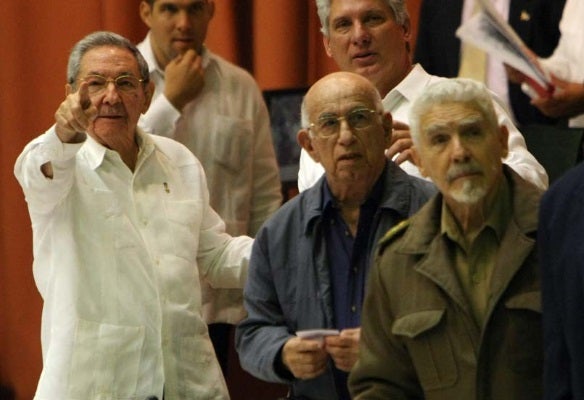
Raul Castro "Sparks" at the Funeral for Asela de Los Santos / Juan Juan Almeida

Raúl Castro (younger than now) with Díaz-Canel, Ramón Machado Ventura and Ramiro Valdés (photo: rtve.es)

Juan Juan Almeida, 28 January 2020 — On January 25, Army General Raúl Castro attended the funeral services for Asela de los Santos Tamayo, held in the Pantheon of Veterans at the Colón Cemetery.

In attendance were the most prominent members of Cuba’s political leadership. It was the same on Sunday, December 8, for the funeral of Faure Chomón.

I should clarify that, when I say “the same,” I am referring of course to the presence of the now almost ninety-year-old younger Castro, who could be seen wearing, under his very well-pressed uniform, adult diapers.

The first-secretary of the Cuban Communist Party arrived at the funeral, which was held on January 25, surrounded by bodyguards and wearing, under his brand new green khaki pants, blue diapers. Perhaps owing to their quality, they let out a small stream of excrement that released an unmistakably foul greeting, which led to an avalanche of questions and concerns.

It is widely known that Cubans — regardless of race, creed, or inclinations either sexual or political — take few things seriously. It is understandable then that, when the attendees at the funeral service noticed the stench and realized that the general was “sparking,” there were smiles and audible comments such as, “The old general shit,” or “The first-secretary exploded a mine,” or “The Chinaman* had a stroke.”

At first there was a lot of joking. But later, after the jokes and smiles had died down, almost everyone, including the most jocular attendees, began to ask serious questions: “If he’s like this now, he can’t have much time left, at least not of useful life… What will happen when he’s suddenly no longer around… Who will fill the power vacuum?”

*Translator’s note: Cubans often refer to Raul Castro as “the Chinaman” because of his facial features.

Cuba Is Paralyzed as Temperatures Drop

14ymedio bigger14ymedio, Havana, 24 January 2020 — All the people waiting in a long line to buy rationed chicken in the Plaza of the Revolution district this week were wearing heavy coats, woolen hats, high socks and/or scarves. At least two elderly women were draped in blankets. Though the scene was reminiscent of the Russian steppes or the Swedish coast, it was actually in Havana.

In recent days Cuba has been experiencing its lowest temperatures in forty-three years. Thirty-two of the island’s meteorological sites have recorded temperatures of less than 10 degrees Celsius (50 degrees Fahrenheit).

In a country where it is “always summer,” as tourism slogans boast, people are poorly prepared for the few brief periods each year when thermometers drop below 15 degrees. Most houses do not have tightly sealed windows. Coats and winter clothes are of poor quality and generally intended only for a slight drop in temperature. Staying warm with soup or hot drinks can also be challenging due to food shortages, which have increased in recent months. continue reading

Some people are just happy not to be sweating all the time. Many look upon this time of year as “the season of love,” when couples can enjoy cuddling more. It also gives those who own imported coats or winter accessories the opportunity to show off a garment that would otherwise spend all year in the closet.

Many parents choose not to send their children to school when temperatures drop below 20 degrees. Absenteeism increases dramatically as getting out of a warm bed becomes a herculean effort for many schoolchildren and workers, especially for those with jobs that require them to be outdoors, in factories or guarding the exteriors of government buildings.

Perennially popular beaches and swimming pools empty out. Households use less water as many residents opt to forego showers, a relief to those families who in recent weeks have experienced serious disruptions in their water supply due to widespread repairs.

The line at the always busy Coppelia ice cream emporium gets shorter while shops that sell coffee or hot chocolate see increased demand. Owners of privately owned restaurants seize the opportunity to offer more stews, black beans and hot creams. At family dinner tables soup takes center stage, which helps to stretch servings of meat or chicken. Those who do not have access to either resort to using instant bouillon cubes or bones.

In light of the current low temperatures, animal welfare activists have asked for donations of clothing to help protect stray dogs and cats. Several private organizations have redoubled efforts to find and shelter animals abandoned in the streets.

The lowest figure recorded by the Cuban Meteorological Institute was 6.6 degrees Celsius (32 degrees Fahrenheit) at the Ciego de Avila weather station.

Two stations also recorded their lowest temperatures ever. One of them was in Veguitas, in Granma province, where it reached 7 degrees Celsius (32 degrees Fahrenheit). The last time temperatures in the province were this low was in January 1977 at a weather station in Jacarito.

The other weather station that set a record was in Manzanillo, also in Granma province, at 10.1 degrees, significantly lower than its previous record of 12 degrees, also set on January 21, in 1977.

Another low was recorded at a weather station on Isla de la Juventud, equal only to the 7.7 degrees reached on January 20, 1977.

The newspaper ADN reported that a man died of hypothermia in Villa Clara, an unprecedented event in the province. Published reports indicate, however, that the deceased, a 54-year-old resident of Remate de Ariosa, had alcohol-related problems and fell asleep in the open air after allegedly ingesting large amounts of alcohol, a combination favorable to developing hypothermia.

The man’s body, partially shielded by the statue of a a crab, was found by workers at a gas station in Caibarien, a town that has seen temperatures fall to as low as 11 degrees.

Traditionally, those most vulnerable during these cold fronts have been elderly persons who live alone and homeless people who sleep in parks and doorways. But travelers who wait at bus stations before dawn, and patients at hospitals and mental institutions can also fall prey.

In January 2010 low temperatures and administrative neglect led to the death of twenty-six patients at a psychiatric hospital in Havana known as Mazorra. Images of their emaciated, abused bodies were quickly circulated by cell phones, which were already becoming common in Cuban life at the time.

___________________________

COLLABORATE WITH OUR WORK: The 14ymedio team is committed to practicing serious journalism that reflects Cuba’s reality in all its depth. Thank you for joining us on this long journey. We invite you to continue supporting us by becoming a member of 14ymedio now. Together we can continue transforming journalism in Cuba.

Silvio Rodriguez ’Discovers’ That the Blacklist Comes from Cuban Communist Party

What Radio Progreso airs is what the ideological department of the PCC thinks,” wrote Silvio Rodríguez. (EFE)

14ymedio bigger14ymedio, Havana, 22 January 2020 — Singer Silvio Rodríguez pointed to the Communist Party of Cuba (PCC) as the creator of an independent “blacklist” of media aired a few days ago on Radio Progreso networks.

“What Radio Progreso airs is what the ideological department of the Cuban Communist Party (PCC, “the leading political force of society and the State”) thinks, and what they are directed [to report],” Rodriguez wrote in a comment on a post he published in his blog Segunda Cita.

“It surprises me that they have not included Segunda Cita, when ‘the pack’ has whipped us,” he added in reference to some moments in which his publications have been attacked from official voices. continue reading

“For the naive, for the uninformed, for those who still believe that the media war against Cuba is a digital story, for those who believe everything they read on Facebook, this is the list with the most reactionary sites,” said the post about Cuban radio. The comment was subsequently deleted but Silvio Rodríguez does not say if this decision was also the product of a “guidance” from the CCP.

The troubadour’s comment comes when the workers of the publications mentioned in that list have reported an attack on their pages.

Many of the media names by Radio Progreso have been blocked for years in the national servers of the Island such as the digital newspapers, Cubanet14ymedioDiario de Cuba or others such as ADN Cuba and the magazines El Estornudo and Tremenda Nota.

This is not the case of Barrio PeriodismoLa Joven CubaEl Toque and OnCuba News which, in general, have been accessible. However, from this weekend until early Monday, these media now included on this “blacklist” could not be accessed.

Manuel Henríquez Lagarde, director of the official CubaSí website, was the first to make the list public, when, on January 16, he listed the 20 websites “that usually assume an open stance against the Revolution, or that, from pseudo-revolutionary positions usually coincide with the policies (…) of the United States Government against Cuba.”

At the beginning of last year the digital magazine Tremenda Nota, which deals with minority issues and the LGBT agenda on the Island, joined the list of blocked sites the same week that the Government held the referendum on the constitution.

Although, in general, the media on the list have mostly reacted by criticizing the censorship of information and showing their solidarity with the others, the editors of La Joven Cuba regretted that some official voices “insist” on placing them in that position: “Where we do not want be, nor will we be.”

La Joven Cuba  joined in the past campaigns against the independent blogosphere that got started on the Island in 2007; in La Joven Cuba’s pages ample space was given to official campaigns that labeled critics as “CIA agents” and instruments of the “media war against Cuba.”

For her part, the Director of Periodismo de Barrio, Elaine Díaz, also regretted the inclusion of her site in the list of reactionary media and argued about the financial transparency of the site, which publishes its reports with the expenses and donations received, especially from embassies and foreign foundations.

__________

COLLABORATE WITH OUR WORK: The 14ymedio team is committed to practicing serious journalism that reflects Cuba’s reality in all its depth. Thank you for joining us on this long journey. We invite you to continue supporting us by becoming a member of 14ymedio now. Together we can continue transforming journalism in Cuba.

With Testimonies from Detainees, Cuban TV Accuses Miami’s "Mafia" of Financing Clandestinos
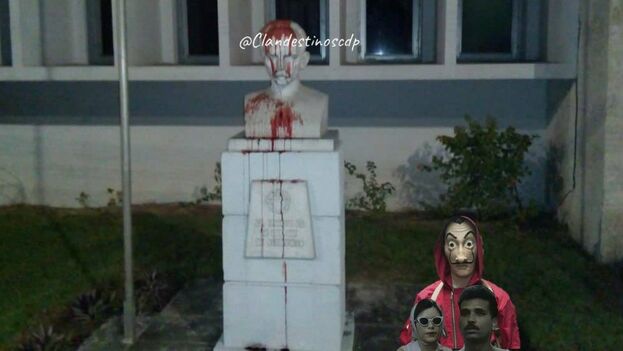
14ymedio bigger14ymedio, Havana, 22 January 2020 — As it usually happens in these cases, Cuba’s State television monopoly presented a report on Tuesday that provides supposed evidence of the participation of “the anti-Cuban mafia based in Florida” in the desecration of José Martí’s busts by a group called Clandestinos.

The report, more than 11 minutes long, presents images of surveillance cameras in which two men are seen moving at night near the Plaza of the Revolution, one of the most controlled areas of the country. In its vicinity is the bust of Martí made by José Delarra and allegedly vandalized, according to a complaint from the workers of the neighboring Bohemia magazine. The bust had to be restored after the action, although photos of the damaged sculpture were never shown.

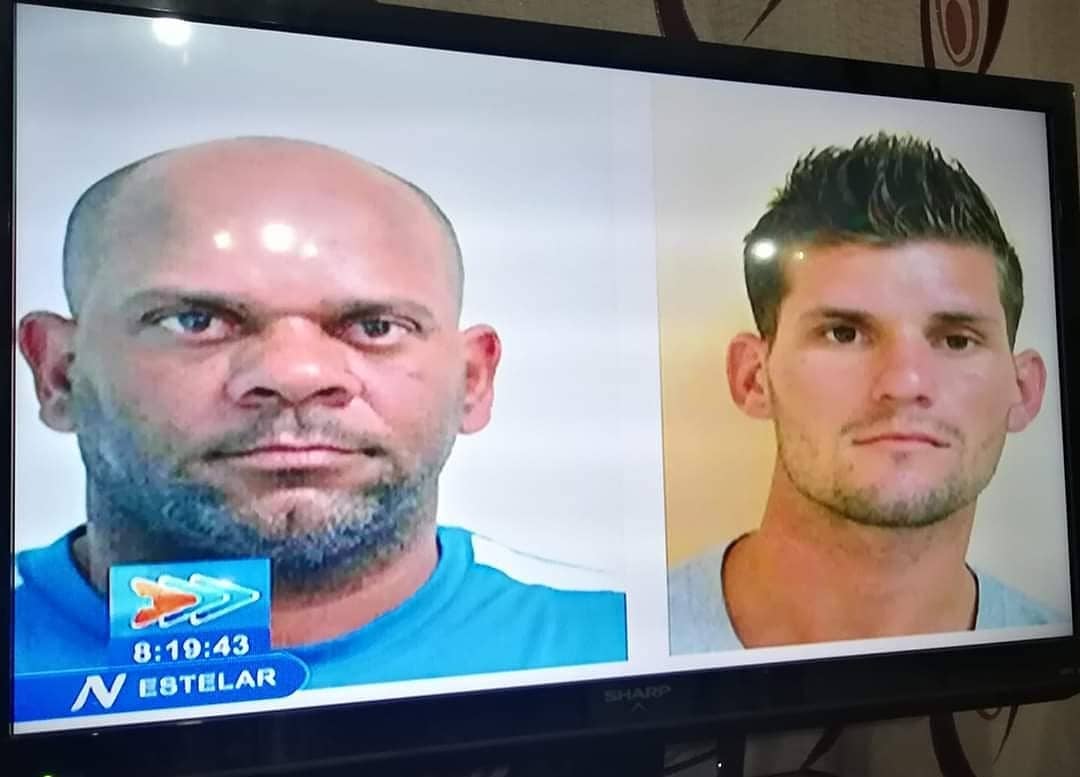
These men, whose arrest was announced on January 8, appear on the screen to relate the actions they took against the monuments dedicated to the national hero. According to the official press, Panter Rodríguez Baró, 44, and Yoel Prieto Tamayo, 29, “denigrated 11 Martí busts and three billboards with political content” in the early days of this year. continue reading

The strange thing is the casual and even mocking tone of the man who is presented as Panter when he talks about his use of marijuana and cocaine. The same sense of manipulation is suggested by his statements about the role of activist Ana Olema Hernández, who is pointed out as the head of the entire operation and who sent about $600 to Panter through Western Union, a not very discreet way of financing a clandestine operation.

To confirm their accusations, the report shows proof of bank transfer receipts, allegedly made by Hernández and her husband. Both allegedly sent more than $1,000 to Cuba to finance “enemy activities,” $600 of it for graffiti.

As an opponent, Cuban television labels Hernández a person who is “at the service of the United States Government and the anti-Cuban mafia based in Florida,” and accusers her of having links with “counterrevolutionary and terrorist” organizations and therefore being a “puppet of subversion” involved in causing “disorders.”

Ana Olema Hernández denied the accusations, which she described as false, through her social networks. “It is impossible to give credit to a report made by a press in the service of a dictatorship, with some interviewees, who are not being interviewed, but after days and days under interrogation, in the dungeons of State Security, are forced, God knows under what threat, to say anything.”

The opponent added that she would be proud “to support any civil and civic resistance movement in Cuba” but that, in her opinion, “that movement was born within Cuba spontaneously.”

Guillermo Mendoza, arrested for owning the phone with which Rodriguez and Prieto’s actions were filmed, and Jorge Ernesto Pérez, Panter’s cousin, also appear in the video. The latter is accused of maintaining communication with Hernández. In addition, both painted posters with the slogan “I vote no” against the constitutional reform last year; all this according to the official version.

“There were containers with pig blood in them. In the case of citizen Panter, a search was made in the garage where objects containing substances that were established to be drugs, specifically cocaine, were found,” said an officer interviewed for the report.

Cuban Television has not specified details about the judicial situation of the accused, but refers to the most serious penalties applied in the past to proclaim the virtues of the regime. “It would be possible to reflect that if in a past time eight medical students were unjustly murdered by an alleged outrage to the grave of a Spanish hero, what do these servants deserve? Luckily for them, the Cuban Revolution is fair,” they say.

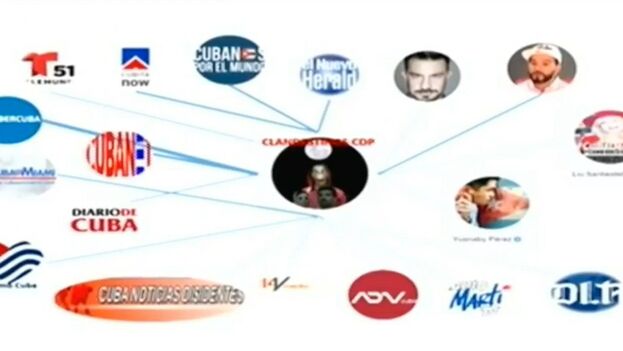
The video also spares no effort in showing an alleged link between the actions of Clandestinos and the independent media that have reported their activities. El Nuevo Herald, ADN Cuba, Diario de Cuba, Cubita Now and 14ymedio are some of those that appear for having disseminated facts of “such magnitude.” That list coincides with the one of the designated pages that an official blogger recently published and was reproduced by other national information spaces.

State television establishes a link between the Clandestinos and the independent press of Miami and popular personalities who have shown support for the group. (Screen Capture)

The same diagram shows the faces of people, such as Alex Otaola, Aldo Roberto Rodríguez Baquero and actor Roberto San Martín, who had shown support for the actions of Clandestinos.

The group takes its name from a film by Fernando Pérez that addresses the clandestine struggle against Fulgencio Batista’s regime and, since the beginning of its activities, it has been cautious not to give details that allow identifying any of its components.

In the street and on the networks, meanwhile, the debate continues on whether the collctive is a group that genuinely struggles to make visible its protest against the Cuban government or a creation of State Security to link it to the opposition.

See also:

Clandestinos: Outcome and Teachings of a Hoax / Cubanet, Miriam Celaya

The Controversy Over The Identity Of The Clandestinos Is Growing

Clandestinos, Legitimate Protest or Provocation by State Security?

Clandestinos: Heroes or Collateral Damage? / Cubanet, Miriam Celaya

______________

COLLABORATE WITH OUR WORK: The 14ymedio team is committed to practicing serious journalism that reflects Cuba’s reality in all its depth. Thank you for joining us on this long journey. We invite you to continue supporting us by becoming a member of 14ymedio now. Together we can continue transforming journalism in Cuba.

Three Girls Die in Old Havana When a Balcony Falls on Them

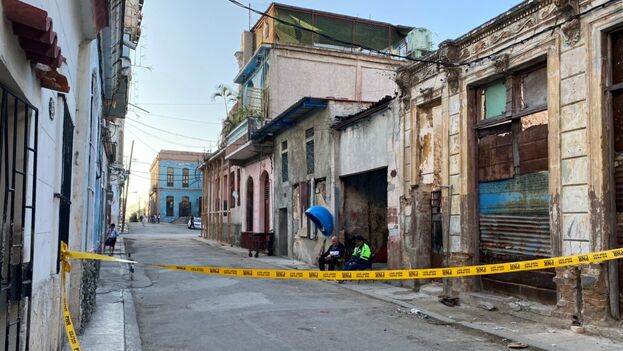
Two of the victims died on the spot while the other died in the hospital. (14ymedio)

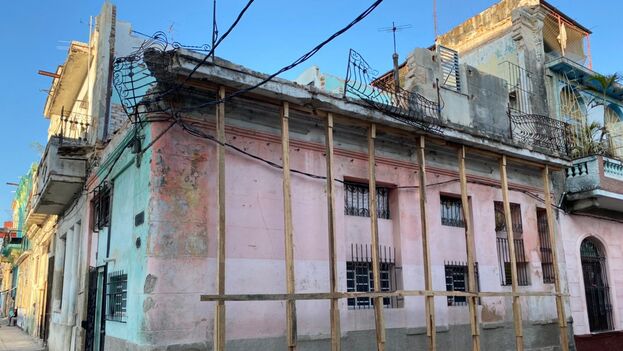
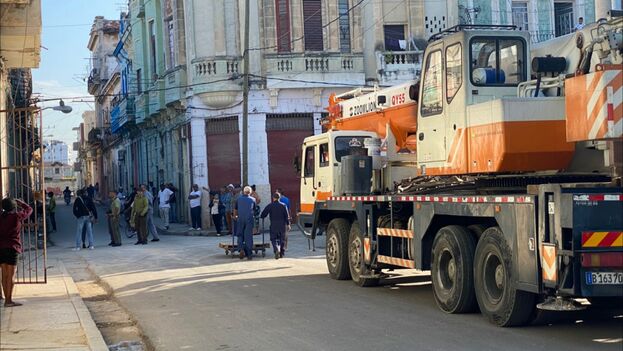
14ymedio bigger14ymedio, Luz Escobar, Havana, 28 January 2020 — Three girls died on Monday when a balcony collapsed in Old Havana, between Vives and Revillagigedo streets, in the Jesús María neighborhood. The neighbors said that the collapse of the structure occurred around half past four in the afternoon when the children had left school and were on the sidewalk rehearsing for the celebrations for the birth of José Martí.

This morning the police were still around and the yellow hazard tape and a crane remained at the scene, as this newspaper has verified.

“The girls were just starting their lives, those parents must be shattered, they were in sixth grade, how many dreams lost by imprudence. Look, the crane arrived, now they come to demolish it with the crane? Now that it already fell? They should also go to the corner and prop it up, so this movie doesn’t happen right away in the next block,” says an old lady with tears in her eyes while talking to a friend. continue reading

All these cases have in common the poor state of the properties and the authorities neglecting to take measures that could have prevented these deaths.

The three girls, María Karla Fuentes and Lisnavy Valdés Rodríguez, 12, and Rocío García Nápoles, 11, were studying at the Quintín Banderas elementary school. Two of the victims died instantly and the third in the hospital. The neighbors claim that the rear of the building had begun to be demolished, but the area was not marked as would have been necessary to avoid situations like this.

“I do not understand, why are there so many police and all that now, that should have been avoided,” said a neighbor on Vives Street this morning when a car from the operational guard arrived to investigate the event.

“I was doing something with my phone and suddenly I felt the rumble, I ran to help, but you couldn’t see them, the pieces of the balcony were huge and two of the girls died on the spot, the one that came out best died as soon as she arrived at the hospital, after she left here in her mother’s arms,” says another neighbor on the block.

Around 9:20 in the morning a parade of boys from a nearby school who were paying tribute to José Martí passed by the front of the collapsed building. The official press has reported the event this morning around 10:00, when the independent press had already featured it on its covers, in some cases since the previous day.

Jesús María is one of the poorest neighborhoods in Havana and is forgotten by the authorities, according to residents.

Just two months ago there was another similar tragedy that involved a minor. It was on November 3, in the Playa municipality, when a building collapsed leaving two fatalities, a 13-year-old girl and her mother. On that occasion there was a survivor, the child’s grandmother.

The operational guard appeared this morning at the scene to investigate the fact. (14ymedio)

Also in March there was the death of another person in similar circumstances in the Cerro neighborhood. On that occasion a building collapsed that the neighbors had been requesting be fixed for fifteen years. After there was a fatality, the building was demolished after evicting the 36 people who lived there.

In July 2015, four other people died, also in Old Havana. A building on Havana Street, between Obispo and Obrapía, collapsed around six in the morning when the inhabitants, for the most part, were still asleep. In the incident, a girl of just three years, two young people of 18 and a woman of 60 lost their lives.

All these cases have in common the poor state of the properties and the neglect of the authorities to take measures that could have prevented these deaths.

Some 1.7 million houses, that is 39% of the housing stock in Cuba, are in a poor or bad state, according to the Housing authorities. The situation is particularly serious in Havana, specifically in Centro Habana and Old Havana, municipalities with a high population density.

_____________

COLLABORATE WITH OUR WORK: The 14ymedio team is committed to practicing serious journalism that reflects Cuba’s reality in all its depth. Thank you for joining us on this long journey. We invite you to continue supporting us by becoming a member of 14ymedio now. Together we can continue transforming journalism in Cuba.

China’s Exports to Cuba Fall Almost 30% in One Year

China has supplied Cuba with machinery and railcars. (14ymedio)

14ymedio bigger14ymedio, Havana, 28 January 2020 – Chinese exports to Cuba fell by almost 30% in a single year from 1.1 billion dollars in 2018 to 791 million dollars in 2019, that is, 309 million dollars less.

The data – provided by the Chinese Customs Office on Monday and disseminated by the British agency Reuters –reveal the liquidity crisis experienced by the Island, since the figure was even higher in 2015, with exports worth 1.9 billion dollars, 63.6% more than now.

That year was the first in which Cuba began to lag in import payments to its foreign suppliers, coinciding with the fall in aid from its main political and economic partner at that time, Venezuela. continue reading

China has since gained prominence as an ally of Cuba and continues to be one of its main supports. The Asian giant invests in alternative energy and financing for development in light industry and communications, among others.

In addition, China supplies Havana machinery and transport equipment, raw materials, chemicals and food.

In 2018, Cuba exported goods and services worth a total of $14.5 billion, and imported $12.6 billion. The data for the last year have not yet been provided, but reductions are expected, as Diaz-Canel himself announced.

Cuba’s exports to China are valued at $492 million in 2019, the most important being sugar and nickel.

______________________

COLLABORATE WITH OUR WORK: The 14ymedio team is committed to practicing serious journalism that reflects Cuba’s reality in all its depth. Thank you for joining us on this long journey. We invite you to continue supporting us by becoming a member of 14ymedio now. Together we can continue transforming journalism in Cuba.

The Exile Community Makes Fun of the "Revelations" on Cuban Television About The Clandestinos

Cuban television links several Cuban exiles in Miami to the Clandestinos.

14ymedio bigger14ymedio, Havana, January 23, 2020 — After being pointed out by the Cuban State’s television monopoly as the main person responsible for the activities of the Clandestinos, Ana Olema Hernández responded this Wednesday on the program El Espejo of AmericaTeve. “The system has no credibility. It’s a total defamation,” said the activist.

Hernández, who lives in Miami, was accused in the Tuesday report on the State channel of having paid $600 to Panter Rodríguez Baró, who is presumed responsible along with Yoel Prieto Tamayo, of pouring pork blood on 11 busts of Martí and writing political content on three walls at the beginning of 2020. In order to sustain its accusations, the program showed alleged receipts of money sent by Western Union.

Hernández admitted having known Rodríguez during a brief visit to Cuba in 2018, but she denies any link to the Clandestinos or knowing any of the other three accused. continue reading

“From the very first moment they have tried to find someone guilty in order to keep the image they want to give that the System maintains absolute control of the country,” said the activist, who thinks the situation is out of the control of the Government.

Hernández was accused in the report of being “at the service of the United States and the anti-Cuban mafia located in Florida”, of having ties with “counterrevolutionary and terrorist” organizations and of being, furthermore, a “puppet of subversion” implicated in causing “disorders.”

“The idea of the Clandestinos isn’t mine. They are trying to deny that there is an autonomous and legitimate opposition that is born from popular discontent,” he argued, before demanding that the Government have free elections.

Yonel Fernando Cardoso, another of those pointed out by Cuban television, admitted in a statement to El Nuevo Herald that he administers the Facebook group, “We are all Clandestinos”, which has more than 11,000 followers, but ties to the collective end there.

“I don’t have any relationship with the four people arrested in Havana. On my page, which is different from the Clandestinos page, I publish the Clandestino actions that other activists send me from Cuba,” she said.

The Miami paper contacted the activist, Liu Santiesteban, who also rejected the ties traced by the Cubans between the Clandestinos and Ana Olema Hernández or Ultrak by the mere fact that they had written songs about them.

“The Clandestinos are liked by a good part of Cuban society, although some people feel offended. I’ve seen many people who were first offended but later understood the message. The Clandestinos have taken away faith in the regime from many people, and that’s what scares the Government,” declared El Nuevo Herald.

The newspaper also spoke with the actor Roberto San Martín. “Why do I have to believe a regime that tortures and assassinates? I’m sure they’re trying to discredit Ana Olema, who recently went viral against the dictatorship, and those guys are simple snitches used to denigrate and shut up the opposition,” he said from Madrid, where he resides.

In addition, he said he had received a “suspicious” call by someone who tried to link him with the Clandestinos. “Under threat of execution, as they’ve had those guys, anybody will say anything. I don’t believe a thing the dictatorship says. There have no respect for the most elemental human rights,” he said.

Some of the media mentioned in a diagram used by Cuban State television are El Nuevo Herald, ADN Cuba, Diario de Cuba, Cubita Now and 14ymedio. They are accused of spreading facts of “similar magnitude,” although the official press itself has reported on the activities of the Clandestinios.

The musician Aldo Roberto Rodríguez Baquero, the political leader Rosa María Payá and the announcer Alex Otaola also appear in the diagram. Otaola told the Nuevo Herald that the Government continues to lie.

“As always, it’s a manipulation, a way to blame others for their disastrous system. It’s a ridiculous farce taking advantage of any excuse to create invisible enemies.”

Translated by Regina Anavy

See also:

Clandestinos: Outcome and Teachings of a Hoax / Cubanet, Miriam Celaya

The Controversy Over The Identity Of The Clandestinos Is Growing

Clandestinos, Legitimate Protest or Provocation by State Security?

Clandestinos: Heroes or Collateral Damage? / Cubanet, Miriam Celaya

_________________

COLLABORATE WITH OUR WORK: The 14ymedio team is committed to practicing serious journalism that reflects Cuba’s reality in all its depth. Thank you for joining us on this long journey. We invite you to continue supporting us by becoming a member of 14ymedio now. Together we can continue transforming journalism in Cuba.

Cuban Authorities Block Reinaldo Escobar, Editor-in-Chief of 14ymedio, From Traveling

Reinaldo Escobar on Monday after being told that he could not board his plane to Columbia. (14ymedio)

14ymedio bigger14ymedio, Havana, 27 January 2020 — The journalist Reinaldo Escobar was not able to travel to Bogotá to participate in the event Where is the region going? Democratic perspectives in Latin America, being hosted by Sergio Arboleda University. The editor-in-chief of 14ymedio was informed that he was “regulated” early this Monday, while trying to pass the immigration window at José Martí International Airport.

“I checked in very early with the Copa Airlines airline and everything went well without any problem, but when I went to the immigration counter they told me what to expect,” he says. “Shortly afterwards another officer arrived, he took my passport and told me to accompany him to an office.”

The officer was sparing in details. “Unfortunately you cannot fly, here on the computer it says that you have a travel ban,” said the official of the Directorate of Identification and Immigration and Aliens (DIIE). continue reading

Escobar invoked article 52 of the Constitution of the Republic which ensures that “persons have the freedom to enter, remain, transit and leave the national territory, change their domicile or residence, without any other limitations than those established by law,” but the Officer insisted that he did not know the reasons for the ban.

“You have to go to the police station in your area to see why you have a travel ban,” he reiterated on multiple occasions.

Escobar is not being prosecuted or investigated for any crime, has no outstanding fines and does not have a criminal record, all reasons that can be legally used to prevent someone from traveling. “My passport is updated, with its corresponding extension and my visa is also in order,” he added.

Several human rights organizations, national and international, have denounced the repression of this new strategy that consists in restricting the movement of activists, opponents and journalists to prevent them from traveling abroad.

Last year, Guillermo del Sol shined a light on this problem through his 55 day hunger strike which he held to denounce, initially, the “regulation” of his son. The independent press sector is one of the most punished, since its professionals are invited to workshops, courses or conferences and are prevented from attending by applying this status.

Two 14ymedio reporters had already been regulated previously, Luz Escobar and Ricardo Fernández, a group now joined by our editor-in-chief.

Abraham Jiménez Enoa, from El Estornudo, as well as Boris González Arenas, Maykel González Vivero and Jorge Amado are among the other journalists from private media who have been through the same.

Among the activists and opponents who have also been “regulated” are Katherine Mojena, Abdel Legrá Pacheco, Fernando Palacio, María Elena Mir Marrero and Enix Barrio Sardá, among others.

The total list of those affected by this measure, which is updated by the Patmos Institute, exceeds to more than 200, although the number is constantly changing because it can be a temporary measure and activated at the convenience of the authorities. Sometimes, when the injured party goes to Migration to protest, he is told that it has been an error and they proceed to remove him from the list, but by that time the plane has left and the planned trip was thwarted.

The most recent case, this same Sunday, was that of art curator Claudia Genlui, who reported on her social networks that she was prevented from traveling to Colombia “for work reasons.” “Why am I regulated? Am I (are we, because this list is growing) criminals? I only see intellectuals, artists, activists and human rights defenders imprisoned on this Island, forbidden from their freedom and limited in their capacities to overcome. A strategy that advocates forcing us into exile, exhausting ourselves and breaking our creative spirit,” Genlui said on her networks.

Since October 2018, Sergio Arboleda University has developed the Cuba Program that focuses on analyzing the democratic perspectives on current affairs in the Island. The initiative seeks to “understand the processes that have been experienced” in the Cuban reality in recent years and “understand the impacts on the region.”

Together with the students of the University’s Politics and International Relations program, Colombian activists and politicians and academics in the region, have passed through the Cuba Program, including voices such as the historian Armando Chaguaceda, the sociologist Elaine Acosta and the journalist Yoani Sánchez

______________

COLLABORATE WITH OUR WORK: The 14ymedio team is committed to practicing serious journalism that reflects Cuba’s reality in all its depth. Thank you for joining us on this long journey. We invite you to continue supporting us by becoming a member of 14ymedio now. Together we can continue transforming journalism in Cuba.

Clandestinos: Outcome and Teachings of a Hoax / Cubanet, Miriam Celaya

Panter Rodríguez and Yoel Prieto, alleged members of Clandestinos presented on Cuba TV. (Facebook photo)

Cubanet, Miriam Celaya, West Palm Beach, 23 January 2020 – the hare has finally jumped. The recently starred report on Cuban television news about the capture and information of the alleged members of the spooky group “Clandestinos”, tends to seal the fate of what, so far, has the appearance of a warped creation developed in the offices of the State Security rather than that of a true “rebellion” in the Castro ranch.

Showing the usual media manipulation to which the regime has so accustomed us -and which, nevertheless, continues to surprise us by its rampant bungling- this time they have presented a group of alleged criminals who confess their participation in the graffiti to the Busts of José Martí and other “symbols of the revolution”, which the authorities themselves claim, without offering images, were occurring in the first weeks of this year.

Incidentally, the statements of the aforementioned accused offer “testimonials” about financing from Miami by the long-established and cliché “anti-Cuban mafia”, also linked to other counterrevolutionary groups on both sides of the Florida Strait. Nothing new in the official script. continue reading

Leaving aside the unreliable television reporting which is lacking in evidence, it is worth highlighting the repetitiveness of the scheme created by the political police. Not only is a plot organized and financed from the US and carried out by stateless mercenaries within the Island; not only is the dissident scheme reiterated, the same as the criminal scheme that all critical sectors to the system within Cuba  have been demonized -which this time brings the additional component of drug possession and consumption- but they have taken advantage of the opportunity to expand the scope to include independent art and journalism sectors in the saga, at the same time raising the tone of the threat to a few, not too veiled insinuations of applying the death penalty to such “crimes” that affront the Fatherland.

I strongly attracts attention that in the midst of the increasingly pronounced economic crisis, given the growing uncertainty about the future that awaits Cubans, and with a permanently bleak horizon with no signs of a viable exit, in just a matter of days it has “emerged” and has been “defeated” by a police force that presumes to be among five best in the world, an imaginary liberating group that had an ephemeral but meteoric life in the networks only to stir up the hopes of the most naïve, and also serves as wild card to the regime to justify any repressive action against the opposition and against any manifestation of dissent or questioning the dictatorial power. All very suspiciously opportune.

But, although crushing, the message of this television report is not harmless: it points directly to the fact that any demonstration against the designs of the Power class will be severely punished, without ruling out the maximum death penalty by execution. And in that broad “criminal” spectrum that the regime has staged are included from a blueprint that summons legitimate citizens right to vote against a spurious Constitution, from staining a bust of Marti or a billboard of the official ideology to peacefully opposing the application of a government disposition, as is the case of Decree 349 that prohibits independent art demonstrations, but note, not in favor of the political power. All the unhappy and freethinkers are absolutely susceptible to falling into the dark sack of disloyal mercenaries.

Paradoxically, it is this murky media escalation of Power that seems to shed more light on the hoax. If anything is demonstrated, it is that “Clandestinos”, far from meaning a libertarian advancement, as its most ardent defenders wished it were so, has proved to be a maliciously useful trick to the dictatorship both to quell the outbreaks of citizen protests that have begun to bargain in different parts of Cuba and to stop future similar manifestations and through its course, to maintain the iron fence of isolation around dissidence.

However, the set could collaterally transmit a subliminal information: such wear of police “intelligence” and so much time and resources destined to plan the bluff, discredit any manifestation of nonconformity and raise the repressive emphasis suggest that the internal Cuban situation is a lot more complex and delicate than what we see or guess at.

the moment is definitive critical but defining, not only for those who hold the absolute Power and for all its cohort of Amanuenses, hitmen and other thugs, but also for the entire independent civil society that aspires to rights and freedoms long denied. Now the cards are on the table. As far as I am concerned, Clandestinos does not go beyond being the most recent deception of Castro’s “intelligence”, although confirmation of my suspicions does not give me any satisfaction.

If this unfortunate episode can be of any use to us, it is to stop believing in masked mirages and put aside our differences. Because it is clear that they come for everyone: opponents, journalists and independent artists, network activists and even corner protesters, that is, all those who defy the regime’s excesses or exercise citizen freedoms without asking permission and with unmasked faces.

If Castro’s media has convinced me of anything with this TV report, it is that Clandestinos is its Frankenstein: an invention of State Security “think tanks” meant to hunt the unsuspecting, deepen the divisions that weaken civil society, create false expectations to provoke disenchantment and discourage Cubans’ aspirations for change, make believe that any resistance to the dictatorship is impossible (even that which is framed and hidden), and create a matrix of negative opinion about any manifestation of confrontation to the regime.

But it so happens that not only the dictatorship and its dark repressive apparatus depend on the success or failure of this awkward presentation. Ultimately, it is also up to us, opponents, dissidents, journalists and independent artists and freethinkers of all trends not to let us be tempted with ghostly creations and keep our claims. Let the Power invoke its specters. And good luck to them and the past that awaits them!

Translated by Norma Whiting

Bolivian Running The Cuban Medical Programme Arrested On Corruption Charges

Carlos de la Rocha was the national coordinator of ex-President Evo Morales` government health programme (Red Uno)

14ymedio bigger14ymedio, Havana, January 9th 2020 – The Attorney General of Bolivia arrested Carlos de la Rocha, who was national coordinator of ex-President Evo Morales´ government health programme, and accused him of corruption,  for alleged “anti-economic” activity, failure to complete duties, and aggravated robbery, as reported in the country´s press.

De la Rocha, a Bolivian national, and doctor by profession, rejects the charges and insists that there are documents which prove he did everything in a legal manner. “I am innocent of all wrongdoing, we always managed the programme and its resources with total transparency. You can see that by examining all the documentation in the Ministry of Health”, the ex-official told the press before being taken off to a detention centre.

The ex-official had made a declaration to the Attorney General, following a summons from that office to clarify what happened to the millions of dollars used by the previous government to finance the Cubans in Bolivia. continue reading

According to his lawyer, Luis Velasco, De la Rocha did what he was supposed to do: “He was appointed by memorandum as coordinator of this programme, he proceeded to administer and manage the funds by way of the approved budget”, he told Eju TV channel.

The Medical College of Bolivia requested an investigation into the funding provided by the government of Evo Morales, an ally of Cuba, for the contracting of doctors from the island. Havana withdrew more than 700 “cooperating aid workers” from the country, following Evo Morales` exit last November.

A little before that, the government in Ecuador had decided to put an end to the presence of Cuban doctors in the public health system, and, a year earlier, following the electoral victory of Jair Bolsonaro, Cuba had withdrawn 8,300 doctors who were working in remote parts of Brazil.

“We are discovering the indiscriminate use of government resources, the misuse of public money deposited in private accounts for, supposedly, paying Cubans, when those funds should have been in a fiscal account”, stated the President of the Medical College of La Paz, Luis Larrea.

Larrea accused the Cuban doctors of inflating the statistics of patients treated, and discarding drugs paid for by the Bolivian budget in order to increase purchases of drugs, by the previous government, from the island. He also asserted that Morales discriminated against Bolivian doctors, many of whom were unemployed, while he contracted foreign personnel.

The Bolivian Minister of Health, Aníbal Cruz, revealed that only 205 out of the 702 Cubans stationed in Bolivia had qualifications as doctors. After reviewing the contract papers of the Cuban functionaries, the Jeanine Añez interim government President determined that the majority were technicians or chauffeurs. Nevertheless, they were all charged as doctors.

In over 13 years in government, Evo Morales never revealed the cost of the Cuban squads to the Bolivian treasury.

Cuba’s principal source of income is the sale of medical services. International agencies have criticised Havana for the doctors´employment conditions, under which they receive 25% of what the foreign governments pay for them.

“We don´t have true and complete information about the salaries of the Cuban mission, but what we do know is that the money came from the Health Ministry. They paid $1,040 monthly for each of them.” said the new Minister, Aníbal Cruz.

From its preliminary database, the Ministry of Health calculates that its country paid Cuba $69.4m for the Cuban missions, without taking into account the eye operations promoted by the Venezuelan President, Hugo Chavez, which were also carried out by Cuban doctors.

Roxana Lizarraga Vega, Minister of Communications of the Interim Government, said that at least 100 of the Cubans who came to Bolivia as part of the medical teams were in fact intelligence agents.

The La Paz police entered three Cuban medical team “safe houses”, where they found electrical circuits, security cameras, a hidden safe room, a safe, and various documents which are  being studied by the Attorney’s office.

 Translated by GH

________________

COLLABORATE WITH OUR WORK: The 14ymedio team is committed to practicing serious journalism that reflects Cuba’s reality in all its depth. Thank you for joining us on this long journey. We invite you to continue supporting us by becoming a member of 14ymedio now. Together we can continue transforming journalism in Cuba.

Fines of 100 Cuban Pesos for Sitting at the Havana Bus Terminal

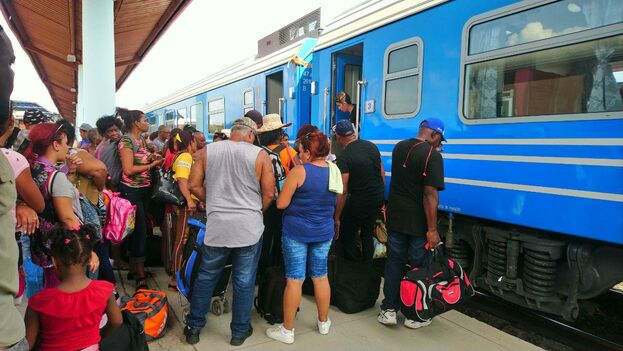
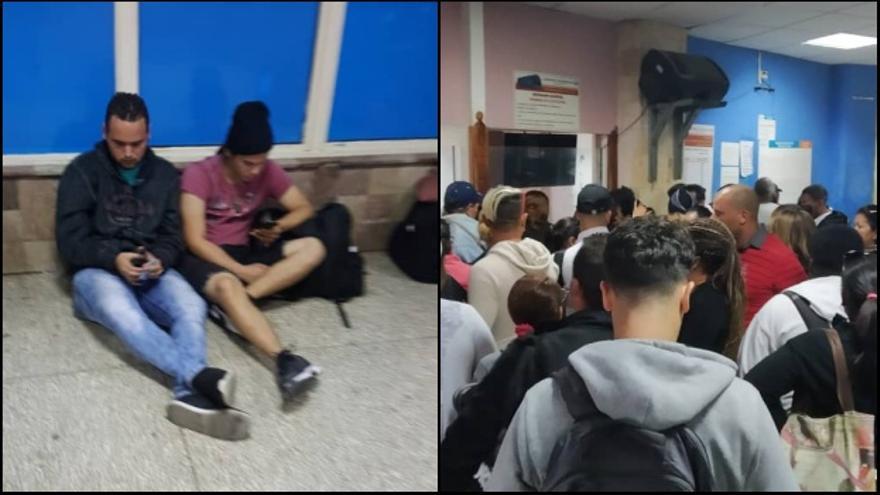
Travelers sit on the ground or lean against the walls of the National Bus Terminal in the absence of sufficient seats. (Courtesia)

14ymedio bigger14ymedio, Havana, January 22, 2020 – The same scene is repeated day after day. Hundreds of passengers crowd in the Bus Terminal of Havana and in the absence of enough seats, some make themselves comfortable by sitting on the floor, or on the projections of a wall. Without knowing it, they commit an infraction that can end in a fine, as happened on Tuesday to several university students.

That day during the afternoon, an inspector imposed fines of 100 cuban pesos each to a group of young people who had sat down on a small wall inside the bus station while they waited for the transportation to take them to their destination.

The inspector sanctioned the young people because they had allegedly violated Decree Law 272, especially article 17, which considers an infraction to affect “by any form or means, wall, facades, sidewalks, doors, windows or any part of the exterior of buildings, cinemas, theaters, hotels, elevators or other premises open to the public. “ continue reading

The text regulates behaviors in the matter of Territorial and Urban Planning and punishes those who damage decorations, the communal hygiene and monuments. Often it is also applied in public spaces such as bus terminals and government offices, which generates much discomfort among citizens who stick up for themselves by appealing to the lack of facilities while waiting for service.

“Who likes sitting on a wall when you can be in a seat with more comfort?” asks Dayana Peña, who witnessed the incident at the main interprovincial bus station in Havana and often frequents those installations. “This place has no facilities for the number of people who spend hours waiting.”

The young woman, who lives in Matanzas and travels every week to the Cuban capital, says that “instead of improving the situation so that passengers who pay for the service do not go through all these inconveniences, they want to fix the matter by imposing fines.” She says she has even seen “people who have ended up at a police station for arguing over the inspector’s fine.”

In her Facebook account another witness, Diraine Aguiar, denounced the case, which immediately prompted several comments of solidarity with the young people and complaints about the state of the terminal, which was the subject of a capital repair program recently.

“They gave me an unjust fine for sitting and leaning against a little wall of the terminal. Me and two other students,” said one of those affected by the penalty on condition of anonymity. The young man said that many passengers showed their solidarity with the students and complained to the inspector for her harshness and for not taking into account the infrastructure problems of the terminal.

Although the inspector who imposed the fine was not identified, it is known that it is Teresa Fernández. Last December, Fernández was the target of a complaint made on the social networks by a self-employed worker who was also fined for selling his products outside the municipality where he has his self-employed license.

In the incident on Tuesday, “the fine has no legal basis, for several reasons, but especially because there was no sign that prohibited sitting in that place, in addition to the fact that people were forced to sit on the ground including the elderly and disabled because in the waiting list room there were about 200 people and only about 25 seats”, explained one of the fined individuals to this newspaper.

“The inspectors arrived and went directly to where we were sitting, no one from the terminal management intervened to explain the situation nor did any employee call to our attention the matter prior to the incident, the first complaint was to impose the fine of 100 cuban pesos, which is a lot of money for a student who has no income of his own,” he claimed.

A few hours later, the inspectors were still prowling around the place. “This terminal is a disaster, they demand a lot and do very little,” a passenger waiting to travel to Sancti Spiritus complained at nightfall. “They demand a lot from customers but the bathroom is a disaster, there is not a single drinking fountain, everything they sell to eat and drink is very expensive and to top it off there is almost no place to sit.

The woman, who was traveling with her two daughters, improvised a seat in a corner with some luggage and a cardboard box. “The floor is cold but that’s what it is because the seats are all full and nobody wants to risk a fine for leaning against the wall.”

Translated by Wilfredo Díaz Echevarria

______________________

COLLABORATE WITH OUR WORK: The 14ymedio team is committed to practicing serious journalism that reflects Cuba’s reality in all its depth. Thank you for joining us on this long journey. We invite you to continue supporting us by becoming a member of 14ymedio now. Together we can continue transforming journalism in Cuba.

Cuatro Caminos Hasn’t Recovered

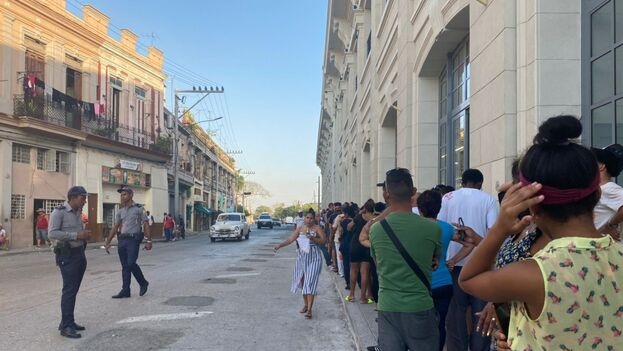
It is necessary to line up for almost half an hour to access the Cuatro Caminos market. (14ymedio)

14ymedio bigger14ymedio, Luz Escobar, Havana, 13 January 2020 — Although it is less than two months since the reopening of the Cuatro Caminos market, it has already suffered two temporary closures. This Saturday, the establishment reopened completely after five days with the food area closed.

The state corporation Cimex confirmed to this newspaper that the market suffered breakdowns that made it difficult to provide services, so on January 6, a partial closure was carried out to perform “maintenance work, troubleshooting, refueling and inventory.”

In a note spread through its main communication channels, Cimex had already explained that the main actions of the maintenance process were in the areas of freezing and refrigeration and that, in addition to polishing floors, the entrance door had to be repaired by Arroyo Street, plus other electrical arrangements. continue reading

A neighbor of the central market, which has a private cafe in front of its entrance, confirmed to this newspaper that “it was only five days that that part of the food market was closed” and it “never” closed completely.

However, little has been noted of the alleged resupply promised by Cimex.

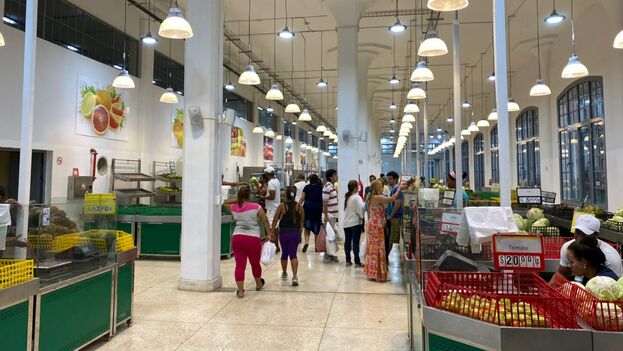
In the agricultural products part of the Cuatro Caminos market, in Saturday there were only cabbages, tomatos, pineapples, pumpkins and papayas. (14ymedio)

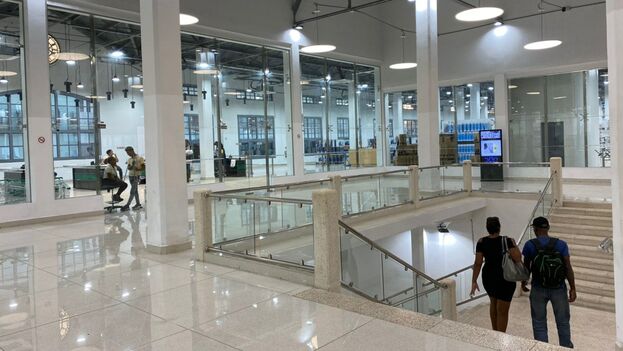
Walking this Saturday through some of the departments, with their polished, bright and spacious corridors, resembled walking through a museum of modern art.

“I do not know why so money was spent on this super-space. Look at some of the agricultural products right now, there are only cabbages, tomatoes, pineapples, pumpkins and papayas,” said an employee of that section to 14ymedio.

To enter the mall you had to wait in line for at least 25 or 30 minutes, all  to not find on the shelves the products you wanted, such as butter, chicken breasts, and eggs. The cleaning and household tools department also exhibited great poverty in its supplies.

“Inside the market is a shame. I have sometimes seen the empty windows, or the same product repeated to infinity. Today there is not a quarter of everything that the leaders of the country showed proudly on television on the day of its reopening for the [celebration of] Havana’s 500 years,” another neighbor of the property told this newspaper.

Around the market there is a large police presence and a large number of surveillance cameras. In each building entrance you can see between two and four officers controlling the passage of customers, who let in ten at a time to prevent a large number of people from entering in the same period of time.

The installation, reopened on November 16 after years of total repair, closed its doors on the same day of its official opening due to the incidents that occurred as a result of the crowds. Several unfortunate incidents were baptized by Internet users in social networks such as the Battle of Cuatro Caminos, and the situation caused great economic losses and managers were forced to decide to close their doors to repair the damage caused.

Walking through the establishment is like touring a museum of modern art. (14ymedio)

Presented before the national television cameras as a modern market and the high point so far of this century, the space ultimately proved unable to escape the same problems that any other store in the country is experiencing.

Recently, during some rains in the capital, images of floods that partially affected the market circulated on Facebook. A neighbor who also saw his house under water last week summed up the situation: “Many invested in the building but the surrounding infrastructure is still the same.”

See also:

The Cuatro Caminos Market Closes Until Next Week Due To Social “Indiscipline”

The “Resurrection” of the Cuatro Caminos Market and Free Trade in Cuba

Why the Reopening of the Cuatro Caminos Market Failed

The Cuatro Caminos Market Will be a Museum

Without Its Market Cuatro Caminos Seems Lost

______________

COLLABORATE WITH OUR WORK: The 14ymedio team is committed to practicing serious journalism that reflects Cuba’s reality in all its depth. Thank you for joining us on this long journey. We invite you to continue supporting us by becoming a member of 14ymedio now. Together we can continue transforming journalism in Cuba.

The Controversy Over The Identity Of The Clandestinos Is Growing

The nature of the group that calls itself “Clandestinos” is unknown, and it’s not clear if it really committed the actions promoted on its social networks.

14ymedio bigger14ymedio, Luz Escobar/Mario J. Pentón, Havana/Miami, January 9, 2020 — Doubt, controversy and passion surround the Clandestinos, an anonymous group that through social networks says they have dumped pork blood on several busts of José Martí in Havana. The Government says it detained two of the members on Wednesday but the organization says it doesn’t know them.

The official newspaper, Granma, said the police detained Panter Rodríguez Baró, 44, who had a record, and Yoel Prieto Tamayo, 29, for “the profanation of some busts of José Martí,” but without mentioning the name of the group.

“The offense was a dirty media ploy to create the belief that there is a climate of insecurity and violence in Cuba,” said the article, which was read on the news on television. continue reading

The information, read on Primetime News, also questioned the speed with which the news spread on social networks and independent media. “The photos that showed the busts of the national hero covered in pork blood were posted on the Internet a very short time after it was done,” the text pointed out. “Several alternative media that posted the story support those who try to orchestrate lies about the Cuban reality.”

The Clandestinos immediately denied any connection to those arrested. “We don’t know these people. No member of our organization has been detained,” said one of the members, without revealing his identity, in correspondence with 14ymedio and el Nuevo Herald.

“We’re not a political group,” added a presumed member of the Clandestinos, which claimed responsibility for throwing pork blood on Martí because “his image has been very manipulated by the dictatorship.”

“It’s an outrage that his name is used to reproach and abuse people,” he added. According to his version, the group chose the figure of Martí because “he is loved by all Cubans.”

“He’s our national hero, our apostle, and whatever action is taken with his figure has a great impact,” he added.

Since the beginning of the year, the Cuban internauts have been debating whether their actions were a form of protest or vandalism, or if it’s a strategy of the omnipresent State Security to justify its repression against the dissidents, but up to now there is little evidence and few witnesses.

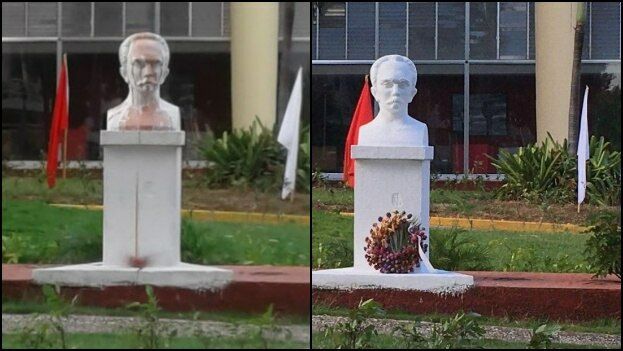
In a tour by 14ymedio of several places where the Clandestinos said they carried out actions, there are few certainties. On January 4, the fence located on one side of the Ciudad Deportiva, where the faces of José Martí, Fidel Castro and Lázaro Peña can be seen, doesn’t show any intervention or traces of having been changed, although two days before, in a video of the Clandestinos, you can see a red stain.

Bust of José Martí outside the Ministry of Transport. On the left is the photo taken by Enrique Sánchez on January 1, and on the right an image by 14ymedio on January 4. (14ymedio).

It wasn’t possible to find a bust with blood outside the Latin American Stadium, where the group said they poured blood over one of the sculptures. Nor were there traces of any action two days later outside the police station on calle Infanta near Manglar.

Attempts to obtain the exact locations of the stained busts from the Clandestinos didn’t help locate them. In addition, the authorities could have cleaned and painted many of them in the meantime.

The group’s name comes from a Fernando Pérez movie that addresses the clandestine struggle against the regime of Fulgencio Batista and it is careful not to give details that would allow identification of any of its members. One of them appeared in a Facebook video covered with a hood, and the press could only speak with him through chatting, and for a short time.

The official Cuban press has given free rein to its indignation but has been very frugal in releasing information concerning the facts, including the content of the arrest warrant. The personnel of the reviews Bohemia and Verde Olivio, whose writing is close to the buildings that are most emblematic of power in Havana, promote an act of repudiation against the Clandestinos, calling them “vile and unpatriotic counterrevolutionaries”.

According to Bohemia, a bust of Martí made by the now-deceased Cuban sculptor, José Delarra, had to be restored after the group’s action, but they didn’t show any photos of the action.

Vague opinion columns, texts of claims around the figure of the national hero, references to expected sanctions in the Penal Code against those “who don’t deserve to be called Cubans” have appeared in media like Cubadebate and Granma and have been replicated by members of the Government, including Miguel Díaz-Canel.

The Clandestinos assert that the photos give them recognition. “Why would the Government complain about something that didn’t happen?” they said, after many Cubans didn’t believe the photos and thought they were a hoax or something that was photoshopped on the social networks.

Anonymity makes it easy for people who don’t initially have ties to the Clandestinos to join the cause, whether by following or even by imitating them. Some Facebook posts are sharing the slogan “We are all Clandestinos”, placing the group in the predicament of having to claim or refute actions that can be carried out independently.

“We want to send a message to the dictatorship: this is war. We are tired of bowing our heads. And to the people the message is clear: The time has come,” said the supposed leader of the Clandestinos.

The organization has members in Cuba and in exile, added the spokesperson, refusing to reveal the number of militants. But he did say that they were mainly young people who were “tired of the dictatorship”.

One of the few witnesses of the Clandestinos’ actions was the meteorologist, Enrique Sánchez. “I was walking through the area of the Ministry of Transport and what called my attention was the stained, vandalized bust,” Sánchez told this newspaper.

“It was on January 1, in the afternoon, when I saw it. It made me mad so I took a photo in order to complain on Twitter about the lack of punishment for whoever was responsible,” he added. Sánchez stated that he didn’t agree with “desecrating national symbols as a mode of protest”.

A little later, this newspaper could confirm that the bust had been cleaned and painted and that an offering of flowers had been placed at the pedestal.

From Miami, where he was visiting, the dissident, Guillermo Fariñas, spoke about the subject with the América Noticias network. He showed an exchange of messages that he had with an internaut who identified himself as a member of the group. “What they’re doing is exercising the right of rebellion,” said the winner of the European Parliament’s Sakarov Prize for Freedom of Thought.

“It’s a group that doesn’t use our same nonviolent methods,” Fariñas said. “Other dissidents and I go down one path, but the right to rebellion exists, and they can go down a different path.”

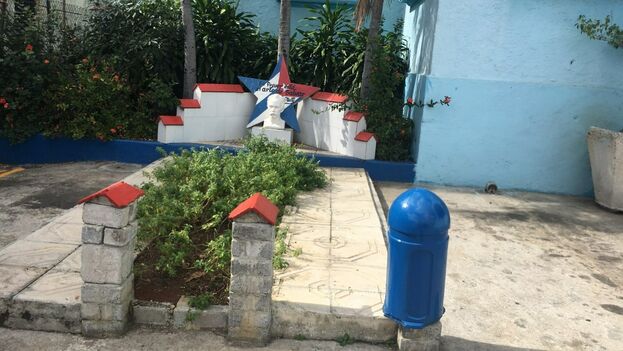
Bust of José Martí just outside the Cerro Police Station, one of the places the Clandestinos said it carried out its actions. (14ymedio)

Meanwhile, the journalist and director of the magazine Tremenda Nota, Maykel González Vivero, wrote on Facebook, “The problem is that the bust is not alive and cannot defend itself. Martí is one thing, otherwise open to criticism, and the busts and pedestals are another. They speak about who erected them, not only of Martí himself, and they are something dead,” he added.

The dissident, Antonio González Rodiles, criticizes the Clandestinos movement. “In a time where it’s impossible for the opposition to hide anything from the Regime, it will do wonders for showing them as misfits, riffraff, vandals, incompetents–the Government  has always used this line,” he wrote on his Facebook page. Several followers of the dissident said that the actions might be a provocation orchestrated by the Government.

In the last decades in Cuba there have been frequent cases of graffiti on walls and storefronts denouncing the acts of the authorities, with slogans like “Down with Fidel” or “Down with Raúl”. However, actions around the figure of José Martí have been more circumscribed on the artistic scene.

At the beginning of 2018, an intense debate erupted over the censorship of the film, I want to make a movie, directed by Yimit Ramírez. The Cuban Institute of Arts and Cinematography (ICAIC) removed the tape from the ICAIC Youth Show because one of the characters “says something unacceptable” about José Martí, calling him a “turd” and a “faggot”.

“This isn’t something that can be accepted simply as an expression of creative freedom,” said the institution in a statement published on Facebook, which further fuelled the debate over the sanctification of the figure of Martí.

Translated by Regina Anavy

________________

COLLABORATE WITH OUR WORK: The 14ymedio team is committed to practicing serious journalism that reflects Cuba’s reality in all its depth. Thank you for joining us on this long journey. We invite you to continue supporting us by becoming a member of 14ymedio now. Together we can continue transforming journalism in Cuba.