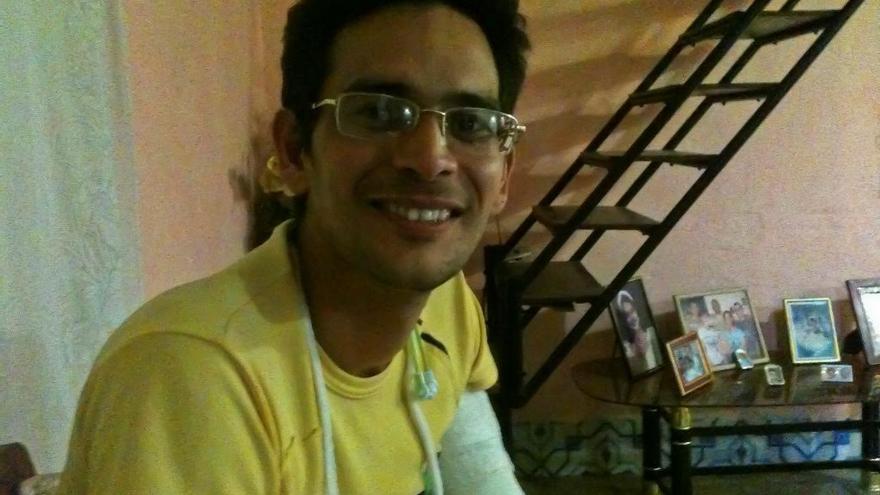
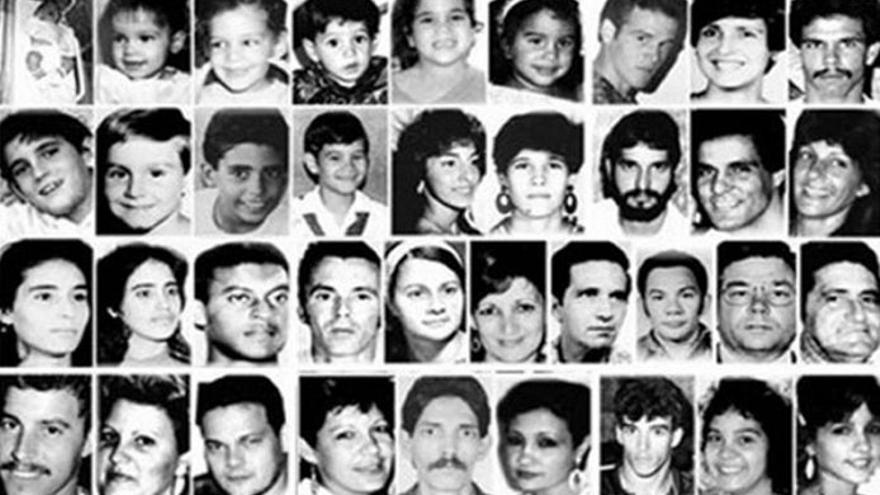
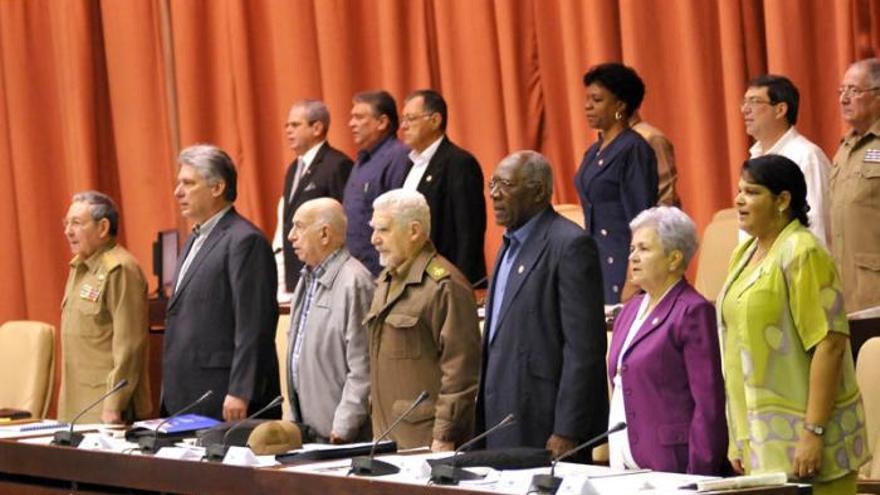
Amnesty International adopted Ricardo Bofill as a prisoner of conscience in 1985. (Capture)
14ymedio, Havana, 12 July 2019 — Former political prisoner Ricardo Bofill Pagés, a renowned human rights activist in Cuba, died at the crack of dawn in Miami at 76 years old, according to friends and family members speaking to Radio y Televisión Martí.
“I received a call with the bad news from Yolanda Miyares, his partner in the struggle and a neighbor. The competent professionals of 911 had already done their work. By this means I transmit to his relatives and to human rights activists and friends the sad news Yolanda has told me just now,” wrote Oscar Peña, his friend and fellow fighter for human rights. continue reading
“For Ricardo Bofill, my respect for his tenacity, his courage and intelligence. Like Father Varela yesterday, today he taught us to think. Rest in Peace, civil rights professor,” Peña added.
Miyares confirmed to Radio y Television Martí that Bofill had died at three in the morning at home and that he suffered from hypertension and heart disease.
On January 28, 1976, Bofill founded the Cuban Committee for Human Rights (CCPDH) along with Elizardo Sánchez Santacruz, Adolfo Rivero Caro, Edmigio López Castillo and Enrique Hernández Méndez.
In 1967 Bofill was sentenced to 12 years in prison for “enemy propaganda” in the process known as the “microfraction,” where former members of the Popular Socialist Party, critical of the authoritarianism of Fidel Castro, fell. In 1972 Bofill was released on parole.
He was imprisoned again, for two and a half years, in 1980 after divulging the document Cuba: Human Rights in Permanent Crisis. He was then accused of maintaining links with Western diplomats and drawing up “counter-revolutionary documents.” Amnesty International adopted him as a prisoner of conscience in 1985.
Between August 1986 and January 1987, he was a refugee at the French Embassy in Havana and left when the French government received a commitment from the Cuban authorities that the dissident would not be arrested. A year later, the Cuban government authorized him to leave the island, but he could only do so on the condition that it would be a final exit.
In a ceremony held at the school in 2015, Miami Dade College presented him with a special recognition for his fight for freedom.
__________________________
The 14ymedio team is committed to serious journalism that reflects the reality of deep Cuba. Thank you for joining us on this long road. We invite you to continue supporting us, but this time by becoming a member of 14ymedio. Together we can continue to transform journalism in Cuba.
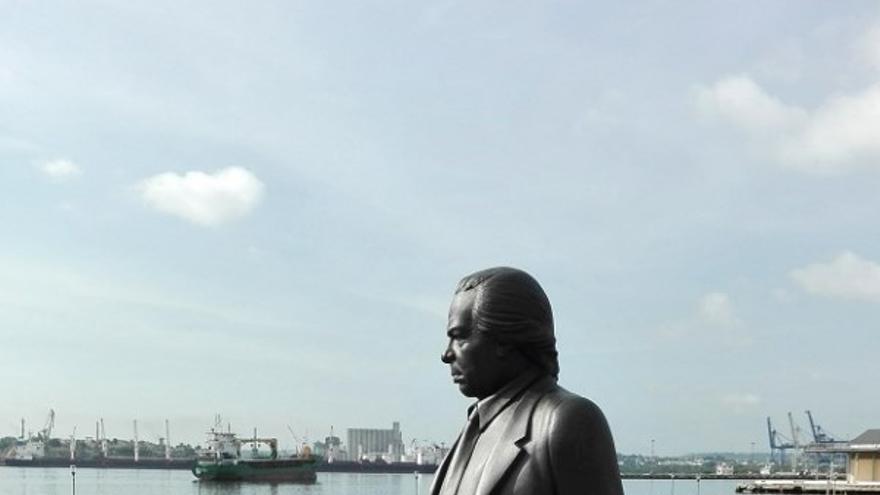
“They achieved the miracle of turning Nicolás Guillén into another person,” an Internet user said ironically about the newly inaugurated sculpture. (Art for Excellencies)
14ymedio, Marcelo Hernandez, Havana, 12 July 2019 — With a smile from ear to ear, a sparkling look, a mane grown long and a mischievous phrase sticking to his lips, is how so many remember the poet Nicolás Guillén. As of this Wednesday, however, those who pass from through the Alameda de Paula, in Old Havana, come across a statue accompanied by a sign with his name but which bears very little resemblance to the writer from Camagüey.
On July 10, on the 117th anniversary of Guillén’s birthday, the bronze piece made by the sculptor Enrique Angulo was officially inaugurated. But the image of a man who looks at the bay in a suit and tie, hardly evokes the one who was also president of the Union of Writers and Artists of Cuba, a member of the Central Committee of the Communist Party and to whom the Cuban government awarded the epithet of “national poet,” which is still attached to him in books, manuals and institutional events. continue reading
The controversy was not long in coming and a few hours after the sculpture was presented to the public, several of those who knew the poet personally have criticized the few similarities between the figure and the author of the poem Tengo.
“They have just inaugurated a statue of Nicolás Guillén in Havana, which looks nothing, absolutely nothing, like Nicolás.I have seen many pictures of the poet in different stages of his life and apart from that, I personally saw him since 1971, when he was 41 years old, and in successive years, so I have a clear image in my memory,” composer and musicologist Rodolfo De La Fuente Escalona commented on his Facebook account.
“They achieved the miracle of turning Guillen into another person,” said another Internet user who also evoked some of the poet’s most repeated verses, especially those in which he said “I have, let’s see, / I have the pleasure of going about my country / owner of all there is in it.” Now, “besides that nothing that he said came to pass, with this statue they have taken from him his true face,” he said.
“It’s better that people do not know who this sculpture man is because if they realize that he’s the one who said ’I have what I now have / a place to work / and earn what I have to eat’, they’ll come here to make a protest,” ventured a neighbor of the Alameda, who didn’t fail to notice that “Guillen has his back to the city and is looking out to the North.”
________________
The 14ymedio team is committed to serious journalism that reflects the reality of deep Cuba. Thank you for joining us on this long road. We invite you to continue supporting us, but this time by becoming a member of 14ymedio. Together we can continue to transform journalism in Cuba.
Jorge Luis Arcos is an associate professor of literature at the National University of Río Negro, Argentina. (Facebook)
14ymedio, Havana, 16 July 2019 — Cuban authorities denied entry to Cuba to the poet and essayist Jorge Luis Arcos. The academic was not allowed to board a flight in Santiago de Chile because airline employees informed him that he could not enter the island, according to a press release from the Betania publishing house.
“We denounce this arbitrary situation, which violates the Universal Declaration of Human Rights (signed by Cuba), and we show our solidarity with this brilliant Cuban intellectual, who has seen his rights — as a Cuban citizen — trampled,” the text adds.
Arcos was exiled to Madrid in 2004 and since 2010 has been based in Argentina. Three years ago he traveled to Cuba to present a book on the poetry of Raúl Hernández Novás in the Casa de las Américas and recently he had his passport authorized for travel to the island at the Cuban Consulate in Buenos Aires.
Born in 1956, Arcos is one of the most important Cuban literary critics of recent decades and one of the most renowned scholars of the so-called Orígenes group. He is currently working as an assistant professor of literature at the National University of Río Negro, Argentina. Between 1995 and 2004,in Havana, he directed, along with Enrique Saínz, the literature and art magazine Unión.
He is the author, among others, of books of essays: On The Poetic Work of Fina García Marruz (1990); The Unitiva Solution; On the poetic thought of José Lezama Lima (1990); Origens: Irradiating Poverty (1994) and Kaleidoscope; The poetics of Lorenzo García Vega (2012).
____________
The 14ymedio team is committed to serious journalism that reflects the reality of deep Cuba. Thank you for joining us on this long road. We invite you to continue supporting us, but this time by becoming a member of 14ymedio. Together we can continue to transform journalism in Cuba.
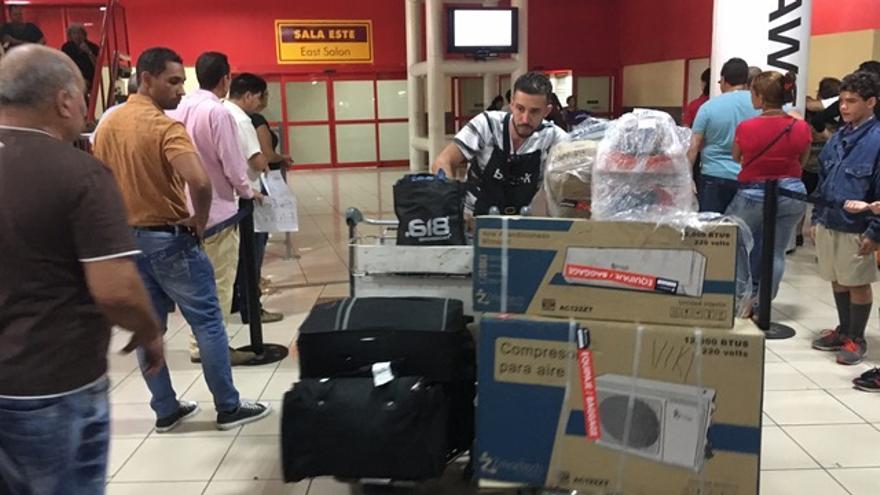
Many Cuban travelers import air conditioning equipment for domestic use or for resale in the informal market. (14ymedio)
14ymedio, Zunilda Mata, Havana, 10 July 2019 — He was one of the first to obtain the ‘purchase card’ that Panama authorized for Cubans as of last October. Since then he has traveled four times to that country to bring varied goods, including three air conditioning units, popularly known as splits. “My business is cold, so people don’t sweat,” Sendry explains to 14ymedio.
With temperatures exceeding 85F every day, summer in Cuba is that time of the year when a breath of refreshing air is greatly appreciated. “This business is not what it was before because the prices of the devices have dropped a lot,” says Sendry. “There is too much supply and now you make less and it takes more time to sell the merchandise.”
If two years ago a device of this type with the capacity to produce one tonne of refrigeration (TRF) cost more than 750 CUC (roughly the same in US dollars) in the informal Cuban market, now they can be less than 550, which leaves a smaller profit margin to the private importers who buy them in retail stores in other countries, pay the costs of airfares and customs duties. continue reading
In Sendry’s house, in a corner of the room, several boxes are piled up with the different parts that make up the splits, the status symbol of an emerging social class that does not want to be dripping fat drops of sweat all day. “I’ve had these here for more than two months and I have not been able to sell them although I am giving them away at 600 CUC which is the cheapest thing that can be found right now”.
In 2013, in the midst of the reforms promoted by Raúl Castro, Cubans not only saw the rules governing travel and immigration relaxed, allowing them to leave the island, but they were also authorized — after eight years of prohibitions — to import air conditioning units, electric stoves, refrigerators and microwave ovens. Both measures unleashed a real rush of personal imports.
But the “split bubble” seems to be deflating. For six years a constant trickle of these devices has landed on the island. “On my flight from Cancun, there were seven and most of them are people who bring them to sell,” says Anayansi, a woman from Matanzas who is also a naturalized citizen of Spain. She makes the trip frequently to bring clothes and shoes. “I do not deal with household appliances because they are complicated and the market here is saturated.”
The drop in enthusiasm is not only due to a greater supply, but also affected by the costs of electricity service. Although compared to other countries in the region, the island does not have the highest rates, the price of kilowatts consumed is high compared to wages.
In October 2010 electricity rates increased in the residential sector. With the current prices, the Electric Union of Cuba (UNE) begins charging 9 centavos for each kilowatt-hour (kWh) below the first 100 consumed, a rate that grows exponentially until reaching a price of 5 CUP (roughly 20¢ US) for each kWh higher at 5,000.
According to data from the last population census, published in 2012, of the 3,880,000 households in the country, about 579,000 had air conditioners. A figure that must have increased significantly in recent years, not only because of the legalization of travel, but because the State began selling these devices in their network of stores in the country, after decades without offering them.
“Before, to have air conditioning one had to be a ’vanguard worker’, or have gone to fight the war in Angola, be a sugar can cutter, and behave well, but now it is different. Those who don’t have to put up with the heat are those who travel, have hard currency, a business or family abroad” explains Richard, a 47-year-old engineer who, along with another friend, has a small AC repair team.
“The minimum you will pay for electricity, to run a modern AC all night, is about 350 CUP per month,” he tells 14ymedio . “Although modern equipment is more and more efficient, that constant expense can not be assumed by many people, so there are families who have the device installed but use it very little,” explains the technician.
For those who have a business renting rooms to tourists, it is not a choice. “We have four rooms with their respective air conditioners, all recently installed and quite efficient, but still what we have to pay monthly electricity exceeds 2,000 CUP,” says Rosendo, owner of a house on the beach of Guanabo, east of Havana.
“These devices are a costly investment, not only for the value of each and then to keep paying for electricity consumption, but also in our case we also had to put bars around the outdoor unit to protect it from thieves,” he adds. On several digital sites, second-hand and “well-maintained” AC units are offered.
Most likely, these devices come from a theft or, above all, from users who can no longer pay the electricity bill.
________________
The 14ymedio team is committed to serious journalism that reflects the reality of deep Cuba. Thank you for joining us on this long road. We invite you to continue supporting us, but this time by becoming a member of 14ymedio. Together we can continue to transform journalism in Cuba.
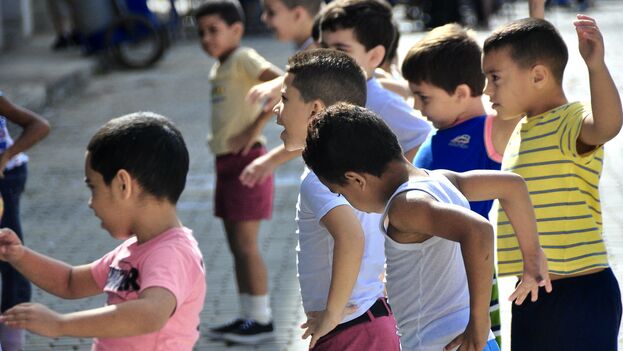
In Cuba there is a deficit of 1,736 Physical Education teachers and many sports areas are in poor condition. (Sue Kellerman)
14ymedio, Marcelo Hernandez, Havana, 11 July 2019 — “Breathe deeply, touch your shoulders with your hands”, the young PE teacher instructs some children who laugh, leave the line and from time to time follow the instructions of the teacher, while they play an improvised football match with a handball.
The scene takes place in the Havana neighborhood of El Cerro, in a square with a cracked pavement with the grass growing through it. It must be one of those 10,700 sports areas with problems, of which 3,863 are evaluated as poor or bad, according to the report presented this week before the National Assembly of People’s Power (ANPP).
This deterioration and the deficit of 1,736 teachers of Physical Education, which the document also mentions, means that in many elementary schools physical education period has become a time to run around or have a snack, but not to do sports. continue reading
Despite the fact that every year hundreds of students graduate from the Provincial School of Physical Education (EPEF), many teachers of this subject migrate to other better-paid activities and many recent graduates do not even teach classes to fulfill their two years of social service. Some end up in the schools practicing this professions, more out of family pressures so they don’t “hang around the house doing nothing,” their true vocation.
“I started with tremendous enthusiasm but along the way I realized that this is very hard,” 14ymedio hears from Osniel Villafuente, a 23-year-old who, five years ago, began to teach Physical Education classes in a high school in San Miguel del Census. A few months passed and he lost the taste for work because “the lack of resources limits everything you dream about during the years you spend learning the profession,” he explains.
Right now, the authorities of the Ministry of Education are in a process of reforming the programs in the subject. For decades, two sports were practiced in elementary school, but after the adjustments in the program this may be expanded to six, and the teachers will choose which sports disciplines they teach, in line with the facilities of each school.
The metal frame of an old school table serves as a goal in a sports area on Carlos III Street that several schools in the area use. A student has brought his own ball to practice with his classmates. The group that arrived later was not so lucky and could only train doing some racing and some squatting.
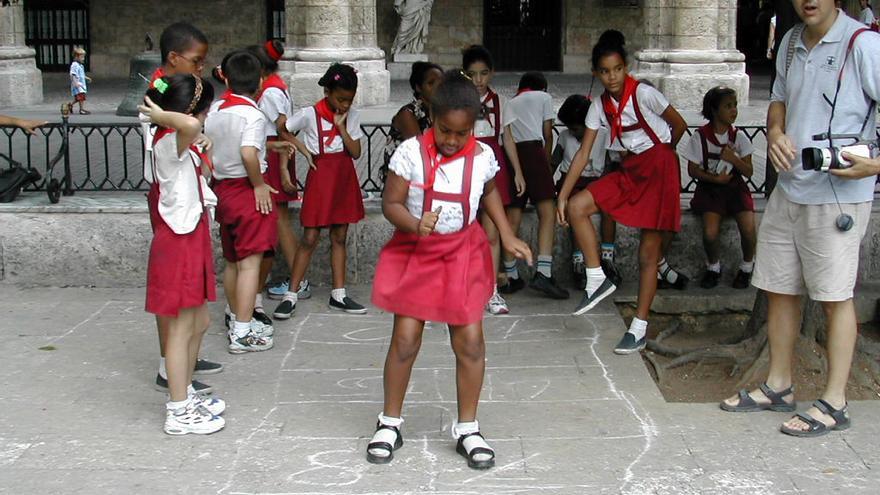
In the absence of teachers and sports equipment, the Physical Education period is often used to snack, run or play. (James Emery)
For Osniel Villafuente the reform that the authorities seek in the subject could, instead of alleviating the problems, end up aggravating them. “With two sports it is already difficult for us to complete the study program because there are few resources. Having a ball is a problem and the areas where we do exercises are in very bad condition. So what is going to happen when new sports are incorporated?”
“In addition, we have a lack of interest among the students because they were born and live in this century, but they are receiving a course conceived and designed in the last century that is not interesting,” adds the teacher, who now works in a small workshop repairing mobile phones. “These teenagers today have grown up with video games and manga cartoons, they make fun of you when you tell them to raise an arm or raise a leg.”
The president of the National Institute of Sports, Physical Education and Recreation (Inder), Osvaldo Vento Montiller, explained this week to parliamentarians about the need to “make the subject of Physical Education an attractive activity for students”. An urgency in an era “where digitization and computer products prevail, in which recreation is associated with a sedentary lifestyle”.
The official acknowledged that the physical education taught in schools across the island continues to generate “dissatisfaction and does not meet the expectations of students.” On the other hand, he pointed out that there is not a good recruitment of talents among children and teens to prepare them as athletes, an absence that is undermining the foundations of Cuban sport.
“I have five students out of a total of 17 who almost never come to Physical Education,” laments a teacher of the subject who twice a week trains her students in a park in the neighborhood of La Timba, near the Plaza of the Revolution. “Four other students have medical certificates that say they can not do physical education, but everyone knows they are justifications that are invented with the complicity of parents to skip this period.”
In schools where teachers are missing, it is common practice for the subject to be graded automatically with the maximum score in the students’ file. A situation that increases disrespect towards the discipline.
“My daughter has three periods without a physical education teacher and at that time what they do is go out to the playground and start playing,” laments Yanelis, mother of a student at the José Luis Arruñada elementary school in the municipality of Plaza de la Revolución. “In several meetings with the school’s management, we have demanded that the problem be solved, but we are told that they do not have teachers, that nobody wants the position.”
The mother considers that now is a good time to alleviate the situation with the salary increase announced at the end of June and that will benefit, starting this month, more than 2.7 million public workers, including employees of the Ministry of Education.
“We’re going to see if that motivates many of those graduates to go back to school and stand in front of a group,” says the woman. “If this is not the case, I do not know how this can be fixed because the longer these children do not receive Physical Education classes, the more they will have less interest in sports, something that will hold them back for the rest of their lives,” says Yanelis.
In universities the picture is not very different. In these centers of higher education the practice of sports is usually limited to students who have the ability to compete and represent their faculty in the University Games. Those who have no talent can barely access the facilities where those who already know how to play basketball, volleyball or baseball are trained, and they must settle for going around the track and doing a little warm-up.
The prominence achieved by Cuba in sports has decreased markedly in the last 20 years. We are already talking with nostalgia about the times when the Island had won trophies in all the regional events and even surpassed first world countries in the Olympics.
Yanelis is clear: “How are we going to have Olympic champions if right now there are children who spend the Physical Education shift throwing stones or playing with a mobile phone?”
_________________
The 14ymedio team is committed to serious journalism that reflects the reality of deep Cuba. Thank you for joining us on this long road. We invite you to continue supporting us, but this time by becoming a member of 14ymedio. Together we can continue to transform journalism in Cuba.
The shortage of agricultural products was one of the most evident signs of the economic crisis that deepened at the end of last year and that still extends over the whole Island. (14ymedio)
14ymedio, Marcelo Hernandez, Havana, July 15, 2019 — Many economists have been seized by incredulity at the official announcement that Cuba’s Gross Domestic Product recorded an increase of 2.2% in 2018, almost double the 1.2% published last December by the same authorities.
In his speech last Saturday before Parliament, president Miguel Díaz-Canel took a surprising turn when he declared that “after concluding the calculations and reconciliations of the levels of activity that determine the performance of the economy,” they had reached the conclusion that the results had been better than expected and that the GDP had grown by 2.2%.
The change was owed mainly to the performance of the construction, public health, and agricultural sectors, according to the state-owned Cuban News Agency (ACN). Several economists call these figures into question, noting the complex economic situation of the second half of 2018, especially with the food shortages. continue reading
The economist Pedro Monreal questioned the method followed to raise the GDP. “The revision of the growth of agriculture to 2.6% is noteworthy, it radically modifies a previous estimate of a decrease of -4.9%. It’s a big variation of 7.5 points,” he pointed out.
The shortage of agricultural products was one of the most evident signs of the economic crisis that worsened at the end of last year and still extends over the whole Island. In December pork reached 70 CUP per pound in some markets in the Cuban capital, despite the government’s attempt to force it down by imposing price caps.
Monreal appeals to the figures recently published by the National Office of Statistics (ONEI) and which don’t seem to fit with the new results. “A few days ago chapter 9 of the Statistical Yearbook of 2018 had been published with information on agriculture. Those statistics were not expressed in value, but rather in physical indicators and they seemed to indicate a not very optimistic trend.”
The economist Elías Amor goes a step further in his criticism. “After the disastrous balance made previously, they’re declaring that the economy grew double what was predicted. Is that how they intend to get credibility? What are the reasons for this statistical, or perhaps political, fraud?” he writes in his blog Cubaeconomía.
Amor recalls that “since 2007 there hasn’t been recorded a polemic like this in the data on the Cuban economy. (…) At the moment, we are not going to accept the 2.2% growth in 2018. There is no reason for it,” specifies the economist, who lives in Spain.
The opinion of both specialists coincides with the warning given by the economist Carmelo Mesa-Lago in February during the Conference on Cuban and Cuban-American Affairs at Florida International University. Then, the University of Pittsburgh professor emeritus emphasized that the Island’s economy is in its worst moment since the 1990s.
Mesa-Lago also recalled that in 2006, when Raúl Castro took power, the government announced a GDP growth of 12.3%. “But it had been gradually declining until in 2018 it fell to 1.2%,” he said in reference to the figure that was modified this Saturday. “The figures become complicated,” according to Mesa-Lago, with the fact that the fiscal deficit jumped from 3.2% in 2007 to 8.7% ten years later.
On social media, users also criticized the new figure for GDP and made jokes about it. On Twitter, a user identified as Conodrum lamented that “the worst thing isn’t that they lie but that some in the hierarchy believe the lies and act in accordance with them.” While Mario J. Pentón wrote ironically on Facebook: “We have always heard that the Cuban Government puts makeup on its growth figures. This is no longer makeup, it’s total plastic surgery.”
Nor were jokes lacking among customers of the agricultural market on San Rafael street, one of the most important in Havana. “Now, yes, we have an abundant GDP, to fill the platforms, the plate, and the eyes,” laughed a lady who had come in search of an avocado but decided to leave with her bag empty when she saw the price: 15 CUP each (roughly 60¢ US, in a country with an average monthly wage of about $30).
Translated by: Sheilagh Herrera
_____________________
The 14ymedio team is committed to serious journalism that reflects the reality of deep Cuba. Thank you for joining us on this long road. We invite you to continue supporting us, but this time by becoming a member of 14ymedio. Together we can continue to transform journalism in Cuba.
Patients are kept under mosquito nets, with fans that they brought from home and with laptops, tablets or mobile phones to pass the time. (14ymedio)
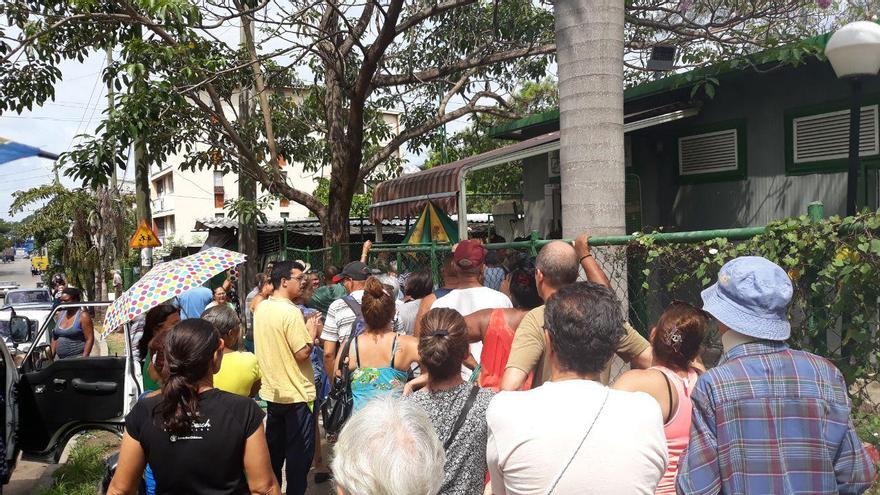
14ymedio, Luz Escobar, Havana, 15 July 2019 — First there was the fever and then the rash broke out. The nine-year-old girl arrived at the 19th of April Policlinic in Havana at noon, last Tuesday. She was diagnosed the minute she crossed the clinic threshold: “That is dengue, she will be admitted,” said the emergency room doctor categorically.
The little girl had been infected with the annoying companion that these days spreads through the neighborhoods of the Cuban capital. Dengue fever, the viral disease inseparable from the warm months on this island, crowds the consultations and the hospital wards, without official announcements or national statistics about its presence.
After being diagnosed, the girl waited with her mother to be transferred to the Marfan Municipal Pediatric Hospital, in an ambulance that took more than an hour to arrive. Inside the vehicle there was only one rickety bench and none of the resuscitation equipment that “appear in the movies,” the little girl pointed out with disappointment. continue reading
Inside the ambulance there was just a rickety bench to sit on and no medical equipment. (14ymedio)
After one o’clock in the afternoon, the entrance hall to Marfan Hospital was a hive of people. Mother and daughter were accompanied from the clinic to avoid the admitting area, a widespread practice among those who do not want to stay in a hospital center where the material conditions, the heat and the bad quality of the food complicate the stay.
The doctor on duty, who at that time was taking care of two other patients, asked “And what is this, another inpatient?” And immediately added that the hospital had no beds available. A few minutes later, a space opened up in one of the rooms and the patient received her sign-in form, although she still had a long way to go.
After several blood tests, the mother took all the papers to the reception but the employee who had to complete the process was having lunch. When he returned, 45 minutes later, the pen had been stolen and he took another half hour to fill out the documents. The girl was sweating buckets, because the air conditioning in the hospital was broken.
With the delay, the bed that had opened up became occupied again and the patient was left in a bureaucratic limbo: she had the hospitalization papers but there was no room for her. Finally, at three o’clock in the afternoon, a possibility arose. Mother and daughter went to the fourth floor, where most of the patients were “suspected of dengue.”
The actual numbers of how many people have been infected by this virus are difficult to pin down. Some never go to the hospital for fear of being admitted, others have mild symptoms and by the time they realize what it is the worst has passed, and there is no lack of those to prefer to appeal to a contact in a polyclinic or hospital to get tested ’under the table’ and find out through the platelet count if they have been infected.
With the abundant rains of recent weeks the presence of the Aedes Aegypti mosquito, the main carrier of the virus, has increased. In addition, unlike other years, the vector campaign to control the mosquitos has not been as intense as in the past, due to the economic problems that the country is going through which have forced cutting back on inspectors and fumigation.
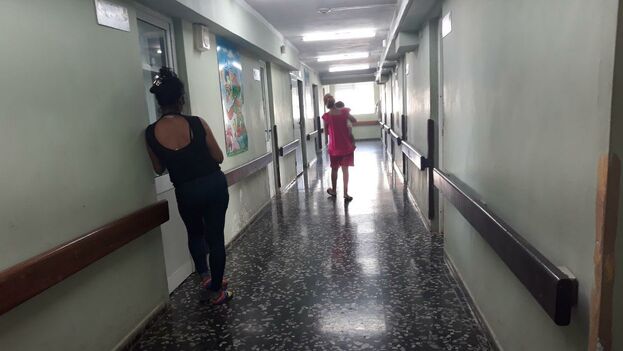
Day and night, family members of the sick share stories in the hallways about the other hospital centers. (14ymedio)
Every patient diagnosed and admitted is only part of how dengue affects the life of a Cuban family. Shortly after the girl was hospitalized at the Marfan, the father, grandmother and other relatives showed up, carrying everything from bottles with boiled water to food, a fan, a bucket, sheets and towels.
This time they were lucky, because in the bathroom of the room there was no lack of water and the plumbing worked. A true miracle. “I have been transferred from another hospital and there was no water there,” says the mother of a girl who was placed in a nearby bed. “The food is not bad, but it doesn’t taste good,” warns the grandmother of another patient.
Underneath mosquito nets*, with the fans that they brought from their homes and with laptops, tablets or mobile phones — providing alternatives to the boring TV programs — so the children spend their time. From time to time, doctors arrive to evaluate them, take their temperatures, and report if a bed has been freed up so those waiting below can go up and go to bed.
Day and night, family members of the sick share stories in the hallways about the other hospital centers. Everyone has some anecdote to tell about the delay, the problems and the shortcomings. The rooms become small parliaments, much closer to the reality than the discussions of the National Assembly which, just at that time, were underway a few kilometers from Marfan Hospital.
Each and every one of those who remain there counts the days, the hours and the minutes until they can leave. On the second day without a fever, the girl receives a medical discharge. The family packs up the makeshift camp they had assembled with belongings brought from the home. There are laughs, farewells and a gesture towards the patient from the neighboring bed who inherits a bar of soap and a piece of bread.
The little girl receives a paper to present to her local clinic and bed rest is recommended. From the polyclinic in her neighborhood they send a fumigator to the house to “eradicate any focus.” A day earlier, in the Parliament, the vice-head of Epidemiology of the Ministry of Public Health, Regla Angulo, had reported that there were outbreaks of dengue in several areas of the country, but he gave no data, no figures, no details. Nothing.
*Translator’s note: Dengue patients themselves are a major vector in spreading the disease, infecting mosquitos that bite them and get infected and then pass the virus on to others.
_________________
The 14ymedio team is committed to serious journalism that reflects the reality of deep Cuba. Thank you for joining us on this long road. We invite you to continue supporting us, but this time by becoming a member of 14ymedio. Together we can continue to transform journalism in Cuba.
The president of Mexico, Andrés Manuel López Obrador. (EFE)
14ymedio, Carlos A. Montaner, Miami, July 14, 2019 — Mexico is trembling. It occurs every once in a while. AMLO is the acronym for Andrés Manuel López Obrador, its president. The word that best describes all that is happening there is “uncertainty.” No one knows what could happen. When societies are in this situation, generally the worst occurs. The cloudy forecast paralyzes investment and influences negative outcomes. Mexicans overwhelmingly elected a peculiar personage and there will be consequences there.
The stock market and the peso have fallen. Carlos Urzúa, a notable economist, moderate and reasonable, resigned from AMLO’s cabinet and the fire started. He was, until a few days ago, the Minister of Finance. Like well-mannered suicides he wrote a letter in which he explained, more or less, his reasons. Evidently, he has not killed himself. He’s returning to academia, which is a form of taking one’s own life, at least the public one.
AMLO is a person comfortably installed in the past. He wants to develop Mexico with the political vision of 1906, 113 years ago. But his model is the general Lázaro Cárdenas, nationalizer and anti-imperialist, who occupied the presidency in the six-year term of 1934 to 1940, a mere 85 years ago. That foolishness appears in the papers of the MORENO sect, created by López Obrador to aspire to the presidency. continue reading
Another crazy idea. Isn’t the tragic performance of Pemex, the state-owned petroleum company, enough for AMLO to understand that it makes no sense to promote once again the entrepreneur-state? The era of trying out nationalization was that of Cárdenas and it has already been seen where that led. Does AMLO realize that it is impossible to eradicate corruption by widening the perimeter of the State and giving officials greater discretion?
The terrible corruption in Mexico, begun in the colonial era, but exponentially increased during the Republic, is the result, precisely, of the nexus between the State and the productive apparatus. When AMLO affirms that in his Government “the long neoliberal night” ended, he is not only reiterating a corny, empty phrase that the epigones of the Forum of Sao Paulo (Hugo Chávez, Rafael Correa, Evo Morales, Daniel Ortega) were in the habit of repeating, but also demonstrating his incapacity to understand the disastrous relationship between public spending and good government.
What AMLO called “the long neoliberal night” was the result of the inflation, the loss in purchasing power of the currency, and the rampant corruption during the terms of Luis Echeverría (1970-1976) and José López Portillo (1976-1982). How is it possible that AMLO thinks, seriously, that the evils of our republics can be cured with a larger dose of state interventionism and control if those were, precisely, the evils that have traditionally poisoned our public life?
The good Governments of the first term of Óscar Arias in Costa Rica (1986-1990), of Luis Alberto Lacalle in Uruguay (1990-1995), of César Gaviria in Colombia (1990-1994), of Ernesto Zedillo in Mexico (1994-2000), of the second term of Carlos Andrés Pérez in Venezuela (1989-1993), and also of the fourth term of Víctor Paz Estenssoro (1985-1989), who started in the fifties leading the first populist project of Bolivia and, three decades later, put forward and carried out the first liberal Government of national salvation, were the result of the awful consequences of Keynesianism applied in Latin America.
On that list of benign reformers would have to be included the Argentinean Carlos Menem (1989-1999) because of his privatizations. If he had kept public spending under control, which would have prevented the devaluation of the peso and the subsequent evil history of the “corralitos,” a new day would have dawned in Argentina. Ultimately, he would have buried the disastrous Peronism and the band of Kirchner and her 40 thieves would have remained in their cave without reaching the Casa Rosada.
What happened in Latin America starting in the eighties and nineties was what happened in Israel with Likud’s arrival to power (1977), in England with Margaret Thatcher (1979), in the United States with the ascension of Ronald Reagan (1981), and in Switzerland with the triumph of Carl Bildt (1991). They put an end to the “long socialist night” (we allow ourselved to be corny in just vengeance), because the example of what was happening in Chile in the economic sphere was decisive, even though what was happening in the political sphere sickened us.
I conclude where I began: AMLO and uncertainty. If he does not improve he will do much damage to Mexico. I fear the worst. It’s what usually happens.
Translated by: Sheilagh Herrera
___________________________
The 14ymedio team is committed to serious journalism that reflects the reality of deep Cuba. Thank you for joining us on this long road. We invite you to continue supporting us, but this time by becoming a member of 14ymedio. Together we can continue to transform journalism in Cuba.
Special school of San Cristóbal, Artemisa, which health authorities have equipped to hospitalize patients with dengue. (14ymedio)
14ymedio, Bertha K. Guillén, San Cristóbal (Artemisa), 1 July 2019 — An outbreak of dengue keeps Public Health authorities on alert in San Cristóbal, in the province of Artemisa. Up until now seven people have been confirmed as carriers of the virus, but more than twenty are admitted under suspicion, as an official from the Institute of Hygiene and Epidemiology in the province confirmed to 14ymedio.
“We are equipping an admitting room in the special school with a capacity for 40 people, there all the conditions are set up to avoid the illness being spread, the number of admissions suspected of dengue vary between 18 and 23 people daily, although in recent weeks we have reached up to 30,” said another employee of the Institute via telephone.
The symptoms of the dengue virus include rash, muscle and joint pain, migraine, and weakness. The illness can cause hemorrhage and requires hospitalization, especially if the patient has previously suffered the same ailment. continue reading
Last year the official press reported on the presence in the center of the Island of a “serotype of dengue” of which there had not been outbreaks reported since 1977 and which required extreme epidemiological measures. In Cuba there are four serotypes transmitted by the Aedes Aegypti mosquito present in the country.
San Cristóbal is currently the municipality of the Artemisa province with the greatest number of focal centers of mosquitos that transmit the disease, with around 68 detected in the month of May and another 49 in the first twelve days of the month of June, according to a note published in the provincial newspaper El Artemiseño.
The causes of the growth of the focal centers are attributed to the rains of these months that create a favorable environment for the proliferation of the mosquito, in addition to the lack of personnel to carry out sanitation campaigns and home inspections.
“Although these focal centers are localized, we have not yet been able to exterminate them, many have left this type of work to start their own businesses or work privately, here we don’t make enough, and at this point we no longer ’invent’,” Arsenio Rodríguez, one of the fumigators, explains to 14ymedio, using a common Cuban expression for figuring how to get by on very little. “This week some workers from other nearby municipalities will have to come to help control the situation.”
Rises in the number of people infected by the dengue virus are frequent in the summer months, especially in years with a lot of rain. In addition to the intense heat, in the summer season of 2019 high precipitation levels are being reported above historic averages, according to data provided by the Institute of Meteorology.
In the past few weeks medical students have been displaced from the classrooms to cover the deficit of workers. The young people must make inquiries through the whole community, especially in the zones where the principal focal points of the vector have been located.
“They told us that we would have to be very meticulous and also report any case with fever or symptoms that would suggest a dengue infection, in addition to collaborating with the sanitation work,” explains Susana Méndez, a student in the third year of medical school.
The causes of the increase of the focal point are attributed to the rains of these months that create an environment beneficial for the proliferation of the mosquito. (14ymedio)
Despite the risks many people prefer to go through the illness in their houses and not go to the doctor to not risk being admitted. Although the institutions guarantee they are in good conditions, there are problems in potable water supply and cleanliness and the facilities are in a deplorable state.
“This is still an old woman wearing blush, as they say, now it is a special school, but side by side it’s also a maternity waiting home, a primary school, and high school, before everything was only one thing, imagine so many people together in the same place,” says one of the ex-patients of the ward.
“The truth is that the water situation is really complicated, it comes on Friday for a while and until Monday we don’t see it again,” affirms María Eugenia, one of the nurses.
The doctors do not have a record of the real number of infected persons, “Everything is a question of statistics,” says one of the doctors in charge of the admitted patients who prefers to remain anonymous out of fear of reprisal.
“The patients enter with criteria for admittance out of suspicion of dengue, the follow-ups are done, and later we send specimens to the Pedro Kourí Institute of Tropical Medicine to do the analysis that confirms the diagnosis, but the results never reach our hands, they remain, presumably, in the National Institute of Hygiene, Epidemiology, and Microbiology,” he says.
The majority of the patients find out this confirmation weeks after the illness passes or they never end up receiving the official notification that they suffered from dengue.
Translated by: Sheilagh Herrera
________________
The 14ymedio team is committed to serious journalism that reflects the reality of deep Cuba. Thank you for joining us on this long road. We invite you to continue supporting us, but this time by becoming a member of 14ymedio. Together we can continue to transform journalism in Cuba.
For many Cubans, power cuts also mean greater difficulties in cooking. (EFE)
14ymedio / Mario J. Pentón, Havana, 14 July 2019 — Despite the government’s commitment not to allow “programmed blackouts” this summer, power cuts of several hours are multiplying throughout the country and causing annoyance among the population. Pinar del Río, Artemisa, Mayabeque, Villa Clara, Cienfuegos, Camagüey, Las Tunas, Holguín and Santiago de Cuba are the most affected provinces.
“Faults can occur as a result of thunderstorms or weather events, but not because of lack of electricity,” said a senior employee of the Electric Union, Elaine Moreno, at the end of last month; words that are now being remembered by customers of the state company.
Candles, matches and fuel to light an oil lamp have become products in high demand these days in the streets of the city of Camagüey and other municipalities of that province. The frequent blackouts of several hours have made many try to equip themselves for a possible upsurge in the power cuts as the summer progresses. continue reading
“We’ve had several blackouts of about four hours each day and also late at night, Crescencio González, a resident in Guernica cast in Camaguey, told 14ymedio. “When the light goes out in the evening or late at night, you suffer a lot because there is no longer anyone sleeping in this heat without a fan,” he laments.
“In my neighborhood we call the electric company several times to see what is going on but they tell us that there are breakages, although nobody believes it because they are four-hour blackouts, at different times of the day,” González explains. The blackouts are also happening in Cascorro and in Nuevitas, the second city in the province of Camagüey.
In the social network Twitter, several residents in the affected areas with power outages have begun to use the hashtag #ReportoApagonCuba to report the situation. The journalist José Raúl Gallego called on the authorities to respond if it is “programmed blackouts” to save fuel.
The reporter explained on Saturday that in the neighborhood where he resides, Reparto Saratoga in Camagüey, they were suffering the third day of blackouts. In a call to the customer service of the electric company, an employee explained to Gallego that at the moment the circuit is “down due to an emergency in the system, without a schedule to restore service.” However, the official could not answer the question of whether it was “the same emergency yesterday and the day before yesterday?”
Yes, they were saving it for me. They turned off the electricity in my house, 5:33 pm, Reparto Saratoga, Camagüey. Third day of blackouts and before had been out other days in the week. #ReportoApagonCuba #ApagonesCuba #ApagonesProgramados
According to official figures, during the summer 400,000 tons of fuel are allocated to the country’s thermal power plants every month to cover the electricity demand that increases at this time of the year due to a greater use of fans, air conditioners, and other uses that shoot up with high temperatures and school holidays. The residential sector accounts for 56% of demand, while state and non-state clients account for 44%.
Cuba is going through a serious liquidity crisis that has forced it to cut imports. Its main ally and benefactor, the Government of Nicolás Maduro, in Venezuela, has had to face its own internal crisis, as a result of which it substantially reduced oil shipments to the Island.
With less money to buy the oil at international market prices and without the Venezuelan subsidy, the authorities juggle to prevent the island from returning to the years when the blackouts lasted 12 hours, during the euphemistically called Special Period.
“My son bought an air conditioner in Miami because I couldn’t stand the heat of Cienfuegos any more, but I have had to go back to ‘la penca’ [a brand of fan],” says Eloisa, a elderly woman of 71 who lives in Buena Vista.
“On Friday the electricity was out for seven hours and on Saturday we woke up with no electricity, every time they shut it down it, I remember Fidel and his ‘Energy Revolution’.” All my cooking appliances use electricity, so when it goes out, what remains is bread from the bodega,” she added.
1/3 Attention! A friend sent this sms: “In Pinar del Rio since Friday there are blackouts morning and afternoon, today Sunday I called and they told me that there is energy deficit and they do not have the plan but they are rotating the circuits for at least 4 hours … ? # ApagonesCuba #ReportoApagonCuba pic.twitter.com/zKar4cjfh7
Power cuts have also been common these days in Pinar del Río. Several residents have said that when they called the electric company, they received the response that there was not enough generation to supply the customers.
“Where are the photovoltaic panels, the hydroelectric plants, the wind farms and generators?” asked an internet user identified as Alexis_Cuba. The government insists it is working to diversify the island’s energy sources, and hopes that 24% of the country’s consumption will be covered by renewable sources in 2030.
________________
The 14ymedio team is committed to serious journalism that reflects the reality of deep Cuba. Thank you for joining us on this long road. We invite you to continue supporting us, but this time by becoming a member of 14ymedio. Together we can continue to transform journalism in Cuba.
Cuban independent ieporter Ricardo Fernandez has now been missing for 48 Hours
14ymedio, Havana, 14 July 2019 — Independent journalist Ricardo Fernandez Izaguirre, who works with 14ymedio and lives in the city of Camagüey, has been missing since Friday morning, according to information provided to this newspaper by the activist Berta Soler, leader of the Ladies in White.
Soler details that the reporter was at her home in the Havana neighborhood of Lawton, from where he left around 11 am on July 12 to go to the national bus terminal and travel to the city of Pinar del Río. Fernandez agreed to make a phone call to confirm that he had arrived safely, but never called.
Soler fears that the reporter has been arrested by the State Security since he has not given any sign of life in the last 48 hours. Any attempt to call his mobile phone results in a message that indicates that the cell phone number is “off or outside the coverage area.” continue reading
Soler’s house, which also houses the headquarters of the Ladies in White, was surrounded from the early hours of Friday by a police operation, according to the activist. Fernandez, who also collaborates with La Hora de Cuba and Christian Solidarity Worldwide (CSW), arrived at the house on Thursday afternoon and fell asleep at nightfall.
The wife of the journalist, Yuleysy Ruiz, adds that Fernández wanted to travel from Havana to Pinar del Río to visit his daughter who lives in that city. “The last time we heard from him was Friday at five in the morning. He called his mother but since then we do not know anything else and we are all very worried.”
A report issued earlier this month by the Cuban Observatory of Human Rights (OCDH) denounced that during the first semester of 2019 there were at least 1,468 arbitrary arrests in Cuba.
The organization, based in Madrid, said it has registered numerous complaints of arrests, as well as detentions at airports, fines and other types of illegal actions that have been committed against opposition leaders, activists and independent journalists.
_______________
The 14ymedio team is committed to serious journalism that reflects the reality of deep Cuba. Thank you for joining us on this long road. We invite you to continue supporting us, but this time by becoming a member of 14ymedio. Together we can continue to transform journalism in Cuba.
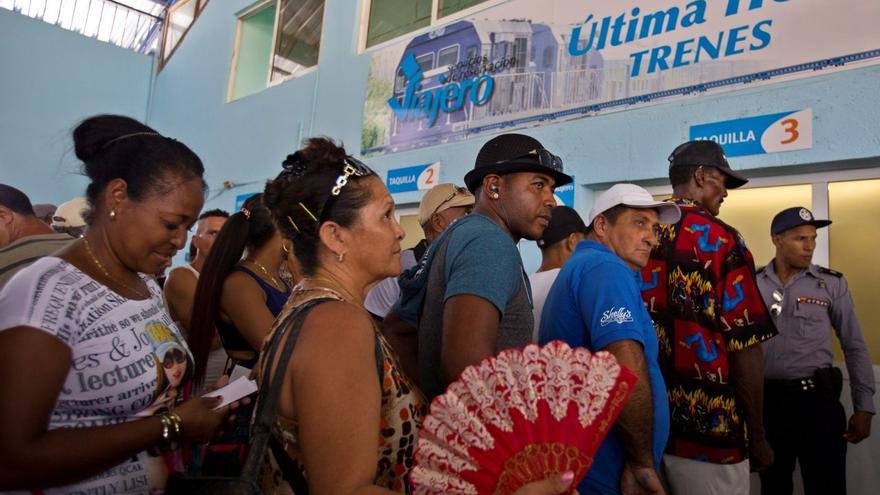
A woman observes the line of passengers to buy train tickets (EFE)
EFE (via 14ymedio), Havana, 14 July 2019 — The new trains with cars purchased by the Cuban government from China through a 150 million dollar loan, will operate starting Saturday, with the first route between Havana and Santiago de Cuba.
The trains will carry 700 passengers and make the trip in 12 to 14 hours, a significant improvement over current travel times of an entire day or more. Tickets are 95 Cuban pesos (roughly $24 US) in first class (with air conditioning) and 70 CUP in second class.
The cost of Cuba’s plan to restore its deteriorated rail network is estimated to be three billion dollars.
_________________________
The 14ymedio team is committed to serious journalism that reflects the reality of deep Cuba. Thank you for joining us on this long road. We invite you to continue supporting us, but this time by becoming a member of 14ymedio. Together we can continue to transform journalism in Cuba.
The word “guagua,” which for Cubans means bus, comes from the English Wa & Wa Co. Inc (Washington, Walton, and Company Incorporated) which was the first United States factory to export buses to the island. The logo of Wa&Wa Co. Inc. was a white blue and red hare, colors of the American flag, and figured prominently on the front, back and sides of their buses.
Additional notes: The closest English approximation of the sound of the Cuban word “guagua” is “wawa.”
14ymedio, Yoani Sánchez, Havana, 13 July 2019 — From that year I remember the wait, it was a feeling that filled everything like the unstoppable ticking of a story that was about to end. More than hunger, the heat of summer and the blackouts, the most difficult thing to endure was that prolonged parenthesis that had become our lives. And then July and August of 1994 arrived. The months in which we lost the little innocence we had left.
The news was diffuse, fragmented. “It was there, at the exit of the bay,” pointed out some residents in my Havana neighborhood of San Leopoldo, in the days after that 13 July when 37 people lost their lives at sea, among them 10 children. At first it seemed unreal, one more rumor of a frustrated escape, but little by little the story began to take shape, we knew the names of the victims and we knew the details of their last minutes.
Three tugboats — Polagaro 2, Polagaro 3 and Polagaro 5 — had sunk a ship carrying 72 people who were traveling with their eyes focused on the other side of the Florida Straits. People escaping a deep, dehumanizing crisis, which the ruling party had baptized with the “nice” euphemism of “Special Period in Times of Peace.” But in fact it was a time of material and moral deterioration, when children went to their parents with their hands out to ask for a piece of bread, a time when from the rostrum a delirious Fidel Castro called on us to “resist and win.” continue reading
That morning, 25 years ago, a few kilometers from the bed where I slept my apathetic dreams of adolescence, a terrifying scene developed that has been reconstructed thanks to the testimony of the survivors. The three tugs that were chasing the migrants pointed high pressure water hoses on them, knocking several adults and children off the deck. Those traveling on 13 de Marzo tugboat could do little against the onslaught.
The sea was filled with tumult and shouting a few meters from the imperturbable lighthouse of Morro, the same one that weeks later would again see avalanches of people leaving, this time in fragile crafts. While the water filled the throats of those dozens of people, others sitting along the wall of the Malecón to alleviate the summer heat stared out to sea imagining their dreams of a future in another place.
Then, the official media recrafted the story at will and blamed the tragedy on those who had stolen the 13 de Marzo tugboat and accused them of being irresponsible. They said that “the accident” was due to a collision between the fleeing ship and one of the Polargo tugboats, a version widely refuted by eyewitnesses who spoke of persecution, purposeful ramming of the boat, and water hoses. The state newspaper Granma also blamed the sinking on strong swells, low visibility and the deteriorated state of the boat itself.
The Communist Party militants were ‘oriented’ to tackle the rumors of state responsibility in the action, the Rapid Response Brigades greased their parapolice mechanisms of repression and a slab of silence was placed over that 13 July, similar to that the Chinese authorities have put on the events of Tiananmen Square. Even today, a quarter of a century later, the majority of Cubans living on the island avoid talking about it in public.
In their study circles, the militants of the Cuban Communist Party (PCC) denounced the “new hoax of the empire,” while some calculated how to get rid of the red card they carried in their pockets and emigrate to that place where “the enemy” lived. Most of the bodies of the victims were never recovered from the bottom of the waters and, to this day, Havana is missing a monument that remembers them. Despite its seriousness, the event is not studied in any History class in the schools of the Island.
During the days following that morning, the official media did not lose any opportunity to paint the actions of the Polargos as part of the revolutionary militancy that had motivated the crew of the three ships to try to prevent the theft of the tugboat. They exempted the authorities from any responsibility, not one of the perpetrators of the sinking was prosecuted and, instead, their work received copious praise from the Plaza of the Revolution.
With such complicity and without an institutional investigation, the tragedy became a state crime. Especially because it was used to induce fear in a civilian population about what could happen to them if they tried to escape from the “socialist paradise” imprisoning us. But even terror did not work.
Less than four weeks later the Maleconazo erupted and finally Castro opened the national borders for anyone who wanted to emigrate. Thousands and thousands. This time the Polargos did not go out to chase them, but many also drowned. The dramatic events of that summer put an end to the last illusions of a subjugated people.
___________________
The 14ymedio team is committed to serious journalism that reflects the reality of deep Cuba. Thank you for joining us on this long road. We invite you to continue supporting us, but this time by becoming a member of 14ymedio. Together we can continue to transform journalism in Cuba.
If the hypothesis is correct that the legion of the faithful is the human matter that makes up the renowned historical generation, it can be concluded that this group is already a thing of the past. (Granma)
14ymedio, Reinaldo Escobar, 12 July 2019 — Although the expression “historical generation of the Cuban Revolution” has been used to define a specific group of people, there is no official thesis through which it can be determined who deserves to be included in that list and what formalities someone must meet to appear and remain on it.
If it were an academic definition without connection to the reality of political power, the title in question could be considered to be defined purely by age and could be applied to anyone born during the first half of the last century with a minimum range of error.
For the “unquestionably young” Cubans born in the 21st century, many of those in the older generation who hold important positions are considered simply old. This is the case for Esteban Lazo, current president of the National Assembly of People’s Power, born in 1944, a man who represents the ‘hinge’ from a generational point of view; as a young man he completed all his tasks and matured among the rugged steps of the intermediate leadership, but he is not included in the political parnassus of the historical generation. continue reading
To be recognized as a member of this elite requires at least three additional requirements: to have participated in the struggle against Fulgencio Batista’s dictatorship, to embrace the communist ideology and, what appears to be most important, to have a proven loyalty to the top leadership generation.
In his speech to commemorate the 9th anniversary of the assault on the Moncada barracks, delivered on July 26, 1961 in the Sports City of Santiago de Cuba, Fidel Castro mentioned for the first time in public the idea of creating a unitary entity that would bring together the forces that had fought against Batista’s tyranny: the 26th of July Movement, the Revolutionary Directorate and the Popular Socialist Party.
With this decision, other groups were omitted from the distribution of power, among them the so-called Triple A, which was a derivation of the Authentic Party led by the ousted president Carlos Prío Socarrás, and all those who sought to find a peaceful way out of the dictatorship.
With the entities chosen by the comandante en jefe , the Integrated Revolutionary Organizations (ORI) would be founded as a previous base for the creation of a narrower political group that would be called the United Party of the Socialist Revolution of Cuba (PURSC).
Just two months later the process of dissolution of the organizations involved began, but it was not until March 8, 1962 that the National Office of the ORI was presented with 24 members of the three organizations mentioned. After an acute crisis, on March 26 of that same year, Fidel Castro decided not to wait any longer and turned the ORI into the PURSC and incidentally placed himself at the head of the new party.
Finally, on October 3, 1965, a list of one hundred people who formed the Central Committee of the newly appointed Communist Party of Cuba (PCC) was presented. These one hundred protagonists are the only ones with satisfactory credentials to present themselves as the historical generation of the Revolution.
The oldest of the list was a militant of the old Popular Socialist Party, Juan Marinello, now deceased, who was born in 1898; the youngest, a group of five fighters from the Sierra Maestra born after 1940 whose only active survivor is Leopoldo Cintra Frías, currently two years short of joining the octogenarian club, and today the current minister of the Armed Forces.
Of that list only seven other men remain active, 60 percent have died, more than 20 were defenestrated, the rest vegetated in a dark retirement. There are at least a dozen names that do not even have a file on Ecured, “the Cuban Wikipedia.” If the hypothesis is correct that this legion of the faithful is the human matter that makes up the renowned historical generation, it can be concluded that this group is already a thing of the past.
Raúl Castro is still the first secretary of the Communist Party of Cuba, his second in command in this organization is José Ramón Machado Ventura; and the only person behind them who has real power is the vice president of the Councils of State and Ministers, the legendary commander Ramiro Valdés. He is also the only one of them who was an assailant at the Moncada Barracks, an expeditionary on the yacht Granma, and a participant in the Invasion of the West. He has a reputation for being a cruel and astute man and maintains an enviable physical form for his 87 years.
If everything goes as planned, in April 2021 the 8th Congress of the PCC will be held. Miguel Díaz-Canel has already been named as a sure successor to Raúl Castro at the head of the Party. From that moment the historical generation will no longer have the physical, mental or legal capacity to sign laws or issue decrees. They will not even have the right to speak or vote.
One can speculate ad infinitum about what might happen in the minds of those who, sitting around the table where decisions are made, look at each other knowing they will all be thinking the same thing: that the historical ones are not there anymore to frown, and a whole nation anxiously awaits a new direction, a different imprint.
But there is not even the certainty that the plan is complete.
Editor’s Note: This article was originally published in the International Yearbook dedicated to Cuba by the CIDOB Barcelona Study Center .
____________________
The 14ymedio team is committed to serious journalism that reflects the reality of deep Cuba. Thank you for joining us on this long road. We invite you to continue supporting us, but this time by becoming a member of 14ymedio. Together we can continue to transform journalism in Cuba.
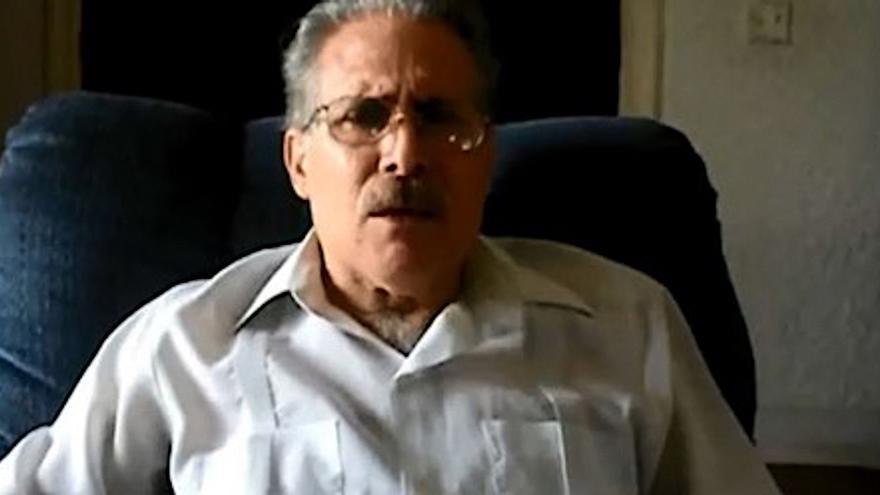
 14ymedio, Havana, 12 July 2019 — Former political prisoner Ricardo Bofill Pagés, a renowned human rights activist in Cuba, died at the crack of dawn in Miami at 76 years old, according to friends and family members speaking to Radio y Televisión Martí.