Repressive Escalation in Cuba: Pulse or Attack? / Miriam Celaya

Police in Cuba (File photo)

Cubanet, Miriam Celaya, West Palm Beach, Florida, 29 July 2019 — The repressive escalation against civil society activists and independent journalists continues to increase in Cuba. Everything confirms, without room for doubt, that the dictatorial will is to completely suffocate any manifestation contrary or even moderately critical of the political power.

Unreasonable arbitrary short time detentions; the absurd migratory “regulations” that prohibit dozens of activists and journalists from leaving the country to prevent them from participating in forums, training courses and events of any nature; the raids and confiscation of means of work, among other strategies, are everyday occurrences, generating an atmosphere of tension similar to that preceded by the raids of the Black Spring (2003), when 75 dissidents, among them journalists and political opponents, were prosecuted and convicted  to long sentences in Castro prisons.

What stands out now is that the harassment remains constant, especially — although not exclusively — against the youngest and most active members of the emerging civil society. continue reading

This time the police offensive goes beyond the one usually employed against the “traditional” dissent — formed by political parties, journalists and activists of various initiatives, already fused for years in these leadership roles — and extends to more recent citizen, proposals, whether they are promoted by contestant artists, journalistic websites tolerated until yesterday, or by a whole plethora of new actors that are adding voices and wills in a definitively plural society, which has ceased to be unanimous and uniform and has found in Information and Communication Technologies (ICT) an effective tool to exist, get informed and proliferate in the social networks, extending their communication and influence beyond government control.

Simultaneously, and against the deepening economic crisis, far from stimulating the growth of what they call “non-State forms of the economy,” the authorities continue their strategy of pressure and persecution against the private sector under the pretext of an alleged fight against corruption, infractions, or abusive prices and hoarding. It could be said that, in the midst of growing hardships, there is a government effort to win enemies in the population.

Price ceilings in market and private sector services, mandatory routes for passenger carriers, excess bureaucratic controls and regulations, extortion by an army of corrupt parasites called “state inspectors,” demonization of wealth and, more recently, a new decree-law to arbitrarily regulate the use of the internet, are some forms of the war without quarter that the State-Party-Government is waging on an increasingly impoverished and exhausted citizenship, but also a citizenship that is more dissatisfied and frustrated.

The Palace of the Revolution can barely disguise that what lies beneath such a show of strength is an undeniable weakness. The political mafia knows that the “continuity” proclaimed by the current hand-picked president is not possible in a Cuba driven by increasingly urgent changes. The paradox is that these changes would bring a scenario incompatible with the much-vaunted continuity. And since power is chained in its own absurdity, it has opted for the worst route: to crush any hint of citizen independence, without exceptions, be it political or economic in nature.

At the same time, the government’s much-fondled discourse of a “plaza under siege” becomes less effective, if not harmless. Not only because the Venezuelan crisis, combined with the pressures of the current US administration are severely affecting the Cuban economy and creating a social climate unfavorable to the populist-nationalist superficiality and the old battle trench slogans, but because in the new generations, immune to the communist infection and the “revolutionary” obsession, there is an abundance of “deserters,” more than the numbers of those faithful to the myth of the Moncada, the Granma and the Sierra Maestra.

A good part of Cubans born since the dark 90’s are currently grouped into two sides: the side of the opportunists, who pretend loyalty to the system to defend niches or privileges, and the side of the nonbelievers. The latter is the breeding ground where the irreverent abound, those who, as if the fact that they ignore the legacy of the “the historical generation” were not enough, mock it, flooding the networks of memes with images that were considered, until recently, sacred icons of the revolutionary pantheon, and placing the nomenclature at all levels, more earnestly since — finally! — the murky Cuban hierarchy decided to “govern with transparency” using the internet. And it is well known that under conditions of dictatorship all questioning is dissent.

Consequently, to the two ever-useful villains – Imperialism and its “mercenaries of the internal opposition” — a growing number of young people have been added who, with citizen positioning from virtual space, and devoid of ideological extremisms and idolatries to false heroes, exercise the right to make demands on the leaders and to encourage changes within the Island.

More than a decade after a dark character of the “historical” nomenclature threatened to “tame the runaway colt of the internet,” not only has independent digital journalism multiplied and diversified, but new social actors are emerging, grouping together, getting organized and convening activities according to their interests, beyond the will of the caste in power. It is the worst nightmare of any autocracy.

In the meantime, the signals extending from the Power predict more difficult times and greater risks. There are reasons to suspect that what today seems to be the simple heartbeat of the Castro Regime’s strength, might well be the prelude to a new attack. And this time the repressive machinery will not only come for opponents, dissidents, activists and independent journalists, but against all manifestations of citizen freedom. If we really aspire to a plural Cuba, it is time to stop thinking in the singular: We are all Cuba.

(Miriam Celaya, a resident of Cuba, is visiting the United States)

Translated by Norma Whiting

Beer Prices Are ’Capped’ in the Private Sector in Pinar del Rio and Las Tunas

The ‘capped’ prices affect both domestic and imported beers sold in coffee shops and private restaurants. (Flickr / Brando)

14ymedio bigger14ymedio, Havana, 24 July 2019 — What seemed impossible one week ago is already a reality in Pinar del Río and Las Tunas. As of August 1, the prices of beverages sold in private premises will be capped’ in both provinces, according to their respective Provincial Administration Councils (CAP).

Beers, juices, soft drinks and malts that are sold in restaurants and private cafes can only be sold up to a maximum price established in the list approved by the CAP. In the case of the municipality of Viñales, a tourist epicenter, “a differentiated study will be done and will be reported shortly.”

Prices for nationally produced beers, Bucanero and Cristal, in 350 milliliter bottles and 355 ml cans will be set at 30 CUP [Cuban pesos] (1.25 CUC [Cuban convertible pesos]); and locally produced beers, clear and in bottles of 350 ml, will be 15 CUP. The Cacique and Mayabe brands, which are sold in 355 ml cans will cost 25 CUP, while imported beers — with current value in state markets of up to 1.40 CUC — will be set at 35 Cuban pesos (1.45 CUC) .

Juice boxes of 200 milliliters will be set at 25 CUP, those of 500 ml at 35 CUP, and those of a liter at 65 CUP, prices that leave a very narrow profit margin for private businesses. The canned Buccaneer malt of 355 milliliters will be set at 20 CUP and imported malts of the same volume at 25 CUP, the price list details.

Meanwhile, soft drinks in 1.5 liter boxes may not exceed 30 CUP and soda, in cans of 355 milliliters, 15 CUP.

Shortly after the announcement, the economist Pedro Monreal described it on Twitter as “irrational and there is no need to demonstrate it.” According to the academic, “the test of demonstrating that this could have some rationality lies with those to whom the idea occurred. To begin with, they might kindly indicate the ‘school of economic thought’ by which they were inspired.”

The decision is part of a package of economic measures announced at the end of June by the Government which began with a wage increase that benefited 2.7 million workers in the state sector.

In recent weeks, beer has been at the center of attention since the publication of a report in the official press of Cienfuegos, which questioned the high prices of the product in the private sector.

The text reported that private businesses were selling beer for “200% of its sale price, perhaps 250% of its cost price. For someone who did not invest a drop of sweat to produce it.”

The article also referred to sources within the administrative framework of state stores who warned private businesses about the sale of national beers and about profiting by selling them in more than the allowed quantities, established as two boxes (of 24 cans or bottles each) per person.

In Pinar del Río, the Council of the Provincial Administration has also set a price of 5 CUP for recreation equipment and cart rides for children pulled by animals and for other services related to children’s entertainment. Among these are included motor-operated devices created by the entrepreneurs themselves to inflated toys imported by individuals.

For its part, the Municipal Council of the Administration of Sandino limited the activities of leasing homes, rooms or public spaces in La Bajada, on the Guanahacabibes peninsula, a protected area with a wide diversity of flora and fauna.

Perhaps I understood it the wrong way around, but I believe it has been said — several times — the official focus is to use economic mechanisms and not administrative ones. Beer is not a basic product, and should operate based on supply and demand in the private sector. — Pedro Monreal (@pmmonrealJuly 24, 2019

In La Bajada, a coastal community, the rental of houses to tourists has proliferated in recent years, along with private guide services to the area, horseback rides and private food services.

In Las Tunas the measure also applies to prepared food. The price of bread with roast pork will be set at 5 CUP, the same as bread with ham, while the price of bread with a hamburger will be 7 pesos. Fruit juices and smoothies will be fixed at 2 and 3 CUP respectively.

______________

The 14ymedio team is committed to serious journalism that reflects the reality of deep Cuba. Thank you for joining us on this long road. We invite you to continue supporting us, but this time by becoming a member of 14ymedio. Together we can continue to transform journalism in Cuba.

Patience, This Year the School Uniforms Are Late

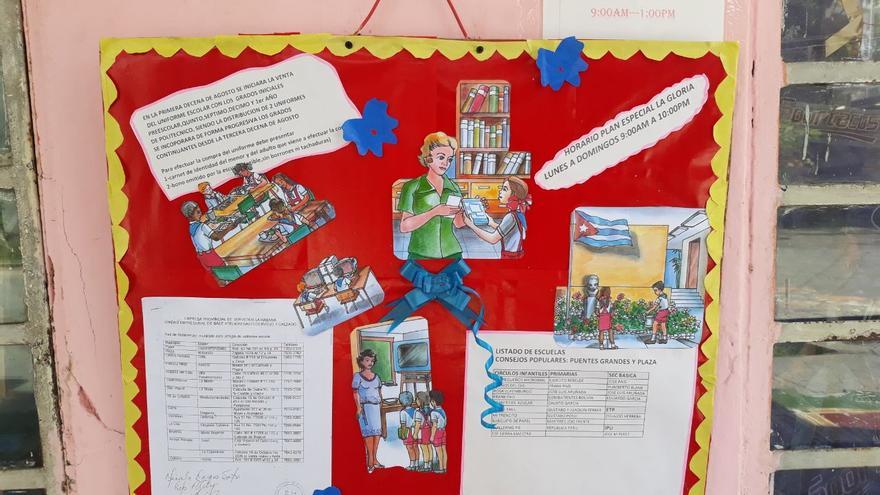
Bulletin board displays in the schools announce the sale of uniforms. (14ymedio)

14ymedio bigger14ymedio, Luz Escobar, Havana, 26 July 2019 — Bulletin boards in schools or workplaces are often ornaments hung in a corner, loaded with historical events and photos that nobody pays attention to. However, at certain times they gain prominence and dozens of eyes gather around, such as when the date school uniforms will go on sale is posted, which sets off tensions, annoyance and hours of waiting for the families every year.

These days, parents are very attentive to the window for the sale of uniforms, because a day lost in finding out could mean their child’s size is no longer available in the store. At the points of sale, the shelves are still empty, but on the bulletin boards are the details regarding the marketing of this essential clothing.

Normally this moment comes between May and June, when the distribution of the garments begins, but this year the situation has changed. The delay in the arrival of the raw material has affected the manufacture and subsequent distribution of the uniforms, for which this year’s number is three million.

Factory workers have had to work overtime and holidays to complete the production and meet the demand, and according to a report on national television from the managers of the Apparel Company, 80% of the uniforms are now finished.

The Deputy Minister of Internal Trade, Nancy Valdés, announced that the beginning of the sale could not be guaranteed at the end of July and during the month of August, and asked for patience, noting that it is a priority issue for the Government.

Mirla Díaz, vice president of the Light Industry business group, said that the arrival of the raw material occurred at the beginning of June and that, as soon as the fabrics were in the country, they were transported to the warehouses and then to production units.

This Wednesday, at one of the points of sale of the Plaza Municipality, a mother asked about the day the sale will begin, but only received a reproach from the saleswoman: “Read the bulletin out there, where everything is explained.”

____________

The 14ymedio team is committed to serious journalism that reflects the reality of deep Cuba. Thank you for joining us on this long road. We invite you to continue supporting us, but this time by becoming a member of 14ymedio. Together we can continue to transform journalism in Cuba.

"Cubans Are the Central Nervous System of the [Venezuelan] Regime"

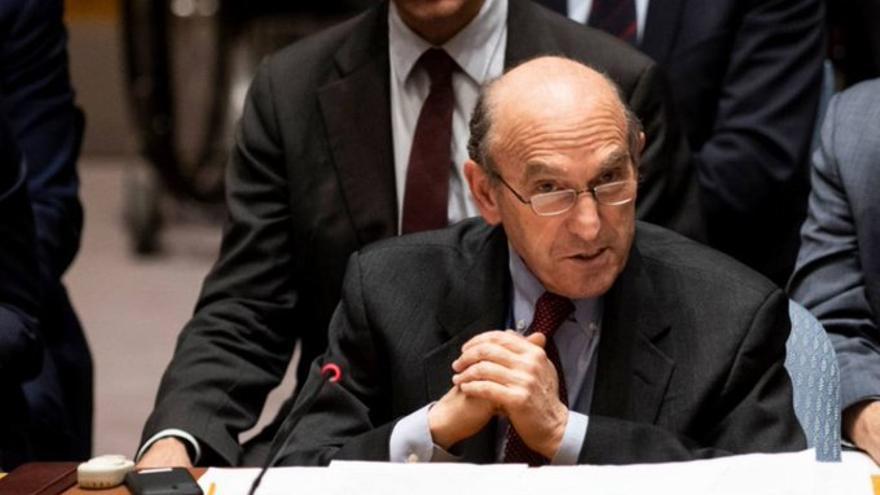
Elliott Abrams admits that the military option is not completely ruled out, although it is not preferred by the US. (@USAenEspanol)

14ymedio bigger14ymedio, Havana, 22 July 2019 — Elliott Abrams, a special US envoy for Venezuela, has estimated 25,000 Cubans reside in the country who provide information to the Nicolás Maduro regime, as detailed in an interview with the Spanish newspaper ABC. The ambassador places about 3,000 the Island’s collaborators in Caracas engaged in intelligence work, spying on the military and civilians, or teaching how to torture. The remainder, doctors or teachers, “can also be spies and informers.”

“To understand [Cuba’s] influence, it is enough to remember that Maduro’s bodyguards are Cubans. As I see it, Cubans are the central nervous system of the regime,” Abrams said, also suggesting the possibility that the attempted coup d’etat on April 30 was discovered by Cuban spies and frustrated by that.

Elliott believes that the survival of both regimes is very connected, mainly by oil. “We must now put pressure on the few remaining undemocratic countries [in Latin America], Cuba and Venezuela among them. In the case of Venezuela, I think it is also clear that, given its economic crisis, it is not a country that can continue offering subsidies to Cuba, because it is giving the Island between 50,000 and 80,000 barrels of crude oil per day. That, we estimate, amounts to $75 million a month, which is not a small amount of money,” he said.

The New York politician also analyzes the relevance of the Russian role in the survival of the Chavista regime. The support of that power is basic, he argues, among other reasons because of the power of its veto in the UN Security Council.

Although Elliott points out that China also joins with Russia in blocking condemnations in the international organization, his intuition tells him that it would stop doing so if it were not for going along with Russia.

The Rosneft oil company is another practical reason why the support remains seamless. The Venezuelan government owes the Russian company more than 8 billion dollars and has asked it to help it sell its oil after the US applied sanctions to PDVSA, the state-owned oil company. Thus, Elliott believes, Venezuela endures despite the difficulties.

In spite of everything, the American believes that the sanctions are effective and a way to go. In the interview, Elliott speaks about individual penalties, such as those applied to four senior officers, recently, for the death of Captain Rafael Acosta Arévalo.

“If the sanctioned person is accustomed to coming to Miami, if he has an apartment or savings here, something more frequent than it seems, that ends. I can say that we have been approached by several people of the regime very concerned about the sanctions and asking for them to be lifted, especially when they affect their family, because such sanctions can be extended to the family of the affected, and there are those who have their children in American universities. So we are convinced that these sanctions have a real and concrete impact,” he said.

Elliott also spoke of the possible withdrawal of these sanctions if the punished collaborate, as has been the case with General Manuel Cristopher Figuera, against whom they were lifted after he aligned himself with the head of Parliament, Juan Guaidó, and started to collaborate with the US Government. “His should be an example for others. The same thing we have done with him we can do with others,” he says.

The ambassador had explained that the United States is trying for a transition in Venezuela without resorting to force, although it does not expressly reject it. Elliott says that the ideal, according to Washington, is for Maduro to leave power and the different parties to negotiate a transitional government that will take the country to new elections.

He admits, in this, certain divergences with the European Union, since Brussels believes in a supervised election and Washington considers that this panorama is impossible with all the powers controlled by Chavismo.

In this regard, he believes that the statements made recently by the acting Spanish Foreign Minister and future head of European diplomacy Josep Borrell about the US Government are not positive. The Spanish chancellor said in May that Washington behaves in relation to Venezuela “as the cowboy of the west,” when in this situation “it is not for anyone to draw their guns” but to find “a peaceful, negotiated and democratic solution.”

Despite this, he does consider the position of the Government of Spain positive. “We agree on the result we want. We both want a true democracy through free elections to stop the terrible violations of human rights. The difference is in the transition period.”

Also the report made by the UN High Commissioner for Human Rights, Michelle Bachelet, is a source of satisfaction for Elliott, who confesses that the US government is very impressed with its strength. However, he also believes she missed an important task, as she could have requested to visit prisons and did not do so.

Finally, and although he emphasizes that the military route is the last option for his Government, he admits that it is not ruled out. “No one could have told George H. W. Bush in the 1988 elections that he would end up invading Panama! So we will see what the future brings us, for now, suffice it to say that we have the ability to use military pressure.”

___________________________

The 14ymedio team is committed to serious journalism that reflects the reality of deep Cuba. Thank you for joining us on this long road. We invite you to continue supporting us, but this time by becoming a member of 14ymedio. Together we can continue to transform journalism in Cuba.

Puerto Rico and the Crisis Underneath the Surface

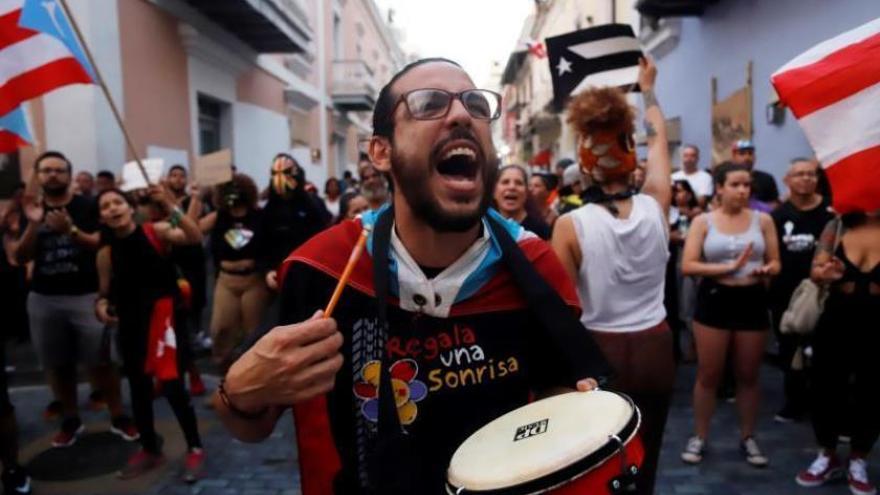
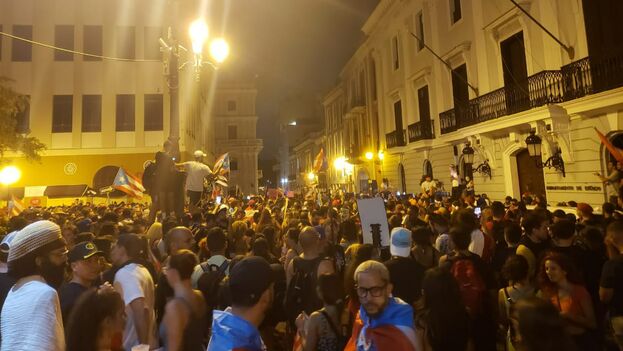
Protesters in front of the seat of Government known as La Fortaleza, in San Juan, Puerto Rico. (EFE/Thais Llorca)

14ymedio bigger14ymedio, Carlos A. Montaner, Miami | 28 July 2019 — It was an unusual spectacle. Popular demonstrations forced the resignation of Ricardo Rosselló, governor of Puerto Rico. It was the first time that something like this had happened since 1898, when the United States snatched sovereignty of the Island from Spain in what became known as the Spanish-American or Spanish-Cuban-American War.

However, the central nucleus of the conflict remains intact. Apparently, the reasons for this episode have to do with the corruption of the government and the disclosure of a vulgar chat in which Rosselló and some twenty buddies and officials make offensive comments about political adversaries, or major artists, like Ricky Martin, but that’s not the whole truth.

That’s the surface. Underneath, like a ghost of the 19th century, lies the problem of status: independence, autonomy, or full statehood. Faced with the glaring insensitivity and stupidity of Rosselló and his courtiers, those in favor of independence or autonomy, the “populares” went out to the streets. They were right to be indignant, but the almost 900 pages of chat were anecdotal. They turned out to be a magnificent alibi. The hidden key of the protest was status. continue reading

I know the Island very well. I lived there from 1966 to 1970. I taught in a private university and our son was born there. It’s a beautiful and very dear place. It’s true that more than half a century has passed, but nothing has changed in the political order since 1898, except the proportions of the three trends.

Half a century ago the supporters of independence were 5% of the electoral register. Supporters of autonomy (or “free staters”) were, more or less, 60%, and those who wished to transform the Island into state number 51 of the American Union were at somewhere around 35%.

Today it seems that support for independence continues to be at 5% of voters, while the rest of the population is divided in similar proportions between supporters of autonomy and statehood. Sometimes the “populares” and sometimes the “staters” win. Fifty years ago only the autonomists would have won.

Wilfredo Braschi, a magnificent writer, extremely intelligent, friend of Luis Muñoz Marín, caudillo of autonomy, warned me of this with a certain melancholy: “The trend is unstoppable. The number of supporters of statehood will be more and more.”

The definitive blow against supporters of Puerto Rican independence was dealt by the United States Congress. In 1917, it granted American citizenship to all Puerto Ricans born or yet to be born on the Island. That allowed them to settle in “continental territory” without limits. Today there are more than 5 million in the United States and barely 3.3 million in Puerto Rico. (Florida is the state with the greatest number of Puerto Ricans: more than a million.)

The stability of the Island, democracy, republican institutions, American citizenship, which very few Puerto Ricans are prepared to renounce, individual freedoms, and, ultimately, the links with the United States, mean that Puerto Ricans have a per capita of forty thousand dollars annually, placing them at the head of Latin America, although they are at the tail of the United States.

Simultaneously, there is no extreme poverty, nor children that go hungry, lack schooling or medical attention. There is even the paradox that life expectancy in Puerto Rico (some 81 years) is higher than that of the United States. The same thing happens in post-secondary education: 47.1% of Puerto Ricans participate in it. Although it’s true that the average of the United States is 47.6%, Puerto Ricans surpass 20 of the 50 states in the Union.

None of these objective facts negates the immense problems of Puerto Rican society: drug use, violence related to that scourge, the enormous external debt, or the proportionally gigantic size of its public sector, but, as they say on the Island, nothing that doesn’t allow them to adequately deal with those conflicts.

What will happen, ultimately, from the resignation of Rosselló? Nothing. Everything will continue the same until, in many years, the number of staters clearly overtakes the autonomists and they decidedly ask for incorporation into the United States. That is the observable trend. Wilfredo Braschi, with melancholy, warned me about it.

Translated by: Sheilagh Herrera

_____________________

The 14ymedio team is committed to serious journalism that reflects the reality of deep Cuba. Thank you for joining us on this long road. We invite you to continue supporting us, but this time by becoming a member of 14ymedio. Together we can continue to transform journalism in Cuba.

’The 26th’ of Cuban President Diaz-Canel

Cuban PresidentMiguel Díaz-Canel before 10,000 Granmenses gathered in the Plaza de la Patria of Bayamo this July 26. (@PresidenciaCuba)

14ymedio bigger14ymedio, Reinaldo Escobar, Havana, 26 July 2019 —  The commemoration of the 66th anniversary of the assault on the Moncada Barracks, on July 26th, was the confirmation that Miguel Díaz-Canel is, definitely, the one chosen to remain in command of the country as a stand in for the historical generation.

The president himself implied in his first words, before 10,000 Granmenses gathered in the Plaza de la Patria of Bayamo. “I was wondering how and in whose name I am going to talk to you today, taking into account that in these acts, by tradition, two speeches are always delivered, that of the province where the celebration is held and that of the protagonists of the story.”

He recalled that the central words of all the previous commemorations “have always been the job of Fidel, Raúl, Ramiro Valdés and Machado Ventura.” And he added that it seemed an important detail “that the protagonists of the story, alive, lucid, active in their political leadership” have entrusted him to pronounce the central words of that act. continue reading

As has become usual in the revolutionary liturgy of recent years, there were songs with patriotic pretensions, poems, “improvisations” of peasant decimists  (poets) and speeches by an excited little pioneer and an exalted young student. Federico Hernández, member of the Central Committee and first secretary of the Communist Party in the province, made the usual summary of partial successes and deficiencies to be resolved, while summoning those present to resist the aggressions of the empire and to continue in the construction of socialism.

In his speech, Díaz-Canel made the obligatory allusions to history by citing words of Fidel Castro and resuscitatin Ñico López, one of the assailants of the Moncada Barracks later killed after the landing of Granma, “Raúl’s great friend, who occupies a place of honor in his office where there is a photo of the boy with the big black glasses. ”

The president reiterated that the Revolution, which today needs to fight a battle for Defense and the Economy and has to defend itself from the enemy, “requires at the same time that we strengthen in our people punctuality, civicism, the essence of solidarity, social discipline and the sense of public service.”

To draw a portrait of the situation that the country was experiencing in the times before the Moncada assault, he appealed to “a study that the Helms-Burton law causes us to dust off,” carried out by the Catholic University Foundation in 1956 which discusses the need for agrarian reform in the country.

Díaz-Canel, to refute the arguments of those who today are demanding the return of property taken from them without compensation, emphasized the difference between the confiscations carried out against “the embezzlers of the Batista dictatorship” and the nationalizations, “a right that the international community recognizes for all sovereign nations,” although he omitted the detail of the properties seized from thousands of Cuban individuals who were not a part of the Batista dictatorship.

The phrase “No, we understand each other,” taken from a quote by Antonio Maceo during the Baraguá Protest, was repeated rhetorically to refer to the dispute with the United States Government and supposed reconciliation proposals that imply “abandoning friends.”

The leader estimated the economic damage caused to the country by the economic restrictions imposed by the United States on Cuba from March 2018 to April 2019 to be 4.343 billion dollars, although he warned that this data does not include the losses caused by the latest measures of the Donald Trump administration “that limit travel licenses, prohibit cruise ships from docking and reinforce financial restrictions.” He attributed the shortages and lack of spare parts to these phenomena.

Referring to internal affairs and the challenges to be focused on, he mentioned “first of all the economic and military invulnerability of the country, the legal system, the adequate response to whatever internal obstacle exists, be it bureaucratism, insensitivity or corruption that cannot be accepted in socialism.”

Díaz-Canel also referred to the recent increase in salaries that has sparked so much controversy among economists. “Given the old dilemma of raising wages now or waiting for productive results to support these elevations we decided to raise them, not one but several times the value of what was being paid,” he said.

He added: “But to sustain these and all possible social benefit measures, it is necessary to produce more and improve the quality of services. New measures proposed by the people must be approved in the coming weeks and months.”

He did not forget to express solidarity with the Government of Nicolás Maduro in Venezuela or to condemn those who denounce his excesses. He announced that he will attend the meetings of the Sao Paulo Forum to carry the messages of the Revolution and “strengthen the integration of leftist forces and their mobilization against the imperial offensive that has proposed to break us, divide us and confront us.”

Finally, the three octogenarians who participated as spectators in the act, Raúl Castro, Ramiro Valdés and Machado Ventura went up to  stage the final photo of arms raised in victory. At that same moment, the death of Cardinal Jaime Ortega was announced in Havana and, in Washington, new economic sanctions against Cuba were announced.

________________

The 14ymedio team is committed to serious journalism that reflects the reality of deep Cuba. Thank you for joining us on this long road. We invite you to continue supporting us, but this time by becoming a member of 14ymedio. Together we can continue to transform journalism in Cuba.

Jaime Ortega, Cardinal of the Thaw, Dies in Havana

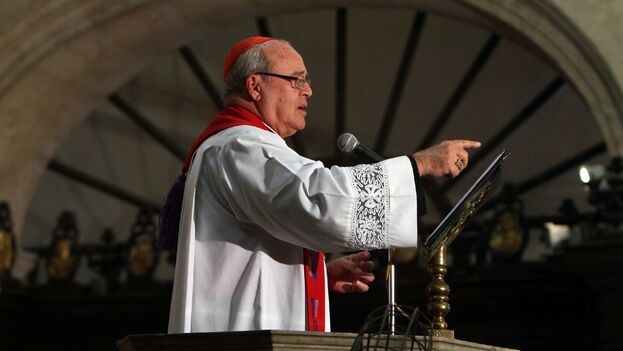
Cuban Cardinal Jaime Ortega delivers a sermon on Friday, April 6, 2012 at the Cathedral of Havana. (EFE / Alejandro Ernesto)

14ymedio bigger

Luz Escobar and Mario J. Penton, Havana/Miami, 26 July 2019– Cardinal Jaime Ortega (1936-2019), a key figure in the secret talks that led to the reestablishment of relations between the United States and Cuba, died at age 82 on 26 July in Havana, after a long illness, according to ecclesiastical sources.

“Jaime Ortega was a figure of great weight during the last decades, both in the life of the Cuban Church and in the life of our people. A controversial figure, no doubt, but one whose intention was always to serve Cuba and the Church,” said Father José Conrado Rodríguez, pastor of the church of San Francisco de Paula.

Although on many occasions he did not agree with the Ortega line, Father Conrado confessed that he always “respected” the figure of his teacher, for “his love for Cuba” and his “desire to do good.” continue reading

“Jaime always looked for the Church to be present in the life of the country. He was attentive to problems that affected the life of the nation, such as emigration,” he added.

“He tried to solve big and serious problems and he did it with the best will, although personally I think he was not so happy about the way he faced them,” added the priest, very critical of the closeness, under Ortega’s leadership, between the Cuban Church and the State.

Jaime Lucas Ortega was born on 18 October 1936 in Jagüey Grande, in Matanzas province. He entered the seminary in 1956 and after four years of studies he was sent to Canada. He returned to Cuba in 1964 to be ordained a priest.

His ministry was interrupted for eight months in 1966 during his confinement in the Military Units of Production Aid (UMAP), forced labor camps established by the communist regime of Fidel Castro, where religious, homosexual and the disaffected were sent. The following year he was appointed pastor of his hometown.

In 1969 Ortega was promoted to the head of the cathedral of Matanzas and nine years later consecrated bishop of Pinar del Río by Pope John Paul II. During these years he also taught at the San Carlos and San Ambrosio Seminary. In 1981, the Polish Pope appointed him archbishop of Havana, and in 1994 he was named a cardinal, the second Cuban to reach the highest title granted by Rome.

In that year he was one of the main architects of the pastoral letter Love Hopes All Things, which contained strong criticism of the Government, and especially of the dreaded State Security. In those years, the voice of Ortega was one of the most critical in the concert of Cuban bishops, condemning the “violent and tragic” events of the sinking of the tugboat 13 de Marzo.

“His appointment as cardinal was a gift from Pope John Paul II to the Cuban Church. The Pope wanted the Church to break with the silence it had been forced into and leave the temples to evangelize,” said the priest Castor José Álvarez Devesa from Camaguey.

Father Álvarez believes that one of Ortega’s great achievements was the pastoral structure he built in his archdiocese, which are called the ecclesiastical provinces. “He organized vicarages, pastoral councils, linked the faithful with the Church and through his attitude of dialog important things were achieved, such as the pilgrimage of the Virgin of Caridad de Cobre throughout the Island, which has been a blessing,” he said.

According to the priest, the Cuban Church “has had very great challenges” with the introduction of the Marxist system. “Cardinal Jaime chose to return to Cuba and serve his country and his Church,” he added. Álvarez also highlighted Ortega’s role in condemning the death penalty on the Island and the right of Cubans to leave and return to their country.

During the almost 35 years that he was in charge of the Archdiocese of Havana, Cardinal Jaime Ortega restored dozens of temples, established a Diocesan Pastoral Council to make the work of the Church more effective, and established the headquarters of the Conference of Catholic Bishops of Cuba.

One of Ortega’s works is Cáritas Havana, created in 1991, which preceded Cáritas Cuba, the largest NGO on the island that distributes medicines, food and other types of aid on a daily basis. Ortega played an important role in the creation of socio-religious publications New Word, in 1992; Lay Space and Love and Life.

As a cardinal, in 2011 Ortega participated in the process of releasing the 75 political prisoners of the Black Spring and in the subsequent banishment to Spain of many of them. He was later criticized for having affirmed, before international media, that there were no political prisoners in Cuba.

The priest was considered the architect of three papal visits to Cuba — John Paul II in 1998, Benedict XVI in 2012 and Francis in 2015 — who officiated massive public masses in spaces previously reserved for power.

In 2010, Ortega inaugurated a new headquarters for the San Carlos and San Ambrosio Seminary, which was the first new construction by the Catholic Church on the island since 1959. The cardinal also committed his figure to the creation of the Félix Varela Cultural Center, an educational institution that is an alternative to the educational monopoly of the Cuban State.

Instrument in the secret negotiations between Washington and Havana 

“I was the letter,” Ortega said about his role in the secret negotiations between the United States and Cuba that allowed the reestablishment of relations between the two countries during the presidency of Barack Obama.

As the cardinal revealed, years after the two neighboring countries ended a break of more than half a century, Pope Francis secretly entrusted him with the delivery of a letter to Raúl Castro and Obama.

“Perhaps the most important part of my mission came when President Raúl Castro asked me to transmit on his part a message to President Obama, of which I would be the bearer when I took the letter of the Holy Father to the president in the White House,” recalled the Cardinal during a speech.

The message commissioned by Raúl Castro was that Obama had not been responsible for the policy towards Cuba, that he was an honest man and that in Havana they knew his intentions to improve relations with the Island.

Obama thanked Castro for his words and sent a verbal message with the cardinal: “It was possible to improve the existing situation,” despite the differences. On 17 December 2014, the date of Pope Francis’s birthday, Cuba and the United States announced the restoration of diplomatic relations.

Both parties recognized the work of the Catholic Church as a mediator, although sectors of exile and opposition in Cuba strongly criticized Ortega because he did not demand an improvement of human rights and freedoms on the Island.

After more than three and a half decades at the head of the Havana archbishopric, Ortega said goodbye in 2016 when Pope Francis accepted his resignation and in his place appointed the Camagueyan Juan de la Caridad García Rodríguez.

Recently, the Conference of Catholic Bishops of Cuba granted the Cardinal the Monsignor Carlos Manuel de Céspedes Distinction . The bishops of the eleven Cuban dioceses were present at the ceremony.

Church sources reported that Ortega Alamino’s body will be exhibited in the cathedral of Havana for three days starting this afternoon, “according to the Vatican protocol.” They also said that the funeral will be Sunday at 3:00 pm.

Through a tweet from President Miguel Díaz-Canel, the Cuban government offered its condolences for the death of Cardinal Ortega. “His contribution to the strengthening of relations between the Roman Catholic Church and the Cuban State is undeniable,” the leader wrote.

_____________

The 14ymedio team is committed to serious journalism that reflects the reality of deep Cuba. Thank you for joining us on this long road. We invite you to continue supporting us, but this time by becoming a member of 14ymedio. Together we can continue to transform journalism in Cuba.

The ‘Apartheid’ of Abel Prieto

The author reproaches Abel Prieto for his July 18th article in ’Granma’. (EFE)

14ymedio biggerDear Mr. Prieto, if the intention of your article published on July 18, 2019 in the Granma newspaper was a recommendation for the public to listen to Mr. Fernando Ortiz and to be nurtured by his work — as reflected in your last sentence, although using other words — I am of the opinion that you did not need to insult a figure of the Cuban intelligentsia, whether it pleased him or not, and to attack all Cubans in general by dividing us into types or sects, according to your own definition of “external cubanidad*” and “cubanía*.

You warn us that there are “rumberos (musicians) and entertainers, who master a spicy repertoire of Cubanisms, enjoy rum, dominoes, good tobacco, strong coffee, laugh at Pepito’s jokes, cry at a bolero and always wear a Virgin of Caridad del Cobre medal around their neck . They are active practitioners of external cubanidad, but they are essentially oblivious to cubanía.” And in addition to this, you previously call them “annexationists.” [people who want Cuba to become part of the United States]

You show us in this way in your article a detailed description of citizens of our country who, apparently, for you do not represent what they have to represent having been born in Cuba. Even if, you warn, and according to my interpretation of the previous quotation extracted from your text, they carry out human activities equal or similar to the rest of those who do exercise “cubanía.” continue reading

It is frightening to think that the fascists disqualified Jews in the twentieth century in the same way, proclaiming publicly and macabrely that even if the Jews were human beings, they were not “equal” to them.

To hide your disrespectful qualifications a little more, you do not dare to call them bastards or anti-Cuban, but disqualify them with a little more elaborate but equally scandalous expletives, concluding, in other words, that there are people who exercise “external cubanidad ” and not “cubanía.

It is not for pure pleasure that you, mischievously and voluntarily, hide behind the thoughts of other intellectuals mentioned in the text, such as Elías Entralgo or Ortiz himself, in addition to using copious insults against Mr. Cabrera Infante to justify the unscrupulous launch of your own abominable conclusions, cited above.

I wonder why it is that you dare in your article to denigrate us in such a way, all Cubans, for some thinking differently from others. I suspect that certainly in the current international context you would not dare to launch a public statement against Puerto Ricans, stating that some are and others are not, unless you suffer from a severe neurological problem.

Just look at the result of some disrespectful phrases that were not well received by the Puerto Rican citizenry, which, unlike your daring and excessive public letter, were contained in the private messages of their president and provoked a mass protest that ended with his rapid resignation.

I also suspect that your boldness comes from your great feeling of impunity derived from your job and your current position and status, and that, for obvious reasons, this feeling is closely linked to the cowardice of the current Cuban rulers who use sticks to repress any peaceful protest of citizens against any of their untouchable party faithful, which, following the guidelines of Article 4, Paragraph 4 of the new Constitution, pushes and encourages any Cuban to fight by any means against any ‘other’ that opposes an order issued by the Communist Party although such opposition is peaceful, such as carrying a discreet poster on the sidewalk, or writing a press article.

Mr. Prieto, as those who know well the injustices of this life say, the jailer is brave in the world of prisoners.

I hope that your article is of much better benefit to you than the rest, and that, when you reread it, it will never produce the bad taste that it produces and will produce in those of us who will have the miserable bad luck of encountering this shameful page and reading your public segregationist thoughts in the future.

Guamacaro, Canadá, 29 July 2019

*Translator’s note: Taking the definitions from a Cuban government website: “Cubanidad — the quality of being Cuban; Cubanía — the vocation of being Cuban.” An English equivalent might be “Cubanness.” See also: All About Cubanía

_______________

The 14ymedio team is committed to serious journalism that reflects the reality of deep Cuba. Thank you for joining us on this long road. We invite you to continue supporting us, but this time by becoming a member of 14ymedio. Together we can continue to transform journalism in Cuba.

Ricky Left to the Rhythm of Reggaeton

Protesters celebrate the resignation of Ricardo Rosselló. (14ymedio / Juan Jaramillo)

14ymedio bigger14ymedio, Yoani Sanchez, Generation Y, San Juan, Puerto Rico, 27 July 2019 — “He had to go and he left.” With these words the taxi driver welcomes me. No name or details are necessary, because in the streets of Puerto Rico everyone knows who he’s talking about. While driving through San Juan, the driver tells me how “people tossed out” Governor Ricardo Rosselló after days of protests, in which outrage and reggaeton shook hands.

At a traffic light, the driver, in his 50s, hits the steering wheel with gnarled hands as if it were Ricky’s face. “He didn’t want to leave, but he had to step down,” he insists. Along with his two children, the driver spent every night of last week around La Fortaleza, the official residence of the Puerto Rican governor. “I carried a flag, but in black and white, without colors, because here we are still in mourning,” he says.

While he tells me the details of the nights of protest, we pass through several blocks where balcony after balcony and door after door display the flag with the blue triangle and red stripes one after another. A banner so similar to the Cuban flag that in my fantasies of the recently arrived, I imagine being in Havana the day after a change of government. continue reading

This confusion of realities haunts me as the car heads towards old San Juan. So when the driver says “people joined together and it didn’t matter if you were an artist or a mechanic, rich or poor, everyone was together,” I fantasize about some workers who drop their picks and shovels on the railroad line to shout in chorus with novelists and troubadours in front of Havana’s Plaza of the Revolution.

The image lasts in my head for a second before I return to Puerto Rico.

Hurricane Maria is an open wound that crosses the Island. “My brother lost everything and had to move from the town where he lived, spent a year and a half without electricity,” says the taxi driver. Interposing some words in English: babyexpensivedealerfood… a linguistic mix that I hear everywhere in this free state associated with the United States.

Evening falls, headlines around the world point to this place where in the plazas twerking people celebrate the first day without Ricky, the beginning of a new stage, filled with questions. In one of those places, where popular joy, alcohol and hip movements mix, is Alder, a musician who plays the piano and the clarinet. He also dances, but with some care.

“I had sciatica problems last year and I don’t want to be in a wheelchair again but I couldn’t miss this,” he tells me as he glugs down a bottle of a craft beer made by friends. “These are not gone, they remained after the crisis and the hurricane, they are still here,” he says, pointing to the label “one hundred percent Puerto Rican.” Every time he tries to twerk he puts a hand on his waist, “to not do it too hard,” he says.

Beside him, a family has come with two darling and barking mutts, collected from the shelters where they left them when they fled from the hurricane to their families in the United States, who took them in that fateful September 2017. The winds and rains took then more than 4,600 lives, according to a study by Harvard University.

“It was hard because we had to go back to our origins, learn to do things that we hadn’t done for years,” says Nata, a Puerto Rican who has come out to celebrate with her two rescued pets. “There were people here who didn’t know how to live without air conditioning, without their cell phones or without electricity and ‘Maria’ forced us to learn from scratch,” she recalls.

“After that, the telephones did not work so people were in the street. In the villages they had to improvise common pots to feed themselves and the citizenry had to organize themselves to deal with the disaster,” she says. “This all started with ‘Maria’. Without what happened to us two years ago people would not have ended up mobilizing as they have done now, they would not have ended up uniting.”

The tipping point was the recent leak of a chat of almost 900 pages in which Rosselló shared with his close collaborators, his “brothers”, as he called them, hundreds, thousands, of opinions, comments and public policy issues. Sexual jokes and misogynistic jokes also dot the extensive exchange in the Telegram app that ended up sinking his Government.

But the rejection was incubated long before. “This is a rich boy, he doesn’t know what’s going on down here,” says a very thin man on the outskirts of a club that has been closed for more than a year. “He is the son of former Governor Pedro Rosselló González, so he has always had a good life without difficulties,” he explains and heads to a place where, on a rickety sofa, several drug addicts have a peaceful space to inject.

The musicians have been protagonists of the social movement that brought down Rosselló. The voices of Bad Bunny, Residente and Ricky Martin act as a soundtrack to social dissatisfaction and, at the bus stops, young people with wireless speakers blast their rhymes. You can go from one side of the city to the other completing the songs with the snippets that emerge from cars, windows and the voices of Puerto Ricans themselves.

Several phrases call for independence, for taking advantage of the situation to “go beyond and end the colony,” as a young man demands outside a small house near La Puerta de Alto del Cabro bar, a traditional site that has managed to survive despite the onslaught of the big chains. But it is the rejection of Rosselló, the villain of the day, which everyone seems to share.

Alder waited all Wednesday afternoon for Ricky to leave. In the musical studio where he recorded some songs, they stuffed themselves with popcorn, drinks and patience to celebrate the governor’s departure. After seven o’clock in the evening their supplies had run out and “the bastard still did not resign,” he recalls. It was like watching the end of a movie that goes on and on without the credits appearing.

An hour later, they decided to go to the outskirts of La Fortaleza. “It may take time but tonight he’s going, no matter what,” said Adler. In the early morning, he ended up on the bench of a drunk and happy park as if he had been part of the “liberating command” that removed the governor from his post. There was no one on the street who did not feel part of that group as well. They did not need balaclavas or machine guns, they did it with shouts.

Exhaustion and so many impressions mix up everything in my head. I grew up hearing about the two wings, that it is only together that the islands can take flight. Dawn arrives, and on the other “half of the bird” just a few hours remain before Cuba’s official 26th of July event.

Here, Puerto Ricans exercise their civic force against power, and there, Cubans attend the liturgy of immobility, the worn out ceremony of “continuity,” the motto most repeated by Cuban president Miguel Díaz-Canel to prolong what has already lasted too long. Here they talk and unite, there we shut up and fear. On the same morning, San Juan is a party and Havana a tomb.

Harry drives an Uber for ten hours a day, his real estate business was ruined by the hurricane. Every person I meet has a before and after ‘Maria’. Just mentioning that name makes people emotional, exploding in an avalanche of anecdotes. “I should have left, because a brother of mine who lives in New York was going to help me get settled there, but I didn’t want to leave my parents alone,” he says.

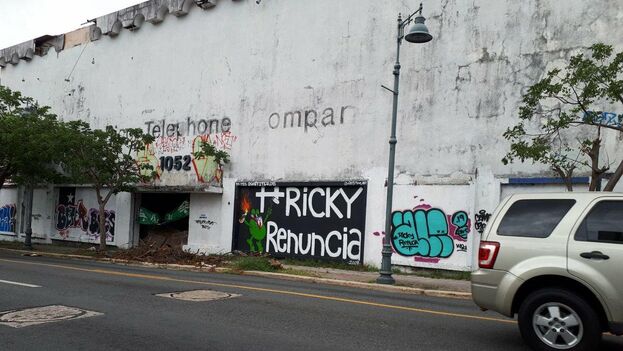
One day after the governor’s resignation the graffiti on the streets continue to recall the long days of demands. (14ymedio)

Skeptical about Roselló’s departure, Harry is one of the few who has not gone to demonstrate or celebrate after the governor’s resignation. “It doesn’t matter, a corrupt one leaves and another arrives,” he says. “Whoever comes will also steal,” he says categorically as we head for Ocean Park in Santurce. A black cloth whips loudly back and forth on a flagpole. “Ricky resign,” it says in huge white letters.

The vehicle turns the corner, passes a Walgreens pharmacy, a McDonald’s and a KFC. Throughout the neighborhood, local businesses try to maintain themselves in the presence of large firms that “sell cheaper and cheaper,” Harry tells me. “Young people prefer to eat a hamburger over a fricasé,” he laments.

Harry has been very worried since Wednesday, when Rosselló announced that he was leaving. “I live from tourism and the people who come here to do business. If they see us as an unstable or unsafe country, they won’t come,” he calculates. He proposes a trip to and from the beach for a good price, but then immediately realizes that I come from an Island; “ah … true you also have enough sun over there,” he says.

I arrive at Río Piedras, where time seems to have stopped. The once populous boulevard is now a street with few businesses and abandoned buildings. A store displays its Made in China merchandise on the sidewalk. Walking, I come across a cart that sells honey, lemon and ginger. I need them because my throat is sore from the Havana rain and the Puerto Rican revelry. I take advantage of the shade and approach the merchant.

“This was full of life before,” he says. Several cats come out of the abandoned house behind me. One, black as night, rubs against my legs to get me to give him something to eat. I cross the street and buy a corn fritter from a woman who has her little post at the entrance to a cafeteria. A recorded voice constantly repeats the list of sales “today only.”

In Río Piedras, near the University of Puerto Rico, people got tired of waiting. A coffee seller evokes the 1996 gas explosion in the Humberto Vidal store that left 33 dead and an indelible mark in the memory of the community. “Afterwards everything went from bad to worse,” he tells me and gives me a cup with a strong and bitter liquid that makes my eyes cross. “We didn’t have to fire a shot and Ricky left,” he boasts.

If it weren’t for a few details of the accent and because the coffee has no hint of roasted peas, I would think I was conversing with any Cuban in a town in the interior of the country. He smooths his hair with hand, raises his index finger and predicts that “already Puerto Ricans are not the same as before, now we know we are strong, that we must respect ourselves.”

Across the street, a Colombian underwear store exhibits bras with lace. “So Cuban,” says the man. I make a move to leave because I suspect that he will repeat stereotypes about my island, the other wing, a wing with its own wounds. I sense that he will recite to me “the conquests of the Revolution,” but I am wrong. “You don’t have this,” he emphasizes with a hint of superiority. “At least we have started along the road.”

I turn to give the cat something to eat but it is gone. The building where it came from smells of abandonment, of that humidity that is encrusted in the walls when people stop inhabiting a place. A nearby graffiti demands that Ricky step down and in the corner a tattered flag beats against a balcony. I squint my eyes and my tiredness or the heat make me see blue stripes instead of red stripes next to a triangle, blood red.

__________________

The 14ymedio team is committed to serious journalism that reflects the reality of deep Cuba. Thank you for joining us on this long road. We invite you to continue supporting us, but this time by becoming a member of 14ymedio. Together we can continue to transform journalism in Cuba.

Panama Declaration / Rafael León Rodríguez

Rafael León Rodríguez, La Habana, b. 1945.

Rafael León Rodríguez, (El candil de Rafa), Panama City/Cuba, 10 June 2019.The members of the Coalition for Democratic Unity (Muad), who met in Panama City 3rd and 4th of June, 2019 in the 2019 Strategy Workshop, along with our colleagues from the island of Cuba, who were hindered from going there by the government, agreed the following:

The rise to political power in Cuba of Miguel Diaz-Canel Bermudez and the taking effect of a new constitution, not only have implied no change in the political and economic conditions in the country, but have also exacerbated the lack of political representation in the government organs and the precarious material and spiritual state of the nation.

Muad, since its creation in 2015, has offered its meetings to help overcome the decades-long climate of confrontation and hostility in Cuba, and nothing has been achieved since then. continue reading

Our objective is to help bring about a nation which respects democracy and the rule of law, but not as a result of the victory of one player over the other, but rather the triumph of everybody over idleness, irresponsibility, and neglect. A change that every individual can feel they have contributed to.

Our fundamental liberties continue to be violated by our own constitution, and the laws which derive from it. They continue to use the rhetoric of “enemy” as their way of remaining in ignorance about their opposition. They stigmatise those who emigrate, who are a mixed population, but remain always Cubans, and lock up anybody who thinks differently. They insult those who work, and, even worse, those who manage, through their work, to free themselves from poverty and necessity.

These conditions don’t help the country or offer any hope. Even less when they are accompanied by the excessive economic power of the military organisations, determined to build gigantic luxury hotels using foreign companies and workers, putting into practice generous policies to attract foreign capital, offering nothing to any corresponding national entities.

Faced with the overriding need for “enemies”, we Cubans find we have been classified as such by the state, which is supposed to be our support. It’s an anomalous situation which views all good deeds with suspicion

Muad rejects the treatment recently handed out to our fellow-countrymen who tried to help the victims of the tornado, which hit some of the poorest areas of Havana last January 27th.

We also reject the repression which ended the march against homophobia last May 11th, and showed the image of a country which persecutes what in the rest of the world would be seen as a party. And we reject the silence of the state in the face of femicide, and crimes related to sexual, or racial discrimination, or anything else which damages human dignity.

We appreciate the facility of getting internet and social media access in the island. This novelty has shown that Cuban civil society is a reality, as initiatives which were up to recently difficult to deal with have acquired the ability to let people know about stuff which was previously unknown.

People have been mobilised to help victims, defend more humane treatment for animals, fight against homophobia, denounce state decrees blocking artistic liberty, and reduce the price of the so-called network of networks, just to give a few examples.

In the same way it was possible to mobilise a No vote before the constitutional referendum last February 24th. The campaign in support of it, organised by the Cuban government, monopolising the communication media and sanctioning any public protest against the proposed text, found itself up against a public argument mobilised by the social media. The partiality in the communication media, and the mobilisation of public opinion, put into doubt the approval sought.

As a result of the new constitutional text, the country will prepare a new electoral law. Muad urges the Cuban state to draft it so as to be a model which permits effective citizen participation in the process of electing political representatives, respecting freedom of association and movement irrespective of ideological preferences.

We call on the Cuban government to free up a space for participation, so that the growing movement does not hit a brick wall of repression and insult, which is what happened with help for the victims of the tornado in the days following January 27th, and with those who protested against homophobia last May 11th.

Right now we are seeing a growing distance between the governments of Cuba and the US. Our neighbour’s regime of sanctions against Cuba has been re-energised, with unexpected consequences.

Muad considers that our vulnerability to these actions by the United States are due to the country’s inability to produce food, and generate productive and financial resources which could make us independent of the actions of other countries. The signatories to this Declaration once again urge the Cuban government to free up the obstacles holding back our productive capacity and our  agriculture and high added value services.

Muad supports the fighters for democracy in Venezuela and Nicaragua, and wants all illegitimate governments to be replaced by democratic regimes. Because of our movement for democracy in Cuba, we know the cost and pain suffered by both peoples.

Political repression is, in Muad’s view, the most troublesome and unacceptable part of the authoritarian practices of the Cuban government. The maintenance of a one-party system in the new constitutional text renders ineffective the proscription of discrimination in that same text. We specifically reject the existence of political prisoners and the criminalisation of the children, spouses, brothers and sisters of members of the opposition, as a way of discouraging their fight.

Freedom is freedom – and that’s it. Without it, there is infinite pain. Time to put an end to this nonsense.

Panama City/Cuba, June 10th, 2019.

 Translated by GH

Lavrov Closes Ranks with Havana and "With the Cuban Leaders"

“We’re going to continue supporting the Cuban leaders,” emphasized the diplomat, who met this Wednesday morning with his Cuban counterpart at the Ministry of Foreign Affairs headquarters. (@CubaMINREX)

14ymedio bigger14ymedio, Havana, July 24, 2019 — Russia isn’t waiting time. Foreign Minister Sergey Lavrov’s tour through Latin America, which began this Tuesday with his arrival in Havana, sent the clear message that the old ally maintains with the Island a “deep agreement on the international agenda,” said the Minister of Foreign Relations, Bruno Rodríguez, during a press conference this Wednesday.

The minister’s visit happens at a moment of special financial tension for Cuba, and Lavrov has emphasized that Russia will contribute to “making the Cuban economy more sustainable in face of the blows,” alluding to the new restrictions imposed by the Administration of the United States.

Lavrov has also confirmed his backing of the senior leadership of the country, after more than a year of Miguel Díaz-Canel’s presidency. “We are going to continue supporting the Cuban leaders,” emphasized the diplomat, who met this Wednesday morning with his Cuban counterpart at the Ministry of Foreign Affairs headquarters. continue reading

During the meeting, Lavrov mentioned the joint economic projects that are in development, which “make progress in a sustainable way in strategic sectors like energy, industry, and transport,” according to a note in the official newspaper Granma. The minister stressed that Russia has in Cuba a “trustworthy and long-standing” partner.

For three decades Moscow supported the Cuban economy via subsidies and sugar purchases for which, on occasion, the Soviets ended up paying seven times above its cost on the world market. Of the 31.7 billion debt that the Island incurred, it only payed 500 million and Russia canceled the rest.

Recently, the economist Carmelo Mesa-Lago detailed that “the Soviet Union gave Cuba, in 30 years from 1960 to 1990, some $65 billion,” but despite that, the Island “didn’t change its structure and its system to be able to grow and finance imports. The money practically vanished.”

Last October Cuba and Russia signed seven agreements for collaboration in areas like the steel industry, sports, and customs services, at the same time opting to strengthen bilateral collaboration, commerce, and investments on the Island.

Railway is one of the sectors where the relationship between both countries has been the most palpable. Russia is carrying out an ambitious renovation project of the Cuban rail network, affected by decades of technical deterioration and lack of investment.

In June the director of the Russian company Sinara Transport Machines (STM), Anton Zubijin, said that projects of that type on the Island add up to 200 million Euros. “We have already covered half of the way, we’re providing 45 locomotives, and we are building together a locomotive repair factory,” he explained.

However, it is the collaboration in the military sphere that has gotten more international attention, especially from the United States. At the end of 2018 it was made known that the Cuban Government will receive a Russian credit of $50 million that will allow it to buy all types of arms and military material from Moscow.

Cuban authorities are seeking to modernize the military industry and armaments through the purchase of Russian tanks and armored vehicles, in addition to ships, spare parts, tools, and accessories.

Caption: Raúl Castro Ruz, first secretary of the Communist Party of Cuba, accompanied Lavrov to the inauguration ceremony for the restoration of the Statue of the Republic at the National Capitol. (Angélica Paredes/ Radio Rebelde)

Raúl Castro Ruz, first secretary of the Communist Party of Cuba, accompanied Lavrov to the inauguration ceremony for the restoration of the Statue of the Republic at the National Capitol. Russian experts were the ones in charge of the rehabilitation process of this sculpture and are putting gold plating on the dome of the emblematic building.

The restored sculpture is the work of the Italian artist Angelo Zanelli and it is considered the third tallest statue underneath a roof in the world.

Although so far no official reference has been made to the situation in Venezuela, Lavrov’s arrival in Cuba also coincides with the dialogue process between the regime of Nicolás Maduro and representatives of the opposition which is being held in Barbados, on which Russian influence has projected several times.

This Tuesday Lavrov told the press that “the situation in Venezuela is changing for the better,” and he stressed that after the “failed attempts” of provoking a new “color revolution,” “common sense is beginning to prevail.”

“In light of the positive comments of the president of Venezuela, Nicolás Maduro, and of the opposition figures on how the negotiation process is going, I trust that an agreement that satisfies everyone will be able to be reached. That will go, first and foremost, for the benefit of the Venezuelan people,” he emphasized.

Recently Elliott Abrams, special US envoy for Venezuela, warned of the importance of the Russian role in the survival of the Chavist regime. The support of that power is essential, argued the New York political figure, among other reasons because of its veto power in the United Nations Security Council.

Translated by: Sheilagh Herrera

__________________

The 14ymedio team is committed to serious journalism that reflects the reality of deep Cuba. Thank you for joining us on this long road. We invite you to continue supporting us, but this time by becoming a member of 14ymedio. Together we can continue to transform journalism in Cuba.

Cuban or Imported, Beer Sets the Beat of the Economy on the Island

In recent months authorities have had to import greater volumes of beer to be able to meet the demand. (14ymedio)

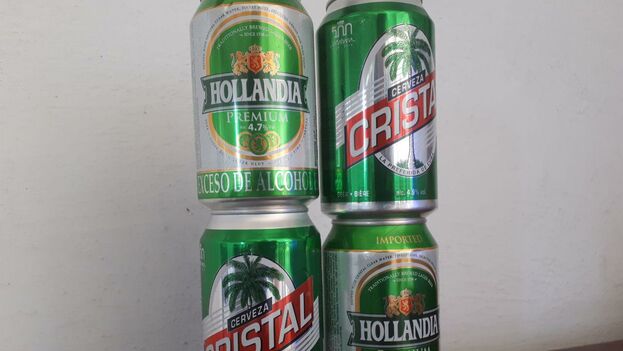
14ymedio bigger14ymedio, Zunilda Mata, Havana, July 22, 2019 — “We don’t have Cristal or Bucanero,” repeats the employee of a state-owned cafe in Havana. On the counter, a can of Heineken and another of Hollandia sum up the offerings of cold drinks, at a price of 1.50 and 1.75 CUC, much higher than the domestic product.

Beer, which three decades ago was almost a luxury or was only consumed on very special occasions like weddings, birthdays, and carnivals, has become a frequent companion to summer on the Island, at private restaurants, the tables of the new rich, and the relaxation of tourists. “There’s nothing better than a lager in this heat,” declares Urbano Rodríguez, a bartender at the private restaurant La Grandiosa, on the beaches in the east of Havana.

“It’s the product that’s sold the most, above soft drinks, cocktails, and bottled water, but also in the past year it’s become the most difficult to get,” confirms the employee, who has worked in the private food industry for 16 years. “A while ago it was easy to stock up on beer but now we have to almost do an espionage operation in the stores to know when they are going to put it out.” continue reading

Rodríguez laments that “there’s very little supply of domestic beers and every time they put it out in a market, they run out quickly.” The customers of the private restaurant where he works “have had to get used to drinking imported beers that are always a little more expensive,” he points out. In La Grandiosa, Cristal and Bucanero are sold at 1.50 CUC, but a can of Heineken surpasses them both.

The price of the beers is determined in the majority of countries by various factors, from the level of the company, taxes on alcohol, availability, the type of beer, which can be industrial or craft, but also the flavor and the tradition of a certain brand. However, on the Island that price is determined by factores like scarcity, shipments, and money of the informal economy.

Only two state-owned places of the twenty visited by this newspaper had domestic beer this weekend. The rest had imported product or totally lacked it. However, a similar trip to 20 private establishments revealed that in all of them there was Cristal or Bucanero, along with imported beers.

At state-owned markets domestic beer has a price of 1 CUC but the private, more exclusive places sell it for double, although in the past year, frequently, they have only been able to get brands from Mexico, Panama, Europe, and a few other far-off places on the planet.

“It’s clear that the tourists want to drink Cuban beers but if there aren’t any, there aren’t, and that’s it,” points out the bartender. “Who comes here to drink Dutch or German beer?” he asks. “They blame private companies for stockpiling boxes and boxes of Cristal or Bucanero when they sell it in stores, but what are we going to do, if we don’t keep up the supply we don’t sell.”

A result of the shortage is that it is more common to find imported beers than domestic brands. (B. Snelson)

Recently, in an article published in the official press in Cienfuegos, self-employed workers were blamed for “stockpiling” domestic beer to later sell it at a higher price. The text reported that the product sold at private businesses costs almost “200% its sale price, perhaps 250% its cost price. For someone who didn’t invest even a drop of sweat in producing it.”

The price of beer in the private sector provoked a bitter controversy around who is responsible for the increase. While the official press points at the entrepreneurs, independent economists blame low production and the State’s attempts to control prices.

The text also blamed sources inside the administrative framework of state-owned stores who notify the private businesses about the sale of domestic beers and make money for themselves by selling them more than the permitted quantities. The product has suffered frequent shortages in recent years, which has obligated the regulation of its retail sale to two cases (of 24 cans or bottles each) per person.

According to the statistical yearbook of 2018, beer production has modestly grown on the Island to reach some 2.6 million hectoliters at the end of 2018, but demand seems to have increased more, especially from the liberalizations that expanded the practice of self employment and the arrival of a greater number of tourists.

“What has also happened is that beer has stopped being a luxury product and become something that Cubans feel that they deserve and that they should have it whenever they want. They’ve realized that it’s not an elite product but rather a proletarian beverage, to drink after work,” points out Erick Núñez, who works as an accountant at several private businesses.

“It’s been a slow process, influenced by the visits of emigrant Cubans who invite their family members on the Island to eat, spend a weekend at the beach, and stay in hotels, where beer is one of the least luxurious and most consumed drinks,” he believes. “What used to seem unattainable came to be something that everyone wants.”

The opinions of the economist Pedro Monreal match up with that hypothesis, and on his blog El Estado he points out that “in the case of beer, the same thing is happening as with almost all products: the demand is relatively divorced from the income that comes out of the pockets of the worker. Part of the explanation is remittances.”

Monreal explains that “there are specialists who place the level of remittances at some $3 billion annually, but it would be enough to assume half of that figure — $1.5 billion — for that income via remittances to surpass all the salaries paid in Cuba (34,262,000,000 Cuban pesos in 2017 [roughly $1.37 billion US]).”

On an international level the average price of a beer is $5.70, according to a study done in 2018 in 48 cities. Havana is far below the world average, far from the $8.00 of Hong Kong and the $7.70 in Zurich. But 1.50 or 2 CUC for a cold one is still high for those who live on their salary on the Island, who must pay an entire day’s wage — or more — to refresh themselves with a single Cristal.

It’s on that point where remittances, money from informal business, and earnings obtained through the private sector come into play. These incomes are what “are bringing up the price of some products, including beer,” believes Erick Núñez. “It’s a status symbol, a marker of economic solvency and everything that involves.”

“It’s happened that way with other products, which started out being the exclusive domain of the few who were able to pay for them and now they have a greater and greater demand,” points out the accountant. “On that list we can put disposable diapers for children, which before were a thing of the elite and now even the most humble person tries to look for some extra money to buy them, and also vegetable oil for cooking.”

“Remittances play a positive role in the Cuban economy,” notes Pedro Monreal, who believes that “the problem is that it’s an ’extra’ demand that the economic model has not been able to take advantage of to generate an equivalent ’extra’ supply,” and he points out the problems of production as the source of the shortage and the rise in prices of the product in the private sector.

A source from Cervecería Bucanero S.A. (CBSA), the most important domestic producer, tells this newspaper that “after the problems with raw materials a few years ago, production has stabilized and the plan is being fulfilled.” The official from the joint enterprise explains that “the shortage is owed to an increase in consumption and bad practices in distribution.”

This matches up with the judgment of the economist Elías Amor, a resident of Spain, who questions the explanation given in official media about the lack of beer in establishments managed by the State. If “they run out in state-owned stores it’s because those responsible for the communist planning are incapable of detecting needs and much less of increasing the supply.”

“Cubans who want to enjoy a cold beer know where they can find it, although they have to pay a higher price,” assures Amor. “Nobody can be punished for it. The owners of the private establishments do what they have to do: provide service, even though the price is higher.”

In the small storage room at La Grandiosa restaurant, this week some cases of Cristal beer alternate with those of the Heineken brand. “In summer we run out more quickly, we almost have to count on double what we normally have in other months,” says Urbano Rodríguez. “Because the beach without beer is hell.” The word of a bartender.

Translated by: Sheilagh Herrera

________________________

The 14ymedio team is committed to serious journalism that reflects the reality of deep Cuba. Thank you for joining us on this long road. We invite you to continue supporting us, but this time by becoming a member of 14ymedio. Together we can continue to transform journalism in Cuba.

Between “Collateral Damage” and Direct Damage”

New technologies have not only facilitated the emergence and proliferation of sites of undeniable quality and variety in Cuba, and their disappearance would certainly be an important loss of spaces rigorously attained. (14ymedio)

14ymedio bigger14ymedio, Miriam Celaya, West Palm Beach, 23 July 2019 — Journalist José Jasán Nieves, general editor of El Toque, is the author of an article published last Sunday in which he exposes his particular vision about the difficulties of the new Cuban journalism in order to survive official pressures and obstacles, while noting that what he considers the Government’s current repressive escalation (though he doesn’t call it that) against the “alternative press” is the “confrontational focus” of Donald Trump’s policy against Cuba.

J.J. Nieves defines as “new journalism” what has emerged in Cuba in the last seven years outside the official press monopoly, endorsed in more than thirty websites which – “supported by the expansion of access to digital technologies, internet, and new forms of financing from the small private sector” – made it possible that “Cuba’s story” to cease to be “bi-chromatic (for or against the socialist model)” and to acquire “the same complexity as (.. .) the society in transition in this archipelago in the Caribbean Sea”.

The author mentions the participation of young professionals, graduates of Cuban universities, many of them with experience in the official press, as a factor that has elevated the quality of journalism. Another favorable factor for the rise of this new journalism is what he considers a “climate of greater tolerance towards dissent in the political sphere,” aided by the spirit of detente that led to the reestablishment of diplomatic relations between the US government and Cuba in the Obama era, and “towards emerging forms of civil society” (said to have been promoted by the “updating of the model” speech) and by Raúl Castro’s economic reforms implemented since 2011. continue reading

The author mentions the participation of young professionals, graduates of Cuban universities, many of them with experience in the official press, as a factor that has increased the quality of journalism

However, despite the fact that the “new journalism” distances itself from the poles or “factions” – “no longer the hell of a repressive dictatorship or the idyllic fantasy of the lighthouse country and guide of the international left” – and that its contents “better satisfy the information needs of the people”, Nieves complains that he is considered by the current president, Miguel Díaz-Canel, as the new subversion, which is “the clearest confirmation of an approach already applied to him by the security organs of the Cuban State since his first editions.” It seems as if the author naively considers the repressive bodies as an entity independent of the Government.

In keeping with the discourse of the same power that suffocates both the “faction” of those who speak of a repressive dictatorship and the new and conciliatory journalism, for Nieves, the great villain of this story is Donald Trump with his policy of confrontation towards Cuba. It is the American president, and not the lack of political will on the part of the Cuban Government, which “can end at once the permissiveness towards the also termed  “alternative press.”

There are many of us who do independent journalism and do not accept agendas dictated from abroad, nor do we share at all the confrontational policies of Mr. Trump or previous presidents, although we are not remiss when it comes to labeling the Cuban government as “a dictatorial regime”, just as it is, which does not include us in any faction. Instead, to label ourselves as such would be to follow the official agenda of Castroism.

The writing contains some “small” omissions, such as the fact that, like it or not, there is a long history of previous independent journalism in which many activists and professional journalists, like Reinaldo Escobar or Raúl Rivero – which cost the latter jail time during the incursion of the Black Spring – who many years ago assumed the responsibility of describing Cuba as complex and concealed (not necessarily “bi-chromatic”) in a way that never appears in the official media. It also ignores that media – such as 14ymedio or Diario de Cuba, to name two known cases – not only have their access blocked from the Island, but are also not included in “el paquete”*. That is why it is appropriate to remind Nieves that all journalism has the right to exist and that it should belong to Cubans, and not to a select elite of well-intentioned university professionals or an almighty political power to choose what type of press they should taste.

The text contains some “small” omissions such as the fact that, like it or not, there is a long history of independent journalism

 At any rate, new technologies have not only eased the emergence and proliferation of sites of undeniable quality and variety in Cuba, whose disappearance would certainly be a significant loss of hard-earned spaces and a very painful setback in terms of civic freedoms, but also the possibility of turning any citizen into a journalist who narrates his own reality, his problems, his demands and aspirations, from his community, a variant of journalism that emerged decades ago around the world and that, with its lights and shadows, has been present in Cuba.

It should be noted, however, that José Jasán Nieves’s article could be an important contribution to a long-held debate around Cuban independent journalism – understood as independent of the most holy State-Party-Government trinity – call it new, alternative, or any denomination, whose existence and character has been questioned by both Tyrians and Trojans, and that, in short, has suffered harassment and repression in its entirety from the same common enemy, which is not exactly imperialism.

If there is one thing all us factions – those who dedicate themselves to the dangerous profession of dissenting or, at least, questioning a reality that depends exclusively on the designs of the caste that holds the political power in Cuba – is that the causes of our prolonged National crisis and the threat of extinction of our free journalism spaces are within Cuba and not in the policies dictated by a foreign power, whatever it may be, as was demonstrated during Obama’s conciliatory agenda or with the worsening pressures from Trump.

If Nieves prefers to assume the current incursion against independent journalism as Trump’s “collateral damage”, and if that makes him feel any better, it will be beneficial.  For my part, as an independent journalist and as a citizen, I choose to continue fighting against the direct damage to all our freedoms, which has been (and continues to be) the one that originates from the Palace of the Revolution.

*El Paquete (the package) is a one terabyte collection of digital material distributed since around 2008 in Cuba’s underground market as a substitute for broadband Internet.

Translated by Norma Whiting
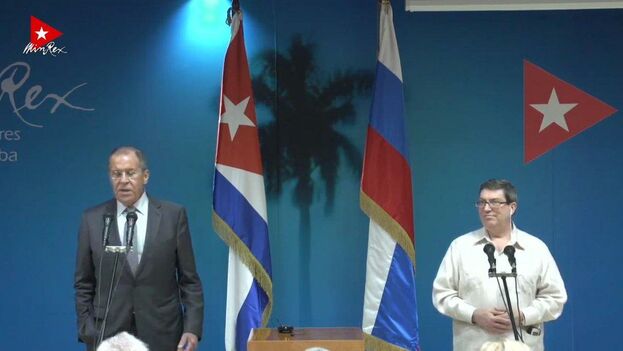
_________________

The 14ymedio team is committed to serious journalism that reflects the reality of deep Cuba. Thank you for joining us on this long road. We invite you to continue supporting us, but this time by becoming a member of 14ymedio. Together we can continue to transform journalism in Cuba.

Gasoline is "Lost" in Havana

Drivers lament that they have to pay for the lease of state-owned taxis whether or not there is gas to drive them. (14ymedio)

14ymedio bigger14ymedio, Luz Escobar, July 18, 2019 — Alexander Barroso had traveled around to several service centers in Havana this Wednesday and the most-repeated response was “there is no gasoline.”

“Monday was the last time that I was able to fill the tank at L and 17th and it was sucking up the last bit that remained in the cistern. After that, no matter where I go, it’s ’there’s none, it’s all gone.’ So that’s why I’m in this line,” he tells 14ymedio.

Barroso works as a driver transporting fruit from other provinces to Havana and has come to the gas station on the corner of 25th and G, in El Vedado, via a tip-off from a friend who assured him that it was one of the few places selling fuel to customers. A few hours earlier, the Minister of Energy and Mines, Raúl García, had denied on Cuban television any problem with the fuel supply that would be affecting the energy sector in the wake of the blackouts that the Island had experienced the previous day. continue reading

The official version is a failure at one of the power plants, but the lines at service centers confirm that the lack of petroleum is more than real.

Caption: The line was advancing slowly, but some filled not only their tanks, but also containers to take home. (14ymedio)

The line of taxis, state-owned cars, garbage trucks, private cars, and motorcycles on Wednesday reached from the gas station at which Barroso was waiting to the central Calle 23, some 100 meters.

“The thing is bad but as far as I can see it, it’s going to get a lot worse,” said the driver of a tow truck belonging to the Electric Union of Cuba, positioned in the line. He said that he had been stopped for two days, without being able to work because he hadn’t been able to find petroleum anywhere, and he expressed his lack of hope of being able to fill the tank this week.

The slowness of the line bothered many customers who were complaining about the lack of forward movement. Faced with the fear that the lack of fuel would continue, drivers were filling not only their tanks, but also various receptacles to bring extra gasoline home, despite the fact that selling it in containers is prohibited with the goal, claims the Government, of preventing stockpiling and the diversion of fuel from the state-controlled sector to the private one.

The informal fuel market is widespread in Cuba despite the Government’s efforts to control it by demanding proof of purchase from state and private workers of fuel at service centers. Despite that, many private drivers go to those informal sale networks of gasoline and diesel to cut the costs of keeping their old cars running, which are, as a general rule, gas guzzlers.

“It’s a mess now. Whatever you can grab now, it’s a big fuss. My car has GPS and that’s kilometers traveled against the route sheet, there’s no ’invention’ [i.e. cheating] here,” says the driver of the tow truck after denying the proposal of a botero (taxi driver) who was offering to sell him some of the liters he was allocated by the State through a card.

“I was in a line all morning at a gas station on Fifth Avenue and I didn’t make it,” laments Yantiel, driver of a Peugeot made two decades ago with which he offers trips to the provinces for tourists and local passengers. “It’s disrespectful, because the administrator of the place doesn’t know when gasoline will come again. There’s no information,” he adds.

Some lost hope of being able to fill the their tanks this week. (14ymedio)

The drivers of State taxis that drive the route to and from the airport don’t escape the problem, either. “We have to pay the daily lease, which is rather expensive, whether or not we have gasoline,” complained a driver who didn’t want to give his name. “Whether or not I make money I have to pay 35 CUC daily to the State and for two days I haven’t been able to go out to the street because I have no fuel,” he protests.

For Cubans the lack of fuel rekindles the ghost of the return of the Special Period. The crisis of the 90s, after the fall of the Soviet Union, was not only a time of a lack of food and frequent power cuts, but also of grave effects on mobility. The streets filled with bicycles and at bus stops people would wait for hours to get on a bus.

Despite the global fall of the petroleum flow between Cuba and Venezuela, Caracas is still the main energy provider for the Island, which in 2019 so far has received some 53,500 barrels a day of oil from Petróleos de Venezuela (PDVSA). The figure reveals a decrease of 40% if compared with the first half of 2015, according to the company’s data.

On May 10, the US Treasury Department announced sanctions against two companies and two oil companies that, it said, had delivered oil from Venezuela to Cuba since the end of 2018 until March of 2019. PDVSA also reduced its exports to the Island so far this year, according to internal commercial numbers that the Reuters agency had access to, and despite the fact that in May a leak of documents revealed that the delivery in that month had quadrupled that of April.

Just this week, a report published by the newspaper Clarín stated that Maduro’s Government is using pirated boats to continue the delivery of petroleum to Cuba and thus elude Washington’s sanctions. Still, according to that source, PDVSA was sending some 60,000 barrels daily to the Island, against the 100,000 that it was sending before the US measures.

In his recent speech in front of Parliament, Miguel Díaz-Canel assured that there has been a deficit in importation of fuel, which has obligated Cuba to “establish measures of internal restriction for its consumption, avoiding as much as possible effects on the population and on the main productions and services of the economy.”

“I’ll have to put away the car again because I don’t have the nerves to wait in these lines in this heat,” concluded a woman before leaving the line on Calle 25 and G. “This is taking too long. In this time I already would have reached where I’m going on foot.”

Translated by: Sheilagh Herrera

__________________

The 14ymedio team is committed to serious journalism that reflects the reality of deep Cuba. Thank you for joining us on this long road. We invite you to continue supporting us, but this time by becoming a member of 14ymedio. Together we can continue to transform journalism in Cuba.

Cuban Leinier Dominguez Wins in Dortmund and Enters the Top Ten of the World Rankings

Leinier Domínguez’s return to classical chess, after two years of inactivity, could not have gone better. (@STLChessClub)

14ymedio bigger14ymedio, Havana, July 22, 2019 – Cuban Grand Master Leinier Domínguez was crowned champion Sunday at the Sparkassen Chess-Meeting of Dortmund, in Germany. His performance in this European event led him to rise the number ten position in the world rankings.

He greeted his followers this morning on his Facebook account and said he was “very happy to have won such a strong and prestigious event in the world of chess”

“Without a doubt [it’s] one of the best results of my career,” he added. Dominguez pointed out that the victory was not his alone and thanked his family and his wife for being the pillars of his life. “Now I will take a break and soon I will be competing again in St Louis Rapid/Blitz from August 8 to 15,” the chess player announced. continue reading

After dividing the center with the black pieces against the Polish Radoslaw Wojtaszek, the “Idol of Güines”, who now plays for the United States, finished the tournament with 4.5 out of 7 possible points. At the end of the competition he accumulated two wins, five draws and not a single defeat, as reported by ChessBase.

In this 47th edition of the event in Dortmund, eight chess players played in a round robin competition, with a time limit of 140 minutes for the first forty moves.

The Cuban was ranked second among the players at the tournamanent, surpassed only by the Russian Nepomniachtchi, who was defending his title but in the end took fifth place, with four points.

As a result of his victory this Sunday, Dominguez added three points to his ELO chess ranking that placed him in the top ten of the live chess ratings.

Other players who participated in the chess tournament were the Azerian Teimour Radjabov, Radoslaw Wojtaszek from Poland and the Hungarian Richard Rapport.

Since returning to chess, Dominguez has participated in three classic game tournaments, where he has won nine times, with 17 draws and only one defeat in 27 games, ten of those against chess players exceeding 2,700 ELO ranking points.

Translated by Wilfredo Díaz Echevarria

_________________________

The 14ymedio team is committed to serious journalism that reflects the reality of deep Cuba. Thank you for joining us on this long road. We invite you to continue supporting us, but this time by becoming a member of 14ymedio. Together we can continue to transform journalism in Cuba.