The New Heat Record in Cuba is in Veguitas

This Sunday the maximum temperatures marked by thermometers in Cuba fluctuated between 32 and 35 degrees Celsius (89.6 to 95 F). (14ymedio)

14ymedio bigger14ymedio, Havana, July 1, 2019 — This June 30 in the afternoon the record for heat in Cuba was broken when the station in Veguitas, province of Granma, registered a maximum temperature of 39.1 degrees Celsius (102.4 F), as the Institute of Meteorology reported this Monday.

Armando Caymares, of the National Forecast Center, told the official press that this maximum was reported at 3:30 in the afternoon and it is the most notable value since records started being kept at a national level. continue reading

The data was later ratified by experts from the Cliamte Center who certified the new national record of absolute heat.

As Caymares explained, the few clouds and the weakness of the wind favored the intense evening warm-up in the area; a high pressure system in the low and medium levels of the troposphere influenced the eastern region.

The Twitter account @invntario, which posts data about Cuba, offered records going back to 1901.

Why limit yourself to feeling the heat when you can also visualize it?

This is how the average monthly temperatures (C) have behaved in Cuba from 1901 to March of 2019 pic.twitter.com/8boDTF4erK

Previously the record was 38.8 (101.8 F) degrees, and it was recorded in Jucarito on April 17, 1999.

This Sunday the maximum temperatures marked by thermometers in Cuba fluctuated between 32 and 35 degrees Celsius, although they were higher in some places in the eastern provinces. For this week forecasts indicate possible temperatures around 33 degrees Celsius.

Translated by: Sheilagh Herrera

__________________

The 14ymedio team is committed to serious journalism that reflects the reality of deep Cuba. Thank you for joining us on this long road. We invite you to continue supporting us, but this time by becoming a member of 14ymedio. Together we can continue to transform journalism in Cuba.


Cuban MeToo Movement Challenges the Power with “Hairs on Its Chest”

For the official Federation of Cuban Women, women are soldiers, impeccable workers and players that underpin the ideology (Alan K.)

14ymedio bigger14ymedio, Yoani Sanchez, Havana, 2 July 2019 – He watches her pass by and whistles as she walks away, on the bus he sticks to a young woman until he is so close she feels his sweat on her skin and, when he gets home, his wife has dinner on the table and doesn’t start eating until he takes his first bite. At night, even though she doesn’t want to, he will “fulfill his manly role.” These situations are so common and repeated that many have come to believe that this must define normal, a woman’s lot.

This entire web of pressure, abuse and violence is coming to light as a result of the personal scream of a singer who decided to tell what she lived through. The public denunciation made by Dianelys Alfonso, known as La Diosa de Cuba (The Cuban Goddess), against the musician José Luis Cortés, El Tosco (The Rough One), for alleged verbal, physical and sexual abuse has opened a Pandora’s box of incalculable scope. We can delineate when it all began, but not how far the catharsis will go.

Cuban society is pierced from one side to the other by machismo. A harassment and exploitation that is so commonplace that many do not see it, or do not want to see it. It begins very early, sinking its roots so deeply into everyday life that sometimes it is difficult to separate how far feminine will goes and at what point masculine imposition begins, how much more determinate is machismo, than is the free will of a human being. continue reading

From the men who still brandish the teasing compliment or supposed street flattery as a way to respond to the physical attractiveness of a woman, passing through the administrator who believes that by organizing a party with gifts for March 8 – International Women’s Day – he has paid his share of respect towards “the beautiful gender,” right up to the official spokesman who accuses a dissident of moral laxity or of being a prostitute just because she utters a criticism.

Millions of women on this island are trapped between the role of “flowers of adornment,” and that of domestic slaves or of pieces to be used and discarded. Not only are they condemned to perform most of the domestic chores, but from the time they are small they are trained to please, complacently serve and assent to masculinity. Departing one centimeter from that mold can lead from insults to aggressions.

They are the ones who do the most of the cooking, take care of the children, go to school meetings, do the tasks related to the care of the elderly, financially support the children of the husband who took off or who does not pay support, attend the sick, and work in the most thankless places in hospitals, schools, soup kitchens or asylums.

They are also mistreated. A violence that has many faces, some of them so apparently “benign” such as to pushing them to always look “beautiful, well-groomed and attractive.” Something that forces them to straighten their hair, paint their nails, shave their legs, constantly fuss with their hairstyle, wear make up, dress sexy and be willing to compliment and conquer, grateful that men pass by, look, praise or touch.

But coercion can also be much stronger. It is the boyfriend who says “if I see you with another man, you know what’s going to happen to you”; the husband who prevents her from wearing tight pants; the neighbor who insinuates that if she is very lonely he can accompany her and be at her side so that no other man dares to bother her; the boss at work who lets fall that she has a promising future ahead and “all the attributes” to achieve it.

There is also physical violence. Like that suffered by the woman who conceals her black eye under sunglasses; another who endures beatings because she has nowhere to go in the absence of shelters to house battered women; or the woman who has been protecting herself for years from the slaps of a husband who comes home drunk but she has to put up with it because – after all – she migrated from the east and it would be illegal in Havana if he were the kick her out of the house.

The actress who has to undress on stage to achieve a role, the singer who only has sexual relations with the bandleader so she can aspire to a permanent position in front of the microphone, the professional who must accept the idiotic flirting of her company’s director to be chosen to go on a trip, get a promotion, or simply have the chance to keep her job.

And the social and institutional violence of the police who, when she comes to file a complaint, repeat “no one should intervene between a husband and wife”; the lawyer who refuses to take her case because the defendant is a powerful man and she is “a perfect unknown”; the friends of the abuser who are on his side and throw tons of mud on the credibility of the victim; the official figures that hide the femicides; and government spokesmen who strut in international forums insisting that on this island there is no real problem of gender violence.

Now, all that reality begins to find a speaker from the MeToo movement, which has been slow to reach this island, but in other places on the planet has already made visible a problem shared by many women. A movement that has given strength to other women to bring several abusers before the courts, and to dissuade other men from continuing to commit their excesses. A movement that has raised awareness about the situation of gender-based harassment in this country.

What role has the official Federation of Cuban Women (FMC) played in all of this? So far none, because the largest and only formal female organization allowed in the country does not act if it does not receive guidance from Power ahead of time. Feminism, like social, environmental or LGBTI activism, has never been looked on kindly by the Cuban government, which considers all these “isms” to be forms inherited from bourgeois mentality and capitalist countries.

For the FMC, women are soldiers, impeccable workers and players that underpin the ideology, but defending them from male abuse would, in many ways, be confronting the Government itself. In the end, harassment against females is not only carried out at the domestic or social level, but it is disseminated and validated by the State itself.

The “hair on the chest” Power that dominates Cuba resorts to sophisticated threats against women who oppose it. They publicly question women’s morality, accuse them, when they engage in active dissent, of not acting on their own impulses but under the management of some man, allude to their lack of femininity and, in the final indignity, reveal their most intimate details, exactly those that they taught her in school and the family to hide, keep silent about, keep in the shadows.

_____________________

The 14ymedio team is committed to serious journalism that reflects the reality of deep Cuba. Thank you for joining us on this long road. We invite you to continue supporting us, but this time by becoming a member of 14ymedio. Together we can continue to transform journalism in Cuba.

On La Rampa, Better Not to Look Down

The public works project of the Electric Union have not taken any care to respect the works of La Rampa. (14ymedio)

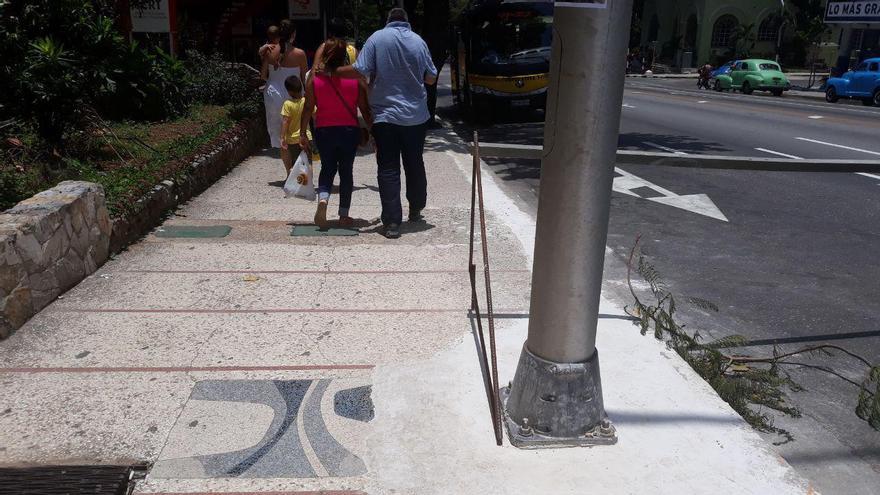
14ymedio bigger14ymedio, Marcelo Hernandez, Havana, 24 June 2019 — If something differentiates Cuban nationals from tourists when they walk through the streets, it is the place where they fix their eyes. While the visitors are left looking at the beauty of the architecture or the miracle that a decrepit balcony has not yet fallen, those of us who live on this island walk around all the time looking down to avoid the gaps in the sidewalk, the puddles of sewage water and all types of common waste on public roads. This is the case almost everywhere on Havana’s La Rampa, where foreigners also like to enjoy the scenery under their shoes.

The most famous sidewalk in the Cuban capital is dotted with mosaics by national artists such as Amelia Peláez, Wifredo Lam, René Portocarrero, Hugo Consuegra, Mariano Rodríguez and Cundo Bermúdez, among others. For decades, walking along it has been like enjoying an exhibition hall without having to pay entrance fees. Although the years and the deterioration has caused it to lose some of its beauty, Havanans trusted that the stone and granite were harder than the apathy.

But a few days ago the Electric Union began to break up the pavement of 23rd Street, especially in the section between L and M and, in addition to taking pieces of the artistic works with them, they did not hesitate to carelessly fill in the outline of the images and cover parts of others with cement.

Now, everyone keeps looking down when they walk by along La Rampa, but not to admire the beauty under the feet but to see how far the mess can go. It does not matter if you are Cuban or foreigner, everyone looks at the ground and it hurts, of course it hurts.

__________________

The 14ymedio team is committed to serious journalism that reflects the reality of deep Cuba. Thank you for joining us on this long road. We invite you to continue supporting us, but this time by becoming a member of 14ymedio. Together we can continue to transform journalism in Cuba.

Cuban President Diaz-Canel Takes Up Fidel Castro’s Obsolete Discourse on Intellectuals

During the speech, Díaz-Canel was interrupted several times by long standing ovations from the artists. (UNEAC)

14ymedio bigger14ymedio, Havana, 1 July 2019 — Miguel Díaz-Canel used his closing speech to the IX Congress of the Union of Writers and Artists of Cuba (UNEAC) to recall the controversial Words to the Intellectuals delivered by Fidel Castro in 1961 and to call for fighting the “cultural mercenaries, those willing to lynch how many artists and creators who support the Revolution.”

In his words, the Cuban leader warned that “creation is not going to be limited, but the Revolution that has resisted 60 years by knowing how to defend itself is not going to leave its institutional spaces in the hands of those who serve its enemy.”

The year 2019 began marked by an open controversy in the art world over Decree 349, which regulates artistic expression on the Island. The new regulation, which came into force last December and has not yet been applied to its full extent, caused a a schism between Cuban intellectuals who openly support it and those who consider that it censors art, especially because it regulates who can and can not be considered creators, and because it interferes with the dissemination of art in private spaces. continue reading

Díaz-Canel defined Cuba as a country “riddled with journalists by the most influential media on the planet” and said: “Fidel [Castro] knew to warn of the risk of losing our greatest strength: unity, identity, culture, with the colonizing avalanche that advanced in the times of globalization.” The president expressly referred to “massive access to new technologies, promoted by modern merchants.”

Social networks also had a place in the words of Diaz-Canel, in the midst of an increase in the presence of Cubans on Twitter and Facebook, where, in recent months, there have been frequent criticisms of the management of the Government, demands for improvements in services and, more recently, an intense campaign for the state telecommunications monopoly to lower the prices of Internet access.

On that issue, the president again praised Fidel Castro for being aware that these accelerated development technologies would be “a powerful weapon of education and multiplication of knowledge” and he created the University of Computer Science (UCI), under the direction of State Security.

The president, coinciding with the 58th anniversary of the Words to the Intellectuals, recalled the meetings in the National Library that gave rise to a cultural policy within strict ideological limits and also to the creation of the UNEAC. “If, 60 years ago, the attempt to fracture the visceral union between that vanguard and its Revolution, that is, itself and its people, was defeated, later and many times over the years, the adversary would uselessly endeavor to do so,” he proclaimed.

Díaz-Canel also took up the controversial words pronounced by Castro on that occasion to define the limits of artistic production [“Within the Revolution, everything, against the Revolution, nothing”]. “I’ve always been worried that from those words a couple of phrases are extracted and they are raised as a slogan,” said Diaz-Canel. “Our duty is to read it aware that it is still a document for all time.”

The president recognized in his words the outgoing UNEAC president, the writer Miguel Barnet, who held the office for more than two decades, and congratulated the newly elected Luis Morlote Rivas, a cadre without an artistic career who previously served as vice president of UNEAC, after being president of the Hermanos Saíz Association and who is currently a deputy of the National Assembly of People’s Power.

Morlote represents the new litter of faces that are taking positions within national institutions, of proven ideological loyalty and a discourse totally aligned with the Communist Party. Among his most combative actions in recent years was his presence in the Parallel Forums of the VII Summit of the Americas in Panama, 2015, where he was part of the shock troops against Cuban activists.

In his first words as president of the government organization, Morlote said that at the UNEAC Congress it was demonstrated that “there is a UNEAC committed to the Revolution, with the thoughts of Fidel and Raúl, and of all those who continue their work.” For his part, Barnet was recognized with the position of honorary president of the organization.

“I do not have a work as big as el Turquino [Cuba’s highest peak], but after 22 years in the Executive of the UNEAC and eleven in the presidency I can say: do not believe that it has been a sacrifice, I have surrendered and I will continue delivering, because for me most important is the cause, this great Revolution that has brought us this far,” said Barnet, accepting the new position.

During the speech, Díaz-Canel was interrupted several times by long standing ovations from the artists, and many of his phrases received brief applauses and approvals from the voices of some artists.

The National Council of UNEAC was also elected, composed of Alicia Alonso, Leo Brouwer, Alfredo Diez Nieto, Ambrosio Fornet, César López, Eusebio Leal, Chucho Valdés, Graziella Pogolotti, Martha Rojas, Omara Portuondo, Pablo Milanés, Roberto Fernández Retamar, Rogelio Martínez Furé, Rosita Fornés, María Teresa Linares, Fina García Marruz, Silvio Rodríguez, Nancy Morejón, Jesús Ortega, Verónica Lynn, Pedro de Oraá, Jesús Chucho Cabrera and Miguel Barnet.

The Cuban art sector is undergoing a rapid transformation with the emergence of new technologies, the growth of cultural consumption “a la carte” and the expansion of the private sector. If, before, the creators needed to be integrated into an institution to record a record, publish a book or perform in a show before the public, now there are recording studios, video clip professionals and private bars where they can do these things without government intervention.

Decree 349 attempts to regulate the phenomenon and return to cultural institutions the ability to decide everything from what music is heard in those particular places, to what art can hang on the walls of the independent galleries that have sprung up all over the country.

Díaz-Canel also did not miss the opportunity to refer to the United States and linked the funds destined to promote democracy on the island with the protests of recent weeks on the Internet.

The president accused the current Trump administration of asking “those who wish to access the privileged preserves of the empire to give an account of what they do or say on social networks,” an idea repeated in recent days by officials and official spokesmen against the users of the state monopoly Etecsa who are demanding a reduction in the pricesit charges to access the internet.

___________________

The 14ymedio team is committed to serious journalism that reflects the reality of deep Cuba. Thank you for joining us on this long road. We invite you to continue supporting us, but this time by becoming a member of 14ymedio. Together we can continue to transform journalism in Cuba.