
Cuban Government Obscures the Figures to Hide the Magnitude of Emigration

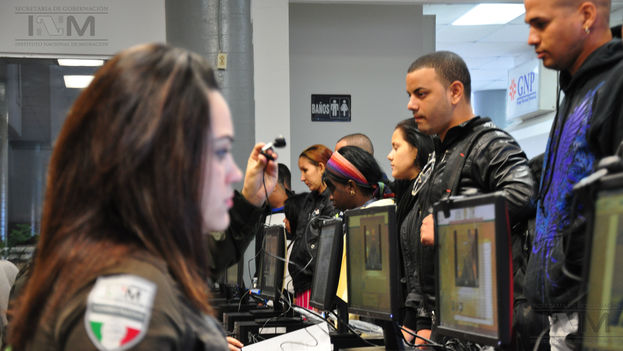
Cuban migrants arriving in Mexico. (INM)

14ymedio bigger14ymedio, Mario Penton, Miami, 3 August 2017 — Fewer than 42,000 Cubans have emigrated since 2013 according to official statistics published in Havana. However, US officials say they have welcomed more than 141,528 Cubans during the same period. The enormous discrepancy between these data is explained by the lack of transparency of the Cuban Government, which conceals the magnitude of migratory movements by counting them in the general category of citizens traveling abroad.

“Cubans do not migrate in great numbers, but they travel more and more,” said Ernesto Soberón Guzman, an official with the Foreign Ministry. In 2016, 723,844 Cubans went abroad, according to the National Bureau of Statistics and Information (ONEI). continue reading
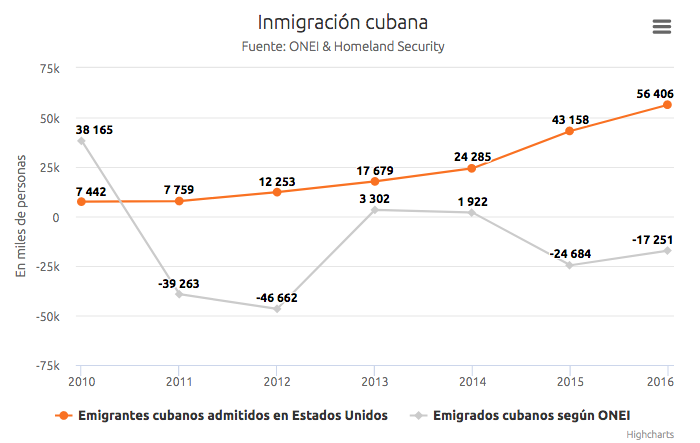
Cuban Immigration. Sources: Cuban government and US Homeland Security. Orange line: Cuban emigrants admitted to the United States (US figures). Grey line: Cuban emigrants (Cuban figures)

If tens of thousands of Cubans who left the country do not appear as emigrants, it is because many of them return before the end of the two-year term that marks the end of their rights as residents on the island, explains Cuban sociologist Elaine Acosta.

“Others have decided to undertake the process known as repatriation, which allows them to regain their residence in Cuba and stay abroad,” adds Acosta.

Cuban law considers that those who remain abroad “continuously for a term longer than 24 months and without the appropriate authorization,” to no longer be citizens.

Those repatriated are counted in the official statistics as resident in the country, although in reality they live abroad. The same thing happens with those who return before the expiration of the 24-month period of a stay abroad.

This management of the figures shows a sudden decrease in emigration. Prior to the 2013 reform, more than 45,000 people left, but in 2014, for the first time in over half a century, ONEI says that more people returned to Cuba than left.
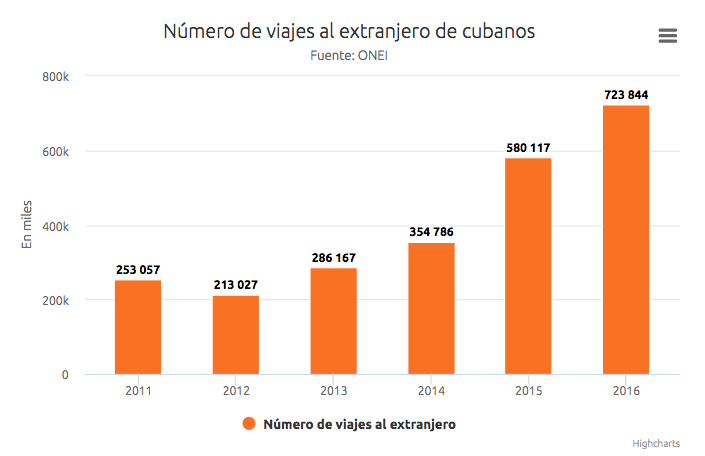
Number of trips abroad by Cubans (Source, Cuban government)

These figures contradict the figures published by the United States, which registered the entry of 141,528 immigrants from Cuba since 2013, not including rafters, while the ONEI only reported a general total of 41,935 émigrés during the same four years.

In addition, the figures from Havana include all Cubans who leave the country permanently, whatever their destination. Ecuador, which was also a popular destination for Cuban emigration, received 33,700 people from the island since 2013. And in the same period Spain registered more than 15,000 new residents who were born in Cuba. That is, the sum of Cuban immigrants in Ecuador and Spain, not including the US, which is the primary destination of Cubans, exceeds the total number of migrants counted by Cuba’s ONEI.
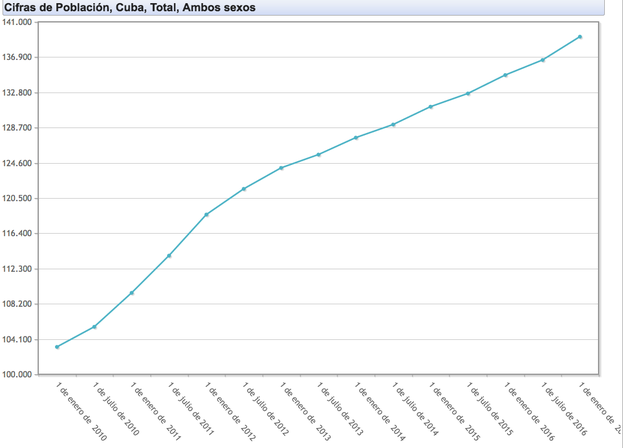
Residents in Spain born in Cuba according to the National Institute of Statistics. Historical series since 2010. (INE)

Elaine Acosta, the sociologist, believes that both segments (the emigrants who maintain their Cuban residence and the returnees) have significantly increased the number of trips abroad from the island, as in the last five years almost half a million have gone abroad.

On the other hand, returnees were only about 14,000, according to the ONEI. This category implies that the citizen recovers his or her rights on the island, among which include participating in the electoral process, receiving free care in the national health system, being able to own property, and the coveted permit to pay import duties once a year in Cuban pesos (CUP) – versus in Cuban convertible pesos (CUC), worth 25 times more.

“The quality of migration statistics leaves much to be desired because they respond to an ideology and there are no studies to break down the figures,” explains the sociologist, who regrets that the ONEI figures do not say how many Cubans who travel abroad have another nationality or residence. Another shortcoming noted by the specialist is that only the number of departures is counted, not the number of individuals who have traveled abroad.

For the sociologist, based in Miami, the national press uses the official figures to “depoliticize” the causes of the exodus. “This is an instrumental use of emigration to reinforce the thesis of economic migration and hide the reality that people are living,” he adds.

Osmanis Gálvez, 42, who emigrated to the United States three years ago, says he returns to the island at least once a year. He was recently repatriated after paying 100 CUC in an office of the Ministry of the Interior.

“I will not go to live in Cuba, but this is a way to inherit my mother’s house and bring her the products she needs without having to pay for them in dollars at Havana customs,” he says.

Frank, a Cuban who has resided in Miami for two years, did not need to be repatriated because on obtaining his permanent residence in the United States, he immediately traveled to Cuba and was able to “enter” before the two-year term expired. Since then he has been traveling once a week to Cuba as a “mule”to carry products to supply the island’s growing black market.

Although travel is one of the most common desires among Cubans, it remains the preserve of those who maintain work and residence outside national borders or have relatives abroad to finance the escape, since on the island the average official monthly salary isn’t even $30, and a plane ticket to Miami costs almost a year’s salary.
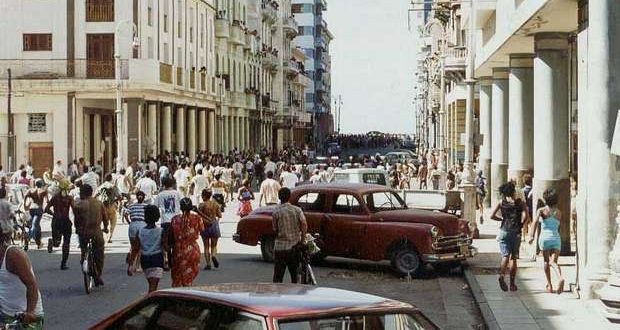
 

The Day Havanans Shouted "Down With Fidel!" / Iván García

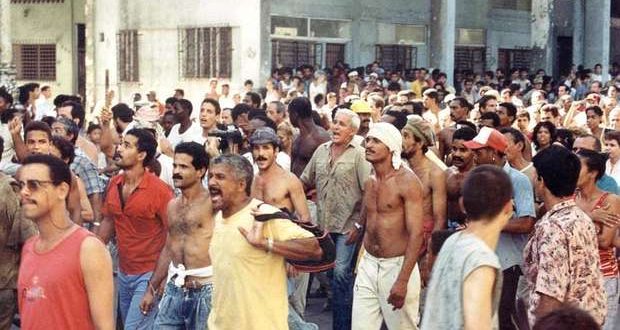
People walking down Galiano Street heading to the Malecón on August 5, 1994. Taken from the blog Maleconazo.

Ivan Garcia, 8 August 2017 — When night falls on Havana’s Malecon, an optical illusion gave the impression that on the horizon the sun was devouring the sea. This is the hour when Daniel, a retiree of 66, sat himself down on a wooden bench and, along with several neighbors, and drinks the worst quality homemade rum.

For half a century, Daniel has lived in masonry shell facing the Malecon. The cheap paint on the facade can’t hide the cracks of the aggressions of the salt air which has chipped away pieces of the old building.

“Every now and then we have electrical problems,” he says, pointing out several uncovered wires in the entry hall, “and the water pump is always broken,” says Daniel, as he parsimoniously continues to smoke a hand-rolled cigarette. continue reading

For Havanans who live in areas along the shore, the incursions of the sea, the hurricanes, carnivals, and clandestine businesses, mark a difference with the rest of the residents of the capital. “Here on the Malecon you can see everything. Couples having sex on the wall or against the cliffs, tourists looking for hookers — women and men, and people selling marijuana, take away food, or little cones of peanuts. The Malecon shows you the good and bad of Havana,” affirms Daniel.

The Colon neighborhood, a stone’s throw from the maritime walkway, is the cradle of prostitution, illicit games and the consumption of drugs. A zone where poverty is a difficult cross to bear, potable water is a luxury, and people think twice as fast as most Cubans.

And it was precisely these neighborhoods — Colón, Jesús María, Belén, San Isidro, Los Sitios and San Leopoldo — that were the epicenter of that spontaneous and popular protest that took place on 5 August 1994, known as the Maleconazo.

It is unlikely that any Havanan over age 40 will not remember what they were doing that day.

“In 1994, in this part of the city we were not as bad off as in other parts of the country. During the Special Period we did not have blackouts because the electrical system is buried. But the people were fed up. There was tremendous hunger, very few could eat a hot meal once or twice a day. And even if you had money, there was nothing to buy. At night they put up signs against the government. Plans to hijack the Regla ferry or a port craft were forged in Central Havana,”says Daniel, and he continues recalling:

“The youngest were acting up. Making rafts, stealing bikes, robbing the yumas (foreigners) to get their money or whatever they could. It was an ugly scene. On 5 August I was putting some tiels on a friend’s house, when I heard the hubbub. Then, my friend’s wife tells me that people are breaking the windows in the Hotel Deauville and attacking the hard currency stores.

“When I looked over the balcony,” Daniel continues, “I saw some thousand men and women, different ages and races, had taken to the streets and were protesting. At 11 in the morning there was a human sea. They came from other neighborhoods, they began to raid the state properties and shout Abajo Fidel. Some were demanding freedom. My buddy and I believed that the government had faltered. If there had been cellphones, like there are now, the system would have fallen.”

Susana, a 59-year-old housewife, lives in a basement in Amargura Street, in Old Havana. “August 5th fell on a Friday and like every day, I was selling something at the entrance to the tenement. That day I was selling avocados for a dollar, or its equivalent, 120 pesos. There was a fucking dog. The Cuban peso lost its value. A pound of rice cost 100 pesos and a pound of black beans 120 pesos, if you could find them. Beef had disappeared and pork was over the moon: 150 pesos a pound. People were eating stray cats, pigeons, and making soup with lizards.”

Susana continues evoking one of the worst eras in Cuba in almost six decades of Castroism. “The people were on the point of exploding. When the protests started I put away the sack with the avocados and headed to Avenida del Puerto. That was impressive. People were shouting slogans against the government. The rumor was spreading that boats were coming from Florida to collect whoever wanted to leave. I prepared a bundle of clothes and put some salt crackers in a plastic bag. I already saw myself in Miami.”

Carlos, a sociologist, says that the protests starring Havana’s Malecon left behind a great lesson. “The government realized that people were fed up with so many blackouts, so much poverty and the scarcity of food. If they were able to neutralize the revolt in less than 12 hours it was because it was spontaneous, without a leader or an organized strategy. If there had been leadership in those protests, the story would probably have been different.”

Víctor Manuel Domínguez, a journalist and freelance writer, on 5 August went to Santiago de Las Vegas. “I had gone to visit an outstanding nephew in a military unit. When I returned to my house, near Chinatown, I was struck by several jeeps and special troopers with long weapons. They had broken the windows of shops and the OFICODA. The number of people coming down to the Malecon was tremendous. ”

In 1994, Domínguez was affiliated with an illegal union directed by Carmelo Diaz. Twenty-three years later, Víctor Manuel thinks that it would be very difficult for a popular protest like the one of the 5 of August to be repeated.

“The genesis of this revolt was not to demand political rights or democracy. People threw themselves into the street simply because they wanted to emigrate. I’m not optimistic. The dissidence today is living on the moon, and most Cubans, although we complain, we do not have the option to go out to protest against the government. There is a lot of individualism and citizen solidarity. It’s each man for himself,” points out Victor Manuel Domínguez, and confesses: “I will never forget the extensive blackouts and empty casseroles. Some nights I went to sleep without eating anything all day.”

Martha Beatriz Roque Cabello, an economist and former political prisoner recalls: “In August of 1994 I had been an opponent for five years and that day, when the protests began, I was at my sister Elena’s house on Neptuno, at the corner of Lealtad. I remember two women police officers, who took off their uniforms and joined the march. The local opposition did not even see it coming.” And she emphasizes: “I do not believe that the dissidence can lead future protests. It is disconnected from the people, making appeals and proclamations that do not resonate among the Cubans. The changes in Cuba will come from popular pressure.”

August 5, 1994 was an example. 23 years have passed and no new Maleconazo is on the horizon. Fear and apathy are winning the game of everyday poverty and a future between question marks. For now.

Prosecutors Demand Three Years in Prison for Karina Gálvez and the Confiscation of Her Home

The indictment also demands the seizure of Karina Gálvez’s house. (14ymedio)

14ymedio bigger14ymedio, Havana, 5 August 2017 — Economist Karina Gálvez received the prosecution’s petition on Saturday for the alleged crime of “tax evasion.” According to this petition, the member of the Center for Coexistence Studies (CEC) could be sentenced to three years of house arrest and confiscation of her home, she informed 14ymedio.

“A messenger from the Tribunal, on a motorcycle, came to my mother’s house to give me a document that I had to sign as received,” she says. “The paper, sent by the Municipal Court of Pinar del Rio, details that the prosecutor has arrived at provisional accusations.”

The prosecution is asking for “three years of deprivation of liberty plus the same period of limitation of freedom.” This latter means a person cannot travel abroad, must inform the authorities when leaving the province, and is obliged to have work. continue reading

The accusation also requires the forfeiture of the house that Gálvez acquired after the flexibilizations for the purchase and sale of houses promoted by the Government of Raúl Castro at the end of 2011.

In the next five business days, her lawyer will present a plea to ask for acquittal or a lower penalty. “Starting with this communication, my lawyer will have access for the first time to the case file,” says the economist.

However, neither the lawyer nor the defendant has been informed of the date of the oral hearing.

In January, Galvez was arrested and taken to the headquarters of the State Security where she spent six days under arrest. The police searched her home and since then the house has been under investigation and is sealed, which prevents access for the owner or her family.

The economist has been under pressure from the authorities since last December when she was summoned to the Department of Immigration and Immigration (DIE), where she was questioned about her travels outside Cuba.

Other members of the Convivencia magazine have been cited by the police and have received warnings, including the director of the publication, Dagoberto Valdés, who last October was told by an official that “from today” his life will be “very difficult.”

Amid this wave of pressure, members of the CEC, which organizes training courses for citizens and civil society, issued a declaration of commitment to their work in the island. “We are not leaving Cuba, we are not leaving the Church and we will continue working for the country.”

The Private Sector is the Victim of the Government’s Double Speak

A private restaurant in Havana. (EFE)

14ymedio biggerReinaldo Escobar, Havana, 5 August 2017 — The brake announced last June has just materialized. By canceling the awarding of licenses in several areas in which people have been allowed to work for themselves, and stopping the award of new licenses in several others, the government has confirmed fears about the advance of the private sector, and put at risk the small spaces of efficiency won by the population.

This week the Official Gazette published the decision to not grant new authorizations for this form of non-state management “until the perfection of self-employment is concluded.” This formula hides a misleading term — perfection — too subjective to be the object of legislation.

Fears are also growing before what remains to be achieved. Both the last Council of Ministers as well as the recently concluded session of the National Assembly, made clear that there is a package of regulations directed at the self-employment and cooperatives sector that will be announced in the coming months. continue reading

Many business owners fear losing their investment if draconian requirements are applied to them, but those principally affected may be the consumers. They are facing the risk that the good service and better quality that the private sector has achieved in areas such as food service, lodging, appliance repair and transportation, among many others, could be a thing of the past.

This week’s decision was preceded by official statements about illegalities and tax evasion. It is expected, then, that the upcoming regulations will aim at prioritizing the fight against violators, rather than seeking solutions such as the establishment of wholesale markets, commercial import permits or tax incentives.

Punishment and penalization seem to be the only ways in which the Cuban government deals with its citizens. On detecting irregularities the only way the government resolves them is with coercive measures, such as suspending the issuing of licenses, an increase in the number of inspectors, or the demonization of the economic prosperity achieved by the most successful.

This confrontational attitude shows that autonomous forms of management continue to be a necessary evil for the ruling party, while the figure of the small businessman remains an antagonist of the “New Man,english beach blue flag status

” which was once intended to be created. The enemy does not land on the coast or found opposition parties, but offers tasty pizzas at home, manages beauty salons and opens websites to promote its services.

The government is trapped in a contradiction. On the one hand the government wants to prevent the private sector from growing too fast, but it exhibits the sector as an example of the progress of the reforms promoted by Raúl Castro. At the end of the first half of this year, the growth of those engaged in self-employment, with 567,982 workers, has been used in international forums and debates as a sign of openness and development.

However, that figure may be affected in the coming months. When the licenses returned by those who were disappointed and failed to succeed exceeds the number of licenses issued for new affiliates. It is easy to predict a decrease or at least a paralysis in the volume. Stagnation and the duration of this slowdown will have negative repercussions on the exercise and influence of the private sector in the national economy. A digression that could cause enthusiasm to decline and paranoia to grow.

The Maleconazo, Cuba’s First Popular Revolt, Happened 23 Years Ago / Iván García

Ivan Garcia, 6 August 2017 — Havana, 4 August 1994. Amidst the suffocating heat, 12-hour blackouts, the devalued currency, and the scarcity of food, the sensations felt on the streets of Havana 23 years ago had reached the breaking point.

Frustration and social malaise were in full bloom. People sat on the corners making plans to emigrate. Even the most intransigent Fidelistas, in whispers, suggested urgent changes were needed in the monolithic structures of power.

The question was simple. If Fidel Castro didn’t introduce economic reforms, a great number of Cubans were going to die of hunger. Some of my friends and relatives looked like they’d emerged from Nazi concentration camps because of all the weight they’d lost. My mother lost some of her teeth, and solved a problem of buying food by selling her record collection of Brazilian music for just 39 dollars. continue reading

Chinese bicycles were distributed at workplaces and as they were too heavy, many workers sold them or took them to the countryside to exchange for a pig; if they didn’t have a patio they kept the pig in the house. A doctor we knew, who was 60, spent so much trouble trying to find something to feed the pig, which he kept in the unused bath in his house, that he died of a heart attack.

In 1994, in the midst of the Special Period, an avocado cost one dollar, or 120 pesos under the counter, and rice was 100 pesos a pound, when you could find it. A pound of roast pork was 150 pesos, and old people stood in long lines for a cup of lime tea. The Committees for the Defense of the Revolution (CDR) passed out tickets that gave you the right to eat a Zas* hamburger — one of Fidel Castro’s “inventions” — and drink a glass of soda pop.

Cats disappeared from the city: those who ate them said they tasted like rabbit. More than a few people passed out in the street. The illnesses caused by the lack of vitamins and proteins got worse and worse. If Option Zero was reached, the army would be in charge of distributing food to the blocks. Illegal departures by raft shot up. In this environment of misery and desperation, life passed in the capital.

On the night of 4 August, in the Vibora neighborhood, there was a planned 12-hour blackout from 8 at night until 8 in the morning. Many people put their mattresses on the roofs of their houses and slept like that.

At ten in the morning on 5 August, different versions of what was happening on the Malecon started to spread through the neighborhood. “Listen, this is fucked up. In Colon, San Leopold and Jesus Maria people are throwing themselves into the street. They’re sacking the stores and overturned a police car,” said a gentleman who claimed to have come from Central Havana.

A group of young people and adults, along with the driver on the 15 bus route, who was then at the Vibora stop, decided to travel to the epicenter of the conflict. During the trip the driver was picking up people with big bags, as if they were going on a picnic. It was rumored that illegal sailings were leaving for Florida and anyone who wanted to could get aboard.

Just beside the former Presidential Palace, the combined forces of the police, State Security, and Special Troops, stopped the bus (a converted truck). The driver opened the doors and the we passengers, to prevent the military from taking possession of the truck full of detainees quickly all got off and taking advantage of the human sea already taking shape at that house, we disappeared among the crowds and into surrounding streets.

For the first time I heard shouts of “Down with Fidel.” The huge crowd walked toward the Malecon and the Avenida del Puerto. People with binoculars searched the horizon for boats. The destruction of the “shoppings” and at the Hotel Deauville were obvious. The wide road that runs parallel to the Malecon was filled with stones and pieces of bricks.

At four o’clock in the afternoon, dozens of army trucks, jeeps with mounted machine guns at the back, special unit soldiers and construction workers from the Blas Roca Contingent, armed with baseball bats and thick steel bars were lashing out left and right, beginning to restore order.

Meanwhile, news spread from the TV that Fidel Castro was coming to the area of the revolt.

A military vehicle pulled up in front of the Capitol building. And those who, until that moment, in the area, had been screaming against him, from intuition and fear changed their tune. They began to applaud and shout “Viva Fide,” joined by hundreds of supporters of the government. The mob mobilized by the regime came down Prado Street, shouting revolutionary slogans, with signs and aluminum tubes in their hands.

By eight o’clock at night, the spontaneous popular protest had been controlled by the olive-green autocracy.

What happened 23 years ago deserves an analysis. Could it happen again? Let’s go by step.

During the 1960s, the mass emigration of a middle class made up of politicians, doctors, engineers, journalists and other professionals allowed Fidel Castro to sweep away all the republican institutions, bury the free press and raise his hermetic dictatorship.

Backed by widespread popular support, Castro erected a Soviet-style state. Even the Constitution was a carbon copy. An army that was once the largest in Latin America, a powerful network of agencies that were appendages of the regime, to which was added the effectiveness of the secret services. All this allowed Fidel Castro to found one of the most perfect machines of social control in modern history.

Workers had no right to strike or to form trade unions, and laws condemned those who dared to dissent many years of imprisonment (or death penalty). El barbudo (the bearded one) sowed terror among Cubans.

Opposing the regime had — and still does — a high personal cost ranging from repression and ’murder’ of a dissident’s reputation to verbal lynchings that can end in criminal proceedings.

It is one of the reasons, among others, that explain why Cubans do not rebel. The most they do is complain: the majority of the population is convinced that Castroism is a disaster.

The ordinary citizen perceives the State as a territory of a privileged caste that, due to historical or genetic merits, it is up to them to govern without accountability to the people.

Despite the perpetual economic crisis affecting the nation, it is not likely that in the short term mass protests will occur where Cubans claim their rights or demand democracy.

But, look, any arbitrariness of the regime can trigger small or medium protests. Cases have already been reported. Like the protest of the drivers in Bayamo or bicitaxistas in Havana.

Right now, the new state policies restricting private entrepreneurs could become the embryo of numerous protests. Although, in general, these groups do not have leadership or organizational methods. They are rather spontaneous, driven by government abuses.

The dissidence has failed to connect with that segment of the population that is in conflict with the military junta that governs Cuba’s destiny. And in turn, many disgruntled people avoid contacting the opposition, for fear of being branded as ’counterrevolutionaries’.

But the social upheaval, low wages and distrust towards the regime is present. There are more accumulated social problems than the State’s capacity to solve them.

Today, the island is a box of matches that at the slightest touch can set off a spark. Even fear has an expiration date.

*Translator’s note: “One night [Fidel] asked his consultants to ship some McDonald’s hamburgers to him by air. He wanted to compare them with some burgers he had created and christened “Zas.” After trying the gringo hamburgers, he declared the Cuban versions better. The Zas burgers were sold in cafes that were converted into hamburger restaurants, two per person.” Source: Ivan Garcia earlier post. 

For Cuba? / Fernando Dámaso

Fernando Damaso, 29 July 2017 — The slogan adopted for the so-called 2017-2018 General Elections is “For Cuba.” According to propaganda claims, these elections are unique in the world in that, unlike in most countries, it is not political parties which nominate candidates but rather citizens at the grass roots level. In reality this is not the case.

The party, the only legally recognized party, does it by using official civil society organizations — the only such organizations which are legal — which operate under its direct control. Furthermore, if a “troublesome” candidate should happen to slip past the control mechanisms, the party — once again, working through these same organizations — will do everything in its power to make sure the individual is not nominated. In practice, a candidate has never been nominated who had not been previously approved by the party. continue reading

It is precisely at the grass roots where any real citizen participation begins and ends, where voters “choose” a candidate from those already chosen by the party. Only those nominees who have been previously “filtered” and approved will be on the ballot.

The governing body for municipal, provincial and the national elections is the so-called Candidates Commission, composed of representatives appointed by the municipal, provincial and national leaders of these same governmental organizations (the Cuban Central Workers’ Union, the Commitees for the Defense of the Revolution, the Federation of Cuban Women, the National Assembly of People’s Power, the University Students’ Federation and the Pre-University Students’ Federation).

These organizations draw up lists of candidates for the provincial legislatures and the National Assembly without any citizen participation. As is widely known, everything is tightly managed to ensure that the absolute unanimity of voting that characterizes Cuban legislatures is maintained, from the grass roots to the National Assembly.

Since all representatives are required to be nominated and elected by the electoral base, those whose nominations and elections are considered crucial are assigned (or planted) to ensure that none of the party’s stalwarts get left out. This often involves a candidate being nominated based on his or her place of origin or other incidental considerations. As a result, someone may be nominated and formally elected in a place which he has not visited in years and to which he no longer has any ties.

By democatic norms, Cuba’s general elections are undoubtedly “quite original.” Perhaps that is why its “elected” leaders remain in power for decades. In spite of being terrible at governing, spending their terms in office veering from disaster to disaster, they win reelection every time.

Rather than being a democratic electoral process, the Cuban system amounts to a process of dynastic ratification and a way of recycling its buffoons.

Cuba Has No Plan B To Make Up For The Loss Of Venezuela

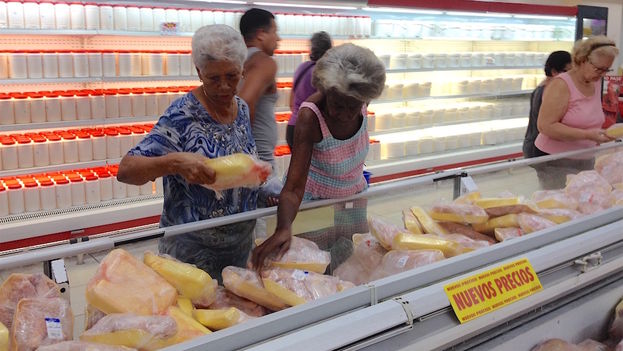
Cubans are tired of being unable to access foods of animal origin other than chicken. (EFE)

14ymedio bigger14ymedio, Mario Penton, Miami, 4 August 2017 – “It doesn’t matter when, all we get are feathers,” complains the father of a family, disgusted on finding no kind of meat other than chicken in the Hard Currency Collection Stores (TRD), the state chain that sells only in Cuban Convertible Pesos (CUC). Since the beginning of the Venezuelan crisis, Cubans have been bitter about the shortages in retail markets, a problem that will grow in the coming months, according to economist Omar Everleny Perez.

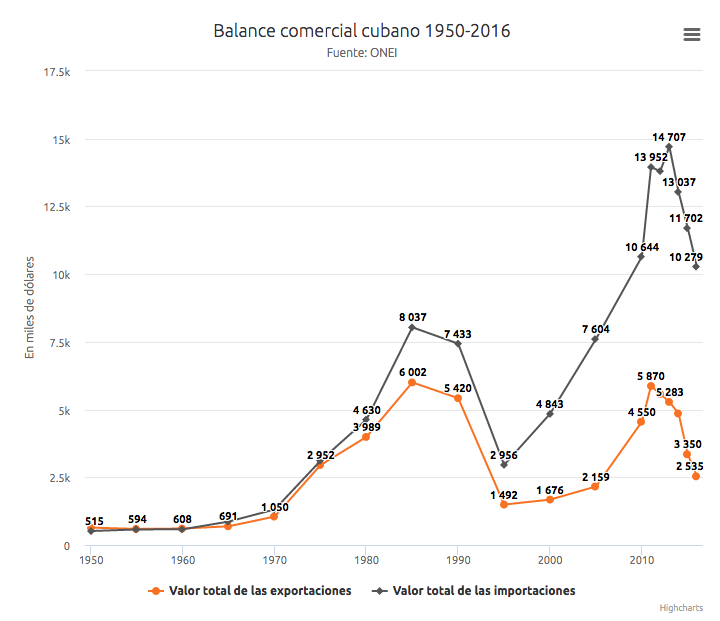
The country cut 1.5 billion dollars in imports in the first half of the year, which will directly affect the population,” said Perez, in conversation with 14ymedio. continue reading

Trade balance: imports (black line) and exports (orange line) in Cuba since 1950.

The abrupt cut in imports stems from the decision to use 2.306 billion dollars to make payments on external debt, renegotiated with the Paris Club and other creditors, adds the former director of the Center for Studies of the Cuban Economy.

“They renegotiated a debt that they had not paid since 1986. Creditors waived up to 90% in some cases, but they had to pay that remaining 10% and could only do so by cutting imports,” he explains.

According to Perez, a contributor to the magazine Temas, the national economy is beginning to show signs of macroeconomic recovery but it is not enough.

“From the macro point of view, it seems that there will be a change in the trend line, but 1% growth does not tell you anything. The country needs to grow from 5 to 7% — and not just for one year — so that people feel it,” he adds.

“With this rate of growth, seeing an improvement in living conditions would take at least 30 years. How do you say that to a 50-year-old?” Pérez quips.

Cuba announced that at the end of this semester the economy had grown by 1.1%, after a GDP fall of 0.9% in 2016. Pérez attributes this positive result to tourism, which grew by 23%, and the sugar cane industry, which produced about 1.8 million tons of sugar.

“Tourism is changing lives in many parts of Cuba. For example, in the municipality of Trinidad, the revenues of the non-state sector surpassed those of state enterprises for the first time. In this municipality the private sector generated 56.9% of the total collected,” he says.

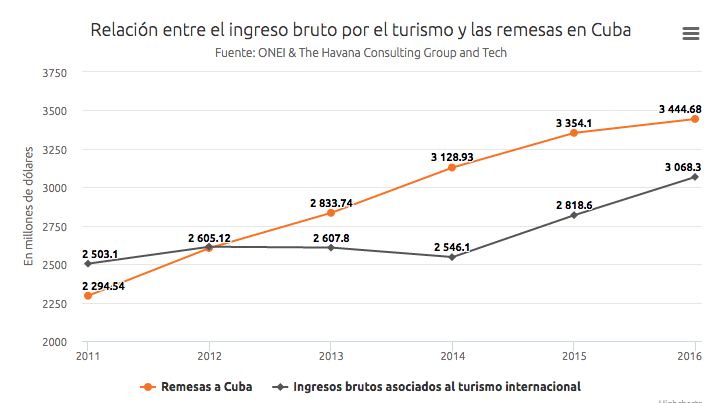
The Havana Consulting Group has just published very interesting data on the increasing contribution of remittances to the functioning of the national economy. The Miami-based consulting firm says remittances grew 2.7% in 2016 to $3.444 billion, surpassing net revenue from tourism that year, according to official sources.

The difference is even greater when compared to net tourism receipts, which will not exceed $1.3 billion after deducting the costs of imports needed to cater for tourists, especially food, as Cuba produces nothing.

Gross income from remittances (orange line) versus tourism (black line).

Pérez Villanueva is worried about the strong impact that the eventual fall of Nicolás Maduro’s government in Venezuela would have on the Cuban economy.

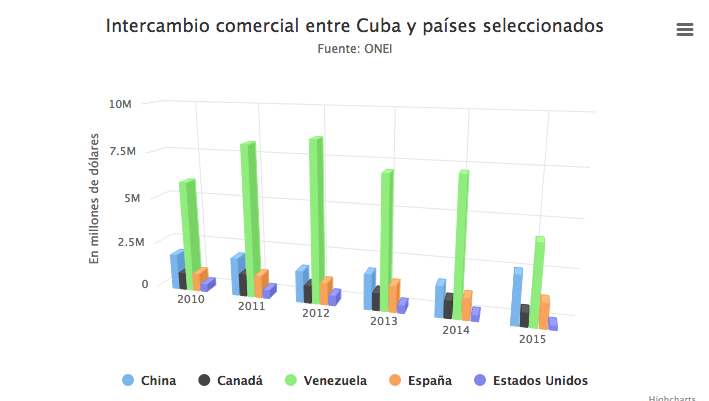
“Venezuela continues to be Cuba’s number one trading partner, despite its crisis. For the past two years, the problems of that country have been growing, but no measures have been taken to counteract the end of that trade relationship,” he says.

Perez believes that Havana should be thinking of sending its highly skilled labor to other countries with oil reserves like Angola or Algeria. “It will never be the same as with Venezuela and those countries could not absorb the number of doctors [that Venezuela has been paying for], but at least it would cushion the blow,” he says.

Trade by country over time.

Cuba could take advantage of currently low oil prices to buy fuel from other allied nations, such as Russia or Algeria, but the lack of credit is a chronic problem, according to the Minister of Economy and Planning, Ricardo Cabrisas, who acknowledged in the Report on Behavior of the Economy and Planning 2017 that the Island’s ability to obtain loans is affected by the amount of debts due.

However, according to Pérez, Cuba is trying to strengthen new mechanisms to generate electricity from renewable sources, but “it needs time and money.” There is also an attempt to revive national oil production, which is declining due to the depletion of the wells.

“If the supply of Venezuelan oil is stopped, it would not be as it was in the USSR. We receive from Venezuela half the fuel we need, and in the time of the former Soviet Union we received virtually all of it,” he added.

“The country should bet heavily on foreign investment,” says Pérez Villanueva, who was ousted after a series of lectures in which he displayed his critical opinion on the economy’s progress on the island.

“The guidelines say that foreign investment is not a complement to domestic investment but rather a part of the national investment, but in practice the level of appropriations is not noticeable,” he adds.

Despite continuing to publish the portfolio of foreign investment opportunities, the investment flagship project, the Mariel Special Development Zone, continues to be bogged down with small investments.

For Pérez, the country has to immediately expand trade on its own, something that seems very distant, especially after the freeze in the granting of new licenses for self-employment announced last Tuesday.

“There is a mass of workers who could leave the guardianship of the State and pay taxes in activities related to what they studied [at the universities]. This would prevent engineers graduating in Computer Science from leaving for Canada or quitting to drive a taxi “.

However, Perez believes that the state does not want healthy competition to exist because the great socialist state enterprise remains its model. “In Cuba, ideology continues to set the tone, not the economy.”

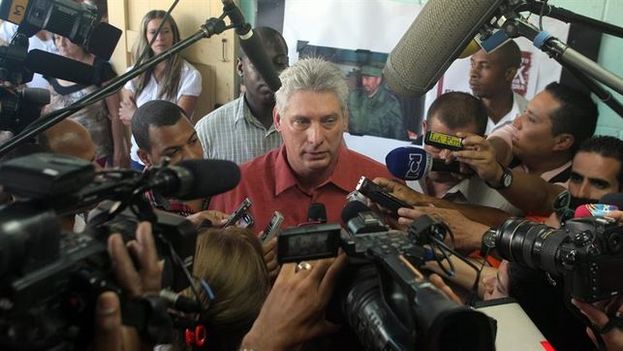
Miguel Diaz-Canel, A Future Lenin Moreno?

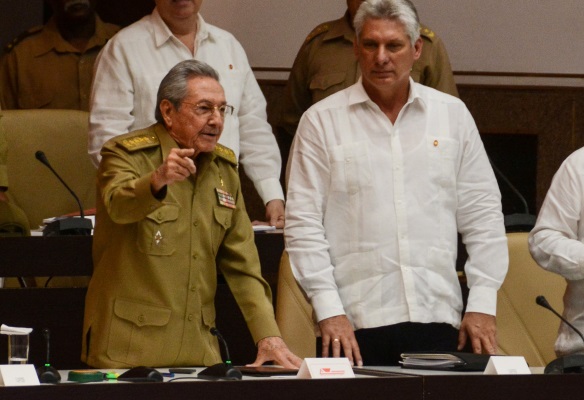
Miguel Díaz-Canel, the current Cuban vice-president (EFE)

14ymedio bigger14ymedio, Yoani Sanchez, 4 August 2017 – Each ruler leaves his imprint. More than a decade ago Fidel Castro relinquished power and his brother promised continuity; but he dismantled the boarding high schools in the countryside, the army of social workers and the open anti-imperialist rallies. This coming February, Miguel Diaz-Canel could assume the presidency of Cuba and those who believe he will follow the script to the letter underestimate the vicissitudes of politics.

In recent days the news about the Venezuelan crisis has failed to overwhelm the political impact of what is happening in Ecuador. The country, which until recently was led by a man of arrogant discourse and aggressions against the press and his opponents, now has a more sedate president who is – at top speed – marking distances with his predecessor.

Lenin Moreno came to power wrapped in the controversy over a distortion of the vote in his favor. Last June, during a conference in Madrid, his main electoral opponent, Guillermo Lasso, defined that victory without circumspection: “In February there was the most brazen fraud that has been seen in Ecuador,” he said. The doubts about the cleanness of the elections and the closeness of the official candidate to Rafael Correa augured nothing good. continue reading

Nevertheless, a few months after assuming the highest position of the state, Moreno seems ready to chart his own course. He has huge motives to separate from Correa because the scandal of the Brazilian construction company Odebrecht is stepping on the heels of the previous administration and the country has a debt of more than 24 billion dollars. A figure that the outgoing president tried to hide before leaving, but that has finally been revealed by the current executive.

Moreno has come to converse with several opponents, including the former president Abdalá Bucaram (1996-1997) exiled for years in Panama. This is a step that shows a clear change of direction for the Palace of Carondelet, which until recently fought those who disagreed politically with blows, insults and threats.

This week, the difference between the two most recent presidents went one step further and Moreno revoked the powers of the vice president Jorge Glas, a kind of tutor left by Correa to watch over the course of the so-called Citizen Revolution. The schism threatens to fracture the Alianza País party, shaken between those who support the former president and those who clamor for the decisions of the current president to be respected.

From distant Belgium, Correa burns with anger at what he considers a betrayal. His impetuous character, fed even more by ten years in power, has led him to write numerous critical messages against Moreno on the social network Twitter. His successor has become an antagonist and has refused to follow the path laid out by the 54-year-old economist for his party colleague.

In these months Moreno, as will happen to Diaz-Canel, has had to face his people and the international community. He has realized that it is one thing to be the designated heir, while something quite different to take the helm in the control room of a country that has long been ruled by the whims of one man. To lead with some efficiency, in both cases, requires breaking with those who placed them in those positions.

The differences between the Ecuadorian and Cuban cases are marked. While the government of Rafael Correa lasted a decade, on the island the Castro brothers have controlled every detail of the economy and politics for more than half a century. The imprint left by the Correa’s time in power in Ecuador is intense and is evidenced in a greater polarization along with a weakening of civil society, but the effect of Castroism is much deeper.

Moreno has managed to distance himself from his predecessor because, among other reasons, there are democratic structures in the country that support him in this effort, something far from the Cuban landscape. In spite of the international questions about his election to the presidency, the Ecuadorian has the approval of the majority of the governments of the region and of international bodies, some of whom see him as a concerned administrator trying to impose order on the asylum.

Miguel Diaz-Canel, less charismatic and grayer, will have biology in his favor. While it can not be ruled out that Rafael Correa will put an end to his Belgian retreat and try to reassume the Ecuadorian presidency, the current Cuban vice president will witness the deaths the members of the historic generation, people who now consider him a manageable upstart, with no battles or dead to show in his favor.

However, the economic gulf that the island dauphin will inherit will be even more unfathomable. The country that he will receive in February is experiencing a process of economic stagnation, has failed to resolve the dual currency system, is experiencing a slowdown in the expansion of the private sector and has not even been able to convince a significant number of foreign investors to put their money in the Island.

Sitting in the presidential chair and with the script of each step written on the table, Miguel Díaz-Canel will face the dilemma of having to make his own decisions. With the stares of commanders and generals fixed on the back of his neck, he is likely to opt for submission. But something of his imprint, his personality, will creep into the agenda. One day, out of bravery or fear, he will end up giving some mortal blows to Castroism.

When The Night Is Darkest

Anyone can be arrested without prior order, here we simply call it kidnapping. (Miguel Gutiérrez / EFE)

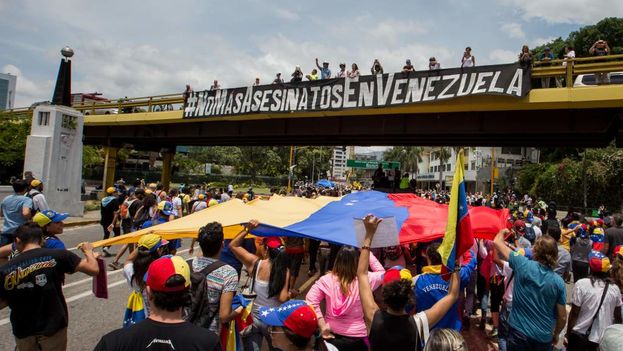
14ymedio bigger14ymedio, Reinaldo Poleo, Caracas, 3 August 2017 — Many Venezuelans are exhausted, the dictatorship today posing to us a scenario of fear and despair. There is no public meeting or march that is not repressed even before it begins. The regime’s paramilitary and efectivos flood the streets of Venezuela with murders and arrests. Sniper rifle is no longer unusual at any demonstration, nor is it surprising that most of the bullet impacts against the demonstrators are directly to the head.

Nor are the arbitrary arrests of deputies or their relatives rare, in violation of their immunity. The rights of citizenship have ceased to exist, we are no longer judged by our natural judges, it is now military justice that is responsible for charging any citizen. Anyone can be arrested without prior order, here we simply call it kidnapping.

The most interesting thing about fear is that it leads you to attack those closest to you, who are just as vulnerable as you are. Fear makes you see your own weaknesses and leads you to blame your environment for your misfortune. It’s easier to distance yourself from what really terrifies you. And in psychological warfare this is well-known, demoralizing, deepening the differences, breaking the unit, fracturing it, so powerful is fear. That is why fear is a fundamental part of tyrannies, hope is eaten away, it neutralizes joy and devastates faith, demobilizes and in this spiritually devastated terrain, sows meekness, dependence, ideologies.

Division is good for dictatorships. continue reading

The currency is devaluing at a rapid pace. Just yesterday my wife miraculously got my medicine for tension, though they only sold her two boxes, and when I went to buy another two boxes (a month’s treatment) in the same place, just an hour and a half later, I paid twice as much.

The black market dollar, that is, the only one that obtainable, goes from a price of 10,389 bolivars per dollar on Friday, July 29 to 13,780 on August 2.

Every minute that passes, the darkness closes in on the noble nation of Simon Bolivar. My hope is set in the new dawn. These are hard times, the next few hours are decisive and I am sure that we are all going to put everything we have into survival of our country.

We are pacifists, democrats and a people of faith.

But the dictatorship can never underestimate the strength of a people when they close the windows of freedom. We Venezuelans have shown through 18 years that we are not going to put our knees on the ground. We are going to fight, have no doubt.

________________________________

Editorial Note: This testimonial is part of a text that the author has published in his blog and has shared with 14ymedio.


Señor General “Going-Backwards” / Cubanet, Miriam Celaya

Raúl Castro next to Vice-President Miguel Díaz-Canel (Reuters)

cubanet square logoCubanet, Miriam Celaya, Havana, 2 August 2017 – In line with the last meeting of the Council of Ministers, held at the end of June, where – according to what the General-President said in his closing speech of the Ninth Ordinary Session of the National Assembly – many deficiencies and problems were analyzed in the self-employment sector (TCP). The Official Gazette, in an extraordinary edition (No. 31) dated Tuesday, August 1, 2017, has decreed the suspension, supposedly temporary, of the delivery of licenses for at least 27 activities of the private sector (“self-employed”), “until the perfection of this sector is concluded.”

In addition, the decree states that in the future – and permanently – no new licenses will be granted to work in the areas of: wholesale of agricultural products; retailers of agricultural products; cart vendors or sellers of agricultural products on an ambulatory basis; buyer and seller of music records; and and operator of recreational equipment.

Despite this, according to what the First Vice Minister of Labor and Social Security told the official press, the provisions of the decree “do not constitute a setback in the development of (self-employed) activity,” but will “consolidate the organization and control of self-employment work so that it continues to advance in an orderly and efficient manner.” But this official did not explain how a process that has been stopped by a government decree could “advance.”
continue reading

And while such a strategy of advancing by going backwards may be paradoxical, more impudent still are the pretexts that were used to justify the retraction of what was announced years ago as a process of reforms that would oxygenate the internal economy and allow the potential for employment for a portion of the labor force let go from government jobs.

It turns out that the fickle old ruler has discovered “deviations in the implementation of the approved policy” for the TCP, ranging from the use of raw materials and equipment “illicit in their origins” to the “breach of tax obligations,” including under-reporting of sales/income, by members in the sector.

The truth is that, although the authorities have frequently expressed that the TCP has reported benefits in “lightening the burden of the State,” in the reordering of labor, as well as in the supply of goods and services – which, by the way, is not, nor should it be the natural aspiration of private labor anywhere in the world – in practice, this sector has become the most propitious villain (after the “criminal imperialist blockade”) to justify the causes of the failures inherent in the Cuban sociopolitical system.

The aforementioned “deviations” include “lack of answerability and timely solution to problems,” “imprecisions and inadequacies in control” and “deficiencies in economic contracting for the provision of services or supply of production between legal entities and lay persons,” among others.

These latter deficiencies, however, are not attributable to those who engaged in the TCP, but to the representatives and government officials responsible for correct compliance, who did not adequately fulfill their obligations, so that – if tabula rasa is used in the application of the law – the posts of state inspectors, officials of the National Tax Administration Office (ONAT), police officers, and a whole host of bureaucrats related to the implementation and control of TPC should also be suspended and constitute a dense layer of parasites that only tax the increased corruption, which is spread throughout the country in epidemic proportions.

But the new decree of “General Rupert Going-Backwards” also suffers from numerous intrinsic contradictions, such as, that among the activities in this species of temporary “hibernation” are included, first, those who rent housing, rooms and spaces, as well as coffee shops and restaurants (paladares), which is a real folly in a country that – it is said – expects that the number of visitors will reach 4 million this year, and does not have the hotel and food service infrastructure capable of satisfying such demand.

Seen from a more objective perspective, it is obvious that the Cuban government prefers that the foreign tour operators installed throughout Cuba benefit from the influx of foreign visitors, and not the native entrepreneurs themselves. This is not explained as a simple perversion of the system – which it also is – but is making Power panic, in the face of the demonstrated ability, in just a few years, of the private sector to achieve prosperity and autonomy. These entrepreneurs are much more successful and competitive than the State sector, and thus are a potential social force relatively independent from strong government subjection. And it is well-known that the power of autocracies is based on the most absolute social control.

There’s nothing so threatening for the autocratic regime as the possibility of consolidating an autonomous – and therefore potentially free – segment within Cuban society. Hence, the demonization of what they call “accumulation of wealth” and the questioning of the ability of some entrepreneurs to travel abroad and import raw materials and supplies, openly expressed in the aforementioned speech by the General before Parliament.

Equally paradoxical is that during the most recent session of Parliament the existence of a deficit of 883,000 thousand homes in Cuba was officially acknowledged – a figure that should actually be much higher – but at the same time a Decree published today in the Gazette has prohibited the granting of new licenses for private contractors, in direct contradiction to the fact that it has been precisely private construction activity that has marked a slight growth in the manufacture and repair of houses. In contrast, State dependent construction has been accumulating colossal defaults for decades, in a country whose housing is in a calamitous state an whered the majority of the population lacks the resources to attain housing.

Analyzing all the weaknesses and inconsistencies of the new Decree would require dozens of pages, but it is not worth the effort. We are simply facing the latest development of the unrealistic project of “updating the model,” which has been the chimera of Castro II since his arrival to the olive-green throne. There’s nothing so grotesque as trying to implement from the proven imperfection of Power the “perfection of self-employment,” the only segment of the national economy that works with some efficiency.

The General and his claque know it, so this new limitation on the private sector is actually the legal expression of the government’s terror of losing social control in a country where discontent, dissatisfaction and shortages continue to grow. At the moment, everything indicates that the general-president’s reformist disguise will continue to unravel at the seams.

Translated by Norma Whiting

Cuba: Killing the Language and Making Beauty Ugly / Iván García

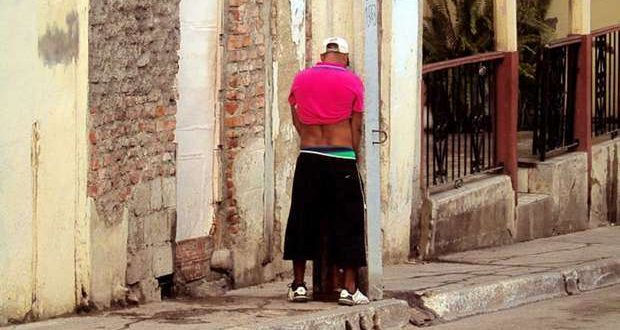
Man urinating in the street. From Cubanet.

Ivan Garcia, 31 July 2017 — Although they speak bad Spanish, with sentences chopped-up and sometimes incoherent, Sarah and Liudmila, in theory, are not illiterate. Their academic certificates show they passed the twelfth grade.

After finishing pre-university with their high school diplomas, they opted for the quickest way to make some money — working as escorts or prostitutes. Equally happy to sleep with a foreigner, of whatever nationality, race, belief or sexual orientation, or a Cuban, so long as they have enough money to pay for a night of fun, alcohol and cocaine.

Liudmila tells Sarah about her latest achievement. She does it in a made up language that they speak in Havana. continue reading

Original version: “Went out last night. Hooked a wild one who was at the pa’comer y pa’llevar (Havana cafe ). We downed a basin-full and then I went with the fool to his “holy room” (reference to a Cuban initiation ceremony). The guy gave me an incredible fuck. In the end he gave me 50 pesos. Today, it’s a second round with this freak; yawanna stringalong, bitch?”

Translation: “What I did last night. I won over an excellent client. We had some beers and then rented a room in a private house.  The guy was the best in bed. He paid me 50 dollars. I’m going to see him again today. Want to come with me?

Sarah and Liudmila, like thousands of young Cubans, prostitute themselves for a fistful of dollars. It’s their right. What is pitiful is the vulgar way they express themselves.

Right now, Cuba is exposed to various interconnected crises. An ongoing economic crisis; and a crisis of identity, with a whole lot of young kids who aren’t interested in their country’s history, or culture, and, fundamentally, the absence of morals and values, which is accentuated by the deterioration of the language. With people who speak worse and worse Spanish and whose conduct is sometimes vulgar and aggressive.

We know that the Castro regime has not done what it should have in economic and social matters.  Starting with services and going on through “revolutionary aesthetics” in design and architecture  – mostly clumsy and in poor taste – and on to its inability to provide meat, fish, seafood or fruit for the people, not just for tourists.

The hardships and shortages could be overcome with a government which is efficient and not corrupt. But, the crisis of values?

It would definitely take a long time to change that. Generations, probably.

You get in a shared taxi and say “good day” and no-one answers. People drop rubbish at every corner, leading to epidemics with who-knows-what consequences. Everyone thinks they have the right to play unbearably loud music in their house, and never mind the neighbours.

People frequently mistreat their children or hit their girlfriend or wife. It’s also become normal to drink beer in a bar and, although there may be a public toilet nearby, the men prefer to urinate in the street. And, in urgent cases, to defecate on the stairs in a building.

A story. I was going to my apartment, when I saw a woman excreting in the entrance to a building round the corner from mine. Seeing me scowling, the woman, the worse for a few drinks, says: “Hey, whitey, don’t act all refined. Everybody taking a shit does it where they can.  I’m not going to keep it bottled up, am I?

But the most lethal attack is on the Spanish language. One way or another, we Cubans have been killing it by incorporating in our vocabulary marginal expressions which many people think are funny or witty.

It’s not a joke. Sergio, a political science graduate, considers that the poor language employed by the official media, a virile and nationalist narrative, with a hint of tropical neo-fascism, has influenced the regression of Castilian Spanish and also affected the rules of civilised behaviour.

“Fidel Castro wanted to sweep away the past and adopted a new language – crude, arrogant and belligerent toward his opponents, inside and outside the country. Compañero and compañera were substituted for lady and gentleman. And he replaced politeness with a “proletarian manner”, which didn’t work in practice. All the government and Communist party propaganda is been filled up with repetitive slogans, initials and a boring lexicon. And that water brings this mud. Now, when they talk, many Cubans don’t have a command of more than five hundred words from the dictionary, they can’t write and their grammar is appalling”.

Sarah and Liudmila, Havana prostitutes, are good examples of this deterioration.

Translated by GH

The Vicissitudes Of A “Regulated” Person

A uniformed Immigration official reported Monday to Regina Coyula that she could not travel because she was “regulated”. (EFE)

14ymedio bigger14ymedio, Regina Coyula, Havana, 1 August 2017 — I should be in Panama right now. But on July 31, when I showed up at the desk at José Martí International Airport, I was shown to an office where an Immigration officer informed me that I could not travel because I was “regulated.” The word has unpleasant connotations because the most frequent regulation in Cuba is menstrual regulation. In any case, questioning that official about the cause of such a ban was futile. She did not seem to know anything beyond the bad news, and it is logical that she does not have the details, given the way compartmentalization works (or is supposed to work) within the Ministry of the Interior.

I can deduce with confidence that this measure comes from the department that “attends” opponents of the government, known as Section 21 or the Directorate of Counterintelligence Confrontation. In order to know why I was “regulated,” the old retirement villa of the Marist Brothers in La Vibora district, known Villa Marista, is the place where the questions are asked. continue reading

An officer on duty (‘visitor’, I think they call him) was responsible for hearing my complaint and handling the response. The officer dialed the phone and asked for Lieutenant Colonel Kenia, and explained that I was standing in front of him asking about the reasons for the “regulation.” On the other end of the phone, the person asked for my name and surnames, and after a pause the response was disconcerting: Section 21 is not responsible for my ban on leaving the country.

I, who have an idea – an old idea but an idea at least* – of how counterintelligence works, know that if you do not have a traffic ticket or a charge against you for stepping on the grass, and if you do not work for any state agency, but you do engage in independent and critical journalism, the cabals mark 21.

But the visiting officer, very convinced that my meager record of opposition did not qualify me for the league of 21, suggested that I visit the offices of Attention to the Citizenry for Immigration where – and these were his words and not my interpretation – they would tell me who had “regulated” me and why.

After a few stumbling blocks with the leadership of the place, I arrived at 20th Street near the corner with 7th, in Miramar. I did not omit any details speaking to the official who received me and I was direct: I went to Mexico on June 26, invited to a political meeting and I was not allowed to travel.

At the time I did not inquire about the measure, because it seemed to me part of a strategy to abort or disrupt the meeting since, like me, a large group of would-be attendees was left on land by decision of the authorities. But this July 31, I was not going to a political meeting, I was going to the Latin American and Caribbean Internet Governance Forum, an event sponsored by the United Nations. As I do not belong to any party and I am the leader only of my own opinions, I wanted to know by whose orders and why I remained “regulated.”

The official, a captain, clarified for me first thing was the mistake of the Villa Marista officials; they could not give me information about who decided this part of my life and why, but she would consult on my case with her superior, a lieutenant colonel and head of the Department of Attention to Citizenship.

I spent the wait of 40 or 50 minutes reading. Then the captain wrote down my version and put my phone number at the bottom of the page. She then informed me that the bosses had made the decision to “deregulate” me starting on Wednesday.

“That is, I can get on a plane at one in the morning on Tuesday/Wednesday?”

The captain said yes, and, cheerful, added that, just in case, she would suggest doing it after eight o’clock in the morning.

I thanked her for the attention and I walked out under a tremendous downpour. Just 20 minutes after leaving the Immigration office, the phone rang. It was the cheerful captain with a counter-order: “No, you can not travel until further notice and you will be notified.”

This is when one wonders what is the idea of ​​the political police and the guidelines they receive, because my participation in the event is not newsworthy, but my absence is.

Why is the government so sensitive when it is accused of violating human rights? What Rule of Law do they presume if they do not respect their own body of law shaped during this long authoritarianism? What are they afraid of, it the propaganda always insists that they enjoy the unrestricted and combative support of our working people?

But what am I doing asking rhetorical questions?

*Translator’s note: Regina Coyula, in an earlier stage of her life, worked within Cuba’s Ministry of the Interior

Cubans on the Island Don’t Like Maduro / Iván García

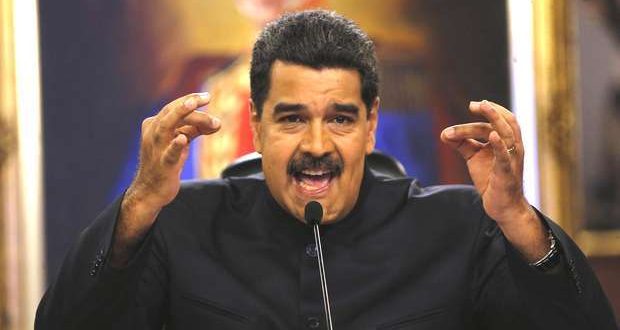
Venezuelan president Nicolas Maduro. Source: Washington Post

Ivan Garcia, 2 August 2017 — Not even the threat of rain accompanied by a slight coastal breeze dampens the terrible heat that of this summer in Havana. People on the street are in a bad mood.

The sun burns, public services are inefficient as always, and empty dinner plates mobilize thousands of capital residents to rummage around for provisions in farm markets plagues with shortages, or hard-currency stores that allow a hot meal.

In Cuba, one lives day to day. The leftovers from last night’s dinner serve as the morning’s breakfast. The number one national priority is food. Next, among other things, is escaping the unbearable heat in front of a noisy Chinese fan. continue reading

This is what Mario, a retiree, does, during the afternoon while the grandkids play in the street and in the adjoining apartment a goat bleats before being sacrificed for a Santeria fiesta, as he watches the Telesur channel with indifference, a channel with a shamelessly pro-chavista slant describing the atmosphere in Caracas the day after the elections of the Constituent Assembly.

To the majority of Cubans, the topic of Venezuela sounds like a broken record. It’s like reviving the past of the “marches of the combative people” in front of the former United States Interest Section in Havana — now the American embassy — screaming the demands of Fidel Castro’s latest whim.

To the retired Havanan, Venezuela brings a feeling of deja vu. “It’s the same shit, but with a different collar.  Poor Venezuelans. If this Constituent Assembly thing goes through they’re done for. Wherever Cuban style socialism goes in there’s nothing but a puppet with a head. These systems are impoverished by nature. They just generate pseudo-patriotic discourse, insults to anyone who thinks differently, and societal polarization.”

Mario has a daughter who “serving on a mission in Venezuela. She is in Carabobo and tells me that there are also protests there. She talks with the Venezuelans, although they do not support the opposition, they do not want to know anything about Maduro either. The man is a thug. With those Mao style shirts he puts on and his speeches wanting to imitate Chavez. This is going to blow up in his face. They don’t even want Maduro in the place. The bad thing for us is that when Venezuela is fucked the oil they give us will be hanging by a thread.”

To be sure, people consulted for Diario Las Americas, including four Cubans who worked as aid workers in Venezuela, do not know how the Constituent Assembly can rescue the South American nation from the economic, political and social crisis that the nation is experiencing.

“I do not this Constituent Assembly. What is that thing?” asks astonished Miladys, who has just returned from Guanabo, east of the capital.

For two and a half years, Asniel was a sports coach in the Venezuelan state of Cojedes. “It’s bad. At night you can not go outside. Poverty is huge. I came back a year ago and I think Venezuela, with its lines, shortages, drugs and violence, is much worse than Cuba. There is tremendous corruption among the rulers. Most Venezuelans are disgusted with Maduro, though many do not trust the opposition either, because most opponents are from the wealthy class.”

A Venezuelan couple living in Vargas state often travel five or six times a year to Cuba to sell “this and that, appliances, smartphones. We are mules. With the chavitos (CUC) we earn, we buy dollars and then we sell them in Venezuela,” says the man and adds:

“The situation in Venezuela is ugly, brother. Many people go hungry, because they only get one meal a day. Many people have lost weight. I was a Chavista, but I would not vote for the pelucones (opponents) either. The country is rotten from top to bottom. Government officials are only interested in making money by stealing and profiting from state assets. Crime is brutal. Whatever you have, they snatch it from you. If Maduro remains in power that can end in a civil war. Those who have money seek to emigrate, the poor will be fighting it out among themselves,” says the Venezuelan couple sitting in a park west of Havana.

Delia, a nurse, has bad memories of Venezuela. “I came back in December of last year. Nothing works there. You see the children of 13 and 14 with pistols and even machine guns. In Venezuela, life is worthless. They kill you for anything, a mobile phone, take your money or just for killing. The Chavistas I met work on favoritism and opportunism. They join state institutions to solve their problems. In the hills there are groups that support the government, but some of these types look like hired assassins. They ride on motorbikes armed to the teeth. They support Maduro in exchange for impunity. Venezuela is a very nice country, but the economic crisis and the stubbornness of Maduro have fucked it up.”

Josué, an old man who sweeps parks, smiles shyly when asked about the Constituent Assembly in Venezuela. “I suppose Maduro set up that whole plan to secure himself in power and rule for a long time, like Fifo (Fidel). Hey, when you hear someone talk about socialism and social justice flee, because they just want to be on the throne their whole life.”

Laura, an engineer, believes that Maduro’s Constituent Assembly is going to bring ’peace’ in a simple way, “dismantling the National Assembly, imprisoning most of the opponents and dismissing the prosecutor Luisa Ortega. He (Maduro) wants to imitate Fidel Castro, who implemented a Soviet-style constitution for ever and ever.”

For many on the island, the parallelism between the social processes of Venezuela and Cuba seems homogeneous. It looks so much like what we’ve experienced it’s frightening.

The Private Sector Accounts For 18% Of The Cuban Economy Despite The Obstacles

The Havana Consulting Group highlights the importance of Cuban exiles in the development of the private sector on the island through their financial support. (14ymedio)

14ymedio bigger14ymedio, Miami, 1 August 2017 – The work performed by the self-employed in the island already generates 17.8% of the gross income of the Cuban economy despite difficulties such as high taxes and shortages of raw materials, according to the latest report from The Havana Consulting Group (THCG), which considers this sector as “a necessary and essential force in the development of the country.”

The study by THCG contrasts with the measure announced Tuesday by the government, which, according to a note in the Communist Party newspaper Granma, intends to suspend the granting of several forms of self-employment licenses with the aim of curbing “illegality and disorder.”

The analysis published by the independent consulting firm based in Florida, states that the 535,000 people who work legally in the private sector (plus another 500,000 who do so illegally) on average receive, as a minimum, income ten times higher than what is received in the state sector. continue reading

“This change that is taking shape in Cuban society is irrefutable proof that, if the government were to decide to make a real economic opening and release the country’s productive forces, with a reform like Viet Nam’s or China’s, in two to three years Cuba could take out millions of Cubans out of poverty. In a short time it would be another country,” says THCG.

“This significant difference in earnings has led to the creation of new market segments with different levels of purchasing power, which have consumption patterns different from the rest of the population,” explains the author of the article, Emilio Morales.

Nevertheless, THCG argues that, despite the boom in private activities, “This significant difference in wages has given rise to the creation of new market segments with different levels of purchasing power, who have patterns of consumption different from the rest of the population.”

The report was drafted ahead of the authorities’ decision to limit licensing, affecting nearly thirty occupations such as home rentals and paladares (private restaurants) and cafés. The decrease in the issuance of these licenses may result in still greater increase of the state sector in the economy of the island.

“In the period 2010-2016 there has been a boom in the Cuban private sector. Entrepreneurs have developed very successful and profitable business models,” the study says.

According to THCG, the state agency GAESA, which belongs to the Armed Forces, controls strategic sectors such as 85% of the retail market, 40% of the hotel sector within the Cuban tourist industry, and 27% of the Telecommunications Company of Cuba, among others. However, the independent consultant’s analysis points out that “its business structure only represents 21% of the gross income of the Cuban economy, not 60%, as the media and news agencies have pointed out in recent weeks.”

The report also stresses the importance of Cuban exiles in the development of the private sector on the island through their financial support, “which has managed to create a market of goods and services that is estimated at between 2.5 and 3.8 billion dollars.”

“The fact that Cuban entrepreneurs already control 18% of the gross income of the economy with all the limitations they have is a good sign that the mutation has begun to take shape,” THCG said.

The Betrayal Of The Minstrel

Silvio Rodríguez lost the ‘blue unicorn’ of his creativity many years ago. (EFE)

14ymedio bigger14ymedio, Yoani Sanchez, Havana, 30 July 2017 — Songwriters are often confused with prophets or leaders. The output of numerous troubadours has ended up molding consciences, erecting political slogans and becoming unquestionable mantras. Every social movement needs its musical soundtrack and in Latin America these loners of the guitar have sonorously accompanied more than one.

Chroniclers equipped with melodies most commonly take these songs literally, confusing the characters of their stanzas with the flesh and blood being who ascends the stage. Under the lights, in the intimate atmosphere of a theater, they intone those phrases that are later later subverted for thousands of spectators into slogans and postures. continue reading

After the hard years in which a ballad could cost them their lives or prison, Latin American troubadours who shaped the protest songs now exist in a stage of permissive tranquility. The fiercest battle is waged against reggaeton, not against censorship. Their greatest fear lies not in swelling the blacklists, but in the audience moving the dial to look for some other, “more moving,” music.

They are no longer the focus of the reviews and the critics, and find themselves in the boring corner of the consecrated who no longer fill stadiums nor provoke sighs. They live on past glories and rarely does one of their songs make it to the top of the lists, although on TV they are still presented as “unsurpassable” or “indisputable.”

Among these shaggy ones of the easy verse, the most roguish have ceded their guitar to some power they criticized years ago, to vegetate in the shadow of festivals, tributes and interviews. The few darts they still throw in their lyrics mix the most recurring commonplaces of progressive discourse, while their clothing maintains every trace of a disguise of calculated sloppiness.

The best-known names of a few decades ago, today they caress the discs with which they assembled crowds and made their consciences throb. In the absence of those emotions, they are now engaged – without score and with weakened voice – in their professorships of how to behave civically or how to incite a rebellion that they themselves dismissed as unprofitable.

Some of those musical themes they composed, when they breathed the air of making love not war, have been hijacked by militants and extremists who sing them – neck veins bursting – in front of their political opponents. From libertarian musical expressions they became the gags to silence differences, mere hymns of blind battle.

The times of rhyming and believing each verse have given way to cynicism. Many of the minstrels who put rhymes to nonconformity moved away from the public scene; others parked their uncomfortable songs in search of greater income, while the majority, having lost the muse, have become defenders of whatever cause can hide their creative drought.

Nostalgic for a time when crowds gathered, more than one has chosen to sing to the powerful and dedicate his refrains to certain unpresentable populists. They compose to order, exalting in their refrains faded revolutions transmuted in dictatorships, and so they earn a space on the official platforms where the promises abound and the sincerity is lacking.

These are not the times when Victor Jara took his art to the ultimate consequences. “I do not sing for singing / nor for having a good voice, / I sing because the guitar / has meaning and reason,” said the Chilean who died at the age of 40 with dozens of bullets embedded in his body. Now there are plenty of artists who take care with every word to avoid moving beyond the scheme of the politically correct. Composers of polished rhymes and well-combed hair who walk through government palaces and whose honoris causa is welcomed.

They are a part of that plethora of intellectuals and artists who appear in the family photo, pointing out anyone who confronts them as the cause of all problems. Bitter anti-imperialists, false ecologists and distrustful of wealth – as long as that phobia does not affect their own pockets – they star in cantatas against distant powers and governments under which they do not live.

About four years ago, the Spanish singer-songwriter Luis Eduardo Aute said that he identified with President Rafael Correa’s Citizen Revolution. The statement was made at a time when the Ecuadorian ruler was engaged in a tough fight against the media in his country and put strict limits on freedom of the press. The irreverent poses always involve a lot of myopia, of not seeing beyond the fabricated irreverence. Under the influence of his own refrains, Aute believed in the character of his songs and that: “They say that everything is tied / And well tied to the markets,” when in reality he forgot that other powers also like to control every detail, especially words.

In Cuba lives an extreme case. Silvio Rodríguez lost the ‘blue unicorn’ of his creativity many years ago. As his subjects were filled with visible seams and boredom, his public outlook became closer to the official discourse. He stopped writing unforgettable songs to engage in diatribes against “the enemies of the Revolution.”

Recently, the singer added his signature to the manifesto Let the Catalans Vote, asking the Spanish Government to allow a referendum on independence in Catalonia. Rodríguez’s name is accompanied by other figures such as artist Yoko Ono, African-American philosopher Angela Davis and Nobel laureate Rigoberta Menchú.

Rodriguez, author of Ojalá, initialed the statement that “a large majority of Catalans have repeatedly expressed in various ways the desire to exercise the democratic right to vote on their political future.” He considers that “preventing the Catalans from voting” contradicts democratic principles, precisely those that Cubans have been unable to enjoy for decades in their own land.

There is nothing left in this Rodriguez of the rebellion that characterized his first tunes. In 2003, he signed the Message From Havana To Friends Who Are Far Away, in which a group of intellectuals offered justifications for the imprisonment of 75 dissidents on the island. The document also supported the decision of Fidel Castro’s government to shoot three men who hijacked a passenger ship to try to escape to the United States.

With a comfortable life, a recording studio authorized by the Government and with a full table, the minstrel went astray in bows and silences. His music, which once accompanied the disobedience of so many citizens in this part of the world, is now a part of the official lyrics, of the symphony of power.

_____________________________

Editorial Note: This text has been previously published by the Spanish newspaper  El País  in its edition of Sunday 30 of July.