Cuba: The Return of the Power Cuts / Ivan Garcia

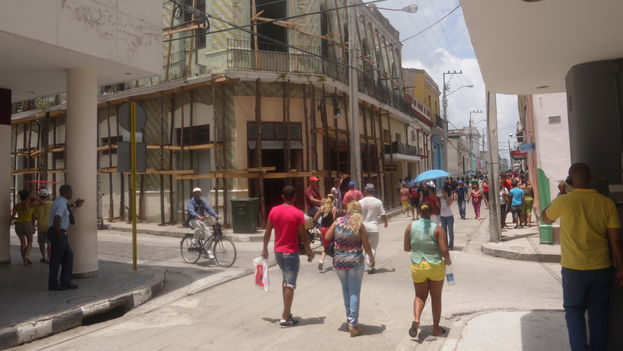
Black out in Cuba (Cubanet)

Ivan Garcia, 27 May 2016 — As of three weeks ago there have been power cuts of up to three hours in different parts of Havana. Sometimes longer.

“Friday, April 29 in Altahabana (a neighbourhood in the southeast of the city), the power was cut off from eleven at night until four-thirty in the morning. Because of the heat, I spent the whole night waving a fan over my eight-month-old baby. Two days earlier, there was a three-hour outage in the afternoon,” I was told by Magda,  who works at Comercio Interior.

In the central and eastern provinces, the power cuts started in the middle of March. According to Reinaldo, who lives in San Pedrito in Santiago de Cuba, 550 miles east of Havana, the blackouts aren’t the only problem. continue reading

“In some parts of Santiago we get water every eight or nine days. People store it in buckets, bowls and improvised tanks, which increases the chance of mosquitos transmitting dengue, zika and chikungunya. You can add to that the countless earthquakes you get in the months of December through March. Many families sleep in the parks because they are afraid their roofs will collapse. The power cuts in Santiago are frequent. Sometimes half an hour, and other times up to five hours,” Reinaldo told me.

In Remedios, a town in Villa Clara province, 180 miles from the capital, Odaisi, an intensive care assistant, tells me that the cuts have become worse since the end of April.

“There are two or three a week, and sometimes up to five hours, or all night. People go out in the street because of the dreadful heat. Lots of people phone the electric company but they get no reply,” Odaisis said.

Esther, who works in a substation on the outskirts of Havana, is sure it isn’t because of a fuel shortage, which is what many people think. “Fifty percent of the electricity generated in the country uses Cuban diesel. And there are new plants which run on gas. The problem is unexpected breaks in the cables, which, together with maintenance to the power stations in Matanzas and Holguín, have created power shortages in peak hours.”

A power company official, who preferred to remain anonymous, didn’t think that the present cuts will get as bad as the ones in the years of the Special Period [a time of severe crisis after the collapse of the Soviet Union and the elimination of its aid to Cuba].

“No way. The country is much better prepared to deal with electricity supply. Thousands of kilometres of cable have been replaced, transformers and connections have been renewed, and power distribution losses, which got to thirty percent, have fallen to five percent. There is also more modern equipment in the power plants, and we have a contract with Russia to build two new power stations and modernise four others. Our present problem is due to breakages, but we will sort them out in the month of May,” the official assured me.

But Noel, who works at CUPET, the initials of the Cuba Petrol Company, is doubtful. “Out of the 105 thousand barrels a day we were receiving from Venezuela two years ago, now we only get sixty thousand, and my bosses tell me that they expect it to reduce further down to forty thousand or fewer barrels. In Venezuela, because of the drought, and the bad technical state of their power stations, there are constant power cuts outside of Caracas. To that you can add the economic crisis and the fact that oil exports represent ninety-five percent of their income.”

Although a barrel of oil has fallen from over a hundred dollars a barrel a few years ago to a little under thirty dollars on the international market, Orelvis, an economist, believes that the Cuban government doesn’t have enough money to buy fuel.

“Bartering with Venezuela is the perfect business deal. Medical services in exchange for oil, and part of the oil gets re-exported. Now electricity generation in the country has increased. More hotels and private businesses consuming more, and some of the people with money to buy things have air conditioning and electrical appliances in their houses. I think there has been a setback in electricity production, but I don’t think that the situation can be as serious as in the 90’s, and the Special Period, but people need to be ready for programmed blackouts in the coming months,” he thought.

Raisa, a technician in the electric company sees the problem differently. “Every province and town in the country has an assigned level of fuel consumption, and, for various reasons, most of them are consuming more. That, plus the recent breakdowns, are the cause of the latest outages.”

But it’s difficult to convince the Cuban in the street with technical arguments. There is nothing they like less than a power cut.

“It’s one damn thing after another. A screw-up getting any food. Salaries which are too low, not enough public transport, and now they are telling us that if the drought continues, the water supply will be cut in Havana. And, the cherry on the cake, more power cuts. It’s too much. We have had these problems for nearly sixty years, and they have never come up with a definitive solution,” complains Adelberto, a pensioner.

The electricity cuts in Cuba are cyclical. For one reason or another, they always recur. It’s one of the pernicious legacies of Fidel Castro’s revolution.

Translated by GH
“I’m Going to Set Fire to It and See What Happens” / Anddy Sierra Alvarez

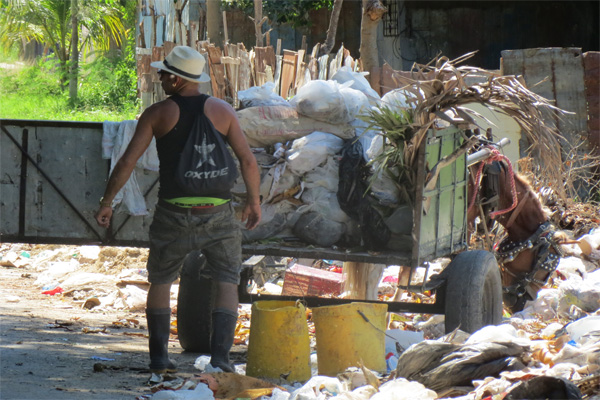
Man throwing trash into the dumping ground. (Photo: Anddy Sierra)

Anddy Sierra, Havana, Cuba, 30 April 2016 — The battle by Lumumba residents against the dumping of solid waste in the neighborhood is all but lost. The garbage dump, established three years ago, is bigger today and includes debris from roadwork done in the area.

According to residents, there were initially only twenty meters of trash, but today it covers more than a hundred. Local residents point to Comunales, the company in charge of collecting the solid waste, as the main cause for what is happening. continue reading

“They blame us for creating this dump but it’s not our fault. In this borough (Arroyo Naranjo) it’s Comunales; they are the ones responsible for all the waste here,” said Amelia Corrales, a resident of Lumumba.

“The problem is that we are black and that makes us scapegoats,” notes Yaima Lombillo, a resident of a neighborhood that is predominately dark-skinned. We either have to put up with it or set the trash ablaze to get the firemen to come, as happened three months ago.”

Enrique Peña, a worker at the local headquarters of the company, says that every three months they pick up all the refuse. “We come with a six-person brigade, two trucks and a bulldozer to collect the debris left there by residents. It takes us three hours and in the end everything is clean,” he said. Pity.

He continues, “We don’t throw our trash there but neither do we make sure that some of our workers aren’t dumping garbage there instead of going someplace further away.”

But the problem is that residents do see company workers dumping their trash.

“I passed there three times yesterday and there was a worker throwing garbage there instead of picking it up. When I returned, there was another one doing the same thing. We will continue living in filth and breeding more Aedes aegypti mosquitoes [carriers of dengue fever and the zika virus],” said Miguel Borroto, an area resident.

Local authorities have not responded to the problem. Attempts were made to speak to the local representative but he refused to discuss it. “I am very busy and am not going to my waste time talking to you,” said Alejandro, the area’s representative, when I asked him about the Lumumba dump.

Residents will have to make due with Comunales’ three-month schedule for cleaning an area which apparently its own employees are trashing. “I am not expecting much,” says Yaima Lombillo, “so I am going to set fire to it all and see what happens.”

A Dead End / Fernando Damaso

Fernando Damaso, 24 May 2016 — Historically, Venezuela has been a country of dictators, as have others in Latin America: Simon Bolivar was one, regardless of his merits as the Liberator of America from the Spanish yoke;  and then the Monagas brothers were (1846-1858); followed by Guzmán Blanco (1870-1888), Cipriano Castro (1899-1908), Juan Vicente Gómez (1908-1931), Delgado Chalbaud, Marcos Perez Jimenez (1950-1958), Hugo Chavez and now, in the process of learning, Nicolas Maduro.

Maduro’s pedantry, his attempt to be Chavez’s “designated” successor, his accelerated loss of popular support, the unassailable triumph of the opposition in achieving a majority in the National Assembly, the systematic setbacks of his operation and, now, the overwhelming number of signatures collected to proceed with a midterm recall referendum, plus his economic failures, have made him hysterical, inventing conspiracies, economic wars, interventions and other absurdities, products of his fevered mind and those who guide him from inside and outside the country. As Uruguay’s former president Mujica said, “He is madder than a goat.”

To this is added the environment around him which is not favorable: Argentina without Cristina Kirchner and with Macri, Brazil without Dilma Rousseff and with Temer, Evo Morales unable to be reelected, Correa responsibly dedicated to the his country’s recovery from the earthquake, and Cuba getting worse all the time.

As if that were not enough, the institutions and organisms created by the Latin American Left (UNASUR, ALBA, CELAC and others) in the years of splendor, for their mutual support and to maintain themselves in power, ignoring those existing previously, are in the doldrums, having lost their main sources of economic support, and very little has been done, other than some passing some generic declarations, more formal than real, to make it clear that they are still breathing, although they are in intensive care.

Maduro blames the opposition, the “empire” the OAS, Uribe, and the many who criticize the problems in Venezuela, but forgets that it is, above all, he and Chavism that is to blame. With Maduro and those who sustain him in power, Venezuela will not emerge from the political, economic and social crisis in which it finds itself.

Internet Domains, Sovereignty And Freedom / 14ymedio, Regina Coyula

Of the approximately 7.4 billion people living on the planet, only 3.2 billion are connected to the Internet. (CC)

14ymedio bigger14ymedio, Regina Coyula, Havana, 25 May 2016 — For Cubans who update their domestic entertainment weekly with the now famous, private and anonymous “Weekly Packet,” a subtitle in bright greenish-yellow letters at the beginning of movies has become familiar. It is the ever present www.gnaula.nu, which appears so frequently that it spurred my curiosity: I found it impossible to recognize what country corresponded to the extension “.nu” so I turned to the always useful Wikipedia.

Surprise. The country where all the movies we watch at home are pirated is Niue, an atoll with the pretensions of a little island, attached to New Zealand. In 1996, an American (who of course doesn’t live in Niue) took the rights to “.nu” and in 2003 founded the Niue Internet Society, and offered to the local authorities to convert the quasi-island into the first wifi nation of the world. The offer was rounded out with a free computer for every child. Nothing spectacular; we’re talking about a population of barely 1,300 people. continue reading

The irony is that while “.nu” generates enormous profits, the inhabitants of Niue who want to connect from home and not from the only internet café are obliged to pay for installation and service.

So I find another curiosity: the second most used internet extension after “.com” corresponds to another little place in the corner of the Pacific, also unnoticed, a group of islets of roughly four square miles. Tokelau is the name of this place whose domain “.tk” hatched in 2009 and was free, and today it is the virtual home of hundreds of thousands of sites of dubious probity.

The way in which the territorial domains of each country (ccTLD, which stands for: country-code-top-level-domain) are managed is very different. The Internet Corporation for Assigned Names and Numbers (ICANN) has left the who and how to the discretion of each country. Many countries have privatized it either in the hands of institutions or companies created for that purpose, while in others it is done by an entity attached to a stage agency.

The two ways of operating ccTLDs have advantages and disadvantaged. Deregulating the extensions tips the balance toward the more profitable companies to the detriment of the agencies, NGOs and social and cultural institutions. Decreasing the influence of governments, can weigh heavily on the sovereignty of countries with fragile economies or small and young countries.

As a counterpart, state-regulation administration tends to protect social and cultural interests, a successful management style that can lead to gains that positively impact national life. It can also happen that the process for buying a ccTLD are restrictive or discriminatory, sheltering under deliberately vague rules to be applied at their discretion, as is the case with Cuba’s “.cu”.

In Latin America, Argentina is the only country that offers a site for free; hence the millions of sites with the extension “.ar”. This gratuity is about to change because a way to collect payments is being studied. In Chile and Nicaragua domains are administered through public universities. In Guatemala it is also done through a university but in that case a private one.

State regulation occurs in Venezuela through the National Telecommunications Commission (Conatel), and in Cuba through the Information Technologies and Advanced Telematic Services Company (CITMATEL).

Colombia, and without going into details about its antecedents, is a reflection of a similar debate ongoing in many countries. A private company owns its ccTLD and they believe that the fact that 89% of the owners of a “.co” site are foreigners living outside the country, far from violating national identity, internationalizes Colombia and brings its brand to the entire world. What underlies these debates is that the market is imposed on cultural values and little can be done in the defense of an intangible patrimony.

But ultimately, who governs the Internet? Any observant newcomer claims that the United States governs it. On its territory are the institutions and the majority of the servers intended to organize what would otherwise be chaos.

The now well-known ICANN assigns domain names (DNS) to IP addresses, has a contract with the government and is located in California. Very influential internet companies such as Microsoft, Google and Amazon are also American. By September there will be news of a change; simply that ICANN will be independent of the United States Department of Commerce.

In this asymmetric influence are counterpoised the interest of other parties involved and also of the internet. International organizations such as those dealing with trade (the ITO), intellectual property and the International Communications Union have been involved in conjunction with ICANN. Virtual space modifies the notion of sovereignty, with added risks to equality and diversity; so the term governance has gained importance in the design of policies, where governments, civil society, business, academic and technical innovators come together.

In the same way that innovative technicians have placed in our hands the protocol that ensures open access to the internet from any type of device, it behooves governance to establish policies, even if they are not binding, to guarantee freedom of expression and information, full access and limits on control.

Shameful Friends / 14ymedio, Yoani Sanchez

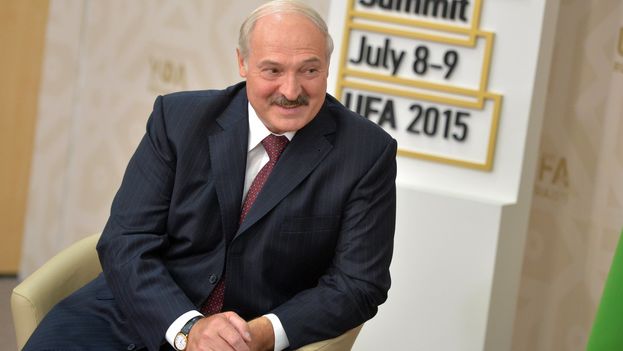
Alexandr Lukashenko has been in power in Belarus since 1994. (CC)

14ymedio bigger14ymedio, Generation Y, Yoani Sanchez, Havana, 25 May 2016 – People with whom we share sorrows and joys are a reflection of ourselves, however different they may appear. As friends we choose them to accompany us, but also to complete us, with the diversity and continuity that our human nature needs. The problem is when our choices of coexistence are not based on affinities and preferences, but on interests and alliances focused on annoying others.

In the same week, the Cuban executive has embraced two deplorable authoritarian regimes. A few hours after Cuban Vice President Miguel Diaz-Canel Bermudez met with government functionaries in Belarus, Havana’s Plaza of the Revolution hosted a meeting between Raul Castro and a special representative from North Korea’s Workers Party. Disgraceful comrades, shamelessly embraced and praised by the island’s officialdom.

In a world where civil society, calls for the respect for human rights, and movements that promote the recognition of rights are making themselves heard ever more loudly, it is difficult for the Cuban government to explain his good relations with Europe’s last dictator and with the cruelly capricious grandson who inherited power through his bloodline. What united the island’s authorities with similar political specimens?

The only possible answer is sticking their finger in the eye of Western democracies and the White House. The problem with this attitude lies in the demands from these fellow travelers for commitments and silences. Diplomatic friendship is converted into complicity and the comrades end up defining the nature of those who have chosen their company.

‘El Sexto’: “Myths are very dangerous, but an idea can break them.” / 14ymedio, Maria Tejero Martin

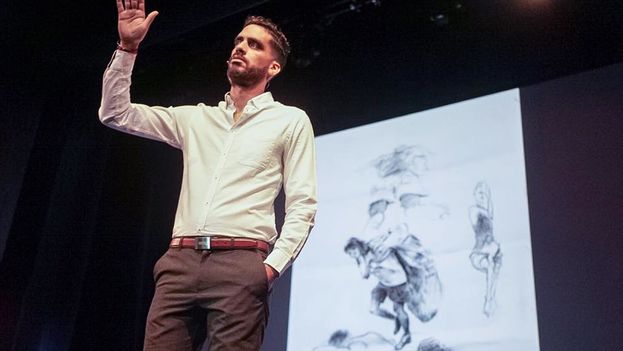
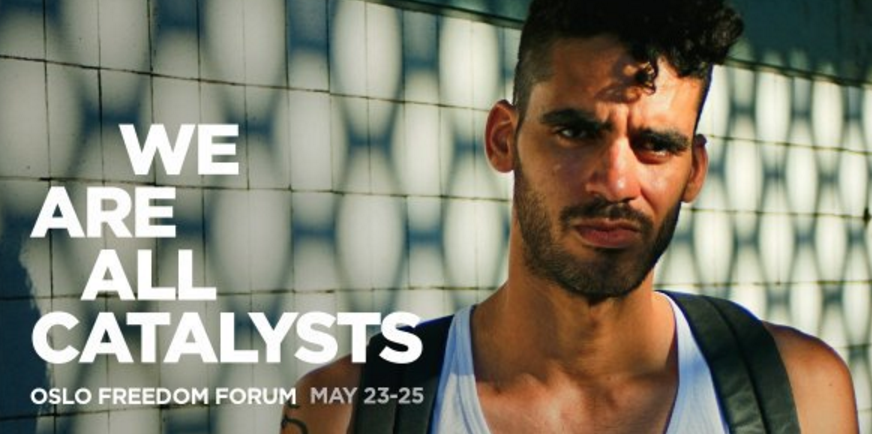
Danilo Maldonado – known as El Sexto – at the Oslo Freedom Forum. (OFF)

14ymedio biggerEFE (via 14ymedio), Maria Tejero Martin, Oslo, 24 May 2016 – Danilo Maldonado is known as El Sexto the name engraved in ink on his skin and that he paints on the walls of Havana to plant an idea of freedom in his compatriots, like a seed that flourishes and breaks the “dangerous myths” that, he says, surround Cuba.

When he was nine he caused his mother grief when he drew Fidel Castro in his military uniform but with the head of a monkey; by his twenties he had decided to turn himself into the antihero El Sexto (The Sixth), in response to the regime’s campaign to free Los Cinco (The Five), Cuban agents arrested in the United States. continue reading

In his thirties, after the United States initiated contacts with Cuba after years of the embargo, Maldonado “knew I would go to jail” he told EFE, when he was inspired to paint the names “Raul” and “Fidel” on the backs of two pigs for a piece of Orwellian inspired performance art which he was unable to carry out.

“The worst thing is that I never got to release them, but I went to jail, I went to jail for something that never existed, without cause or role,” explained Maldonado, who was declared a prisoner of conscience by Amnesty International.

His incarceration prevented him from collecting the Vaclav Havel Prize for creative dissent a year ago in Oslo, and today he is in the Norwegian capital for the first time, where he is participating in the Oslo Freedom Forum, although he says that he has already attended this annual forum of activists and defenders of human rights “in conscience.”

This is a basic word for this artist who considers himself a “prisoner of conscience” who seeks to “awaken” the conscience of Cubans and open the eyes of foreigners whose romanticism prevents them from seeing that the vintage cars that circulate around Havana “means that we are stuck in time.”

Meanwhile he draws on a page, showing the Little Prince that he carries on his long lean arm. And if, as Antoine de Saint-Exupery’s character would say, “the essence is invisible to the eyes,” Maldonado feels that his mission is to attack just there, on the plane of abstract consciousness, where he “works with things that don’t exist to make them a reality.”

Like freedom in Cuba, he laments, although he is “sure” that art will first bring rights to the island and later allow them to become reality, in the same way, he explains, that he conceived the hunger strike he undertook in prison as a work of art titled “Mao’s awakening.”

“I said that if consciousness could change what is, it should save me from there, I would die because I would have been talking complete shit. The bars have to opened by the hands of the repressor himself, only in this way will art exist. And so it happened,” he affirmed.

Maldonado believes that art can serve as a catalyst for any change, like a predecessor, and says that “an idea can destroy what exists.” Even the regime.

“I want to bring down a dictatorship that has lasted for a very long time in my country, demystify it and demystify the false canons it was selling, like that of Che Guevara,” says El Sexto.

“Often it sold [the idea] that wearing green and roaming the world with weapons was cool. And it is not cool. Cool was a guy like Martin Luther King, Mahatma Gandhi or Christ. But cool is not the type of people who believe they are rebels and what they are is a murderer who wants to impose his idea,” he added.

Maldonado does not mince words, either to defend the caricatures of Muhammad or to charge his followers who have spent centuries killing in his name.

“That is what I don’t want to have happen in my country, that I die and that fucking nutcase passes as a savior. What I want is that my art demystifies and destroys him, leaves his essence in the base and that people understand he is not good,” he says, referring to Castro.

For him, he is confident that “art can do anything,” even with some “very dangerous myths.”

“They manage to go on for so long that if people don’t chip away at them they are more dangerous dead than alive. But an idea can destroy and undermine anything (…) That is why they fear me and follow me. They took me prisoner because they know of this influence,” says the artist, who says he will continue living in Cuba and will give his life for what he considers his duty: “Awakening” consciences.

Cuba is Not Brazil or Venezuela / 14ymedio, Pedro Campos

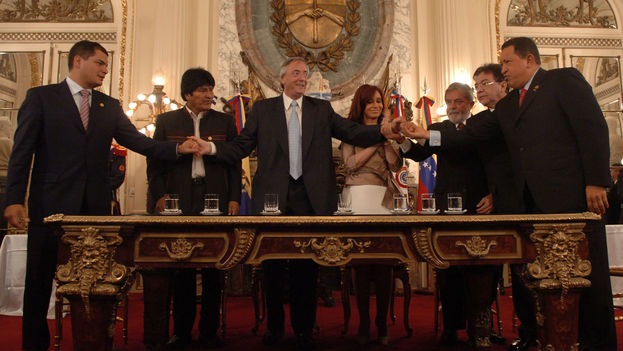
The leaders of the so-called wave of 21st Century Socialism, gathered during the creation of the Bank of the South. (DC)

14ymedio bigger14ymedio, Pedro Campos, Havana, 24 May 2016 – The receding tide of the populist wave in Latin America, in particular the delicate situation in Venezuela and the ouster of Brazilian president Dilma Rousseff, has uncovered all kinds of speculation about the supposed relationship of cause and effect controlling political-economic and social process in Cuba.

Those who are still waiting for the problems within the island to be solved believe they can be resolved from outside, while the ‘statist fundamentalists’ take advantage of the ‘threat’ to entrench themselves in their anti-democratic and anti-socialist positions.

However, Cuba is not Brazil or Venezuela, in any sense. Its processes have different origins, circumstances and dissimilar dynamics of development and, therefore, an evolution that proceeds along uneven paths. continue reading

Suffice it to recall that this populist wave began almost 40 years after the triumph of the Cuban Revolution of 1959, at a time of the sharp decline, due to natural exhaustion, and the disappearance of the socialist camp, and that Hugo Chavez came to power through democratic means, subject to the general principles of democracy and its mechanisms.

Now, it is precisely the setting aside of these democratic institutions and the assumption of authoritarianism that is at the center of the reversal of that wave.

This has nothing to do with the emergence and evolution of the Cuban political process, its origin and its authoritarian essence. It emerged as an offshoot of the violence and social polarization inherited from Batista’s coup d’etat and the subsequent armed confrontation. This made possible a government that went against the grain of the demand for democracy that served as a base of support for the fight against the Batista dictatorship and that was built on the confrontation between the United States and the USSR, during the Cold War.

The “socialism of the Cuban state,” which is neither socialist nor Cuban, was not what inspired this wave, but it rode it for its own benefit, encouraged the confrontation with “American imperialism” that feeds the geopolitics of its subsistence and, in any case, encouraged its authoritarian and state-centric tendencies that brought it to the current situation.

We mustn’t forget that it was Chavez and his oil that made possible the abandonment of the reforms forced by the fall of the socialist camp and the subsequent so-called “Special Period in a Time of Peace” in Cuba—a time of severe economic crisis after the loss of the Soviet subsidies.

We must also remember that the paradigms of the so-called 21st Century Socialism, which originated and gave strength to this wave, were related to democracy and participatory budgets leading to greater citizen involvement in decision making of all kinds, with the direct intervention of workers in the property, management and distribution of wealth and the Marxist concept of the law of value, pushed by Hugo Chavez, Heinz Dieterich and the People’s Summit held in Cochabamba, Bolivia, in 2006.

These fundamentals were never adopted by the Cuban government-party-state and later were gradually abandoned by Chavez himself in favor of state-centrism.

This phase of decline depresses the influence of the Cuban government in the region and could affect the support that, for Cuba’s state monopolies, are represented by Venezuelan oil and the billions of dollars Cuba obtains in “leasing fees” for Cuba doctors and paramedical personnel hired out in “medical missions” abroad.

But from there to an assumption that the Cuban government is threatened, is quite a stretch. To expect regional pressures in support of respect for human, political and civil rights, yes; to imagine a regional isolation similar to the 1960s, no. Suffice it to recall the new scenario in Cuba-US relations and the possibilities for economic exchange.

“Only Revolutionaries can destroy this Revolution,” Fidel Castro said in November 2005 at the University of Havana. This is true: the most dangerous enemies of the Cuban political process, who have been leading it to stagnation and to the “abyss,” are those who themselves are entrenched in power and who stubbornly impede the advance toward the democratization of politics and the socialization of the economy.

The political system defined by a dictatorship of the proletariat, originating in Stalinist Russia and perfected by the guerrillas in power, liquidated the opposition early on, eliminated its material base of support by nationalizing everything, and excluded all of the democratic mechanisms—multi-party elections and the full exercise of civil and political rights, the recall referendum process, impeachment, and a democratic constitution—essential to confronting authoritarianism. These mechanisms must be created from below.

Thus, democratization will be a process, not an act, that demands the creation of an atmosphere of relaxation and harmony that can facilitate an inclusive national dialog; the recognition of fundamental freedoms; moving to a new Constitution that is the fruit of the creation and democratic and horizontal discussion of the Cuban people and approved by referendum; promulgation of a new democratic electoral law; and the establishment of a modern state of law with full functional and informational transparency, under permanent popular control: a Republic that is democratic, humanist and supportive, one in which there is room for everyone.

The Step-Motherland’s Droit de Seigneur / 14ymedio, Miriam Celaya

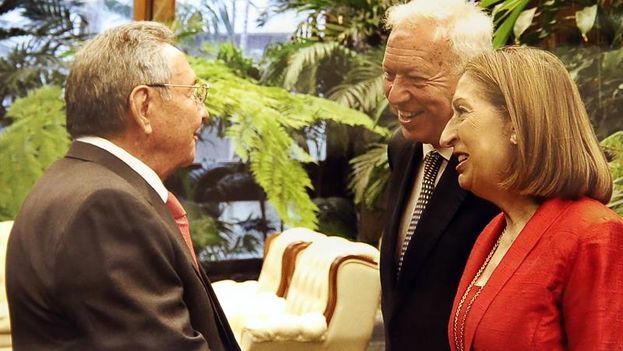
Spanish Foreign Minister José Manuel García-Margallo and Minister of Development, Ana Pastor, greeting Raúl Castro. (EFE / Estudios Revolución)

14ymedio bigger14ymedio, Miriam Celaya, Havana, 23 May 2016 — Jose Manuel Garcia-Margallo, Spain’s Minister of Foreign Affairs and Cooperation, recently made his second visit to Cuba. Unlike his first, in November 2014–when the general-president did not deign to meet with him—this time his “highest excellency” Spanish Foreign Minister was emphatically welcomed by the upper echelons of power.

This new attitude between both sides is not so strange, since García-Margallo was in a “democratic” mode in 2014, triggering the olive-green gerontocracy’s suspicion and displeasure. Now, the Chancellor has come solely in a business mode, with the mission to strengthen and expand as much as possible Spain’s investments in Cuba before the resources of the powerful northern neighbor intrude (for a second time) in the territory of the former Spanish colony, once again depriving Spain of its devalued Crown jewel. continue reading

This time, the Castro’s media monopoly reported cryptically, in a brief note, the exchange with “the distinguished visitor,” who was accompanied by senior officials in the fields of Development and Cooperation of the Spanish Government and by the Ambassador of that country in Cuba, citing “positive relations between the two nations” and “the recent signing of agreements in Madrid regularizing Cuban’s intermediate and long term debt,” which “creates favorable conditions” for strengthening of relations between the two countries.

There is no doubt that the current scenario proved advantageous for the Spanish Chancellor when talking business with the satrapy

On Cuba’s side, the meeting was attended by the Foreign Minister, a Deputy Chairman of the Council of Ministers, the Minister of Foreign Trade and Foreign Investment, and the Foreign Affairs Deputy Minister. It was obviously a business visit that was took place in greatest secrecy.

So, as usual, details of interest did not reach the public about bilateral economic issues, debt terms and repayment of potential Spanish investments, although it is known that Spain is one of Cuba’s main trading partners and has maintained a strong business presence for more than two decades in Cuba, especially in the tourist and hotel field. Therefore, these should be topics of importance for the population, in the midst of the deep Cuban crisis.

In another sense, but equally secret, there were the activities carried out by the same Spanish Foreign Minister during his previous visit. Less than two years ago, the now “most excellent” visitor raised great distress at the Palace of the Revolution when he delivered the keynote On Living through the Transition: a Biographical View of Change in Spain–also behind closed doors and in the presence of a handpicked audience—in such a government space as the Higher Institute of International Relations. The piece established a comparison between the Spanish reality at the end of the Franco era, the beginning of the process of democratic transition, and the Cuban reality today, under the late Castro regime.

In retrospect, it is fair to concede that—although García-Margallo’s speech in November 2014 in Havana did not reach the national media—none of the governments and representatives of democratic nations who had visited us until then had so boldly expressed criticism towards Cuban official policy nor had they spoken about the importance of freedoms of speech, press, assembly and association.

However, on his first visit, the Spanish Foreign Minister did not enjoy the same privileges as US President Barack Obama, whose speech–directed to all Cubans and not to a select group of Castro’s faithful—was broadcast in real time through Cuban media, and it made a deep impression in the minds of ordinary people. Of course, the US president is not one to be provoked.

It is as if favoring the protection of the interests of Spanish business in Cuba must necessarily involve forgetting the exclusion Cubans live under, so exploited by those same entrepreneurs

That explains why Cubans did not learn about the audacity of García-Margallo, the first representative of a democratic government who mentioned, before an official venue’s microphone, ideas as subversive as the importance of political party pluralism as a pillar of democracy and national harmony, efficiency of peaceful political transitions in order to achieve true lasting changes, and the regaining of freedoms violated by long lasting autocratic regimes.

On that occasion, García-Margallo referred to the need for monetary unification and acceleration of changes in Cuba, decentralization of decision-making, ratification of the United Nations covenants on civil, political, economic, social, and cultural rights, and freedom of association, among other topics that are also taboo for the Cuban government.

In short, we would need to point that, when comparing the Spanish foreign minister’s approach on his first visit to Cuba with his second, there is no doubt that there was a setback in terms of defense of human rights and democracy for Cubans, as if favoring the protection of the interests of Spanish business in Cuba must necessarily involve forgetting the exclusion Cubans live under, so exploited by those same entrepreneurs. All this goes against the grain of the hypocrisy of officials of that country, who, when it is convenient for them, make reference to “the close historical, cultural and blood ties that bind our two nations.”

Now it turns out that García-Margallo has even chosen to be the interpreter of the wishes of the Cuban people, so his purely business mission in Cuba is not only justified by the large presence of Spanish capital in the former “always faithful island of Cuba” but because “the Cuban people now primarily want progress and economic development, and we will help in that change.” Unfortunately, we do not know how he will manage to do that. For now, freedom and the ratification of the covenants, blah, blah, blah … is still pending. Ah, Spanish politicians, always so fickle!

If Cuban rulers of the past 57 years are so very “Spanish,” it is not surprising that things in Cuba are so very topsy-turvy

However, the current considerate stance of the Spanish authorities towards Castro once again addresses the question of “roots,” no matter the tree. According to media allegations, Mr. Garcia-Margallo recently stated “in Cuba, apart from human relationships, Fidel’s and Raul’s father was a soldier who fought on the side of our troops during the [War of] Independence, and he later changed sides,” so the dictator brothers “are very, very Spanish.”

Well, finally! That explains everything: if Cuban rulers of the past 57 years are so very “Spanish” it is not surprising that things in Cuba are so very topsy-turvy, and even less strange that now—in the midst of the transition from Castro-communism to Castro-capitalism—the step-motherland’s claim for a certain droit de seigneur is being encouraged from La Moncloa*, especially when history, always so whimsical, seems to be closing another cycle that–bridging the gaps—mimics that episode over a hundred years ago when Spain and the US were quarreling over the spoils of the Island-in-ruins.

*Official Madrid residence of the Spanish Prime Minister

Translated by Norma Whiting

Lady in White Berta Soler Threatened With Prison / 14ymedio

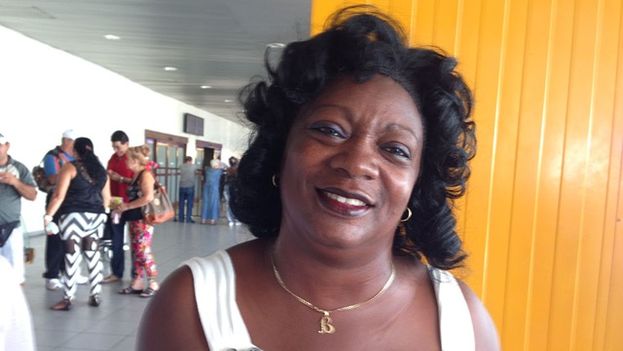
Berta Soler at the Havana airport. (File / 14ymedio)

14ymedio bigger14ymedio, Havana, 24 May 2016 — Berta Soler, leader of the Ladies in White, faces a prison sentence of three months to five years for the alleged crime of resistance. The activist was arrested last Sunday when she attempted to go to the Cathedral of Havana for the inauguration of the new archbishop of the capital. After being charged by the authorities, she is required to available to them at all times and cannot leave Cuba before her trial. “I didn’t become an opponent [of the regime] in order to travel and I am prepared to go to prison if that is the decision. I won’t even get a lawyer,” Soler told 14ymedio.

The group of 31 activists, among them 22 Ladies in White, was intercepted on leaving the Ladies in White’s headquarters in the Lawton neighborhood. The repudiation rally against them before the Sunday Mass was organized for 9 in the morning and involved many people who were not even from the neighborhood. “Although we already knew we wouldn’t be able to get there,” Berta Soler said, “we decided to leave [for the church] because our house is not a jail cell.” As commonly occurs, tempers flared and finally the police arrived to arrest them.

“When they stopped us we sat down, which is a common practice in peace movements around the world, except in Cuba,” Soler emphasized.

Berta Soler was driven to the Alamar neighborhood where, she said, there was “a classroom reserved by the PNR (People’s Revolutionary Police).” At about six or seven in the evening they told her that this time there would be formal charges. “At first they said that I had scratched a policewoman, but eventually they dismissed the charge of attack,” she said.

That night an official who said she was the investigator/prosecutor on her case told her that she was accused of resistance. “I didn’t respond in any way and went to sleep. At a quarter to ten at night they came to find me to sign the accusation but I didn’t sign any document. We (and they as well) have videos that show I never lifted a hand to anyone or attack anyone, not even verbally.”

Berta Soler says she has no problem complying with the requirement that she not leave the country. “At the moment I have no plans for any trip. The closest is an idea to go to Geneva, but that still has not materialized. If before [the trial], or at any time I need to leave the country for some event, they will have to stop me from traveling at the airport itself,” she said.

The date of her trial has not been set.

Rosa María Payá: “Totalitarianism is not broken in Cuba, we can not pretend it is” / EFE (14ymedio), María Tejero Martín

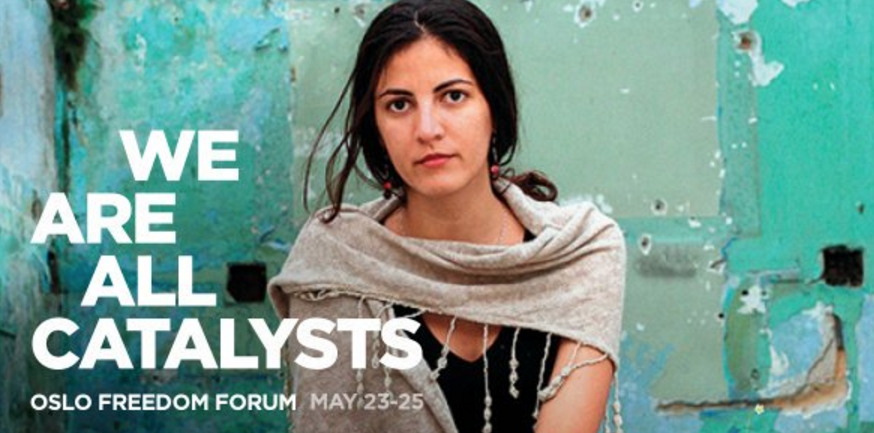
Rosa Maria Paya (Photo: Orlando Luis Pardo Lazo)

14ymedio biggerEFE (via 14ymedio), María Tejero Martín, Oslo, 23 May 2016 — Cuban opposition member Rosa María Payá said Monday ,in an interview with EFE, that the “totalitarianism” of the government led by Raul Castro “has not broken” despite the open contact with the United States and the European Union (EU), and so she asked that these approaches be used to achieve “concrete progress.”

“Rapprochement with Cuba is very good, but it depends on how and how it is sold. It also has negative consequences, such as the rest of the world perceiving an internal process of openings toward democracy, and this has not occurred,” said Payá in the Norwegian capital, where she has come to participate in the Oslo Freedom Forum (OFF). continue reading

The dissident said that “totalitarianism has not been broken” despite the “legitimacy” with which it might have re-clothed itself after the visits of personalities such as US President Barack Obama, the high representative of the EU for Foreign Policy, Federica Mogherini, Pope Francis or the Rolling Stones.

Payá, daughter of the prominent opposition leader Oswaldo Payá, who died in 2012 in a car crash which his daughter blames on the Cuban regime, believes that the international community has an “opportunity to pressure the regime for this change toward freedom.”

Payá criticized the “excuses that can be cynical, but are invoked as pragmatic” which are used as an argument to initiate dialogue with Cuba placing special attention on economic relations and relegating to the background demands for human rights and freedom.

“People say things like if we negotiated with China, why not with the Cuban regime. Under this line of thinking, why not with North Korea?” she said.

We regards to negotiations between Brussels and Havana, she considers it “worrying” that no light has been shined on the text that serves as a basis for contacts between the two parties and warned that it is not enough to simply include “a mention of human rights, because tyrannies have already learned to deal with these mentions.”

“The support has to be concrete, specific and on measurable issues. Not only speeches in support of democracy, of human rights,” she said, calling for support for the holding of a plebiscite on the island, access to communications media and information, and the release of political prisoners.

“Totalitarianism, which has not been broken, is broken when the ability to decide does not reside in the same group of generals. At that moment the transition will have begun, which won’t happen in a single day. We cannot pretend this is happening,” she said, in a message she directed to “the international community,” from whom she asked for “support.”

” Cubans are human beings just like everyone else, like Spaniards or Belgians. We did not endure five decades in order to have Airbnb, but rather all out rights (…), having more Americans to travel to the island is not enough, it is a racist approach to think so,” she claimed.

To Payá, inaction may also affect the international community itself and democratic countries.

In this regard she pointed to how the situation in Venezuela has been evolving under the leadership of Hugo Chavez and president Nicolas maduro, but also the ideas that have come from “political parties in Spain.”

Looking ahead to the upcoming Spanish elections, Payá stressed that “the Spanish people are sovereign, so it is up to them to decide,” although she expressed her concern for “the influence of the totalitarian regime in Havana and the Chavista regime which is concerned with undermining Latin America and exporting its ideas to Europe.”

About the rise of anti-democratic positions, the Cuban opponent once again called on democratic countries to act.

In terms of rights, “Cubans were already in the worst situation ten years ago, but now the rest of the world is worse off as well,” she warned.

Danilo Maldonado, known as "El Sexto," is also speaking at the Oslo Freedom Forum this week.
Danilo Maldonado, known as “El Sexto,” is also speaking at the Oslo Freedom Forum this week.

Why Cuban Agriculture Is Inefficient / Iván García

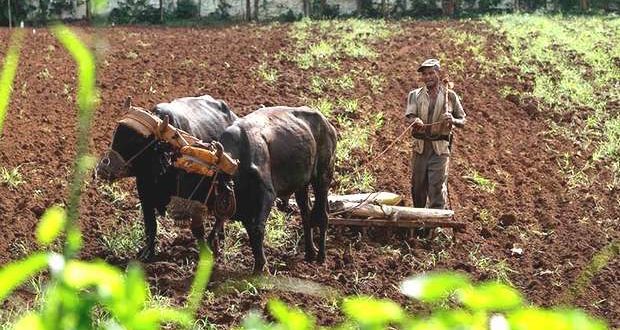
Plowing in Cuba with oxen. (From On Cuba)
Plowing in Cuba with oxen. (From On Cuba Magazine)

Ivan Garcia, 19 May 2016 — The raindrops tinkle on the zinc roof of a greasy hut used to store sacks of fertilizer, agricultural tools, and the various ancient contraptions that are always be a nuisance to keep in the house.

Osvaldo, the sixty-five-year-old owner of a farm southeast of Havana, calmly takes a drag on a cigarette butt, scratches his head with his thick fingers, which look like twisted meat hooks, and asks his son, “Where the hell have you left the wrench to open the water pump?” Then, once the engine has been started, he runs through the rain back to the entrance of his house. continue reading

Before answering a question as to why Cuban agriculture is incapable of supplying people with enough food, he takes a swig of coffee and rocks back and forth in his iron chair. He then tells me:

“No point in beating about the bush. It’s the government’s fault that agriculture doesn’t work. I have lost count of the number of measures and strategies the agricultural directors have drawn up. The problem is that you can’t grow a crop sitting behind an office desk. Every piece of farmland is different. The amount of sweet potatoes or beef cannot be planned from an office in Havana.”

He continues unwrapping his opinions about the black hole in the nation’s agriculture. “The land is for the peasants. If the government wants to buy everfything that’s harvested, they need to pay a fair price for it. Now they have promised to pay properly, but two or three months down the line Acopio (Cuba’s state procurement and distribution agency) and other government departments start to fall behind on their payments. In my case, they owe me 20 to 30 thousand pesos. The Havana middlemen buy your entire harvest, in cash.”

Osvaldo is aware that shortages breed speculation. “But the government needs to get real. They sell everything at very high prices to individual farmers — fuel, seed, working clothes — and the agricultural equipment is of poor quality. Also, times have changed. Now, nobody wants to work on the land. Everyone is going to Havana or Miami. And when it comes to hiring workers to gather the harvest, you have to pay at least a hundred pesos a day. That drives up the cost of what you’ve harvested. If the government gave the land to the people who are working it, in Cuba, the food that they produced would be for export”.

When you speak to private farmers, people working in co-operatives or tenants, their opinions vary, but most of them believe that, to increase the harvests, you have to first create appropriate living and working conditions.

“I lost about a hundred pounds of bananas and sweet potatoes because Acopio couldn’t provide enough transport,” observes a farmer with a credit and service cooperative, who prefers to remain anonymous. “It’s a joke. They have some honest people but most of the officials there are corrupt.”

When Fidel Castro came to power in January 1959, he began applying countless forms of production management to Cuban agriculture, from huge state farms and cooperatives to land leases.

But harvests did not increase. Bureaucrats always come up with excuses to explain the shortfalls. They blame the unchecked greed of middlemen, hurricanes, rain or drought.

Though intended to alleviate the deficit, targeted price controls quickly generate even greater shortages instead. But there could be other reasons as well. Economist Juan Triana Cordoví cannot be accused of being of a dissident. But in his article “Price Caps”, published in On Cuba Magazine, Triana tries to find answers to the riddle. For this economist, prices controls are just the tip of the iceberg.

There are other explanations. According to Triana, if you compare produce production in 2005 to that of 2009, you will find that harvests were, on average, was 15% smaller. With respect to potatoes, the drop was 50%. In the case of vegetables, the average rate of growth in this same period did not exceed 1% while tomato production fell 30%.

In 2009, 34,558 hectares of produce were planted (4,245 of which were potatoes), while only 16,494 hectares were planted in 2014 (596 of which were potatoes). In short, in 2009 — the latest year for which data is available — there was 50% less produce and 14% less potatoes planted. In 2009, 32,174 hectares were planted while in 2014 only 21,397 hectares were planted. This amounts to 66% of what had been planted just five years earlier.

Less acreage under cultivation, lower yields, increased demand, higher costs… “What else can we expect but for prices to go up?” asks Triana.

But the government is only thinking in the short term. Faced with complaints from millions of its citizens, the solution is a home remedy to relieve the pain while it continues to postpone the radical solution that Cuban agriculture needs.

Average Cubans approve of the new measures the state has taken to cap prices and close El Trigal wholesale market south of Havana. On May 13 Martí Noticias toured fifteen produce markets — some state-run; some private, leased or cooperative operations.

In the markets with price controls, the chalkboards indicated nine to fifteen items for sale. Tomatoes, on average, cost 2 pesos per pound. Guava was priced at 1.5 to 3 pesos, a banana went for 2 pesos, and cassava and sweet potato sold for 1 peso per pound.

The privately-run markets had more variety, were cleaner and provided better quality, though the prices were twice as high. For example, two Caney mangoes cost 30 pesos while a six-pound melon went for 25 pesos.

Osvaldo, the peasant quoted above, believes that price controls will not increase farm production. And he is sticking to his theory: “When the land belongs to the peasants, and they are allowed to import and export without having to rely on the state, there will be more than enough food,” he says.

In no country with an autocratic government — whether it be Vietnam, China or the former Soviet Union — did state-control of the land work. Cuba is hardly an exception.


Translated by GH 

The New Archbishop Of Havana Confesses To Being “Scared” / 14ymedio, Zunilda Mata

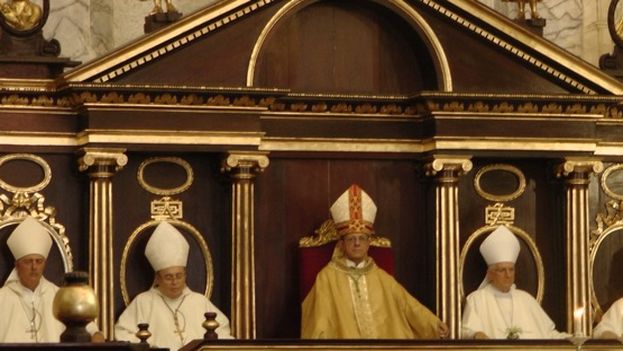
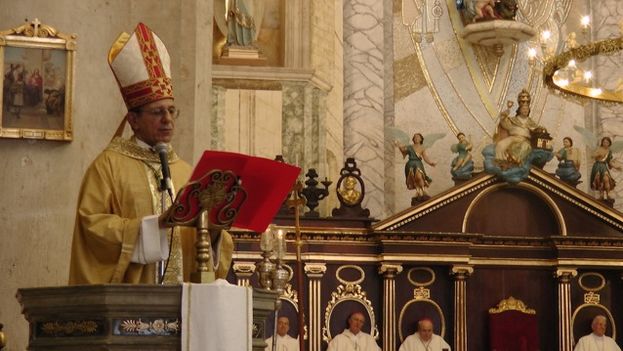
The new archbishop of Havana, Juan de la Caridad Garcia Rodriguez at his inaugural Mass (14ymedio)

14ymedio, Zunilda Mata, Havana, 22 May 2016 – In a packed cathedral with screens showing the mass for those who couldn’t enter the temple, Havana’s new Archbishop, Juan de la Caridad Rodriguez, took possession of his new post this Sunday. The successor to Jaime Ortega y Alamino delivered a homily in which he acknowledged he was “scared” the face of so much responsibility.

“You will understand that I’m scared” and “do not understand the mystery of why I’m here,” said the prelate who also enumerated his wishes that Cubans might “live in peace, eat in peace, work and study in peace, and die in peace.. For which “we dream that no one touches anyone, no one hits anyone, no one, nobody hurts anyone.”

A multitude waited for García Rodríguez from the early hours of the morning in the vicinity of the church. At the front door of the Cathedral Cardinal Ortega y Alamino awaited him, and he opened the ceremony with the crozier in his hands, subsequently handing it over to the new archbishop. On June 29 Pope Francisco will deliver to him in Rome the pallium, a liturgical ornament appropriate to his status.

For Marcia, 66, “it begins a new era for our church and I hope he will bring harmony and respect,” she told this newspaper. Christian and very attentive to ecclesiastical life, the woman notes that “there are high expectations among those who frequently come to this church and people have received the appointment with joy.”

The ceremony on Sunday was attended by several Cuban bishops of various dioceses and the Archbishop of Miami, Thomas Wenski. Government representation was headed by the Vice President of the State Council, Salvador Valdes Mesa and Caridad Diego, head of the Office of Religious Affairs of the Central Committee of the Communist Party.

The new archbishop of Havana, Juan de la Caridad Garcia Rodriguez presided at the Eucharist accompanied by several concelebrating bishops (14ymedio)

Along with parishioners who usually attend Sunday Mass in Havana’s main church, numerous foreign press correspondents, tourists passing through town and dozens of onlookers also gathered. “This is a historic moment and I came to take pictures and send them to my relatives in Tampa,” a young history student at the University of Havana explained to 14ymedio.

A group of faithful Catholics from the Camaguey region also came to the church. “I am very proud that one of our own has come so far,” Mauritius, age 58 and a resident in Sibanicú told this newspaper. He added, “it has been known for years now that this priest was destined for great challenges.”

Garcia Rodriguez, who served as bishop of Camaguey, was appointed in April by Pope Francis as the new archbishop of Havana. The appointment came after the pope accepted the resignation of former archbishop of the city, Jaime Ortega y Alamino, who had passed the age of 75 years, which is the limit set in the Code of Canon Law.

During the Mass on Sunday a message sent by Pope Francis from the Vatican was read, in which he explained his decision and said that Garcia Rodriguez is “endowed with recognized intellectual and moral qualities,” in addition to enjoying “a wide expertise in the exercise of the pastoral work.”

Born in 1948, the new archbishop of Havana was appointed priest in 1972 and joined the parish of Morón and Ciego de Avila. He was also pastor of Jatibonico and Florida, as well as the founder and director of the School for Missionaries in the diocese of Camagüey, for which was named archbishop in 2002.

Garcia has stressed that he expects his episcopate to serve to increase the dialogue with the Cuban government, so that “the Church can be present in spaces that belong to them, such as education, the media and prison ministry.”

Missing People / Dora Leonor Mesa

Dora Leonor Mesa, 13 May 2016

Guide for Members of Parliament No. 17-2009

This manual is the result of a collaboration between the Interparliamentary Union, a world-wide parliamentary organisation, and the International Committee of the Red Cross (ICRC), with the support of the International Red Cross Movement and the Luna Roja Media.

On all five continents, parents, brothers, spouses, are children are desperately seeking  family members, about whom they have no news. Families and communities, who don’t know what has happened to their loved ones, cannot move on from the violence which has disrupted their lives. continue reading

When the armed forces in Latin American countries started their practice of making people disappear, as a tool of repression, they thought they had discovered the perfect crime. No victims, therefore no murderers, no crime.

The States: Responsible for finding a solution 

In the first place, it’s the responsibility of State authorities to prevent people going missing and to find out where the people who have disappeared actually are.

A forced disappearance is a detention or kidnapping carried out by State officials, or people or groups acting with the authorisation, support, or acquiescence of the State, followed by the concealment of the fate or whereabouts of the missing person.

The Argentinian authors found precedents for people disappearing in Nazi practices during the Second World War, when seven thousand people were secretly shipped to Germany under the Nacht und Nebel decree (Night and Clouds), passed in 1941 by the Supreme Command of the German army.

Following Hitler’s orders, the Nazis resorted to making members of the opposition disappear so that they did not become martyrs in their home towns if they were tried in court and sentenced to death. The decree laid down that anyone could be detained on a simple suspicion, and “vanish.” In this way, it was not possible to obtain information about the status and whereabouts of the victims, and that’s how they tried to achieve an “effective intimidation” of the population, and of family members, as a result of the paralising terror which it would unleash.

The International Convention on Missing Persons (2007) is the first universal treaty to define and prohibit enforced disappearance. In order to fight against this brutal crime, the Convention sets out four main ideas:

  • Combating impunity
  • Prevention
  • Victims’ rights
  • Application

Fields of Action

To address missing persons’ problems, five fields of action were identified:

The prevention of disappearances includes, as a fundamental measure, respect for the right to exchange news

To find out what has happened to people who have gone missing. It is important to maintain vigilance, so that the issue of missing people is not forgotten at the national or international level.

Manage the information and records relating to people who have gone missing. The collection and interchange of information with all interested parties should be arranged and coordinated adequately and actively, to increase the efficiency of the measures adopted to clarify what has happened.

Deal with the bodies and information relating to those who have died.

Support missing persons’ families.

The Role of Members of Parliament

  • To check whether their country has laws relating to missing persons and their families (these regulations may be found in a variety of laws).
  • If there aren’t any, to propose that the necessary legislation be enacted.
  • To confirm that the law in their country conforms with international humanitarian law and international law on human rights; if it does not, to not hesitate:
  • To make contact with the appropriate authorities to obtain information;
  • To prepare questions for the government;
  • To open a parliamentary debate on the need for legislation to protect people against forced disappearances and to respect the rights of missing persons and their families;
  • To iniciate a debate on the contents of appropriate legislation;
  • To seek the advice of the International Committee of the Red Cross (ICRC) and other competent international organisations.

(1) Ana Lucrecia Molina Theissen (1988).  Enforced disappearance of persons in Latin America.

See also: International Committee for the Red Cross: Missing Persons

(2) International Convention for the protection of all people against forced disappearance, 2006. Article 2.

(3)Amnesty International (1983) Disappearances. Editorial Fundamentos, Barcelona, p.8.

Translated by GH

In Search Of The Owner Of The City / 14ymedio, Pedro Armando Junco

Camagüey is one of Cuba's largest cities and is more than 500 years old (14ymedio)
Camagüey is one of Cuba’s largest cities and is more than 500 years old (14ymedio)

14ymedio bigger14ymedio, Pedro Armando Junco, Camagüey, 21 May 2016 — Every city rests on the man who safeguards it. He can be called mayor, administrator or public official; ultimately the label is the least important. This is his charge, like the steward of the millionaire’s mansion. His obligation lies in the zeal with which he is able to optimize the performance of the city’s people. For this he counts on public economic resources and the necessary personnel.

He is, almost always—as he always should be—the ideal citizen. He is the man everyone knows, who knows everyone’s name and where they live, because, among his reasons for being, his priority is to be ready to hear the needs of the last inhabitant of the village at any time. continue reading

However, in Camagüey this citizen never shows his face, no one knows his name, or where he resides; and worse, when we assume who he is and where he is, it is impossible to address him and we can not establish a dialogue with him even through the press.

The certainty of not having been democratically elected lies in that nobody knows him. Despite his phantasmagoric existence, when he takes measures in search of “perfecting” the city, they are arbitrary and counterproductive. I have given this man the name: “The Owner of the City.”

Camagüey, despite its narrow winding streets due to its five hundred years of existence, was a city where it was easy to circulate. Dozens of traffic lights ordered the path of the cars, police officers took care of traffic violations, to the point that the least of its alleys was accessible to traffic, and both the sidewalks and the pavement were kept clean and in perfect state of repair. It is said that Camagüey once qualified as one of the most beautiful cities in the country. Above all, at any hour of the night or in the earliest hours of the morning, the citizenry enjoyed a high level of security.

The Camagüey of today is far from what it once was. The Owner of the City is pleased to close streets for the slightest reason. Martí Street, an important artery through the historic center and the main route to the east for the fire brigade, has been permanently blocked in front of Agramonte Park. An outdoor café has been placed in the street to serve international tourism, as the snacks sold there are priced in hard currency not attainable by ordinary Cubans.

Also to attract tourists, they have unearthed the rails that were sleeping under El Gallo Plazoleta, so that the visitors can see that there were once trams in the city, although the result has been too turn this into the most inconvenient and dangerous crossing—over those sharp steel strips—and on occasion bicycles and motorcycles come to grief there.

The parking lot at Merced Plaza—now called Workers Plaza—was dismantled and vintage benches have been placed around the central ceiba tree, so that those who visit us will have the most beautiful image of the place, although cars in the business center of the province now have to park on another street, under permanent guard. It seems, that the Owner of the City wants to convert Camagüey into a showcase for tourism, to the detriment of its permanent residents.

The most important streets in the center—Cisneros, Independencia and San Esteban—have been closed for many months under the pretext of repairing the abutting buildings, and Republica Street has been modified into a boulevard for pedestrians only, while San Martin Street is in such a state of disrepair that it is very difficult to travel on it, without anyone showing any interest in its restoration.

Everyone who knows this city could intuit that these being the exclusive thoroughfares of the historic center, its viability is reduced by nearly half and thus its potential, while intersecting streets are overburdened by traffic.

If we add to that the reductions in parking spaces in the plazas, forcing parking to the left of the narrow lanes in the Historic Center, this leaves only a tiny space where not even a bicycle or a pedicab can get through—the common vehicles of residents—causing heavy volumes prone to traffic jams. There are only four traffic lights in the city, three of them on the central highway. In “peak” hours traffic in the non-preferential directions suffers long delays because of this lack.

The narrow sidewalks of old Camagüey are mostly damaged, obstructed by structures placed to shore up the buildings, or by the theft of the utility covers. They are filled with dog excrement which is everywhere due to the lack of discipline among unethical people and the absence of inspectors capable of correcting the bad habits of animal owners.

People walk in the street more than on the sidewalks. No one respects the rules of circulation: not only do cyclists and pedicabs ride against traffic, but motorbikes and cars, very dangerously, do the same thing, turning the city into something very like a rural village.

More could be said of the current Camagüey. There remains much to be censored, but the shortage of publishing space makes it impossible. I am barely permitted to make a call to the Owner of the City asking him to consider these constructive criticisms and to begin his necessary labor. To ensure that this urban honeycomb shelters not only international tourism, but also its more than 300,000 inhabitants, his work is urgently needed along with more rigorous and effective attention.

________________________

Editor ‘s Note: This text was originally published in the blog La Furia de los Vientos (The Fury of the Winds) and is reproduced here with permission of the author

Filmmakers Reaffirm Their Demands / 14ymedio, Luz Escobar

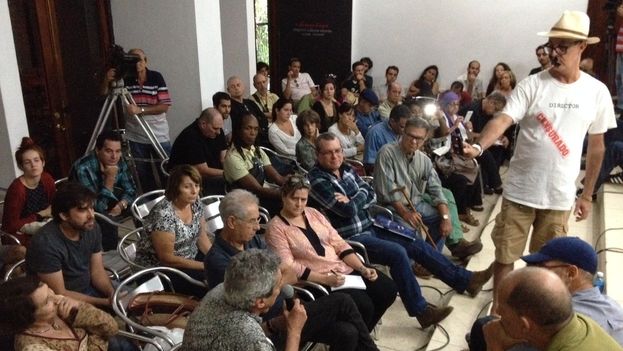
A meeting of the Cuban Filmmakers G20 group held last year in the Fresa y Chocolate Cultural Center. Standing is Juan Carlos Cremata a recently censored Cuban filmmaker. (14ymedio)

14ymedio, Luz Escobar, 21 May 2016 – Three years after the first meeting of the G20, a group of Cuban filmmakers who are demanding a Film Law, the group continues to wait for an institutional response that addresses their demands. This week a letter was made public reaffirming their demands for greater recognition for filmmakers and the legalization of independent productions, among other benefits.

Ignored by the official media and frowned upon by the authorities who should be responding to these demands, the group has also been transformed over its three years of existence. Exhausted, worn out and with the responsibility of other commitments, a group that formerly contained 22 names now has only eight members. continue reading

However, those who remain in the independent group believe that only united can they achieve the objective of having filmmakers’ expectations valued, and address everyone’s proposals in a practical way,” says the letter. They see that in this way they will be able to “confront the tasks ahead quickly, efficiently and responsibly.”

The artists make it clear that the Cuban Institute of Cinematographic Art and Industry (ICAIC) should not disappear, but rather be transformed. The group recognizes the institution as the “rector of the film industry in the country” but clarifies that by saying that “the ICAIC is all of us.”

The highlight of their demands is the creation of a new Film Law to give a “cultural and legal coherence to the film and audiovisual system in the country.”

In earlier statements the filmmakers stressed the urgency of seeking better management and regulation of financial relations, banking and taxes for their work in a “transparent and efficient” way, in a context in which producers who not tied to the ICAIC now work without legal or institutional support.

The filmmakers see as a ray of hope the use of the word “cinema” in one of the new Guidelines emerging from the 7th Communist Party Congress held earlier this year. In addition, comments on the concept of new forms of economic management, made by Raul Castro at the Party Congress, have fueled hopes that audiovisual creators could be included.

The document that has circulated this week by email summarizes the events of the past three years and says that the effort has both “found support and run into misunderstandings.” The objectives that led to the creation of the G20 “have not been realized,” note the authors of the letter.

At the head of the mission to overcome misunderstandings and multiply support around the demands of filmmakers, are Manuel Perez Paredes and Fernando Perez—both winners of the National Film Award—Jorge Luis Sánchez, Magda González Grau, Dean Luis Reyes, Pedro Luis Rodriguez, Mijaíl Rodriguez and, although his name does not initially appear as a signatory of the letter, the filmmaker Enrique (Kiki) Álvarez.

The group emphasizes in its missive that it will continue “faithful to its founding objectives.” It also says that it will revisit the “meetings and exchanges among artists of three generations,” which it qualifies as “one of the most legitimate conquests of these three years.” These meetings take place in the Fresa y Chocolate Cultural Center in Havana.

The current legislation on cinema dates from 1959, when the ICAIC was founded, but the emergence of new technologies, the appearance of independent producers and the economic problems being experienced by the ICAIC, along with the notorious cases of institutional censorship, have exposed cracks in the regulations.

“The only chance for Cuban cinema to overcome its current ethical and aesthetic poverty is a Film Law with all and for the good of all*,” director Kiki Alvarez told 14ymedio. “The rest, the circumstantial debates, are detours, delays and we never know anymore who favors them,” he added.

*Translator’s note: A quote from José Martí repeated without cease by the Castros.