Oswaldo Payá Remembered On The Anniversary Of His Birth / 14ymedio

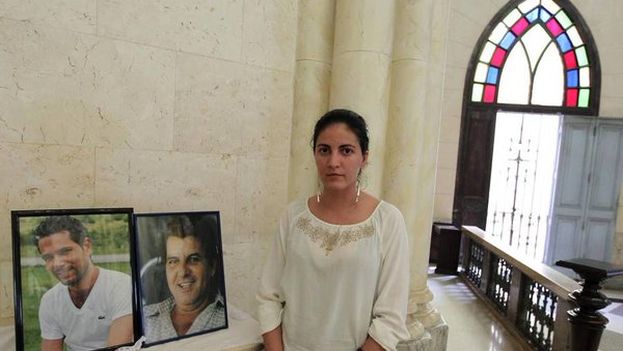
Rosa María Payá in the parish El Salvador del Mundo in the Havana neighborhood of Cerro. (Twitter)
Rosa María Payá in the parish El Salvador del Mundo in the Havana neighborhood of Cerro. The photos are of Harold Cepero and Rosa María’s father Oswaldo Payá. (Twitter)

14ymedio bigger14ymedio, Havana, 29 February 2016 – A Mass in memory of the 64th anniversary of Oswaldo Payá’s birth was held Monday afternoon in the parish of El Salvador del Mundo in the Havana neighborhood of Cerro. Celebrating the Mass was the Auxiliary Bishop of Havana, Monsignor Alfredo Petit Vergel.

The ceremony was attended by the daughter of the deceased opponent of the Castro regime, Rosa María Payá, who is now the president of the Latin American Network of Youth for Democracy and who traveled to the island for the occasion. She was accompanied by numerous friends and activists from Cuba’s independent civil society, and the Mexican Congresswoman Cecilia Romero. continue reading

Rosa María Payá told 14ymedio that her presence on the island is also intended to promote the initiative of the citizen platform, Cuba Decides, demanding a plebiscite so that “Cuban citizens will have the opportunity to choose their leaders, through free and multi-party elections.”

This is the second trip that Rosa María Payá has made to Cuba after settling in Miami with her family in 2013.

After the liturgy Rosa María Payá addressed the attendees and read a text of Oswaldo Payá’s where he said, “God puts you in a place and at a time with a neighbor who is around you. Who is my neighbor? It is not an abstract being: my neighbor is the Cuba of today, here and now.”

Oswaldo Payá, founding leader of the Christian Liberation Movement died on 22 July 2012, along with the young activist Harold Cepero, on the road leading to the city of Bayamo. The incident has been described by the family as a deliberate crime organized by the political police, but the authorities have refused to review the case and maintain the version of it having been a car accident.


Congresswoman Ileana Ros-Lehtinen’s Questions to John Kerry / 14ymedio, Pedro Campos

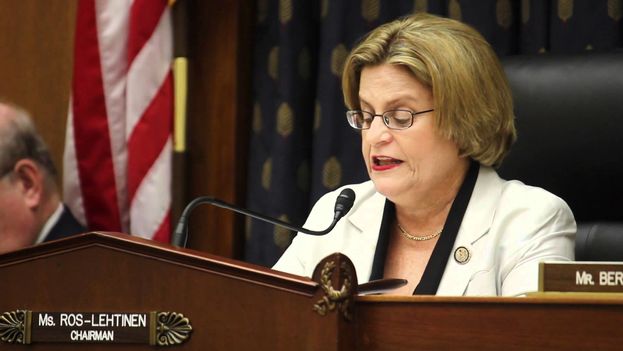
The Cuban-American Congresswoman Ileana Ros-Lehtinen during a hearing. (CC)

14ymedio bigger14ymedio, Pedro Campos, Havana, 29 February 2016 – The Miami press reports that Cuban-born US Congresswoman Ileana Ros-Lehtinen asked Secretary of State John Kerry, during a Congressional hearing, what progress the Cuban government has made, given the many concessions made by the United States, and how does he justify the mass exodus of Cubans that has increased some 80%. At the same time, she requested the extradition of those responsible for the downing of the Brothers to the Rescue planes, and reminded him that since the announcement of rapprochement, there have been more than 8,000 arrests on the island.

If it were simply a political confrontation between Republicans and Democrats about some aspect of American foreign policy that had no implications for world peace, I would refrain from commenting, but the debate significantly affects the interests of the Cuban people, who Congresswoman Ros-Lehtinen has always prided herself on representing. continue reading

Her questions to the Secretary of State are evidence of what everyone knows: she does not share the essence, the basis of the new policy of the Obama administration and, to try to discredit it, presents its measures as “concessions” to the Cuban government that has not done nothing to deserve them.

This is the great original error on which she bases her questions, because the new policy is not conceived as a give and take, but rather as a way to eliminate in the medium and long term the barriers that prevent the Cuban people from exercising their sovereignty for themselves, without foreign interference.

I have always believed that the policy of blockades and pressure against the Cuban government by Unites States affected the Cuban people first and not their rulers, and managed to put the ruling bureaucracy in the role of victims; in short, it has been used to try to justify disastrous economic, repressive and undemocratic policies and, ultimately, has affected the needs of the people themselves, because the bureaucracy has never lacked for anything.

Some defend this mess saying that once the Cuban people begin to starve they will rise up against the government. There is nothing more to say about that.

I am among those who are happy with the change of US policy toward Cuba, since its implementation will make it clear that the rulers have been the perpetrators who have sacrificed the Cuban people for their state-centric policies – supposedly socialist – and it will do away with all these justifications; there will be no way to continue imposing the current control over the economy, politics, the press, culture, education, public health, or of preventing the Cuban people from taking into their own hands the sovereignty that is theirs by right.

There is no defense of the socialism-that-never-was, primarily responsible for the current national disaster, without recognizing that the policy of the embargo-blockade has been its fundamental source of international support. Remove this girder and watch it collapse. But it seems that the Cuban-born congresswoman, in her attempts to discredit Obama the Democrat, does not adequately evaluate his policy toward Cuba.

This shift is intended to take effect in the medium and long term, passing from acceptance of the current Cuban government and having as its principal basis something that those who imposed and maintained the blockade-embargo never intended: it is we Cubans ourselves who have to fix this mess and not the policies of some foreign power. Interference only serves to encourage the Cuban people’s uniting behind the most vulgar nationalism/anti-imperialism.

The congresswoman’s questions are based on false premises. If the idea is to question the policy, go to the bases of it and not to some supposed effects that no one is proposing over the short term.

Perhaps she herself and the Cuban-American caucus in the United States Congress, which has opposed President Obama’s call to end the blockade-embargo, could provide some of the answers to these questions. Meanwhile, the blockade-embargo continues to be an indirect support to economic and political centralization. It prevents the empowerment of Cubans and stimulates mass exodus and arrests, while proposals to end the Cuban Adjustment Act support and encourage internal groups who are for confrontation and not for dialog.

Republicans have every right to try to defeat the Democrats, but they do not have the right to do so at the expense of the Cuban people.

Cuban Education through the Keyhole / Somos+

Somos+, Amelia Albernas, 26 February 2016 — In my time, professors were proud of being what they were: a living gospel. We students were instructed by them and, furthermore, educated. The values and principles I have are thanks to my parents — one a psychologist and the other a history teacher — and to those teachers who had a true love for their profession.

Sadly, the new generations of Cubans don’t count and won’t be able to count on this. Material deficiencies and — why not? — spiritual ones, also, have wrecked the education that many of us received in past decades. The social and economic deterioration of the country has destroyed educational teaching. The exodus of teachers to other professions with better salaries is a reality that is striking but perfectly understandable. Our teachers lack great commitment, but it’s hard to ask for that commitment if salaries are low. continue reading

So it’s urgent and necessary that a profound change be produced in Cuban society and in the system of government, because a generation of sad, ignorant and lazy people will inherit this island, which José Martí defended with so much impetuous reason*.

It’s because of this that, today, I will share some ideas about what path our social project of Somos + should take in order to stop this disastrous process of demoralization in such an important sector as education. The nation owes an enormous debt to its teachers, and the general opinion is that there should be a more effective way to pay them.

The profession of teaching deserves respect and consideration.

Education, by necessity, should continue to be subsidized; this is an unavoidable principle for every nation and a human right. Apparently it’s not a way to earn money, but only apparently. In reality, school is the beginning of everything. Without an integral and convincing education it’s impossible to count on good professionals and technicians. But it’s to be noted that there should be no indoctrination and, much less, a personality cult of any man.

Education, for most of the dictatorial governments, means trying to direct children in order to reproduce the typical behaviors of the society they represent. For Somos+, education means making creators, inventors and innovators, not conformists. And because we have been and are witness to the enormous loss of values in the young generations that live today in our Cuban society, we champion an education where the maxim is to “drink from all sources, taking as a base the spring of our nationality**.”

Educating for creativity is educating for change and shaping people who are rich in originality, flexibility, future vision, initiative, confidence, risk-taking and readiness to confront the obstacles and problems that are presented to them in their lives as students and in everyday life, in addition to offering them tools for innovation.

Creativity can be developed through the educative process, favoring potentialities and making major use of individual and group resources inside the teaching and learning process.

Continuing with these ideas, we can’t speak of creative education without mentioning the importance of a creative atmosphere that fosters reflective and creative thought in the classroom.

The concept of creative education begins with the approach that creativity is linked to all spheres of human activity and is the product of a determined historical social evolution.

On the other hand, creative education implies a love for change. Creativity must be fostered in an atmosphere of psychological freedom and profound humanism, so that students feel capable of confronting what is new and giving it respect, teaching them to not fear change, but rather to feel at ease with it and enjoy it.

Based on our reasoning for a freer country, we state our principles:

“The best way to defend our rights is to know them; thus we keep faith and strength. Every nation will be unhappy as long as they don’t educate their children. A town of educated men will always be a town of free men. Education is the only way to free oneself from slavery.”

*Martí, José. Complete Works. Volume XVII.

**Taken from Ideas and Principles of the Movement Somos+.

Translated by Regina Anavy

A ‘Che’ for Foreigners / 14ymedio

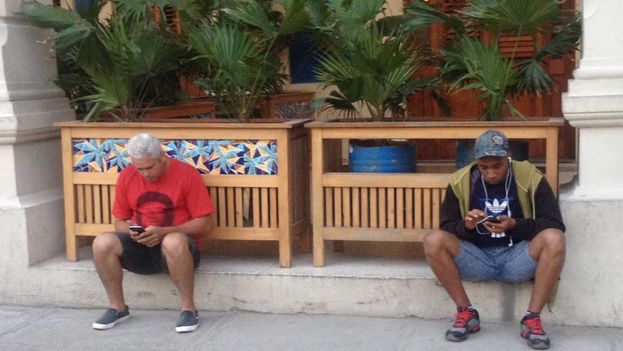
A tourist in Havana wearing a shirt with the face of Che Guevara, while a Cuban exhibits another with Adidas logo. (14ymedio)

14ymedio bigger14ymedio, Havana, 29 February 2016 — “If you see someone with a Che T-shirt that person is a foreigner; but if they are wearing a United States flag, you can be sure it is a Cuban,” quipped an illegal tourist guide, while showing his customers the numerous trinkets with the Argentine guerrilla’s face as one more commodity. For less than 20 convertible pesos, a tourist can get the black beret and some other souvenir with the blue bars and white star to complete his “revolutionary costume.”

However, young people in Cuba seem interested in following other fashions, far from the ideological kitsch. The brand names of the capitalist world are here to stay and it doesn’t matter if the clothes are original or poor quality copies, the priority for many is the size of the logo that attests to their manufacture outside the national borders.

It is not difficult to find images like the one above, where you can see a foreigner sporting a T-shirt with the famous Korda photo and a short distance away, a young Cuban sporting one with the Adidas logo. The symbols of foreign industry will win the battle of popularity over those with patriotic and political symbolism. The latter is now pure merchandise to sell to tourists in products that cater to other than consumer appetites.

The Fable of Miguelito and His "Haier" Chinese Refrigerator / Miriam Celaya

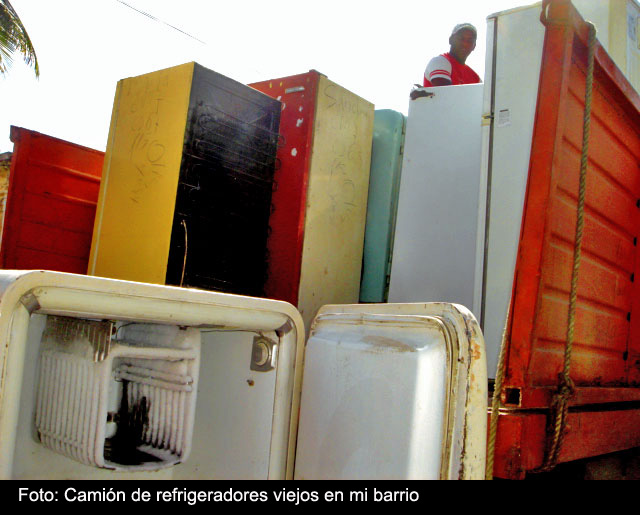
Old fridges being taken away (Claudia Cadelo)

Miriam Celaya, Sin Evasion (Without Evasion), 15 February 2016 – This Sunday in February, Saint Valentine’s Day, my neighbor Miguelita was overjoyed, although it was not exactly because of it being day of love. He had just finished paying for his Haier refrigerator, made in China, that he had acquired almost a decade earlier by the work and grace of the last sub-revolution orchestrated by the Revolutionary-in-Chief, Castro I shortly before he abandoned the podiums and microphones for good; this particular sub-revolution was known as the “Energy Revolution.”

Admittedly Miguelito, an exceedingly honest type, has not skipped even one of the payments for this “drizzle” refrigerator, as these appliances were popularly baptized due to the continuous streams of water that flood their interiors. It is said that no one, of those who “benefited” from one of these cold artifacts, finished paying the modest bill for the equipment, barely 6,000 Cuban pesos (equivalent to 250 Cuban convertible pesos – CUCs), paid through direct withholding from the monthly salary of those who work for the State. It is also said that there were exceptional cases of those who paid cash for the new equipment, in order to further reduce the cost of the appliance. continue reading

As was common in project spushed by Castro I, the scenic unfolding of his delusions amply justified any waste. So, as long as the energy campaign lasted there was a gigantic mobilization of inspectors, police, social workers, delivery trucks, members of the Committees for the Defense of the Revolution, student helpers, carting stuff off to the dump – how many other 21st century Alladin fans – in the replacement of old equipment for new.

The purchase of electrical generators that were placed in different localities, as well as the distribution of rice cookers, electric stoves, and other equipment, to thousands of nuclear families, along with the substitution of old Soviet- or US-made electrical appliances, for new more energy efficient Chinese equipment, unleashed a kind of modernizing frenzy throughout the capital.

Those were the times in which tens of thousands of incandescent bulbs were collected from Cuban homes by contingents of “social workers” – the standard bearers of the occasion, today extinct – and “energy-saving bulbs” were handed out. Meanwhile thousands of Soviet air conditioners were dismantled, even though they were still working, and their owners were given new Chinese equipment.

And as also used to happen in all Castro I’s out-of-control campaigns, speculation broke out and we saw traffickers proliferate – especially among the social workers and inspectors assigned to the sacred mission of the moment – dedicated to the illegal sale of those old Russian and American refrigerators, which were collected from homes. For an additional “under the table” payment, you could even switch out a refrigerator or air conditioner that had been broken for a long time.

No one knows exactly what that last Delirium-of-the-Unnamable cost in hard currency. It is true that the old appliances were large consumers of energy, and at that time with Venezuela’s generosity Chavista oil flooded the Cuban horizon, allowing the government a populist campaign of great magnitude. However, still today the cost of such a mass mobilization is unknown, as is the amount of debt acquired from China, provider of new equipment, or the payments committed to this Asian nation, usurer par excellence.

Nor is it known the fate of tens of thousands of wrecks removed from homes and transported, with few controls, to dubious warehouses by flotillas of state trucks.

Either way, and as had happened with the massive handout of bicycles at the beginning of the ‘90s, Cubans’ enthusiasm for the Haiers was boundless, although most prefer not to remember that.

And given that Miguelito’s meager income, as in so many other Cuban homes, did not enable him to pay the total for the refrigerator in cash, he chose to pay for his Haier in installments. With the natural mischievousness all natives of the island are believed to possess, and taking into account the age of the Great Orator – he assumed that “the process” of payment would last as long as what remained of that person’s life – the refrigerator would be extremely cheap: a period of a little more than eight years seemed so long to him, that Castro I would never end up collecting it, nor would he – Miguelito – end up paying it.

Simply, “there is not enough life span left for this.” And with a knowing wink he urged all the neighbors to choose this type of payment. “Don’t pay cash, don’t be dumb, this isn’t going to last that long!” Although many of the Haier refrigerators haven’t lasted that long either. In fact, Miguelito’s has already been repaired twice.

But this Valentine’s Day Sunday my neighbor just had a bitter surprise: as he was just leafing through the Juventud Rebelde (Rebel Youth) newspaper, where a photo on the front page showed the former Undefeated Commander, today a stooped old man with an perplexed gaze, next to the Patriarch of Moscow and All Russia who was visiting Havana, the motor of his Haier quit. His Chinese refrigerator stopped working – this time for good, according to a friend of his, a refrigeration technician, who came to look at it – exactly when had he made the last payment, of 60 Cuban pesos monthly over more than eight years, withheld from Miguelito’s salary at the bank.

Now, while lamenting his bad luck, my neighbor has found comfort in the teaching: “I should have known that old trickster wasn’t going to invest in anything that was capable of surviving him.” And he went to his mother’s house to pick up a Westinghouse American refrigerator, which she never wanted to exchange, and which she lent to her son to “resolve” things, until Miguelito could buy his own.

And from Claudia Cadelo on TranslatingCuba.com: More Refrigerator Stories

Fun (or not!) with Fridges, Part 1: Cold Water and Eternal Debt / Claudia Cadelo

Fun (or not!) with Fridges, Part 2: The arrival of the refrigerator / Claudia Cadelo

Fun (or not!) with Fridges, Part 3: The coming of the refrigerator (II) / Claudia Cadelo

Fun (or not!) with Fridges, Part 4: They finally arrived / Claudia Cadelo

Fun (or not!) with Fridges, Part 5: Rendering of Accounts (and refrigerator gaskets) / Claudia Cadelo


Four Cuban Exiles Accused of Terrorism in 2014 Are Sentenced for “Rebellion” / 14ymedio

Raibel Pacheco, one of the four convicted. (Courtesy of his family)

14ymedio bigger14ymedio, 29 February 2016 — José Ortega Amador, Obdulio Rodríguez González, Raibel Pacheco Santos and Félix Monzón Álvarez, accused of the crime of rebellion, were sentenced Wednesday to prison terms of between 10 and 15 years. Arrested in May 2014, the four men who were living in Miami before arriving on the island, were tried by a court in Havana, as reported to this newspaper by family members of the accused.

The case has been the subject of a great deal of talk during the 22 months between the arrest and trial of the four men. At the time, the Miami community and a large part of the Cuban people received the official information with skepticism and the news item quickly disappeared from the national media. continue reading

On 14 May 2014, the official newspaper Granma announced that the four citizens of Cuban origin “were arrested while planning to undertake terrorists actions in the national territory,” and were accused of “fomenting rebellion and attacking military units.” Those implicated had traveled to the island from “mid 2013” to “study and plan their execution,” according to the article.

However, it was only this week that the four men were brought to court. Although initially the Cuban authorities had suggested that they would be prosecuted for terrorism, the prosecution finally focused on an act of rebellion and “crimes against the internal security of the state.”

At the hearing, Pacheco acknowledged that he had come to the island to “stir up the people against the tyranny,” according to witnesses at the scene, but also said that he lacked the resources to do so. During the trial no evidence was presented of the possession of weapons, maps, or military sketches. Nor was there any talk of contacts with organizations of the internal opposition.

The defense lawyers brandished the concept of “impossible crime,” contained in Chapter 5 of the Cuban Penal Code in which it is established that if “the offense clearly could not have been committed, the court may freely mitigate punishment” and even exempt the accused “in a case of apparent absence of dangerousness.”

Pacheco Santos was sentenced to 15 years imprisonment, while the others involved were sentenced to 10 years in prison. A family source said “this is a ploy to trade them in negotiations with the United States before Obama comes.”

Granma, the official organ of the Communist Party explained that during their interrogation the accused had declared themselves to be “under the direction of the terrorists Santiago Álvarez Fernández Magriñá, Osvaldo Mitat and Manuel Alzugaray, who live in Miami and have close ties to the terrorist Luis Posada Carriles.”

In 2009, Pacheco, 33, registered a company in Florida under the name of Cuban Liberation Force Inc., and opened a digital page where the only content was a text that said the entity had created a “request for members of the Armed Forces to gather within Cuba,” and that their reason for being was “freedom and the overthrow of the regime to restore a system of rights.”

In Miami, Pacheco worked in a carpentry shop during the day and took economics classes at night at Florida International University, according to his family. His wife, Adriana Torres, a nurse and also a Cuban resident in Florida, has been able to visit him in prison and is currently three months pregnant.

The father of the accused, Segundo Manuel Pacheco Toledo, was rector of the University of Holguin for 11 years and a deputy in the National Assembly of People’s Power. Pacheco Toledano worked at the Embassy of Cuba in Mexico, from there he fled and crossed the US border in 2012. The family considers the sentence against his son to be government retaliation for the escape of the former official.

After the flight of his father, Pacheco stopped traveling to Cuba regularly. Before his arrest, he had flown to the island on 22 April 2009 and initially stated that the reason was to visit his paternal grandfather who was to undergo surgery. His mother, Nieves Santos Falcón, a prominent biologist who works at the School of Medicine at the University of Miami, has maintained the innocence of her son over the years.

In May 2014, and already in the midst of secret negotiations that would give rise to the restoration of relations between Cuba and the United States, delegations from both countries held a meeting on the arrest of the four men. “The Cubans provided some information about the allegations that we are now reviewing,” the State Department in a statement.

The closeness between the trial held this week and upcoming visit of United States President Barack Obama to Cuba nurtures the hope of the defendants and their families. “This is to fill the backpack of requests to US Secretary of State John Kerry,” suggested one those attending the trial. “I hope that he can see the birth of his child and return to his life in Miami,” added this relative of Pacheco, for whom “this has been a nightmare and someday the details will be known.”

“I do not want to keep doing away with little animals” / 14ymedio, Yosmany Mayeta Labrada

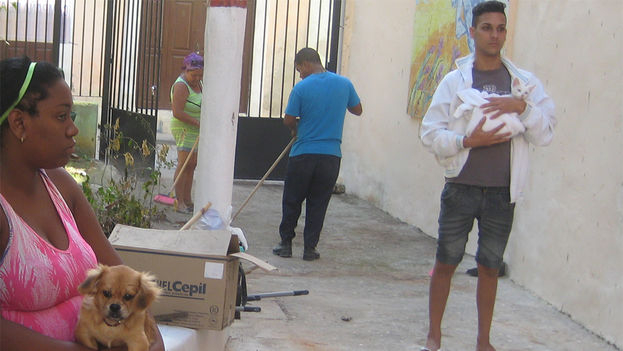
Sterilization campaign. (14ymedio)

14ymedio bigger14ymedio, Yosmany Mayeta Labrada, 25 February 2016 – “The latest puppies I drowned in a bucket at birth,” said the owner of a female dog about to be operated on this Wednesday as a part of the sterilization campaign in Old Havana. Similar stories were heard in the line, long but well-organized, of those waiting to get an appointment for the free surgeries.

As of last Monday, many of those interested gathered at the site accompanied by their pets, that ranged from pure-bred animals to mutts without pedigree. “I don’t want to keep doing away with the little animals,” said another lady who lives very near to the makeshift clinic on Oficio Street; her dog had had three litters.

There are thousands of abandoned dogs and cats in the country, and no programs to protect or adopt pets. In an attempt to alleviate this situation, there are periodic initiatives sponsored by the Office of the City Historian and a Canadian group, the Spanky Project. continue reading

María Gloria Vidal, president of the Society for Animal Welfare, lamented a few months ago in the official press that the Cuban population “suffers from certain culture and level of responsibility on the keeping of animals,” so when economic hardships affect a family “the solution is to get rid of them. Most of the time are thrown into the street.”

Since the late eighties, several groups have tried to promote Animal Welfare and Protection Act, without success. In 2000 a meeting of on the control of the dog population sponsored by the World Association of Animal Protection was held, but so far neither the Institute of Hygiene and Epidemiology, nor the Ministry of Public Health have implemented the agreements reached at the event.

“Here is is difficult to find food for people, imagine also keeping an animal,” says Flora, a retired teacher who took her dachshund to get the surgery because she fears “having to share” her limited resources “with more animals.” Flora says she has never abandoned a pet, “I would die before I’d through an innocent into the street.”

Appointments for the sterilization operations ran out early in the last three days. Susana Hurlich, a Canadian leading the project, explained that the plan is to take care of 40 dogs and 40 cats every day until 26 February, and they have also registered some groups of animals picked up in hopes of adoption.

Hulrich explained that “given the demand for the campaign, we are now starting a new list” and they have taken steps to prepare “a space in Quinta de los Molinos” although there is still no date for its opening.

Initiatives like this should be “repeated more often” said Damian, a young man waiting his turn with a male Boxer. “We need to teach children from an early age to love animals, in order to avoid what we are seeing with abuse and abandonment,” he added.

Yanelis Nunez, a resident in the 10 de Octubre municipality, looks at the sterilization campaign with relief. “I have two cats and one has given birth several times. I think it’s time to tie it off,” she said. Nunez said that for these animals the situation for abused and abandoned animals “is worse,” because “there is much less sensitivity to it than with dogs.”

An investigation by Aniplant revealed that in Cuba about 1,500 convertible pesos a year is spent on sterilization for every 5,000 dogs, while the slaughter of these animals caught in the street uses more than 10,000 liters of gasoline a year, just to transport them. They are taken to places where overcrowding and the cruelty of the practice of euthanasia horrifies pet lovers.

The Spanky Project proposal has emerged to improve this situation. The association is led by the Canadian Terry Shewchuck, who was vacationing in Cuba several years ago and found himself alarmed as the absence of a system to care for animals. For over a decade, his group has provided clinical care and sterilization services to thousands of pets.

This coming Saturday the campaign will offer vaccinations and deworming in the Laika clinic, also in Old Havana. A moment that will again draw to the scene dozens of people who share a common feeling: a love for animals.

*The ambulatory clinic with instruments donated by the Canadian side has been opened in Casa Calderson on Oficio Street, between Santa Clara and Sol, Old Havana. Due to its limited capacity it invites interested pet owners to book an appointment by calling +53 78609463.

Rosa Maria Paya at the Geneva Summit for Human Rights and Democracy

Geneva Summit for Human Rights and Democracy

Tuesday February 23rd, 2016

Rosa María Payá, Christian Liberation Movement of Cuba and Latin American Youth Network for Democracy 

Thank you for this opportunity to spread the voice of the Cuban people. Cubans have lived for nearly 60 years without the freedom to express our own voice. The Revolution of 1959, immediately suppressed freedom of speech, freedom of association, freedom of movement, as their totalitarian tools to remain in power forever. These suppressions came with the repression and the violence, as illustrated by the long list of extrajudicial killings perpetrated by the Cuban authorities.

In this moment, I would like to remember and honor the memory of Orlando Zapata Tamayo, dead exactly 5 years ago, during a hunger strike in a Cuban prison. My prayers are also for the 4 innocent pilots from Brothers to the Rescue, shot down in international waters by the Cuban military, on February 24, 20 years ago. continue reading

In February 2016, the same violators of human rights are still ruling on the Island. Even more dangerous, this corporative and military elite is involved in a fake transition not to democracy, but to legitimize their total control upon Cuban society, with a renewed image for the international public opinion, in order to attract foreign investors and financial credits.

This combination of the worst of communism and the worst of consumerism is leading my country to dynastic State capitalism, a “Castro-capitalism”, like my father Oswaldo Paya, warned in a book that is going to be published very soon.

It´s a system where the “historical generation” and their descendants, have monopolized all the economic resources of Cuba, while they keep sequestered the political sovereignty of our nation, condemning an entire people to the economic and social scarcity, because the absence of Human rights prevents Cubans from managing themselves.

Is this the Cuba where the European Union and the United States expect to make profits, with the justification that at some point there will be an empowerment of the civil society? This empowerment hasn’t happened, not because of a foreign policy, but because of a totalitarian state that does not recognize legal personality to any Cuban citizen, and, therefore, no one can belong to a business company or civil association or political party.

We do not believe that, what hasn´t happened in China or in Uzbekistan, is now going to happen in dictatorial Cuba.

My father, Oswaldo Payá —founding leader of the Christian Liberation Movement, and winner of the Sakharov Prize of the European Parliament—, denounced this operation of the regime as the Fraudulent Change. He paid with his life for his peaceful activism to achieve the real rights that belong to the Cuban people. On July 22, 2012, my father was extrajudicially executed by agents of the political police, together with my dear friend Harold Cepero, staging a car crash that never took place, in a location of Cuba that remains to be determined. Not satisfied with this double crime, my family was threatened to death and forced to exile, in order to carry on with more safety our lives and our struggle for a free Cuba.

But we do not belong to exile, and I refuse to remain in exile, treated as a stranger by the Cuban government and their despotic bureaucracy, including the new embassy in Washington DC, where they didn’t open the door to me.

Next Monday February 29 my father would be 64 years old. Our friends and I, in person, will be there, back in Havana in a thanksgiving mass for his life.

Death is not more powerful than Love. And the legacy of my father Oswaldo Payá and Harold Cepero is full of love for life in a free Cuba. Many Cuban lives are still in risk today. This is why we are now trying to open an independent investigation, to stop the impunity, to find out how Oswaldo Payá and Harold Cepero were murdered in Cuba.

In the summer of 2015 a special report was released by Human Rights Foundation, where all evidences indicate that this was a crime against humanity, with the involvement of Cuban authorities.

We’ll never give up on justice, because there can be no reconciliation without the recognition of the whole truth. A nation that pretends to forget the violence against its innocent people will remain a captive nation. And It will be a nation condemned to suffer such violence over and over again.

Cuba is now the country that many Cubans DO NOT want to experience. My people are selling their houses to escape through Central America, or boarding a raft to reach the United States.

But I’m not here just to tell you about our tragic history, I’m here to ask you to support the Cuban people in our struggle to change our history.

Today it is my honor to be part of the Latin American Youth Network for Democracy. We coordinate efforts in 20 countries to preserve and to rescue the democratic values that have been compromised in many parts of our continent, because of corruption, authoritarianism, and the interference of the Havana regime, as in the Venezuelan case.

So, it is time for Cubans to decide our own destiny, and to stop being the subjects of official agendas and secret pacts between governments.

It is time to put an end to the impunity of the Cuban government, which has never been chosen by Cubans in free, fair and pluralistic elections. It is time for the younger generations to assume our responsibility to build together a better Cuba.

This why more and more Cubans are now saying YES to a citizen initiative that claims for a plebiscite in Cuba, through a national and international campaign called Cuba Decide. Totalitarian and post-totalitarian systems cannot coexist with the people deciding by themselves. And this is precisely what Cuba Decide stands for, in order to initiate a true transition on the Island. Cuba must open to our own citizens, who have the right to decide the system we want to live in, after almost 60 years of unconsented government.

Cubans have the right to be asked if we want to vote, in free elections: in a safe frame for peaceful and plural political organization, with international institutions and personalities supervising the process, to avoid fraud. In this, we need all of your solidarity to spread the liberation message of Cuba Decide, and for all Cubans finally to decide our own future.

By democratizing our country we do not need to become another corrupt nation. This fatalism is another fallacy of the regime, a lie repeated by many academics from the free world.

Let me tell you that, as a young Cuban woman, me and many like me, are now struggling to live and love in a decent, inclusive, prosperous and modern 21st century society. Please, join us, in this effort to return sovereignty to the people, to give power to the people and not to the powerful. The last Iron Curtain must fall, and it must fall now!

“Freedom is indivisible, and when one man is enslaved, all men are not free”, said President John F. Kennedy in his speech at the Berlin Wall. “Dictatorships do not have political colors: they are just dictatorships”, said my father until his life was taken.

Dear friends: the Cuban people are not a monolith, to the image and likeness of the Communist Party, the only one legal according to the Constitution. In this new era of “normalization with Cuba”, the table of negotiations should contribute to a true transition and not to the interests of a General in power. We, Cubans do not need that the European Union or the United Sates solve our problems, but we need them to be coherent and to support the right to decide of the Cuban people, using all the channels available.

We are Latin Americans, but we believe in the best principles of North America too. We are Caribbean, but we stand for the best values of Europe too. We are Cubans, but we are Asians and Africans struggling for a better life. Despite the rhetoric of a reactionary regime, let’s not forget that we Cubans are no less than human. And each and every one of the universal human rights applies to us, as much as to anyone in the world.

No man is an Island. No nation is an Island. As my father used to say: help us to globalize solidarity, or human rights in Cuba will always be in danger.

God bless you all, and all our families and countries.

Thank you very much.
Pro-Castro Foolishness / Luis Felipe Rojas

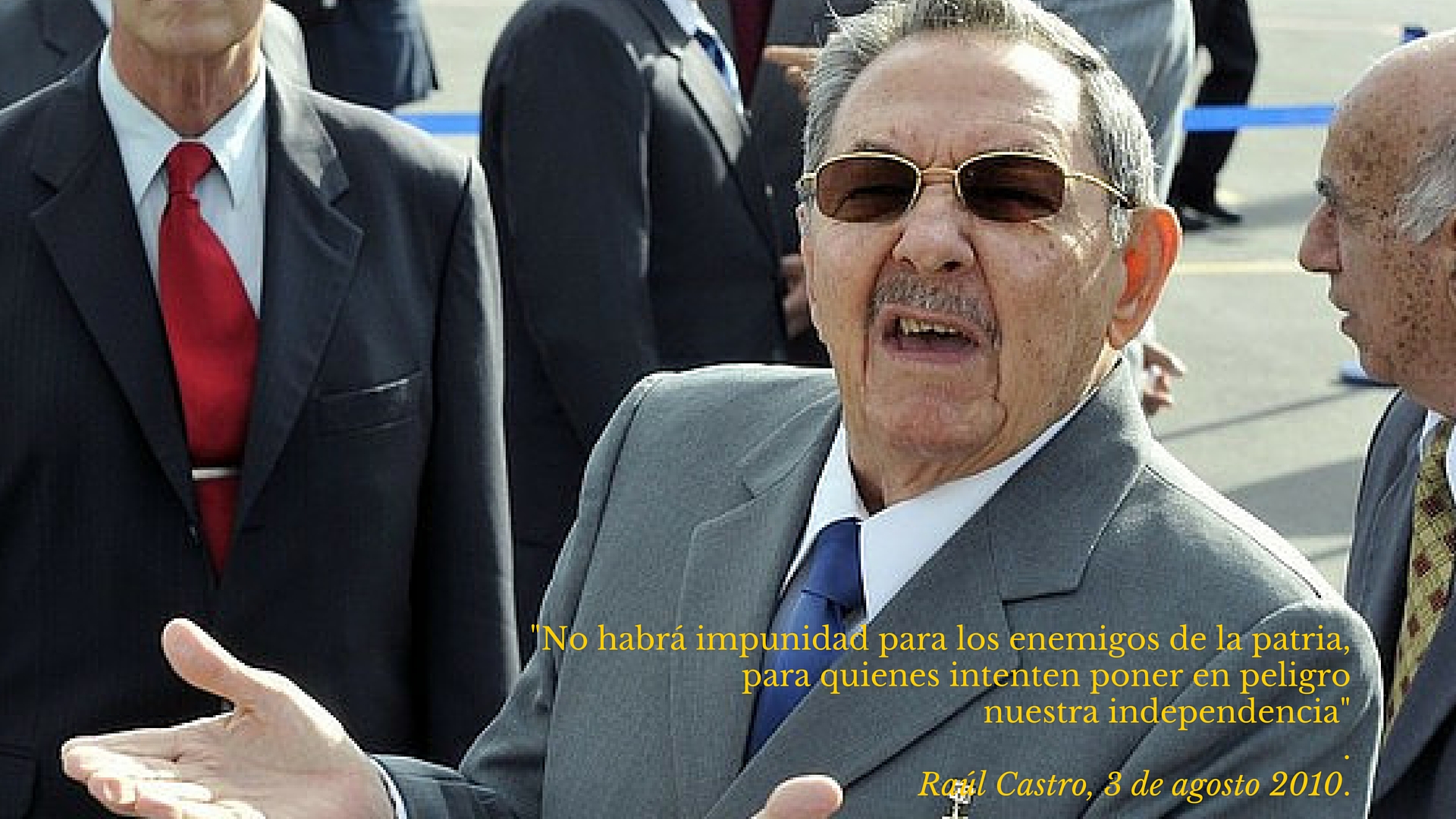
“There will be no impunity for the enemies of the fatherland, for those who intend to endanger our independence.” — Raúl Castro, 3 August 2010.

Luis Felipe Rojas, 28 February 2016 — Attention, all who rabidly applaud the Obama-Francisco-Castro pact: it is worthwhile to make difficult proposals, ask inconvenient questions, and bother the military beast that has run the Island with the trembling hands of whisky hangovers.

Oh, no? Not in your plans? It must be said again and again, because after the hugs have come the kisses, and who knows what else. Among secretaries of agriculture, lady mayors, aide-de-camps, successful businesspeople, and rock superstars, there must be somebody left with a little shame who will make it known to Raúl Castro that his outstretched hand should go in another direction, he should look the people in the eye and quit posing for a photograph that will take on a sepia tone faster than his egomania can stand it. continue reading

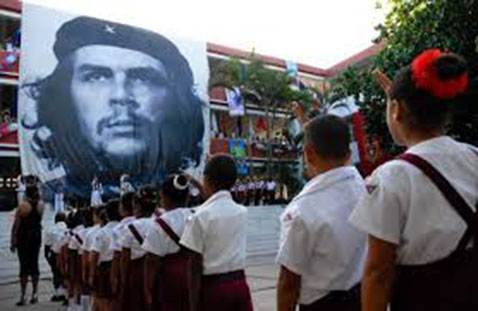
Muriel Bowser, Lady Mayor of Washington, visited Cuba last week and said that she wants an educational system similar to that in Cuba for her fellow citizens. Was she including among this the Study-Work method — that she was taken to see — which Cuban instituted to put an end to the family and turn common citizens into robots? Does Her Ladyship know that Cuban children are obligated to shout that they want to be like Ché Guevra, and that from repeating it so much they become so, barely out of adolescence?

Those children who were so excited to be like Ché Guevara left the country to kill Africans that they had never met, and returned bearing all the traumas of war, turned into fat fifty-somethings, who today run a plastics factory or a Rapid Response Brigade (those at-the-ready to shout down — or even beat down — any display of non-conformance with the regime).

Could it be that no superstar, before giving a concert or going out to enjoy mojitos and pork chunks, will ask Castro to disarm the surveillance mechanism that keeps an eye even on the intimate apparel of every Cuban woman? The wizened stool-pigeon of the neighborhood, the “honorary official,” the “specialist” of State Security who controls every provincial cultural center, even the thug who organizes a raid on dissidents — they are all part and parcel of that magic that today enthralls the political tourists when they gaze upon Raúl Castro. He is the criminal with whom they pose and will be seen in the Times, the Washington Post, or the now “spotless” and in-the-running-for-an-Oscar Boston Globe.

It will never be to late to align oneself to infamy. So, start running today to Havana, stroll around sporting your little container of bottled water, take a whiff of that 21st Century dungheap that has been sold to you as the best-educated nation of Latin America. Forget about the penitentiary system, of the fear among neighbors, of the violence that can just as easily decapitate with machetes as take a youth’s life by kicking him until his spinal cord is crushed in the police station at Zanja and Dragones streets.

Go and tell the world that Cuba has changed, that the island is a paradise.

Translated by: Alicia Barraqué Ellison

Covering the “Eyes” of Claudio Fuentes / Luis Felipe Rojas

Cuban photographer Claudio Fuentes, arrested by the political police in Havana. Courtesy: Ailer González, State of SATS.

Luis Felipe Rojas, Miami, 15 February 2016 — Cuban photographer and dissident Claudio Fuentes was once again arrested on Sunday, 14 February, by forces of the National Revolutionary Police (PNR) in Havana. The Castro regime’s gendarmes kept Fuentes from taking part in the peaceful action #TodosMarchamos [We All March], which the Ladies in White and dozens of activists put on in support of Human Rights.

Cuban photographer Claudio Fuentes, arrested by the political police in Havana. Courtesy: Ailer González, State of SATS.

Claudio Fuentes is an independent photographer who has been arrested on numerous occasions for taking part in and photographing peaceful activities of the internal dissidence in Cuba. His photographs reveal victims of beatings, women who express their courage against the threatening actions of the Cuban dictatorship, but he has also photographed in an original manner life in Havana as he has lived it.

The information regarding the arrest of Claudio Fuentes was provided by Ailer González, who in charge of artistic projects for State of SATS, which is directed by Antonio Rodiles. The activist posted various photos in which Fuentes can be seen being detained at the hands of the PNR and officials from State Security. Similarly, González reproached the journalist Fernando Ravsberg and others who blame the Cuban opposition for not bringing together more people.

“…And how do you mobilize them under a totalitarian dictatorship where there are these levels of control, harrassment and repression? Assisted further by the Obama administration, the Vatican and even Kirill, the czar of the Russian mafia?” asked the activist.

For over 10 months, diverse organizations and individual activists have documented 41 consecutive Sundays in which the military forces have violently repressed the Ladies in White during their march upon leaving St. Rita Church, on 5th Avenue in the Miramar neighborhood in the Cuban capital. The Forum for Rights and Liberties (FPDyL) has coordinated support for the women.

Claudio probably is free at this hour, and frustrated because they did not allow him to photograph that piece of Cuba not found in today’s tourist guides. If not, I send him all my solidarity — as on several occasions he did with me, when the henchmen were detaining me and minutely recording my life in a small town of eastern Cuba where the tourists, businesspeople and celebrities did not, and still do not, arrive to stroll impassively while looking the other way.

I will leave you here other marvelous photos taken by Claudio Fuentes.

“Gente” [People]. Photos by Claudio Fuentes.

Lía Villares, Cuban activist. From the series, “Gente.” Photos by Claudio Fuentes.

Translated by: Alicia Barraqué Ellison

The Business of Exporting Cuban Medical Services / Ivan Garcia

Cuban doctors protesting in Bogota

Ivan Garcia, 26 February 2016 — In a hospital in East Caracas, a bronze plaque records:”To the medical workers who died in Bolivarian lands while doing their duty”, as if they had fallen in battle.

But they didn’t die in combat. They were victims of the street violence which has converted Venezuela into a slaughterhouse with the highest crime rate in the world. In April 2010, which was the last time the Venezuelan government reported on the matter, 68 Cuban doctors had died for that reason.

For doctors like Jorge (the names of the people interviewed have been changed), Venezuela was a nightmare. “I spent two years in a slum in Cerros de Caracas. Early in the morning you could hear fights and gunfire. It seemed like the wild west. The embassy advised us not to go out in the street at night. I have never felt so afraid. Not even during the war in Angola”. continue reading

Venezuela has ended up not just the most dangerous, but also the worst paid by the olive green autocracy, which has made the export of medical services the country’s principal industry.

While he was in Caracas, Jorge was paid $200 a month and the Ministry of Public Health (MINSAP) deposited 150 convertible pesos into a bank account for his wife in Havana. “Cuban doctors go to places nobody wants to go to. And with terrible salaries. The government wins both ways. It gains propaganda and earns money from us”.

“Why do Cuban medical professionals go to difficult locations, risking their lives?”, I ask him. Jorge looks up at the ceiling of the dilapidated clinic in a poor neighbourhood in Havana and thinks for a few seconds, before replying:

“Some go in order to emigrate, others see these journeys as a way of earning some money in order to sort out personal problems. I don’t know, there are lots of reasons, but I can assure you that the last thing on their mind is the altruism that Cuba talks so much about”.

An investigation carried out by various independent journalists for the Institute for War and Peace Reporting (IWPR), published in Cubanet in September 2015, revealed how Cuban personnel in the so-called “international missions” are robbed of their salaries.

According to this investigation, the Asistencia Médica Compensada programme has become a way of getting in foreign currency and a useful diplomatic and public relations tool for the Cuban authorities.

Those who join the medical brigades abroad enjoy higher salaries and have access to major perks. But they have to hand over at least 50% of their income to the government, depending on their assignment. As an example, the report indicates that the doctors located in Trinidad and Tobago deposit half their salaries in an acount in the name of Rody Cervantes Silva, coordinator of the brigade, who then transfers it to the government.

“Supposedly, this is a voluntary ’donation’ says Odalys, who is a dermatologist, and who offered her services in South Africa and Portugal, and explains that the payment system is different in each country.

“The contract you sign with MINSAP doesnt give you much detail. You sign it more because you need the money than for any other reason, and you hardly read the small print. In Pretoria they paid me $400 a month and the bank deposited $1200 for me. Looking into it, I knew that my real salary was $5,000. They kept hold of 70% of it. Even so, with the money you get, you can sort out your house and even buy a second hand car, said Odalys.

The international missions also are a basis for running parallel businesses in the countries in which they operate. Oscar, a gynaecologist, carried out under-the-counter abortions in a private clinic in an African country. “I made $500 for each abortion. I was able to buy a house and a modern car with the money I saved”.

Irene, head of a group of nurses, went frequently to Venezuela, Brazil and Ecuador, for work reasons. “Before I left, I bought three or four thousand dollars.  With this money I could buy flat-screen televisions and cellphones, among other things, and I sold them when I got back. With this investment I make two thousand convertible pesos profit”.

But it is the government which makes the most out of these medical services exports. Ten billion dollars annually. According to Yiliam Jiménez, president of Cuban Medical Sales SA, Cuba has 51 thousand health professionals serving in 67 countries.

This Services Retailer is a network of companies, research institutes and high standard clinics which offer services at competitive prices in the international market.

While many Cuban hospitals and medical centres are crying out for repairs and and patients bring buckets and fans, towels and sheets when they are admitted, clinics like Cira García, the La Pradera Medical Centre and CIMEQ (Surgeons’ Medical Research Centre) offer a la carte menus, have air-conditioned rooms and 24 hour ambulance services.

The overseas medical squads have also converted themselves into a migration option. It’s an unusual week in which Solidaridad sin Frontera, a Miami-based organisation, does not receive six or seven calls from Cubans who want to join the Programme for Cuban Medical Professionals, better known as Visas CMPP, offered by the US government.

Since 2000, about 6,000 medical workers have deserted their international missions. And, up to 2010, 68 Cuban doctors have died in Venezuela, victims of street violece. Six years later, the up to date figure is not known. A plaque in a hospital remembers them.

Iván García

Martí Noticias, February 24, 2016.

Photo: Cuban health workers, who deserted medical missions in Venezuela protest in Bogotá.

Translated by GH

He is Obama, Not God / Iván García

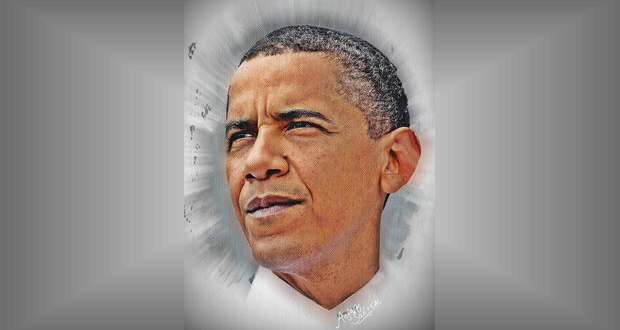
Obama-620x330Ivan Garcia, 24 February 2016 — Neither American economic power nor Barack Obama’s oratorical skills seem to be enough to satisfy exaggerated, unreasonable or personal demands from the diverse group of Obama fans who make up Cuban society.

The national psyche is fixated on the underlying and widespread idea among Afro-Cubans that foreign money, investment and commerce can put the madness that is the national economy back on track.

After class at Eugenio Maria de Hostos, a high school located in Havana’s La Vibora neighborhood next to a steel mill, a group of students are chatting. “Dude, I swear, when Obama comes in March, I am going to ask him to buy me a pair of Nikes. My New Balance shoes are worn out,” says a boy amid chatter and laughter. continue reading

A teenage girl in the sixth grade says she would like to talk to Obama about “fixing the school, which is dilapidated, and getting me a scholarship to study film in the United States.”

One might think of such trivial requests and fantasies as forms of child’s play. But speaking in a serious tone as he skillfully maneuvers through a series of potholes on Tenth of October Avenue, Antonio’s comments suggest otherwise.

A taxi driver who works twelve-hour days driving an old car with a Ford chassis, a Hyundai engine and a German transmission, Antonio observes, “I think this visit will be very important. Obama will probably bring some good things. The government is fixing the streets and replacing vintage cars with new American ones.”

Giorvis, a bricklayer, would like the Obama administration to approve temporary visas for Cubans seeking short-term employment in the United States. “I have a cousin in New York in real estate. He tells me that they need workers. If they allowed temporary employment in the United States, people would spend a few months there and then return to the island. I assure you most people would not want to emigrate,” he says.

If the government of Raul Castro were to open an office where people could submit written proposals to President Obama, the number of letters it received would be surprising.

Starting with Nora, a plump mulata who sells paper cones filled with peanuts for a peso apiece at the bus stop on the corner of Ascosta and Pey streets. She dreams of getting a small loan to repair her dilapidated shack. Then there is Osniel, the owner of a cafe who wants to import food supplies directly from Miami. Finally there is Sergio, a first baseman on a junior league baseball team who would urgently ask Obama to sign an aggreement between the MLB and the Cuban Federation to halt the constant drain of players jumping the fence. In one way or another, every Cuban wants something from Obama.

But Obama is not Houdini. Over the course of twenty-four hours he will have to listen to the strident rhetoric of military dictators demanding the return of the Guantanamo Naval Base, the lifting of the “blockade,” billions of dollars in reparations and the closure of Radio Marti and its television affiliate.

According to a Communist Party official in Tenth of October, the most populous burrough in Cuba, “expectations are that there will be a huge reception and that he will likely give a speech in the auditorium of the University of Havana or the Palace of Conventions. But not in the Plaza of the Revolution. Since it’s the symbol of anti-imperialist resistance, that would be a contradiction. Although, given the times in which we live, anything is possible.”

One sector that would also like to speak frankly with Obama is the dissident community, if there is time in his schedule to meet with them. Within the opposition there are a variety of views and differing opinions.

On March 21 in 2003 — the same day of the month on which Obama will set foot on Cuban soil — Jorge Olivera, a poet and independent journalist, was one of seventy-five dissidents sent to prison on orders from Fidel Castrol

For Olivera the visit by the U.S. president could mark a turning point. “I hope he meets with members of civil society and the opposition, the old and the new. At least that is what he has suggested in several interviews. I am one of those who believes this could be a watershed.”

Berta Soler, leader of the Ladies in White — a group of women whose peaceful marches led to three-way negotiations between the regime, the Catholic church and the Spanish government to free prisoners of conscience from the Black Spring of 2003 — is more skeptical.

“On January 28 the Ladies in White sent a letter to President Obama describing concrete cases of human rights violations by the dicatorship. [These involve] assaults Sunday after Sunday on our marchers demanding the release of political prisoners, harassment, theft of money and property by authorities, and threats to family members. We have as yet to receive a reply from Obama. Our group will approve of Obama’s visit to Cuba if and when he meets with independent members of civil society and the oppostion. Otherwise, Obama will be complicit in the dictatorship’s violation of human rights,” says Soler.

One month before Air Force One lands in Havana and the stunning presidential limousine known as “the Beast” rolls through the city, Cubans have come up with every observation, request and piece of gossip imaginable.

“They say an aircraft carrier and a submarine are coming as part of the secret service detail protecting Obama,” says a craftsman who sells his products in the capital’s historic district. “Several avenues will have to be fixed just so the Beast can get around Havana. What we need once and for all is food, construction materials and investments from the U.S. that will benefit Cubans, not the government.”

According to some polls, the U.S. president’s approval ratings in Cuba are higher than those of the Castro brothers. And he is more popular on the island than in his own country. In spite of the complaints by average citizens, dissidents and the government, Obama elicits positive reactions among Cubans.

El Negro, as he is affectionately called by many here, could boast of being able to fill a stadium or plaza voluntarily. But fulfilling a litany of requests is another matter. He is Obama, not God.


“I’m Afraid That Ecuador Will Deport Me To Cuba” / 14ymedio, Mario Penton

Sigfredo Ochoa values the freedom he has found in Ecuador but feels rejected in the Andean country. (Courtesy of the interviewee)

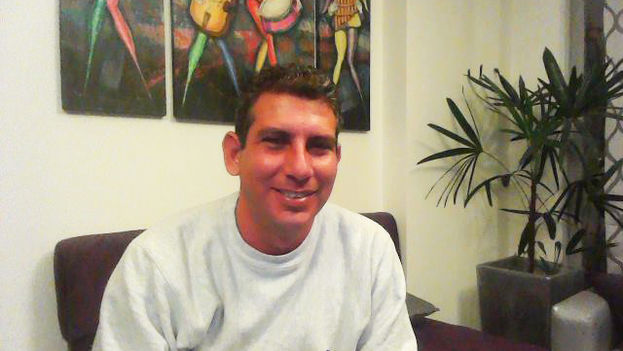
14ymedio bigger14ymedio, Mario Penton, Miami, 26 February 2016 — Sigfredo Ochoa is 40 years old. Six months ago he was one more “Palestinian” in Havana, a Cuban from Holguin living “illegally” in the capital of his own country, according to the authorities – a status that earned him that strange moniker among native Havanans. He worked as an investigator, regulator and auditor in the Provincial Trade Company, a state entity that, among other things, manages the dwindling quotas distributed through the ration book.

“The idea of coming to Ecuador arose mainly because of the state of siege I experienced because of my homosexuality. At work it was impossible not to be discriminated against, and on top of that there is the economic situation we Cubans experience. My salary wasn’t enough to live on; if I ate I couldn’t clothe myself, if I clothed myself I couldn’t eat; a question as existential as Shakespeare’s ‘to be or not to be,’ but in a tropical version. continue reading

Ochoa noted that it wasn’t easy to get the money to leave the island. His parents had to sell the old family house and buy a small apartment in order to cover the cost of the trip. The passport cost him five months salary, and adding the cost of the ticket and the first months’ living expenses, it wiped out the few dollars he had.

“My mother has Alzheimer’s disease and has already been operated on for colon cancer. My father is a retired old man. Together their pensions don’t total 30 CUC a month (under $30), tell me, who can live in Cuba on that money? I had no option, I had to sacrifice myself for them… and for me.”

Sigfredo’s expectation was, like many Cubans who set off for Ecuador, that he would be able to enter the labor market in the Andean country, where the minimum salary is 366 dollars a month, more than ten times that in Cuba, although the cost of living is higher in Ecuador.

“I thought getting a job would let me survive and be able to help my parents, but everything here has wiped me out. These people do not want to give us work and they don’t want us in their country. We go out looking for work and they simply tell us they don’t want Cubans. In a month we have no money left to pay the rent and we have to sleep in the street. I don’t know what I’m going to do,” he laments.

On entering Ecuador with a tourist visa, Cubans have 90 days to try to legalize their status in the country. For several years that have done it through a professional visa, which in the interest of the nation’s human resources, allows professionals from the island to qualify for the title previously legalized by the Cuban Foreign Ministry and certified at the Ecuadorian embassy in Havana, and so to stay in Ecuador and subsequently find work in areas such as healthcare and education.

Cuban doctors and professionals took advantage of the opportunity to come en masse, which forced the Cuban government to come to an agreement with Ecuador to suspend this right to university graduates coming from the island. Over time, other alternatives to legalization were also closed, such as the temporary visa, valid for six months, know as the 12-IX and the commercial visa.

“The only option now to legalize myself is to marry an Ecuadorian and have children. It’s the only possibility left to us Cubans. Ecuadorians are asking between 3,000 and 4,000 dollars for a marriage of convenience that enables us the privileges of a spouse,” says Sigfredo.

Sigfredo is grateful to Ecuador as the country where he discovered freedom. “What struck me most when I get here is that you can speak out and say what you really believe without anyone controlling it.” However, just the fact of being Cuba, and in addition being undocumented, has led to a lot of discrimination.

“One of the many times I’ve sought work a restaurant they wouldn’t even let me speak. ‘There is no work for Cubans here. You and dogs are the same thing,’ they said. They kicked me out with these words, ‘Get out of here, you people come to this country to steal our jobs.’ That hurt me so much because I didn’t want to take anyone’s job, I simply had the idea of helping my family and getting out of the nightmare that is life in Cuba,” he lamented.

Employers in Ecuador often take advantage of these undocumented migrants as cheap or slave labor. “Once I worked in a bar for a week. I did the cleaning and served as a barman for 20 dollars a day. I never say a single cent. When I asked for my pay the owner said he would call the police. We are completely defenseless.”

Many Cubans are living in the center of Quito. “There are many who are undocumented,” comments Ochoa. “Recently there was a raid and they took several. I live with fear, I try to go out only after sunset or very early in the morning, in the hours when the police usually aren’t in the streets because I’m afraid they will deport me to Cuba.”

For Sigfredo, in Ecuador, as in Cuba, there is nothing to hope for. He does not believe he can obtain residency and, even though he has tried to join other groups departing for the United States, the extremely high cost – around 6,000 dollars – and the dangers of the jungle have stopped him. Now he sees a hope.

A group of Cubans who share his fate have decided to give a voice to those migrants who are surviving in the streets of Quito. He was one of those who went to the demonstration at English Park. “It is the only hope we have left, if they don’t want us here, at least we can go where we can grow as people and work honorably. That’s all we are asking for.”

‘El Sexto’ Exhibits the Pigs That Sent Him to Jail in Cuba / 14ymedio, Mario Penton

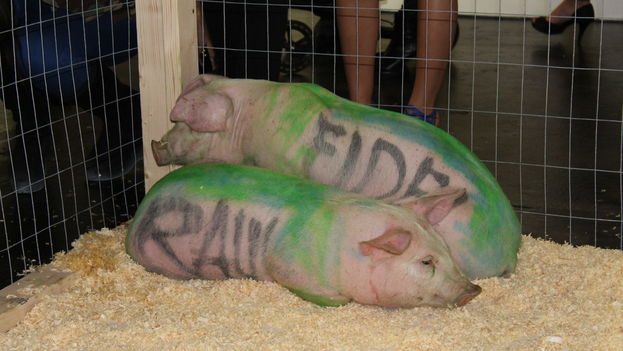
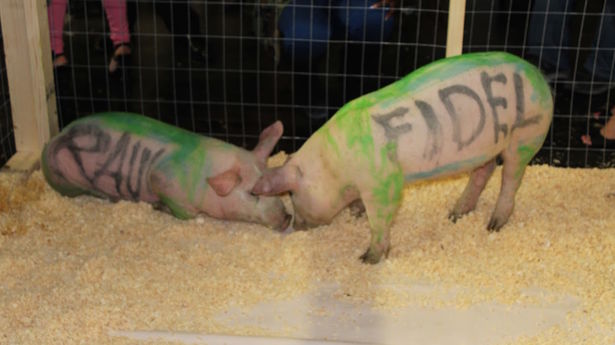
'Raul' and 'Fidel', the pigs from the performance art piece banned in Cuba, were paraded through the Market Gallery in Miami on Thursday. (14ymedio)
‘Raul’ and ‘Fidel’, the pigs from the performance art piece banned in Cuba, were paraded through the Market Gallery in Miami on Thursday. (14ymedio)

14ymedio bigger14ymedio, Mario Penton, Miami, 26 February 2016 – Last night in Miami Danilo Maldonado (known as ‘El Sexto’, The Sixth), was able to show off the pigs Raul and Fidel, which cost him ten months in prison in Cuba. The opening of the exhibition “Pork,” at the Market Gallery in Miami Beach this Thursday, included the performance art piece banned in Cuba at the end of 2014, in which the two pigs walked peacefully around in an area restricted for their display, while a crowd gathered around and flashes lit up the pigs, who now and then appeared to pose.

El Sexto is an artist of freedom. At times irreverent and iconoclastic, but decidedly sensitive and intuitive. “The only way to find freedom is to go out and get it. I am still looking for it, but only this search is what frees you from a state of repression,” he told 14ymedio while preparing for the opening of his first exposition in the United States.

Enlivened by the well-known and controversial band Porno Para Ricardo, the event welcomed hundreds of participants, especially young Cuban Americans, and was a showcase for the work of the artist imprisoned for his performance art piece in Havana’s Central Park, inspired by Orwell, that never saw the light of day until last night in Miami. Since then, the image of the two pigs painted olive-green with the names of Fidel and Raul on their sides, accompany El Sexto wherever he goes. continue reading

“For me, the pig chosen by Orwell was the closest thing to the characters I wanted to represent. But in addition, it is the only thing left to us, there is no fish, no chicken… all there is is pork,” he said, to explain his choice.

Maldonado began his artist work painting graffiti on the walls of Havana which he signed underneath with the pseudonym “El Sexto” (The Sixth), as a way of protesting against the huge campaign financed by the Cuban state to demand the release of the five spies considered heroes in Cuba. His social criticism and sarcastic messages were completely unacceptable to the authorities, who interpreted his art as a hostile act.

“I have been a follower of El Sexto for a long time. His work shows the injustice of the Castro regime, the lack of freedom, Valle Grande Prison (where he was held), the hunger strike he was forced to undertake…” commented Sheila Oliva Gonzales, a young Cuban who graduated from the National School of Arts in Cuba and now lives in Miami.

Despite everything, his imprisonment was a learning experience for El Sexto. “In Cuba there is a society that is falling apart, a country that is collapsing and this system has no solutions.”

The trip to the United States has represented a qualitative leap in Maldonado’s artistic career, but also on a personal level. “It helps you to want to transmit what you see to those over here. Here people believe in big dreams, and they are motivated to work, they have a purpose. That makes you fee.”

Ramon Alejandro, one of the great Cuban painters of exile, was present at the exhibition. “I did not know that he was a photographer, or that he painted on fabric, I only knew the drawings that circulated on the internet. He is a very good painter and what he does is very interesting, independent of its social and political implications,” he commented.

Others who were also there were Berta Soler, leader of the Ladies in White, and Antonio Gonzalez Rodiles, director of the Estado de Sats project. “It’s fantastic that he can have the exposition here, because he couldn’t do it in Cuban. It seems that Raul has bought this name and now it is his property, and the name Fidel as well. Now no one can have it, not even the pigs,” lamented Soler.

Danilo Maldonado, who is very close to the Todos Marchamos (We All March) initiative undertaken by several civil society groups on the island and in exile, has said on numerous occasions that his intention is to return to Cuba in March and to continue attending, along with his mother and grandmother, Santa Rita Church, with the Ladies in White. “The importance of Todos Marchamos is that no one has dared to do this before now, to take to the streets,” affirmed the artist.

Former Democratic congressman Joe Garcia, who was also present at the evening, praised Maldonado’s courage, because he had the opportunity to leave Cuba but decided to say. “This makes him a good Cuba, a patriot. The most heroic acts are those silent acts that people undertake to improve their country. And there are thousands and thousands of Cubans who are doing this every day,” he said in praise of El Sexto.

One of the most moving moments of the night, along with the realization of the performance art piece aborted in Havana, was the moment when El Sexto proceeded to get a tattoo of a declaration asking for the freedom of the Venezuelan politician Leopoldo Lopez, imprisoned in that country, and the Cuban political prisoners.

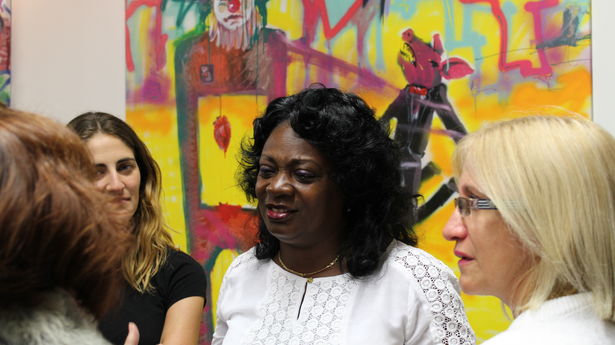
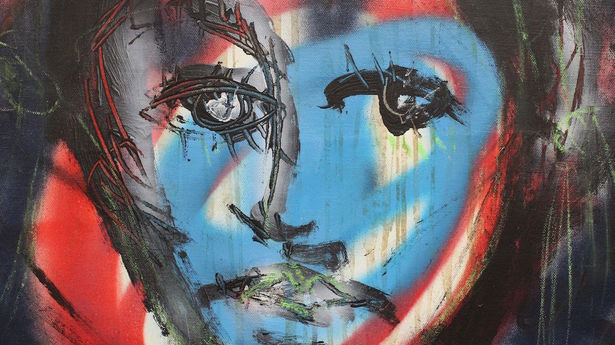
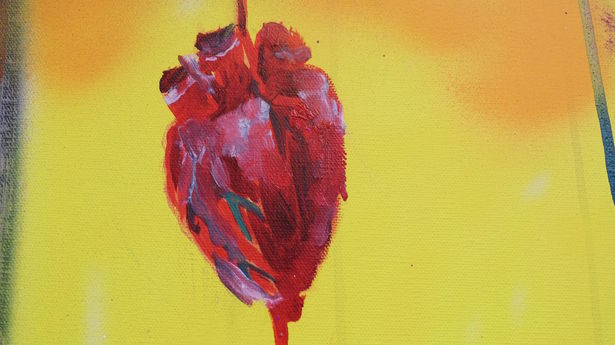
“Pork” an Exposition of “El Sexto” in Miami / 14ymedio

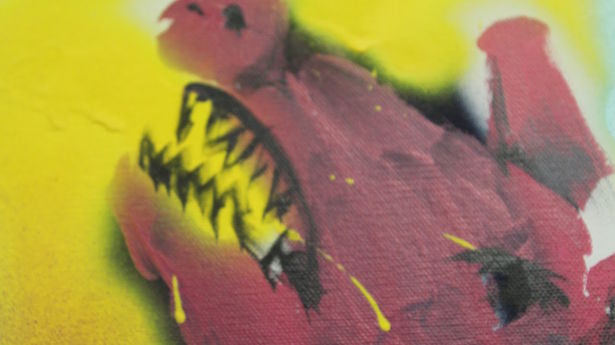
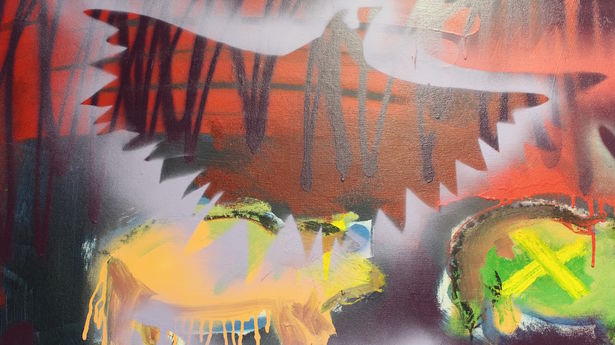
19 Exposicion-Sexto-Miami_CYMIMA20160226_0037_12This Thursday opening in Miami was the exposition by graffiti artist Danilo Maldonado, known as “El Sexto” (The Sixth). There was a great deal of publicity and friends and colleagues joined the occasion. Maldonado plans to return to Havana in March and continue his activism and also resume his street art, which has made him the most famous underground artist on the island.

Outstanding among the pieces at the Market gallery in Miami Beach, the 'performance' art that cost Maldonado ten months in prison in a Havana park two pigs with the names Fidel and Raul painted on their sides.
Outstanding among the pieces at the Market gallery in Miami Beach, the ‘performance’ art that cost Maldonado ten months in prison in a Havana park two pigs with the names Fidel and Raul painted on their sides.
Maldonado, age 32, based his planned performance on George Orwell's 'Animal farm" where the animals rise up against the farmer under the leadership fo the pigs.
Maldonado, age 32, based his planned performance on George Orwell’s ‘Animal farm” where the animals rise up against the farmer under the leadership fo the pigs.
Unlike what happened in Cuba, where the artist was arrested and pigs confiscated, on this occasion the animals walked around quietly in a restricted area while the crowds crowded around to take pictures of them
Unlike what happened in Cuba, where the artist was arrested and pigs confiscated, on this occasion the animals walked around quietly in a restricted area while the crowds crowded around to take pictures of them.
From Valle Grande Prison 'El Sexto' not only continued with his artwork inside the prison, but also carried out two hunger strikes and brought out visual testimony of the overcrowding and bad conditions in Cuban prisons.
From Valle Grande Prison ‘El Sexto’ not only continued with his artwork inside the prison, but also carried out two hunger strikes and brought out visual testimony of the overcrowding and bad conditions in Cuban prisons.
Ladies in White leader Berta Soler at the show. While he was behind bars, El Sexto also kept a kind of diary, when he wasn't in isolation. The human rights organization Amnesty Internationl declared him a prisoner of conscience.
Ladies in White leader Berta Soler at the show. While he was behind bars, El Sexto also kept a kind of diary, when he wasn’t in isolation. The human rights organization Amnesty International declared him a prisoner of conscience.
The strong social criticism and sarcastic messages that characterize the work of this young man are not at all appreciated by the Cuban authorities who interpret his work as a hostile act.
'El Sexto' is very critical of many Cuban artists on the island whom he considers "accomplices of Castroism" and be believes they work they do is "an art of lies" because "they aren't capable of questioning the system."
‘El Sexto’ is very critical of many Cuban artists on the island whom he considers “accomplices of Castroism” and be believes they work they do is “an art of lies” because “they aren’t capable of questioning the system.”
In the graffiti artist's opnion, a great deal of the blame for the system that has come this far falls on the artists, who have helped to legitimate ex-president Fidel Castro and his brother Raul.
In the graffiti artist’s opinion, a great deal of the blame for the system that has come this far falls on the artists, who have helped to legitimate ex-president Fidel Castro and his brother Raul.
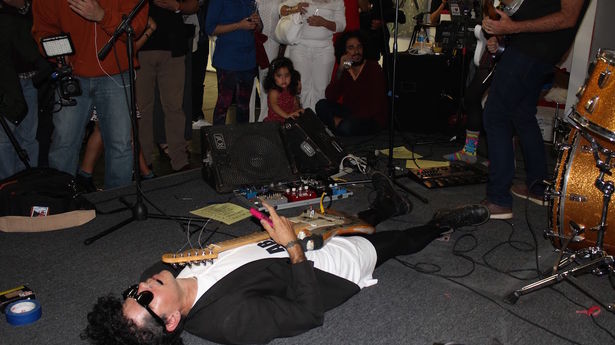
At the show the punk rock group Porno para Ricardo played several themes which mix the renegade feeling of their lyrics, civic protest and criticism of the repressive organs of the Cuban government.
The exhibition also included a showing of the film "The Life of Juanita Castro" - Fidel and Raul's sister who has lived in the US since 1964.
The exhibition also included a showing of the film “The Life of Juanita Castro” – Fidel and Raul’s sister who has lived in the US since 1964.