EFE (14ymedio), February 2016 — Cuban writer Leonardo Padura said today that he views positively the upcoming visit of U.S. president Barack Obama to Cuba, and he believes it marks “a different moment” in the relations between both countries, which have always been “very traumatic.”
“We are living at a unique moment: Obama is coming, the Rolling Stones are coming, a baseball team is coming, Chanel is coming… This has become like a theme park that everyone wants to visit,” joked Padura to EFE in Havana.
The author of “The Man Who Loved Dogs” confessed that he was surprised by the news of Obama’s trip announced for 21-22 March, which he greeted as something “very good.” continue reading
“I think that everything that contributes to eliminating tensions, building bridges, coming to a better understanding and, in the end, a better life for Cubans. you have to greet this as a positive thing,” he said.
The trip of President of the United States to the island “historically is marking a different moment. The relations between the United States and Cuba have always been very traumatic and, if that trauma is overcome and we travel a path towards real normalization of relations, it will be beneficial for everyone, especially for us Cubans,” he added.
Leonardo Padura participated today in Havana at the “Cultural Thursdays” colloquium organized by the Spanish Embassy in Cuba, held on this occasion to celebrate the 25th anniversary of the creation of his character Mario Conde, the protagonist of his saga of police procedurals.
Along with Padura, speaking at the symposium was the actor Jorge Perugorría, who plays Mario Conde in the film and television series “The Four Seasons” which will premiere this year, directed by the Spanish filmmaker Felix Viscarret.
Jorge Perugorría told EFE that Obama’s visit has created “a kind of expectation among Cubans” and he hoped that it will serve to change and definitely improve relations between the two countries.
“I thought this [the visit of US president] was something I would never see. However, it has been faster than we imagined. Since the famous declaration of 17 December 2014 so much has happened, and so quickly. Obama is coming and I think it’s fantastic that this is happening and that the two countries will follow the path of understanding and normal relations,” said the actor.
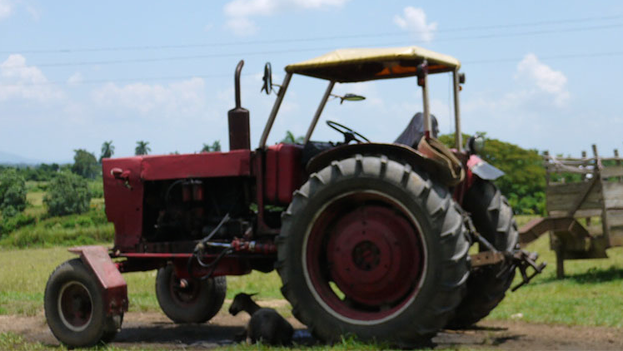
The old tractor on La Isleña farm in San Juan y Martinez, Pinar del Río. (14ymedio)
“Do not put me in the dark to die like a tractor”
(popular parody of a line from José Martí)
14ymedio, Reinaldo Escobar, Havana, 25 February 2016 – Two pieces of news have raised hopes among Cuban farmers. One is that the United States company Cleber LLC will install a tractor factory in the Mariel Special Development Zone (ZEDM). The second is the announcement that China will open a line of credit so that the island can buy YTO brand Chinese tractors to use in the rice program.
To encourage more hopes, the newspaper Granma dedicated an article today to an explanation of the situation of the 62,668 tractors registered in the country, of which 95% have been in use for more than 30 years. The article reports the number of these machines, their distribution by area, what they are used for, and how many tires or tracks they had. But they said nothing about the future of these obsolete vehicles nor the new ones to come. continue reading
However, Cubans learned long ago that when the river is roaring it is because it is carrying stones, but when you can’t hear it it’s doing the same. It’s been a long time since anyone has repeated from a podium or in a meeting with senior officials that plowing with oxen is better than doing it with farm machinery.
The thousand small tractors the US firm proposes to produce annually are optimal for use with organoponic cultivation methods and they suggest selling them to independent farmers in Cuba. The tractors will enter the market under the name Oggún, one of the main orishas of the Yoruba religion tied to technology and surgeons.
A rural legend, repeated by old already-retired tractor drivers, tells that at the end on the seventies in the San Juan y Martinez nursery area, a huge pit was dug to bury hundreds of destroyed tractors. Whole machines buried as scrap before handing them over to the peasants. State ownership “was ready to die” before making the transfer to the calloused hands of the private producers.
Time passed and the “Special Period” arrived and only then was the decision made to hand over whatever was unusable. Alfredo Perez, operator of a ’56 Ford belonging to La Isleña farm in Pinar del Río, who tells how this transfer worked. “As far as I know, in the nineties the state enterprises began giving the private farmers some farm machinery,” he says.
The farmer remembers that in most cases the tractors involved were in such poor condition, that in all the bureaucratic paperwork it appeared as the sale of decommissioned equipment, not property. From there it was up to the farmer to find a way to do what the state had failed to do despite all its resources, which is what they did. “They handed over a ghost that had to be resuscitated,” remembers Perez.
Despite the poor mechanical condition of the equipment, it was necessary to have an endorsement letter from the president of the cooperative and a commitment to lend the vehicle to whatever entity needed it , including the police.
The current practice is that when a state enterprise receives a new fleet of machinery, they hand over the old equipment to the cooperatives. Sometimes the machines are in terrible condition, other times in pretty good shape or even the company itself can help the cooperative get the parts to make it work.
Another way to acquire a tractor is to have the great good fortune to know the owner of a piece of American-made equipment that they want to sell. The Soviets awarded by another system what they weren’t allowed to market. The price of these “agricultural almendrones*” could vary between 100,000 to 150,000 Cuban pesos, depending on their condition and the farm implements included.
Alfredo only knows one farmer to whom they sold “ten years ago, a new tractor, and it was Alejandro Robaina,” the famous tobacco farmer of Vueltabajo. The farmer has some reservations and wonders if “the Americans” are going to distribute through the state or market them freely.
With the wisdom of a man of the countryside who knows that nothing is certain until the harvest is gathered in, Alfredo knows that tying the tractors to Oggeun is very premature, “because it is not even confirmed that they will build the factory,” and “only time will tell.”
Increasing food production is a priority for the State, so as to be able to replace imports and meet demand. The shortages and consequent rise in prices generate controversies of every kind, but there is something everyone agrees on: the solution is to produce more and for this, willpower isn’t enough, tools are needed. The farmers need better resources and marketing tractors puts to the test the old governmental prejudices: the Cuban countryside, stuck in the 20th Century, is facing the modernity it needs.
*Translator’s note: “Almendrones” (from the word for almond) is what Cubans call the pre-Revolution American cars still circulating in Cuba.
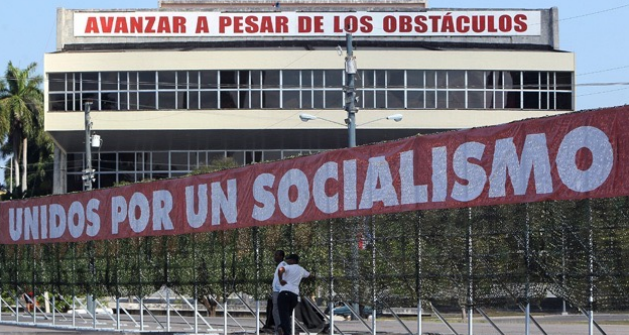
Billboards being prepared for May 1st in Havana’s Plaza of the Revolution
14ymedio, Havana, 19 February 2016 — The meeting “Socialism And The Society We Want, organized by several organizations for tomorrow at the Omega Cinema in Havana, had to be postponed because at the final hour the management of the site reported that the theater “will not open its doors that day.”
Scheduled to participate in the meeting are leftist independent organizations such as Participative and Democratic Socialism (SPD), Cuban Leftist Democratic Socialists and Cuban Socialist Refoundation (ISDC-RSC) and the New Socialist Project for Cuba (NPSC).
In the article published in the SPD Bulletin this Friday, it said that the meeting was postponed, given there is not enough time to find an alternate venue. The organization assures that it will continue preparing for the event and that the date, place and time will be “announced promptly.”
Speaking to 14ymedio, Pedro Campos, one of the organizers, said the commitment was made verbally a week in advance, with the idea of paying the rent on the day of the event. “When we went by yesterday to confirm the reservation, we were told that the place was closing that day but were offered no explanation. It wasn’t for fumigation for because someone had forbidden it. They simply said it would be closed.”
Campos did not want to speculate on the reasons for the refusal. “As they say in the TV show Passage to the Unknown, everyone can draw their own conclusions,” he added.
14ymedio, Havana, 15 February 2016 – The Cleber Tractor Company has become the first U.S. company to receive authorization from the Office of Foreign Assets Control (OFAC) of the United States Department of the Treasury to operate in Cuba, as reported Monday Associated Press (AP).
Last November, the Alabama-based company won a license of the Government of Cuba to operate in the Mariel Special Development Zone (ZEDM).
Cleber will built an assembly plant for up to 1,000 small tractors a year, specifically designed to support and expand organoponic cultivation methods. These products will be sold to independent farmers in Cuba, according to the AP. The assembly plant will be called “Oggún,” like the orisha of the Yoruba religion linked to technology and surgeons, and syncretic with Saint Peter in Catholicism.
The company’s partners, Horace Clemmons and Saul Berenthal – who was born on the island – received notice from the Treasury Department last week and plan to initiate their activities in the country in the first trimester of the coming year.
“Everyone wants to go to Cuba to sell something, but we are not trying to do that. We are studying the problem and how to help Cuba resolve the problems that they believe are the most important to resolve,” Clemmons told AP. “We believe that we will both win long term if we do things that are beneficial to both countries.”
Among the biggest problems facing Cuban farmers is access to machinery that will facilitate work in the fields. Currently, the tractors that remain active are state-owned, are affiliated to a cooperative or have decades of use in private hands, and have been preserved thanks to ingenuity and spare parts purchased in the informal market.
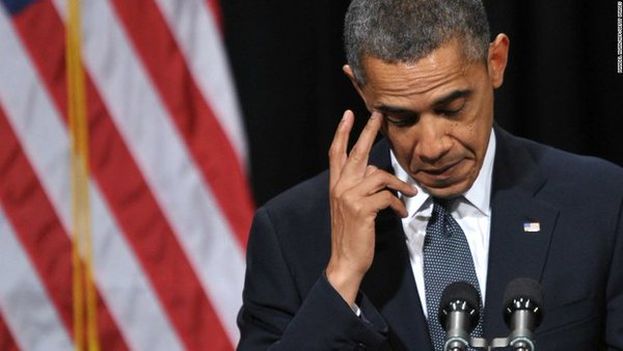
US President Barack Obama, this February. (WhiteHouse)
14ymedio, Miriam Celaya, Havana, 11 February 2016 — More often than reason dictates – since the announcement of the restoration of relations between the governments of Cuba and the United States – statements, newspaper articles and even open letters have appeared taking to task president Barack Obama for a decision that some consider a political mistake, an excessive concession to the longest dictatorship in this hemisphere or, at best, naïve. There have even been those who have gone so far as to accuse the American president of orchestrating “a betrayal of democratic Cubans,” even if unaccompanied by arguments to support such an affirmation.
Without wishing to discuss the sovereign rights of each person to say what their own intellect dictates, it is noteworthy that the angriest complaints rest on questions that are not attributes exclusive to the president of the United States. Let’s take, for example, the issue of the relations themselves. Has this political rapprochement been more beneficial to the Cuban government, perhaps, than the acceptance and recognition it has had from other democratic governments? That is, countries such as Germany, Great Britain, France and Spain, among others, that have maintained relations with the Cuban dictator for years, and yet to date their governments have not received so many complaints on the part of those who indict president Obama for the same “crime.” continue reading
Another interesting issue is the wave of anxiety over the lifting of restrictions on Americans’ visits to the island, and trading between US producers and Cuban companies, when for decades we have received millions of European and Canadian visitors and have traded with businesses in numerous democratic companies without, so far, raising so many hackles.
In fact, foreign investors have been active on the island since the nineties – among them the well-known entrepreneurs from our stepmother country, Spain, which have exploited native labor ad nauseam in flagrant violation of the laws of international entities that defend the rights of workers – and have offered the Cuban government greater profits than all the relaxations of the embargo pushed by the US administration.
I wonder why Cubans’ democratic longings have never been directed toward the politicians and businessmen of that nation, culturally and historically related to the island, and why it has never offered vertical and openly declared – or at least convincing – support for the struggle for democracy on the island.
Is the critical approach of Barack Obama to the Castro dictatorship morally more reprehensible than the flirting of Madrid’s Moncloa Palace with the Palace of the Revolution, or than the entertainment received by the general-president Castro II during his recent stay in France, cradle of modern democracy?
Was it not the Holy Father himself, the humble Francis, who gave major honors to the island satrapy by favoring the ex-president Castro I with a personal visit, while deliberately ignoring the repression of the dissidents, avoiding a meeting with representatives of civil society, and conveniently omitting any criticism of the deplorable state of human rights in Cuba?
However, with a persistence worthy of better causes, the critics of the current US administration maintain a moral blockade against Barack Obama, as if he should take responsibility for the history and destiny of a people that has been sufficiency irresponsible as to allow itself the sad eccentricity of supporting the longest dictatorship in memory in the Western world.
Recently in this newspaper, a letter was published where a Cuban directed four personal questions to President Obama (Four Questions For You, President Obama). These four questions summarize approximately the same complaints and demands of a great number of the resentful, who do not understand why the president of our northern neighbor “has taken no [effective] actions” to force the Cuban dictatorship to respect the democratic rights of Cubans, or why he has not done enough to guarantee the quality of life of the islanders since 17 December 2014, as if some of these issues were priorities or key issues for the president of a foreign country and not matters that we Cubans are capable of resolving ourselves.
Paradoxically, this young Cuban who says he “does not want to emigrate and dreams of a free, independent and democratic Cuba” has clearly subordinated Cuba’s national sovereignty to the will and decisions of that foreign government. Indeed, some patriots show themselves to be so passionately naive that one doesn’t know whether to give them a round of applause or burst into tears.
But this is how things are in these parts. There are also others abstractly flying an exacerbated civicism that falters, however, when they try to apply it to daily life. I wonder if this young man and so many other “demanding” Cubans here – in particular those who attend the meetings to nominate candidates or the so-called “Accountability Assemblies” – have had the courage to ask their representative what he or she is going to do to guarantee the human rights, freedom and prosperity of (at least) their neighbors and the community.
And taking the matter to a more individual level, how many of them ask themselves what they are doing to change the state of affairs in Cuba.
Personally, I have no demands of President Barack Obama nor to any specific foreign government. Most likely if I were in his shoes I would do the same: seek to safeguard the interests of my nation and my compatriots, as well as the safety of my loved ones. It is what I aspire to in a future Cuban president, when we live in a democracy. I suppose that Mr. Obama has every right from his own discernment to think: If Cubans in great enthusiasm applauded the installation of a dictatorship from before I was born, if they have chosen to escape it or to tolerate its excesses ad infinitum, who am I to assume the role of redeemer?
It seems cynical, and may be so, but if you look at it coldly, it’s reality. The Cuban dictatorship has done exactly what we have allowed it to do. And it will remain on the throne of power as long as it wants, not only for its own absolute power but because Cubans consent. For an autocracy to succumb there doesn’t have to be an assault on barracks or the unleashing of a war; it is enough to stop obeying it.
Until that happens, we can bombard Barack Obama or the next occupant of the White House with any questions we like; the truth is that the real answer is among ourselves.
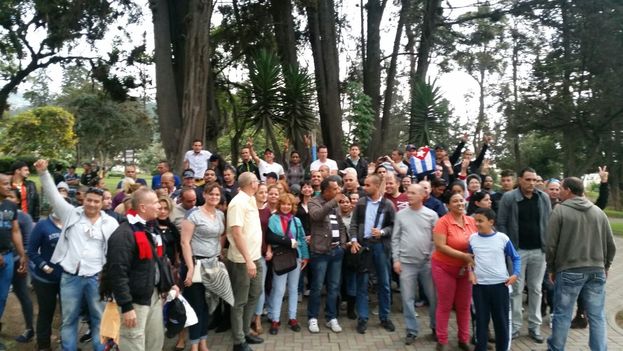
A group of Cubans living in Ecuador met in the English Park to demand their rights. (Facebook)
14ymedio, Mario J. Penton, Miami, 24 February 2016 — Fifty Cubans met in English Park, in the north of Quito, to request treatment similar to their compatriots stranded in Central America. The anonymous call to the meeting, which circulated among groups of Cubans on Facebook, asked all Cuban immigrants living in Ecuador to agree to “ask and demand” that they be sent to the United States, because, they say, they are fed up with “the abuses and contempt” in the Andean country.
According to the event organizers, their goal for the “First Meeting of Cubans in Ecuador” is to be heard about their “rights as human beings.” In addition, they affirm they do not want “any form of conflict within in the country,” and only want “to have a dignified life and to be able to choose the ideal place to do so.” continue reading
Pedro Sanchez, one of the participants, told 14ymedio via the Messenger app that the protesters set three objectives. First, push for an agreement between the Governments of Ecuador and Mexico to allow a safe transfer to the United States of those Cubans who are undocumented in the country; second to form a movement with a legal basis; and third, to advocate for the nine Cubans who are imprisoned in the Hotel Carrion and are also part of their struggle. The Hotel Carrion is an immigration jail where undocumented Cubans are sent while awaiting eventual deportation to the island.
“The main problem of the Cuban community is discrimination,” says Osvaldo Hernandez Cabrera. “Here they don’t want to legalize us or give us work.. We only ask that they give us a direct way to reach the United States via Mexico as they have given our brothers. We are not illegal, we are Cubans stranded in Ecuador,” he claimed.
To get a work permit, he adds, there are many requirements and most of the time, when they go in search of employment, they are rejected with a resounding “no Cubans are hired here.” “We are trying to send letters and get them to listen to us, otherwise we are ready to throw ourselves on the border with Colombia to get them to pay attention to us,” he said.
Hundreds of messages of support have been sent to these Cubans from different parts of Ecuador. “Some of us are not in Quito, but we are one hundred percent for the cause. From other places we will be supporting everything that is needed,” said Yordey Betancourt, an app user. Another young Cuban lamented the discrimination to which she is subjected. “Today a lady told me on the trolley (bus) ‘this is not your country.’ They mistreat us without reason, because Cubans are good. Give us an out and Ecuador will see that we will never return. We’ve run out of money and they no longer want us. Incomes, sales, taxis, trade… they all increased with us and now they do not want us.”
Vivian Hernandez Valdes supports the requests of the group: “What they are asking for is fair. The living conditions of many compatriots here are very poor and I think it is the right time for all Cubans who are in Ecuador and want to travel to the United States to get the same treatment as those in Panama and Costa Rica.”
The Cuban community in Ecuador grew starting in 2008 when the country lifted the visa requirement for travellers from the island. It is estimated that there are about 40,000 Cubans residing in the country. Ecuador was used as a springboard by Cuban migrants to reach the United States to take advantage of the Cuban Adjustment Act. According to official figures, in mid-2010 37,000 Cuban entered the country, a trend that continued rapidly increasing until Rafael Correa’s government decided to re-impose a visa requirement last December, after the immigration crisis that broke out in Central America.
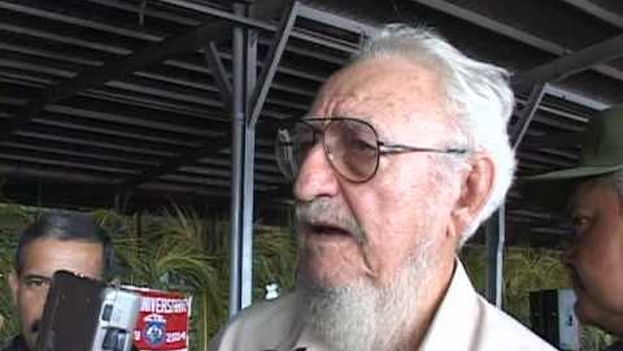
Ramón Castro Ruz died Tuesday in Havana. (Youtube)
14ymedio, Havana, 23 February 2016 — On the morning of Tuesday, 23 February, Ramon Castro, brother of Fidel Castro and Cuban President Raul Castro, died in Havana at age 91, according to the official newspaper Granma.
Born in Biran, now in the province of Holguin, on 14 October 1924, he was the second child of Angel Argiz Castro and Lina Ruz Gonzalez. In his family he was called by the nickname Mongo Castro.
He studied agricultural engineering at the University of Havana and was imprisoned during the Batista regime in 1953, after his brothers’ assault on the Moncada barracks in Santiago de Cuba and the Carlos Manuel de Céspedes barracks in Bayamo. continue reading
The official note said that he “cooperated with the 26th July Movement and organized one of the networks supplying the Frank Pais Second Eastern Front.”
After the first of January 1959, he served as advisor to the Ministries of Agriculture and Sugar as well as three other ministries, where he is remembered “with neither pain nor glory,” according to former colleagues consulted by this newspaper.
Ramon Castro is credited with a part of the responsibility for the disastrous livestock policy and the dairy development plan during which cows were imported from Canada, animals that were not acclimated to conditions in Cuba. He was also the director of the failed Special Genetic Plan of the Valles de Picadura.
The official note states that he had received “several awards and held the title of Hero of Labor of the Republic of Cuba”.
For several years, the eldest of the brothers has been out of public life and the rumor about his ill health had spread on the island. The statement about his death, also read on the main television news, did not specify the cause.
To the Cuban people he is particularly remembered for his great physical resemblance to his brother Fidel Castro.
His remains were cremated and will be transferred to Biran, his birthplace and the place where the remains of his parents repose, state media reported.
In addition to Ramón, children from the marriage of Angel Castro Argiz and Lina Ruz Gonzalez were Angela Maria, born in 1923 and died in 2012, Fidel Alejandro (1926); Raúl Modesto (1931), Juana de la Caridad (1933); Emma de la Concepción (1935) and Agustina del Carmen (1938).
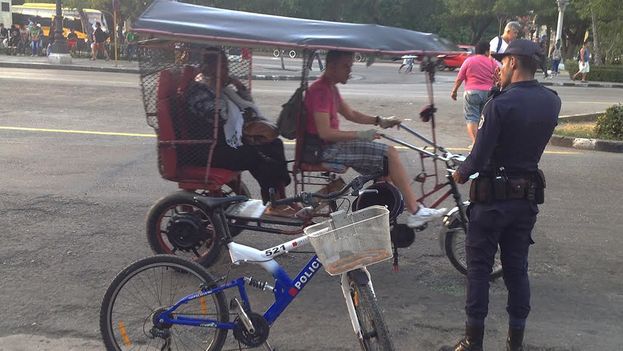
A police checking the papers of a pedicab driver in Havana. (14ymedio)
14ymedio, Havana, 23 February 2016 — Preferred by customers for short distance travel and demonized by motorists who consider them a danger to traffic, pedicabs are part of the urban landscape of Havana and many provincial cities. With their three wheels and their many decorative variations, these vehicles use the “human fuel” of a driver who pedals you to your destination. That makes them the most precarious link in passenger transport in Cuba.
Those who work the pedals are harassed by the police and exploited by the owners of the pedicabs. Many, the poorest, come from the east of the country and are considered “illegal” in the so-called “capital of all Cubans,” because they lack the resident permits required to live in the city. The days they manage to make more than five convertible pesos (CUC) they feel happy, although there are some who brag about giving tours for tourists for no less than “20 CUC per hour.”
The “bite” taken out by the police must also be factored into the prices. Among those in uniform extortionists abound and avoiding a fine or a confiscation can only be achieved with gifts or hard cash. In the network of corruption suffered by self-employed workers, the pedicabs drivers are on the lowest rung of the ladder. They must pay if they want to continue to pedal through the city.
SOMOS+, 20 February 2016 — We’ve got a special post today, an Open Letter written for us by Lizet González Rodríguez, a mother from Cienfuegos who recounts her battle against the ETECSA monopoly, in addition to giving us important details about her life and way of thinking. It also serves as a gloomy reminder of the constant and flagrant violations this company commits against the privacy of its clients.
We’ve faithfully honored this author’s text. It’s a bit extensive, but it’s worth it.
Somos+
From Lizet González Rodríguez — Thanks to the kindness of the Revolution and not my own, after 7 years of living with a Latin American student from the ALBA project in the field of Medicine, it is with a clean human conscience and without an eye for greed, that it was because of him, during the last year of his career, I was granted telephone service as a reward for my hard work, gained in large part due to my effort and sacrifice, and not due (at all) to the Cuban Revolution. It was through his stay in the house that we got to know other foreign students that would visit us for the friendship and familial support our home provided.
It’s well known that our only telecommunications company, ETECSA, famous for their poor understanding, or their complete ignorance of the difference between quality service and cost, offers internet services to foreign students in Cuba. continue reading
Since the company does not provide telephone services, these students visit homes like mine near the school of Medical Sciences that have telephone service in order to ask for permission to use the family phone and to link their internet account to our telephone number so they can stay in touch with their family abroad, thereby using the full palette of options. They can do this without signing a contract, or without any explanation of the ins-and-outs of the service, the account owner cannot use the service that is being linked to their own, and no favors, or exchanges of any kind takes place.
As another option, they sell a certain amount of hours for a price, and if they go over their allotted time, they incur extra cost; all this for an astronomical cost. After some time, practically at the end of the student’s course study, the one we let use our telephone service, we find ourselves summoned by ETECSA; they accused me, as the named owner of the telephone account, of committing fraud against the company, and I, as the account owner, and not the foreign student who had a contracted service with ETECSA, could do so without needing to authorize, nor officially sign as owner.
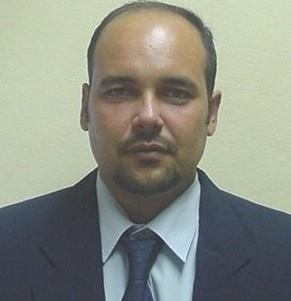
My story begins at the end of 2014, one morning I heard shouting in the streets and it was directed towards my husband. I got close to the door and saw three people, one in particular, a supervisor from ETECSA, Yoiner Besada Chaviano, whose photo I’ve attached to my letter, I got it from his Facebook profile, because I consider him to be the most sadistic and sarcastic person that could exist in this company, truly fear inspiring; he’s followed by two people, one who is the whistle blowing agent from MININT [Ministry of the Interior], who days earlier had been interrogating the neighbors.
But, not to get off topic, I’ll tell you how things went down. Not wanting to explain myself from behind the fence and in front of the neighbors, I invited them in my house.
Amusingly, supervisor Besada said they were there due to anomalies in my service and they wanted to check the service connection in the house, of course, without a service order, or warrant. I agreed since I had nothing to hide. They didn’t find what they were looking for. Afterwards, I told them to come outside to the patio to where the telephone connection hooked up and again, they didn’t find any “anomaly.” We went back into the living room where I asked them exactly what type of anomalies they expected to find? He said he wasn’t sure, but they were under orders from the Havana office’s anti-fraud department.
I kept pressing the question and he continued to be evasive. Finally, I asked the million dollar question: “Do you think it’s from an internet connection that a medical student has linked up with my phone?” He answered with another question as would any of his kind, “Ah, why do you have an internet connection?” “You should know,” I said, “it wouldn’t come in through thin air, nor satellite, but through an obsolete telephone cable.”
That’s when he gave me a summons and had me sign to the effect that my husband, who is the account owner, should appear at his offices next week to explain the use of the telephone services and another form where it said that our telephone service was under investigation. I didn’t sign this last form because I didn’t agree with it, not to mention, I wasn’t the user under contract.
My husband went to the interview where we left practically accused by a commission of telephone fraud and were to await a judgement. Two days later our service was cut off and the company had us under investigation. We were notified that same day of the suspension, which had to be done within 30 days, and our service remained cut off for 2 months despite the fact that the investigation was supposed to take only 9 days. Ok, fine, my questions are thus:
— How can they sell an internet service to a student without providing a personal line to link it and force him to give 2 telephone numbers of third parties in order to get service?
— How do you charge a telephone account, month after month, for access to ENET and continue collecting fees from a student for internet service if according to your company, it was fraudulent?
— How do you investigate and prosecute a national user if he never had a contract for said service and as a consequence, his link, if he wasn’t notified to verify what happened and inform him of his national rights and duties, or is that something too unimaginable to ask for?
— And finally, how could this national user be prosecuted for a fraud he didn’t commit due to not being the person authorized to use the said service, without being notified, but investigated, stepped on, judged, bullied instead of it being the foreign user who is the exclusive party?
In February of 2015, after 2 months and several weeks, the judgement on the investigation found the national user committed “telephone fraud” and was issued an excessive fine, based on the company’s losses, which as we all know is a totally inflated rate, it’s extremely expensive, well out of the financial reach of people who work and is compensated with only a part of their salary.
This supposed fee for “the alleged economic losses” incurred by ETECSA, was expected to be paid in CUC [hard currency], which is not the customary, monetary form of payment for services.
This case is based on subjective proof and threats, in findings of espionage through the use of the telephone service likely by cell phone (my cell phone), while they violated the terms of confidentiality of clients without any recourse, and they were always sure to note they wouldn’t give any data if we got a lawyer, and all the while, this threatened to uncover our own Pandora’s box: that our mobile telephone service, for which we Cubans pay a veritable fortune, has become our worse enemy; they tap all our calls and listen to our messages in a truly despicable manner and later use them against us.
And fine, I ask myself:
Where does this leave this dominated people’s rights to citizenship, to humanity?
How far can the impunity of man go? How can they reduce us to a bare minimum?
In this abusive and arbitrary, and somewhat polemic case, I was found to be acting as “head of a group,” named without much explanation (since I wasn’t the account owner, but my husband).
Just the chilling image of a video conference, they’d say from Havana, could very well be from the office next door, explaining via antiquated and stupid equipment run by a paid underling which they claim are the same services used by the Highest Offices of the Province so they can speak to their families abroad, some because they can’t afford it economically, and others so they’re not monitored by machinery used for spying by those they flatter and defend. Betraying themselves when they seem lost, the very occurrence of making a call to a third-party in the outside world as a suspected fraud.
How long are we going to be prisoners of a system that doesn’t let us communicate with the real world so that people continue to live under the shadow of an expired world model without knowing reality, a reality that we all know is censorship and being manipulated by a system imposed on our country, while they shout to the four winds that they are not the ones who deprive us of these services, rather it is the fault of a brutal imperialism that makes them do it and limits our development, the very same imperialism with which they are currently seeking to re-establish relations.
Even though our rights are neglected in contemporary Cuba. How far and for how long are we to suffer the despotism and trampling of rights normally bestowed to any individual in other parts of the world, making us prisoners on our very soil.
Given everything that was exposed, I had to “hand over” my telephone service to a neighbor in order to pay the “compensation.”
A year later, in February 2016, the second part of this nightmare begins. The neighbor that I gave my telephone service to was called in by ETECSA for suspicion of fraud, which we thought was the result of some leftover data error that reappeared from the last case that came to the surface now that she has no internet access. I mean, since December 2014, that phone did not have an internet link tied to it.
In her case, the same history was repeated in those offices, she was surrounded by “a commission” of 8 individuals, like a firing squad, and through their affirmations their intimidations, where they told her that her telephone service was under constant monitoring during the last year (once again, a clear violation of citizen rights).
During the questioning, it became known that I, the little so-and-so, had “transferred” my telephone service, to which she explained that I had done so due to the problems previously described and my desire to not continue with this named entity’s service.
Afterwards, they continued questioning why she used services like “3 party calls, call waiting, and busy signals, etc. (Ah, fellas, isn’t this . . . phone service?) to which she alleged that she didn’t stop those features because she didn’t think it was necessary, plus they questioned the use of a card to call long distance to which she gave her own explanation. They argued that it was through that same avenue that fraud continued to be committed, something totally impossible and stupid (which now is sadly a common occurrence), ironically, even by they themselves.
When she asks why she’s being investigated and accused by this “commission,” all of this, mind you, without any proof of internet access and without knowledge of the subject, is when they asked her about me, if Lizet González, daughter of . . . if I’ve visited her home, used her telephone, if she’s given me an illegal extension, what’s my relationship with her, etc. to which she responded: No.
This is when they tell her, clearly intending to create conflict between neighbors, that I’m tricking her and using her (I guess, telepathy, or magic), and since I don’t have a phone, I have somehow interfered with her connection, making it some kind of receptor so that I can continue my “telephone fraud.”
It is inexplicable for a reasonable person to understand, always arguing even amongst themselves, questioning the sheer possibility of it all, and in the end, thinking “yes, it can be so.”
Nevertheless, without giving much explanation, after an afternoon of shock and visible deterioration, my poor neighbor was advised to go home, to change her telephone number, cancel all her services with ETECSA and that afterwards said entity would give her the “ultimate verdict” — to either pay a high restitution “for nothing,” or end her telephone service.
This is where we are in this moment and of course, there’s much friction between the families, but once more, this is just another sad example of Divide and Conquer.
I ask myself. Now, do I truly warrant this type of high-level attention as if I worked for the CIA, or NASA?
This has an indisputable not so hidden connotation: politics.
Political views vary within my family. My father is a retired, General of a Brigade. My husband, on the other hand, is one of the few direct family members of Luis Clemente Posada Carriles living in Cuba; this is reason that neither of us can have communication with the exterior without being monitored by “them.”
They wanted to stay on top of what we thought, even what we ate, and this intensified after my husband presented an invitation for an entrance visa at the U.S. Interest Section in Cuba for his radicalized cousin in 2013. She didn’t have anything to do with his previously mentioned Uncle, but it left us MARKED and of course, the visa was not granted, so we wouldn’t have gone through this nightmare if it hadn’t been for that.
Since that time, a relentless pursuit began, to strangle us with never-ending fines (related to other entities), all arbitrary and inexplicable, asphyxiating our family’s economy of which I have the proof.
The goal of this letter is to relay my story, one of thousands as a victim of a system that for a long time, I DO NOT BELIEVE; the one that my father, a man who I admire and respect, fought for, one that promised and didn’t deliver as we all know, that brags about non-existent human rights that are constantly violated; that represses, that abuses; that blocks; that persecutes; that brands anyone who wants change as counter-revolutionary, those who intend to revolutionize problems; or has the concept already changed?
This letter could cost me dearly, but it’s necessary for the world to know the reality we live in and all the deprivation and spying the Cuban people are subjected to. That’s why I am demanding my rights and liberty and nothing more than what should be ours. I don’t think we should wait anymore for it, but instead, we should pursue the truth. Change is within our grasp, that’s why every day WE ARE MORE (Somos+), we are voices that rise up to denounce the oppressive abuses of those who suppress us as a people, as Cubans.
Sincerely,
Lizet González Rodríguez
Natural de Avenida 30 entre 47 y 49, edificio 2, apto 9. Cienfuegos. Cuba
Email: lizetete71@gmail.com
Person referred to in my letter: Yoiner Besada Chaviano, ETECSA Inspector
Juan Juan Almeida,18 February 2016 — The latest property to be auctioned off is part of a plan to lure big American investors called Project Ramon. It involves destroying a small local beach and converting it into an exclusive tourist resort catering to a very few.
This new ecological disaster is being forged in Ramon de Antilla. continue reading
Motivated by insolvency and economic uncertainty, the country’s top leaders and their managers have decided to make some changes. The chosen option is to sell the island to the highest bidder. I am talking about bidders of the highest caliber — an essential requirement — who are interested in breaking into the Cuban market. I am not criticizing them. This is how things have been done since the beginning of time, by setting aside one’s principles. It’s called politics.
It is no secret that Cuban leaders are desperately looking for foreign capital to prop up the country’s fragile economy. And with the untimely collapse of its principal ally, Venezuela, Cuba has become very interested in a range of business opportunities.
The government is offering a range of investment options in projects totaling 8.7 billion dollars. But the key component to be auctioned off, on which only the largest American investors can bid, is known as Project Ramon. It involves destroying a small local beach and converting it into an exclusive tourist resort catering to a very few.
This new ecological disaster is being forged in Ramon de Antilla, an undeveloped peninsula of extravagant beauty located in the town of Antilla, north of Holguin. Nineteen kilometers long, it separates two important bodies of water: the Bay of Banes and the Bay of Nipe.
Located very near the idyllic Saetia Key, the site boasts innumerable natural attractions. In addition to beautifying the area and serving as a breeding ground for sparrow hawks, grassquits, red-billed tropicbirds, multi-colored land snails, reptiles and exotic insects, local residents insist that its mangroves and forests also harbor the treasure trove and ghost of the feared English pirate William Hastings.
The economic crisis and expectations for change in Cuban society have led the regime of Raul Castro to open the gate. And with the tax receipts such a mixed-use development could generate, the project’s planners are hoping to attract significant investment, much greater than what went into building the Varadero resort. Project Ramon is so ambitious that the hope is will become Cuba’s biggest tourist draw.
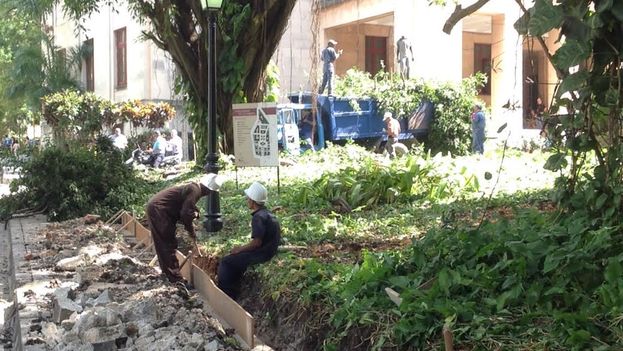
Intense renovations at the University of Havana have triggered speculation about a possible visit of Barack Obama to the University of Havana’s Great Hall. (14ymedio)
14ymedio, Havana, 24 February 2016 – For several days students at the University of Havana have observed with surprise several teams of builders who are refurbishing and repairing the common areas and the most important areas on “The Hill,” the site of the University of Havana. Speculations about the Aula Magna – the Great Hall – as a possible site for Barack Obama’s speech have soared as a result of the major clean up.
Were he to speak there, he would be the first United Stats president to take the floor at this academic site; Jimmy Carter spoke there in 2002 but he was no longer in office. On that occasion, the speech stood out particularly for his reference – with the speech being broadcast live on television – to the independent Varela Project, which advocated political reforms.
In that speech, the politician who for years official propaganda had referred to disparagingly as “the peanut seller,” alluded to his agricultural origins, and also requested that the then government of Fidel Castro allow the International Committee of the Red Cross to visit Cuban prisons, and receive the United Nations Commissioner for Human Rights to discuss issues such as prisoners of conscience.
Those who speculate that Obama will speak in the emblematic auditorium during his March visit, hope that the president of the United States will demand greater freedoms as well as mass access to the internet.
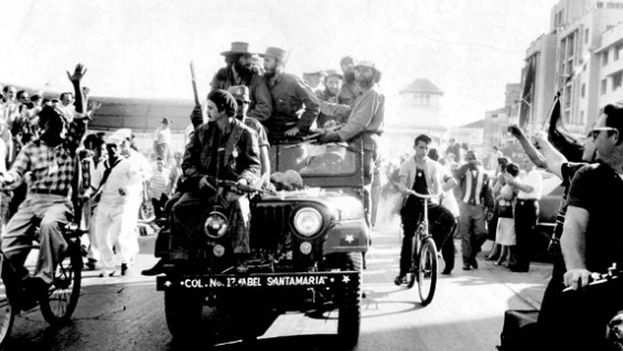
Since 1959, the rebel group that capitalized on the triumph of the Revolution began to question anyone who disputed their decisions. (Historical Archives)
14ymedio, Pedro Campos, Havana, 23 February 2016 – As of early 1959, the rebel group that capitalized on the democratic revolutionary win against the Batista dictatorship began labeling as counterrevolutionaries anyone who questioned their decrees, policies and decisions, without differentiating between those who did it through healthy dialog – including from their own ranks – and those who openly and violently confronted them.
The fight for the restoration of democratic institutions was what had united the Cuban people at that time. The trigger that divided the large anti-Batista coalition was the interest of the rebel leaders to prioritize social and economic transformations and to postpone, indefinitely, the holding of elections and the establishment of a democratically elected government based on the 1940 Constitution. continue reading
This disdain for democracy, a disregard for the interests of others and those who thought differently, as well as the channeling of the torrent of revolutionary spirit among the people according to the narrow interests of this rebel core, led to early and subsequent confrontations and gave rise to a diverse opposition and “counterrevolution” that would encompass every political-economic and social aspect that this core considered a threat to its power.
Throughout all the years since, they have maintained this approach of putting in the same “counterrevolutionary” bag all those who simply disagreed or who did not support some “revolutionary” measure, along with those who chose to confront them in a violent way.
Now in Cuba, in 2016, general-president Raul Castro, brother of the historic leader, will soon receive the president of the United States, a country that is “the center of the imperialist world, cradle of the counterrevolution, the historic enemy that has tried by every possible means to destroy the Cuban Revolution.”
But internally Raul Castro’s government does not even recognize that there is an extensive non-governmental democratic socialist side that, from dialog rather than confrontation, has done everything possible to make its constructive positions known to the leadership of the Party-State-Government, the Cuban people, international public opinion and the historical opposition.
Many of us have been treated as counterrevolutionaries and enemies, and if they have left some spaces where we can participate, such as the magazine Temas (Themes), meetings of the Cuban Writers and Artists Union (UNEAC), the Juan Marinello Foundation and others, they apply to us covert and sophisticated forms of repression, trying to block our message and keep us as far as possible from decision making, that is away from the bureaucracy that is the main brake on advances in the country, and which, like ivy clinging to a wall, clings to power and denies the people and the workers.
But even this does not lead us to fall into provocations and abandon our democratic vocation of dialogue and move to confrontation and violence.
We must trust and work so that the influence of the majority of the people who do not want more violence, but rather democracy and participation, leads the Government to undertake a process of internal dialogue and negotiation, like that it is undertaking with the “historical enemy,” “French imperialism” and other less recognized imperialisms, that will open the channels to the democratization of politics and economy.
As a democratic socialist I deplore violence, terrorism, vindictiveness and a settling of old scores and once again I call on the Government-Party-State to cease repression of thought and the peaceful political activism of those who think differently, and to undertake a process of democratization leading to the reconciliation of Cuban society.
It is time to understand that it is not the same to disagree, to differ, to dialogue and try to seek an understanding, as it is to oppose dialogue and engage in open confrontation. It is not the same to support the blockade-embargo and the politics of external pressure, as it is to support international policies of dialog and rapprochement.
Some of us democratic socialists have met with members of the opposition in search of consensus for an inclusive national dialogue and to open avenues for the process of democratization that we long for, but we have never supported open confrontation, violence and provocation, nor have other peaceful opponents done so.
It is time for the Cuban government to change this mistaken focus of considering anyone who does not share its methods and conceptions a “counterrevolutionary,” which hinders a much needed national dialog, and to internalize the same processes of consultation and peace that guide its foreign policy.
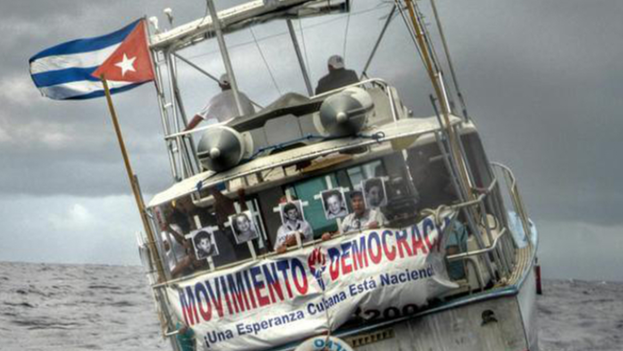
A flotilla marked the 20th anniversary of the 13 de Marzo Tugboat sinking. (Democracy Movement)
14ymedio, 23 February 2016 – The Democratic Movement and the Mambisa Vigil, Cuban exile groups in Miami, are preparing a protest that will take place off the coast of Cuba coinciding with President Barack Obama’s visit to the island on 21-22 March.
The details of the protest will be announced this coming Thursday, but the leaders of both organizations explained their intentions to the Mexican news agency Notimex, saying that they firmly believe that the historic visit will only serve to legitimate a repressive, single-party regime that has perpetuated itself in power for decades. continue reading
“We want to confront Cuba with a presence demanding free elections when Raul Castro leaves the throne and not a hand-picked successor,” Ramon Saul Sanchez from the Democratic Movement told Notimex. The activist, who considers the Cuban government terrorists, has been imprisoned on several occasions, undertaken several hunger strikes, and led fleets of boats into Cuban waters. “We are going to advocate for the reunification of the Cuban family,” he added.
The Mexican news agency also spoke with Miguel Saavedra, from Mambisa VIgil, who said his protest action will take place outside the Versailles restaurant on 8th Street in MIami, where they regularly hold their protests.
“President Obama is trying to do whatever he can to make Congress see we can do some kind of business with Cuba and to get them to lift the trade embargo” lamented Saavedra.
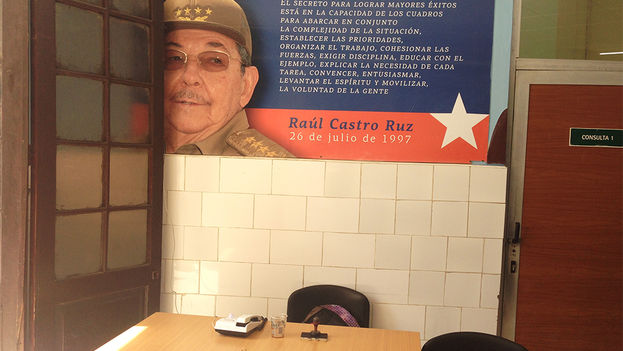
Calls for efficiency are everywhere, but the Cuban economy is not emerging from the crisis. (14ymedio)
14ymedio, Havana, 22 February 2016 — Several generations of Cubans have lived surrounded by calls for efficiency, sacrifice and productivity. There are so many billboards, posters and slogans demanding that people to do more and better, that we don’t even read them or listen to these demands. They are on the walls, in workplaces, in schools and even in hospitals, but they do not achieve their objective nor make the country into a more productive and prosperous place.
With Raul Castro the slogans have lost some of their ideological baggage they carried during the reign of his brother, and are now filled with demands for quality. Also proliferating are calls for “tightening our belts.” However, the forecasts for economic growth for 2016 stand at 2%, half of what was expected in 2015.
Weak growth is also due, in part, to the falling prices of nickel and sugar, two of the country’s most important exports. But it is mainly due to the low productivity of a country that imports 80% of the food that it consumes.