What People Are We Talking About? / Dimas Castellanos

Havana (El Nuevo Herald)

Dimas Castellanos, 18 January 2016 — A commentary on five foreign policy issues raised by the Cuban president, Raul Castro, on December 29, 2015 during the closing session of the National Assembly of People’s Power.

1. Since 2015 there have been benefits from mutually advantageous, cooperative relationships with various countries, particularly the Bolivarian Republic of Venezuela.

True, but these benefits are the result of a relationship that does not follow the normal laws of commerce. The reduction or total loss of Venezuelan petroleum subsidies and its impact on Cuba would be a repeat of what happened with subsidies from the former Soviet Union. Both examples illustrate the impossibility of sustaining an economy that is not self-supporting and the government’s inability to learn from past lessons. The cold, hard fact is that events in Venezuela help explain the real cause of the reported decline in GDP in 2015. continue reading

2. At the close of the last regular session of the National Assembly, I noted that an imperialist and oligarchic offensive has been launched against progressive Latin American revolutionary undertakings, which our people will challenge with determination.

We are sure that new victories will come to the Bolivarian and Chavez Revolution under the leadership of Comrade Maduro against the constant, destabilizing onslaught from the right, encouraged and supported by outside forces.

We rely on the commitment of the Venezuela’s revolutionaries and its people, overwhelmingly Bolivarian and Chavista, to follow the legacy of the unforgettable President Hugo Chavez.

We are convinced that the Venezuelan people, as they did in 2002, and the civil-military alliance will not allow the achievements of the Revolution to be dismantled and will know how to turn this setback into victory.

Cuba will always stand beside the Fatherland of Simon Bolivar and call for an international mobilization to defend the sovereignty and independence of Venezuela, and for acts of interference in its internal affairs to cease.

To claim that what has occurred in Venezuela is the result of an imperialist offensive is to sidestep the incompetency demonstrated by the Chavez regime. The use of a substantial portion of the bonanza generated by the high price of petroleum in order to export Bolivarian populism to the region instead of using it to diversify an economy entirely dependent on the production of oil only proves this point. The obsession for expansion over diversification has had a greater negative impact than any “imperialist offensive” in creating the disastrous situation in which this South American country finds itself.

To say that events there will be confronted by “our people” is to deny that the majority of Venezuelans, after supporting Chavez for years, cast a protest vote. Given this situation, one must ask the following questions. What people are we talking about? Do the millions of Venezuelans who voted for the opposition candidates not also make up the people? Who and what criteria define who the people are? When were “our people” asked to challenge the decision by those categorized as non-people?

Suggesting that new victories will come to the Bolivarian revolution led by Maduro, evoking commitments by revolutionaries to the legacy of Chavez and ignoring the popular will as expressed at the polls is a manifestation of interference in the internal affairs of another country, something that the government of Cuba has always accused the United States of doing.

All indications are that what occurred there could occur here if truly democratic elections were held. It seems, however, that the takeaway lesson is to postpone once again any step that could lead to democratization. The great danger is that without democratization there will be no solution to the numerous and serious problems facing Cuban society. Nevertheless, the process underway is unstoppable, especially given the change in mentality that is occurring among Cubans since diplomatic relations have been restored with our neighbor to the north. Democratization will come one way or another, but it will come. Trying to stop it is a march against history, against the winds of change sweeping through the region, against the destiny of the Cuban nation. And therefore it will fail in the end.

3. The proclamation of Latin America and the Caribbean as a zone of peace by all the heads of state at the second CELAC summit, which took place in Havana in January 2014, is a solid basis for developing relations between our countries and internationally. 

At this conclave the Cuban president stated, “For years our region has been a zone free of nuclear arms… but we believe that is not enough. We believe it is necessary for the region’s heads of state and heads of government to formally agree that any difference, any conflict, shall always be resolved through the dialogue of negotiation and that it will never end in threats or the use of force.”

Contrary to these emotional words, the decision to challenge the results of democratic elections in Venezuela could lead to civil war. Then the declaration of Latin American and Caribbean countries as a zone of peace would be nothing more than an empty slogan if these nations do not renounce the domestic use of violence. It would reveal a lack of political will to achieve it whenever peace is threatened by revolutionary populism.

4. As indicated in the Declaration of the Revolutionary Government, published on December 1, the “wet foot dry foot” policy, the Parole Program for Cuban doctors and the Cuban Adjustment Act remain the principal incentives driving the abnormally high level of emigration from Cuba to the United States.

The principal incentives are not US policies. For one action to be the cause of another, it has to precede it. The massive and continuous exodus that has turned Cuba from a country to which people immigrated to one from which people emigrated began in 1959, before these policies even existed. The real cause is the nature of the totalitarian system itself, which — while depriving Cubans of their civil liberties — has been unable to develop a viable economy capable of satisfying the basic needs of its citizens.

Beyond the impact that the prolonged conflict between the two governments might have had, it is only logical that there would be migration from a country with a poor economy to one with the most advanced economy in the world.

Given this reality, the only thing that could halt the exodus would be a structural transformation capable of guaranteeing Cubans’ basic needs, something that ideological entrenchment prevents.

The best proof of this is the increasing emigration from other parts of the world to destination countries which have not adopted anything even resembling the Cuban Adjustment Act. People simply move from areas where conditions are bad to where they are better, something that even certain species of animals do, including migratory birds, who do not relocate because of some “wet wing–dry wing” policy.

Also, the United States is not the principal country to which doctors are fleeing. They have to be recertified there, which involves paying for licensing exams and getting by until they are granted permission to practice medicine.

The only doctors going to the United States are those willing to work at anything or the few cases in which family members assume the costs of recertification. A bigger factor in the exodus of doctors is the fifty thousand physicians rented out to other parts of the world, a situation in which the level of exploitation is not difficult for them to understand.

5. We have reiterated that, in order to normalize bilateral relations, the government of the United States must lift the embargo and the seizure of territory occupied by the Guantanamo Naval Base without insisting that Cuba abandon the cause of independence or renounce the principles and ideals for which several generations of Cubans have fought for a century and a half.

As stated, these demands are not feasible. Once bilateral relations have been reestablished, solutions must be sought through bilateral negotiation. If the Cuban government does not want to make concessions to a foreign government, it must make concessions to its people, who are denied means of expression, institutions, rights and freedoms.

If it acts in this way, it would strengthen the position of the US president, who has demonstrated a willingness to move towards full normalization of relations with Cuba, weaken the position of the members of Congress opposed to lifting the embargo and advance the goal much more quickly than by levelling accusations and condemnations through the United Nations. More than ever, the solution ultimately depends on the course of conduct the government of Cuba decides to follow.

Originally published in Diario de Cuba
Our Everyday War / 14ymedio, Carlos Alberto Montaner

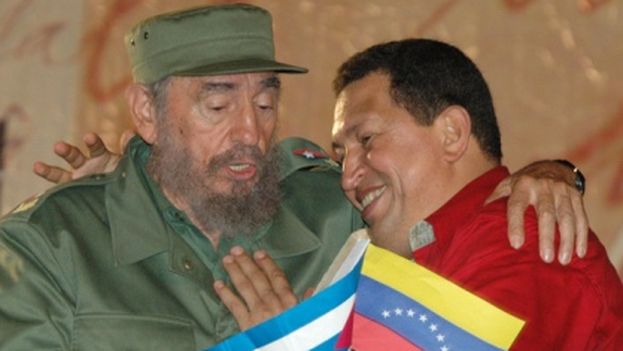
The Cuban president Fidel Castro and the late Venezuelan President Hugo Chavez. (DC)

14ymedio, Carlos Alberto Montaner, 31 January 2016 – Let’s get right down to it. The current conflict that divides half the planet, and especially Latin Americans, is between neo-populism and authoritarian democracy, against liberal democracy. I just developed a short course on the subject at the Francisco Marroquín University in Guatemala. I do not know any other institution so committed to economic and political freedom. Impressive.

In the neo-populist corner of the ring appear, to the left, Father Marx, statism, cronyism, Liberation Theology, the Dependency Theory, Eduardo Galeano, Che Guevara, Ernesto Laclau, Hugo Chavez, Evo Morales, Fidel Castro, all mixed up, plus the other issues: long-lasting caudillos, excessive public spending, ALBA, 21st Century Socialism, the Sao Paulo Forum and a tense et cetera with a closed fist and a street slogan on its lips. continue reading

In the liberal corner we find Father Adam Smith, Ludwig von Mises, Hayek and the Austrians, Milton Friedman and the market, James Buchanan and the School of Public Choice, Douglas North and the institutionalists, individual responsibility, private enterprise, the Rule of Law, FTAA, free global trade, the Asian Tigers, the successful Chilean reform, Ronald Reagan, Margaret Thatcher, Mario Vargas Llosa, and the small and efficient state.

This axis of confrontation is relatively new.

The 19th century was about old-fashioned liberals against conservative, also old-fashioned. The 20th saw, first, the battle between the supposed virtues of Hispanic identity against the defects of the Anglo-Saxons (José Enrique Rodó’s Ariel and the incendiary lectures of Manuel Ugarte). The 1910 Mexican Revolution simmered in the anti-imperialist sauce.

Following this was the appearance of Marxism and fascism, cousins who ended up looking very much alike. The Twenties were those of the Argentine psychiatrist José Ingenieros, with his soul and umbrellas both red, and those of José Carlos Mariátegui and his Seven Interpretive Essays on the Peruvian Reality.

Soon after, in Mussolini’s Italy, a young Argentinean soldier observed the fascist experience with admiration. His name was Juan Domingo Perón and on his return to Buenos Aires he launched his “Third Way.” Neither communism nor capitalism: Justicialism. That is, Peronism, pure and simple. It was the Creole expression of fascism.

The Cold War followed immediately on World War II. Before and after Latin American was filled with sword-bearers sanctified by Washington. The axis of confrontation then passed through the barracks against the communist, or everything that smelled of them.

In the Forties another force broke through: the democratic left. They began to triumph in Guatemala (Juan José Arévalo), Costa Rica (José Figueres), Cuba (Carlos Prío), Venezuela (Rómulo Betancourt) and Puerto Rico (Luis Muñoz Marín). They were democratic anti-communists who came from the left. They fought against militarism from anti-communist positions.

They also constituted a soft vegetarian variant of populism. They believed in the paternalistic welfare state and did not reject statist measures. Reigning in the economic field was his majesty Lord Maynard Keynes and politicians who were using the national budget and public spending to boost the economy. Wonderful. They were intellectually entitled to squander fortunes. Simultaneously, they distributed profits and executed land reforms that almost never achieved their objectives.

In 1959 the badge of the struggle changed again. Fidel and Raúl Castro, along with Che Guevara and with the innocent help of other democratic groups, overthrew the “soft” military dictatorship of Batista, with the objective of establishing a communist dictatorship copied from the Soviet model. They proposed, essentially, to destroy the governments of the democratic left, defining the adversary by its relations with the United States and with property.

If you were pro-American and pro-market, even if you were leftist and respected freedoms, you were the enemy. Cuba attacked Uruguay, Venezuela, Peru, Panama, everything that moved and breathed. Also, of course, the old military dictators like Somoza, Trujillo and Stroessner, but not for being tyrants, but for being pro-American and pro-capitalist. The island was “a nest of machine guns in motion.” The United States joined the war in 1965; in the midst of a civil war Marines landed in the Dominican Republic in order, they said, “to avoid another Cuba.”

With Allende in 1970 the dangerous game of authoritarian democracy began and it ended three years later in a hail of bullets. Pinochet, who was Allende’s man, or so Mr. Allende believed, ended up bombing him. However, as the general didn’t know a single thing about economics, he handed off these mysterious activities to some young Chileans who had graduated from the University of Chicago and Harvard. Soon they began to turn the situation around.

It was the first time Latin America heard of Friedrich Hayek (Nobel Prize in 1974), or Milton Friedman (1976). In the mid-eighties it was clear that populism had plunged Latin America into a pool of corruption, unbridled inflation and unrestrained public spending. The region had failed. They spoke then of the “lost decade.”

Thus arose the first liberal cycle in Latin America. Its main protagonists came from another ideological quarry, but they were flexible and intelligent people. Among others, included the Bolivian Victor Paz Estenssoro, who returned to power in 1985 to fix the mess of 1952, the Costa Rican Oscar Arias, the Argentine Carlos Menem, Mexico’s Carlos Salinas de Gortari, the Colombian Cesar Gaviria and the Uruguayan Luis Alberto Lacalle.

More than liberal convictions propelled the certainty of populist failure. Unfortunately, accusations of corruption against Salinas and Menem, plus the excessive increase in public spending in Argentina, discredited that liberal reform and its enemies began to effectively attack “the long neo-liberal night.”

In 1999, finally, Hugo Chávez began to govern and he initiated another phase of authoritarian democracy. This has now come to its end, sunk in poverty, with shortages and corruption, giving way to the new cycle of liberal democracy, that perhaps started with the Mauricio Macri’s victory in Argentina. Let’s hope it lasts.

French Press Describes Cuba as “The New El Dorado” / 14ymedio

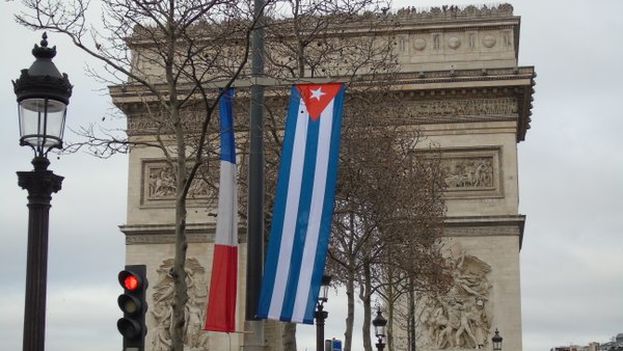
The Arc de Triomphe adorned with French and Cuban flags for an act of remembrance by Raul Castro at the tomb of the unknown soldier. (EmbacubaFrancia)

14ymedio bigger14ymedio, Havana, 1 February 2016 – Raul Castro’s current visit to Paris is receiving widespread coverage in the French press, focused on the possibilities offered by Cuba’s appearance in the international market. The island is considered the new El Dorado by many of the publications that trumpet the advantages of investing in a place with a privileged geographical position and where almost everything remains to be done.

Jean-Christophe Dauphin, from the private equity company AGSM, was enthusiastic about a recent trip to Cuba during an interview on radio Europe 1. “I was there in July for ten days, and it is evolving very very quickly. The last day I was in Havana I ran into Brazilians, Austrians… the whole world is in the race. One will have to have sharp elbows not to drown in the middle of the mass,” he said. continue reading

Appearing on the same radio station was former Secretary of Foreign Trade Pierre Lellouche, now a deputy for the Union for a Popular Movement party (UMP), who praised Raul Castro’s visit to France and the leadership he has taken in his country in this regard. However, he stressed that to date trade with Cuba is negligible, “It is about 200 million euros a year, that is, nothing.” Lellouche added that France must support the island in moving forward “toward democracy and human rights.”

L’Express published a comprehensive report in its employment section on French investments in Cuba and again called it the Island of El Dorado. “Cuban labor is highly skilled,” according to Didier-Pier Florentin, of Havana Development, who is quoted in the article. The sectors with the least presence and, therefore, greatest opportunities, are energy, tourism, transportation and the internet, according to the French publication. Stéphane Witkowski, president of the Institute of Latin American Studies, emphasizes the importance of the geographical position of the island: “Cuba occupies a strategic position, especially for companies who want to get into other Latin American markets.”

The international prestige of Cuban medicine, which the government has exported for decades, has led France to be particularly attracted to that sector. The DMS Group, which specializes in high technology for diagnostic medicine, is particularly interested in investing in this area, the second highest source of exports from the island, after nickel.

“We are about to finalize an agreement with a Cuban company for the distribution of our products,” revealed Samuel Sancerni, Deputy CEO of DMS. “Our goal is to position ourselves in the market before the United States reaches Cuba,” he adds.

Another French company, Abivax, born from the merger of three laboratories, was a pioneer in proposing an alliance with Havana in 2014 in biotechnology, with the goal of becoming the world leader in vaccines.

In an interview published Monday in the Catholic daily La Croix, the Cuban writer Jacobo Machover says that despite the enthusiasm displayed by the international press, the human rights situation in Cuba has worsened since the restoration of diplomatic relations with the United States. And, he added, “there is no will to change on the part of the regime.”

The writer, who lives in France, points out that there are strong limits on freedom of expression and on access to the internet, and that visits by heads of state such as Hollande or Italy’s Matteo Renzi, “consolidate and legitimate the Castro dictatorship.”

Machover believes life for the Cuban people has changed very little since US President Barack Obama’s announcement in December 2014. “There is a wave of emigration that has gone unnoticed in the media, but that is of very large proportions,” he explains. “This is the largest exodus since the Rafter Crisis in 1994.”

At 5:00 pm, Paris local time, there will be a demonstration at Champs-Elysées-Clemenceau Metro Station, called by a group of intellectuals through a manifesto entitled “Against Raul Castro’s visit to France.” The manifesto is signed by Machover, Laurent Muller, president of the European Association for a Free Cuba, Jesús Zúñiga, a refugee Cuban independent journalist, the writer Zoe Valdes, and journalist Bernard de la Villardière, all of whom live in the French capital.

Hollande And Castro: Plenty of Wine But No Democracy / 14ymedio, Yoani Sanchez

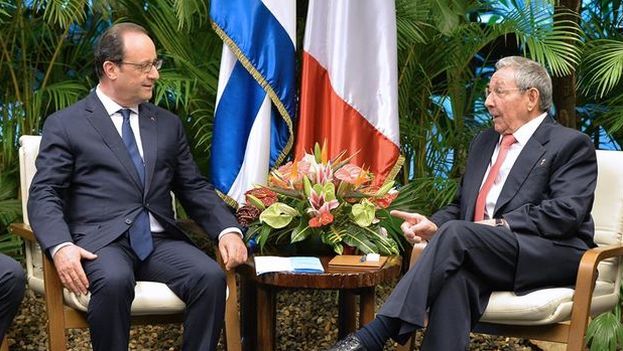
François Hollande and Raul Castro at the Palace of the Revolution in Havana, during the visit of French President to Cuba in May 2015. (EFE)

14ymedio bigger14ymedio, Yoani Sanchez, Washington, 1 February 2015 — Iranian President Hassan Rouhani cancelled his lunch with François Hollande because the latter didn’t want to take the wine off the table. Tonight, however, the French leader will not ask Raul Castro about the issue of human rights violations in Cuba, to avoid annoying his visitor. A gesture that will affect the image of France much more than having dispensed with a glass of red.

Facing the leader of a powerful nation with a controversial nuclear program, the authorities did not want to deprive themselves of one of the symbols of their identity. But facing the General who permits no opposition nor independent press in his country, the hosts lower the tone of democratic requirements, similar to Rome’s covering the nakedness of his its statues to please Rouhani. continue reading

In the homeland of “Liberty, Equality, Fraternity,” failing to take advantage of Raul Castro’s official visit to demand a democratic opening would be a huge disappointment. The reasoning from a French government source, declaring that the question of human rights “is always present,” is unconvincing. This is the time to push the octogenarian caudillo for a commitment to a democratic opening on the Island in the near term.

France loses nothing if it takes a stronger stance on the lack of freedom under which 11 million Cubans live. Unlike Rouhani, Raul Castro will not purchase more than 100 modern Airbuses, not will he offer a contract for the extraction of thousands of barrels of oil. The Plaza of the Revolution is only going to offer losses and disrepute.

It will fall to the French executive to silence the complaints of the creditors of the Paris Club – which last December forgave 8.5 billion dollars in Cuban debt –when they never see one cent of the remaining 2.6 billion that Havana committed to pay over a span of 18 years. Which it is highly unlikely to do, because the Cuban system is an expert in wasting other people’s money and in swindling those who help them.

The same thing will happen with the 360 million euros of the bilateral accord reached this Monday to finance development projects. Money that Cuban officialdom will use at its convenience, but not to empower citizens to prosper nor to develop an autonomous business network. Over time, these resources end up feeding corruption, the illegal market, and the pockets of the olive-green clad rulers.

Raul Castro will promise Hollande tonight that his piece of cake is safe. As he has said to so many, undoubtedly, he will confirm to “friends of Cuba, the Revolution will always remember you.” The “friendship” in this case is inextricably linked to complicity in and silent acceptance of the authoritarianism imposed on the Cuban citizenry.

It is just another maneuver to gain time. Hollande will leave office and a new administration will have to deal with those who have spent nearly six decades in power in Cuba, and the story will start again at the beginning: commitments, pats on the shoulder, ceremonial photos and a dinner where the wine flows freely, but where the indecent presence of democracy is well hidden.

Cuba Will Test Home Internet Service In Old Havana / EFE, 14ymedio

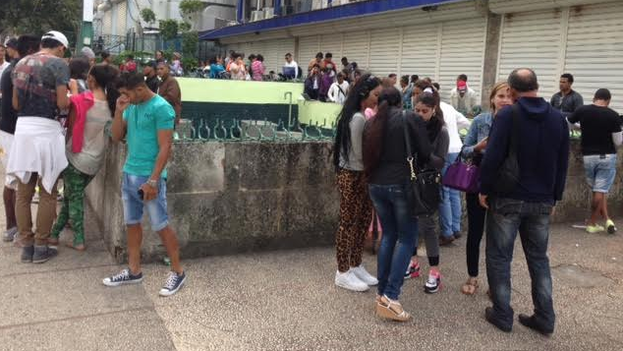
In wifi connection areas such as this on La Rampa, the flood of users decreases the connection speed.(14ymedio)

EFE (14ymedio), Havana, 31 January 2016 – A pilot project will test internet service in private homes in Havana, where 30 new public wifi zones will be established, as part of the 2016 projects announced by the State-owned Telecommunications Company of Cuba (ETECSA).

The director of the company, Odalys Rodriguez del Toro, said that test would be carried out in two of the People’s Council areas in the Old Havana district, the oldest part of Havana, “in hopes that in the future we can start bringing Internet to homes,” according to a Cuban News Agency (ACN) report. continue reading

These connections, a new service, will be through fiber optics, under an agreement with the Chinese company Huawei, with rates for the service to be announced later, according to the director.

Rodriguez del Toro also there will be an expansion of 30 new wifi areas in Havana, two for each of its 15 municipalities, to provide access to this service which is already available in 17 public spaces in the city; there is currently no service in the Cerro and Cotorro districts but they will get it in the coming days.

“The goal for this year is to have three city parks with wifi in each district and to reach other areas with large crowds such as El Castillito, the Cuba Pavilion, the Plaza of the Revolution, Balneario University in the Playa district, and in the future, cafes, bars and restaurants that request it,” the official added.

At the close of 2015, more than 150,000 Cubans on average accessed the internet every day, after the opening of 58 public wifi access points across the island, according to data from ETECSA.

The creation of the popular wifi areas was one of the alternatives implemented since July of last year by Cuba’s state telecommunications monopoly in order to expand internet connections, which continue to be unavailable in private homes.

The island is currently one of the countries with the lowest rates of connectivity in the world, with only 5 percent of the population having internet access, a percentage that drops to 1 percent in the case of broadband.

Internet access from private homes is not allowed except for Cubans in some professions as medical professionals, journalists, academics and intellectuals, who require special government permission to have connections.