
The Culprit Has The Solution / 14ymedio, Yoani Sanchez

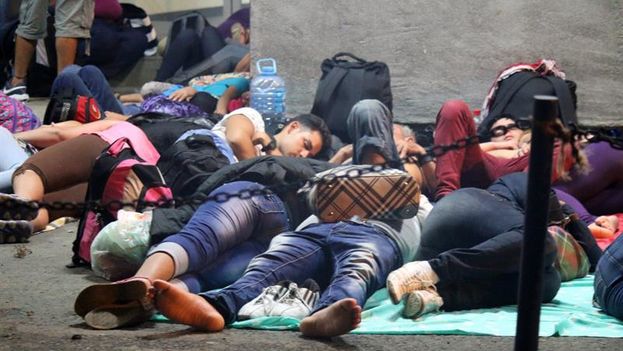
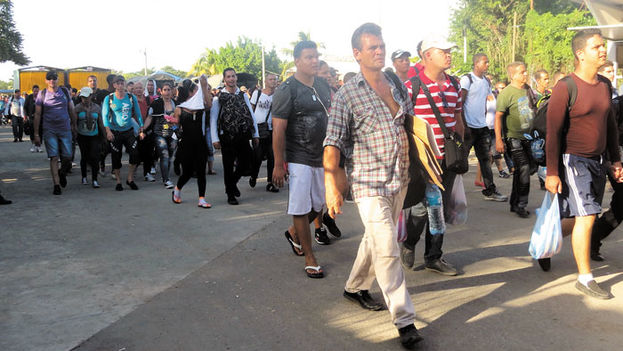
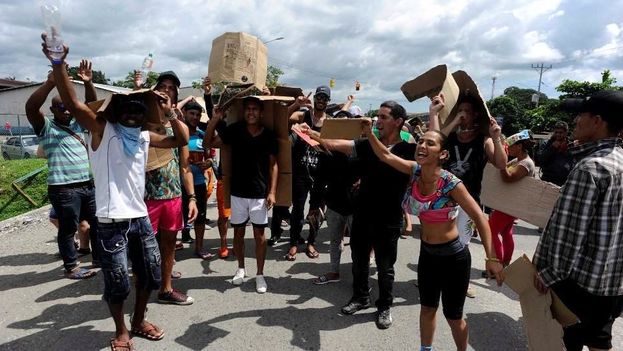
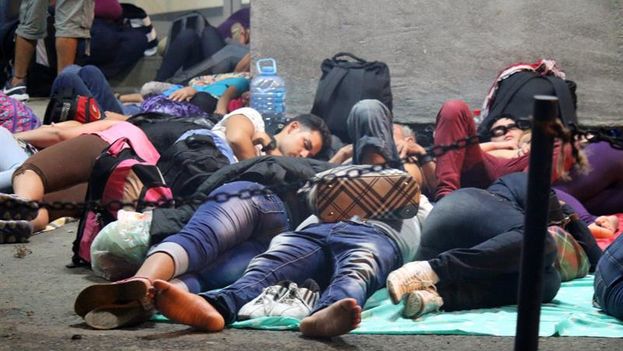
Hundreds of Cubans are still stranded at the border of Costa Rica while Nicaragua denies them entry to move north. (EFE / Alvaro Sanchez)

14ymedio bigger14ymedio, Yoani Sanchez, Havana, 21 November 2015 – “Anyone who has $15,000 to give a human trafficker is not fleeing poverty,” were the words of Oliver Zamaro, an official spokesperson on Cuban television who was commenting this Friday on the situation of the more than 2,000 Cubans stranded at the border between Costa Rica and Nicaragua.

After days of silence on the situation, the partisan media wants to use the drama of these compatriots as a weapon against the White House. An overused strategy that barely has any effect at this point. Now, they want to convince us that the massive exits are not the responsibility of the country being left behind, but rather of the other one those leaving are trying to reach. continue reading

Suffice it to mention the thousands of Cubans who escape to other nations where there is no “wet foot, dry foot” law, to realize that the responsibility for the exodus that we have been experiencing for more than half a century rests on a system that has not been able to offer its citizens material prosperity, personal fulfillment or freedom… Much less a future.

Why, if they can get $15,000, do they prefer to invest it in a dangerous escape with no certainty of getting to the other side, instead of creating a business or prospering in their own country? The answer is painful and compelling: because there are no guarantees, no hope

Mr. Zamora apparently ignores that the amount of money mentioned, equivalent to more than 60 years of the salary of a professional earning 500 Cuban pesos a month, comes from a desperate action, or from help sent from abroad. The majority of those who are currently in Central American shelters have sold all their belongings to undertake such a dangerous route, or depended on relatives who have emigrated to finance the payment to the human traffickers.

The question would be why, if they can get $15,000, do they prefer to invest it in a dangerous escape with no certainty of getting to the other side, instead of creating a business or prospering in their own country. The answer is painful and compelling: because there are no guarantees, no hope and because the timeframe of their lives cannot wait for the promises of improvements on the horizon: promises that every time we come close to touching them become more distant.

The problem unleashed is growing, because Nicaragua’s closing of the border to Cubans is not deterring those left on the island from trying to leave. The flights to Ecuador continue to carry Cubans who, instead of feeling discouraged by the increasing difficulties, believe that the visibility of their cause might protect them and create pressure for a corridor that guarantees passage to the north.

It seems to be a repeat of the effect that moved 10,000 people to occupy the Peruvian embassy in Havana in 1980, and shortly after led more than 100,000 to leave from the Port of Mariel, the same migratory fever that led 35,000 Cubans to figure in the Rafter Crisis in 1994. A nation in flight, one whose children cyclically find a route to leave behind the land where they were born.

It is noteworthy that this situation is happening when Raul Castro’s reforms seem to have peaked and proved their ineffectiveness in bringing about results that can be seen in daily life

It is noteworthy that this situation is happening when Raul Castro’s reforms seem to have peaked and proved their ineffectiveness in bringing about results that can be seen in daily life. Not even the reestablishment of relations between Cuba and the United States has managed to appease the widespread disappointment and despair among Cuba’s youngest.

The undeclared but latent threat, that the Cuban Adjustment Act will be repealed, has only hastened each individual’s decision to abandon their country, but this is neither the trigger nor the cause for deciding to risk one’s own life and those of small children on a journey filled with danger.

A brief statement by Raul Castro in front of the cameras on national television, where he would say what millions of Cubans have waited decades to hear, would be enough to stop the flow of migrants and even to start to reverse it. Not offering this final speech, of the autocracy that will give way to another government, makes him guilty of everything that is happening.
Another Prisoner Swap? / Mario Lleonart

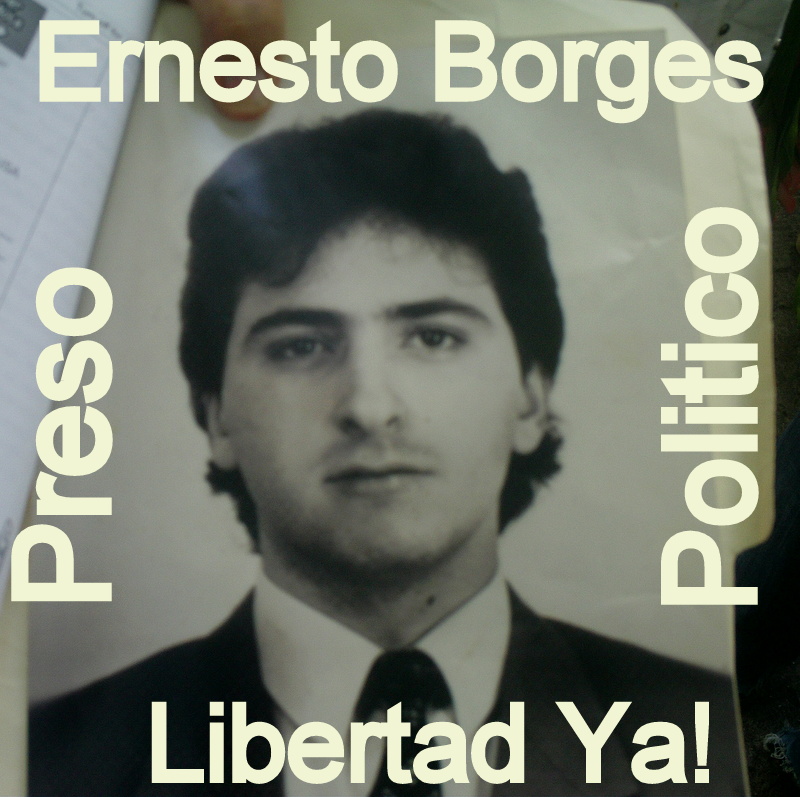
Mario Lleonart, 30 October 2015 — Once again the name of Ernesto Borges Pérez returns to the public arena, generating new expectations about his release. He has served more than seventeen long years of the thirty to which he was sentenced, after his death sentence was commuted at the prosecutor’s request. Ernesto’s advance disclosure thwarted the illegal infiltration into the U.S. of twenty-six Cuban spies, of the hordes frequently sent there. But at the cost of seventeen unrecoverable years from Ernesto’s valuable life. Everything indicates that he is the bargaining chip long set aside to trade for the spy Ana Belén Montes.*

Ernesto may finally go free and benefit from his heroic action, which by any measure was invaluable, whatever the price paid. I hope that the answer to the prayers we have raised for so long finally arrives. Ernesto’s parents Yvonne and Raul, elderly and ailing, can still experience the greatest happiness of their lives. His brother Cesar, and Paola, his only daughter, in exile, can laugh again. And he, with his tremendous human virtues, strengthened in prison, can still be of great benefit to a world greatly in need of heroes like him.

*Translator’s note: The U.S. Defense Intelligence Agency analyst convicted in 2003 of spying for Cuba and sentenced to 25 years in prison. See, e.g. “New Revelations About Cuban Spy Ana Montes.”

Translated by Tomás A.

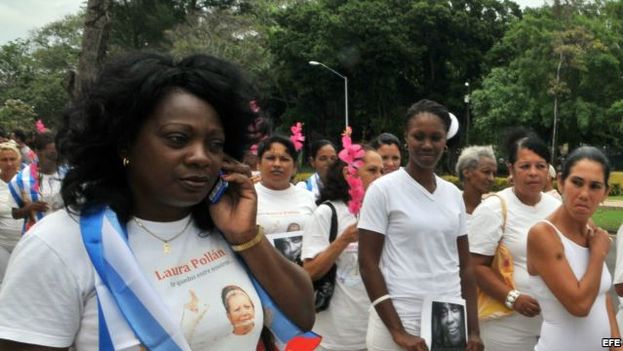
Cuban State Security Warns Berta Soler “The End Of Opposition” Has Arrived / 14ymedio

Berta-Soler-Damas-Blanco-CC_CYMIMA20141021_0001_13
Berta Soler, leader of the Ladies in White (CC)

14ymedio bigger14ymedio, Havana, 20 November 2015 — The leader of the Ladies in White, Berta Soler, was arrested Friday outside Havana’s Fifth Police Station and held for several hours. The regime opponent was there to show her solidarity with the the activist Hugo Damian Prieto, detained since October 25 and charged with the alleged crime of disorderly conduct for participating in a demonstration.

During the arrest, at a police unit in Alamar, east of the capital, Soler was warned by State Security official who called himself Francisco, that “the end of the opposition has already been reached.” The agent added that it was also time for “the end” of the Sunday marches in the area of Santa Rita Church.

Among those also detained during the day were Ladies in White Lismery Quintana, Maria Ancon and Maria Cristina Labrada, as well as the activists Zaqueo Baez, Egberto Escobedo and Angel Moya. All were released hours after their arrest, as was confirmed by this newspaper.

Chronicle of a Cuban ‘Rafter’ on Foot (Part 3)

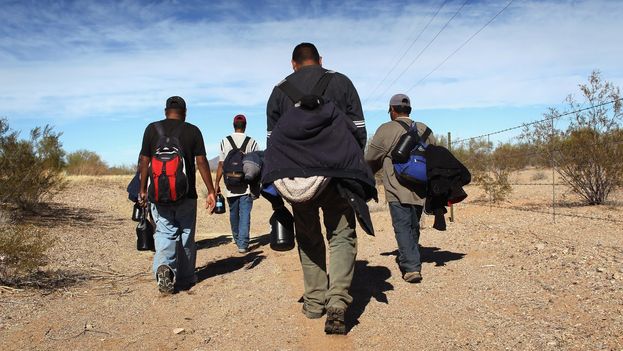
Overland immigrants cross the border between Mexico and the United States

This is the third and final part of the testimony of a Cuban who has made the dangerous trip from Guatemala to the United State. Part 1 is herePart 2 is here.

14ymedio bigger14ymedio, Mario J. Penton, Mexico City/Laredo Texas, 20 November 2015 – The smell of coffee draws me to the kitchen. The first rays of the sun have yet to appear when Domitila and her husband Juan get ready to start work on the farm. They protect us that day, hiding us from the Mexican police, always ready for deportations. “There have been hundreds, if not thousands, of Cubans who have passed through this house. They all say the same thing, ‘You can’t work there, you can’t live there’,” they say.

“Thanks to the Cubans we have this little ranch.” Their house barely has two rooms, one of which our group of immigrants is occupying. The family treasure is their farm, a little expanse of land with rubber trees. In this place we received the best care of the whole journey, we even get a bath.

A special solidarity joins this noble-hearted woman with the fate of Cuban migrants. Her daughter has lived in the United States for ten years. She arrived there as a ‘wetback’ and since then they haven’t seen each other. This was our last stage towards Mexico City. continue reading

A cold wind, in keeping with the altitude, and the endless lights leads us to believe we have arrived at the capital. The danger of a special police checkpoint makes us throw ourselves from the truck as fast as we can and take off into the semi-desert. The guide hurries us. Again, an altercation with the tropical version of the “revolutionary tough guy” is about to get us deported. The intervention of women prevents a river of blood, at least for the moment. The night passes without other mishaps.

To the joy of some and sadness of others, tonight is the last time we see the Hindus and the Central Americans. Halfway along the road a vehicle intercepted us, they climbed on and quickly took another route. According to what they tell us, they will enter at another border crossing.

We meet the “patroness,” a lady with the credentials of a trafficker who combines, in her features, virility with cunning and the female sixth sense

We arrived in Mexico City at three in the morning. A beautifully designed house, full of artworks and books of literature, religion and history suggest to us that we are in contact with someone knowledgeable and sensitive to the world of culture. Meeting the “patroness” is a huge surprise, a lady with the credentials of a trafficker who combines, in her features, virility with cunning and the female sixth sense.

“One Cuban who is coming alone!” Timidly I raise my hand. “Another!” A boy from the group joins me. “Another Cuban who is coming alone!” she says imperiously. “You! Get up, let’s go!” Maikel is traveling with his uncle, but his pleas are useless. It is decided and there is no turning back. He will have to leave his uncle alone.

The Cuban “tough guy,” who tried to sneak into this first departure, ended up with his tail between his legs on learning that even though he had given his wife’s jewels to the coyote in Guatemala, supposedly his money is not enough and he will have to wait in Mexico. We immediately think that this is the response of the organization to the aggressive attitude of the guide who took us to the capital.

After breakfast they lead us to a trailer. On the way I confirm my suspicions: the “patroness” is a woman of exceptional intelligence. Easy conversation and well-formed opinions, who holds forth fluently about the Mexican reality. She has dedicated her life to study, is not married and her main hobby is travel, such that in her 40 short years she knows well a good part of the world, including Cuba. After wishing us the best part of the journey, she makes us appreciate the privilege bestowed by the Cuban Adjustment Act and asks us to take advantage of this opportunity to improve ourselves and become good men.

The truck driver is also easygoing. His name is Oscar. He has spent many years transferring goods to the United States border. Although he is forced to smuggle Cubans to support his family, according to what he tells us, it has never entered his head to emigrate to the United States. With the money he makes, he “scrapes by” he tells us.

For nearly fifteen hours we are locked in that trailer, in places specially designed to hide people. Tiny little spaces we have to get into at every checkpoint that trips us up along the way, although, according to what Oscar says, everyone is paid.

“Corruption is the cancer that afflicts Mexico,” complains Oscar, “but we are all corrupt because the politicians themselves are the first in corruption and enrich themselves at the expense of the country.” While he traffics with three little Cubans towards the neighbor to the north, the generals, he thinks, do the same with arms and drugs. Everyone is involved, just at a different scale.

A white pick-up controlled by the fearsome Zetas is charged with getting us to the border. The trafficking ends with them, because they are the ones who control the underworld of the border area.

In Nuevo Laredo the border crossing is organized. A white pick-up controlled by the fearsome Zetas is charged with getting us to the border. The trafficking ends with them, because they are the ones who control the underworld of the border area. They tell us to leave everything we have, that is, barely a bag with a change of clothes that we carry hidden. Supposedly we should arrive at the international bridge to Laredo, Texas, with nothing, so as not to raise the suspicions of the Mexican police. After an exchange of words with our dealers, I manage to save the papers that testify to my university degree and a Cuban flag. All the rest is left in the past. They give us four Mexican pesos, with which we begin a new life. Before us, the bridge that marks the end of a life without rights.

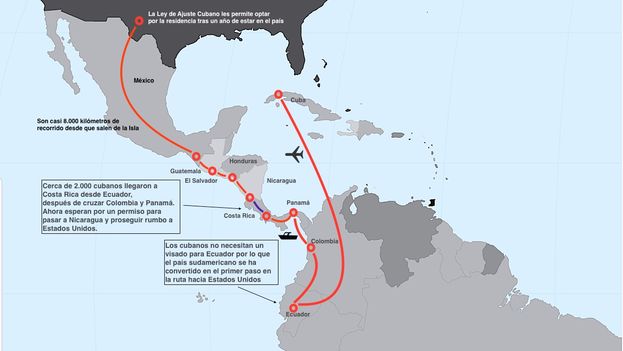
The route of Cuban migration. (14ymedio)

Nothing compares with the thrill of feeling free. Holding back the tears, we advance as fast as possible to reach the other shore. The nightmare is over. Jungles, swamps, police, the fear of an assault, narcos, traffickers, all is left behind like the price to be paid for freedom.

A group of around 80 Cubans is spending the night at the US immigration facilities, which are overflowing with the flood of Cubans. Some have been waiting days to process their paperwork. Not all of them arrive for political reasons. Many comment that their intention is to return to Cuba as soon as they obtain US residency. They left Cuba, selling their homes or going into debt, via Ecuador for two basic reasons: desperation in the face of a situation with no outlet, and fear of losing the privileges awarded by the Cuban Adjustment Act, with the recent openings toward the regime in Havana.

They have never heard about any rights and they don’t know what democracy is.

It is a time to give thanks, for us to rejoice on reaching the land of freedom. Also a time to mourn for those who did not make it. We have crossed our on Red Sea, and now the task before us is not to long for the onions of Egypt, although what lies ahead is the desert that faces every migrant.

We can finally say, like José Martí: “Freedom is expensive and you have to decide to pay its price or resign yourself to living without it.”

Double-bladed Scissors / 14ymedio, Miriam Celaya

Members of the Cuban opposition march together during the Americas Summit in Panama

14ymedio bigger14ymedio, Miriam Celaya, Havana, 12 November 2015 — Value judgement comments are very often made abroad about what – more or less – some have taken to calling “an internal dissidence crisis in Cuba,” implying an epitaph, and with premature and unjustified gloating, when we consider that frustration and dissatisfaction – the primeval basis on which all dissidence feeds – have maintained an upward trend on the Island.

However, the existence of a crisis is not necessarily a negative sign. The new landscape, encompassing daily life in Cuba and international relations, involves rearrangements and challenges for all stakeholders, especially those who move counter to truly hostile political conditions. In any case, crises create growth opportunities as well as challenges.

So we are facing what will be a growth crisis for some opposition groups, if they know how to assume the challenge to define their strategies and advance. If they persist in continuing with their old methods and concepts that lead nowhere, however, they will face a crisis of extinction. continue reading

Slow going, winding path

The current Cuban scenario is at a juncture where a transformation is taking place due to circumstances that have been building in the past few years which mark a slow, though significant, turning point in the profoundly State-based, centralized system that characterized the entire previous “Revolutionary” period.

Among these changes are Fidel Castro’s exit and his brother’s, the general-president, succession to power with the start of a process of economic lukewarm reforms which – though lacking in depth, extent and effectiveness – envelop an admission of the failure of the government’s mission, opening a crack in the extreme centralization and creating a point of no return that has permitted the (minimum) resurgence of private initiative.

The repressive capacity of the Castro regime is its most powerful institution to date, and it is extraterritorial in character. Venezuela is proof of it.

There have also been legal changes that restored certain rights, such as the sale of homes, cars, and other goods, as well as emigration reform that eliminated the humiliating exit permit and extended to 24 months the Cuban nationals’ periods of stay abroad.

In the field of computers and communications, marketing of computer hardware and cell phones were authorized, mobile e-mail service was established and public Wi-Fi sites were created, among other measures. Despite their limitations – high prices and slow, sporadic connections – these measures represent some flexibility from the previous ironclad monolithic practices of the regime.

Obviously, compared with technological advances and rights that are enjoyed in democratic societies, such transformations are minimal. In fact, they implicitly reflect the lack of rights that Cubans have been enduring for decades. However, these restrained steps taken by the Government – forced by the need to survive and not by a real political resolve to change – mark the beginning of the end of totalitarianism and prepare the setting for demanding deeper changes.

Unfortunately, in the absence of solid structures in the independent civil society that can sway the pace, direction and depth of the changes, the transformations have been implemented from the very military power established in 1959, to suit its own interests, which has set the slow pace of the process and the twists and turns along the road, including about-face phases or stagnation of some of the adopted measures.

A new schism

In this sense, last year’s December 17th announcement of the restoration of relations between the governments of Cuba and the U.S. marked a milestone that shocked the entire Cuban society in general – and the dissidence in particular – since it dramatically ripped to pieces the old official discourse of David vs. Goliath, rendering it obsolete on the one hand, while on the other, it introduced a new relationship style between the U.S. government and the internal opposition.

Strategies of factions of the opposition are inevitably leading to a breaking point, and, in addition, they are fueled by ancient evils such as autocratic governments, authoritarianism and the yearning of its better-known leaders to steal the limelight.

This has forced a schism in the dissidence, whose most radical sector considers this reconciliation of the two governments a “betrayal” of democratic Cubans on the part of the Obama administration, at the same time that they disapprove of an eventual lifting of the embargo, all of which immediately places the solution to Cuba’s internal political conflicts in the hands of and under the laws of a foreign government.

Another problem is the tendency to ignore their own limitations against the powerful government machinery. Some radical groups expect general elections to be held immediately after the resignation of the current government, an unrealistic (and impossible) move, considering that the longstanding dictatorship holds not just the country’s economic, political and military power, but in addition, it absolutely controls all the structures of the social order and directs a broad and efficient paramilitary apparatus. In fact, the repressive capacity of the Castro regime is its most powerful institution to date, even extraterritorially. Venezuela is proof of it.

There is also a moderate trend sector within the dissidence that views the end of the U.S.-Cuba dispute as a possible opening that would favor a climate of deeper changes – including legalization and consolidation of independent civic organizations and the emergence of a middle class – as well as increased pressure from the international community on the Cuban Government for change in the political sphere, and a potential improvement in the living conditions of the population, among other positive effects.

This trend is betting on dialogue and negotiations to achieve reforms that will open opportunities for citizen participation that will face the power structure, historically based on a monolithic system as well as a gradient to ensure a peaceful and orderly transition, avoiding social chaos, settling of scores, summary trials and vandalism peculiar to abrupt changes in long-traumatized societies.

But, so far, the moderate sector has not been able to assert itself in the political arena and lacks recognition, not only by the Cuban Government – for obvious reasons – but it has also been ignored by international governments and organizations currently interested in negotiating with the regime.

The Cuban opposition cannot delay in such issues as abandoning the role of mere political folklore which the international press has tried to turn it into, and assuming the new conditions more realistically.

Both strategies, the radical and the moderate, pursue, as a common goal, the establishment of democracy in Cuba, but their irreconcilable approaches will inevitably lead to a breaking point. In addition, they are being fueled by ancient evils, such as autocratic governments, authoritarianism and the yearning of its better-known leaders to steal the limelight.

However, the real challenge facing the opposition is to overcome the resistance phase as an end in itself and to conquer the participation and commitment of Cubans inside the Island, something that has not been attained by either strategy.

The Cuban opposition cannot delay in such issues as abandoning the role of mere political folklore which the international press has tried to turn it into, starting by putting an end to conflicts that lead nowhere. The other path would be to disappear from the effects of wear and tear and mass departures.

It is clear that the current political and economic global interests of governments with very different ideals have encroached on our country and are negotiating with the dictatorship, while those of us who rightfully aspire to re-establish the nation are not finding the essential unification hinge to get the two sharp blades of a scissors to cut the Gordian knot of the Castro regime. Tomorrow could be too late.

Who destroyed the Tosca Cinema? / 14ymedio, Reinaldo Escobar

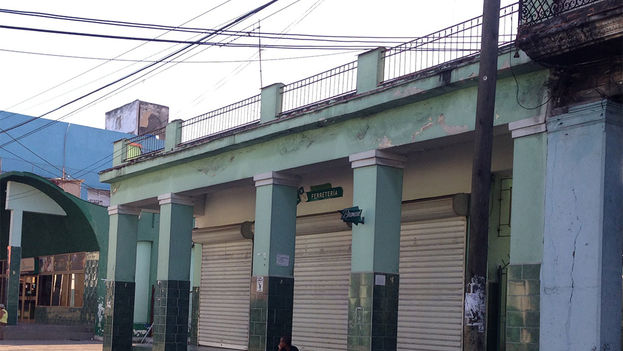
Hardware store where the Tosca Cinema once stood. (14ymedio)

14ymedio bigger14ymedio, Reinaldo Escobar, Havana, 9 November 2015 – In his recent speech in Merida, Mexico, the general-president Raul Castro remembered his first visit to Mexico, recalling that he had sought asylum in the embassy of that country in Havana because he was accused up putting a bomb in the Tosca cinema in the capital and, he clarified, “I still don’t know where that theater is. I believe it exists.”

It wasn’t exactly a bomb, but a firecracker that exploded on the night of 9 June in the little movie theater in the Santos Suarex neighborhood. The accusation against Raul Castro was part of a wider complaint, filed in Case No. 297 of 1955 for Crimes Against the Power of the State. There were 19 defendants, among them José Antonio Echevarría, and even some exiles like former President Carlos Prio. continue reading

The Court published the case on Thursday, 16 June 1955 and the next day Fidel Castro appeared at the court to file a written complaint where he mentioned a plan to assassinate him and his brother. It said that the accusations against Raul made no sense because the young man was at the events in Marcané that day, a village in the then municipality of Holguin in Oriente province, visiting his father who was ill. That Friday the Mexican embassy gave Raul Castro political asylum after he had returned clandestinely to Havana and spent some days at the Siboney Hotel, at Prado and Virtudes Street.

To give his complaint continuity, Fidel Castro tried to publish an article in Bohemia Magazine on Monday, with the prophetic title of “One can no longer live here,” but Miguel Angel Quevedo, director of the prestigious magazine, refused to publish it.

Mr. President, with all due respect I must announce that Tosca Cinema no longer exists

On the afternoon of Friday, the 24th, Raul Castro went to Jose Marti Airport to fly to Mexico. He was seen off by his siblings Fidel, Lidia and Enma, along with the journalist Luis Conte Agüero. The immigration law of that time ignored that the Cuban was crossing the border with an accusation against him (one that would now be called terrorism), for which he hadn’t even stood trial. Such was the cruelty of that tyranny.

It seems that at that time Raul Castro was innocent of that explosion, where there was more noise than damage.

Mr. President, with all due respect I must tell you that the Tosca Cinema no longer exists. Only those older than 40 vaguely remember its disappearance. Instead, at number 1007, there is now a hardware store with the name of Brimart, which nobody knows the significance of. There is a surviving bakery across from it, which retains the name of the heroine of Sardou’s drama, immortalized by Puccini in his opera.

(All the historical data mentioned here appears in the book “We Will Fight to the End, Chronology, 1955” published by the Council of State’s Office of Publications, under the authorship of Rolando Davila Rodriguez.)

Rebellion Comes To The Theater / 14ymedio, Yania Suarez

El Portazo offers an ingenious show where theatrical drama merges with cabaret

14ymedio bigger14ymedio, Yania Suarez, Havana, 19 November 2015 – The presentation of Cuban Coffee by Portazo’s Cooperative was a public success during the Havana Theater Festival and is currently a success in Matanzas, its place of origin. Staged by the Matanzan group El Portazo and directed by Pedro Franco, the spectacle seeks – in addition to being profitable – to discuss the problem of Cubans’ prosperity, “starting with economic research based on our present reality.”

The group offers an ingenious show where theatrical drama merges with cabaret and the public is treated like customers enjoying the artistic and gastronomic offerings of El Portazo cooperative.

Cuban Coffee raises the dilemma of the recent changes in the island’s economy that harms natives while benefitting foreign investors. During the play, these latter are equated to “invaders” through scenes recalling the fights for independence and tributes to the heroes of these events, along with a question about love of country that is repeated on several occasions. continue reading

A fragment titled “The Taking of Havana by the English” traces the tragedy of Pepe Antonio, native of Guanabacoa and still living, who leaves the country because he got tired of living off tourist tips, wants an iPhone, and what he hates most is “working for the English.” His story manages some good moments that successfully mix tragedy and comedy.

This emotional and direct rebellion that gains strength in the first two acts, is diluted in the last act

The audience was especially excited about the reference to the real drama of a generation that has abandoned the country en masse, as well as by the reading of a letter from Leonor Perez to his son in exile. The laughter grew with the first appearance of the militia character, a drag queen in a wig with a pink gun, who launches an act of repudiation against the young people who are leaving, while she points her gun and dubs Rata de Dos Patas (Two-legged Rat), a famous song by the Mexican Paquita la del Barrio that went viral on YouTube.

During a good part of the show there are statements of rebellion and independence. However, regrettably, this emotional and direct rebellion that gains strength in the first two acts, is diluted in the last act, titled “Where we attend morning assemblies so as not to lose the tradition of dialog and our basic naivete” where the criticism exhibited becomes “constructive criticism.”

The “constructive criticism” must meet two unalterable premises. The first is that the government is capable of solving the problem, and second, that the time frame to reach the solution is undefined (and even infinite). If the criticism fails to meet these requirements, the criticism is considered an attack and the person making it is an enemy of the people. More than criticism, it’s about a statement of faith.

After so much exciting rebellion and the demand for so much courage, at the end of the show there is a sense of retreat. The Militant protests because her life project is happening “in slow motion,” as troubadour Erick Sanchez’s song says, but an infinite time credit is extended to those responsible for it. It calls for respect for its opinion without having distinguished it from that of the powers that be, and falls back on official euphemisms, but just shows its obedience and diminishes its voice. It is a shame that in a work so well staged, it ends this way.

The Commission on Defense and National Security, an Alejandro Castro Corporation / Juan Juan Almeida

Alejandro Castro Espín (R) and Abel Enrique González Santamaría (L)

Juan Juan Almeida, 16 November 2015  — Bound by a peculiar loyalty based on the quasi-inbreeding of its members and located in a walled compound at the corner of 36th and 39th streets in Havana’s Nuevo Vedado, the Commission on Defense and National Security (not to be confused with the Council on National Defense), is a group with a disturbing profile but no legal standing, created with the intention of preserving the status quo.

Under the Constitution, which we are supposed to be revising but which is still in force, the National Assembly of People’s Power ranks as the highest institution of government, imbued with legislative and constitutional powers. Subordinate to it are the Supreme Court, the Attorney General and even the Comptroller General. It appoints the Council of Ministers and the Council of State.

But that’s only on paper. In practice, the epicenter of power lies at the always bountiful table set every Sunday for lunch at La Rinconada, the housing complex where the president of the Council of State and Council of Ministers of the Republic of Cuba, Raul Castro, resides. continue reading

It is the source of directives (those dealing with both domestic and foreign policy) that each institution, ministry or department must follow based on a precise decision-making formula, one which takes into account — pardon the redundancy — compartmentalization, security, effectiveness and responsibility. The octogenarian general then reads, revises and personally approves them before they are formally adopted.

But driven by his usual feelings of paranoia, his oft-stated intention to resign, his loss of confidence in all those around him and a clear desire to monitor compliance with the designated responsibilities, some time ago the Cuban president used the regular Sunday meal to grant extraordinary powers to his firstborn son.

That was how the irascible, high-handed, obtuse and brutal Alejandro Castro Espin created a para-governmental organization with unlimited powers that, without any legal basis, operates like a parallel government under the following mandate:

1. To plan, direct and monitor the operations and departments of the Ministry of State Security.

2. To create, configure and appoint the advisory and coordinating committees necessary for the various ministries to fulfill their missions.

3. To participate in the regulation, consolidation and control of all designated central administrative State bodies.

4. To carry out and manage, under his direction, the responsibilities to which President of the Republic entrusts it.

This small and powerful clan operates like a large corporation that, in my opinion, results in the type of complicity that comes from engaging in group sex.

I say this because, curiously, the senior advisor to this very important commission — the writer and journalist Juan Francisco Arias Fernández (aka Paquito) — was the husband of one of Alejandro’s former girlfriends. Even more surprising is the fact that the deputy advisor is Abel Enrique González Santamaría, a young writer and researcher with a law degree, a masters in international relations and a doctorate in political science. In addition to being an expert in inter-American relations and national security, he was also the boyfriend of Alejandro’s current partner.

An unambiguous detail. It seems that, more than the country, what really matters to the Commission on Defense and National Security is the crotch. It should join up with CENESEX.*

*Translator’s note: The National Center for Sexual Education (CENESEX) is headed by Mariela Castro, sister of Alejandro Castro.

Controversy Rages in Chile on the Recruitment of Cuban Doctors / 14ymedio

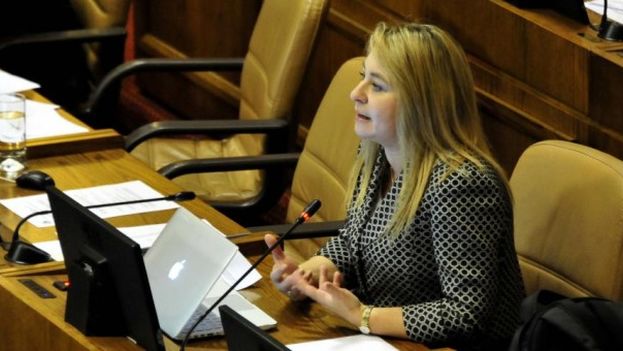
Deputy Marisol Turres (CC)

14ymedio bigger14ymedio, Havana, 7 November 2015 – Critics of the potential arrival of Cuban doctors in Chile have raised their tone in recent weeks in the South American country. Marisol Turres, national deputy from the Independent Democratic Union (UDI) party, denounced that the situation is almost one of “human trafficking” and questioned the conditions imposed by the Cuban government on its doctors working in Chile.

The proposal to contract for Cuban doctors has been pushed by Alejandor Navarro, a senator from the Broad Social Movement (MAS), who, at the end of September, was backed by the majority of mayors in the country. However, the Chilean Association of Medical Faculties (ASOFAMECH) clarified that while it was not opposed to the arrival of the professionals, they must past the Unified National Examination of Medical Knowledge (Eunacom).

The Chilean Medical Faculties have warned that, of the 787 doctors licensed in Cuba, equally split between Chileans and foreigners residing in the country, of those who have so far taken the theory section of the national examination, only 23.5% have passed on the first attempt, and an additional 12% have managed to pass on the second, third or even the fourth attempt. continue reading

Those who are concerned about the arrival of the physicians, as is the case with UDI deputy Turres, also demand that the Ministry of Health (Minsal) pressure the Meidcal College to train specialists and oblige the scholarship students to work in public service when they finish university.

The deputy laments that “it is a terrible violation of human rights, because the Cuban government expropriates a large portion of their salaries, and their families must stay in Cuba

Although she declared she is not against the initiative, in addition to her concern about “human trafficking,” Turres laments that “it is a terrible violation of human rights, because the Cuban government expropriates a large portion of their salaries, and their families must stay in Cuba… Let them come with their families and keep 100% of the payments from the State of Chile and not have most of their pay taken by the country they come from.”

At the end of September, 225 mayors delivered a letter to the branch ministry, which supports the arrival of the Cuban doctors to make up for a deficit of 3,795 doctors, and to resolve “the waiting lists, while Chile trains its specialists.”

While the debate heats up in Chile, thousands of health professionals on the island dream of a new “medical mission” abroad, which allows them to earn higher incomes. For the Cuban government it is a lucrative business, since the export of health services to some 40 countries represents 64% of total income from services. According to the director of the Commercialization of Medical Services, Yilian Jimenez, Cuba expects to gross more than 8.2 billion dollars from the program in 2015.

Cuba And The United States Cooperate In The Conservation Of Marine Protected Areas / 14ymedio

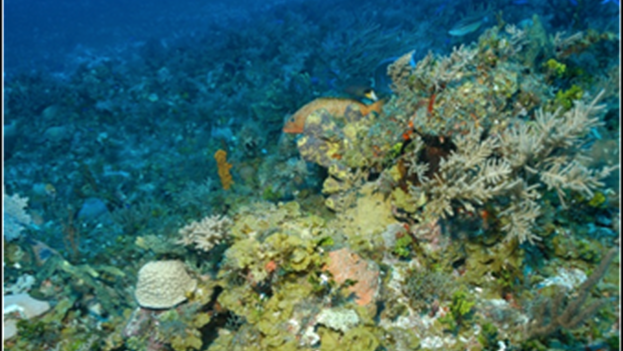
The project will start with the Guanahacabibes National Park, including the Bancos de San Antonio in Cuba.

14ymedio bigger14ymedio, Havana, 18 November 2015 — Washington and Havana will cooperate in the scientific arena, in the administration and management of marine protected areas, according to a memorandum signed Wednesday by the National Oceanic and Atmospheric Administration (NOAA) and the National Park Service of the United States (NPS) with the Ministry Science, Technology and Environment of Cuba.

The agreement provides for collaborations to promote the conservation and management of marine natural resources, sharing scientific and technical information and promoting understanding and comprehension. The project will start with Guanahacabibes National Park, including the offshore Bancos de San Antonio, in Cuba; and the Flower Garden Banks and Florida Keys and the Dry Tortugas National Parks and Biscayne Bay national parks, in the United States.

“The opportunities for international cooperation in marine conservation is invaluable and this agreement brings us closer to securing a healthy and productive ocean for everyone,” said NOAA Administrator, Kathryn Sullivan.

Costa Rica Treats 67 Cubans Injured By The Use Of Military Force In Nicaragua / 14ymedio, EFE

Hundreds of Cubans are still stranded at the border of Costa Rica while Nicaragua denied entry to move north. (EFE / Alvaro Sanchez)

14ymedio bigger14ymedio/EFE, San Jose/Managua, 17 November 2015 — The Costa Rican Social Security Fund (CCSS) had to treat 67 Cubans after clashes with the Nicaraguan Army, according to the Government of Costa Rica. The migrants were treated at the Cuidad Neily Hospital, at the hostels located in La Cruz canton and at a border post on the northern border of the country.

Dr. Maria Eugenia Villalta Bonilla, CCSS medical director, reported that migrants were treated for various injuries caused mainly by tear gas fired by the Nicaraguan Army; however, none were in serious condition.

Since Monday, the Cuban migrants have been in various shelters in the community of La Cruz, and the Emergency Health Services of the area are being reinforced with more personnel, in order to prioritize patients requiring immediate medical attention. The emergency health services of La Cruz are available 24 hours a day, with more personnel on duty from 7 AM to 4 PM. continue reading

This level of care in the northern zone of the country will be maintained as long as necessary, according to the institutions, that is as long as Cubans remain in the shelters, as the institutional priority is to maintain an adequate level of health care.

Migrants were treated for various injuries caused mainly by tear gas fired by the Nicaraguan Army

Migrants have also been assessed to rule out other illnesses caused by environmental conditions, such as respiratory infections, nutritional problems, flu and dehydration.

Tension between Costa Rica and Nicaragua intensified this Monday with accusations made by both governments. Nicaragua formalized a complaint against Costa Rica before the 192 member states of the United Nations for provoking a humanitarian crisis by allowing the islanders to leave, according to Nicaraguan Deputy Foreign Minister Maria Rubiales.

The complaint was also sent to Secretary General Ban Ki-moon, the International Organization for Migration, the United Nations High Commissioner for Human Rights and the United Nations High Commissioner for Refugees (UNHCR).

About 2,000 Cubans arrived in Ecuador by air and from there moved unofficially through Colombia and Panama, reaching Costa Rica, where on Saturday the government granted them seven-day transit visas valid to reach Nicaragua on their trip to the United States.

However, on arriving at Peñas Blancas, the border between Costa Rica and Nicaragua, the Nicaraguan government denied them entry and on Sunday afternoon the army stopped about 800 who tried to enter illegally.

Following this incident, the Managua Government deplored and condemned “the irresponsible attitude, disrespectful of all international conventions and agreements on human mobility, by the Government of Costa Rica.”

The Nicaraguan Deputy Foreign Minister said that Costa Rica caused “this situation by pushing these immigrants to cross our border illegally.”

Costa Rica did not consult Nicaragua with regards to whether it was in a position to deal with Cuban immigrants, said Rubiales. “You cannot take actions that have to do with the sovereignty of another state without any negotiation,” she argued.

Costa Rica sent a note of protest to Nicaragua in which it criticized the use of the Army and tear gas against immigrants, who include pregnant women and children

Nicaragua suggested that the issue of Cuban migrants must be addressed within the Central American Integration System (SICA).

In response to these accusations, Costa Rica sent a note of protest to Nicaragua in which it criticized the use of the Army and tear gas against immigrants, who include pregnant women and children, a measure which was also rejected by human rights organizations in Nicaragua.

Costa Rican Foreign Minister Manuel González reported that his country would take to international organizations the problem of hundreds of Cuban migrants trying to reach the United States.

The minister said that talks were held on Sunday with the Secretary General of the Organization of American States (OAS), Luis Almagro, to explain the situation and said that he “did not rule out” raising the issue in that forum.

In addition to the OAS, Gonzalez confirmed that this issue was discussed today in Ecuador, during a meeting of national coordinators of the Community of Latin American and Caribbean States (CELAC), in which his country responded “to a rude and unfounded statement by the Government of Nicaragua, which makes serious accusations against Costa Rica.”

This situation has made strained relations between Costa Rica and Nicaragua even more tense, the two countries have been at odds since 2010 over territorial disputes brought before the International Court of Justice.

The Secretary for International Relations of the ruling Sandinista National Liberation Front (FSLN), Jacinto Suarez, said it is possible the situation will “complicate” bilateral relations, “because they have been making some statements that seem to want to complicate things.”

This episode adds to the long list of disputes that Costa Rica and Nicaragua have maintained for years. In late 2010, Costa Rica filed a complaint before the International Court of Justice, for alleged invasion of its territory

However, according to Sandinista deputy Carlos Emilio López, the matter can be resolved through diplomatic channels.

“The Government of Nicaragua has a vocation for dialogue, of resolving conflicts through diplomacy. We hope that the governments can sit down together to find a solution to this situation,” said the official representative.

This episode adds to the long list of disputes that Costa Rica and Nicaragua have maintained for years. In late 2010, Costa Rica filed a complaint before the International Court of Justice, for Nicaragua’s alleged invasion of Costa Rican territory in Isla Portillos, also known as Harbour Head Island, as part of a dredging project to connect the San Juan River with the Caribbean Sea.

Nicaragua, in turn, protested a road being built by Costa Rica parallel to the tributary, alleging damages to the San Juan river from the construction.

Meanwhile Cubans, housed in shelters set up by the Red Cross, churches and civil society organizations, wait near the border with Nicaragua to continue their journey across the continent to reach the United States.

A Thousand Cuban Migrants Stranded In Costa Rica Remain In Shelters / 14ymedio, EFE

Cubans return to Costa Rican soil after Nicaraguan police and soldiers prevented them from continuing their journey to the US. (El Nación)

14ymedio bigger14ymedio/EFE, Managua/San Jose, 19 November2015 – Nearly a thousand Cubans who find themselves stranded in Costa Rica on their journey to the United States remain in six shelters set up by the Costa Rican authorities to provide them with humanitarian assistance. The Latin American foreign ministers will meet this coming Monday in El Salvador in order to find a solution to the problem.

The National Emergency Commission (CNE) announced today that there are 982 Cubans in the six shelters, while at the border post of Peñas Blancas, on the border with Nicaragua, 400 who did not want to move to shelters remain.

Civil society organizations and university students have joined the humanitarian efforts that include donations and food preparation, while the Red Cross monitors the health of the islanders. continue reading

On the other side of the border, Nicaraguan Foreign Minister Samuel Santos said that the expulsion of the Cuban migrants to Costa Rica was an act of “defense” against an “imposition.” “Nicaragua, which is a fraternal people… we discussed it calmly, but with the impositions nothing can be done, it is the obligation of every people to defend themselves,” Santos told reporters.

The foreign minister also denied that Costa Rica has asked Nicaragua to shelter the Cubans.

The situation of Cubans on the border has further strained the already deteriorated relations between Nicaragua and Costa Rica.

Managua accused its neighbor of “launching” the Cubans toward their territory, causing a humanitarian crisis, while Costa Rica has rejected those claims and says it has acted according to international law to grant visas to migrants and prevent them falling into human trafficking networks.

The Cubans left their country via air to Ecuador, which does not require them to have a visa, and from there they travelled “irregularly” to Colombia and Panama to reach Costa Rica.

On Tuesday, the Cuban government attributed this situation to the immigration policy of the United States with regards to Cuba, and affirmed that it is in contact with Costa Rica and Nicaragua to find a “a quick and appropriate solution” to the problem.

According to Havana, this policy “encourages irregular emigration,” violates the migratory accords in effect between both countries and is “inconsistent” with the current bilateral context, in addition to hindering the normalization of migratory relations between Cuba and the United States and creating problems with other nations.

Costa Rica organized a meeting of foreign ministers of the countries between Mexico and Ecuador in order to discuss joint actions, especially the creation of a humanitarian corridor for the transit of Cuban emigrants across America from south to north.

How Does History Help Us? / Dimas Castellano

Dimas Castellano, Havana, 17 September 2015 — 120 years ago, between 13th and 18th September 1895, twenty delegates selected from the five corps that the Libertador’s Army was divided into, and formed into a Constituent Assembly, promulgated the Constitution of Jimaguayú.

This Constitution, different from others in that it wasn’t structured in three parts — organic, dogmatic, and with a reform clause — but rather contained 24 consecutive articles without divisions into titles, sections or chapters. In it the Government of the Republic resided in a Government Council with legislative and executive powers. The executive power devolved upon the President (Salvador Cisneros Betancourt), while the legislative power stayed in the hands of the Government Council. In addition to a judicial power, organised by the Council, but functioning independently. The posts of General in Chief and Lieutenant General were vested in Máximo Gómez and Antonio Maceo respectively. continue reading

Appearing in the people’s history as a counterpoint to absolutism, constitutionalism is fundamental to governability. The constitutions reflect the requirements for social development. In that sense, the Magna Carta of Jimaguayú was an expression of the need of the new political and legal order of the Republic in Arms. It constitutes an important link in Cuban constitutional history.

On its 120th anniversary, the weekly Trabajadores of Monday September 7th and the daily Granma of 16th of the same month each included reports,  under the headlines: “Neither Marti nor radical”, and “120 years after Jimaguay respectively, which I am going to comment on.

1 – In Granma the historian Rolando Rodríguez is cited, who stated that Jimaguayú is a document of overwhelming importance in the history of Cuba, an indication of the legal and republican idea and the determination to provide a constitutional direction to the Cuban insurrection.

If that constitutional text is recognised as a necessity of the new political and legal order demanded by the island and an important link in our constitutional history, how can the official historiography consider it as a “document of significant importance in Cuba’s history”, without a critical reference to the present Cuban constitutional situation, which has little or nothing to do with — starting off with the divisions of power — the legacy of Jimaguayú?

2 – The article in Granma says that “Martí longed to drop the authority that the Cuban Revolutionary Party had awarded him at a representative meeting of the Mambisa combatants …” [Ed. note: term used to refer to any pro-independence fighter in the Wars of Independence]

In José Martí’s War Diary — referring to his encounter with Antonio Maceo and Máximo Gómezon May 5th 1895 in La Mejorana — he wrote “… Maceo and Gómez talk in low voices, near me [1]: hardly speak to me. There in the hallway; that Maceo has another idea about government; a council of  generals with authority through their representatives, – and a Secretary General: the land, and all its functions, which create and support the army, like Army Secretary. We are going to a room to talk. I cannot sort out the conversation for Maceo: but V. stays with me, or he goes with Gómez? And he speaks to me, interrupting me, as if I were the continuation of the shyster lawyer government, and its representative … I insist on being ousted by the representatives who are meeting to form a government. He does not  want every operational head sending his man, his creation: he will send four from the Oriente: “within 15 days they will be with you. – and will be people who will not let  Doctor Martí mess with me there …” [2]

One may deduce from this text that in La Mejorana Martí considered his removal. These were his words: “I insist in being deposed before the representatives who are meeting to select a government.” That is not a longing, but a demand to not be removed other than by an assembly of representatives.

If the Revolutionary Party of Cuba started off on the basis of an analysis of the Ten Years’ War as an organising and controlling entity, and one which promotes awareness and is an intermediary link to get to a republic and that great mission had hardly got under way, it is difficult to accept that their hope was to shed their authority.

Also, if Martí’s attachment to institutionalisation and democracy led him in 1884 to move away from the Gómez Maceo plan, when he took the opportunity to write to the General in Chief: “But there is something which is higher than all the personal sympathy which you can inspire in me, and this apparent opportunity: and it is my determination not to contribute one iota by way of a blind attachment to an idea from which all life is draining, to bring to my land a personal despotism, which would be more shameful and disastrous than the political despotism I am now supporting.” How can it be affirmed that Martí “was longing to be shot of the authority afforded him by the Revolutionary Party of Cuba”?

3. Granma says: “It is also established that every two years there would be an assembly charged with proposing necessary changes in accordance with changed circumstances, which would elevate it to a higher position than that approved in Guáimaro.”

If the 1959 revolution is seen as heir and continuation of the constitutional legacy, it would seem to be contradictory that, on taking power, instead of re-establishing the 1940 Constitution as it had promised to, it replaced it with statutes known as the Fundamental Law of the Cuban State, without convening any constituent assembly.

Cuba remained without a Constitution until 1976 when there was approved the first revolutionary constitution modelled on the that of the Soviet Union, which prohibited any modification before 1992. Then, in 2002, the system installed in 1959 was declared irrevocable. With that decision, the Cuban constitution ceased to reflect ongoing changes which occur in any society, and became a braking mechanism on society.

The question is: How can our constitutional history be praised from the standpoint of a reality which negates it?

4. In the Trabajadores weekly paper, Antonio Álvarez Pitaluga states in En la de Jimaguayú that there was no balance of power and nor did they defend Martí’s thesis. It is said that Enrique Loynaz del Castillo and Fermín Valdés Domínguez defended  José Martí’s hypotheses, but I think that it is now difficult to sustain that position, because if you look through the documentation, above all the minutes of the Council of Government, you see that in all the Assembly’s discussion there was not a single mention of Martí, nor of his documents, nor any analysis of his thoughts. That is to say, they avoided it; you don’t necessarily  have to say they did it intentionally, but rather unknowingly, because many of the people there knew him, his work, his revolutionary activity, but not his thinking or his documents.

The questions are: 1 – Was Fermín Valdés Domínguez unaware of José Martí’s thinking? And 2 – if Fermín Valdés Domínguez, followed by the majority of the delegates, defended the division and limitation of powers, which was one of José Martí’s republican ideas, was the important thing that his name should appear in the documents, or that the majority should defend and impose his ideas, as actually happened?

The 120th anniversary and the two articles published demonstrate that you cannot deal with any historical event, much less one of such importance as the constitutional text of Jimaguayú, without relating it to the present in order to show that  we have either gone forwards or backwards. If we do not have regard to the limitations of the present constitution which cry out loud for fundamental reform, how does history help us?

[1] In the original, “I hear” is crossed out

[2] Martí, José. Texts chosen from three volumes. Volume III, p. 544

Translated by GH

Silvio Rodriguez Believes That “We Must Do Something” For Cubans Caught Between Costa Rica And Nicaragua / 14ymedio

The singer Silvio Rodriguez. (CC / Flickr)

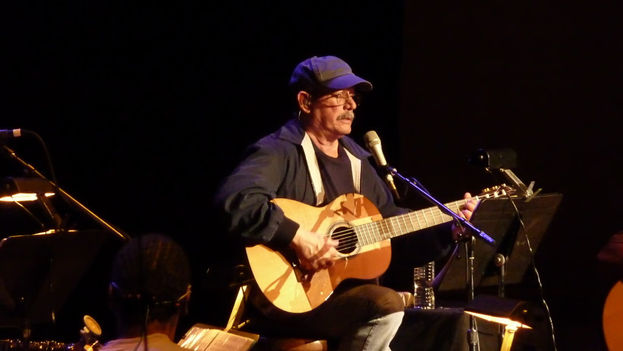
14ymedio bigger14ymedio, Havana, 18 November 2015 — The Cuban singer Silvio Rodriguez believes that “we must do something” for the close to 2,000 Cubans who are waiting at the border between Costa Rica and Nicaragua in hopes of continuing their journey to the United States. “Having seen these countrymen carrying their children (the innocents of this bitter adventure), moves me deeply and mobilizes me,” the artist wrote this Wednesday in his blog.

Rodriguez denounced a “manipulation by the media and interests against Cuba, just at the time when the headlines are filled with terrorism and forced migration towards Europe.”

“Now the Costa Rican Foreign Minister launches the not at all providential ‘solution’ of building a bridge so that these two thousand Cubans will arrive at their destination. What a great man this gentleman is, doing this for Cubans, knowing full well that in the United States there is a law especially favoring the arrival of our people with dry feet,” added the singer.

“I haven’t seen news of a some pronouncement in favor of another group of Latin Americans. I only see the foreign minister making an international call in a resounding attempt for the moral legalization of the Cuban Adjustment Act (and incidentally ridding himself of a problem). Right now with the rapprochement between Washington and Havana that ‘law’ is on shaky ground. What a load of crap!” he writes.

Cuba blames the Central American Immigration Crisis on the US Cuban Adjustment Act / 14ymedio

A group of Cubans who tried to cross from Panama to Costa Rica on November 13. (THE NATION)
A group of Cubans who tried to cross from Panama to Costa Rica on November 13. (La Nación)

14ymedio bigger14ymedio, Havana, 17 November 2015 — Citizens who are trying to reach the United States from other countries on the continent are “victims of the politicization of the immigration issue by the Government of the United States,” Cuba’s Ministry of Foreign Affairs (MINREX) said in a statement read on Cuba’s primetime news Tuesday night.

MINREX commented on the “complex situation” created at the borders of Costa Rica, where some 2,000 Cubans arrived from Ecuador, having crossed Colombia and Panama. On Saturday, the Costa Rican government granted them a special visa valid for seven days, to reach Nicaragua, on their trip to the United States.

However, on arriving at Peñas Blancas, on the border between Costa Rica and Nicaragua, the Nicaraguan government denied the Cubans entry and on Sunday afternoon the Nicaraguan Army forcibly stopped about 800 who tried to enter illegally. continue reading

According to MINREX, the United States’ Cuban Adjustment Act and the implementation of the “wet foot-dry foot” policy “are incongruent with the current bilateral context, impeding the normalization of migratory relations between Cuba and the United States, and creating problems in other countries.” This is “because it confers a different treatment on Cubans, the only ones in the world, by admitting them immediately and automatically, regardless of the paths and methods they use, including if they arrive in the country illegally.” MINREX further argued that, “it constitutes a violation of the letter and spirit of migratory accords in effect, whereby both countries assume the obligation of guaranteeing legal, secure and orderly migration.”

MINREX also “denounced” the Cuban Medical Professional Parole Program, created by George W. Bush in 2006, saying that it “encourages doctors and other Cuban health workers to abandon their missions in third countries and emigrate to the United States.” MINREX said that it is “a reprehensible practice aimed at damaging Cuba’s programs of cooperation and depriving Cuba of vital human resources, as well as the many countries that need them.”

In its public statement, MINREX says that currently “the Cuban authorities have maintained permanent contact with the governments of the countries involved, with the objective of finding a quick and appropriate solution that takes into consideration the well-being of Cuban citizens.”