Ruins at Prado and Teniente Rey, the ‘in corner.’ (14ymedio)
14ymedio, Reinaldo Escobar, Havana, 23 October 2015 — Tourists like to portray ruins. They do this at the Greek Parthenon, the Roman Coliseum and the crumbling Mexican pyramids. But Havana’s ruins have “another charm.” As in this picture, where a good telephoto lens can capture a tiled wall with enclosed shower, the bowels of an electrical installation, truncated stairs and, hopefully, even the innocent graffiti a teenager scribbled on the wall of his bedroom.
This is the corner of Prado and Teniente Rey, where until recently a seedy little bar served as a meeting point for the gay community. A hunting ground, where the roles of prey and hunter were happily played out between prostitutes and middle-aged tourists.
Perhaps this desolate landscape will not last as long as others that have become emblematic of the capital city. With its privileged position, facing the National Capitol, it can be expected that the debris will be cleared away very soon. Perhaps at first there will be a parking lot, and with time a hotel, a store, an office complex.
I fantasize that the ground floor will house a café where deputies will finish settling the arguments still pending in the Parliament. I see lobbyists, stalking like new hunters, the most influential parliamentarians and I also imagine that the odd nostalgic tourist will lament the crime of what they did with the beautiful ruins.
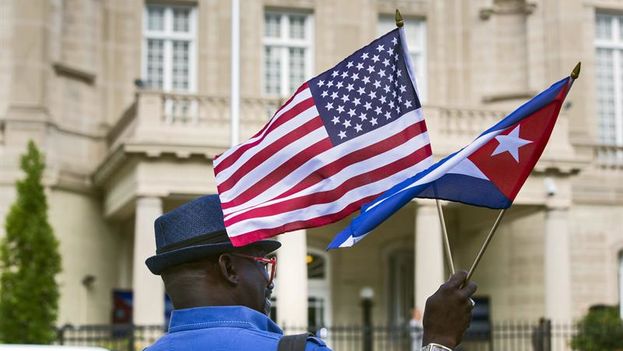
The inevitable contamination of the United States can only be assimilated in a Cuba faced with the exhaustion and advanced age of the Revolution, and the cultural failure of “We will be like Che.” (EFE)
14ymedio, Manuel Cuesta Morua, Havana, 23 October 2015 — During the State-sponsored 12th Forum of Cuban Civil Society Against the Blockade, which ended last Friday at the Ministry of Public Health’s auditorium in Havana, a unique paper was presented. Under the title “The Blockade: Methodology for Calculating Costs,” Pico Nieves, and expert from the National Institute of Economic Research, presented findings that deserve political attention, but not economic.
After listening to the presentation, one question lingered in the air. What logic does the Cuban government follow when it demands compensation for the costs of a voluntary war and, moreover, one that it did not win?
There are at least six arguments that challenge the proposal from Pico’s research:
– Political: Two enemy States do not negotiate. Nothing in international practice or in the literature on States in conflict shows or demonstrates that the friend-enemy relationship, according to the German political theorist Carl Schmitt, involves trade in goods and services between them. The goal motivating such a pair is the disappearance of the other, not business relations. continue reading
– Economic: The structure of the Cuban economy is not compatible with the American economy. Goods and services that Cuba could offer are not in the “market basket” of the American citizen, and, with regards to what Cuba could receive from the United States, which is everything, there is no Cuban monetary or wage structure, unless it was reproduced, since the 1970s or ’80s, of the type of a central or peripheral economic relationship that supposedly justified the Cuban Revolution.
– Ownership structure: A privatized economy such as that of the United States does not fit with an economy as nationalized as that of Cuba. What would be the State partnership of Cuba with a country like the United States where there isn’t the most remote possibility for a role like the State’s in the Cuban economy, except with regards to trade relations?
– Creating wealth: If the Cuban economic model of production was always one of State capitalism, there is a key difference with the American model. There the economic model is one of openness and plurality par excellence, and in Cuba, on the contrary, we are faced with the most closed and centralized economy. This leads to an increasingly important difference, the technological differences which are enormous. In this sense, the only option would have been for the United States to give international organizations political license to flood Cuba with credits. But again, we encounter the obstacle that we are enemies.
– Economic policy: The sectors that could be attractive to the United States, for example tourism and cultural sectors, were only opened up in Cuba in the nineties and then only reluctantly.** In the 1970s and ‘80s allowing Yanke tourism in Cuba, the only potential area of economic ties, would have run up against that era’s most important concept of political control: ideological diversionism. US tourism would have brought the American Way of Life, inconceivable in that time.
– Ideological: The inevitable contamination from the United States can only be assimilated in a Cuba faced with the exhaustion and advanced age of the Revolution, and the cultural failure of “We will be like Che.” What’s left of that model supposedly superior to and incompatible with capitalism?
In reality, the only chance of economic relations with the United States, in conditions of political peace, would have been through the facilitation of credit and then we would have had a problem not only with the Paris Club, but also with the Washington Consensus and the vulture funds. The inefficiency of the Cuban economy cannot be solved with money.
There is no analysis that could reconcile the Cuban Revolution being in a normal economic relationship with the United States. The Cuban Revolution is a “permanent revolution.” Permanent revolution is war, although it was a cold war, with the United States.
But the government’s insistence on compensation for a voluntary war with the United States, far beyond the political necessity of balancing the accounts for the uncompensated nationalizations, reveals the subconscious of those in power in Cuba: If the model of the command economy was possible with a war mentality, it is only sustainable in relation to the American economy. The Revolutionary “Plattism*” of the better.
Translator’s notes: *The term “Plattism” refers to the Platt Amendment passed by the US Congress and subsequently adopted into Cuba’s first Constitution in 1901 as a condition for the United States removing its troops from the island. The Amendment gave the United States authority to intervene in Cuba’s foreign affairs, an “occupation without occupiers.” **After the collapse of the Soviet Union and the end of its massive subsidies to Cuba, the State was forced to seek other sources of foreign exchange.
Ivan Garcia, 2 October 2015 — While waiting for the intermittent autumn drizzle to stop, Cecilio, a housing-swap* broker in Havana, watches the re-broadcast on a local sports channel of a bio about Chicago Bulls player Michael Jordan on his 42-inch flat screen TV.
He glances at his watch from time to time and peers out the shutters to see if the rain has stopped. “I’m waiting for a client who wants to sell a two-bedroom apartment with a garage. We have a four o’clock appointment to look at it, but the rail will cause a delay,” he says, annoyed.
Cecilio has been engaged in buying and selling homes for 23 years. “This business works if you are serious and businesslike. And you can earn good money. When it was illegal I looked for one or two thousand dollars for every sale. Now less, but I have enough clients to never stop. The sale of homes in Havana is an irregular market. There are fat times and thin times,” he confesses. continue reading
According to this master of swaps, “people are not stupid. They ask a price for an apartment as if it were in New York. But if the house is in El Vedado, Mirarmar, Fontanar, Sevillana or Casino Deportivo and has a garage, the sale is a sure thing,” and says, puffing on a menthol cigarette.
“A house with a garage in ordinary condition will sell for no less than $50,000 dollars. And an apartment in a building with a parking lot around $30,000.” says Cecilio.
Why does a garage raise prices so much in a real estate transaction? I ask a specialist at the Housing Institute in the 10 de Octobre district.
“For years, in Havana, there has been a marked lack of garages for cars. Dormitory-cities ahve been built, like Alamar, Mulgoba or San Agustin, without garages or parking spaces. Vehicle owners have had to make do. So you see improvised garages in public spaces or in doorways. Having a garage in Cuba is worth 30 CUC a month (around $27 US), simply for the idea of renting it to store cars. If it is used for a snackbar, bar or other business, the earnings can be higher,” says the specialist.
Herminda, a talkative and amiable old woman lives in a large house a stone’s throw from Monaco, the commercial area between the Havana neighborhoods of Sevillano and Casino Deportive. And for 5 CUC a day she rents her garage to a private entreprenuer who sells bread and pastries.
“That’s 150 chavitos (convertible pesos) a month. Fifteen times what the government pays me for my pension. With this money I’m not a burden on my children. I can go to the theater and every now and then eat in a private restaurant,” she says laughing while petting the ears of her restless dachshund.
Three years ago Lourdes took advantage of the boom in 3-D cinemas and on returning from a visit to Miami brought a more than 70-inch TV and professional audio equipment.
With two dozen black leather armchairs, fifty pairs of polaroid glasses and air conditioning to keep the room at 62 degrees fahrenheit, she reconverted the ramshackle garage filled with household junk into a 3-D cinema.
“But those people (the regime) banned it. I had invested more than $8,000 and I still haven’t recovered the money. Then the cinema went underground. I charge 2 CUC a person. And sell a cup of popcorn and a soft drink for 1 CUC,” says Lourdes.
If you walk around Havana you’ll see hundreds of garages transformed into small private businesses. From snackbars, bars, candy stores, barber shops, beauty salons, photo or video studios or even artisan shops where the trader, discreetly, whispers to you that he or she sells fashionable clothes under the table and perfumes at bargain prices.
Eleonora and Carlos Manuel, a couple living in Nueva Vedado, jokingly say they should ask for an offer on their garage.
“Thanks to the garage we could set up a photo or video studio for quinces (girls’ 15th birthday celebrations) or weddings. The garage is what lets us give ourselves a few luxuries, like staying in a hotel two weeks a year in an all-inclusive package in Varadero,” they point out.
Yosvany lives in a two-bedroom apartment, facing Cordoba Park, in La Vibora neighborhood. He is selling it for 30,000 CUC (about $27,000). “Several buyers have told me to the price is too high. But I tell them my apartment has a large private underground garage.”
If you have patience, says Cecilio, the housing-swap broker, “You can sell with no problems: the apartment can be restored and improved, but the garage is insurance money they exceeds the $24 a month that the State pays a worker.
Following the broker’s advice, Yosvany prefers to wait for a better offer. If there is one thing a Cuban knows how to do it is to wait.
Photo: Roofed Garage in a house near Avenida de Acosta, in Lawton, 10 de Octubre district in Havana. Built in 1945, it is in excellent condition. Like many in Cuba, it is fully gated and among other amenities has a 24-hour water supply. It was on sale for 35,000 thousand. Photo taken from Havana Keys, real estate agency specializing in the buying, selling and renting in Havana.
*Translator’s note: Until recently it was illegal to buy and sell housing in Cuba and transactions had to be arranged as trades, which gave people a chance to trade up or down according to their needs and finances.
Cuba could become the most aged country in the Americas (14ymedio, Luz Escobar)
14ymedio, Orlando Palma, Havana, 23 October 2015 — The National Funeral Home, nine at night. In one of the rooms only one person is found. A woman is rocking in the chair furthest from the coffin. She’s filing her nails. “Who was the deceased?” asks someone from the doorway. “I don’t know; I’m here waiting for my daughter who went to the bathroom,” she answers. When she gets up and leaves, the casket is left alone. No one has come for the final goodbye.
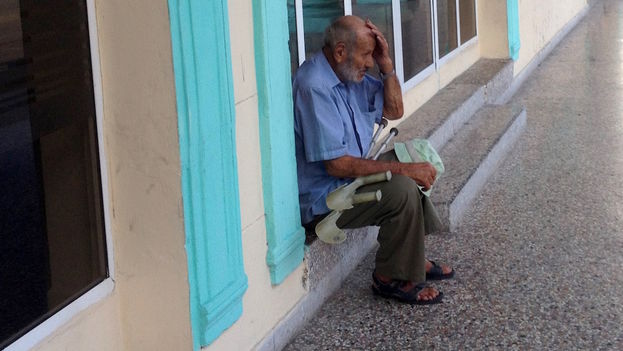
The image of a society where families take responsibility for grandparents until the end of their days has shattered in recent decades in Cuba. The aging population, economic problems and high rates of migration among the young are some of the reasons that many elderly people find themselves without family support or company. continue reading
“You can plant a tree, raise a child or write a book, but that does not mean you won’t be alone when the reaper comes,” says Manolo, 81 years old, who lives in a rooming house in the Los Sitios neighborhood of Havana. A retired engineer, he has lived alone for more than 20 years since his son left for the United States during the rafting crisis. Among his greatest fears are dying with no one nearby and “that they find me because of the stench,” he says ironically.
According to official figures, 18.3% of the Island’s 11.1 million residents are over age 60, and by 2025 it is estimated that the elderly will exceed 25%. Cuba could become the most aged country in the Americas. The situation presents not only a challenge for the health care infrastructure and social security system, but also for family organization and humanitarian agencies.
Although it is still common to find grandchildren, parents and grandparents under the same roof given the serious housing problems, the cases of old people who live alone also have increased in recent years. According to the 2012 census, in 9% of Cuban homes at least three generations live together, but in 12.6%, old people live alone.
Every day, those people have to overcome the obstacles of solitary old age. Low pensions or lack of family affection are among the reasons that they do not spend their last years in the material comfort and affection that they always dreamed of. Instead, they have to take care of themselves, appealing to neighbors in search of support or asking for help from humanitarian organizations.
Laura, 64 years of age, is one of more than 3,000 volunteers from Caritas who assist some 28,000 people, especially the elderly, throughout the country. There is a lot of work given the increase in the number of people who are growing old alone. She believes that in a few years she, too, will need help because she never had children and she was widowed five years ago.
“I give food to some because they have problems getting around, while others I keep company on one afternoon or another, and I talk to them,” explains this retired teacher who lives on the outskirts of the city of Ciego de Avila. Based on her experience, “there are more old people living alone because many of their children have left the country.”
Across the hall of the rooming house in Los Sitios, where Manolo lives, an old woman has just been taken to the hospital. “Her daughters do not know, because we have to wait for them to call from Spain in order to give them the news,” he says. Nevertheless, the man believes that once admitted she is going to be more careful because they cannot keep taking care of her.
Bedridden, the woman needed her neighbors to help her bathe and eat. “Everyone living here is old, and we can no longer carry her to the bathroom,” the old neighbor worries. “The daughters send money for disposable diapers and skin cream, but they are not here to help day in and day out,” says the old man.
However, the Public Health system does not seem to be prepared to deal with the marked aging of the Island’s population, either. Of the more than 83,000 doctors in the country in 2013, only 279, some 0.33%, were specialized in Geriatrics and Gerontology.
In rural areas the phenomenon of old people living alone seems to occur less often, but it is still worrisome. “The youth don’t want to learn about the countryside, and they leave, so that this has turned into a town of old people,” says Maria Antonia, 69 years old and resident of Vertientes, Camaguey. One of her sons is working in Veradero in a construction crew, and the other “joined the military, and they gave him a house in Havana,” she explains.
The woman has a surprising routine for someone her age. “I get up before five to brew the coffee that I later go out to sell in some places.” She can be on her feet three or four hours in the morning to offer her merchandise. “When I return home, I am in a lot of pain,” she says. “But what am I going to do?” she asks resignedly.
“I only have neighbors when I am in pain and need to go to the doctor,” explains Maria Antonia, who suffers from heart disease. Nevertheless, she says she prefers her current situation of solitude to ending up in a nursing home. “No, that would kill me; I need to be active,” she says. For months she has not been able to clean because of arthritis in her hands, and she pays a woman to clean her house. “I’m fading little by little,” she explains uneasily.
More than 142,000 senior citizens reside in Camaguey province, but there is a capacity of only 911 beds in 13 nursing homes plus 24 daycare centers for the elderly. In statements to the local press, Doctor Jesus Regueira, head of the Elderly, Social Assistance and Mental Health section of the Provincial Public Health Department, has lamented that the availability of beds does not correspond “to the potential demand.”
However, most of the elderly consulted for this article say that the lack of family affection is the greatest problem of living alone. “Sometimes I spend days without talking to another person,” says Maria Antonia. “What I fear most is leaving this life without anyone knowing; it scares me that there is no one to close my eyes.”
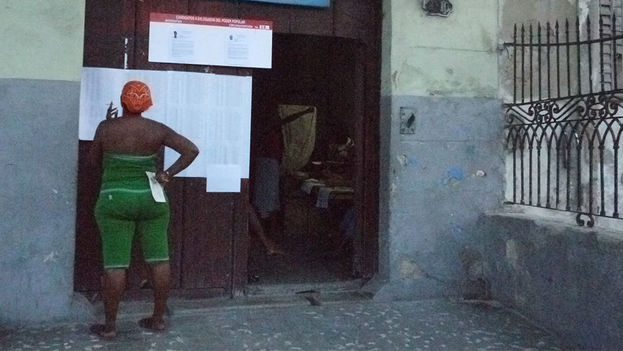
A woman checks the list of candidates for the municipal elections. (14ymedio)
14ymedio, Reinaldo Escobar, 23 October 2015 — Poet, teacher and literary critic Guillermo Rodriguez Rivera has published an interesting article about the Cuban electoral system in the blog Segunda Cita, managed by the singer Silvio Rodriguez.
Rodriguez Rivera insists that the need for reform of the Cuban electoral system is not unrelated to the rapprochement between the governments of Cuba and the United States, and he is right. The Electoral Act has been bad since its enactment in 1982 and should have been changed long ago. Not, as Rodriguez Rivera says, because transforming it is a necessity “that emanates from the process of updating our Socialist model.” continue reading
“Today, in truth, we Cubans are not electing 612 deputies as members of our National Assembly of People’s Power,” says the university professor, although it would have been better to acknowledge that we never have elected them. If there has never been an occasion in which one of those proposed has been rejected for not accumulating 50% of the votes, it is not because they are good or bad, but because the majority of the voters don’t really know who they are.
The poet recognizes that “it is the Candidate Commission that is really electing our deputies; we voters do not do anything but ratify them” — certainly a good point — but he does not have a clear proposal for how a mechanism will work to convert a citizen into a candidate. He limits himself to suggesting that “the other 50% will be personalities outside the provincial assemblies, but proposed and approved by them as candidates,” so that the task of selecting half of the list will be transferred from the Candidate Commission to the Provincial Assemblies. The current political approach, that shapes an absolute majority in the Provincial Assemblies, would be charged with perpetuating their hegemony by choosing those who, in their judgment, are politically correct.
Rodriguez Rivera points out that “the rejection of the old politics has motivated voters who are very disinformed with respect to the deputies they elect.” No Guillermo, it is not about a prejudice embedded in the 8 million voters in this country.
In the first place, “the old politics” is only understood in Cuba by those who are 88 or older, who experienced first hand the last Cuban elections, which occurred in 1948 (assuming the poet does not legitimate the Batista farces) and, on the other hand, the current Electoral Law in Article 171 establishes that “every voter is to consider, when determining which candidate to vote for, only their personal characteristics, their prestige and their capacity to serve the people.” Information that they must deduce from a photo and biographical data that is posted and that, by the way, is not even drafted by the candidate, but by the electoral commission of his or her district.
At the end of Article 171, in case it wasn’t clear, it was specified that, “Candidates can participate together in events, conferences and workplace visits and exchange opinions with the workers which allows, at the same time, for them to get to know the candidates personally, without this being considered a campaign of election propaganda.”
As there is always someone who does not fully understand the purposes of a Revolutionary Law, in Article 172, in its first paragraph, it is stated that it is a crime to violate the principles established in Article 171.
The new electoral law must return to the political profession virtues that have been snatched away. In a State of Law citizens must be able to express themselves freely without fear of reprisals, and must have the right to associate around their points of view.
The idea that the candidates come before the cameras to defend their proposals is not sufficient if this right of presenting political proposals is not extended to all points of view and under equal conditions: Liberals, Social Democrats, Christian Democrats, Environmentalists, Communists and others who appear in the rich Island fantasia. And not just one month before the elections, but during the entire year, and not exclusively in the provincial television studios but also in whatever media exists.
The Candidate Commission has to go, along with the prohibition on political campaigning. The voters must have the right to know how the deputy they elect is going to vote on their behalf.
The president of the Republic must be elected by a direct vote of the citizens and not in a parliamentary caucus.
Along with the Electoral Law, there must be a Law of Political Parties proclaimed, and above all there is a need to convene a plural and democratic Constituent Assembly to provide us with a modern Constitution, in accord with the demands of the 21st century. All this must be done because it is lacking, not because Fidel Castro has said that the ‘current model’ “doesn’t even work for us anymore,” a phrase which, moreover, has been ignored arguing that they had interpreted it to the letter.
Man in front of a newsstand reading a printed version of ’14ymedio’, distributed in “alternate” ways.
14ymedio, Reinaldo Escobar, 21 October 2015 — In the last half century the Cuban media could be categorized as private monopoly in the hands of the only permitted Party. However, in the inevitable process of transition to democracy, it is essential to modify this situation. The first step should undoubtedly be to diversify the forms of ownership of these informative spaces to ensure quality and plurality.
The presumed arrival of several international media seeking to install themselves in the country could help to raise the quality of journalism and develop new approaches. However, it will have to be done appropriately so as not to strangle the incipient national independent press, which confronts serious material disabilities in the face of the current monopoly situation and the great consortiums arriving in the country. continue reading
The best solution for a scenario of this nature would be, along with freedom of the press, the creation of (non-state) public media that would combine a cooperative structure with state subsidies and an eligible and renewable management team. “Everyone’s” information channels should not be subject to the contents of one’s purse, nor the editorial conspiracies of journalists with any type of power, be it political or economic.
The renewal of political life in the country will also require the presence of all ideological viewpoints in the media. However, none should be tied to the financial resources of the political groups. So to achieve an equality of opportunities there will have to be laws in this regard.
The evolution of democracy in Cuba will determine what is most desirable, but it should seize the relative advantage presented by starting from scratch. This involves learning from the experiences of others, and opening a public debate to facilitate finding the best approaches and formulas for future Cuban press.
The parliament, representative and plural, should have its own channel, although it would threaten to be very boring, but it would have the obligation to transmit the debates, publish the laws and clarify the doubts of the population. Hours of interminable discussion to change a comma or a phrase in a law would fill the broadcasts.
There will also need to be a space – television, digital or printed – for the dissemination of cultural values, without elitism or favor. Faces linked to the party in power should not get the most on-air time, nor should those who can pay for the spaces, but rather those who have more value and shine in our country. Something like this will put a definitive end to the shameful blacklists that have censored in the media emigrant artists, “deserting” athletes, scientists critical of the government and citizens who don’t embrace the ideology in power.
If these commitments are met in the public media, the private can compete on quality and diversity, under the premise of the greatest possible freedom of expression. However, these alone are just the foundation of the complex edifice of a free press, which in their own way will have to emerge from its own cracks and adjust to the earthshaking movements of reality. Citizens will cease to be passive receptors of what they see, hear or read, consuming at will information “a la carte.”
It will then be the job of journalists to offer a professional and attractive product, one that manages to compete in the market for information without kneeling before power nor appealing to exaggeration as a strategy.
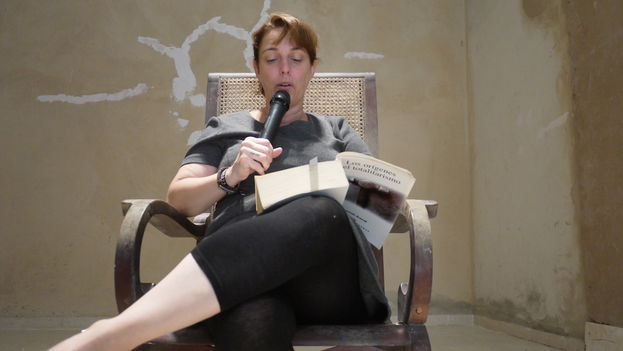
Tania Bruguera during a staged 100 hour reading of The Origins of Totalitarianism, by Hannah Arendt, at her home in Havana. (14ymedio)
14ymedio, 23 October 2015 — Tania Bruguera has been selected along with five other candidates as a possible winner of the 2016 Hugo Boss Prize, an award that the Guggenheim Foundation in New York awarded every two years since 1996 in recognition of artists whose work is “among the most innovative and influential of our time.”
Nancy Spector, Deputy Director and ‘Jennifer and David Stockman Chief Curator’ of the Guggenheim Museum and president of the jury, announced the finalists, chosen by a panel of art critics and curators, on Friday. In the last two decades, the jurors have chosen as finalists influential artists from around the world, recognizing both emerging and established artists of all ages, genders and media.
Along with Bruguera, nominees for the prestigious recognition include the British Mark Leckey, Americans Ralph Lemon and Laura Owens, Egyptian Wael Shawky and South Korean Anicka Yi.
The winner of the Hugo Boss Prize will be announced in the fall of 2016 and will receive $100,000 and hold an exhibition dedicated to their work in 2017 at the Guggenheim Museum.
This video is not subtitled in English, our apologies.
14ymedio, 20 October 2015 — An independent group of transgender activists in Cuba denounced for the first time, on Monday, LGBTI discrimination on the island before the Inter-American Commission on Human Rights (IACHR). Mariela Castro, director of the National Center for Sex Education (Cenesex), however, did not participate in the meeting, in which the lawyer James L. Cavallaro and other members of the — Tracy Robinson and Felipe Gonzalez — listened for an hour to the testimony of several speakers, such as Juana Mora Cedeno, from Free Rainbow; the transgender Sisy Montiel from the Transfantasy Network, and Carlos Quezada, from the Institute on Race Equality and Human Rights.
Quezada acknowledged the “visibility” of the subject in Cuba, lamenting that it is associated with one name, that of the daughter of Cuban president Raul Castro. “However, such visibility at the international level contrasts with the real human rights situation for members of the LGBTI community in Cuba,” he explained. “Members of the independent community in defense of LGBTI rights in Cuba wonder what would happen with the visibility of the issue on the island, if the Mariela Castro were not in Cenesex,” he added. continue reading
The activists Cedeno and Montiel have petitioned the Cuban authorities to avoid discrimination based on sexual orientation, with no response. Both also affirmed that they are victims of police surveillance and the tapping of their phones and added that agents of State Security questioned them about their possible participation in the last Summit of the Americas.
Cedano highlighted that the lack of official data on the rights of LGBTI people, which has been collected in independent surveys. These surveys have put into relief the discrimination and abuses against the community, including by the Cuban authorities themselves.
The activist pointed out the discrimination in the workplace and denounced the impunity enjoyed by these discriminatory attitudes towards homosexual, lesbian and transgender people.
Sisy Montiel, sentenced to 17 years for “female mannerisms,” talked about the marginalization from an early age of young boys who want to dress like girls, warning that this condition forces them to leave school and thus end up in prostitution.
Ivan Garcia, 20 October 2015 — In Guanabacoa, a town southeast of Havana, you still hear stories about Gilberto Martinez Suarez, alias Gilbert Man. Though told with a pinch of exaggeration and myth, they are largely true.
This mediocre reggaeton musician was known in Guanabacoa with his frequent parties in a villa renovated in record time, generous tips in bars and private restaurants, monumental orgies and flashy cars.
“To tell the truth, he wasn’t much of a singer. But all the girls’ jaws dropped when he drove by in cars we had only seen in American movies. The man seemed to be from another planet, what with all the gold chains and necklaces he wore,” says Giselle, a university student. continue reading
Liudmila, a hooker who drums up customers in Havana nightclubs, recalls, “One night some very big black guys came in wanting to hire me for a wild party. They told me to find four or five really good-looking girls. Three days later we were taken to Gilbert Man’s house. The guy paid us 200 CUC each to dance naked.”
If you talk to marijuana and cocaine dealers in Havana, almost everyone agrees that “Gilbert was something else,” as one dealer in the old part of town put it. “The Man spent more than a thousand on powder and weed every weekend,” he notes.
In the winter of 2015, Gilbert Man was arrested at his home in Guanabacoa in a full-blown sting operation. The reggaeton musician was wanted by US authorities for credit card fraud, identity theft and forgery in two Florida counties.
With the money he stole, he was able to build a flashy mansion in Guanabacoa, acquire four cars and spend money hand over fist. He liked to be noticed.
After the Revolution a bearded Fidel Castro tried to construct a different kind of society, one which swept away the scourges of the past. The new government passed laws that eradicated casinos, prostitution and drug use.
It was not just that the military regime adopted an outlandish ideology. It also tried to create a “New Man,” described by Argentine communist Che Guevara as “a cold and ruthless machine for killing Yankees in every corner of the globe.”
Ideological eugenics dictated that these children of the Revolution have their emotions excised. Loyalty to Fidel Castro was sacred. As modern Frankensteins, they were supposed to work without material incentives. They had no religious beliefs — the church was supposedly the opiate of the masses — and liquor and rumba were considered to be vices of degenerates.
As it turned out, the experiment did not work. Those who remain from that batch are liars who parrot every slogan and feign loyalty to the “Revolutionary cause” while stealing from their jobsites.
When they leave the island, they behave and act with the same duplicity they learned in Cuba: stealing, lying and climbing the social ladder by trampling over others.
In January of this year an in-depth investigative report by a Florida newspaper, the Sun Sentinel, documented how several Cuban criminal organizations living in the United States embezzle public funds.
Their crimes include Medicare fraud, traffic accidents staged to cheat insurance companies and marijuana production. According the Sentinel article, 9% of marijuana trafficking offenses and federal insurance scams are committed by Cuban criminals.
At the end of its investigation, the Florida daily came to the conclusion that there is a revolving door that allows thieves easy access to the country and a safe means of escape to Cuba when the situation starts to look dangerous for them.
It is estimated that over the last twenty years Cuban criminals have stolen more than two million dollars from US businesses and taxpayers.
There are about three-hundred people living in Cuba who have embezzled money from US government programs. Under permissive conditions of the Castro regime, they have set up private businesses using other individuals as proxies.
An attorney for ONAT (National Office of Tax Administration), the agency in charge of regulating private sector employment, states that “several thousand businesses in the hospitality, food and transportation sectors — which happen to be the most profitable — are funded by money from the United States that was obtained illegally. I know of privately owned restaurants that have been reporting losses for years but which are still doing business. These are money laundering operations.”
The owner of a fleet of five cars and three jeeps used as taxis admits that his business is bankrolled by a relative in Miami. “Both he and I live off the proceeds from the business. Every month I get five or six thousand dollars from couriers he sends from Miami,” says the man.
When you inquire about the legitimacy of these funds, he becomes evasive. “What do I care if the money is clean or not? It’s how I get by and it allows me to have a decent life in Cuba,” he replies.
Cuban-born criminals take advantage of special provisions of the Cuban Adjustment Act. Between 2009 and 2014 fourteen people were arrested in Miami and charged with conspiracy to commit marriage fraud in order to illegally acquire permanent residency status under the Adjustment Act.
Let’s call him Eduardo. He is almost six feet tall and in 1980 officials at the Combinado del Este prison complex sentenced him to deportation through the Port of Mariel*. He belongs to a group of so-called “excludables,” criminals that the government of the United States considers dangerous. After reaching an agreement with the Castro government, the US repatriated them to Cuba.
Eduardo returned to the island seven years ago and still makes his living from illegal activities. Although he spent most of his time in the United States behind bars, he knows how to function in American society. He says someone living in Miami hired him “to teach some Venezuelans and Central Americans how to pass for Cubans by using the speech, gestures and the particular quirks of Havana neighborhoods. These people later travel to the US with photo IDs and documents from here.”
There’s no stopping Cuba’s “New Man.” He is still out there, defrauding America.
Diario de las Americas, October 12, 2015.
Photo: Reggaeton singer Gilberto Martinez Suarez, alias Gilbert Man, posted on Facebook these two photos of himself posing next to his car and his house in Guanabacoa on the outskirts of Havana. Martinez was wanted by US authorities for using with fake credit cards, identity theft and forgery in two Florida counties. From Diario las Américas.
*Translator’s note: The Castro regime took advantage of the Mariel Boatlift to send many convicted criminals from Cuban prisons to the United States.
Ivan Garcia, 22 October 2015 — The Commodore Center Mall, to the west of Havana, is one of the preferred shopping sites for the official intellectual jet set, who from their newsletter launch poison darts against “Yankee imperialism and its cruel economic blockade against Cuba.” But in their private lives they dazzle themselves with products Made in the USA.
In this chain of stores flanking the Commodore Hotel, the showcases display Nike, New Balance, Levi denims, Colgate toothpaste, Palmolive soap and Head & Shoulders shampoo, among more than fifty other American brands.
In an open air cafe, you can drink Coca-Cola and enjoy German sausages flavored with Del Monte tomato sauce. On the other side of Avenida Tercera, in the Business Center, appliances such as Black & Decker electric skillets, RCA blenders and Hamilton rice cookers are sold, all patented in the USA. continue reading
I invite you to tour the twenty international pharmacies tucked away in Havana. There you can buy products made by Johnson & Johnson, antihistamines and antibiotics and other products from US labs.
At any Havana store you show up at with hard currency you can buy California apples and Kentucky chicken thighs. Since 1993, all this merchandise, produced by the “Revolution’s number one enemy” is sold legally on the Island to those Cubans who, in one way or another, come to possess dollars, euros, or convertible pesos.
In the offices of national institutions, some 90% of the computers use Windows software. And in those areas, where one might think that cheap nationalism, the registered brand of Casa Castro, generates guys allergic to Yankee paraphernalia, you can calmly observe a police official wearing RayBans, taking statements from a regime opponent accused of being a “mercenary and lackey of the American government” on an HP computer.
How rigorously and to what extent does the US economic and financial embargo affect Cuba, I asked a university professor, a specialist in economic matters.
The man cleared his throat and responded, “There is plenty of political propaganda. The story is simple. Fidel Castro nationalized dozens of American companies and in the give and take of foreign policy, Eisenhower stopped buying Cuban sugar, our main export product and then the legislature decreed a partial economic and financial embargo and then Kennedy strengthened it and in 1996, after Cuba shot down the four Brothers to the Rescue planes, Clinton codified it.” He drinks some mineral water from a bottle and continues:
“From whatever side you look at it, the Palace of the Revolution or White House, the embargo is the product of a political dispute that brought the dirty war and subversion on both sides. Fidel Castro believed he was licensed to export guerrillas to Latin America, support with arms and instructors the Colombian and El Salvadoran guerrillas, and offer political asylum to people from the United States who were terrorists and criminals,” he explains in a neutral voice.
He continues, “Of course in economic terms, Cuba has taken the brunt of that dirty war. Before 1959, 95% of our economic structure depended on trade with the United States. But in the 38 years we were subsidized by the Kremlin (1961-1989), the effects of the embargo were hardly noticed. If the Cuban government had been proactive and established a nationalist and sovereign strategy — without participating in the African wars which is one of the causes of the current extensive economic crisis, and had placed an emphasis on saving resources, economic expansion and a free market and doing business with the West — the current effects of the embargo would be minor.
“It is a heavy burden, especially financially, because transactions can’t be made in dollars and that increases the costs of freight and exports. The US Office of Foreign Assets Control’s closing of foreign banks to commerce with Cuba has been a hard blow to credit and businesses. But since December 17th [the day Cuba and the US announced a reestablishment of relations], Obama has partially dismantled the embargo.”
“Still, it remains. And it is complicated to buy medicines or food paying cash, because due to the economic disaster the Cuban central bank has no liquidity. In addition, there is a marked government emphasis on favoring military companies and groups under the harmful control of the family capitalism which is in control in Cuba.
“There is also a harmful Cuban State embargo that affects private entrepreneurs and ordinary citizens. Look at the abusive customs tariffs and you can see that the State is not interested in making things easier for people to get ahead by their own efforts,” concludes the Havana professor.
The olive-green autocracy cites economic losses of more than 121 billion dollars. The US executive demands 7 billion in compensation for nationalizations carried out by Fidel Castro against American properties.
The reestablishment of relations between the two countries who experienced their own Cold War would allow the development of a strategy that would satisfy the two parties.
But for now, General Castro’s government simply makes demands without giving anything in return. It considers itself a victim of the embargo. And asks for redress with a volume of capital that is more than nine times the 13 billion dollars of the Marshall Plan for post-war Europe in 1947.
Silverio, a banker, believes that the White House must repair the economic damage, “but not this monstrous amount of money that Raul Castro is asking for. An exit may be that the United States invests in public works and housing for poor people, which is the majority in Cuba. And not by giving those resources to the Cuban State which, through lack of transparency, corruption and inefficiency, would result in some of the money fattening the pockets of a few,” he says.
Litigation and negotiations on damages from the embargo and compensation from the Castro government to US businesses have only begun.
Meanwhile, in Cuba, with enough hard currency, the rigors of the embargo are a joke.
Photo: Store where Nikes are sold in Havana. Taken from “What embargo: Top U.S. brands sell in Cuba,” AP dispatch published in May 2007 by NBC News.
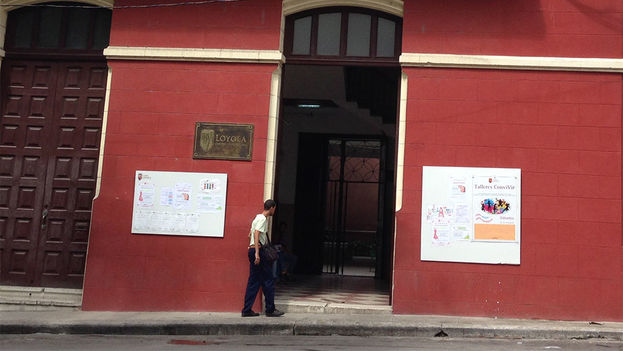
14ymedio, Reinaldo Escobar, Havana, 21 October 2015 — In the middle of Los Sitios neighborhood, in the heart of Central Havana, the Jesuits have a project focusing on the neediest sectors of the population. The elegant façade of the place contrasts with the humble homes surrounding it, where so many families face the drama of an alcoholic father, a daughter working as a prostitute or a teenager in prison. The Loyola Center programs are for them, and for those who face these problems daily.
This project of the Society of Jesus, which has other sites in Cienfuegos, Camagüey and Santiago de Cuba, was inaugurated in January 2012 and since then has not stopped growing. In the mural at the entrance of the imposing building, there are announcements for dance classes for girls, support for single mothers, and computer and language courses.
Of particular note is the “Basic Course for small business management” that began its 13th session this September. Of the 120 people who applied for admission, just over 80 came on the first day and now there are fewer than 50. Both students and teachers believe that this course is a success. continue reading
Darien Garcia who directs the courses is a graduate in accounting, age 38, with the rare virtue of believing in what he does in a country where many people of his generation dream of emigrating, or simply stand around on a corner to pass the time. This young man spent eight years teaching at the University of Havana and has now been at the Center for two and a half years.
The teacher explains why more than half of those enrolled do not attend the course. “This drop off is because, when they see that we don’t teach any get rich quick tricks here, they leave the course.”
“Of all the current students, only 15% have businesses, another 10% are on the verge of starting something, and the rest are State workers who want to move to the private sector, single mothers who are housewives, and others who are about to be.”
The basic course lasts two-and-a-half months and is divided into phases: the introduction, which includes vision, mission, analysis of the environment, business objectives and target market; a second phase with all the tools of the process: accounting, finance, costs and management of resources; and a third phase with legal aspects, taxes and more emphasis on business ethics. The latter class is given by priests. In addition, every Wednesday at 7:30 pm there are lectures on various topics with free access.
“We take advantage of the opportunity to teach values in the solidarity economy, like how to make your business grow without crushing others, which is very complex. We have students with professional training, some with university degrees, but also some with warped ethics, which we try to address. It is very curious how some, when they confront a problem, the first thing that comes to mind is to apply a fraudulent solution, whether to resolve things ‘under the table’ or to deceive the consumer. Here we pass on business ethics, an economic system of sustainable development, that respects people and the environment.”
Adapting to current circumstances, this course also teaches how to manage non-agricultural cooperatives and offers thematic courses such administration and working in teams. For the coming year a course is planned on the principles of food service, another on financial processes for private businesses in Cuba and the second round of “managing cooperatives,” which includes a topic very popular in State enterprises: internal control.
“In Cuba we have the idea that internal control is a method to keep employees from stealing,” explains Darien Garcia. “But, in reality, its objective is to improve a business, to make it more efficient and effective.” In the case of cooperatives, it is not mandatory from a legal point of view, but it is essential for the health of the business.
In the previous 12 terms, with more than three courses per year, more than 240 people have graduated. In 2016, there is a proposal to measure the impact of the project on a society slowly evolving, changing paradigms and lifestyles.
One of the most interesting dynamics happening is that at a Center that teaches how to run a business, students are given tools based on knowledge management and then they have to confront the known limitations that still confront entrepreneurs.
The Loyola Center in the neighborhood of El Sitios, in the heart of Central Havana. (14ymedio)
“We are based on the principles of economic solidarity and sustainability, that don’t limit the accumulation of wealth, but that make the students understand that to achieve their personal well-being they have to also achieve that of those around them. We work only within what is legal, understanding that drugs, prostitution, weapons, are all illegal. We confront the problems of many who believe that they know everything, and limit themselves to copying what has been successful. Some go to the extreme of wanting to copy the successful, and if someone puts the sofa in that position, they also want to put it the same way,” explains professor Garcia.
Across the country there are now 440 registered non-agricultural cooperatives, of which 400 are operating. On the other hand, the law only allows for 211 self-employment occupations, some of which are described so generically they can encompass any work, while others are defined so rigidly that they leave little space. All of this is talked about and discussed in the Loyola Center classrooms and hallways, where the embryo of the new Cuban middle class may be being formed.
“Today, there are businesses, including cooperatives that even though they don’t accumulate property, they accumulate wealth, for example in construction,” explains Darien Garcia. “What we propose as a social project of the Jesuits in Cuba is not to strengthen those who have the most fruitful businesses and the higher economic and cultural levels, but to reach those businesses in more difficult conditions, those that are emerging. Our social mission is to be where the most deficient sectors of society are.”
Ivan Garcia, 10 October 2015 — Dressed in black, a young and elegant female officer from the Consular Section of the U.S. Embassy in Cuba, who didn’t want to be identified, met on October 2 with ten Cuban journalists, official and independent, to chat about the new Program of Diversity Visas for 2017.
Beginning October 1 until November 3, an open lottery will remain in effect, administered by the Department of State, which will offer permanent residence to those people who fulfill the strict requirements for qualifying.
The requirements to participate are simple: be a native of one of the eligible countries — among which Cuba is now included — and have an approved baccalaureate or a minimum of two years of work experience. continue reading
The candidates in the program are chosen randomly by computer. Registration for the 2017 Diversity Lottery is carried out only through the Electronic Diversity Visa Lottery.
Although the elegant woman didn’t know the recent statistics of Cubans who arrived in the U.S., legally or illegally (up to September 23, the rough figure was 55,000, including some 20,000 approved for family reunification and close to 34,000 who arrived illegally in the U.S. under the protection of the Cuban Adjustment Act), she indicated that this strategy is promoted by Washington and Havana in order to encourage safe, legal and orderly emigration for people who don’t have family in the U.S.
Friendly, with that innate capacity that some U.S. politicians and managers have for communicating with the media, without giving anything away and smiling at loaded questions, the officer stoically withstood a photo and video session in a salon of the Embassy, flanked by the stars and stripes and a photo of Barack Obama.
Forty-eight hours after the press conference, the news spread like wildfire throughout Havana. In a short time, I received some twenty phone calls from close friends gathering information.
I left for Old Havana. In a narrow and dusty alley, a group of adults and young people were conversing about the new lottery. “The Americans went back to opening el bombo [The U.S. lottery] although this time it’s a global lottery,” commented Josuán, who learned about it “because now I connect to the Internet every day in the Galiano wi-fi zone.”
Raudel, a private entrepreneur without relatives in the U.S., entered his data Saturday afternoon on the registration form. “They ask for a ton of information. But it’s easy. In the ’90s, I enrolled several times in el bombo, when it was exclusively for Cubans, but I didn’t have any luck. Now we’ll see. I believe it’s a good option for those who, like me, don’t have family on the other side and aren’t so desperate that we would throw ourselves into the sea on a raft.”
Lourdes, an engineer, is waiting to fill out the form until next week. She has access to the Internet at work, but she feels “frustrated and without a future. I’m going to test my luck. It’s like playing the bolita [An illegal lottery, very popular in Cuba]. If I enter the lottery I might win; if I lose I’ll continue trying.”
According to a diplomatic source who requested anonymity, this is the first of programs that, in the future, will be offered by the U.S. Government, so that Cubans can opt for a safe emigration and obtain temporary study or work visas.
Abel, a colectivo* taxi driver, views the good news from another perspective: “Now Obama is moving the island North. It’s painful to see how most Cubans want to leave. If the emigration doors keep opening, Castro and his henchmen will be the only ones left.”
The way we’re going, Cuba will soon be empty.
*Translator’s note: Colectivos (collectives) are shared taxis following a fixed route.
Juan Juan Almeida, 19 October 2015 — The G2, Cuba’s domestic spy agency, is nothing more than a fun-loving caricature of the former KGB. What is difficult to believe is that the special services headquarters which direct espionage operations against Cuba have shown themselves to be even more inept.
The Cuban government neither has nor could maintain an army of spies. We have bought into this myth. Espionage is an expensive proposition and recruiting spies is not like planting rice. Though difficult for us to accept, Cuban authorities are talented and treacherous enough to know how to stoke paranoia, distrust and confusion by creating a constant and frantic struggle for reaffirmation against “a person unknown.” This has made us prone to isolation, some degree of lunacy and a few too many hallucinations. continue reading
Albert Einstein, that most international of physicists, said, “You cannot solve a problem with the same mindset that created it.”
Now is the time to find common ground in order to face the obstacles that divide us. There is no point in inventing yet more informants, those agents created for a specific task and trained for a specific mission. We routinely label people as “agents” with dangerous and contagious certainty. We should realize that no single nation can simply go around recruiting and sending infiltrators out into the world like spores in search of information.
From the enigmatic Julius and Ethel Rosenberg to a young physicist named Klaus Fuchs, from former CIA officer Aldrich Ames to Soviet military intelligence colonel Oleg Penkovsky, and to the legendary James Bond, history and literature are replete with spies who have captured our imagination. Adventurers or idealists, altruistic or greedy, heroes or informers, the world certainly knows of spies who succeeded in altering the course of history. But such cases are a far removed from our all too mundane reality. The fact is there are fewer Cuban spies in Miami than bullfighters with mustaches in Madrid.
Margaretha Geertruida Zelle, a Dutch woman known worldwide as Mata Hari, was a famous exotic dancer, high-class prostitute and a well-known actress who used her luxurious perch to collect information and sell it to both the French and German intelligence services. She was caught, tried and executed, but not — it is said — before blowing a kiss to the firing squad. You’ve heard of Percy Alvarado*? Listen, the life of agent Friar is more an embarrassment than a source of pride.
There was the wily and charismatic Richard Sorge, — a man with an exquisite sense of humor — who was a Soviet spy and German national who worked for the NKVD, the forerunner of the KGB. A student of political science, he served as a volunteer in the German army and worked as journalist in Japan. Closer to home, the story of Antonio Guerrero — one of the five Cubans convicted on espionage charges in the US — is more foul than the dog mess on my shoes.
It is a profession older than prostitution, or even carpentry. The Cold War continues to feed into our exaggerated and overly fanciful mythology with the obvious glamour this secret activity acquired in the last century. Perhaps that is why terminology such as “intercepting communications,” “reading encrypted codes” and “eavesdropping” bring to mind intrigue and stimulate the imagination.
But the G2, Cuba’s domestic spy agency, is nothing more than fun-loving caricature of the former KGB. What is difficult to believe is that the special services headquarters which direct espionage operations against Cuba have shown themselves to be even more inept. It seems they relied on informants who knew how to sell information that was full of gaping holes.
The only way to make our dream a reality is to wake up and stop seeing spies, informers and snitches among our next door neighbors.
*Translator’s note: A Guatemalan national who infiltrated the Cuban American National Foundation in Miami on behalf of Cuba’s security services. Known as “agent Friar,” he now writes a blog from Havana.
Somos+, 20 October 2015 — They have released Danilo Maldonado, better known as El Sexto (The Sixth). We are happy for the participation of all the activists and people who continued to press for his freedom before this injustice, in spite of the long wait. A special thanks to all our members and sympathizers who collaborated with the campaign “We are for El Sexto,” and also for all the mobilization of information about this case. We want you, Danilo, to continue spreading your art, an uncensored art full of truth. Much success to all the Somos+ Movement and all those Cuban lovers of freedom. As you said so well: “Bad people exist because the good allow them to.”
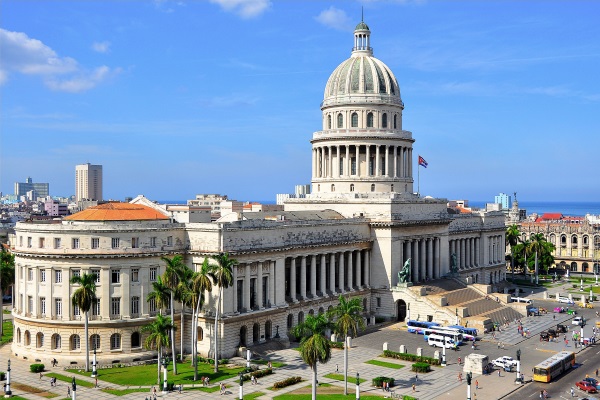
Havana’s Capitol Building (photograph from the internet)
Cubanet, Miriam Celaya, Havana, 5 October 2015 — In recent days the official Cuban press published a report on the National Capitol building restoration work currently underway, in order to get it ready for the operation of the National Assembly at an unspecified future date.
Unfortunately, the report suffers from inaccuracies and from the typical flourishes of the Cuban school of journalism, which focuses more on the emotions of the author during his quick tour of the works and his personal adventure aboard a winch at over 262 feet above ground than on the truly interesting questions that might interest a fairly astute reader, for instance, the total cost of the work five years after the start of the project, which has already exceeded the length of time that it took to construct the iconic building, or the reasons that led to the decision to return this structure to its original function of hosting Parliament after its deliberate and systematic destruction and its Republican values by the willpower of Castro I. continue reading
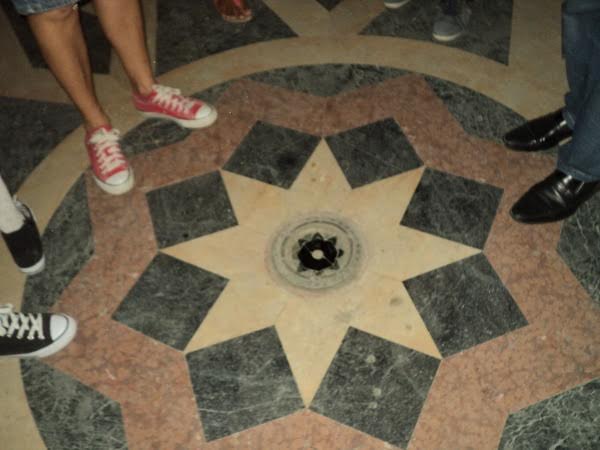
Another interesting detail would be to find out whether the great 25 carat diamond will be returned to its original place at the feet of the Statue of the Republic, under the 301-foot high cupola, a spot marking Kilometer Zero of that other icon of Cuban civil engineering, the Central Highway. This point seems particularly allusive, since the referenced report includes that this building receives grade one protection, that is, that the building’s original configuration should be preserved and unaltered, including both structural and ornamental elements.
Details of restored ceiling and bronze fixture (author’s photograph)
The Enigma of “Kilometer Zero”
Thus, in addition to the issue of the enormous cost of the magnificent building’s rehabilitation in the midst of a city whose housing stock is literally falling apart, the current restoration of the National Capitol places the enigma of its diamond back in the limelight, a topic deserving of its own separate chronicle.
The gem is surrounded by legend, and it is said to have belonged to a Russian czar, and to have arrived in Cuba in the hands of a Turkish jeweler who bought it in France. Prior to that, its origin is ambiguous and hazy. What we know for sure is that it was bought by the government of General Gerardo Machado y Morales (1925-1933) and destined to meet the young Republic’s excessive national vanity when it was planted in the main floor of the emblematic Capitol.
During the second presidency of Dr. Ramón Grau San Martín (1944-1948) it was rumored to have been stolen by an obscure police lieutenant or by a corrupt official. The mystery has never been cleared up completely, but the diamond was returned to the base of the Statue of the Republic, where it remained in view of visitors until 1973.
From that time, the fate of the controversial gem is a complete mystery, when without notice and under circumstances unknown to the public, the decision to replace it with a replica was made. Reportedly, the original was placed in the vault of the Cuban National Bank. There is no reliable testimony or evidence to corroborate the story, but popular speculation has it that the omnipotent dictator, former President Fidel Castro, assumed ownership of the gem. There are also those “in the know” who say that the precious stone was removed from the country years ago, under the auspices of the autocrat himself, but neither of these versions has been confirmed and those truly or supposedly involved have kept absolute silence on this matter.
A Return Road
Over five decades ago, and in the name of a revolution with a short life but with devastating and prolonged effects, the Capitol building was seized by the Unmentionable. The chambers of Congress were disabled and the majestic building was delivered in the early 1960’s to the then newborn Cuban Academy of Sciences, an institution with congenital malformations, whose cost and name would far exceed its functions. This institution was responsible for methodically destroying most of the heritage furniture and other interior facilities of the property.
Over a period of several years, successive partitions were constructed inside the Capitol building which affected the walls and columns, while the interior gardens at the north and south wings and the light fixtures, plumbing, stained glass, mirrors, curtains, tapestries and frescoes decorating the interior suffered the ravages of the neglect and rapacity of the new occupants.
Meanwhile, basements often flooded and were not drained at appropriate intervals, so the resulting moisture affected hydraulic and electrical installations.
Under the arch of the staircase, the Tomb of the Unknown Mambí* and related statues were desecrated for decades, since this area was regularly used to load and unload “maintenance” service trucks, and eventually became a virtual automotive repair shop for the Academy.
The exterior Versailles-style original gardens were gradually transformed into makeshift sports areas where children and adolescents would skate and play soccer or baseball, to the consequent detriment of the gardens, while the constant plodding of pedestrians through them turned the once green lawns into dirt footpaths.
The outer corners at the foot of the Chambers had become literally impassable because they were saturated by the stench of those passersby who regularly used the area to relieve themselves, while the rear esplanade became places where senior groups would do their morning exercises, and the side ramps of the majestic stairs served as slides for all the surrounding neighborhoods’ kids to play on.
All the surrounding areas oozed with the filth and decay inherent in the system. It might be said the government’s intent was to subject, through humiliation, the stunning arrogance of this proud symbol of the Republic.
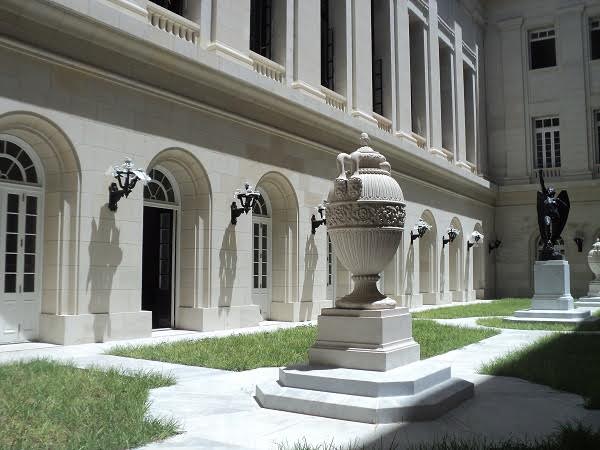
Inner courtyard and gardens of the north wing, restored (photo by the author)
Towards the end of the 1980’s another one of the raves of Castro I — “the greatest” Library of Science and Technology in Latin America — played havoc with the rich collection of the Cuban Library of Congress, which miraculously had hitherto remained relatively intact and safe from voracious predation. Lots of valuable books, fruit of human knowledge and treasures of world culture ended up strewn and on piles on the floor of the Salón de los Pasos Perdidos (The Gallery of Lost Steps) at the mercy of the violence of some “scientists” turned-retailers, a fact that -of course- was not documented by the official press or by government institutions, but one that numerous eyewitnesses and I can attest to. Someday, this episode should be included among the losses caused to Cubans by so much official vandalism, and we should demand reparation.
The brand new library never reached the heights that The Amazing-in-Chief dreamed of, nor fulfilled the functions over which such mayhem took place. Thus, apathy and detriment continued to rule over the Capitol, turning it into a pitiable spectrum of what it was during the Republic. Interestingly, the product of what so many engineers, architects and artists created had been almost destroyed by the power of one man.
However, to everyone’s surprise, despite the economic crisis facing the country, and counter to the growing needs of the population, the largest restoration ever made to the Cuban National Capitol is currently being undertaken by the Office of the City’s Historian.
As usual, the authorities have not bothered to report the amounts and sources of funds that have been earmarked for construction. Transparency is not a quality that adorns autocracies, and the “reformist” spirit of the General-President is not enough, but it is assumed that the restoration of the rich stained glass windows, the bronzes, the marble, the tapestries, the sculptures, the frescoes, the furnishings and the precious woods, plus the carpentry to restore doors and windows to their original appearance, will reach a very large sum.
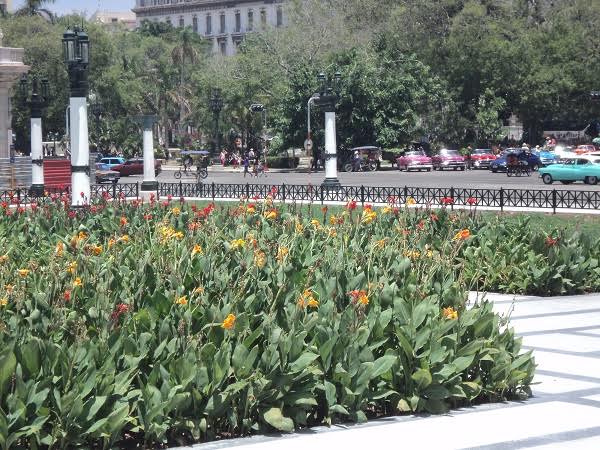
To date, they have already completed work on most of the north wing of the building and its gardens, now visible to the public. Project leaders want to tempt the public with a preview of its restored appearance.
Capitol building, partial view of north gardens (Author’s photograph)
Perhaps in a not too distant future, people in Havana traveling through the area will gaze at that colossal symbol of the city with renewed pride. By then, another phase may be over of the curious cycle of the return to symbols — and only symbols — of the Republican tradition orchestrated by Castro II. Perhaps many Cubans, with the patience worthy of better causes, will resign themselves to gaze over the beautiful gardens and the imposing Capitol glamour, to later return to their daily hopelessness and poverty. Or maybe they will decide to change their own reality, convinced that restoration of prosperity and democracy are not included in government projects.
*Rebels from the Cuban Wars of Independence from Spain
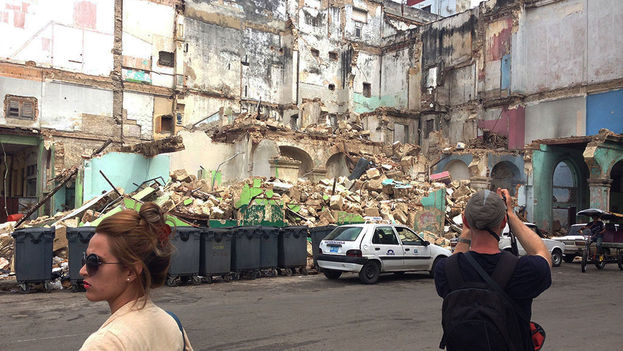
 14ymedio, Reinaldo Escobar, Havana, 23 October 2015 — Tourists like to portray ruins. They do this at the Greek Parthenon, the Roman Coliseum and the crumbling Mexican pyramids. But Havana’s ruins have “another charm.” As in this picture, where a good telephoto lens can capture a tiled wall with enclosed shower, the bowels of an electrical installation, truncated stairs and, hopefully, even the innocent graffiti a teenager scribbled on the wall of his bedroom.