Raul Castro in His Worldwide Debut / Cubanet, Miriam Leiva

raul-castro-ONUCubanet, Miriam Leiva, Havana, 30 September 2015 – The organization United Nations organization is celebrating the 70th anniversary of its creation in a big way. The most important players in world politics and the dignitaries from the majority of its member countries met in New York. The 2030 Sustainable Development Summit, where Pope Francis gave his first speech before the UN, took place from 25-27 September, and the Conference on Gender Equality was held on the 27th. The high-level meetings of the UN’s 70th session began on the 28th.

Raúl Castro traveled for the first time to the United States as President of Cuba on 24 September. The General-President wore the halo of the reestablishment of diplomatic relations with the United States, the reopening of the respective embassies, conversations with President Obama, the constant flow of dignitaries from other countries and American visitors to Cuba, the mediation between Venezuela and the US, and participation in the meeting of Colombian President Juan Manuel Santos and the chief of the FARC-EP for the signing in Havana of their first peace accord. continue reading

The Cuban leader seemed to enjoy the influence of his constant accompaniment of Pope Francis during his Cuban tour—with a synchronicity developed during the papal facilitation of conversations with the US—and appeared to be counting on the symbolism continuing in Washington, New York and Philadelphia.

But the media stumble caused to the Supreme Pontiff over the detention of more than 150 activists from the independent civil society, among them three ladies who had been invited by the Papal Nunciature to greet him, uncovered the buried reality that in Cuba the same dictatorship from the last almost 57 years still exists; and it tarnished the arrival of Raúl Castro in the US, and his presence in the Cuban seat during the speech by the Holy Father before the United Nations on 25 September. Then he did not hear Cuba explicitly named for the negotiations with the US, nor the condemnation of the embargo/blockade, just as had not happened in the speeches by Pontiff previously during the US Congress joint session. The public greeting, and the Francis/Castro/Obama meeting that had been predicted by the media, did not occur.

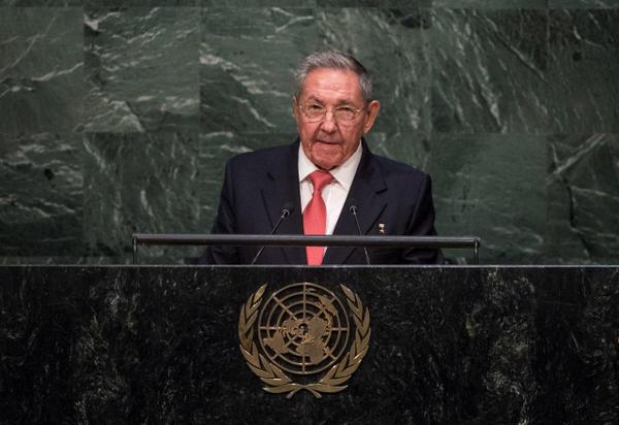
Nonetheless, Raúl Castro saturated the UN as planned, to make up for his prior absence since assuming power nine years ago. He delivered speeches on 26, 27 and 28 September at the 2030 Development Summit, the Gender Equality Conference, and the high-level segment of the UN General Assembly, consecutively.

The General held meetings with: Bill Clinton; the Prime Minister of Sweden; Ban Ki-Moon; the President of Guyana; Vladimir Putin; Xi Jinping; Lukashenko (the dictator of Belarus); Francois Hollande; Democratic senators and representatives; the president of the US Chamber of Commerce and CEOs of major corporations; the Governor of the State of New York, Andrew Cuomo, and the mayor of the City of New York, Bill de Blasio; as well as other personalities. Also, diplomatic relations were established with the Marshall Islands.

During the inauguration of the 70th Session of the UN General Assembly, on 28 September, Obama reiterated that the policy maintained by the US towards Cuba for 50 years had failed in bettering the lives of the Cuban people, that the US will continue having differences with the Cuban government, and that it would defend human rights—but that it would deal with these matters through diplomatic channels as well as through increased levels of commerce and people-to-people ties (a policy initiated by President Obama in 2009).

He added that, as progress is made, he is confident that the Congress will inevitably lift “an embargo that should not be in place anymore.” He similarly reaffirmed that his policies have the same objectives, through other means: “Change won’t come overnight to Cuba, but I’m confident that openness, not coercion, will support the reforms and better the life the Cuban people deserve, just as I believe that Cuba will find its success if it pursues cooperation with other nations.”

Raúl Castro delivered a speech in Comandante style, albeit closely hewing to the brevity required in the UN (unlike Fidel Castro on 28 September 1960). He reiterated demands on the US for normalizing relations: elimination of the embargo, compensation for the embargo/blockade, return of the territory occupied by the Naval Base at Guantánamo, and the cessation of broadcasts from Radio and TV Martí.

That night he attended the reception hosted by Barack Obama for high-level dignitaries attending the UN—the first such occasion, since the reestablishment of diplomatic relations, in which he participated as Chief of State and Government at an official activity of the United States Government.

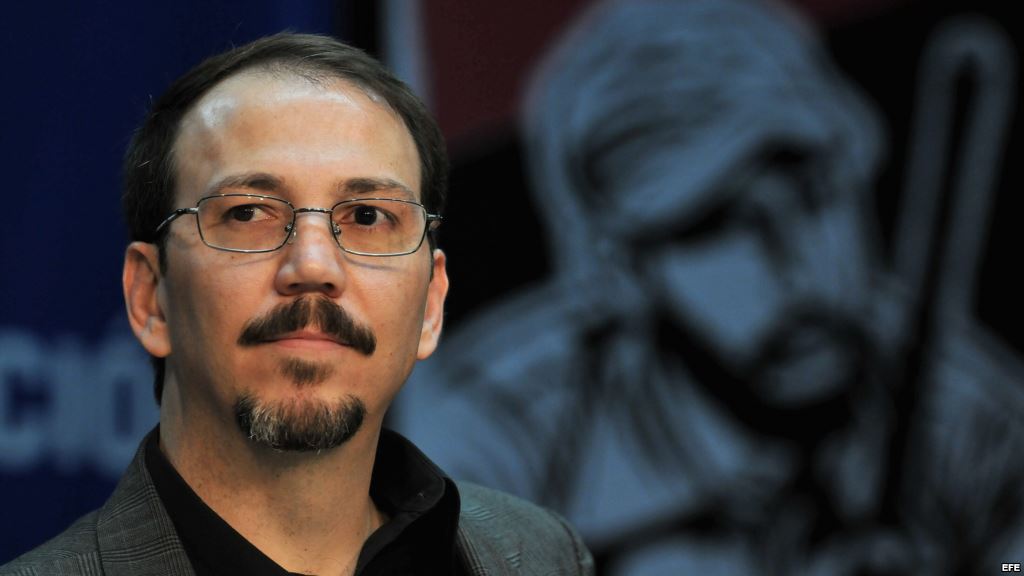
The presidents met the next morning, accompanied by their chancellors, Alejandro Castro Espín (Raúl’s son), and other functionaries. Later, [Foreign Affairs Minister] Bruno Rodríguez held press conference where he stated that the meeting had taken place in a respectful and productive atmosphere.

Regarding the detention of government opponents during the visit by Pope Francis, the minister responded that the Cuban government is proud of its record of achievement in human rights, that the exercise of all rights is guaranteed, that the laws and courts adjudicate and sanction according to the legal classification of behaviors, and that laws regarding foreign government agents in the US and European countries are much more severe.

This answer constitutes a warning that the Cuban government continues to categorize all opponents as US agents, and that it could go back to using Law #88 of 1997, on “Protection of the National Independence and Economy of Cuba,” for which they sentenced 75 peaceful individuals to terms of up to 28 years in prison. Twelve of those so condemned are still in Cuba on parole.

The world has opened up for Raúl Castro. How he will fulfill his promises remains to be seen. He cannot forget the “disposable ones”: almost all the people of Cuba.

Translated by Alicia Barraqué Ellison
That First Central Committee / Reinaldo Escobar

Fidel Castro during the formation of the Central Committee of the Communist Party of Cuba, on October 3, 1965.

14ymedio bigger14ymedio, Reinaldo Escobar, Havana, 2 October 2015 – Fifty years ago the first Central Committee of the Communist Party of Cuba (PCC) made its appearance. It was composed of one hundred people, among whom there were 57 commanders of the Revolution, nine captains, one lieutenant and 33 civilians. Of that constellation only eight remain alive and in office, not including Fidel Castro. The average age of these “survivors” who made it to today is approximately 83 years.

The last time there was a formal election to the Central Committee was in 1997 during the Fifth Congress of the PCC. On that occasion, 14 members from the initial list remained, but that was 18 years ago and, after the deaths of Vilma Espín, Juan Almeida, and more recently of Jorge Risquet, plus the retirements due to dismissal or illness of Roger Acevedo, Osmany Cienfuegos and Pedro Miret, the so-called “historic generation of the Revolution” has been considerably narrowed in its number. continue reading

We can consider the case of Commander Guillermo Garcia, still active, although he is not a member of the current Central Committee, he was in that inventory of tried and tested revolutionaries unveiled on 3 October 1965, the same day that, to justify the work of these creators of anniversaries, the Party was baptized with the epithet of “Communist,” Ernesto Guevara’s farewell letter was read, and the newspaper Granma was founded.

Aside from Raul Castro, those remaining active include Ramiro Valdés (83 years), Jose Ramón Machado Ventura (85), Abelardo Colomé Ibarra (76) and the youngest of all, Leopoldo Cinta Frías, who on 17 July of this year turned a mere 72. Added to that are Armando Hart (85), who is in a wheelchair, General Ramon Pardo Guerra, head of the Civil Defense, and Julio Camacho Aguilera, who only appears in the commemorations of minor importance. The birthdates of the latter two do not appear in any accessible register.

The implacable laws of biology lead us to calculate that the decline will be much more dramatic when the eighth Party Congress takes place in 2021

The implacable laws of biology lead us to calculate that the decline will be much more dramatic when the eighth Party Congress takes place in 2021 (if it is held at all). By then, there will probably be no one who feels guilty for the executions or the confiscations, which is the price to be paid today for displaying the crest of having belonged to the historic generation who earned its pedigree on that October night at the Chaplin (now the Karl Marx) theater, which served as the stage to present the brand new Central Committee.

In this one hundred names are two suicides (Osvaldo Dorticós and Haydee Santamaria), one executed (Arnaldo Ochoa), and one sentenced to 20 years in prison (Jose Abrantes). But most died in combat or in a hospital bed; or have gone into retirement, either through the infirmities of age or dismissals. At least none have defected (as far as we know), if that serves as a point of honor to those who did ​​the casting.

It was a troop obedient to the will of the Maximum Leader. Those who fell docilely accepted their punishments, and those who ascended humbly assumed their promotions. They silenced their differences and tried to applaud like members of the best claque. They knew when to raise their hands in approval and how to step over those compañeros who deviated from the path and, in this trance, they became skilled in the dark drafting of informers’ reports

They are already past or passing. We will have to learn to forgive without forgetting. The future, as the irreverent rocker Gorki Aguila says, belongs entirely to the future.

What Does Alejandro Castro Espin Do? / Juan Juan Almeida

1443639798_alejo

Juan Juan Almeida, 30 September 2015 — Alejandro Castro Espín’s intrusion into Cuba’s political scene has led to a whirlwind of Homeric fantasies in which his biography emerges as a genuine epic poem. This is quite normal; it is how myths are created. But be careful. To either demonize or idealize someone is to make the same mistake: It mythologizes a figure who will later end up embarrassing us.

Alejandro is not, nor will he be, the person who succeeds his father. There is a popular joke that goes like this: Eight out of ten Cubans complain about the government; the two who do not are Raul Castro’s grandson-bodyguard, Raul Guillermo, and his son-advisor, Alejandro.

Popular wisdom. Vilma and Raul’s son was born on July 29, 1965. I do not want to rehash the past — there has already been a ton written on the subject — but it is worth recalling that he began his university education at IPSJAE (José Antonio Echevarría Polytechnic University), only to abandon his studies in refrigeration engineering barely two years later to focus on a less demanding and more promising military career. Perhaps this earned more gold seals for his resume than the appellation on a bottle of cheap wine. continue reading

A lover of sports and bad habits such as digging into other people’s lives, a man with a face like a vegetarian takeout sign, Alejandro is credited with having earned engineering degrees, a doctorate in political science and a masters in international relations as well as being a writer and researcher on issues related to defense and national security.

No doubt he has many more but what is striking is that even the island’s official press seems unsure of the positions and responsibilities held by the youngest of the Castro Espíns’ offspring.

On April 11, 2015, during the Seventh Summit of the Americas held in Panama, the website of the Ministry of Foreign Affairs (MINREX) stated, “Cuba was represented by Chancillor Bruno Rodríguez Parrilla as well as by Alejandro Castro Espín and Juan Francisco Arias Fernández, both from the Defense and National Security Commission.”

He was mentioned again on the same MINREX website on September 29, 2015 — almost six months later — in reference to a meeting between President Barack Obama and the Cuban president. While the organization remained the same, his position in it seems to have changed:

“Cuba was represented by the minister of foreign affairs, Bruno Rodríguez Parrilla, and by Alejandro Castro Espín and Juan Francisco Arias Fernández, advisor and deputy-advisor respectively of the Defense and National Security Commission.”

Alejandro’s job is either beginning to take shape or, worse, becoming distorted. The Council of National Defense, as stipulated by the Constitution of the Republic of Cuba, “is made up of the President of the Council of State, who presides; the Vice-President of the Council of State; his Vice-President; as well as five members appointed by the Council of State at the suggestion of its President.”

Alejandro is not among its members. He holds no designated post. His job, for now, is simply to be an empty bottle. The answer to the puzzle is easy enough: Raul Castro is to nepotism what Albert Einstein is to relativity.

Twelve Ladies in White Arrested Outside Combinado del Este prison / 14ymedio

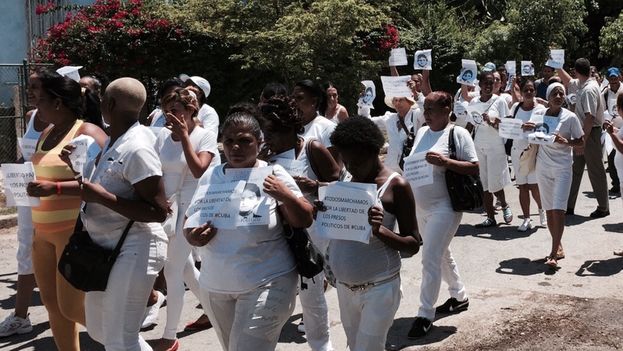
Ladies in White in Havana.

14ymedio bigger14ymedio, 1 October 2015 – The regime opponent Martha Beatriz Roque denounced the arrest Thursday of 12 Ladies in White protesting outside the Combinado del Este prison in Havana. The activists presented themselves at the place to complain about the prisoners Ricardo and Ariel Gonzalez Sendiña, sons of the Lady in White Lazara Barbara Sendiña, who are on hunger strike.

The two prisoners, convicted of the alleged crime of theft and slaughter of cattle, maintain their innocence. Since they began fasting, both are in punishment cells. The women demanded answers about their state of health, but the prison authorities did not give details.

The organization’s leader, Berta Soler, at the site, reported by telephone to the reporter Lazaro Yuri Valle Rica on the imminent arrest of the activists. Minutes later, in her Twitter account, Soler describe the arrests as “brutal.” To date, the whereabouts of the protesters is unknown and their phones are shut off.

The leader of the Youth Front of the Patriotic Union of Cuba (UNPACU) Carlos Amel Oliva Torres, was also arrested on his return from a trip to Spain. The activist is right now in the Third Police Unit in Santiago de Cuba.

A Queen Without Competition / 14ymedio, Reinaldo Escobar

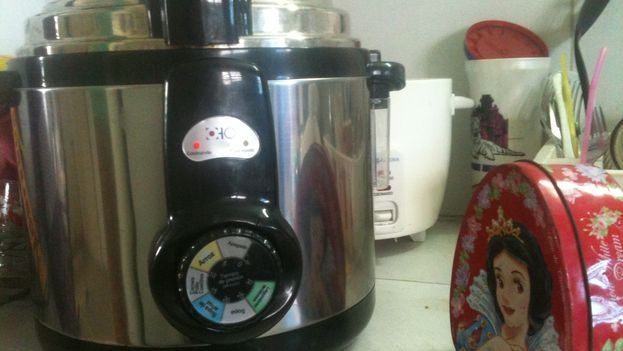
Queen electric cooking pot. (Luz Escobar)

14ymedio bigger14ymedio, Reinaldo Escobar, 1 October 2015 — The “Energy Revolution”, one of the last initiatives promoted by Fidel Castro before his public retirement, made some peculiar appliances appear in Cuban homes. Perhaps the most popular was the electric cooking pot was popularly called Queen, manufactured in China and which serves equally to make a red bean stew or meat and potatoes.

Those appliances which were distributed in bulk throughout the island, as if it were a military operation, were sold on credit and at a price that did not exceed 400 Cuban pesos (about $16 US). One day, coinciding with the departure of the Commander-in-Chief from his post, those pots also disappeared.

Since the middle of this year the Queen began to be assembled in Cuba in the ProHogar plant in the city of Santa Clara, as a part of the Household Production Industry (INPUD), a project founded in 1964 by the then Minister of Industry, Ernesto Guevara.

The group made up of 32 skilled workers assembles some 700 appliances a day that then go for the commercial network of hard currency stores and are sold at prices exceeding 30 convertible pesos (over $30 US). The items for sale can no longer be paid for on the installment plan, that characterized their distribution during the “Energy Revolution.”

Also lost in time are the memories of those refrigerators in INPUD fabricated that were distributed based on “merits” in one’s workplace. Instead, the entity now seeks to impose its products on the market through the harsh law of quality and competition with other similar products. The Queens are no longer for commoners.

‘El Sexto’ Abandons Hunger Strike After 24 Days / 14ymedio

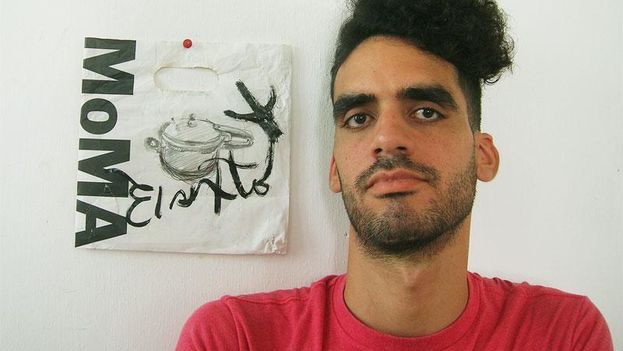
Danilo Maldonado, ‘El Sexto.’ (Artist’s File)

Danilo Maldonado (El Sexto) ends 24-day hunger strike with promise from prison authorities that he will be released in 15 days.

14ymedio bigger14ymedio, Havana, 1 October 2015 — The artist Danilo Maldonado, El Sexto, abandoned the hunger strike he had maintained for 24 days this Thursday. His mother, Maria Victoria Machado, confirmed the news after a visit to the Valle Grande prison, where the graffiti artist has been since last December.

This Thursday, Machado went to the prison to demand the release of her son and met there with a lieutenant colonel who was identified as a “mediator.” The official informed her that “Danilo lifted the hunger strike” and that “from today he will begin to eat.”

Machado was able to meet personally with El Sexto, whom she said was “in high spirits,” although his face “reflects that he has been on hunger strike, his lips are completely cracked,” his mother said. Tomorrow, Friday, the lady will be able to visit him again and bring him food to alleviate his days of fasting.

The artist told his mother that the hardest part of the hunger strike was “the psychological part.”

After asking for personal information, including her address and contact phone number, the lieutenant colonel said that the artist would be “released in fifteen days.” To a question from 14ymedio, the mother of graffiti artist said she believes that “now that there are international agencies involved in his case, it is possible they will do what they said.”

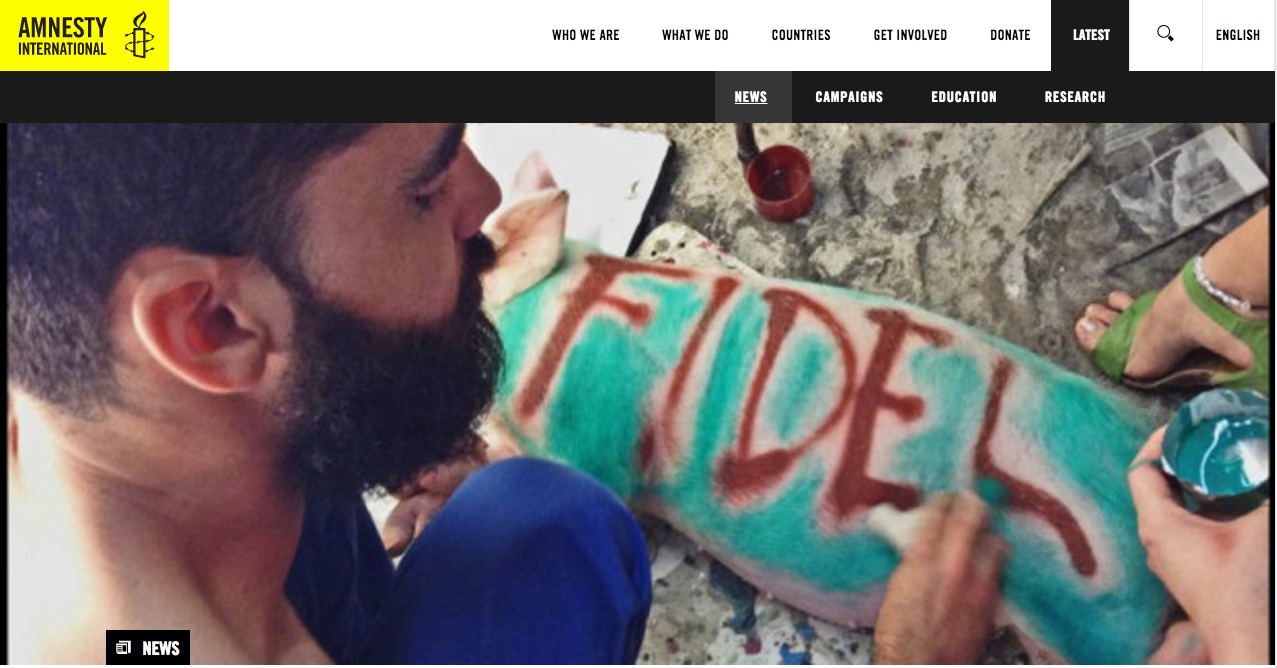
El Sexto, classified as a prisoner of conscience by the human rights organization Amnesty International, was arrested for organizing a performance with two pigs painted with the names Raul and Fidel.

It’s Not the “Blockade”: It’s Fear 14ymedio, Pedro Campos

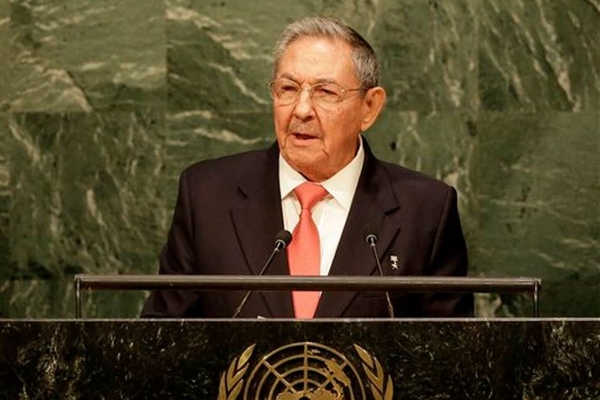
Raul Castro gives his speech at the UN. (UN)

14ymedio bigger14ymedio, Pedro Campos, Havana, 30 September 2015 – The Cuban leaders insist that the “blockade” is the main obstacle to economic development in Cuba. This was confirmed by general-president Raul Castro at the United Nations General Assembly on Tuesday.

Up until today, after the fall of the socialist bloc and the USSR, the United States blockade-embargo* remains the Cuban government’s main justification for the whole economic and social disaster caused by the Statist wage model imposed in Cuba in the name of socialism, in truth a kind of State monopoly capitalism.

The Cuban economy declined to the extent that the State concentrated ownership of land, which came to be 90%, as well as of industry and services, which reached 100%, and state monopolies controlled foreign and domestic trade.

All this was spiced with price controls, voluntarist* policies and plans, total control by the economic elite of the country of state investments and expenditures (“central planning”), the elimination the relationship between goods and money, elimination of individual and collective initiative, a war on private capitalism and cooperatives, now skewed with a thousand obstacles. Simply stated: it was increasingly constraining the initiative of society. continue reading

It has not been the “blockade,” as the Government says, nor this “socialism,” as argued by those who believed there was such a thing, that have been causes of the disaster, but rather the Statist wage model imposed by those who capitalized on the 1959 triumph of the Revolution. Instead of restoring the 1940 Constitution and the democratic institutions which for which all the democratic political movements and all social sectors had fought for, the State assumed control of all large, medium and small enterprises, all private or associated property, domestic or foreign, and they continued to exploit wage-labor.

In the name of a democratic and popular revolution the government imposed a persona, authoritarian, anti-democratic dictatorship which they called “of the proletariat” where the proletarians continued to be proletarians (i.e. workers), deciding nothing and, what’s worse, being exploited.

In the name of a nonexistent socialism they also appropriated the Cuban labor force for half a century, of the humble and dispossessed in the name of whom they erected this economic and government system. And unbearably, they called this thing socialism!

If from the former owners of land, factories, businesses and real estate they took away their material property, from four generations of revolutionaries of all stripes they took away their lives, which were placed at the service of the state in the Armed Forces, the State Security services, diplomatic work, international missions, guards and demonstrations. There was a need to defend the state from so many arbitrarily generated enemies.

But this is not the time for blame. If I mention blame it is because it is incriminating that the main cause was an effect, albeit one that has also done so much damage to us, above all because it has served to justify such nonsense.

It is time now for solutions. How to resolve the problem? Many of us have raised this and even Raul Castro knows it and says so, but he is in no hurry: the productive forces need to be freed.

How? By democratizing the political and economic life of the country. It is necessary to destroy the obstacles, laws and regulations that prevent people from deploying their initiative; to eliminate every restriction that stands in the way of the private labor of doctors, nurses, dentists, lawyers, architects and other professionals. The restrictions on free cooperativism need to be eliminated. Dismantle the state business monopolies and the price controls on agricultural and industrial products. Allow Cubans to import whatever they wish, establish stores and factories, with simple import and sales taxes.

Involve workers in the direction, management and profits of state enterprises, allow autonomous companies to invest, buy and sell. Allow the broad development of SMEs of all types, be they of private or associated capital, supported by private or state capital. Allow Cubans living abroad to invest in the island, supporting their families and friends. Change the tax laws to stimulate production and services.

To change the Foreign Investment Law for a simple investment law for everyone, where you can engage in all the forms of production that reality demands, with freedom for unions and guarantees for the fair wages for the workers. To reduce the size of the state and its spending. To expand and free the internet allowing free trade and horizontal exchange of information of all kinds. The free market makes possible the development of free labor, whether individual or associated. Without these changes there is no socialism, sustainability nor prosperity.

And can these changes in the economy be made by an authoritarian elite that aspires to perpetuate itself in power and maintain political and economic control over society?

So far it has been proven that they can not. First – or in parallel – there must be a process of democratization of the political life, which in a climate of trust will allow other sectors, groups or visions to perform with a focus on democratizing the society. This implies freedom of expression, association and free elections so that all political and economic trends manifest themselves and interact democratically to work towards a new constitution and a new electoral law.

A genuine democracy must establish participatory budgets locally, so that taxes and budgets are controlled more by communities to strengthen their capacities and sustainable development and to ensure that all relevant laws are widely and horizontally discussed and that all of the are subject to referendum.

And without an internal “blockade,” even if the other persists, so that as Cubans we can see what we are capable of.

If the blockade-embargo were lifted and these obstacles continued, the State would swallow all the loans and only support unproductive state enterprises of interest to the elites to paternalistically continue to govern health and education at a low cost, a pittance for food on the ration book, and precarious levels of wages, pensions, housing support and transportation the majority.

But the bureaucracy does not want socialization nor democratization: they do not want to risk their power and privileges. The fear of losing power is the ultimate cause that prevents these changes. Please, do not frighten them even more. No one needs to be done away with. Do not forget “with all and for the good of all.”

Whoever helps empower the people, whoever helps improve the living conditions of the people, whoever helps people to be more free and able to decide their destinies, to let them be happy and prosperous, whoever would do more for the welfare of the people, would win the greatest popular support.

If we have the United States to thank for all this and the lifting of its “blockade”… you get the idea, reader.

Translator’s notes:
*The Cuban regime insists on calling the US embargo against Cuba “the blockade.”
**In this context “voluntarism” is relying on volunteer labor for major economic activities.

Freedom of Expression: A Change That Has Been Just Another Strategy / Hablemos Press, Weiner Alexander Martínez

Weiner Alexander Martínez Estepe/ HABLEMOS PRESS.

27 September 2015, Havana – The flexibilities described by the Cuban government in recent years regarding freedom of expression constitute only a change in its political strategy, the objective being to improve its image before international public opinion and organizations that defend human rights.

Testimonies of various government opponents and independent journalists indicate that repression of their activities has not ceased, but rather that the methods used have evolved, becoming more subtle and imperceptible.

They differ from those in the now distant 1970s and 80s, when the dissidence (and even any person who would dare to express divergent ideas) was dealt a “strong hand.” continue reading

Currently, the Island’s independent journalists, as well as the organizations of human rights activists or dissidents, are in the midst of a psychological war waged by the State Security apparatus.

The most common tactics consist of weakening the opponents, attacking their weaknesses, psychologically torturing them as well as their families; carefully tracking all their steps, relationships, friendships, influences, and even their enemies—so as to cause them to be isolated from their families and suffer social and moral death.

This way, nobody can prove that the security forces are harassing them, being that on no occasion do the agents appear in their uniforms, nor can they be shown to be behind the actions they commit.

For these purposes, they rely also on technology, spying on and filtering emails, telephone calls and text messages, and mounting surveillance operations across the street from activists’ dwellings.

All of this goes on with no concern over operational costs, being that the Ministry of the Interior (MININT) and the Armed Forces do not answer to the public regarding their expenditures.

As journalists of the Hablemos Press Agency, we have not remained far from the war. My family has been threatened, stigmatized, and often coerced so as to instill fear and insecurity among all members.

The reality faced by dissidents and independent journalists is harsh in all senses of the word. But currently, in my opinion, there is something that without a doubt is a point in favor of the non-governmental organizations.

The desertions, violations of protocol, corruption, and fragmentation in its ranks have weakened the organs of State Security, revealing many of the obscure facets of this apparently solid institution.

This entity, also, suffers from the effects of the destruction of Cuban society, as is happening in the schools, state institutions, factories and high levels of government.

The infiltrated agents could not only exist among the ranks of the opposition. The accusations of actions, roundups, and names of covert operators are concrete proofs that show that even among the eternal faithful of the Homeland, Party and Revolution, there can also be stowaways in service to the Cuban dissidence.

When all is said and done, there is not one Cuban affiliated with Castroism, consecrated to the Revolution and the Party, who lives honestly off his salary and does not find himself forced to betray the laws and regulations imposed by the leaders.

The classic modus operandi of Joseph Fouché could be the description for many of those State Security agents, about whom it is easy to say, in Cuban style, that “they dance to whatever rhythm they are played.”

From its beginnings, the repressive machines of the government utilized one of the simplest and most decisive weapons to win a war: distrust. Thus could a group of dissidents be fragmented with just a simple salute from a police agent or a chief of security to those gathered at any spot in the neighborhood: an interesting strategy that bore fruit while it lasted.

While the covers are blown from the clandestine agents, the proofs of the presence of infiltrators can be seen everywhere. Videos of assassinations committed in Cuba for diverse causes, extracted from an exclusive MININT database by any one of its intrepid “followers” are now circulating hand to hand.

True democracy in Cuba is still very far away from those of us who suffer discrimination because of our firm stance before falsehood. Which shows that they repress us for defending the truth, because repressors defend the lie.

Translated by: Alicia Barraqué Ellison