
The Weighty Legacy of ‘Furry’ / 14ymedio, Reinaldo Escobar

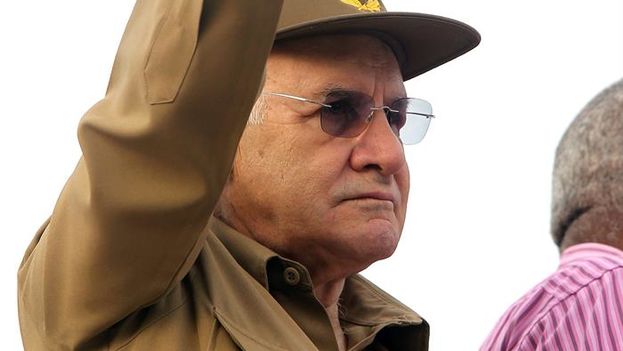
General Abelardo Colome Ibarra, alias 'Furry,' minister of the interior from 1989 until his resignation on Monday, 26 October 2015 (EFE / Alejandro Ernesto)
General Abelardo Colome Ibarra, alias ‘Furry,’ minister of the interior from 1989 until his resignation on Monday, 26 October 2015 (EFE / Alejandro Ernesto)

14ymedio bigger14ymedio, Reinaldo Escobar, Havana, 27 October 2015 — Every Cuban has a minister in charge of his or her affairs, but the Ministry of the Interior is responsible for everyone. This is the reason why, when someone says “The Ministry” everyone understands that they are speaking about MININT, the Ministry of the Interior, that macro entity that controls, among other things, immigration, firefighters, border guard troops, identity card offices, the police, and that colossal apparatus generically known as “the organs of State Security.”

Abelardo Colome Ibarra was, since 1989 and until yesterday, the all-powerful minister of the interior. His long record of service began 30 November 1956, when he joined the revolutionaries who took the city of Santiago de Cuba to support the landing of the Granma expedition. He ended the war against Batista with the rank of commander, not yet having reached age 20, and has since been the confidant of the Ciuban Government (especially of Raul Castro, having been head of his bodyguard) which has entrusted him with missions such as head of the State Security, directing the police, or commanding the war in Angola.

Furry, as his close associates call him, until this Monday was one of the seven living and still active men appearing on the list – almost never disaggregated – of the so-called “Historic Generation” of the Cuban Revolution. His role as a founder of the first Central Committee of the Communist Party and of the National Assembly of People’s Power, plus his being named as a “Hero of the Republic of Cuba,” support the merits that have allowed him to do something unusual: resign his position and receive a tribute. continue reading

Some years ago a rumor circulated about his declining state of health, but he continued to be one of the makers of government policy, and this also makes him responsible for the shadiest events, such as the sinking of the 13 de Marzo tugboat in July of 1994, the downing of the Brothers to the Rescue planes in February of 1996, the arrests of 75 regime opponents in the spring of 2003, and the frequently denounced horrible conditions in Cuban prisons. Under Furry’s mandate the activist Orlando Zapata Tamayo died, at the beginning of 2010, after a prolonged hunger strike during which it is alleged his jailers denied him water.

Who doesn’t know that it is almost impossible to organize a repudiation rally without the consent of State Security? Whenever Sunday operations are carried out in various provinces to suppress the Ladies in White, in the end there is a report that ends up on the minister’s desk. Behind every one of these brief and arbitrary detentions, beatings, assaults on the homes of regime opponents, searches and seizures, has been MININT and Furry.

During all the years of the humiliating “exit permits” that were required to leave the country, the lists of who could leave and who could not were drawn up in that institution. In the same way, from these offices were issued – and are still issued – the refusals to allow a Cuban abroad to return to his or her country, even for a visit.

According to insiders, Colome Ibarra had been spending less and less time in his office while the work was carried out by the vice-minister, Carlos Fernandez Gondin, also a member of the Cuban Communist Party Central Committee and a deputy to the National Assembly. Fernandez Gondin’s appointment as the new minister has not been a surprise, although it put to rests rumors that insinuated that Alejandro Castro Espin, Raul Castro’s son, would be promoted to the job.

Within six months Fernandez Gondin will probably be promoted to the Politburo as a part of the renewal that is expected with the upcoming 7th Congress of the PCC. His face rarely appears in the media and he has a reputation as a loyal and inflexible person. In a few years, when there is no one from the Historic Generation making decisions, he will be surrounded by people to whom he does not owe obedience and whom he will know a lot about because he will have read secret reports on every one of them. This could be interpreted as bad news for the future of Cuba.
To March or Not to March… that is the Question / 14ymedio, Miriam Celaya

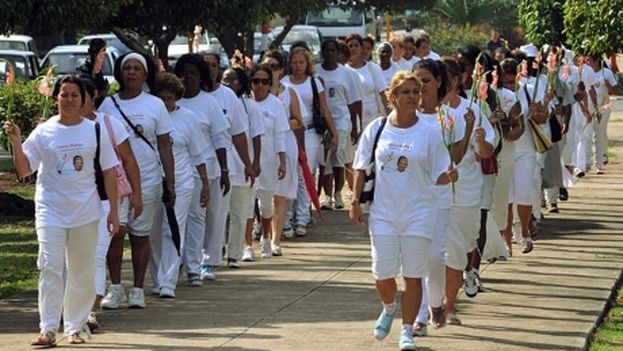
March of the Ladies in White through Havana. (EFE)

14ymedio bigger14ymedio, Miriam Celaya, Havana, 28 October 2015 — The latest cyber-skirmish unleashed around statements made by Eliécer Ávila, leader of the opposition movement Somos+, about the #Todosmarchamos initiative, once again focuses first, on the need for restraint in political discourse and the importance of not allowing ourselves to be swayed by the provocations of those who pursue only ratings and drama from the comfortable security of their distant geographical locations, and secondly, on the inability to weigh things at fair value, whether by the so-called opposition leaders — regardless of their strategies, their ideological orientation or their political proposals, if they happen to have them — or by public opinion.

In this case, there are numerous myths contained in a sort of Theogony of the opposition, a mirage created and sustained from abroad in an absurd desire to hold on to an opposition epic — which should eventually replace the current revolutionary epic — which, like the latter, creates pockets of prestige and heroism, and even castes and lineages, depending on whether the new heroes are willing to bleed or get slapped on the head. It is a well-known fact that we Cubans are experts at repeating our mistakes, especially those that guarantee future suffering and shredding of vestments.

We Cubans are experts at repeating our mistakes, especially those that guarantee future suffering and shredding of vestments continue reading

If there is anything I agree 100% on with Eliécer, it’s the need for the independent press in Cuba to cease to be complacent with the opposition – sadly mimicking the stance of the official press towards the Castro regime — and assume from this day (during the dictatorship) the usual journalistic roles and functions in democratic societies. This includes questioning absolutely everything and everyone, desecrating any public figure whose effect should ultimately be to serve, not to rule. In this regard, here are some observations I propose that might seem unbearable to some extreme radicals. I suggest that the passionate stop reading at this point so they can avoid the usual patriotic tantrums.

I shall not vent my sympathies or personal differences on the opposition — not on a nonexistent “opposition movement” — an environment that I know by heart, since it’s been almost fifteen years since I delved into it. What I know or believe about anyone is completely irrelevant.

I have found many of the most honorable, honest, generous and dedicated people I’ve ever met in my life within the opposition, and also many of the worst and most harmful: ambitious, hypocritical, opportunistic, false patriots and, as Eliezer stated, some corrupt little characters who have made the “struggle for democracy” a way of life. Over the years I have come to understand that that reality is not unique to the Cuban stage or that it is bound by the geography of the Island. There are good and bad Cubans both in Cuba and in the Diaspora, there are those who live for Cuba and those who live from it. Note that I am merely reviewing the facts as a necessary and true evil. It is what it is, period.

There are good and bad Cubans both in Cuba and in the Diaspora, there are those who live for Cuba and those who live from it

Some people prefer to ignore that the Cuban dissidence is as varied in its composition from the point of view of human quality as any other social group. In fact, all the vices inherited from a corrupt and sick system are present in our sector, including atavistic evils, such as an autocratic government, authoritarianism and despotism. There is even what we might call an opposition gerontocracy, firmly clinging to old precepts and unchanging bad habits, incapable of evolving in the light of new scenarios.

When I travel abroad, I’m always surprised to hear someone, perhaps with the best of intentions, refer to dissidents in general, including independent journalists, as “heroes.” And what’s worse, there are characters who “modestly” accept the epithet, as if it were their true right. I will never support a leader who perceives himself as worthy of moral supremacy over the everyone else. In addition, such a prefabricated pantheon of heroes will only serve to cement many present and future ills.

Nevertheless, in those circumstances, and with those actors, we must continue to open the way for Cuban democracy. We optimists believe in the best of scenarios and, with the passing of time, many individuals and proposals will surface which will expand and diversify the options in the political and social milieu, thus covering all interests and including all the trends and options for citizen participation And we will need to learn to live with our differences.

Another one of the most notorious Cuban imaginary myths of all time is based on measuring the value of people by their willingness to “shed blood,” to be beaten in the streets or locked in dungeons. To march or not to march seems to want to establish itself as the moral question for future politicians. It doesn’t matter whether the event is repeated again and again with the same result, and the dictatorial power continues to not move one inch, or that one of those “common” citizens, the ones who are trying to get free from the Castro yoke, has joined in the martyrdom. It is known that no “leader” has attracted followers by becoming the scapegoat of a dictatorship known to be repressive and capable of the worst abuses.

To march or not to march seems to want to establish itself as the moral question for future politicians

It seems to be that what’s truly important is that the more marches and more beatings one gets, the more “courageous” one becomes, and that will get you a place of privilege in the select club of the anti-Castro titans.

But given that no Cuban “peoples” are willing to suffer the already traditional Sunday assaults, the organizers of this Antillean Via Crucis have not only summoned the other dissidents –including those who have been labeled a “naive” and even “traitors” for having acted in accordance with the US administration policy of détente — but they question the reluctance of those who do not abide by the summons.

And they see in this negativism, not the right of others to choose their own methods of resistance or their own path to work for the Cuba we want, but an alleged intention to divide the opposition or “to play into the hands” of the dictatorship. It would seem that if the Castro regime has not failed it is because some of us, whether absurdly or cowardly, have refused to march after attending church. Not believing in God, in the sponsors of the initiative or in their results, is secondary: a herd must follow the alpha male, who — in the purest Castro sense — will assume that those who do not follow him blindly are cowards and are against him.

Thus, Eliécer Ávila’s greatest sin was excessive transparency in a world of masquerades, forgetting that to ignore provocations is the wisest and most expeditious strategy that anyone aspiring for political leadership could employ. The sponsor of Somos+ wasted a great opportunity to keep his subtle silence.

There is no need to conquer freedom. Being free will suffice, though it needs to be done intelligently.

I, for one, while enjoying the privilege that my status as an opinion journalist grants me and my complete lack of commitment to leaders or parties of any political color, take the opportunity to join the commentary of a wise reader: there is no need to “fight” for democracy, practicing it should be enough; there is no need to conquer freedom, being free will suffice, though it needs to be done intelligently. It is impractical to continue implementing strategies that lead to the same result again and again… except when what we seek is that seal of pedigree that has been repeated so many times throughout our history.

In Cuba’s immediate future we will not hear that worn-out phrase that marked our lives and legitimized the rights of the privileged few over the rest of Cubans: “Did you by any chance fire shots in the Sierra Maestra?” It will be replaced with “Did you by any chance march on Sundays down La Quinta Avenida?” God forbid!

Translated by Norma Whiting

Reimbursement is Important / Fernando Damaso

Fernando Dámaso, 23 October 2015 — In Cuba, unlike other countries, public services are totally centralized by the State through its different companies: electricity, gas, telephone, water and sewer, municipal and other.

Being part of the same thing, these entities are considered untouchable, and they do things and undo them at their own whim, without considering the effect on citizens and businesses, State as well as private. Thus, they connect and disconnect the electricity according to their interests. The same thing happens with the gas service, telephones and drinking water. continue reading

Furthermore, in order to do maintenance and make repairs, they break up the streets and sidewalks; they interrupt transit and create multiple nuisances. Repairing what’s destroyed takes a long time to execute, and, in general, it’s bad quality. All of this causes economic loss to all types of businesses, for which no one answers.

It would be good if these consequences, when they aren’t caused by natural phenomena, were reimbursed economically by the companies causing them, by handing over a sum for the harm inflicted on a factory or a business: the value of what they lost when they had to stop producing or selling.

In addition to being just, this would oblige these companies to be more efficient in their work. Presumably, where they presently take 10 or 12 hours to repair a breakdown, with a brigade in which few work and many talk or lounge about, if they had to make reimbursements, they would see themselves obligated to do the work in less time and with only the minimum, necessary personnel. Furthermore, the result of the work would be better quality, since doing it poorly would affect the companies economically.

It’s something to think about; although, personally, I think that many of these services could be leased out, with less cost, better quality, less time and more efficiency, by private companies that contract for them, a general practice with magnificent results in many countries.

Translated by Regina Anavy

The GAE, a Lie Transformed into Reality / Juan Juan Almeida

Juan Juan Almeida, 26 October 2015 — Before the Special Period, the financial capacity of the country had already been reduced to a minimum, so reforms were being instituted that supposedly would “help” the nation cope with the economic contingencies of the time.

And when the situation reached that almost invisible point at which point any action or oversight could hasten the death of a terminally ill patient, circumstances forced the Cuban military to become productive by generating income from agriculture, transportation, tourism, construction, finance and commerce.

The armed forces of the world are divided into three main services — army, navy, air force — plus aerial defense. continue reading

Among the things the fall of the Communist bloc brought to Cuba was the Special Period. No one can forget the famine, polyneuritis or dramatic increase in illegal emigration, much less the events of 1994.

I think it is worth remembering that the crisis did not only affect the civilian population. It also impacted the institutions of government, especially those that were not productive, such as the Ministry of the Interior (MININT) and the Revolutionary Armed Forces (FAR), which were preparing for a cataclysm. They had already experienced their own catastrophe in 1989, when soldiers, officers and even a few generals (some of out of a sense of duty, some out of convenience) left the institution.

Even before the Special Period, the economic capacity of the country had already been reduced to a minimum, so reforms were instituted that would supposedly “help” the nation cope with the economic contingencies of the time.

No crisis in the world explodes without prior warning, or at least not without some sort of clue. If instability had arisen, MINFAR would have been facing the prospect of being in a weak defensive position. Therefore, at a meeting of the Military Council, a well-known advisor to Raul Castro suggested scrapping the traditional organizational structure of the armed forces and consolidating the troops under one roof. As a result, air defense — a force much more expensive than any army — was merged with the ground forces while the various military headquarters were centralized under a single command. Contrary to appearances, this was more than just a word game.

Due to lack of supplies and obsolete technology, military maneuvers came to an end and a period of invention began. On orders from Raul a group of innovators emerged who used the nation’s financial resources to develop a radar system that did not work and a grotesque Cuban-made aircraft that did eventually fly but ultimately crashed. As might be expected, the crew died with no funeral being held.

And when the situation had reached that almost invisible point at which any action or oversight could hasten the death of a terminally ill patient, circumstances forced the Cuban military to become productive by generating income from agriculture, transportation, tourism, construction, finance and commerce.

It was at this time that the Business Administration Group (GAE) was created in an effort to control the corruption that resulted from this new military-commercial hybrid. While it did not function very well, it did at least appear to function, allowing the FAR to feign operational efficiency, safety and solvency.

To put it simply, any given screw factory has production costs which include workers’ salaries, equipment, electricity, raw materials and a few other things. All these contribute the final retail price. But the GAE screw factory — to use an example — has no fuel costs because this item is already covered in its budget. Besides getting the fuel for free, it can also avail itself of prisoners, soldiers and recruits in precarious employment situations to manufacture its product. On paper a military screw costs nothing to produce and is sold for hard currency. The never-ending story. 

The Cuban government is expert at deception, using its know-how of illegal methods and its undeniable skill at fomenting gossip. These techniques, referred to as “active measures,” generate a fiction that is picked up by the press (both foreign and domestic), and used to sway public opinion, including our own. We then repeatedly echo the lie until it becomes the precarious truth. Besides being used as tool to control companies and ministries, its purpose is not only to generate profits but also torrents of uncertainty.

The Remake / Fernando Damaso

Fernando Damaso, 28 October 2015 — The Cuban authorities applaud the “victory” obtained in the vote for the lifting of the blockade-embargo at the United Nations. It’s actually their twenty-fourth Pyrrhic victory since 1992, when they lost the substantial Soviet economic subsidies, and began to be bothered by the blockade-embargo, which they previously didn’t care about and treated as a joke.

These 24 Pyrrhic victories have not advanced one iota the cause of ending the blockade-embargo because the resolution that was approved is not binding, that is, there is no mandatory compliance; the countries vote according to their current interests, so a vote in favor of ending it does not affect its relations with the United States, and a vote in favor of keeping it would affect their relations with the Cuban government. It’s all nothing more than sheer political opportunism, without much real significance. continue reading

Submitting the measure one more time as a remake, in a time when meetings and talks are being held between the two countries, with the aim of solving this and other ongoing problems, constitutes an error of Cuban diplomacy. Progress in the lifting of the blockade-embargo and the solution of other problems can only be achieved at the negotiating table, where give and take is required. What happens at the UN every year is pure comic theater: it only causes laughter.

But with this remake one wonders whether the Cuban authorities really want to put an end to the blockade-embargo, or if they are doing everything possible to see that it is maintained, so they can continue using it as a smokescreen to hide their demonstrated ineptitude and incompetence.

In this country of magical realism, everything is possible.

Translated by Tomás A.

I no longer want to find you, Camilo / 14ymedio, Yoani Sanchez

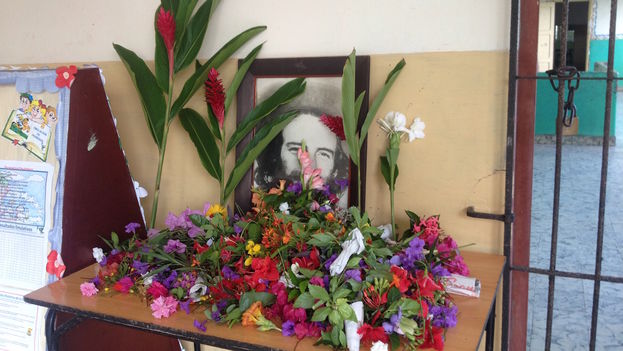
Flowers for Camilo Cienfuegos at a primary school in Havana's Plaza district (14ymedio)
Flowers for Camilo Cienfuegos at a primary school in Havana’s Plaza district (14ymedio)

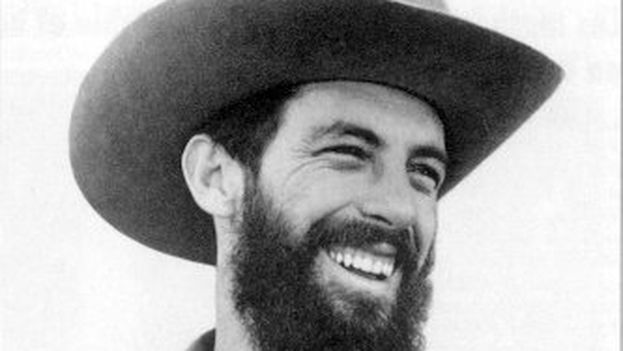
14ymedio bigger14ymedio, Generation Y, Yoani Sanchez, Havana, 28 October 2015 — The wall of the Malecon tastes of salt and is rough to the touch. Standing on it, my school uniform splashed by the waves, every October of my childhood I threw a bouquet of flowers into the sea. The tribute was addressed to a man who had died fifteen years before I was born. His face was on the walls and in schoolbooks, with an enormous smile beneath a broad-brimmed hat. Those were the days when I still dreamed of meeting Camilo Cienfuegos.

The story, repeated to the point of exhaustion in school assemblies and official propaganda, told of a plane that disappeared while the Commander was flying between the cities of Camagüey and Havana. For the children of my generation it was an almost magical enigma. We believed that one day we would find him, a bearded jokester, somewhere in the Cuban geography. It was just a matter of time, we thought. continue reading

But the years passed and on this long and narrow island there has never been detected even a single piece of that twin-engine Cessna. New technologies burst into everyone’s lives, satellites search every inch of the planet, and mythical cities, submerged or buried, are found all over the globe. But of Camilo, not a single clue.

The illusion that he would return to unite “the highest leadership of the country” was giving way to another desire. In the mid-eighties I heard talk of Camilo Cienfuegos as the hope for change. “If he were here, none of this would have happened,” the elderly intoned. “He wasn’t a communist,” my grandfather said.

Once again we want to find alive the hero of Yaguajay, but this time to lead our dissatisfaction and to help us overcome our fear.

In the Special Period the urge to discover at least a vestige of that tailor-turned-guerrilla forcefully resurfaced. We speculated that if the circumstances of his death were unraveled, Fidel Castro’s government would fall like a house of cards. The best-kept secret of the Revolutionary era would also be its end. But even in those years the mystery was not solved.

A few days ago a little girl reminded her mother she needed to take a bouquet of flowers to school to throw into the sea on the day this Havanan not yet turned 30 disappeared. A second later the girl asked, “But is he dead, or is he not dead?” Her mother explained the official version in a bored voice, ending with a categorical, “Yes, he’s dead… he is not breathing.”

The mystery has collapsed. Not because we found answers, but because we got tired of waiting for them. Right now, nothing would change because we know that Camilo Cienfuegos is alive somewhere – with his graying beard – unless it is scientifically proven that the official version is true. Nor would there be a great commotion on finding out his death was an assassination order by his own compañeros from the Sierra Maestra.

Time, implacable, has ended up burying Camilo.

Camilo Cienfuegos. (CC)

U.S.-Cuba: Obama 3, Castro 0 / Ivan Garcia

Castro-y-Obama-en-Nueva-York-_ab-620x330Ivan Garcia, 7 October 2015 — According to Francisco Valido González, 47, a dissident who works in a transit bus cooperative, his association, in theory, can ask for credit from a U.S. bank in order to acquire new buses.

His cooperative’s buses have more than 200,000 kilometers on them, and 15 years of use. In his narrow apartment, a stone’s throw from Calzada de Güines, in the municipality of San Miguel del Patrón in the southeast of Havana, he keeps the auto parts he bought in the informal market under the bed where he sleeps.

From overuse of the buses, breakdowns are constant. “Almost always, between 10 to 12 days a month, I have to stop because of a breakdown,” he told me in December 2014. continue reading

Taking a page from Barack Obama’s book on “empowering small businesses and private workers,” Validio wrote a missive to the Minister of Transport soliciting authorization for his cooperative to obtain credit, which would permit it to buy 50 new microbuses.

Nine months later, he’s received silence for an answer. Since 17 December 2014, when both nations surprised the world with the reestablishment of diplomatic relations, the opinions of Cubans on the street have gone from exaggerated expectation to lassitude and pessimism.

Hundreds of business owners rubbed their hands in anticipation of the new panorama that was approaching. Noelvis, a mechanic in a bus cooperative on Avenue Santa Catalina, made grandiose plans.

His cooperative had been visited by Thomas Donohue, president of the U.S. Chamber of Commerce. “If the Government approves, our cooperative can request credit from a U.S. bank and buy a couple of car washes and modern tools,” he commented last March.

Six months later, Noelvis isn’t so optimistic. “The game of dominoes is stalled. Up above (the Government), they’re not getting off their high horse. They don’t even answer our questions. Total silence.”

Francisco Valido drives a collective taxi 12 hours a day, and in spite of earning 2,500 Cuban pesos a month (a little more than 100 CUCs — equal to about the same in US dollars), to make ends meet at the end of the month he repairs footwear for the residents of the neighborhood.

In the cooperative, Noelvis earns a salary of 2,000 Cuban pesos (about 80 CUCs). “But it’s not enough. Because of the high cost of living in Cuba, you need at least 400 CUCs a month to be able to have two meals a day and pay the rent, light and telephone.” Outside work hours, he fixes old American and Soviet cars. This extra money allows him to live without big worries.

David, a computer specialist, has been embroiled for the last three months in bureaucratic procedures to open a private cybercafe in Havana.

“My project was to buy 12 computers with credit that my family in Miami was going to arrange with a computer company in the U.S. In the cafe there would be a bar. Everything would be air-conditioned with a space for nightly downloads of jazz and trova music. It would have Wi-Fi, and I’m sure that the people who connected sitting on the sunny sidewalk would appreciate it.”

If you walk around Havana and chat with private entrepreneurs, you will hear more or less the same stories. Even the cooperatives, legal entities that appeared under the mantle of the State and which theoretically can invest with foreign companies, are under the governmental magnifying glass.

Marino Murillo, the obese czar of the island economy, has expressed caution in the approval of new cooperatives. “In fact, the Government put the hand brake on,” says a cooperative member in Havana.

On two occasions, December 17, 2014, and September 18, 2015, Obama released a range of measures to dismantle, brick by brick, the codified financial and commercial embargo toward the government of Havana.

Washington emphasizes the spread of Internet service, telephone calls, construction materials, and sea and air travel. The White House is interested in favoring small businessmen, and in allowing Cubans access to new technologies.

But the Palace of the Revolution is not opening its mouth. The shifty ancients in the Government observe the course of events without opening a door or a window.

The Communist regime is interested only in transactions with State companies, 75 percent of which are administered by the military. After nine and a half months of the new agreement between the two countries, which live their particular Cold War, the harvest is meager.

IDT, a U.S. telecommunications company, negotiates with ETECSA, its Cuban State-owned counterpart; Airbnb allows the rental of houses in Cuba from the U.S., and this has increased the number of flights and American visitors to the Island.

But General Raúl Castro keeps the ramparts fortified. There is no Government strategy for private workers to get credit or buy food and foodstuffs from the neighbor to the north.

On the financial terrain, the field continues clogged with the bizarre double currency system, which complicates any commercial transaction. In an arbitrary manner, the Regime implements an artificial exchange rate with the dollar, which makes it more expensive for travelers from the U.S.

The only move on the chess board that the military Government has is giving bombastic speeches and asking for something without offering anything in return.

Up to now, neither Obama nor Pope Francis has been able to handle it.

PHOTO: Raúl Castro and Barack Obama, during their meeting on Tuesday, September 29, in New York. Photo by Doug Mills, The New York Times.

Translated by Regina Anavy

How Have Cubans Benefited Since December 17? / Ivan Garcia

"Now you are a saint"
“Now you are a saint” (Still from the video below)

Note from TranslatingCuba.com: The video is not translated into English. The gist of message (other than what is obvious from the images) is that things in Cuba haven’t changed for ordinary people since the announcement of the reestablishment of US-Cuba relations.

Ivan Garcia, 16 October 2015 — Seated at the helm of his polished 1958 Impala convertible, Eduardo Colón, a private taxi driver, listens to Adele’s concert on his player, while he waits for the marriage of an American couple outside the Saratoga Hotel, very close to the National Capitol in the heart of Havana.

The couple arrives with relaxed tourist faces, wide-brimmed sombreros, video camera in hand, and before climbing aboard the ancient Chevrolet, they take a selfie with the car in the background. continue reading

If anyone has benefited from the more than 100,000 Americans who have visited Cuba since the December 17 thaw, there’s no doubt that private taxicab drivers are at the top of the list.

“Speaking economically, since the Day of San Lázaro* last year, things have gone better for me. Especially with the Americans. For a couple of hours’ drive around the city, they pay me up to 60 chavitos (65 CUCs, “dollars”), Eduardo pointed out.

The owners of homes for rent and private restaurants in the medium- to high-price range in the usual tourist zones in the capital are earning more money.

“I rent three rooms at 30 CUCs a night. And in 2015, of the 17 people who rented from me, 11 were from the U.S. When the bonanza begins, the infrastructure of hospitality, gastronomy and transport is going to collapse. For me I’m doing well, but I admit that the markets continue to be short on supplies and telephone calls to the U.S. are still very expensive,” said Elsa, the owner of a spacious house.

For Onilio, almost ten months after the Americans, neighbors to the north, stopped being enemy número uno, the balance of positive things is little.

“I work hard at selling illegal cigars to tourists. I notice that there are more Americans, who are cooler and who help the clandestine cigars-and-rum business. But it still isn’t very good,” said a seller in the Hotel Inglaterra vicinity.

Kirenia, a prostitute, doesn’t think that Amercian affluence has caused an increase in prices. “It’s still the same: 50 or 60 bucks for a night. If the client looks like he’s well-heeled, you can ask for a hundred. But up to now the Americans I’ve seen aren’t coming in waves to link up with whores.”

For most of the people interviewed, the scene hasn’t changed too much. “It’s more peel than potato. For those who do business downtown, where the rich foreigners are, things are going better. But for those who live far from the center of Havana, life is the same,” states the proprietor of a private bar.

Still Yasmani has noted benefits. He has a bar that offers tapas, and he rents out five rooms with a spectacular view of the Malecón for 35 CUCs a night.

“I do business with Airbnb, and I almost always have clients,” he affirms. The State hotels, mainly administered by military companies, can’t complain either. “This year we are cheek to jowl (full), comments Eusebio, a receptionist at a hostel in Old Havana.

In restaurants like Los Nardos, a joint venture between home hotels and the State at kilometer zero** in Havana, it’s almost impossible to get a reservation for dinner.

“I notice there are better opportunities. Although at the moment they haven’t fallen into my pocket. I’m still earning 10 CUCs a day, like always,” says Joel, the doorman.

Those who haven’t seen any benefit are the majority of Cubans who own nothing. “I’m still earning the same shit (550 pesos/month, around 23 dollars) as before December 17. And as far as food goes, buying it takes almost my whole salary, and when I need a bottle of cooking oil, I have to save in order to buy CUCs so I can get it in a “shopping”***,” notes Manuel, a bus mechanic.

A wide segment of the population complains about the shortage of food and the sky-high prices. “No one understands that now that we Cubans can buy food from the U.S., the markets are empty,” says Rosa, a housewife who prowls the shelves of Ultra, one of the large dollar stores in the capital.

According to a recent article by Juan Juan Almeida in Martí Noticias, in a journalistic investigation among foreign businessmen in Cuba, the Regime has a silent strategy to reduce the buying of food and merchandise in the U.S. as a way of putting pressure on the U.S. business lobby to force a more energetic campaign for repeal of the embargo.

Almost 10 months after December 17, not too many benefits are felt in Cuba. The olive-green autocracy continues without implementing a road map that would please private workers, to whom, supposedly, Obama’s measures are directed.

The official sinuous politics awakens resentment and mistrust in Cubans on the street. “Before, the Government complained that we couldn’t access the Internet because of the blockade. Now U.S. businesses offer us free Internet, and the State says that they prefer to be in charge. They are interested only in exploiting Cubans with steep prices and abusive taxes,” comments Reinier, sitting on a sidewalk under the sun on Calle 23 in Vedado, while he tries to communicate by IMO**** with his relatives in Florida.

A few meters away, Diosbel waits in a Havana Tour office to buy a ticket to Miami. “We thought that after December 17, the price of airline tickets was going to go down. The flight to Miami is as expensive as the one to Colombia. And the Government doesn’t give us any news about the ferry. They’re saying that the U.S. Post Office is going to negotiate with the Cuban Post Office. What for? Those sons of bitches only permit you to send something that weighs one and a half-kilogram, and if you go over, each kilo costs 20 CUC. The reestablishment of relations hasn’t brought anything that’s good for Cubans,” he says, annoyed.

In Havana opinions are divided. Some believe that in 2016 gaps will inexorably open up, and there will be better conditions for those Cubans who have only coffee for breakfast and who don’t receive hard currency.

Others are more pessimistic. And they’re certain that the Regime won’t move its chess pieces until the Americans lift the embargo. And if the Regime is good at something, it’s inertia.

Translator’s notes:
*One of the more popular saints in Cuba, venerated on December 17.
**The location from which distances are measured and from which you can set your odometer, usually in a capital city.
***Special stores that take only Cuban Convertible Pesos, which can be bought in exchange for Cuban Pesos; these stores carry food items not found in the Cuban Peso shops.
****Popular program for audio and video chat.

Translated by Regina Anavy

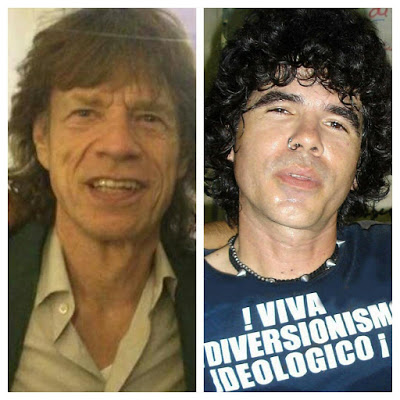
Mick Jagger Meets with Gorki From Porno Para Ricardo in Havana (NOT) / Fake News

2015-10-07_05.52.54Arsenio Rodríguez Quintana, Barcelona — On Sunday, October 4, after visiting the Cuban Art Factory in Havana, the Rolling Stones singer was walking with the rocker and Cuban government critic Gorki Aguila Carrasco along 5th Avenue, where the Ladies in White meet every Sunday and march in support of human rights in Cuba. Cuban State Security blocks Gorki from going to meet them, but last Sunday, the day of Orula, an orisha venerated in Cuba, the miracle happened. Gorki was wearing an El Sexto T-shirt that interested Jagger, who asked about El Sexto’s state of health after his hunger strike, and offered to buy some of his artworks to support him.

They also spoke about the possibility of Gorki opening for the Rolling Stones should the conversations with the Ministry of Culture for the Stones to play in the Karl Marx Theater bear fruit.

Now that so many American rock, pop and jazz musicians are coming to Havana, it is worth remembering that this city where I was born had home grown impresarios (from 1910 to 1959) that brought the best American or European musicians of their times to Cuba: Enrico Caruso, Nat King Cole or Lola Flores, for example.

The person who cut this ebb and flow between Havana and the world was Fidel Castro. For more than 50 years – except in 1978, another USA-Cuba political rapprochement, and in 1999. The Castro regime not only censored jazz and rock so that it would not come into Cuba, but also censored and imprisoned those who played it.

Jagger, regrettably was in Havana but he didn’t meet with Gorki, the news is false, but my dear friends Ailer and Lia Villares will perhaps smile at my autumn dreams from Barcelona.

Vandals Paint Che Statue with the Word “Murderer” / 14ymedio

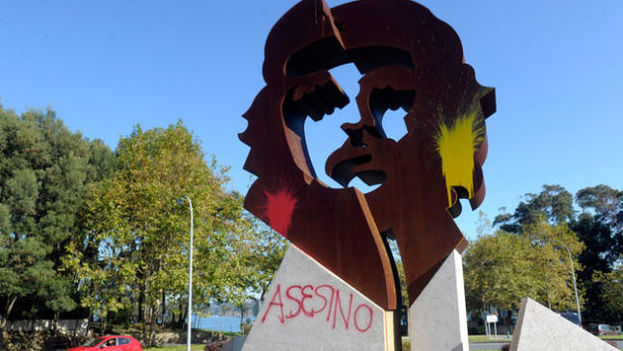
Paint on the statue of Che in the Galician town of Oleiros. (La Opinión A Coruña)

14ymedio bigger14ymedio, Spain, 26 October 2015 — At dawn on Sunday, a group of vandals painted the statue of Ernesto Che Guevara in the Galician town of Oleiros with the colors of the Spanish flag and the word “murderer.” This is the fourth attack on the monument since it opened in 2008.

The vandals, according to a local resident who alerted the police, acted around six o’clock in the morning and were wearing masks and coveralls. The attack, carried out with glass bottles filled with paint, came hours before a tribute to Che organized by several Portuguese, Galician and Cuban collectives to mark the 48th anniversary of the revolutionary’s death.

When the police arrived at the statue in Santa Cristina Park, the vandals had already left.

The mayor of Oleiros, Angel Garcia Seoane, branded them “idiots” and added that the modus operandi of the attack reflects the “behavior of cowards, during the night.” The councilman said the statue would be cleaned the next day.

On Sunday different groups of Cubans in exile and from the Association of Victims of Castroism, in addition to individuals, expressed their “repudiation” of the tribute in the face of a monument they called “illegal.” For them the monument is an “aggression against all the victims of Fidel Castro’s dictatorship.”

The first attack on the monument occurred just weeks after its unveiling. Both at that time and in August 2013, the 26-foot high statue was spotted with red and yellow paint.

In 2008, groups in opposition to the local Alternative Party government demonstrated against the monument’s construction and the 180,000 euro cost of building the roundabout where the work, donated by its makers, was placed.

Neighborhood Journalism in Cuba / 14ymedio, Rene Gomez Manzano

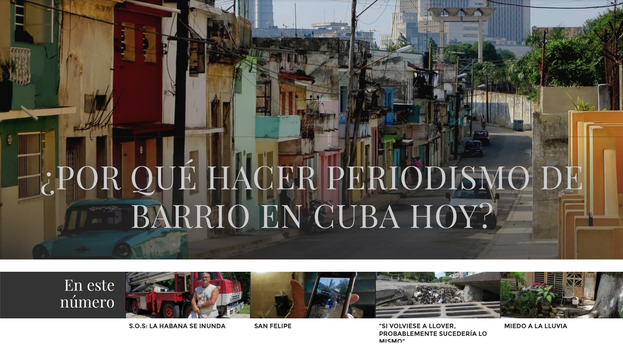
Homepage of “Neighborhood Journalism.” Headline: Why do Neighborhood Journalism in Cuba today?

14ymedio bigger14ymedio, Rene Gomez Manzano, Havana, 24 October 2015 — Thanks to the US Embassy in Havana, which provides press briefings with national and international news to us Cubans who navigate in their internet rooms, last Monday, October 19, I learned about a new information organ. Periodismo de Barrio (Neighborhood Journalism) is the name by which the colleagues engaged in it identify themselves.

The presentation of the new digital media starts with an appealing paragraph: “Journalism is an implicit promise of change. Presenting yourself as a journalist is almost like preaching in favor of hope. When you ask someone to tell you their story, it is not just asking them to confide in you, but also to believe that sharing their story can help to change something.”

According to its statement of principles, “Neighborhood Journalism is born with the objective of bringing to the public the stories of neighborhoods affected by natural disasters, or particularly vulnerable to phenomena such as hurricanes, floods, droughts, fires, landslides or others caused by man.” continue reading

A summary of the United States press fills more than 34 pages of the first issue. In addition, there are reports – of good quality including some that are excellent, although perhaps one might consider them late – dedicated to floods suffered by different Havana neighborhoods six months ago, during the torrential rains of last April 29.

It should be clarified that the colleagues of the new media have shown a special interest in not projecting themselves as against the established government in our country. In the presentation, for example, it is bluntly stated, “We do not accept donations from any institution that seeks – or has sought – the subversion of the Cuban political system.”

Are these journalists outside the system, but who do not want to stand out as being so? “Chemically pure” informers who do not want to identify themselves with any party agenda? Agents of a new pro-government initiative to make it seem that in Cuba the press acts freely? The broad access that Neighborhood Journalism enjoys to the Castro regime’s organs and officials could suggest the latter.

But the answers to these questions do not seem to have great importance. The purpose of truthfully reflecting the realities that confront our compatriots in the face of natural disasters deserve everyone’s applause. And it is fair to say that the compañeros of Neighborhood Journalism, to achieve this purpose, have displayed objectivity and professional skill. They do not follow the easy path of limiting themselves to proclaiming “the Revolution does not abandon its children.”

The series of reports begins with a piece by Geisy Guia Delis devoted to the work of the members of the National Search and Rescue Detachment, belonging to the Fire Department. It does not lavish laudatory adjectives or trite words on them: it focuses on the facts, such as – and this is just one example – the outstanding performance of a disabled rescuer, something that is perhaps exclusively Cuban.

From the expository point of view, it might have been preferable to start the delivery of Neighborhood Journalism with another of the reports. But we should not belittle different aspects of importance. Among them, the understandable aspiration to play it safe, leading off with a laudatory work which, regardless of the humanitarian effort undertaken, is about an arm of the Ministry of the Interior, an emblematic force of the system. One more way not to alienate the powers-that-be.

The second article is a report from San Felipe by Monica Baro: probably the best of the issue. It is amazed that the dispossessed of this capital neighborhood continue to suffer the calamities described in the report, trembling with anxiety whenever the sky clouds over and threatens rain with the consequent promise of certain flooding. And this more than half a century after the proclamation of the “Revolution of the humble, by the humble and for the humble”…

The colleagues of Neighborhood Journalism elude political allusions like the one I just offered, but it is not necessary to make them. They describe the reality and this, in its turbidity, is more eloquent than any adjective or declarations. We await their upcoming issues.

The Day Castro and Khrushchev Led the World to the Brink of Nuclear War / Ivan Garcia

Fidel-Castro-y-Nikita-Kruschov-en-las-Naciones-Unidas-septiembre-de-1961-_ab-620x330Ivan Garcia, 25 October 2015 — The eyes of eighty-four-year-old Roman Galvan come alive as he remembers the dark days of October 1962 when it seemed that Cuba would be erased from the map following what appeared to be an impending nuclear conflagration between the United States and the former Soviet Union.

Fifty-three years later, Galvan lives in a dilapidated state-run nursing home in La Vibora, a neighborhood half-an-hour’s drive from downtown Havana.

“In 1962 I was a militiaman. In October I was called to serve in a military unit in the east. Like a lot of Cubans, I had no idea what a nuclear war was. I was willing to die for what I believed to be a just cause. We were young and immature. What Fidel said was law,” recalls Roman. continue reading

He later fought in wars in the Escambray mountains and in Africa. While fighting to defend Marxist ideology and Fidel Castro’s ego, his family fell apart.

“My wife and I separated, my son spends more time in jail than on the street and I have lost track of my daughter. It wasn’t worth giving up my life for Fidel or the missile crisis or these other wars. But it’s too late now. I am old and counting down the hours,” he says as his blurry eyes fill with tears.

More than a million Cubans were mobilized in October 1962. According to official accounts, Nikita Khrushchev was planning to deploy twenty-four rocket launchers, forty-two R-15 rockets, about forty-five nuclear warheads, forty-two Ilyushin IL-28 bombers, a squadron of fighter aircraft, including forty MIG-21 aircraft, two Soviet air defense divisions, four mechanized infantry regiments and other military units; some 47,000 soldiers in total.

The operation was code-named Anadyr by the Kremlin. Castro, then thirty-six-years-old, was aware of the consequences he could face from the United States as a result of his reckless strategy.

It marked the height of the Cold War. Seventeen years had passed since the defeat of Nazi Germany at the hands of allied troops. By then, the destructive power of nuclear weapons was well-known.

Some 195,000 people were killed in Hiroshima and Nagasaki after President Harry Truman ordered the Enola Gay to drop two atomic bombs on these Japanese cities.

By 1962 the destructive power of these weapons was fifteen times greater. They were not mere toys. A responsible statesman would have calculated the severe consequences of initiating a baptism of fire by the world’s two nuclear superpowers.

When the Soviet Union collapsed in 1991, the country’s secret intelligence archives were opened and the stupidity of Fidel Castro and his leadership became clear for analysts and historians to see.

In letters to Khrushchev, Castro urged the Soviet leader to pull the nuclear trigger. At the time, Ernesto Che Guevara, the firebrand guerrilla from Argentina, wrote an article praising the attitude of the revolutionary government and challenging the Soviet leaders.

“It is a chilling example of a people willing to sacrifice themselves in a nuclear conflagration so that their ashes might serve as the foundations of new societies. When this happens and a covenant is made to remove nuclear missiles without consulting them, there will be no sigh of relief, no thanksgiving for the truce. They will jump into the fray to provide their own unique voice, their battle stance and their willingness to fight, even if it is alone,” wrote Guevara.

There were aspects to the missile plot of which Fidel Castro and his cabinet were unaware. Oleg Penkovsky, a lieutenant-colonel in Soviet military intelligence, code-named Agent Hero by the CIA, had informed the West of the Soviets’ strategic nuclear inferiority and Moscow’s plans for deploying missiles in Cuba.

As a result of the crisis, the United States and the Soviet Union decided to set up a direct telephone link, known as the “hotline,” between the White House and the Kremlin.

When subsequent negotiations to remove nuclear weapons from Cuba were conducted, Khrushchev sidelined the swashbuckling Fidel Castro. The October Crisis is a compelling parable about the irresponsibility of the island’s military regime.

The main actors in this drama are either dead or awaiting God’s call. The supporting players, like Roman Galvan, are living out their last days in ramshackle homes for the elderly.

Photo: Fidel Castro and Nikita Khrushchev meet for the first time at the United Nations General Assembly in New York in September 1962. From Pinterest.

Cuba, A Country Without Thermometers / 14ymedio, Luz Escobar

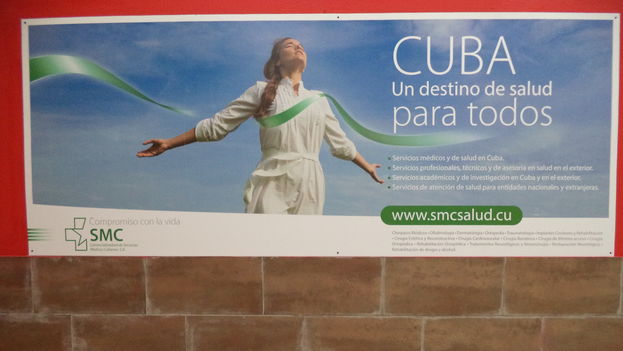
Promotional posters for Cuban Medical Services in the departure terminal at Havana’s Jose Marti Airport. (14ymedio)

14ymedio bigger14ymedio, Luz Escobar, 25 October 2015 – There are few grandmothers left who simply put their hand on a grandchild’s forehead to find out if he or she has a fever. With the widespread availability of body temperature thermometers in the home, this peculiar gift has been lost. Now it is imperative to have this little gadget that uses mercury or batteries, which, nevertheless, has been in short supply or entirely missing from Cuban pharmacies for years.

Maria Esther is a modern grandmother: “I grew up with thermometers and home phones as normal things,” she says with the pride of a woman born in the 20th century. Last week she was left in charge of both of her granddaughters and the little one started to show symptoms of the flu. Hours of calling stores, pharmacies and clinics shocked her with the hard reality: there are no thermometers for sale in Havana. continue reading

Asking at a pharmacy in the Cuban capital for this gadget of glass and quicksilver is like inquiring about an object from outer space. Faces of surprise and laughter are the employees’ response if a customer is looking for thermometers. At the clinic at the corner of Concordia and Campanario streets in Central Havana, a clerk told the frustrated buyer categorically, “We haven’t had any of those here for years,” like someone reporting the last sighting of an endangered species.

The customer, before leaving, resigned, took the opportunity to ask, “This medical power of a country, that sends doctors to fight Ebola… but doesn’t have any thermometers to check a simple fever…” Other customers silently nodded. Just a week ago official television confirmed in an extensive report the drug shortages threatening the country.

According to Barbara Olivera, head of the Operations Department of BioCubafarma, some 60 drugs classified as the “basic health core,” mainly those used to treat cancer, have disappeared from the national pharmacies. This is due to “accumulated production arrears since 2014,” the official said.

The loss of some foreign suppliers of raw materials and the “diversion of resources” [as employee theft is called in Cuba] were other causes identified for the shortages. Thermometers are not made in Cuba. They are imported from China, and are the mercury type, although many countries prohibit their use. They cannot be sold in Europe as of 2007, although they were sold in Spain until April 2009.

The national press harshly criticized the situation with medicines, but did not say a word about other products such as tape, elastic bandages, or bandaids. The Cuban people are so used to such shortages that you barely hear any complaints about the difficulties of getting something as simple as gauze, syringes, swabs or cotton balls.

Many resolve the problem by asking their relatives abroad to send them a thermometer. “At home, a couple of years ago, we had one sent to us by a cousin in the United States, but it was in Fahrenheit,” says Lourdes, 51. “I never understood how to convert to Celsius but we knew that over 100 degrees was a fever; but we can’t use it any more for lack of batteries.”

Even in the clean, well-stocked and air conditioned international pharmacies that sell in hard currency it’s not easy to find one. When they appear, the price ranges between six and ten CUC (approx. $6 to $10 US), according to the manufacturer, for sophisticated digital thermometers. In the pharmacies that sell in Cuban pesos those available are the mercury type and sell for three Cuban pesos (about 12¢ US).

But having hard currency guarantees nothing. In the Casa Bella store in Miramar, the helpful clerk says they don’t haven’t had thermometers for months and in response to a question says, “Don’t take the trouble to call others, they aren’t available in any pharmacy.” Behind her, a sign announces “excellent service.”

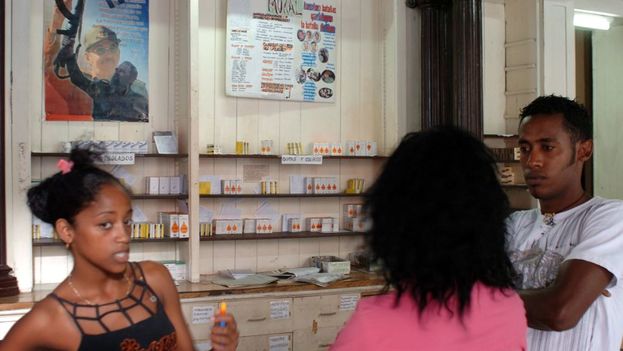
Pharmacy in Havana (EFE)

Customers at the Taquechel y Sarra tourist pharmacy, located in the historic center of Havana, receive the same response. “Beautifully restored, but few medicines,” says an old woman bitterly, on coming to buy pills for heartburn and leaving “stunned” by the prices.

The capital experiences only part of the problem. In June of 2014 in Granma province, the thermometer crisis reached a point where they didn’t even have them in the emergency rooms in the hospital network. However, people in the province could by them in the black market for 10 Cuban pesos. A similar situation occurred in Santa Clara, where some pharmacy clerks said the product hadn’t crossed their desks in more than 20 years.

Now the shortage has spread to all provinces of the country, as confirmed by this newspaper. In Pinar del Río an employee said that sometimes you could find digital thermometers in an entity of the Ministry of Public Health which she identified as “medical purposes” for a price of around 100 pesos. But “for a while now they haven’t had them,” she said.

The problem remains six months after the deputy health minister, Alfredo Gonzalez, assured the official press that Cubans would be able to buy such products “more easily” this year. Even Roberto Morales himself, Minister of Public Health, said they were taking the first steps, although they would not be able to meet the demand for the current year.

‘El Sexto’ Marches with the Ladies in White This Sunday / 14ymedio

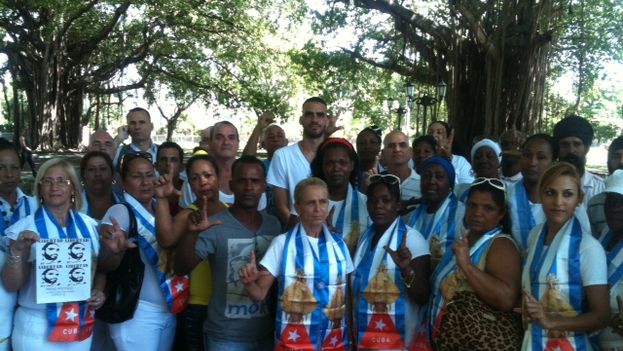
The artist Danilo Maldonado, ‘El Sexto,’ marched with the Ladies in White this Sunday (Photo Angel Moya)
The artist Danilo Maldonado, ‘El Sexto,’ (the tallest person in the photo) marched with the Ladies in White this Sunday (Photo Angel Moya)

14ymedio bigger14ymedio, Havana, 25 October 2016 — The artist Danilo Maldonado, ‘El Sexto’ (The Sixth), joined 48 Ladies in White during their traditional walk down Fifth Avenue in Havana this Sunday. Released last week after ten months in prison, the graffiti artist accompanied the women and about twenty activists who gathered outside after mass at Santa Rita Church.

Also participating in the march were Jose Daniel Ferrer, leader of the Patriotic Union of Cuba (UNPACU), along with the families of the three activists arrested while trying to approach Pope Francis during his visit to Cuba. The regime opponents Zaqueo Baez, Ismael Boris Reñi and the Lady in White Maria Josefa Acon are still being detained, after having been arrested on 20 September at the Mass in the Havana’s Plaza of the Revolution.

In the east of the country, UNPACU reported more than 80 arrests today to prevent individuals from reaching the Sanctuary del Cobre. In Havana, after the march, more than 50 Ladies in White and activists were arrested.

Happy on the Outside but Worried on the Inside / Somos+, Javier Martinez Delgado

Somos+, Javier Martinez Delgado, 22 October 2015 — Since 1959, when the Castro brothers hijacked a triumphant revolution that was thought to be democratic, the Cuban government has portrayed the United States as the country’s main enemy. All our economic, social and political misfortunes over the next fifty-five years would be blamed on the “restless and brutal empire,” at least until now.

Many people thought that December 17, 2014 would mark a new chapter in relations between our two countries and in some ways it has. However, the Cuban regime continues to blame its economic failures as well as its violations of civil and political rights on the same enemy: the never-ending US embargo, known in Cuba as the blockade. continue reading

One might think that 2015 would bring about improved economic and social conditions, and a gradual breakdown of repressive actions by the one-party state, but just the opposite has happened. Now who is to blame?

The US blockade? Yes, according to Esteban Morales. For those not familiar with him, Morales was director of the Center for United States Studies at the University of Havana, a Doctor of Sciences and, as a political insider, one of the people most knowledgeable about relations between the two countries.

After December 17 — or 17D as this new phase in relations between Cuba and the United States is known — Morales was present at the official opening of the US Embassy in Havana and has written several analyses explaining the positions of the two countries towards the negotiating process.

We can glean from published comments on Cubadebate and the blog The Insomniac Pupil that, in his view, the current US blockade must be completely lifted before we will see effective measures coming from the Cuban government. He writes, “…the measures taken so far by the Obama administration have not even scratched the lock. Clearly they are intended to empower those sectors of Cuban society, which — as we know — think such measures could encourage domestic political change in Cuba.”

Since December 17 the American administration has taken unilateral economic measures, largely related to the expansion of opportunities for travel to and from the island. But it has not been the only change. We are no longer on the list of state sponsors of terrorism, thus reducing the possibility military intervention, an ever-present topic of government rhetoric. Several politicians and economists have also visited the island as part of advance preparations for what are expected to be closer relations. Nothing, however, seems to be enough.

Certainly, most of the measures taken by President Obama have not affected the lives of average Cubans. The embargo remains powerful and most of the punitive measures adopted by the American government are still in place. But there are questions I ask myself.

Has the Cuban government taken any measures to relax the internal blockade? Has it reduced the price of cars rotting away in Havana dealerships? Has it raised the minimum wage for professionals? Has it taken effective measures to allow freedom of the press, of assembly, of opinion? Has it accepted calls for universal internet access? Has it granted a role to Cubans under new foreign investment laws? The answer to all these questions is NO.

17D began as a duet. Although Mr. Morales’ arguments sound too much like those overbearing speeches we have been hearing for fifty years, he could not be clearer when he says, “As long as Obama does not take measures to start seriously lifting the blockade, the sooner the better, I am sure Cuba will pay no attention or react to such limited and unilateral measures, which are directled solely at those sectors Obama wants to empower.”

The Cuban government uses the blockade as a cover to hold onto power, to justify unpopular measures, to silence the opposition, to unjustly arrest those who dare to express an opinion, to denigrate the thousands of young people — those who want to see change — by calling them mercenaries while the leaders of the Revolution live like millionaires.

By not taking steps to improve the lives of Cubans on the island, the system is choking itself. The American administration takes unilateral steps while domestically the Cuban regime maintains and strengthens its own internal blockade on society.