New Reforms to Emigration Policy? / Laritza Diversent

Although recent legislative changes to immigration laws in Cuba represent a step forward, they still retain aspects that are political and restrictive in nature and in violation of the right to free movement.

The changes to immigration regulations do improve the legal wording and drop any reference to entry and/or exit permits and to the letter of invitation, which had been a tacit acknowledgement of Cubans’ inability to travel from an economic point of view.

In practice the situation remains the same. The requirements of most of foreign embassies located on the island and the high fees charged for travel documents, which must be paid in hard currency, make the possibility of traveling overseas an impossible dream for most Cubans.

However, new policies have been put into effect and new categories have been created. In residential real estate, for example, guarantees are now being offered to foreign residents and their families as well as to owners and renters of real estate on the island.

The state is clearly focusing on sectors with economic potential: foreigners and emigres. The latter are being given the opportunity to reclaim a residence on the island and with it the right to take part in elections, become self-employed, buy cars and homes, etc.

However, the possibility that the Ministry of the Interior might grant this right to Cubans living overseas — to people not physically living in the country — no doubt means that it will choose which emigres shall and shall not regain their rights.

16 June 2014

There’s No Room, Wait Outside / Julio Cesar Alvarez

Gatehouse clinic in Central Havana. Photo courtesy of the author.

HAVANA, Cuba — Doctors working in the clinic located within the gatehouse of Central Havana Children’s Hospital refused medical treatment to a three-month-old infant named Alexander because his parents refused to comply with an internal policy of the hospital.

The policy allows only one parent to be present in an exam room. According to the doctor and nurse on duty the lack of space in the rooms is the reason for this policy.

According to Dr. Mario Lorenzo Medina, vice-director of health care at Central Havana Children’s Hospital, overcrowding in the consultation rooms was the reason why only one of the parents could be present.

“My doctors don’t have the room. They work in crowded conditions,” the director told the infant’s father. continue reading

For the parents — 25-year-old Yanela Durán Noa and Augusto César San Martín, an independent journalist — this policy violates the right of both parents to be present during an examination of their son.

The director of the hospital politely acknowledged this right but said that the policy would remain in effect until working conditions for his doctors improved. If parents refuse to comply, they are denied access to an exam room.

Dr. Giselle from the Coco and Rabí clinic in the 10th of October district is of the opinion that the rights of the parents trump any other consideration, especially a hypothetical lack of space.

The nurse who denied medical assistance. Photo courtesy of the author.

“The patient is always right. There is no significantly compelling reason to deny him care,” says Giselle.

For the father, not only was the directive an embarrassment, but so too was the treatment by the clinic’s medical and nursing staffs.

“They didn’t even ask why we brought the child in. The doctor and nurse refused to treat him. And when I asked for their names in order to file a complaint, they rudely told me that I was not the police,” says Augusto César San Martín.

Cuban doctors travel to inhospitable locations in order to provide medical care in very difficult conditions.

Photo: A dog sleeping in one of the clinic’s exam rooms.

While on these international “missions,” they work in open-air exam rooms under conditions of both sun and rain. They do this without objection and without a word of complaint. Even snakes pose no barrier to their work overseas.

The parents in this case consider denying them entry because of an alleged lack of space to be absurd since the policy is followed even when the rooms are empty.

Alejandro’s parents filed a complaint with the Ministry of Public Health almost two months ago. They have yet to receive a reply.

Cubanet, June 23, 2014, Julio Cesar Álvarez

14ymedio As Viewed by the International Press / 14ymedio

How the worldwide media reported on the birth of this newspaper and its subsequent censorship on the island

14ymedio, June 21, 2014

Hours before 14ymedio was born, the Spanish newspaper El Mundo published a column by Gina Montaner, “14ymedio’ against ’55ymedio” contrasting the name of our yet unborn daily with the long years that the island lived submerged not only in a lack of information, but also under institutionalized disinformation. Montaner emphasized one of the challenges to the Cuban press, so different from those faced by the international media: “In Cuba everything is up for grabs and the real revolution—the technological one accompanied by freedom of expression—is one of the great challenges of the post-Castro period.” The Cuban journalist added: “If Cubans get access to ‘14ymedio’, it will be a breath of fresh air compared to the nauseating ‘Battle of ldeas’ of the government media.”

A few minutes after 8 a.m. Cuban time this past May 21st, 14ymedio was visible in all the countries of the world. But on the island it could only be seen for a little over an hour. Then, our website was diverted to another address where they tried to discredit the director of 14ymedio. continue reading

The international press reported this blockage. The prestigious American newspaper The Wall Street Journal ran a headline on the 22nd, “ Cuban Dissident Starts Website, Which Is Promptly Hacked.” “Cuba’s government explicitly bars any printed material that it interprets as a threat, so there are no independent newspapers,” noted the newspaper. But despite the lack of internet access in the island, said the writer, the new website “poses a direct challenge to the Cuban regime’s almost total control of information.”

A day after the 14ymedio blockade the Inter-American Press Association (SIP) issued a statement denouncing the situation, which was reproduced by several outlets, including El Nuevo Herald. “While the measure is not surprising, the world expected more tolerance from the government of Raul Castro, considering his efforts to show a more positive, more open image in order to garner more respect from the international community,” it said in a statement setting out the SIP’s views on freedom of expression.

The blockade was lifted briefly on May 24, the day of the publication of a long commentary in the newspaper Granma, which denounced the “project of the counterrevolutionary blogger Yoani Sánchez to create a digital media outlet.” Several international media outlets reproduced 14ymedio’s tweet encouraging Cubans to “read us before the next blockage,” which indeed occurred a few days later. Since then Cubans have had to go back to this newspaper by anonymous proxies that hide the IP of the computer, to prevent the identification of the source of the connection.

On June 2nd the Nuevo Herald of Miami spotlighted the “battle against censorship” in a series dedicated to 14ymedio. Further from our borders, various European media announced the birth of 14ymedio: the British BBC; El Pais in Spain (which published a report last May 22 titled “Birth of the free press in Cuba” and on June 15 interviewed its director); and La Repubblica in Italy, among others. The leading French newspaper, Le Monde, also ran a note to explain the blockade suffered on the island. The title it chose, “Cuba: le premier média numérique bloqué independant dès are lancement” (“Cuba’s first independent online newspaper blocked at its release”), angered some of the independent publications that came before, but from the outset 14ymedio has acknowledged the work of its predecessors.

In Mexico, the daily La Razon devoted considerable space to 14ymedio, reprinting an article most representative of the its writing as part of a piece titled “They Have Resources for a Year and 11 Journalists.” “The editorial staff is composed of 11 persons including Yoani and her husband, Reinaldo Escobar, a journalist with extensive experience, who worked with the official press, but left 30 years ago. Other team members are young Cubans, mostly under 30 years old,” said the newspaper, which also republished the first story run in 14ymedio, “Red Dawn: Havana is Killing Out There.”

Translated by Tomás A.

The Modest Growth of the Cuban Economy Falls Short of Expectations / 14ymedio

14ymedio, Havana | June 23, 2014 — The Cuban economy is growing at a rate slower than the official forecasts, according to data announced by the Minister of Economy and Planning, Adel Yzquierdo Rodriguez. He said that during the first half of this year the GDP (Gross Domestic Product) will increase by just 0.6%, but will improve during the following months to an increase of 1.4% by the end of the year. However, independent analysts question these expectations and believe they are not a realistic reflection of the state of the economy.

The Cabinet last Saturday presented details about “the difficulties that continue to damage the Cuban economy.” Rodriguez blamed the failure of the Plan’s objectives on the “adverse weather conditions” and “the complex international situation.”

The Minister of Finance and Prices, Lina Pedraza Rodriguez, noted a substantial drop in productivity in 124 companies, which had planned a positive balance but ultimately had losses.

At the meeting, the ministers also addressed the issue of monetary unification. The head of the Permanent Commission for Implementation and Development, Marino Murillo Jorge, explained that this measure “will not by itself solve all the problems of the economy,” but requires the implementation of other policies aimed at increasing the efficiency and level of productivity of labor.

In addition, the officials said that, at the end of May, around 467,000 people were self-employed, but they have not provided any statistics on the high number of the self-employed who have ceased their activities.

Translated by Tomás A.

“Casting” for Employment/ 14ymedio, Yoani Sanchez

Yoani Sánchez, Havana, 25 June 2014 – Eugenia lost her job of thirty years in an office of the Ministry of Transport. She was left “available,” according to the declaration of her bosses, before they offered her a job as a bricklayer. Reluctant to lay bricks and mix mortar, she launched herself on the private market to see what she could find. Her possibilities were few. She doesn’t speak any other languages, she’s never touched a computer, and she doesn’t have the “good looks” of youth.

A friend signed her up on a digital site to look for work. “We don’t accept people with dentures,” said the first interviewer when she went for a job cleaning a house rented to foreigners. The owner of the place wanted “a clean woman who doesn’t talk very much, doesn’t smoke and looks strong.” She hired someone else and Eugenia decided to invest in her physique.

She dyed her hair, bought new shoes, and made the rounds of several cafes and restaurants in Central Havana. Over fifty, almost all the places responded the same, “we already have people in the kitchen and you won’t do for a waitress.” Eugenia noticed that behind the bars or waiting tables in the new privately run places there are almost always young thin women with prominent busts. continue reading

“You are from Havana, right?” she was asked at a place where they contracted with people to wash and iron. Eugenia was born in Holguin and spent nearly her entire life in the Cuban capital, but the owner of the laundry said she wouldn’t do. “We want Havana people, so there will be no problems with relatives who come and want to stay in the house.”

A neighbor told her about another possibility, caring for an old man. He was retired military and could barely get around in a wheel chair. “You can’t say anything bad about the Revolution in front of him,” warned the children of the old man, who had to feed him, change his clothes and read him the Granma newspaper. In the end, Eugenia also failed to get that job.

For a few days she managed to care for a child, but it was only a week because, “if you can’t sing and don’t know any children’s games my son gets bored,” the mother of the little boy told her. Eugenia only knows how to fill out forms, attach stamps, and nod her head affirmatively during the long meetings that were held at her company. She can’t compete in today’s job market.

Yesterday she heard about a job scrubbing in a private restaurant. “You can’t leave the kitchen during work hours,” the cook told her. “It’s better if the customers don’t see you,” he repeated, before confirming that she was “on a trial basis.”

It Isn’t What It Seems / Rebeca Monzo

On my planet the abnormal is normal. For example, when we go shopping — whether it be in those dark, poorly ventilated stores, whose scant merchandise is priced in CUP (Cuban pesos), or the well-illuminated, air-conditioned hard currency stores, whose somewhat greater selection is priced in CUC — we are met at every step with surprises.

A few weeks ago a friend who was visiting brought us some wonderful bread sticks, which had been purchased at one of the Silvain stores. They came wrapped in an enormous plastic envelope much larger than the product it contained. When I looked more closely at the package, I noticed it carried the Caribbean Queen label, an indication the packaging would normally be used for shellfish.

Last week there was a knock on my door from a “dark bag” vendor I know, who was selling lobster tails. They came wrapped in a plastic package identical to the one containing the bread sticks.

None of this is surprising. They are simply examples of the “details” we have been experiencing for many years now. We have become so accustomed to them that they seem perfectly normal. continue reading

In the 1980s some doctors wrote prescriptions on the backs of paper labels from cans of Soviet condensed milk. It was also quite common for Fiesta shampoo (the only kind available in those days) to come in the same amber-colored bottles used to package household cleaning solution. It was also the era of conjoined products (the kind that were not easy to move). In other words if you needed deodorant, you had to also buy a machete and a can of shoe polish because the three were sold together, or “conjoined.” Fortunately, that phase had passed by the mid-1990s when dollar possession was decriminalized and hard-currency stores were opened.

But we are still subject to inappropriate packaging of some products sold in both currencies. What is one to do? We already know that socialism is not perfect! In spite of comrade Murillo’s insistence to the contrary, what is quite clear is that this is not really the option we Cubans would prefer. To dispel any doubts, he should just drive his brand-new car past the embassies of any number of countries, slow down, lower the tinted windows and take note of the long lines of citizens crowded outside the consulates, applying for visas in an attempt to “escape.” Many of them are the same people who fill the plazas, answering “the call of the Revolution.” As one might conclude, not everything is as it seems.

24 June 2014

Prats Sariol: “To Write About the Cuban Reality is a Duty” / Luis Felipe Rojas

1402916595_img_0574

I hadn’t seen José Prats Sariol since 1997, when he offered a lecture on Phenomenology in the conference room of the School of Arts at the University of Havana. Seventeen years later he came to Miami to talk about the great poet Gaston Baquero, at the invitation of the Pen Club of Cuban Writers in Exile, and Saturday afternoon, June 14, he spoke to us of Gaston… and Cuba. The author of the novel Mariel (1997), the studies contained in Criticizing the critic (1983), The Artizada Matter, and others, presented the talk Gastón Baquero, poetic singularity.

“The fact that Gastón (an anti-communist, labeled with the epithets of ’Batista supporter’ and ’Franco supporter’) wrote a seminal text like “With César Vallejo in Paris — when it rains” is a ’singular’ event, if we see that Vallejo was a community who was the direct opposite — ideologically — of the Cuban who had to go into exile, after the pressures put on him by the ’Cuban Revolution,’” said Prats Soriol.

“Both lived in the same street, in the same block, on the same sidewalk in Madrid that harbored them, and only a sensitivity so high, this singular detail, would make one find the other. The singularity is that in this small deviation in which you say: this is different, it makes it singular. It is one of the problems of poetry today, and it greatly resembles that,” continue reading

he said.

1402916596_img_0584The meeting featured the voices of the poets Orlando Rosardi and Angel Cuadra reading a poem by Baquero. At the end of each piece Sariol talked about the author of “Discourse of the Rose in Villalba,” about how Gastón came to Origins Magazine and how he later influenced the poets who followed him. But for Cuba, the current professor at the University of Arizona, offered an aside.

Cuba is a duty

Cuba is the passion of this Doctor of Philology who has crossed the waters, the classrooms from Havana, Mexico to disembark with his lessons and poetic approximations “in the Arizona desert.” However, he admits that he would like to bring the map of everything produced on the island.

“Sadly, many things escape me, books, authors. I could talk with a certain authority about the generation of Origins, the generation of the 30s, but when I want to advance a little bit more, for example your generation, I start to slip. And why? Because of ignorance, because I don’t have access to the books. I met Magaly Alabau here in the United States, what ignorance, a critic of Cuban poetry who hadn’t read Magaly Alabau. I never had access to her, I didn’t kow her, although later I read her books, she became my friend.

“Prats, why haven’t you written about Magaly Alabau?”

“Out of ignorance,” I answered myself.

“As long as the dictatorship exists, it’s a duty for me. Of course I respect opinions, that other people aren’t interested, but for me it’s a duty as a Cuban to write and offer my point of view about the situation in Cuba, and I include all Cubans,” he concluded.

16 June 2014

Cuban Mission in Venezuela in Danger / Juan Juan Almeida

They add up to thousands, the Cubans, health professionals, who have been sent to Venezuela since the first Cuban Medical Mission landed in Caracas December 16, 1999.

Our technicians, doctors, nurses; they continue and will continue fulfilling the Hippocratic Oath in the South American country and the sacred duty of offering medical attention to all who need it.

The enthusiasm of the first collaborations has eroded, today all the personnel of the Cuban medical cooperation seem to be transitioning to a bad moment, full of insecurity and uncertainty, because among many other situations, they confront the discontent of a wide sector of the population.

So shows a classified report dated last Friday, June 13, signed by Dr. Victor Gauter, chief of all the missions, and sent with urgency to the Cuban Public Health Ministry. continue reading

The document in question asserts that in the Carabobo state alone, located in the north central coast of Venezuela, in a central region of the country, in the first week of June, that is to say, from Sunday the first until Saturday the seventh, the following points were given which I quote verbatim because of their importance:

– Nine Cuban cooperators were threatened by Venezuelan nationals. Among the main causes of these threats are the relationship of a couple of married nationals and political issues.

– Two collaborators deserted, one stomatologist and one a rehabilitation technician from Valencia township.

– Five volunteer workers were attacked in different townships of the State.

– Two popular medical offices were stoned, one in the Valencia township and the other in the Naguanagua location.

– In the Bolivar and Marti CDI, located in the Guacara township, they hung posters that said, “Cubans out.”

– At the “La Libertad” stomatology clinic, ASIC Bolivar, also in the Guacara township, they opened a hole in the wall and they stole all the instruments and halogen light from the display case.

– Eight collaborators were urgently hospitalized on presenting symptoms of dengue fever.

It is a lot for only one state, and too much for a week. But before such concrete events, with clear traces of a serious conflict that looms, the directors from Havana responded with their habitual irresponsibility and, without abandoning the repeated formula of false humanism, they sent an official who travels states with the mission of recruiting personnel in order to form groups of Cuban computer experts linked to social networks who will flood Twitter uploading photos of achievements and “red Sundays.”

Come on, as if real problems could be controlled with visual solutions. We should not forget that the damages caused to people, with the sole objective of politicizing, have not only consequences but also guilty parties.

Translated by mlk.
18 June 2014

The Trumpet Player’s Sad Ballad / Luis Felipe Rojas

Rogelio Betancourt shows his passport in Castilla Plaza in Madrid, June 2014. / M. G.-R.

According to El Pais, “Rogelio Betancourt Suárez no longer lives on the streets of Morocco. After 11 months of facing the daily uncertainty of knowing whether he will find something to eat or a place to sleep, the Cuban trumpet player has managed to overcome the Stations of the Cross that had become his life. Betancourt has managed, finally, to cross the Spanish frontier and has left behind the legal limbo in which he found himself.”

20 June 2014

State Security Summons Estado de Sats Members to “Warn” Them About “For Another Cuba” Graffiti

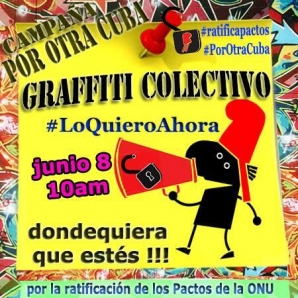
Campaign for Another Cuba. Graffiti Collective, #WeWantItNow, June 8 at 10 am, Wherever you are!!! For the ratification of the UN covenants/ (Estado de Sats)

Several members of Estado de Sats were summoned by State Security to a Havana police station this Saturday, to “warn” them about the Grafiti Colectivo Por otra Cuba, organized by the independent project for this Sunday, to support the campaign demanding that the Government ratify the United Nations covenants that it signed in 2008.

“They wanted (…) to threaten us, as always, and to say that they would not allow any type of action,” the visual artist Lía Villares told Diario de Cuba.

“I told them it was an international action, a global movement in support of the campaign, and that they couldn’t prevent what was happening in different parts of the world,” she added. continue reading

Two years since the start of the campaign, Estado de Sats has proposed “simultaneous and collective graffiti,” within and outside Cuba, of the For Another Cuba logo, created by the graphic artist and caricaturist Gustavo Rodríguez (Garrincha).

Also “to document the actions and post photos and videos on social networks, to make this ’collective graffiti’ a media success in support of the message For Another Cuba.”

In addition to Villares, also summoned were the photographer Claudio Fuentes, the writer and independent journalist Camilo Ernesto Olivera, and the activist Dixán Romero, who did not appear because of irregularities in the summonses.

“I went out wearing a shirt with the campaign logo and they were so upset, evidently so disturbed, that they talked to the logo, not to me,” related Villares, who was “warned” by two officials.

“I asked them why they don’t combat corruption, delinquency, why a person like myself sitting there at three o’clock on a Saturday afternoon (…) why they were doing this work while the country was falling apart. But that didn’t interest them, they wanted to deliver their threatening and intimidating message,” she added.

The Campaign for Another Cuba demands that Havana ratify the United Nations covenants on civil, political, economic, social and cultural rights.

Diario de Cuba, 8 June 2014

Setting the Record Straight* / Rafael Leon Rodriguez

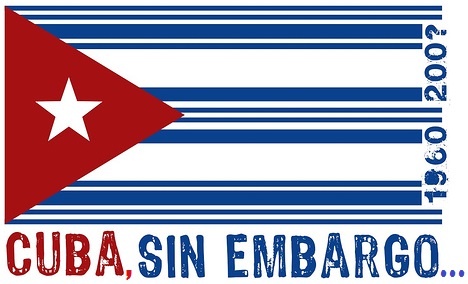
“Sin embargo” (literally “without embargo”) means “however” in Spanish. Image: http://youngsday.com/

In recent years, every time the issue of Cuba comes up, whether in relation to the transition to democratic freedoms or to other topics of a political nature, from any place in the world, our repressed national island passions are unleashed. It doesn’t matter whether it’s about a concert at the Civic Plaza** in Cuba, such as the one held in 2009 by Juanes and other artists, or, as now, it’s about a letter with proposals to the President of the United States on Economic Issues.

The reactions for and against, beyond the extremes, show a plurality of opinions from Cuba’s emerging civil society. And this is logical, since democracy is essential plural, as the peaceful opposition is plural, in opposing the only thought embodied by the half century military dictatorships that remains in power in Cuba.

The letter referenced, signed by forty Cuban and American personalities based outside the island, invited President Barack Obama to east some of the restrictions imposed by the American embargo on Cuba. This set of long-standing laws, in our opinion and in the opinion of the majority of the countries of the international community, have been counterproductive for the Cuban people in every sense, justifying and strengthening in different ways the human rights violations of the Castro dictatorship, such that maintaining it is a difficult case to defend. continue reading

With regards to the text of the missive, focused primarily on aspects of the market and not on human rights, at least places in the public arena the agenda of the necessary and urgent changes in our archipelago.

The changes produced so far, determined by the new guidelines of the Communist Party and the Revolution, clearly point to an economy of state capitalism which guarantees the dynastic succession, under the processes of the so-called 21st Century Socialism. Thus they flirt, supposedly through the markets, with the merchants. But, as we already know from experience, real socialism can only be patched up, and participative democracy is the only form which is truly perfectible, and it is in that direction, without a doubt, that we must turn our course.

In December 1996, the Cuban Democratic Project (Proyecto Demócrata Cubano, or Prodecu) in an open letter to the U.S. government states: “It is a fact that the political acts of the leaders of the United States of America have influences and, at times, determined, the history of the Cuban people over time. The last four decades have not escaped this reality.”

And it asked that, “the authorities of the government of United States of American accept the proposals of the Cuban government to initiate unconditional talks with the purpose of negotiating the Cuban-U.S. dispute.”

It is this formula, of negotiating, that is the only one that can bring us peacefully to democracy, justice, and the rule of law. The essential elements are synthesized in the letter from the forty.

Translator’s notes:

*The title “Singing the forty” is a play on words. In Spanish the expression (from a card game) means “to read the riot act” or “to set the record straight”; Rafael is also referring to the forty (in fact, 44) signers of the letter to Obama.

**”Civic Plaza” is the original name of what is now called the Plaza of the Revolution.

10 June 2014

Antunez Under Cautionary Injunction / 14ymedio

14ymedio, Placetas | June 22, 2014 — The activist Jorge Luis Garcia Perez, known as Antúnez, was released last Friday with an injunction that prevents him from leaving the municipality of Placetas without permission. His arrest last Sunday at 10:30 p.m. generated many expressions of concern and solidarity from the Cuban dissident community.

The activist must answer in court for an alleged crime of “public disorder,” for which a file was opened in preparatory phase, case number 651 2014. Initially Antúnez was threatened with being charged with “contempt for the figure of Fidel Castro,” but that charge was later discarded.

If he fails to obey the injunction Antunez could be imprisoned. His current legal situation also prevents him from traveling outside Cuba.

Translated by Tomás A.