Note: This documentary has been around for a while, but for those who haven’t seen it, we are reposting it here. Several of “our” bloggers appear: Juan Juan Almeida, Laritza Diversent, Gorki Aguila, Ciro Diaz, Yoani Sanchez, Orlando Luis Pardo Lazo, Claudia Cadelo, Dagoberto Valdez, Reinaldo Escobar, Eliecer Avila.
Month: August 2013
The Political Burden of the Dictatorship after the Dictatorship / Miriam Celaya
Days ago, I had the opportunity to read a smart and funny article by Eugenio Yáñez, in which, based on the age of the highest representatives of the government, the writer was questioning the “youth” proclaimed by Castro 2 in his recent speech for the 60th anniversary of the assault on Moncada barracks. Almost at the end of that article, Yáñez successfully launches a judgment referring to the olive green gerontocracy still in power in Cuba: “Instead of trying to distort reality, it would be better to clear the way for new generations that will do it better, because it’s impossible to do it any worse”.
The extent of the case, as simple as it is accurate, brings to mind a debate a couple of years ago with several of my friends that focused on a discussion about who could be the alternative political actors we might consider for the presidency of a Cuba in transition. On that occasion, there were very interesting analyses around opposition figures and programs of the most diverse leanings and positions, including the dissident spectrum from the last part of the ’80s decade until today. The opinions of those debating were, of course, also very different and emotional at times.
I will not fall into the naïve temptation of retelling a version of that reunion here, or the viewpoints of each participant because, after all, it was not about trying to decide the Cuban transition in a simple dialogue among friends, nor does Cuba possess the necessary minimal conditions for freedom and democracy, political maturity or enough civility, even among the dissident ranks, to tolerate criticism or opinions that are different from their own evaluations. In fact, almost every figure carries within him the messiah virus or the belief that he eats the egg of absolute truth for breakfast every morning, and only the more honest ones, the best, have the ability to recognize the evil in their own hearts, and to keep it duly restrained and not allow it to expand and dominate them. Even the people seem to interpret the criticism of any leader or program as a divisive attempt. Often, people seem to need idols more than freedom itself.
But back to the question, the fact is that at that unique and unforgettable meeting attended by several intelligent and acute individuals, the idea that raised the most debate was that of a fellow member who closed the circle, declaring: “Anyone who is democratically elected and supports civil liberties conducive to the exercise of all human rights will do as president for me, since, if that were the case, we would be guaranteed the right to criticize him, to speak out against his administration, to demand, to force him to listen to demands and, within a reasonable period of a few years, to remove him from office in new elections if he doesn’t meet the voters’ expectations”.
I must confess that at that time I wasn’t 100% on board with his proposal, though I could understand he had made a good point. Maybe I was driven by distrust in imagining what the performance of certain shady characters would be when anointed with legitimate power leading the destiny of a nation in the turmoil of a transition that will undoubtedly be difficult. That prospect terrifies me still.
However, Yáñez’s article has made me think about the Cuban reality and once again taken me back to that memorable gathering where, as so often happens, a group of friends discussed the hypothetical future of a democratic Cuba. That friend and Yáñez are both right: the Castro regime has deliberately performed so badly that no one else could do it worse, not even the worst of the worst hidden kingpins we have in every sector of Cuban society. But, to elect “the wrong thing” so we won’t have the worst one, doesn’t sound to me like a good political sense.
Definitely, in the presence of a democratic election, I would not vote for just anyone. However, due to the stubbornness of the eternal Moncada octogenarian boys who cling to power, I can’t help but to recognize that any other option would be preferable, at least for the majority. The dictatorship has become the point of reference to such an extent of what a government should not be that it has sealed the evil within the fate of the Cuban people, even long after it’s gone. And so, paradoxically, it could still play a political role, in case it becomes indirectly responsible of an unfortunate future election of the transition that awaits us.
Translated by Norma Whiting
9 August 2013
ECURED: Ministry of Truth / Regina Coyula

The esteemed Haroldo Dilla, after exploring ECURED, has written an entertaining article where he notes some deficiencies in what tries to present itself as a reference encyclopedia for Cubans. Although I am not frequent user of the page, I agree with Dilla about its slowness and other defects identified by him and Rafael Rojas.
What is alarming is that, unlike Wikipedia, ECURED is found on every computer in the island’s schools, it is the obligatory reference for students for their classwork, and announces its access via mobile phones and digital television. ECURED is “fed” by the workers of the Youth Club of Computing, students at the University of Information Sciences (UCI), and others with similar profiles who must expand it by ten articles a month each, copied from printed sources. That is the meaning, here, of “collaborative.” Lacking rigor, lacking qualifications, quantity for quality.
Before its imminent appearance, I could not fathom the need for a labor of such enormous scope, even with the duplication of contents previously published on other sites; and one can only understand ECURED as the Ministry of Truth, like a version of the world far beyond the “destruction of history” facing the excessive freedom of Wikipedia.
It would have been rational to create a team of Cuban collaborators to contribute content to the global encyclopedia, to post those other points of view that balance (or not), and to have avoided this ill-conceived network, poorly executed and with no future, as evidenced by the diffusion of and avidity for the portable versions of Wikipedia, which can be accessed from multiple paths through the same computers that offer their services privately, but not before meeting the goal of feeding ECURED.
Regina Coyula, Havana
Translated from Penultimos Dias
26 August 2013
Summer Bells / Jhortensia Espineta Osuna
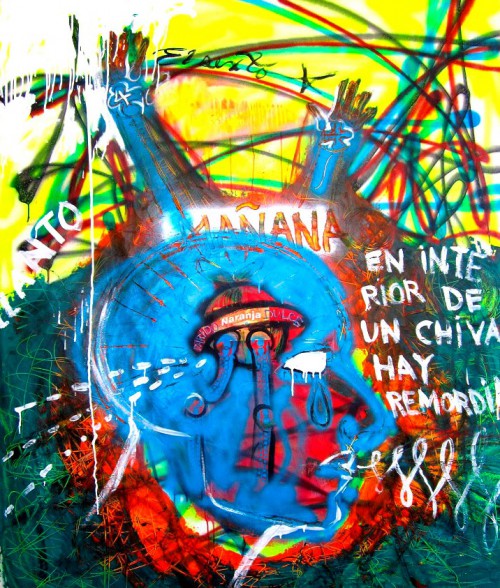
By Jhortensia Espineta Osuna | Translated by Alison Macomber
Dunia, your daughter, doesn’t leave her room, or the room that you both share and that you all shared with your mom and your grandmother until they decided to die last June, one after the other, so August wouldn’t remove the liquid that remained between their skin and bones.
Through the window, the neighborhood parades by, wearing their Sunday clothes. Others only pass with their nylon bags to begin the week with whatever is in the bag.
It’s the end of the month; you’re trapped between the window and the cracks on the floor where the ants have made small colonies. The living room is large, with only corroded furniture, incapable of filling the territory. The painted wall exhibits your title “Doctor of Medicine,” along with your white coat and your stethoscope. The three things hang on the thickness of the adobe wall of lime and cement.
You don’t move from where you stand and you look at the old man with the dog on the front sidewalk. Since his son arrived, the old man is in better condition. His ribs are no longer visible underneath his skin, and maybe he doesn’t need to kill cockroaches at night, filling the floor with insects and gobs of spit.
You still haven’t moved from this spot; you continue standing there between the cracks on the floor. The old man pets the dog’s belly as he lifts his leg and urinates on the wall.
‒Bringing that dog here cost two thousand dollars!
Your whisper surprises you and you look out the window.
The old man enters behind the dog, and then he closes the door behind him.
‒A dog!
The old man’s son arrived in a car one night, filling the block with noise and music. When he left, he was just a boy lacking many aspirations other than seeing his father killing cockroaches and spitting everywhere. Now he is a mixture of grease and odors; with him he brought a fat woman as greasy and odorous as he and they filled the house with furniture capable of holding him, his fat woman, and an entire family of smelly, obese white people.
CONTINUE READING THIS STORY HERE.
The publication of this story is part of Sampsonia Way Magazine’s “CUBAN NEWRRATIVE: e-MERGING LITERATURE FROM GENERATION ZERO” project, in collaboration with Orlando Luis Pardo Lazo, and a collection of authors writing from Cuba. You can read this story in Spanish here, and other stories from the project, here.
Marginalization and Promiscuity / Rebeca Monzo
 Much has been said lately about the subject, after the most recent address of Raul, where he addressed these social problems that were simply ignored. Now the media constantly make programs dedicated to this social phenomenon, in efforts to improve what they themselves decided to ignore all these years of Revolution, becoming unwitting accomplices and partners.
Television, one of the most important means of dissemination, is precisely the one that has influenced programs and novels, where vulgar language and gestures have been the constant, regardless of the old and well-known phrase of “a picture is worth a thousand words.” This method, therefore, is a massive “fixer” of good and evil.
I remember about twenty years ago, in a famous and popular TV show on Saturdays, led by an elegant and fine presenter. Interviewing the famed Spanish actor Echenove, she asked: “How has your visit to Cuba been?” Echenove, totally uninhibited, replied, “pues me ha ido de pin…“* She blushed, then said “excuse me, but that word is ugly and you shouldn’t say it.” “What?” he argued, “it can’t be, because everyone here says it.”
 As for promiscuity and poor hygiene habits, our press emphasizes offenses committed by individuals, and closes its eyes to the problems caused by bad management and the continued lack of hygiene in food handling practiced in state facilities. The most representative example is the sale of unrefrigerated pork in the farmers market, not to mention that it is transported without any hygiene in open air vehicles, even on occasion with workers sitting on the pieces of meat.
They also criticize how and where coffee cups are rinsed, that are sold freshly brewed at the various private and public establishments, as well as the water used to make fruit juices sold, improper handling of certain foods, etc. and, what is never mentioned, is where did they learn all these bad habits reminiscent of the Middle Ages.
Weren’t voluntary work and the schools in the countryside the genesis of all this promiscuity that also brought so much of this social indiscipline? What were the conditions of those camps and schools so that these situations didn’t occur, mainly due to the lack of clean water and adequate facilities, forcing many students to have to relieve themselves “open air” like animals? Why, then, weren’t adequate provision taken so that this didn’t happen? On the contrary, they were established as standard practice.
On the other hand, they are now also attacking the phenomenon of noise and music at soaring that makes people scream to be heard, and annoys the neighbors, forcing them to listen to what they don’t want to. This also happens in many buses, where in addition to crowding, heat and odors, we must also must stoically endure the deafening sound of music, imposed by the driver or some lazy and rude passenger who doesn’t care about disturbing the other occupants of the vehicle.
“It’s never too late if the reaction is good”, I would say, to paraphrase an old maxim, given the new concern of the media. But what concerns me, extraordinarily, is that we have had to wait nearly half a century, for Raul to talk about it in a speech, to “become aware” of it, and that, as he usually does, he continues to attack the effects without having the courage to denounce the causes and, above all, those who caused these and other social ills.
*Translator’s note: He uses a vulgar phrase [which Rebeca does not spell out in full] meaning, roughly, “it’s all gone to hell,” thinking it means “it’s been fantastic.”
26 August 2013
Connect to Facebook, Connect to Cuba / Luis Felipe Rojas

Screen shot taken of the conversation with these “friends” on Facebook.
Accused of being frivolous and made for gossip and rumors, Facebook, the well-known and so active social page, could be affecting in an unusual way a community thirsty to share information inside and outside the island.
A live messenger of information flow in many directions benefits young people inside as well as outside Cuba. Well into the night on Sunday we can talk with some about the impact of this social network on those who have been left inside the information corral. They sent their answers over here through mobile devices at odd times and with the imprint of a Facebook “chat.”
Claudia del Río
A social activist living in Miami, she supports pro-democracy changes believes there is something positive in the exchanges. “First, the active community is composed of many ages and different interests, although statistics could make us believe that 45% are interested and follow the issue of Cuba and part of the informed dissidence, they come to share the news but don’t go any further. There are 15% who are interested in helping and bring a little push to organize themselves, to do something and set aside the concern that something has to be done but they don’t know how to do it.
“They could do many things to help and to create an extremely strong network that could even become uncontrollable by the Cuban Government, but they lack that spark of desire and discipline, and working on a single project to bring about a solution that is in our hands.”
Ted Henken
A specialist in communication and Associate Professor of Sociology and Latin American Studies at Baruch College, he believes that yes, there is a real impact that can already be measured, “Because FB functions as our modern agora. It is a meeting place for many people with frivolities but also causes and sacrifices. The major problem in Cuba is the lack of access and the monitoring.”
Aimel Ríos
He is an expert in international relations and assistance and solidarity projects for ’people in need’. He is active on social networks, believing that the impact of a network like FB within Cuba helps “to have their voices heard in the world, they can speak for themselves. The virtual community is a bridge between the real Cuba on the island and the real community at the global level.”
‘Estre-Llita’
She is an active young woman with a very visible militancy in Miami when it comes to the cause of freedom for Cuba. In the photos she uploads to her FB wall she appears alongside singers like Raudel (Escuadrón Patriota/Patriot Squadron) or Amaury Gutiérrez, or with human rights activists like Berta Soler. The activities she participates in she shares on Facebook.
“Social networks are free spaces to express yourself. Plus, they have the potential to be a bridge for communication from there (Cuba) to here, and here to there. I think it can help revive the interpersonal relations that have been lost through distance. Also it’s super-effective for spreading information. For example, when a dissident is being attacked there. Look, when there was an outbreak of cholera in Cuba… here we first heard about it through social networks, principally through FB.
“Also, due to the boomerang effect… many Cubans on the island also got that information. The flow of information benefits all of us, those there and those here, because we know that the official media are biased and say whatever they want whenever they want. Those of us from here also have a commitment to disseminate what comes out of there.”
‘C.J.L’
(Lives in Cuba and only connects to the web when supportive friends allow it.)
“A social network like FB would definitely affect the island. The social purpose of the network inexorably coincides with the desires and the most primordial thirst for information that we Cubans have: family, neighbors, friends and all those “disappeared” from these geographic boundaries could return to us, those inside, as if by magic.
“For me, going to FB and writing a name os some friend or relative I barely remember, or browse among friends of friends, or among the suggestions on the site and see faces you barely remember and to return to them in this incredible little window of a message that is stronger than a hug and add them to your friends and see what they do every day, their photos, even their jokes… then Amsterdam or Monte Video are no longer those impossible places, where people are lost from pur memories without a word, perhaps another language, other times, but no longer this forgetfulness they condemn us to.”
3 June 2013
Salon / Diana Karen Tur Garma






Smokescreen / Fernando Damaso

Photo Archive
After the Cuban team stayed on the road following a fifth place finish in the Third World Baseball Classic, having been being beaten five consecutive times in the five games scheduled, on top of that by a U.S. team composed of college freshmen and sophomores, the authorities governing national baseball, supported by some sportswriters, have turned up applauding, having won the Rotterdam Tournament in the Netherlands, with the Cuban national team, and now with the successes in the 3rd Tournament of Challengers in Canada, with the team from Ciego de Avila, also professionals and with some players from the national team.
All the fans know the serious problems of Cuban Baseball and its sustained decline, as well as the reluctance of the sports authorities to confront and resolve them, in order to maintain archaic concepts. Pretending to erase past defeats with current Pyrrhic victories in lower-quality tournaments against inferior teams will not convince anyone. (The team from the United States, called NWCAA, which stands for Northwest County Athletic Association, consists of players under 19 years old from St. Louis, Missouri; the Japanese were represented by JX Eneos, champions of the Yokohama City Industrial League; and of the same caliber, Canada’s team, the worst of all. The only team made up from a nationwide selection is the one from Chinese Taipei). There are none so blind as those who will not see!
It is also possible that all the current fuss has been stirred up as a smokescreen to obscure the poor performance of the Cuban delegation at the recently concluded 14th World Athletics Championships in Moscow, as well as the setbacks suffered in the 15th World Watersports Championship in Barcelona, in the 21st Volleyball Grand Prix by the women’s team, and by the three chess players who failed to qualify for the World Cup, held in Norway. It is a formula already applied on other occasions, under the slogan of “turning setback into victory,” with the goal of trying to keep some threadbare flag flying, in this case that of so-called “socialist sport.” We expect more of the same, until the time when real changes occur.
22 August 2013
The Houses She Never Had / Odelin Alfonso Torna
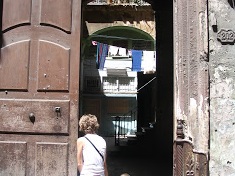 Elsa Velázquez Mata wanders between delusions and afflictions. She’s always seen carrying a portfolio where she saves several records of housing she never received, despite being dependent on welfare, letters sent to her from ministers, medical certificates that attest to the congenital heart condition of her youngest son, and a diary (little notebook) that holds her laments over 17 years.
Elsa, a 43-year-old agronomist, has suffered physical abuse, eviction, prison, and worst of all, the mockery of a government that says it defends the rights of women.
Elsa Velázquez lives with her son in the home of an aunt, in the Santa Maria del Rosario neighborhood in the Havana municipality of Cotorro. “Someone lives because of me, eats because of me, I have no record of identity and residence,” she says while showing an identity card made for her: a piece of white cardboard where her personal data appears in cursive, her photo and fingerprint in methylene blue.
Five years in prison “for burning her husband”
Her life took a sharp turn in 1997 when she was the victim of domestic violence on several occasions. She was sentenced to five years imprisonment for burning her former husband with hot water. But Mata Velázquez always denied the incident. She says her ex-husband, aided by his brother, a former police officer, carried out the attack on himself to have her charged so he could stay in the house.
This Cuban woman has been watched by the authorities for 17 years. In 2004, after serving five years in prison, and with her two-month-old son, the Director of the Convention Center in Havana, Abrahán Maciques, promised her that before the baby started eating she would have a completely legal apartment, Maciques headed in the Provincial Department of Housing and under the protection of the functionary Rafael Martinez, initiated her first housing file for priority cases, number 290 of 2004.
She occupies an abandoned post office
After a year of waiting without receiving the promised housing, the Popular Power in Havana opened two new files for Elsa, numbers 6000 and 6017 of 2005. Two years later, on September 15, 2007, the case was transferred to the Popular Power of Guanabacoa, and Elsa appears on the housing waiting list with case numbers 05272 and 1146. On December 23, 2009, the municipality of Cotorro took over the case and two other files were opened (061285 and 04568), the latter corresponding to a disabled home in the town of Santa Maria del Rosario. All these files were traded (sold), because according to Elsa, “in the civil registry she appeared with another identity.”
Weighed down by being shunted around so much, in January 2008 Elsa decided to take her child and occupy an abandoned post office, located in the town of Santa Maria del Rosario. Aware of the violation, she decided to send a letter to then postmaster of Cuba, Luis Enrique Blanco Prieto, so that this place would be legally handed over to her. On the 28th of that month she was evicted by force. She says that in her absence, the police broke the lock of the room with gunpowder and took the roof, the windows and a rice cooker donated by Social Security.
On May 24, 2010 Elsa response from Luis Enrique to assess the case. But it was too late, that post office had been taken over by a police chief named Daniel.
The houses she never had
February 13, 2010, was her last attempt to demand a “comfortable” home, as she had begged for in each of the files. She made this demand to Juan Contino, then President of the Popular Power in Havana. In reviewing the records of “social cases Liudmila Mejía and Orlando Nunez, the latter second in command of the Popular Power in the capital, found that Elsa Velázquez Mata appears as the owner of six apartments.
Today Elsa, among her delusions, demands “compensation” for the houses she never had. Maybe that’s why she keeps all the meticulous files on the homes, the dates of appointments with officials, letters, eight ration books, newspaper clippings, speeches by Fidel Castro and even the official donation of an abandoned post office.
About the author

Odelín Alfonso, born Havana, 1970. Graduated in 1989 in industrial electronics from the former Eduardo García Delgado Technology Center. In 2004 he joined the internal opposition as eastern region coordination for the Liberal Orthodox Party, and, in 2005, the independent press.
e-mail: odelinalfonso@yahoo.com
19 August 2013
The Notice With the Commandments / Lilianne Ruiz
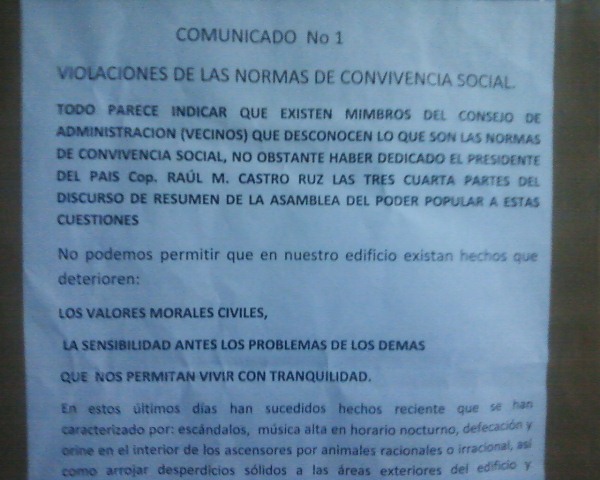
 Communication No. 1
Violations of the Rules of Social Coexistence.
Everything seems to indicate that there are members of the administrative council (neighbors) who don’t know the rules of social coexistence, even though the president of the country, Cop. Raul M. Castro Ruz [dedicated] three-quarters of his speech before the National Assembly of People’s Power to these questions.
We cannot allow these things to deteriorate in our building:
Civil moral values,
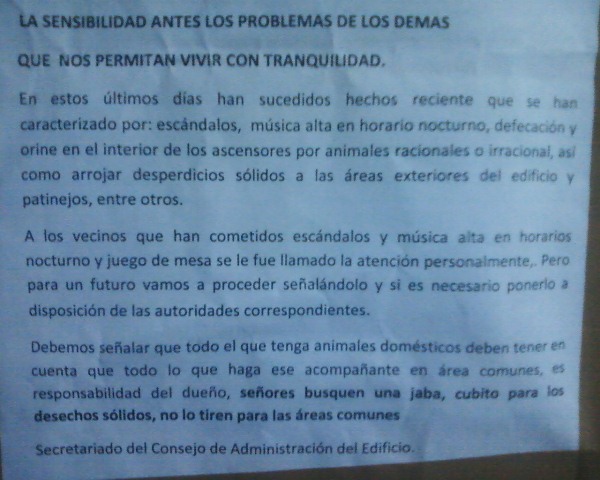
Sensitivity to the problems of others
That allow us to live in peace.
Lately recent events have occured characterized by: scandals, loud music at night, defecation and urine in the elevators by rational or irrational animals, as well as throwing solid waste in the areas outside the building and patios, among others.
To the neighbors who have committed scandals and loud music at night and playing board games, you were personally notified. But for the future we will proceed to take notice and if necessary pass the information to the corresponding authorities.
We must give notice that everyone who has pets should take into account that everything done in the common area is the responsibility of the owners, gentlemen find a bag, bucket for the solid waste, don’t throw it in the common areas.
Secretariat of the Administrative Council of the Building
This notice, which I thought it was unusual, was stuck and stuck again on the walls, the front door and the door to the parking of my building. I live at 702 Lombillo Street. My friends who come to visit me have always found it a little crazy — a little eighties-ish — the way the Committee for the Defense of the Revolution (CDR) has stuck propaganda on the walls. The new signs were put up by the CDR after that speech by the general-president where he called the people scoundrels, he who has been holding the yoke imposed by his family for over five decades, almost without protest.
In the first paragraph there is a gap, a dynamited bridge, between the fact that the neighbors don’t know the rules of coexistence and still haven’t learned them, even when the general explained to everyone how to live together nicely.
As if presidential opinion was the beginning of havng a conscience. As if we didn’t have a conscience. But in Cuba the people can not understand their responsibilities when they have never tasted what it means to have rights. Rights against the government, which here has been sold as something sacred, unquestionable, supported by the international left. And turned into an ideology, where conscience is drifting, scared, powerless.

If we look closely there is a moment where it says it’s unknown whether the urine in the elevator is the work of rational animals.
It’s not clear to me if it’s a joke, in a communication that displays so much indignation and that has been written, obviously, by someone who has felt satisfied with the definition of “species in danger of extinction,” as the expresident of the Island — who ruled from 1959 — has called humanity.
A tyrannosaurus rex, no doubt. Doomed to extinction.
And the way it is worded it seems like some idiot making jokes in bad taste. However, all is true.
Here we see the end result of this experiment. And the notices are still appearing. I intend to attach photos of them all.
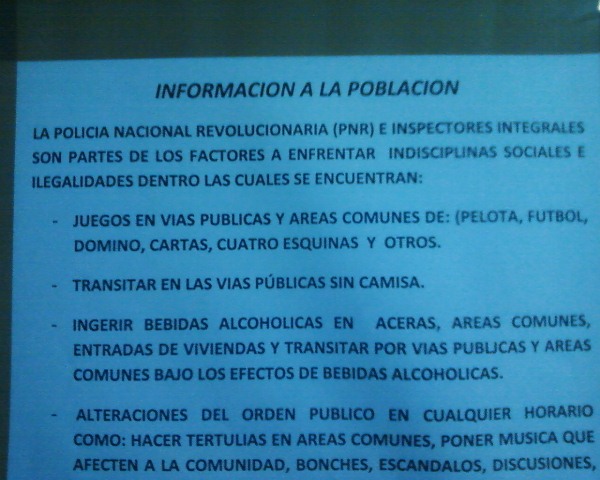 INFORMATION TO THE PEOPLE
The National Revolutionary Police (PNR) and Member Inspectors are part of the factors confronting social indiscipline and illegalities which include:
– Games in public streets and common areas: baseball, football, dominoes, cards, four square and others.
– Walking on public streets without a shirt.
– Drinking alcoholic beverages on sidewalks, common areas, housing entrances, and walking on public streets and common areas under the effect of alcohol.
– Alterations to the public order at any hour like: discussions in common areas, playing music that affects the community, groups, scandals, discussions,
23 August 2013
1. 2. 3. and 4. Autos / Luzbely Escobar


Varadero is no longer a prohibited city, but… / Ivan Garcia
 In a country such as Cuba not known for its middle class, few are the families who can give themselves the luxury of paying between 300 and 800 convertible pesos for a three or four night package in an “all included” hotel of Varadero.
Even though an employee at a Havana tourism bureau mechanically repeats a string of numbers and statistics, to reinforce the thesis of the increase in Cuban tourists in 4 and 5-star hotels, behind the numbers are different hidden matrices.
Nothing is black and white. Less so in Cuba, where an average citizen receives a monthly salary in pesos equivalent to 15 or 25 dollars. According to predictions of the Ministry of Tourism for 2013 almost 1.5 million Cubans could take a dip in Varadero.
This is good news. But the fabulous beach and the comfort of its hotels are still not within the reach of the majority. One and a half million Cubans represents 10% of the total population.
A not so gratifying percent for a government that shouts their heads off with populist discourse in favor of the poor. Behind a series of nationalizations, decrees and expropriation of businesses, mansions and works of art of the Cubans who generated riches, the middle class suddenly disappeared.
Many felt obligated to flee to the South of Florida. The number of doctors and engineers on the island dropped by more than half. With a base of voluntarism and utopias, a frenzied Che Guevara buries the rules of the economy underground.
All the summer properties that upper and middle class people possessed in Varadero became the summer homes of the heavyweights in the revolutionary state. Other homes swelled the real estate funds of the Workers Central Union of Cuba (CTC), in charge of giving a week of rest to the most loyal and dedicated workers.
The carelessness, lack of maintenance, looting and robbery of vacationers in the hotels and villas, caused the best beach in Cuba to enter a stage of destitution. It was pitiful to see the splendid chalets destroyed by the salty air and state apathy. Sometime in the 80s, when the soviet paradise of workers and peasants cut the subsidies to the island, Fidel Castro decided to bet on capitalist tourism.
With the fall of the Berlin wall and the shabby Soviet communism, Castro maintained his anti-Yankee discourse and continued brandishing a sermon agreeable to the ears of the dispossessed. But, in practice, they started dismantling the “benefactor state.”
The houses owned by the unions were expropriated and renovated by the State. They rented them in dollars, the money of Castro’s enemy. But the generals, ministers, and functionaries maintained their residences and floated their yachts in Varadero.
The “dedicated compatriots” had no other choice than to spend their vacations in the country, swim in rivers and shores or beaches without conditions. Varadero turned into a prohibited city. Only the inhabitants and workers of the town had access. A police control station was put up on a bridge entering the city.
Chubby Europeans or Canadians went arm in arm with male and female prostitutes who target tourists. The families and friends of the “worms” and “scum” also had the green light. Cuban-Americans who, thanks to their buying power, were now received by the regime with a red carpet.
It was an era of embarrassing apartheid. The Cubans could not dine in a restaurant of a hotel or enter the room of a foreigner. We were 3rd class citizens in our own country.
Raul Castro, appointed to the presidency by his brother, overturned the absurd anti-constitutional norms. Since 2008 any Cuban with hard currency can enjoy a stay in tourist installations anywhere in the country.
However banned zones exist. Exclusive. Reserved areas to hunt wild boar, golf courses and villas designated for high officials. But they are becoming fewer. From 2008 to the date, gradually, national tourism is growing.
Varadero is the preferred enclave for the majority of Havana’s residents, for its proximity to the capital–some 80 miles–its 52 hotels and dozens of private homes for rent.
Those with less money, for 70 or 80 pesos (3 dollars) a head, rent a bus and spend eight hours on the beach. They bring water, food and cheap rum. These tend to be day trips arranged under the table, and the bus driver and the transport boss of some company split the profits evenly.
There are families who save the whole year and in summer rent a private home. The costs are not within reach for the average Cuban: 40 CUC (the cheapest) and 100 CUC, daily.
And then there’s the “all included” option. The preference of those with certain purchasing power. First of all, they reserve and pay in one of the various tourist travel agencies (Cubatur, Cubanacan, Gaviota, Isa Azul or Gran Caribe).
Each agency has a variety of offers. Cubanacan, Gran Caribe and Gaviota are the most expensive. They offer rooms in 4 and 5-star hotels. A 3 or 4-night stay costs around 600 convertible pesos.
Cubatur and Isla Azul are the most affordable. For 300 CUC you can enjoy 4 days of sun and sea. The difference in price marks the quality of service. In the hotels grouped under Cubanacan, Gran Caribe and Gaviota you find the Spanish names Melia and Barcelo and the food is more varied and elaborate.
A brief survey of 30 Cubans, pertaining to this 10% who can spend a mini vacation in Varadero, found that 14 could enjoy this thanks to money sent by family in the United States or Europe. Eight were discreet prostitutes. Four, worked for themselves and saved the money.
The other four Cubans had been voluntary workers overseas and with savings, or certain under the table services, such as illegal abortions or plastic surgery, this allowed them to repair their house, acquire a car and enjoy a stay in Varadero.
In the “all included” hotels it is very difficult to find a professional or worker who can manage a vacation with their miserable salary of 15 to 25 dollars a month.
With this mess in the media, Cuba has fragmented into castes. And the hotels of Varadero have been converted into recreational sites for a few.
Ivan Garcia.
Photo: Until 1976 the city or town of Varadero, where the most famous beach in Cuba is found, was a municipality. But since 2010 it was reincorporated into Cardenas, one of the 13 municipalities that today form the province of Matanzas.
24 August 2013
The Afrocuban, Past and Present in Cuba / Luis Felipe Rojas

The 12th edition of the magazine Blogger Cubano is already on the street. It is a special edition of more than 80 pages dedicated to the Afrocuban topic — with particular emphasis on the current institutional racsim in Cuba — and a color photo gallery, full size unfolded, from Luis Felipe Rojas and Orlando Luis Pardo. The issue contains texts by Juan F. Benemelis, Miguel Cabrera Peña, Leonardo Calvo Cárdenas, Manuel Cuesta Morúa, Darsi Ferret, Ángel Escobar, Juan Antonio Madrazo, Luis Felipe Rojas, Ángel Velázquez Callejas, Roberto Zurbano and Armando Añel.
“May 2013 marked the 101st anniversary of the assassination of the leadership of the Independents of Color Party, an event that decisively conditioned the process of racial integration, doomed in Cuba after its independence from Spain,” the editor write in the introduction to the issue. “Simultaneously, and still hanging in the air, is the latest event of institutional racism on the island, which occurred in the spring of this year, 2013: the dismissal of Roberto Zurbano (whose case is directly addressed in the section The Controversy), former director of the Editorial Fund of the House of the Americas, after publishing an article in the New York Times critical of the reality of Cubans of African descent. In this context, and given the importance for the future of Cuba, Blogger Cubano has taken on this topic in this special issue. “
19 August 2013
Fishing From the Iron Bridge / Luzbely Escobar
Passing by way of the iron bridge I see a soldier on his motorcycle waiting for all the pedestrians to cross so that he can fit through the narrow passage left after the bridge was closed for repairs. After allowing everyone to pass he finally went through on his bike. As this was happening I looked under the bridge. There I saw a group of kids fishing. They were extremely engaged in their fishing techniques and didn’t even see me watching.


23 August 2013
Occasional images… / Claudio Fuentes