


3 June 2013
English Translations of Cubans Writing From the Island
 By Rolando Pulido
6 June 2013
They’re no longer dressed in blue uniforms and some boys even show off their rebellious manes. Hair that no teacher will demand they cut — at least for the next few weeks — hair that will ultimately fall to the razor of Obligatory Military Service. They still look like students, but very soon many of them will be marching with rifles slung over their shoulders. They are young men who just, days ago, finished their school days at different high schools all over Cuba. The college entrance exams are long past and this week they’ve learned who will have a place in higher education.
Just outside the schools, the lists of the accepted and unaccepted speak for themselves. José Miguel Pérez High school — in the Plaza of the Revolution municipality — could be a good example to explain the situation. This educational center is one of the best performing high schools in the capital. A situation partly due to the professional and economic composition of the neighborhood, which means many parents can afford after-school tutors (we refer to these as “dishtowels” — they clean things up). Despite these advantages, the end-of-year statistics for this school are more alarming than satisfying.
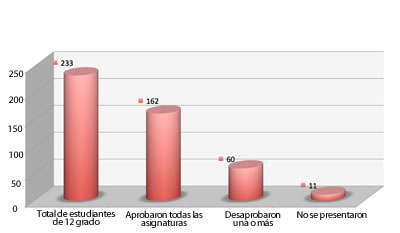
Of 233 12th grade students in this high school, 222 took the entrance exams and only 162 managed to pass all tests. The rest will have to go to a second round, or content themselves with failure. The highest number of low marks was in Math, in which only 51 students achieved a score of between 90 and 100 points. In the applications for careers, teaching specialties are repeatedly put down as a back-up choice; “To guarantee getting a place, even if the tests don’t go well,” these potential teachers of tomorrow say, with a certain indecency.
Statistics from José Miguel Pérez High School
The beginning and end (?) of a mistake
The young people who completed secondary school this year are the products of the educational experiments led off by the so-called Battle of Ideas. They are 17 and 18 today, so they started junior high as the “Emergent Teachers” program was gaining strength, a program that put hastily trained young people barely out of their teens — if that — at the front of the classroom. Today’s graduates were educated in classrooms where television and VCRs were the protagonists, for lack of sufficiently trained teachers. At the most difficult times they could count on receiving at least 60% of their classes from a screen. They also went through puberty at a time of rising ideological indoctrination. While it is true that this has always been inherent in teaching in Cuba over the past five decades in, its climax came after the Elian Gonzalez case. Fidel Castro took advantage of that event in the late nineties to impart a twist to the political discourse in all aspects of national life.
Those who graduated from the twelfth grade a few weeks ag, are the first batch who did not have to go to boarding schools in the countryside. Encouraging news for the young people themselves and especially for their parents. However, the readjustment for teachers caused by the change forced many of them to rethink careers based on study, books and binders. The teachers who came from these schools in the countryside had to adapt to new conditions. Despite the difficulties of the former regime of internment, for the teachers these countryside schools were sites of direct contact with the farmers who sold or traded for agricultural products. One of the few incentives for working in such a place was being able to take some bananas, taro, pork or fruit to the city at a much cheaper price than in the markets of Havana. The loss of that little privilege discouraged some teachers from continuing on the path of teaching.
Memorize or question?
The countless hours lost in the classroom to teacher absenteeism is another of the hallmarks of recent graduates. To this we have to add the decline of the investigative character of science instruction, due to the deterioration or absence of chemistry, physics and biology labs. In many high schools chemistry experiments were practically canceled due to the shortages and fear that students would have access to the chemicals. Physical education, computer science and English were the biggest losers in the exodus of teachers to other areas of employment. High school education emphasized rote learning of dates, names, events, without progress in creating their own opinions, a spirit of asking questions, or the capacity of discernment. Graduates can hold in their heads the years and important days of our country’s history, but fail to form their own opinion about what it all means.
The quality of handwriting, spelling and the correct use of Spanish also fell short as educational objectives. This coming September, university classrooms will see students with serious deficiencies in all three areas. But that does not mean that they will be faced with excessive demands or be unable to complete their programs of study. They will attend a University whose quality of teaching is far from that once exhibited in Cuba. In the 2013 ranking of Latin American universities, the University of Havana fell from position 54 to 81, another sign pointing to the urgent need to review the entire educational model. The educational level of the new entrants to higher education, has forced them to lower the bar.
The tinkering with the alchemy of learning, the successive experiments marked more by the voluntarism than scientific analysis, the excessive presence of ideology in every subject, the encouragement of docile, rather than questioning, minds, students’ limited access to updated materials (read internet) and the educational fraud that flourishes where ethics is absent, are all undermining one of the main pillars of national identity: that which consists of knowledge, academics and teaching. But a problem can not be remedied unless we confess that it exists. So while they continue speaking in a triumphalist tone about Cuban education, it will continue to sink into mediocrity, into material and pedagogical deterioration.
6 June 2013
 Without any hint of shame the state-run press reports that an American citizen attending a public presentation by her president at the National Defense University interrupted him and even questioned some of his policies in a rude manner according to several journalists present. The importance of this news for Cubans lies in the fact that this woman, as well as many other people in the United States and other democratic countries, have the right to do this. In our country on the other hand, not only would it be considered a serious action, you could also spend years in jail for it.
In another article it is reported that, in a session at the Ninth Congress of the Union of Cuban Journalists, someone posed the question, “What sort of journalism does Cuban socialism require to make it stronger as it goes through a period of change?” The replies all have a common denominator: to petition the state to act less as a guardian and to request authorization to be more critical, though always “being aware of the challenges that the country faces in the midst of the incessant and worsening harassment by the American government, which has not abandoned its goal of destroying the country’s socialist project…,” blah, blah, blah. Without the least embarrassment these journalists accept state control over what they write and report, and their appeal amounts only to “being allowed to write and report a little more.” It was always my understanding that rights are not something to be begged for, but rather to be demanded.
Another article mentions a “big tweet for Cuba” (a reference to the Five*, who by now, if my math is correct, are four), accompanied by a photo of a “stand in” at the front of the White House. As I indicated at the beginning of my post, how wonderful to be able to do all this freely, without anyone interfering! It is as safe and secure as a picnic. In democratic countries, that is, because if these things happened in ours, they would all be considered “destabilizing actions orchestrated by local mercenaries fulfilling orders from the empire.” That simple.
It is striking that presumably intelligent people would lend themselves to this sordid political game by participating in it as though they were performing a commendable action for which they deserve respect and even applause. I believe the solution to the problems between the governments of Cuba and the United States (and I say governments) must be through dialogue. I do not believe it can be achieved through tortuous paths, but through truth, honesty and frankness, assuming each lives up to its responsibilities.
*Translator’s note: Five Cubans serving prison sentences in the United States for espionage, for whose release the Cuban government has been actively and publicly campaigning. One of the four has been paroled and recently returned to live in Cuba with the permission of the American courts, in exchange for giving up his U.S. citizenship.
3 June 2013
Once again, the Cuban regime supports — far from international view — the dictatorship ruling Syria. We are always on the same embarrassing team: Russia, with the dictatorship of Putin; China, more of the same but with different style; Bolivia, where its president just manipulated the Constitution to guarantee himself a place in the upcoming election for a third term; Nicaragua, few presidents have such effrontery; and why continue, their names speak for themselves: Ecuador, Venezuela, Iran, and as if that wasn’t enough, North Korea.
And the news, in the official newspaper of the Communist Party of Cuba on May 16 the headline encapsulates with apparent what is nothing more than a disgrace: “A dozen countries oppose UN resolution on Syria.” That is, the news is not that 107 countries approved it, or even that 59 abstained, including Brazil, one of our allies.
As much as we should be accustomed to this arbitrary politics of benefit to party members, in the style of highway robbers, and of course, its obsession with confronting the United States, simply leaves us outraged.
In the face of this arbitrariness typical of the Castros, I can’t stop being ashamed; the only thing that saves me is my opposition to the government and it’s national and international politics.

Ángel Santiesteban-Prats
Prison 1580, May 2013
5 June 2013

The Poster for British Week in Havana
London has come to Havana. During this week of British Culture that is celebrated from the first of June in our country, even the climate has decided to be in sync with that of the other Island. Grey skies, drizzle, mist at dawn. All we lack is the silhouette of Sherlock Holmes sneaking around a corner or a magician knocking with this staff on the wood of our door. They are days of great music and a chance to appreciate unusual schedule in the movie theaters. Since last Tuesday they have been showing a selection that includes the 2013 Oscar winning documentary Searching for Sugar Man, and also the biographical film Marley, about the life of the famous reggae singer and composer. The selection of cartoons for kids and teens will probably attract a good audience at a time when many are on vacation from school.
I have been enjoying some of the programming not only for me but also for many others. Especially thinking about those young Cubans , or forty years ago, secretly listened to an English quartet which the official media now play everywhere. The striking colors and the design of the poster for this “British Week” has evoked for me the iconography of the Mad Hatter in Alice in Wonderland, and also the delightful adventurers in the Yellow Submarine. So some of us have also taken it as a tribute to those battered Beatlemaniacs from back then. These days, however, the greatest comfort comes from the window cracked open to let in this fresh air that comes to us from the outside. This gift of sensing that culture can make the Atlantic seem narrower, the passing years shorter, the losses recoverable.
5 June 2013
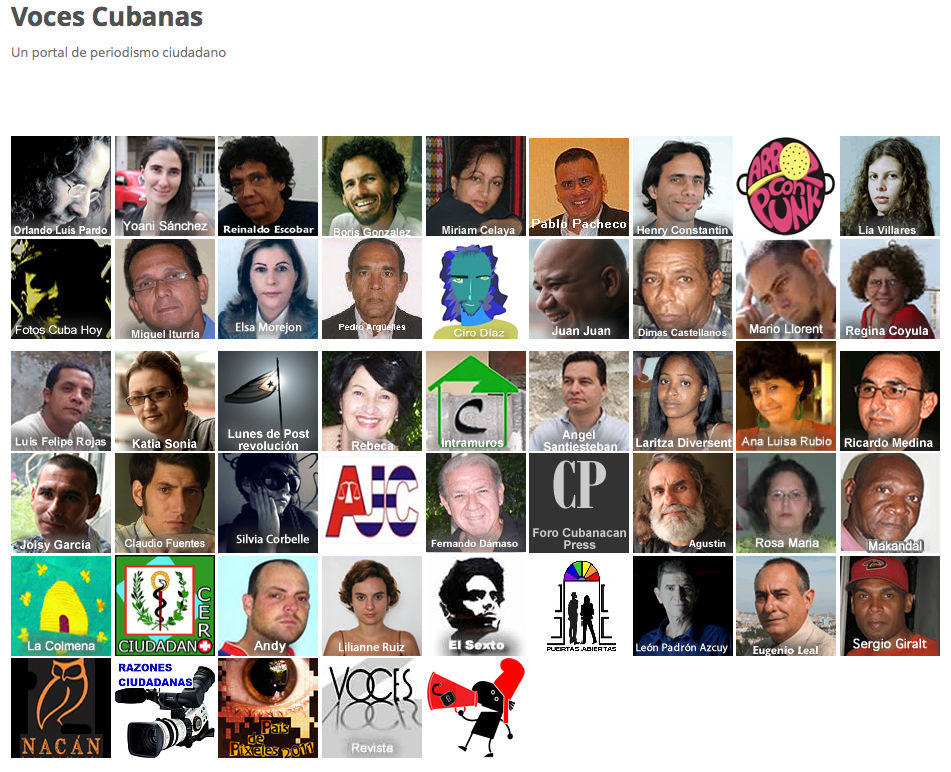 From May 29th until today I could not open VocesCubanas.com, the alternative platform that contains my blog Island Anchor. As I thought the “closure” could be only be in the Spanish Levante — I live in the province of Castellón, in the community of Valencia — I called followers of my posts living in Zaragoza, Madrid, Canary Islands, but none could access “Cuban Voices” nor enter my blog, not even from Google by searching on the titles of the last texts.
Coincidentally, Wednesday May 29 was the last day of Yoani Sanchez’s stay in Madrid, where she delivered a speech at the ceremony for the Ortega and Gasett awards, given by the newspaper El Pais; the next day she was received in Havana by family and friends while the Spanish newspaper reproduced her words and pictures with former President Felipe González and other figures of the Spanish Socialist Worker’s Party (PSOE) and the media.
No one should be ready to think that the closure of the Voces Cubanas portal in Spain was a way to lessen the impact of her words and to annul any commentary on her extensive tour of Americanand European countries. But who benefits from the silence of censorship? Who gave the order to disconnect? Where and by whom was it executed? The answer points to the officials who monitor the news in the Cuba Embassy in Madrid and to the Island regime’s network of consulates in the Iberian Peninsula.
It is not the classical theory of conspiracy; the Castro regime tactic is very old and the order stands, the diplomats-cum-State-Security-Agents executed it based on a Guide to events that demystifies the Havana government’s propaganda. They simply overload the networks, hack pages, multiply the trash emails against some, and “take the offensive” against others, even in media such as El Pais. The rest is up to time and the naive who are silent before the long arm of censorship.

4 June 2013
 Lic. Noel Rodríguez Ávila
From an economic point of view Cubans have come to feel that they lack a future, it has been more than five decades and they have seen no fruits of their labors, which don’t even meet their basic needs of housing, food, clothing and a job with a decent wage.
The loss of motivation to study careers requiring a technical or university education comes from there being no economic advantage, nor even jobs to fill with these qualifications. The insecurity makes people look to the future and old age with fear.
There is no hope of prosperity. Every discourse has a political focus, with regards to the economy they only talk about working and being productive, about control and demands, not of new factories or investments or more employees. They talk about a primitive agriculture, subsistence level. An educated people can’t accept these miserable proposals.
Religious freedom is tolerated, but the system doesn’t like it. There is a lack of freedom of expression.
Cuban people are taught to watch each other, there’s a paranoia about being heard and being informed on to the authorities.
The State’s organizational structure is designed to convince us that all is well, or to understand what is wrong by looking for external causes, or in lower level management and not at the strategy of the higher ups who re never wrong. This limits the possibility of changes, all this is integrated into every Cuban citizen leading to a frustrated frustrated, hopeless personality, faking it, with no exit, looking abroad for an option, a hope.
The aspiration of every professional is to go on an international mission to earn a little money, have a house, buy a car, and have some comforts; when they can’t achieve it they want to leave even more to get away from their family, their country.
Emigration to the United States has also been an option, although risky, sad and cruel, when people use any kind of floating artifact to get to that country, to embrace a hope for prosperity and to help their family who with anguished hope said the magic words, “arrive safely” and then, gratefully, receive remittances that alleviate their economic stress.
In any event, the solution for Cubans is not outside, but within.
5 June 2013
Having served eight years in prison of the 12 he’d been sentenced to, they granted him freedom because of his good behavior.
The prisoners said goodbye to him with a mixture of sadness and joy, everyone wanted to be in his place, it was a feeling that gnawed at them.
A few days later they saw him return and the annoyance was widespread in the barracks. He declined to explain, he just went to his bed and lay face down.
Someone said he’d returned to serve those twelve years, plus four more for fleeing.
Later he explained that the guards were to blame. The day he was supposed to leave, they brought him in around 10 at night according to internal regulations.
“There I was informed that they wouldn’t sign my release until midnight and one minute, not one less nor one more, the duty officer told me. And I looked at that door where I should be getting out. I had dreamed of this moment for eight long years, and now the door was in front of me, begging to be possessed, begging me to take her all night. She offered herself like a woman receiving me with her legs open, ready to be penetrated, and I was biting my nails, watching the dark impertinence of those open arms.
The guards weren’t paying me any attention, ignoring the lack of respect of putting me in front of a naked woman without the ability to touch her, and I stretched out my fingers, then my hand, stood up, and I don’t remember how, my legs — responding to their own impulse — started to walk.
And in that immense night, without receiving freedom, I was lost.
Ángel Santiesteban-Prats
Prison 1580, May 2013
4 June 2013
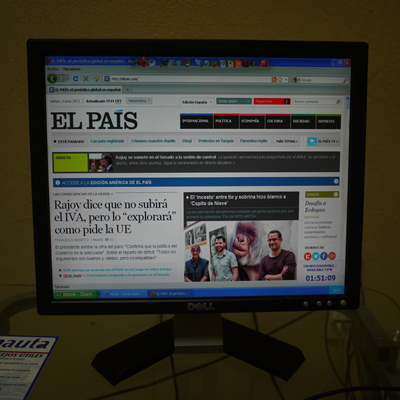
In 1993 Fidel Castro found himself on the ropes with the economic crisis and accepted the circulation of the dollar in Cuban territory. Until then, possessing foreign currency could cost you several years in prison. “The enemy’s money” came to stay, although years later it would be replaced by substitute called the “convertible peso” or CUC. Among the most notable details of the decree that authorized the dual currency — the CUC and the Cuban peso — were the motives for doing so. The Official Gazette recognized that this measure “contributes positively to reducing the number of incidents characterized as punishable which will relieve and support the work of the police and the courts. That is, it would save work for prosecutors and judges if people were allowed to carry dollars. However, the key lay in the date chosen for the new law to take effect: August 13, the birthday of the Maximum Leader.
Two decades have passed since that time and Cuban society is still gripped by monetary schizophrenia. Fidel Castro no longer holds the post of president but it seems that his brother is also given to mixing legal relaxations with the family calendar. On June 3 he commemorated not only the 82 years of his life, but he also put an end to a strategy of excessive control of Internet access. Just a few hours from the end of this day, the 118 cybercafés with public connections to the web opened. A somewhat bitter birthday gift for the General who had been delaying however possible the conversion of Cubans into internauts. Most likely this small step toward information flexibility will also happen with the legalization of the dollar: it will not be reversed.
Since this morning, Tuesday, the new public Internet sites began to operate with Internet and Intranet service. At a cost of 4.50 convertible pesos, a little more than $4.50 US, the user can access cyberspace for one hour. You can also choose to surf the national intranet for 0.60 CUC, or access “.cu” email only for 1.50 CUC an hour. In various tests performed — undetected, so far — none of the pages considered political were censored. With a minimum connection speed of 512 KBPS, the interface that welcomes the user as soon as the computer is turned on is called Nauta. Although all the workings and installed programs run on Microsoft Windows.
On opening day Internet portals accessible from the new locations included those such as El Nuevo Herald, news sites in the style of Diario de Cuba, and several blogs critical of the government written from the Island. The high cost of the service, in a country where the average monthly wage is around 17 dollars, seems to be the key constraint. This contradicts the deputy minister of communications who recently declared that “it will not be the market that regulates access to knowledge in our country.” To date, those who have hard currency — authorized to circulate by the former president — will be able to afford entry to social networks, to classified ad sites, and the tempting employment or scholarship sites where you can register to try to emigrate.
Curiously both measures — the legalization of the dollar and this timid opening to the Internet, have been the fruit more of pressure than the government’s desire for openness. To allow Cubans to possess convertible currency was a decision taken in the face of evidence that in the informal market the so-called “greens” circulated every day more strongly at the end of the eighties and the beginning of the nineties. A similar situation happens now with the information that flows from the vast World Wide Web. Pirate connections to the web on one side and the advance of the clandestine webs of audiovisual distribution on the other, confirm the futility of stemming the tide of kilobytes.
The first users who tried the cybercafés this morning were surprised at the speed of the connection, but lamented the excessive costs. Several official reporters hovered around the tables of a local center in the Vedado neighborhood trying to capture snapshots of Havanans throwing themselves en masse on the keyboards. Instead, they found a few cautious clients sizing up the limits of the new service. Each one had to show their ID card and sign a contract before seating themselves in front of a computer screen. A contract that clarified that the service should not be used for “actions that can be considered (…) harmful or detrimental to public security.” A sword of Damocles that could be interpreted also from political and ideological considerations.
From birthday to birthday, so go changes in Cuba. Twenty years ago it was the dollar… today the Internet.
5 June 2013
Please follow this link to support me.
4 June 2013
 This morning I went with my friend Magy to buy some bananas and ingredients for us to make a nice salad. We stopped at the EJT (Ejército Juvenil del Trabajo or Youth Labor Force) farmers’ market. We did not find anything worthwhile but we did overhear a conversation between two quite elderly men we recognized from our neighborhood.
One was saying to the other, who was dressed in military fatigues and boots in spite of being well into retirement age, how expensive and bad Cuban-made cleaning liquid was. The one in boots, raising his voice so those of us present could hear, replied, “No, it’s good. I just bought some here, and it came sealed and everything.”
“Listen, don’t be blind,” the other one said. “They dilute this stuff at the factory. And instead of the three pesos it used to cost when it was good and thick, it now costs twenty-five. Don’t you realize they are robbing you?”
“O.K.,” said the one in boots. “It’s true, but they only steal so they can give it to you.”
The other gentleman, who could not contain himself after such an utterly idiotic remark, said, “Look, my friend, I don’t want anyone stealing anything for me, much less the state. It’s like when they tell us they are giving us health care and education for free. It’s just one more excuse and a fable no one believes anymore.”
In the midst of this my friend came over, took me by the arm and said, “Enough of this. I have something more interesting to show you.”
She led me past shelves to a pushcart vendor, who was selling some very attractive avocados and enormous bunches of bananas. As we were shopping, we saw an elderly lady coming towards us. She was carrying a transparent nylon bag. Inside was a pair of pink slippers, which looked to be quite nice. She approached us shyly, offering them to us for only five CUC.* Suddenly the boy who had been waiting on us grabbed her package, turned to us and said, “I saw them first. And, besides, they are my girlfriend’s size. So, sorry, ladies, but the slippers are mine.”
We left, “our sides splitting” with laughter, but not before having to wait for the vendor to buy the slippers from the poor lady, who also wanted to buy some produce, before completing our transaction. “That’s socialism for you!” I told my friend.
*Translator’s note: Five CUC is slightly more than five dollars US at the official exchange rate.
4 June 2013

Editor’s note: This post is in French and is only partially translated here.
Text of notice:
In solidarity with the imprisoned Chinese writer Li Bifeng, the International Literary Festival of Berlin is calling on intellectuals and artists, schools and universities, media, theaters and other cultural institutions around the world to organize readings, June 4, 2013, on the occasion the sad anniversary of the crackdown in Tiananmen Square, and within the framework of the World Wide Reading Day on the theme of resistance.
In response to this appeal, the House of Writers and Literature, Biennial of Poets in Val de Marne, the French Pen Club, the Wandering Word and Poetry Market invited writers and poets living in France to support a writer or a poet “gagged in their own country,” by reading their texts.
Performance by Armand Gatti, Serge Pey and Chiara Mulas followed by readings:
Tahar Bekri (Tunisia) for Mohamed Ibn Dhib (Qatar)
Yves Boudier (France) for Li Bifeng (China)
Francis Combes for Mumia Abu Jamal (United States )
Jean-Luc Despax (France) for Angye Gaona (Colombia)
Marc Delouze (France) for Gao Xingjian (China)
Jacques Demarcq for Trung Nguyen Van Tuc and Phan Ngoc Tuan (all three of Vietnam)
Jean Pierre Faye (France) to Melissa Patiño Hinostroza (Peru)
Irene Gayraud (France) for Angel Santiesteban Prats (Cuba)
Jabbar Hussin (Iraq) for Bei Dao (China)
Werner Lambersy (Belgium) for Parviz Khazraï (Iran)
Mazen Maarouf (Palestine) for Rasha Awad, Haidar al-Mukashfi, Nur al-Ahmad al-Nur (all three of Sudan)
Jean-Baptiste Para (France) for Alireza Roshan (Iran)
Anne-Marie Garat (France) will also join the party.
[Angel Sebastian-Prats is included in the tribute]
“Among the readings that will be held, one will be for Ángel Santiesteban-Prats, unjustly imprisoned in Cuba by the Castro dictatorship, for the simple “crime” of expressing himself freely in his blog.
His story, The Moon, A Death and a Piece of Bread, will be read by the French poet and writer Irène Gayraud.

2 June 2013
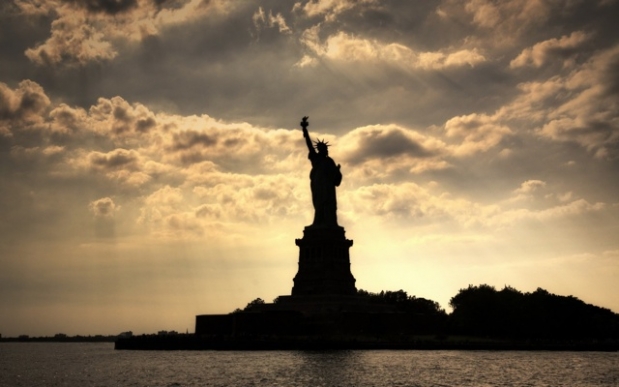
In my Cuban childhood, during the horrendous ‘70s, years of scarcity and closure, the United States was a mythical space. It was the unknown, the outside, the other, freedom, illusion: a chimera of hope in the midst of the sterilizing infirmity of Real Socialism. In my childish imagination, perhaps because the maps imported from Eastern Europe were painted that way, the United States was colored gray. And this cold gray stood out marvelously against the rabid red of the political banners of my country, perverse propaganda that still invades Cuba’s classrooms, with parents unable to avoid (or even complain about) this mind manipulation of their own children.
In myths, as in the promised land, the visionaries rarely get to live. I was lucky: I write these lines in the mute morning of Manhattan, where I am now after three months traveling from coast to coast to multiple universities and cultural institutions, the government and the press of this continental country.
I have no family in the United States. I came completely alone, direct from my eternal neighborhood of Lawton to the capital Washington DC. At the Havana airport they took my documents for an hour without explaining why: they wanted to see my reaction as takeoff time approached and I remained abandoned in the chilly room. In short, they played with me like a fierce feline that teases its prey before devouring it. The objective, perhaps, was to make my last memory of the Island a bitter experience filled with disgust. They almost managed, but no: my last memory of Cuba is a vision filled with pity for a people trapped in this belligerent logic, be they victims or executioners.
As soon as I got there, I was at the Tech@State conference, with the redemptive possibilities of the new digital media and social networks, but also the technological tyranny that authoritarian states employ to stifle freedom of expression. Thus, from the beginning I understood the full magnitude of how the repressive Cuban experience is common even in countries with democracy. The struggle for fundamental rights does not end when a dictatorship falls, rather it remains against the despotisms of control that are attempted from any power.
Next Yoani Sanchez, blogger of Generation Y, appeared with me at the New School of New York. In a packed theater, she and I discussed the free future of Cuba and the civil education of our citizens, today so ignorant about rights and so intolerant in social life. We were even subjected to “acts of repudiation” by a little group of Americans who escorted us around the Big Apple as if they were our bodyguards. We also suffered the anti-Cuban rudeness of the Cuban government, who with an official Protest Note blocked our presenting in a room of the United Nations, and we had to improvise a press conference in the hallway of some offices where very few from the public could fit. continue reading
Along with Yoani Sanchez I was received both by senators and the White House. I hallucinated on seeing the high level faces I’d seen only on a TV screen. The transparency of the institutions of government in Washington DC is impressive, as are its monumental spaces. My subconscious was waiting to see armed elite troops in the “heart of power,” but what I saw was an army of students who laughed as they crossed security barriers to get an early idea of who and what mechanisms lead their country. No police, for example, asked me for identification right in the street, as is common in Cuba without any reason: the oppressors there are bored and annoying passersby with impunity is the source of their authority. That is called barbarism.
Shortly after Yoani Sanchez left the United States, Rosa María Payá arrived, the young daughter of the martyred founder of the Christian Liberation Movement, winner of the European Parliament’s Sakharov Prize: Oswaldo Payá Sardiñas (1952-2012), who died violently in unclear circumstances, while the Cuban government offered the hypothesis of a “traffic accident,” which the surviving witnesses then denied as soon as they were deported from Cuba to their home countries.
With Rosa María Payá it was the city of Miami we inhabited. A Miami every minute more merciful to those who were tortured in Cuba and driven into exile. A commercial, cosmopolitan Miami where so many spies infiltrate who come to commit crimes and, yet, a Miami ever more tense but without forgetting its worthy pain. A Miami, fortunately, where 101% of Cuban culture is lovingly preserved, so that sooner or later it can be restored to the desert (and deserted) soul of our Island now in the materialist hands of an octogenarian clan.
We occupied there, together or separately, the major radio and television channels, each speaking our bit of truth to an audience of perhaps millions not only in the United States but in a great part of America. There I saw her return to Cuba in a strangely cold sunrise and I felt that, with just a 45 minute flight, I should also be there, in the land that I miss and that I do not want to be far from, but there are men there disposed to the worse so that there will be no democracy coming in a future of freedom, which will never come to Orlando Zapata Tamayo, Juan Wilfredo Soto, Wilman Villar, Laura Pollán and Oswaldo Payá.
In the U.S. I have given lectures on the Cuban blogosphere in universities in Pittsburgh, Princeton, Providence, Boston, Los Angeles, New Jersey, La Crosse, Madison, Durham, and other cities. On all the campuses I have been treated with respect by faculty and students, full of questions, sometimes so naive that it makes them vulnerable to the rhetoric of an expert from the regime who narrates the world of his image and convenience.
I have seen Cuban State Security agents dressed as diplomats and academics, as at the LASA 2013 event, where dictatorially it is Havana that imposes its mediocre monologue. I have met exiled families in every corner of America, each imagining a lost nation which perhaps very few will return to, not now, not ever, but a nation whose well-being concerns them every day and for which they would give the best of themselves. It’s a poignant diasporic homeland: an intimate unrenounceable homeland where the Castro regime is a nightmare from which they awoke to move the next generation to safety, so that the anthropological damage would not become congenital.
I have most loved Cuba under the snow and in a grove of trees as beautiful as they are unnameable. I have missed my dogs and cats. In return, I have tried to illegally feed a squirrel, but they are wild and fortunately don’t trust me: they don’t recognize me as Orlando Luis (nor do I).
I call my 77-year-old mother almost daily, thanks to a system of Cubacall that the Cuban government tries to block, because it puts a strain on their monopoly prices. She is happy that I am no longer in the post-communist cauldron, but sounds very concerned about what a perverse power can do to me. And it’s not the “long arm” of State Security: State Security has been located here for decades (the decency of democracy is fragile faced with the brazen). My mother María is of the generation of fear, but she is completely justified in fearing the death throes of the State establishment’s dying beast. Thus, when she says goodbye she always tells me, “Landy, don’t say anything.” And I carry the blame of never pleasing her, because her only son keeps talking and talking: words embodied in my throat that come from you and you, and you know it, right?
I do not want to stop breathing in the United States. The air is clear as midnight in the higher latitudes (I didn’t even sneeze). Here I saw snow for the first time and found it warm. Here I felt the emptiness of ancient and classical pieces in the Metropolitan Museum, for example, so often seen as reproductions in books, and I assumed that the originals are exhibited in Hollywood stage sets: tinsel as the flow of desire and a measure of the truth. Here I have been celibate rather than celebrated, because it is in the U.S. where I wait for the beautiful digital eyes of my intangible love to recognize me (in an afternoon after autumn: forgive the terrible poetry of the Southern Cone).
In addition, I wish to visit two destinations at the limits: Puerto Rico and Alaska. In many ways, Cuba fully vibrates here: that left on the Island could interpret it as an imitation kidnapping. We don’t need it. We lack nothing, Cubans in this university of opportunities called the United States, where everything is within the reach of a click and of our ability to be self-sufficient and good people.
We can leave the Cubag Archipelago in peace in the hands of an uncivil military that could already be in the majority, along with the corrupt and the marginal: the fabric of the nation must be mended from scratch, from the unknown, from the outside, from the other, from freedom, from illusion, from a mirage of hope on this side of the Malecón.
Hence, I sometimes fantasize with the idea of founding a new territory, a natural reserve of happiness, a micro-nation that could end up being an economic power and an example of respect for others and the natural environment. A little piece of land bought in the State of California, for example, where law would barely need to be imposed because no one would conceive of harming anyone. A planetary refuge with human values, where no power would mutilate our spirituality nor humiliate our biographies, be they inspired or not by some God.
A country not “with all and for the good of all” (that Marti demagoguery where no one fits, and that drags us from the Republic of the Revolution to the Counter-Revolution), but rather “with each and from the good of each,” because we are not a mass but individual people and we are born and we die individually, preferably privately. A Cuba without caudillos that doesn’t have to wait until the end of the Castro regime to be its antipode, even geographically.
Homeland is not Humanity. Homeland is behaving here and now with humanity.
Translated from Diario de Cuba.
2 June 2013