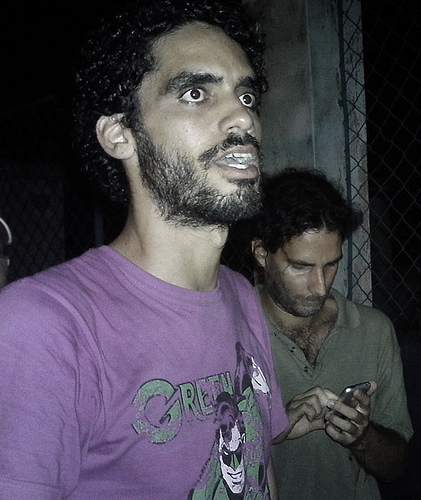
El Sexto rapping for his Freedom of Expression
vocescubanas.com/boringhomeutopics/files/2012/02/sexto-be…
February 21 2012
English Translations of Cubans Writing From the Island
El Sexto rapping for his Freedom of Expression
vocescubanas.com/boringhomeutopics/files/2012/02/sexto-be…
February 21 2012
 With regards to the Book Fair, I’ve noticed that many bloggers are readers of long standing. I started at reading when I was 4-years-old and haven’t stopped. Neither computer games nor television shows have taken away the pleasure of a book. It makes my mouth water to see those electronic readers whose screens are still visible under the light of the sun, because I have a lot of books in digital format, and it bothers me to read them on the computer, spending hours sitting in almost the same position but I have no choice.
I have a little room filled with books from floor to ceiling, (my husband is a writer) and we have made successive donations and in one period we sold the best of our library — sold it for very little indeed — to be able to eat.
But to sit with a book when the house is quiet, I love it. Right now I’m reading Paradise on the other corner by Vargas Llosa. I don’t fixate on his pedigree as a Nobel prize winner; I read everything and I’ve read a lot of forgettable books. In childhood I inherited from my brother some orange hardcover books from the publisher Billiken, and my parents always gave me books as gifts. Salgari, Verne, Proceedings of the Pickwick Club, The Kon Tiki expedition, Little Women, Tom Sawyer, A walk through the house.
I enrolled in the youth room of the National Library and every week I checked out a book. I was in elementary school and I went alone back and forth on the former Route 119, without the parental overprotection that we see now.
I alternated Corin Tellado and Clark Carrados with Les Miserables and Anna Karenina in the school holidays while I finished primary school. During high school I got to Agatha Christie, Conan Doyle and Poe, and those Dragon editions with their long, narrow format which I devoured. By the time I read In Cold Blood, One Hundred Years … and Hopscotch!, which I did not understand at all.
But there are books that are memorable for different reasons. A science fiction novel of the Soviet era called The country of foam I loved so much that when I visited The Hermitage tried to make myself understood without success to reach the sculpture which gives rise to the plot of the novel. I did not want to read it again, because it was a book from childhood in which I might now would find a lot of defects. The Three Musketeers, that I was given in the Reyes edition in 1966, a beautiful hardcover edition and large black and white illustrations. As a young woman I borrowed to read titles like The Godfather, Jackal, Papillon, but classical literature was on the shelves of my house, and between bestseller and bestseller, I improved my reading.
I came late to poetry but it was good for me because it allowed me to “digest,” what I do is to intersperse some poetry between a block of narrative. I married a writer which was also a plus. Our punishment is a child who barely reads.
After so much hedonism, I will list the ten books I would take to a desert island.
The Three Musketeers, The Mysterious Island, The Red and theBlack, Conversation in the Cathedral, The Sound and the Fury, The Tin Drum, Complete Poems of Vallejo, A Thousand and One Nights, The Decline and Fall of Almost The Whole World, War and Peace.
And I’m sure on the desert island I will lament some that I forgot.
February 21 2012
 After touring most of Europe, eleven countries in Africa, ten in Asia and traveling through America from New York to Buenos Aires, sisters Anna and Arancha, natives of Oviedo, Asturias, Spain, decided to land in Havana and come to know other places of the Caribbean’s largest island, where their grandparents came as immigrants and prospered enough to send the “four dollars per month to the family” and return to the Spanish Peninsula after 28 years as successful people.
“Cuba was a pending issue for us. Grandpa did very well here, obtained some rental properties in Old Havana and contributed as a member to the Asturia Society funds. At home we have lots of letters and photos of his island stay, but it has changed a lot and actually contradicts the memories we brought with us.”
As it is almost impossible to “see the island” in just three weeks, the sisters, ages 60 and 63, were armed with maps and accompanied by a friend from Valencia who been five times, readjusted their route from Havana to Viñales Valley in Pinar del Rio, the beach resort of Varadero in Matanzas province and the small colonial city of Trinidad to South Central. Santiago de Cuba was left for another winter.
After wandering through several squares, parks and museums of the Old Quarter, the Spanish tourists traveled in “old cars” — the so-called “almendrones” more than half a century old — the Malecón, Linea, 23rd streets, and other areas of the Vedado neighborhood, “the most modern but stuck in the fifties. “
Ana was impressed by the architecture of Havana, the natural exuberance of the Viñales Valley and the transparent waters of Varadero, but believes that the services provided by employees of the Hotel Allegro, occupied by Italians, are a mixture of grace of Cubans and farrullero spirit of the Italians, whose shouting usually fall well to the bus guides, who say that only Spanish tourists “complain”.
Arancha, for her part, was struck by “the stinking filth of the streets of Havana, the dilapidated state and the polluting cars, more appropriate to populate a wrecking yard than to transport people from one end of the capital to another,” which surprised her because “it contradicts statements by the Cuban authorities about the environment and global warming.”
Their mutual friend, captivated by the blue sky, the mild winter and the beauty of tropical palms and coconut trees of Cuba, was once again unnerved by “the bustle of the city and the indolence of the survivors of this island, trapped under an eternal and ridiculous dictatorship, which bores even God himself.”
February 23 2012

February 23 2012
 Daniel, 39, made a trip of 6,000 kilometers from Spain, to hacerse santo’* in Havana. He bought a low fare ticket from Iberia and brought in his wallet his savings from ten years as a computer programmer.
It all started one night when he was reunited with a childhood friend. Things were going well with the man. He was wearing brand name clothes. And driving a 50,000 euro Mercedes.
After a few drinks, he told him that had progressed thanks to the ’santo’* he realized in Cuba. “Things looked black for my friend. On some vacations on the island met his current wife. Her mother was a priestess. And convinced him that when he made a saint’* things would change. And they did change,” says Daniel, who instead of making the Road to Santiago, he decided to to Havana, hoping to have the same fate.
According to his account, he lived a fucked life Spain. And he thought it was worth spending 10,000 euros to get ahead. Maybe it would turn things around. Today, in Cuba the ’saint’ costs a foreigner between 3,000 and 4,000 euros. Depends on the saint or orisha.
Olga, an experienced santera, clarifies that it costs the same to take Eleguá as Obatala. Or Shango. For outsiders like Daniel an entire industry of Santeria has been assembled. Swedes, Japanese or Spaniards have a wide range of options when it comes to ’hacerse santo’. Of course, They have to bring everything from their country, starting with the white clothes.
The babalaos abound on the island. There is even competition. The State, which once hindered Afro-Cuban religions, has joined the party. And if you are not a severe critic of the regime, you may belong to the Yoruba Association.
The Association has an official site at Prado and Monte. And just by picking up the phone, they serve powerful people of the Communist Party Central Committee. The Letter of the Year** of the official babalaos is even reported in the national media.
To fall into grace, at times, the make offerings to the ’pledge’ of Fidel Castro. And they pray for the health of the old guerrilla, who by the way, these days, is rumored to be in serious condition.
Then babalaos and santeros do their thing. Make money. They have hundreds of foreign godchildren. And successful Cubans. For some time here, there has been a dissenting society of the Afro-Cuban religion. They are independent of government. And their snails speak differently from those of their official counterparts.
They are critics of the status quo. Like those favored by the regime, many babalaos have the sign of the dollar on front. It’s their star.
“To make a saint” in Cuba is a booming business. It’s no longer seen to be a “folkloric wave.” There are party leaders, esteemed musicians and intellectuals, more and more of those who have an Eleguá on the threshold of their houses.
When things go wrong, the ’godfathers’ implore their ’godchild’ to “make the saint”. And that means spending money. There are three rates. For foreigners like Daniel the ’saint’ it is expensive. For Cubans living in the U.S. it costs more, but not as much as for a clueless Finn. For Cubans on the island, the price is cheaper. Well, it depends on what you mean by cheap.
A “saint” can cost between 10,000 and 15,000 Cuban pesos (420 and 650 dollars) depending on the type of “saint” and the appreciation or ambition of his ’godfather’. That itself is nothing compared to the $ 6,000 U.S. that was charged to Richard, a Canadian married to a mulata from Havana.
In any event, to be ’made holy’ means two years salary for a Cuban worker. And maybe more. The reasons to go to the ’throne’ vary. Health problems. Eagerness to thrive. Even trouble with the law.
Or a fashion. People who like plenty of money are ’made holy’ to have a “protection”. “And an amulet of protection,” says Miriam, an accountant by trade.
She knows what she’s talking about. She has stolen with both hands for years now. And never gone to jail. Not even had trouble with the law. Even coming out well from a close shave with the audit performed by the group of incorruptible of Gladys Bejerano, head of the Comptroller of the Republic.
That flurry of bills falling on the Afro-Cuban religions has brought its consequences. Unscrupulous people who profit from the faith. Phonies. Crooks and hustlers. But of course there are some like Horace, a recognized babalao, who continues to respect the beliefs.
You can go to see it in a rickety tenement in Cerro. Just pay one peso five centavos for the inquiry. And you don’t have to buy a live animal. Or give him a bottle of whiskey. Or a box of Robaina cigars. If your case does not look good, according to the reading of the shells thrown, Horace will give you Arosohumbe. A saint who is free. Believe it or not.
Photo: Marcus Encel. Santera cubana.
Translator’s note:
*Hacer santo: Roughly, this is a ceremony of initiation into the Santeria religion. The initiate is not “made a saint”… rather they are assigned one.
**Letter of the Year: A letter predicting events of the year to come.
September 2 2011

Two things are infinite: the universe and human imbecility, Albert Einstein once said. The phrase, brilliant, full-length portraits of those who, creators who possess absolute truth, seek to dictate conduct, attitudes, formulas and obligatory behaviors for centuries and centuries, forgetting the constant denials of history. They are not the first to try and, unfortunately, will not be the last: the long road of mankind is marked by eternal empires that weren’t, unique ideas that no one remembers, inviolable laws that everyone violated, irreversible decrees that became wet paper, absolute rules that everyone forgot and sublime nonsense, which has made then and will make them the laughing stock of the different generations. It happens from time to time at any latitude: it is like a recycling of old mistakes.
To repeat such nonsense today and also to believe that someone will take it seriously, proves the eminent physicist right. To be more vulgar, we can add that man is the only animal that trips twice over the same stone, and sometimes three, four or more times.

Nations have periods of greatness when everything seems to support their splendor (ideas, economics, politics, laws, arts, etc.), and periods of decadence, when everything seems to conspire to their misfortune. Today it is our turn, though it hurts to accept it, to be in the latter period. Just listen, read and look around to prove it to yourself: a lack of original ideas, no real solutions to economic, political and social problems, no intelligent and fair laws, and not even an art without straitjackets, as well as social indiscipline The lack of values, poor education, physical and mental violence, bad habits and other negative phenomena abound, before the official indifference of most citizens. Without a doubt, mediocrity has found its place in our society and to eradicate it will be a difficult task, especially when, for now, the winds blow in its favor.
February 20 2012
This video is under two minutes long. The subtitles appear to have stopped working. Here are the lyrics:
IMPORTED BLACKOUTS – An original song by Ciro Diaz
Ohhh…. Fucking up a little island is nothing
Anyone can fuck up a little island
With few natural resources it was easy, to drown it in misery
But Fidel Castro loves the hardest efforts
That’s why he made friends with Chavez
To see if he could fuck up Venezuela
It looked like it would be hard
Because every time they dug a hole
They found every imaginable mineral
And the oil never stopped gushing
Only a president truly idiotic
Would allow his plans to embrace
The foolish ideas of Fidel and Cuban counter-intelligence.
And just like that ten years later, the job seems to be completed
Venezuela now has blackouts, blackouts imported from Havana
Venezuela now has blackouts, our experience was useless to them
Venezuela now has blackouts, blackouts imported from Havana
Venezuela now has blackouts, if they don’t hurry they will be left with nothing.
 BUT THE DEAD, AYE, CONTINUED DYING
The Februarys begin to accumulate, with the complicity of our indolent amnesia. Indecent. Till death do us bring together. Was it one or three years ago? Orlando Zapata Tamayo? Or were the last names reversed? From Santa Clara or Santiago de Cuba? Before or after the clinical case of Laura Pollan …?
Cuban prisons continue coagulated and there is no clemency to alleviate their high population density. There will be no national mercy with the resisting bodies. It is a strategic question of governability. The minds turned to war shall be brought low to force them to think of peace. Or to abolish them. The only survival tactic in the face of the powers-that-be will be to continue playing the witness, without sticking our noses into the path of the State. Without calling aloud our contempt or our panic. Without pronouncing it in public writing, either. Become invisible, live the life of us, even a life without biography. Become imbecilic.
Materialistic mutism. Mediocre meanness. Innate ruthlessness, or worse, learned.
The dead will die solely and exclusively in the name of the dead. Over the futility of virtue. A country in eternal waiting manipulates even its martyrs to blows of forgetfulness. We do not want to believe that the lack of solidarity makes us naked before the hangman. Rather to abandon to its fate the corpse of the neighbor is considered a good sign of fitness. Idiotness. There are too many Cubans. In any event, not all of us could conquer the future. Statistics are statistics and without statistics there are no statistics.
The Februarys continue to accumulate, as a plot by conspirators against ourselves. Till death do us bring together. Let capitalism take us confessed. Was it two or three years ago? Orlando Zapata Tamayo? Or with the last names reversed? In an intensive care unit, or in a punishment cell of maximum insecurity? Before or after the cynical case of Laura Pollan…?
Unrecognizable Cubans. Irreparable Cubans. When an energetic and virile people trembles, justice cries.
February 23 2012
 When, in the history of the country, was the crime of being a counterrevolutionary invented? How can it be a crime to be against something like a revolution. The French Revolution, the revolution in Haiti, the Mexican Revolution, the October Revolution, the Cuban Revolution, can anyone tell me the exact number of dead, imprisoned, crushed, left behind by each of these revolutions?
It is dangerous to oppose because Revolutions are violent machines that seek to justify the horrific death of many in the name of macro social ideas. Like some huge pruning scissors are applied on behalf of social justice to the heads of humans.
So it is logical that there are many in opposition although the terror makes many of them hide their heads. This metaphor should be understood by executions of so many Cubans, who were not necessarily Batista henchmen, the imprisonment in the hell of a revolutionary prison where you lose all rights because in the consciousness of the bully there is only one party ideology, or it can be reset by ingenuity or by this mechanism of self-preservation. The three things relate different ways of dying.
However, the leaves keep growing, the sea keeps repeating the same movement for ever and ever, the sun, the babies, because life can not be prevented in spite of everything. The problem arises with consciousness: I am, and that is opposed by the vertex to the idea of a revolution.
What do I gain by following the rules, or what do I risk with a little hope, with a little faith, I insist, the size of a mustard seed? I also once thought vaguely that it was that they underestimated the opposition cries, to make the blind see, the lame walk, but those voices that oppose violence have the power of the spirit of the sea, the rising and setting of sun, the tears and laughter of a baby.
Freedom is older than the State, but has always been in danger. Something like counter-revolution cannot be a crime, to be against violence, arbitrariness, lack of freedom to be opposed without fear of punishment can not be a crime or an offense, or a stigma.
The more that such violence needs to repeat over and over the same speech to convince some who are fleeing the terror to be submissive and not look for trouble, taking refuge in their private life, afraid to talk even at home, because the abusers officials, politicians, leaders of a caudillo communist system have decreed that politics is a right reserved to their class, their followers, not those who oppose them in a civil and peaceful manner.
They use force to suppress, to vex, to kill and spread terror so that you will retreat into your private life, with the blackmail of “look how much you will risk to denounce evil.”
To justify such violence takes a lot of propaganda. The language is the death of pleasure, you can access knowledge through language, but of all this repetition creates a replacement mechanism that closes the possibility of experience, you begin to accept the lies and so you can go through life deceived, not having the taken the time and responsibility to say NO.
They kill with discourse, and much more so if this discourse, exhausted from hiding so many lies, having to turn itself over and over, extending for hours, you end up accepting that you can put off until tomorrow the work of defeating the dragon. “The submission of the masses is an irrefutable fact.”
I still hold onto hope and and the impulse to fly every time that I ignore the fears and let myself write. But at the end of the day it is hope, to be freed rather than write. You have to really believe it, the problem of Cubans is not really believing that we can be free, for fear, the serious counterrevolutionaries that we are more than return the pleasure and kill the discourse.
February 21 2012


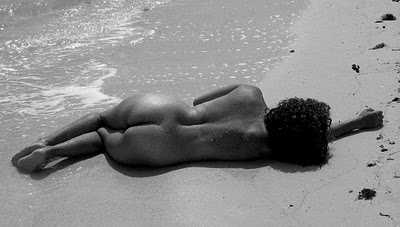
Photo: Francis Sánchez
One day I discovered that my wife accused me of attempted murder. She based her accusation on a poem she had found among my unpublished scribbles, where I addressed the dream of a just death that could follow a liberating shot. Carrying forward the tragic event, with the right that attends every potential victim, she published a disturbing poem in the magazine La Gaceta de Cuba — as it had received a mention in the Cuban Writers and Artists Union “Julian del Casal” award — “Having Read Francis’s work ‘pedaleo.’”
Her first verse, in her own self-defense, could not be clearer and more forceful: “i have discovered that my husband kills me in a verse.”
Her writing came through like that, in small letters, as if belonging to a crushed soul, even before I was able to print my own ‘pedaleo’ poem, the cause of the problem, which only some time later would appear in my book Caja negra (Black Box) (Ed. Unión, Havanna, 2006.) One needs not to be too perceptive to understand that her feminine denunciation would cause some impact, which added to the flutter already stirred among the critics due to its piercing expressive sign—a generational, even genealogical, trait, shared with this virtual criminal?—or perhaps because the most hidden and hurt vein of her anguish had been exposed.
These days she is traveling to Havana, to the Book Fair; she is there right now—which I’m clearly using to my advantage—presenting her latest poetry book, escribir la noche (writing the night) (Ed. Letras Cubanas, Havana, 2010,) where the accusatory poem is featured. As it can be seen, for the title of the book she insists in taking out words from the oven which seem to grow in contact with the air, over which someone has rolled with a rolling-pin. I will not defend myself. I would never subject to any doubt that the dough of our love exudes all the pains and traumas that sincerely unite words. We are flesh of the same flesh. To kill and kill ourselves are edges of the same dream. Always a third shadow walks behind us.
My text was also lacking—before hers —those caps, while my desire for an “impossible shot” pointed, finally, at opening the door of the suicide, a tunnel “behind my head.” Sometimes what unites us most are precisely the abusive fears that attempt to destroy and scatter the place of a human gaze over the earth. My boredom with lived circumstances has acquired the hyperbolic shape of my own death, an intimate break-up with myself, and the terror of those tanks sent down the street in some remote China, because we had always felt them advancing. Doubtlessly, the veil of our innocence was always torn.
Bear in mind that, to her, in her verses, the savage bestiality enters and passes over us almost without warning, with the siege of daily life, with “the weariness of the province,” that colorless and odorless repression which has also fused us like broken bones. I will now limit myself to publishing, for the first time, both poems, together, in the order they were written. I give myself to this with full consciousness of my uselessness as an individual, but, at the same time, with that temerity of species that brushes its perfection in the shudder of love—for justice, for liberty, and for her, Amanda,—just as that man could have felt, he who briefly stopped a caravan of tanks that advanced—was his name ever known? Will he be remembered?—over Tienanmen Square.
(Ciego de Ávila, Cuba, February 16, 2011.)
pedaleo [pedalling]
i pedal up the street with a certain pride after stowing the moldy cries of my wife and give pause momentarily to the idea of shooting myself. if i am free it is because I have come tosubstitute air, i believe, and to hate her, and to measure from a distance the city that rots and decomposes. through the hole left by the idea of a bullet the smaller jokes can be seen. in between Napoleon and i, for example, only circumstances fit.
my childhood wrapped in a pavilion of perfumes is selling its body to injured soldiers of death. but this placidity comes with a punishment for the furrow left by the dream, no less eternal than the virgin’s corset or the hump of Miguel Angel sleeping on the scaffold.
it could happen–hearing this crippled mirror: one day they will judge me for my actions.i will not be an expatriate. i will not be mouth open on the cement like a bird with broken ears.
although it never bore fruit even my fatal destiny must be fulfilled like that of a flower.
what small difference is there between my two aimless legs that sour the emptiness of the city and those of the Chinaman — kicking on the gallows — when he held back the armored avalanche in the momentarily symbolicTienanmen Square?
i coordinate movements, i drown heaven below and i watch the livid look of God, the chariot of fire or his two great empty windows through the tunnel that goes — i blow, sometimessink my fingers, etc. — this impossible shot behind my head.
Francis Sanchez, from Caja Negra (Black Box) Ed. Union, Havana, 2006)
after the reading of Francis’s pedaleo
i’ve discovered in a verse that my husband kills me, in another he avoids killing me by pedaling his bicycle with no direction through the moldycity to the foundations. the air — he says — saved me from the shot, it also saved him from the same bullet ricocheting in his neck. he doesn’t know i read these poems with pride not because the same verse where he exorcizes silence, momentarily extracting the edge from the idea, of killing me and killing himself, but because it lets me visualize with minimum sound, truths that soothe me, stammered “between the largest and the smallest men only fitting the circumstances.” he knows that we are conquering forgetting and this is huge advantage: in this life no one will judge us by our acts.
i can survive his momentary hatred, uncertain, while i hide in the smell of my ears the gunshot wound that he didn’t give me, flowing, unstoppable, i can survive the fact that napoleon, miguel angel, the heroes without name sustained in the everyday scaffolding and not appearing i, on another scaffolding still weaker, giving foundations as strings.
i can survive the pain that only loads on their backs rusty sacks of my screams and my body intact as a white flag over his body in flames. and not my hands stopping the onslaught of tanks that threatens us the tedium of the province, the dust from their walls rotting under the inclemency of the neighbor, of the hunger and nakedness of the province and its bitter trains, always on time. and not my flaxen children born from me, from before me, giving us the true useless significance.
i can not survive the deck of oblivion, the absence of the white deer against the horizon, meandering dreams under the same purity. i can not survive the signs that abandon a spring with adolescent fear. how heavy a park broken in memory, the oaths spilling by saffron scent of the flame tree. the touch of your hands on my astonishment, on the roundness of distress. there is much to suffer to return to that perfume and find it intact in memory.
i have discovered that my husband kills me in one of his insipid pedalings around the city for not receiving in his neck the ricochet of the shot that he didn’t give me, my husband who tries one day to sit down at his side, at last alone, and to talk, and yet, when I read in his veins, the tunnels discover other forbidden worlds.
(Ileana Álvarez, in escribir la noche, Ed. Letras Cubanas, La Habana, 2010.)
Translated by Karen, t, and Sydney
February 23 2011
Mayabeque, Cuba.
My Dears,
My name is Angel Pulido Donato, I am 30 years of age, I’m sick with HIV-AIDS.
This is where you most feel the dictatorship, in the regime of the AIDS prison in San Jose de las Lajas, in Mayabeque. They (the authorities) fill their mouths to say that this is a special unit, and it is a lie. This place is full of bars on all sides, we are mistreated.
To us, the HIV-AIDS patients here in Cuba when we stand before a court, it is best not to say you’re sick because sentences are much higher, if so, they punish you with 5 to 6 years.
Here we are depressed. People are dying. We have low defenses and opportunistic diseases attack us, and even if they don’t, we get depressed.
Here it is like a concentration camp but for the sick, they fill their mouths to say that AIDS patients are bad, problematic, it is that people do not help us, so they do not worry about us. I have seen many people die here, and I do not want to die in this place after being sentenced to death by my illness.
Meanwhile, the more sick people who are ill, the better it is for them because it is a business. Everything that comes here for us is stolen by the authorities: chicken, cheese, ham, meat, beans, powdered milk, they give us nothing here, we only drink watery tea for our snack, and they fill their mouths saying they give us six meals a day and it is a lie.
We get chicken, fish but they don’t give it to us, the put it in the blender and what we get is the broth of this meat.
Here, nobody can complain, if you come visit from any province around the world, you have to stop and sign your name and if you say anything the one in charge of discipline, who is a prisoner like myself, will beat you down, and people are dying here.
In this year nine have have already died, the latest died of candidiasis, an opportunistic disease that attacks us because of the poor conditions in which we live, the lack of medical care and hygiene. The water we drink is not clean, put it out 3 times a day for a little while and if you go to the bathrooms you feel the urge to vomit.
Now they are fixing the bathrooms, I expect an important visitor has them running.
They beat us when we demand our rights because we have had to reveal ourselves. They have repeatedly hit us recently without consideration of the fact that we are sick.
The authorities hate us. Every time a patient with HIV / AIDS goes to the court the sentences are extreme. They give us 10 or 12 years, just for being sick.
The penetenciary authorities of this prison have also created a command of prisoners whose jobit is to beat with sticks any prisoners who do not comply with their rules and violate ours.
I know I am going to die, I have parasites, they don’t give me any medical care, they tell me it is only for the gravely ill and the asthmatics are the only ones who get attention, for the rest they have no medications.
Why are there no medicines here, is this is a prison for AIDS and Cuba is a medical powerhouse?
Here there are 400 prisoners, more or less, sick of HIV/AIDS including women whom they bring more and more without preparing conditions for them.
The world should know this, tell them, they are killing us.
Spanish post
January 23 2012
 Those were the difficult eighties, and the stillness of the Plaza neighborhood’s House of Community Culture cracked under the onslaught of officialdom trying trying to abort a lovely project that, against all odds, Mireye Felipe and Maria Gatorna, Director and Deputy Director respectively of that institution, tried mightily to advance: a space for rock concerts.
It was a fact that this cultural event, despite the isolation and harsh prohibitions, managed to cross the impenetrable wall imposed by the senior representatives of culture in our country.
Rock, no way, it’s outrageous, and much less heavy metal! Those were the pro-government voices they had to listen to and which these two courageous women had to confront, seeking a place for the young lovers of this cultural event, where rock music could be played.
Mireya was soon transferred to another institution and Maria was left alone, boldly facing up against the old concepts and ingenuousness, with her soft, modulated voice, more suited to a faithful representative of classical music than rock, to make the Nomenklatura of the official Culture understand the benefits of these restless youth, and to create for them, there in the Communal patio, a space for them.
 Bit by bit she pierced the wall of intolerance, and Maria intelligently took advantage of every little crevice, as step by step she gained ground. Thus, with courage, effort and unflagging devotion, that space became what everyone knew as Maria’s Patio. She was undoubtedly the Alma Mater who sheltered in her arms all those boys marked and rejected, by fear and official intolerance.
Today, many years later, when the courtyard disappeared as such and Maria is no longer there, a then young-rookie-of-lens-and-shutter, breaking into the world of freaks, rockers and the police became, in fact, an eyewitness. Thus, Alfredo was filling drawers and drawers with rolls and contact sheets, which distilled the faces and moments already historic. No one ever wanted to commit to publish these photographs here. Now, from France, which he has called home for some years, with his wife and daughters, Alfredo is working on a book project that will soon come to light, thus paying a tribute to Maria, the Patio and all those young people scattered around the world today , which form an important part of the Cuban cultural diaspora.
February 21 2012
 Graphic: Publish and find announcements of: Purchase, sale and rental of houses; purchase and sale of cars and parts; classifieds, cellphones, work, nightlife and friends. Ads using only your email. Create your own website and advertise your business on the internet. Express your opinion in our discussion forums.
The story of a young Cuban who is now a rich man thanks to his computer skills came to me the week before last through an acquaintance who attended a lecture by businessman Carlos Saladrigas. This young man came to my attention again in the news on the blog Café Fuerte, for the creation of Yagruma, a crowdfunding platform to help artistic projects on the island. Our initiative flourishes with the little “filip” he gave it.
Less showy, but much more comprehensive, Revolico.com, despite the difficulties of accessing it from Cuba, is undoubtedly the most visited site after Google, email accounts, Wikipedia and the viral Facebook. Its distinctive feature is that Revolico is a site created exclusively for Cuba. We can find classifieds, swaps, sales of all types, ads for private restaurants and other services, rental of rooms or houses, and even a matchmaking section.
The popularity of the site has done nothing but grow; and now you can find — on the windshield of your car, under your door, or behind the plastic panels of the Chinese-make Yutong buses — some flyers that advertise another site: Cubísima.com. With a profile similar to that of Revolico but with the addition of discussion forums and other online services.
Far from being in competition, both sites have joined together. Hence, there is no doubt they have created a platform that will increase their influence in the emerging virtual life in Cuba. The filters the government tries to put on them are useless: so far people have accessed them despite their being banned on several national internet servers, and will continue to do so.
With regards to support platforms, we hope to see them multiply via PYMES* (can it be?) and, why not, for many civil society projects, and that ghost of a fiber cable will be an additional partner.
*Translator’s note: PYME is an acronym for “Small and Medium Size Enterprises”
February 20 2012
Note: This video is two minutes long.
Translated by Chabeli
20 February 2012