The Government Editorial / Lilianne Ruíz

"Faced with the interference from the Yankees and the European Union, UNITY!"

The Cuban government gave its first statement on the death of Wilmar Villar, on January 23rd. It was taken from the Central Committee of the Communist Party. The paper in question, Unico Diario, is the only daily newspaper. It is the official organ of propaganda, of the only party legally allowed on the island, this is of course, the Communist Party. I expected at least one story of the events, but the story is devoted to a series of human rights abuses committed in other parts of the world. They, in that way are willing to join the list of abusers, beating all competition in longevity: 53 years! It is good teaching in order to swell the ranks of the club of murderers!

State Security is twisted and dirty, without scruples, without values, idiot-proof though not because it is less guilty. For I understand that the Chiefs for whom it works; those of State, they do not still have any more resources than absolute vileness, because, along the way, they lost their soul. But the gendarmes, for many privileges and brainwashing, being accomplices, are earning a dark satisfaction that is devouring them completely. In these situations I find strength only by reading the Gospels. Forgive me, if I repeat myself.

Someone told me that he read, in the BBC, that Wilmar was imprisoned for contempt of authority and for beating his wife. I don’t know how much stock in the BBC is held by the Cuban government, a representative of the most predatory left, but it seems disrespectful. I am not interested in Villar domestic relations, but in the fact of Wilmar’s death as a result of respiratory deterioration during a hunger strike. His wife, the mother of two girls, was also arrested after involvement in a non-violent political protest.

I cannot repress the cynicism of the Communist Party, of the shield of the caudillos, when it states, in the media, that with much urgency they have given the world the news without investigation of the facts. To my knowledge, no Cuban jail has been visited by Amnesty International, the Red Cross, or the Rapporteur of the Commission on Human Rights because of the constant refusals of the government. Imagine if CNN were to have access to the hole where Wimar Villar remained nearly two months while on a hunger strike, then dying of pneumonia because of the punishment they implemented by their attitude! Cuban National Socialism uncompromisingly, cannot stand the gaze of an International Commission, but complains to the United Nations of suffering economic isolation.

State Security is twisted and dirty, without scruples, without values, idiot-proof though not because it is less guilty. For I understand that the Chiefs for whom it works; those of State, they do not still have any more resources than absolute vileness, because, along the way, they lost their soul. But the gendarmes, for many privileges and brainwashing, being accomplices, are earning a dark satisfaction that is devouring them completely. In these situations I find strength only by reading the Gospels. Forgive me, if I repeat myself.

Translated by: Hank Hardisty

January 30 2012
Wilman Villar Mendoza: The Death of a Dissident / Yoani Sánchez

Wilman Villar Mendoza

The punishment cell is narrow, is five feet wide by two long, cold and there is not even a blanket for cover. From the hole in the floor that serves as a toilet, a rat occasionally emerges and looks curiously at the curled up man lying there. Outside shouts are heard, metal banging, and the general noise of the Aguadores prison, one of the most feared in eastern Cuba. This scene, common in our prison system, was repeated in early January and was had as its protagonist a young man of 31.

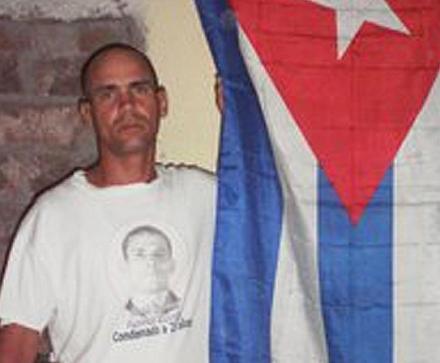
He was called Wilman Villar Mendoza was arrested on November 14, 2011 while participating in an antigovernment protest in the streets of Contramaestre, his hometown. In images broadcast after his death, he is seen at the head of a group carrying the Cuban flag, while the astonished passers-by do not know whether to join the crowd or to shout down the demonstrators. Probably the memories of that place passed through his head again and again while he shivered within the damp walls of the dungeon, but that we can never confirm. Because of that place he would only emerge — already dying — to the hospital and finally to a grave in the cemetery.

Villar Mendoza, the prisoner who recently died of a hunger strike, made a living doing carpentry and masonry work. His specialty was the most slender and beautiful wooden flowers that tourists buy as souvenirs to remember this island. A stalk and six petals carved with the patience of one who knows that time is not worth much in Cuba, the minutes will not bring him anything more successful or happier. He gave form to a piece of cedar, shaping it for hours and hours, brooding with that frustration that is always greater among the youth of the province.

In September 2011 this sense of social unrest led him to join the opposition group Patriotic Union of Cuba. According to the official propaganda je was a common criminal who had even “brutally” beaten his wife in July last year. But too many witnesses, including his own wife, suggests that such insults are only trying to kill his image after the death of his body.

In Cuba, in the words of a friend, “nobody knows the past that awaits you,” because criminal records of citizens are also determined by their political behavior. As there is no separation of powers, as the judicial system is not independent of the party branch, those whose ideology falls short will find it reflected in their criminal records.

Maritza Pelegrino / From 2space.com

Generals have been known to have shoot their mistresses, ministers caught in million dollar embezzlement schemes, children and their fathers involved in various crimes that have never been brought before a court. But when it comes to an opponent of the regime, it is enough to have bought milk on the black market, quarreled with your wife, or parked your car badly, to be taken as a culprit.

The Criminal Code does not include any section for “political offense,” so that the “inconvenient” are always charged under another section. Which is what happened to Wilman Villar Mendoza, who resisted police arrest on July 7, 2011 after a domestic incident. Purely by “coincidence” he would only be prosecuted for this case four months later, when he participated in a protest against the government. On arresting him, an officer shouted in front of several witnesses: “now we’ll make you disappear,” and they did.

The practice of turning activists into criminals is nothing new. In February 2010, when Orlando Zapata Tamayo died after 85 days without food, Raul Castro said publicly that he was a common criminal. He had forgotten that seven years earlier in the book The Dissenters, prepared by pro-government journalists to justify the imprisonments of the Black Spring, Zapata Tamayo appeared with photo, name and surname. Playing with history and rearranging it tends to create these contradictions … since no government has ever been able to predict “what the future holds.”

Fortunately, a criminal record can not explain all of the attitudes that a man comes to take in his life. To present Villar Mendoza only as a choleric husband who beat his wife does not explain why he was left to die without food. To accuse him as a common prisoner seeks to reinforce the Manichean idea as that in Cuba there are no decent people, patriotic and law-abiding, who are also opposed to the government. Hence the flood of insults that have rained on the memory of the deceased and the official interest used his civic activism as a way to “clean up” some criminal past.

A recent editorial in Granma asserts that there was no hunger strike. It does not explain, however, how someone only 31 years old deteriorated so rapidly in two months of confinement to the point of dying in a hospital from “multiple organ failure.” There is also the testimony of relatives and friends who visited Villar Mendoza in jail to convince him to eat again, but could not get him to stop repeating “Freedom or death!”

To disprove the official version, there are also numerous reports of fasting that appeared in news media in exile and Twitter accounts of local activists since mid-December. The Internet shows what the Cuban press hides.

According to the statement of Maritza Pelegrino, her husband ceased to feed himself on November 24 when he was sentenced to four years imprisonment. He interrupted the strike on December 23 because his jailers made him believe that he would be in the list of prisoners pardoned by General Raul Castro. But he returned to starvation six days later in finding out that all those promises were just lies, dirty tricks.

Tied up and naked they then put him in the punishment cell where he contracted the pneumonia that would kill him. He arrived at the hospital on January 13 and doctors warned the family that only a miracle could save him. Less than a week later he was no longer breathing.

Wilman Villar was killed by the late medical intervention and neglect of those who should have watched over him in prison. A system that has cut off all peaceful, civic and electoral paths for citizens to influence national course killed him. He was turned into a cadaver by a judicial apparatus riddled with irregularities and ideological preferences, where a political opponent is held guilty of any crime with little chance to prove otherwise.

It was not just the lack of food or water that caused the sad outcome of January 19, but having to use one’s body as a public square of indignation, on an island where protest is prohibited.

At his death, Wilman Villar Mendoza had two daughters, aged five and seven years. Their mother still does not know how to explain to them what happened.

Originally published in Spanish in El Pais, 31 January 2012

From My Archive / Rosa María Rodríguez Torrado

Taken from "todocoleccion.net"

The contractions of the womb “favored” María del Carmen Peña with her birth on January 1, 1959, the same day the guerrillas led by Fidel Castro came to power. I met her in seventh grade and we studied together through the tenth.

Her classmates and teachers knew that every year all those born on that day met with Castro, took photos, and received multiple and expensive gifts that were not available in the entire network of stores nationwide.

Once she rejoined us in early January displaying a fat Rolex on her wrist that had been presented at the most recent annual meeting. We all admired the generosity of the leader of the revolution, who was more generous than the Swiss manufacturer, randomly rewarding some young people with this symbol of authority, which was only worn, at that time in Cuba, by leaders of the upper echelons of real power.

It was the misuse of office to reward at will because he was master of everything, he had and could do everything, and disposed of the resources available to him as if they were his own.

She lived in Santos Suarez and I have not seen her since. Years have passed, the Mariel Boatlift, the Cuban emigration maintained and growing, the domestic human rights movement and opposition … and I wonder if the Rolex survived the Special Period, or if it was converted into a savior in that painful period and perhaps helped — exchanged for paper money — to “warm the plate” and diversify the family table for a few days. But what then?

From the early stage to the onset of the ’70s we did not grasp the signs of arrogance coming from power. This was just a tiny sample of the encyclopedia of disasters they have brought us and the rights they have taken away. It was cheap and broken watch that we are still paying for, that they left we Cubans who did not have the ’privilege’ of being born with the new year when Cuba was turned into a feudal fiefdom by a group of guerrillas.

January 31 2012

Apartheid in the Lyric Theater of Cuba? / Miguel Iturría Savón

On September 12, 2011, the soprano Yoslainy Perez Derrick, a member of the National Lyric Theater Choir of Cuba (TLNC) sent a letter to the State Council, with copies to the Ministry of Culture and National Arts Council, complaining of irregularities hampering her artistic development within that institution, because for 15 years she has played only secondary roles without being evaluated as a solo artist, despite her record, high professional standards and broad curriculum.

In her extensive testimony she enumerates the requests to the director of the company, the pretexts used by him, the humiliations and the constraints that favor her exclusion. “They’ve been closing the fence on me every day, subtly forbidding the possibility to develop myself as an artist, I’m not scheduled even in roles that previously performed… I was evaluated as a first level singer with the choir in 2003, and since that date I have not been re-evaluated.”

To amend the opportunities denied to the 38-year-old black singer of it would be enough to hear some of her recordings and concerts or read her bulging curriculum, but things are not so easy with the Master Adolfo Casas Chirino, director of TLNC, who upon receiving the complaint met with the Secretary of Nucleus of the Communist Party and the Arts Council before responding to Martha Orihuela, Director of Inspection of the Ministry of Culture, who sent arguments against the applicant, dated 31 October and 2 November.

The first alleges appreciation of “the interest of the compañera in excelling since she graduated at the senior level at ISA, and her intention to progress, aspiring to roles in the various titles of the works presented in the Grand Theater of Havana.” She cites the roles performed by Yoslainy Perez in La Traviata, Cecilia Valdés, Maria La O and The Magic Flute, but warns that “she has already reached the maximum level to which she can aspire as a choir singer” and that to ascend to actress singer “would require a prior audition and a vacancy that matches her type of voice,” lyric soprano. After which she cites other details and describes her as “disrespectful to the approach… we have a retrograde thinking, demagogue, favoritism, insubordinate and even patronizing …”

The second letter, signed by the Director and members of the Artistic Council members, is more of the same.

Yoslainy Pérez Derrick (Havana, 1973), graduated in Music Education from the Adolfo Guzman School (1989), has a Bachelor degree, studied English and German, art direction and production, vocal technique with Ricardo Linares Fleites, director of the Lyric Theatre Chorus, and with Martha Clarke, soloist of the company and professor at the Instituto Superior de Arte (ISA), where she majored in Voice.

With the Lyric, she joined the cast of Porgy & Bess, under the general direction of Maestro Manuel Duchesne Cuzán and musician Enrique Pérez Mesa, which won success in Austria and Spain in the summer of 2000. She took on the characters Estrella in the operetta Amalia Batista, of Flora in La Traviata, of the Second Lady in The Magic Flute, and was a cast member in the operetta Cecilia Valdés.

She has been a soloist in in concert-tributes to G. Gershwin, Gonzalo Roig, Mariana Gonitch, Lyrics of the Future, la Sala San Felipe Neri, the Plaza de Armas with the National Concert Band, the Amadeo Roldan Auditorium, and the Catalan Society; as well as singing in Galas of closure and Master Classes of foreign directors such as the Austrian Hartmut Krones, George Backer, from Luxembourg, the Korean Jae-Joon Lee, and the Spanish soprano Elisa Belmonte. In 2009 she won 2nd place and the award for best performer of opera Gonitch Marian Competition.

Such a record belies the disqualification about the lack of skills and other pretexts used by the Director and the Arts Council to deny the place of the TLNC singer actress where she remains in the choir since 1996. Is the color of her skin the cause of marginalization at the elite institution?

Adolfo Casas argues that his company has no racial prejudice and that the staff includes significant actors of African descent, among them one of the leading sopranos. Yoslainy Pérez Derrick expressed otherwise and considers it “segregated” because she prefers to realize her aspirations without flattery or will not remain silent about nepotism and the abuse of power practiced by Casas.

Artists requesting anonymity say that all who claimed their rights or alleged irregularities in the “fiefdom de Zulueta 253″ (seat of TLNC), were shown the exit door with little in hand.

This “bureaucratic apartheid” enjoys the complicity of the State Council and the Ministry of Culture, agencies that sent Pérez Derrick’s letter back to the slaughterhouse, without subjecting it to an impartial analysis with advice or views of experts not involved in the problem.

In the aftermath, the aspirations of the black soprano continue to be held back by the unilateral opinion of the Maestro Adolfo Casas and the Arts Council who bend their necks before its draconian codes. Undoubtedly, this mechanism will continue wasting the artistry of talented professionals.

The TLNC is losing ground to companies that exhibit greater force in their development and scene settings. The easy way is to recycle the same pieces, sets, actors, stage movements and concessions, but it only manages to bore fans of the genre and divert viewers to other companies that seek excellence.

For its human material, the Lyric Theater could multiply its proposals and present them in various locations. Its professionals need practice and freshness before the viewpoints of different managers and specialists, which provide opportunities for singers like Pérez Derrick.

For such purposes a competent director is needed, and not an overseer who cracks the whip on the slaves he develops. Despotic vices and styles turn Cuban culture into a victim of these mistakes.

December 13 2011

Ideology, Later Not Being / Lilianne Ruíz

I can’t stand ideas. I aspire to a pure understanding of reality and of myself but I have to postpone it. I read in order to erase, in order to find within the forgotten. Or in the memory, which is the same. I get scared seeing myself in the street surrounded by people who cause a tremendous sense of exhaustion in me and I like to just stay in my house. Nevertheless, I have to go out, to take my daughter to school, to prevent the confusion that can cause her to think that mom believes that the heroes are not heroes, that vowels are not red nor are consonants blue. It’s too bad that I don’t have at hand that book by Rimbaud that neither gives me the true color of the vowels but music, the rhythm of beauty transformed into a chord.

Today my daughter has cut out for me a pile of paper jewelry, a necklace, earrings, rings. After having seen a documentary that included the testimony of a widow from Villar, I feel like quitting everything and staying shut in with my daughter in my ark until the flood that hasn’t stopped for 53 years, where plants , animals, and people have been lost, finally passes. I don’t know if I have an ark. And worse, after the deaths of so many people considered pariahs by the Brahmans of communism, is the fact that the majority of Cubans on the island are apathetic regarding the suffering of opponents of the regime. They repeat fragments of the speech of the flood not because they are even convinced but because they have come to forget the fear, just looking for alternatives in order to survive and to get the impression that they live in the most contemporary style.

So if I were to ask a DJ who works a disco, he will say to you that politics are not his thing, that one has to live. David Torrens, who I do not know, but with whose stuck-up representative I exchanged a few words while looking for work, would say that art is their thing. My friend Taisuki, who’s getting more and more lost to my sympathies, has told me that her thing is beer and cheap clothes that she treasures as if they were out of a copy of Vogue magazine. The ration book shopkeeper has told me that he was born into “this”  and that he can’t do anything about it and that “you have to live”. Cuba will have, as some say, “human capital” but it’s hard to find people who persist in the effort of discerning between good and evil.

I detest the preaching of virtue since we’ve already seen where San Ignacio de Loyola leads to by effect of the butterfly, the poor; what a trap! I prefer forgetting. Or, simply that the fear of God is the beginning of wisdom and I insist that responsibility is inseparable from freedom. There is no end in the creation of ideology, I wish the ocean would just wash away ideology. In a brain inhabited by only one doctrine, with an ideology that cannot pass the test of forgetting, to  truly format itself,  there are vast extensions, that by absence of blood circulation, are dead. The power of mirrors but it’s necessary to test which images reflect the face of our humanity and which do not, which images call together the amazing company and which drive  them away to leave us alone.

To Theresa of Avila, the experience of climbing the Jacob’s ladder is a symbol, it left her stunned. What would Theresa de Avila do if she wakes up in Cuba? Would the silliness of this infused understanding make her desist from the compassion of my Virgin before the downtrodden? Could the ground upon which we step be planted with the emptiness of love? Not with the emptiness but with its image, without saying the word “love” too much, love has to be a void in speech, the powerful trumpets of the Temple of Jerusalem, the reign of the image. This is my ark. If I can still try, without guilt, to be happy tomorrow, it is not because the “Battle of Ideas” that is forming the “New Man” (read: “political police”) is any less bitter, paranoid schizophrenia induced from the Tribuna* all the way to the eastern half of the island, that killed Villar.

If I can be happy tomorrow, it is for the perseverance of life, because not even the Totalitarian State has power over dreams, but it’s necessary to get Teresa out of her silliness so that the lizard is not stuck so firmly to the inside of the pot, so that earthly happiness is given up, the rain, the paper jewelry, and to be able to enjoy all this without threats. Is it necessary to give up making laws in the world that guarantee that the right to life does not exclude the right to freedom? Lezama has written a beautiful text entitled Teresian Non-rejection. If all this effort were impossible for us, there would remain hope for the awareness of good and evil. One does not condemn a man for cheating, one does not let him die of hunger, one does not separate him from his family, he is not to be tortured, he is not to be left in the cold, never, but much less so, for having declared himself opposed to a government that condemns him to misery, to fear, to not being.

*Translator’s Note: The “Tribuna” is a stage with a podium that has been constructed in front of the U.S Interest Section in Havana. It is here that officials of the Cuban government including both Fidel and Raul Castro, give speeches, often condemning the United States.

Translated by William Fitzhugh

January 31 2012

From My Archive

Taken from "todocoleccion.net"Taken from "todocoleccion.net"

The contractions of the womb “favored” María del Carmen Peña with her birth on January 1, 1959, the same day the guerrillas led by Fidel Castro came to power. I met her in seventh grade and we studied together through the tenth.

Her classmates and teachers knew that every year all those born on that day met with Castro, took photos, and received multiple and expensive gifts that were not available in the entire network of stores nationwide.

Once she rejoined us in early January displaying a fat Rolex on her wrist that had been presented at the most recent annual meeting. We all admired the generosity of the leader of the revolution, who was more generous than the Swiss manufacturer, randomly rewarding some young people with this symbol of authority, which was only worn, at that time in Cuba, by leaders of the upper echelons of real power.

It was the misuse of office to reward at will because he was master of everything, he had and could do everything, and disposed of the resources available to him as if they were his own.

She lived in Santos Suarez and I have not seen her since. Years have passed, the Mariel Boatlift, the Cuban emigration maintained and growing, the domestic human rights movement and opposition … and I wonder if the Rolex survived the Special Period, or if it was converted into a savior in that painful period and perhaps helped — exchanged for paper money — to “warm the plate” and diversify the family table for a few days. But what then?

From the early stage to the onset of the ’70s we did not grasp the signs of arrogance coming from  power. This was just a tiny sample of the encyclopedia of disasters they have brought us and the rights they have taken away. It was cheap and broken watch that we are still paying for, that they left we Cubans who did not have the ’privilege’ of being born with the new year when Cuba was turned into a feudal fiefdom by a group of guerrillas.

January 31 2012

Macho State / Rosa María Rodríguez Torrado

In remembrance of Wilman Villar Mendoza
The Cuban state talks nonsense with the traditional verbiage with which they usually justify their inexcusable acts and remain silent about the reasons and abuse that led to the death of Wilman Mendoza. The chess strategy that “the best defense is an offense” ends whatever possibility of dialogue with sectors outside the state dramaturgy, undermines the approach to democratic governments and truncates the necessary spaces of reconciliation between all the children of the nation. To keep Cuban society subjugated and divided remains its primary objective.

We are more than a few well-wishers who were hoping that this time an investigation of the causes of our compatriot Villar Mendoza’s death would be ordered, but for the authorities, the harassment, coercion and abuse are weapons that guarantee political control and their remaining in power. A “macho” state militarized, prohibitive and completely choking us, which, despite having so much power, is afraid and shows its moral weakness by insulting and lying about the hunger strike of an opponent.

The luxuriant tree and good of the country, which should give shade for everyone equally, is torn apart with verbal and physical abuse of the imprisoned peaceful opponents — according to statements from prisoners, ex-political prisoners and their families — and they pour insults and defamation over those who dissent from the system. But they don’t fool anyone. The leaves of the wicked continue to fall in this perennial autumn and their exuberance of slander is lost with new winds of disobedience by peaceful citizens, who throb expectantly behind the locks of this repressive society that increasingly refuses to live without speaking up.

February 2 2012

Macho State

In remembrance of Wilman Villar Mendoza

The Cuban state talks nonsense with the traditional verbiage with which they usually justify their inexcusable acts and remain silent about the reasons and abuse that led to the death of Wilman Mendoza. The chess strategy that “the best defense is an offense” ends whatever possibility of dialogue with sectors outside the state dramaturgy, undermines the approach to democratic governments and truncates the necessary spaces of reconciliation between all the children of the nation. To keep Cuban society subjugated and divided remains its primary objective.

We are more than a few well-wishers who were hoping that this time an investigation of the causes of our compatriot Villar Mendoza’s death would be ordered, but for the authorities, the harassment, coercion and abuse are weapons that guarantee political control and their remaining in power. A “macho” state militarized, prohibitive and completely choking us, which,  despite having so much power, is afraid and shows its moral weakness by insulting and lying about the hunger strike of an opponent.

The luxuriant tree and good of the country, which should give shade for everyone equally, is torn apart with verbal and physical abuse of the imprisoned peaceful opponents — according to statements from prisoners, ex-political prisoners and their families — and they pour insults and defamation over those who dissent from the system. But they don’t fool anyone. The leaves of the wicked continue to fall in this perennial autumn and their exuberance of slander is lost with new winds of disobedience by peaceful citizens, who throb expectantly behind the locks of this repressive society that increasingly refuses to live without speaking up.

February 2 2012

Another Blog / Rosa María Rodríguez Torrado

Esteemed visitors and collaborators:

I invite you to visit a new blog written from Cuba. It’s called “Rafael’s Lamp” and the author is my husband. So those who want to explore the different aspects and views of the Cuban reality, have a new alternative. I thank you in advance for your solidarity.

[The Spanish version of the blog is here: El candil de Rafa]

February 1 2012

The Park at Calzada and K / Miguel Iturria Savón

Seven almendrones, fifteen concrete benches, a video camera on every third pole and four policemen on every corner, waiting for the dozens of prospective immigrants who come from Monday to Friday to the triangular park at Calzada and K streets, Vedado, Havana.

The now Parque de las Palomas (Park of the Doves), formerly the Park of the Lamenting, continues to be the anteroom of the impressive capital funeral home, but beyond the tears for the departed, in the faces of those who wait there to enter the nearby United States Interest Section in Havana, there is a mixture of tension and hope that is usually bartered for euphoria or sadness, depending on the outcome of the consular interview.

While waiting for the Cuban employee who organizes the line and accompanies people to the entrance of the most popular — and most surrounded by police — embassy on the island, the potential travelers converse quietly, talk on their cell phones, or ask the next person about the hypothetical questions they will respond to in interviews with the consular officials, who will grant or deny them an entry visa for the United States.

It is difficult to pinpoint which provinces those who are assembled there come from, but many betray their origin by an eastern accent, or by the license plate of the old American car — the almendron — that brings them from Camaguey, Santa Clara, Matanzas, Guines or Pinar del Rio.

The most beautiful girls take little walks along the surrounding streets, as if to say goodbye to Havana’s passersby; while men take the opportunity to have a beer at the open air bars across the street, or snacks in the cafeteria of the basement of the funeral home, depressing compared to the small but competitive Rumba K.

In the little triangular park on Calzada and K there is not talk about politics, only the expectations generated by the desire to depart and the opportunities that the Americans bring to legal immigrants. Only the opponents and independent journalists who wait to get on the Internet in the Lincoln and Roosevelt rooms, talk among themselves about national or international problems.

To some extent, people waiting in the little capital park symbolize a constant drain to Cuba, mainly young people, because the 20,000 visas granted annually by the United States since 1995, mostly through family reunification procedures, invitations from relatives, and the program for political refugees, and the exodus by sea or through Mexico, amounts to over half a million in just three decades.

According to U.S. statistics, 168,000 Cubans were naturalized and 315,000 were able to establish legal residency in the United States; meanwhile 35,000 attempted the voyage to Florida and 38,969 were admitted as refugees in that country on account of political reprisals.

Not even those waiting for a permanent or temporary visa in the park on Calzada and K, nor the bystanders who pass through the site, think about the human tragedy hidden behind the faces of tension and hope.

Share

February 2 2012

How did you think of it, Danilo? / Joisy García Martínez

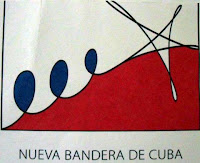
Danilo Maldonado, known as “El Sexto” has proposed, from his insistent irreverence towards power, a new flag for Cuba, saying it will lead to “new trends in social thinking.”

Danilo Maldonado is known among members of the emerging Cuban society as “El Sexto.” He is a young, carefree and happy, and lives in Arroyo Arenas, a small village belonging the municipality of La Lisa in Havana. He belongs to the new generation in Cuba that some would like to define as “The New Man Take Two.” He has filled Havana with graffiti, in which he shows his irreverence towards the authorities, for which he was recently arrested and subsequently freed by the authorities.

According to his explanation, the blue loops of the new flag are the generation that is left behind by the star of freedom. The red background represents all the pain and suffering of the people’s search for freedom. The white is in honor of the fallen and the oppressed and all those who fight for their freedom.

The design was carried out — according to its author — in the carefree and childlike manner of the new trends of social thought, where the sinuous line tracing a diagonal route accentuates the ascending movement as a way to reach the star, freed from the triangle enclosing it.

There are differing opinions about his “juvenile” proposal, its irreverence toward power and patriotic symbols. However, as an excellent friend told me, “he also has rights, therefore, it is the most logical, respects his points of view, and refutes them with logical arguments,” although to be honest, and respecting all points of view, I, in particular, would refute them with historic arguments, always understanding that in order to live in a democracy, with rights an so on, we all must have the power to propose what we believe in, even if we know no one supports us.

2 February 2012

Another Blog

Esteemed visitors and collaborators:

I invite you to visit a new blog written from Cuba.  It’s called “Rafael’s Lamp” and the author is my husband. So those who want to explore the different aspects and views of the Cuban reality, have a new alternative. I thank you in advance for your solidarity.

[The Spanish version of the blog is here: El candil de Rafa]

February 1 2012

Painting the Forgotten / Rosa María Rodríguez Torrado

He has drawn a table and put a patched plate on the worn paper: there is no canvas nor oils because of the scarcities. Even the air is going hungry, and the brushes go back and forth over the watercolor in an effort to hypnotize the spiritual asthma that such poverty provokes. He loves his Casablanca so much that he wants to go far away, where the nostalgia won’t force him to dream of it and he won’t have to live in his abandonment.

He waits for success with his brushes and a degrading sign — that they profaned with white — that he rescued from his big neighborhood. Long ago he left off the practice of painting bars. Now he draws on the potholed pavement and broken sidewalks, his alienated steps back to what he will remember if he does not return.

January 30 2012