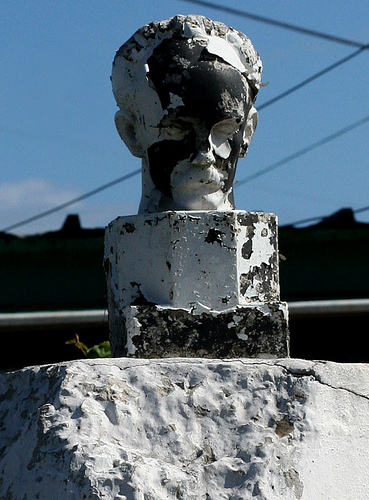
CENSORSHIP against Memories of Development in Tropical Cinema 2011, Originally uploaded by orlandoluispardolazo.
Translated by: Claudia D.
December 8 2011
English Translations of Cubans Writing From the Island
CENSORSHIP against Memories of Development in Tropical Cinema 2011, Originally uploaded by orlandoluispardolazo.
Translated by: Claudia D.
December 8 2011

Like all the airports in the world, ours is impersonal, stressful, glass and aluminum on all sides. Once in a while the door to customs opens and someone comes out with their luggage wrapped in cellophane. The waiting family members scream, tears running down their faces, the newcomer is flushed with emotion. Meanwhile, on the first floor are the departures, the last hugs between people who may never see each other again. There are booths with glaring officials who check the documents. Passport, visa, ticket… permission to leave. I always wonder what happens to those who pass by this window without a “white card,” without this demeaning authorization that we Cubans must have to leave our own country. But there are few testimonials, the denials happen far from the runway where the planes take off.
The rumor that tomorrow, Friday morning, Raul Castro could announce an easing of the restrictions to enter and leave won’t let me sleep. In four years, my passport has filled with visas to arrive in other countries but lacks a single permit to leave this insularity. Eighteen denials of permission to travel is too much; more like a personal vendetta than the exercise of some bureaucratic regulation. I’ve had my suitcase packed for a long time. The clothing it contains is yellowing with time, the gifts for friends have expired or gone out of style, the papers I would read about current events are outdated. But the suitcase keeps looking at me from the corner of the bedroom. “When will we travel?” I imagine its worn-out wheels asking me. And I can only answer that perhaps this Friday in a parliament — without real power — some decree will return to me a right I should have always enjoyed.
In the event that the anticipated “immigration reform” is announced, I will test its limits from the airport, facing that checkpoint so many fear. My suitcase and I are ready. Willing to see if the guard will press the button that opens the door to the departure lounge, or if he calls security to take me away.
22 December 2011


He worked for years in the Urbano Noris sugar plant. He complied with all of the daily chores required by his job. He was useful. And efficient. But today, he is another one of the many Cubans floating adrift.
Humberto Hernandez Palma lives in San German and worked in the Urbano Noris central for quite some time, but now he has been faced with something very difficult. He is sick. He has gone through the medical commission in his region three times in just one year. During the first occasion- he told me- they diagnosed him with “table one”, which means that he is completely limited in his physical strength. However, the provincial medical commission refused to recognize that measure and handed him a report which stated he had “median limitation of physical force”.
He sought answers within what he thought was fair- the National Medical Commission- but in November, the National Commission responded that they denied his request for medical leave. He tried to find some answers in the sugarcane production plant Urbano Noris but there they also told him that he does not meet the necessary prerequisites to have a medical leave on the grounds of health problems. During recent times he has also started to suffer from serious heart conditions (cardiopathy).
They then sent Humberto to the Labor and Social Security Department of the municipality to obtain 60 percent of the salary in one year, to later end up unemployed and with serious difficulties to buy all the medicines he would need to take care of his heart condition. He is another Cuban who, amid sugarcane and some light smoke, has ended up floating adrift with his horizon plagued by countless dark clouds.
Translator: Raul G.
20 December 2011

A solitary man sweeps the dry leaves on the wide avenue where not one car is traveling in either direction. He lowers his head and avoids talking with the cameraman. Perhaps it’s a punishment for not applauding with sufficient enthusiasm at a meeting, or not bowing with theatrical reverence before a Party member. The scene of the sweeper on his desolate street is captured in a documentary about North Korea that has circulated on our alternate information networks. A painful testimony, with people all dressed the same, grey depersonalized buildings, and statues of the Eternal Leader on all sides. Hell in miniature, which leaves us with a sense of relief — at least in this case — for not having been born under the despotism of the Kim dynasty.
When Fidel Castro visited Pyongyang in March 1986, almost a million people greeted him, among them thousands of children waving flags with suspicious synchronicity. Cuban television reveled in the chorus that sounded like one voice, in dancers who didn’t differ from each other by even a hair out of place, and in those little ones playing the violin with surprising mastery and anomalous simultaneity. Months after this presidential trip, on the artistic stages of Cuban elementary schools they tried to emulate this robotic discipline. But there was no way. The girl next to me threw the ball seconds after mine had already fallen to the floor, and some abandoned shoe was left behind on the stage after every performance. The Maximum Leader must have felt disillusioned by the chaotic conduct of his people, so different from those syncopated genuflections before the Secretary General of the Workers Party in North Korea.
On Monday the images of thousands of people crying in the streets over the death of Kim Jong-Il called to mind those perfectly timed children. Although our tropical experiment never managed to “domesticate us” like them, we did copy something in the Korean model. In these parts, as well, genealogy has been more determinate than ballot boxes, and the heritage of blood has left us — in 53 years — only two presidents, both with the same last name. The dauphin over there is named Kim Jong-un; perhaps soon they will communicate to us that over here ours will be Alejandro Castro Espin. Just to think about it makes me shudder, as I did one day before those long rows of little girls throwing a ball at the exact same millisecond.
December 20 2011

María is a beautiful woman in our neighborhood who, every afternoon, very made up, is out walking her dog, and each time that I see her I can only think of Chekov.
Today she woke up with her body in pain, a little cough and feeling chills, so she decided to go to the polyclinic nearby. Once there in the emergency room, she was attended to by a young doctor who, upon seeing her, immediately sent her to get blood tests. When the results came back the doctor, not wasting any time, had her admitted to the hospital and covered her with a mosquito net to isolate her, saying that she had dengue fever, and he immediately informed her husband, who was in the waiting room.
When the ambulance came, they told him the husband couldn’t accompany her, but he flatly refused to let his wife go off without his even knowing where they were going to take her and both of them gave up going to the hospital and returned home.
Not even an hour had passed when a doctor and nurse showed up at the couple’s house to tell them that they had to go with the nurse. Faced with the insistence of the husband and his refusal to let her go alone, they agreed to his accompanying her. This time there was no ambulance, it was a closed transport from some State company, and inside there were other patients they had collected along the way. Maria said that this improvised transport drove like a kitchen mixer through the streets of the city, making stops to pick up others presumed ill, until it was almost like a crowded bus.
Finally they arrived at the old Covadonga hospital where, in a ward crowded with patients, they lined up to be treated. Maria asked who was last in line and said she had the impression, for a minute, that they were handing out beef, because the line was just as long as at the ration store. Her turn finally came and they sent her for tests, this time it was foreign students who were drawing blood; they poked her several times until finally they got it right. Sore all over, she huddled with her husband and waited patiently for the results.
After a while a doctor came and told her, “Ma’am you can go home, you don’t have dengue fever, you have a simple cold. Do you feel well?” “Perfect!” she replied, though she was quite dizzy, but fibbing she added, “I never felt better!”
She motioned to her husband and once she lost sight of the doctor Maria said that it reminded her of her early years at the University when she was running track and field as they made a rapid beeline for the Covadonga exit, and grabbed the first old taxi they saw to get home-sweet-home as fast as possible.
Fortunately, she’s well. She told me of her odyssey herself while, with her accustomed elegance, she walked her little dog, parading past my house.
December 7 2011

None of the classics of Marxism-Leninism could foresee the possibility that a country formally declared as socialist would be governed by a family dynasty. But now we get the news (?) after the death of Kim Jong Il that the leadership of that country will be left in the hands of his third son, Kim Jong-un, whom they call “the brilliant comrade.”
With the information available to us on this island, we should not make predictions about whether the new Kim has reformist tendencies, or is subnormal, or is more totalitarian than his predecessors. What I do consider useful to put on the table is the ease with which in this country’s public offices are inherited and, what interests us most, is how the Cuban media, private property of the Communist Party, approaches the issue: taking it for granted.
In the name of an alleged respect for the sovereignty of nations, they will recognize the legitimacy of the new leader, happy that a precedent exists, quick to point out the “imperialist maneuvers” or “media campaign” launched with regards to a family clan’s perpetuating itself in power. We must pay attention to the degree to which such a monstrosity is accepted, because said acceptance will be directly proportional to the proclivity to repeat here what happens there.
And I won’t even try the line, “this is not North Korea.”
19 December 2011
 I was talking with a neighbor in his thirties or forties, who confessed to me with relief that, “Raul’s regime has improved the conditions of life, given us some oxygen, because the brother had suffocated us.”
I smiled before throwing a bucket of skepticism on his head. “Yes, Raul is lifting the prohibitions on a lot of absurdities his brother introduced; but this hasn’t improved the economic base, nor improved the lack of individual freedoms.
“You’re always criticizing! Do you deny that we are better off? And now we don’t depend on the Americans or the Russians. For the first time we are free.”
“Freedom is not synonymous with sovereignty. Why do you think they made these openings?”
My neighbor just opened his eyes and shrugged his shoulders.
“Governability, chico, governability. It is the only reason for these changes.”
“What freedom are you talking to me about? Now I can open a little business, quit the Party and the Union, be my own boss, make my own rules. This makes me free.”
“Sure, if you want a freedom like this,” I said, my thumb and forefinger nearly touching. “You’re the ideal for the future for our society. I congratulate you.”
I changed the subject. The guy was left half content between my congratulations and the plans concocted in his mind. He understood nothing.
December 12 2011

52-year-old Irma Caceres, who has worked for decades in a storage business located in the municipality of San German (Holguin province) has been denied of her right to retire due to illness.
According to the medical documents she submitted, Irma suffers from arterial hypertension, obesity, two hernias, chronic sciatica, degenerative osteoarthritis, and circulatory deficiency.
“Even then”, Irma tells me, “the medical group which examined me last month refused to give me medical leave due to illness, alleging that even with those ailments I still did not fulfill the necessary requirements”.
Mrs. Caceres explained to me that the only solution that the “specialists” offered her was that the head of the business should relocate her to another job. The victim claims that she has ousted all resources and tried all methods to prove that her health will not allow her to even work in another place, but she has grown tired because no one is tending to her case.
The 26 years which Irma Caceres has served in that business have served her for nothing because with all the ailments she is suffering from, it has become evident that she will become one of the many workers who make up the list of the “unemployed”.
What has happened, she tells me, “is the new practice of the State applied in order to do away with us without having to pay us retirement. It leaves us floating adrift, for there is nowhere to look”.

Translated by: Raul G.
17 December 2011

My son and I both saw Juan of the Dead at different times. This is a Cuban movie that has just been awarded a Popular Award at the 33rd Latin American Movie Festival. Rafael loved the profusion of bad words, with the “role” of the female blogger played by White Rose White; the “little groups of dissidents at the service of the government of the United States” and the humorous scenes throughout the footage. For Rafael, Juan of the Dead was a lot of fun. Rafael’s mother, as you know, likes to look a little beyond what you see — in Juan of the Dead she saw a zombie country.
This is an unusual B movie within Cuban cinema, which is so focused on social issues. And from the co-producers, Oh, the co-producers! Who are almost always stuck on the inevitable topic of prostitution. This work of Alejandro Brugués connects immediately with his audience and from this base filled with humor — the scene of the dance of the wives is memorable — (I’m not going to tell you the story of the movie so you will go see it), he constantly prods at our society. Look, I don’t go to see films to critique them, it’s an amusement, but brought to trial, Brugués would not be absolved. Although a spontaneous campaign would immediately be organized to call for his release.
Translated by: Hank
December 14 2011

For those who doubt that things here will get worse, I inform you that the first to set up the Chinese Model have been some of those in the emerging private sector. Since they are obligated to pay high taxes for their operating licenses, in addition to salaries and benefits for their employees, they tighten things up by putting pressure on the people at the bottom. Employees without a fixed salary are only paid a fraction of total revenues. In that way, new businesses never lose. Whoever doesn’t like it is free to leave because there will always be someone else desperate to take his place.
To my amazement, when I thought this post was complete, I found out that something very similar exists in the state sector. The drivers of the new taxis that roll through the city, which are identifiable by their white and yellow colors, must pay a daily fixed tax — on top of the costs they pay for gasoline and maintenance. If the driver fails to pay this tax two times, the taxi is handed over to another driver whose name is on a long waiting list.
Unwritten laws of a new labor scenario and an absence of labor unions to protect the interests of the least favored reminds me that a long time ago a revolution took place so that things like this would not happen.
Translated by: Hank
December 16 2011
 You turned six and were already waiting for your neck scarf, the slogan “Pioneers for communism, we will be like Che.” Later, you started high school and, automatically, without anyone asking you, joined the Federation of High School Students (FEEM). As you continued to grow up, you ironed your skirt and under your uniform blouse a pair of breast buds began to be noticeable. When you reached puberty you were already a member of the Committee for the Defense of the Revolution, and then you became a part of the Federation of Cuban Women (FMC). Tedious meetings, ladies watching if you got home late, tongues ready to betray any irreverent phrase that escaped your lips.
They taught you a dozen courses about the role of women in the Revolution, but no one came to stay the hand of your husband who beat you at home. You were just a number on the membership list and — more than once — you diverted money from your FMC dues to make it to the end of the month. It was hard for you to learn to separate the language of the communications you read in an animated voice, from the domestic phrases in which you showed your disgust. You developed several techniques to stifle your yawns in these assemblies where they demanded “more sacrifice, more commitment.” And suddenly, everything began to seem so useless, so detached from reality, so distant from the ridiculous allowance the father of your children gave you, from your boss who demanded “favors” if you wanted to keep your job. You realized that the real discourse of your days was what came out of the half-empty pot — like an open mouth — in the middle of your kitchen.
For the last five years you haven’t been a member of the FMC. What’s the use of an organization like this, you say now, after coming to understand that demands for the rights of women can’t be met through such a masculine officialdom. Last night you heard on TV that the FMC wants to “put a new spin” on their role in society, and afterwards you felt your womb, rubbed your arms, looked at the unpainted walls of your house and your life in national currency. And despite the difference between your bare face and the perfect makeup of those interviewed on prime time news, you feel more free. Because that report had a whiff of mothballs and you don’t, you are alive for the first time your forty years, “belonging” to no one.
17 December 2011

Cuban Television puts forth, in its horrible primetime schedule, another program of manipulated news coming from Telesur, with a Venezuelan ideologue-manipulator-agent-“journalist,” Walter Martinez, who has forgotten ethics and the first rule for a reporter: to report news without adding his personal opinion, which in all cases is linked to an ideology that he represents and that pays him, and therefore has a particular interest (like a pirate without a hook he appears every night on Cuban screens sniffing the rear ends of Chávez and Castro).
I would have to ask how much is the monetary gain in this matter, and the advertising benefit received by the president of his country, to lend his face and impudence to defend a socialism that, be it either from the 20th or the 21st century, is the same scam. Like a virus, it ruins the economy of our nations, and if Venezuelans want to be sure, go for a ride around the island, but not by those hospital-hotels that make it easier for their treatments, which I have nothing against, let alone healing a human being from any country, but the mass-media function for which they later are used. Let them go out on the streets, visit homes, hospitals almost in ruins, without doctors, medicine or surgical tools, etc.
To make matters worse for the Cuban people, in trying to educate us across generations like automatons, remember that there are dozens of programs that daily accommodate the official news chosen for political censorship, with the exact narration for all media information, and which are repeated as a torture for the rest of our existence. With two hours a day, deploying the best technology and the highest production costs, the inadvertent Roundtable show, which goes about building a militarized anti-logic, attacking everything that smacks of capitalism, its star attraction being the United States, then the right-wing presidents. Before it was Aznar, now Sarkozy and Berlusconi, among so many, while defending the Latin American Presidents who have allied themselves with Chávez.
To this we must add the three newscasts, the kings of media disinformation, who also go about justifying the international disasters of their ideological peers. The ineptitude and excesses of the abysmal administration of the Castro brothers of the weak national economy for half a century. The constant radio news. The famous Radio Reloj, which from minute to minute puts out the most incredible and unjustifiably manipulated news. The written press: read six pages of one and you’ve read all the rest. The daily Rebel Youth, which is no more than the journal of the oldies in rebellion who are in power. The publication of Workers, which is nothing other than the voice of betrayal of the Cuban working class in the service of the tyrannical masters.
Throw in the printed organ of the Communist Party of Cuba (the only party), the mother of all news, which picks and chooses what the people of Cuba should know. The magazine Bohemia, that not in the worst moments of past dictatorships was submissive or official. The provincial papers governed and monitored by the regional Communist parties. The digital news bulletins, also like parrots, copying what is accepted at the request of political superiors.
It’s as if they put speakers in our ears and shouted at us again and again what we should think, memorize and perform, and, as an exercise in boredom, start counting from 1 to 53, the years of dictatorship, to corroborate the emptiness that lights up that space. And last but not least, this Mr. Official Walter Martínez appears, and with each image, chosen also for its censorship, he gives us pre-processed news, underestimating the intelligence of viewers, and all this does is guarantee that we have the worst news program, not even the “Democratic” Republic of North Korea’s are worse.
There is a reporter who is not silent for a minute, with a know-it-all air of God Almighty, who will hang posters, use nicknames, with the constant irony of always rowing toward the benefit of Chavez’ and Castro’s shore. In the past he would come to Cuba to record an interview with Fidel Castro, which was nothing more than an ode to the old Comandante, a chorus of criticism of his political enemies, a suck-up to the great leader. The only thing this man has achieved, is that in Cuba we have silent movies again. The viewers, with the volume at the minimum, guarantee the elimination of the interruption of his submissive voice so they can enjoy the images that the Cuban government censors of the national news. What he doesn’t know, or perhaps does and doesn’t mind, is that his program is also reviewed and edited before being aired, so that after censorship, there is another more refined Cuba where he at times appears to be too much of a “journalist “and becomes a spokesperson at the service of the enemy. Not even he, an official voice for both countries, has emerged unscathed from the arrogant and extremist ideology of Fidel.
And as usual, the mouthpiece Walter Martinez, when he comes to the end of his journalistic farce, says “You may turn off the camera, Mr. Director,” and he removes himself. The camera, before going dark, takes in his image, and with the gallantry of the frustrated official he wished he had been, he walks down the aisle to get closer to the screen as a symbol of the nightmare and the danger it represents, and then with greater impudence and cynicism makes a military salute to the camera that reaffirms what we already know, which is that he is at the service of the military in Venezuela and Cuba.
One day, I’m sure very soon, Mr. Walter, you will lose the benefits with which you have been bought and hopefully won’t find yourself on the roster that hands out paychecks for spies.
Translated by Regina Anavy
November 23 2011
 Yesterday afternoon we were going in our old Lada (Russian car) by road to a house of a friend who had invited us for dinner. Since she lives in a beautiful building on 9th Street, very close to the Malecón on a very high floor and they had announced the fireworks that they were going to launch from the Flotilla of Liberty, I thought it would be very convenient; from this height we could watch them in all their promised splendor.
All day it stayed grey and rainy, with the arrival of the Northern cold front, and it didn’t improve in the afternoon. When we were arriving at the area where she lives, we could see many more police than usual. I supposed that it was due to the predictions that a great many people would be gathering at the Malecón.
Very experienced in these practices of repressing and counteracting any type of spontaneous demonstration, the authorities had taken methods to avoid any trace of them.
In practically all the parks and open areas of Vedado, the spaces were covered with tents, where they offered edibles and music. But what most captured my attention was to see the group of X Alfonso, whose concert was first planned to take place on the Streets 23rd and G, putting up the platform and the equipment for it, exactly on the corner of 9th Street and the Avenue of the Presidents, or G Street, as it is popularly known, precisely where one can find the Maternity Hospital of Línea. In my mind I couldn’t conceive, how is it a concert would be permitted, with the well-known speakers making so much racket, in a place where there should be silence, where woman are hospitalized just about to give birth, and there are recently born children, who mostly need silence and rest.
I could observe the proximity of the Havana Malecón, covered by people, that in any given moment, if the circumstances require, they could be easily be used as an outraged public, to repress any citizen demonstration.
We left the house of our friend before 10 at night, the time the concert was said to start. I never knew if finally the fireworks could be seen. The night stayed very rainy and my friend told me, today, that from her window she could see observe the small crowd that went to the concert. What she says baffled her a bit, was to see the nurses approaching the makeshift podium and after a while returning to the hospital. It really ended, as I could say, being really disconcerting.
Translated by: BW
December 10 2011


