Month: July 2011
Occasional photos by… / Orlando Luis Pardo Lazo
Occasional photos by… / Orlando Luis Pardo Lazo
Occasional photos by… / Orlando Luis Pardo Lazo
Sad Memory / Miguel Iturria Savon
It was July 15 or 16, 1994 when Angela Medina, my children’s aunt, asked me to accompany her to a house in the Purisima neighborhood, Cotorro municipality, where she saw her neighbors shot with water cannons in Havana Bay by the military who shipwrecked the tugboat, 13 de Marzo, in which she had meant to leave for Florida with her husband, children, and dozens of people made desperate by hardship and lack of opportunities.
Ángela, Jesús, Mileidis and Miguel Ángel owed their life to the haste of the driver who forgot to pick them up in the middle of the secrecy and rush of the endeavor. They felt then, relief, frustration, anger and grief for their dead friends, whose relatives refused to say goodbye to them at the municipal funeral, controlled by the agents of State Security, ready to quell any outbursts in response to the crime committed by those who carried out the orders from the highest governmental level.
I can’t forget the face of tragedy of those tearful people, shocked by the news of the disaster and the offensive of the authorities. A few steps from the market were the Purisima market were the uniformed forces, ready to arrest and detain, robots without mercy.
A month later, Jesus threw himself into the sea on a raft and was taken to the U.S. Naval Base at Guantanamo Bay, converted into makeshift camp for 40,000 boat people, among which were survivors of the tugboat 13 de Marzo, who gave witness to the tragedy in front of the cameras of the northern nation, despite having accused themselves in Havana under threat, made to corroborate the official version of events.
That event, still hidden away on the Island under seven locks, is an international scandal. The dedication of the authorities to protect the perpetrators and silence the aftermath of the assassinations is evidence of the absurdities of power. By violently preventing the diversion of the old tug loaded with children and young people they sent a message of horror to thousands party enthusiasts.
The familiar sequels rounded out the trauma: The Balsero/Rafter Crisis of August 1944; the signing of immigration treaties with the United States; the later illegal exits and other alternatives to exile through Mexico, The Bahamas, Venezuela or Ecuador, all mask the real problem. That socio-political immobility continues to fuel the dream of escape from the “socialist paradise.”
I hardly hear from Angela and her family, they live in Florida with the relatives of the victims of the tugboat 13 de Marzo, not wanting to know about Cuba or the circumstances that led them to abandon the country where they grew up. Perhaps in a short while, that “marine warning” of July 13, 1994, will be a chapter in the past and those guilty will be called to account for their infamy.
July 18 2011
The Beast Grows Angry When it is Reminded of its Dead / Ricardo Medina
 My brother and friend, Priest Pastor Bautista Mario Félix Lleonart Barroso, told me “the beast grows angry when it is reminded of its dead” in a text message that reflected his worry because of the arbitrary arrest of my wife Katia Sonia Martín Véliz and Aimé Cabrales Aguilar, on the morning of July 13.
Unfortunately, while many Cubans paid tribute to the victims of the tugboat “13 de Marzo” (March the 13th) that, by order of the Cuban government, was sunk in the waters of the Bay of Havana to the sound of pressurized water jets and sandbags, the world shuddered because of the death by freezing of a young Cuban who was trying to escape the same regime that massacred a group of people seventeen years ago.
This time, Adonis put himself at the risk in search of freedom like any human being, he tried to make it in the rear landing gear of an Iberia aircraft that served the Havana-Madrid Flight 6620. His body was found with wounds in the chest and the head, as reported by the Anatomical Forensic Institute of Madrid. Cubans submerged in complete misinformation had no knowledge about another victim of the Castro regime intolerance. I do not think Adonis was escaping repression, but he was in search of opportunities that Cuban people are deprived of.
The Priest Bautista was right; the beast grows angry when it is reminded of its dead, but the firm stand of the internal opposition movement, day after day, continues to remember and pay tribute to the dead of the dictatorship, until it is time for the murderers to present themselves before the court of life and assume the consequences of their actions.
Presbyterian Ricardo Santiago Medina Salabarria+
Translated by: Nina
July 13 2011
The Magnification of the Absurd / Rebeca Monzo
 In my stroll around the neighborhood, camera in hand and absorbed in my thoughts, I sensed the voice of a man walking beside me talking to himself. I can’t bear to look at him — not even if he’s that old — I thought. When his eyes met mine, taken by surprise, he said to me, “Don’t think I’m crazy, it’s that the most unusual thing just happened to me.”
He told me that for some time he had been suffering from some problems that he blamed on the age, but a doctor friend of his, after taking a peek, told him that what he had to do was go to a dentist, that is was almost certain that his health problems stemmed from the poor condition of his mouth. He added that because of this, he decided to go to the dentist’s clinic and there he saw a doctor, who told him he needed several extractions to be done urgently. That same day, he had four. The doctor gave him an appointment for the next week, to recuperate a little and continue with other things. When the date of the appointment came, he went back to polyclinic and on leaving it, continued his story. But this time things did not turn out as he thought. After having to wait a couple of hours, because the office was full, the doctor told him she could not see him because they had run out of gloves, and to call occasionally to see if they had arrived, as if the gloves traveling alone, he said.
Without giving it much thought, he went back to his friend the doctor, and asked if he could get him some from the hospital where he worked, and he got a package with twelve pairs. Very happy, he hugged the treasure and went back to the clinic to see the doctor. Look, I brought you a few pairs of gloves. He started to get a little more heated as he told me that she refused to accept the gift, arguing that this was not enough for all patients she had to see, and if she cared for him and not others, it could turn out to be a problem for her. He said that even though he insisted and argued, the doctor reiterated her refusal, so he left, feeling defeated and crushed. That’s why you caught me talking to myself, ‘he reiterated.
Thinking about it, it brought to mind misery loves company, and I dared to tell him that I had also experienced a similar situation in the polyclinic that served the area where I live. On one occasion, I told him, I had gone to see a doctor recommended to me by a friend, to get a filling. The doctor told me to wait in her cubicle, while right before my eyes she attended a patient with an oral infection. When she finished with him she told me to sit down and washed her gloved hands in the little sink there. When I saw that, I got up as if I were operated by a spring and said, “I’m so sorry, doctor, I just remembered I left the pressure cooker in the stove, I’ll come back another day.”
She’s still waiting for me!
If Kafka were alive now, here on my beloved planet, he would still be, I’m sure, I great writer of novels of manners.
July 27 2011
The Citizen, A Debt to Padre Varela / Dimas Castellanos
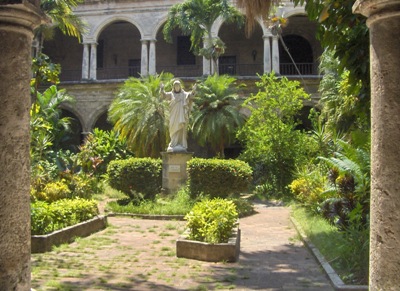
Under the title, “The place of citizenship, political participation and the Republic in Cuba,” the Padre Felix Varela Cultural Center was the scene, Saturday, July 2, of a lecture by a lawyer and university professor, Julio César Guanche. The institution, belonging to the Archdiocese of Havana, occupies the building which, until last January, was the site of the San Carlos and St. Ambrose Seminary, where Father Felix Varela y Morales, in the early nineteenth century, held the chairs of Philosophy and Constitution, from which he developed a cultural, educational and civic work, leading to the formation of thinking about Cuban nationality.
In his opening remarks, the president of the Yosvany Carvajal Cultural Center explained that this new area of thought, studies and discussions, will begin its academic functions this coming September and later other educational and cultural functions will be added. The Julio César Guanche conference was a final rehearsal prior to opening.
There is nothing more opportune for the Cuban sociopolitical reality than the issue of citizenship and political participation. In this sense, the young Cuban intellectual’s dissertation began with the words of Felix Varela at the inauguration of the Chair of Constitution in 1821: I would like to call this Chair, the chair of freedom, human rights, and national guarantees, of the regeneration of the illustrious Spain, the source of civic virtue, the basis of the vast edifice of our happiness, for the first time among us has reconciled with the philosophy of law … which contains the fanatic and despotic ….”
Among other approaches, Guanche addressed issues concerning the legality of contemporary Cuban society and the need to create and use spaces, actual or potential, to exercise citizenship through keys defined by Felix Varela. He noted that despite the statistics displayed by the Cuban authorities regarding the high popular participation in elections, the electoral system leaves in place conflicts between institutional and citizen participation and he added that government programs at the local, provincial and national levels are not defined through the electoral process. Thus, the role of citizens and their political participation in Cuban politics became an axis of intense and respectful debate among intellectuals, academics, scholars and journalists present, of all shades, on how to build power, to confirm power, expand power and to use politics to broaden the ways of living together: a practical testimony to the necessity of discussing vital public issues of our society.
Interventions such as those of professors from the University of Havana, Berta Alvarez and Maria del Carmen Barcia, regarding the Cuban constitution and the concept of citizenship, respectively, and the writer Victor Fowler, who explained the difference between the formation of citizens and revolutionaries, proved the appropriateness of the invitations from the editor of the magazine Espacio Laical.
Father Varela, whose name heads the Cultural Center ,was the first to speak in Cuba about the concept of homeland encompassing the entire national territory, of belonging, rootedness and interests, he evolved from autonomy to become a promoter of independence; he moved from the good treatment of slaves to the elimination of the horrific slave trade and the abolition of slavery; he chose education as a path to liberation; he plotted his own course to Cuban thought and insisted on teaching us to think; and in addition, he introduced ethics in scientific, social and political studies. For all that this great teacher, who also held the José de la Luz y Caballero Chair of Philosophy, defined as our real civilization.
The conference and the current debate also revealed that the work begun by Varela 190 years ago is not only unfinished, but pending. Indeed, just two weeks ago the President of the State Council of Cuba, Raul Castro, said in an enlarged Council of the Council of Ministers: We need to discuss and disagree over all levels of management, because in a diversity of views are the best solutions to our current problems. A limited truth, as the diversity of opinion must be extended to public debate.
In a society like Cuba’s, lacking an independent civil society, it is about promoting dialogue as a mechanism for participation and exchange of ideas, without which any project of social transformation cannot succeed, although headed by the Communist Party. In Cuba, for known reasons, people are tired of being objects of slogans and speeches. It is necessary that individuals involved in the survival become public, until the deliberations are transformed into a source of perfecting governance. It is therefore essential to open the doors of politics, whose starting point begins with the exchange of ideas between all parties to identify common interests, to propose measures before they are implemented or are in the process of being implemented.
The policy, whose definition is derived from polis, as the ancient Greeks called the city, from its beginning was related to public activities to ensure the common good. That is, politics like human invention began from the time when communities realized that their fate was subject to decisions to survive. Politics is just that, a relationship between people with common interests to solve problems and, therefore, it predates and transcends the class division of society, and is a natural human activity that requires participation, learning by doing, making mistakes, to become true citizens.
The challenge lies in transforming individuals into citizens, into political actors. A transformation that has its starting point in universally recognized human rights, particularly in the first generation of civil and political rights. This process of civic education and the formation of currently non-existent public opinion, requires acting from ethical and moral principles that place the human being as an end and not as means.
Published in Diario de Cuba, Tuesday, July 13, 2011 (www.dddcuba.com)
July 15 2011
R&R Cigar / Rebeca Monzo
 It was a very fashionable refrain when we were kids. Right now, it again seems to occupy the foreground in the media of our planet: rescue the railroad right of ways, rescue agriculture, rescue the sugar industry, rescue the fishing fleet, rescue urban transport, rescue the dry cleaners, rescue the hair salons, rescue the bovine cattle, rescue the milk industry, rescue the food service, rescue the family doctor’s houses, rescue light industry, rescue the henequen plant, rescue, rescue, rescue.
The more I try to strain my memory, I can’t locate in which previous government it was that all this came down from, but I know we already spent 52 years with it. Why now, in the year 2011, is it that our leaders are informed of this and that everything I mentioned has to be rescued. Where were they (if they are the same ones), who didn’t realize that everything has deteriorated rapidly? With that mentality of always blaming imperialism for all of our problems, I don’t believe that we can move even a single step forward. If we continue giving time after time, implementing guidelines, studying even the most hidden places in the country and waiting for the proper implementation of these, the time will come when now there is nothing left to do. Well then we will go heads down, muttering the chorus goes like this: “R&R Cigar, R&R Barrel, the cars go fast, when there was a railroad.”
Translated by: BW
July 20 2011
Playing at Capitalism / Rebeca Monzo
 The Nuevo Vedado neighborhood is excited. In the blink of an eye, four new restaurants have sprung up, very well put together, and a few cafes, not to mention a number of improvised timbiriches — small kiosks — where their offer various products doubtfully handled.
The new paladares, private restaurants with this name — meaning “palate” — born of popular ingenuity — and, like almost everything that becomes popular on my planet, came from a Brazilian soap opera broadcast on TV. Thus arose the paladar, to differentiate these first restaurants — which started up more than 15 years ago — from those of the State. Of the original, few remain. Now, with the new ones, there is hope of an opening, something more serious and fundamental than previously, the fever seems to have spread like a pandemic. In the background, lies the unspoken: to retake the truncated capitalism of fifty-two years previous. Their new owners proudly call the “Restaurants” with a capital “R.”
All this is very good, healthy, and brings new color to the neighborhood, the city and the country. The question that comes to mind is the following: Will there be enough demand for everything that is in offer?
In my travels, this Saturday at noon, camera in hand, I visited three of the new premises, as well as the already renowned La Casa. What most caught my attention was that they were all empty. Their respective owners very kindly showed me the facilities and allowed me to take photos.
Everyone comments that the prices are too high, but they have their logic: The products and supplies are not sold to their owners at wholesale prices, as they should be. They have to shop at the hard currency stores and in the expensive farmers markets, to get everything to produce their menus. They also have to pay inflated taxes, plus the salaries and social security for their employees, the electricity at a very high price per kilowatt, and also have to keep the inspectors content so they don’t become too fastidious.
In any event, something is gained and the lost appetite of citizens for private property is restored, without the absolute dependence on State paternalism that has already caused so much damage. Let us continue, therefore, playing at capitalism.
July 16 2011
The Fall of the Apostle (Jose Marti) / Fernando Dámaso
Soon, May 19, will mark the anniversary of the fall in Dos Rios, former province of Oriente, of José Martí, the most universal and transcendent of all Cubans. Poet, writer, critic, journalist, humanist, diplomat, politician, revolutionary and the main organizer of the independence struggle of 1895 which, after fierce fighting, allowed the emergence of the Republic.
His written work, long and deep, covered practically all spheres of knowledge of his time. His thinking, comprehensive, still maintains its validity at the present time our country and may apply to others, given its universal character. Of Marti, much has been said and written, but his ideas have not fared as well. Many of them, in the mouths of demagogues and opportunists have served as false moral cover for political outrages and every kind of arbitrariness, far from their true objective. However, this is not the responsibility of the Apostle, but of those who have, over the years, used them for their own personal interests.
Marti, deeply humanist, lucid thinker, was able in his short physical existence (only 41 years) to see where others saw nothing, and to feel and understand the convulsions characteristic of one era ending and another beginning, in addition to furthering the daunting and thankless task of combining different wills for the sake of achieving a great ideal: the independence of the land of his birth. His honesty and his conviction that he should be present in the war that had broken out and the mediocrity of some, led him to the battlefield, for which he lacked the necessary practical experience, that fateful May 19.
It is true that with his death, Cuba lost a unique figure who might have eschewed regionalism, warlordism and other diseases affecting the gestation of the nation, as well as others of his own birth, but with the distance of years I think that perhaps, like Ignacio Agramonte and Antonio Maceo before then, fate was magnanimous to him, not giving him too long an existence to lose prestige or to face ridicule.
It is that today makes Martí’s ideas and his thinking and work respected by honest Cubans, seeing in them some of the valid responses, so necessary for the reestablishment of the Republic that he imagined and that, unfortunately, was prematurely cut short, not being allowed its development and consolidation.
May 17 2011
Occasional photos by… / Orlando Luis Pardo Lazo
Occasional photos by… / Orlando Luis Pardo Lazo
Cuba Independent and Democratic Party Delivers Constitution Proposal to Cuban Parliament / Ricardo Medina
Katia Sonia Martín Véliz, Eastern Coordinator of the Cuban Independent and Democratic Party, delivered a Constitution Proposal at noon on July 21, to the People’s Power National Assembly in the name of the National Executive Committee of the CID.
The proposal of the Constituent Assembly is the fruit of months of work and was accompanied a cover document, signed and sealed by that body as an acknowledgment and nod with folio 1487, in which the National Executive Committee Cuba of the Cuban Independent and Democratic Party explains to the Nomenklatura that real change in Cuba must be under the rule of law, without any exclusions, and where supported by the people directly and without repression; taking into account the opinions and participation of all Cubans, regardless of their place of residence.
The missive dated July 20, recognizes the example and vision of Commander Huber Matos Benitez, founder of the CID and current Executive Secretary and stresses that accepting the enrichment of the constituent proposal with the opinion of all Cubans living on the island or in the diaspora.
The National Executive Committee (CEN) is composed of Daniel Mesa Cantillo, Katia Sonia Veliz Martin, Ricardo Santiago Medina Salabarria, Irel Gómez Moreira and Nivaldo Amedo Ramírez.
Lisbán Hernández Sánchez
Giraldilla Information Center
July 22 2011
More Lists, Fewer Lists / Fernando Dámaso
I have carefully read each one of the approved guidelines in the recently completed Sixth Party Congress. They are the closest thing to a simple list of general intent, some questionable for their weight of discrimination against nationals, to be achieved in a period that is neither immediate or near, but rather distant. Furthermore, being only guidelines, specific plans will be needed for their practical realization, including projects, financing, power and methods to implement them, deadlines, and so on. Such a huge amount of resources and labor that I doubt the Cuban government is in a condition to take them on and ever less to to bring them to fruition.
The general crisis in which we find ourselves, and it gets worse with each passing month, needs more than general intentions to resolve. Concrete measures are imposed in the short term, to untie the multiple knots created over the years. This is what has been raised for some time by the citizens and not solutions, which extend into the indefinite future. Increase, achieve, manage, transform, duplicate, etc., are verbs used for far too long: few people really believe in them.
Nobody has forgotten the wonderful plans to solve problems, applied for more than half a century without real results. Among those fallen by the wayside are the Cordon of Havana, which liquidated the fruit trees and did not produce a single grain of coffee, the Pangola, to feed a cattle that was never developed, the Ten Million Ton Harvest, which dealt a mortal blow to sugar production, the Dairy, which left us without milk, the Rice, did not produce rice, Turquino, which did not solve the problem of coffee either, Nutrition, which left us without food, and so on. To return to the same with other named projects does not update any economic model.
Maybe some optimists think that with this list we are already on our way to emerging from the crisis. Nothing could be further from the truth. This is nothing more than pure economic theory and social policy, something like a collection in a single document of the texts of the many manuals that proliferated in the former Soviet era, and that were quite dogmatically applied in most areas of national life. Like a repeat of something already known, now when someone makes or builds something, it is in compliance with the guidelines. A few years ago, it was part of the Battle of Ideas. Simply more of the same.
Facing a crisis laid down over fifty years, in which responsibility is not external, is not an easy task for any president, particularly if political and ideological reasons prevail over economic ones. Even more so when the actual time available for its implementation is limited. I do not understand why things change overnight, turning them upside down in one fell swoop, without entrusting them to God or the Devil, to be restored to their proper position (feet down), and why they need so many studies, analysis, meetings, discussions, approvals and time. It’s good to worry about not making a mistake, something not done before, but the nation needs profound and immediate changes that end the complete paralysis of free the productive forces, allowing their rapid development. Only then, with the participation of all citizens, without exception, will we overcome the crisis.
May 26 2011