Cuba, an Ignored Republic / Iván García

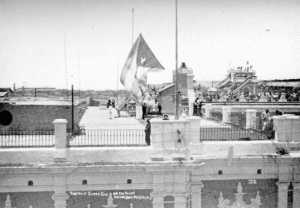
Photo: Raising the Cuban flag on May 20, 1902.

For Sandra, a teenager who is currently in the 8th grade, January 1st of 1959 is the independence and birth date of Cuba as a republic. And believe me, the girl is not ignorant. She has excellent grades and enjoys good literature and cinema.

But no history professor mentioned to her that it was actually on May 20th 1902 that the Republic of Cuba was born. The official version of history tries to avoid the date.

When the professors speak about the first years of republican life, they always add the phrase “a mediated republic”. The history of Cuba which is taught today in the classrooms lacks any sense. It’s black and white.

Only what the government is interested in is mentioned: The 10 years war, Carlos Manuel de Cespedes, Perucho Figueredo, and Ignacio Agramonte, among others, and they leave out the profound existing contradictions between the independence fighters of the time. They obliquely mention the life of Jose Marti, Antonio Maceo, and the Dominican Maximo Gomez.

That 20th of May in 1902 is barely mentioned at all in the Cuban classrooms. The new generations do not know that Tomas Estrada Palma was the first Cuban president. On that day, Havana locals witnessed how the American flag was lowered (interventionist country in 1898 and 1902) and how the flag of the solitary star was raised.

Youths and adolescents are stuffed with dates and facts about the assault on the Moncada barracks in 1953 by Fidel Castro. Also, from the moment one enters first grade they talk a lot about the guerrilla war in the massive mountainous area of the Sierra Maestra. And it’s not a bad thing that the victors are the one who tell their story. But a capital sin of the regime’s historiography has been to avoid mentioning all the events which occurred during the 57 years before the triumph of the olive green revolution.

That historical amnesia can be seen whenever we look at any aspect of Cuban life. It seems as if all that is good or grandiose came from the hand of Fidel Castro. A country which forgets its past will have an uncertain future.

One must turn the page on the way the official media tells history. That republic was not perfect. Many elections were fraudulent. During a specific period, the communist party was illegal. There were dictators, Machado and Batista. Many corrupt politicians. And we depended economically on the United States.

It’s true. But during 5 decades of a republic they introduced a Constitution — the one from 1940 — which was advanced for its time. There was freedom of the press; laws which benefited the workers; independence from tribunals and the existence of Habeas Corpus.

Also due to its close proximity to the United States, public phones, radio, and television were introduced in Cuba before any other European nations. Havana was more of an important city than Zurich or Brussels.

One does not have to be a supporter or an adversary of the Castro brothers in order to realize the twisted turn given to our republican history. If you carry out a poll of secondary school students, very few will know the day which the republic was born.

It’s unfortunate. Just like the United States has its 4th of July and Mexico has its 16th of September, the Day of the Nation in Cuba is May 20th. Even if the regime would rather ignore it.

Translated by Raul G.

May 22 2011

“We are Frustrated by the Stress of the Constant Repression”, declared the dissident Sonia Garro / Iván García

Photo: Laritza Diversent. Sonia Garro and her husband on January 2010

From a public pay phone and despite the fact that she was being watched by police agents in civilian clothes, the woman for which one man decided to climb up on his roof and yell anti-governmental slogans (as can be seen in this video,), Sonia Garro Alfonso told El Mundo that she and her husband, Ramon Alejandro Munoz Gonzalez, feel overwhelmed by the “stress of the constant repression” which the Cuban regime has maintained over them for quite some time.

She did not know that they would have recorded the video and uploaded it onto YouTube. The final straw which led Munoz Gonzalez to protest in that way was the desperation he felt when, on May 9th, his wife Sonia, and three other women (Niurka Luque, Niola Camila Araujo, and Leydis Coca- all of which are Ladies of Support to the Ladies in White) were violently suppressed and beaten by fifty agents of the “rapid response brigades” (the name given to paramilitaries used to oppress dissidents in Cuba) at 51st Avenue and 100 Street.

Her crime? Having taken to the streets with a white blanket on which she had written in black letters “No more police repression” and “Sentence the murders of Juan Wilfredo Soto Garcia”, the dissident who died in Santa Clara on May 8th as a consequence of a beating.

After they were beaten, the four were arrested and taken to different police units in accordance with where they live. When Munoz found out about what happened, and after he investigated in his corresponding unit, Sonia’s husband headed to Section 21 of the Department of State Security where they did not tell him where she was being held.

It was the final straw. He decided to do what he did, and continues doing: protesting on his own. He says that as long as the violent repression continues against them or the dissidence on the island, then he is even willing to chain himself to a tree in the middle of a central avenue of Marianao. Munoz Gonzalez goes out to the street with the chains he has thrown on himself, and not with his machete, which he only wields when he is on the roof of his house.

Sonia has not only been beaten and detained on various occasions, but she has also had to withstand scornful and humiliating treatment for being black. In this last arrest they told her: “Nigger, we are going to send you straight to Manto Negro (the female prison) because you have us tired out already.” In the case of Sonia, as occurs with all dissidents who are black or mulattoes, the State Security agents always shove this sentence in their faces: “I can’t believe that you are black and a counter-revolutionary.”

Sonia Garro Alfonso has spent years suffering because of her skin color. Because of her very dark skin color, on the day she graduated as a Clinical Laboratory Technician, functionaries from the Public Health Ministry chose a white student to go up and receive her diploma from the hands of the minister. This was a humiliation she has never been able to forget. In 2006, when she refused to give up her activities in favor of afro-descendants or her independent cultural project which she runs with children of poor neighborhoods, she was expelled from her work place.

Nor has life been easy for her husband, Ramon Alejandro Munoz Gonzalez. He is a mulatto professor of folkloric dance who was also expelled from his work due to his social activism. That was the pretext which the police found in order to apply the “social dangerousness” law to him and send him to prison for a year.

The scene of the unusual protest is a blue house located on 47th Avenue, No. 11638, between 116th and 118th in Marianao. It’s just a few steps away from Los Zamora, Los Pocitos, and Palo Cagao, three of the most marginal and conflicting neighborhoods in Havana, filled with prostitutes, pimps, and delinquents. But also filled with professionals and dissidents like Sonia Garro and Ramon Munoz. Even if today they are on the verge of a nervous breakdown.

See also: Desperate Cuban demands freedom; Sonia Garro or the cruelty of a regime and Accords from the first afro-descendant assembly.

Translated by Raul G.

May 22 2011

Sparrows Without a Country / Ernesto Morales Licea

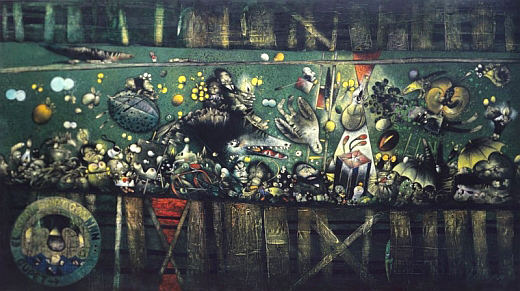
"The Great Blackout," emblematic work of Pedro Pablo Oliva

Few intellectuals more timid than the Cuban must have existed in the history of art and contemporary thought. Few intellectuals with such iridescent skin that it amusingly changes tone and nuance according to the light that passes over them.

In these days when a monumental name in Cuban art has just suffered the endless fruits of intolerance, of ideological militarism, it occurs to me to ask where are those intellectuals committed not only to their society, but to the destiny of art itself through its practitioners.

The new ousting of Pedro Pablo Oliva, his beautiful and transparent statement, and the sepulchral silence of those for whom the weight of their titles requires them to take part, presented a new scenario for the intellectuals of the island to show off their pale condition.

Where are they, in this second, those writers and playwrights who staged an electronic fuss after the television appearances of Luis Pavón and Papito Serguera? Yes, where now is the host of the National Literature Awards, who only appears to jump–shyly, timidly, when they step on the keys of his memories, his memories of exclusion and punishment for hidden homosexuality or conflicting poetry? Where are the presumed chroniclers of their time?

Where is the discordant denunciation of the members of the National Union of Writers and Artists of Cuba, demanding explanations, rejecting the methods, lining up on the side of an irreplaceable creator in his moment of courage and honesty?

Under what pretext, with what pantomime as an excuse have the purported names of Cuban thought, let’s say Desiderio Navarro, Reynaldo González, Alfredo Guevara and Anton Arruda closed their throats? Or is how they won’t touch with the tip of an opinion the Theoretical-Cultural Center homonym; how the practices of institutional homophobia and film censorship seem to have eased off; and how The Seven Against Thebes is published without reprisals, so it’s not worth it to raise your voice?

While a senior representative of Cuban art is accused of being a traitor and unpatriotic, and is forced to close his workshop of artistic fantasies, where are the words of the media figures Nelson Domínguez, Alexis Leyva (Kcho), Ernesto García Peña, Roberto Fabelo?

Will Amaury Pérez denounce in his much loved television program this offense against an author whom I dare say is among those he most admires? Will Roberto Chile feel motivated to turn the focus of his lens, and will he film not a postmodern promotional, but a documentary about the outrage against Pedro Pablo?

I know these are all rhetorical questions. I know they are sullen and empty questions. Because we all know the answers. And because Pedro Pablo Oliva knows them too.

In the presentation of his catalog, I read some words of Pedro Pablo Oliva that come to mind now, as if caught on a hook. Pedro Pablo who, incidentally, does not write as dazzlingly as he paints… but almost.

In this text the Pinar del Rio artist evoked his mother, in the old house where the family lived, scaring away a flock of sparrows which every day sought rest within. His mother waged a war without quarter. But one afternoon of stifling weather, of the island heat, the painter’s mother decided to escape by passing the time under the damp shade of the fruit trees that crowded the entrance to the mansion. There, above her, were the same sparrows that she frightened from her home with curses. They were perched on the branches of the tree: their home. And they did not attack her for sitting underneath. A few hours later the woman returned to the old house and proclaimed, “I will never again frighten a sparrow from this house. Here there is room for everyone.”

Unfortunately, dear Pedro Pablo, on your beloved island there is still no room for all the sparrows.

May 24 2011

Havana – New York / Claudia Cadelo

I met her in 2004, we had a mutual acquaintance, a neighbor of mine. She spent her life in clubs and at concerts, always with boys who came to collect her in a car. I liked her, she was fun. In the afternoons when she woke up sometimes she’d come and have coffee at my house. With her parents abroad, she lived without working and even though she was sometimes short of money, her nights out weren’t affected because the men paid.

Chance, that had one day put us in the same neighborhood, separated us. For years I didn’t hear from her and thought, as is common on this island, that she’d left the country. Recently we ran into each other and I discovered I was right, she lives in New York now and comes to Cuba on vacation. I don’t know what happened, Cubans find so many ways to run away from this land that I don’t even take the trouble to inquire, though the stories can be funny, but also very sad and sinister. Also, I’m a little sensitive on the topic of emigration, wondering who will be here beside me in ten years, when all my friends have left.

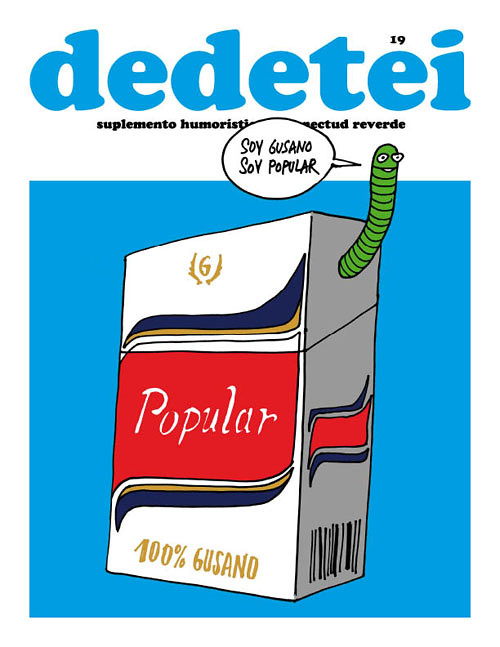
In the short time we shared, she told me that she worked a great deal over there, and that generally speaking, she’s considered a communist. “Communist?” I exclaimed, “You were a big fat worm. What happened to you?”

“The system in the United States,” she said, “is inhumane, here it’s better, more humane.”

I looked at her with my mouth hanging open. She doesn’t like the new country where she lives because she has to work; in Cuba she didn’t have to because she was a kept woman. How can you use politics to justify your own inability to be productive?

“I don’t agree with you,” I said, trying to contain the passion that comes over me when people come from a democracy and tell me fairy tales about the dictatorship. “Sure, a lot of people don’t work because the salary is ‘inhumane’ and no one is interested in breaking their back for nothing. But still it seems very good to me that you have to work to earn your own bread. It’s normal.”

“Cubans don’t like to work,” she replied, and then I knew that because she didn’t want to work she assumed everyone else didn’t want to either. What a capacity for generalization!

Before we parted she told me she was about to have an operation. I assumed it would be in Cuba, given what a humane government we have. You can’t even imagine my surprise when she exclaimed, “No! I’m having it over there!”

24 May 2011

From the Depths of Hell… / Miriam Celaya

Protests in Spain. Internet photo.

During this past week, the official Cuban media have shown very reliable evidence of how it is possible to use information from international events to mask and to try to dilute conflicts within the Island. There is no doubt that government journalism takes the cake in what I normally call the squid effect: a dark stream of dark ink for slipping away in the midst of the confusion and coming away unscathed. At the same time, it tries to create the false expectation that a reversion to communism in Europe is close at hand and viable. In Spain, no less.

The latest news acquisition by the media to squirt its ink on the national disinformation spectrum has been the demonstrations that have been taking place in several Spanish cities, and the press has instantly launched into its fabrication of an environment supposedly conducive to communism in these expressions of social discontent. Judging by what the written press and TV newscasts are publishing, the popular clamor in Spain is inspired by a spirit between Marxist and anarchist, capable of bringing down Capitalism, Transfiguring the social order and establishing the first labor commune of the XXI century. As simple as that. Of course, it doesn’t show it explicitly, but those are the intentions underlying the reports. A simple example is the “declarations” of one of the protesters expressly interviewed by the newspaper Juventud Rebelde…via e-mail. Could it be that this subject was carrying a sign with his e-mail address, to make things easy to the journalists on this side? Coincidentally, the individual is a Communist sympathizer or militant. The journalists in our national press have such good aim! Thus, the mobilization of Spanish citizens, mostly young, under the legitimate claims of changes capable of reversing the current economic crisis, unemployment, corruption and other ills afflicting the Iberian country, have been converted, by the grace of the official Cuban press, into a revolution ready to destroy Capitalism and establish a system change.

It is no coincidence, then, that the unusual role is being granted to the United Left from the official media, as if it were the party that organized, convened, and sustained the protests in the plazas, and counted on an overwhelming social support. And, in addition, it is an occasion to celebrate! From the logic of journalism at the service of power, movements against Ahmadinejad in Iran, or against Muammar Gaddafi in Libya don’t qualify as real, national, people’s demands, but they are uprisings organized from outside by the West, though the peaceful protests that take place in the heart of a Western democratic society constitute practically a prelude to a legitimate and vindicating Marxist labor revolution by the will of the majority of Spaniards.

Without a doubt, a minority party would do everything possible to seize the day’s critical moment to try to grab a larger share in the current political scene. It is exactly what this United Left seems to be doing. It is clear that many Spaniards are fed up with the crisis and are making use of the advantage of living in a democracy; that is, they are exercising their right to protest, to demonstrate publicly, and to claim what they consider just. That is infinitely more than we Cubans can dream about right now, sunk in the manure of Tropical Communism, so I hope that Spaniards know enough to safeguard those civic spaces they enjoy. I hope that the protesters in the Spanish Squares are able to achieve their goals without waiving their right to demand them whenever they see fit to do so. I hope that the vicissitudes of their long and rich history will allow them to discriminate between the word “change” and its main antonym “communist system”. I have great faith that the country that knew how to develop a remarkable transition after the tensions of a long dictatorship will be able to respect the constitutional order and achieve its aspirations without turning violent its civility, a pillar of liberty that cannot be surrendered. May their crisis be about growth and not regression. These are my best wishes for Spain, from the depths of my communist hell.

At the close: Monday May 23, the results of the regional and autonomic elections were published, and the Partido Popular won. The Cuban media, curiously, have refrained from mentioning where the United Left came in.

Translated by Norma Whiting

May 24 2011

From Hosts to Jailers / Yoani Sánchez

Image taken from: www.vox.com.mx

I was eight months pregnant when I met two Basque radicals living in Cuba, Rosa and Carlos, or at least that’s what they called themselves then. They invited us to their Miramar mansion for a party with troubadours and chorizos. They had some sources for Serrano ham and dried fruit, foods we only knew of from the movies. But not even the aromas and flavors could dispel our rising doubts as we observed them. How did these people manage to live in a such a place, with a car with private plates and such a well-stocked pantry? What had they done to access privileges unthinkable for nationals?

My son was born a month later, the Serrano ham didn’t reappear in my life for many years and a decade later I ran into Carlos in the street. I called him by name but he didn’t answer. He jumped as fast as he could into a car and lost himself in the bustle of Avenue Reina. Of Rosa, I knew that she had moved and was now introducing herself as Daniela. Her new facade was distributing tour packages. But, as happens in Havana, stories were rife, gossip circulated, secrets made the rounds, and I learned that they were wanted by Spanish justice and the mansion to which they’d been assigned functioned as an official guest house. The two of them could not return–under their real identities–to Spain.

Nonetheless, their pampered refuge came to an end. Today their hosts have become their jailers. The same government that one day sheltered and provided them resources has refused, for months now, to falsify new passports so they can go to France or some other place. I don’t know under what new names Rosa and Carlos are known, where they are living, or how many of their previous privileges they have now lost. I imagine they have ended up confined to this Island, distrustful of those around them, cursing their fellow travelers who gave them shelter, those “generous” protectors of earlier days, who ended up imprisoning them here.

“Table“ Without a Tablecloth / Rosa María Rodríguez Torrado

The relentless attack, the deep antagonism (philosophical?) and the extreme criticism–constant and unrelenting–of capitalist countries, marks the “Roundtable” program Cuban television broadcasts every day for an hour and half starting at 6:30 PM on Channel 6 or Cubavisión.

It’s worth mentioning that in Cuba we have only five TV channels and that the super-politicized program–overseen and directed by the senior management of the government and only party defending only the interests and points of view of the Cuban State–is broadcast simultaneously on three of them; rebroadcast later the same day, and then shown again as highlights of the week on Sundays. Thus, they continue simplifying and manipulating our options and leaving us with the caustic, reductionist and frustrating taste of “take it or take it,” that Cuban society is subjected to and that characterizes our national life. Paraphrasing the old adage that “it never rains but it pours,” in my country, Monday through Friday, we do not want the Roundtable and we have to see if on three channels.

May 18 2011

So What Is Actually Going On In Spain? / Reinaldo Escobar

For ordinary mortals in Cuba who are informed about what happens in the world through the newspaper Granma, the Roundtable TV show and the Television News, it appears that in Spain capitalism is facing its imminent demise. For many, even the ghost of the Fifth Regiment seems about to rise from the Republican ashes. The signs that were raised in the Puerta del Sol left no room for doubt, the images were worth more than words: the cameras took pains to focus on the youngest people and, I say it without shame, the most lovely, those who danced most beautifully and chanted the slogans of the Madrid May.

But this morning we learned that in the local and regional elections the Popular Party (those rightists!) had wiped the floor with the Socialist Party (PSOE) and that the Spanish electorate, for whom the exercise of democracy is no longer a novelty, had gone to the polls if not massively at least in a higher proportion than five years ago.

Adding to the confusion for Cuban readers of the official newspapers and television viewers, they warned us that the anti-system popular rallies had been called using social networks that rely on the new technologies of Twitter and Facebook, the same ones, as they have explained to us, that imperialism used to try to overthrow the regime in Iran and to oust the Egyptian president.

Now, those who won the elections hope to definitively liquidate Zapatero and his team, invoking, among other arguments, the demonstrations that from an irate left demand, in public plazas, the end of the government. I can can assure you that our commentators classify this demand as political opportunism or something similar.

Something is missing in the explanation that allows us to fully understand what happened. Will Spaniards suffer the same kind of confusion about what is happening in Cuba?

23 May 2011

“Table“ Without a Tablecloth

The relentless attack, the deep antagonism (philosophical?) and the extreme criticism–constant and unrelenting–of capitalist countries, marks the “Roundtable” program Cuban television broadcasts every day for an hour and half starting at 6:30 PM on Channel 6 or Cubavisión.

It’s worth mentioning that in Cuba we have only five TV channels and that the super-politicized program–overseen and directed by the senior management of the government and only party defending only the interests and points of view of the Cuban State–is broadcast simultaneously on three of them; rebroadcast later the same day, and then shown again as highlights of the week on Sundays. Thus, they continue simplifying and manipulating our options and leaving us with the caustic, reductionist and frustrating taste of “take it or take it,” that Cuban society is subjected to and that characterizes our national life. Paraphrasing the old adage that “it never rains but it pours,” in my country, Monday through Friday, we do not want the Roundtable and we have to see if on three channels.

May 18 2011

The Lie of Lies / Luis Felipe Rojas

“We have never lied to the people. The unity of our people is not based on the worship of an individual or of the cult of personality of a certain individual. It is based on a solid and profound political conscience. The relationships of the direction of our Revolution and the people are based on conscience, based on principles, based on proven loyalty, and among other things, based on the fact that we have never lied to the people”.

– Fidel, July 18th 1985.

Photo: Luis Felipe Rojas
That’s what the cover of Granma looked like this past May 11th in order to justify the death of a human being from Santa Clara just a few days prior. But it turns out that not telling a lie means not to speak it. When, in your country, while you try to sleep at night you are haunted by the images of your beaten friends, of women who have shared a lump of bread and a bit of watered down soda with you, or have slept next to you on a train while trying to move from one place to another or to help someone in need, then the truth dies or is injured. The photos which come along with this post were taken in Caimanera, Guantanamo, and Bayamo. And while all the women are not beaten, nevertheless they are testimonies of just how much humans are hurt when a totalitarian government wants to impede the flood of freedom which inevitably rushes upon them.

Yisel Flores, Maria Alfonso Cordova, and Elisa M. Reiner are three dissidents toward the regime; they reside in the municipality of Caimanera in an enclave which is special because of its location near to the American Naval Base of Guantanamo. On January 27th they were brutally beaten under the orders of the so-called State Security, the National Revolutionary Police, and their paramilitary gangs known as the Rapid Response Brigades.

Photo: Luis Felipe Rojas
The beatings of Caridad Caballero Batista, Martha Diaz Rondon, or Reina Luisa Tamayo Danger have also been denounced in this blog.

Yakelin Garcia Jaenz was beaten in Bayamo this past February just for opposing the imprisonment of her husband, Ariel Arzuaga Pena, and while attempting to respectfully commemorate the death of Orlando Zapata Tamayo. The windows of her home were destroyed by the mobs, while absolutely nothing happened to the aggressors. Today, Ariel awaits a trial with the prosecutor requesting a sentence of 8 years in jail.

The government continues, the lies flow, and truth awaits at the bend of the road.

Translated by Raul G.

May 22 2011

Poverty of Language / Fernando Dámaso

From what I hear on the radio, see and hear on television and read in the newspaper, I’ve come to the conclusion that Cubans, at least those who have some role in these media or who are interviewed, have stopped thinking and devote themselves to repeating old slogans and common phrases, particularly those that have been said by someone important. It’s the syndrome of inability to use their own heads and, at the same time, of self-censorship, taking care not to overstep the established boundaries.

Like catch phrases, every time they say or write something, they use the well-known “as the compañero said in his speech,” and so on. It’s like a protective shield to avoid disgracing oneself, by saying or writing something that hasn’t been authorized. The original responsibility is transferred to the compañero in the speech, and it’s assumed that anyone who speaks or writes only has to reaffirm because they are unable to think for themselves. The slogans are incorporated here, although they don’t contribute anything important, because they sound good to receptive ears, trained by years of media manipulation.

When someone, tired of hearing and reading nonsense, or by mistake, says or writes something interesting that goes beyond the ordinary, it creates a scandal and is softly whispered, “Did you see what he said!” or “I think the same myself.” There are those, more dogmatic and fearful, who add, “They’re going to make him pay for that!” Unfortunately, these different cases are rare, and it’s very difficult to hear or read anything truly interesting, to not be demonized in the alternative media.

For many people, especially leaders, officials and journalists, they will find it very difficult in a democratic society to overcome years of repetition of slogans and ideas of others without exercising their minds and developing their own opinions. They coud even fall into a depression, finding no words left to use, weakening their lexicon. They might even have to wait for the list of approved words and–why not?–the list of those forbidden. Habits, over time, become the law!

Let us hope that in new times, they will be different, and freely use all the richness of our language, without straitjackets or guidance from above. Receptive ears also will be different, having grown civilly, and will not be shocked at the truth, but will demand that it be said.

May 12 2011

The Official Press, a Sedative for Change / Laritza Diversent

By now we’re used to the newspaper Granma, which excessively highlights one piece of news and omits another. Of course, it’s the official organ of the government and the Communist Party, which owns it and therefore decides what is reported and how. However, it’s difficult to accept the fact that the media is used to propagate the culture of fear and repression.

Looking for information on receiving satellite signals and antennas, I found in the Official Gazette of the Republic, which publishes Cuban laws, one order of the Executive Committee of the Council of Ministers (CECM) and two from the Ministry of Information and Communications (MIC) regulating the issue: Resolutions Nos. 98 and 99 from 1995, and Decree No. 269 of 2000.

The rules consider it a violation to import, manufacture, sell or install equipment, antennas, accessories and other devices for receiving radio communications from space, among which are included television signals, as well as broadcasting them.

The regulations provided for administrative fines of 1000 pesos for individuals and 10 to 20 thousand for companies. However, several newspaper articles from Granma informed the public that the fines were 10 to 20 thousand pesos, without specifying. The figures applied by MIC inspectors, at their discretion, could be for either an individual or a company.

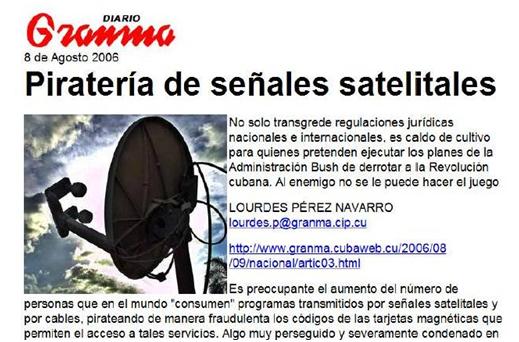
The most characteristic work of Granma was the article entitled “Piracy of Satellite Signals” by the journalist Lourdes Pérez Navarro, in August 2006. The reporter revealed how, inside the island, the illegal broadcasting of foreign television programs was developed, the national standards that they violated and their harsh punishments.

According to the journalist, the customers for the business of broadcasting foreign television signals receive “spaces with an avalanche of commercial propaganda that displays the appearance of capitalism, anti-Cuban messages and even pornography.”

She even gave a political-ideological touch to the matter. “In the case of Cuba, part of the programming that is received in this way contains destabilizing content, which is interventionist, subversive and which calls, increasingly, for carrying out terrorist activities,” she said.

Three years later, through those alien television signals, Cubans watched as Amaury Pérez acknowledged that in Cuba “there is no freedom to have an antenna” and ” … thousands of justifications for not having Internet.”

They picture Pérez saying on Cuban television, “I have an antenna” like he did on the program “To the Point” from the television network Univisión, during his trip to Miami in the last quarter of 2009.

The singer admitted having brought it in from Mexico. “… I installed it even though it was one of the larger ones, not so small. At that time nobody had any idea about the antenna, but I … television for me is very important,” he said. Amaury did not say whether he had permission to use the service. What is certain is that he could see it in Cuba thanks to the illegal reception of signals.

Pérez Navarro claimed that “the broadcasting of satellite programs, technically known as a multipoint distribution system through microwave,” was authorized as a telecommunications service with a limited character.

In other words, in Cuba, only expressly authorized companies can distribute and enjoy the service, people who are given permission by the MIC to be users. The journalist also omitted that the service was coded and intended mainly for tourism and the diplomatic corps.

Pérez Navarro usually covers the “Issues of Law” section in Granma. The article also reported that the piracy of signals “… violates agreed-upon international regulations of usage” and commits “a chain of crimes and administrative violations, which call for severe sentences under various laws and judicial norms.”

She masterfully exposed all the crimes involved in the case. She began with smuggling, which carries penalties of up to 3 years’ imprisonment and fines between 15 and 50 thousand pesos. According to the reporter, tourists and Cubans living abroad were bringing receivers and cards into the country, in violation of customs laws.

“We have detected that another way to own antennas has been the pilfering of such equipment or accessories from persons authorized to provide the service,” she said. In this case, she warned that this was committing the “crime of theft or robbery with force” and another of receiving stolen property, for whoever acquired these things on the black market.

She mentioned other crimes: “illegal economic activities,” by providing the service without a license, aggravated by the use of materials from the black market. “Speculation or monopolization” by purchasing merchandise for resale, and “Damage,” when “electric and telephone poles are disabled or transmission is broken by relocating the cables.”

She also warned that administratively there are “heavy fines and confiscation for the transgressors….The broadcasting of satellite programs requires a license granted by the agency of control and supervision of the Ministry of Information and Communications, an entity that has inspectors with the full authority to impose fines and confiscate equipment when violations are detected.”

In her article she quoted verbatim the contravention referred to in the articles of Decree-Law No 157 of 1995, another of the rules governing the matter, which states that “the amount of the fines to be imposed … shall be determined by the Minister of Information and Communications.” But she distorts the information when she gives the figure for the amount of the fines, as set forth by Resolutions 98 and 99 of that Ministry.

“A fine could be imposed of from 10 to 20 thousand pesos in national currency, or its equivalent at the official exchange rate in convertible currency, besides other administrative confiscation as an additional measure without the right of compensation or any payment,” Pérez Navarro said in her article.

She further reported that “according to Decree Law No. 99, inspectors are empowered to raise said fine up to half of the maximum (10 thousand pesos more), which could mean imposing financial penalties of up to 30 thousand pesos.”

For the finishing touch, she said: “For some, the illegal distribution of satellite television programs has become a form of unjust enrichment, which comes under Legislative Decree 149 of 1994, and they will be deprived by means of confiscation of substantial possessions that do not correspond to their perceived salaries and that they cannot justify.”

Pérez Navarro finished her report stating that “the work of persuasion of the masses” was essential “to eradicate this practice at once to support authorities charged with enforcing regulations for those who with absolute irresponsibility violate the law.”

I confess that my mouth fell open, with Pérez Navarro’s report. That regulatory clarification did not promote the observance of the law, but rather the culture of fear and repression among Cubans. I won’t dedicate even a single sentence to denounce the MIC and its inspectors, for violating the law and defrauding the public. Not to mention that to do its work they violate the citizen’s right to a home, a constitutional right.

The official press knows they have the power to dictate what is right or wrong, what to see, hear and read, and who to obey, through the dissemination of information. However, it doesn’t dare question the politics of exclusion and repression that ithe government implements through its socialist legality, for the people it promised to serve. In other words, it’s the sedative of change.

Translated by Regina Anavy

May 6 2011
Meow Meow the Dead / Orlando Luis Pardo Lazo

He died, in the end, without a name, the poor little high-contrast black and white kitten. He died of hunger and cold despite our sheltering him in a warm cloth with all the warm milk we could drop into his strawberry mouth. Separated from his mother by the mean hand of dim-witted resident of Buenavista in Havana. They threw him way behind the backdoor of house, still so small (would it have cost them so much to wait a couple of weeks?). They tossed him like a promise at this “counterrevolutionary” house where pity for animals still remains. A house where perhaps they would use “the imperialist dollars from the CIA” and other imbecilic inventions of our country to buy evaporated milk in hard currency, and dedicate hours and hours to saving a meowing life that no one else in this Cuba in the midst of a General Crisis of Socialism (CGS) cares about saving.

Who cares about it. If you live every day to kill or be killed, just like in the army or in prison: Favorite logic of the Total State.

Just this week the political police experts rounded up another Cuban television directly (another Padilla Case just months after the Piard Report), and they sat down with no explanations on the editing room of the Cuban Institute of Radio and Television (ICRT) to erase, chapter by chapter, my work as photo-set of the soap opera of the day on this Island of Iniquity (the tetragram OLPL terrifies them). Just this week, too, various paperwork issues of mine were interfered with by an operative in real time who listened into my cell phone (+53) 5-334-0187, without the cautious CUBACEL company being aware of it (to them it’s enough to collect the dollars that the “enemy” sends me thanks to our capitalist-loving system of digital recharges through ezetop.com).

What will it take for them to get the message. I’m sure the majority of the operators and directors are already finishing up their paperwork to become Spaniards and flee, as soon as they can, to the Plaza del Sol, to peacefully protest the European establishment and forget their complicity with the censors, their left-behind compatriots.

Kitty died, in the end (I knew, at his young age he would never survive) and he is not the first to die on me. Nor the first I’ve had to sacrifice to not see them suffer from the pangs of hunger or from a beating, or non-accidental poisoning. Kitty stopped moving in the early morning, blaming me for my entire species with each cramp in my hand, complaining to everyone each time I forced him to open his mouth and swallow.

I decided to bury him in the anonymous early morning of this insipid Sunday in May. The Day of the Nobodies.

I put him in the red earth. Stones from the sea. And a stolen postcard. I talked to him a bit before leaving.

Still, I have things to do for him. For others like him, feline or human. Beings turned into zeros by the pedestrian apathy of my country or planet.

My heaven, heaven doesn’t exist. I keep you much closer than this rotten word. My my window I see you.

Goodbye Kitty (I have written like this before in this blogspot cemetery).

May 22 2011

A Date That Should be Respected / Fernando Dámaso

Today, May 20, as in all countries that respect their history, we should mark the 109th anniversary of the birth of our Republic, but here, officially, that’s not the case: This date, like so many others, has been demonized and expunged from the national calendar. Like hundreds of thousands of Cubans whom we have seen forced to live in exile or in the memory of those who do not accept the erasure of history. This bad habit, absurd to many, has been a natural practice of our government for years, with regards to the figures and dates of our nation which they find bothersome, regardless of their era.

On this date our flag was raised for the first time, free and sovereign, throughout our entire country, hoisted by the glorious hands of General Maximo Gomez as he announced to the world the emergence of a new nation. Simply for that fact alone, for what it meant to those who participated in it as principal figures, and for what it represented to different generations of Cubans who had the good fortune to witness such an event, that day in 1902 deserves to be remembered, regardless of any subsequent assessment which may or may not be fair. This changing-changing of history over the last fifty years is neither healthy nor serious: It conspires against the true identity of the country, subjecting it to harsh ideological shift.

The Republic instituted this day as a result of the struggle and efforts of several generations, like any human endeavor, was not born perfect, but in the short period of its existence (only 56 years), despite caudillos, regionalism and political and social tensions, it achieved results that placed it first in many things among the countries of the Americas and the world, which is easily verifiable by studying the publications and documents of the time.

The epithets of neo-colonial, pseudo-republic and mediated-republic, as used by the present government and its officials, have no purpose other than to discredit the work of generations of Cubans, which, in many respects has been destroyed without something of greater worth being substituted. It is difficult to hide an involution such as this nation has experienced, making it now one of the most backward in the Americas and the world, one where the poverty level (never officially released) affects the majority of citizens (the income of a person does not exceed two hundred fifty dollars per year).

It is true that the Republic was born with a constitution that included an Amendment as an appendix whose Third Article concerned sovereignty and independence, but it was repealed in 1934. Also let us not forget that the Socialist Constitution was born with an entire Article of submission to the Soviet Union, and that did not disappear until the extinction of the USSR. It seems that the same sins repeat themselves in different historical times, although some they criticize and others they pretend to forget.

With lights and shadows, as in all other things, on May 20, 1902 the Republic arrived, and it is a date that should be remembered with pride by all honest Cubans, regardless of the political ideology they profess. Because over all of them, transient beings all, love should prevail in the nation, the land where, fortunately or unfortunately, we were born, and we must respect the work of our ancestors which no one has the right to invalidate.

May 20 2011

Sebastián Martínez, Spanish Journalist in Cuban Prison / Angel Santiesteban

Sebastián Martínez

The Cuban government doesn’t censor, persecute and punish its nationals enough, though they live in the diaspora, but that it also is expanding to foreigners its need to teach a lesson to anyone who dares to break the “untainted” — and only authorized — image that it exports of the deteriorating “Revolution” which, if it ever was, has now lost its way.

For eleven months the Cuban authorities have held the Spanish citizen Sebastián Martínez Ferraté, who authorized one of the Spanish journalist who reports for TV5 in that country to do an expose, professionally done of course, on child prostitution in Cuba, which is clandestinely carried on in a great number of homes on the island.

It’s worth mentioning that there are no images in the report of pedophilia, nor anything morbid, much less the corruption of minors; the documentary only uncovers public opinion about the food chain of prostitution on the Island, particularly in Havana, where young girls are sold to the highest bidder. The saddest part, not just for the Government, but for all Cubans, is that the supply chain operates with the complicity of teachers who, for 10 CUC, allow the girls to leave school during class hours and cover up their absences to avoid the notification of their parents, who rely on them for the “rigor and protection” of Cuban education.

Time passed and, through a Cuban “friend” who lives in Spain, they deceived Sebastian and brought him to Cuba believing that he would be airing some reports on hospitality. The day his plane landed at the airport in Havana, was the last day of the World Cup in South Africa, and Cuban Security took care to note, once again, a penalty without a player in, and so the most universal sports was celebrated.

As soon as he stepped foot in the airport terminal, they were waiting for him and without offering him any explanation he was arrested and taken to an unknown place, which reminds me of the complaints of the Cuban Government itself against the United States with regards to the prisoners at the Guantanamo Naval Base without any criminal proceedings.

Eleven months have passed and his family has not been authorized to visit him nor to receive news of his legal status nor even a report on his health. His wife, Dr. María Ángeles Sola, is–consistent with her name, Sola, meaning alone–on her own with their five-year-old daughter, having taken every possible measure at the Spanish Foreign Office in Madrid, but in the first six months the only response she’s gotten from the Cuban authorities was to deny her any contact with the Ambassador in Havana; they will not even tell her the reasons for keeping him in prison.

Maria says, as she recently declared on a Spanish radio station, that the Government has ignored Sebastian’s situation. And that the declarations of the Minister of Foreign Affairs and Cooperation, Trinidad Jimenez, have only served to placate the media and the press and to justify her Government.

Cuban authorities have allowed Maria to contract for the services of an attorney to represent Sebastian, and paying several thousand euros, she’s come to the conclusion that it’s useless, a waste of time, and that they’ve stolen her money.

After great insistence by the Spanish mass media, the wife managed to get the Consul in Havana to visit him in prison, without receiving any concrete response to his kidnapping, given that to date no legal charges have been filed against Sebastian. Maria strongly denies the statements of the Spanish Foreign Office, and charges that the Government and the Spanish Socialist Party is complicit with the Cuban dictatorship.

The question we all have is why doesn’t the Spanish Foreign Office defend Sebastian’s rights as an ordinary citizen. When will the Spanish Government assume a critical posture, without complications of any kind, with the totalitarian policies of Cuba, and turn its back to later justify what it did not witness. The truth is that both the Spanish Socialist Party and the Spanish Government have abandoned Sebastian, even as they affirm that he’s receiving consular assistance.

His wife Maria Sola and a mutual friend, Manual Fernandez, have appealed to me to use this space to help in spreading this outrage against international rights, and of course I have urgently complied. Knowing that the regime specializes in constructing false crimes and simulating trials where, before they’ve heard a single word from either party, they’ve already passed sentence.

I would hope that within this grain of sand that I am launching at international opinion–like that of Jose Marti for whom the whole glory of the world fit into a single grain of sand–can fit all the righteousness of good human beings, and that we can join our voices in demanding the Rights that belong to a defenseless man who suffers unjust imprisonment for doing his job as a journalist.

I want this kernel of corn that launched international opinion, like that of José Martí, the whole glory of the world fit into a kernel of corn, now it fits all the righteousness of the good human beings, and we demand our voices joining the Rights that corresponds to a helpless man who suffers unjust jail for doing his duty as a journalist.

Hopefully we will achieve our aims.

May 20 2011