Information from Santa Clara / Miriam Celaya

José Lino Asencio. Photograph courtesy of Ricardo Medina

Since the death of John Wilfredo Soto this past May 8th as a result of beatings received by local police, successive acts of violence, threats and harassment of various kinds have been carried out against dissident groups and individuals in the city of Santa Clara.

My friend and colleague, Carlos Valhuerdi, has informed me by telephone about the hospitalization of Jorge Luis Artiles Montiel (Bebo) on a hunger strike since May 9th to demand justice for Soto. Bebo was admitted to the medical room C, bed 21 (phone (42) 270 450) at the Arnaldo Milián Hospital in the city of Santa Clara.

Witnesses who had contact or were involved in the care of Soto shortly before his death continue to be harassed. Such is José Lino López Asencio’s case, who was beaten earlier last week by some individuals while they shouted revolutionary slogans in an isolated neighborhood near his home. Lino went to the hospital with severe headaches, dizziness and vomiting, where he was treated by a Bolivian student because the doctor had “no time” or “was busy.” The student ordered a head x-ray, which came back negative: Lino showed no fractures. However, they did not order a tomography and much less an MRI or any other additional tests, except an abdominal ultrasound to verify that pancreatic fluid had not leaked into the cavity.

Apparently, the medical authorities at the Santa Clara Provincial Hospital have discovered that dissidents in the region have the tendency to develop rare pancreatic disorders. Finally, at this “consultation” Lino was advised complete rest and prescribed Naproxen to treat inflammation. Later that night, he again returned to the hospital and received an analgesic injection intravenously to relieve the headache. The friend who accompanied him, Sander Reyes Machado, said that, after leaving Lino back at his house and setting out for home, some unknown individuals were waiting for him in that same remote neighborhood, who attempted to beat him with clubs, but ran away because Sander was armed with a machete and showed his intentions to use it to defend himself.

Lino continued with headaches, dizziness and swelling of the face into the next day. Once again he went to the hospital. This time they indicated a tomography and reached a diagnosis of a left sub occipital neuralgia with post traumatic cephalalgia. The neurosurgeon who examined him, Dr. Agustín Arocha García, stated there were no blood clots in Lino’s brain. They continued with the anti-inflammatory treatment.

As if all the troublesome process were not enough, on Saturday, May 21st, Lino was taken to the Third Unit of the Santa Clara Police, so that he could once again relate the assault he was subjected to. Just five days after his initial declaration, Lt. Colonel José Luis Pacheco Ribalta, Head of Province Criminology — who had previously been a police-instructor — conducted an interrogation peppered with threats, and belatedly took photographs, when the Naproxen tablets were already having their effect on the facial swelling. They indicated that they would “investigate” the events and that “they would question him again”.

Carlos Valhuerdi, dissident and independent journalist in Santa Clara is the source of any information expressed herein. As Valhuerdi states, harassment of members of the group linked to William (Coco) Fariñas has gone on since Soto’s death, and there is strong pressure against witnesses of police brutality. A group representing Guillermo Fariñas’s group stood outside the Third Unit, in Lino’s support, while he was being interrogated.

Translated by Norma Whiting

23 May 2011
The Building That Resembles a Galician Apothecary / Iván García

If you want to know the soul of the Cuban people, you must live in a solar or tenement building. That’s where you’ll find diversity. Stories of prostitutes, pimps, gays, hustlers, thieves and dissidents.

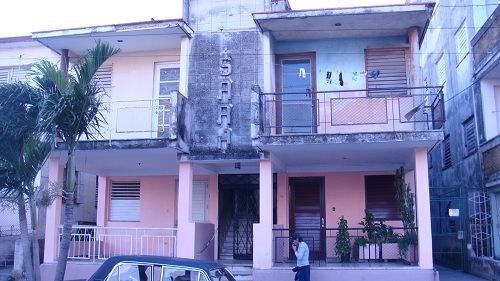
I invite you to visit a building in the Havana neighborhood of Lawton. It consists of a ground floor and an upper floor with a total of with apartments, some larger than others. Four interior and four exterior terraces on the street.

It was ordered built in 1957 by Rosara, a pharmacist originally from Galicia. After saving coins and crumpled bills under his mattress for years, the Galician decided to take a leap in his life and become a landlord.

The idea was good, but times were bad. It was inaugurated in 1958. A year later, Fidel Castro and his bearded ones took over and did not take long to nationalize factories, sugar mills, refineries and buildings. Rosara could never recover the money he invested.

It’s been 53 years. The facade of the building has not been fully repainted. The letters R and O have fallen off and it reads now only SARA. But compared with the 19-century filthy tenements in the old part of Havana, which collapse under a passing shower or medium-intensity winds, Rosara is a five-star hotel.

I present to you its tenants. Along a narrow hallway four families live. A mother with three children, unemployed and mentally imbalanced, eating whatever comes along and living like a gypsy.

In another apartment, a neighbor devoted to Santeria. Above, a couple of old people loyal to Castro. In their old age they survive on their retirement checks and remittances sent from the United States.

Next, a family maintained by their daughter. From Europe, she sends euros, so they can eat two meals a day and sleep with air conditioning.

In one of the apartments on the ground floor with a terrace, lives a couple with good manners and a son in college. Next, the classic generous type, who constantly disturbs the neighbors to offer his various trades. On the top floor, a specialist in sports statistics, serious and quiet.

It is a building where people usually say good morning, something rare in the island. And they do not ask for money, or to borrow sugar or rice, as is customary in most rooming houses and buildings of the capital.

Nor do they often have violent family quarrels over trivial matters like who ate the bread the brother got on the ration book, or who sold the parents’ egg ration, which have occasioned more than one bloody encounter in the country.

The building Rosara is a piece of Cuba today. Neighbors who have gone into exile, people who disagree publicly and good workers who answer summonses from the government.

The final tenant lives in one of the apartments above. He is a freelance journalist and has two blogs. For two years he’s trying to repair his floor. One day he wants to live with his daughter and his wife.

February 26 2011

Playing to Kill / Iván García

Right now, the personal enemy of Edna is an Xbox. A single mother of 43, she thought to resolve by great problem of few recreational opportunities for her son, so she asked her relatives in Miami to send him a superb and sophisticated computer game.
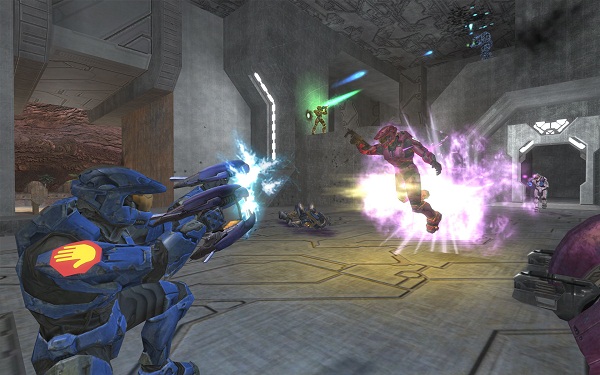
“I thought my son Michael, 11, could spend more time at home. He was addicted to video games and in one month and he would sometimes pay up to 50 convertible pesos (60 dollars) to play on the floor of a neighbor who rented his equipment for a “chavito” (one dollar) per hour, “says Edna.

The good idea has turned into adversity. The boy is connected to Xbox from the moment he comes home from school. He has no social life. With his friends, who come in bunches to sit in the room, they take the controls to compulsively play the ultra-violent games proliferating in the market.

Michael has little interest in school. During class hours, he doesn’t concentrate on his school work but spends his time talking about the latest version of a bloody game. Or he escapes to the house, to improve his assassination skills as a virtual killer.

Michael’s aim to be the best ‘killer’ among his peers in the neighborhood. According to Edna, she’s gotten up in the middle of the night and found him stuck to his Xbox.

Her child’s manias greatly concern her. She has taken him to see a psychologist, who unsuccessfully tried to wean him from the addiction. Such virtual violence is taking its toll on Michael. He has become impulsive and a boy of few words.

Video games are not a serious problem in Cuba, as often happens in first world countries. But it is a phenomenon to consider.

The entertainment industry is a shocking business. They take in 48 billion dollars a year, which leaves the eight billion spent on movies in the dust. And they want to earn more money.

According to think tanks, analysts and experts in the field, in just five years the industry could become the seventh-largest, surpassed only by arms, drugs, prostitution, casinos, food and medicine.

Geographically, Cuba is closer to the United States than Fidel Castro would have liked. Despite being a nation commercially embargoes by the Americans and ruled for 51 years by an authoritarian government that denies freedoms, the latest in American technology comes to the island immediately.

Such is the case of Apple computers, the iPhone or the next-generation Xbox. The worst and most violent video games also arrive. Many children and teams eat them up.

Some parents do not believe that virtual fanaticism is harmful. Maybe not. But addiction to games of blood and death has led to many tragic events in America.

In Cuba, youth violence does not go that far, but it has quietly been increasing. Due to the many material shortages, there needs to be a sharp eye on the harmful consequences addiction to violent video games can have on children.

Edna does not think her son is capable of taking a sharp knife from the kitchen and stabbing anyone. But when she sees his aggressive behavior she has her doubts. You never know.

February 28 2011

The United States, the Intimate Enemy of Fidel Castro / Iván García

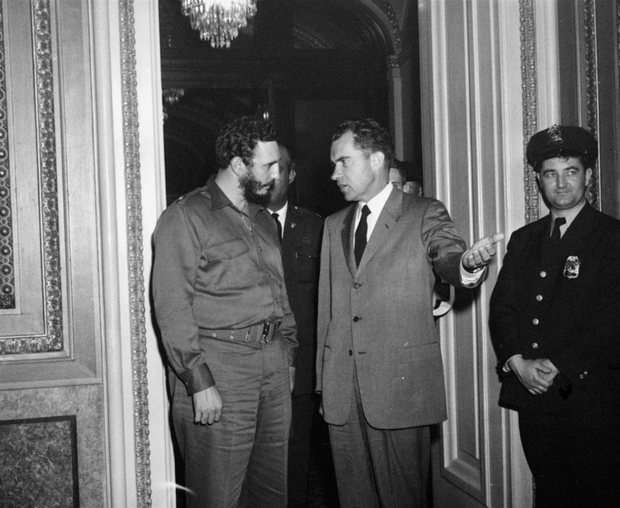
Photo: Richard Nixon, then vice president, met with Fidel Castro during his U.S. tour in April 1959.

One morning in 1958, in intricate landscapes of the Sierra Maestra, after a heavy bombardment by dictator Fulgencio Batista’s air force on defenseless villages, the guerrilla leader Fidel Castro wrote a note to his secretary and friend Celia Sánchez. He vowed to her that after the air raid and verification that the bombs used were made in the USA, from that moment on, he would begin his real war against the United States of America.

And so it happened. The support in arms, logistics and military training which the United States provided Batista, was the starting point for his personal crusade against the gringos. As a lover of history, the young lawyer from Biran had antecedents. Since the island was a colony of Spain, the imperial cravings of the colossus of the north were clear.

After 1898, the U.S. military occupation and the outrageous Platt Amendment–which was like a sword of Damocles over our fledgling sovereignty–were the breeding ground that increased the hatred and frustration of many, given the foreign policy of their neighbors on the other shore.

Castro’s political enemies had seen signals of his war against the Yankees in the letter he sent to President Roosevelt in 1940, while studying at the Colegio Dolores, Santiago de Cuba:

“My good friend Roosevelt, I do not know much English, but I know enough to write. I like listening to the radio and I’m very happy because I heard that you will be President for another term.

“I am 12 years old (which was not true, because he was born on August 13, 1926 and the date of the letter is dated November 6, 1940, so he was already 14). I’m a boy, but I think a lot and I can’t believe I’m writing to the President of the United States.

“If you would like, give me (or send) a real American greenback of ten dollars because I’ve never seen a real American greenback of ten dollars and I would like to have one.

“If you want iron to build your boats, I’ll show you the biggest mines of iron of the country (or world). They are in Mayarí, Oriente, Cuba.”

Roosevelt neither answered him nor sent the money. Castro opponents believe that this was the real beginning of his anti-imperialist crusade. I think not. Before the triumph of his revolution, Castro’s relationship with the United States was not incendiary.

When the July 26 Movement needed money to buy weapons, Fidel took a trip to New York and Florida in search of the greenbacks of Cuban immigrants. It was from the start of the bombing in the eastern mountains, that he saw for the first time what his future campaign would be.

It is also likely that after his extensive U.S. tour in April 1959, where he visited universities and monuments, chatted with the press, organizations and personalities, and met with then Vice-President Nixon, but not with President Eisenhower, who refuse to meet him, giving an excuse for not receiving him that he had a date to play golf, that Castro decided to open fire from his island of reeds in the Caribbean.

Castro would explain his motives one day in his memoirs. The truth is that since 1959, Fidel has held an aggressive verbal duel with 11 leaders of the White House. And he even put them on the brink of nuclear war in October 1962. He has done everything possible to arouse the ire of the Americans.

The United States has had its share of blame, with its dirty war and its surplus of stupidity. I think it was a senator, Jeff Bridges, who once said that to Castro’s stupidity, the United States responded with a greater stupidity.

But in January 2009, Barack Hussein Obama came to the presidency. Castro was not ready for Obama. With his mind trained to the presidents of the Cold War, he could not decipher this mestizo with the strange name.

Looking for clues, he quickly read two books by Obama, Dreams From my Father and The Audacity of Hope. But he found nothing. In them, Obama never mentions the Cuban revolution and Castro and Che Guevara. In The Audacity of Hope, he mentions only Cuban Americans and their success.

Cryptic Obama, Castro would think. Perhaps because the young Barack lived much of his childhood in Hawaii and Indonesia, the coming to power of the bearded one didn’t make his stomach jump. Castro has tried to seduce him. But Obama did not answer, not even the insults of old commander.

The point, in my opinion, is that Castro does not understand Obama. He can’t even understand how it was possible that this skinny black guy reached the White House.The reason is simple. The one and only comandante is still stuck in the Cold War period. United States and the world have changed. And Castro suspects that this is impossible.

March 26 2011

Cuba: Children No, Abortions Yes / Iván García

For Ricardo, 32, the worst business one could have in Cuba is to have kids. “I have two and I know what I’m talking about. If my old lady didn’t get rid of them it’s because the gynecologist told us that if she had another abortion she could be left sterile. After pulling our hair out we decided to have it. And God punished us. We got twins.”

Many couples think like Ricardo. Abortion as become a contraceptive method in Cuba. It’s practically irresponsible.

Heidi, 27, is going for her 5th abortion. “The doctor would not let me, but stronger than his medical ethics were the 25 dollars that I put in the pocket of his coat. It’s crazy to have a child now. I live in the room of a tenement with a large family and some sleep on the floor. I work in a pharmacy and earn 290 pesos (12 dollars). My boyfriend does not work. Every time I get pregnant, I get an abortion.”

Abortion is almost a sport for some Cubans. The doctor Raisa blames couples neglect when they have sex. “Young people don’t like using condoms to protect themselves. And girls often don’t have any contraceptives. Cuban public health should be more rigorous about abortions. the situation has gone from bad to worse.”

Interruptions of pregnancy are free on the island, like the rest of health care. Even though there are doctors who take money under the table to do abortions. According to a Havana gynecologist, he makes about a hundred dollars a month. “They also give me nice presents, even a leg of ham in one case.”

But the dance of banknotes occurs when doctors go on aid missions abroad. A report in the Wall Street Journal published in January 2011 by Joel Millman, gave a clue about the behind the scenes business of Cuban doctors performing abortions in African nations and the Middle East. Joseph, a physician who spent 3 years in South Africa, said that to offer abortions in these countries is a way to return to the island with enough money. “If things go well you’ll even make enough money to desert. ”

Institutions like the Catholic Church have take on the issue of abortion full tilt. The dissident physician Oscar Elias Biscet, recently released on parole, has been a leading voice against indiscriminate termination of pregnancy. Dr. Hilda Molina, now living in Argentina, conducted a crusade for years against the use of fetuses in the production of drugs by national scientific institutions.

No doubt, Cuba is the country in the Americas that provides the most facilities for the practice of abortion. One of the harmful trends generated by the revolution. The precarious living conditions and homelessness have caused a high number of women choose abortion, sometimes after more than twelve weeks of gestation. The official media do not touch the issue publicly. As if it didn’t exist.

Mass practice of abortion and little desire to have children by couples, are contributing to the rapid aging of the population. If life is difficult for young people, imagine the elderly. Cuba is not a good country for old people. By 2020, there will be more seniors than children aged between 0 and 14. Add to this that every year 20 thousand people migrate legally to the United States, hundreds of them still of childbearing age.

The Havana gynecologist believes that such a large number of abortions is also a response to dissatisfaction with the status quo. “They do not care to have a child in a country full of scarcities. There are women who get rid of them because they are waiting to leave and want to give birth abroad, with more resources. It is unfortunate, but that is happening. ”

Fidel Castro’s revolution has been an efficient factory for producing shortages. Quite the opposite in the case of abortion. You can give him a gold medal.

May 2 2011