A Little History / Fernando Dámaso

We Cubans, with regards to our history, are quite chauvinistic. We believe, and even are convinced of it, that since we appeared on this earth, we have been fighting for freedom. It goes back to chief Hatuey (who incidentally was neither Cuban nor Spanish) and his death at the stake. Since then we have always been warriors, through rebellions, conspiracies, wars and revolutions. There’s even a person who has said we have accumulated over five hundred years of struggle. This is only one side of the coin.

On the flip side, of which very little is spoken and less written, it appears that since 1492 (the date of discovery) to 1848 (the date of disembarkation of Narciso Lopez en Cardenas, who by the way also was not Cuban but a Venezuela married to Cuban), a period covering three hundred fifty-six years (three and a half centuries), liberation actions were conspicuous by their absence and we lived peacefully and quietly, without major hot flashes, Spanish, African, Chinese and Creole, born of the mixtures of one with the others. Neither should we forget that we were the last colony to become independent of Spain, when all Latin American nations had achieved it years earlier.

It can be argued that Spain held onto the island so as not to lose it, as the most precious jewel in her crown, and there is some truth in it, hence the bloody wars of 1868 and 1895, but it is also true that independence, despite all the sacrifices of the Cubans, was provided by U.S. intervention in 1898, when both contending parties were quite exhausted, even though its strategic objectives were at the tip of their fingers. It is also known that at the end of the war caudillismo and disagreements between different military chiefs and the Government-in-Arms, undermined the Mambi Army (José Maceo never obeyed the command of the Eastern Department, first from, General Mayia Rodriguez, who had quit to avoid complicating the situation, nor from General Calixto Garcia, who replaced him. General Maximo Gomez had offered his resignation as Commander-in-Chief, and only remained in office, retired to Las Villas, before the death of Antonio Maceo and his son Panchito Gómez Toro).

With regards to the intervention it’s necessary to recall some figures. Maximo Gomez was in Las Villas with about five thousand men under arms, many of them ill-equipped, and because of the distance, he had no direct involvement in the events that would occur around Santiago de Cuba. Calixto Garcia was the one who was in the east, also with about five thousand men under similar circumstances. It is true that in previous months they occupied villages, but they abandoned them after a few hours, unable to maintain them at the onset of the Spanish forces. In Santiago de Cuba, which decided the war, the Spanish had about twelve thousand soldiers, well armed and equipped. The U.S. Army landed, to defeat this opponent, about twenty thousand troops, armed and superbly equipped who, along with the troops assembled by Calixto García, put paid to the Spanish defense, obtaining their surrender.

Sooner or later, Cuba and the United States will regularize their relationship and we will live together as good neighbors. This happened between the U.S. and Russia, China and Vietnam, countries that are more geographically and culturally distant. Our case is not going to be the exception. To achieve this, among other things, we must begin to remove the many layers of ideological and political paint that have covered the events and characters of our common history. This is the only purpose of these lines. By a twist of fate, we may be called to be the last country to abandon socialism (if North Korea does not take that honor from us). History likes to make fun of statements of eternity: According to its creators, the Nazi regime would last a thousand years and yet it didn’t last twelve, and the monolithic, strong as steel and irreversible Soviet regime, today is just a sad memory. Words, fortunately, are only words and, when not carried away by the wind, they are taken by time.

April 26 2011

Cuba: Whose Afraid of the Debate? / Iván García

Every day Cuba is more of an island than ever. A sector of the official intelligentsia is engaged in an interesting debate on the future of the country. It’s something that’s needed. I don’t think it’s the shock troops of Cuban Intelligence, as a certain sector within the opposition insultingly suggests.

Simply something is moving. Both bloggers — we call those accepted by the government, within this movement there are many nuances — as well as figures within the national culture use new information tools to reflect their points of view.

I’m not naive. In Cuba spontaneity is rare. Certain government sectors, to counter the phenomenon of alternative bloggers, have encouraged the intellectuals who defend the irreversibility of the revolution, who with their talent, in their proposals, reports, articles and analysis, assume the need to maintain a project created by Fidel Castro in 1959.

Is good that journalists of the caliber of Reinaldo Taladrid, Rosa Miriam Elizalde and Enrique Ubieta sharpen their pencils and make known to us their keen observations.

Their works, which I sometimes do not agree with, are better and more substantial than the soporific political speeches of the island’s hierarchy. The evil background of this supposed “Battle of Ideas” is an unwillingness to accept the other side.

And it exists. They live in the same country and think differently. I would be disappointed if people who I appreciate professionally, such as Sandra Alvarez or Elaine Diaz, bloggers accepted by the government and of unquestionable quality, fall into the cliché of the official discourse, of labeling all who disagree with the Castro brothers, with the crutch of ‘agents of the empire, mercenaries or traitors.”

Any ideology or political system leads to resistance. To fail to recognize it is to deny the dialectic. Unanimity does not exist. A government cannot govern only for its supporters. In democratic societies, the various factions argue and talk to each other. In Cuba, each side is entrenched in an islet. And they fire their missiles. They read what the opposite group writes sideways. But always at hand they have the little sign that some are “puppets operated by the State ” and others, “mercenaries paid by the empire.”

If the Cuban revolution is considered a mature and consolidated project, it need not fear open and respectful debate among Cubans who think differently. Enough of monologues. There should be a dialogue.

I find it incomprehensible that journalists, analysts and foreign scholars can debate with people who advocate socialism and these intellectuals cannot even say hello to citizens whose “sin” is to not agree with the Castro brothers.

What is at stake is not to tear the system down and implement capitalism as Enrique Ubieta believes, director of La Calle del Medio, the only readable newspaper on the island.

It would be very pretentious to think that bloggers barely known in Cuba, by dint of posts that are read only by those the other side and 0.2% or less of the Cubans, will create a climate of opinion to unseat the established status quo.

Were it to happen, it would be the first blogger revolution in history. Let’s not fool ouselves. Yes, new tools such as the Internet, Twitter or Facebook have a remarkable drawing power. But only when the deterioration of a nation, its citizens’ complaints and malfunctions of the country’s economy articulate a widespread discontent.

If things in Cuba are distorted it’s simply from inefficient government management. If there is a sector of society that asks for deeper changes it is because the present does not meet their expectations.

What has devalued Marxist socialism is incompetence. It has not worked. Nowhere. And not for lack of professionals and resources. True, in the utopian communist society there is no lack of material and money is not needed. Nor is the army or the police to suppress or tough guys with State Intelligence making your life impossible.

But we must keep our feet firmly planted on the ground. And to be human, to truly evolve, we need freedom, confrontation of ideas, dialogue and to listen to the other party.

The point that most worries closed governments such as Cuba’s is information flow, and therefore they control it because they find it easier to govern. They also inconvenience people fleeing the tight state control.

I think the followers of the revolution driven by convictions. If so, they are honest citizens. So why not have a face to face dialogue?

If, in fact, the supporters of Cuban socialism have solid arguments, I do not see why they’re so afraid to discuss eye to eye, and not in virtual forums. Please Ubieta and company, show that you are free men.

Photo: Max Lexnik, journalist in exile in Miami, with bloggers from La Joven Cuba, a blog of Cuban university students. Transcription of the first part of the meeting.

May 17 2011

Cyber-Cubans: Digital Anarchy / Ernesto Morales Licea


I don’t have to think too hard to come up with the question I’ve had to answer most often since I came to the United States. It’s this: “How do independent bloggers on the Island update their pages without access to the Internet?” It’s an indecipherable puzzle for those who assume a connection as a vital necessity, without which their existence would be unthinkable.

And the first thing I say, sarcastically, is, “Never ask that of an independent blogger in Cuba, because they won’t say anything worthwhile.” Claudia Cadelo, author of the blog “Octavo Cerco,” has her answer ready every time a foreign journalist asks about her arrangements. “If I tell you the methods I use, I would automatically have to find others.”

Each one a keeper of secrets regarding the opportunities, a digital rebel, slippery, using his own methods without revealing them, sometimes not even to his closest colleague, because in this revelation he might make a false step. The procedures vary from the most basic and public, to the most deviously wonderful, such that one day they will be related in sui generis conferences when this long night has finally come to an end.

Despite all that, however, some tricks do leak out, and become public because it’s unstoppable: the bloggers know that to declare them won’t put them at risk from the machine, and they throw some light on the mystery they themselves have built: stewing the censors in their own sauce, using legal tricks against which they can do nothing.

To whom, in the modern world, would it ever occur to imagine the following procedure to maintain a personal page?

A blogger writes his post, taking care that it doesn’t fill more than one screen on his computer. Then, pressing “Print Screen” on his keyboard, he makes a digital image that he stores in his cell phone, and sends via text message to a distant collaborator who can download the photo, transcribe the text, and upload it to the Web.

For other authors, facing even greater economic instability (having a cell phone in Cuba is an act of faith), the process is simpler: dictate your texts by a landline telephone to someone who, far from the city or far from the country, publishes them in your name.

Only a handful of Havana hotels offer navigation services to Cubans, with a terrifying price: 6 convertible pesos an hour–some 8 dollars–and only a handful of bloggers can sporadically access this option, knowing that their stomachs will reproach the excess. In the interior of the country this continues to be impossible, because in order to pay this abusive amount in a cybercafe you have to present a foreign passport.

But even more surprising is the social mechanism through which Cubans consume and promote these prohibited materials. The old maxim of the Three Musketeers has become law: “One for all and all for one.”

A lone Cuban with access to the Web, whether clandestine or legal–in his workplace, for example–is a potential distributor. To download an article, store it in a flash memory, and pass it to all the people in your circle of friends, is the existing norm.

Sometimes, they even print them secretly with State printers. A reckless colleague in my city stopped me right in the street one day and said, “You have me working for you. You’ve barely published something on your blog and I have to print more than one copy of it.”

Most Cubans have access to a computer today. The ways in which they procure them is worthy of another epic. But the truth is that the “information traffic,” the marketing solidarity between the disconnected and the privileged functions better than the coercive methods of the guardians of the One Truth. State Security would have to requisition from each Cuban his USB device, his personally tailored computer, his DVD bought on the black market, and, I’m sure, even so some other surrealistic way would appear.

Similarly, Cubans today have almost unwittingly brought down the information monopoly of television and audiovisual programming. They have long ceased to consume only what’s offered on the national network.

I remember, for example, that when the episodes of the successful Fox series “Prison Break” came out, I saw them one by one in my remote Bayamo at almost the same time as my friend living in Ontario. Their circulation was delayed for a couple of hours: the time it took my English-speaking countrymen to post the subtitles. The same day each episode was released on American television, a legion of illegal satellite antennas, camouflaged with a bunch of grapes under a complicit eave, would capture them for the Cuban market.

Currently, the most successful television programs in the United States, entertainment shows like that of Alexis Valdés or “Case Closed” on Telemundo; news and current affairs programs like “A Mano Limpia” from AméricaTeVé or “María Elvira Live” from Mega, move with surprising speed from one end of the Island to the other.

There is no police operation that can disrupt a practice that is already part of everyday life of Cubans, their modus vivendi. For every dish that is discovered and confiscated, they are making another ten in secret workshops, and there are twenty interested buyers.

In the nation’s capital lives a colorful character who delivers cards with his e-mail and phone number to customers, and signed with an alias of war: “The NETFLIX of Central Habana.” From anywhere in Cuba you can call him, to get a documentary series, the films of Al Pacino or the latest recordings of Rita Montaner, and for a good price the Caribbean pirate will ensure they reach their destination.

The same applies to illegal connections to the Internet.

In fairly cosmopolitan cities of the country, it is a sustained act of espionage to find out who provided you with an Internet account. Nobody trusts anybody. But once you win the confidence of the “providers,” navigating is a matter of money, and strategy.

Money: For the most part it costs between two and three convertible pesos an hour. Are astronomical amount to citizens who earn, on average, 12 per month. Strategy: a blogger friend updated her volatile page for some time, thanks to the account of an official journalist of the most recalcitrant in his political purposes. Like many others, he had made ​​hypocrisy a method of survival.

Thanks to his hard-line discourse, the journalist, working for a mediocre provincial newspaper, had “won” an account of 50 hours per month, with the purpose of allowing him to be active on social networks. Of those, he would sell to anyone who would hard currency in his hands.

According to my amused colleague, the journalist who was supplying a few hours was the first to post defamatory comments under each post she published. At the time of payment, he apologized: “You know this is a good for both of us. This way we both have the most secure connection.”

Thus, I understand the anxieties of the Cuban apparatus with new technologies, with digital development. Thus, I understand the bellicose speech of the lobotomized guy in a video made by the military–also leaked thanks to the Internet!–doing the indescribable to explain to the officials with many stars and little sense, the dangers of the new cyberwar which, without their realizing it, had been introduced on their very own Island.

And although I understand it, I smile dismissively: this time they have lost. Implementing more controls will accomplish nothing, stripping more professionals of their monitored accounts. Anchoring a fiber optic cable from the Venezuelan headquarters will accomplish nothing, to strengthen their propaganda efforts, now on the Web.

That elusive cable is going to slip through their hands, and be diverted to unintended destination: like the house of a courageous voice unafraid to say what he thinks, that through the computer of a tropical hacker who meanwhile earns some money with his downloads, enables thousand of the disconnected to free themselves from the official brainwashing.

What doubts remain: Is it worth celebrating the independence won by the Cubans with respect to their mass media, something unthinkable twenty years ago. And I ask myself, intrigued, if some capricious fate hasn’t chosen this virtual ground to open the democratization of my country, leaving in shock all the great minds who dreamed, at some time, of a path, but never one from this direction.

29 May 2011
Sense of Belonging / Fernando Dámaso

With the establishment of the socialist system, the sense of belonging is diluted in the so-called masses, an abstract entity without personality of its own and, therefore, able to be used in whatever way, according to political expediency. The masses, always ready for whatever action the demagogue requires, provide a simple sounding board that mechanically and increasingly repeats whatever sound it has been given. In reality the masses neither think nor analyze nor decide, although they are supposedly granted such abilities. Lacking individuality, the masses are an amorphous amalgam, whose unique feature is its quantity, although not a mandatory requirement: the masses is a generic everything without limits. It may consist of ten, a hundred, a thousand or a hundred thousand people. For the purpose of its use it’s all the same.

In opposition to the exist individualities and the sense of belonging. Each individual is different from the others, although there may be features that are common. The difference is precisely what makes them valuable and important. Each individuality tends to cluster in what we call a sense of ownership, without losing its own distinctive features. The first group is familiar characters, and therefore we say a sense of belonging to the family. Then follows a sense of belonging to the neighborhood, school, society, recreation or social club, the workplace, religion, profession, social class, city or town, and so on until reaching the sense of belonging to the country, which some mistakenly coincide with the patriotic sense, exalting it too much, leaving aside all the previous ones, which are actually the most important and lead to the latter, within national boundaries.

The existence of the sense ownership ensures that each of them can defend something that can be partially or completely different from that of others. Thus, having a sense of belonging to the family makes to prioritize and defend the family interests, as opposed to those of others, to possess a sense of belonging to the neighborhood makes you want to fight for its improvement, and so on. This sense of belonging is what allows individuals grouped within it, naturally, to become involved in the process of development. It doesn’t exist and is diluted in the concept of the mass, you lose the sense of concrete and daily struggle, which is replaced by a generic sense, regarding plazas and platforms, impossible to quantify and, worse still, to perform.

Thus one hears to the point of tedium about the masses struggling for peace, justice, freedom, equality, and fraternity, and so on. Magnificent slogans for public policy billboards, pamphlets and speeches lacking any essence, true social deceptions, designed to avoid at all costs the participation of individuals, with their sense of belonging in the social and historical realm.

To revive the sense of ownership existing in the Cuban nation since its foundation, is an unavoidable step for solving the accumulated national problems accumulated, as the solution is only possible, by successive solving of the problems of the family, neighborhood, school, work, and so on, or that is, by the fruitful exercise of the sense of belonging.

May 29 2011

You, Princess, No. Not You. / Yoani Sánchez

You come out of this filth of the starving …
Joan Manuel Serrat, from his song “Princess”

She was raised to succeed. As a little girl, her mother took the fried egg of her own plate, if need be, to give it to her, because she was a promise which the whole family was hanging from. They didn’t even let her scrub, so that her hands would not crack and harden from the scouring pad and the soot. When she combed her hair into ringlets her elder sister predicted she would one day marry a Frenchman or a Spaniard or a Belgian, someone from the “nobility” of monarchy or business. “Everyone will love you!” cried her grandmother, whose fingers were twisted with arthritis from half a century of washing and ironing for the whole street. They wouldn’t even let her have a boyfriend in the neighborhood, because she had to be preserved for the future that awaited her, for the potentate who would come and take her from that crowded tenement in Zanja Street, from that crowded country in the Caribbean.

One day, when she was barely out of adolescence, she found him. He was much older and didn’t belong to any wealthy family, but he had an Italian passport. Nor did she like him physically, but simply imagining him in Milan made his bulging beer belly look not so big. The aroma of the new clothes he brought every time he came to Havana also covered the smell of nicotine and alcohol that always came from his mouth. At home, her family was delighted. “The child is leaving us to live in Europe,” they told the neighbors, and her own mother cut her off when she tried to explain that her fiancé that occasionally became violent and beat her. And so they pushed her to complete the legal paperwork and make the marriage official. In the wedding photos she looked like a sad princess, but a princess.

When the plane landed in the Italian winter, he no longer seemed like the kind man who, 24 hours earlier, had promised her mother that he would take care of her. He took her to a club that same night where she had to work serving clients liquor, and even her own body. For months she wrote her grandmother about the perfumes and food she had tried in her new life. She recreated, in her letters and phone calls, a reality very different from what she was living. Not a word of extortion, nor of the husband who had evaporated leaving her in the hands of a “boss” whom she had to obey. In the Havana tenement they had all spoiled her and made her happy and she didn’t want to disappoint them. When the Italian police dismantled the prostitution ring in which she was trapped, she sent a brief text message to her relatives on the other side of the Atlantic, so they wouldn’t worry, “I won’t be able to call you for several weeks. I’m going on vacation to Venice to celebrate my wedding anniversary. I love you all, your Princess.”

29 May 2011

Between a Rock and a Hard Place / Laritza Diversent

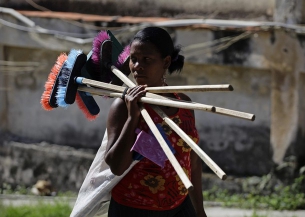
A woman selling brooms in Havana. (Reuters, May 2011)

In less than a month, the Communist Party’s official newspaper published, in its weekly Letters to the Editor column, three critical opinions from those who are licensed to practice the fourth most popular self-employment activity for Cubans.

Officially, the activity is called “Producer/seller of miscellaneous items of use in the home.” The legislation that regulates the sector does not specify if it is obligatory to engage in both actions. However, from the presence of these self-employed on the main thoroughfares of the city and the increase in licenses granted by the State, we can presume that it is legal to be a seller alone, without also being a producer.

On May 6, a reader of Granma recounted his experience when he unsuccessfully looked for an electrical resistor in the hard-currency stores in Central Havana and Old Havana. As he wrote, he found them in the stalls of the self-employed on Neptune Street, for a price of 10 CUC (250 Cuban pesos), when in the hard currency stores they are often sold for less than 5 CUC.

“I really do not need any analysis on this subject as it is obvious that this is not allowed, and that those who should enforce the regulations are not doing it will, allowing others to live of our work,” said the reader to conclude his letter.

For his part, José Julio, a disabled self-employed man of 58 with a stall in the central Calzada de Diez de Octubre, says, “I do not force anyone to buy from me. The law says self-employment prices are negotiated freely. If they think I sell it for too much, then don’t buy from me.”

On May 20, another reader wrote in Granma: “The state offers a package of four steel wool pads for one CUC (24 Cuban pesos), and these are quickly monopolized by those self-employed who then sells them to 10, 12 or 14 Cuban pesos each, or at times the prices is more than 200% higher than the official price.”

And here’s the crux of the matter: the law forbids the self-employed to sell industrial goods acquired in the established commercial network, as well as food products pre-prepared by the established network on the Island. Also, they must trade in their own services and products exclusively, utilize primary materials in these activities, and show inspectors proof of this legality. But the only way to get the merchandise is to acquire it in the state retail markets, because that is the only legal outlet recognized by the authorities, as to date the State has not created any wholesale markets.

Granma has not yet published a single opinion in favor of the self-employed who engage in sales activity, nor any article that reflects the legal contradictions. Apparently, the law and Granma agree to put them between a rock and a hard place.

Originally published in Diario de Cuba.

29 May 2011

The Smell of the Carob Tree / Laritza Diversent

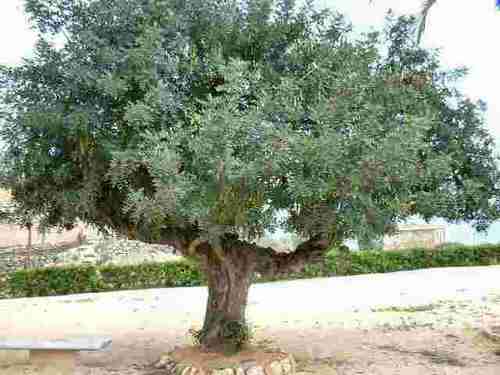
David was found guilty of murder by the Camaguey tribunal after investigators from the Ministry of the Interior found traces of his scent on the trunk of a carob tree.
Laritza Diversent

In its sentence number 57 of March 30, 2007, the Camaguey Court sentenced Delvis David Pena Mainer to 40 years imprisonment for the assassination of a young 23-year-old man and his 17-year-old wife. Delvis, 44 years old, declared himself innocent but the Camaguey court found him guilty through a “pile of existing proofs against him”.

According to the organ of justice, on January 27, 2005, David waited for his neighbor behind a carob tree. When he arrived, he attacked him with brutal machete blows until he killed him. The wife of the young man heard the desperate pleas and ran out to help him, but upon seeing the crime she turned back and ran. Pena Mainer followed her and violently attacked her with his machete. The young woman died of excessive loss of blood due to so many wounds.

The couple moved to the “New Times”, a locality of the municipality of the Vertientes in Camaguey. There were rumors in the neighborhood that the young man had sexual relations with the daughter of his neighbor, David, and also with his wife. Pena Mainer “decided to rid himself of the insult he was being subjected to, eliminating him physically”, affirmed the tribunal in their sentence.

David had undergone three operations on his spine after an accident which occurred in 1999. In 2000, his injuries disqualified him from permanent work. The tribunal determined that “he did not suffer from a certain illness that would impede his movement”, however, they did not comment on his ability to run after a young woman to attack her.

The body of the young man was 11 meters from the carob tree. “The investigator shrewdly suggested that they take samples from the smell of the tree”, the court said. David acknowledged having been there 15 days before and five days after the crime, but the tribunal said that the argument did not justify “the presence of his scent in that specific place”.

In the same fashion, the judges rejected the evidence for the defense, relating to “the canine technique applied”. According to the court, the investigator confirmed that “the hound lost the trail” and the proof was not significant, without specifying when this was realized.

In their sentence, the court also did not expose any information about the measures which were taken to protect the scene of the crime against environmental contamination or the peoples’ curiosity. The fact “provoked a grand commotion among the population”, according to the judge.

According to the court, the injuries found on both victims were carried out by a right-handed person, like Pena Mainer, who was also found with a sharp blade. In the handle of the weapon there was some blood, “…although they were not able to determine to which species it corresponded”, the court added.

The judges accepted an experiment which was done on 4 different blades to prove the similarity between the chips seen by an unskilled artist, a neighbor of Pena Mainer, when he uncovered the suspected culprit days after the crime. The witness noticed one which was broken against the head of a pig, according to expert Zurdo. The sentence does not explain with which objects the left ones were nicked.

After four years in prison, Delvis David seeks new elements to justify his innocence. He was hoping to compare blood samples found on the weapon, with DNA of the victims, but the judges ordered the blade to be delivered to the Union of Corrective Labour with Sabanilla internment in Camagüey.

In reality, there is a low probability that his case will be reviewed by a superior court. Not after the judged from the province with the evidence ordered “the destruction and disposal” of various articles of clothing of the victims, some with “stains of hematic aspect”, spots of blood from the place of the events and two slides hanged in the carob tree where they were impregnated by its smell.

Translated by Raul G and Ivana Recmanová

May 8 2011

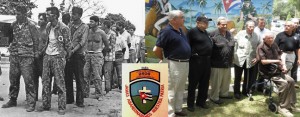
Forgotten Combatants / Miguel Iturria Savón

They are beginning to fade, the echoes of the insane propaganda about the challenge among the exiles who landed at the Bay of Pigs, April 17, 1961, and the policemen and militiamen who counterattacked in the name of the Revolutionary government, unaware that Castro’s interwoven dictatorship backed by the Soviet Union, whose tanks and machine guns influenced the defeat of Brigade 2506, which marks a before and after in the ruin of the nation.
Neither the bulky official bibliography nor the few testimonies of the defeated shake the boredom of most Cubans, hence the need to revisit the issue from the perspective of the losers, those heroes who demonized like the Mambises of the nineteenth century and the enemies of Machado or Batista, looking for help from the U.S. authorities to defeat Castro, who in the days previous executed dozens of opponents and imprisoned thousands of potential conspirators.

Brigade 2506 was the armed wing of the exile groups, led then by José Miró Cardona, former Prime Minister the Government of Cuba in 1959. It included 1,500 men trained in camps in Central America, Puerto Rico, Louisiana and Florida.

The small army controlled the road to San Blas and moved many miles in three days of unequal combat, as Castro mobilized more than 40,000 well-armed troops. The mission was to establish a “beachhead” 40 miles wide on the eastern shore of Bay of Pigs, from Playa Larga in the north to the Playa Girón in central and Caleta Verde to the south. If they managed that strip of land they would institute a provisional government there, which would request international assistance.

The lack of ammunition and other supplies before the regime’s aerial counteroffensive and the intervention the artillery and Soviet tanks, marked the denouement in favor of the dictatorship. The brigade lost 69 men in combat, 10 were shot, 9 were suffocated while being moved to Havana, 10 died on the boat back and 1,174 were captured and tried in April 1962. The Castro government reported 1,250 dead and 3,000 injured.

Despite being sentenced to death in a public and televised trial, the sentence was changed to 30 years of forced labor or the payment of compensation amounting to almost 53 million dollars at a rate of 500,000 for Jose Perez San Roman, Chief of Brigade 2506 and each of its two commanders, and from 50 thousand to 20 thousand for each fighter. With the exception of 9 who remained behind bars until 1986, the rest were released in December 1962 when the Committee of Families created in exile deposited the ransom in the accounts of government, raised by private donations.

The Bay of Pigs action is the most significant event in the civil war that broke out in Cuba during the establishment of totalitarianism, whose dictatorship we still suffer. Guerrilla warfare in the mountains of Escambray, the Oriente and Pinar del Rio, plus the missile crisis in October 1962, are events of the the same national conflict that involved third parties in favor of the Democrats or the Communists.

Two decades later, the propaganda machine continued to demonize those defeated fighters, while exalting the handful of leaders who were victorious, as if they were not responsible for the island’s socio-economic disaster.

Among the expeditionaries of that spring who confronted the dictatorship that flourished in our nation, beyond these days from Florida, are the names of Ernelio Oliva, second commander, Captain Luis Morse, Eduardo Zayas Bazán, Mario Martínez Malo, Santiago Jont, Esteban Bovo, Julio González Rebull, John E. Pou, Arturo Cobo, Cesar Eli, John Clark and others who deserve the honor of the nation when freedom is no longer a dream.

April 26 2011

Today As It Was Yesterday / Miguel Iturria Savón

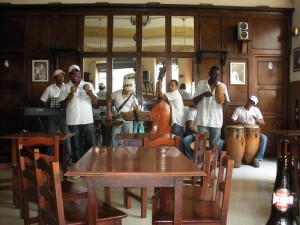
They say that Benny Moré, before becoming “the barbarian of rhythm of Cuban music,” passed the hat in the bars of the Avenida del Puerto in Havana, where he sang with his guitar for a plate of food and three rums. In one of those bars he discovered the famous Miguel Matamoros, who needed another voice that alternated with his own. The rest is history: Benny displayed his talent in Mexico, New York and then in the recording studios and nightclubs in Cuba.
History repeats itself on our island and in the countries n the continent. At the end of the nineties Polo Montanes rose to fame, the natural Guajiro from Pinar del Rio, discovered by a foreign producer at a recreation center in the province. Polo triumphed in Colombia before being released in Havana.

Decades after the “Barbarian of Rhythm” passed the hat, talented musicians depend on the currencies of the tourists who go to bars, restaurants and hotels along the Avenida del Puerto, Prado, Obispo and other streets of Havana, where they surprise by offering sones and guarachas for diners.

Tourists are not as lavish but the menus are expensive and they assume that they include the creole rhythms, jazz and the universal songs played with local flavor by small groups. Maybe that’s why they don’t understand why one of the musicians passes the hat and tries to sell an album at the end of each set.

If you conversed with the artists you would know that despite their professional level and after playing ten or twelve hours a day, they take home only what is collected with the hat or the gourd, because their salary in local currency is shameful.

The income earned by singers and instrumentalists is the equivalent to 160 CUC per month for the group. Of that number, 50% goes to the company that represents them, 10% to the tax office (ONAT), and the rest is divided between them, almost eight dollars a month.

The musicians are paid for four to eight days a month, although they perform 15 to 30. This also includes procuring the instruments, sound, transportation, promotion and managing the day or night contracts, including the Salon Rosado de the Tropical and music houses of Havana, Varadero and Santiago de Cuba, where the administration gives priority to the highest-rated bands, though they do not represent the most authentic Cuban music.

To make matters worse, they must have an affiliation with a company of the ministries of Culture and Tourism, and respect for the rules of the corps of inspectors who seize instruments, impose fines or close down their contracts if they see them selling discs or other irregularities, though they encourage bribery to compensate for their own salaries.

The rules of the businesses contribute to dozens of vocal and instrumental groups being deactivated every month, required to perform 19 activities a month when artistic demand is decreasing and for lack of budget they’re closing the venues. This excess has been criticized by the likes of Adalberto Alvarez, Juan Formell, Lourdes Torres and Tony Pinelly, who told a radio station of the capital that “if companies flew through the air they couldn’t pay for the damage they do to the artists.”

The musicians have to pay for their own CDs and compete with the emerging reggaeton artists and figured benefited by television and on state labels, which opens the doors of agencies that pay better and offer their shows in hard currency, inspired by foreign rhythms and patrons.

While the musicians survive by passing the hat, some authors with access to the mass media censor “the imitation of foreign” and seek “to promote Cuban music without ignoring the universal.” Rafael Lay, director of the Aragon orchestra, told the newspaper Juventud Rebelde that he was surprised to know that the brass band of the twentieth century is not “appropriate to perform in the music venues,” whose programmers prefer reggaeton.

A former singer of the group warns that the problem is worse in the provinces: “From Havana it’s impossible to know the talent that is lost in the interior, which influences the exodus of groups and principals to the capital which then becomes a bridge to overseas.”

Some think that passing the hat is demeaning and that “we are paralyzed in time,” that it’s enough to travel to Mexico, the United States or Spain to look at to other figures and see how the mechanisms of promotion work, less bureaucratic than in Cuba, where voices such as Lourdes Torres and Leo Vera work in cabarets and have no CDs out.

Everything seems to indicate that, “Today is like yesterday,” the silenced soneros have to wait for someone to discover them in the bars and promote them abroad, to be recognized on the island, as happened with the aging members of the Buena Vista Social Club.

April 12 2011

Pines / Fernando Dámaso

One day in April, no matter the year, the pines of the fence began to bleed. All of us, seekers of nests, looked puzzled and, children at the end, we went to the grownups to explain this phenomenon to us.

Avelino, the winemaker, Galician, sweet-natured and generous, he said that the same thing happened in Spain, it was the blood of Christ, soon to be crucified, which ran from his brow crowned with thorns.

Juan, who was renting bicycles, a frustrated engineer and foul-mouthed, explained that the pine dripped red when the wind came from the south, when women and hens were brooding.

Rosalba, of the rose garden, beautiful even in her old age, told us that the pine was very sensitive and, every so often, the pain produced by the barbed fences made it bleed.

With all these explanations in mind, we all went back to the pines and spent the afternoon watching them bleed. When it started to get dark, we returned to our homes a little sad. Along the way I was thinking: how wonderful that the pines are bleeding, which can make the adults know so many interesting things! Back in the house, I did not ask my mother and when she came to put me to sleep I realized that the pints were crying blood because we only notice them once a year.

April 17 2011

“Fight for your food, Taino.“ / Fernando Dámaso

Given the changes planned to be introduced into our economic model, designed and planned by the government, some citizens, according to our intellectual and material abilities, without anyone ordering us to or paying us for it, have taken on the task to comment on the aspects that we consider positive and negative. It is simply, exercising our own discretion, something that, at least in official speeches, they said we should practice.

Despite all this, it seems that some of the journalists who have opinion columns (always official) in the national press (also official), have targeted attacks against those who offer opinions and who do not repeat, at the foot of the letter, the official propagandized opinion sanctified in the guidelines. They also seem to have received a methodology (eternal mania of our bureaucrats to regulate everything) about how to do it, because they all use the same scheme. First they denigrate the author of the opinions, heaping on the insults and linking him to the enemy (it can’t miss), noting that he’s repeating the enemy’s views. After the reporter (you should call it the press officer) makes a statement, he proclaims himself a defender of socialist ideas and disqualifies those who do not share these ideas or simply criticize them. Then he develops the core of his article, one by one by repeating the official views on the various issues discussed, crushing more of the same, with a minimum lack of originality.

I understand that these journalists, who receive their salaries from the government, are worried about the possibility of being unemployed and joining the list of those “available” (remember that the word “unemployed” only applies to capitalism, to socialism never) and therefore they try valiantly to score points so they may stay. The defense is allowed. As a troubadour says in one of his best known songs: Fight for your food, Taino, fight your food. However, this does not authorize them to be so primitive in their approach or as unethical: ideas are defended with arguments, not insults. They seem to forget that they are targeting citizens who, according to the government itself, are highly educated.

If you really want to know the opinion of others and to value them when making decisions, the attitude of the journalists from the national press is counterproductive. To continue to repeat questionable assumptions, trying to offer them again with a light varnish to make them shine, is to continue losing time, of which we continually have less and less. We can argue in a fair fight, respecting each other and also respecting the opinion of each one, even if not shared. What if we don’t agree? That’s better. Conformity and unanimity have never brought us good results. The current crisis is a prime example.

I think adding different opinions and not prohibiting them, is the only way to find solutions and to find a possible path through everything, without exclusions of any kind. The important thing is to join efforts to save the nation, placing it in the path of progress and that Cubans, together again, are able to discard forever the hatreds and animosities, which have artificially divided us for too many years.

February 13 2011

The Agrarian Problem / Dimas Castellanos

17-de-mayo1

In the struggle for land ownership and against eviction in Cuba, many farmers and farm workers lost their lives. Among them is Niceto Perez, who was killed May 17, 1946. In tribute to him and the rest of the martyrs of the field that day, the Law of Agrarian Reform was promulgated in 1959 and the National Association of Small Farmers (ANAP) founded in 1961. A brief look back to such a vital issue in our history can form an idea about the achievements and what we are still waiting for in this area.

The diversification of agricultural property in the sixteenth century began with the delivery of circular farms for raising livestock to Spanish settlers in Cuba. Later, in the spaces between haciendas–unowned land–other farmers were allowed to farm, but the royal decree issued in 1819 to identify the rightful owners did not recognize the latter. For this reason about 10 thousand families were robbed of the land they worked. Subsequently many farmers were displaced by the advance of the sugar industry, with orders No. 34 and 62 issued in 1902 by the government auditor, by which the railroad companies and U.S. investors could acquire land. From this process emerged the modern estates with over half of the country’s land in the hands of national and foreign companies.

The discontent of the peasants had begun in 1717, the year that about 500 armed planters staged a protest against the tobacco monopoly which set the price and quantity and prohibited the sale of the surplus, similar to the current Empresa de Acopio. Those protests were repeated until 1723, when the growers of Santiago de las Vegas were hanged; later farmers were involved in the independence struggles of the nineteenth century. They developed, in parallel, associations to defend their interests. In 1890 they founded the Association of Settlers in the areas of Manzanillo and Bayamo, and in 1913 the Farmers’ Association of the Island of Cuba. Beginning in 1930 they began a broad struggle against eviction and for better markets, prices, credits and rent rebates.

Under the guidance of the Communist Party in October 1937, the First National Farmer’s Congress was held and they created committees, unions and peasant associations in the six provinces, some of whose demands were endorsed in the 1940 Constitution. The Second National Peasant Congress in 1941 created the National Peasant Association (NCA), and likewise, but under the direction of the Authentic Party, was founded the Peasant Confederation of Cuba (CCC). During the government of Fulgencio Batista, between 1940 and 1944, families settled on lands abandoned by the state and landowners. One such case took place in the hacienda Uvita, Sierra Maestra, with over thirty-three thousand acres. However, each settled family was only given “five hens and a rooster, a plow, a machete and a few dollars,” similar to the current distribution of land in usufruct by Decree-Law 259. Despite these efforts, in 1944 54% of the land was concentrated in large estates, while many peasants continued to live in poverty.

In his brief “History Will Absolve Me,” Dr. Fidel Castro proposed to grant land to all tenant farmers, subtenants, sharecroppers and squatters who occupied plots of up to 165 acres. Accordingly, the October 10, 1958, the Commander of the Rebel Army, Law 3, arranged to transfer land ownership to the occupying lots of less than 165 acres and on 17 May 1959 he signed the Agrarian Reform Act, which limited large estates to just under 1,000 acres and gave titles to a hundred thousand families, who could get 66 acres without payment and purchase additional lots to complete 165 acres. With this Act, the State concentrated in its hands, 40.2% of the country’s arable land.

The Second Law, issued on October 3, 1963, lowered the maximum of 165 acres with 100,000 other properties turned over to the State, increasing its properties up to 70% of arable land, accounting for volume higher than all prior estates. Then in the ‘70’s, with the intent to further reduce private property, they insisted on the socialization of farms that had been in private hands. As a result of this effort, the number of Agricultural Production Cooperatives increased from 136 in 1977 to 1,369 in 1986, 64% of private lands, a process in which the ANAP had to intervene directly in order to convince farmers to join their farms and work together collectively. Currently non-state land is about a quarter of the arable land, with more than half in tobacco, corn, beans, cocoa, coffee and vegetables that are grown in Cuba.

Army General Raul Castro, in his speech on July 26, 2007 in Camaguey, explained the need to produce in Cuba–where surplus land and rainfall of the last two years had been generous–the food the State was buying abroad at high prices. That is, he took up the unresolved issue of the inefficiency of state agriculture, of which sugar is a paradigmatic case, since the island had emerged from the eighteenth century as the world’s largest sugar producer. However, two centuries later, when the entire industry and agriculture are almost all in state hands, it has fallen from 8.5 million tons produced in 1970 to 1.2 million in the 2010-2011 harvest. A result similar to the early years of last century and without any correspondence to the thousands of professionals, academia and research, machinery, irrigation systems and technology now existing.

In the Guidelines of the Economic and Social Policy of the Party and the Revolution, adopted recently, it was confirmed: that the socialist planning system will remain the principal means to address the economy, the socialist state enterprise is the main form, and encouraging the participation of foreign capital will continue. However, it turns out that the system of socialist planning, the state-owned monopoly and granting rights to foreign businessmen that are refused to Cubans, are among the main causes of the current crisis. Three aspects sufficient to lead to new failures.

For the foregoing reasons, the Cuban Government should amend Decree-Law 259 to transfer ownership to the peasants of the land which the State is unable to make productive, and increase the limit from 100 to 165 acres, consistent with the farmers’ struggles and in memory of Niceto Perez, and of the previous laws and the needs of the country.

(Published in el Diario de Cuba (www.ddcuba.com) 17 May 2011)

May 20 2011

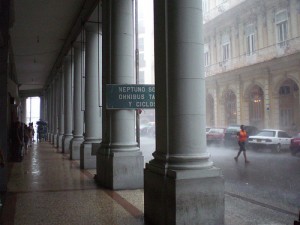
Rain Has Arrived in Havana / Iván García

Photo: Josh Michtom, Flickr

The habaneros were screaming for it. After 9 months of a fierce drought, where water-laden clouds kept moving around the city, and the dams and reservoirs had gone to code red, the rain appeared.

Now, when the month of May leaves us, the longed-for spring showers made themselves present. Children and teens in shorts, barefoot and shirtless enjoyed the first serious rain of the season

Some adults also joined the party. And worried. Water reserves in Havana reach only 18%. And added to that, more than 60% is lost every night because of leaks in the whole capital. The alarming shortage made the water authorities give a new turn of the screw in the distribution of the precious liquid in the capital.

In most neighborhoods of Havana, on alternate days, usually after 8 pm at night, potable water is distributed to the population. In the old part of town there are places where running water has never reached the tap.

There are houses with pipes thick with magnesium and garbage. Nemesio, a resident of Laguna Street in the marginal and largely black suburb of San Leopoldo, has forgotten the last time he took a shower.

In these places, the birthplace of prostitutes and swindlers, the “pipers”, as they call those who handle the “pipes” or tank trucks, often make a lot of money. A family in a three-story tenement, with some resemblance to a U.S. prison from the mid-20th century, pays up to $20 for the “piper” to fill their water tanks.

In these parts, water has its price. Types who came from the east of the country who live underground in Havana, charge 4 dollars to fill up a 55-gallon tank. And believe me, there’s enough work. With the first rains of May, people breathed a sigh of relief.

“We now need it to rain every day for two months, in order to take the bad away,” says a santera. Like her, there are many people afraid of the vagaries of time. The news from the north and south is frightening. Murderous tornadoes in the U.S. and endless rain in South America. As if to show that the world is upside down.

In Arroyo Arenas, municipality of La Lisa, west of the capital, there was an intense local storm, which dropped hail the size of lemons. The rains of May also brought thunderous lightning, and because of deficiencies in drains and sewers, the streets were flooded.

But that’s not important. Habaneros were clamoring for rain, so the dams and the water table are overflowing. We’ll see if these showers alleviate the African heat.

The showers of May have returned a smile to residents and authorities. Let the water continue. Let Havana become Macondo.*

Translator’s note: Macondo is a fictional town created by Gabriel Garcia Marquez. It suffered a four-year rainfall.

Translated by Regina Anavy

May 28 2011

Investors’ Incentives… Cuban Style / Ernesto Morales Licea

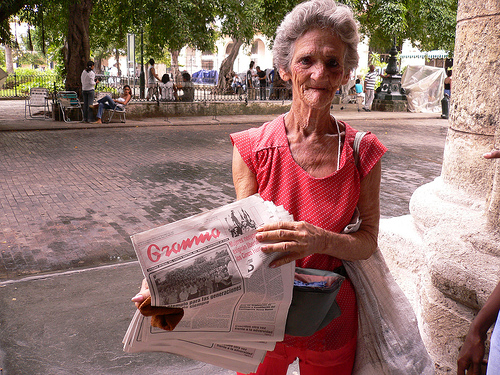
Vendedora de periódicos en Cuba
Newspaper vendor in Cuba

My mother just closed the business that fed the better part of my family in Cuba over the last decade. The reason: the country’s new plan of economic recovery.

A little over ten years ago, someone who shares my blood and who had an immense business vision, became a pioneer in a particular business: Renting to foreigners. She started in 2000, in the tiny provincial town where we live, accompanied by barely a couple of reckless people, in the new enterprise of allocating part of her house to accommodate tourists.

Born at that time, striving, beset by doubts, was what then would be the most “ambitious” of the private businesses in socialist Cuba: renting in foreign currency.

Timid reforms at first, then significant investments, an ever-growing number of Cuba households deforming their square feet to cram their members in like contortionists, and reserving one or two rooms for the gentlemen with pink cheeks to spend their nights in.

In the beginning the State was cautious. It allowed economic activity reluctantly, like one accepts the inevitable: like it accepted the circulation of the dollar only to veto it later. But it allowed it.

In order to be an altruistic benefactor? Out of a desire to elevate the standard of living of its citizens? Not so much.

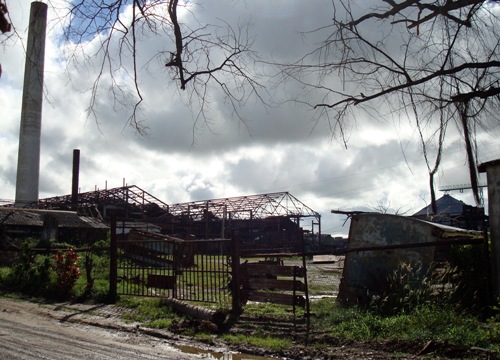
If they turned a blind eye at first, if they legalized the activity after the fact, it was for reasons of elementary logic: the sugar industry had been demolished and tourism emerged as the savior of the Cuban economy. But where to host the growing number of the curious who looked to the island, the pry into the Jurassic relic of a Bolshevik state in the 21st Century? In what hotels? In what infrastructure?

The inventive salvation of the starving was the solution: if they want to rent their homes, fine, let them do it. Earning a few pesos in hard currency. Sleeping with less space. And let them deliver a big chunk of gold later.

The initial amount of monthly taxes seemed disproportionate to landlords: $ 100 per active room. They were unaware that even that number would grow over time to much, much more.

House for rent in Cuba, with its official and obligatory logo

Because the always well-informed inspectors from Housing–the governing body of the activity–responsible for keeping a vigil over their martyrdom, because the iron rules in these home-businesses would be met, learned something unexpected: the homeowners were preparing breakfasts, cooking Creole dinners for their guests, and pocketing five, seven, ten dollars more than usual.

After a lot of meetings and deliberations, the Olympian bureaucracy spoke: Whoever chooses to offer food must officially declare it. And pay for it 30 CUC a month more into the treasury. (The era of convertible pesos, those funny little notes in color, had been born).

Nobody in their right mind declared it. With the abusive and monthly sum of 100 CUC per room, whether or not they had any customers, whether or not they had any income, no one wanted to pay one cent more. In the interiors of their houses, with the shutters closed, with the caution of the criminal, enterprising Cubans were preparing orange juice, tortillas with cheese, toast; they cooked their lamb stew and their fried plantains.

Measure, countermeasure and response: a short time elapsed until the new decree: whether or not they offered food, all homeowners renting rooms would pay 130 CUC monthly per room to the state. And problem solved.

Thus passed a few years. Some furnished and air-conditioned two rooms knowing they had to take in 260 CUC just to maintain their license, and many times it was the work of faith and charity. In boom months, especially at the ends of the year when tourists from half the world take refuge from the snow on a tropical island, the profits could allow them to pay that sum and enjoy some income. And above all: to save money for the coming months when not a single “Charlie” would knock at the door.

But, again, the map of the country moved. The naive joy of some music served to celebrate the decision: the General-cum-President, with power firmly in his own hands, discovered that the country couldn’t take it any more — with the same clairvoyance that he’d discovered a year earlier that the marabou weed had taken over Cuba’s farmland — and that he had to reform the national economy.

Meetings and discussions, proposals and refusals, Granma newspaper articles and entertaining Roundtable TV shows, speeches, briefs, reports and memos: with the parsimony of the big decisions, one fine day they informed expectant Cubans that the economy finally would shake off the rust. Finally private activities would not be stigmatized, banned or reluctantly tolerated.

Economic revitalization–Cuba and its eternal euphemisms!– was on the march.

I remember a suspicious first incident that I heard about by chance: next to me, a country barber was telling his interlocutor that very soon he would be handing in the license for his “business.” Cutting hair in the remote community of Mabay–where a tarnished plaque recalls that the first soviet in America was built there–had become unviable since he had to pay a tax of 200 pesos a month.

Before me was the first victim of the experiment: the economic revitalization, which would put the State barber shops into private hands, had just raised, astronomically, the cost of the license for a barber who could, at most, charge two or three pesos for each haircut.

And like a raging avalanche, before which taxi drivers are swept away, before which exhausted workers lose their jobs, the Cuban State implemented its economic recovery with notable efforts: raising the taxes on every economic activity by which Cubans maintained their poverty level standard of living. And the worst of the worst: imposing taxes on activities that had always been exercised without paying any taxes on them.

Neither the palm tree toppers, nor the scissor sharpeners, nor the grass cutters, would be exempt from the joyous revival.

So my mother, with the pain of closing something of a tradition; with a vague nostalgia for the days when a family member who is no longer with us founded his small but successful business, just turned in the authorization to be allowed to rent two rooms to regular customers after a decade in business.

When the impossible and shameless figure of 200 convertible pesos per room reached the ears of the shorn landlords, they thought it was a joke in bad taste. Later they understood.

The think tanks did not assume that the time had come to alleviate the hardship and deprivation of its citizens. The government measures to encourage investment, were the horrifying mechanisms implemented by an abusive State to more effectively empty the pockets of its squalid servants.

May 19 2011