High-end cars will pay a 35% tax, standard combustion cars 25%, while hybrids will be charged 15% and electric vehicles 5%
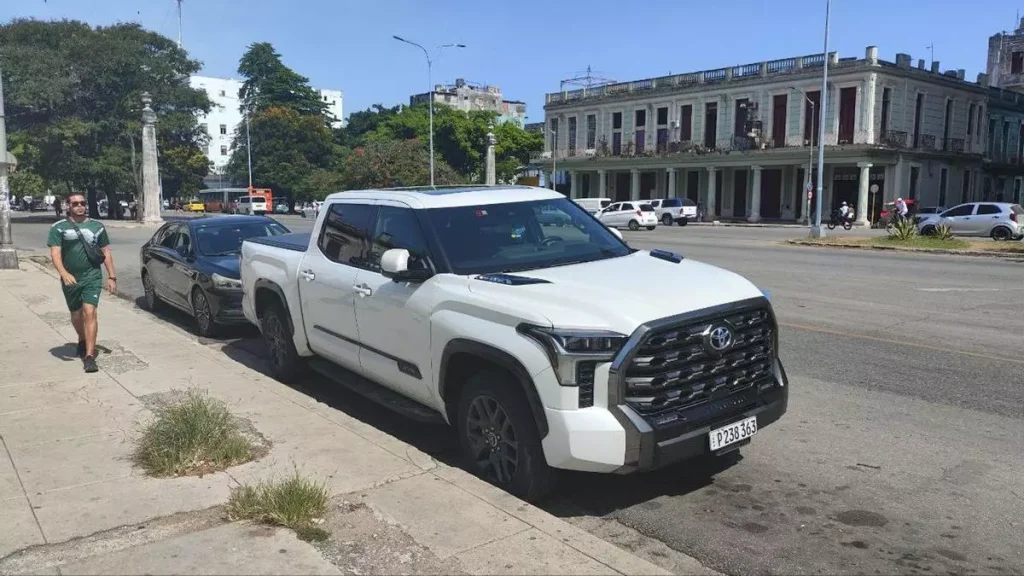
 14ymedio, Madrid, August 5, 2026 / Private individuals will be able to manufacture or assemble vehicles under the new regulations for the sector, published this Tuesday in the Official Gazette and explained to the official press by the minister in charge, Eduardo Rodríguez Dávila. The package includes two sets of rules – with several decrees and resolutions – that ease the import and sale of these products, establish tax exemptions for those that run on renewable energy, and regulate transfers of ownership with the aim of renewing Cuba’s aging vehicle fleet and promoting the energy transition.
Despite the many liberalizations, there is one restriction to keep in mind: non-resident foreigners will not be able to buy vehicles in Cuba. Those who hold temporary, real-estate-based, or humanitarian residency will be able to do so, as will private, state, and foreign companies.
Although it is possible to own as many vehicles as one wishes, there will be temporary limits on acquisition through import. In the case of electric cars, only one is allowed per lifetime, while for electric motorcycles or mopeds the limit is two as unaccompanied baggage and one if sent as a shipment. For combustion or hybrid motorcycles and tricycles, the cap is one every five years, and for light trailers, one unit per trip or shipment.
For combustion or hybrid motorcycles and tricycles, the cap is one every five years, and for light trailers, one unit per trip or shipment
Another change applies to those posted abroad. Doctors, diplomats, aid workers, and other state employees who must spend more than two years outside the island may buy a vehicle of any type, with up to eight seats, one time only.
Another new feature concerns the transfer or sale of vehicles between private individuals, including transactions from individuals to private companies or vice versa. These transactions are permitted but must be properly formalized, which includes registration before a notary and payment through the bank – in any authorized form – in either foreign or national currency. Cash is completely excluded as a method of payment, in a country that largely continues to operate outside the banking system.
Among the notable points in this section is the creation of a legal avenue for acquiring the vehicle of an emigrant who had not completed the transfer of ownership on the island. Until now, the cars of people who left the country were left at the mercy of the State, which could confiscate them if the owner had not formally transferred them beforehand. Now, a special provision opens a path for family members or other interested parties to regularize the situation through a proxy or, in the event of death, in accordance with inheritance law.
On the tax side, there are also new provisions to encourage vehicles that do not require diesel, in addition to a full tariff exemption for electric cars. Luxury or high-end automobiles (both combustion and hybrid) will carry the highest import rate, at 35% of the sale price, followed by standard combustion vehicles (cars, pickup trucks) at 25% and heavy combustion or two-wheeled vehicles at 20%. By contrast, the lowest taxes are reserved for the more sustainable options: 15% for hybrids, 5% for imported electric vehicles, and 3% for electric vehicles assembled locally on the island.
Another extensive section covers public transportation. To facilitate the import of vehicles intended for mass transit, a 12% rate applies to combustion buses and minibuses – compared with the 35% or 25% for cars – which drops, if assembled in Cuba, to 7% or 5% for hybrids and electric vehicles.
According to the official press, in the first half of 2026, 35,494 motor vehicles were sold on the island, 65% of which were combustion-powered
Additionally, the minister noted that the Public Transportation Development Fund remains in place, funded by special taxes on vehicle sales, through which several major acquisitions have been made to date. These include 15 electric hearses for Havana, a catamaran for Isla de la Juventud, 300 electric tricycles for passengers and health care workers, 110 minibuses for bus routes, 20 buses for the National Bus Company (Empresa de Ómnibus Nacionales), and ten for Vía Azul, as well as electric vehicles for transporting hemodialysis patients, bicycles, trucks, and others.
According to the official press, in the first half of 2026, 35,494 motor vehicles were sold on the island, 65% of which were combustion-powered, 5% hybrid, and 30% electric. Moreover, 70% of them were mopeds, motorcycles, and tricycles, making clear the predominance of this type of vehicle.
As for imports, data from the U.S.-Cuba Trade and Economic Council show that the value of sales from the U.S. rose to more than 148 million dollars through May. Now, according to figures from Minister Rodríguez Dávila, it is known that 41,963 motor vehicles have been brought to the island – without specifying from where, although it can be assumed that most came from the neighboring country and from China – as unaccompanied baggage or shipments, of which 19,443 are electric mopeds and motorcycles and 22,520 are the same but combustion-powered.
Translated by GH.
______________________
COLLABORATE WITH OUR WORK: The 14ymedio team is committed to practicing serious journalism that reflects Cuba’s reality in all its depth. Thank you for joining us on this long journey. We invite you to continue supporting us by becoming a member of 14ymedio now. Together we can continue transforming journalism in Cuba.