Óscar Pérez-Oliva accuses the U.S. of maneuvering to displace foreign companies established on the Island and impose its own.
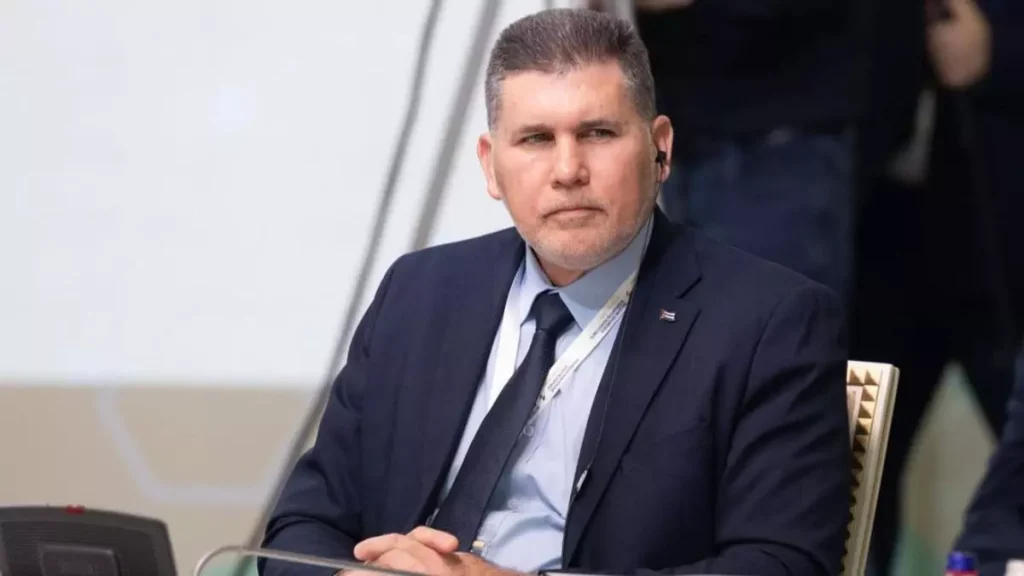
 14ymedio, Madrid, September 29, 2026 – Cuban Vice Prime Minister Óscar Pérez-Oliva Fraga denied in an interview with Reuters published Tuesday that businesspeople linked to U.S. President Donald Trump had met with Cuban officials this year seeking business opportunities on the Island.
“I am not aware of any company directly linked to President Trump having contacted Cuba,” said the vice prime minister, who is also Minister of Foreign Trade and Fidel Castro’s great-nephew. He emphasized that neither he nor any other Cuban official had met with representatives of companies connected to the U.S. president.
However, he insisted that they are open to negotiations with U.S. investors: “It is not our policy to prohibit U.S. companies from investing in Cuba, trading with Cuba or doing any kind of business with Cuba,” Pérez-Oliva maintained. “What prevents this possibility is the existence of the trade embargo.”
As the British news agency recalls, businesspeople linked to Trump have been associated with possible business opportunities in Cuba for years. Reuters specifically mentions meetings held in 2016 by people in the now-U.S. president’s circle that caused a stir at the time because of the possibility that they were violating embargo laws.
“It is not our policy to prohibit U.S. companies from investing in Cuba, trading with Cuba or doing any kind of business with Cuba”
The Guardian reported two weeks ago that several Trump Organization executives had traveled to Cuba in recent months and held meetings with Raúl Guillermo Rodríguez Castro, the grandson of Raúl Castro, known as El Cangrejo [The Crab] to “explore opportunities” amid the departure of Spanish hotel companies.
The British newspaper questioned the maneuvering by the U.S. president’s circle, seeking control of Cuban assets by taking advantage of the vacuum left by the withdrawal of major international companies, such as Spain’s Meliá and Iberostar and Canada’s Sherritt, which operated on the Island after being threatened with sanctions by the U.S. Government itself.
A similar idea was outlined by Pérez-Oliva on Tuesday in the interview: “On the one hand, international companies – Cuba’s traditional partners around the world – are being threatened and pressured to halt their economic and commercial relations with our country,” he said. “On the other, efforts are being made to promote the activities of U.S. companies.”
The minister was referring to the State Department policy that allows U.S. companies to export fuel to Cuba’s private sector, which he described as an attempt to return Cuba to a dependence on the U.S. reminiscent of the colonial era. “[That policy] is aimed at forcing Cuba’s economic dependence,” Pérez-Oliva said, and he insisted: “We will never again be a colony of any country.”
“In light of these sanctions, these companies are evaluating alternatives to determine how to continue their operations”
Those exports are conditioned on their being received by private small and medium-sized enterprises, although, as 14ymedio has documented, the State sector has managed to enter the business. The U.S. has become Havana’s main supplier, ahead of Spain and China, historic commercial partners of the Island.
Pérez-Oliva also told Reuters that the stalled dialogue between Washington and Havana has left international investors in a situation of uncertainty. The minister recalled the situation of Canadian mining company Sherritt International, which suspended its participation in the joint venture it maintained with the Cuban Government in May.
In recent months, U.S. businesspeople have shown interest in taking control of Sherritt. The eventual entry of U.S. capital would allow the company to obtain authorization from the Office of Foreign Assets Control (OFAC) to continue its operations in Cuba. One of the most lucrative offers comes from Texan Ray Washburne, a former Trump Administration official.
The Australian company Antilles Gold, which owns a copper and gold mine in Cuba, also suspended its participation in the operations of the joint venture with the Cuban state-owned company GeoMinera, after the U.S. State Department sanctioned the project.
“Neither Antilles Gold nor Sherritt has withdrawn,” Pérez-Oliva maintained. “In light of these sanctions, these companies are evaluating alternatives to determine how to continue their operations.”
Washington, for its part, maintains that these measures do not go far enough and has called for political changes with “free and fair” elections
Like Sherritt, Antilles Gold has proposed changes to the structure of the joint venture to the State Department that would allow U.S. entities to assume more than 50% control and, as a result, seek the lifting of the sanctions or an OFAC license to operate in Cuba.
Pérez-Oliva highlighted the economic reforms being implemented by his government and accused the U.S. of obstructing that process. Washington, for its part, maintains that these measures do not go far enough and has called for political changes with “free and fair” elections.
In response to a question from Reuters, the vice prime minister rejected rumors that he was being prepared as Cuba’s next president: “I have no aspirations in that regard,” Pérez-Oliva said. “I am simply a public servant and I will work wherever I am needed, without aspiring to any particular position.”
Translated by Regina Anavy
______________________
COLLABORATE WITH OUR WORK: The 14ymedio team is committed to practicing serious journalism that reflects Cuba’s reality in all its depth. Thank you for joining us on this long journey. We invite you to continue supporting us by becoming a member of 14ymedio now. Together we can continue transforming journalism in Cuba.