The Minister of Education admits that only 73% of teaching positions are filled and that uniforms “will not be available for all students.”
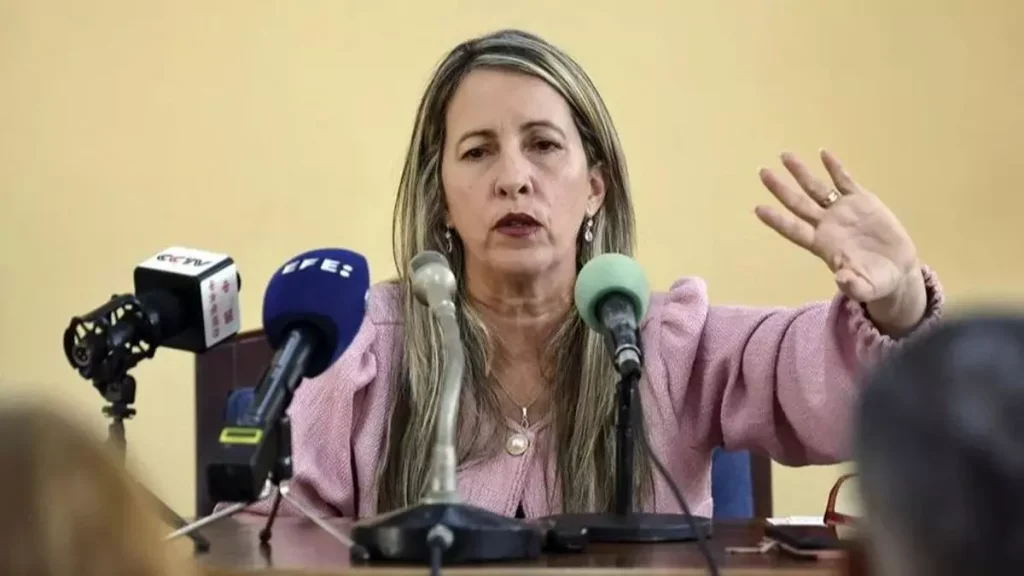
 14ymedio, Havana, August 28, 2026 / Despite the fact that many mothers doubt if it is practical to send their children to school, and despite the country experiencing its worst economic crisis since 1959, authorities continue to promote the resumption of the school year on September 1st. Unlike the triumphalist tone of recent days, however, this time the government openly acknowledges the difficulties. The main ones: a shortage of teachers, a lack of uniforms, and the impossibility of guaranteeing in-person classes due to the crisis.
This Thursday, Cuban Education Minister Naima Trujillo Barreto announced during a press conference that the new enrollment will serve approximately 1,400,000 children and adolescents across all levels of education. President Miguel Díaz-Canel deemed it appropriate to increase this figure to “more than 1,500,000” to use the return to classrooms as an argument against those who speak of a “collapse” in Cuba.
The president’s enthusiasm contrasts sharply with the figures acknowledged by the Minister of Education. “Currently, Cuba has 73% total coverage with trained staff,” admitted Trujillo Barreto. “The most complex situation” in this regard is in Havana, the official said, where “around 3,000 teachers are arriving from the eastern part of the country” to support schools.
To confront this deficit officials indicated that Resolution 10 will be applied, allowing compensation for the additional teaching load assumed by teachers, but they did not specify the compensation systems. Faculty will also be adjusted, and university students and professionals from other sectors who are not currently teaching will be incorporated into the teaching staff.
“Without electricity, no workshop can function; without fuel, we cannot transport the fabric from one place to another in the country; without money and without the possibility of importing, fabrics cannot enter either.”
Another major problem centers on the production of school uniforms. The industry reached August with a production level of around 12% for primary schools and slightly higher for secondary schools. “School uniforms will not be available for all students on the first day of classes,” the minister admitted. “Without electricity, no workshop can operate; without fuel, we can’t transport fabric from one part of the country to another; without money and without import options, fabric isn’t coming in either,” the minister explained.
A resident of Luyanó confirmed to 14ymedio that ninth and tenth grade students have been authorized to go to classes in “street clothes”: long pants and a white, blue or red sweater.
Students will be allowed to wear their bandanas—in the case of primary school—even if they don’t have the uniform, the minister confirmed. Schools must be flexible and cannot impose specific color combinations or clothing on those who don’t have the required garments. According to Trujillo, in some areas, additional days have been set aside for sewing the garments, and some students have resorted to making them at home.
For students in the general education system, younger than those in higher education, in-person learning will be prioritized, Trujillo explained. However, “current conditions require us to organize the process differently.” The minister stated that there will be “interruptions at certain times, intensive remedial periods, and closures” within each of the three periods that make up the school year.
“There are centers with resources for 15 days, others for 20, and others where supplies are still being transferred.”
The organization will take into account the characteristics of each community. Some institutions will be able to maintain double sessions every day, while others will do so only on certain days of the week. In other cases, it will be necessary to modify start times or the frequency with which students remain at the centers.
Transportation constitutes one of the main factors that will determine how each institution will function, because there are students and teachers who have to travel long distances to get to their centers.
Food is another preoccupation. The minister assured that basic conditions are guaranteed in the semi-residential and residential institutions that will begin operations, although coverage varies depending on the region. “Some centers have resources for 15 days, others for 20, and others where supplies are still being delivered.”
According to a testimony from the local government of Luyanó, water trucks are not being distributed to residents who have been without service for days and who have been demanding it because “the distribution of water in tanker trucks for schools is being prioritized to guarantee the restart of the school year.”
The minister indicated that in-person classes will not return to what they were before the “difficulties that began to worsen in February of this year.”
Similarly, to address these needs, the authorities are relying on the private sector. As Trujillo Barreto explained, “those who previously supported certain processes on a case-by-case basis will now assume commitments established through contractual relationships.”
The previous school year ended early in June, and several grade levels had to adopt a hybrid learning model due to the energy crisis. Regarding UNESCO’s warnings that education on the island “is at risk due to the energy crisis,” the Cuban minister responded that this generation “will not be at risk of not receiving an education” and that they will strive to provide “the best possible conditions.”
The official acknowledged that between 17,000 and 23,000 students had to remain “more distant” from their schools during the last academic year. For this year, the Ministry claims to have developed a plan for approximately 17,000 students. However, the minister indicated that in-person learning will not return to pre-pandemic levels due to the “difficulties that began to worsen in February of this year.”
______________________
COLLABORATE WITH OUR WORK: The 14ymedio team is committed to practicing serious journalism that reflects Cuba’s reality in all its depth. Thank you for joining us on this long journey. We invite you to continue supporting us by becoming a member of 14ymedio now. Together we can continue transforming journalism in Cuba.