A purple marker transforms an optimistic slogan into the epitaph of a city that has lost a large part of its young people.
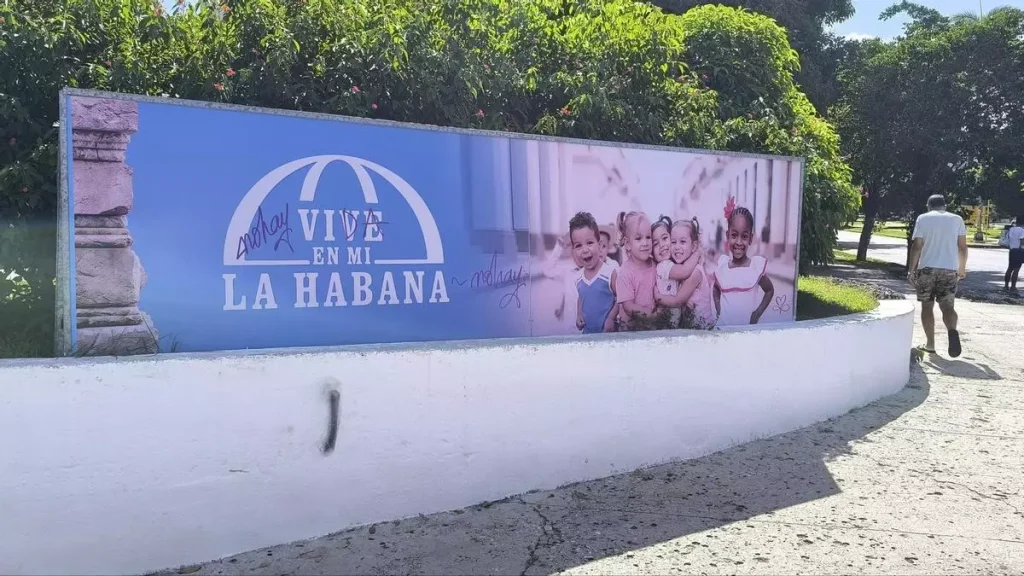
 14ymedio, Juan Diego Rodríguez, Havana, October 13, 2026 – Someone has decided to correct the official propaganda with a simple marker. At the corner of 23rd and G streets, in Havana’s El Vedado neighborhood, a sign that originally proclaimed “Havana Lives in Me” has received a correction that is as simple as it is devastating. Over the printed letters, an anonymous hand added “There is no” and changed one word. The result comes much closer to the everyday experience of the capital’s residents: “There is no life in my Havana,” as if the city itself were dictating its epitaph.
The intervention did not require a team of restorers, an expert commission, or a budget allocation. All it took was a purple marker, a certain degree of calligraphic skill, and the conviction that the message, decorated with photographs of smiling children, urgently needed updating. The new version also has the virtue of being far more believable than the original.
The sign’s location adds another layer of irony. G Street, officially known as Presidents Avenue, was for years one of the main gathering places for young people in Havana. On its benches, walkways, and flower beds, emos, rockers, geeks, and other urban tribes gathered to express their differences, listen to music, fall in love, or simply spend the night away from family supervision.
The economic crisis has emptied pockets and streets, emigration has taken away a large portion of the young people, and police operations have helped discourage spontaneous gatherings
There was a time when, on weekends, the avenue was teeming with young people dressed in black, with dyed hair, piercings, and guitars. The emos even became the subject of international news reports, while the police tried to control youth gatherings that challenged, if only through their appearance, the uniformity promoted by those in power.
Nothing remains of that bustle. The economic crisis has emptied pockets and streets, emigration has taken away a large portion of the young people, and police operations have helped discourage spontaneous gatherings. Added to this is the demographic collapse of a country where fewer and fewer children are being born and farewells are commonplace. The avenue retains some of its trees, benches, and monuments, but it has lost much of the energy that once made it a place of gathering and rebellion.
The photographs on the sign show five smiling, healthy, carefree children. They represent a Havana that is supposed to be young and vibrant, although reality points in the opposite direction. The “there is no” added to the advertisement also sums up this absence. There is no fuel, no medicine, and no adequate transportation, but there are also no longer many of the young people who once filled G Street with their eccentricities, arguments, and desire to take on the world.
Where young people once gathered to show that they were alive, an unknown person has now had to write on a sign that the city has been a corpse for quite some time.
Translated by Regina Anavy
______________________
COLLABORATE WITH OUR WORK: The 14ymedio team is committed to practicing serious journalism that reflects Cuba’s reality in all its depth. Thank you for joining us on this long journey. We invite you to continue supporting us by becoming a member of 14ymedio now. Together we can continue transforming journalism in Cuba.