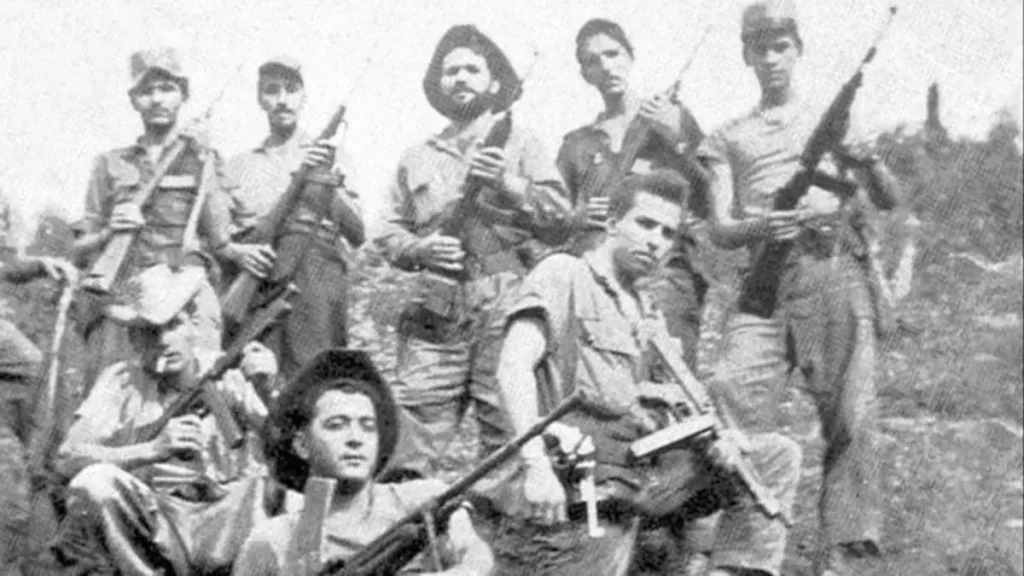
This Monday marks 66 years since the La Campana executions in Escambray, carried out by Commander Félix Torres.
 14ymedio, Pedro Corzo, Miami, October 11, 2026 / I write out of a need to express my thoughts and share my experiences, to suggest to those who, in good faith, embrace disruptive proposals, that they properly inform themselves about the promoters of magical solutions; that they thoroughly investigate who the people are who promote expedited procedures, radical changes that supposedly will satisfy everyone. This suggestion applies to saviors from both the right and the left.
And it is testimonies like the one I present below that demonstrate how a country’s citizens can lose their rights and property, while being plunged into spiritual and material misery by those who use their histrionic skills to manipulate the resentments and envy, proclaiming a false impartiality and an unjust justice. These deceivers have numerous resources at their disposal, the greatest being the folly and animosity of their followers.
We Cubans had many warnings. We neither listened nor wanted to see. My country wasn’t brought down by some curse, but by a criminal who knew how to manipulate the worst of our society, placing them in a situation where they could destroy everything they had coveted without having worked for it.
For those of us who were young in October 1960 and have survived these almost seven decades, those days are unforgettable: they were a watershed moment in our lives and the end of a pipe dream. It’s true that many were never devotees of the tyrant, but the rifle fire we didn’t hear awakened even the most dormant among us, spurred on by a profound sense of justice.
The trial of these men was a spectacle reminiscent of the Roman Colosseum and the crimes committed against Christians.
Those days are indelibly etched in our memories. It is a memory that will always haunt us until we have managed to bring the Castro brothers’ crimes to justice, among which, for the people of Villa Clara, those first executions at the painfully remembered La Campana farm in Escambray hold a prominent place.
It happened on the 12th of this month. Five patriots were executed: Porfirio Ramírez Ruiz, president of the University Student Federation of Las Villas, and captain of the Rebel Army; Plinio Prieto Ruiz, commander of the Rebel Army; Sinesio Walsh Río, peasant and captain of the Rebel Army; and José Palomino Colón and Ángel Rodríguez del Sol, both agricultural workers.
The trial of these men was a spectacle reminiscent of the Roman Colosseum and the crimes committed against the Christians. No evidence or reliable witnesses were needed; nor was a verdict reached. It was the will of Fidel Castro, who used a commander named Félix Torres as his loyal henchman, that carried out those vile assasinations. This comandante had devastated the Escambray region with a disastrous agricultural plan that affected all the campesinos, particularly the poorest.
That trial reiterated what many had observed in previous trials during the Castro revolution. More than a hundred people were prosecuted. Individuals with no connection whatsoever were brought together in the same case. Of course, they never received adequate legal representation: the judicial process was an essential part of the campaign of intimidation and repression being implemented, of which most of the population was unaware.
The death of these patriots did not intimidate those whose convictions committed them to freedom and civil rights.
Those who were to be executed, I reiterate, were never sentenced in the sham trial. Father Olegario Cifuentes accompanied them on the bus that took them to the execution wall at the La Campana estate. Witnesses from that time affirm that, when the bus transporting the condemned men passed through the city of Manicaragua, one of them shouted firmly and without a hint of fear: “They’re taking us to La Campana to be shot.”
Father Olegario spoke with them, asked them to go to confession, and offered to deliver a message to their families. Plinio Prieto gave him a brief letter for his wife and children and said, with the fortitude that characterized his entire life, before dying:
“I have faith in God and in men.”
The deaths of these patriots did not intimidate those whose convictions bound them to freedom and civil rights. On the contrary, the sacrifice of these five patriots who took up arms against the Fidel Castro regime resonated throughout the country, but the Escambray region was the most fertile ground and the main stage for the Cuban struggle against totalitarianism.
______________________
COLLABORATE WITH OUR WORK: The 14ymedio team is committed to practicing serious journalism that reflects Cuba’s reality in all its depth. Thank you for joining us on this long journey. We invite you to continue supporting us by becoming a member of 14ymedio now. Together we can continue transforming journalism in Cuba.