The deputy foreign minister accuses Marco Rubio of “intimidating, blackmailing, and promising carrots to governments in every corner of the world.”
 14ymedio, Madrid, October 15, 2026 / Part of the exile community in Miami joined the U.S. diplomatic push on Wednesday to gather support against the annual resolution that the Cuban regime presents at the UN calling for an end to the “blockade.” Opposition organizations, supported by activists and former political prisoners, presented an initiative in the city called Appeal by the Cuban Pro-Democracy Opposition to the Governments of the Free and Democratic World, in which they call for a vote against the Castro regime’s proposal.
“For decades, the Cuban communist regime has used this annual vote to portray itself internationally as the victim of foreign aggression and to divert attention from its own responsibility for the profound political, economic, social, and humanitarian crisis our country is suffering,” the text states.
The document attempts to disprove the existence of a U.S. blockade and accuses the Cuban regime of having disastrously managed the flows of money and raw materials it received for decades from the Soviet Union and Venezuela. It also draws on bilateral trade figures between Havana and Washington, authorized through exemptions or for the private sector, depending on the case, to deny that restrictions exist. It specifically cites fuel shipments, which have been permitted exclusively from the United States since this January and which reached a value of $231.74 million over eight months.
“For decades, the Cuban communist regime has used this annual vote to portray itself internationally as the victim of foreign aggression and to divert attention from its own responsibility”
Another of the arguments put forward by the exile community is the humanitarian aid that the State Department has coordinated this year with the Catholic Church for distribution throughout the Island. This donation began with an allocation of $9 million promised after Hurricane Melissa struck in October 2025 and continued with another $100 million amid the current crisis. The regime has accepted both, while accusing Washington of “hypocrisy,” blaming it for “applying draconian coercive measures” while announcing “soup and cans of food for a few.”
The text’s promoters — among whom José Daniel Ferrer stands out, having reported that nearly 1,000 signatures of support had been collected by Wednesday — are calling for the sanctions policy against Cuba’s current leaders to continue while humanitarian aid outside government channels is increased. But their main focus is the appeal to the international community to vote against the resolution presented by Cuba on October 28, following its submission to the General Assembly between the 27th and that same day.
“Do not give the Cuban regime political backing that it can subsequently use for propaganda and to conceal the absence of freedoms within Cuba,” the document states. It explicitly names the governments of the European Union, the United Kingdom, Canada, Norway, Japan, South Korea, Australia, New Zealand, and Latin American democracies, urging them to “vote against (…) or, at the very least, abstain.”
The appeal aligns with the message Marco Rubio conveyed to Salvadoran President Nayib Bukele on Tuesday during a telephone call in which, among other matters, he asked for his country to vote against the Cuban resolution. According to the secretary of state, “the Cuban regime will not carry out the reforms the people deserve as long as it believes the international community is on its side.”
Just one day earlier, Rubio had spoken with Abelardo De la Espriella, and although the content of that conversation is unknown, everything indicates that he asked his new regional partner for support on the designated date.
These developments have prompted a reaction from the Cuban regime, which issued a statement on Wednesday through its foreign minister, Bruno Rodríguez. “The U.S. Secretary of State, nervous and anxious in the face of yet another defeat at the United Nations, is pressuring and blackmailing heads of state and government in several countries to change their votes against the blockade in the UN General Assembly,” he wrote on his X account.
“With his repeated lies and new actions, he is trying to silence the act of collective punishment he is committing against the Cuban people and make the rest of the international community complicit in this barbarity,” he added in his post.
“With his repeated lies and new actions, he is trying to silence the act of collective punishment he is committing against the Cuban people and make the rest of the international community complicit in this barbarity”
Deputy Foreign Minister Carlos Fernández de Cossío went even further, lamenting that, “in the year of the greatest intensification of the economic war,” the United States was seeking to “blame the victim of aggression, discredit the victim, and thereby attempt to change a position that the international community has historically and unmistakably maintained in rejecting the economic blockade.” He also added that Rubio “is going from country to country and calling heads of government in a desperate effort to intimidate, blackmail, and promise carrots to governments in every corner of the world.”
At the end of September, a document obtained by the Associated Press and confirmed by several officials to the news agency revealed that the U.S. State Department had plans to impose “stricter controls” on Cuban officials traveling to the United Nations for the resolution vote. However, this has no practical implications, since Havana’s permanent delegation in New York is one of the largest, with 47 officials, according to the NGO Archivo Cuba.
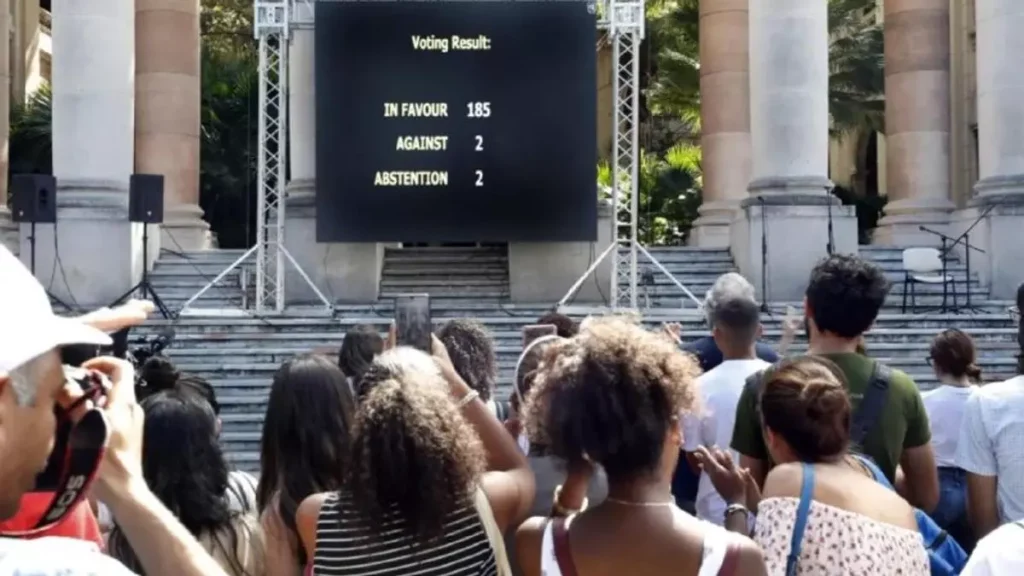
The Cuban regime has historically secured the Assembly’s support for this resolution. Its best year was 2016, when it received no votes against it and the text passed with just two abstentions, from the United States and Israel, which have always voted the same way. Since then, although support has remained overwhelming, the loss of votes has been noticeable. In 2025, the proposal passed with 165 votes in favor, seven against, and twelve abstentions, the worst result to date. This year’s outcome will almost certainly be much worse.
Translated by Regina Anavy
______________________
COLLABORATE WITH OUR WORK: The 14ymedio team is committed to practicing serious journalism that reflects Cuba’s reality in all its depth. Thank you for joining us on this long journey. We invite you to continue supporting us by becoming a member of 14ymedio now. Together we can continue transforming journalism in Cuba.