Amid the gloom, they give “one of the few joys of the day, of the week, of the month”
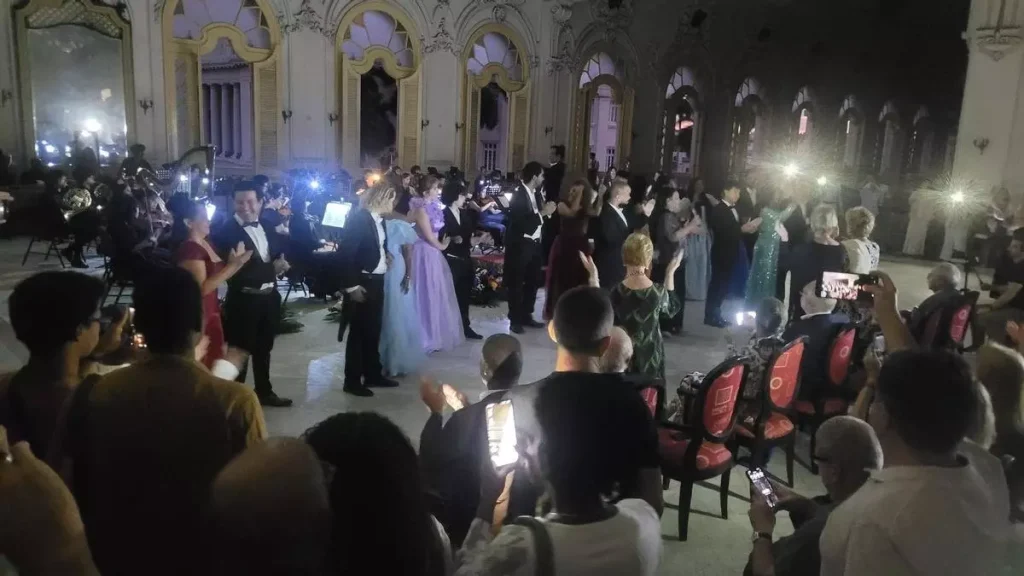
 14ymedio, Havana, March 23, 2026 – Months of preparation and rehearsals were on the verge of going to waste last Saturday at the Gran Teatro de La Habana. That day was the culmination of the preparation for the Caruso concert, a lyrical evening commemorating the historic presence in Cuba of the famous Italian tenor Enrico Caruso, who performed in 1920 at that emblematic site, then known as Teatro Tacón. However, 20 minutes before the program began, the national electrical system collapsed, in what was the second total blackout in a week.
“Organizing and carrying out a project becomes more difficult every day,” laments Yhovani Duarte, director of the Symphony Orchestra of the Gran Teatro de La Habana, in a heartfelt post on social media, in which he recounts that, despite the lack of electricity, he decided to go ahead with the concert in front of the audience, which filled the venue.
“The theater director called me and said: ‘What do we do?’ Well, we open the windows and make music as long as the light allows it. The audience is there and deserves it. Seeing all the seats filled and some people standing was more than enough reason to give our best,” he writes.
“The magic happens. After half an hour you can only see the small lights of the musicians, and the faces are indistinguishable, but they are incredible”
On the other side, in the audience, was the countertenor Ubail Zamora. As a spectator, he recounts that, in the darkness, the orchestra uses portable lamps to illuminate the sheet music. “The magic happens. After half an hour you can only see the small lights of the musicians, and the faces are indistinguishable, but they are incredible… giving their best,” he says in a post on his social media.
From the stage, Yhovani Duarte and his musicians experience a catharsis with the audience, as the night stripped away the last traces of light. “It was beautiful to hear the enormous ovation the choir received after performing Va, pensiero, from the opera Nabucco, and the intense applause for each soloist and the orchestra. The concert went on, and the sunset was gifting us obscurity and the magic happened.”
“With the first harmony of Nessun dorma from Turandot, as if someone had given a signal, the flashlights of the cell phones in the audience all turned on at once, and the full emotional charge became evident on the faces and in the tears of the orchestra musicians and on mine,” adds the director.
Across from him, from Zamora’s perspective, the lights from the phones begin to reveal the singer to them, “perhaps, one of the few joys of the day, of the week, of the month… When it all ends, the ovation fills the venue and pours out through the windows of the hall.”
“When it all ends, the ovation fills the venue and pours out through the windows of the hall”
“The offer of La Traviata was now a catharsis for the finish. It was a magical late afternoon-evening that I will never forget,” adds the Symphony Orchestra director in his message, which has gathered dozens of comments highlighting the professionalism and courage to carry out their work despite adversity.
Duarte closed his post by thanking the team of the National Lyric Theater of Cuba, the Symphony Orchestra of the Gran Teatro de La Habana Alicia Alonso, and the audience, “who accompanied us until the end in the darkest part of the night, but with the light that only music can give us.”
The light generated by the musicians and attendees fades away. “Outside there is a dark Havana,” says Ubail Zamora, who, like the rest of the spectators, heads home. “I leave with some friends passing in front of a dimly lit Capitol, trying to stay illuminated after the wonderful hour I have just experienced,” he says, although he immediately admits that “reality hits you in the face with a blunt blow when you say goodbye to everyone and know you are going to walk through a very dark and dangerous Old Havana.”
“You arrive home, with a trembling and lonely soul after a day that seemed wonderful. And you write 24 hours later, still without electricity, with a weak connection, trying to gather a lot of calm so that the precise words come out, the ones your colleagues and every person who made it possible to change our lives for an hour deserve,” he says. And he concludes: “The phone battery is running out, and in the distance it seems they have turned on lights in one of the nearby neighborhoods because you can see the glow. Here the mosquitoes are eating me and I slowly fade. I return in the gloom to my corner, and as for the light… not even hope.”
Translated by Regina Anavy
______________________
COLLABORATE WITH OUR WORK: The 14ymedio team is committed to practicing serious journalism that reflects Cuba’s reality in all its depth. Thank you for joining us on this long journey. We invite you to continue supporting us by becoming a member of 14ymedio now. Together we can continue transforming journalism in Cuba.